Geppetto: Versatile Verifiable Computation
Craig Costello
C´edric Fournet
Jon Howell
Markulf Kohlweiss
Benjamin Kreuter
†Michael Naehrig
Bryan Parno
Samee Zahur
†Microsoft Research †University of Virginia
Abstract
Cloud computing sparked interest in Verifiable Computation protocols, which allow a weak client to securely outsource com-putations to remote parties. Recent work has dramatically re-duced the client’s cost to verify the correctness of their results, but the overhead toproduceproofs remains largely impractical. Geppetto introduces complementary techniques for reducing prover overhead and increasing prover flexibility. With Multi-QAPs, Geppetto reduces the cost of sharing state between com-putations (e.g., for MapReduce) or within a single computation by up to two orders of magnitude. Via a careful choice of cryp-tographic primitives, Geppetto’s instantiation of bounded proof bootstrapping improves on prior bootstrapped systems by up to five orders of magnitude, albeit at some cost in universality. Geppetto also efficiently verifies the correct execution of propri-etary (i.e., secret) algorithms. Finally, Geppetto’s use of energy-saving circuits brings the prover’s costs more in line with the program’s actual (rather than worst-case) execution time.
Geppetto is implemented in a full-fledged, scalable compiler and runtime that consume LLVM code generated from a variety of source C programs and cryptographic libraries.
1
Introduction
The recent growth of mobile and cloud computing makes out-sourcing computations from a weak client to a computationally powerful worker increasingly attractive economically. Verify-ing the correctness of such outsourced computations, however, remains challenging, as does maintaining the privacy of sen-sitive data used in such computations, or even the privacy of the computation itself. Prior work on verifying computation focused on narrow classes of computation [32, 51], relied on physical-security assumptions [41, 47], assumed uncorrelated failures [19, 20], or achieved good asymptotics [2, 28, 30, 31, 33, 38, 44] but impractical concrete performance [46, 50].
Recently, several lines of work [9, 46, 49, 52] on verifiable computation [28] have combined theoretical and engineering in-novations to build systems that can verify the results of general-purpose outsourced computations while making at most cryp-tographic assumptions. Two of the best performing, general-purpose protocols for verifiable computation [46, 49] are based on Quadratic Arithmetic Programs (QAPs) [29]. To provide non-interactive, publicly verifiable computation, as well as zero-knowledge proofs (i.e., proofs of computations in which
some or all of the worker’s inputs are private), many recent sys-tems [3, 7, 9, 10, 16, 25, 39, 54] have converged on the Pinoc-chio protocol [46] as a cryptographic back end. PinocPinoc-chio, in turn, depends on QAPs.
While these protocols have made verification nearly practical for clients, the cost togenerate a proof remains a significant barrier to practicality for workers. Indeed, most applications are constrained to small instances, since proof generation costs 3–6orders of magnitudemore than the original computation.
With Geppetto1, we combine a series of interlocked tech-niques that support more flexible, and hence more efficient, provers. These techniques include the new notion of Multi-QAPs for sharing state between or within computations, bounded bootstrapping for succinct proof aggregation, a QAP-friendly C library for verifying cryptographic computations, and a new technique for energy-saving circuits, which ensures the prover’s costs grow with actual execution time, rather than worst-case execution time.
In more detail, we first generalize QAPs to createMultiQAPs, which allow the verifier (or prover) to commit to data once and then use that data in multiple related proofs. For example, the prover can commit to a data set and then use it in many differ-ent MapReduce jobs. At a finer granularity, we show how to use MultiQAPs to break an arithmetic circuit up into many smaller, simpler verifiable circuits that efficiently share state. Today, compiling code from C to a QAP typically requires unrolling all loops and inlining all functions, leading to a huge circuit full of replicated subcircuit structures. Since key size, and key and proof generation time all depend linearly (or quasilinearly) on the circuit size, this blowup severely degrades performance. With MultiQAPs, instead of unrolling a loop, we can create a single circuit for the loop body, use a proof for each iteration of the loop, and connect the state at the end of each iteration to the input of the next iteration. This allows us to shrink key size and key generation time, and, more importantly, to save the prover time and memory. Prior work suggested achieving similar properties via Merkle hash trees [8, 12, 27, 29, 43], but implementations show that this approach increases the degree of the QAP by tens or hundreds per state element [9, 16, 54], whereas with MultiQAPs, the degree increases only by 1.
With MultiQAPs, the prover generates multiple proofs about related data. This improves flexibility and performance for the prover, but it degrades attractive features of Pinocchio, namely that the proof consists of a (tiny) constant-sized proof, and the verifier’s work scales only with the IO.
As a second contribution, we explore the use of bounded proof bootstrappingto obtain MultiQAPs with constant-sized proofs. In theory, with proof bootstrapping [11, 53], the prover can combine any series of proofs into one by verifiably com-puting the verification of all of those proofs. Very recent work elegantly instantiates unbounded proof bootstrapping [9], but this generality comes at a cost (§5,§7.3.1). Our instantiation and implementation of bounded proof bootstrapping shows that, as with semi-homomorphic vs. fully homomorphic encryption, if we pragmatically set a bound on the number of proofs we intend to combine, we can achieve more practical performance.
To support bounded proof bootstrapping, Geppetto includes a QAP-friendly C library for general-purposecryptographic com-putations. Such computations arise in many outsourcing appli-cations. For instance, a MapReduce job may need to compute over signed data, or a customer with a smart meter may wish to privately compute a bill over signed readings [48]. As another example, recent work [7, 25] shows how to anonymize Bitcoin transactions using Pinocchio [46] and would benefit from the ability to verify signatures within transactions. In existing QAP systems, computations take place over a relatively small (e.g., 254-bit) field, so computing cryptographic operations (e.g., a signature verification) requires an awkward embedding of the cryptographic machinery via either a BigInteger library built out of field elements or via large extension fields [25]. With our techniques, all of these examples can be naturally and effi-ciently embedded into a proof of an outsourced computation.
By considering (bounded or unbounded) bootstrapping in the context of our QAP-friendly crypto library, we show how to ef-ficiently compile and outsource computations so that the com-putation itself is hidden from the verifier. For example, a patient might verify that a trusted authority (say the US FDA) signed the code for a medical-data analysis, and that the analysis was correctly applied to the patient’s data, without the patient ever learning anything about the proprietary analysis algorithm. Pre-vious systems could potentially support this scenario via univer-sal circuits [46, 49] or circuits executing CPU instructions [9], but the extra level of interpretation potentially slows the com-putation down by orders of magnitude (see§7.3.1).
Lastly, just as MultiQAPs eliminate the redundancy that comes from code repetition (e.g., in the form of loops or func-tion invocafunc-tions), we introduce the nofunc-tion ofenergy-saving cir-cuits to eliminate the redundant work that arises from code branching. With energy saving, the prover only exerts crypto-graphic effort for the actual path taken (e.g., only the ‘if’ branch when the condition is true). While energy-saving circuits are generally useful, they are particularly beneficial when using bounded proof bootstrapping to combine many proofs from a MultiQAP. Such proof compaction requires the key generator to commit, in advance, to the maximal number of proofs to be combined. With energy saving circuits, the key generator can choose a large number, and if a particular computation re-quires fewer proofs, the prover only performs cryptographic op-erations proportional to the number of proofs used, rather than the maximum chosen by the key generator.
We have implemented Geppetto as a complete toolchain for verifying the execution of C programs. Geppetto’s code is
avail-F0 F1 (8) F2 F2 F1 F0 F1 (1)
...
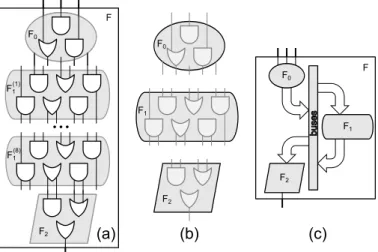
buses F0 F1 F2 F (a) (b) (c) FFigure 1: MultiQAPs (a) Most existing verifiable computation sys-tems compile programs to a single large circuit-like representation, leading to internal redundancy. (b) By extracting common substruc-tures, we can represent a program as an assembly of smaller circuits, but the verifier must now also check all connections between circuits. (c) MultiQAPs connect circuits usingbusstructures that support suc-cinct and efficient commitments to the bus values.
able at https://vc.codeplex.com. It includes a compiler in F#, a cryptographic runtime in C++, QAP-friendly libraries in C, and various programming examples. Our compiler takes as input LLVM code produced by clang, a mainstream state-of-the-art optimizing C compiler; this enables us to focus on QAP-specific compilation. Our libraries support explicit, low-level control for programming MultiQAPs, allowing the C program-mer to dictate how state flows from one QAP to another and hence control the resulting cryptographic costs. Geppetto also provides higher-level C libraries for common programming pat-terns, such as MapReduce or loops.
2
Geppetto Overview
In this section, we give an overview of Geppetto’s main con-structions: MultiQAPs (§2.1), proofs for cryptographic op-erations and bootstrapping (§2.2), and energy-saving circuits (§2.3). We defer cryptographic definitions to§3 and our pro-tocol to§4.
2.1
MultiQAPs
2.1.1 MultiQAP Intuition
At a high level, prior verifiable computation systems like Pinoc-chio [46] allow a prover to convince a skeptical verifier that F(u) =y, whereuis a verifier-supplied vector of inputs. The prover accomplishes this with a constant-sized proofπ, and the verifier’s work scales linearly in|u|+|y|, regardless of the com-plexity ofF. However, as F grows to encompass larger and more complex functionality (see Figure 1), the CPU and mem-ory costs for the prover (as well as its key size) increase su-perlinearly. As§7.2 shows, this limits prior systems to modest application parameters.
To scale to larger problems, we can naturally decompose the proof ofF into a conjunction of proofs ofmsimpler functions F0, . . . ,Fm−1. For example, ifF(u) =F1(F0(u)), then na¨ıvely the prover could use Pinocchio twice to prove:
z = F0(u) (0)
y = F1(z) (1)
The verifier would check a proof for each equation separately andcheck that the output fromF0was correctly used as input toF1. Unfortunately, this means that the prover must send the intermediate statezto the verifier, and the verifier must perform work linear in|z|. Ifzis large, then handling so much interme-diate state would make it difficult or impossible for the verifier to benefit from outsourcing.
Instead, with Geppetto, we have the prover return a constant-sizeddigest,Dz, representing the intermediate statez. The ver-ifier uses this digest when checking the proof for Equation (0) and when checking the proof for Equation (1), ensuring that the prover consistently used the same intermediate state in both proofs, but without requiring the verifier to explicitly handlez.
Prior work achieved a similar reduction in verifier effort by extendingF0to hash its output andF1to hash its input, so the verifier need only handle the constant-sized hash value [8, 12, 29, 43]. However, those hash computations make both functions more expensive [9, 16]. In contrast, with Geppetto, we observe that Pinocchio already computes a digest-like structure and that, with a careful refinement of its encoding, we can have the prover compute digests almost for free.2
In more detail, we divide all of the variables used to com-puteFinto disjoint sets we callbanks. Each bank falls into one of three categories: a bank may representF’s (the overall com-putation’s) input and output (uandyin our earlier example); it may represent a set of ‘local’ variables used within a singleFi; or it may be abus, i.e., a set of variables shared between multi-pleFi(e.g.,z).
Each bank is associated with its own cryptographic key ma-terial, used to compute a succinct digest of the values assigned to the bank’s variables: the prover produces a digest for each local bank and for each bus, while the verifier produces a digest for the IO banks as part of the verification process. The latter ensures that the proof verification is with respect to the input the verifier supplied, and the alleged output the prover produced.
To verify a proof that a givenFiwas computed correctly, the verification algorithm will need a digest forFi’s local bank, and digests for any buses or IO banks thatFireads or writes. Con-tinuing our earlier example, the verifier computes IO digestsDu andDy. The prover computes and returns digestsDF0 andDF1 summarizing the intermediate variables used byF0andF1 re-spectively, and asingledigestDzrepresenting the values on the bus between them. He also returns proofsπ0andπ1to demon-strate thatF0andF1were computed correctly. The verifier runs the verification algorithm twice:
Verify((Du,DF0,Dz),π0) (2)
Verify((Dz,DF1,Dy),π1) (3)
2We use ‘digest’ rather than ‘commitment’, since only some of the digests need to be binding—see§3.1.
F;F0, . . . ,Fm−1 FunctionFis decomposed intomfunctionsFi
χ
χχ Formal variables used when computingF
B, ` A partition ofχχχinto banksBb∈Bwith`
4 =|B|
B(tb)
b An instancetbof bankBb;
χb Commit-and-prove message for bankBb(Defn. 2)
σ,n A proof schedule (Defn. 1) with lengthn=4|σ|
Q?,Qi The MultiQAPQ?, combining sub-QAPsQi
ρ,d A QAP has sizeρand degreed
Figure 2:Notation summary for§2.
and acceptsyasF(u)if both checks succeed.3Note thatDz oc-curs in both verification checks. Formally, a system that allows a prover to commit to state in this fashion and use the result-ing commitments in multiple proofs is known as a commit-and-prove (CP) scheme (see§3.1).
As shown in Figure 1, proofs of complex functionsFmay in-volve multiple instances of a simpler functionFi. For example, Fimay represent the execution of a single function call, or a sin-gle loop iteration inF. Each instance ofFirequires the prover to generate (and the verifier to check) a fresh proof, along with digests for the banks involved. In §2.1.2, we formalize these relationships with aproof schedule(Defn 1); each step in the schedule indicates whichFiis “active”, which banks it depends on, and which set of bank values this particular instance ofFi depends on.
To efficiently build a commit-and-prove system supporting such schedules, we use Pinocchio’s techniques to express each functionFias a Quadratic Arithmetic Program (QAP)Qi, a for-mat suitable for succinct cryptographic proofs. To share state between individual Qi, we combine them into a single Multi-QAP Q?that also efficiently incorporates the buses connecting them. Using a MultiQAP also simplifies our definitions, con-structions, and security proofs. In particular, we can repeat-edly use a commit-and-prove scheme for asinglerelation forall proof schedules composed of differentQisteps, with the abil-ity to share compact, private digests between the proof steps. MultiQAPs support this functionality without significantly in-creasing the prover’s costs beyond what is required to handle each sub-QAP of the schedule individually.
2.1.2 Scheduling Proofs With Shared State
As described in§2.1.1, we decompose the proof of a complex functionFinto a conjunction of proofs ofmsimpler functions F0,. . . ,Fm−1.4 Letχχχrepresent all of the formal variables used when computingF; this includesF’s input and output variables, variables “local” to the computation of eachFi, and the variables shared across theFi. Based on these different roles, we partition χχχinto banksBb∈B.
A given execution ofF may involve several instances of the same bank (e.g., if Fi represents a loop body, then the banks
3This approach generalize’s Pinocchio’s, which calls(D
F0,π0)the proof for
F0and has the verifier computeDuandDzinside the verification algorithm. 4Cryptographers think ofFas a language, andF’s IO as a language instance. Programmers may see this proof as a trace-property, e.g., interpretingu,yas a valid input-output sequence obtained by running a program whose specification is captured byF.
corresponding to its IO and local variables may take on differ-ent concrete values on each loop iteration). We refer to these distinct instances of bankBbasB
(tb)
b fortb=1,2, . . .reserving tb=0 for the instance that assigns the constant 0 to every vari-able inBb. With these notations (summarized in Figure 2), we can define proof schedules.
Definition 1 (Multi-proof schedule) A schedule σ is a se-quence ofstepsof the form(i,t)where i∈[m]andtis a vector with an index tb≥0for each bank Bb∈B. We define n
4 =|σ|to be thelengthof the schedule, and`=4|B|the number of banks. Each step(i,t)of the schedule selects a function Fiand the instances B(tb)
b of the banks it uses, with tb=0whenever Fidoes not use Bb. We require that Fiuse only its local bank BFi, that is, tFj=0whenever i6=j.
Aproofforσconsists of (1) a proofπi for each of its steps, and (2) a digest D(bt)for each of its bank instances B(bt).
Intuitively, the schedule indicates a sequence of calls toFis for which the prover must generate (or the verifier must check) a proof, and the indexestof the banks digests that the prover (or the verifier) should use with that proof. The variables in any banks not used in a given step are implicitly set to 0 and hence can be represented with a trivial digest.
Returning to our example from§2.1.1, we haveB= (Bu,By, BF0,BF1,Bz)and the schedule for Equations (0) and (1) would beσ= [(0,(1,0,1,0,1)),(1,(0,1,0,1,1))].
2.1.3 An Efficient CP System from MultiQAPs
To understand Geppetto’s MultiQAPs, it helps to review how Pinocchio encodes computations as QAPs. This encoding en-ables Pinocchio’s efficient cryptographic protocol.
Quadratic Arithmetic Programs (QAPs) [29, 46] Ab-stractly, Pinocchio compiles a functionF into a conjunction of dequations of the form
Q(χχχ)=4
^
r∈[d]
(vr·χχχ)(wr·χχχ) = (yr·χχχ) (4)
whereχχχis the vector ofF’s variables, which range over some large, fixed prime fieldFp, and the vectorsvr,wr,yr each de-fine linear combinations over the variablesχχχ. Each equation (indexed byr) can be thought of as encoding a two-input mul-tiplication gate in the arithmetic circuit computingF, withvr indicating each variable’s contribution (if any) to the gate’s left input, wr indicating each variable’s contribution to the gate’s right input, andyrindicating the variable’s relation to the gate’s output. We say thatQhas sizeρ=4 |χχχ|and degreed.
Crucially, Pinocchio’s evaluation key (used by the prover to create his proof) contains cryptographic key material for each variableχ∈χχχ, and the structure of that key material depends directly on which (and how)χparticipates in each of thed equa-tions in Equation (4), i.e., on the value ofχ’s entry in each of the vectorsvr,wr,yr.
From QAPs to MultiQAPs If we decompose F into sim-pler functionsFi, then we can create a corresponding QAPQi
for eachFi. Suppose we wish to connectQ0, which has some variablesz0representingF0’s output, withQ1, which has some variablesz1representingF1’s input, with|z0|=|z1|. SinceF0 andF1are different functions,z0andz1undoubtedly participate in different equations inQ0 andQ1, and hence, as explained above, will have different key material representingz0andz1. As a result, a digest forz0will be completely different from a digest forz1,even if z0=z1! We could fix this by combiningQ0 andQ1into a single QAP and adding equations requiring that
z0=z1, but then we lose the benefits we hoped to gain from decomposingF.
Instead, we combine all of the(Qi)i∈[m] into a single
Multi-QAP Q?. Q? has the same equations and variablesχχχused in the Qi. In addition, for each variablesthat we wish to share between some subsetQˆ of theQi, we add a new variable ˆsto a new bus bank associated withQˆ, and we add an equation relat-ing ˆsto the local copy ofsin each of theQiinQˆ. Continuing our earlier example, we will introduce a new bus for variables
ˆzwith|ˆz|=|z0|=|z1|, and for each ˆzinˆz, we will add an equation:
z0+z1=zˆ (5)
relating it to the corresponding variables in Q0 and Q1. By adding the ˆzbus as a layer of indirection, it no longer matters if z0is used differently inQ0thanz1is inQ1; the prover can cre-ate a single digestDˆzrepresenting the values on the bus, and the verifier can use this digest when checking the correct execution ofQ0, as well as that ofQ1, just as in the example in§2.1.1, when computing Equations (2) and (3). Because the verifier only accepts proof schedules with trivial digests for all other local banks (Definition 1), when she verifies a proof ofQ0, all of the variables inQ1are set to 0, and hence Equation (5) says thatz0=zˆ, whereas when she verifies a proof ofQ1, all of the variables inQ0are set to 0, and hence (5) says thatz1=zˆ.
If we follow these steps to combine msub-QAPs(Qi)i∈[m],
each of size ρi and degree at most d, along with the buses connecting them, into a single MultiQAPQ?, thenQ?has size ρ?=|s|+∑i∈[m]ρiand degreed?=d+|s|, wheresincludes
all intermediate variables shared between theQi. By choosing a decomposition from F to(Fi)i∈[m] that exploits the structure
ofF, Geppetto’s compiler can ensure that most variables are lo-cal to oneFi, so we typically achieve|s|<<d. Since each step in a proof schedule considers only oneQiat a time, the size and degree of the “active” QAP within Q? is only slightly larger than the original Qi. Thus, MultiQAPs enable state sharing across sub-QAPs without significantly increasing the prover’s costs beyond what is required to handle the sub-QAPs of the schedule individually.
2.1.4 Other Techniques for Stateful Computations
Prior work explores other, largely complementary mechanisms for handling verifiable computations over state. As discussed in §2.1.1, a classic way to condense state is to commit to it via a hash [8, 12, 29, 43]. When specifying the IO to a functionF, the verifier only gives the hash value h=H(u). The prover supplies the full data values and, as part of the verifiable com-putation, hashes the data and proves that the hash matches the
one supplied by the verifier. A recent system, Pantry [16], im-plements such collision-resistant hashing on top of the existing QAP-based Pinocchio [46] and Zaatar protocols [49].
As shown in §7.2, using MultiQAPs is much cheaper than hashing when all (or most) of the state will be used in a given computation. Thus, MultiQAPs will typically be advantageous when passing state between computations, such as between mappers and reducers in a MapReduce job or within a decom-posed program such as the one shown in Figure 1, since a good compiler will ensure that state is passed between computations only if both computations actually need it. MultiQAPs are also advantageous for IO when the verifier’s inputs can be split in two pieces, a (mostly) static and a dynamic portion, that inter-act in each computation. For example, we might see this pattern if the computation takes in a large dataset and a small query, and the query needs to verifiably compute on most of the dataset.
In contrast, hashing is advantageous when the inputs are large, but the verifiable computation only accesses a small por-tion of the input at a time. For example, if the computapor-tion is over a large database but any given computation only selects a handful of records, then hashing makes sense. Hashing is also suitable for transferring state between verifiable computations performed with keys created by mutually distrusting parties.
As an orthogonal contribution, Pantry uses hashes to build a RAM abstraction based on Merkle trees [43], though subse-quent work [10, 54] suggests that handling RAM via memory routing networks [8] performs better for most memory sizes. Regardless, these techniques are orthogonal to Geppetto in the sense that they focus on dynamic RAM accesswithin a putation/QAP, rather than on transferring state between com-putations. Indeed, routing networks would likely be the most efficient way to allow a given Geppetto sub-QAP to incorpo-rate a RAM abstraction. Recent work demonstincorpo-rates [54] that such abstractions can be naturally integrated with Geppetto’s compilation-based approach.
Finally, in concurrent work, Backes et al. modify the Pinoc-chio protocol to incorporate a linearly homomorphic MAC in order to optimize computing on authenticated data [3]. Using signed Geppetto commitments offers an alternate approach; we defer evaluating the tradeoffs to future work.
2.2
Verifiable Crypto and Bootstrapping Proofs
In theory, we should be able to verify cryptographic compu-tations (e.g., a signature verification) just like any other com-putation. In practice, as discussed in§1, a naive embedding of cryptographic computations into the fieldFpthat our Mul-tiQAPs operate over leads to significant overhead. In§5, we use a careful choice of cryptographic primitives and parameters to build a large class of crypto operations (e.g., signing, ver-ification, encryption) using elliptic curves built “natively” on Fp. For example, this makes it cheap to verify computations on signed data, since the data and the signature both “live” inFp. Prior work used such tailoring for unbounded bootstrapping [9] and hashing [9, 16].
Our most complex application of this technology is a form of proof bootstrapping [11, 53], which we use to address the
main drawback of CP schemes. With CP schemes, includ-ing our MultiQAP-based scheme, the size of the cryptographic evidence—and the verifier costs—grow linearly with the num-ber of digests and proofs. While often acceptable in practice, these costs can be reduced to a constant by using another in-stance of our CP scheme to outsource the verification of all of the cryptographic evidence according to a target proof schedule. More formally, let Verifyσ?(D,Π)be the function checking that a scheduled CP proof cryptographically verifies, whereD
and Π are the collections of digests and proofs used in the schedule σ?. We recursively apply Geppetto to generate a quadratic programQσ? forVerifyσ?. This yields another, more
efficient verifierVerify◦σ?(D◦,π◦)with a single, constant-sized digestD◦ofD,Π, and all intermediate variables used to verify them according toσ?, and with a single constant-sized proofπ◦ to verify, now in constant time.
We further observe that Verify◦σ? need not be limited to just
verifying the execution ofVerifyσ?. For example, suppose an
authority the client trusts (e.g., the US FDA) cryptographically signs the verification keys forVerifyσ?, and we defineVerify◦
σ?
to first verify the signature on the keys before using them to
runVerifyσ?. If we use Geppetto’s option to make digests and
proofs perfectly hiding, then the verifier checks a constant-sized proof and learns that a trusted algorithm (for example, a medical diagnosis) ran correctly over her data, but she learns nothing about the algorithm. Thus, a client can efficiently and verifiably outsource computations with proprietary algorithms.
Although the general idea of bootstrapping is well-known [11, 53], its practicality relies on careful cryptographic choices to support an efficient embedding. Recent work [9] in-stantiated and implemented an embedding that supports boot-strapping an unbounded number of proofs but this generality comes at a cost (§5).
In §5, we explore a pragmatic alternative that supports only bounded-length schedules but can achieve better performance. Intuitively, the construction is based on the observation that the algorithmVerify◦σ? described above, can itself be scheduled and
bootstrapped. In other words, given an initial CP scheme
P
, we define a second CP schemeP
0 that verifies a schedule forP
of length at most L. If our application requires a schedule longer thanL, we can define a third CP schemeP
00 thatcon-denses digests and proofs from
P
0. With enough levels, we canensure that the verifier only receives a constant-sized digest and proof, and hence only performs work linear in the overall com-putation’s IO, regardless of how the prover decomposesFinto smaller functions. The overall protocol can be thought of as a tree of proof schedules, where the arity of each node isL, and as we move towards the root of the tree, each level con-denses the digests and proofs from the nodes above it. Our full paper [23] formalizes this process, adapting the usual proof-of-a-proof bootstrapping techniques [11, 53].
Using multiple levels reduces both the key sizes and the prover’s work. For example, suppose the application produces Nproofs for
P
. The na¨ıve approach of using a single recursive levelP
0would require a key capable of consuming allNproofs.Instead, with multiple levels, we can design
P
0to consume√Nelse circuit inputs
×
outputs+
+
+
+
if circuit 1-cond cond×
else circuit inputs×
outputs+
+
+
+
if circuit 1-cond cond×
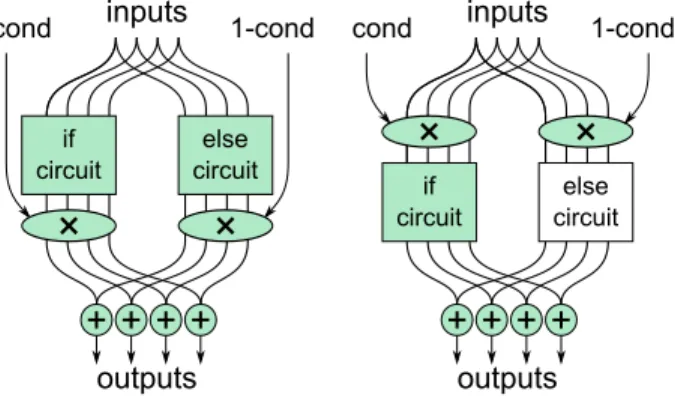
Figure 3: Energy-Saving Circuits. Moving the multiplex step can nullify expensive crypto operations, since at runtime, in one of the two circuit blocks, every wire inside takes on the value zero.
The resulting keys will beO(√N), instead of sizeNfor a single recursive layer.
Our CP definitions and theorems (§3), as well as our compiler (§6.4), support multiple-levels of bootstrapping through such recursion. For example, our compiler (§6.4) rewrites source programs to replace outsourced function calls by proof verifi-cation and can be called on its own output.
2.3
Energy-Saving Circuits
Existing verifiable computation systems represent a computa-tion as a quadratic program (informally, a circuit), which results in a program whose size reflects the worst-case computational resources necessary over all possible inputs. For instance, when branching on a runtime-value, Pinocchio’s prover interprets and proves both branches and only then joins their results. Con-cretely, the commandif(b) {x = y} else {x=2*z} is ef-fectively compiled asx = 2z + b*(y-2z), as shown generi-cally in the left side of Figure 3. Similarly, if a loop has a static bound ofNiterations, the prover must perform work for allN, even if the loop typically exits early.
Ideally, we would like to “turn off” parts of the circuit that are not needed for a given input, much the same way hardware circuits can power down parts not currently in use. Geppetto achieves this by observing that in our cryptographic protocol, there is no cryptographic cost for QAP variables that evalu-ate to zero (however these variables still increase the degree of the QAP, and hence the cost of the polynomial operations the prover performs). Thus, if at compile-time we ensure thatall intermediate variables for the branch evaluate to 0 in branches that are not taken, then at run-time there is no need to evalu-ate those branches at all. The right side of Figure 3 shows an example of how we achieve this for branches by applying the condition variable to theinputsof each subcircuit, rather than to the outputs. Thus, in contrast with Pinocchio, the prover only does cryptographic work proportional to the path actually taken through the program.
Prior compilers [49] use a related technique that applies the condition variable to theequationsin each branch, rather than to the inputs. This avoids the need to interpret untaken branches, but produces more constraints than Geppetto in the common
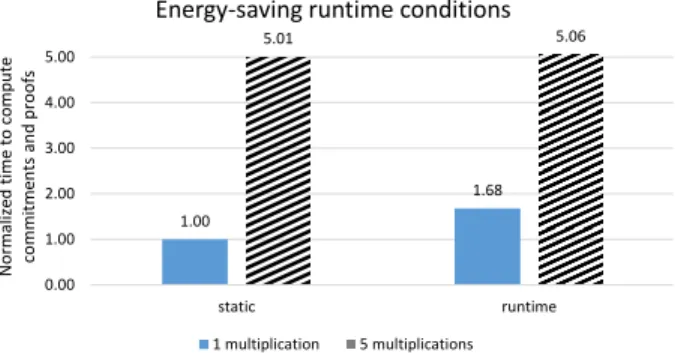
case when the branch contains more equations than inputs. §6.5 explains how our compiler produces energy-saving cir-cuits, while§7.4 quantifies the significant savings we recoup via this technique.
3
Defining Proof Composition
We now give formal cryptographic definitions for the concepts introduced in§2, deferring our concrete protocol to§4.
3.1
Commit-and-Prove Schemes
As discussed in§2.1.1, Geppetto employs three types of digest, one forF’s IO, one for the local variables for eachFi, and one for each bus. Each digest,D, may hide the values it represents via randomnesso. Without hiding, we use a trivial opening o=0 (and may omit it). We require that all digests of bus values be binding, as otherwise the prover could, say, use one set of values for the bus when proving thatF0correctly wrote to the bus, while using a different set of values when proving thatF1 correctly read from the bus. In contrast, digests used only in a single proof, e.g., for intermediate local variables, need not be binding, since the verifier only needs to know that there exists an assignment of values to those variables corresponding to a single correct execution. Finally, digests of IO naturally need not be binding since the verifier computes them herself.
As a side note, while Geppetto uses commit-and-prove schemes to prove function executions, such schemes also en-able interactive protocols where values are committed, used in proofs, and opened dynamically. For instance, they easily inte-grate with existingΣ-protocols as employed in anonymous cre-dential systems [5, 17].
Since we are interested insuccinctproofs, we modify earlier definitions of commit-and-prove schemes [18, 26, 37] to only consider computationally bounded adversaries. As a succinct digest implies that more than one plaintext maps to a given di-gest value, an unbounded adversary can always “escape” the digest’s binding property.
Each MultiQAPQ?in our construction defines a relationR from the family
R
of all MultiQAPs over a fixed field F. As our security definition has a security parameterλ∈N(which intuitively determines the size of the fieldF), we actually talk about a sequence of families of polynomial-time verifiable rela-tions{R
λ}λ∈N.Definition 2 (Succinct Commit-and-Prove) Consider `-ary polynomial-time verifiable relations{
R
λ}λ∈N on tuples χχχ of a fixed length`.A succinct commit-and-prove scheme
P
= (KeyGen =(KeyGen1,KeyGen2),Digest,Prove,Verify)for{
R
λ}λ∈Ncon-sists of five polynomial-time algorithms as follows:
• Key generation is split into two probabilistic algorithms:
τ←KeyGen1(1λ)takes the security parameterλas input
and produces a trapdoor τ= (τS,τE)(independent of R and consisting of a simulation and extraction component).
(EK,VK)←KeyGen2(τ,R)takes the trapdoor and a
EK and a public verification key VK. To simplify notation, we assume that EK includes a copy of VK, and that EK and VK include digest keys EKband VKbfor b∈[`].
• D(bt)←Digest(EKb,χ(bt),o(bt)): Given an evaluation key for
b, message instance t for b (χ(bt)), and corresponding ran-domness o(bt), the deterministic digest algorithm produces a digest D(bt)ofχ(bt).
• π←Prove(EK,χχχ,o): Given an evaluation key, messages
χχχ∈R, and openingso, the deterministic prove algorithm returns a succinct proofπ; i.e.,|π|ispoly(λ).
• {0,1} ←Verify(VKb,D
(t)
b ): Given a verification key for b, the deterministic digest-verification algorithm either re-jects (0) or accepts (1) the digest D(bt).
• {0,1} ←Verify(VK,D,π): Given a verification key and`
digests D, the deterministic verification algorithm either rejects (0) or accepts (1) the proofπ.
Proof-verification guarantees apply only when each digest D(bt) inDeither passes the digest-verification algorithm or was com-puted directly by the verifier.
We define two security requirements below. Standard defi-nitions for correctness and zero-knowledge are in the full pa-per [23]. First, we require that digests shared across multiple proofs (i.e., those representing bus values) bebinding, meaning the prover cannot claim the digest represents one set of values in the first proof and a different set of values in the second proof. We collect the indexes of their keys in what we call thebinding digest subset S⊂[`].
Definition 3 (Binding) The commit-and-prove scheme
P
is binding for `-ary relations{R
λ}λ∈N and binding digest sub-set S⊂[`], if for all efficientA
and any R∈R
λ,Pr[ τ←KeyGen1(1λ);τ= (τS,τE);
(EK,VK)←KeyGen2(τ,R);
b,χ,o,χ0,o0←
A
(EK,R,τE): χ6=χ0∧b∈S∧Digest(EKb,χ,o) =Digest(EKb,χ0,o0) ] =negl(λ).
Second, we require that if an adversary creates a set of digests and a proof thatVerifyaccepts, then the adversary must “know” a valid witness, in the sense that this witness can be successfully extracted by “watching” the adversary’s execution. Note that the trapdoor the extractor receives fromKeyGen1is generated independently of relationRand hence cannot make it easier for the extractor to produce its own witnesses.
Definition 4 (Knowledge Soundness) The commit-and-prove scheme
P
is knowledge sound for`-ary relations{R
λ}λ∈N, if for all efficientA
there is an efficient extractorE
taking the random tape ofA
such that, for any R∈R
λ,Pr[ τ←KeyGen1(1λ); τ= (τS,τE); (EK,VK)←KeyGen2(τ,R); (D,π;χχχ,o)←(
A
(EK,R)kE
(EK,R,τE)): ∃b∈[`].Verify(VKb,D(bt))∧Db(t)=6 Digest(EKb,χb(t),o(bt)))∨ ∀b∈[`].Verify(VKb,D (t) b )∧Verify(VK,D,π)∧χχχ∈/R ] =negl(λ).3.2
Composition by Scheduling
As discussed in§2, intuitively, we can verify the correct execu-tion of a complexF by verifying simpler functions and using digests to share state between them. We now formalize this in-tuition by extending knowledge soundness to multiple related proofs that share digests according to a proof schedule.
Definition 5 (Scheduled Knowledge Soundness) The commit and-prove scheme
P
is scheduled knowledge sound for`-ary relations{R
λ}λ∈Nand binding digest subset S⊂[`], if for all efficientA
there is an efficient extractorE
taking the random tape ofA
such that, for any R∈R
λ,Pr[τ←KeyGen1(1λ); (EK,VK)←KeyGen2(τ,R); (σ,D,Π;χχχ,o)←(
A
(EK,R)kE
(EK,R,τ)): ∀D(bt)∈D.(Verify(VKb,D (t) b )⇒D (t) b =Digest(EKb,χ (t) b ,o (t) b ))∧ ∀D(bt)∈D.Verify(VKb,D (t) b )∧ ∀(i,t)∈σ.Verify(VK,D(t),πi) ⇒ ∀(i,t)∈σ.χχχ(t)∈R ] =1−negl(λ),whereD(t)indicates a digest instance t for each bank b used in a given proof (and default digests of 0 values for any bank not used), andχχχ(t)represents the digested values.
Theorem 1 (Scheduled Knowledge Soundness) If a CP
P
is knowledge sound and binding for`-ary relations and binding digest subset, then it is scheduled knowledge sound for the same relations and subset.The proof of Theorem 1 can be found in the full paper [23]. Intuitively, it follows from extracting valid digest openings from all subproofs, and leveraging the binding property of the bus digests to guarantee consistency across subproofs.
4
Geppetto’s CP Protocol
We now construct an efficient commit-and-prove protocol for
`-ary relations{
R
Q?λ}λ∈N(see§3.1) defined by a MultiQAPQ ?
derived from multiple QAPsQi, as described in§2.1.3.
4.1
MultiQAPs as Polynomials
We use Pinocchio’s technique (which originated with Gennaro et al. [29]) to lift quadratic programs to polynomials.
Given MultiQAPQ?, of sizeρ?and degreed?, we first de-fine a set
D
ofd?“root values” of the formr∈ {2i}d?i=1,5and we define the polynomialδ(x)as the polynomial with allr∈
D
as roots. Recalling§2.1.3, we then define a set
V
ofρ? poly-nomialsvk(x)by interpolation over the roots inD
such that for k∈[ρ?],r∈D
: vk(r) =vr,k. Each of the kpolynomials es-sentially summarizes the effect one ofχχχ’s variables has on the computation. We define similar setsW
andY
using the vectorswrandyr.
We say that the polynomial MultiQAP is satisfied byχifδ(x)
dividesp(x), where: p(x) = ∑ρk=0χk·vk(x) · ∑ρk=0χk·wk(x) − ∑ρk=0χk·yk(x) .
We use MultiQAPs to prove statements about shared state. To achieve this, the polynomials corresponding to bus values need to fulfill an additional condition. We say that a bus bank Bbiscommitment compatibleif (i) the polynomials in each set
{yk(x)}k∈Bb are linearly independent, meaning that no linear combination of them cancels all coefficients, and (ii) all poly-nomials in the set{vk(x),wk(x)}k∈Bb are 0. The first property is crucial for commitments to be binding, while the second im-proves performance and facilitates zero-knowledge when using externally generated commitments.
By inspection of Equation (5), the buses in our MultiQAP construction in§2.1.3 are commitment compatible. Concretely, continuing our example from that section, Equation (5) will be encoded as the QAP equation:
(0+· · ·+0)(0+· · ·+0) = (1·z0+1·z1+ (−1)·zˆ).
4.2
Commit-and-Prove Scheme for MultiQAPs
Geppetto’s protocol inherits techniques from Pinocchio [46]; the key differences are starting with MultiQAPs instead of QAPs, and splitting the prover’s efforts into separate digest and proof computations.
We present our protocol in terms of a generic quadratic en-codingE [29]. In our implementation, we use an encoding based on bilinear groups. Specifically, letebe a non-trivial bi-linear map [13]e:G1×G2→GT and letg1,g2be generators ofG1andG2respectively. To simplify notation, we define the encodingE(x)to be eithergx1 or gx2 depending on whether it appears on the left or the right side of a product∗.
Below, eachBb∈Brepresents a subset of[ρ?], and we use the commit-and-prove messageχ(bt) to represent the values of bank instanceB(bt). Protocol 1 (Geppetto) • τ←KeyGen1(1λ): Choose s,{αv,b,αw,b,αy,b}b∈[`],rv,rw R ← F. Constructτas (τS,τE) = (s,{αv,b,αw,b,αy,b}b∈[`],rv,rw),(rv,rw). • (EK,VK)←KeyGen2(τ,RQ?): Choose{γb,βb}b∈[`] R
←F. Set ry=rv·rw. To simplify nota-tion, define Ev(x) =E(rvx)(and similarly for Ew and Ey).
5Choosing roots of this form enables our C++ library to implement an effi-cientd?logd?algorithm [15] for the prover’s polynomial division.
For the MultiQAP Q?= (ρ?,d?,B,
V
,W
,Y
,δ(x)), con-struct the public evaluation key EK as:(EKb)b∈[`], (E(si))i∈[d], Ev(δ(s)),Ew(δ(s)),Ey(δ(s)) where each bank’s digest key EKbis defined as:
Ev(vk(s)), Ew(wk(s)), Ey(yk(s)) Ev(αv,bvk(s)), Ew(αw,bwk(s)), Ey(αy,byk(s)), E(βb(rvvk(s) +rwwk(s) +ryyk(s))), k∈Bb Ev(αv,bδ(s)), Ew(αw,bδ(s)) Ey(αy,bδ(s)), Ev(βbδ(s)), Ew(βbδ(s)), Ey(βbδ(s)). Construct the public verification key VK as:
(VKb)b∈[`], E(1), Ey(δ(s)), where each bank’s digest verification key VKbis:
VKb=E(αv,b),E(αw,b),E(αy,b),E(γb),E(βbγb). Additionally VK includes digest keys EKbfor digests that the verifier computes (e.g., for IO banks). Since EK and VK are public, the split into prover and verifier keys is pri-marily designed to reduce the verifier’s storage overhead.
• D(bt)←Digest(EKb,χ (t) b ,o (t) b ): Parse o(bt)as(ov,ow,oy).
If Bbis an IO bank, simply return:
Ev(v(b)(s)), Ew(w(b)(s)), Ey(y(b)(s)),
where v(b)(s) =∑k∈Bbχkvk(s) +ovδ(s)(and similarly for w(b)(s)and y(b)(s)). Since the verifier typically computes these digests, ovis typically 0. Note that all of these terms can be computed using the values in VKb, thanks to the linear homomorphism of the encoding E.
For any other bank, compute:
Ev(v(b)(s)), Ew(w(b)(s)), Ey(y(b)(s)), Ev(αv,bv(b)(s)), Ew(αw,bw(b)(s)), Ey(αy,by(b)(s)), E(βb(rvv(b)(s) +rww(b)(s) +ryy(b)(s))) . Note that all of these terms can be computed using the values in EKb. The values above constitute an extractable digest of the χ(bt) values, perfectly hidden via o(bt). For commitment-compatible buses, this digest is also binding. Furthermore, for all commitment-compatible buses, v(b)(s),w(b)(s),ov,ow are all 0, so the digest above simplifies to:
Ey(y(b)(s)),Ey(αy,by(b)(s)),E(βb(ryy(b)(s)));
• π←Prove(EK,χ,o): Parse each ob∈oas(ob,v,ob,w,ob,y)
and use the coefficientsχto calculate: v(x) =
∑
k∈[ρ?]
χkvk(x) +
∑
b∈[`]ob,vδ(x),
and similarly for w(x), and y(x).
Just as in a standard QAP proof [29], calculate h(x)such that h(x)δ(x) =v(x)w(x)−y(x), that is, the polynomial that proves thatδ(x)divides v(x)w(x)−y(x). Compute the proof asπ←E(h(s))using the E(si)terms in EK.
• {0,1} ←Verify(VKb,Db(t)): Verify digest D(bt)by checking
Ev(v(b)(s))∗E(αv,b) = Ev(αv,bv(b)(s))∗E(1) (6) Ew(w(b)(s))∗E(αw,b) = Ew(αw,bw(b)(s))∗E(1)(7) Ey(y(b)(s))∗E(αy,b) = Ey(αy,by(b)(s))∗E(1) (8) and theβcheck:
Eβb(rvv(b)(s) +rww(b)(s) +ryy(b)(s))
∗E(γb) = (9)
Ev(v(b)(s))+Ey(y(b)(s))∗E(βbγb)+E(βbγb)∗Ew(w(b)(s)).
(For buses, we do not require the checks in Equations(6) and(7), and we can simplify theβcheck (Eqn(9)).)
• {0,1} ←Verify(VK,D0, . . . ,D`−1,π): Combine the
di-gests and perform the divisibility check on the proof term E(h(s))inπ: ∑b∈[`]Ev(v(b)(s)) ∗∑b∈[`]Ew(w(b)(s)) (10) −∑b∈[`]Ey(y(b)(s)) ∗E(1) =E(h(s))∗Ey(δ(s)).
As described, the protocol supports non-interactive zero-knowledge proofs, in addition to verifiable computation. For applications that only desire the latter, the multiples ofδ(s)in theEKand the use of digest randomizationsomay be omitted.
Theorem 2 Protocol 1 has binding digests, as defined by Defi-nition 3 under the d-SDH assumption.
Theorem 3 Protocol 1 is a knowledge-sound commit-and-prove scheme, as defined by Definition 4.
Theorem 4 Protocol 1 is a perfectly zero-knowledge commit-and-prove scheme.
We refer to the full paper [23] for the proofs of these theorems and the definition of their assumptions. Like the protocol, the proofs inherit their techniques from Pinocchio.
5
Verifiable Crypto Computations
Background Pinocchio, along with the systems built atop it, instantiates its cryptographic protocol using pairing-friendly el-liptic curves. Such curves ensure good performance and com-pact keys and proofs. An elliptic curveE defines a group of prime order p0 where each element in the group is an (x,y)
point, withxandydrawn from a second fieldFpof large prime characteristic p. When Pinocchio is instantiated with such a curve, the QAPs (and hence all verifiable computations) are de-fined overFp0, and hence code that compiles naturally to
oper-ations onFp0 is cheap.
Approach At a high-level, we choose the curveE we use to instantiate Geppetto such that the group order “naturally sup-ports” operations on a second curve ˜E, which we can use for any cryptographic scheme built on ˜E, e.g., anything from signing with ECDSA to the latest attribute-based encryption scheme.
In more detail, suppose we want to verify ECDSA signatures over an elliptic curve ˜E built from points chosen fromFq. If we instantiate Geppetto using a pairing-friendly elliptic curve Ewith a group of prime orderp0=q, then operations on points from ˜Eembed naturally into our QAPs, meaning that basic op-erations like adding two points cost only a handful of crypto-graphic operations, rather than hundreds or thousands required ifp0did not align withq.
Bootstrapping As described in§2.2, proof bootstrapping is a particularly compelling example of verifying cryptographic operations, since it allows us to condense a long series of proofs and digests into a single proof and digest.
Remarkably, Karabina and Teske [35] show that it is possi-ble to generate two MNT curves [45]E and ˜E that are pairing friendly and, more importantly, ˜Ecan be embedded inE,and E can be embedded in ˜E.
Ben-Sasson et al. [9] recently instantiated and implemented such curves to bootstrap the verification of individual CPU in-structions. Geppetto can use a similar approach to achieve un-bounded bootstrapping of entire QAPs. Specifically, we could instantiate two versions of Geppetto, one built onE that con-denses proofs consisting of points from ˜Eand another built on ˜E that condenses proofs consisting of points fromE.
Unfortunately, there are drawbacks to using the curves Ben-Sasson et al. found. First, they were only able to find a pair of curves that provide 80 bits of security. Finding cycles of perfor-mant curves for the more standard 128-bit setting appears non-trivial, since just finding 80-bit curves required over 610,000 core-hours of computation. Second, the MNT curve family is not the most efficient family at higher security levels, and achieving a cycle requires larger-than-usual fields, creating ad-ditional inefficiency [9].
To estimate the costs of using MNT curves at the 128-bit se-curity level used by Pinocchio, we coded up all of the relevant curve operations in Magma [14] and counted the group opera-tions required. We made very optimistic assumpopera-tions about the optimal implementation of the curves, e.g., by assuming that the operations employ all available EC tricks within the pairing computation, even though the actual curves may not allow for them. Even under these assumptions, our measurements indi-cate that key and proof generation, as well as IO verification, for Geppetto’s first batch of proofs would be 34-77×slower than a standard Pinocchio-style proof, while the constant pairing-based portion of proof verification would be 11×slower; sub-sequent batches would cost more, due to technical challenges in the way the curves fit together [9].
As a pragmatic alternative, we use a sequence of nested curves (an option suggested previously [9, Footnote 10]) to in-stantiate and implement bounded bootstrapping, Specifically, we instantiate one version of Geppetto with the same highly efficient BN curve [6] employed by Pinocchio. We use the BN curve to generate a collection of digests and proofs for our MultiQAP-based CP scheme. We then construct a sec-ond curve capable of efficiently embedding the BN curve op-erations. When instantiated with the second curve, Geppetto can efficiently verify crypto operations on the BN curve. Thus,
a verifier can, for example, check signatures on the verification key built on the BN curve and then use that key to verify the BN digests and proofs. To gain greater scalability, this process can be repeated with a bounded number of additional carefully constructed curves, each used to verify the digests and proofs from the previous curve. Unfortunately, none of the curves can efficiently embed later curves, and hence when generating keys, the client must ultimately commit to the maximum number of BN proofs that will be verified. Fortunately, our use of energy-saving circuits saves the prover effort if it ends up using fewer proofs.
Details We construct bilinear systems,
G
IN andG
OU T. To achieve this at the 128-bit security level, we instantiateG
IN us-ing a Barreto-Naehrig (BN) elliptic curve [6], and then constructG
OU Taccordingly with the Cocks-Pinch method [21]. Roughly, the latter constructs a pairing-friendly curve by outputting a fi-nite field corresponding to a given, prescribed group order. We fix the primepfrom the BN parameterization as the group order, so that the output of the Cocks-Pinch algorithm is the prime ˜p (as well as the other parameters required in the description ofG
OU T). The following lemma makes this explicit in a special case that is of most interest in the current work.Lemma 1 Let x∈Zbe such that p=36x4+36x3+24x2+6x+ 1and p0=36x4+36x3+18x2+6x+1are prime. If
˜
p=5184x8+10368x7+12204x6+8856x5+4536x4
+1548x3+363x2+48x+4 (11)
is also prime, then there exists both an elliptic curve E/Fpof order#E(Fp) =p0with embedding degree k=12(with respect to p0), and an elliptic curveE˜/Fp˜, such that its order# ˜E(Fp˜)is a multiple of p andE has embedding degree˜ k˜=6(w.r.t. p). Our full paper contains proofs and construction details [23].
To construct additional nesting curves, given a group order, we once again apply the Cocks-Pinch approach to produce a sequence of curvesE(i), defined over prime fields
Fpi, respec-tively, such thatpidivides #E(i+1)(Fpi+1). Each hop creates a larger curve, and hence will eventually produce curves equal to or larger than the MNT curves that support unbounded boot-strapping. For example, for the first Cocks-Pinch curve, ˜p is 509 bits (with embedding degree 6), and the next two levels are 1023 bits and 2055 bits with embedding degrees 3 and 1.
Even when we reach these larger sizes, the inner layers (es-pecially the BN curve where most of the “real” computation happens) are still more efficient than the MNT curves, and even at comparable sizes, exponentiations on the Cocks-Pinch curves are faster due to a CM endomorphism (not available for MNT curves) and aG2cubic twist. Of course, for sufficiently large problems, the unbounded approach eventually offers better per-formance.
6
Implementation
The Geppetto system includes a library for guiding the compila-tion of banks and buses, a cryptographic compiler that operates
on C programs via LLVM, and libraries that support common programming patterns and bootstrapped computation.
Although it has been applied to over 10,000 lines of C and supports many LLVM instructions, Geppetto imposes semantic restrictions on source programs, thereby reflecting limitations of compilation to QAP encodings. For instance, it offers almost no support for computations on pointers. Recent work shows how to remove many of Geppetto’s restrictions [54].
We first explain our programming model by example, then describe the design and selected features of our compiler, and finally discuss C libraries and programming patterns.
6.1
Programming Model
A Geppetto programmer defines the structure of outsourced computations, their compound proofs, and the shared buses that connect them, thereby explicitly controlling cost and amortiza-tion of proof and digest generaamortiza-tion. This structure is embed-ded in source C programs via library invocations. (The design of higher-level syntactic sugar and programming abstractions is left as future work.)
From the verifier’s viewpoint, Geppetto’s C programming model is reminiscent of remote procedure calls (RPCs). The programmer marks some function calls asoutsourced, indicat-ing that the verifier should remote the calls to an untrusted ma-chine, then verify their results using the accompanying crypto-graphic evidence. This approach provides a clear operational specification of the verified computation, even for complex proof schedules: when the main program of the verifier com-pletes, its outputs and return values must be the same as those that would be obtained by executing the entire program on a single trusted machine.
We illustrate the definition of outsourced functions on the Geppetto program sample.c, outlined in Figure 4. The program defines some application code (elided), notably compute()that operates on a matrix and a vector of integers.
The programmer intends to fix the matrix across instances of compute, and vary the input vector. To this end, sample.cdeclares three banks for verifiable outsourced com-putation. For instance, relying on the Geppetto header file, BANK(QUERY, vector) defines a QUERY bank datatype that carries values of typevector, and functions likesave_QUERY andload_QUERY, analogous to RPC marshalling and unmar-shalling functions. By convention, each bank instance can be assigned only once, and must be assigned before being loaded.
The program then defines two functions:job, the outsourced function, andmain, that repeatedly callsjoband processes its arguments. Note that the call tojobis marked asOUTSOURCE, and that the digestdb to the largest inputMis computed just once, outside the loop.
• When compiling sample.c natively outside Geppetto, geppetto.h provides trivial definitions that implement DATA, QUERY, and RESULT as in-memory buffers and OUTSOURCEas a local call: OUTSOURCE(job, db, q)is replaced withjob(db, q).
• During compilation, Geppetto interprets the outsourced function ofsample.c, using symbolic values for the
pay-#include "geppetto.h" // Geppetto banks and proofs // application code
typedef struct { int M[SIZE][SIZE]; ...} bigdata; typedef struct { int x[SIZE]; ...} vector; void compute(bigdata *db, vector *in, vector *out); BANK(DATA, bigdata) // we define 3 IO banks BANK(QUERY, vector)
BANK(RESULT, vector)
RESULT job(DATA db, QUERY in) { bigdata M;
vector query, result; load_DATA(db,&M); load_QUERY(in,&query); compute(&M, &query, &result); return (save_RESULT(&result)); }
int main() { bigdata M;
vector query[N], result[N]; ... // prepare the data & queries
DATA db = save_DATA(&M); // digest M once into db for (i=0; i<N; i++) {
QUERY q = save_QUERY(&query[i]); RESULT r = OUTSOURCE(job, db, q); load_RESULT(r,&result[i]); }
... // do something with the results }
Figure 4:Example Geppetto Program (sample.c). load of its input banks, and generates a public key pair
(EK,V K).
• In prove mode, using EK, Geppetto interpretssample.c with concrete values to produce cryptographic digests (D) for each bank; it interceptsOUTSOURCEto accumulate in-termediate values during the execution ofjoband to pro-duce a proof (π) for each outsourced call.
• Inverify mode, usingV K, Geppetto produces a version of the program that replaces bank loads and outsource calls with cryptographic verifications; this version can then be natively compiled withclang -DVERIFY sample.c. In both modes, the execution flow of main determines the schedule (σ) of calls to outsourced functions.
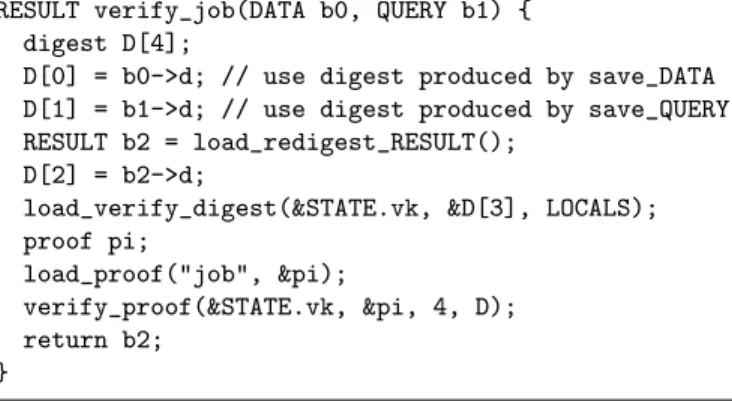
In more details, in verify mode, verification keys are initially loaded from files, banks are supplemented with cryptographic functions for verifying digests, andOUTSOURCE(job, db, q) is replaced with the function callverify_job(db, q). In Fig-ure 5, we show the implementation ofverify_job, generated by Geppetto during the Geppetto compilation ofsample.cand included during its native compilation with the-DVERIFYflag. Just likejob,verify_jobtakes two banks and returns a bank. The input banks propagate previously computed (or verified) di-gests from the caller; in particular, thebigdatadigest is shared across all calls. The function loads and digests the prover’s pro-posed value for the output bank, verifies the local bank’s digest
RESULT verify_job(DATA b0, QUERY b1) { digest D[4];
D[0] = b0->d; // use digest produced by save_DATA D[1] = b1->d; // use digest produced by save_QUERY RESULT b2 = load_redigest_RESULT();
D[2] = b2->d;
load_verify_digest(&STATE.vk, &D[3], LOCALS); proof pi;
load_proof("job", &pi);
verify_proof(&STATE.vk, &pi, 4, D); return b2;
}
Figure 5: Simplified Verification Example. Geppetto replaces the original outsourced functionjobwith a version that loads the function result and cryptographic evidence and then verifies that the function was computed correctly.
evidence, and verifies the computation’s proof. If any veri-fication fails, the program exits with an error. Otherwise, the resulting bankb2carries the correct response to the outsourced computation.
6.2
MultiQAP Programming Patterns
Geppetto provides additional support for common commit-and-prove patterns, coded as generic C libraries.
Sequential Loops Many large computations consist of a main loop with a codebodythat updatesloop variablesat every iter-ation, and also reads (but does not modify)outer variables.
Geppetto provides a generic template for outsourcing each loop iteration (or, more generally, for outsourcing fixed num-bers of iterations that fit within a single QAP), with a bank for the outer variables; hence the cost to digest and verify the outer bank is amortized across all loop iterations.
What about the loop variables? Recall that our commit-and-prove scheme requires that each bank be assignedat most once in every proof. Thus, we usetwobuses for the loop variables, alternating between odd and even iterations of the loop, and we compile the loop bodytwice, once reading the even loop vari-ables and writing the odd loop varivari-ables, and once the other way round. Hence, our generic template defines three banks, two outsourced functions, and a refined loop that alternates calls be-tween the two. The verifier then checks two digests and one proof for each iteration, except for the first iteration (where it computes a digest of the initial values of the loop variables) and the last (where it recomputes a digest of the final values returned by the prover).
MapReduce Geppetto also provides a few generic templates for parallel loops (likesample.cabove) and MapReduce com-putations. As with sequential loops, for MapReduce computa-tions, we use a series of buses to succinctly share potentially many variables between mappers and reducers. Specifically, we adopt Pantry’s model [16] in whichM mappers feedR reduc-ers. Geppetto compiles a MapReduce job into a MultiQAP with two sub-QAPs (Qmfor the mapper computation andQr for the
reducer computation) withmax(M,R)shared buses in between them. Each reducer reads fromMbuses and computes its out-put. Each mapper computation takes an ID as input, telling it which Rbuses to write its outputs to. For example, suppose M =10 and R=2, and hence we have 10 shared buses. The first mapper writes its output for reducer 1 to bus 1 and for re-ducer 2 to bus 2 (and implicitly writes zeros to the other buses). The second mapper writes its output for reducer 1 to bus 2 and for reducer 2 to bus 3. This continues until the tenth mapper writes its output for reducer 1 to bus 10 and its output for re-ducer 2 to bus 1. The prover sends the digests for all of the computations and buses, along with the proofs binding them together, back to the verifier, who ensures (via the digests fed into eachVerifycall) that the data was routed correctly between mappers and reducers. If desired, all of the proofs and digests can be made zero knowledge, and since the dataflow between mappers and reducers is data independent, the computation as a whole is zero knowledge as well.
Automated QAP Partitioning As explained above, Gep-petto’s libraries enable programmer-directed QAP partitioning. We also experimented with automated partitioning of large monolithic QAPs, expressed as finding hyper-graph cuts. We had some success efficiently finding approximate cuts in graphs of up to 200,000 equations with the METIS tool [36]. However, the programmer-directed approach is more flexible and better exploits regular structure such as loops.
6.3
Symbolic Interpretation via LLVM
Next, we provide details on the construction of the Geppetto compiler. We elide QAP techniques described elsewhere [46].
General-Purpose LLVM Front-End As a front-end com-piler, we use clang [40], a fast full-fledged C compiler with rich syntax, standard semantics, and optimizations. Hence, Gep-petto compilation to quadratic equations starts from a low-level, typed, integer-centric representation of the program, obtained by running (for instance)clang -O2 -S -DQAP -emit-llvm sample.c -o sample.s, where-DQAPdeclares but does not define Geppetto primitive types and functions.
Compiling to QAPs benefits from clang’s aggressive inlining and partial evaluation. We disable other, unhelpful clang opti-mizations, such as its replacement of multiplication by a con-stantx∗8 (free in QAPs) with a bit shiftx<<3 (which incurs bit splitting). Using clang should also facilitate extension to other LLVM-supported languages, but this may require adding support for more of LLVM’s instruction set.
Interpreting LLVM Bitcode Instead of emitting an arith-metic circuit, Geppetto first compiles, then evaluates programs (in prove mode) by symbolic interpretation of LLVM code. Keeping the circuit implicit facilitates the generation of proofs for large computations, inasmuch as the unfolded circuits can be much larger than the LLVM code that generates them.
Our interpreter relies on a shallow embedding into F#, re-lying on the F# control stack and heap; i.e., function calls are
implemented by calls to an F#callfunction, and mallocs are F# array creations.
Some values are known at compile time, and used to special-ize the QAP equations (Eqn. (4)) we produce. Others are known only at run time; these values are treated symbolically, using an abstract domain for integers; their operations generally involve adding QAP equations.
Interpretation is cheap relative to cryptography, so, in prove mode, we simply re-interpret the LLVM code to produce con-crete witnesses for all run-time intermediate variables (the ‘wires’ of the implicit circuit), and we accumulate them into digests and proofs. Thus, Geppetto usestworelated interpreters (described below) that differ in their interpretation of integers.
Symbolic Interpretation (1): Compilation Geppetto sepa-rately interprets each outsourced function. As a side-effect of their operations, variables and equations are added to the func-tion’s QAP. For instance, multiplying two unknown integers adds a variable (for the result) and an equation. Global caches identify and eliminate common subexpressions.
For this interpretation, we represent unknown integers as a triple of (i) a linear combination of QAP variables; (ii) a source semantics: either some LLVMintn integer (e.g., int, short, char) or a field element (for embedded cryptography); and (iii) a range: an interval inZthat covers any value this integer may have at run time. Keeping track of ranges enables us to opti-mize precomputations for fast exponentiations, to miniopti-mize bi-nary decompositions (which cost one equation per potentially active bit), to detect field overflows, and to defer integer trunca-tion (which require binary decompositrunca-tions) for almost all op-erations. For instance, our compiler may represent the (un-known) value of an LLVM local variable as ‘an int32, obtained by adding the 5th and 6th QAP variables, with range 1..100’.
At this stage of the compilation, the MultiQAP consists of one QAP per function, plus ‘linking’ information on the shared buses. This suffices to generate keys, as the compiler traverses each function’s QAP in turn, while keeping the buses virtual.
Symbolic Interpretation (2): Evaluation in ‘prove’ mode
We use another, faster instance of our interpreter, and we now interpret the whole program, not just its outsourced code. De-pending on the program’s control flow, one outsourced function may be interpreted many times with different ‘run-time’ val-ues. The evaluator still distinguishes between ‘compile-time’ and ‘run-time’ values, although it has values for both, because it needs to accumulate QAP witnesses for any operation on ‘run-time’ values, in strict correspondence with the QAP variables and equations produced by the compiler. Hence, values for all QAP variables introduced at compile time are stored as inputs for the cryptographic digests.
Because some compiler optimizations depend on data not available at run time (such as integer ranges and caches), the evaluation of some operations depends on auxiliary ‘interpreta-tion hints’ passed along by the compiler. For example, before XORing a variable with a constant, a hint tells the evaluator whether a new binary decomposition is required (as we try to re-use existing decompositions) and, when required, how many
bits it uses (as the evaluator must record a witness for every bit of the decomposition provisioned by the compiler).
The evaluator also intercepts calls to load or save banks, as well asOUTSOURCEcalls, and computes digests and proofs re-spectively. When evaluation completes, the prover will have produced exactly the evidence expected by the verifier.
Cryptography (FFLib) All cryptographic operations are im-plemented in a separate high-performance C++ library, with ef-ficient support for many base fields and elliptic curves. FFLib is optimized for native x64 execution, unlike our QAP-friendly crypto libraries (§6.4). In addition to default curves that achieve 128-bit security, it also supports toy curves for testing and de-bugging. Since as much as 75% of the total run time (for key, digest, and proof generation) is spent multiplying and exponen-tiating elliptic curve points, we optimize these operations using standard pre-computation and batching techniques [46].
Primitive Libraries Whenever possible, we reflect (and even implement) primitive features of the interpreter using C types and functions. Pragmatically, this keeps our code base small, and lets us rely on standard (non-cryptographic) tools for testing and debugging purposes—for instance by comparingprintfs between native clang runs and interpreted runs of the same code. We provide a basic IO library. When loading from a file, a flag indicates whether this is a ‘compile-time’ or a ‘run-time’ file. Values from compile-time files are baked into the compiled QAP. For run-time files, the compile-time interpreter allocates fresh local QAP variables, and the evaluation-time interpreter loads the file’s contents as run-time values. Thus, the file repre-sents private, untrusted inputs provided by the prover.
As another example, for many programs, QAP size intri-cately depends on compile-time values; the interpreter provides a primitive function int nRoot() that returns the degree of the QAP being generated (or proved), thereby letting C pro-grammers debug the cryptographic performance of their code and even control the partitioning of their code between several QAPs of comparable degrees—for instance by unrolling a loop until four million QAP equations have been generated.
6.4
Cryptographic Libraries and Bootstrapping
Geppetto has specific support for the compilation of programs that evaluate cryptographic operations, to enable bootstrapping and other flexible applications of nested evaluation.
Field arithmetic and cryptography To support bootstrap-ping, we provide custom C libraries that implement primitive field operations including addition, multiplication, division, and binary decomposition. These enable fast, field-based embed-ding of cryptography, intuitively taking advantage of 254-bit words. The field type is also implemented natively. Thus, field operations can be compiled both with clang and for bootstrap-ping by Geppetto.
Accordingly, our IO library supports loading C structs that mix machine integers and field elements. As shown in the code
of verify_job, we use it to load cryptographic evidence as ‘run-time’ data, and similarly for all other pieces of evidence. By choosing to load the verification keys at ‘compile time’ or ‘run time’, we select a different trade-off between performance and flexibility (see§7.3).
QAP-Friendly Elliptic Curves Cryptography We devel-oped a plain, QAP-friendly C implementation of the elliptic-curve algorithms for§5, including optimal Ate pairings. We briefly discuss two specific optimizations.
As in prior work [9], we use affine coordinates (2 field el-ements) instead of projective ones (3 field elel-ements). Native implementations use projective coordinates to avoid a field divi-sion when adding two points; since we verify the computation, however, a field division is just as fast as a field multiplication.
For fast multiplication, the native algorithm has four cases at each iteration of the loop, due to the special treatment of infinite points in addition. To prevent these conditional branches, which are costly when compiling to QAPs, we add an initial summand and remove it at the end.
Bounded Bootstrapping Our compiler implements multiple levels of bootstrapping, as described in§2.2. Continuing with our example in§6.1, assume we wish to compress theNproofs by writing a bootstrapped function that aggregates the values in the result[N]array. Geppetto’s libraries will ensure that allNproofs (and corresponding digests) are verifiably verified, in addition to verifying the aggregation of the result array. To this end, we include another, similar but distinct copy of our Geppetto library that lets the C programmer define ‘level 2’ or ‘outer’ banks and outsourced functions. We can then pro-gram with two nested levels of verifiable computations, with the outer top-level calling ‘level 2’ outsourced functions, which in turn call inner ‘level 1’ outsourced functions according to their own schedules. Hence, we also support proof schedules, digest re-use, and MultiQAP programming at ‘level 2’. As before, we obtain our verification specification by using a trivial im-plementation of banks as local buffers and ignoringOUTSOURCE annotations.
When compiling, we first run the Geppetto compiler with the trivial definition of ‘level 2’ banks andOUTSOURCE, and the primitive Geppetto definitions for ‘level 1’. This generates keys and code for outsourcing all ‘level 1’ functions. We then run the Geppetto compiler with the primitive Geppetto definitions for ‘level 2’, and with the-DVERIFYflag for ‘level 1’, thereby in-cluding, e.g., the code ofverify_jobinstead ofjob, as well as our supporting cryptographic libraries for all ‘level 1’ elliptic-curve verification steps.
When proving, we run the Geppetto prover first at level 1 (producing evidence for its outsourced calls) then at level 2 (loading that evidence from untrusted, ‘run-time’ files). When verifying,