Fair Stateless Model Checking
Madanlal Musuvathi
Shaz Qadeer
Microsoft Research {madanm,qadeer}@microsoft.com
Abstract
Stateless model checking is a useful state-space exploration tech-nique for systematically testing complex real-world software. Ex-isting stateless model checkers are limited to the verification of safety properties on terminating programs. However, realistic con-current programs are nonterminating, a property that significantly reduces the efficacy of stateless model checking in testing them. Moreover, existing stateless model checkers are unable to verify that a nonterminating program satisfies the important liveness prop-erty of livelock-freedom, a propprop-erty that requires the program to make continuous progress for any input.
To address these shortcomings, this paper argues for incorporat-ing a fair scheduler in stateless exploration. The key contribution of this paper is an explicit scheduler that is (strongly) fair and at the same time sufficiently nondeterministic to guarantee full cover-age of safety properties. We have implemented the fair scheduler in the CHESSmodel checker. We show through theoretical arguments and empirical evaluation that our algorithm satisfies two important properties: 1) it visits all states of a finite-state program achieving state coverage at a faster rate than existing techniques, and 2) it finds all livelocks in a finite-state program. Before this work, non-terminating programs had to be manually modified in order to apply CHESSto them. The addition of fairness has allowed CHESSto be effectively applied to real-world nonterminating programs without any modification. For example, we have successfully booted the Singularity operating system under the control of CHESS. Categories and Subject Descriptors D.2.4 [Software Engineer-ing]: Software/Program Verification — formal methods, validation; D.2.5 [Software Engineering]: Testing and Debugging — debug-ging aids, diagnostics, monitors, tracing
General Terms Algorithms, Reliability, Verification
Keywords Concurrency, fairness, liveness, model checking, multi-threading, shared-memory programs, software testing
1.
Introduction
Concurrent programs are difficult to get right. Subtle interactions among communicating threads in the program can result in unex-pected behaviors. These behaviors typically result in bugs that oc-cur late in the software development cycle or even after the software
Permission to make digital or hard copies of all or part of this work for personal or classroom use is granted without fee provided that copies are not made or distributed for profit or commercial advantage and that copies bear this notice and the full citation on the first page. To copy otherwise, to republish, to post on servers or to redistribute to lists, requires prior specific permission and/or a fee.
PLDI’08, June 7–13, 2008, Tucson, Arizona, USA. Copyright c2008 ACM 978-1-59593-860-2/08/06. . . $5.00. Phil1: while ( true ) { Acquire ( fork1 ); if ( TryAcquire ( fork2 ) ) break; Release ( fork1 ); } // eat Release ( fork1 ); Release ( fork2 ); Phil2: while ( true ) { Acquire ( fork2 ); if ( TryAcquire ( fork1 ) ) break; Release ( fork2 ); } // eat Release ( fork2 ); Release ( fork1 );
Figure 1. Example of a nonterminating program.
is released. Traditional methods of testing, such as various forms of stress and random testing, more often than not miss these bugs.
Model checking[5, 24] is a promising method for detecting and debugging deep concurrency-related errors. A model checker sys-tematically explores the state space of given system and verifies that each reachable state satisfies a given property. This paper is con-cerned withstatelessmodel checking, a style of state-space search first proposed in Verisoft [8]. A stateless model checker explores the state space of the program without capturing the individual pro-gram states. The propro-gram is executed under the control of a special scheduler that controls all the nondeterminism in the program. This scheduler systematically enumerates all execution paths of the pro-gram obtained by the nondeterministic choices.
Stateless model checking is particularly suited for exploring the state space of large programs, because precisely capturing all the essential state of a large program can be a daunting task. Apart from the global variables, heap, thread stacks, and register contexts, the state of a running program can be stored in the operating system, the hardware, and in the worst case, in a different machine across a network. Even if all the program state can be captured, processing such large states can be very expensive [12, 21].
On the downside, stateless model checking is directly applicable only toterminatingprograms. Such programs terminate under all executions and equivalently, have acyclic state spaces. In our expe-rience, most realistic concurrent programs have cyclic state spaces. This paper introduces the novel technique offair stateless model checkingfor effectively searching the state spaces of nonterminat-ing programs.
Nontermination and cyclic state spaces present a significant ob-stacle to existing stateless model checkers. To illustrate the prob-lem, consider the nonterminating program in Figure 1. The pro-gram is a variation of the dining philosophers example with two threadsPhil1andPhil2trying to acquire two resourcesfork1
andfork2. Phil1 acquiresfork1and then attempts to acquire
fork2without blocking. If this attempt fails, then it releasesfork1
1 10 100 1000 10000 100000 15 20 25 30 35 40 # Non ter min ati n g Ex ecu ti ons Depth bound
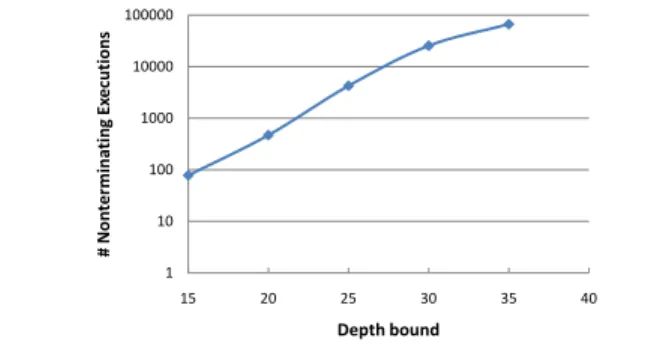
Figure 2. Number of nonterminating executions increases
expo-nentially with the depth bound.
order. The retry loops in the two threads create cycles in the state space of the program.
A typical stateless model checker is ineffective in detecting er-rors in such programs for two fundamental reasons. First, to avoid divergence resulting from nonterminating executions, the model checker must be run with a depth bound. To get good coverage for safety verification, this bound must be large enough to allow ex-ploring the deepest state in the state space. However, as the bound increases, the model checker spends exponentially more resources unrolling cycles in the state space than visiting new states. A use-ful measure of the wasteuse-ful work performed during the search is the number of non-terminating executions explored for a particu-lar depth bound. Figure 2 shows that, for our example (Figure 1), as the depth bound increases the number of nonterminating ex-ecutions explored increases exponentially. Second, nontermina-tion introduces the possibility of livelocks, an entirely new class of errors characterized by the inability of the program to make progress. For example, the repeated execution of the transition se-quencePhil1: Acquire(fork1), Phil2: Acquire(fork2), Phil1: TryAcquire(fork2), Phil2: TryAcquire(fork1), Phil1: Release(fork1), Phil2: Release(fork2)is a live-lock. Depth-bounded stateless model checking does not have the ability to detect such errors.
Fair stateless model checking solves both the aforementioned problems by performing state-space search with respect to afair and demonicscheduler. Our first key insight is that correct pro-grams make continuous progress on fair schedules. A schedule is fair if every thread that is enabled infinitely often is sched-uled infinitely often. Conversely, a schedule is unfair if a thread is starved of its chance to execute despite being enabled in-finitely often. 1 For example, the schedule in which Phil1 per-forms Acquire(fork1) and then Phil2 repeatedly executes
Acquire(fork2), TryAcquire(fork1), Release(fork2)is unfair. A cycle in the state space of a correct program corresponds to an unfair schedule in which an enabled thread is starved continu-ously so that the other threads participating in the cycle are unable to make progress. By performing state-space search with respect to a fair scheduler, the model checker is able to prune such cycles away. Note that a cycle in an incorrect program, such as the one in Figure 1, might correspond to a livelock. However, such an erro-neous cycle must be fair, otherwise it would not be considered an error by the programmer. Our scheduler does not prune such cycles and will in fact generate an infinite execution in the limit. It is this ability to distinguish between fair and unfair executions that gives fair stateless model checking the ability to detect livelocks. 1In the literature, this notion of fairness is qualified asstrongfairness. For brevity, we simply refer to this notion without the qualifier in this paper.
a,c Thread t a: x := 1; b: end; Thread u c: while (x != 1) d: yield(); e: end; a,d b,c b,d b,e Init x := 0; State Space t u t u u u
Figure 3. Example of a nonterminating program.
Obviously, a fair scheduler is restricted from making some scheduling decisions that are otherwise available to a scheduler with no fairness requirement. It is important to ensure that these restrictions do not reduce the coverage achieved during state-space exploration. Our second key insight enables us to do so. We ob-serve that threads in correct programs indicate when they are un-able to make progress byyieldingthe processor. A yield is usually indicated by the presence of a sleep operation or a timeout while waiting on a resource. To achieve fairness, the scheduleronly pe-nalizes yielding threads and prioritizes threads that are able to make progress. In particular, the scheduler is fully nondeterminstic in the absence of yield operations. Section 3 describes the fair scheduling algorithm and provides theoretical results to characterize its sound-ness. To support these theoretical results, Section 4 provides exper-imental results which indicate that our algorithm achieves complete state coverage on a variety of programs.
We have implemented our scheduler in the CHESS model checker. This algorithm extends the ability of CHESS to handle nonterminating programs. Prior to this implementation, any pro-gram given to the checker had to be manually modified to terminate under all schedules. This manual effort was a significant hurdle to the deployment of CHESSbecause in our experience, real programs are almost always nonterminating. By not requiring this manual ef-fort, the fair scheduling algorithm has significantly improved the applicability of CHESSto real-world programs; we can now boot the Singularity operating system [13] under the control of CHESS. We present our evaluation, including several bugs found, in Sec-tion 4.
In summary, the main novel contributions of this paper are the following:
• We have introduced fair stateless model checking, a novel technique for systematic testing of nonterminating programs. Our method significantly enhances the applicability of stateless model checking to large programs with cyclic state spaces. In addition, it allows stateless model checkers to detect a new class of livelock errors.
• We have implemented our algorithm in the stateless model checker CHESS. The algorithm makes it much easier to apply CHESSto large programs and found three previously unknown errors in real-world programs of which two are livelocks.
2.
Overview
In this section, we present an overview of our method for system-atically testing nonterminating programs. We use the example pro-gram in Figure 3 to motivate the discussion. This propro-gram has two threads and a global variablexinitially set to zero. The first thread
tsetsxto 1, while the second threaduspins in a loop waiting for the update ofxbyt. The state space of this program is shown at the
right of Figure 3. For this simple program, the state can be captured by the program counter of the two threads. For instance, the state
(a,c)is the initial state where the two threads are about to execute the instructions at locationsaandcrespectively. The state space contains a cycle between(a,c)and(a,d), resulting from the the spin loop ofu. Obviously, this program does not terminate under the schedule that continuously runsuwithout giving a chance fort
to execute.
Our method is applicable to programs that are expected to ter-minate under all fair schedules. That is, nontermination under a fair schedule is unexpected and is potentially an error. However, there is no requirement on these programs to terminate under unfair schedules. We call such programsfair-terminating. The program in Figure 3 is fair-terminating since its only infinite execution is not fair. This execution continuously starves threadtdespitetbeing enabled infinitely often.
Our intuition for fair-terminating programs is based upon our observation of the test harnesses for real-world concurrent pro-grams. In practice, concurrent programs are tested by combining them with a suitable test harness that makes them fair-terminating. A fair scheduler eventually gives a chance to every thread in the program to make progress ensuring that the program as a whole makes progress towards the end of the test. Such a test harness can be created even for systems such as cache-coherence protocols that are designed to “run forever”; the harness limits the number of cache requests from the external environment. In addition, the notion of fair termination coincides with the intuitive behavior pro-grammers expect of their concurrent programs. For instance, one expects the program in Figure 3 to terminate when run on a real machine. This expectation is due to our implicit assumption that the underlying thread scheduler in the operating system is fair.
In this paper, we provide a solution to the following important problem:
Input: A concurrent programQ and a safety propertyϕ
Problem:Determine ifQis fair-terminating and satisfiesϕ. IfQis not fair-terminating, produce a fair nonterminating execution ofQ. IfQviolatesϕ, produce a finite execution ofQviolatingϕ.
All previous solutions proposed for this problem arestateful; they require capturing the state of the programQ. As discussed in the introduction, capturing the state of large program is error-prone and expensive. The main contribution of this paper is a practical statelesssolution to this problem.
Our solution, calledfair stateless model checking, uses a fair and demonic scheduler for systematically exploring the set of fair executions of the program Q. The scheduler maintains a partial order on the set of threads in each state. Intuitively, this partial order defines a scheduling priority over threads in each state — an enabled thread cannot be scheduled in a state if a higher priority thread, as determined by the partial order, is enabled in that state. The priority is updated appropriately during the execution of a program with the guarantee that any infinite execution generated by our scheduler is fair (Section 3). An execution obtained by unrolling an unfair cycle in the state space of a nonterminating program is pruned by our scheduler, thereby leading to a more efficient search.
While being fair, the scheduler must also be demonic and at-tempt to generate enough schedules to achieve full state cover-age. For example, a scheduler that generates a single fair sched-ule is useless for finding bugs because it misses most behaviors of the program! Similarly, a round-robin scheduler does not consider many interleavings of the threads in the program. Ideally, it would be desirable for a fair scheduler to generate all possible fair exe-cutions of the program. But the set of all fair exeexe-cutions of a
fair-terminating program, even for a fixed input, may be (enumerably) infinite. Therefore, it is impossible for any stateless model checker, including ours, to generate all fair executions in a bounded amount of time. However, for checking safety properties, it is only neces-sary to generate enough executions to cover all reachable states of the program.
To achieve full state-coverage, our scheduler depends on an important characteristic of correct programs. We observed that threads in correct programs indicate when they are unable to make progress byyielding the processor. Whenever a thread waits for a resource that is not available, it either blocks on the resource or yields the processor. A block or a yield tells the operating system scheduler to perform a context switch, hopefully to the thread holding the resource required by the waiting thread. If the waiting thread does not yield the processor and continues to spin idly, it will needlessly waste its time slice and slow down the program; such a behavior is consequently considered an error. Therefore, in addition to being fair-terminating, correct programs also satisfy the following good samaritan property: if a thread is scheduled infinitely often, then it yields infinitely often. The program in Figure 3 satisfies this property because there is a yield statement in the spin loop of threadu. Also, a thread that terminates after executing a finite number of steps obviously satisfies the good samaritan property.
Our scheduler introduces an edge in the priority order only when a thread yields and thereby indicates lack of progress. Thus, our scheduler ensures that in the absence of yield operations, the priority order remains empty and all threads have equal priority. At each scheduling point, the scheduler nondeterministically attempts all scheduling choices that respect the priority order. Our intuition is that programs are parsimonious in the use of the yield operations as their excessive use may unnecessarily decrease performance. Therefore, these operations are used sparingly, typically at the back edges of spin loops. Consequently, every reachable state is likely to be reachable via a yield-free execution along which our algorithm behaves like the standard nondeterministic scheduler used in model checkers. We provide theoretical results (in Section 3) characteriz-ing the coverage of our algorithm. We also provide experimental evaluation (in Section 4) to show that our algorithm provides com-plete state coverage on a variety of realistic programs.
In summary, fair stateless model checking is a semi-algorithm which takes as input a program that is expected to satisfy the good samaritan property and be fair-terminating. There are four out-comes possible when this algorithm is applied to such a program.
1. The algorithm terminates with a safety violation.
2. The algorithm diverges and generates, in the limit, an infinite execution that violates the good samaritan property.
3. The algorithm diverges and generates, in the limit, an infinite fair execution.
4. The algorithm terminates without finding any errors.
In theory, the second and third outcomes manifest in an infinite execution being generated. In practice, it is not possible for a stateless model checker to identify or generate an infinite execution. Therefore, we ask the user to set a large bound on the execution depth. This bound can be orders of magnitude greater than the maximum number of steps the user expects the program to execute. The model checker stops if an execution exceeding the bound is reached and reports a warning to the user. This execution is then examined by the user to see if it actually indicates an error. In the rare case it is not, the user simply increases the bound and runs the model checker again. Using this mechanism, our algorithm is able to detect the livelock in the program of Figure 1.
3.
Fair stateless model checking
In this section, we describe fair stateless model checking in detail. We fix a multithreaded programQwith a finite setTidof threads. The programQstarts execution in its initial states0. At each step, one thread inTidperforms a transition and updates the state. In this presentation, we assume that the transition relation of each thread is deterministic and consequently thread scheduling is the only source of nondeterminism. However, our method is easily generalized to accommodate a nondeterministic but finitely-branching thread transition relation.
The programQ is equipped with state predicates enabled(t)
andyield(t)for each threadt∈Tid. The predicateenabled(t)is true in a statesiff threadtis enabled ins. The predicateyield(t)
is true in a statesiff threadtis enabled insand executing threadt insresults in a yield.
An executions0
t0 →s1
t1
→s2. . .is a finite or infinite sequence
of states and transitions. Each such execution is equipped with a state predicate sched(t) for each threadt ∈ Tid such that for alln ≥ 0,sched(t)is true insnif and only if tn = t. A finite
executions0
t0 → s1
t1
→ s2. . . snisterminatingifenabled(t) is
false atsnfor eacht∈Tid. Such a statesnis called adeadlock.
A statesisreachableif it is the final state of an execution. An infinite executionσ = s0
t0 → s1
t1
→ s2. . .isfair iff for
all threadst ∈ Tid, iftis enabled infinitely often inσthentis scheduled infinitely often inσ. This property is formalized as the following linear temporal logic [23] formula:
SF=∀t∈Tid :GFenabled(t)⇒GFsched(t)
Every infinite executionσofQis expected to satisfy the following good samaritanproperty:
GS=∀t∈Tid:GFsched(t)⇒GF(sched(t)∧yield(t))
Intuitively, this property states that for all threadst, iftis scheduled infinitely often, then in infinitely many of thosettransitions thread talso yields. The fair stateless model checking algorithm, apart from detecting safety violations, also attempts to detect an infinite execution that either violates the good samaritan property or is fair. We refer to the value of the predicatesenabled(t),sched(t), andyield(t)in statesass.enabled(t),s.sched(t), ands.yield(t)
respectively. We also use s.ES to refer to the set {x ∈ Tid |
s.enabled(t)}of threads enabled in states. Given a relationR⊆
Tid×Tidand a setX⊆Tid, we define
pre(R, X) ={x∈Tid| ∃y∈Tid: (x, y)∈R∧y∈X}. We present the fair model checking algorithm (Algorithm 1) as a nondeterministic fair scheduler. Our algorithm makes explicit the available nondeterministic choices at each scheduling point. It is easy to augment this description with either a stack to perform depth-first search or a queue to perform breadth-first search. To focus on the essence of our algorithm, we have elided the (standard) search mechanism from the algorithm description.
The algorithm takes as input a multithreaded program Q to-gether with its initial stateinit. It assumes that the programQ
comes with a functionNextStatethat takes a statesand a threadt and returns the state that results from executingtin states. The al-gorithm starts with the initial state and an empty execution. In each iteration of the loop (lines 7–30), the algorithm extends the current execution by one step. The algorithm terminates with a complete terminating execution, when thereturnstatement on line 9 is exe-cuted.
Each threadt∈Tidpartitions an executionσinto windows; a window of threadtlasts from a state immediately after a yielding transition by threadtto the state immediately after the next yielding transition by t. Our algorithm maintains for each statesseveral
init.P :={}; 1
∀u∈Tid:init.E(u) :={}; 2
∀u∈Tid:init.D(u) :=Tid; 3
∀u∈Tid:init.S(u) :=Tid; 4
curr :=init; 5
whiletruedo 6
T :=curr.ES\pre(curr.P,curr.ES);
7 ifT ={}then 8 return; 9 end 10 t:=Choose(T); 11
next:=NextState(curr, t); 12
next.P :=curr.P\(Tid× {t}); 13
foreachu∈Tiddo
14
next.E(u) :=curr.E(u)∩next.ES; 15
ifu=tthen 16
next.D(u) := 17
curr.D(u)∪(curr.ES\next.ES);
else 18 next.D(u) :=curr.D(u); 19 end 20 next.S(u) :=curr.S(u)∪ {t}; 21 end 22
ifcurr.yield(t)then 23
H := (next.E(t)∪next.D(t))\next.S(t);
24 next.P :=next.P∪({t} ×H); 25 next.E(t) :=next.ES; 26 next.D(t) :={}; 27 next.S(t) :={}; 28 end 29 curr :=next; 30 end 31
Algorithm 1: Fair stateless model checking
auxiliary predicates that record information about a window of threadt.
1.S(t)is the set of threads that have been scheduled since the last yield by threadt.
2.E(t)is the set of threads that have been continuously enabled since the last yield by threadt.
3.D(t) is the set of threads that have been disabled by some transition of threadtsince the last yield by threadt.
In addition to these predicates, each statesalso contains a relation s.Pwhich represents a priority ordering on threads. Specifically, if
(t, u)∈s.Pthentwill be scheduled insonly whens.enabled(t)
and¬s.enabled(u).
In each iteration, the algorithm first computesT(line 7), the set of schedulable threads that satisfy the priorities incurr.P. IfT is empty, then the execution terminates. Otherwise, the algorithm se-lects a threadtnondeterministicallyfromT(line 11) and schedules tto obtain thenextstate. It is this nondeterminism inherent in the execution of theChoose(T)on line 11 that a model checker must explore. As explained earlier, it is easy to add systematic depth-first or breadth-first search capability to our algorithm. Line 13 removes all edges with sinktfromPto decrease the relative priority oft.
The loop at lines 14–22 updates the auxiliary predicates for each threadu ∈ Tid. The set E of continuously enabled threads is updated by taking the intersection of its current value with the set of enabled threads innext(line 15). The setDof threads disabled by threadtis updated by taking the union of its current value with
a,c ES = {t, u}, S(u) = {}, D(u) = {}, E(u) = {t, u}, P = {}
a,d ES = {t, u}, S(u) = {u}, D(u) = {}, E(u) = {t, u}, P = {}
a,c ES = {t, u}, S(u) = {}, D(u) = {}, E(u) = {t, u}, P = { (u,t) }
u: while (x != 1)
u: while (x != 1)
a,c ES = {t, u}, S(u) = {t, u}, D(u) = {t, u}, E(u) = {}, P = {}
a,d ES = {t, u}, S(u) = {t, u}, D(u) = {t, u}, E(u) = {}, P = {}
u: while (x != 1) u: yield()
u: yield()
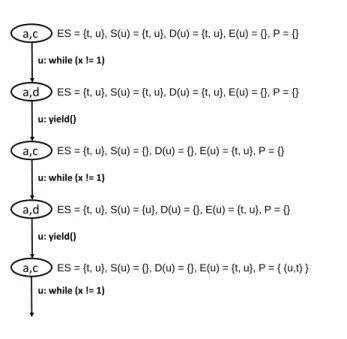
Figure 4. Emulation of Algorithm 1 on the spin loop in Figure 3. When threaduyields in the second transition from state(a,d), the
Pin the subsequent state ensures thatudoes not enter the spin loop the second time.
the set of threads disabled by the latest transition (line 17). The set of scheduled threads is updated on line 21.
Finally, if the transition just executed is a yielding transition, then the data structures are updated appropriately to mark the beginning of a new window ofu(line 23–29). The setHcomputed on line 24 contains only those threads that were never scheduled in the current window of thread tand were either continuously enabled, or disabled by thread t at some point in the window. Line 25 reduces the priority oftwith respect to the threads inH.
Figure 4 shows an emulation of Algorithm 1 for the program in Figure 3. For conciseness, Figure 4 only shows the emulation when the scheduler attempts to schedule the threaducontinuously. We focus the emulation on the values of the relation P and the predicatesS(u),D(u), andE(u). The relationPis initialized to be empty. The predicatesS(u),D(u)andE(u)are initialized in such a way that their values remain unchanged until the first yield of threadu. These values also provide the additional guarantee that the update ofP at the first yield of any thread is guaranteed to leave the value ofPunchanged. This behavior ensures that the first window of any thread begins after its first yield at which point the predicatesS(u),D(u)andE(u)get initialized appropriately.
In the emulation, the scheduler executes threaducontinuously. Starting from the initial state(a,c), the first window ofubegins once the scheduler has scheduledutwice. At this point,uhas gone through the spin loop once and the state is(a,c)again. In this state,P={},S(u) ={},D(u) ={}, andE(u) =ES ={t, u}. Whenuis executed for one more step,uis added toS(u)and the state becomes(a,d). In this state,yield(u)is true asuwill yield if executed from this state. However, theP relation is still empty allowing the scheduler to choose either of the two threads.
If the scheduler chooses to scheduleuagain, the thread com-pletes the second iteration of the loop and the program enters the state(a,c). Algorithm 1 adds the edge(u, t)to P because the setH on line 24 evaluates to{t}. Thus, the algorithm giving the yielding threadua lower priority than the pending threadt. This
update toPmakes the set of scheduler choicesT ={t}. Thus, the scheduler is forced to schedulet, which enablesuto exit its loop.
Generalizing this example, if the threadtwas not enabled in the state(a,c), say iftwas waiting on a lock currently held by
u, the scheduler will continue to scheduleutill it releases the lock. Further, iftwas waiting on a lock held by some other threadvin the program, the fairness algorithm will guarantee that eventually
vmakes progress releasing the lock.
THEOREM1.Every infinite executionσgenerated by Algorithm 1 satisfies the propertyGS ⇒SF.
PROOF.We do the proof by contradiction. Suppose Algorithm 1 generates an infinite execution σ = s0
t0 → s1
t1
→ s2. . . that
satisfiesGS but does not satisfySF. Therefore, there is a thread usuch thatσsatisfiesGFenabled(u)∧FG¬sched(u). That is, the executionσeventually reaches a statesiafter whichuis never
scheduled but is enabled infinitely often. LetTbe the set of threads that are scheduled infinitely often inσ. SinceTidis finite andσis an infinite execution, the setT is nonempty. SinceσsatisfiesGS, every thread inTmust yield infinitely often. There are two cases: threaduis enabled forever aftersi or threadu is both enabled
infinitely often and disabled infinitely often aftersi.
Case 1:Suppose threaduis enabled forever aftersi. Consider
an arbitrary t ∈ T. Since σ satisfies GS and t is scheduled infinitely often inσ, there existj andk such thati < j < k, sj.sched(t),sj.yield(t), sk.sched(t)and sk.yield(t). Consider
the iteration of the loop in lines 6–31 of Algorithm 1 in which the
curr = sk. Sinceuis forever enabled but never scheduled after si, we have thatu ∈ next.E(t) andu 6∈ next.S(t) at line 24.
Therefore, at line 25u∈Hand the edge(t, u)is added tonext.P. Since threaduis continuously enabled aftersiand therefore after sk, the edge(t, u)precludes the scheduling oftaftersk(line 7).
This is a contradiction sincetis scheduled infinitely often. Case 2:Suppose threaduis both enabled infinitely often and disabled infinitely often after si. Since T is finite, there must
be some thread t ∈ T that disables u infinitely often. Since σ satisfies GS and t is scheduled infinitely often in σ, t dis-ables u at some point after i and between two states where
yield(t) holds. Formally, there exist j such that i < j < k ≤ l, sj.sched(t), sj.yield(t), sk.sched(t), sk.enabled(u),
¬sk+1.enabled(u), sl.sched(t), and sl.yield(t). Consider the
iteration of the loop in lines 6–31 of Algorithm 1 in which the
curr = sl. Since uis never scheduled after si, we have that u∈next.D(t)andu6∈next.S(t)at line 24. Therefore, at line 25 u∈ Hand the edge(t, u)is added tonext.P. Since threaduis never scheduled aftersi and therefore aftersk, the edge(t, u)is
present insn.P for alln≥k. This edge precludes the scheduling
oftaftersk(line 7) whenever threaduis also enabled. This is a
contradiction since threadtdisables threaduinfinitely often.2 Theorem 1 yields the following termination guarantee about Algorithm 1.
THEOREM2.If no infinite execution ofQ satisfies the property
GS⇒SF, then Algorithm 1 terminates onQ.
PROOF.We do the proof by contradiction. Suppose Algorithm 1 does not terminate on Q. Then the tree of executions explored by the algorithm is infinite. SinceTid is finite, this execution tree is finitely branching. By K¨onig’s lemma, there must be an infinite execution in this tree. Since every execution generated by Algorithm 1 is an execution of Q, this execution must satisfy
GS ⇒ SF (by Theorem 1). Hence, we arrive at a contradiction.
2
Now, we prove certain desirable properties of the fair model checking algorithm.
THEOREM3.At line 7 of Algorithm 1, the setT is empty if and only if the setcurr.ESis empty.
PROOF.The proof relies on the fact that thePrelation when viewed as edges in a graph with nodes fromTidcontains no cycles. The loop invariant at line 6 requiring thatcurr.Pis an acyclic relation is sufficient to prove our theorem.
We first prove this loop invariant. Upon loop entry, we have
curr = init. The relationcurr.P is empty and the invariant is trivially true. Consider an arbitrary iteration of the loop. We assume the loop invariant at the beginning of this iteration and prove it at the end. In each iteration of the loop, whenever outgoing edges fromtare added toP at line 25, all incoming edges into t have already been removed earlier at line 13. Line 21 adds t tonext.S(u)for allu ∈ Tid and therefore it is guaranteed that t∈next.S(t)at line 24 andt6∈Hat line 25. Thus, even line 25 does not add any incoming edges intotand each iteration of the loop leavesPacyclic.
We now show that the loop invariant implies our theorem. Clearly, if curr.ES is empty at line 7 then T is also empty. We prove the other direction by contradiction. Suppose T is empty butcurr.EnabledSetis nonempty. Thereforecurr.ES ⊆
pre(curr.P,curr.ES). Consider the projection of the relation
curr.Prelation on to the setcurr.ES. Sincecurr.Pis acyclic and
curr.ES is nonempty, this projection is a nonempty acyclic rela-tion and therefore contains a maximal element. That is, there exists t ∈ curr.ES such that∀u ∈ curr.ES : (t, u) 6∈ curr.P. This contradicts our assumptioncurr.ES⊆pre(curr.P,curr.ES).2 Theorem 3 guarantees that Algorithm 1 never reports a false deadlock. In practice, this means that the algorithm can always drive the program to a terminating state, without requiring the execution to be pruned at a partial execution. Such pruning, as can typically happen with depth-bounding techniques, avoids wasting scarce model checking resources.
While the theorems above hold even for infinite-state systems, the theorems stated below provide intuition for the efficacy of the fair model checking algorithm on finite-state systems. For the re-mainder of this section, we assume thatQis a finite-state program. For finite-state systems, all infinite behaviors traverse cycles in the state space. A cycle τ is a transition sequence x0
t0 →
x1· · ·xn tn
→x0such that the statesx0, x1, . . . , xnare all distinct.
The cycleτ is reachable if the statex0is reachable. The cycleτ isfair if for every threadt ∈ Tid, either¬xi.enabled(t)for all i∈ [0, n]ort =tifor somei∈ [0, n]. The cycleτ isunfairif
it is not fair. Note that an infinite execution that traverses an unfair cycle forever is not fair.
The following theorem shows that our algorithm unrolls an unfair cycle fully at most twice and thus significantly reduces wasteful search.
THEOREM4.Suppose every infinite execution ofQ satisfies the property GS, s0
t
→ s1· · ·x0 is a finite execution of Q, and
x0
t0
→x1· · ·xn tn
→x0is an unfair cycle inQ. Then, Algorithm 1 does not generate the executions0
t → s1· · ·x0 t0 → x1· · ·xn tn → x0 t0 →x1· · ·xn tn →x0 t0 →x1· · ·xn. PROOF.Sincex0 t0 → x1· · ·xn tn
→ x0 is an unfair cycle, there is a threadusuch thatu 6=tifor alli∈ [0, n]andxi.enabled(u)
for somei∈ [0, n]. LetN(i)denote(i+ 1)mod(n+ 1). Since xi.enabled(u)for somei∈[0, n], there are only two cases: either xi.enabled(u)for alli∈[0, n]or there existsi∈[0, n]such that xi.enabled(u)and¬xN(i).enabled(u).
Case 1:Supposexi.enabled(u)for alli∈[0, n]. Since every
infinite execution ofQ satisfiesGS, there existsi ∈ [0, n]such thatxi.yield(ti)is true. Therefore the edge(ti, u)is in the priority
graph after the execution oftithe second time the unfair cycle is
executed. Sinceuis never scheduled, this edge is not removed, and consequentlyticannot be scheduled at the next occurrence ofxi.
Case 2:Suppose there existsi∈[0, n]such thatxi.enabled(u)
and¬xN(i).enabled(u). Since every infinite execution ofQ satis-fiesGS, there existsj∈[0, n]such thatti=tjandxj.yield(tj)
is true. Therefore the edge(tj, u)is added to the priority graph
af-ter the execution oftjthe second time the unfair cycle is executed.
Sinceuis never scheduled, this edge is not removed, and conse-quentlyti =tjcannot be scheduled at the next occurrence ofxi. 2
Now, we present two theorems that characterize the soundness of our algorithm on finite-state systems. Consider a finite transition sequenceα = x0
t0
→ x1· · ·xn. The yield countof thread tin α, denoted by δ(α, t), is the cardinality of the set{0 ≤ i < n | t = ti ∧xi.yield(t)}. The yield countof α, denoted by δ(α) is the maximum ofδ(α, t) over all threadst ∈ Tid. The yield countof a reachable statesis the minimum ofδ(σ)over all executionsσwhose final state iss. The following theorem captures the soundness guarantee of our algorithm for safety properties. THEOREM5.Algorithm 1 either generates an infinite execution or visits every reachable state ofQwhose yield count is zero.
PROOF.Suppose Algorithm 1 does not generate an infinite execu-tion. Therefore, the tree of executions explored by the algorithm is finite (by K¨onig’s lemma). This tree is guaranteed to contain all executions whose yield count is zero because along such an execu-tion the priority graph remains empty throughout. Every reachable state ofQwith yield count zero is the final state of an execution in which there are no yields. Therefore, the algorithm eventually visits all such reachable states.2
Every infinite execution generated by our algorithm reveals a liveness error (Theorem 1). Theorem 5 indicates that our algorithm is sound with respect to safety properties if the programQ does not have any liveness errors and all reachable states are reachable by yield-free executions. Theorem 6 below captures the soundness of our algorithm with respect to liveness properties as well. THEOREM6.Supposex0 is a reachable state ofQwhose yield count is zero andτ =x0
t0
→x1· · ·xn tn
→x0is a fair cycle whose yield count is at most one. Then Algorithm 1 generates an infinite execution.
PROOF.We do the proof by contradiction. Suppose Algorithm 1 does not generate an infinite execution. By Theorem 5, the state x0 is eventually visited with an empty priority graph. If the yield count ofτ is zero, then there are no yields in τ and τ can be executed repeatedly to generate an infinite execution. Suppose the yield count ofτis one. Sinceτis fair, every thread that is enabled anywhere in the cycle is also scheduled in the cycle. Moreover, a threadtmay yield at most once inτ. Therefore, the setS(t)
contains bothE(t)andD(t)at the unique yield point oft, if any. Consequently, the yield oftdoes not add any edges toP.2
As discussed in Section 2, we expect that all reachable states are reachable by a yield-free execution due to the parsimonious use of the yield operation by real programs. If this is not the case, then our algorithm can be parameterized by a small constantk >0so as to only process everyk-th yield of a thread. The soundness theo-rems (both for safety and liveness) for the parameterized algorithm are straightforward generalizations of the corresponding theorems stated above.
4.
Evaluation
This section presents the empirical evaluation of the fair demonic scheduler described in Section 3. We have implemented our
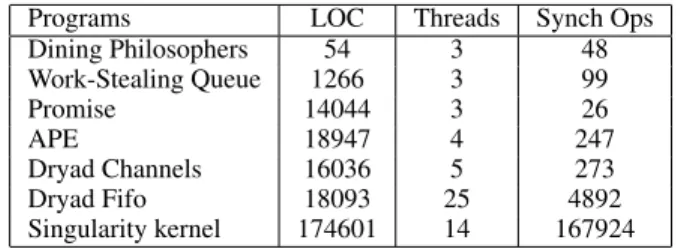
algo-Programs LOC Threads Synch Ops Dining Philosophers 54 3 48 Work-Stealing Queue 1266 3 99 Promise 14044 3 26 APE 18947 4 247 Dryad Channels 16036 5 273 Dryad Fifo 18093 25 4892 Singularity kernel 174601 14 167924
Table 1. Characteristics of input programs to CHESS
rithm in the CHESSsoftware model checker. CHESSis designed for systematic testing of shared-memory multithreaded programs. To use CHESS, the user provides a test case that exercises a concurrent scenario. CHESSexecutes this test repeatedly, while controlling the thread schedule such that every execution of the test takes a differ-ent interleaving. CHESSis stateless and avoids capturing any state, including the initial state of the program, during state-space search. The implementation of the fair scheduler in CHESSmaintains data structures to implement the auxiliary state used in Algorithm 1. An important issue is the inference of yielding transitions; our im-plementation treats every synchronization operation with a finite timeout and every explicit processor yield as yielding operations. Another important issue is the integration of fair-scheduling with the context-bounded search [22] strategy implemented in CHESS. In a concurrent execution, apreemptionoccurs when the scheduler forces a context switch despite the current running thread being en-abled. Context-bounded search explores only those executions in which the number of preemptions is bounded by a small number provided by the user of CHESS. Fair scheduling is easily combined with context-bounding. The only subtle aspect of the combination is that fair scheduling can introduce a preemption when the cur-rently running thread gets a lower priority than another enabled thread. For soundness of the context-bounded search, it is impor-tant tonotcount such preemptions.
4.1 Ability to handle large nonterminating programs
Prior to the implementation of the fair scheduler, CHESS, like other stateless model checkers, could only handle terminating programs. As depth bounding was unsatisfactory for our purposes, any in-put program with nonterminating behavior required manual mod-ification. As an example of the effort required, consider the sim-ple program in Figure 3. One can fix the nonterminating behavior by introducing a synchronization variable thatublocks on when waiting for an update tox. In addition, the behavior oft(and all other threads that accessx) should be modified to appropriately signal the synchronization variable after an update tox, a non-local change to the program. Finally, one has to ensure that the intro-duced synchronization does not result in deadlocks due to adverse interactions with existing synchronizations in the program. In prac-tice, such modifications typically require intimate knowledge of the program, and in our experience, are difficult and error-prone. Pre-viously, it took us several weeks to prepare a realistic program as an input to CHESS.
With the fair scheduler in place, CHESS could readily handle nonterminating programs. Table 1 describes the programs CHESSis currently able to handle. Table 1 also provides the maximum num-ber of threads created and synchronization operations performed per execution of these programs in CHESS. In particular, we are able to systematically test theentireboot and shutdown process of the Singularity operating system [13]. Also, we have run CHESS on unmodifiedversions of Dryad, a distributed execution engine for coarse-grained data-parallel applications [15], and APE (Asyn-chronous Processing Environment), a library in the Windows
oper-ating system that provides a set of data structures and functions for asynchronous multithreaded code.
Apart from these large programs, CHESSis also able to handle low-level synchronization libraries that typically employ nonblock-ing algorithms. Manually modifynonblock-ing them to be terminatnonblock-ing is ei-ther impossible or requires algorithmic changes. We have applied CHESSto an implementation [20] of the work-stealing queue algo-rithm originally designed for the Cilk multithreaded programming system [7], andPromise, a library for data-parallel programs.
4.2 Coverage of safety properties
This section demonstrates that the fairness algorithm is effective for checking safety properties. First, we show that the algorithm achieves 100% state coverage for the first two programs in Table 1. Also, we show that fairness significantly improves the speed of the state space search, for various search strategies. Finally, we demon-strate the ability of the the fairness algorithm to find both existing and previously unknown safety violations in large programs.
All the experiments described in the paper were performed on an off-the-shelf computer with Intel Xeon 2.80GHz CPU with 2 processors and 3 GB of memory running Windows Vista Enterprise operating system.
4.2.1 State coverage
CHESS is a stateless model checker and thus does not have the capability to capture program states. To measure state coverage, we manually added facilities to extract states for two examples; the dining philosophers and the work-stealing queue. The state of these programs consists of the state of all global variables, the heap, and the stack of all threads in the program. While the bits com-prising the state can be automatically extracted, we had to manu-ally abstract the (infinite) state of the program into a reasonable, finite representation. Also, in order to avoid multiple representa-tions of behaviorally equivalent heaps, we used a simple heap-canonicalization algorithm [14].
Table 2 shows the results from our coverage experiments for these two examples, each with two configurations. For each of the configurations, we used four search strategies — a context-bounded search with bounds (cb) from 1 to 3 and a depth-first search (dfs). For each strategy, we ran CHESS with and without the fairness algorithm. As termination is not guaranteed without fairness, the search proceeds only upto a depth bound (db) varying from 20 to 60. Once the depth-bound is reached, a random search [17] is performed until the end of the execution is reached. New states visited during the random search are included while measuring state coverage. To measure the total number of states reachable with a strategy, we also performed a stateful search of the state space and stored the state signatures in a hash table. We used this table to check if the subsequent runs cover all of the states.
In our experiments, we found that the fairness algorithm achieves 100% coverage on all but one of the cases. The fairness algorithm times out for a depth-first search strategy on the work-stealing queue with two stealers. The fourth column in Table 2 shows the number of states explored with fairness, and except for the one case above, this number is greater than or equal to the total number of states in the third column. The number of states explored with fairness is larger than the total number of states, as the fairness algorithm introduces additional preemption points. This essentially forces the fairness algorithm to visit states that are beyond the cur-rent context-bound.
For comparison, Table 2 also shows the number of states visited for runs without fairness with different depth bounds. For some runs, the search with small depth bounds terminate without visiting all the states. In other cases with larger depth-bounds, the search
Search Total With Without fairness
Configuration Strategy States Fairness db=20 db=30 db=40 db=50 db=60
Dining cb=1 27 27 27 27 27 27 27 Philosophers cb=2 28 28 28 28 28 28 28 2 philosophers cb=3 29 29 29 29 29 29 29 dfs 29 29 29 29 29 29 29 Dining cb=1 102 102 102 102 102 102 102 Philosophers cb=2 144 144 143 144 144 144 144 3 philosophers cb=3 167 171 167 169 169 169 169 dfs 177 177 174 177 177 168* 139* Work-Stealing cb=1 278 278 236 278 278 278 278 Queue cb=2 814 814 554 765 814 814 814 1 stealer cb=3 1287 1297 694 1133 1287 1287 1287 dfs 1726 1726 871 1505 1726 1307* 683* Work-Stealing cb=1 350 378 238 334 350 350 350 Queue cb=2 1838 2000 971 1630 1822 1838 1838 2 stealers cb=3 3271 3311 1805 2955 3269 3271 3271 dfs 4826 1321* 1686* 1239* 460* 245* 245*
Table 2. Number of states visited for the context-bounded and depth-first strategies both with and without fairness. Search without fairness is not guaranteed to terminate and thus needs to be pruned at a depth bound. The state coverage achieved for runs that did not terminate within5000seconds is marked with a *.
times out. For the work-stealing queue with two stealers, all runs using the depth-bounded strategy time out.
4.2.2 Rate of state coverage
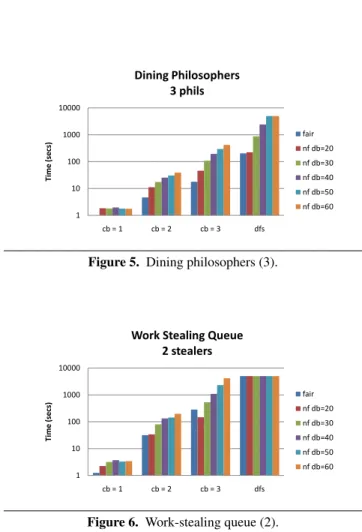
Fair stateless search can be more efficient as it does not unroll un-fair cycles in the state space (Theorem 4). To quantify this, Fig-ures 5 and 6 show the time taken to complete the search for two of the four configurations in Table 2. The results were similar for the other two (smaller) configurations. The figures show the time taken to complete the search for each of the search strategies with and without fairness. For the runs without fairness, we report the time for various depth bounds. Note, the y-axis on these figures is in log scale. The runs with fairness explores the state space exponentially faster than the runs without fairness, without sacrificing state cov-erage. In Figure 6, for cb=3 strategy, the run with a depth bound of
20completes faster than the run with fairness but does not cover all states. Also, the depth-first strategy times out in all runs.
4.2.3 Ability to find errors
The experiments above show that fairness improves the efficacy of safety checking without sacrificing soundness for two programs. On larger programs, for which state extraction is not manually feasible, we demonstrate the efficacy of the fairness algorithm indirectly by demonstrating its ability to find safety errors in the programs.
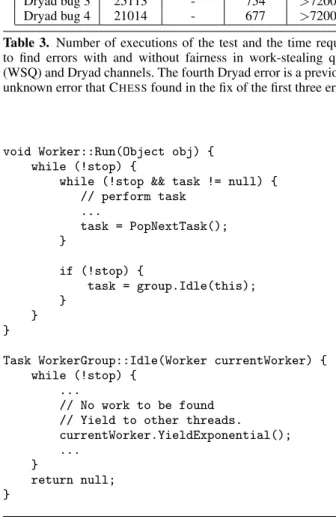
A prior version of CHESShad found six bugs on versions of the work-stealing queue and the Dryad channels, modified to be termi-nating. We ran CHESSon the unmodified programs with a context-bound of 2 preemptions, both with and without fairness. Since these programs are nonterminating, we set the depth-bound to 250 for the search without fairness. This depth-bound is the minimum re-quired to find these errors. Table 3 compares the performance of the search with fairness to the search without fairness. As the table shows the fairness algorithm finds the first five errors much faster both in terms of the number of executions explored prior to the buggy execution and the time taken for the search. The sixth error is not found by the search without fairness.
The seventh row in Table 3 shows a previously unknown bug that the fairness algorithm found in Dryad. The bug is caused by an incorrect fix of bug 3 by the developer of Dryad. This error is also not found by the search without fairness.
1 10 100 1000 10000 cb = 1 cb = 2 cb = 3 dfs Ti m e (s e cs) Dining Philosophers 3 phils fair nf db=20 nf db=30 nf db=40 nf db=50 nf db=60
Figure 5. Dining philosophers (3).
1 10 100 1000 10000 cb = 1 cb = 2 cb = 3 dfs Ti m e (s e cs)
Work Stealing Queue 2 stealers fair nf db=20 nf db=30 nf db=40 nf db=50 nf db=60
Figure 6. Work-stealing queue (2).
4.3 Liveness violations
The fairness algorithm diverges in two cases, when the program violates the good samaritan property (Section 2) or contains a live-lock. Both these outcomes indicate correctness or performance er-rors in the program. We demonstrate one instance of each violation that CHESSfound in existing programs.
No. of executions Time (secs)
With Without With Without
Bugs Fairness Fairness Fairness Fairness
WSQ bug 1 82 182 2 8 WSQ bug 2 112 432 8 24 WSQ bug 3 212 843 12 74 Dryad bug 1 310 11024 8 273 Dryad bug 2 4002 47030 114 1247 Dryad bug 3 25113 - 754 >7200 Dryad bug 4 21014 - 677 >7200
Table 3. Number of executions of the test and the time required to find errors with and without fairness in work-stealing queue (WSQ) and Dryad channels. The fourth Dryad error is a previously unknown error that CHESSfound in the fix of the first three errors.
void Worker::Run(Object obj) { while (!stop) {
while (!stop && task != null) { // perform task ... task = PopNextTask(); } if (!stop) { task = group.Idle(this); } } }
Task WorkerGroup::Idle(Worker currentWorker) { while (!stop) {
...
// No work to be found // Yield to other threads. currentWorker.YieldExponential(); ...
}
return null; }
Figure 7. Violation of the good samaritan property. Under certain cases, the outer loop inWorker::Runresults in the thread spinning idly till time-slice expiration.
4.3.1 Good samaritan property violation
We used CHESSto test the implementation of a library that provides efficient parallel execution of tasks. This library maintains a col-lection of worker threads, partitioned into a set of worker groups. CHESSdetected a violation of the good samaritan property during the shutdown of the library. There is a field calledstopin both theWorkerandWorkerGroupclasses. During the shutdown pro-cess, thestopfield in a worker group and thestopfield in each worker of that worker group is set to true, causing all the workers to eventually finish. However, there is a small window of time dur-ing which thestopfield in the worker group is true but thestop
field in one of the workers is false. In this situation, if the queue of tasks is empty, then the worker spins in a loop without yielding the processor until its time-slice expires. This behavior starves other threads, potentially including the one that is responsible for setting thestopfield of the worker to true.
volatile int x; //...
int x_temp = InterlockedRead(x); if(common case 1) break;
if(common case 2) break; ...
// spin in the uncommon case while(x_temp != 1){
Sleep(1); //yield
// BUG: should read x once again }
Figure 8. The spinloop incorrectly waits on a temporary cache of the global variable, resulting in a livelock.
4.3.2 Livelock in Promise
We used CHESS to test the implementation of promises, a con-currency primitive for specifying data parallelism. The implemen-tation is optimized for efficiency and selectively uses low-level hardware primitives for performance. CHESSdetected a livelock in promises caused by simple programming error. While we are unable to provide the actual code snippet, Figure 8 shows pseudo-code exhibiting the same error.
For the sake of performance, programmers tend to make local copies of shared global variables. The livelock in Figure 8 occurs when the program erroneously waits for the local copy to change, without updating the copy with the value in the global variable. This bug was hard to detect as it only occurred in those rare thread interleavings in which the common cases shown in the pseudo-code were inapplicable.
5.
Related work
The need for fairness when reasoning about concurrent programs is well known [19, 2, 6, 3, 10]. Of the different useful notions of fairness [6, 18], this paper deals with strong fairness (also known asstrong process fairness[3] orfairness[19]).
Fairness has also been studied extensively in the context of model checking [5, 24, 25, 1, 12] of temporal logic specifications, all of which deal with stateful model checking. To our knowledge, this paper is the first to propose fairness as a means of improving the efficacy of stateless model checking for safety verification. Also, this paper is the first to extend the ability of stateless model checking to comprehensively detect livelocks.
Our fair scheduling algorithm is related to the explicit scheduler construction in Apt and Olderog [2, 6]. This scheduler is primarily used as a proof methodology for proving the termination of con-current programs. In particular, the scheduler requires generating a randominteger for the priority of a thread after every step. Such “unbounded nondeterminism” [10], while useful in generatingall fair schedules of a program, cannot be effectively implemented in a model checker. In contrast, our algorithm requires a finite choice among a subset of enabled threads at each step of the execution.
Most operating system schedulers employ mechanisms to fairly share resources among competing threads and users. These algo-rithms typically manipulate priorities [16, 11] based on resource usage or use randomized schemes [27] to guarantee fairness. These algorithms are not designed to expose the nondeterministic choices of the scheduler and cannot be used in a model checker.
The model checker described in this paper belongs to the class that directly execute programs [8, 26, 21, 28] (as opposed to ana-lyzing abstract program models). The technique of stateless model checking was proposed in Verisoft [8] and has been successful for systematically testing industrial concurrent systems [4]. Stateless
model checking typically relies on partial-order reduction tech-niques [9] to reduce the state space explored. Partial-order reduc-tion can only determine the equivalence of two execureduc-tions of the same length and thus is inherently incapable of detecting equiva-lence of executions that revisit the same state in a cycle. Partial-order reduction, however, can be used to significantly reduce the set of all fair schedules of fair-terminating programs, an interesting avenue of future research that we are currently pursuing.
Killian et al. [17] use a hybrid stateful and stateless technique to find liveness errors in network protocols. Their algorithm can only find those liveness violations that are characterized by the presence of “dead states” and will not find the livelock in the dining philosopher example (Section 1) or the violation of the good samaritan property, described in Section 4.3.1. Also, their algorithm provides no soundness guarantees of finding livelocks.
6.
Conclusions and future work
This paper proposes the use of a fair scheduler in stateless model checking. Fairness both enables the detection of liveness errors and substantially improves the efficiency of safety verification in a stateless model checker. The incorporation of the fair scheduling algorithm in the CHESSmodel checker has significantly improved the applicability of CHESSto large nonterminating programs. The fairness-enhanced CHESShas found many liveness errors in several industry-scale programs.
Currently, CHESSchecks two liveness properties: fair termina-tion and the good-samaritan rule. We would like to extend CHESS to check an arbitrary liveness property. To motivate this work, we are currently identifying liveness properties that are useful for mul-tithreaded software. We are also investigating extensions to the fair scheduler to handle unbounded thread creation.
Acknowledgements
We thank Tom Ball for help with the evaluation of the fair sched-uler. We also thank Patrice Godefroid, Andreas Podelski, Mihalis Yannakakis, and the reviewers for valuable comments on a prior version of the paper.
References
[1] S. Aggarwal, C. Courcoubetis, and P. Wolper. Adding liveness properties to coupled finite-state machines. ACM Transactions on Programming Languages and Systems, 12(2):303–339, 1990. [2] K.R. Apt and E.-R. Olderog. Proof rules and transformations dealing
with fairness.Science of Computer Programming, 3:65–100, 1983. [3] Krzysztof R. Apt, Nissim Francez, and Shmuel Katz. Appraising fairness in languages for distributed programming. InPOPL 87: Principles of Programming Languages, pages 189–198, 1987. [4] Satish Chandra, Patrice Godefroid, and Christopher Palm. Software
model checking in practice: an industrial case study. InICSE 02: International Conference on Software Engineering, pages 431–441, 2002.
[5] E.M. Clarke and E.A. Emerson. Synthesis of synchronization skeletons for branching time temporal logic. InLogic of Programs, LNCS 131, pages 52–71. Springer-Verlag, 1981.
[6] Nissim Francez. Fairness. InTexts and Monographs in Computer Science. Springer-Verlag, 1986.
[7] Matteo Frigo, Charles E. Leiserson, and Keith H. Randall. The implementation of the Cilk-5 multithreaded language. InPLDI 98: Programming Language Design and Implementation, pages 212–223. ACM Press, 1998.
[8] P. Godefroid. Model checking for programming languages using Verisoft. InPOPL 97: Principles of Programming Languages, pages 174–186. ACM Press, 1997.
[9] Patrice Godefroid. Partial-Order Methods for the Verification of Concurrent Systems: An Approach to the State-Explosion Problem. LNCS 1032. Springer-Verlag, 1996.
[10] Orna Grumberg, Nissim Francez, and Shmuel Katz. Fair termination of communicating processes. InPODC 84: Principles of Distributed Computing, pages 254–265. ACM Press, 1984.
[11] Joseph L. Hellerstein. Achieving service rate objectives with decay usage scheduling. IEEE Transactions on Software Engineering, 19(8):813–825, 1993.
[12] G. Holzmann. The model checker SPIN. IEEE Transactions on Software Engineering, 23(5):279–295, May 1997.
[13] Galen C. Hunt, Mark Aiken, Manuel Fhndrich, Chris Hawblitze-land Orion Hodson, James R. Larus, Steven Levi, Bjarne Steensgaard, David Tarditi, and Ted Wobber. Sealing OS processes to improve de-pendability and safety. InProceedings of the EuroSys Conference, pages 341–354, 2007.
[14] Radu Iosif. Exploiting heap symmetries in explicit-state model checking of software. InASE 01: Automated Software Engineering, pages 254–261, 2001.
[15] Michael Isard, Mihai Budiu, Yuan Yu, Andrew Birrell, and Dennis Fetterly. Dryad: distributed data-parallel programs from sequential building blocks. InProceedings of the EuroSys Conference, pages 59–72, 2007.
[16] J. Kay and P. Lauder. A fair share scheduler.Communications of the ACM, 31(1):44–55, 1988.
[17] Charles Edwin Killian, James W. Anderson, Ranjit Jhala, and Amin Vahdat. Life, death, and the critical transition: Finding liveness bugs in systems code. InNSDI 07: Symposium on Networked Systems Design and Implementation, pages 243–256, 2007.
[18] M. Z. Kwiatkowska. Survey of fairness notions. Information and Software Technology, 31(7):371–386, 1989.
[19] Daniel J. Lehmann, Amir Pnueli, and Jonathan Stavi. Impartiality, justice and fairness: The ethics of concurrent termination. In ICALP 81: International Conference on Automata Languages and Programming, pages 264–277, 1981.
[20] Daan Leijen. Futures: a concurrency library for C#. Technical Report MSR-TR-2006-162, Microsoft Research, 2006.
[21] M. Musuvathi, D. Park, A. Chou, D. Engler, and D. L. Dill. CMC: A pragmatic approach to model checking real code. InOSDI 02: Operating Systems Design and Implementation, pages 75–88, 2002. [22] Madanlal Musuvathi and Shaz Qadeer. Iterative context bounding for systematic testing of multithreaded programs. InPLDI 07: Programming Language Design and Implementation, pages 446– 455, 2007.
[23] Amir Pnueli. The temporal logic of programs. InFOCS 77: Foundations of Computer Science, pages 46–57, 1977.
[24] J. Queille and J. Sifakis. Specification and verification of concurrent systems in CESAR. InFifth International Symposium on Program-ming, LNCS 137, pages 337–351. Springer-Verlag, 1981.
[25] M. Y. Vardi and P. Wolper. An automata-theoretic approach to automatic program verification. InLICS 86: Logic in Computer Science, pages 322–331. IEEE Computer Society Press, 1986. [26] W. Visser, K. Havelund, G. Brat, and S. Park. Model checking
programs. InASE 00: Automated Software Engineering, pages 3–12, 2000.
[27] Carl A. Waldspurger and William E. Weihl. Lottery scheduling: Flexible proportional-share resource management. InOSDI 94: Operating Systems Design and Implementation, pages 1–11, 1994. [28] Junfeng Yang, Paul Twohey, Dawson R. Engler, and Madanlal
Musuvathi. Using model checking to find serious file system errors. ACM Transactions on Computer Systems, 24(4):393–423, 2006.