Solving Problems with New Principles
The rollout of new 5G services will intensify the already fierce competition among communication service providers (CSPs). Rising network costs, rigid resources, and unforeseen shifts in demand are putting margins under pressure, hampering innovation, and placing a premium on customer experience.
To capture more market share in such a highly competitive landscape, a CSP must be able to cost-effectively roll out new services with agility and speed while maintaining telco-grade performance and reliability. A modern telco cloud platform should furnish the architectural foundation, operational flexibility, and multi-layer automation to rapidly launch 5G services and dynamically scale to meet changes in demand. This path to modernization is lit up by the transformational power of cloud-native principles. Kubernetes, containers, and microservices help supply the technology for modernization; DevOps practices, continuous integration and continuous delivery (CI/ CD) pipelines, and automated operations streamline the development, deployment, and management of new services.
Consistent infrastructure also plays a critical role in modernization because it can unite multiple clouds and multi-vendor networks into a simple solution that can be centrally managed at scale. Ubiquitous automation ties all the moving parts together to reduce costs, promote on-demand delivery, and set the stage for service innovation.
About VMware Telco Cloud Platform – 5G Edition
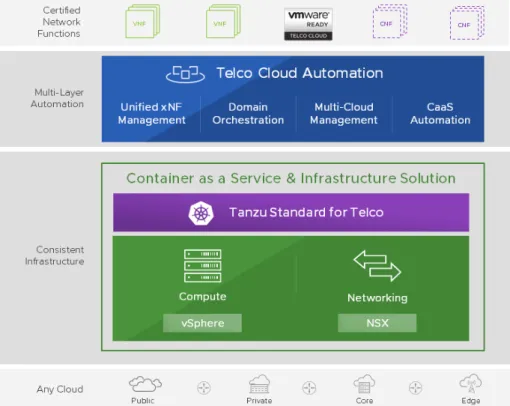
VMware Telco Cloud Platform is powered by field-proven compute and networking coupled with VMware Telco Cloud Automation™ and a telco-grade Kubernetes distribution. VMware Telco Cloud Platform empowers CSPs to rapidly deploy and efficiently operate multi-vendor CNFs and VNFs with agility and scalability across 5G networks that span from the core to the edge.
The field-proven compute and networking, which are supplied by VMware vSphere® and VMware NSX-T™ Data Center, enable CSPs to run both CNFs and VNFs on consistent horizontal infrastructure. The Kubernetes distribution—Tanzu Standard for Telco—is designed to support telecommunications use cases. The platform
implements containers as a service for deploying and managing CNFs.
The platform expedites the innovation cycle, simplifies operations, and reduces costs to modernize your network and accelerate the deployment of 5G services.
Containers as a Service on Consistent Infrastructure
VMware Telco Cloud Platform enables CSPs to take the first step toward cloud modernization by running a broad set of network functions on consistent horizontal infrastructure and deploying them throughout their 5G networks, from core to edge. The solution provides containers as a service (CaaS) and uses Kubernetes to
AT A GLANCE
VMware Telco Cloud Platform™ – 5G Edition is powered by field-proven compute and networking coupled with VMware Telco Cloud Automation™ and a telco-grade Kubernetes distribution. VMware Telco Cloud Platform empowers CSPs to rapidly deploy and efficiently operate multi-vendor CNFs and VNFs with agility and scalability across 5G networks.
KEY BENEFITS
• Gain web-scale speed and agility to accelerate the rollout of 5G services • Deploy virtual network functions (VNFs)
and containerized network functions (CNFs) on consistent horizontal infrastructure • Manage distributed network functions across 5G networks, from core to edge • Optimize the placement of network
functions
• Automate lifecycle management of
infrastructure, Kubernetes clusters, network functions, and services
• Accelerate the deployment of network functions through the VMware Ready for Telco Cloud program
• Follow a reference architecture from VMware to implement a solution that works best for your business
• Add optional components to meet your requirements, including VMware vRealize® Suite, VMware vSAN™, VMware Telco Cloud Operations, and a VIM — either VMware Cloud Director or VMware® Integrated OpenStack
VMware Telco Cloud Platform
Deploy and Operate 5G Functions and Services on
Consistent Infrastructure with Multi-Layer Automation
D ATA S H E E T | 2
orchestrate CNFs and containerized services. The solution supports deploying applications with a microservices architecture, establishing network resiliency, creating seamless cross-cloud application continuity, and isolating multi-tenant services to address business requirements and compliance regulations, such as high availability and service-level agreements.
Multi-Cloud Automation
As part of the platform, VMware Telco Cloud Automation is natively integrated with the infrastructure and the CaaS solution to automate and orchestrate the following layers of the telco stack:
• Infrastructure layer
• Containers as a service layer • Network functions layer • Network services layer
The multi-layer automation enables CSPs to accelerate time-to-market for their network functions and services while igniting operational agility through unified lifecycle management.
The cloud-first approach of VMware Telco Cloud Automation provides multi-cloud placement, easing workload instantiation and mobility from the network core to edge. It also offers standards-driven generic modular components to integrate and extend an existing multi-vendor MANO architecture.
KEY CAPABILITIES
• Architect the network for optimum application response, scale, and service availability
• Utilize microservices and optimize resources with a telco-grade Kubernetes distribution • Deliver new network functions and services
on demand and at scale across multiple clouds
• Gain repeatability across network functions and services
• Onboard network functions using standards-based templates
• Model network services based on multi-vendor network functions
• Automate lifecycle management for network functions
• Obtain 360-degree awareness of your telco cloud from infrastructure to services • Accelerate the time it takes to deploy
functions and services through automated provisioning and the VMware Ready for Telco Cloud program
FIGURE 1: VMware Telco Cloud Platform combines consistent horizontal infrastructure with multi-layer automation and access to an ecosystem of certified network functions.
REFERENCE ARCHITECTURE
VMware Telco Cloud Platform can be deployed across 5G networks to meet target design and scalability objectives. The VMware telco cloud reference architecture
provides guidance for designing and creating an infrastructure and automation solution. The reference architecture describes the high-level design principles and considerations to implement the environment. It also provides example scenarios to help understand the solution's capabilities.
Key Capabilities and Benefits of VMware Telco Cloud Platform
VMware Telco Cloud Platform establishes an open, disaggregated, and vendor-agnostic ecosystem to streamline 5G service delivery from design to lifecycle management automation while creating a unified, developer-friendly architecture with key capabilities for resource optimization, operational consistency, and multi-layer automation.High Performance CaaS and IaaS infrastructure
VMware Telco Cloud Platform enables CSPs to deploy both CNFs and VNFs on consistent horizontal infrastructure. With NSX-T providing enhanced networking between these network functions, the platform offers high performance and scaling, with the following functionality providing examples:
• VMware NSX managed Virtual Distributed Switch in Enhanced Data Path mode (N-VDS (E)) that leverages Data Plane Development Kit (DPDK) techniques to provide a fast virtual switching fabric on VMware vSphere
• Low-latency data plane through CPU pinning, fine-grained non-uniform memory access (NUMA) placement, and vertical NUMA alignment
• Improved performance through multi-tiered routing, bare-metal NSX Edge nodes, and huge pages with the access efficiency of translation lookaside buffers
Telco-grade Kubernetes
The CaaS functionality of VMware Telco Cloud Platform simplifies the operation of Kubernetes for multi-cloud deployments, centralizing management and governance for clusters. The platform provides telco-grade CaaS enhancements, such as the following:
• Multus, Antrea, and Calico to attach multiple container networking interfaces to Kubernetes pods through its plugins
• Topology Manager to optimally allocate CPU memory, and device resources on the same NUMA node to support performance-sensitive applications, and
• Kubernetes cluster automation to simplify deployments and management of Kubernetes master and worker nodes.
With these enhancements, CSPs can take advantage of a telco-grade Kubernetes platform to address emerging 5G use cases.
Additional performance and management enhancements include the following: • Support for conventional performance enhancement technologies, such as DPDK
and single-root input-output virtualization (SR-IOV) for data plane acceleration • Extensions to support automated cluster configuration and provisioning • Profile based worker node dimensioning to optimize usage and performance
Service and application awareness
VMware Telco Cloud Platform dynamically adjusts infrastructure and resources to accommodate the requirements of each network function. With this capability, CSPs can architect their 5G networks for optimum application response, scale, and service availability. The platform supports multiple auto-operation models, triggering actions from NFV operations, VNF management, or EMS to enhance service quality and resiliency. The result helps CSPs improve resource utilization and operational efficiency.
ACHIEVE CLOUD MODERNIZATION
Gain web-scale speed and agility to accelerate the innovation cycle and deliver new services to the market faster while maintaining telco-grade performance, reliability, and quality.
D ATA S H E E T | 4
Tailored design and onboarding
VMware Telco Cloud Platform provides a visual blueprint composer that allows CSPs and equipment vendors to easily create and optimize network function and service templates that follow standards. The platform is vendor-neutral; CSPs can onboard these functions and services with descriptors and packages compliant with ESTI SOL001/004 standards. Network services can also be designed with a combination of network functions from multiple vendors and formats (CNF and VNF). The
onboarded elements are then available in centralized catalogs to maximize reusability.
Multi-layer lifecycle management automation
VMware Telco Cloud Platform lets CSPs centrally manage and automate the virtualized architecture, from CaaS to network services. Application management (G-xNFM) unifies and standardizes network function management across the virtual machine- and container-based infrastructure.
Domain orchestration (NFVO) simplifies the design and management of centralized or distributed multi-vendor network services. CSPs can onboard CNFs and VNFs using standard-compliant TOSCA templates.
The multi-cloud infrastructure and CaaS automation ease multi-cloud registration of Kubernetes clusters and the virtual infrastructure manager (VIM), enable centralized CaaS management, synchronize multi-cloud inventories and resources, and collect faults and performance from infrastructure up to network functions. Kubernetes clusters can be created and optimized automatically to align with the requirements of network functions and services.
By using the centralized VMware Telco Cloud Automation catalogs, CSPs can easily trigger an instantiation workflow. CSPs are guided at each step by an intent-based placement engine that aligns the blueprint requirements with the capabilities of each cloud to minimize rollbacks.
VMware Telco Cloud Platform also offers automation through a policy engine that executes closed-loop policies as well as standard and custom workflows for tailored decisions. For lifecycle management of network functions and services, these policies and workflows apply to the entire lifecycle—from day 0 to day 2 operations. With this multi-layer lifecycle management automation, CSPs can remove complicated, tedious, and repetitive tasks while maximizing overall resource utilization through optimal placement, dynamic scaling, and dynamic workload management.
Streamlined deployment and maintenance
Because VMware Telco Cloud Platform natively integrates the automation with the virtual infrastructure, it transforms integration-intensive projects into efficient product deployments. It accelerates service deployment, simplifies future upgrades, and reduces overall costs while eliminating error-prone manual configurations. Native integration between automation and infrastructure components from VMware also means continuous knowledge of the telco cloud state, optimized placements, VIM and cluster configurations auto-discovery, and continuous synchronization across the components of the telco cloud.
VMware Ready for Telco Cloud Certification Program
VMware further enhances interoperability by certifying partners' network functions through the VMware Ready for Telco Cloud program. With simplified and certified interoperability of functions, CSPs can select the best solutions for their use cases while reducing the risks associated with the complexity of onboarding various network functions.
FOLLOWING STANDARDS FOR INTEROPERABILITY
While many vendor platforms inherently restrict interoperability, VMware Telco Cloud Platform follows the ETSI and CNCF guidelines. The Infrastructure, G-VNFM, and NFVO are designed to interface with ETSI SOL-compliant components of the MANO framework, such as OSS, BSS, EMS, and VNFM. And the solution’s network function composer, coupled with the VMware Ready for Telco Cloud program, bolsters innovation and interoperability—providing ready access to new capabilities.
VMWARE READY FOR TELCO CLOUD AT A GLANCE
The VMware Ready for Telco Cloud program helps CSPs identify VMware partner network functions that have been validated to work with VMware technology. These network functions meet VMware standards for integration and interoperability. The VMware Ready for Telco Cloud logo indicates the unique capabilities of integrated products.
This award-winning program ensures interoperability and operational readiness between VMware Telco Cloud Platform and the network functions of VMware partners, enabling CSPs to onboard and deploy the functions rapidly throughout their 5G networks. With close collaboration with partners, VMware creates an ETSI-compliant descriptor, workflow, resource, and artifacts for a validated and tested Cloud Service Archive (CSAR).
The program removes time-consuming, difficult integration work from CSPs so that they can focus on innovation and accelerate the deployment of 5G services. The objective of the program is to create a multi-vendor ecosystem consisting of numerous network functions.
Included Components
VMware Telco Cloud Platform – 5G Edition comprises the following VMware components.
FUNCTION COMPONENT
CaaS orchestration VMware Tanzu Standard for Telco
Automation VMware Telco Cloud Automation – 5G Edition Compute VMware vSphere Enterprise Plus (with VMware
vCenter Server as a mandatory add-on component) Networking VMware NSX-T Data Center
Optional Components
The following VMware products can be combined to construct a more comprehensive telco cloud environment. VMware Telco Cloud Operations, for example, is an optional component for analytics and assurance that provides holistic end-to-end insights.
FUNCTION OPTIONAL COMPONENT
Infrastructure orchestration VMware Cloud Director or VMware Integrated OpenStack Storage VMware vSAN Standard Operations VMware vRealize Suite Standard Analytics and assurance VMware Telco Cloud Operations
LEARN MORE
For more information about VMware Telco Cloud Platform, call 1-877-VMWARE (outside North America, dial +1-650-427-5000) or visit https://telco. vmware.com/