AIS Electronic Library (AISeL)
AIS Electronic Library (AISeL)
ICIS 2019 Proceedings
Crowds, Social Media and Digital Collaborations
Reposts Influencing the Effectiveness of Social Reporting System:
Reposts Influencing the Effectiveness of Social Reporting System:
An Empirical Study from Sina Weibo
An Empirical Study from Sina Weibo
Jie Tang
The Hong Kong University of Science and Technology, [email protected]
Ka Chung Ng
The Hong Kong University of Science and Technology, [email protected]
Follow this and additional works at: https://aisel.aisnet.org/icis2019
Tang, Jie and Ng, Ka Chung, "Reposts Influencing the Effectiveness of Social Reporting System: An Empirical Study from Sina Weibo" (2019). ICIS 2019 Proceedings. 13.
https://aisel.aisnet.org/icis2019/crowds_social/crowds_social/13
This material is brought to you by the International Conference on Information Systems (ICIS) at AIS Electronic Library (AISeL). It has been accepted for inclusion in ICIS 2019 Proceedings by an authorized administrator of AIS Electronic Library (AISeL). For more information, please contact [email protected].
Reposts Influencing the Effectiveness of
Social Reporting System: An Empirical Study
from Sina Weibo
Short Paper
Jie Tang Department of ISOM
The Hong Kong Univeristy of Sciance and Technology
Clear Water Bay, Kowloon, Hong Kong [email protected]
Ka Chung Ng Department of ISOM
The Hong Kong Univeristy of Sciance and Technology
Clear Water Bay, Kowloon, Hong Kong [email protected]
Abstract
Social media platforms are transforming individuals from passive receivers as in traditional one-way communication channels to active senders who react to and disseminate information easily. However, such feature breeds a wide spreading of unverified information online, i.e., rumor. Previous research pointed out the duality of social media that it can serve as a potential tool for social reporting by leveraging users' collective intelligence, but it could also become a collective rumor mill. We propose that repost amount will positively influence the survival time of rumor, which we use to indicate the effectiveness of social reporting system. The preliminary results support our hypothesis and social contagion theory are adopted to explain the mechanism. We elaborate on the potential contribution and future research plan as well.
Keywords: Rumor, Social Media, Misinformation, Social Reporting System, Weibo
Introduction
Nowadays, social media platforms are changing the way we deliver, receive and disseminate information. People are no longer passive receivers of news and events as in traditional one-way communication channels. Instead, everyone can be an information source, and further, get it disseminated to a wider audience through social media. Oh et al. (2013) pointed out the duality of social media in the context of social crisis. They noted that social media can serve as a potential tool for social reporting, which is beneficial to get things clear by leveraging community users’ knowledge, which they called “collective intelligence”; but it may also become a collective rumor mill, which might accelerate exponentially the transmission of misinformation, gossip, and even propaganda (Leberecht 2010). Similarly, rumor, defined as an unverified statement which refers to an object, person, or situation rather than an idea or theory (Buckner 1965), is also believed to encounter such duality issue when being disseminated on social media. On the one hand, one may concern for social stability sake, that getting an unverified statement spread too widely may stir anxiety or other undesired emotions among people. On the other hand, social media might serve as an informal channel (as compared with traditional mainstream ones) of information dissemination, which could assure people be well-informed, take active participation in public discussion, and facilitate clarification of facts through such discussion.
Sina Weibo is one of the biggest and most popular microblogging websites in China1. Launched by Sina Corporation on 14 August 2009, Sina Weibo grew dramatically fast and has over 445 million monthly active users till Q3 20182. Facing the duality issue mentioned above, Sina Weibo launched a “Community
1Michelle & Uking (2 March 2011). "Special: Micro blog's macro impact". China Daily 2Weibo Added 15 Million Users in Q3". finance.yahoo.com
Management Center”3 in May 2012, which is believed to take advantage of community users’ collective intelligence in getting rid of misinformation and to control its spread. It relies on the social reporting system where users can report a post if he/she believes it is misinformation, and the details of this report are publicly displayed, including the report user ID, report reason, reported post, and processing stage (i.e., stage of proof, judgment, and publicity). Once the post being reported is decided as a rumor, further transmission will be prohibited.
From the description above, we may expect that if the reporting system is effective and efficient, a rumor’s survival time, i.e., the duration of transmission, on social media should be short, meaning that it is identified and reported quickly. Misinformation online can cause tremendous social impacts on people’s behaviors and thought. In December 2016, The New York Times reported that a man carried an AR-15 rifle and walked into a pizza restaurant in northwest Washington because he read online that the restaurant “was harboring young children as sex slaves as part of a child-abuse ring led by Hillary Clinton”4. Therefore, we believe it is important to study the reporting system because it signifies the transmission of misinformation is under control and undesired consequences like mass hysteria would be less likely to happen. We choose to study the effect of sharing, to be more specific, users’ repost of the rumor, on survival time. There are two reasons for us to focus on this factor.
Firstly, most of the existing literature on rumor spreading focus on static factors such as rumor’s characteristic, e.g., topic (Vosoughi et al. 2018), content ambiguity (Oh et al. 2013); or the characteristic of the sender, e.g., credibility (Oh et al. 2013; Guan et al. 2014); or the receiver, e.g., gender (Guan et al. 2014). However, little-to-no attention was paid to other user’s interaction with the focal post. Although it has long been acknowledged in classical communication theories like the Shannon-Weaver Model (Shannon 1948) that the elements sender, receiver, and message are critical in communication. We propose in the context of nowadays social media, an interactive perspective would be necessary to help advance our understanding. Compared to traditional communication channels like newspaper, broadcast, and television, social media platforms which provide many easy ways for every single user to express their attitudes and thoughts. Everyone who reposts a message becomes a sender, in addition to a receiver, in the further transmission of this message. Such interaction is supposed to influence how long information can survive during transmission because it could be slowed or even stopped when expressed suspicion and proof accumulated. The effect of this process is important, therefore, we aim to study its role in the current study. Secondly, practically speaking, repost is one of the most common channels provided by the social media platforms for rumors being noticed and exerting impact on the audience. Among the interaction functions provided, i.e., “like”, “add to favorite”, “comment” and “repost”, it is obvious that repost is the most influential way for information dissemination. Because if the one who reposts has expressed some opinions or attitudes, they can be seen most widely through repost than other ways and would be integrated by the subsequent audience. Even if the one who reposts says nothing but just spread it out, it is already a direct action of dissemination. So, if we are adopting the interactive perspective to understand user’s reaction on the survival time of rumor, we hope to capture the most influential means of interaction, i.e., repost. Based on the above discussion, we propose our research question formally as following:
RQ: How can repost amount influence the survival time of a piece of rumor in social media platform with a social reporting system?
The current research leverages microblog posts that are reported by users and ultimately verified in the Sina Community Management Center as misinformation. However, they should be treated as rumors as they are unverified during their dissemination. We address our research question by regressing the rumor survival time on the count of its reposts, controlling for message- and sender-specific characteristics. Our preliminary findings show that repost amount has a positive significant effect on rumor’s survival time, which support our hypothesis. Moreover, we address the problem of reverse causality by restricting the rumor spreading time span to investigate how repost amount in the first 1, 5, 30 and 60 minutes, respectively, influence rumor survival time and the results are consistent to our main findings. We plan to
3http://service.account.weibo.com/?type=0&status=4
4 https://www.nytimes.com/2016/12/05/business/media/comet-ping-pong-pizza-shooting-fake-news-consequences.html
improve the current study in two directions: 1) we will provide more robustness tests to understand how users’ interaction affects rumor’s survival time, and 2) we will explore the underlying mechanisms with more in-depth analysis of repost texts.
Overall, we believe that our study can contribute to the growing literature of rumor and misinformation analysis. We address the gap by studying the relationship between rumor dissemination and its survival time. And we empirically test the effectiveness of social reporting system, which will advance our understanding on the duality of information dissemination on social media. By further understanding the psychological mechanism of this relationship, our study can also provide practical implication to social media platforms in building effective systems to leverage the collective intelligence but minimize the undesired consequences of rumor spreading to society.
Literature Review
Rumor spreading has long been discussed theoretically in literature. According to the basic law of rumor proposed by Allport and Postman (1947), "first, the theme of the story must have some importance to speaker and listener; second, the true facts must be shrouded in some kind of ambiguity" (p. 33). It has been widely accepted and extended by many subsequent studies. For example, Rosnow (1991) hypothesized four conditions to predict rumor generation and transmission, i.e., general uncertainty, outcome-relevant involvement, personal anxiety, and credulity. Similarly, Oh et al. (2013) adopted and extended Allport and Postman (1947)’s model to study user’s tweet during the social crisis, where such information processing can be either collective intelligence in the form of social reporting or collective rumor mills. They found that information source ambiguity, personal involvement, and anxiety aroused are significant predictors for rumor dissemination.
In addition to these attempts in enriching theoretical foundations, emerging empirical research are investigating rumor or misinformation spreading as well. A recent study by Vosoughi et al. (2018) showed a comprehensive descriptive spread pattern of true and false news online, indicating that they differ in terms of spread scale, speed, and induced emotions. The authors also differentiated false news based on topic, i.e., the effect is more profound for political news than other topics like terrorism, natural disasters, etc. Guan et al. (2014) go beyond characteristics of the message, by examining characteristics of the message (i.e. picture-contained or not, URL-contained or not), the sender (i.e., verified account or not) and the receiver (i.e., gender). Several studies on emergency crisis information propagation on Twitter used retweet count as a dependent variable to study its spreading pattern. For instance, Sutton et al. (2015a) adopted a social network lens to study how user’s follower-followee networks influence the crisis information transmission. Sutton et al. (2015b) focused on the message itself and examined the effect of tweet’s content and style feature. Notably, Burnap et al. (2014) provided a novel dynamic perspective and studied the information flows in the transmission process over time.
In terms of the duality issue we pointed above, a few studies put effort into exploring the way how social media can control the spreading of misinformation. Pennycook and Rand (2019) studied the influence of social media platform algorithms on misinformation spreading. They found that news content ranking algorithms based on crowdsourced trust ratings can help people effectively identify more reliable sources, thus reduce the circulation of misinformation online. Ross et al. (2018) examined the effectiveness of warning messages, which was supposed to be a possible mechanism to control the propagation of false information on social media. They tested two designs of warning messages, i.e., flagging news as disputed and including negatively framed risk-handling advice, but no evidence supported either design as effective. Bode and Vraga (2015) also considered the role that social media may play in correcting misinformation. They tested a function of Facebook, which provides related stories upon clicking a post including misinformation. They manipulated the related stories and found that when they correct (vs confirm) the misinformation, misperceptions are significantly reduced. Both Ross et al. (2018) and Bode & Vraga (2015) examined possible solutions for controlling misinformation spreading. However, their studies are not investigating directly the final state of the misinformation, but user’s subjective perception instead. The current study complement prior studies by 1) examining a different mechanism where rumors are controlled through a social reporting system; and 2) considering directly the survival time, i.e., the time span between the original post and the last repost, to proxy the effectiveness of such mechanism.
Hypothesis Development
As introduced before, we are particularly interested in the repost amount of rumor as a predictor of survival time. There are two competing possibilities. On the one hand, more repost may result in shorter survival time. This prediction is consistent with the original intention of introducing social reporting system, i.e., making use of collective intelligence to detect rumors. So, the argument would be that as repost getting more, a bigger base of the audience is exposed to the rumor, thus it would be more likely that someone would identify it as misinformation and report it.
On the other hand, more repost may result in longer survival time. Because, as more people involved in the process, individuals rely on the “collective” to identify the truth, and tend not to put much cognitive effort on their own. Contagion theory can be used to account for such claim. Ogunlade (1979, p. 205) describes behavioral contagion as a “spontaneous, unsolicited and uncritical imitation of another’s behavior”. It occurs when the observer and the model share a similar situation or mood and when the model’s behavior encourages the observer to review his condition and to change it. In our context, the model can be anyone who already posted the rumor, either original post or repost, and the observer is the person who is exposed to the focal rumor. Obviously, they share the same concerns about what is contained in the rumor message, and model’s (re)post behavior makes the observer exposed to the rumor thus examine his/her situation. As social contagion theory suggested, members of collective behavior crowds are temporarily irrational or even act without thinking. Therefore, it is reasonable to predict that when rumors getting spread wider, people are entering a collective crowd and act with little critical thinking nor much cognitive effort for truth-seeking.
We would argue that in the context of rumor spreading on social media, the latter mechanism would prevail. Social media, an emerging online platform for information spreading, differentiates from offline information channel as it is anonymous. As early contagion theorists (e.g., Le bon 1895; Park 1972) indicated, one component of being psychologically crowd is that the individuals feel invisible and anonymous, which will allow people to behave without worrying personal consequence. Therefore, we assume that given the important anonymity of social media, the platform users who are exposed to rumors are more likely to act as members in the crowd, i.e., temporarily irrational, influenced by each other and behave without critical thinking. Therefore, we propose that more repost of a rumor predicts a longer survival time.
Data
Data Collection and Analysis
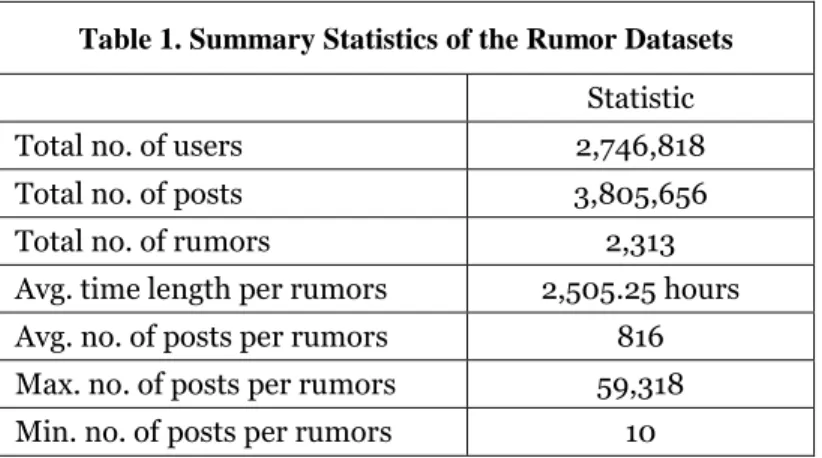
We obtain a publicly available rumor dataset from Ma et al. (2016). Their microblog datasets were constructed from Sina Weibo between 5/2010 and 4/2014. They collected a set of known rumors from the Sina community management center, which officially reports various kinds of misinformation spread in social media. Given a rumor ID, they obtained its content, all related information and repost/reply messages using the Weibo API. The resulting dataset consists of 2,313 rumors. Table 1 shows the summary statistics of the datasets.
Table 1. Summary Statistics of the Rumor Datasets Statistic Total no. of users 2,746,818 Total no. of posts 3,805,656
Total no. of rumors 2,313
Avg. time length per rumors 2,505.25 hours Avg. no. of posts per rumors 816 Max. no. of posts per rumors 59,318 Min. no. of posts per rumors 10
Given that the Sina Community Management Center was launched in May 2012, we restrict our analysis on rumor posted after May 2012. We check that a rumor contains 110.5 Chinese characters on average, with a standard deviation of 44.1. This means that rumors are generally long story with details. Besides, the majority of rumor contains picture (86% of the total), which we believe is a way to increase rumor’s perceived believability. To better understand the datasets, we further run a topic modeling algorithm on all rumors and choose the number of topics based on the goodness-of-fit (AIC and BIC). We obtain 20 topics in total, which covers various aspects, such as government, Olympic game, international relationship, law, university, health, education, etc. This provides generalizability to our study.
Dependent, Independent and Control Variables
We are interested in understanding the survival time of a rumor, thus our dependent variable is represented by the time between the created time and the time being reported of a rumor, measured in hour. As it is hard to obtain the exact rumor reporting time from Weibo, we consider the time between the created time and the time of the last repost as a proxy for rumor’s survival time. This is reasonable as a post is restricted for any further actions (repost, comment or express attitude) once being reported as a rumor.
For our independent variable, it is the number of reposts of a rumor. Both reposts with and without comments are considered. On average, the proportion of reposts without comments is 30.1%, which means nearly one-third of reposts are simply shared without any expression or thought. We even find one rumor consists solely of reposts without comments. Besides, among those reposts with comments, we find that the proportion of reposts with emoji only is 7.7% and with comments less than 10 Chinese characters is 24.3%. These show that people likely share messages without much cognitive processing, which provides us insight into the reason why more share will lead to longer rumor survival time.
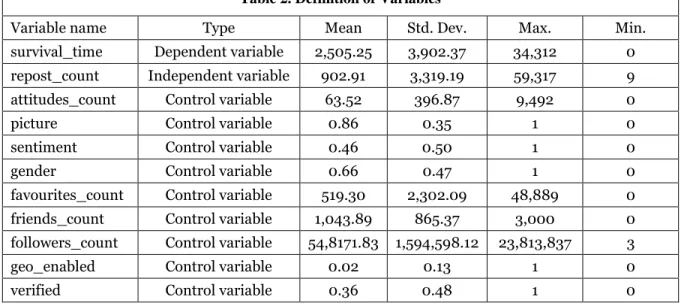
We also consider a set of control variables obtained from the dataset. We first consider message-specific control variables, which include the count of the number of attitudes (e.g. like) expressed by people and an indicator indicating whether the rumor includes a picture or not. Vosoughi et al. (2018) found that people generally have biases in sharing, which is caused by the sentiment of the information. Therefore, we measure the sentiment of a rumor using machine learning model and employ it as a control in our analysis. Next, we consider sender-specific control variables, including the gender and the number of favourites, friends, and followers of the sender. We also control whether the sender has enabled the possibility of geotagging and whether the sender account is officially verified or not. The descriptive statistics of all variables used in our study are summarized in Table 2. One note is that a survival time of zero means that the rumor was reported within an hour.
Table 2. Definition of Variables
Variable name Type Mean Std. Dev. Max. Min.
survival_time Dependent variable 2,505.25 3,902.37 34,312 0 repost_count Independent variable 902.91 3,319.19 59,317 9 attitudes_count Control variable 63.52 396.87 9,492 0
picture Control variable 0.86 0.35 1 0
sentiment Control variable 0.46 0.50 1 0
gender Control variable 0.66 0.47 1 0
favourites_count Control variable 519.30 2,302.09 48,889 0 friends_count Control variable 1,043.89 865.37 3,000 0 followers_count Control variable 54,8171.83 1,594,598.12 23,813,837 3
geo_enabled Control variable 0.02 0.13 1 0
Analysis & Results
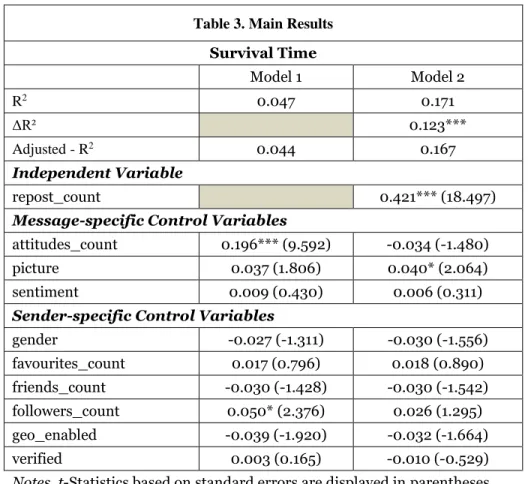
Table 3 shows the results of our main analysis. Model 1 includes only control variables and it obtained an R-square of 0.047. From the model, we observe that the count of attitudes is significantly positively related to survival time, which means that a rumor with more attitudes expressed by people is more likely to survive. Besides, followers_count is also statistically significant, meaning that more followers of the sender will help rumor to survive. Model 2 shows the effect of repost_count in addition to control variables, the R-square increased largely by 0.123 with statistical significance, which means that our variable of interest can provide additional explanatory power to rumor survival time. It is significantly positively related to survival time (𝛽 = .421, 𝑝 < .001), which support our hypothesis. We also note that after including repost_count in the model, the effects of attitudes_count and followers_count are dissipated. We check the multicollinearity between variables and it is not a concern as all variance inflation factors (VIFs) of variables are below 1.5. For attitudes_count, two possible reasons are that (1) attitudes_count may act as a proxy of repost_count, or (2) repost_count gets more explanatory power and suppresses the effect of attitudes_count. For followers_count, we expect that repost_count should act as a mediator between followers_count and survival_time, as followers in most cases express their view through reposting. This conjecture is supported by a mediation analysis (Zhao et al. 2010), in which we find an indirect-only mediation effect. Specifically, when repost_count is not considered, the effect of followers_count on survival time is significant (𝛽 = .050, 𝑝 < .05). When repost_count is considered, the indirect effect of follower_count on survival time is
significant, where the standard coefficient for follower_count on repost_count is 0.068 (𝑝 < .01), and that for repost_count on survival time is 0.421 (𝑝 < .001). Meanwhile, the direct effect of follower_count on survival time becomes non-significant (𝛽 = .026, 𝑝 > .05). Apart from that, we observe that all sender-specific variables are statistically non-significant.
Table 3. Main Results
Survival Time Model 1 Model 2 R2 0.047 0.171 ΔR² 0.123*** Adjusted - R2 0.044 0.167 Independent Variable repost_count 0.421*** (18.497)
Message-specific Control Variables
attitudes_count 0.196*** (9.592) -0.034 (-1.480)
picture 0.037 (1.806) 0.040* (2.064)
sentiment 0.009 (0.430) 0.006 (0.311)
Sender-specific Control Variables
gender -0.027 (-1.311) -0.030 (-1.556) favourites_count 0.017 (0.796) 0.018 (0.890) friends_count -0.030 (-1.428) -0.030 (-1.542) followers_count 0.050* (2.376) 0.026 (1.295) geo_enabled -0.039 (-1.920) -0.032 (-1.664) verified 0.003 (0.165) -0.010 (-0.529) Notes. t-Statistics based on standard errors are displayed in parentheses below the coefficient estimates.
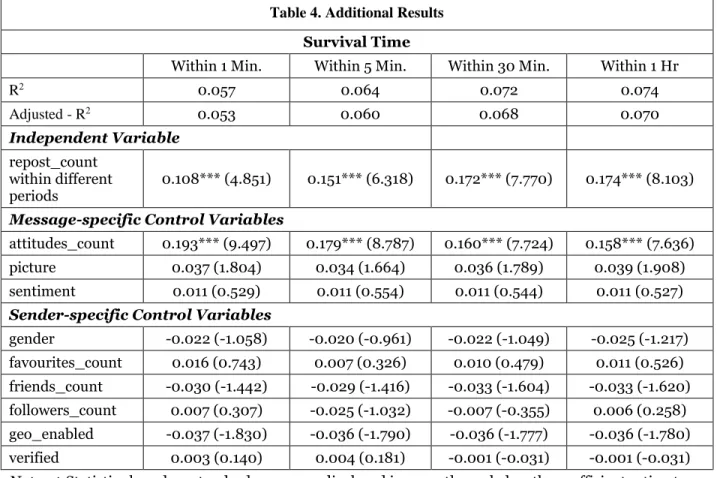
One may argue that a rumor can be reposted a lot because it can survive long. To address this concern, we restrict our count of reposts within one minute, five minutes, 30 minutes and an hour from the rumor creating time. We argue that how long a rumor can survive should not affect people’s responses to the rumor within the starting short period. Table 4 summarizes our findings. The results show that the number of reposts has a significant positive effect on all four cases. These means that more reposts will indeed lead to longer rumor survival time even within a short period of time. Besides, we observe that after restricting the count of reposts within different periods, attitutes_count becomes significant again. While when we extend the period of time, the effect of attitutes_count reduces and becomes smaller than the effect of repost_count. This suggests that repost_count indeed suppresses the effect of attitutes_count.
Table 4. Additional Results
Survival Time
Within 1 Min. Within 5 Min. Within 30 Min. Within 1 Hr
R2 0.057 0.064 0.072 0.074 Adjusted - R2 0.053 0.060 0.068 0.070 Independent Variable repost_count within different periods 0.108*** (4.851) 0.151*** (6.318) 0.172*** (7.770) 0.174*** (8.103)
Message-specific Control Variables
attitudes_count 0.193*** (9.497) 0.179*** (8.787) 0.160*** (7.724) 0.158*** (7.636) picture 0.037 (1.804) 0.034 (1.664) 0.036 (1.789) 0.039 (1.908) sentiment 0.011 (0.529) 0.011 (0.554) 0.011 (0.544) 0.011 (0.527)
Sender-specific Control Variables
gender -0.022 (-1.058) -0.020 (-0.961) -0.022 (-1.049) -0.025 (-1.217) favourites_count 0.016 (0.743) 0.007 (0.326) 0.010 (0.479) 0.011 (0.526) friends_count -0.030 (-1.442) -0.029 (-1.416) -0.033 (-1.604) -0.033 (-1.620) followers_count 0.007 (0.307) -0.025 (-1.032) -0.007 (-0.355) 0.006 (0.258) geo_enabled -0.037 (-1.830) -0.036 (-1.790) -0.036 (-1.777) -0.036 (-1.780) verified 0.003 (0.140) 0.004 (0.181) -0.001 (-0.031) -0.001 (-0.031) Notes. t-Statistics based on standard errors are displayed in parentheses below the coefficient estimates. *, ** and *** indicate the significant level at 5%, 1% and 0.1%, respectively.
Conclusion
We intend to contribute to the growing literature on rumor spreading by investigating the effectiveness of the rumor reporting system from users’ reaction to the rumor. We show that more reposts of the rumor will significantly extend its survival time, signifying a less effective social reporting system. The possible mechanism we propose is that in online social media like Sina Weibo, where anonymity is an important peculiarity, users have little concerns about their behaviors on personal consequences. Users are likely to become crowd as identified in contagion theories (Le bon 1895; Park 1972), where they behave in an uncritical, irrational way, and are easy to be influenced by each other. Such tendency is assumed to be especially salient when they are exposed to unverified information, i.e., rumor. Therefore, the original intention of setting social reporting system to utilize collective intelligence may not work well. Our study also provides practical implication to social media platform that other means shall be implemented to control rumor spreading.
We plan to further validate and explore the mechanism of such relationship in two directions. We will conduct a richer textual analysis on reposts to uncover people’s emotional tone and attitudes toward the
rumor. This would allow us to further identify whether social media help promote collective intelligence or serves as a collective rumor mill. Further, we will conduct a controlled experiment to uncover the underlying mechanism of the relationship between rumor dissemination and the effectiveness of the reporting system, with more rigorous control on message- and sender-specific characteristics. In doing so, we can further address the confounding concerns instead of simply controlling for several message- and sender-specific characteristics. With a clearer understanding of the mechanism of such relationship, we might continue investigating how platform features (i.e. algorithm, user interface, policy) can leverage this mechanism to reduce rumor dissemination.
References
Allport, G. W., and Postman, L. 1947. “The Psychology of Rumor”.
Bode, L., and Vraga, E. K. 2015. “In Related News, That Was Wrong: The Correction of Misinformation Through Related Stories Functionality in Social Media,” Journal of Communication (65:4), pp. 619-638.
Buckner, H. T. 1965. “A Theory of Rumor Transmission,” Public Opinion Quarterly (29:1), pp. 54-70. Burnap, P., Williams, M.L., Sloan, L., Rana, O., Housley, W., Edwards, A., Knight, V., Procter, R., and Voss,
A. 2014. “Tweeting the Terror: Modelling the Social Media Reaction to the Woolwich Terrorist Attack,” Social Network Analysis and Mining (4:1), pp. 1-14.
Guan, W., Gao, H., Yang, M., Li, Y., Ma, H., Qian, W., Cao, Z. and Yang, X. 2014. “Analyzing User Behavior of the Micro-Blogging Website Sina Weibo during Hot Social Events,” Physica A: Statistical Mechanics and its Applications (395), pp. 340-351.
Le Bon, G. (1896) “The crowd: A study of the popular mind”. New York: The Macmillan Company. Leberecht, T. 2010. “Twitter Grows up in Aftermath of Haiti Earthquake,” CNET News, 19.
Ma, M., Gao, W., Mitra, P., Kwon, S., Jansen, B. J., Wong, K. F., and Cha, M. 2016. “Detecting Rumors from Microblogs with Recurrent Neural Networks,” in Proceedings of the 25th International Joint Conference on Artificial Intelligence, S. Kambhampati (eds.), New York, NY, pp. 3818-3824.
Ogunlade, J. O. 1979. “Personality Characteristics Related to Susceptibility to Behavioral Contagion,” Social Behavior and Personality: An International Journal (7:2), pp. 205-208.
Oh, O., Agrawal, M., and Rao, H. R. 2013. “Community Intelligence and Social Media Services: A Rumor Theoretic Analysis of Tweets During Social Crises,” MIS Quarterly (37:2), pp. 407-426.
Park, R. E., and Levine, D. N. 1972. “The Crowd and the Public: Masse und Publikum and Other Essays” Henry Elsner. jr (eds.), London, University of Chicago Press.
Pennycook, G., and Rand, D. G. 2019. “Fighting Misinformation on Social Media using Crowdsourced Judgments of News Source Quality,” PNAS (116:7), pp. 2521-2526.
Rosnow, R. L. 1991. “Inside Rumor: A Personal Journey,” American Psychologist (46:5), pp. 484.
Ross, B., Jung, A., Heisel, J., and Stieglitz, S. 2018. “Fake News on Social Media: The (In) Effectiveness of Warning Messages,” in Proceedings of the 39th International Conference on Information Systems, J. P. Heje, S. Ram, and M. Rosemann (eds.), San Francisca, USA, pp. 1-17.
Shannon, C. E. 1948. “A Mathematical Theory of Communication,” Bell system technical journal (27:3), pp. 379-423.
Sutton, J., Spiro, E.S., Fitzhugh, S., Johnson, B., Gibson, B., and Butts, C.T. 2014a. “Terse Message Amplification in the Boston Bombing Response,” in Proceedings of the 11th International Conference on Information Systems for Crisis Response and Management, S. R. Hiltz, M. S. Pfaff, L. Plotnick, P. C. Shih, University Park, PA, pp. 612-621.
Sutton, J., Spiro, E.S., Johnson, B., Fitzhugh, S., Gibson, B., and Butts, C.T. 2014b. "Warning Tweets: Serial Transmission of Messages During the Warning Phase of a Disaster Event," Information, Communication & Society (17:6), pp. 765-787.
Vosoughi, S., Roy, D., and Aral, S. 2018. “The Spread of True and False News Online,” Science (359:6380), pp. 1146-1151.
Zhao, X., Lynch, J. G., and Chen, Q. 2010. “Reconsidering Baron and Kenny: Myths and Truths about Mediation Analysis,” Journal of Consumer Research (37:3), pp. 197-206.