The effect of electronic medical record system use on communication between
1pharmacists and prescribers.
23
Alexander Singer1*§, Roberto Duarte Fernandez1* 4
5
1Department of Family Medicine, University of Manitoba, Winnipeg, Manitoba, Canada 6
7
*These authors contributed equally to this work 8 § Corresponding author 9 10 11 Email addresses: 12 AS: [email protected] 13 RDF: [email protected] 14 15 16 17 18 19 20
Abstract
21Background: The Electronic Medical Record (EMR) is becoming increasingly common in health 22
care settings. Research shows that EMRs have the potential to reduce instances of medication 23
errors and improve communication between pharmacists and prescribers; however, more 24
research is required to demonstrate whether this is true. This study aims to determine the effect 25
of a newly implemented EMR system on communication between pharmacists and primary care 26
clinicians. 27
Methods: A retrospective chart analysis of primary care EMR data comparing faxed pharmacy 28
communications captured before and after the implementation of an EMR system at an 29
academic family medicine clinic. Communication requests were classified into the following 30
various categories: refill accepted, refill denied, clarification, incorrect dose, interaction, drug 31
insurance/coverage application, new prescription request, supplies request, continued care 32
information, duplicate fax substitution, opioid early release request, confirmation by phone call, 33
and other. 34
Results: The number and percentage of clarification requests, interaction notifications, and 35
incorrect dose notifications were lower after the implementation of the EMR system. The 36
number and percentage of refills accepted and new prescription requests increased after the 37
implementation of the EMR system. 38
Conclusion: The implementation of an EMR in an academic family medicine clinic had a 39
significant effect on the volume of communication between pharmacists and prescribers. The 40
amount of clarification requests and incorrect dosing communications decreased after EMR 41
implementation. This suggests that EMRs improve prescribing safety. The increased amount of 42
refills accepted and new prescription requests post EMR implementation suggests that the EMR 43
is capable of changing prescription patterns. 44
Keywords: Electronic Health Record, Electronic Medical Record, Electronic Medical Records, 45
Electronic Health Records, Prescribing, Primary Care, Medication Safety 46
Background
47Medication errors are an unfortunate, yet frequent part of medical care. Franklin et al [1] define 48
medication errors as “any error in prescribing, dispensing or administration of medication.” 49
These are common causes of preventable drug-related emergency department visits, 50
hospitalizations and deaths. In some cases, these errors may result in adverse drug events, 51
which refer to any harm induced by medication administered during medical treatment or 52
diagnostic procedures [1]. According to Kohn et al [2], adverse events cost the United States 53
between $37.6 billion and $50 billion, while preventable adverse events cost them between $17 54
billion and $29 billion. These values include costs sustained by lost income, lost household 55
production, disability, and health care costs. In 1993, medication errors were responsible for an 56
estimated 7,000 deaths [2]. In a study in Germany, Rottenkolber et al [3] found that adverse 57
drug events cost the country € In Canada, preventable drug-related
58
hospitalizations cost the healthcare system an estimated $2.6 billion per year [4]. 59
There are different types of medication errors, one type being prescribing errors [1]. Many 60
medication errors may be related to pharmacists misinterpreting the exact details on a 61
prescription. Presumably this was a greater issue with hand written prescriptions and digital 62
health records should improve this type of error. In a study carried out in the UK, researchers 63
found that 36% of paper records were at least somewhat illegible, while legibility of the EMR 64
was not an issue [5]. Prescribing errors made up 70% of medication errors in two studies carried 65
out by the American Academy of Family Physicians and National Research Network in primary 66
care clinics; according to Kuo et al [6], electronic tools could have prevented at least half of 67
these errors. Based on these studies, it is clear that prescribing involves a significant risk for 68
patients. Fortunately, communication between prescribing clinicians and pharmacists is evolving 69
and changing with the expanded and consistent use of electronic medical records (EMR) in 70
primary care. 71
Studies examining the effect of EMRs on prescribing have shown an impact on prescribing 72
practices and potential errors. Based on the findings of Lau et al [7], EMR use has a 51% 73
chance of improving office practice, a 19% chance of having negative consequences, and a 74
30% chance of not having any effect. In a study in Pakistan, electronic prescribing had a 75
profound impact on prescribing errors and decreased their frequency [8]. According to Tamblyn 76
et al [9], the use of computerized decision-making support resulted in fewer instances of 77
inappropriate prescriptions and higher rates of discontinuation of drugs causing harmful 78
interactions. While it is clear that EMRs have the potential to improve quality of care by reducing 79
the likelihood of errors, further exploration is needed to determine if this potential is being met. 80
The purpose of this study is to determine the effect of a newly implemented EMR on 81
communication between pharmacists and primary care clinicians. There is a paucity of data on 82
the effect of EMRs on communication between prescribers and pharmacists in primary care 83
populations. Our aim was to determine how the EMR affects the number and type of faxed 84
communication requests received from pharmacists. During the study period, there were no 85
formal changes to the typical practices and normative behaviours regarding how clinicians 86
decided on whether to issue a prescription without seeing a patient. As in other clinical 87
environments however, it is a clinician’s decision based on the information available whether to 88
issue a renewed prescription without formally seeing a patient in the clinic. We hypothesized 89
that after several years of using an EMR, communication patterns and types of communication 90
will have changed. Specifically, we were most interested in whether the introduction of EMRs 91
would reduce the number of clarification faxes. By better understanding this process, we may 92
also be better able to expect the impact of further modernization on prescribing in the primary 93 care environment. 94
Methods
95We conducted a retrospective chart analysis comparing faxed pharmacy communications 96
captured before and after the implementation of an EMR in December 2011 at a family medicine 97
academic teaching unit in Winnipeg. We analyzed faxed pharmacy communications spanning 98
from September to November 2011 (the period immediately prior to the implementation of the 99
EMR) and we analyzed communications from one of the provincially approved EMRs (QHR 100
Accuro) from September to November 2014 (39 months after EMR implementation). Requests 101
were classified into various categories including: refill accepted, refill denied, clarification, 102
incorrect dose, interaction, drug insurance/coverage application, new prescription request, 103
supplies request, continued care information, duplicate fax, substitution, opioid early release 104
request, confirmation by phone call, and other. Clarification requests were defined as requests 105
that could not be interpreted by pharmacists without intervention because of illegibility or other 106
communication issues. The analysis was conducted at the Family Medical Centre (FMC) in the 107
Department of Family Medicine at the University of Manitoba. FMC is an academic family 108
medicine teaching unit that has prescribers including primary care clinicians (Family Physicians 109
and Nurse Practitioner) along with resident learners and a clinician pharmacist, as well as other 110
members of a multi-disciplinary health team including a nurse, dietician and social worker. 111
Ethical approval for this study was obtained from the Winnipeg Regional Health Authority and 112
the University of Manitoba Research Ethics Board. Individual participant consent was not 113
obtained in accordance with Canada’s Tri-Council Policy Statement: Ethical Conduct for 114
Research Involving Humans and the University of Manitoba Research Ethics board policy 115
regarding retrospective chart reviews. 116
117
Results
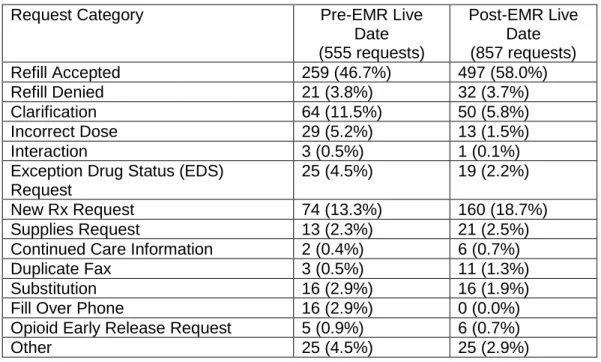
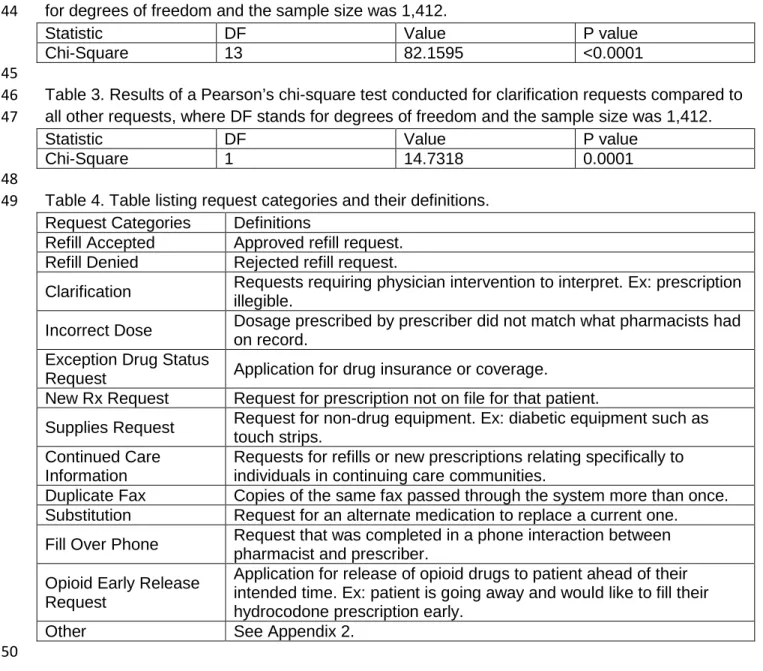
118Our findings are summarized in Table 1, consisting of our raw data. Our statistical findings are 119
summarized in Tables 2 and 3 (see Appendix). 120
Table 1 presents the number of different communication requests between pharmacists and 121
prescribers, both before electronic medical records (EMRs) were implemented and three years 122
after EMRs were implemented. In both time periods the most frequent communications were 123
regarding accepted refills, while the least frequent communications concerned drug interactions. 124
In the refill accepted, refill denied, new prescription, supplies request, continued care 125
information, duplicate fax, and opioid early release request categories there were more 126
communications after EMR implementation than before EMR implementation. Table 1 also 127
shows that the number of clarification and incorrect dose communications was lower after EMR 128
implementation. 129
Pearson’s chi square test was used to compare the use of an EMR and different request 130
categories. This revealed that the use of an EMR did have an impact on the difference in the 131
number of requests seen in both timeframes, p<0.0001. In a separate Pearson’s chi square test, 132
the use of an EMR was shown to affect the number of clarification requests, specifically, in each 133
timeframe, p=0.0001. In both tests, our p-values indicate statistical significance. PROC 134
GLIMMIX of SAS version 9.3 (SAS Institute, Cary NC) was used for our analysis. 135
Discussion 136
Our results demonstrate a statistically significant change in the types of faxed communication 137
between pharmacists and primary care providers after the implementation of an EMR. The 138
most clinically significant change is a dramatic reduction in the number of incorrect dose and 139
clarification requests, with a slight decrease in the number of interaction requests. It is also 140
interesting to note that the number of refill requests and duplicate faxes increased after EMR 141
implementation. 142
The reduction in clarifications and incorrect dose notifications from pharmacists supports 143
previous work demonstrating that EMR prescriptions are consistently legible. Ammenwerth et al 144
[10] demonstrated that compared to handwritten prescriptions, use of EMRs led to a higher 145
relative risk reduction in studies that compared different EMR systems. This is not surprising 146
since EMRs eliminate the possibility of legibility errors, but from a medication safety point of 147
view this is an important benefit. Clarification requests serve as a corollary for “near misses” in 148
prescribing errors, as those are items that a pharmacist takes the time to review and require 149
intervention from the pharmacist [11]. Presumably, given the large number of prescribing errors 150
that are known to be made in general, many relate to incorrect doses or incorrect medications 151
being dispensed, leading to patients being harmed [6]. 152
Interactions are another area of interest. The EMR used in the study site does have a decision 153
support tool that scans for drug interactions as do pharmacy systems in Manitoba. The number 154
of interactions noted by pharmacists dropped, but a very small number were reported as faxed 155
communications in both pre and post EMR implementation. This may relate to other forms of 156
communication being used to discuss interactions, such as telephone calls. Alternatively, it may 157
mean that the decision support systems meant to pick up interactions are not being monitored 158
carefully and therefore, providers are not discussing the findings frequently. The dramatic 159
increase in the total number of refill requests and requests for new prescriptions was an 160
interesting and surprising finding. We expected the EMR to be more efficient than a paper 161
record in terms of renewing medications at the time of a visit and determining when medications 162
were due. We attempted to allow for significant maturity of use post EMR implementation so 163
that primary care provider familiarity with the EMR was not as great an issue. Unpublished 164
quality improvement work undertaken at the study site has shown that billings and appointment 165
availability went up post-EMR, despite the clinic being mostly closed to new patients, with the 166
exception of prenatal and pediatric patients. Practice sizes remained very stable at the study 167
site. In addition, the total number of patient visits per month remained stable over the two time 168
periods. Thus, there must be other potential explanations beyond lack of patient access. 169
One such explanation is the ease with which prescribers can fill refill requests in the new 170
electronic system. Rather than have a patient book an appointment to fill an ongoing 171
prescription, prescribers may be opting to examine their patients’ records and fill the refill 172
request digitally when appropriate to do so. Our study was also not designed to consider a 173
change in pharmacist practice during the study period either. It is also possible that during the 174
study period there was a change in pharmacists’ communication patterns making them more 175
likely to send faxed communications, but our study was not designed to explain such an 176
association. 177
Another possible explanation may be a capture bias. The process by which fax renewal 178
requests were recorded in the paper environment was a workflow designed by the 179
administrative staff to keep back-up copies of prescription faxes for 1 month prior to being 180
shredded. This was a manual process due to frequent errors requiring multiple faxes to be sent 181
before filing the final copy in the paper chart. It is possible that some faxes did not get placed in 182
the “back-up” binder. Conversely, when reviewing fax renewal requests in the EMR, all 183
pharmacy faxes were stored in a structured way. Therefore, it may simply be an artifact of 184
better capture that led to the increase, which also suggests underreporting of the other types of 185
communication in the paper environment, strengthening our finding that the EMR improved 186
patient safety. 187
The other possible explanation is the lack of a truly integrated and interoperable prescribing 188
system. While this remains the norm in Canada for the most part, true “ePrescribing” does not 189
exist in the study clinic. By capturing what is essentially a paper process on a computer, it is 190
possible that the increased volume of fax renewal and new requests occurred because users 191
did not utilize the prescribing functionality efficiently in the EMR, therefore missing the 192
opportunity to prescribe medications at a visit. We did not have enough data to establish this as 193
a possible cause; however, further qualitative work or advances in technology could help better 194
explain this phenomenon. 195
It is also possible that some communication between pharmacists and prescribers was missed 196
in both pre and post EMR workflows. If a pharmacist had called the clinic and spoken directly 197
with a prescriber, this interaction would not have been captured as a distinct faxed 198
communication document. While chart access was far less efficient in the paper environment, 199
we have no data that suggests more or less phone calls were made in either situation. Our data 200
may reflect a change in pharmacist practice over the two time periods related to the dramatic 201
rise in EMR use in Manitoba during that time or other changes in primary care. There may be 202
other factors that changed the likelihood of pharmacists to send faxed communications to 203
prescribers but analysis of those was out of scope of this study. 204
Our findings are important because they demonstrate a significant change in prescribing 205
patterns and improvement in safety with the implementation of an EMR. The implication may be 206
that prescribing using written paper is less safe than prescribing using a computer. Various 207
studies have noticed substantial reductions in the rates of prescribing errors after implementing 208
computerized provider order entry (CPOE) systems [12-14]. In one study, however, certain 209
errors increased in frequency after the CPOE system was introduced [12-14]. Interestingly, 210
among the increased errors observed were an increase in duplicate prescriptions, which was 211
something also observed in our study. 212
In our study, we observed that the number of duplicate faxes increased, despite the number of 213
incorrect dose, interaction notification, and clarification requests decreasing. This finding has 214
also been observed in other studies. As previously mentioned, Colpaert et al [12-14] also found 215
an increase in the number of duplicate prescriptions, as well as other errors, despite the 216
decrease in the overall prescribing error rate when using a CPOE system. Senholzi and Gottlieb 217
[15] also found that the number of duplications increased, while the number of illegible 218
handwriting concerns decreased after implementing a CPOE system. They thought a possible 219
explanation for this was prescribers overlooking the duplicate-therapy warning as it was not 220
readily visible on the screen before corrections were made to the system. Another possible 221
explanation for this increased presence of duplicate faxes comes from over-completeness 222
associated with CPOE systems; as ease of use and the number of standard phrases increases, 223
users are more likely to copy and paste patient data into different fields, resulting in duplication 224
errors [16]. Interestingly, in a different study, George and Austin-Bishop [17] found that most of 225
the errors made by physicians at the clinic of study were duplicate orders. 226
Limitations
227Our study did have limitations. First, our study focuses on the prescriber perspective, since we 228
investigated the EMR in a clinical setting; as such, we lacked a direct interface between the 229
prescribers and pharmacists and depended on fax communications to gain the pharmacists’ 230
perspective. Second, much of the literature in this area does not use the same methods and 231
definitions. Additionally, studies evaluating CPOE systems may not relate exactly to our setting 232
as we lacked a direct interface between the prescriber and pharmacist in our study. As such, 233
comparisons between studies should be made carefully [1]. 234
There were some limitations based on our sample and retrospective design which did not allow 235
for comparison at multiple time points to determine if the pattern observed related precisely to 236
EMR implementation. The results are also limited to a single practice and there is no control so 237
it is possible that this experience is not universal although other literature in this area suggests 238
otherwise. 239
Our research implies that more robust prescribing systems that better integrate prescribers and 240
pharmacists may lead to further improvements. While other industries have moved to advanced 241
fully digitized point of contact systems that integrate consumer and warehouse systems to 242
manage inventory, prescribing uses pre-20th century technology such as faxes and printed 243
pages signed with a pen. Our data supports investment in more advanced fully digitized 244
prescribing with web-based database links between pharmacists and prescribers. If 245
communication can be made more legible and safer by simply upgrading to a printed page or 246
fax, presumably complete interoperability would offer further advantages. 247
Conclusions 248
We found that the implementation of an EMR in an academic family medicine clinic significantly 249
changed the volume of communication between pharmacists and prescribers in significant 250
ways. Crucially, the amount of clarifications and incorrect dosing communications were reduced 251
suggesting that EMRs improve prescribing safety. Conversely, the number of refill requests and 252
requests for new prescriptions rose post EMR implementation. This may represent improved 253
capture or propensity of the EMR to change prescription patterns at patient visits. These 254
findings are important as they establish that EMRs may have a beneficial impact on patient 255
safety and efficiency. By reducing the amount of time pharmacists spend clarifying 256
prescriptions, workflow can be greatly improved. This is greatly beneficial in a community 257
pharmacy setting where it is common to find only one pharmacist on duty at certain times in the 258
day. Further technological advances in how prescriptions are created, managed, and how 259
pharmacists and prescribers communicate should take improving efficiency and reducing error 260
into account as important benefits. These data suggest an overall positive change post EMR 261
implementation with further improvements in prescribing technology needed to fully realize the 262
benefits digitization in primary care. 263
Competing Interests
264AS receives a stipend as the Manitoba eHealth Family Physician Champion by Manitoba 265
eHealth. RDF has no competing interests to declare. 266
Authors’ Contributions
267AS and RDF contributed equally and are major contributors of this submission. AS participated 268
in designing the study and interpreting the data retrieved, while RDF collected data from the 269
electronic medical records used in this study. Both authors helped to draft the manuscript and 270
read and approved the final version of this manuscript. 271
Authors’ Information
272AS is a family physician, assistant professor at the University of Manitoba in the Department of 273
Family Medicine, and a network director for the Manitoba Primary Care Research Network 274
(MaPCReN). RDF is a B. Sc. graduate from the University of Manitoba, currently enrolled in the 275
School of Pharmacy. 276
Acknowledgements
277The authors acknowledge pharmacists Robyn Small and Carrie Evans for their work on a quality 278
improvement project that inspired eventual research into this area. The authors also thank clinic 279
pharmacists Christine Leong and Jamie Falk for their input on the study design and manuscript 280
review. We appreciated the efforts of Dr. Gerald Konrad, and Carol Styles who provided 281
valuable comments on an earlier version of this manuscript, as well, William Peeler and Sylvia 282
Froese for performing processes necessary to the conception of this study. The authors also 283
acknowledge Brenden Dufault, MSc; George and Fay Yee Center for Healthcare Innovation; 284
College of Medicine, University of Manitoba for his work in statistical analysis of our data. This 285
project was supported by the Department of Family Medicine at the University of Manitoba. 286
References 287
1. Franklin BD, Vincent C, Schachter M, Barber N: The incidence of prescribing errors in 288
hospital inpatients: An overview of the research methods. Drug Safety 2005, 28(10):891-289
900. 290
2. Kohn L, Corrigan J, Donaldson M: To err is human: Building a safer health system. 291
Washington, DC: National Academies Press; 1999. 292
3. Rottenkolber D, Hasford J, Stausberg J: Costs of adverse drug events in German 293
hospitals - A microcosting study. Value in Health 2012, 15(6):868-875. 294
4. Hohl CM, Nosyk B, Kuramoto L, Zed PJ, Brubacher JR, Abu-Laban RB, Sheps SB, Sobolev 295
B: Outcomes of emergency department patients presenting with adverse drug events. 296
Ann Emerg Med 2011, 58(3):270-279.e4. 297
5. Holroyd-Leduc JM, Lorenzetti D, Straus SE, Sykes L, Quan H: The impact of the electronic 298
medical record on structure, process, and outcomes within primary care: A systematic 299
review of the evidence. Journal of the American Medical Informatics Association 2011, 300
18(6):732-737. 301
6. Kuo GM, Phillips RL, Graham D, Hickner JM: Medication errors reported by US family 302
physicians and their office staff. Quality and Safety in Health Care 2008, 17(4):286-290. 303
7. Lau F, Price M, Boyd J, Partridge C, Bell H, Raworth R: Impact of electronic medical 304
record on physician practice in office settings: A systematic review. BMC Medical 305
Informatics and Decision Making 2012, 12(1). 306
8. Shawahna R, Rahman N-, Ahmad M, Debray M, Yliperttula M, Declèves X: Electronic 307
prescribing reduces prescribing error in public hospitals. J Clin Nurs 2011, 20(21-308
22):3233-3245. 309
9. Tamblyn R, Huang A, Perreault R, Jacques A, Roy D, Hanley J, McLeod P, Laprise R: The 310
medical office of the 21st century (MOXXI): effectiveness of computerized decision-311
making support in reducing inappropriate prescribing in primary care. J Am Med Inform 312
Assoc 2011, 18:732-733,734,735,736,737. 313
10. Ammenwerth E, Schnell-Inderst P, Machan C, Siebert U: The Effect of Electronic 314
Prescribing on Medication Errors and Adverse Drug Events: A Systematic Review. 315
Journal of the American Medical Informatics Association 2008, 15(5):585-600. 316
11. Davydov L, Caliendo G, Mehl B, Smith LG: Investigation of correlation between house-317
staff work hours and prescribing errors. American Journal of Health-System Pharmacy 318
2004, 61(11):1130-1134. 319
12. Vaidya V, Sowan AK, Mills ME, Soeken K, Gaffoor M, Hilmas E: Evaluating the safety and 320
efficiency of a CPOE system for continuous medication infusions in a pediatric ICU. AMIA 321
...Annual Symposium proceedings / AMIA Symposium.AMIA Symposium 2006, :1128. 322
13. Potts AL, Barr FE, Gregory DF, Wright L, Patel NR: Computerized Physician Order Entry 323
and Medication Errors in a Pediatric Critical Care Unit. Pediatrics 2004, 113(1 I):59-63. 324
14. Colpaert K, Claus B, Somers A, Vandewoude K, Robays H, Decruyenaere J: Impact of 325
computerized physician order entry on medication prescription errors in the intensive 326
care unit: a controlled cross-sectional trial. Crit Care 2006, 10(1). 327
15. Senholzi C, Gottlieb J: Pharmacist interventions after implementation of computerized 328
prescriber order entry. American Journal of Health-System Pharmacy 2003, 60(18):1880-329
1882. 330
16. Ash JS, Berg M, Coiera E: Some Unintended Consequences of Information Technology 331
in Health Care: The Nature of Patient Care Information System-related Errors. J Am Med 332
Informatics Assoc 2004, 11(2):104-112. 333
17. George D, Austin-Bishop N: Error rates for computerized order entry by physicians 334
verus non physicians. Am J Health-Syst Pharm 2003, 60:2250-2251, 2252. 335
336
Appendix 337
Table 1. Different categories of communication between pharmacists and prescribers, and their 338
respective amounts before EMR implementation and three years after EMR implementation. 339
Request Category Pre-EMR Live Date (555 requests) Post-EMR Live Date (857 requests) Refill Accepted 259 (46.7%) 497 (58.0%) Refill Denied 21 (3.8%) 32 (3.7%) Clarification 64 (11.5%) 50 (5.8%) Incorrect Dose 29 (5.2%) 13 (1.5%) Interaction 3 (0.5%) 1 (0.1%)
Exception Drug Status (EDS) Request
25 (4.5%) 19 (2.2%) New Rx Request 74 (13.3%) 160 (18.7%) Supplies Request 13 (2.3%) 21 (2.5%) Continued Care Information 2 (0.4%) 6 (0.7%)
Duplicate Fax 3 (0.5%) 11 (1.3%)
Substitution 16 (2.9%) 16 (1.9%)
Fill Over Phone 16 (2.9%) 0 (0.0%)
Opioid Early Release Request 5 (0.9%) 6 (0.7%)
Other 25 (4.5%) 25 (2.9%)
340 341 342
Table 2. Results of a Pearson’s chi-square test conducted for all categories, where DF stands 343
for degrees of freedom and the sample size was 1,412. 344
Statistic DF Value P value
Chi-Square 13 82.1595 <0.0001
345
Table 3. Results of a Pearson’s chi-square test conducted for clarification requests compared to 346
all other requests, where DF stands for degrees of freedom and the sample size was 1,412. 347
Statistic DF Value P value
Chi-Square 1 14.7318 0.0001
348
Table 4. Table listing request categories and their definitions. 349
Request Categories Definitions
Refill Accepted Approved refill request. Refill Denied Rejected refill request.
Clarification Requests requiring physician intervention to interpret. Ex: prescription illegible.
Incorrect Dose Dosage prescribed by prescriber did not match what pharmacists had on record.
Exception Drug Status
Request Application for drug insurance or coverage.
New Rx Request Request for prescription not on file for that patient.
Supplies Request Request for non-drug equipment. Ex: diabetic equipment such as touch strips.
Continued Care Information
Requests for refills or new prescriptions relating specifically to individuals in continuing care communities.
Duplicate Fax Copies of the same fax passed through the system more than once. Substitution Request for an alternate medication to replace a current one.
Fill Over Phone Request that was completed in a phone interaction between pharmacist and prescriber.
Opioid Early Release Request
Application for release of opioid drugs to patient ahead of their intended time. Ex: patient is going away and would like to fill their hydrocodone prescription early.
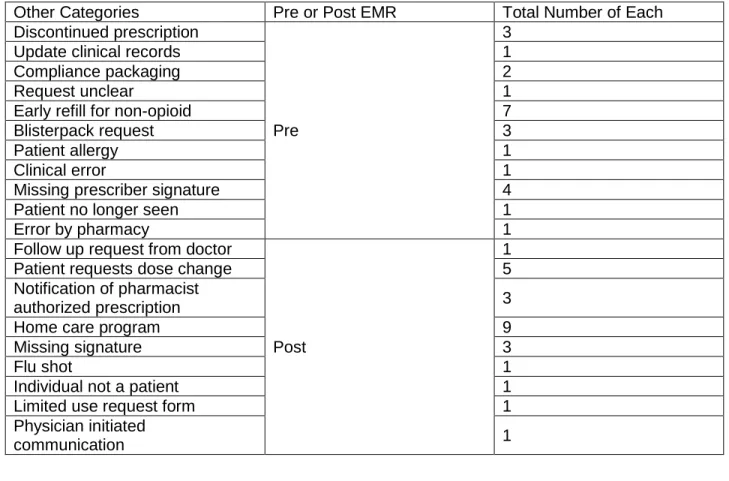
Other See Appendix 2. 350 351 352 353 354 355 356 357
Table 5. Description of categories counted as “other,” EMR era in which they appeared, and the 358
number of each. 359
Other Categories Pre or Post EMR Total Number of Each Discontinued prescription
Pre
3
Update clinical records 1
Compliance packaging 2
Request unclear 1
Early refill for non-opioid 7
Blisterpack request 3
Patient allergy 1
Clinical error 1
Missing prescriber signature 4
Patient no longer seen 1
Error by pharmacy 1
Follow up request from doctor
Post
1
Patient requests dose change 5
Notification of pharmacist
authorized prescription 3
Home care program 9
Missing signature 3
Flu shot 1
Individual not a patient 1
Limited use request form 1
Physician initiated
communication 1
360
Abreviations: 361
EMR – Electronic Medical Record 362
EMRs – Electronic Medical Records 363
UK – United Kindom 364
FMC – Family Medical Centre 365
PROC GLIMMIX – “Procedure” for fitting “Generalized Linear Mixed Models” 366
SAS - Statistical Analysis System 367
CPOE – Computerized Patient Order Entry 368
MaPCReN – Manitoba Primary Care Research Network 369
AS – Alexander Singer 370
RDF - Roberto Duarte Fernandez 371