On: 25 October 2013, At: 08:15 Publisher: Routledge
Informa Ltd Registered in England and Wales Registered Number: 1072954 Registered office: Mortimer House, 37-41 Mortimer Street, London W1T 3JH, UK
Assessment & Evaluation in Higher
Education
Publication details, including instructions for authors and subscription information:
http://www.tandfonline.com/loi/caeh20
Assisting learning in e-assessment: a
closer look at educational supports
Marc Lafuentea, Ana Remesala & Ibis M. Álvarez Valdiviab aEducational and Developmental Psychology Department, Universitat de Barcelona, Barcelona, Spain
b
Educational and Developmental Psychology Department, Universitat Autònoma de Barcelona, Barcelona, Spain Published online: 24 Oct 2013.
To cite this article: Marc Lafuente, Ana Remesal & Ibis M. Álvarez Valdivia , Assessment & Evaluation in Higher Education (2013): Assisting learning in e-assessment: a closer look at educational supports, Assessment & Evaluation in Higher Education, DOI: 10.1080/02602938.2013.848835
To link to this article: http://dx.doi.org/10.1080/02602938.2013.848835
PLEASE SCROLL DOWN FOR ARTICLE
Taylor & Francis makes every effort to ensure the accuracy of all the information (the “Content”) contained in the publications on our platform. However, Taylor & Francis, our agents, and our licensors make no representations or warranties whatsoever as to the accuracy, completeness, or suitability for any purpose of the Content. Any opinions and views expressed in this publication are the opinions and views of the authors, and are not the views of or endorsed by Taylor & Francis. The accuracy of the Content should not be relied upon and should be independently verified with primary sources of information. Taylor and Francis shall not be liable for any losses, actions, claims, proceedings, demands, costs, expenses, damages, and other liabilities whatsoever or howsoever caused arising directly or indirectly in connection with, in relation to or arising out of the use of the Content.
This article may be used for research, teaching, and private study purposes. Any substantial or systematic reproduction, redistribution, reselling, loan, sub-licensing, systematic supply, or distribution in any form to anyone is expressly forbidden. Terms &
and-conditions
Assisting learning in e-assessment: a closer look at educational
supports
Marc Lafuentea*, Ana Remesalaand Ibis M. Álvarez Valdiviab
aEducational and Developmental Psychology Department, Universitat de Barcelona,
Barcelona, Spain;bEducational and Developmental Psychology Department, Universitat Autònoma de Barcelona, Barcelona, Spain
This study analyses the educational support offered through information and communication technology during formative assessment in two different cases in higher education. We analysed one blended and one virtual case from two different universities. The study aimed at identifying specific patterns of educa-tional support intended to foster two interaction processes: (1) the promotion of greater autonomy in the students and (2) the construction of more appropriate meanings by them. The analysis showed that these two processes were achieved with different attainment levels in each of the two study cases. Specific patterns of support mediated by technology were found underlying these different results. This led us to identify ‘suitable’ and ‘undesirable’ patterns of support in e-assessment practices.
Keywords: formative assessment; educational support; e-assessment; teaching/ learning strategies; post-secondary education
Introduction
Assessment is an essential part of the instructional process as whole, not just a matter of marking. Indeed, assessment should also promote the enhancement of teaching and learning results (Benett 2011; Clements and Cord 2013; Price et al. 2010). Nowadays, information and communication technologies (ICT) are regarded as crucial tools for this improvement, as e-assessment is playing an increasingly important role in the transformation of higher education (Whitelock 2010). Many studies claim that the innovation and importance of e-assessment relies on auto-mated marking, easing the instructor’s workload (Chiou, Hwang, and Tseng 2009; Noorbehbahani and Kardan 2011; Stödberg 2012). However, we should not restrict the contribution of e-assessment to this very last aspect of the process: ICT provides an excellent medium not only to track students’learning, but also to support it (Daly et al. 2010; Russell et al. 2006). Therefore, how assessment can guide learning should be of special concern for educators and instructional designers.
Current literature offers plenty of well-established principles to promote learning through formative assessment (Black and Wiliam 2009; McLoughlin and Luca 2006; Morgan and O’Reilly 2006; Nicol and Macfarlane-Dick 2006; Rust, O’Donovan, and Price 2005). These principles generally relate to topics such as the power of feedback to move students forward, the communication of learning goals *Corresponding author. Email:[email protected]
© 2013 Taylor & Francis
http://dx.doi.org/10.1080/02602938.2013.848835
and assessment criteria, the use of peer and self-assessment or the promotion of criti-cal thinking and metacognitive skills. From a sociocultural point of view, the reason why these principles may ultimately support learning lies in their potential to pro-mote two processes which, generally speaking, explain how teaching facilitates learning:
Negotiating meanings with students: to increase the amount of shared mean-ings between the participants (Mercer2000). This process allows the instructor (as well as more expert peers) to use semiotic devices to foster the construc-tion of more appropriate and accepted knowledge by the student (Coll, Mauri, and Onrubia2002). Semiotic devices are ways of using language that help cre-ate shared knowledge; for instance, affirming or rejecting someone’s idea or reformulating someone’s contribution by extending and perfecting it (Mercer 2000). These devices – and many others – are used in a negotiation process where the instructor connects with students’ initial representations of the instructional context and the learning contents, and appropriately supports a revision of those meanings. This process is rooted in the classical concept of intersubjectivity. The importance of the instructor’s actions aimed at promoting higher levels of intersubjectivity in online settings has been well documented (Bober and Dennen 2001; Dennen and Wieland 2007; Garrison and Cleveland-Innes2005).
Increasing students’ autonomy and self-regulated learning: in the process of activating the students’ learning ownership (Black and Wiliam2009), the stu-dents progressively develop the ability to make decisions over their learning, as they become more capable of identifying the task, planning a response, enacting a strategy and reviewing their own performance (Greene and Azevedo 2007). According to Black and Wiliam (2009), activating students’ learning ownership involves critical aspects such as motivation, interest, meta-cognition and self-assessment. However, promoting students’ autonomy requires a transfer of control over learning from the expert to the student. The instructor regulates the assistance offered, so that more and richer support is given when the student is less capable of performing the task, and vice versa. Guidance–often described as a scaffolding process– can only fade out once the student has sufficient knowledge to provide ‘internal’guidance (Kirschner, Sweller, and Clark 2006). Adjusting the explicitness of scaffolding according to students’characteristics is a delicate process in online settings, both in indi-vidual tasks and collaborative activities (Rienties et al.2012).
The main purpose of this study is to analyse how specific support devices in e-assessment practices – often defined as principles for good assessment practice–may contribute to making students more autonomous and to the construc-tion of more adequate meanings. We sought to identify patterns by which specific supports were articulated during e-assessment practices, and how these patterns might facilitate (or hamper) students’ learning autonomy and knowledge construc-tion. The findings provided some examples of suitable support patterns (and ‘undesirable’ones) that will hopefully contribute to improve criteria for instructional design and implementation of online formative assessment processes.
We studied the educational supports offered by means of ICT during e-assessment processes in two different scenarios in higher education: a virtual and a
blended case (Allen and Seaman 2006; Oliver and Trigwell 2005). Studying differ-ent and contrasting scenarios increases the likelihood offinding diverse examples of support patterns. Our objective was not to compare these two cases, but to find diverse examples of both successful and unsuccessful support patterns. While some studies have stated that the format (virtual or blended) of the course does not predict different patterns of participation per se –at least, students’ participation– (Brooks and Bippus 2012), other authors have underlined the differences between the two formats (Mansour and Mupinga 2007), and even asserted the superiority of online environments over blended settings (Reasons, Valadares, and Slavkin2005). Indeed, virtual environments, compared to blended settings, have usually been described as more student-centred scenarios (Heckman and Annabi2005; Vess2005).
In our analysis, we considered the assessment process at two levels. First, we examined the assistance offered to students in every assessment activity individually considered (Coll et al. 2007). Second, we considered the assistance offered to stu-dents throughout the assessment programme, that is, throughout the whole set of assessment activities that are displayed in the entire course (Lafuente 2010). These two concepts are developed further in the paper.
Method
We performed a case study. This is an appropriate method when researchers seek to answer descriptive questions (what happened), as well as explicative questions (how and why it happened); it is also useful for reaching a deep understanding of an instructional context (Flick2009; Yin 2003). Two cases at two different universities in Spain were analysed. The criteria used to choose the cases were:
ICT devices should be used for formative assessment purposes, developing several assessment activities in a‘continuous assessment’programme.
The proportion of ICT usage should differ: one case should develop in a blended format; the other should take place completely online.
Participants took part voluntarily, and we always followed the institutional ethical standards. We treated data anonymously and only for the strict purpose of this study.
The first case was a compulsory course on Educational Psychology in a PhD programme, carried out in a blended format, combining fortnightly face-to-face activities with activities developed on the Moodle Learning Management System (LMS) (McGill and Klobas 2009). There were 41 participants (three instructors teaching collaboratively and 38 students). For the instructors, this was their first experience teaching in a blended setting; the technological experience varied among the students. The assessment programme included these activities:
collaborative elaboration of summaries of the six course units;
presentation of collaborative summaries and participation in fortnightly face-to-face sessions;
peer assessment of presentations;
participation in three discussion e-forums (students had to make a contribution at least once a month, throughout the duration of the course);
individual synthesis by the end of the course.
The second case was a compulsory course on Instructional Psychology for the degree of Psychology. This course took place on a virtual university campus (a LMS based on Sun Microsystems software). The participants were 35 students and one instructor, all of whom had extensive experience in e-learning settings. The assessment programme included the following activities:
screening activity (students had to answer some questions about their knowl-edge and expectations on the course);
collaborative discussion to summarise the three main ideas of each unit; collaborative case study in each unit;
individual reading of a monograph and answering a reading guide; individual synthesis by the end of the course;
authentication test (this activity took place in a face-to-face setting: each stu-dent had to answer four questions on the previous activities to verify the authorship of the previous delivered products).
Both cases comprised seven units; both included a presentation unit (where instructors presented the objectives, activities and methodology of the course), a
final unit (devoted to synthesising the contents) and five intermediate units where participants worked on various course contents. The blended course lasted 25 weeks, and the virtual course lasted 19 weeks.
We collected all the written exchanges between the participants throughout the course. We registered all the messages posted by instructors and students on the LMS, and gathered all the documents related to these activities (including all the draft and final products). Additionally, in the blended case, we systematically observed the face-to-face sessions, particularly whenever assessment activities took place. We also used questionnaires and semi-structured interviews to collect comple-mentary data that helped us reveal the participants’ performances during the assess-ment process. All students completed three questionnaires: at the beginning of the course, at the midpoint and at the end. Semi-structured interviews were carried out with seven volunteer students from the blended case and three from the virtual case; in the interviews they expanded and complemented some of their prior answers to the questionnaires. Likewise, we held three different interviews with all the instructors during the course.
Data analysis
Analysing educational supports
Although the initial sample was composed of all instructors and students in both courses, the analysis ultimately focused on the educational supports received by one single student from all their instructors and peers in each case. We chose to study the supports received by a student who got a‘B’as afinal grade, since‘B’was the most frequent grade in both courses. Therefore, we studied the supports received by these two individual students by means of ICT during all the assessment activities, in four different units of the course: Presentation Unit, Unit 1, Unit 4 and Final Unit. We picked these different moments of the course to have a representative sample of what occurred throughout the assessment programme (as well as to simplify the analysis and the subsequent presentation of results).
The analysis started by describing the main performances by instructors and students during the course. Assessment activities were considered in a broad scope, including what happened before the assessment activity itself–while discussing and clarifying norms and expectations, for instance– and afterwards – while correcting or giving feedback. It is important to consider these performances and the educa-tional supports offered at different moments of the activity, and how they evolve in time (Mercer2008).
By studying the evolution of such supports we identified diverse patterns, grounded on the analysis of four different dimensions of the educational assistance: (1) type; (2) proximity; (3) level of elaboration and (4) quantity. Despite conceiving the educational support as a continuous process, we strived to divide and identify the different ‘chunks’ of assistance that a student might receive along assessment processes. For each of these dimensions, we created a category system which was later used for content analysis. To this purpose, first we defined operational criteria for each category based both on theoretical principles derived from a literature review and on the singularity of our cases (Kane2006). Then, we applied the cate-gories to the data in an iterative process that involved adjusting some catecate-gories, until reaching the full agreement in saturation and final definition of the categories. Later, to determine the reliability of the coding system, three external judges applied it to the Presentation Unit in both cases (selecting 15 educational supports for each case). The external judges were instructors experienced in teaching and assessment through ICT in higher education, as well as researchers with experience and/or inter-est in the e-learningfield. Below is the resulting category system for each dimension and the levels offinal agreement reached by the external judges:
Types of educational support: 14 categories of educational supports were identified in the assessment processes, based both on bibliographical research and on the singularity of our cases. These 14 categories relate to different processes (see Table 1): (1) communicating the demands of assessment tasks, (2) communicating the correctness of assessment contents and (3) communi-cating the overall achievement. The final overall agreement reached by the three external judges was 0.88.
Proximity of educational support: any educational support may adopt a direct or indirect approach regarding the learner who receives it (Rogoff 2003). Criteria used to distinguish both approaches are explained in Table 2. The overall agreement of the external judges applying these two categories was 0.91.
Level of elaboration of the educational support: feedback can be expressed at different levels of elaboration of information (Álvarez, Guasch, and Espasa 2012; Kulhavy and Stock 1989). Lower levels are usually related to the verification of learning (simply expressing the correctness or incorrectness of contents: ‘very well’,‘this is wrong’). Higher levels are related to elaboration of learning: the information communicated allows students to understand and overcome their mistakes. Higher levels of feedback are associated with expressing causes, showing examples, giving arguments or reasons, hints, etc. In our study, we distinguished three different levels of elaboration of educa-tional supports–level 1 (low), level 2 (moderate) and level 3 (high)– accord-ing to the explicitness of contents, the exhaustivity of elements communicated, the justification of contents, the presence of examples, the presentation of
relationships between the content of support and other aspects of the course and the supply of contextual hints for using that support. The overall agree-ment by the judges applying the three categories was 0.89.
Quantity of educational support: the overall amount of educational supports, and its evolution, as we will discuss later, is a dimension that allowed us to identify support patterns. Since it only involves adding up thefinal number of educational supports, there was no need to subject this dimension to the external judges’consideration.
We identified 148 educational supports received by the individual student in the blended case and 412 supports in the virtual case. Every educational support was coded to a type category, assigned to a proximity category (direct or indirect support), and coded to a level of elaboration (levels 1, 2 or 3). We also noted the participant giving the support (instructors or peers), and coded the ICT device used for offering that assistance.
Analysing the construction of shared meanings and the promotion of greater autonomy by students
In terms of the construction of shared meanings between the instructor and the student, we distinguished two different yet interwoven processes: first, we analysed the negotiation of meanings revolving around the assessment contents; second, we studied the negotiation of meanings on the assessment task. In order to reach greater understanding of educational support processes, it is important to differentiate between the assistance intended to regulate the ‘how’,‘when’or‘why’of the activ-ity, and that addressed to regulate the correctness of ideas, concepts or procedures expected to be learned. Supports like ‘I like very much this idea’, or ‘I am afraid you are confusing the term constructivism with constructionism’, are different from ‘This paper is due on May 8th’ or‘Consider drawing a concept map or some sort of schema before writing the synthesis’. While all these educational supports can be given in the same context and can be interrelated, we must distinguish those addressed to improve the representation of the contents from those intended to adjust the representation of the task.
For the analysis of the construction of shared meanings on the assessment con-tents, we took as positive indicators the increasing supports confirming correct contents, as well as the decrease of supports pointing out incorrect and miss-ing contents. Finally, we adjusted the interpretation considermiss-ing the level of elabora-tion and proximity of such support, as well as the participant giving that support.
In order to analyse the construction of shared meanings on the task, we consid-ered as positive indicators the progressive decrease of educational support (see Table 1); we also considered the source of the support, and the proximity and level of elaboration of such support.
As for the analysis of the transfer of control over learning to students, we consid-ered as positive indicators: (1) the decrease of support over time, (2) the presence of support of gradually lower levels of elaboration, as well as (3) the decrease of direct support to the student. Keeping standards of qualitative research, no indicator was considered in an isolated manner; instead, we paid attention to the relations among all dimensions, taking into account the specific context revealed by the participants’ performance.
Results
Support patterns for promoting the construction of shared meanings on the assessment contents
The blended case
Regarding the meaning negotiation around the contents, we observed that in the blended case, this was present only in two activities in the LMS: through peer assessment (using a form) and in the forum discussions. This negotiation of mean-ings was always carried out among peers; there were no significant supports by the instructors. This pattern, which we called ‘peers’ responsibility during the activity’, yielded no positive indicators of such negotiation of meanings within these activities.
Table 1. Categories of types of educational support. Types of educational support
(A) Communication of the demands or requests of assessment tasks
The objectives of the activity
Assessment criteria or rubrics for the activity
Models of good or bad fulfilment
Process or steps to be taken for the completion of the activity
Deadlines or extension of requested products
Relations with other activities in the course
Strategies or procedures related to the task or content
Strategies related to participation or (individual or team) organisation of work
Strategies related to the use of technological tools or for overcoming technological issues
Requested use of specific resources or materials for developing the activity
(B) Communication of the correctness of assessment contents
Correct aspects of the content
Incorrect aspects of the content
Ignored or not considered aspects of requested content
(C) Communication of the overall achievement
Grades or general level of achievement
Table 2. Criteria to analyse the proximity of educational support.
Direct educational support Indirect educational support The support refers to the specific
situation of an individual student or team of students
Semantic contingency
The support refers to the general situation of students The support is addressed to a
concrete or identifiable student or team of students
Individualisation or generalisation of the support
The support is addressed to unspecific students or to the whole class Bidirectional Direction of communication Unidirectional Private Privacy of communication Public
Regarding the development of negotiation of meanings throughout the assessment programme, we observed a similar pattern based on the transfer of responsibility to the students of such process of discussion of ideas and concepts during the intermediate units of the course. We could not identify any meaningful validation by the instructors. This pattern, which we called ‘peers’ responsibility during the programme’, produced some positive indicators, such as an increasing number of correct contents communicated during the course and a decreasing amount of incorrect contents. However, we must attribute these indicators to the negotiation process among peers.
The virtual case
With regard to the virtual case, we identified two different patterns depending on the individual or collaborative nature of the activity. In the collaborative activities, we observed the pattern‘team negotiation during the activity with afinal closure by the instructor’. During the activity development, the peers and the instructor offered support, communicating their agreement or disagreement with the contents written up to that point. By the end of the activity, the instructor gave direct support to the team communicating the suitability of those contents; the instructor also gave indirect support, appraising the contents of the activities elaborated by all the teams and making public comments to the whole class.
In the individual activities, we recognised a pattern called‘final and personalised feedback by the instructor’. At the end of the activity, the instructor offered direct support to the student, commenting on the correct elements of the contents, and communicating the final grade. The presence of positive indicators of negotiation within a single unit was higher in the later units of the course, and lower in thefirst units.
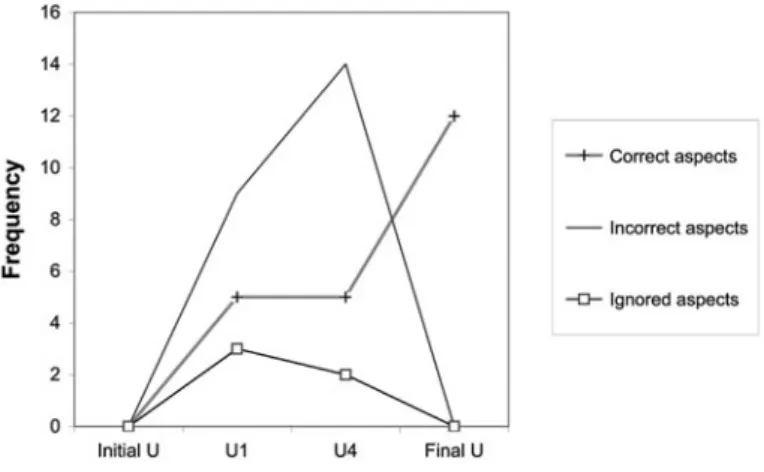
With respect to the construction of shared meanings around the contents throughout the assessment programme, we detected the pattern‘in-process andfinal support’by the instructor. The instructor offered educational supports in that respect from Unit 1 to the Final Unit. Figure1shows the number of supports offered to the student concerning the communication of correct, incorrect and ignored contents
Figure 1. Evolution throughout the assessment programme of the educational supports for the representation of contents (virtual case).
during the Initial Unit, Unit 1, Unit 4 and Final Unit. The confirmation of correct contents increases throughout the course, reaching its peak in the Final Unit; this is a positive indicator of shared meanings. In addition, pointing out incorrect contents decreases in the Final Unit, after reaching its peak in Unit 4. Highlighting missing contents also shows a decreasing profile. These are also positive indicators of the construction of shared meanings around the contents.
Support patterns for promoting the construction of shared meanings on the assessment task
The blended case
We identified a pattern based on ‘initial and indirect support’. At the beginning of the activity, we observed supports regarding the demands of assessment tasks given by the instructors to the whole class. These supports hardly appeared later in the development of the activity. There was one exception to this pattern in the individual synthesis activity, where a pattern is identified as‘initial andfinal indirect support’. In addition to the initial communication of requirements, the instructors decided to publish on the platform all the students’ individual syntheses at the end of the activity.
Throughout the assessment programme, we observed a large number of educational supports during the Presentation Unit: indirect supports regarding the activity requirements – such as promoting the use of materials, presenting the relationship between a given activity to others, communicating the steps to be taken for the activity completion, etc. These supports generally decreased as the assess-ment process developed. However, at the end of the course, the instructors published all the individual syntheses on the platform. This peak of educational support at the end of the programme in our view indicates that instructors and students did not share meanings on the assessment task to a sufficient extent. Therefore, the support pattern we observed in the development of the assessment programme could be described as‘initial andfinal indirect support’to the student.
The virtual case
In the virtual case, the negotiation of meanings around the task took place differently in individual and collaborative activities. In individual activities, we iden-tified a pattern based on the‘initial and indirect communication of instructions’; the instructor gave support to the whole class, fostering a first representation of the activity at the start. In collaborative activities, though, we identified a more complex pattern: ‘initial communication of instructions and support to the process’. Besides the supply of indirect support at the beginning of the activity, we found supports throughout the whole assessment activity. The instructor gave educational support to enhance teamwork coordination and organisation. Some of these supports were also direct assistance intended to solve misunderstandings or incomprehension regarding the activity demands.
Regarding the assistance developed throughout the assessment programme, we identified a pattern called ‘initial communication of instructions and support to the process’. The communication of the demands of assessment tasks is revealed, in our study, by the presence of 10 different types of educational
support (see Table 1). For the sake of simplicity, Figure 2 shows five of these 10 types. We show the evolution of support concerning the communication of: the assessment criteria, the objectives of the activity, the process or steps to be taken, the deadlines or extension of the product and the strategies related to par-ticipation. The above-mentioned pattern apparently achieved a successful out-come as a clear positive indicator shows: the frequency of these educational supports generally decreases throughout the course. In the Initial Unit, we can see a great number of these supports; they appear in a decreasing profile in intermediate units of the course, and they dip in the Final Unit.
Support patterns for transferring the control and responsibility over learning to the student
The blended case
We identified two patterns of support which we called‘steep transfer of control from the instructor to the student’as a one-way movement and‘transfer of control to the student and eventual retaking by the instructor’as a back-and-forth movement.
There were examples of the ‘steep transfer’ pattern in peer assessment of presentations: the instructor gave the instructions for the activity at the beginning, and transferred completely to the students the responsibility of making contributions to the peer assessment, without any further assistance.
One example of the ‘transfer of control and eventual retaking’is observed in the forum activity: the instructors gave supports to promote a first representation of the requested task; then, they transferred the responsibility of making contributions to such forums to the students;finally, the instructors took the control back at the end of the activity by making evaluative comments on the most relevant messages. Figure 2. Evolution throughout the assessment programme of some educational supports for the representation of tasks (virtual case).
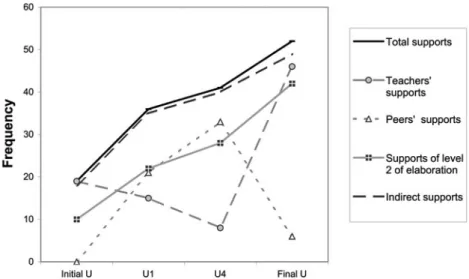
Figure 3shows the amount of educational supports provided by instructors and peers throughout the assessment programme; we noticed that the instructors gave supports by means of ICT mostly at the beginning of the process (in the Presentation Unit) and at the end (during the Final Unit). In the intermediate units, the responsi-bility of assisting learning was delegated to the peers. This pattern points to the ‘transfer and retaking’structure expressed within several activities of the same case. Therefore, this pattern – developed on an activity scale – might repeat itself on a larger scale–throughout the assessment programme.
The objective of transferring the control over learning to the student is only partially achieved by these support patterns. We gathered both positive and negative indicators of this process’s success. On the positive side, we detected an increasing number of indirect educational supports– as previously mentioned, increasing indi-rect support is taken as a positive indicator of efforts to transfer the control over learning to the student, as the student may not need more personalised and specific support. We could also see a greater number of peers’support during intermediate units; this is interpreted as efforts to make the students more responsible for support-ing each other in collaborative and peer-to-peer assessment activities. On the nega-tive side, we observed a clear rise in the overall number of educational supports. We also detected that the support of a moderate level of elaboration (level 2) steadily increases throughout the course; however, according to our theoretical model, the support of lowest level of elaboration (level 1) should be the one increasing.
The virtual case
We identified a pattern which we called ‘continuous monitoring and support throughout the entire activity’. The instructor gave a reasonable amount of support at the beginning of the activity in order to communicate its demands. Throughout Figure 3. Evolution throughout the assessment programme of some indicators of the control transfer (blended case).
the development of collaborative activities we detected direct supports, where the instructor communicated strategies to improve teamwork organisation and assessed the validity of contents elaborated up to that point in draft files. In the individual activities, the supports offered during their development were more indirect to the student (such as answering on a public forum a peer’s query). In both types of activ-ity, the instructor gave direct and personalised supports regarding the correctness of contents at the end.
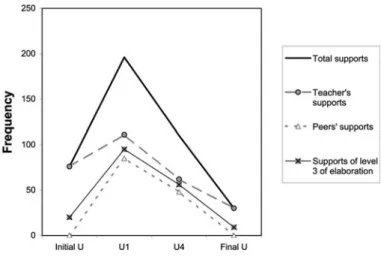
Figure 4 shows that the amount of educational support given by the instructor was always above that given by peers. The instructor’s monitoring and support was continuous throughout the assessment programme. In this case, we also observed an isomorphism between the patterns showed on a micro scale –within an assessment activity–and on a macro scale–throughout the assessment programme.
These patterns achieved the transfer of control to the student to a significant extent. We interpreted the decreasing educational support as the assessment pro-gramme unfolded to be a positive indicator (see Figure4). Likewise, the assistance given in the programme displays lower levels of elaboration; indeed, the supports of the highest level of elaboration (level 3) reached their peak in Unit 1, and from that point on, supports had less justifications, examples, etc., which we interpreted as the student’s increased competence to use this assistance.
Summarising all the support patterns
We would like to finish the results section by summarising all the support patterns found in both cases. In Table3, the same numeration of cells shows isomorphism of patterns; by isomorphism we understand that two patterns display in a similar structure or fashion within a single activity and throughout the entire assessment programme. Similarities include features like the moment when the educational support is offered; the type, quantity or proximity of that assistance or the agent who offers it.
Figure 4. Evolution throughout the assessment programme of some indicators of the control transfer (virtual case).
T able 3. Summary of the educational support patterns identi fi ed in both cases. Negotiation of meanings T ransfer of control Around the contents Around the task Assessment programme Assessment activity Assessment programme Assessment activity Assessment programme Assessment activity Blended case Peers ’ responsability during the programme Peers ’ responsability during the activity Initial and fi nal indirect support Initial and indirect support T ransfer of control to the student and eventual retaking by the instructors Steep transfer of control to the student Initial and fi nal indirect support T ransfer of control to the student and eventual retaking by the instructors 11 2 2 3 3 V irtual case In-process and fi nal support Final and personalised feedback by the instructor (individual activities) Initial communication of instructions and support to the process Initial and indirect communication of instructions (individual activities) Continuous monitoring and support by the instructor Continuous monitoring and support by the instructor T eam negotiation during the activity with a fi nal closure by the instructor (collaborative activities) Initial communication of instructions and support to the process (collaborative activities) 44 5 5 6 6
Discussion
In previous empirical research, the different types of educational supports involved in good e-assessment practice (McLoughlin and Luca 2006; Morgan and O’Reilly 2006)–such as feedback, sharing assessment criteria with students, developing peer assessment, giving support to collaborative work, etc. – are analysed rather separatedly. Our approach led us to analyse different types of supports together and articulate them with other parameters of educational assistance, such as the proximity (Rogoff 2003), level of elaboration (Kulhavy and Stock 1989), quantity, time location of the activity (Mercer 2008), or source of the support. The result is the identification of patterns by which all these parameters are articulated in two different scenarios based on ICT.
We found that patterns of educational support offered through ICT showed up con-sistently across different assessment activities of the same case. We would also like to point out the common repetition of support patterns on different scales of the assess-ment practices. Our analysis allowed for the identification of some support patterns that displayed in a similar structure both on a smaller scale (within each assessment activity) and on a larger scale (at a trans-activity level; that is to say, throughout the assessment programme). This isomorphism of support patterns highlights the importance of studying assessment at these two different levels (Coll et al.2007).
The analysis of educational supports was framed in the development of two general processes – the transfer of control over learning to the student and the construction of shared meanings –which enabled us to judge the ultimate achieve-ment of such patterns of support. As for the results of these two processes, we must state that their level of success was dissimilar and also showed meaningful differ-ences between the two cases. While the accomplishment was more evident in the virtual case, in the blended case the results were more modest. Although our goal was not to compare both cases, but only find diverse examples of support patterns, we actually found different patterns in the two cases. We must bear in mind that the format of the course was just one variable that differentiated the cases, along with other important factors such as the educational degree, the institution or the partici-pants’ experience in online environments. This is a clear limitation of our study, as it hinders the comparison between the two cases. Besides, course formats might be of little importance when considering the influence of other processes such as the design of activities, social dynamics or instructors and students’ relational perfor-mances (Brooks and Bippus2012).
Having different levels of achievement enables us to put forward some examples of patterns which, cautiously and under certain circumstances, could be either pro-moted or avoided if we want to foster greater autonomy and the construction of more appropriate meanings by the students. On the‘undesirable side’, for instance, we identified that the usage of a support pattern, based on the ‘steep transfer’ of control to the student in the blended case, somehow contradicted the guidance required in gradually making the learner more autonomous in doing new or complex tasks (Kirschner, Sweller, and Clark 2006). In that same blended case, when analysing the negotiation of meanings around the contents, we identified that the instructors delegated the responsibility of such process to the peers, with no further mediation by them on the technological environment. Given that this is a postgraduate course, we could speculate that instructors might have overestimated the students’ capacity to self-regulate their learning and collaboration processes. In
other words, the instructors might have failed in detecting the students’ need for more explicit scaffolding (Rienties et al.2012).
Again, while peer assessment and support are powerful tools to promote learning and knowledge construction in class (van der Pol et al.2008), we believe that a min-imum amount of validation by the instructors is always required in such semiotic processes; this is especially true for online environments where instructors have to
find the right amount of posting to foster peer discussion without hampering it (Mazzolini and Maddison2007). Our result also corroborates the instructor’s impor-tance in creating intersubjectivity in online group discourse asserted by previous research (Bober and Dennen 2001; Dennen and Wieland 2007; Remesal 2011). Another ‘avoidable’ pattern we observed was based on an ‘eventual retaking’ of control by the instructor at the very end of the assessment process, addressing mis-understandings or correcting mistakes when it was simply too late for the students.
On the other hand, we identified some patterns that proved to be successful. For instance, the instructor’s display of continuous monitoring and mixed assistance (both by peers in collaborative activities and by the instructor) was a powerful tool for detecting incomprehension and improving teamwork in the online case. Foster-ing collaborative work and peer-to-peer discussion are features of a student-centred approach often attributed to online settings (Heckman and Annabi 2005; Vess 2005); however, the successful pattern of support found in this research shows that these features are not incompatible, but rather reconcilable, with instructor’s continu-ous assistance. Continucontinu-ous monitoring might allow the instructor to diagnose needs in an ongoing process of collaboration, enabling them to detect differences in collaboration styles. This could facilitate the creation of a scaffolding process, whereby the instructor adjusts their assistance to the students’ collaboration, therefore improving the ultimate quality of online learning (Rienties et al.2012).
We observed, as well, that the role assigned to ICT was a key variable that explained successful support patterns; for instance, in the virtual case, we identified that the technological environment was regarded both as a space to gather informa-tion on the student’s learning, and for promoting it (thus fostering the instructor– student interaction, as well as the peer-to-peer interaction). This role assigned to ICT obviously contrasted with what we identified in the blended case, where ICT was used more as a space for gathering information on the student’s learning process, rather than as an environment for supporting it. Actually, in that case, instructors saved most of their supports for the face-to-face setting. This is not a minor issue, as it clearly relates to the claim for a new focus of e-assessment driven by pedagogical criteria instead of technological priorities (Whitelock2010).
A small-scale study like ours does not intend to provide ‘universal’ results, but only specific examples that will help us reach a deeper understanding on how certain supports might work in particular e-assessment contexts. We consider that support patterns are strongly linked to the specific contextual conditions of educational set-tings; therefore, the study of cases that adopt different contents, assessment activities or technological tools from the ones we studied will likely produce different results.
Conclusions
In this study, we took a closer look at educational supports in assessment practices. We were able to articulate some dimensions of educational support in order to identify examples of patterns intended to transfer the control of learning from the
instructor to the student, and to promote the student’s construction of increasingly shared meanings with their instructor.
Our analysis allowed us to identify some patterns in the manifestation of educational support in two different scenarios. Now we know that support patterns were more effective in the virtual scenario and less successful in the blended course. Specific support patterns mediated by ICT underlying these different results were pinpointed. The success of support patterns cannot be completely predicted before-hand:‘actions that would appear to be the most likely to produce learning might not do so in a particular situation’(Black and Wiliam2009, 7). Even so, we believe it is important to pay attention to the impact of certain support patterns on students’ learning. This is especially important if we want to enhance the design of current educational settings mediated by ICT.
In general, the results show that ICT can be an optimal medium to offer support in assessment practices, provided that participants assign to technological devices a role not only for gathering learning indicators and for marking, but also as a means for assisting learning. Further research should contrast the results found in this study. The inherent limitations of case study methodology, regarding the generalisation of results, force us to recommend additional research that might identify different support patterns from the ones we found.
Acknowledgements
This paper uses some results from thefirst author’s PhD research. He would like to acknowl-edge the University of Barcelona for the PhD scholarship award. Finally, the authors would like to thank the reviewers’thoughtful and insightful comments, which helped to improve this article.
Notes on contributors
Marc Lafuente has a PhD in Educational Psychology. He is currently an adjunct instructor at the Universitat de Barcelona and a consultant instructor at the Open University of Catalonia (Spain). His main topic of research is e-learning, particularly ICT applied to assessment of learning.
Ana Remesal has a PhD in Educational Psychology. She is a junior lecturer at the Universitat de Barcelona. Her current research focuses on assessment conceptions, classroom assessment practices and social presence in e-learning. She is a member of the research group GRINTIE. Ibis M. Álvarez Valdivia has a PhD in Educational Psychology. She is a senior lecturer at the Universitat Autònoma de Barcelona and a consultant instructor at the Open University of Catalonia (Spain). Her research interests focus on teaching and learning strategies.
References
Allen, I. E., and J. Seaman. 2006.Making the Grade: Online Education in the United States, 2006. Newburyport, MA: The Sloan Consortium.
Álvarez, I. M., T. Guasch, and A. Espasa. 2012. “The Value of Feedback in Improving Collaborative Writing Assignments in an Online Learning Environment.” Studies in Higher Education37 (4): 387–400.
Benett, R. E. 2011. “Formative Assessment: A Critical Review.” Assessment in Education: Principles, Policy & Practice18 (1): 5–25.
Black, P., and D. Wiliam. 2009. “Developing a Theory of Formative Assessment.”
Educational Assessment, Evaluation and Accountability21 (1): 5–31.
Bober, M. J., and V. P. Dennen. 2001. “Intersubjectivity: Facilitating Knowledge Construc-tion in Online Environments.”Educational Media International38 (4): 241–250. Brooks, C., and Bippus, A. 2012. “Underscoring the Social Nature of Classrooms by
Examining the Amount of Virtual Talk Across Online and Blended College Courses.”
European Journal of Open, Distance and E-Learning. Accessed June 24, 2013. http:// www.eurodl.org/materials/contrib/2012/Brooks_Bippus.pdf
Chiou, C. K., G. J. Hwang, and J. C. R. Tseng. 2009. “An Auto-scoring Mechanism for Evaluating Problem-Solving Ability in a Web-based Learning Environment.” Computers & Education52 (2): 261–272.
Clements, M. D., and B. A. Cord. 2013.“Assessment Guiding Learning: Developing Gradu-ate Qualities in an Experiential Learning Programme.” Assessment & Evaluation in Higher Education38 (1): 114–124.
Coll, C., M. J. Rochera, R. Mayordomo, and M. Naranjo. 2007.“Continuous Assessment and Support for Learning: An Experience in Educational Innovation with ICT Support in Higher Education.”Electronic Journal of Research in Educational Psychology5 (3): 783–804. Coll, C., T. Mauri, and J. Onrubia. 2002. “Ways of Teaching that Foster Learning: An
Approach to the Analysis of Discourse and Activity in the Classroom.”Lecture presented at the Qualitative Classroom Research: What in the World Happens in Classrooms? Oaxtepec, Mexico, May 27–31. Accessed June 24, 2013. http://www.psyed.edu.es/ prodGrintie/conf/CC_TM_JO_WaysOfTeaching_02.pdf
Daly, C., N. Pachler, Y. Mor, and H. Mellar. 2010. “Exploring Formative E-Assessment: Using Case Stories and Design Patterns.”Assessment & Evaluation in Higher Education
35 (5): 619–636.
Dennen, V. P., and K. Wieland. 2007. “From Interaction to Intersubjectivity: Facilitating Online Group Discourse Processes.”Distance Education28 (3): 281–297.
Flick, U. 2009.An Introduction to Qualitative Research. 4th ed. Thousand Oaks, CA: Sage. Garrison, D. R., and M. Cleveland-Innes. 2005. “Facilitating Cognitive Presence in Online
Learning: Interaction is Not Enough.”The American Journal of Distance Education 19 (3): 133–148.
Greene, J. A., and R. Azevedo. 2007.“A Theoretical Review of Winne and Hadwin’s Model of Self-regulated Learning: New Perspectives and Directions.” Review of Educational Research77 (3): 354–372.
Heckman, R., and H. Annabi. 2005.“A Content Analytic Comparison of Learning Processes in Online and Face-to-face Case Study Discussions.” Journal of Computer-Mediated Communication 10 (2). Accessed June 24, 2013. http://jcmc.indiana.edu/vol10/issue2/ heckman.html
Kane, M. T. 2006. “Validation.” In Educational Measurement, edited by R. L. Brennan, 17–64. Westport, CT: Praeger.
Kirschner, P. A., J. Sweller, and R. E. Clark. 2006. “Why Minimal Guidance During Instruction Does Not Work: An Analysis of the failure of Constructivist, Discovery, Prob-lem-based, Experiential, and Inquiry-based Teaching.” Educational Psychologist 41 (2): 75–86.
Kulhavy, R., and W. Stock. 1989. “Feedback in Written Instruction: The Place of Response Certitude.”Educational Psychology Review1 (4): 279–308.
Lafuente, M. 2010. Evaluación de los aprendizajes mediante herramientas TIC. Transparencia de las prácticas de evaluación y dispositivos de ayuda pedagógica [Learning Assessment through ICT Tools. Transparency of Assessment Practices and Pedagogical Support Devices]. PhD diss., Universitat de Barcelona, Spain.
Mansour, B., and D. Mupinga. 2007.“Students’Positive and Negative Experiences in Hybrid and Online Classes.”College Student Journal41 (1): 242–248.
Mazzolini, M., and S. Maddison. 2007. “When to Jump In: The Role of the Instructor in Online Discussion Forums.”Computers & Education49 (2): 193–213.
McGill, T. J., and J. E. Klobas. 2009.“A Task–technology Fit View of Learning Management System Impact.”Computers & Education52 (2): 496–508.
McLoughlin, C., and J. Luca. 2006. “Best Practice in Online Assessment: Principles, Processes and Outcomes.”InProceedings of World Conference on Educational Multime-dia, Hypermedia and Telecommunications 2006, edited by E. Pearson and P. Bohman, 2375–2382. Chesapeake, VA: AACE.
Mercer, N. 2000. Words and Minds: How We Use Language to Think Together. London: Routledge.
Mercer, N. 2008. “The Seeds of Time: Why Classroom Dialogue Needs a Temporal Analysis.”Journal of the Learning Sciences17 (1): 33–59.
Morgan, C., and M. O’Reilly. 2006. Ten Key Qualities of Assessment Online. In Online Assessment and Measurement. Foundations and Challenges, edited by M. Hricko and S. L. Howell, 86–101. Hershey: Idea.
Nicol, D. J., and D. Macfarlane-Dick. 2006. “Formative Assessment and Self-regulated Learning: A Model and Seven Principles of Good Feedback Practice.”Studies in Higher Education31 (2): 199–218.
Noorbehbahani, F., and A. A. Kardan. 2011. “The Automatic Assessment of Free Text Answers using a Modified BLEU Algorithm.”Computers & Education56 (1): 337–345. Oliver, M., and K. Trigwell. 2005. “Can ‘Blended Learning’ be Redeemed?” E-Learning
2 (1): 17–26.
Price, M., K. Handley, J. Millar, and B. O’Donovan. 2010. “Feedback: All that Effort but What is the Effect?”Assessment & Evaluation in Higher Education35 (3): 277–289. Reasons, S. G., K. Valadares, and M. Slavkin. 2005.“Questioning the Hybrid Model: Student
Outcomes in Different Course Formats.” The Journal of Asynchronous Learning Net-works (JALN)9 (1): 83–94.
Remesal, A. (2011). Buenas prácticas con plataformas de aprendizaje virtual en contextos de educación blended: advertencias necesarias sobre errores evitables [Good Practices with Virtual Learning Platforms in Blended Educational Settings: Necessary Warnings about Avoidable Mistakes]. Revista Digital de Investigación Educativa Conectad@2, Special Issue October–December: 17–38
Rienties, B., B. Giesbers, D. Tempelaar, S. Lygo-Baker, M. Segers, and W. Gijselaers. 2012. “The Role of Scaffolding and Motivation in CSCL.” Computers & Education 59 (3): 893–906.
Rogoff, B. 2003.The Cultural Nature of Human Development. New York: University Press. Russell, J., L. Elton, D. Swinglehurst, and T. Greenhalgh. 2006.“Using the Online
Environ-ment in AssessEnviron-ment for Learning: A Case-study of a Web-based Course in Primary Care.”Assessment & Evaluation in Higher Education31 (4): 465–478.
Rust, C., B. O’Donovan, and M. Price. 2005. “A Social Constructivist Assessment Process Model: How the Research Literature Shows Us this Could be Best Practice.”Assessment & Evaluation in Higher Education30 (3): 231–240.
Stödberg, U. 2012. “A Research Review of E-Assessment.” Assessment & Evaluation in Higher Education37 (5): 591–604.
van der Pol, A., B. van den Berg, W. F. Admiraal, and P. R. Simons. 2008. “The Nature, Reception, and Use of Online Peer Feedback in Higher Education.”Computers & Educa-tion51 (4): 1804–1817.
Vess, D. L. 2005. “Asynchronous Discussion and Communication Patterns in Online and Hybrid History Courses.”Communication Education54 (4): 355–364.
Whitelock, D. 2010. Activating Assessment for Learning: Are We on the Way with Web 2.0? InWeb 2.0-based E-Learning: Applying Social Informatics for Tertiary Teaching, edited by M. J. W. Lee and C. Lee McLoughlin, 319–342. Hershey, PA: IGI Global.
Yin, R. 2003.Case Study Research: Design and Methods. Thousand Oaks, CA: Sage.