
A Groupwise Multilinear Correspondence Optimization
for 3D Faces
Timo Bolkart, Stefanie Wuhrer
To cite this version:
Timo Bolkart, Stefanie Wuhrer. A Groupwise Multilinear Correspondence Optimization for 3D
Faces. IEEE International Conference on Computer Vision (ICCV), Dec 2015, Santiago, Chile.
<
hal-01205460
>
HAL Id: hal-01205460
https://hal.inria.fr/hal-01205460
Submitted on 25 Sep 2015
HAL
is a multi-disciplinary open access
archive for the deposit and dissemination of
sci-entific research documents, whether they are
pub-lished or not.
The documents may come from
teaching and research institutions in France or
abroad, or from public or private research centers.
L’archive ouverte pluridisciplinaire
HAL
, est
destin´
ee au d´
epˆ
ot et `
a la diffusion de documents
scientifiques de niveau recherche, publi´
es ou non,
´
emanant des ´
etablissements d’enseignement et de
recherche fran¸
cais ou ´
etrangers, des laboratoires
publics ou priv´
es.
A Groupwise Multilinear Correspondence Optimization for 3D Faces
Timo Bolkart
Saarland University, Germany
Stefanie Wuhrer
Inria Rhˆone-Alpes, France
Abstract
Multilinear face models are widely used to model the space of human faces with expressions. For databases of 3D human faces of different identities performing multiple expressions, these statistical shape models decouple iden-tity and expression variations. To compute a high-quality multilinear face model, the quality of the registration of the database of 3D face scans used for training is essential. Meanwhile, a multilinear face model can be used as an ef-fective prior to register 3D face scans, which are typically noisy and incomplete. Inspired by the minimum description length approach, we propose the first method to jointly op-timize a multilinear model and the registration of the 3D scans used for training. Given an initial registration, our approach fully automatically improves the registration by optimizing an objective function that measures the compact-ness of the multilinear model, resulting in a sparse model. We choose a continuous representation for each face shape that allows to use a quasi-Newton method in parameter space for optimization. We show that our approach is com-putationally significantly more efficient and leads to corre-spondences of higher quality than existing methods based on linear statistical models. This allows us to evaluate our approach on large standard 3D face databases and in the presence of noisy initializations.
1. Introduction
The human face is one important factor for any kind of social interaction in our daily life. This motivates many dif-ferent fields such as human computer interaction, medicine, ergonomics or security, to investigate the human face. Since many of these areas are interested in the 3D geometry of the face, the number of publicly available 3D face databases in-creased over the last years. As the manual analysis of large databases is intractable, automatic data driven and statistical approaches are widely used to analyze the structure of the data. To compute statistics, all shapes of the dataset need to be in correspondence [10, Chapter 1].
Computing these correspondences for human face data is
a challenging task that many methods aim to solve (e.g. [24, 26, 17, 14, 27]). Given a good registration, a statistical face model can be learned. In computer vision and graphics, statistical face models are usede.g. to reconstruct the 3D geometry of the face from 2D images [1], to recognize facial expressions [24], to transfer expressions between images or videos [30], or to change expressions in 3D videos [31].
Statistical face models can also be used to reconstruct the 3D geometry from noisy or partially occluded face scans [5] and are therefore directly applicable for registra-tion. Furthermore, registration methods with prior learned knowledge outperform model-free methods like template fitting [25, 2]. Summing up, this is a chicken-and-egg prob-lem: given a good registration, a statistical model can be learned, and given a representative statistical model, a good registration can be computed. The quality of a given statis-tical model can be measured [10, Chapter 3.3.1], and due to the dependency of the statistical model on a registration, this measurement also evaluates the underlying registration. Methods that aim at jointly optimizing the registration and a statistical model have been developed for princi-pal component analysis (PCA) (e.g. [10, Chapter 4], [21]). Furthermore, variants of this linear method like part-based PCA [6], kernel PCA [8] or human body specific ap-proaches [16] exist. These methods measure the model quality and change the registration such that the quality of the model and the registration improve at the same time. Since the model quality depends on all shapes, these
meth-ods are called groupwise optimization methmeth-ods. Linear
PCA-based methods have been proven to outperform dif-ferent pairwise correspondence optimization methods [9].
Since the variations in databases of human faces from different identities performing different expressions cannot be modeled well using a linear space, the existing methods are not suitable for optimizing the correspondence of human faces. The space of human faces in various expressions can be well modeled using a multilinear model [30, 24, 31, 2, 5], which is a higher-order generalization of a PCA model.
This motivates us to propose an approach to optimize the correspondence for 3D face databases based on multi-linear statistical models. The correspondence is optimized
based on the minimum description length (MDL) principle, which leads to a sparse multilinear model. A key advan-tage of extending MDL to multilinear models is a reduced parameter space, which can be optimized efficiently. The main challenge is that while for the linear case PCA pro-vides an optimal low-dimensional space, the solution for the multilinear case is NP-hard to compute [15]. To find a good basis for face models, we compare different tensor decompositions for their ability to reconstruct unseen face data. Another previously unaddressed challenge related to 3D face data is to allow for manifold boundaries during op-timization, which is needed as the face has a mouth and an outer boundary. We solve this issue efficiently by introduc-ing constraints in the optimization framework.
The main contributions of this work are: (1) we intro-duce the first fully automatic groupwise correspondence op-timization approach for multilinearly distributed data, and (2) we show that our approach is computationally signifi-cantly more efficient and leads to correspondences of higher quality than existing PCA-based optimization methods.
2. Related work
Template-based facial correspondence computation: Our method is related to methods that aim to compute cor-respondences between sets of shapes. While many meth-ods exist to establish correspondence for arbitrary classes of shapes, we focus on 3D face registration methods. Given a sparse set of 3D landmarks, Mpiperiset al. [24] register 3D faces in various expressions with an elastically deformable face model. Passaliset al. [26] fit an annotated face model to the scan by solving a second order differential equation. Huanget al. [17] split the face into multiple parts and per-form a deper-formation of each part to fit an input face. Guoet al. [14] use a thin-plate spline guided template fitting to reg-ister 3D face scans. Panet al. [25] use a sparse deformable model for registration. They learn a dictionary on a set of registered faces and register a new face by restricting the correspondences to be a sparse representation of the learned dictionary. Salazaret al. [27] use a blendshape model to fit the expression followed by a template fitting using a non-rigid iterative closest point method to get the facial details.
All of these methods find a good correspondence, but none of them aim at producing a registration that is optimal for statistical modeling. Note that any of these methods can be used to initialize our optimization approach.
Statistical face models: Given a set of 3D shapes in full
correspondence, various methods can perform statistical
analysis. We focus our discussion on multilinear shape
spaces for 3D faces. Vlasic et al. [30] use a multilinear model for a database of human faces that decouples fa-cial shape, expression, and viseme to transfer fafa-cial
per-formance between 2D videos. Mpiperiset al. [24] use a
multilinear model for identity and expression recognition.
Yang et al. [31] reconstruct the 3D face shape from 2D videos and exploit the decoupling of identity and expres-sion variations to modify the identity or expresexpres-sion within the videos. Bolkart and Wuhrer [2] use a multilinear model to register a large database of 3D faces in motion and per-form analysis on the resulting registration. Bruntonet al. [5] learn multiple localized multilinear models and use these to reconstruct models from noisy and occluded face scans.
As these methods use a multilinear model for 3D faces of multiple identities and expressions, they employ the same model as our method. However, none of them aim at opti-mizing the correspondence using the learned model.
Registration optimization: While some prior works in
machine learning explore the idea of jointly learning a
model and correspondence information (e.g. [4, 29, 18]),
our method is most related to methods that aim to jointly optimize the registration of a set of 3D shapes and a learned statistical model. Kotcheff and Taylor [21] propose a group-wise correspondence optimization based on a PCA model
that explicitly favors compact models. Davies et al. [10,
Chapter 4] give an overview of different objective func-tions for correspondence optimization and motivate an in-formation theoretic objective function minimizing the de-scription length of the data. The basic concept of minimum description length approaches is to minimize the length of a message that is transmitted from a sender to a receiver. They encode the data with a PCA model and alter the cor-respondence such that the number of bits needed to de-scribe the model and the encoded data is minimal. Davieset al. [9] show that MDL outperforms state-of-the-art registra-tion methods for medical datasets. Gollmeret al. [13] com-pare different objective functions. They show that while the determinant of the covariance matrix is easier to optimize, the results are comparable to results produced by MDL.
All these methods model the data with one linear PCA
model. In contrast, Burghard et al. [6] use a part-based
linear model, and Chen et al. [8] model the data with a
non-linear kernel PCA. Hirshberget al. [16] derive a skele-ton based approach specifically for human body shapes to jointly optimize the registration and a statistical model.
None of these methods can model 3D faces with vary-ing identities and expressions. To allow this, we introduce the first groupwise correspondence optimization approach for multilinearly distributed data. Furthermore, while most methods assume the object to be a closed manifold, our ap-proach handles manifolds with multiple boundaries.
3. Multilinear shape space
This section introduces the multilinear model and dif-ferent tensor decompositions to derive the model. Multi-linear models can effectively model statistical variations of faces due to identity and expression as it decouples these two types of shape variation.
3.1. Multilinear model
Given a set of registered and spatially aligned 3D face scans ofd2identities ind3expressions each, every face is represented by a vector f = (x1, y1, z1,· · ·, xn, yn, zn)
T
that consists ofnvertices(xi, yi, zi). We center each face
by subtracting the mean over all training facesfand arrange the centered faces in a 3-mode tensor A ∈ R3n×d2×d3,
where modes describe the different axes of a tensor. The data are placed withinA, such that the vertex coordinates are associated with the first mode, the different identities with the second mode, and the different expressions with
the third mode ofA. The decomposition ofAinto
A=M ×2U2×3U3, (1)
where×ndenotes then-th mode product, results in a tensor
M ∈ R3n×m2×m3 called multilinear model, and
orthogo-nal factor matricesU2 ∈Rd2×m2 andU
3 ∈Rd3×m3. The
n-th mode productM ×nUnof tensorMwith matrixUn
replaces each vectorm ∈Rmn aligned withi-th mode by
Unm∈Rdn. The multilinear model represents a registered 3D facef∈R3nas
f≈f+M ×2wT2 ×3wT3, (2)
wherew2 ∈ Rm2 andw3 ∈
Rm3 are the identity and
ex-pression coefficients.
3.2. Tensor decompositions
The decomposition ofAin Equation 1 is called Tucker
decomposition. The goal is to find the best Tucker decom-position with a lower-dimensional tensorMthat is as close
as possible toA. The quality of the tensor approximation
is measured by the norm of the residual. Computing the best Tucker decomposition is NP-hard [15]. Furthermore, in contrast to decomposing a matrix into orthogonal matri-ces (computed using singular value decomposition (SVD)), Tucker decompositions are not unique. An exact Tucker de-composition can be computed ifmn =rank(A(n))for all
n. Here,A(n)denotes the matrix unfolding ofAin the
di-rection ofn-th mode (all vectors in the direction of then-th mode form the columns ofA(n)). Ifmn< rank(A(n))for at least onen, the decomposition approximatesA.
The following describes different methods to compute the Tucker decomposition. Section 5.1 evaluates for each method its ability to reconstruct unseen data when applied for model fitting. We compare the three tensor decompo-sitions described by Kolda and Bader [20], namely: higher order SVD (HOSVD) [22], higher order orthogonal itera-tion (HOOI) [22], and a Newton-Grassmann optimizaitera-tion approach [12]. All these methods compute a Tucker
de-composition for given maximum mode ranksm2andm3.
HOSVD:HOSVD is a higher-order generalization of
ma-trix SVD. To compute the matrices Un, a matrix SVD is
Registered Shapes Identity Expression Multilinear Model Model Evaluation ECOM P+wREGEREG Optimization L-BFGS
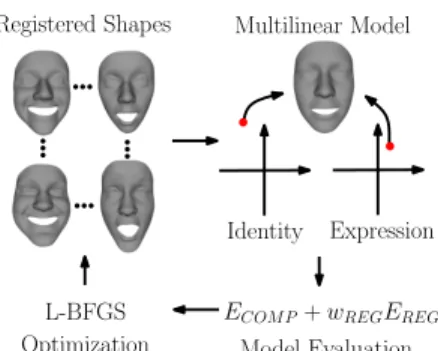
Figure 1. Overview of the iterative multilinear registration.
performed asA(n)=UnSnVnT, whereUn ∈Rdn×dn
con-tains the left singular vectors ofA(n). Truncating columns then reduces the dimensions of identity and expression
space. The multilinear model is then computed as M =
A ×2UT2 ×3UT3. Even for givenm2andm3, the truncated
HOSVD does not give an optimal approximation ofA.
HOOI:Initialized by HOSVD, this method iteratively
op-timizes the Tucker decomposition. Within each iteration, both factor matrices are updated by fixing one and updating the other. That is, for a fixed mode-2 factor matrix, a
ten-sorX =A ×2UT2 is computed, andU3is updated by the
m3 left singular vectors ofX(3). A similar computation is performed for a fixed mode-3 factor matrix. While HOOI
gives a better approximation ofAthan HOSVD, it does not
necessarily find a stationary point.
Newton-Grassmann optimization: Initialized by
HOSVD, the Newton-Grassmann optimization approach constrains each factor matrix to a Grassmannian manifold, an equivalence class of orthogonal matrices. The Tucker decomposition is then computed by a non-linear Newton method on the product of two Grassmannian manifolds. This method converges to a stationary point.
The evaluation of the different tensor decompositions shows that applied to reconstructing unseen face data, they perform almost identical (see Section 5.1). Since HOSVD is the most efficient approach, in the following, we use HOSVD to learn the multilinear model.
4. Groupwise correspondence optimization
This section introduces the concept of groupwise cor-respondence optimizations and describes our approach for multilinearly distributed data. Given a set of shapes in cor-respondence, groupwise correspondence optimization min-imizes an objective function that measures the quality of the correspondence depending on all shapes. Using a statistical model that describes the variation of the shapes, the objec-tive function measures favorable properties of the model.
For PCA models, Kotcheff and Taylor [21] choose the objective function to be the determinant of the covariance matrix, which explicitly favors the induced linear statistical
model to be compact. The compactness of a linear statistical model can be maximized by minimizing the variability of the model, measured by the trace of the covariance matrix.
Compactness measures the variability captured by a model. A compact model can describe instances of a given dataset with the minimum number of parameters and has minimal variance. For models of different compactness that describe the same data, the model with higher compactness and hence lower variance is favorable. It has been shown that minimizing the variance of a PCA model performs sim-ilarly to information theoretic approaches that aim at mini-mizing the description length of the model [13].
Inspired by these previous works, we develop the first MDL-based optimization approach for multilinear models. This extension is challenging because the notion of com-pactness needs to be extended to multilinear models, where
optimal tensor approximation is NP-hard. For 3D face
data, a further challenge arises from manifold boundaries. Figure 1 gives an overview of our multilinear optimiza-tion approach. Given a set of 3D faces of different iden-tities performing different expressions with an initial corre-spondence, we iteratively optimize the correspondence. We compute a multilinear model on the registered data, and it-eratively improve the model. In each iteration, the quality of the model is measured using a groupwise objective func-tion (Secfunc-tion 4.1). The registered shapes are represented using a continuous parametrization (Section 4.2), and the objective function is optimized in parameter space with a quasi-Newton method (Section 4.3).
4.1. Multilinear objective function
Our groupwise objective function consists of two parts:
a compactness energyECOM P, and a regularization energy
EREG. We therefore aim to minimize
E=ECOM P+wREGEREG, (3)
wherewREGis a weight that controls the influence of the
regularization. We now describe both terms in more detail.
Compactness: The compactness of a multilinear model
can be measured as the percentage of data variability
cap-tured in the firstkcomponents of each mode, wherek =
1, . . . ,max (d2, d3)[2]. Compactness is maximized by a sparse model that captures all of the variability in few com-ponents. To encourage a sparse model, we introduce an energy on the variability of the identity and expression sub-spaces. Like Kotcheff and Taylor [21], we choose a log-sum penalty function, as log-sum functions are known to encour-age sparsity by heavily punishing small values [7]. That is, we aim to minimize ECOM P = 1 d2 d2 X i=1 ln(λ(2)i +δ2) + 1 d3 d3 X i=1 ln(λ(3)i +δ3), (4)
whereλ(in)denotes thei-th eigenvalue of the mode-n co-variance matrix. Small regularization constantsδnare used
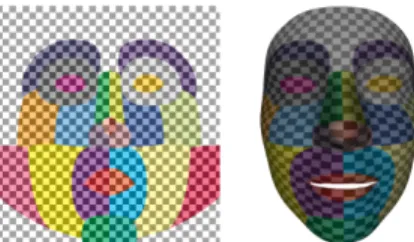
Figure 2. Initial surface parametrization of the 3D face template. Left: 2D parameter domain. Right: 3D parametrization.
Figure 3. Parametrization for one shape. Left: initialization. Mid-dle: thin-plate spline. Right:(u, v)-parameter lines.
to avoid singularities ofECOM Pfor vanishing eigenvalues.
Equivalent to HOSVD, the mode-2and mode-3covariance
matrices are computed as d1
3A(2)A T (2)and 1 d2A(3)A T (3).
The energy ECOM P is minimized by moving points
within the continuous surface of each shape. Since the com-putation of the covariance only considers a discrete number of points instead of the continuous surface,ECOM P can be
minimized by moving points away from complex geometric regions with high variability.
Regularization: To avoid undersampling in these regions,
Davieset al. [10] approximate the integral of the continu-ous covariance matrix by weighting the points by their sur-rounding surface area. Since this does not always prevent the undersampling [13], as done in Burghardet al. [6], we use a regularization within the objective function. The reg-ularization term for each shape is a bi-Laplacian of the form
EREG= 1 n n X k=1 U2(vk(x)) 2 , (5)
wherevk(x)denotes thek-th vertex of shapex. The
double-umbrella operator U2(p) is the discrete bi-Laplacian ap-proximation [19] computed by U2(p) = 1 |N(p)| X pr∈N(p) U(pr)−U(p), (6)
whereN(p)denotes the set of neighbors of vertexpwithin the mesh, andU(p) = 1/|N(p)|P
pr∈N(p)pr−p. The
bi-Laplacian regularizer encourages the points to be regularly distributed over the mesh and prevents fold-overs.
4.2. Parametrization
The registration is optimized by moving points in the surface of each face. Since the surface of the face is 2-dimensional, moving points within the surface can be done by re-parametrization. This requires an initial parametriza-tion together with a continuous mapping from parameter space to the surface of each face. We compute an initial reg-istration for a database of 3D faces using template fitting, and additionally unwrap the 3D template mesh in 2D pa-rameter space to compute an initial discrete parametrization
with parametersti ∈ R2. The embedding in 2D is chosen
to minimize distortions of angles and areas. Each parame-tertiis mapped to the mesh vertexvi = (xi, yi, zi)∈R3. Figure 2 visualizes the initial parametrization in 2D param-eter space (left) and mapped on the 3D surface (right). Due to the full correspondence of all face shapes, this discrete parametrization is the same for all shapes of the database.
With this discrete embedding in parameter space, a
con-tinuous mappingΦis computed that maps parametersα=
(u, v) ∈ R2 into the surface of the shape. A thin-plate spline [11] defines this mapping, computed as
Φ(α) =c+Aα+WT(σ(α−t1), . . . , σ(α−tn))T, (7)
wherec∈R3,A∈R3×2, andW∈Rn×3are the
parame-ters of the mapping, and whereσ:R2→
Ris the function
σ(h) =
(
khk2log(khk) khk>0,
0 khk= 0. (8)
The surface of Φ interpolates all vertices of the shape
(Φ(ti) = vi) and gives the surface with the minimum
bending energy. Figure 3 shows one initially registered shape (left) together with the computed continuous thin-plate spline visualized as densely approximated mesh (mid-dle) and (u, v)-parameter lines (right). The evaluation of
Φat parametersα, whereu(respectivelyv) is fixed andv (respectivelyu) is varied by a fixed discrete step size, gives one(u, v)-parameter line. While the spline interpolates the geometry of the initial shape, it gives a reasonable extrapo-lation of the shape beyond the outer border of the face.
4.3. Optimization
The objective function E in Equation 3 is non-linear.
Due to the choice of the parametrization,Eis analytically
differentiable with respect toα. The supplementary
mate-rial gives the full analytical gradient. We minimizeE us-ing L-BFGS [23], a quasi-Newton method with linear con-straints. These linear constraints allow for each vertex in parameter space to specify a valid rectangular area.
Boundary constraints: For meshes with boundary,
ECOM P is minimized if the entire surface collapses into
a single point. Hence, boundary conditions need to be en-forced. Face shapes have two boundaries, an inner bound-ary at the mouth and an outer boundbound-ary at the end of the acquired scan. Since landmarks are used during the ini-tial registration, the inner boundary at the mouth is regis-tered well. To avoid points that move from the lower to the upper lip or vice versa, we fix the points in the 1-ring neighborhood of the mouth boundary during optimization. Since the outer boundary is not registered well as scans in the database are cropped inconsistently, we allow lim-ited movement for points in the 1-ring neighborhood of the outer boundary. Specifically, the movement is restricted to
at most20mm.
Optimization schedule: Optimizing for the parameters of
all shapes at the same time is not feasible for a large pop-ulation of shapes due to the large number of parameters (d2d32n). Instead, we only optimize the parameters of each shape individually as proposed by Davieset al. [10, Chapter 7.1.1]. This optimization is performed for all shapes of the database during each iteration. Note thatEstill depends on all shapes for this shape-wise optimization, and the method therefore still optimizes the groupwise correspondence. To avoid bias towards any shape, the order of the shapes is ran-domly permuted for each iteration step. Since the rigid alignment of the shapes depends on the correspondence, during optimization of one shape, the alignment is updated after a few optimization steps.
Computational complexity: The computational
complex-ity of one optimization step isO(nd2
2d3+nd2d23)(see sup-plementary material for details). As shown in the following section, our approach is significantly more efficient than ex-isting PCA-based MDL approaches.
5. Evaluation
This section evaluates three different tensor decomposi-tions and our model optimization approach.
Data:For evaluation, we use models of the BU-3DFE [32]
and Bosphorus [28] databases. BU-3DFE contains 3D face scans in neutral expression and in six prototypic expres-sions. Bosphorus covers the six prototypic expressions and
a subset of up to 28 action units per subject. Since both
databases are acquired with different scanner systems, the resulting scans have different resolution and noise charac-teristics. We register the face scans with a template fitting method [27] using the provided landmarks.
For BU-3DFE we use50randomly chosen identities in
7expressions: neutral and the highest level of each expres-sion. For Bosphorus we use all65identities that are present in all7expressions. In the following, we call these subsets BU-3DFE subset and Bosphorus subset, respectively.
Model quality: We quantitatively evaluate the quality of
the optimization with the widely used measures compact-ness, generalization and specificity [10, Chapter 9.2]. The
Figure 4. Artifacts obtained by optimizingECOM Pwithout
regu-larization (wREG= 0). Left: initial registration. Right: result.
identity and expression spaces should ideally be compact, general and specific.
Generalization measures the ability of the statistical model to represent shapes that are not part of the train-ing. The generalization error is measured in a leave-one-out fashion. For the identity mode, each subject is once fully excluded from training and the resulting model is used to reconstruct all excluded scans. The error is then measured as the average vertex distance between all corresponding vertices. The error for the expression mode is computed accordingly by excluding once each expression.
Specificity measures the ability of the statistical model to only represent valid shapes of the object class. To measure the specificity of the model before and after optimization,
we randomly choose10000samples in identity and
expres-sion space and measure the average vertex distance of the reconstruction to the training data.
Reproducibility:To facilitate evaluating the model for dif-ferent applications, we make our optimization code and the optimized statistical model available [3].
5.1. Tensor decompositions
We evaluate the different tensor decomposition methods described in Section 3.2 by fitting the resulting multilinear models to unseen 3D face scans. For this, we use a 10-fold cross validation on the registered BU-3DFE scans. We split the database randomly into ten groups, each with the same ratio of male and female subjects, where all scans of one identity belong to the same group. The error is measured as the distance between a vertex in the fitting result and its closest point in the face scan. The error distribution of all three methods is nearly identical. The median vertex error
is for HOSVD1.145mm, for HOOI1.144mm and for the
Newton Grassmann method1.144mm. Since all methods
perform almost the same, we compute the decomposition with HOSVD in the following.
5.2. Influence of regularization
This section evaluates the influence of the
regulariza-tion EREG on the BU-3DFE subset. The optimization is
performed twice, once only optimizing ECOM P without
EREGand once only optimizingEREGwithoutECOM P.
As discussed in Section 4.1, the regularizer is needed to
Figure 5. Noise example of the database before (top) and after (bottom) optimization. Left to right: no, low, and high noise.
0 10 20 30 40 50 20 40 60 80 100 # Principal components P er cent age of var iabi lit y
High Noise Opt. Low Noise Opt. No Noise Opt. High Noise Low Noise No Noise 0 10 20 30 40 50 0 1 2 3 4 5 # Principal components A vg. poi nt di st ance [m m ] 0 10 20 30 40 50 0 1 2 3 4 5 # Principal components A vg. poi nt di st ance [m m ] 0 1 2 3 4 5 6 7 40 60 80 100 # Principal components P er cent age of var iabi lit y 0 1 2 3 4 5 6 7 0 1 2 3 4 # Principal components A vg. poi nt di st ance [m m ] 0 1 2 3 4 5 6 7 0 1 2 3 4 5 # Principal components A vg. poi nt di st ance [m m ]
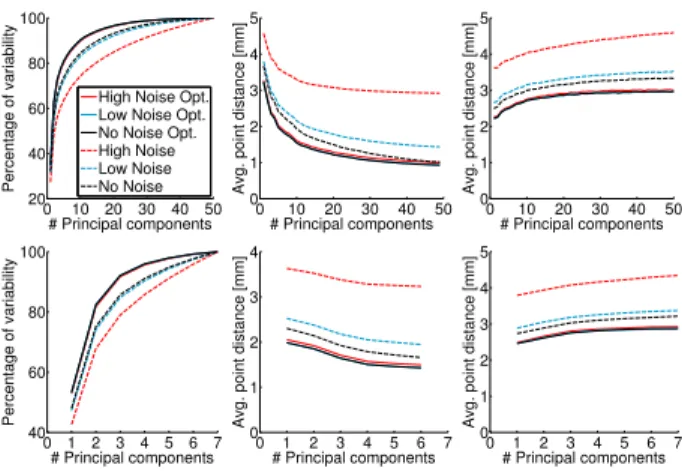
Figure 6. Influence of the initialization for different levels of noise. Left: compactness. Middle: generalization. Right: specificity. Top: identity mode. Bottom: expression mode.
avoid undersampling in regions with high variability and fold-overs. Figure 4 shows the result for one face after only
five iterations of optimizing ECOM P. When minimizing
onlyECOM P, the optimization moves points away from the
eyebrows and around the nose, resulting in sparsely sam-pled regions. Furthermore, fold-overs at the mouth cause vi-sual artifacts. OptimizingEREGleads to regularly sampled
meshes. However, ECOM P increases in this case.
Mini-mizingEis therefore a tradeoff between getting a compact model and a regular mesh structure. In the following, we empirically choosewREG= 0.5.
5.3. Influence of initialization
This section evaluates the robustness to noise in the ini-tialization. State-of-the-art registration methods for faces, as used for the initialization of our method, are able to fit the facial surface well with sub-millimeter accuracy, but the result is likely to contain drift within the surface. To simulate noise regarding these methods, we use the initial
Figure 7. Visual comparison of template fitting [27] (red) and our result (blue) for one subject in four expressions (overlap in gray).
parametrization and add two different levels of noise in the parameter domain. The parameter values of each shape of the BU-3DFE subset are disturbed by random Gaussian noise. Since the 1-ring neighborhood of the mouth bound-ary is fixed during optimization, these vertices are left with-out noise. For both noise levels we choose noise with mean
zero and standard deviationf times the average 3D edge
length. For the lower noise level we choosef to be0.25, for the higher0.75, respectively.
The optimization is performed on the BU-3DFE subset, initialized with the noisy registration. The top of Figure 5 shows an example of the database without noise (left), the lower level of noise (middle) and the higher level of noise (right). The average 3D vertex distance of the initial shapes to the noisy shapes over the entire database is1.11mm for the lower and2.50mm for the higher noise level.
Adding random noise within the surface to each ver-tex increases the variance in 3D positions and therefore in-creases the variability of the data. As expected, Figure 6 shows that the compactness of identity mode and expres-sion mode decreases with increasing noise, since the mul-tilinear model captures less variability with the same num-ber of components. Further, the multilinear model becomes less general and less specific. After15iterations, the aver-age compactness increases by3.8%for the low noise level, and by8.7%for the high noise level, respectively. The aver-age generalization error decreases by0.58mmand1.65mm for the low and high noise level, the average specificity de-creases by0.43mmand1.26mmfor the low and high noise level. After optimization, the model quality for both lev-els of noise is comparable to the optimization of the data without noise. Hence, our optimization method effectively reduces variability caused by drift.
5.4. Comparison
This section compares our approach to two state-of-the-art registration methods for 3D faces based on template fit-ting [27] and PCA-based groupwise correspondence [10].
Template fitting: We compare our optimization to
tem-plate fitting on the BU-3DFE and Bosphorus subsets. For the two subsets, Figures 8 and 9 show the compactness, generalization and specificity for template fitting and after
15iterations of the multilinear optimization. For the
BU-0 10 20 30 40 50 40 60 80 100 # Principal components P er cent age of var iabi lit y MM opt. PCA opt. Template fitting 0 10 20 30 40 50 0 1 2 3 4 # Principal components A vg. poi nt di st ance [m m ] MM opt. PCA opt. Template fitting 0 10 20 30 40 50 0 1 2 3 # Principal components A vg. poi nt di st ance [m m ] MM opt. PCA opt. Template fitting 0 1 2 3 4 5 6 7 40 60 80 100 # Principal components P er cent age of var iabi lit y MM opt. PCA opt. Template fitting 0 1 2 3 4 5 6 7 0 1 2 3 # Principal components A vg. poi nt di st ance [m m ] MM opt. PCA opt. Template fitting 0 1 2 3 4 5 6 7 0 1 2 3 # Principal components A vg. poi nt di st ance [m m ] MM opt. PCA opt. Template fitting
Figure 8. Comparison of template fitting [27], PCA optimiza-tion [10] (PCA opt.) and multilinear model optimizaoptimiza-tion (MM opt.) on BU-3DFE subset. Left: compactness. Middle: general-ization. Right: specificity. Top: identity mode. Bottom: expres-sion mode. 0 10 20 30 40 50 60 50 60 70 80 90 100 # Principal components P er cent age of var iabi lit y MM opt. Template fitting 0 10 20 30 40 50 60 0 1 2 3 # Principal components A vg. poi nt di st ance [m m ] MM opt. Template fitting 0 10 20 30 40 50 60 0 0.5 1 1.5 2 2.5 # Principal components A vg. poi nt di st ance [m m ] MM opt. Template fitting 0 1 2 3 4 5 6 7 40 60 80 100 # Principal components P er cent age of var iabi lit y MM opt. Template fitting 0 1 2 3 4 5 6 7 0 1 2 3 # Principal components A vg. poi nt di st ance [m m ] MM opt. Template fitting 0 1 2 3 4 5 6 7 0 0.5 1 1.5 2 2.5 # Principal components A vg. poi nt di st ance [m m ] MM opt. Template fitting
Figure 9. Comparison of template fitting [27] and multilinear model optimization (MM opt.) on Bosphorus subset. Left: com-pactness. Middle: generalization. Right: specificity. Top: identity mode. Bottom: expression mode.
3DFE subset, the average compactness increases by3.0%,
and the average generalization and specificity decrease by
0.25mm and 0.32mm, respectively. For the Bosphorus
subset, the average compactness increases by1.7%, and the average generalization and specificity decrease by0.15mm and0.16mm, respectively.
Figure 7 visually compares the template fitting (red) to our result (blue) for one subject of the BU-3DFE subset. Before optimization, the shape of the outer boundary dif-fers. The optimization decreases the face for the first and fourth expressions at the cheek, for the second expression at the jaw, and for the third expression at the forehead. Ex-pressions one, two and three are extended at the forehead. After15iterations, the outer boundaries are similar.
To demonstrate the ability of our method to optimize over large sets of shapes, we consider a second subset of the
26action units each, leading to a total of over1000shapes. To keep95%of the data variability after template fitting, a total of27components are necessary, while after15 itera-tions of our optimization,20components suffice. As for the other subsets, generalization and specificity also improve after optimization. To the best of our knowledge, this is the first time a registration optimization based on MDL has been applied to such a large set of shapes.
For all three datasets the model improves significantly during optimization, leading to a more compact model with improved generalization and specificity.
PCA:For brevity, we abbreviate PCA optimization by PCA
opt. and our method by MM opt. during the discussion of the comparison. We start by comparing the computational complexity of the two methods. In the supplementary ma-terial, we show that one optimization step for PCA opt. has complexityO(nd2
2d23), while one optimization step of MM opt. has complexityO(nd2
2d3+nd2d23). For the BU-3DFE subset our non-optimized implementation takes about16.2h for MM opt. and about21.5h for PCA opt. for one iteration when executed on a standard PC.
Figure 8 quantitatively compares PCA opt. and MM opt.,
both after15iterations. While MM opt. gives significant
improvements, PCA opt. only slightly improves the corre-spondence. For small subsets PCA opt. gives significant improvements within few iterations. Our experiments sug-gest that for an increasing number of shape space parame-ters, an increasing number of iterations is required. Since MM opt. models identity and expression independently, the number of shape space parameters isd2+d3, while for PCA opt. the number of shape space parameters isd2d3.
Hence, our method gives better improvements after the same number of iterations and is computationally faster than existing linear optimization methods.
5.5. Discussion
Parametrization:Our proposed method optimizes the
cor-respondence by re-parametrizing the shapes guided by the optimization of a multilinear compactness objective func-tion. This re-parametrization requires a continuous repre-sentation of the surface for each shape. While any kind of continuous mapping can be used, we establish this by a thin-plate spline. For other continuous mappings, the gradient changes, and therefore depending on the mapping (e.g. for
mappings without analytical gradient)Emust be optimized
with a different method.
Data quality:Computing this continuous surface mapping
assumes the original face scans to be regularly densely sam-pled with points that are within the surface of the scan. To get this sampling, any existing template fitting method can be used. For face scans with partial occlusions or strong distortions, template fitting methods fail, since they are un-able to estimate the real face surface in these regions. To
optimize the registration for scans with strong distortions, we would either need another initialization that gives a rea-sonable surface estimation within the occluded and noisy regions (e.g. Bruntonet al. [5]), or the optimization ofE must be allowed to leave the surface of the disturbed scan guided by the underlying multilinear model.
Computational complexity: While the multilinear
corre-spondence optimization is computationally more efficient than previous linear methods, due to the groupwise objec-tive function, the computational complexity is still high. Our experiments show that only a low number of iterations are necessary to get significant improvements. Note that the registration can be seen as pre-processing that only needs to be done once. The application for larger datasets would require the use of a compute cluster to exploit the full po-tential of the parallelizability of the method (especially the gradient computation).
Extensions: Our method is generally applicable to other
classes of multilinearly distributed data. The geometry of the shapes can contain no or multiple holes as long as the boundaries of the holes are constrained. The
regulariza-tion EREG prevents fold-overs around these holes.
Fur-thermore, the extension of our method to more modes is straightforward,e.g. for faces to associate the fourth mode with viseme or age.
6. Conclusion
We have presented the first method for multilinearly distributed data that jointly improves a given registration and a multilinear model. A continuous representation of each shape allows to optimize the registration with a quasi-Newton method. We have evaluated our method on scans of two databases and have demonstrated that our method is robust to noise in the initial registration. A key advantage of our approach over existing linear MDL methods is its in-creased computational efficiency, which allows for the first time to apply an approach based on MDL to databases con-taining over 1000 shapes. We have shown that using the efficient HOSVD method to compute the multilinear model performs similarly when reconstructing unseen face data to more elaborate tensor decompositions. To facilitate experi-ments for different application scenarios, we make our opti-mization code and the optimized statistical model available.
Acknowledgments
We thank Arnur Nigmetov for help with the comparison of the different tensor decompositions, and Alan Brunton, and Michael Wand for helpful discussions. This work has been partially funded by the German Research Foundation (WU 786/1-1, Cluster of Excellence MMCI).
References
[1] V. Blanz and T. Vetter. A morphable model for the synthesis of 3D faces. InSIGGRAPH, pages 187–194, 1999. [2] T. Bolkart and S. Wuhrer. 3D faces in motion: Fully
auto-matic registration and statistical analysis. CVIU, 131:100– 115, 2015.
[3] T. Bolkart and S. Wuhrer. Multilinear mdl for 3D faces, 2015. http://multilinear-mdl.gforge.inria.fr/.
[4] C. Bregler, A. Hertzmann, and H. Biermann. Recovering non-rigid 3D shape from image streams. InCVPR, volume 2, pages 690–696, 2000.
[5] A. Brunton, T. Bolkart, and S. Wuhrer. Multilinear wavelets: A statistical shape space for human faces. InECCV, pages 297–312, 2014.
[6] O. Burghard, A. Berner, M. Wand, N. J. Mitra, H. Seidel, and R. Klein. Compact part-based shape spaces for dense correspondences.CoRR, abs/1311.7535, 2013.
[7] E. Cand`es, M. Wakin, and S. Boyd. Enhancing sparsity by reweightedl1minimization.JFAA, 14(5-6):877–905, 2008.
[8] J.-H. Chen, K. C. Zheng, and L. G. Shapiro. 3D point corre-spondence by minimum description length in feature space. InECCV, pages 621–634, 2010.
[9] R. Davies, C. Twining, T. Cootes, and C. Taylor. Build-ing 3-d statistical shape models by direct optimization. MI, 29(4):961–981, 2010.
[10] R. Davies, C. Twining, and C. Taylor. Statistical Models of
Shape: Optimisation and Evaluation. Springer, 2008.
[11] I. Dryden and K. Mardia. Statistical shape analysis. Wiley, 1998.
[12] L. Eld´en and B. Savas. A newton-grassmann method for computing the best multilinear rank-(r1, r2, r3)
approxima-tion of a tensor.SIAM J. Matrix Anal. Appl., 31(2):248–271, 2009.
[13] S. T. Gollmer, M. Kirschner, T. M. Buzug, and S. Wesarg. Using image segmentation for evaluating 3D statistical shape models built with groupwise correspondence optimization.
CVIU, 125(0):283 – 303, 2014.
[14] J. Guo, X. Mei, and K. Tang. Automatic landmark annotation and dense correspondence registration for 3D human facial images.BMC Bioinf., 14(1), 2013.
[15] C. J. Hillar and L.-H. Lim. Most tensor problems are NP-hard.JACM, 60(6):45:1–45:39, 2013.
[16] D. Hirshberg, M. Loper, E. Rachlin, and M. Black. Coregis-tration: Simultaneous alignment and modeling of articulated 3D shape. InECCV, pages 242–255, 2012.
[17] Y. Huang, X. Zhang, Y. Fan, L. Yin, L. Seversky, J. Allen, T. Lei, and W. Dong. Reshaping 3D facial scans for facial appearance modeling and 3D facial expression analysis.IVC, 30(10):750 – 761, 2012.
[18] M. Irani. Multi-frame correspondence estimation using sub-space constraints. Int. J. Comput. Vision, 48(3):173–194, 2002.
[19] L. Kobbelt, S. Campagna, J. Vorsatz, and H.-P. Seidel. In-teractive multi-resolution modeling on arbitrary meshes. In
SIGGRAPH, pages 105–114, 1998.
[20] T. G. Kolda and B. W. Bader. Tensor decompositions and applications.SIAM Rev., 51(3):455–500, 2009.
[21] A. C. Kotcheff and C. J. Taylor. Automatic construction of eigenshape models by direct optimization. Med. Image
Anal., 2(4):303 – 314, 1998.
[22] L. D. Lathauwer. Signal processing based on multilinear
algebra. PhD thesis, K.U. Leuven, Belgium, 1997.
[23] D. Liu and J. Nocedal. On the limited memory method for large scale optimization. Math. Prog.: Series A and B, 45(3):503–528, 1989.
[24] I. Mpiperis, S. Malassiotis, and M. G. Strintzis. Bilinear models for 3-D face and facial expression recognition. IFS, 3:498–511, 2008.
[25] G. Pan, X. Zhang, Y. Wang, Z. Hu, X. Zheng, and Z. Wu. Es-tablishing point correspondence of 3D faces via sparse facial deformable model.IP, 22(11):4170–4181, 2013.
[26] G. Passalis, P. Perakis, T. Theoharis, and I. Kakadiaris. Using facial symmetry to handle pose variations in real-world 3D face recognition.PAMI, 33(10):1938–1951, 2011.
[27] A. Salazar, S. Wuhrer, C. Shu, and F. Prieto. Fully automatic expression-invariant face correspondence. MVAP, pages 1– 21, 2013.
[28] A. Savran, N. Alyuz, H. Dibeklioglu, O. Celiktutan, B. G¨okberk, B. Sankur, and L. Akarun. Bosphorus database for 3D face analysis. InBIOID, pages 47–56, 2008. [29] L. Torresani, D. Yang, E. Alexander, and C. Bregler.
Track-ing and modelTrack-ing non-rigid objects with rank constraints. In
CVPR, pages 493–500, 2001.
[30] D. Vlasic, M. Brand, H. Pfister, and J. Popovi´c. Face transfer with multilinear models.SIGGRAPH, 24(3):426–433, 2005. [31] F. Yang, L. Bourdev, J. Wang, E. Shechtman, and D. Metaxas. Facial expression editing in video using a temporally-smooth factorization. InCVPR, pages 861–868, 2012.
[32] L. Yin, X. Wei, Y. Sun, J. Wang, and M. J. Rosato. A 3D facial expression database for facial behavior research. In
![Figure 7. Visual comparison of template fitting [27] (red) and our result (blue) for one subject in four expressions (overlap in gray).](https://thumb-us.123doks.com/thumbv2/123dok_us/1456497.2694859/8.918.469.814.104.335/figure-visual-comparison-template-fitting-subject-expressions-overlap.webp)