The Pain and Gain of Offshoring: The Effects of
Tax Progression in a Segmented Labour Market
Silvia Rocha-Akis
CESIFO WORKING PAPER NO. 3739
C
ATEGORY
4:
L
ABOUR
M
ARKETS
F
EBRUARY
2012
PRESENTED AT CESIFO AREA CONFERENCE ON EMPLOYMENT AND SOCIAL PROTECTION,MAY 2011
An electronic version of the paper may be downloaded
• from the SSRN website: www.SSRN.com
• from the RePEc website: www.RePEc.org
CESifo
Working Paper No. 3739
The Pain and Gain of Offshoring: The Effects of
Tax Progression in a Segmented Labour Market
Abstract
Over the previous two decades, many OECD countries have lowered the degree of
progressivity in their tax structures. In this paper, I investigate labour tax progression in a
world characterised by a segmented labour market where the higher-paying jobs are rationed
due to (i) oligopolistic market structures, (ii) insider-oriented unions and (iii) international
offshoring. In this second-best world, a revenue-neutral decrease in the progressivity of the
tax schedule promotes higher domestic (net-of-tax) wage inequality where a shrinking
fraction of workers provides the tax revenue to finance the redistribution to an increasing
share of lower-wage workers. However, as the tax reform involves an increase in the
offshoring intensity, which may translate into a cost advantage for the domestic average
consumer, the overall welfare effect is ambiguous. It is shown that the negative effects
dominate if trade unions are sufficiently insider-oriented.
JEL-Code: L130, H200, F160, J500.
Keywords: relocation, unionised oligopoly, labour market segmentation, labour income tax
progression, trade union preferences.
Silvia Rocha-Akis
Vienna University of Economics and Business
Department of Economics
Nordbergstraße 15
D 311
Austria – 1090 Vienna
[email protected]
February 2012
I would like to thank Ana B. Ania, Andreas Haufler, Ronnie Schöb, as well as the participants
at the CESifo Area Conference on Employment and Social Protection 2011 and the 2011
Annual Congress of the European Economic Association for helpful comments and
suggestions. All shortcomings are mine.
1
Introduction
Evidence shows that traditionally unionised countries are undergoing several unprecedented labour market changes such as a sharp increase in the share of employees hired on temporary contracts, involving the risk of becoming ’trapped’ in precarious jobs (Dolado et al., 2002; Bentolila et al., 2008; European Commission, 2008 and 2010, chapter 3); an increase in dualism whereby workers on stable contracts coexist with workers on tem-porary contracts (Boeri, 2010); an increase in the share of workers that take jobs for which they possess excess educational qualifications, contributing to job-dissatisfaction (Dolado et al., 2000; Green, 2010); and growing low-wage sectors (Lucifora et al., 2005; Bosch and Kalina, 2008).
While the underlying causes for these developments may be manifold, they point to the prevalence of job rationing in occupations offering better pay and attractive career opportunities, and its interaction with institu-tionally shaped patterns in product and labour markets. In addition, the ongoing trend in emerging economies towards producing increasingly skill-intensive goods and services is likely to play a role, as it fosters global labour arbitrage even of higher-paying jobs typically considered insulated from global competition (OECD, 2007; Blinder, 2006).
Even if workers experience downward wage pressure and rising employment insecurity due to more intense global competition, it is often claimed that they can gain as consumers, as they enjoy lower prices, and they can gain as shareholders - provided they own shares.1 Profit income, however, typically accrues disproportionately
to a small layer in society. Therefore, the support for globalisation is ultimately determined by how well-off the average worker feels. In view of the perceived lack of influence over global developments, policy-makers face mounting pressure in understanding the potential societal outcomes of different fiscal policy choices.
The purpose of this paper is to shed some light on how changes in the structure of labour income taxation may affect welfare in a small open economy within the context of international offshoring, strategically interacting firms, and a segmented domestic labour market.2 The focus is motivated by three observations. First, in many
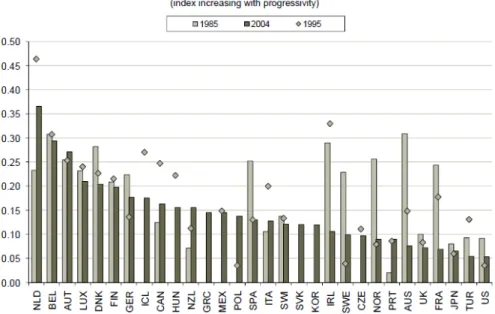
OECD countries major reforms have taken place over the past few decades, aimed at reducing the degree of personal income tax progressivity (see figure A.1 in Appendix A). The trend towards flatter tax systems has
1See, for example, The Economist (2006) for this line of reasoning.
2Due to the prominence of labour income related taxes in financing redistribution in many OECD countries, and due to the limited research on the welfare effects of such taxes in the presence of capital and firm mobility, the present paper focuses only on labour taxes. For an analysis of optimal capital taxation in a framework with a small open economy and a segmented labour market, see Koskela and Sch¨ob (2005).
come about by an increased reliance on social security contributions – which tend to be levied at flat rates –, a reduction in statutory rates, as well as a reduction in the number of tax brackets (OECD, 2006; European Commission, 2007).3 In effect, the progressivity of the tax system is defined by how wide tax brackets are and
by the extent to which taxation is steadily increasing as a percentage of income. Second, I build on the broad consensus that a decrease (increase) in marginal tax rates, for given average tax rates, increases (reduces) work effort when the labour market is competitive, whereas it increases (reduces) the wage pressure when the labour market is non-competitive (e.g. Koskela and Vilmunen, 1996; Lockwood et al., 2000).4 In view of the importance
of the regulation of contracts via collective agreements signed by unions in Europe (Visser, 2006), the latter effect should play a crucial role and has indeed been confirmed empirically for a large number of European countries (see Schneider, 2005, and references therein). Finally, the third consideration is that markets are often dominated by large firms that interact strategically and have the possibility to take advantage of international differences in factor prices by offshoring production to lower-cost countries. Recent evidence suggests that the role of geographic distance on the decision to offshore manufacturing operations and services around the globe has markedly diminished over time (e.g. Head et al., 2009).
Based upon these notions, I consider a small open welfare economy in which domestic workers may either be employed in an oligopolistic sector (denoted as primary sector) where firms perceive competitive pressure from rival firms located in the domestic and foreign countries or, alternatively, workers may be employed in a competitive sector (denoted as secondary sector). Jobs in the primary sector are better paid and regarded as superior as the presence of imperfect product market competition generates rents which are shared with the workers in that sector, all of whom are represented by a trade union.5 Workers in the secondary sector do not
possess bargaining power6 and are entitled to a subsidy, which is financed by taxes that are levied on primary
sector workers’ earnings. A central assumption is that primary sector firms are able to access global supplies of relatively low-wage labour by shifting entire production processes abroad. In this setup, the government uses 3For a detailed country-specific tax progression analysis over a particularly long time span refer to e.g. Schratzenstaller and Wagener (2009). A recent contribution comparing various dimensions of tax progression across countries and time is provided by Pogorelskiy et al. (2010).
4This is because “a progressive tax is a tax on wageincreases. When workers are represented by unions with preferences over wages and employment, the ‘price’ – in terms of forgone employment – of a higher take-home wage goes up. Thus, other things equal, the union will negotiate a lower pretax wage. This may be called the wage moderation effect of progressivity.” (Lockwood et al., 2000, p. 708). The negative relationship between marginal tax rates and pre-tax wages carries over to models that assume labour markets which are characterised by efficiency wages (e.g. Hoel, 1990).
5In practice, it is well known that labour markets are divided into tiers and wages may differ considerably across sectors, even for equally skilled workers (see for example Saint-Paul, 1996).
progressive labour taxes as an instrument to affect welfare via several channels. On the one hand, a change in the degree of tax progression has a direct influence on union wage-setting. On the other hand, by changing the relative international labour costs it affects the offshoring incentives within the primary sector which in its turn has repercussions on the domestic sectoral allocation of employment, the net-of-tax wages and consumer prices. The main results of this study are as follows. A revenue-neutral decrease in the degree of income tax pro-gression, at constant average tax rates, causes a higher domestic net-of-tax wage inequality and a decrease in the aggregate domestic wage income. Essentially this happens because, compared to employment increases, wage increases become a more attractive means for the trade union to raise the domestic primary sector labour income. A higher pre-tax wage, in turn, strengthens the incentives for outward production relocations. As a result, those firms that maintain their production processes in the domestic country are reduced in number, face fiercer rivalry from their competitors located in lower wage countries and therefore earn lower profits. This contributes to a lower domestic primary sector employment, the displaced workers being absorbed in the domestic lower wage sector. Yet, offshoring opens up the possibility that domestic consumers are on average more than compensated for both the reduction in aggregate labour income and the loss in domestic competitiveness, provided that they face sufficiently lower consumer prices. Importantly, the outcome of this trade-off critically depends on the trade union’s preference profile. It is shown that the benefits of a higher offshoring intensity in terms of lower foreign production costs are too weak to compensate the average domestic consumer for the negative domestic labour market effects if the trade union’s inclination to share a given rent among fewer rather than more workers is strongly pronounced. It follows that a decrease in tax progression unambiguously lowers welfare if the trade union is sufficiently insider-oriented.
The paper proceeds as follows. The next section provides a survey of the related literature. Section 3 introduces the general features of the model. Section 4 analyses the output and employment decisions of primary sector firms, the wage formation in the primary sector, and the locational equilibrium of firms. Section 5 discusses how changes in the labour income tax structure affect welfare. Concluding remarks follow in section 6.
2
Related literature
This paper relates to several strands of the literature. On a more general level, it is connected to papers that examine how the possibilities of substituting domestic for foreign jobs in the production process affect domestic labour markets. Grossman and Rossi-Hansberg (2008) formulate a model of offshoring with perfectly competitive product and labour markets where domestic workers specialise on tasks in which their relative productivity is greatest while the remaining tasks are offshored to lower wage countries. Since the offshored complementary input is relatively cheaper, the average domestic productivity increases which benefits domestic workers via higher wages. Hence, offshoring is viewed as domestic technical progress. One significant difference with respect to the present work is that the model relies on a substantial part of production being carried out in the domestic country so that domestic workers can reap the benefits of production fragmentation. By contrast, the present paper allows for entire production processes to be offshored. This is in keeping with the notion that moving unfinished goods back and forth between different countries along the production chain is too expensive when firms have global access to abundant low-cost labour at all skill levels.7 Karabay and McLaren (2010) focus on
the risk aspects related to the increased volatility of workers’ incomes as markets become increasingly integrated. Using alternative proxies for offshoring, Senses (2010) provides evidence that the labour demand elasticities for production workers in the U.S. manufacturing sector are positively associated with increased exposure to offshoring. Other recent empirical papers exploring the relationship between globalisation and labour demand elasticities include Scheve and Slaughter (2004) and Hijzen and Swaim (2010).
None of these contributions addresses the role of redistributive policies in affecting the relationship between offshoring and labour markets. The issue is particularly relevant in the context of European welfare states with highly regulated labour markets. In this respect, Koskela and Sch¨ob (2010) discuss how different labour tax and welfare reforms affect employment when a representative, perfectly competitive firm can replace a part of its homogeneous, unionised workforce with lower wage workers via international outsourcing. One central result is that the positive association between tax progression and employment is robust to outsourcing. In a model where complementary workers differ in skill and only the low skilled workers are exposed to the risk of unemployment due to both search unemployment and outsourcing, Keuschnigg and Ribi (2009) show that
a redistribution of income via an increase in a linear income tax on high-skilled workers and a decrease in the tax burden of low-skilled workers improves welfare. The underlying mechanism is that the reform lowers the gross wages of low-skilled workers thereby lowering the degree of outsourcing and increasing labour market participation. Moreover, high-skilled workers, whose wage is fixed, are assumed to share the benefits of the higher profits. Rocha-Akis and Sch¨ob (2011) investigate how changes in the social security system affect labour markets in the context of internationally mobile production and strategic wage bargaining between unionised labour and oligopolistic firms. The main finding is that deeper economic integration need not undermine redistributive goals as the threat of job offshoring compels unions to carry the cost of redistribution in terms of lower net wages. Only if redistribution exceeds a critical level will some trade unions choose a high-wage/low-employment policy which is associated with offshoring and domestic job losses. Aronsson and Sj¨ogren (2004) discuss optimal nonlinear taxation under right-to-manage wage formation and mobile production in the context of international policy coordination.
All papers mentioned so far ignore the possibility of equally skilled workers receiving different wages in different sectors of the economy. The perspective that labour markets are segmented into good and bad jobs is taken up in Kleven and Sørensen (2004) and Lommerud et al. (2004) who analyse the implications of redistribution by means of labour tax progression in a closed economy with perfectly competitive firms. The studies yield conflicting insights regarding the desirability of raising labour income tax progression. In Lommerud et al. (2004) primary sector workers share industry rents whereas secondary sector workers do not. One key result is that the optimal policy involves the use of progressive taxation provided that unions are strong and the government’s inclination for income equality is high. By contrast, Kleven and Sørensen (2004) consider a dual labour market where the wage in the primary sector is formed according to an efficiency wage mechanism. The authors consider a revenue-neutral increase in progression that involves a higher average tax rate on primary sector workers’ wages and a lower corresponding tax on the wage of secondary sector workers. The central message there is that the positive association between tax progression and employment is not robust to the introduction of dual labour markets, the reason being that under the assumption of zero profit under perfect competition an increase in the average tax rate requires higher equilibrium gross wages if a given effort level is to be maintained. This in turn reduces aggregate employment and demand.
3
The model
I consider a country that is composed of two sectors: a primary sector characterised by an oligopolistic market structure where firms share part of their rents with organised labour, and a secondary sector in which goods are produced under perfect competition thus offering comparatively low-paying jobs.8 The country is inhabited by
T internationally immobile consumer-workers who each supply one unit of labour inelastically and have identical
preferences. They derive utility from the consumption of primary and secondary goods according to the following quasi-linear utility function:9
u(x, y) =αx−1 2βx
2+
y, (1)
wherexdesignates the homogeneous primary sector good andyis the good produced in the secondary sector. In
accordance with other recent models that concentrate on the implications of labour market segmentation, I retain the assumption that workers are identical ex ante, being randomly allocated to the sectors.10 The tax system is
redistributive in that secondary sector workers are entitled to receive an exogenously fixed governmental transfer,
b, while only primary sector workers contribute to its financing. Moreover, I consider a progressive tax structure
within the primary sector, that is, the tax system allows for a redistribution of income towards the less well-off
within the primary sector. Normalising the price of the secondary sector good to 1, the budget constraint of the average consumer is:
s ω1(1
−τ) +a
+ (1−s) (ωc+b)≥y+px, (2)
where s∈ (0,1) corresponds to the share of workers employed in the domestic primary sector, ω1 is the gross
primary sector wage,τ denotes the marginal labour income tax rate,ais the level of tax exemption granted, ωc is the competitive wage firms pay to workers in the secondary sector, andpis the price of the primary good.11
(The superscript 1 generally refers to the primary sector.)
8Taking a more general perspective, the secondary sector might include the informal sector. 9See Haufler and Mittermaier (2011) for a similar specification.
10See e.g. Kleven and Sørensen (2004) and Lommerud et al. (2004).
11Note that one could easily introduce a public good that is financed by a lump-sum tax levied on all workers. This, however, would complicate the analysis without providing additional insights.
The model has four stages. In the first stage, the government decides whether and how to reform the labour income tax structure which is regarded as exogenous by all firms and workers. Then, primary sector firms choose their production locations upon a comparison of potential profits at the domestic and the foreign location. In doing so, they anticipate the union’s reaction to international shifts in industrial production. Given the locational equilibrium, the union sets the primary sector pre-tax wage in full knowledge of the consequences for primary sector employment, that is, subject to the firms’ labour demand schedules. Finally, the firms choose their production and employment levels at their respective locations. The analysis is performed by backward induction.
4
The primary sector
4.1
Output and employment
In the primary sector, N firms engaging in quantity competition produce good x for the domestic market,
according to a constant-returns-to-scale technology where units are chosen so that one unit of labour input produces one unit of output. Labour is the only input in production. I assume that barriers to entry into the industry protect all incumbent firms from new entrants. The demand for goodxis obtained by maximising the
per-capita consumer’s utility (1) subject to the budget constraint (2), which is assumed to hold with equality, and aggregating over the number of consumers yieldingp(X) =α−β(X/T), where α >0, β >0, and X is the
aggregate output in the industry. All primary sector firms are internationally mobile and can therefore choose between producing domestically and producing in the foreign country (representing the rest of the world).12 Let
mbe the number of firms located abroad so that (N−m) is the number of firms that produce domestically, and
assume that unit costs are constant and equal to the respective unit wages, which firms take as given. The profit of firmj isπj=
p(X)−ωj
xj,j= 1, ..., N. In a Cournot equilibrium, output and employment levels are given by xd(m) = T α−ω1 −m ω1 −ωf β(1 +N) , (3)
12It is assumed that international markets are segmented from the viewpoint of firms. That is to say, the firms’ decisions regarding the domestic market are independent from those geared towards serving markets in other countries (a similar assumption is made in e.g. Neary (2003)).
xf(m) = T α−ωf+ (N −m) ω1 −ωf β(1 +N) =x d(m) + (T /β) ω1 −ωf , (4)
wherexd and xf denote the individual output (employment) levels of the firms producing in the domestic and the foreign country, respectively. Positive domestic primary sector output requires ω1 < (α+mωf)/(1 +m) whereas output is produced abroad iffωf <(α+ (N
−m)ω1)/(1 +N
−m).13 The total equilibrium industry
output is then given by
X(m) = (N−m)xd+mxf =T
N α−(N−m)ω1
−mωf
β(1 +N) , (5)
and a firm’s equilibrium profit is
πk(m) =T β xk(m)2
, k=d, f. (6)
4.2
Wage determination
The only difference between both production locations relates to the labour market: whereas labour in the primary sector is unionised in the domestic country, I assume that the foreign wage,ωf, is lower and exogenously given.14 Following much of the literature on unionised oligopolies (e.g. Lommerud et al., 2006 and included
references), I assume that the wage in the primary sector is set by a monopoly union which is fully aware of the consequences of its wage demands for the firms’ employment decisions.15 The union wage is legally binding
for all domestic primary sector employers.16 It is further assumed that the union is not able to affect the
firms’ location decisions strategically. Rather, it is the firms who are forward-looking actors and conjecture the union’s behaviour.17 Consequently, the union takes the industrial distribution of firms across countries as given.
13The latter profitability constraint always holds in equilibrium (cf. equation (9)).
14The exogeneity of the foreign wage is motivated by the large increase in the world supply of (unskilled and skilled) workers associated with the fast growth in the informationalisation and industrialisation in countries such as China, India and the former Soviet Union. Even if labour costs rise at a particular foreign location, I implicitly assume that there are sufficient opportunities for firms to relocate production to some other foreign country so as to maintain a stable cost level.
15The monopoly union model is closely related to the more general right-to-manage model in which the wage is bargained by collective agreement between the trade union and the firms. The similarity between these models is that in both approaches the outcome lies on the labour demand curve. As shall be seen below, in the present specification the equilibrium on the demand curve depends, among other factors, on the union-specific preference profile.
16As reasoned in Haufler and Mittermaier (2011), the assumption of a sector-specific union is appropriate in the European context where collective agreements occur predominantly at industry level.
17Anecdotal evidence suggests that “while employers govern the [relocation] process until the decision is taken, the unions usually get involved at a very late stage and often can only try to cope with its consequences.”(EIRO, 2005, p. 30)
Typically unions wish to maximise both employment and wages. But since these goals work against each other, the equilibrium outcome depends on the relative priority assigned to each of these two objectives. Accordingly, the union objective function is specified as
V = ω1 −ωo(1 −τ){L(m)}δ, where ωo:= ω c+b−a 1−τ (7)
denotes the gross outside income of primary sector workers in excess of the level of tax exemption andL(m) is
the demand for labour in the domestic primary sector, that is,
L(m) = (N−m)xd(m). (8)
The preference parameterδ >0 captures the relative weight the union attaches to the objective of maximising
the primary sector employment at the expense of achieving a higher wage.18,19
As the primary sector good accounts only for a fraction of the workers’ purchasing expenses, the union does not internalise the price effect of its wage-setting decision. Moreover, the union ignores the impact of the primary sector wage on the government’s tax policy decisions, that is to say, it does not take the government budget constraint into account.20 In line with Lommerud et al. (2006), the first order condition for the union’s
maximisation problem can be expressed in terms of the wage elasticity of labour demand,, as follows:
ωo
ω1 = 1−
1
δ,
18A similar approach is employed in Lommerud et al. (2006), among others. If δ→0, the union is inclined to disregard the employment effects of changes in the wage rate and aims primarily at maximising the net-of-tax wage surplus with respect to the secondary sector pay. This is a special case of the “Seniority model” in Oswald (1993). Values ofδsmaller (larger) than 1 reflect a union that is “wage-oriented” (“employment-oriented”). Whenδ= 1 the union’s interest lies in maximising the total union rent.
19Empirical attempts to determine how the wage setting process depends on the union’s preferences are scarce. A survey of British trade union leaders conducted by Clark and Oswald (1993) suggests that generally more weight is placed on wage increases than on employment increases. Likewise, in an effort to estimate union power parameters across five European countries and a range of manufacturing sectors, Dumont et al. (2006) report evidence to indicate that trade unions tend to be wage-oriented, with German and French unions exhibiting particularly pronounced preferences towards wage orientation compared to their Belgian, Italian and UK counterparts.
where := −∂L∂ω(m1) ω 1
L(m). Hence, the equilibrium sectoral wage markup is decreasing in and in the union’s
relative preference for employment over wages. Clearly, positive wages imply > 1/δ and therefore a
wage-(employment-) oriented union chooses the equilibrium wage in the elastic (inelastic) part of the labour demand curve. Explicitly solving for the equilibrium primary sector wage, the first-order condition for a maximum of the union objective subject to (3) yields
ω1(m) = 1 (1 +δ) (α+mωf) (1 +m) + δ (1 +δ) ω o, (9)
where the second-order condition always holds.21 In words, the wage in the primary sector is a weighted sum of
the maximum wage compatible with positive profits and the outside wage. I impose
α+mωf
1 +m > ω
o
≥ωf. (10)
The first inequality reflects the notion that, in net terms, secondary sector workers earn less than primary sector workers and implies ∂(ω1(m))/∂δ < 0. The latter inequality guarantees that ω1(m)
≥ ωf
∀δ, thus enabling
us to take account of the role of asymmetries in international labour costs. For reasons of analytic tractability and in conformity with the empirical results in Dumont et al. (2006), throughout the following I shall restrict attention to values ofδbetween 0 and 1.22
4.3
Implications of offshoring with given tax structure
Assuming for the time being that the global distribution of primary sector firms is exogenously given, it is instructive to consider what happens when the offshoring intensity,m, increases.23 First, quantity competition
implies that firms in the domestic country experience lower profits when the share of rival firms producing at lower cost abroad increases. As this lowers the rents to be shared with workers, offshoring puts downward pressure on
21This is readily seen from the first-order condition: V
ω1 =α+mωf+δωo(1 +m)−(1 +m)(1 +δ)ω1= 0.
22C.f. footnote 14.
23Since the total number of primary sector firms is assumed fixed, m interchangeably denotes the number and the share of offshoring firms.
the domestic primary sector wage: ∂ω1(m) ∂m =− 1 (1 +δ) (α−ωf) (1 +m)2 <0. (11)
This effect becomes incrementally weaker as more firms offshore:
∂2ω1(m) ∂m2 =− 2 (1 +m) ∂ω1(m) ∂m >0. (12)
Furthermore, substituting forω1(m) from (9) into (3) and (4), we have that
∂xf(m) ∂m = T β(1 +N) (N−m)∂ω 1(m) ∂m − ω 1( m)−ωf <0, ∂xd(m) ∂m = − T β(1 +N) (1 +m)∂ω 1(m) ∂m + ω 1( m)−ωf <0, (13)
where it is useful to note that
ω1(m) −ωf =−(1 +m)∂ω 1(m) ∂m + δ (1 +δ) ω o −ωf . (14)
Finally, the following relations are easily verified:
∂L(m) ∂m <0, ∂mxf(m) ∂m >0, ∂X(m) ∂m >0, ∂p(X(m)) ∂m <0.
Hence the following proposition.
Proposition 1. An increase in the (exogenous) offshoring intensity has the following implications: (i) the profits
from sales in the domestic market of any (non-offshoring) primary industry firm fall, regardless of its production
location, (ii) the aggregate domestic (foreign) output and employment in the primary sector fall (increase), (iv)
the total primary industry output increases and therefore (v) the price of the primary sector good decreases. All
described effects fade as the offshoring intensity increases.
A straightforward interpretation is that, as more firms have access to lower-cost labour, both the firms located abroad and the firms producing in the domestic country lose in terms of individual competitive advantage over rival firms. Only the firm that relocates improves its relative position in the market, as shall be shown in the next section. At the same time, as more firms produce at lower costs, the total scale of output is expanded, and the primary sector good becomes less expensive in the domestic country. Hence, offshoring is associated with lower consumption costs.
An essential property of the model is that the impact experienced by domestic workers, as primary sector jobs move offshore, is not symmetric and crucially depends on the union preference parameterδ. In particular,
Proposition 1 implies that while some domestic workers lose their jobs and must accept employment in the secondary sector, other workers suffer in terms of wage cuts that go along with shrinking profits. Generally, the more wage-oriented the union is, the more rationed primary sector jobs are. Yet, due to the stronger reliance on profit, a more wage-oriented union reacts more sensitively to changes in the industry’s offshoring intensity. The following relations can be derived:
∂(m) ∂m >0, ∂ ∂δ ∂ω1(m) ∂m >0, ∂ ∂δ ∂L(m) ∂m <0. (15) To summarise:
Proposition 2. Offshoring raises the wage responsiveness of labour demand. The more wage-oriented the union
is (the lowerδ), the more pronounced the wage cuts in the primary sector and the smaller the number of primary
sector jobs lost following an increase in the share of firms that offshore.
Proof. See Appendix C.
The idea behind Proposition 2 is fairly straightforward. Low values ofδare indicative of a strong asymmetry
between domestic and foreign primary sector wages. Therefore, taking as given the wages, firms that relocate experience a substantial gain in competitive advantage over domestically located firms. By the same token, the latter see their profits shrink to a greater extent (see (3)). As seen from (9), the more wage-oriented the trade union is, the stronger its reliance on the capacity of the domestic primary industry to generate excess profits in the face of foreign competition. This is why a more wage-oriented union reacts more strongly to offshoring
events (see (11)).24 As a consequence, the fall in the domestic demand for primary industry workers caused by
an increase in the share of low-wage competitors turns out to be less severe the more wage-oriented the union is. The notion that deeper global economic integration has contributed to an increase in labour demand elasticities is well established (e.g. Rodrick, 1997). Recently, Senses (2010) empirically tested this hypothesis by focusing explicitly on the role of offshoring in affecting the sensitivity of employment to wages. By means of plant-level data in the U.S. manufacturing sector in the time period 1972-2001 and using various proxies for offshoring she finds a positive association between the ease with which jobs can be offshored and the magnitude of labour demand elasticities. In a similar vein, recent empirical work by Baumgarten et al. (2010) based on individual-level data of workers in the German manufacturing industry between 1991 and 2006 confirms that workers whose jobs are subject to offshoring experience substantial wage cuts. The wage cuts are shown to be particularly pronounced when the authors control for the mobility of workers across sectors.
4.4
The location of industrial production
Conditional on the government’s choice of tax policy, primary sector firms base the decision on whether to locate their production in the domestic country or abroad upon a comparison of profits before and after an eventual relocation. That is, they anticipate the consequences for wages and profits. A location equilibrium is a vector of relocating and non relocating firms with the property that no firm wants to change its location decision given what other firms are doing. In particular, using (6) an offshoring equilibrium can be summarised by a number
b
mof firms that locate their production in the foreign country such that
πf(mb)−K=π
d(
b
m−1)>0, (16)
whereK captures all the lump-sum costs associated with offshoring. Generally, technological advances that ease
the cross-border movement of production facilities, goods and services contribute to lower K. Moreover, the
costs of relocating typically decrease with distance (Head et al., 2009) and when, from the perspective of firms, the foreign infrastructure and the regulatory environment become relatively more attractive.25
24In the real world, the higher wage sensitivity may take the form of offering relatively lower wages to a part of the workerswithin the firm which contributes to a lower average primary sector wage.
25This is not to insinuate that all firms serving the domestic market originate from the domestic country. Firms that face the option between different locations might choose to locate in the foreign country to begin with. In that case, a fall inKreduces the incentives to shift production from the foreign to the domestic country. Only ifKwere sufficiently negative would a relocation of
Unionisation in the labour market and the assumptions in (10) guarantee that a wage gap between the domestic and the foreign country exists for all values ofm. This implies that for allm, firms relocating abroad
have a higher production level in equilibrium. To see this define
∆x(m) =xf(m)−xd(m−1), (17)
which is the change in equilibrium output resulting for anindividual domestic firm that decides to offshore given
that (m−1) firms are located abroad. Using thatω1(m
−1)−ω1(m) = −∂ω∂m1(m) (1+m) m >0,we can rewrite ∆x(m) as follows: ∆x(m) =β(1+TN)N ω1(m) −ωf
−(1 +m)∂ω∂m1(m)which is strictly positive for allmand strictly
decreasing withm (see Appendix D). The intuition behind the latter property is simple: as more rival firms
gain access to lower-cost labour, the relative cost advantage of the firms located abroad diminishes; hence, under quantity competition, further relocations have incrementally less impact on the output of domestically located competitors. It follows that the incentives to relocate attenuate as more and more firms relocate. Clearly, in the absence of positive relocation costs all firms would prefer to offshore. I shall assume that in equilibrium K is
large enough to ensure that an interior solution to (16) always exists. Denoting
∆π(m) =πf(m)−πd(m−1), (18)
we have that if ∆π(1) > K > ∆π(N), there will be an interior relocation equilibrium with 0 <m < Nb . In
particular, since ∆π(m) is strictly decreasing with m, mb is the largest value ofm such that ∆π(m)> K. The
following lemma is an obvious consequence of what has been stated so far.
Lemma 1. Assume K is given. As the share of rival producers that are located abroad increases, the gain in
profit of a firm that relocates shrinks (at a decreasing rate), that is,
∂∆π(m)
∂m <0 and
∂2∆π(m)
∂m2 >0. Proof. See Appendix D.
Figure 1 illustrates the essential relationships. Referring to Proposition 2, the following lemma shall prove ) (m π ∆ 0 < ∆K N m 0 > ∆K 0 mˆ
Figure 1: The share of foreign producers as determined by the equilibrium condition (16), assuming a given tax structure. important for the analysis:
Lemma 2. Assume K is given and suppose that the offshoring intensity in the primary industry increases.
The reduction in the profit gap entailed by relocating to lower-wage countries is the more pronounced the more
wage-oriented the trade union is:
∂2∆π(m)
∂m∂δ >0.
Proof. See Appendix E.
The explanation for this statement is simple as it follows the same line of reasoning as Proposition 2. Because a union that is relatively more wage-oriented reacts more sensitively to changes in outward production relocations, the profit gap between firms located in the domestic and the foreign country narrows more quickly asmincreases.
It follows that the offshoring incentives are curtailed more severely whenδis low, i.e. the slope in Figure 1 becomes
5
Tax policy and welfare
The government has two instruments to influence the economy: the tax rate on primary sector workers’ labour income (τ) and the level of tax exemption (a). The tax revenue is used to finance the employee-based subsidy
(b) conceded to secondary sector workers. While the level of the subsidy is taken to be fixed, the total amount
of redistribution is endogenous as the size of the secondary sector depends on the employment in the primary sector which is determined bymand by the primary sector wage. The latter variables, in turn, are affected by
taxation. The public budget constraint is:
L(m) τ ω1−a
≥(T −L(m))b.
It is assumed that the profit income of domestic shareholders is perfectly diversified. Being residents of a small open economy they only hold a small share of financial assets in the domestic market. Accordingly, a benevolent government considers the sum of individual utilities (1) of theT domestic consumer-workers to be the relevant
welfare criterion. Hence,T u(x, y) is maximised subject to the public and private budget constraints and taking
into account the market demand function for goodx. Assuming that the budget constraints hold with equality,
the government’s objective function can be expressed in terms of the total pre-tax domestic labour income,ω,
and the domestic consumer surplus generated in the primary sector:26
U =T u(x, y) =ω(m) +1
2(α−p)X(m), (19)
where
ω(m) :=L(m)ω1(m) + (T
−L(m))ωc. (20)
Note that due to the assumption of pure redistribution (i.e. what is taxed away from the high-income workers is used to finance transfers for the low-income workers), what matters in terms of welfare from the viewpoint of the government is the total pre-tax labour income, rather than the total net labour income. Contrary to 26Specifically, the following substitutions are made: y=s[ω1(1−τ) +a] + (1−s)(ωc+b)−px,s=T−1(N−m)xd(m), and
Lommerud et al. (2004), the perspective taken here is that of a government not primarily concerned about income redistribution. Rather, as motivated in the introduction, the trade-off between cheaper consumption and higher income caused by tax policies in the presence of offshoring is at the center of the analysis. As seen in (19), welfare is increasing in the share of workers employed in the unionised sector. On the other hand, the consumer prices generally decrease in the share of firms that produce offshore. The question raised in the following sections is whether, and by what mechanism, a reduction in tax progression is compatible with welfare maximisation.
5.1
Comparative statics effects of tax reforms within the primary sector
The consequences of changes in the tax parametersτ andaresult from totally differentiating the pivotal
equilib-rium equations that determine the primary wage rate and the geographic distribution of the primary industry, that is, equations (9) and (16). From these, one can infer the implications for the domestic primary sector firm-level employment. Before analysing the implications of tax progression, it is useful to consider the effects of a change in each individual policy instrument.
5.1.1 The effects of raising the level of labour income taxation
I depart from a proportional tax system in the primary sector, assuming a = 0 throughout this section, and
explore the implications of raising the (average) labour tax rate intended to redistribute income among workers. The effect of totally differentiating expression (9) with respect to the tax is:27
ω1τ:= dω1 dτ da=0 =−Ψ∂∆π(m) ∂m >0, (21) where Ψ :=D−1∂ω1(m) ∂τ >0, (22)
D >0 being the determinant derived in Appendix F and ∂ω∂τ1(m) =(1+δδ)(1ω−oτ). Essentially, the intuition behind
(21) is that the union wants to compensate primary sector workers for the higher tax rate and therefore pushes for a higher gross wage; however, as this augments the gap between domestic and foreign labour costs, precaution
is taken and the benefits of a higher wage compensation are weighed against the associated domestic primary sector employment losses - which by definition are of less concern to a more wage-oriented union. Importantly, it is precisely because the offshoring incentives under Cournot competition are gradually tempered as more firms relocate (∂∆π(m)
∂m <0, as described in Lemma 1), that the union is in a position to demand a higher wage – notwithstanding the deterioration in international labour cost competitiveness. Referring to (3), the impact on the level of output and employment of an individual firm that produces in the domestic country is:
xdτ := dxd dτ da=0 =−T (1 +m)ω1 τ+ ω1(m)−ωf mτ β(1 +N) <0. (23)
The sign of (23) follows from (21) and from totally differentiating the locational equilibrium expression (16) with respect to the tax rate:
mτ := dm dτ da=0 = Ψ∂∆π(m) ∂ω1 >0, (24) where from (18) ∂∆π(m) ∂ω1 = 2T (1 +N) ( N−m)xf(m) +mxd(m−1) >0. (25)
Clearly, a higher equilibrium domestic wage and the associated lower domestic profits imply a higher equilibrium offshoring intensity. The following proposition summarises the results.
Proposition 3. An increase in the average labour tax rate, at constant progressivity, creates pressure on the
wage level. The deterioration in international competitiveness triggers outward relocations of production. Those
firms that maintain their production facilities in the domestic country experience lower profits and reduce their
firm-level employment, thus further rationing domestic primary sector jobs.
This is consistent with the findings in Keuschnigg and Ribi (2009) and Koskela and Sch¨ob (2010) insofar as a rise in the tax wedge increases the wage pressure in non-competitive labour markets and induces firms to substitute toward the relatively less expensive foreign labour. The difference here is that high and low-cost firms co-exist and engage in strategic competition for market shares in the domestic market. Tax reforms therefore
not only affect workers but also firms in an asymmetric way. As expected, the effects of a rise in the level of tax exemption are converse. Note from (9) that the union’s willingness to set a lower equilibrium wage increases when workers enjoy a higher level of tax exemption. Since the partial derivative of the primary sector wage with respect toais ∂ω1(m) ∂a =− ∂ω1(m) ∂τ (ω o)−1 ,
the total derivatives are
dω1 da dτ=0 =−ω1τ ωo, dm da dτ=0 =−mτ ωo. (26)
5.1.2 The effects of changing the degree of tax progression
A progressive tax system requires that the marginal tax rate be higher than the average tax rate. The average tax rate is given by τa = τ ω1(m)−a
ω1(m) . Hence, progression is present when τ > 0 and a > 0. Following the
approach adopted in Fuest (2000), an increase in the degree of tax progression is achieved by simultaneously
raising the marginal tax rate and the level of tax exemption. Accordingly, starting from an equilibrium with a proportional tax system (a= 0), I consider a change in the degree of tax progression that keeps the average tax
rate constant. Moreover, to ensure that the reform is revenue-neutral, it is required that initiallyτ = a= 0.
Totally differentiating the average tax rate ata= 0 yields
dτa= 0⇔dτ ω1(m) =da. (27)
The effect of the proposed tax reform on the primary sector wage can be formulated as
dω1(m) =ω1
Using (21), (26) and (27), we can re-express (28) as: dω1(m) dτ dτa=0 =ωτ1+ω 1 aω 1( m) =−γωτ1<0, (29) where γ:= ω 1(m) −ωo ωo >0. (30)
This result is in line with empirical evidence28 showing that, contrary to an increase in the average tax rate, an
increase in the marginal tax rate (with unchanged average rate) reduces the pre-tax wage in unionised labour markets. Intuitively, a change in the degree of tax progression, for givenδ, alters the trade-off between a higher
net wage and higher employment present in the union objective function. Because under a less progressive tax regime a smaller fraction of the wage increase is taxed, wage increases become relatively more attractive to employment increases. Note that, according to (29), all effects in (21) continue to affect the magnitude of the wage reaction. Further, using (24), (26) and (27),dm=mτdτ+madadelivers
dm dτ dτa=0 =−γmτ <0. (31)
From (29) and (31) it follows that
dxd(m) dτ dτa=0 >0.
The results are in accordance with those of Koskela and Sch¨ob (2010) in that a rise in labour tax progression increases employment even if employers can substitute low-cost foreign for domestic labour input.
5.2
The welfare effects of tax progression
The overall effect of a change in the progressivity of the tax is obtained by totally differentiating (19):
dU dτ dτa=0 = dω(m) dτ dτa=0 +βX(m) dX(m) dτ dτa=0 . (32)
In order to gain insight on the workings of this expression, I proceed in parts.
5.2.1 The domestic labour income
Totally differentiating (20), the impact of a change in the degree of the total domestic wage income can be described as: dω(m) dτ dτa=0 = γh T(1 +m) ω 1(m) −ωc β(1 +N) −x d(m) ! (N−m)ω1τ + T(N−m) ω1(m)−ωf β(1 +N) +x d(m) ! ω1(m)−ωc mτ | {z } >0 i >0. (33)
Considering a decrease in the progressivity of the tax schedule, the interpretation of (33) is as follows. The first term in brackets in the first line describes how the increase in labour costs in the domestic primary sector contributes to a lower domestic primary sector firm-level employment, while the second term captures the benefit of this policy reform, namely, that those incumbent domestic workers who remain employed in the primary industry experience a higher net wage income subsequent to the reform. The second line in (33) reflects the consequences of the higher offshoring intensity. Specifically, less domestic workers now enjoy the sectoral wage surplus due to two reasons: as the share of rivals producing at lower wages increases, the domestic firm-level primary sector output falls; moreover, the number of primary sector employers operating domestically is reduced. It is easily seen that the total sum of domestic wage income increases with the degree of tax progression, regardless of the union’s specific preferences.29 Intuitively, this happens because the total domestic wage income is increasing
with the share of domestic workers that work in the unionised primary sector, which in turn is decreasing with the domestic primary sector pre-tax wage. To summarise:
Proposition 4. Starting from a proportional tax system, a revenue-neutral reform that lowers (raises) the degree
of labour tax progression leads to (i) a higher (lower) domestic gross and net primary sector wage, (ii) a higher
(lower) domestic net-of-tax wage inequality, (iii) a lower (higher) share of primary sector firms that produce
domestically, (iv) a fall (rise) in their profit and output levels, (v) a contraction (expansion) of the domestic
29First, note that the term in the second line of (33) is positive. Then, remark that the term in brackets in the first line is increasing inω1(m). Therefore, after substituting (3) into xd(m) and replacingδby its upper bound (δ= 1), one can verify that the expression is equal toT(1+m)(ωβ(1+N)o−ωc)>0.
primary sector output and employment, and (vi) a lower (higher) aggregate domestic wage income.
5.2.2 The total primary industry output
From (5), it is seen that
dX(m) dτ dτa=0 = T γ β(1 +N) (N−m)ω 1 τ | {z } >0 − ω1(m)−ωf mτ | {z } >0 , (34)
which, considering a decrease in the degree of tax progression, has the following interpretation. The first term in brackets captures the effect that, in terms of labour costs, domestic production becomes relatively less competitive compared to foreign production and, since the own-wage effect dominates, the price of the primary good increases. In other words, the fall in output caused by the loss in competitiveness of firms located in the domestic country is not offset by an equivalent increase in foreign output. This effect, denoted as ’competitiveness effect’, contributes to a lower domestic consumer surplus. On the other hand, the second term in brackets in (34) exerts a positive effect on the consumer surplus: due to the persisting labour cost advantage at the foreign location, domestic consumers generally benefit from a higher share of foreign production in total production; since a decrease in the progressivity of the domestic tax system is associated with a higher equilibrium offshoring intensity, domestic consumers enjoy lower prices. I shall denote this as the ’import effect’. The sign of (34) is ambiguous as it depends on which of these two influences dominates.
5.2.3 The overall effect of lowering tax progression
The following proposition can be put forward by combining the information from the previous sections.
Proposition 5. Starting from a proportional tax system, a revenue-neutral reform that lowers (raises) the degree
of labour tax progression lowers (increases) social welfare if the union is sufficiently wage-oriented.
Proof. We have seen that the aggregate labour income in the domestic country decreases when the tax system
becomes less progressive. This is regardless of the union-specific preferences. The ambiguity as to whether a lower degree of tax progression is desirable from the perspective of the policy-maker therefore stems from the counteracting effects on the domestic consumer surplus inherent in (34). Note that this ambiguity arises only in the presence of offshoring. If the costs of relocating production are prohibitively high, a reduction in the degree
of tax progression has unambiguous effects on welfare as both the labour income and the consumer surplus decrease.30 In essence, offshoring opens up the possibility that domestic consumers are more than compensated
for both the reduction in labour income and the loss in domestic competitiveness, provided that they face sufficiently lower consumer prices. In order to corroborate Proposition 5, (21) and (24) are used to re-express (34) as dX(m) dτ dτa=0 = − T γΨ β(1 +N) (N−m)∂∆π(m) ∂m | {z } <0 + ω1(m) −ωf∂∆π(m) ∂ω1 | {z } >0 = − 2T2γΨ β(1 +N)2(ψ+σ), (35) with ψ:= δ 1 +δ ω o −ωf N xd(m−1)>0, σ:=∂ω 1(m) ∂m φxd(m−1) + (N−m)2∆x(m) ,
whereφ:= (N−m)(1 +N)−N(1 +m) and the expression for ∆x(m)>0 is given in Section 4.4. Sinceγ >0
and Ψ>0 for all δ >0, and limδ→0(ψ+σ) = ∂ω
1(m)
∂m (N−m)
2∆x(m)<0, it is readily seen that the primary
industry output is increasing in the degree of tax progression whenδ is sufficiently low. Invoking section 5.2.2
we can infer that in this case the competitiveness effect dominates over the import effect. It follows that welfare increases in the degree of tax progression provided that the union puts sufficient weight on the wage target at the expense of the employment target in its objective of maximising the labour income in the domestic primary sector.
The intuition builds on the interpretation of equations (21) and (29). Confronted with a lower degree of tax progression, the trade union generally finds that wage increases become a relatively more effective means to raise the labour income in the primary industry compared to employment increases. By definition, this is the more pronounced the more wage-oriented the union is. At the same time, an increase in the domestic wage increases the primary sector firms’ profit opportunities entailed in relocating to lower wage countries, and therefore induces a higher offshoring intensity. The firms, however, anticipate that offshoring tends to dampen the domestic wage,
30It is easily seen that whenm=m
especially ifδis low (see Proposition 2). For this reason, they anticipate that in this case incremental offshoring
will narrow the profit gap between the domestic and the foreign production location more quickly (see Lemma 2). Since the incentives to relocate are more sharply reduced, less firms offshore as a reaction to the tax reform. As a consequence, the benefits of a higher offshoring intensity are too weak to overcompensate the loss in the international wage competitiveness of domestic production, causing a loss in the domestic consumer surplus. This completes the motivation for Proposition 5.
Does a reduction in the degree of tax progression always translate into lower welfare? In order to provide a more general description on the workings of the model and given the rather complicated calculation ofmb in
(16), it is appropriate to make use of a mathematical software. Ideally, one would plot the change in welfare as a function of the two exogenous variables of interest that determine the equilibrium offshoring intensity, namely
δ and K. Note that, invoking (6) and (9), the subsequent comparative statics properties from (16) can be
established ∂mb ∂K <0 and ∂mb ∂δ <0. Moreover, let dU˜ dτ dτa=0 := β(1 +N) T γΨ | {z } >0 dU dτ dτa=0
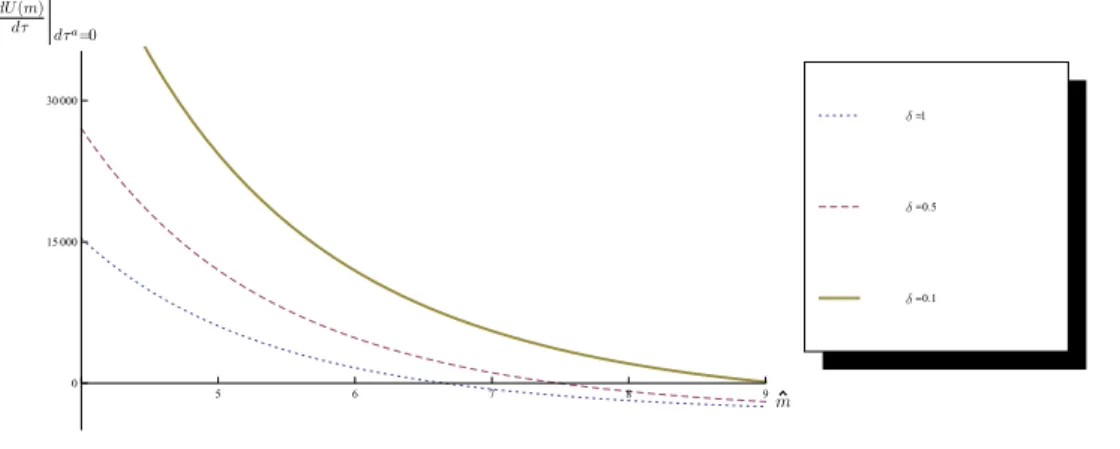
which simplifies expression (32) while retaining its sign as the positive term in parenthe sis cancels. Accordingly, Figure 2 implicitly delivers information on how the welfare impact of a change in tax progression depends onK
and onδ. The parameter values used are α= 10, β =ωc =ωf = 1, ωo = 1.2, N = 10, T = 100 and are highly
5 6 7 8 9 0 15 000 30 000 0.1 0.5 1 dU˜(m) dτ dτa=0 = = = δ δ δ m
Figure 2: The change in welfare due to an increase in labour tax progression with different degrees of wage orientation of the domestic trade union.
representative.31 Given the endogeneity of
b
msome caution is needed in reading this graph. Specifically, higher
values of mb along a curve (i.e. givenδ) imply lower equilibrium levels of Kb, whereKb(m, δb ) denotes the level
ofK such thatmb firms offshore. Moreover, ifmb is held fixed, higher values of δ(i.e. a downward shift of the
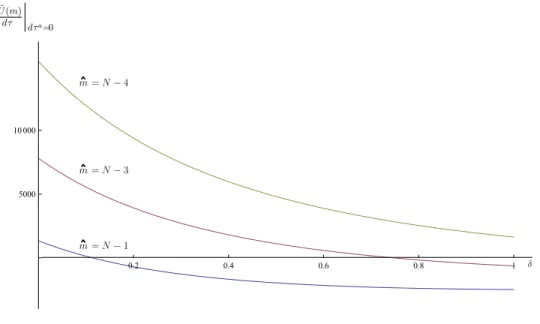
curve) can only be an equilibrium if Kb decreases accordingly. Alternatively, in Figure 3 I plot the tax policy
induced change in welfare againstδand for different levels ofKb. Again, higher values ofδ for givenmb must be
0.2 0.4 0.6 0.8 1 5000 10 000 dU˜(m) dτ dτa=0 m=N−1 =N−3 m =N−4 m δ
Figure 3: The change in welfare due to an increase in labour tax progression with different levels of fixed offshoring costs. associated with lower levels ofKb, while for a given value ofδlower values ofmb require higher levelsKb. The clear
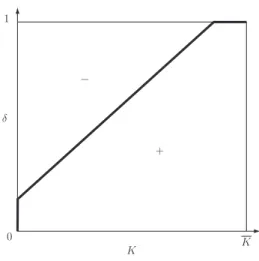
message that emerges from these figures is that a decrease in tax progression tends to decrease (increase) social welfare ifδis low (high) and/orK is high (low). Figure 4 synthesises this information where the area denoted
by a plus (minus) sign denotes combinations ofδandK such that welfare increases (decreases) with the degree
of tax progression andK denotes the level of costs such thatmb =N−1.
6
Concluding remarks
Based on the notion that high marginal tax rates are not sustainable in the face of increasingly mobile tax bases, many OECD countries have reduced the degree of personal income tax progressivity in the last decades. The present paper has contributed to the theoretical analysis of labour income tax progression by incorporating
1 − + 0 δ K K
Figure 4: The welfare impact due of an increase in labour tax progression depends on the combinations ofδandK. strategically interacting oligopolistic firms that may offshore production to lower cost locations. Paradoxically, the findings suggest that the very presence of mobile tax bases in the form of production relocations may, under certain conditions, strengthen the case for tax progression when the labour market in a small open welfare economy is segmented into an oligopolistic unionised sector and a competitive non-unionised sector. Specifically, the analysis indicates that an average household, defined as one that derives its income from labour, is worse off under a less progressive tax schedule, provided that the domestic labour market institutions are such that the interests of insiders heavily dominate over those of outsiders. In contrast, under a more balanced representation of workers a less progressive tax system enhances welfare as the benefits of cheaper consumption offset the negative domestic employment effects associated with a higher offshoring intensity. In substance, the results share a fundamental insight gained from earlier studies on tax progression under imperfect labour markets (e.g. van der Ploeg (2006) and Lommerud et al. (2004)), namely, that in a second-best world distortionary progressive labour taxes may be required to offset other distortions created by labour market institutions.
As with any highly stylised model, the results should be interpreted cautiously. For one thing, I have taken the perspective of an economy where jobs are internationally mobile while workers themselves are immobile. Moreover, it is fundamental to stress that the analysis allows for homogeneous domestic workers receiving different wages. This bears special relevance in the real world when the number of jobs in the higher value-added sectors substantially falls short of the number of workers that possess sufficient qualifications to work in such sectors. Some of the labour market trends mentioned at the beginning of this paper certainly point in that direction.
Still, future research may benefit from explicitly controlling for the possible mismatch between the demand for and the availability of particular qualifications. A further point concerns the role of profits and profit taxation. The present paper restricts the number of policy instruments to wage-related taxes. Since a decrease in labour tax progression may entail a redistribution of income from labour to shareholders, an extended model could incorporate such questions by taking into account the joint determination of labour and capital taxation. In light of the compelling evidence that governments strategically interact with each other when setting their taxes on mobile capital, this would require the consideration of tax competition.
Appendix
A
Statutory income tax progressivity for single individuals at average earnings
Figure A.1: This figure is extracted from Johansson et al. (2008). The measure of progressivity used is the difference between the marginal and average personal income tax rates, divided by one minus the average personal income tax rate, for an average single production worker. Higher numbers indicate higher progressivity.
B
Proof of Proposition 1
Recalling (13), we have that
∂L(m) ∂m =−x d(m) + (N −m)∂x d(m) ∂m <0, (B.1) ∂2L(m) ∂m2 =−2 ∂xd(m) ∂m + (N−m) ∂2xd(m) ∂m2 >0, where due to (12), ∂2xd(m)
∂m2 = 0. Next, using (4), (11), (12) and (14) yields:
∂mxf(m) ∂m = x f(m) +m∂xf(m) ∂m = xd(m) + T β(1 +N) (1 +N−m) δ 1 +δ ω o −ωf −(1 +N)∂ω 1(m) ∂m >0, ∂2 mxf(m) ∂m2 < 0. Finally, (4) implies ∂xf(m) ∂m = ∂xd(m) ∂m + T β ∂ω1(m) ∂m and therefore ∂X(m) ∂m = (N−m) ∂xd(m) ∂m +m ∂xf(m) ∂m + x f(m) −xd(m) = T β(1 +N) ω1(m) −ωf −∂ω 1(m) ∂m (N−m) >0, ∂2X(m) ∂m2 < 0 It follows that ∂p(X(m)) ∂m <0.
C
Proof of Proposition 2
Partially differentiating (11) with respect toδgives
∂2ω1(m) ∂m∂δ =− 1 1 +δ ∂ω1(m) ∂m >0. (C.1)
Further, referring to (B.1) and (13) we have:
∂2L(m) ∂m∂δ =− ∂xd(m) ∂δ + (N−m) ∂2xd(m) ∂m∂δ <0,
where the sign follows from ∂xd(m) ∂δ =− (1 +m) β(1 +N) ∂ω1(m) ∂δ >0, ∂2xd(m) ∂m∂δ =− T(ωo −ωf) β(1 +N)(1 +δ)2 <0.
As regards the labour demand elasticity introduced in section 4.2,can be reformulated as= ω1
δ(ω1−ωo). Hence, ∂ ∂m =− ∂ω1(m) ∂m ω o δ(ω1(m)−ωo)2 >0.
D
Proof of Lemma 1
Recall from Section 4.4 thatxf(m) =xd(m−1) + ∆x(m), where
∆x(m) := T ν(m) β(1 +N) (D.1) with ν(m) := N ω1(m) −ωf +m ω1(m −1)−ω1(m) = 1 1 +δ (1 +N)(α −ωf) (1 +m) +N δ(ω o −ωf) >0. (D.2)
Note that due to (12)
∂ν(m)
∂m = (1 +N)
∂ω1(m)
∂m <0. (D.3)
Hence, partially differentiating ∆π(m) in (18) with respect tomyields:
∂∆π(m) ∂m = 2β xf(m)∂x f(m) ∂m −x d(m −1)∂x d(m −1) ∂m = 2T (1 +N) ∂ν(m) ∂m x d(m −1) +ν∂x f(m) ∂m <0, (D.4)
In oder to prove the convexity of ∆π(m) with respect tom, expressions (12), (13) and (14) are used to establish
that ∂2xf(m)
∂m2 = (T /β)
∂2ω1(m)
∂m2 >0. Consequently, recalling (11) and (D.3) it is straightforward that
∂2∆π(m) ∂m2 = 2T (1 +N) ∂2ν(m) ∂m2 x d(m −1) +∂ν∂m(m) ∂xd(m −1) ∂m + ∂xf(m) ∂m +ν∂ 2xf(m) ∂m2 >0,
which completes the proof of Lemma 1.
E
Proof of Lemma 2
First note that substituting (9) into (3), we obtain
xd(m−1) = T δ β(1 +N)(1 +δ) α−ωf−m ωo−ωf . (E.1) From (D.4) we have ∂2∆π(m) ∂m∂δ = 2T (1 +N) ∂ω1(m) ∂m (1 +N)(1−δ)xd(m−1) δ(1 +δ) + ∂ν ∂δ ∂xf(m) ∂m | {z } >0 +ν∂ 2xf(m) ∂m∂δ | {z } >0 ,
where from (C.1) and (D.3) I used that ∂2ν
∂m∂δ =− (1+N) (1+δ) ∂ω1(m) ∂m and ∂xd(m−1) ∂δ = xd(m−1) δ(1+δ) . To prove Lemma 2 it
suffices to show that
∂ω1(m) ∂m (1 +N)(1−δ) δ(1 +δ) x d(m −1) +ν∂ 2xf(m) ∂m∂δ >0.
Using the expression forν in (D.2), the above expression can be expressed as
∂ω1(m) ∂m (1 + N)(1−δ) δ(1 +δ) x d(m −1)−(1 +N)(1 +m)∂ 2xf(m) ∂m∂δ +N δ (1 +δ) ω o −ωf∂ 2xf(m) ∂m∂δ , (E.2)
where from (13) it is straightforward that ∂2xf(m)
∂m∂δ >0. Inserting (E.1) and using (13), the term in square brackets becomes T β(1 +δ)2 (1−δ) α−ωf −m ωo−ωf −(1 +N)(α−ω f) (1 +m) + (1 +m) ω o −ωf <0.
The sign follows from noting that the expression in the square parenthesis is decreasing withδ. Settingδ= 0, it
is seen that the sum is negative for all admissible values ofωowhich proves that (E.2)>0 and hence ∂2∆π(m)
∂m∂δ >0.
F
The determinant
When equations (9) and (16) hold with equality, the system of equations can be expressed as follows:
F1 ω1 Fm1 F2 ω1 Fm2 dω1 dm =− F1 ada+Fτ1dτ F2 ada+Fτ2dτ where F1 : ω1 −(1 +1 δ)(α+mω f) (1 +m) − δ (1 +δ)ω o= 0, F2 : K−∆π(m) = 0. The determinant is D= 1 −∂ω1(m) ∂m −∂∆∂ωπ(1m) − ∂∆π(m) ∂m =−∂∆π(m) ∂m − ∂ω1(m) ∂m ∂∆π(m) ∂ω1 >0. (F.1)
G
The wage effect of raising the average tax rate
Totally differentiating (9) and (16) with respect toτ and solving via Cramer’s rule yields
ω1 τ =D−1 −F1 τ Fm1 −F2 τ Fm2 =D−1 δ (1+δ) ωo (1−τ) − ∂ω1(m) ∂m 0 −∂∆π(m) ∂m =−D−1∂ω 1(m) ∂τ ∂∆π(m) ∂m >0.