American University in Cairo American University in Cairo
AUC Knowledge Fountain
AUC Knowledge Fountain
Theses and Dissertations6-1-2014
Corporate social responsibility in Egypt: A study on the current
Corporate social responsibility in Egypt: A study on the current
practice, challenges, and potentials
practice, challenges, and potentials
Sara RefaatFollow this and additional works at: https://fount.aucegypt.edu/etds
Recommended Citation Recommended Citation
APA Citation
Refaat, S. (2014).Corporate social responsibility in Egypt: A study on the current practice, challenges, and potentials [Master’s thesis, the American University in Cairo]. AUC Knowledge Fountain.
https://fount.aucegypt.edu/etds/1319
MLA Citation
Refaat, Sara. Corporate social responsibility in Egypt: A study on the current practice, challenges, and potentials. 2014. American University in Cairo, Master's thesis. AUC Knowledge Fountain.
https://fount.aucegypt.edu/etds/1319
This Thesis is brought to you for free and open access by AUC Knowledge Fountain. It has been accepted for inclusion in Theses and Dissertations by an authorized administrator of AUC Knowledge Fountain. For more information, please contact [email protected].
The American University in Cairo School of Global Affairs and Public Policy
CORPORATE SOCIAL RESPONSIBILITY IN EGYPT:
A STUDY ON THE CURRENT PRACTICE,
CHALLENEGES, AND POTENTIALS
A Thesis Submitted to the Public Policy and Administration Department in partial fulfillment of the requirements for the degree of Master of Public Policy and Administration
By Sara Refaat Supervised by Ghada Barsoum, PhD
Assistant Professor, Public Policy and Administration, AUC
DEDICATION AND ACKNOWLEDGEMENTS
First I would like to thank Dr. Ghada Barsoum and Dr. Shahjahan Bhuiyan for their immense support throughout my entire Master’s program, especially during writing my thesis.
I would also like to thank my mother for her constant encouragement, love, and support. Special thanks go to my husband Karim for his sacrifices, patience, love, understanding, encouragement, constant inspiration, and endless support. No one believes in me like he does. I would like to dedicate this thesis to him and to baby Noor, who has endured her mother’s moodiness while finalizing the thesis.
ABSTARCT
Corporate Social Responsibility (CSR) has gained momentum in Egypt throughout the past decade, yet very little empirical research was conducted on CSR practice in Egypt. This study provides an in-depth understanding of why and how is CSR practiced in Egypt, the challenges faced, and how CSR practice can improve in general. The study presents a series of contextualized and tailor made recommendations for using CSR as an agent of good development. To serve the purpose of this study a series of qualitative in-depth interviews were conducted with thirteen members of the CSR community in Egypt. Data collected from interviews exposed a different reality of CSR practice than the one offered by literature. There is a substantive gap between Western CSR theory and practice, and what is actually happening on the ground in Egypt. For instance, members of the CSR community believe that the philanthropic side of CSR was practiced in Egypt centuries ago by both individuals and businessmen mainly for religious purposes. CSR in Egypt is perceived as a long-standing charitable, informal, paternalistic, voluntary practice, associated with religious beliefs. On the other hand, the modern, secular, and corporate concept of CSR emerged in Egypt in the early 2000, thanks to Multinational Enterprises (MNEs) who introduced the concept in Egypt. Interviews also revealed several flaws in the current practice such as CSR being used primarily as a Public Relations (PR) and marketing tool, the lack of a CSR partnership model, and the lack of a CSR vision. The study ends with a series of recommendations. Recommendations suggested by interviewees include greater cooperation between different stakeholders, more research on CSR practice, and finally, investing less in charitable activities, and more in development programs. Recommendations suggested by the researcher include the establishment of a CSR National Council with the mandate of creating a CSR framework and lobbying for CSR policies in Egypt.
TABLE OF CONTENTS
DEDICATION AND ACKNOWLEDGEMENTS...……….…..1
ABSTRACT………...2
CHAPTER ONE 1. Introduction...5
1.1. Historical Account on the Rise of CSR ……… 7
1.2. Statement of the Problem………...11
1.3. Research Questions………12
1.4. Thesis Outline………12
CHAPTER TWO 2. Conceptual Framework ……….…15
2.1. The Holistic Approach to CSR Practice………15
2.2. Carroll’s CSR Pyramid ……… 19
2.3. Stakeholder Theory………24
2.4. CSR as Good Development………...27
CHAPTER THREE 3. Literature Review………...30
3.1. The Role of CSR in Development………..…31
3.2. The Role of Government in CSR Practice……….…….37
CHAPTER FOUR 4. Methodology………..43
4.1. Research Design……….... 43
4.2. Sample Selection………... 45
4.3. Limitations to the Study ………..…. 46
CHAPTER FIVE 5. Data Analysis and Research Findings………...…48
5.1. The Rationale behind CSR Practice in Egypt...48
5.2. The Flaws of CSR Practice in Egypt...53
5.2.1. CSR as a PR and Marketing Tool………....53
5.2.3. Lack of a CSR Vision………..59
5.3. Reforms Suggested by CSR Stakeholders……...63
CHAPTER SIX 6. Conclusion………68 6.1. Recommendations ……….68 6.2. Conclusion……… 73 References…………...………..76 Appendix 1………79
CHAPTER ONE
The business of business is no longer just business, if indeed it ever was (Newell and Frynas, 2007, p.679)
1. Introduction
In an increasingly globalized world, social and environmental issues such as human rights, environmental protection, labor rights, poverty, and sustainability became highly debated topics in the agenda of many governments, civil society organizations, and businesses. Over the past few decades, these issues have emphasized the need for businesses to act more responsibly towards employees, the environment, the government, customers and society as a whole, and to take the issue of Corporate Social Responsibility (CSR) more seriously (Idowu and Filho, 2009).
Though CSR is broadly defined as the responsibility of businesses to society, researchers and CSR practitioners have been struggling to provide both theoretical and empirical clarity to this concept (Brown and Forster, 2013). The term CSR has been defined by the European Commission as, “the voluntary contribution of companies to a better society and a cleaner environment” (Arzova, 2009, p.374). Although this definition is quite vague, and does not imply any straightforward responsibility for the private sector towards its stakeholders, yet it was a stepping stone for a paradigm shift in the way the private sector does business.
Other institutions developed a more comprehensive understanding of CSR. For instance one of the most cited definitions of CSR is the one provided by the World Business Council for Sustainable Development (WBCSD). Which refers to CSR as,
“the commitment of business to contribute to sustainable economic development, working with employees, their families, and the local communities” (Jamali and Mirshak, 2007, p.244).
This definition clarifies that CSR is not about “simple good will or philanthropy, it is about companies adopting a comprehensive approach with respect to their impact on the communities where they operate” (CDS, 2006, p.9).
Independently of how CSR is defined, the importance lies in the overarching paradigm shift, where businesses no longer work in a vacuum. For decades businesses were ‘only’ expected to provide goods and services, employment, increase investments, pay taxes, and maximize benefits to shareholders (Idowu and Filho, 2009). All these practices were being implemented “regardless of whose interests or feelings were injured” (Idowu and Filho, 2009. p.2). But stakeholders are “no longer naïve, instead they are sophisticated, educated, well informed, and above all, they know what is best for them” (Idowu and Filho, 2009, p.2). So starting the twentieth century, businesses are accountable for acting responsibly in both, their day to day operations, and in their general relationship with their community and environment; basically their mere existence goes beyond profit-making (Idemudia, 2011).
businesses in the Eastern and Southern World, CSR soon became a popular concept in many countries in the Middle East, Africa, and the Asian continent (Frederick, 2006). And in the developing world, CSR is a highly contested concept (Idemudia, 2011).
Although highlighting the history of CSR is not the objective of this research, yet, since the concept of CSR is such a recent phenomenon, understanding more the history and the rationale behind the emergence of such a new concept would be of great value to readers, and to the overall objectives of this research.
Hence, before presenting the other sections of this chapter, the next sub-section will present some important background information on the rise of CSR.
1.1. Historical Account on the Rise of CSR
Historically businesses used to operate within the dominant framework suggested by Adam Smith (1776), where “the free market economy is self-regulating by means of the invisible hand” (Claydon, 2011, p. 406). And later with Friedman’s (1970) argument that “the social responsibility of business is to increase its profits” (Claydon, 2011, p. 406). Yet businesses and societies have changed tremendously over the past 40 years (Lee, 2008).
According to Frederick (2006), CSR first emerged in the U.S. during the 1950’s and 1960’s after “a great tsunami of public outrage and hostility pounded business unmercifully… [and] enormous waves of anti-business sentiment” swept the business
community (Frederick, 2006, p.23). Initially, businesses perceived this hostility as unfair criticism, however some businesses realized that the community was calling for businesses to act more responsibly (Frederick, 2006). This responsibility went beyond philanthropy work and good will, as the community was calling for businesses to act responsibly in their day to day work, and to take into account stakeholder interest.
Overall corporate “resistance to the call for socially responsible behavior was common from the 1940’s to the 1970’s” (Lee, 2008, p.53). As the notion of CSR came as a surprise to many businesses that enjoyed a “generally favored place in public opinion in post-World War II years” (Frederick, 2006, p.46). But during the 1970’s this antibusiness sentiment threatened the reputation and sustainability of these businesses, consequently during the 1970’s the business community in the U.S. started taking the basic notions of CSR into their agenda. This was later translated into a revamp of their policies and procedures as well as more attention given to stakeholder interest (Frederick, 2006).
Later on, as a result of globalization, and the proliferation of MNEs around the world, the impact businesses had on the society and the environment became increasingly important (Lee, 2008). The 1970’s “proved to be a turning point in the evolution of corporate responsibility practices and policies” (Post, 2013, p.55). According to Post (2013), this development was due to three main factors, business scandals, political pressure, and “public intolerance of corporate misdeeds” (Post, 2013, p.55).
By the late 1990’s, the concept of CSR “became almost universally sanctioned and promoted by all constituents in society” (Lee, 2008, p.53). And many businesses around the world started to accept “the importance of establishing worldwide standards for responsible supplier, manufacturing, and operating practices” (Post, 2013, p.60).
Today CSR became truly a global idea, “endorsed and actively promoted by key global institutions such as the World Bank, the OECD, and the UN” (Gjolberg, 2009, p.10). CSR has gained momentum in academia as well. Starting the 1970’s business schools in Europe and the U.S. established the field of business ethics, and several academic journals such as the journal of business ethics, and the journal of social responsibility, are now devoted to discussing CSR topics and presenting new research (Sasse and Trahan, 2007). This is an important indication showing the importance given to this recent concept in the academic world, in addition to business circles and international institutions.
In summary, CSR - with its multifaceted definitions - emerged 50 years ago in the U.S and Europe as a paradigm shift in the way businesses are expected to operate, and behave towards the community, the environment, and stakeholders. CSR emerged as a response to local community pressures for businesses to behave more responsibly, and thanks to globalization this concept became global in just few decades.
In Egypt, CSR has “become the focus of increasing attention and concern” (Idowu and Filho, 2009, p.339). Yet extremely limited research on this topic makes it impossible to present a historical account on the rise of CSR in Egypt. Indeed, there are many
unanswered questions revolving around CSR in Egypt, and this study aims at addressing some of these questions. The study addresses the why and how of CSR practice in Egypt, as well as the main challenges faced while implementing CSR.
Being one of the very few researches on CSR practice in Egypt, this study is a significant contribution to existing literature. The main objectives of this piece is to provide a deeper understating of CSR practice in Egypt, identify challenges faced during implementation, provide important recommendations for improving CSR practice in general, and explore the potential of CSR as a tool for national development.
To serve the purpose of this study a series of qualitative in-depth interviews were conducted with the following CSR stakeholders: Non-Governmental Organizations (NGOs), Multinational Enterprises (MNEs), Media and Public Relations (PR) agencies, and a CSR consultant. Rich data collected from the empirical research presents significant findings. The most prominent of which is a different reality of CSR practice in Egypt than the one offered by literature. There is a substantive gap between Western CSR theory and practice, and what is actually happening on the ground in Egypt. For instance, members of the CSR community believe that the philanthropic side of CSR was practiced in Egypt centuries ago by both individuals and businessmen mainly for religious purposes. Members of the CSR community in Egypt perceive CSR as a long-standing charitable, informal, paternalistic, voluntary practice, associated with religious beliefs. On the other hand, the modern, secular, and corporate concept of CSR emerged in Egypt in the early 2000, thanks to MNEs who introduced the concept in Egypt.
1.2. Statement of the Problem
CSR has been practiced in Egypt for the past decade, yet there is no clarity on the effectiveness of CSR practice in Egypt, and whether or not it is achieving its full potential while taking stakeholders’ interests into account.
In light of the increasing attention given by academia, CSR practitioners, and International Organizations to the concept of CSR and the role of businesses in society, extremely limited literature and empirical research conducted on CSR in Egypt, and my professional and academic interest in CSR. This study aims at shedding light on why, and how is CSR practiced in Egypt, the challenges faced, how CSR practice can improve in general, as well as exploring the potential of CSR as a tool for achieving national development.
This study is an important contribution for a number of reasons. First, it will help CSR practitioners, MNEs, researchers, NGOs, and the government in Egypt to better understand the current CSR practice. Second, the study provides recommendations to MNEs, NGOs, and the government, to apply effective, long-term, and useful reforms that would enhance CSR practice in general, as well as integrate efforts to make the best out of CSR practice as a tool for national development. The suggested reforms also aim at implementing CSR practices that maximize collective benefit, instead of those of a single entity. Third, the study is a significant contribution to literature. Finally, the study will hopefully help in stimulating further research in this topic.
1.3. Research Questions
Being an under-researched topic in Egypt, there are many questions revolving around CSR practice, and this research addresses several important issues. To be able to effectively meet the research objectives mentioned above, the study will address the following research questions:
1) Why is CSR practiced in Egypt? 2) How is CSR practiced in Egypt?
3) What are the main challenges faced in the current CSR practice?
4) Based on this study, what are the recommendations for improving CSR practice in Egypt towards a national development tool?
1.4. Thesis Outline
As per the below outline, this thesis consists of six chapters. It started with an introduction, then will follow with a conceptual framework, literature review, methodology, data analysis and research findings, and finally, conclusion
Chapter one introduced the concept of CSR, giving the necessary background and historical information on the concept, as well as presenting the research problem, research objectives, and research questions for this study.
Chapter two presents the conceptual framework developed for this study. Where I have identified three distinct theoretical frameworks from literature and developed a general framework for the thesis called The Holistic Approach to CSR Practice.
Chapter three presents the review of relevant literature on CSR, with specific reference and focus on the role of CSR in development, and the role of government in CSR practice.
Chapter four covers the methodology applied in this research. It starts with the research design, sample selection, and limitations to the study.
Chapter five presents the empirical data collected through qualitative interviews with a sample of thirteen CSR stakeholders in Egypt. In this chapter I also analyze the data collected, addressing the research questions proposed for this study. Rich data emerged from this study showing that members of the CSR community in Egypt define CSR differently than Western scholars. In Egypt members of the CSR community differentiate between the philanthropic, religious aspect of CSR, apparently practiced for centuries in Egypt, versus the modern, secular concept, imported from the West in the early 2000.
Finally, Chapter six presents the conclusion drawn from the research findings, including recommendations to improve CSR practice in general, as well as using CSR as a tool for national development.
CHAPTER TWO
2. Conceptual Framework
This chapter presents the conceptual framework developed for this study. I have identified three distinct theoretical frameworks from literature, then developed a general framework for the entire research called The Holistic Approach to CSR Practice, discussed in more details below.
2.1. The Holistic Approach to CSR Practice
A thorough literature review revealed that despite growing interest in CSR, still there is no general consensus on a definition for CSR (Lin-Hi and Müller, 2013). Instead of “being a consistent concept, CSR is an umbrella term that encompasses various overlapping areas” (Lin-Hi and Müller, 2013, p. 1928). Dahlsrud (2008) claims that there are 37 different definitions of CSR in literature (Dahlsrud, 2008). Being such a dynamic and recent concept, scholars define and discuss CSR under many different lenses; unfortunately this is not helping CSR practice. Indeed, there is a significant “gap between the corporate CSR rhetoric and actual practice on the ground because of difficulties in making it operational” (Pedersen, 2006, p.138). This is a key challenge in CSR practice as businesses “are left with little guidance when they try to translate the abstract concepts of CSR into practice” (Pedersen, 2006, p.138).
Given the above discussion, I believe that a detailed framework is needed in order to set theoretical boundaries to a concept so colorfully described. I also believe that a detailed framework will effectively, address all research questions proposed for this study,
provide the correct theoretical validity and reliability, and if tested this framework might also help organizations and CSR practitioners implement sound CSR practices, especially if geared towards national development. The conceptual framework I developed for this study serves all these purposes.
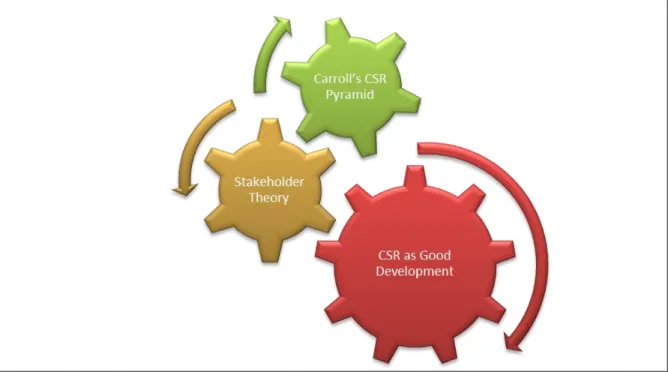
I named the conceptual framework for this study The Holistic Approach to CSR as it combines three main theories, giving CSR a truly holistic definition. This conceptual framework is simply an integration of three theoretical frameworks into a gear shape.
The gear illustration implies that one theoretical framework cannot be implemented without the other. And that effective CSR practice is a result of the effective integration of these three principles. The gear shape also implies that these three theories should be implemented in order, where Carroll’s (1991) CSR pyramid comes first, followed by Freeman’s (1984) stakeholder theory, ending with Sagebien and Whellams’s (2010) framework of CSR as Good Development.
Figure 1: The Holistic Approach to CSR Practice.
The first principle, being the core or basic responsibilities of businesses, is represented by Carroll’s (1991) CSR pyramid. Carroll’s (1991) CSR pyramid consists of four layers of responsibilities: economic, legal, ethical, and philanthropic.
The second gear or the second principle presents CSR practice in relation to its stakeholders, and is presented by Freeman’s (1984) stakeholder theory. Where effective CSR practice is one which integrates effective and genuine stakeholder engagement techniques.
The third and final gear places CSR in the context of development, by framing CSR as an agent for good development. This principle is presented by Sagebien and Whellams’s (2010) framework of CSR as Good Development.
Carroll’s (1991) CSR pyramid comes first because it represents what is CSR, and what are the main responsibilities of businesses in any given society. Freeman’s (1984) stakeholder theory complements Carroll’s (1991) CSR pyramid by focusing on to whom
these obligations are related to, or to whom these responsibilities should serve. Hence CSR is not practiced in vacuum, according to the Holistic Approach to CSR Practice; CSR should be practiced to serve stakeholders interests. The final gear, Sagebian and Whellams’s (2010) CSR as Good Development framework represents how businesses together with its stakeholders can actively and efficiently participate in the development discourse. Hence taking CSR an extra mile, and maximizing the potential and positive impact of CSR practice.
The mechanism of the gear is one which starts with the basic four responsibilities listed by Carroll (1991), which encourage businesses to take stakeholders’ interests into consideration. Once this happens, stakeholders will also move businesses’ responsibilities towards concrete actions that serve their interest. Once businesses’ responsibilities and stakeholders’ interests are interconnected and responsive to each other, this will drive stakeholders to take CSR into the next level which is engaging in development. This final gear is the ultimate potential for CSR practice. As a result of active stakeholder engagement CSR matured from simple business responsibilities to actively engaging and participating in development.
2.2. Carroll’s CSR Pyramid
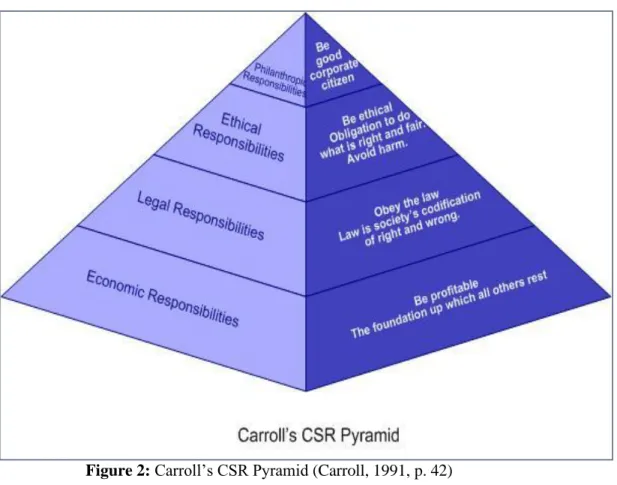
The first gear to The Holistic Approach to CSR Practice is Carroll’s (1991) CSR Pyramid, which defines CSR as the “economic, legal, ethical, and philanthropic responsibilities of companies” (Gjolberg, 2009, p.12). These responsibilities are illustrated in the diagram below:
Figure 2: Carroll’s CSR Pyramid (Carroll, 1991, p. 42)
Carroll (1991) suggests that CSR has four levels of responsibilities; these are economic, legal, ethical, and philanthropic responsibilities (Carroll, 1991). Economic and legal responsibilities have always existed before, “but it has only been in recent years that ethical and philanthropic functions have taken a significant place” (Carroll, 1991, p.40). But what does each responsibility entails? Below is a brief description of the four
responsibilities of businesses, which also constitute a definition and a rationale for CSR practice.
Economic Responsibilities:
By default businesses are created as economic and profit making entities, “designed to provide goods and services to societal members” (Carroll, 1991, p.41). Hence, profit making is the main drive and incentive behind establishing a business. Economic responsibilities come at the bottom of the pyramid, as it is the foundation of any business. Carroll (1991) lists the economic responsibilities of a business as: performing in a manner consistent with maximizing profits, commitment to being as profitable as possible, preserve a strong competitive edge, maximize efficiency, and being identified as a consistently profitable business (Carroll, 1991).
Legal Responsibilities:
By legal responsibilities Carroll (1991) implies that
“society has not only sanctioned businesses to operate according to the profit motive, but business is expected to comply with the laws and regulations promulgated by federal, state, and local governments as the ground aisles under which business must operate” (Carroll, 1991, p. 41).
Here businesses have the responsibility to comply with existing rules and regulations, and respect the rule of law. Legal responsibilities come before social responsibilities. Where being legally responsible and compliant with the regulatory and legal framework of a given country comes before the notion of giving back to society, and the environment.
As suggested by Carroll (1991), legal compliance consists of: performing in consistence with the law and expectations of the government, comply with regulations, be identified as a business that is compliant with the law, provide goods and services that meet legal requirements, and “be a law-abiding corporate citizen” (Carroll, 1991, p.41).
Ethical Responsibilities:
Businesses’ ethical responsibilities is a highly debated topic amongst academia and business circles, as its vague notion sometimes keeps it at the mercy of subjective interpretations. This research piece will follow Carroll’s (1991) definition of ethical responsibilities, described as,
“activities and practices that are expected or prohibited by societal members even though they are not codified into law…ethical responsibilities embody those standards, norms, or expectations that reflect a concern for what consumers, employees, shareholders, and the community regards as fair, just, or in keeping with the respect or protection of stakeholders’ moral rights” (Carroll, 1991, p.41).
The emergence of ethical responsibilities is the real paradigm shift in how businesses are expected to operate, as they are required to take steps beyond legal compliance. Ethical responsibilities are the moral side of how businesses operate. According to Carroll (1991), ethical responsibilities implies: performing according to society’s moral and ethical norms, recognizing and respecting new ethical norms as developed by the society, avoiding compromising ethical norms for achieving business goals, realizing that ethical responsibilities is a step beyond legal and internal compliance, and that “good corporate citizenship is defined as doing what is expected morally or ethically” (Carroll, 1991, p. 41). By definition ethical responsibilities seek to adapt to the local ethical fabric identified by the society in which the business operates.
Philanthropic Responsibilities:
This is the final layer in Carroll’s (1991) CSR pyramid of responsibilities. Philanthropy here is defined as “corporate actions in response to society’s expectation that businesses be good corporate citizens, this includes actively engaging in acts or programs to promote human welfare or goodwill” (Carroll, 1991, p.42). Philanthropy includes cash donations or donating employees’ time in social activities (Carroll, 1991). Philanthropy is a voluntary act of good will, where society desires “firms to contribute their money, facilities, and employee time to humanitarian programs or purposes” (Carroll, 1991, p.42).
This final layer of responsibility falls under the principle of giving back to the community, being a good neighbor to society, and benefiting the society from the presence of the business in a particular area. According to Carroll (1991), philanthropy implies: meeting society’s expectations on the philanthropic role played by the business, the participation of managers and staff in voluntary charitable activities, supporting education, and supporting “projects that enhance a community’s ‘quality of life’” (Carroll, 1991, p.42).
Although Carroll’s definition of CSR is probably the most cited definition in literature yet some scholars criticize and challenge Carroll’s definition. For example some argue that the four guiding principles in Carroll’s CSR pyramid does not “lend themselves easily to empirical testing due to their complex nature…while economic data is easily available, it will hardly separate the responsible companies from the irresponsible ones”
(Gjolberg, 2009, p. 12). This argument is valid, as putting measures or standards for what constitute ethical responsibilities for instance, might be a challenging task.
Others claim that what can be characterized as ethical responsibility in one country, can be judged as legal compliance in another country (Gjolberg, 2009). The argument here is that, although CSR is a global concept yet, it should enjoy some flexibility in the way it is being implemented, especially in different countries with different legal and ethical norms. This is a highly debated issue in literature, especially when discussing CSR in developing countries, which will be discussed in the following chapter.
In summary, despite these critiques, Carroll’s (1991) CSR pyramid offers an important understanding of businesses’ core responsibilities. The pyramid begins with the basic building block of sound economic performance, and profit maximization (Carroll, 1991). Legal compliance comes next, because in democratic societies, “the law is society’s codification of acceptable and unacceptable behavior” (Carroll, 1991, p.42). Followed by ethical responsibility, where businesses are expected to act with fairness, justice, do what is right, and not harm stakeholders (Carroll, 1991). Finally, comes philanthropic responsibilities, where businesses are “expected to contribute financial and human resources to the community and to improve the quality of life” (Carroll, 1991, p.42). These four aspects of CSR are not mutually exclusive, but coordinated efforts to be followed by a socially responsible business (Carroll, 1991).
2.3. Stakeholder Theory
The second gear to The Holistic Approach to CSR Practice is the stakeholder theory. Unlike Carroll’s (1991) CSR Pyramid, Freeman’s (1984) stakeholder theory is not a CSR model by itself, yet it is “one of the earliest and most commonly referred to theories of CSR” (Claydon, 2011, p. 408). As Pedersen (2006) claims, the stakeholder model sets a new paradigm shift for businesses to become more “integrated in, rather than separated from, the rest of society” (Pedersen, 2006, p.139). Indeed, Freeman’s (1984) stakeholder theory rejects the idea that businesses only have responsibilities towards shareholders, instead he believes that businesses “bear a fiduciary relationship to stakeholders” (Claydon, 2011, p. 408).
But who are stakeholders? According to Freeeman (1984), stakeholders are “any group or individual that can affect or is affected by the achievement of a corporation’s purpose” (Freeman, 2004, p.229). Organizations generally have internal and external stakeholders, internal stakeholder include employees, management, board of directors and shareholders (Sagebien and Whellams, 2010). External stakeholders include customers, governments, supply chain, communities, competitors, and the environment (Sagebien and Whellams, 2010).
And what is stakeholder theory exactly? It is a theory of “organizational management and ethics” (Phillips et al, 2003, p. 480).
“Stakeholder theory is distinct because it addresses morals and values explicitly as a central feature of managing organizations. Managing for stakeholders involves attention to more than simply maximizing
can assist or hinder the achievement of the organization’s objectives is the central admonition of the theory” (Phillips et al, 2003, p.481).
The main rationale behind stakeholder theory is that stakeholders to any organization “have the right not to be treated merely as a means to an end,” but should have the right to participate in the direction of this organization, “in which they hold a stake” (Claydon, 2011, p.408). The idea is that any organization has a group of people that affect or is affected by this organization; hence the views and stake of these people should be taken into consideration (Freeman, 2004). Stakeholder theory implies a list of actions as follows: first, organizations have to take into consideration the effect of its action on its stakeholders (Freeman, 2004). Second, organizations must understand stakeholders’ values, behaviors, and interests (Freeman, 2004). Third, understand stakeholders’ relationship with the organization (Freeman, 2004). Fourth, engage in strategic management and planning to take stakeholders’ interests into account (Freeman, 2004). And finally, balance stakeholder interests over time (Freeman, 2004).
Also, with Freeman’s (1984) stakeholder theory the issue of procedural justice gained momentum.
“Who gets how much of the organizational outcomes pie is an important question, but so is who gets a say in how the pie is baked. Stakeholder theory is concerned with who has input in decision-making as well as with who benefits from the outcomes of such decisions” (Phillips et al, 2003, p.487).
The core principle here as Freeman (1984) puts it is that, “stakeholders are about the business, and the business is about the stakeholders” (Freeman, 2004, p.231). Stakeholder engagement is an important opportunity for businesses and stakeholders “to identify and debate what each of them regard as ‘appropriate business behavior’ in
relation to economic, social and environmental matters” (O’Riordan and Fairbras, 2008, p.747). That is why this principle is crucial for sound CSR practice. Some scholars argue that stakeholder engagement is the true essence of CSR, because without the rapport built between the business and its stakeholders, the former will suffer from a gap in understanding what stakeholders need or expect from them (Pedersen, 2006).
Unfortunately, some researchers claim that the notion of stakeholder engagement is not practiced efficiently by several businesses (Barkemeyern, 2009). Indeed, some scholars claim that “intended beneficiaries of CSR initiatives are either not adequately involved or are even completely left out of the CSR agenda” (Barkemeyern, 2009, p.276). Despite the importance of stakeholder engagement businesses are faced with several challenges such as, ways to effectively identify stakeholders, different approaches in stakeholder engagement, and methods for managing conflicting expectations amongst different stakeholders (O’Riordan and Fairbras, 2008).
In summary, for years scholars have discussed the notion of CSR in the context of businesses’ relationship with the society at large (Brown and Forster, 2013). This context implies that CSR strategies and activities should be implemented while taking stakeholders’ interests into account (Muller, 2006). Thanks to Freeman (1984), stakeholder theory became an essential ingredient for organizations to deal with its stakeholders at large. In the context of CSR, stakeholder theory suggests that organizations do not implement CSR in vacuum, or in a manner disconnected from
stakeholders’ interests. Under this notion, CSR should be a responsive tool towards meeting stakeholders’ various interests’.
2.4. CSR as Good Development
The third and final gear to The Holistic Approach to CSR Practice is Sagebien and Whellams’s (2010) framework of CSR as Good Development. The rationale for adding this third gear is that this study places CSR in the context of being a potential development tool in Egypt.
But what is good development? Although very simplistically defined by Sagebien and Whellams (2010), good development “leads towards sustainable development, and bad development as one that does not do so” (Sagebien and Whellams, 2010, p.487). And how can CSR be a tool for good national development? The next chapter of this study presents literature discussions on the role of CSR in the development discourse. Yet, Sagebien and Whellams (2010) summarized these debates, highlighting the main aspects of CSR that can create good or bad development (Sagebien and Whellams, 2010). Accordingly, CSR as Good Development presents a general framework for how CSR can be an agent to development in any given country. The features of this framework are not comprehensive at all, but are helpful as they provide businesses with important indicators as to what CSR actions constitute good development versus bad development. It is important to emphasize that businesses’ involvement in development is totally a voluntary act, yet this framework points at the potential significant role CSR can have in the development discourse.
“In the context of the developing world, CSR is conceptualized primarily as a means through which to expand the benefits of private profit making activities beyond the boundaries of the firm…by voluntarily going beyond the ethical, legal and public expectations that society has of business” (Sagebien and Whellams, 2010, p.488)
As presented by Sagebien and Whellams’s (2010), CSR would constitute good development if it maximizes the spillover effect of foreign direct investments (Sagebien and Whellams, 2010). This can be possible when investors for example decide to contribute to the national development agenda by creating jobs, transferring knowledge, and building infrastructure (Sagebien and Whellams, 2010).
CSR is good development also when it addresses governance gaps, by fostering transparency, rule of law and ethical practices (Sagebien and Whellams, 2010). Also when it introduces “higher levels of performance than those required (or enforced) by local law” (Sagebien and Whellams, 2010, p.487). When it “reduces social and political conflict and prevents/remediates to environmental damage” (Sagebien and Whellams, 2010, p.487). And finally, when it promotes stakeholder cooperation towards development goals, and promotes a healthy and viable local supply chain (Sagebien and Whellams, 2010). All these aspects make CSR a good development tool.
On the other, CSR as bad development would ignore poverty and social inequalities, would usurp the role of the local government, and would not engage in development efforts primarily because businesses and development would have conflicting agendas (Sagebien and Whellams, 2010). CSR as bad development would also lack development expertise within businesses, and would have North- driven CSR agendas and not locally
tailored CSR agendas that meet local needs (Sagebien and Whellams, 2010). Finally, CSR efforts and activities would be serving only the business strategy or interests and not the stakeholders’ interests or development interests.
In summary, this chapter presented the conceptual framework developed for this study. The absence of a generally unanimous definition of CSR in literature was a challenge to this study, yet it encouraged me to develop a holistic framework for CSR practice that would integrate three key theories and frameworks developed by other scholars. The outcome of this effort was the development of The Holistic Approach to CSR Practice. This framework is presented in a gear shape indicating that CSR should be implemented with these three notions working together. Literature is rich with studies and debates on CSR practice, and this framework helped in contextualizing this study in the best possible way. The next chapter will cover the literature review for this study, focusing on two specific yet relevant topics to the purpose of this study.
CHAPTER THREE
3. Literature Review
Literature on CSR consists of a mosaic of definitions, frameworks, researches, debates, case studies…etc. CSR is indeed a rich topic in literature, with many scholars discussing CSR in many different angles. This makes it very challenging to present all these themes and debates in just one chapter. For example literature offers 37 different definitions of CSR, from 27 different authors, over a time span of 1980 to 2003 (Dahlsrud, 2008). On top of that, the conceptual framework developed for this study already identified both a detailed definition and a holistic approach to CSR practice, so more information on CSR conceptual frameworks would be of no value to the study.
Also, I consider this research as an overall significant contribution to literature, not only thanks to the findings of the study, but also thanks to the way important information is presented and discussed – including information presented in the conceptual framework and literature review chapters. Being an integral part of this research, I also believe the literature review should be strategic and focused, and should help in addressing the research questions developed for this study. Finally, being a thesis submitted to the School of Global Affairs and Public Policy, I believe that a discussion of CSR in the context of development and public policy will be of more value and relevance, and will distinguish it from a thesis submitted to an MBA program. Based on this discussion, I therefore decided to present a focused review of CSR literature, presenting two main topics only: the role of CSR in development, and the role of government in CSR practice.
3.1. The Role of CSR in Development
When reviewing literature on CSR and development, scholars raise concepts and theories from almost all social science disciplines, from political economy and sociology, to public administration, and human rights (Vallentin and Murillo, 2012). This is the case for a number of reasons. First, CSR per se is a highly dynamic and contested issue, and scholars from different academic and professional fields struggle to provide some clarity to the concept. Second, being such a dynamic concept, CSR in recent years ‘matured,’ shifting the CSR discourse towards its potential role in the development arena (Idemudia, 2008, p.93). With several scholars agreeing that CSR has a “powerful potential to make positive contributions to addressing the needs of disadvantaged communities in developing countries” (Ite, 2004, p.1). Third, the concept of development itself is also a highly contested issue, with multiple definitions and interpretations (Okoye, 2012). Sometimes development,
“connote economic growth or changes in social, economic and political aspects in a country or by reference to indicators and standards developed independently for measuring GDP, GNP, income levels and so on” (Okoye, 2012, p.368).
The relationship between these two contested concepts – CSR and development - led scholars to study both concepts under several lenses and different social science disciplines, versus the traditional management and development schools (Prieto-Carron et al, 2006). This relationship also led to the “emergence of a critical CSR-development research agenda aimed at highlighting the potentials and limitations of CSR efforts geared towards development” (Idemudia, 2008, p.91). The CSR-development research agenda is rich with discussions, debates, and concepts, and the main recurrent discussions
revolve around the why and how of CSR in development. Both debates will be the focus of this section.
The main rationale offered by literature behind viewing CSR as an agent for development is the inefficiencies and sometimes failures of local governments in solving social and economic problems (Burke and Logsdon, 1996). In many cases government challenges in addressing development issues encouraged societies to look at the “business sector for assistance in identifying and implementing remedies” (Burke and Logsdon, 1996, p.499). Idemudia (2008) - a prominent CSR scholar – claimed that societies shifted from the government to the business sector as a source of “social improvement and a means to promote specific items of social welfare” (Idemudia, 2008). Accordingly,
“CSR is now seen not only as a means by which business can mitigate the impact of the negative externalities that arise from its operations but also as a means to contribute to sustainable development in the South” (Idemudia, 2008, p.92).
Blowfield (2005), interestingly claimed that although CSR did not start as a contribution to development - but more as a call for businesses to stop doing harm - today the concept of CSR is closely linked with issues of poverty reduction and development (Blowfield, 2005). Indeed, one of the important features in the CSR-development discourse is that undoubtedly there is a paradigm shift for businesses from a do no harm approach, to a do good approach, and not only at the mirco-level but also at the macro-level (Newell and Frynas, 2007).
and medium-sized enterprises (SMEs) in global supply chains” (Prieto-Carron et al, 2006, p.980). This justification is related to the role of CSR in local economic development. Other reasons include the potential role of businesses in combating child labor, enhancing labor’s working conditions, and substantially reducing environmental threats (Prieto-Carron et al, 2006). Unlike developed countries, developing countries suffer from the presence of “few constituencies and institutions providing social goods in general” (Dobers and Halme, 2009, p.237). Accordingly, the business sector is seen as a potential agent in filling those gaps (Dobers and Halme, 2009).
As suggested by Sagebien and Whellams (2010), in their framework of CSR as Good Development, businesses are seen as having actual and real benefits to developing countries (Sagebien and Whellams, 2010). This belief comes from the fact that businesses can have a positive impact in developing countries by increasing knowledge transfer, capacity building, employment, and spill overs from foreign direct investments (Ite, 2004).
But not all scholars are so enthusiastic about the role of CSR in development. For instance, some scholars still argue the premise of whether or not CSR should have a role in development (Blowfield, 2005). Others who advocate for the ‘dependencia theory’ believe that companies call for a form of development that disadvantages communities in favor of industrial countries in the North (Idemudia, 2008). And others claim that it is very difficult to create a hypothesis for CSR-development because both concepts are still
subject to countless debates (Okoye, 2012). And finally, some other scholars contend that,
“when CSR is linked to development in Africa, it is often asserted that companies are performing the role of governments and this presents its own challenges. This because the question emerges of how to shape such new-found corporate role to foster development” (Okoye, 2012, p.365).
Yet, as suggested by Sagebien and Whellams (2010), one of the principles of CSR as Good Development is the active role of businesses in development without usurping the role of the local government (Sagebien and Whellams, 2010). This dispute leads me to discussing the next section on the ‘how of CSR in development’.
One of the recurrent discussions in literature is the issue of engaging in a contextualized and decentralized approach to CSR in developing countries, versus a universal, one-size-fits all approach. The belief that many scholars have is that although CSR became a global idea, this does not imply that CSR strategies and practices aimed at local development should be global as well. Societies are different, and “CSR can have different faces in different societal contexts” (Dobers and Halme, 2009, p.238). There are different perceptions amongst scholars on whether MNEs should develop a global CSR agenda for local development, or leave space for the development of a local CSR agenda for local development (Muller, 2006). The CSR agenda is usually “shaped by Northern actors, whereas there is a clear lack of participation/integration of developing country actors” (Barkemeyern, 2009, p.277). Accordingly, one of the challenges of developing a global CSR strategy is that it “may lack ownership and legitimacy at the local level” (Muller, 2006, p.189). The mainstream argument is that CSR practices in developing
countries should enjoy some flexibility in order to adapt to the local context and social fabric of a given country.
On the other hand, some other scholars claim that although local strategies are more responsive and representative of stakeholders’ interests, yet they could be extremely fragmented and diversified (Muller, 2006). This leads to greater pressure on businesses as they try to manage and respond to different expectations (Muller, 2006). Another challenge in developing local CSR strategies aimed at poverty alleviation is the potential absence of governance and a strong regulatory framework in local governments (Ite, 2004). Others claim that businesses will often address some social and environmental issues, but will try to ignore important development issues (Sagebien and Whellams, 2010).
Scholars’ debate on the how of CSR practice in development led to an either or scenario. Either businesses develop proactive local CSR strategies in host countries, done through stakeholder dialogue and engagement (Prieto-Carron et al, 2006). Or businesses develop global CSR strategies, done by following guidance from home countries back in the west, which would embrace global standards for social and environmental issues in host countries (Muller, 2006).
Apart from this either or approach there is the concept of collective partnership and multi-stakeholder engagement. This school of thought claims that CSR can be an efficient agent for development when all concerned stakeholders representing both North
and South, work together “to develop structure and institution that contribute to social justice, environmental protection and poverty eradication” (Dobers and Halme, 2009, p. 237). Dobers and Halme (2009), calls for the CSR debate to be,
“globalized to incorporate developing and emerging countries perspectives. This approach calls for examining which types of problems get addressed and which do not, whose interests are focused on and whose are overlooked, what works and where, what gets measured and what is the interplay between CSR and other governance mechanisms and institutions by the states and supra national bodies” (Dobers and Halme, 2009, p. 246).
A final reflection made by Idemudia (2008), is that contestants of the role of CSR in development tend to make generalizations based on a few anecdotal case studies (Idemudia, 2008). And supporters of CSR in development tend to “overstate the applicability of unique best practice” (Idemudia, 2008, p. 99). Blowfield (2007), gives an explanation to that saying,
“it is not that we do not know about CSR impact per se, rather it is that we really know very little about CSR’s consequences for the intended beneficiaries in whose name it is being conducted” (Idemudia, 2008, p.99).
In summary, a review of literature on CSR and development revealed some important concepts. Mainstream literature no longer views businesses as “the enemies, unconscious engines, or ungrateful beneficiaries of development” (Sagebien and Whellams, 2010, p.484). On the contrary, thanks to CSR, businesses now are viewed as being a potential agent for local development (Ite, 2004). Yet, literature is divided when discussing the implementation of CSR in the development context. Some claim that there is no one size
fits all approach for CSR in development, and that global CSR strategies on development
interests’, yet local governments in developing countries face many challenges to enable CSR to be efficiently implemented as a development tool (Muller, 2006). This issue leads us to the next section which discusses the role of government in CSR practice.
3.2. The Role of Government in CSR Practice
Literature on the role of government in CSR practice predominantly emerged from public administration and public policy scholars. Where many of these scholars believe in the development of a ‘new role’ for governments (Lepoutre, 2007). This ‘new role’ was introduced thanks to the concept of New Governance, which sees governments,
“engaged in a horizontal inter-organizational network of societal actors, where public policy is both formed and executed by the interacting and voluntary efforts from a multitude of stakeholders, rather than the product of a hierarchical command-and-control mode of public administration” (Lepoutre, 2007, p.391).
This ‘expanded’ role of governments has been encouraged by the UN Global Compact and the European Commission, specifically in the area of CSR (Albareda et al, 2008). Where both institutions recognize that the “role of public administration and public policy initiatives were key in encouraging a greater sense of CSR” (Albareda et al, 2008, p.348). And that “CSR public policies must use soft forms of government intervention to shape the voluntary behavior of companies” (Albareda et al, 2008, p.349).
Yet the issue of government involvement in CSR appears as a paradox in light of the general understanding and belief that on the one hand, CSR is a voluntary practice (Okoye, 2012). And on the other hand, government is an important stakeholder, but “mostly in the negative sense of representing an outside threat of regulation” (Vallentin
and Murillo, 2012, p.827). Despite this paradox, in recent years, literature became rich with discussions around the role of government in CSR, “reflecting broader governance trends that embrace ‘soft law,’ quasi-voluntary standards, and other novel incentives to move companies toward and beyond minimum regulatory goals” (Ho, 2013, p.375). In light of this new, challenging, different, and interesting aspect of CSR, this section will present the main ideas and debates around the role of government in CSR practice. Predominantly focusing on whether governments should or should not be involved in CSR, and in case they should be involved, how can governments do that.
Proponents of governments’ role in CSR give several justifications for a more active role of governments in CSR practice. Some scholars believe that governments should be a strong regulator of CSR. The rationale for that is that in an increasingly globalized world, MNEs have become a dominant force in economic development, and “are often perceived as being more powerful than certain states” (Thirarungrueang, 2013, p.173). With MNEs becoming increasingly powerful, those who call for safeguarding the interests of the society call also for “mechanisms to control the potential abuse of this power” (Thirarungrueang, 2013, p.173). Therefore, there have been several attempts to enact regulations on CSR to make sure that MNEs operate according to society’s expectations (Thirarungrueang, 2013).
Others claim that governments should participate in the CSR discourse because “the respective business efforts can help to meet policy objectives on a voluntary basis” (Steurer, 2010, p.50). These policies range from sustainable development and
environmental protection, to human development and development assistance (Steurer, 2010).
Another school of thought views government’s role in CSR not as a regulator but as an “enabling and empowering facilitator” of CSR (Vallentin and Murillo, 2012, p.825). These scholars believe that there are many factors motivating government’s active role in CSR, beyond regulations (Ho, 2013). These motives include, attracting new investments, enhancing businesses’ competitiveness, addressing critical social and environmental issues through public-private partnerships, and integrating local and global markets (Ho, 2013). Also, as mentioned in the previous section, covering the role of CSR in development, some governments
“support CSR in an effort to minimize the negative externalities of corporate activity, create a level playing field for business, holster the legitimacy of law and state policy, and fill governance gaps created by the state’s own institutional weakness” (Ho, 2013, p. 386).
Governments will aim at achieving these goals not by imposing regulations on businesses, but by promoting ‘effective’ voluntary CSR practices (Ho, 2013). An example is that CSR lately turned into a tool for PR and marketing, where companies portray themselves as committed to CSR only to improve their image (Thirarungrueang, 2013). A potential role for the government here would be to promote responsible advertising.
Also, advocates for CSR in development suggest that governments should play a proactive role in creating a “better fit between CSR agendas and the actual development needs” (Barkemeyern, 2009, p.273). This argument suggests a shared responsibility
between businesses, the state, and civil society in trying to solve significant societal and economic problems. Local governments for example might indicate the development priorities in a given country, and encourage businesses to join hands and help existing government efforts in tacking developmental problems (Barkemeyern, 2009). Scholars claim that a “laissez-faire approach is unlikely to produce meaningful contributions towards a more sustainable and inclusive development in the south” (Barkemeyern, 2009, p.286). And that the greatest contribution CSR can make in development is reinforcing existing government led efforts in development and pro-poor initiatives (Newell and Frynas, 2007).
On the other hand, scholars disagreeing with the role of government in CSR claim that CSR should be a completely voluntary practice. The rationale for that is that laws do not “effectively influence corporate attitudes towards socially responsible behavior” (Thirarungrueang, 2013, p. 175). And regulations on CSR practice will end up with cosmetic changes, and not reflect genuine changes or genuine concerns towards CSR stakeholders (Thirarungrueang, 2013). Many of these scholars view government intervention in the traditional way of being “associated with undue and potentially harmful interference, imposing additional costs” (Vallentin and Murillo, 2012, p.826).
Beside the debate on whether or not governments should be involved in CSR, what do scholars say about the suggested mechanisms for governments’ intervention in CSR? Some scholars believe that CSR regulations are more convenient than ‘hard-law’ regulations (Steurer, 2010). These scholars believe that, “compared to hard-law
regulations, the soft-law character of CSR and CSR policies implies comparatively low political costs in terms of resistance by special interest groups” (Steurer, 2010, p. 50).
Beside regulations, the United Nations, together with the World Bank presented four main roles for governments’ role in CSR, these are “mandating, facilitating, partnering, and endorsing CSR” (Ho, 2013, p.386). Governments will endorse CSR by raising awareness, through “information dissemination, training, and educational programs” (Ho, 2013, p.386). By facilitating CSR, governments will set standards, provide “voluntary guideline and certification systems, auditing, and monitoring, and establishing financial and reputational incentives for firms (Ho, 2013, p.386). Through partnering governments will seek the active collaboration with businesses on certain projects or areas (Ho, 2013). And through mandating CSR, governments will enact laws and regulations on businesses (Ho, 2013). These include setting standards for companies’ code of conduct, and compulsory sustainability reporting (Ho, 2013).
Scholars such as Streurer (2010) introduced other potential mechanisms for government regulation of CSR practice. These include, facilitating socially responsible investments, leading by example, and improving disclosure and transparency (Steurer, 2010). Streurer (2010) offers an example for “the best known legal initiative on disclosure and transparency in Europe…the French New Economic Regulations” (Steurer, 2010, p.62). This law requires French companies listed in the French stock exchange to publish social and environmental information in companies’ annual reports, or to publish CSR reports (Steurer, 2010). According to Streurer (2009) this law,
“typically illustrates the soft law character of CSR policies because it does not specify the extent or quality of the information to be published, and neither enforcement mechanisms nor sanctions for non-compliance are foreseen” (Steurer, 2010, p.62).
In light of the discussion over different potential mechanisms for governments’ role in CSR, a concluding idea is that of implementing a mixed approach. This idea calls for “a combination of mandatory and voluntary mechanisms, which will provide the best possible solution for promoting socially responsible behavior by corporations” (Thirarungrueang, 2013, p.177).
In summary, a review of literature on the role of government in CSR practice showed that being such a dynamic and evolving concept, CSR has been lately embraced by public administration and public policy scholars. These scholars discuss whether or not governments should have a role in CSR, and what that role should be. There is no right formula for governments’ intervention and role in CSR. Yet, most of the discussions seem to be an either or scenario, either CSR should be left as a voluntary practice with businesses enjoying self-regulation. Or governments should impose some regulations, or soft laws that would secure stakeholder interests’ and make the best out of CSR.
CHAPTER FOUR
4. Methodology
This chapter presents the methodology applied in this research study. The chapter will start with the research design, followed by sample selection and ending with limitations to the study.
4.1. Research Design
This research aims to be an explanatory study rather than a solely descriptive study. An explanatory study is “concerned with making complicated things understandable…it aims to find the reasons for things, showing why and how they are what they are” (Punch, 2006, p. 34). A good explanatory study is also based on a thorough description of the facts and available information (Punch, 2006). Furthermore, the study will use grounded theory methods to develop an understanding of the current practice of CSR in Egypt. Therefore, this study will be more of an unfolding study rather than a pre-structured study.
For this research I conducted a qualitative study using semi-structured in-depth interviews with a sample of thirteen participants from different organizations in Egypt. I decided to interview key stakeholders involved in CSR practice in Egypt to achieve data validity.
The qualitative methodology is considered appropriate for this study, as the nature of the data and information required a qualitative study, versus a quantitative one. Also, the
sample selection is satisfactory for the purpose of this study, because rich data can emerge from organizations actively engaged in CSR practice
The in-depth interview process was based on open questions that facilitated discussions and encouraged interviewees to express their opinion and share their experience on CSR. The semi-structured interviews and the data gathering process was guided by a set of questions, yet each interview had a different set of probing questions that emerged during the interview process. Respondents were asked about how they defined CSR, aiming to understand whether there are any gaps between local understanding and international definitions for CSR. I also asked about the history of CSR in Egypt to better understand the rise of this concept, and the rationale behind the emergence of CSR. One of the crucial questions during the interview process was asking respondents to describe the current CSR practice in Egypt. This question revealed insightful data, discussed in more details in the next chapter. Respondents were also asked to identify the main challenges faced while implementing CSR, the role of different stakeholder in CSR practice, and the partnership dynamics between these stakeholders. The last set of questions revolved around the potential of CSR as a tool for national development in Egypt, and the role of government in CSR. Finally, respondents were asked to suggest some recommendations for improving CSR practice in Egypt.
All respondents were thoroughly briefed on the purpose of the interview, and an informed consent form for voluntary participation was signed. All interviews were recorded with the consent of the participants, and later transcribed in English. Questions were asked in