Copyright © 2004-08 by the FIDIS consortium - EC Contract No. 507512
The FIDIS NoE receives research funding from the Community’s Sixth Framework Program
FIDIS
Future of Identity in the Information Society
Title: “D6.7c: Forensic Profiling” Author: WP6
Editors: Zeno Geradts (Netherlands Forensic Institute, The Netherlands),
Peter Sommer (London School of Economics, UK) Reviewers: Mark Gasson (University of Reading, UK),
Martin Meints (ICPP, Germany) Identifier: D6.7c
Type: Deliverable
Version: 1.0
Date: Wednesday, 30 April 2008 Status: [Final]
Class: [Deliverable]
File: fidis_wp6_del6.7c_Forensic_Profiling.doc
Summary
This report, on forensic profiling, provides a bridge between forensic science and profiling from technical and legal perspectives.
Conclusions are drawn that new identity systems have their own strengths to detect what was impossible previously. But their weakness is that they can also provide false positives. From the examples it appears that much development is needed in this area before large scale implementation can be used in practice. It is concluded that the different norms approved at European level remain insufficient. They do not deal with the impact of the widespread use of criminal intelligence, the increased monitoring of the average citizen or the increased linkage of police databases. Significant issues such as how to ensure the transparency and accountability of law enforcement activities, the quality of the data processed, e.g. the differentiation between categories of data subjects, or a strict application of the purpose specification principle remain unanswered. Each country will thus be called to make the specific balance between the competing interests at stake, in particular to prevent that the increasing use of personal data for risk prediction turns into stigmatisation of parts of the population.
[Final], Version: 1.0
File: fidis-wp6-del6.7c.Forensic_Profiling.doc
Page 2
Copyright Notice:
This document may not be copied, reproduced, or modified in whole or in part for any purpose without written permission from the FIDIS Consortium. In addition to such written permission to copy, reproduce, or modify this document in whole or part, an acknowledgement of the authors of the document and all applicable portions of the copyright notice must be clearly referenced.
The circulation of this document is restricted to the staff of the FIDIS partner organisations and the European Commission. All information contained in this document is strictly confidential and may not be divulged to third parties without the express permission of the partners.
All rights reserved.
PLEASE NOTE: This document may change without notice – Updated versions of this document can be found at the FIDIS NoE website at www.fidis.net.
[Final], Version: 1.0
File: fidis-wp6-del6.7c.Forensic_Profiling.doc
Page 3
Members of the FIDIS consortium
1. Goethe University Frankfurt Germany
2. Joint Research Centre (JRC) Spain
3. Vrije Universiteit Brussel Belgium
4. Unabhängiges Landeszentrum für Datenschutz (ICPP) Germany
5. Institut Europeen D’Administration Des Affaires (INSEAD) France
6. University of Reading United Kingdom
7. Katholieke Universiteit Leuven Belgium
8. Tilburg University1 Netherlands
9. Karlstads University Sweden
10.Technische Universität Berlin Germany
11.Technische Universität Dresden Germany
12.Albert-Ludwig-University Freiburg Germany
13.Masarykova universita v Brne (MU) Czech Republic
14.VaF Bratislava Slovakia
15.London School of Economics and Political Science (LSE) United Kingdom
16.Budapest University of Technology and Economics (ISTRI) Hungary
17.IBM Research GmbH Switzerland
18.Centre Technique de la Gendarmerie Nationale (CTGN) France
19.Netherlands Forensic Institute (NFI)2 Netherlands
20.Virtual Identity and Privacy Research Center (VIP)3 Switzerland
21.Europäisches Microsoft Innovations Center GmbH (EMIC) Germany
22.Institute of Communication and Computer Systems (ICCS) Greece
23.AXSionics AG Switzerland
24.SIRRIX AG Security Technologies Germany
1
Legal name: Stichting Katholieke Universiteit Brabant 2
Legal name: Ministerie Van Justitie 3
[Final], Version: 1.0
File: fidis-wp6-del6.7c.Forensic_Profiling.doc
Page 4
Versions
Version Date Description (Editor)
0.9 01.01.2008 • Draft deliverable 6.7
0.95 17.01.2008 • Integrated all other information
0.96 27.01.2008 • First page and abstract modification requested by
reviewers.
0.99 10.04.2008 • Revision after review
[Final], Version: 1.0
File: fidis-wp6-del6.7c.Forensic_Profiling.doc
Page 5
Foreword
FIDIS partners from various disciplines have contributed as authors to this document. The following list names the main contributors for the chapters of this document:
Chapter Contributor(s)
1 Executive Summary Zeno Geradts (NFI), Peter Sommer (LSE)
2 Introduction Zeno Geradts (NFI), Peter Sommer (LSE)
3 Definitions Olivier Ribaux (University of Lausanne, sub-contracted
by NFI)
4 Emerging Profiling Technologies
Gerda Edelman, Gert Jacobusse (NFI), Thomas Gloe, Matthias Kirchner (TU Dresden); Olivier Ribaux and Sylvain Ioset, (University of Lausanne, sub-contracted by NFI)
5 Legal Implications of Forensic Profiling
Ekaterina de Vries (Vrije Universiteit Brussel), Fanny Coudert (KU Leuven)
6 Conclusions and Recommendations
All
[Final], Version: 1.0 File: fidis-wp6-del6.7c.Forensic_Profiling.doc Page 6
Table of Contents
1 Executive Summary ... 8 2 Introduction ... 9 3 Definitions ... 12 3.1 Introduction ... 123.2 Definition of forensic profiling ... 13
3.3 Forensic profiling in its context ... 13
3.3.1 Linkage blindness and limits of profiling ... 13
3.3.2 Data available ... 15
3.4 Profiling and the reconstruction process ... 15
3.4.1 The three chapters of the judicial process ... 17
3.5 The different forms of forensic profiling in the judicial process ... 17
3.5.1 The interpretation process and profiling ... 18
3.5.2 Structuring evidence and profiling ... 19
3.5.3 Forensic profiling in an investigative perspective ... 20
3.5.4 Categorical elimination ... 23
3.6 Repetition of crimes as a fertile area for forensic profiling ... 23
3.6.1 Repetition of crimes – crime series ... 24
3.6.2 Repetition of crimes – problems and phenomena ... 25
3.6.3 Repetition of crimes – tactical, operational and strategic analysis ... 26
3.7 Intelligence, risk analysis, detection and surveillance from a forensic profiling perspective ... 26
3.7.1 Distribution of tasks ... 28
3.8 Perspectives: virtual persons and forensic profiling ... 29
4 Emerging Profiling Technologies ... 31
4.1 Digital Image Forensics ... 31
4.2 Tracking people and cars using 3D modelling and CCTV ... 33
4.2.1 Introduction ... 33
4.2.2 Case example ... 33
4.2.3 Discussion ... 35
4.3 Setting up a centre of expertise on intelligent data analysis ... 35
4.4 Example of intelligence management system through forensic profiling: drug profiling ... 36
5 Legal implications of forensic profiling: of good old data protection legislation and novel legal safeguards for due processing. ... 38
5.1 Forensic profiling the old and the new way ... 39
5.2 Scope of application of the different data protection instruments ... 40
5.2.1 Criminal data as personal data ... 40
5.2.2 Data protection instruments applicable to forensic profiling ... 41
5.3 Forensic profiling and the interconnection of police databases ... 43
5.3.1 Accuracy of the information processed ... 43
5.3.2 Re-use of personal data ... 44
5.3.3 Storage of personal data ... 46
[Final], Version: 1.0
File: fidis-wp6-del6.7c.Forensic_Profiling.doc
Page 7 5.4.1 Risk profiling – acting proactively on information inferred from aggregative data 47
5.4.2 Keeping Risk Profiling fair: Due Process? ... 49
5.4.3 Critical analysis of the existing safeguards with regard to risk profiling ... 52
5.5 Alternative legal safeguards for Risk Profiling: Adequate Remedies and Due Processing. ... 54
5.5.1 Adequate remedies ... 54
5.5.2 Instead of Due Process: Due Processing ... 55
5.5.3 Values guiding the Due Processing: Legitimacy and Proportionality ... 56
6 Conclusions and Recommendations ... 58
[Final], Version: 1.0
File: fidis-wp6-del6.7c.Forensic_Profiling.doc
Page 8
1 Executive
Summary
This report, on forensic profiling, provides a bridge between the forensic pre-occupations of FIDIS WP6 and the profiling concerns of WP7. This deliverable is based on earlier workshops on forensic profiling in Amsterdam in 2005 (D7.6a) and in The Hague in 2007 (D7.6b).
The aim of forensic research is to support investigatory and judicial processes by finding traces in otherwise apparently unpromising raw material from which it is possible to build a picture of events and activities. Locard’s Principle is at the foundation of what forensic scientists do: “Every contact leaves a trace”.
The issue is data collected for one purpose but then used for another – and without there appearing to be any controls on the further use. Data Protection regimes appear to be silent on the topic. The regimes protect personal data, not generalised data which may then be applied as part of a profile to disadvantage an individual. And any tests that may exist in the legislation are also subject to poorly-defined exclusions based on public safety and the needs of criminal intelligence. Within Europe, the issue is further complicated by the difficulties of interpreting the various rules for the exchange of data, including intelligence data, between nation state members.
This deliverable provides some discussion to move these issues forward. Conclusions are drawn that new identity systems have their own strengths to detect what was impossible previously. But their weakness is that they can also provide false positives. He goes on to say that while electronic traces are information among others that are valuable in the context of the criminal justice system and forensic science, the technology itself must be understood within its context of use. Forensic profiling follows various objectives that are related to the interpretation process, to the investigation or for intelligence purposes. The use of these possibilities necessitates structured processes that may provide tools that go beyond technologies in order to discuss opportunities and risks. The significance of a profile is very different depending on the aim of processes being carried out: for instance, a physical description of the offender that corresponds to the profile of a certain proportion of the population may have different relevance from an investigative or court perspective.
In this deliverable we also look in several practical implementations which could be used for profiling, in images, tracking persons, finding relation in transport of drugs and setting up such a centre of expertise for forensic profiling. It appears that much development is needed for having large scale implementations.
Finally the arguments surrounding the proposed Data Protection Framework Decision for data processed in the framework of police and judicial co-operation in criminal matters are discussed.
It is concluded that the different norms approved at European level remain insufficient. They do not deal with the impact of the widespread use of criminal intelligence, the increased monitoring of the average citizen or the increased linkage of police databases. Significant issues such as how to ensure the transparency and accountability of law enforcement activities, the quality of the data processed, e.g. the differentiation between categories of data subjects, or a strict application of the purpose specification principle remain unanswered. The multitude of initiatives creates a complex framework prone to legal loopholes and difficult to comprehend.
[Final], Version: 1.0
File: fidis-wp6-del6.7c.Forensic_Profiling.doc
Page 9
2 Introduction
This report, on forensic profiling, provides a bridge between the forensic pre-occupations of FIDIS WP6 and the profiling concerns of WP7. This deliverable is based on earlier workshops on forensic profiling in Amsterdam in 2005 (D7.6a) and in The Hague in 2007 (D7.6b).
The aim of forensic research is to support investigatory and judicial processes by finding traces in otherwise apparently unpromising raw material from which it is possible to build a picture of events and activities. Locard’s Principle is at the foundation of what forensic scientists do: “Every contact leaves a trace”.
More specifically, the aims of digital forensic research are:
• To identify potential sources of digital evidence These are chiefly unintended artefacts from ICT – not the obvious substantive documents and transaction records but such features as configuration files, temporary files, date-and-time stamps, and deleted but recoverable data
• To examine and analyse them
• To derive, by the use of reverse engineering and testing, rules which describe their behaviour
• To produce convenient tools which enable these findings to be used during investigations
The products of forensic science activity can be aggregated with each other and also with other products of an investigation in order to assist a court in reaching conclusions.
Practitioners in Digital Forensics do not necessarily set out to breach privacy – their aim is to aid law enforcement.
But the effect of their work may be to weaken privacy rights because what can happen is that personal data lawfully acquired may then be subjected to a forensic enquiry which reveals more than was originally anticipated.
Looking specifically and simply at Identity Management Systems: in addition to their obvious role as a means to verify identity and then accord appropriate privileges they create audit trails of activity which can then be used to track the movement of an individual based on when and where an identity was presented for checking. The longer the period over which such audit trails are kept, and the greater the level of detail within them, the greater the potential breach of privacy.
Data matching is the traditional retrospective way of offender profiling, linking individuals with personal identifying data. But there is also the proactive practice of ‘data mining’ or ‘risk profiling’, that is, finding patterns and correlations in large databases, inferring a certain profile from these patterns and correlations and subsequently identifying people who fit these computer-generated profiles. People identified in this way may find themselves subject to exclusion, for example, from flying. Moreover whereas in traditional offender profiling an accused has an opportunity to know and test the evidence against him/her, when the techniques are used pro-actively, perhaps against an agenda of public safety, the excluded individual has little opportunity to challenge the profiling. Indeed it may be difficult for anyone to test the profiling algorithms and the quality of the data behind them.
[Final], Version: 1.0
File: fidis-wp6-del6.7c.Forensic_Profiling.doc
Page 10 The issue is data collected for one purpose but then used for another – and without there appearing to be any controls on the further use. Data Protection regimes appear to be silent on the topic. The regimes protect personal data, not generalised data which may then be applied as part of a profile to disadvantage an individual. And any tests that may exist in the legislation are also subject to poorly-defined exclusions based on public safety and the needs of criminal intelligence. Within Europe, the issue is further complicated by the difficulties of interpreting the various rules for the exchange of data, including intelligence data, between nation state members.
This deliverable provides some discussion to move these issues forward.
Olivier Ribaux examines the various definitions that are associated with the word “profiling” and then looks at the meanings attributed to “forensic profiling”. In order to do so he takes us through the various types of analysis that are used in the investigative and judicial processes. One type consists of reconstruction of events; but another uses statistical information to build a “profile” of a possible perpetrator.
He concludes that new identity systems have their own strengths to detect what was impossible previously. But their weakness is that they can also provide false positives. He goes on to say that while electronic traces are information among others that are valuable in the context of the criminal justice system and forensic science, the technology itself must be understood within its context of use. Forensic profiling follows various objectives that are related to the interpretation process, to the investigation or for intelligence purposes. The use of these possibilities necessitates structured processes that may provide tools that go beyond technologies in order to discuss opportunities and risks. The significance of a profile is very different depending on the aim of processes being carried out: for instance, a physical description of the offender that corresponds to the profile of a certain proportion of the population may have different relevance from an investigative or court perspective.
Having provided a framework of definitions and possible theory, the Report then provides a series of practical instances from emerging technologies. Thomas Gloe and Matthias Kirchner provide an update on digital image forensics. Gerda Edelman describes work carried out by NFI into techniques of co-ordinating and aggregating pictures from multiple different CCTV sources using 3D modelling. Gert Jacobussen describes the work at the Netherlands Forensic Institute to set up a centre of expertise on intelligent data analysis which is deploying a variety of network and data analysis tools. Olivier Ribaux and Sylvain Iose describe an intelligence management system which profiles drug seizures developing patterns based, among other things, on chemical composition and communications patterns between those in narcotics gangs.
Katja de Vries and Fanny Coudert then examine the legal implications of forensic profiling. They investigate the distinctions between “due process” and “due processing”. Due process is a fundamental drawn from Article 6 of ECHR. Due processing relates to Data Protection. In relation to forensic profiling is the fact that it does not limit itself to uniquely individual
information (e.g. the fingerprint of one particular individual) but that it makes use of statistical information derived from huge databases (e.g. the profile of the average terrorist inferred from a certain pattern of correlations). A second peculiarity of forensic risk profiling, they say, is the fact that it can be used in a pro-active and hypothetical way. Instead of looking for an individual matching the traces left at a place of crime, forensic data mining can be used to prevent a crime. This pro-active or hypothetical character of forensic risk profiling
[Final], Version: 1.0
File: fidis-wp6-del6.7c.Forensic_Profiling.doc
Page 11 dissociates it from the investigative process directed at a potential trial. The profile used to detect high risk air-plane passengers is not meant to be used as evidence in a criminal trial, but is meant to prevent the high-risk passenger from entering the plane without further screening. The passenger who is told that he cannot enter the plane will often even be unaware of the fact that he was subjected to forensic profiling and simply assume that he apparently looked suspicious.
They then take us through the arguments surrounding the proposed Data Protection Framework Decision for data processed in the framework of police and judicial co-operation in criminal matters. They show that the difficulty of regulating forensic risk profiling in a way which is in accordance with the requirements of a constitutional democracy, is that it is a technique which is almost intrinsically opaque for the data subject who is subjected to it. This makes it hard for the data subject to contest the rightfulness of the processing of his data in court.
They focus particular attention on the attempts to provide regulation of the use of police data. For example, how far is data on criminal convictions “personal”? How do data protection principles interact with Directives designed to reduce crime by promoting cross-border co-operation? What is the position of data collected for one purpose and then re-used for another? What is the position of data collected by private companies and which they are required to retain under some European directive or national law?
They conclude the different norms approved at European level remain insufficient. They do not deal with the impact of the widespread use of criminal intelligence, the increased monitoring of the average citizen or the increased linkage of police databases. Significant issues such as how to ensure the transparency and accountability of law enforcement activities, the quality of the data processed, e.g. the differentiation between categories of data subjects, or a strict application of the purpose specification principle remain unanswered. The multitude of initiatives creates a complex framework prone to legal loopholes and difficult to comprehend.
[Final], Version: 1.0
File: fidis-wp6-del6.7c.Forensic_Profiling.doc
Page 12
3 Definitions
3.1 Introduction
In the context of crime or criminal investigation, profiling is often assimilated with offender profiling, psychological profiling or the use of investigative psychology, mostly, although not exclusively, in the context of violent crimes. DNA-profiling is a different term that is also familiar to a wide range of the population even if its exact scope remains largely unknown. Another immediate perception of profiling in a forensic context is the application of data mining techniques to an important quantity of data collected from crimes and persons in order to recognise patterns that may inform about illegal activities. Less known, but the object of growing interest, is the field of illicit drug profiling (systematic extraction and storage of chemical attributes of drugs seized in order to obtain indications on the manufacture and distribution processes, the size and the evolution of the market). There is thus no one single use of the term “profiling” in forensic science and intuitive meanings apparently lead to very different territories. If the psychological viewpoint appears to fascinate and attract many people, DNA, illicit drug profiling and data mining dimensions appear to belong to technical and highly specialised fields, largely inaccessible to the public.
These ambivalent feelings are the result of a distorted perception of all of the dimensions that lead to wrong expectations and fears: common sense vision of forensic science and criminal investigation differs considerably from concrete practice. Moreover, many different communities of researchers participate in the debate by developing similar but loosely connected models and approaches. These are based on different bodies of knowledge mainly borrowed from psychology, sociology, criminology, forensic science, crime analysis and criminal intelligence, or statistic and computer science. Finally, what really works and what does not is not easy to distinguish.
Thus, in the perspective of the FIDIS project, the process of balancing risks for the subjects and opportunities for the data controller is not immediate (Hildebrandt and Gutwirth 2008). For instance, weighting up the risks of being wrongly profiled as a criminal in the course of an investigation, and the opportunity for an investigator, law enforcement agencies or the criminal justice system to be able to neutralise dangerous criminals early, is not straightforward. There is an initial need to find some unity within these scattered pieces of works.
A better formalisation is also essential from a forensic perspective because notions of identity and identification are at the core of the domain and should properly integrate evolutions associated to id-systems and new identities in information society. Moreover, forensic science needs new frameworks in order to make the best use of data mining technology, not only in the treatment of electronic traces, but also to exploit more traditional forensic case data. This convergence between the different fields of forensic science, and particularly what is called forensic Information Technology (forensic IT), with methods for their exploitation such as data mining, seem to constitute one of the biggest challenges for the future.
This is a considerable task, as forensic science is too often considered to be a list of separated and narrow specialities. However, this FIDIS task, connected with results obtained from other FIDIS activities, offers an opportunity to take some steps towards this objective.
Thus, the distinctions that are provided here aim to identify some of profiling-related concepts, inferences and technical methods explicitly or tacitly used, as the object of research
[Final], Version: 1.0
File: fidis-wp6-del6.7c.Forensic_Profiling.doc
Page 13 or applied in practice. Reasoning activities that may be assimilated with profiling are pervasive. Of these inference forms, some are identified here in order to support further FIDIS tasks which will integrate them into a more global approach of profiling (Hildebrandt and Gutwirth 2008). This account is not intended to be comprehensive, because relevant dimensions go far beyond what can be explored in the single task of this project.
3.2 Definition of forensic profiling
In other FIDIS tasks, the terms forensic and profiling have been addressed separately.
Forensic: « The term forensic, as used in this report, refers to information that is used in court as evidence » (Geradts and Sommer, 2006) p.10. However, there are various definitions and acceptations of forensic sciences. We will consider here that forensic science is the study of traces resulting from criminal or litigious activities. This is an extension of the definition, according that traces are information not strictly dedicated to the court, but also that may bring knowledge in broader domains linked to security that deal with investigation, intelligence, surveillance, or risk analysis (Ribaux et al. 2006).
Profiling: “The process of ‘discovering’ correlations between data in data bases that can be used to identify and represent a human or nonhuman subject (individual or group), and/or the application of profiles (sets of correlated data) to individuate and represent a subject or to identify a subject as a member of a group or category” (Hildebrandt 2008) p. 41. Data mining technology is generally considered as a mean by which relevant patterns are discovered and profiles are generated from large quantities of data.
We consider that forensic profiling consist in the exploitation of traces in order to draw profiles that must be relevant to the context of supporting various security tasks, mostly in the criminal justice system. A distinction of forms of profiles that are used in this context is necessary before evaluating applications of data mining techniques for forensic profiling.
3.3 Forensic profiling in its context
3.3.1 Linkage blindness and limits of profiling
It may be perceived that the necessary data for forensic profiling is immediately available in a suitable form to the criminal justice system. This is definitely not so. Methods for processing data carefully distinguish a selective collection of traces, the collation of the data coming from different sources, the evaluation of its quality, the analysis of the available information and the timely dissemination of intelligence or knowledge on a need to know and right to know basis (Peterson et al. 2000). This decomposition helps to explicit a series of pervasive difficulties when profiling is envisaged.
A broad variety of barriers that go far beyond the inadequate use of technologies (Sheptycki 2004) hamper the fluidity of information. These can lead to a well identified weakness called
linkage blindness (Egger 1984), an obstacle to the detection of relevant patterns in the information which exist in reality. This incapacity to connect the dots is generally accepted to be at the origin of main intelligence failures (United States 2004). Below are some examples of causes, but other legal, organisational, methodological, technological, human and fundamental (complexity) causes may also lead to linkage blindness:
[Final], Version: 1.0
File: fidis-wp6-del6.7c.Forensic_Profiling.doc
Page 14 Law enforcement data is scattered into different files and in different jurisdictions. For
instance DNA and Automatic Fingerprint Identification Systems (AFIS) may be centralised at country level, but both databases are generally treated separately as the result of legal rules. Moreover, databases may also use different classification systems and even preclude extractions of parts of the data, as well as electronic exchanges; Beyond police recorded data, administrative data and openly accessible sources,
information is generally not directly accessible and available. If we suppose a specific situation, a judicial authority must intervene to authorise the access by the police and to order the possessor to grant access. This may dramatically slow down the whole process. Consequently, this may invalidate the analysis of the data in function of the dynamics of the problem under scrutiny. For example, several months are sometimes needed for obtaining some set of data in the framework of international cooperation agreements;
Data comes from multiple sources under a broad variety of forms, which can still occasionally be a paper form. Moreover, the whole data treated, even police recorded data, is not prepared for profiling purposes, rather, it is structured for strictly administrative purposes;
Profiles are hypotheses that are based mainly on imperfect (incomplete and uncertain) information. Thus, profiles may provide irrelevant leads and recovering from wrong investigative directions must be possible through recording assessment of the solidity of the information upon which hypotheses have been drawn.
These difficulties are obstacles to the treatment of data. Whether or not data mining technologies are implemented is not an essential question here. Rather, it appears that collection of data, evaluation of the information and the pre-processing stages for collating different sources of information generally imply a significant effort that must absolutely precede analysis and profiling.
This is particularly evident when dealing with the more fundamental questions of devising models in order to collate data coming from scattered sources. This data is generally available in different formats and must be structured in a suitable form for analysis purposes. Generally, at least three main dimensions of analysis appear relevant when dealing with criminal data for analysis purposes: what are the entities (for instance objects, individual, groups, traces, series, incidents, etc.) and their relations (for instance this person own this car), chronologies (for instance sequence of transactions between bank accounts), and spatio/temporal developments (for instance concentration of activities and their evolutions). It is very doubtful that data mining would be possible without first engaging efforts to collate the data. This is done through models that are based on at least one of those dimensions, depending on what the problem at hand is and what is searched for in the data.
Finally, disseminating obtained results in order to make intelligence products available to an organisation is a critical aspect of the whole methodology. The quality of communication influences the possibility to appropriately use the obtained profiles in the field. The analytical part that entices profiling, at the core of the process, must be thus carefully considered within a broader process.
[Final], Version: 1.0
File: fidis-wp6-del6.7c.Forensic_Profiling.doc
Page 15 3.3.2 Data available
Roughly speaking, sets of data available to law enforcement agencies are divided into two categories:
Nominal data directly designates persons or objects (recidivists, intelligence files and suspect files, stolen vehicles or objects, etc.) and their relations. Nominal data may also be obtained in the framework of specific investigations, for instance a list of calls made with a mobile phone (card and/or phone) that cover a certain period of time, a list of people corresponding to a certain profile, or data obtained through surveillances;
Crime data consist of traces that result from criminal activities: physical traces, other information collected at the scene, from witness or victims or some electronic traces, as well as reconstructed descriptions of cases (modus operandi, time intervals, duration and place) and their relations (links between cases, series).
Nominal data and relations may be abstracted in order to describe the structure of groups of offenders or criminal organisations.
Crime data are ideally also regrouped into abstract descriptions according to recurrent situations that share typical mechanisms. For instance, credit card frauds may be distributed into classes that separate skimming, distraction thefts, other thefts, etc. However, most of the time, data is initially administratively classified according to legal definitions which may mask the real dynamic behind crime problems (Goldstein 1990). This emphasises the necessity to make a distinction between sources of traces (persons or objects), the activity or situation that may explain the traces (the dynamic of the crime: context, immediate environment, victims, offenders) and the offence (legal definition) (Cook et al. 1998; Jackson
et al. 2006).
This separation through crime/criminal data has led to a distinction between the fields of crime analysis, mostly carried out at a regional or local level, and criminal intelligence analysis, mostly the province of central agencies. This duality usually designates two professional communities (Bruce et al. 2004)4. However, both are obviously linked under many forms, particularly because traces directly result from behaviours of individuals and help provide some kind of description. This is compound by the aim of the investigation to identify, localise, and then provide evidence about the link between a trace and a person, to assume an activity or help determine an offence. In this context, forensic profiling will constitute the process that focuses on the exploitation of traces, but may overlap with criminal intelligence analysis.
3.4 Profiling and the reconstruction process
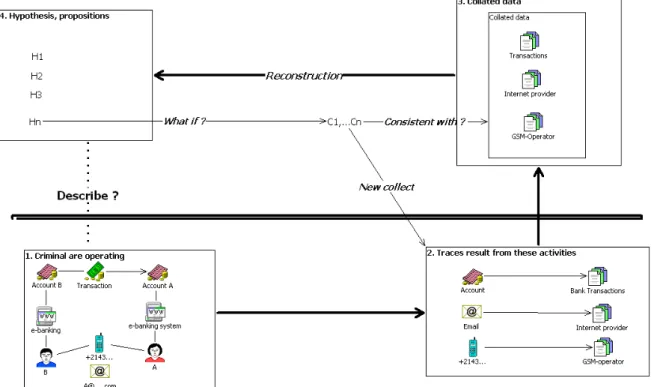
The reconstruction process is central. It starts from the traces (effects) and leads to the management of alternative hypotheses (possible causes) that may explain the existence of the traces. This process can obviously be envisaged through the optic of profiling.
4
IALEIA: International Association of Law Enforcement Intelligence Analysts; IACA: International Association of Crime Analysts
[Final], Version: 1.0
File: fidis-wp6-del6.7c.Forensic_Profiling.doc
Page 16 Each criminal activity is unique, thus the reconstruction process does not aim to extract general principles, but rather to provide an explanation of what occurred in a specific situation with specific persons (what, who, when, where, why and how). However, this activity occurs within a general context (for instance demographic, economical, sociological, criminal, physical, etc.) that also have to be taken into account. For instance, knowing that similar events already occurred in the same region during the same period may be of importance in each phase of the judicial process.
Figure 1: A description of the whole reconstruction process, from the activity to the management of hypotheses
Traces may be visible, latent or even hidden behind irrelevant data. They are frequently fragmentary. For instance, important files on a hard disk may be discretely hidden within directories generally dedicated to other purposes, logically deleted, or even partially replaced by new data. Specific search strategies must be devised for detecting, recognising and collecting relevant traces.
From the traces collected, possible sources, activities and the offence must be described. A modern approach for framing the reconstruction process considers together the offender, the victim, the immediate environment and existing protections (Felson and Clarke 1998; Ribaux and Margot 2007). This so called situational approach emphasises that conditions for a crime to occur are very specific and strongly depend on the motivation and abilities of the offender (perceived risks, expected gain, effort, knowledge or resources), as well as the characteristics of the victims within a specific environment that make her vulnerable and her values attractive (Value, Inertia, Visibility, Accessibility - VIVA). Thus, forensic profiling will not only concentrate on the offender, but also on victims and environment, in order to detect precursors that may lead to repeated victimisation. In fact, this chemistry or opportunities can be helpfully studied in order to look for concentration of crimes in time and place, as well as for explaining the existence and developments of these clusters (Felson and Clarke 1998).
[Final], Version: 1.0
File: fidis-wp6-del6.7c.Forensic_Profiling.doc
Page 17 3.4.1 The three chapters of the judicial process
There are many actors of the criminal justice system who search for answers to the what, who, when, where, why, and how questions, depending of their functions, roles, competence and/or knowledge. Each has a different aim that call for specific reasoning forms. The judges and jury will take responsibilities in the definitive decision at the end of the process. The preparation of the file is supported or carried out by the defendant and his lawyer, the police, forensic scientists or a magistrate. The whole reconstruction process may beneficiate from specific knowledge of experts. Witnesses and victims are themselves interviewed to provide insight on offenders and their activities. Finally, criminologists are interested in the mechanisms of the offence in order to test their hypothesis or develop theories of crime. These contributions may considerably differ from one system to another one. In particular, the role of the forensic scientists may range from providing expertise in very restricted situations to directly participating and coordinating part of the investigative process, where the study of traces and a scientific attitude are expected. Profiling then follows different aims that have to be distinguished.
Brodeur (Brodeur 2005) from a general perspective, and Kind (Kind 1994) with a forensic viewpoint, have both argued for the existence of different types of investigations or chapters that have their own logic in the course of the judicial process: the problem to find (identification and localisation of suspects), the problem to prove (how to structure evidence) and the problem of the trial itself where evidence is presented.
3.5 The different forms of forensic profiling in the judicial process
It is crucial to distinguish the different forms forensic profiling may take according to the different aims of each of the three chapters. They are manifold, but unfortunately, they are not all intensively studied. They are often tacitly applied or result from best practices. Here, the distinction between profiling as the result of a well-grounded professional methodology and its tacit counterpart is not always very clear. Moreover, there is a gap between what mythology about police work might suggest and the actual degree of formalisation of profiling methods practically used by law enforcement agencies.
Here is an attempt to capture only some aspects and methods that are applied at different degrees, but this survey does not intend to cover all possible forms. Even, some forms may be variably applied across organisations in terms of formalisation of the processes using databases, as a best practice or tacitly applied at the level of the individual. They will be mostly envisaged from an inferential perspective first; then, they will be considered in relation with the increased availability of electronic traces. Finally, data mining technologies for treating data will be discussed.
We will study profiling along the three chapters paradigm, but in the reverse order than was presented, because forms are limited when presenting evidence to a court and progressively more diverse when dealing with investigation. First, we will sketch the challenge faced when delivering conclusions to a court, then envisage some forms of profiling when structuring evidence, and finally complete the problematic by considering profiling as an investigative aid.
[Final], Version: 1.0
File: fidis-wp6-del6.7c.Forensic_Profiling.doc
Page 18 3.5.1 The interpretation process and profiling
Following the hierarchy of propositions coined by (Cook et al. 1998) forensic experts are essentially dealing with propositions related to the source (an object or a person) of a trace, alternative activities that may explain a set of traces and explaining how traces may provide other pieces of information aiding the final decision of the judge.
According to traces collected, the expert deals with propositions representing the prosecution and defence positions (Aitken and Taroni 2004). For instance, these propositions may take the form “this electronic trace was generated by this computer versus the alternative possibility that another computer taken in a relevant population caused it”. Or at the activity level, according to traces collected: “this person was surfing on the internet during this particular session versus another person among a relevant population did a manipulation that provoked the traces”.
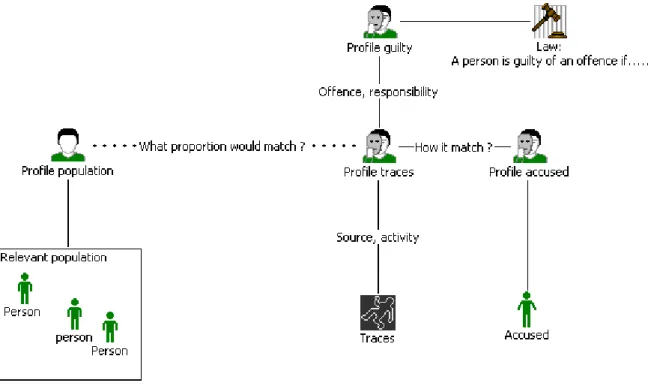
In terms of profiles, one may assimilate a trace to an element of description of an object or a person. Then, interpretation necessitates comparisons between profiles built on the basis of traces collected from the scene (profile trace) with the profile of an accused person (profile accused). It often takes the concrete form of comparing traces with reference material taken from the source, for example a finger mark collected from a scene compared with a fingerprint taken from the accused. We will call the result of this comparison a match5.
The relevant questions are reformulated in a probabilistic form: what is the probability that the profile-trace matches the profile-accused, if the accused person is the source of the trace. Then, from an interpretation perspective, one must consider the alternative possibility: the probability of a same match if another person were at the origin of the trace. Thus the reasoning process must continue by evaluating the proportion of profiles of other persons taken from a relevant population that could have possibly caused traces that match in a similar way.
Population studies (profiles of populations) are of great importance to help provide an informed assessment. Even, evidence is often wrongly considered as absolute: 10-loci DNA profiles, even rare, generally represent more than one single individual on the planet. Frequencies distributions of alleles in different populations constitute necessary background knowledge for assessing evidence. For instance, specific subpopulations and familial relationship may considerably affect allele frequencies.
In the field of electronic evidence, presenting evidence to a court according to this framework is still in its infancy: very few studies help determine on the basis of traces collected on a computer, how the profile built from this information may individualise the user. Many researches have still to be carried out in this direction.
Another form of forensic profiling occurs at this stage because a person must be categorised in function of a criminal rule of law. The virtual person representing the guilty is compared to the profile generated from traces. This is the offence level.
For example it is often asked if a suspect has belonged to or participated in a specific criminal organisation: according to the description of criminal organisation that may differ from one legal system to another one, how is the classification possible on the basis of the profile of the individual? Representation of criminal organisations as defined by the law, classification of a
5
For simplification purposes, we will not discuss the different types of similarities that may result from this process, but this comparison process is at the heart of interpretation
[Final], Version: 1.0
File: fidis-wp6-del6.7c.Forensic_Profiling.doc
Page 19 specific organisation as a criminal organisation and demonstrating the participation of a specific individual in the organisation are frequent and far from obvious questions that have to be answered by the court.
Individual profiling (Jaquet-Chiffelle 2008) is required in this circumstance, as well as when for instance forensic psychiatry supports the assessment of a persons profile in order to evaluate his degree of responsibility that may depend on this kind of diagnosis.
The whole process is synthesised in figure 2. Using profiles in the interpretation process is promising because it rests on definitions of identities and clarifies which attributes are compared.
Figure 2: Description of the interpretation process using the notion of profile
3.5.2 Structuring evidence and profiling
When a suspect has been arrested, forensic scientists may advise an authority on how to deal with traces and provide leads on new traces to be collected. At this stage, a lot of activity is dedicated to test the consistency of available information, under the assumption that the suspect is at the source of the traces and the activity. A test of consistency with the hypotheses is not sufficient for going to court (see above), but it may lead to refute the hypotheses if available traces show unexplained discrepancies.
For instance a person who is supposed to have used her credit card at one place could not have used simultaneously her mobile phone at another distant place. In terms of profiles, coherence of the profile of the person under scrutiny has to be tested from various perspectives in order to detect potential contradictions or on the other hand to support hypotheses by demonstrating consistence (it has still to be confirmed how those concordances may occur by coincidence!). For instance, it may be assumed that the use of a mobile phone is part of the modus operandi of a serial offender when he is operating. Thus, data related to the localisation of mobile phones should show spatio-temporal coherence with data related to the
[Final], Version: 1.0
File: fidis-wp6-del6.7c.Forensic_Profiling.doc
Page 20 crimes themselves. Correlation between different sources of data (traces) may be thus intensively used according to the hypothesis to be tested.
3.5.3 Forensic profiling in an investigative perspective
As stated by many authors (Kind 1987; Wiggett et al. 2003; Jackson 2004; Jackson et al.
2006; Mennell 2006; Mennell and Shaw 2006), there is the realisation among forensic scientists that their role must extend to the investigation itself. They must be particularly engaged when hypotheses have still not been entirely drawn, in the coordination of the forensic information collected, as well as for proposing new collection of data. In this way, the forensic scientist turns from an evaluator to a more investigative attitude (Jackson et al.
2006): who/what is the source of this trace, how can we explain the existence of these traces, what is the offence, what evidence may indicate some possibilities for new data collection, what support and leads to the investigation may be provided, where is the person who committed the crime, etc?
This contribution is based on an entirely different inferential process than for interpreting evidence for the court. Rather than balancing probabilities related to given propositions, it focuses on the development of alternative hypotheses that may explain the existence of traces. Thus, rather than testing the hypothesis of culpability or innocence, we could generally describe the process as starting from the effects (the traces) and imagining possible causes on the basis of general knowledge (abduction and induction). Forms of profiling that arise during the investigative part of the process are manifolds and combine individual profiling with group profiling (Jaquet-Chiffelle 2008). We do not have the pretension of identifying all the possible forms here, only the most typical will be described.
One of the basic operations consists of creating a first profile from the available (collected) information and then searching for all the persons or their relations to objects that correspond to this profile. Profiles are described here as categories that restrict the search within a “selected” population. A person (individual) may generally be described through traces:
They themselves reflects directly some physical aspects of the sources and have some descriptive capacity, such as fingermarks or DNA profiles extracted from biological marks, a snapshot taken from a camera;
Traces and where they are found may be used to infer some indications about physical aspects or inform about clothes or accessories: earmarks found at a certain height on a door and the size of shoemarks may indicate (qualitatively) how tall the source is; a snapshot may provide some physical description as well as information about clothes and accessories;
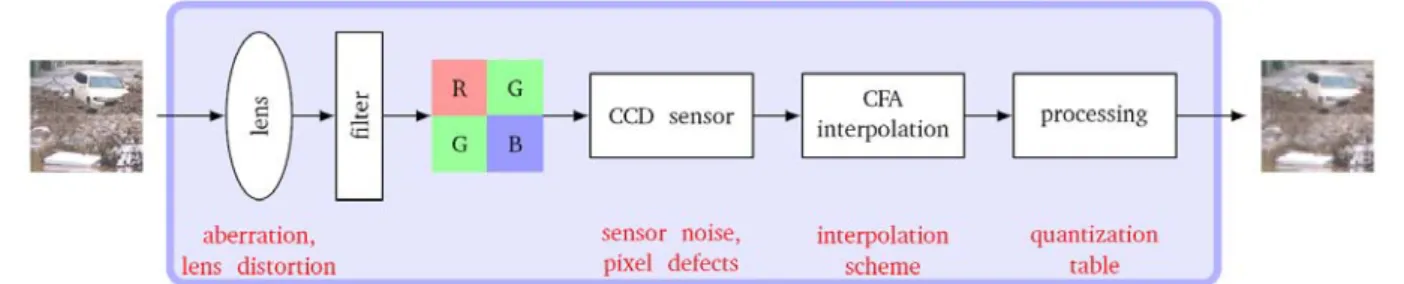
Traces may indicate the make and model of the printer used to print a recovered document, a bullet collected at the scene of crime may indicate the make and model of the firearm used, while paint marks coming from a car may point to a make and model of the implicated car. These are all types of acquisitions that may indirectly point to a person. Other possibilities include the use of fibre for inferring description of clothes, toolmarks or other marks for obtaining some description of the tools used. In a similar way of thinking, but about persons, DNA profiles indicate the gender (generally not
[Final], Version: 1.0
File: fidis-wp6-del6.7c.Forensic_Profiling.doc
Page 21 more about the physical aspect through non-coding DNA sequences chosen for forensic use);
The activity and behaviour in the immediate environment may be inferred through a global analysis of the spatial (and temporal) distribution of traces, such as a sequence of shoemarks, a sequence of withdrawals with a specific bank card at different ATMs, traces of navigation with an internet browser;
Circumstances and application of different theories from different bodies of
knowledge may help to interpret the situations in order to provide other traits of the person or of his behaviour. For instance, geographical profiling (mostly for serial crimes) aims at providing clues for localising a person (Rossmo 1999), or different theories point out that psychological traits may also be inferred. The person may also be the object of a classification process into different categories (pre-defined
classification of computer crime offenders, arson offenders, rapists, etc.).
Each final profile may thus be more or less general. Its attributes are known or unknown, complete or not and mostly uncertain.
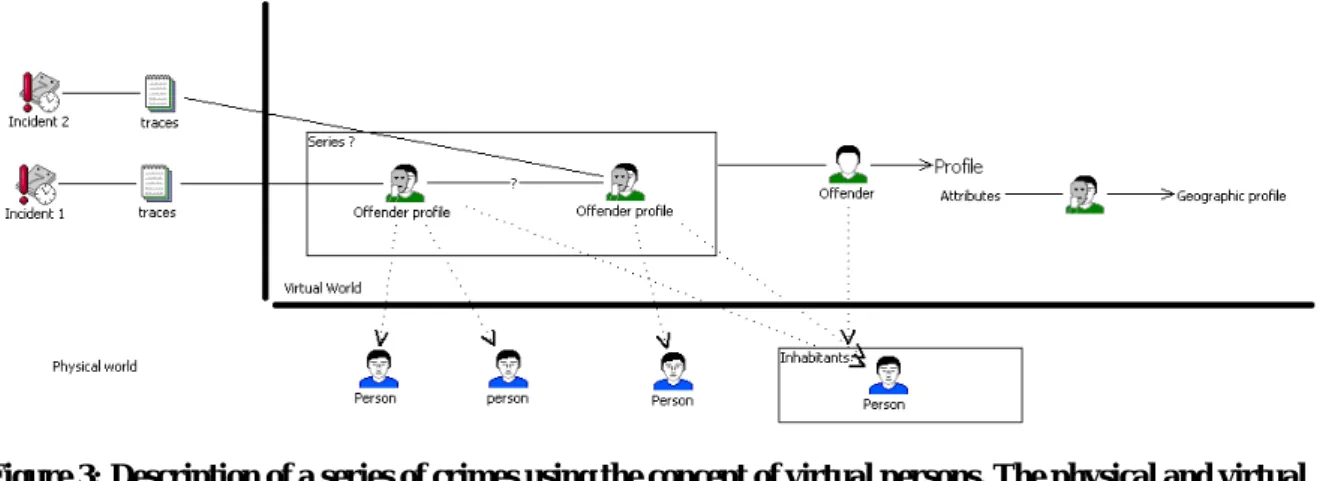
One of the main (but not the only) questions of the investigation is the identification of the sources of the traces and how they may be related with the activity. Developing hypotheses about who/what is the source may be straightforward for instances through the use of DNA databases or Automatic Fingerprint Identification Systems (AFIS). Those systems start from the traces that come from a source (data subject as defined in (Hildebrandt 2008)) , transform them into a digital form (attribute of a virtual person (Jaquet-Chiffelle 2008)), compare them with collections of reference material and suggest as output a (list of) possible candidate(s) (or list of virtual persons) that refer to possible data subjects. The result is then interpreted and integrated into the investigation process. When using AFIS databases, a list of candidates is returned by the system, while for DNA databases, usually a single profile6 is returned. However, with the evolving content of databases and since identical twins have same DNA, occasionally several DNA-profiles may be returned by the database. Moreover, with the extended use of partial DNA or mixtures, putative sources may be multiple.
In order to generalise this process, a useful concept has been stressed by Kind (Kind 1987). He argues for the use of the dual concepts of frame and form. The frame contains the set of entities considered as relevant for the investigation, according to available evidence, while, roughly, the form distinguishes different region of the frame as more or less promising. A list of candidates extracted from an AFIS system constitutes the frame, while scrutinising the content provides as outcome the form. The frame is often constituted of persons or entities that share a common profile. This may also be seen as a non-distributive group profiling approach (Hildebrandt and Backhouse 2005; Hildebrandt 2008; Jaquet-Chiffelle 2008) where a category of individuals is built on the basis of a different set of data and where the decision to insert an individual (or its individual profile) into the frame may depend on features of different natures.
6
The use of profile for DNA may be confusing in the context of this deliverable. However, a DNA profile may be defined as a description of a person through part of her DNA structures. Even if the parts of the DNA – structure used in a forensic context have been chosen for their polymorphism across the population, the same profile may apply to several persons. A profile thus does not define a single individual, but rather a group.
[Final], Version: 1.0
File: fidis-wp6-del6.7c.Forensic_Profiling.doc
Page 22 There are many ways to develop a frame in the course of the investigation, depending on the case and available traces. The direct and simplest way consists in comparing the trace with the collection of reference material (like for DNA or AFIS databases). A similar process consists of comparing images taken from video surveillance systems (CCTV) with collection of photos taken from known persons. The scheme is the same and simple, but obviously the source of data used presents specificities that make the methods routinely applicable, as well as automated profiling possible or not.
Another possibility, when recidivism is known as frequent, is to compare the assumed modus operandi of the offender with modus operandi used by known recidivists. Here again, when serial crime is considered, a profile extracted from the series of modus operandi used by the recidivist (a profile extracted from an already constituted set of information – individual profile) may be used to proceed to the comparison: the burglar usually operated during the night, entered the premises through an open window, and generally selected only credit cards. There may be very different approaches for building such a profile, for instance by expecting that a specific feature occurs in each case or only in the majority of cases, expecting the existence of a specific feature of not, etc. The relevancy of such a profile depends on the expected use of the profile (searching other databases for linking cases, organising specific surveillance, trying to intercept the perpetrators) and thus may take the status of intelligence (see below).
Another important form of profiling is carried out through the application of models and methods used for hypothesising the place where the offender resides, or one of his centres of interest. These methods are known as geographical profiling and may be used in specific situations, for instance when a serial offender operates (Rossmo 1999). With the development of new technologies, data extracted from GSM operators may play an important role in this perspective, for instance by assuming the degree of mobility of a person, where he resides or other spatial dimensions related to his behaviour.
Finally, other possibilities are developed through new id-systems: when a profile of the offender has been developed and some of his activities may be inferred, new frames may be built. For instance if the author was suspected of having used her mobile phone when operating, details of all the calls made during the time of the offence in the region of interest may be asked from the operator, with the hope of detecting the card or the mobile phone used by the offender. If an offender is supposed to have entered a building controlled through id-systems, the list of persons who entered the building may be provided.
All these forms may be used in combination through cross-referencing, for instance when geographical profiles lead to a list of inhabitants, the use of firearms may indicate the relevancy to search among the list of legal possessors, the profile of a car to consider the file of car owners, etc. This data may then be cross-referenced either to build a category of persons corresponding the best to the offender profile, conscious of the fact that the offender may or not appear in these databases. This may, as an outcome, provide a list of relevant identities to be further investigated.
Jaquet-Chiffelle (Jaquet-Chiffelle 2008) stressed that this kind of investigative profiling follows two distinct goals: the first is to identify an individual within a community or infer its habits, behaviour, preferences, knowledge, etc. But the second form is not independent from the first one as it is often not obvious, once identified, to find (ultimately arrest) a person worth being the object of further investigations. Occasionally, the localisation of the person
[Final], Version: 1.0
File: fidis-wp6-del6.7c.Forensic_Profiling.doc
Page 23 even leads to his arrest before he is identified. For instance, when a serial burglar operates, his pattern may be detected and used to devise surveillances that may in turn lead to his arrest. A rich example, well documented, of possibilities to apply such techniques can be found in the review of the investigation of the Yorkshire Ripper during the 70s (Byford 1981). This investigation offers a broad series of inferences and treatment of data typical of complex investigations. Review of the case has led to original ideas about different forms of profiling (Kind 1987). At that time, among other difficulties, the lack of computerisation and possibilities of cross referencing was identified as a severe handicap for the investigation. The ripper was finally arrested through a routine control in the street, because he was circulating with stolen plates. Despite that this arrest was made in isolation from the investigative strategy itself, it was actually also obtained through the use of a systematic control process aided by the databases of stolen plates. Lessons learned from this case have had in particular considerable impact on the development of computerisation for major case management7 and organisations of incident rooms. It may also be considered as a milestone in the development of analytical capabilities within law enforcement such as geographical profiling or the use of information technologies in the management of serious cases.
3.5.4 Categorical elimination
Once the frame has been built, further techniques or investigations may lead to categorical elimination. This can be performed for instance through DNA screening, when persons are eliminated through comparison of their DNA profile with the profile of the trace.
This filtering process, when applied with DNA, offers some guaranties, but occasionally, the profile may not be accurate and leads to a wrongful elimination. This was the case during the Yorkshire Ripper investigation, with the letters and an audio tape received by the police. The tape contained a message of a person who pretended to be the ripper. He had a strong accent from one specific region. By assuming that the sender of the video was the actual ripper, each person who did not correspond to this profile (in particular the strong accent) was eliminated from the investigation. Actually, the person who sent the letters and tape was identified in 2005 thanks to DNA and had apparently no connection with the ripper. This example illustrates one reason why profiling in the course of criminal investigation is particularly critical and necessitates further formalisation.
3.6 Repetition of crimes as a fertile area for forensic profiling
At this point, the treatment of specific cases has been discussed. However, some forms of criminality, such as high volume crimes, are likely to show a substantial serial component. A series of studies in criminology led to the conclusion that both as small number of persons or group of offenders are responsible for a great quantity of cases (Wolfgang et al. 1972; Audit commission 1993), and certain victims and types of victims show different patterns in the way they are repeatedly victimised (Farrell and Pease 2001). Understanding patterns of victimisations and detecting the activity of groups of serial offenders are of crucial interest both from a repressive and preventive perspective, and also from a more strategic perspective, when the structure of some forms of criminality are scrutinised (mobility of offenders,
7
[Final], Version: 1.0
File: fidis-wp6-del6.7c.Forensic_Profiling.doc
Page 24 specialisation, evolution of criminal careers, amplitude of the activity, association between criminals, classification of victims, vulnerabilities, crime phenomena, etc.). This is why modern policing strategies necessitate the implementation of analytical capabilities dedicated to the understanding of the dynamic of crime and the provision of intelligence on which informed decision may be taken.
Forensic profiling has thus a great role to play in this perspective, providing at least that physical material and traces have a demonstrated potential for connecting the dots, or linking cases (Ribaux and Margot 2007).
3.6.1 Repetition of crimes – crime series
Crime series occur when the same offender operates several times. There are no definitive definitions of crime series as group of criminals may operate in different compositions, show different forms of organisation and perpetrate different types of crimes. One may accept that when the same offender operates repetitively, there is a crime series, and that individual crimes of that series are linked. Several crime series may be connected and form a graph structure which represents the activity of a group of offenders.
Thus, three forms of forensic profiling that rely on police recorded data may occur in this context:
1. Detection of a series of crimes and reconstruction of graph structures that represent the activity of single offenders or group of offenders (group profiling)
2. From a series of crime, extract a profile that best describes the series and its or their author(s) (individual profiling)
3. From the graph structure, extract a profile that best describes the forms of criminality and the group of offenders (group profiling)
Crime series detected through police recorded data are generally incomplete and largely uncertain. Not all crimes are reported by victims (level of reportability may greatly vary according to the type of crime) and the collection of traces at each crime scene may be only partial. Moreover, a series of obstacles that ranges from legal constraints to technical difficulties causes impossibilities to detect links, while they actually exist. This is the well known incapacity of connecting the dots or linkage blindness law enforcement agencies systematically suffer from (Egger 1984; Sheptycki 2004).
From this perspective, basic contribution of forensic science concentrates on crime linking through physical evidence. Detection of links is particularly efficient when the type of crime causes the exchange of physical traces. For instance, DNA databases automatically detect a great number of series, when traces are collected systematically and there is a realisation within the organisation that this detection is useful (Girod et al. 2004). A series of arsons, linking through the analysis of illicit drugs seized, or even series of bombing have largely benefited from this approach (Ribaux and Margot 2007)
Other types of traces, such as toolmarks (Geradts et al. 1999), earmarks, shoemarks (Girod 2002; Rix 2004), may be used in combination, thus augmenting the chance to detect series of
[Final], Version: 1.0
File: fidis-wp6-del6.7c.Forensic_Profiling.doc
Page 25 crimes through at least one of these dimensions. Electronic traces may also be used for detecting the use of the same mobile phone or smart-card for organising the operation, linking cases when surveillance cameras show withdrawal with stolen bank cards perpetrated by the same person, or for linking different withdrawals perpetrated with the same stolen cards, and even linking unsolicited e-mails through technical information found for instance in the header of the message (Birrer et al. 2007).
All detected links present some degree of uncertainty: they may exist or may not exist and we are more or less certain of that. However, links inferred from physical material present the advantage of being the result of a direct comparison of measurable data collected at scenes of crime, while other approaches necessitate as a precondition some form of interpretation. For instance, a traditional method for linking crimes (Völlmer 1919) relies upon the comparison of modus operandi which are already the result of a reconstruction process and thus necessitate uncertain reasoning to be performed as a precondition.
Other approaches consist of focusing on behavioural aspects of cases which add other levels of inferences and uncertain reasoning. This psychological based methodology has been considered as a breakthrough, as it brought systematic and structure for linking violent crimes. However, a series of drawbacks have now been detected, ranging from difficulties of filling long forms to feed the database to the lack of assessments of the global efficiency (Godwin 2001; Grubin et al. 2001; Witzig 2003).
Thus, by using a holistic perspective, the detection of links is envisaged by monitoring and combining all the possible dimensions. However, pragmatic constraints (cost of input and analyse data, time, knowledge, etc.) and other types of constraints limit the practical possibilities to aggregate data and multiply all those perspectives. This inevitably contributes to linkage blindness. This problem ought to be attenuated by choosing the more solid and efficient dimensions through systematic assessment and comparisons of available methods. Beyond the type of data used, the central mechanism for detecting series rests on proximity measurements: spatio/temporal, modus operandi or similarities between traces. There is also space here for developments, seeing that each serial offender shows an individual profile, while automatic methods for comparing cases generally rely on one single metric (see also the example about drug profiling below).
3.6.2 Repetition of crimes – problems and phenomena
Forms of repetition of crimes other than the serial activity of offenders may be relevant to decide which measures (preventive, repressive or a combination) may be appropriately taken. For instance, hot-spots or crime clusters may incite to concentrate police surveillance on specific area during a certain period, independently of the serial activity of single offenders. Concentration of crimes may be also due to the attractiveness of a potential victim, a residence or a specific environment, independently of how many authors are operating. In this perspective, profiling techniques used refer to spatio/temporal crime cluster analysis that aims to alert based on relevant patterns extracted from crime data.
More generally, the concept of the problem analysis triangle helps analysis of situations in terms of a combination of a likely offender who meets a suitable target within a specific environment without the protection of a capable guardian. These approaches belong to a set of very rich theories in criminology, called opportunities theories (Clarke and Eck 2003). In this perspective, crimes (and more generally problems that regroup recurring incidents and