Latour, M, Husser, T-O, Giesers, B, Kamann, S, Goettgens, F, Dreizler, S,
Brinchmann, J, Bastian, N, Wendt, M, Weilbacher, PM and Molinski, NS
A stellar census in globular clusters with MUSE: multiple populations
chemistry in NGC 2808 star star star
http://researchonline.ljmu.ac.uk/id/eprint/11743/
Article
LJMU has developed LJMU Research Online for users to access the research output of the University more effectively. Copyright © and Moral Rights for the papers on this site are retained by the individual authors and/or other copyright owners. Users may download and/or print one copy of any article(s) in LJMU Research Online to facilitate their private study or for non-commercial research. You may not engage in further distribution of the material or use it for any profit-making activities or any commercial gain.
The version presented here may differ from the published version or from the version of the record. Please see the repository URL above for details on accessing the published version and note that access may require a subscription.
For more information please contact [email protected]
http://researchonline.ljmu.ac.uk/
Citation
(please note it is advisable to refer to the publisher’s version if you
intend to cite from this work)
Latour, M, Husser, T-O, Giesers, B, Kamann, S, Goettgens, F, Dreizler, S,
Brinchmann, J, Bastian, N, Wendt, M, Weilbacher, PM and Molinski, NS
(2019) A stellar census in globular clusters with MUSE: multiple populations
chemistry in NGC 2808 star star star. Astronomy & Astrophysics, 631. ISSN
Astronomy
&
Astrophysics
https://doi.org/10.1051/0004-6361/201936242
© ESO 2019
A stellar census in globular clusters with MUSE: multiple
populations chemistry in NGC 2808
?
,
??
M. Latour
1, T.-O. Husser
1, B. Giesers
1, S. Kamann
2, F. Göttgens
1, S. Dreizler
1, J. Brinchmann
3,4,
N. Bastian
2, M. Wendt
5, P. M. Weilbacher
6, and N. S. Molinski
7,11Institut für Astrophysik, Georg-August-Universität Göttingen, Friedrich-Hund-Platz 1, 37077 Göttingen, Germany e-mail:[email protected]
2Astrophysics Research Institute, Liverpool John Moores University, 146 Brownlow Hill, Liverpool L3 5RF, UK
3Instituto de Astrofísica e Ciências do Espaço, Universidade do Porto, CAUP, Rua das Estrelas, PT4150-762 Porto, Portugal 4Leiden Observatory, Leiden University, PO Box 9513, 2300 RA, Leiden, The Netherlands
5Institut für Physik und Astronomie, Universität Potsdam, Karl-Liebknecht-Str. 24/25, 14476 Golm, Germany 6Leibniz-Institut für Astrophysik Potsdam (AIP), An der Sternwarte 16, 14482 Potsdam, Germany
7Institut für Geophysik und extraterrestrische Physik, Technische Universität zu Braunschweig, Mendelssohnstr. 3, 38106 Braunschweig, Germany
Received 5 July 2019 / Accepted 29 August 2019
ABSTRACT
Context. Galactic globular clusters (GCs) are now known to host multiple populations displaying particular abundance variations. The
different populations within a GC can be well distinguished following their position in the pseudo two-colors diagrams, also referred to as “chromosome maps”. These maps are constructed using optical and near-UV photometry available from theHubbleSpace Telescope (HST) UV survey of GCs. However, the chemical tagging of the various populations in the chromosome maps is hampered by the fact that HST photometry and elemental abundances are both only available for a limited number of stars.
Aims. The spectra collected as part of the MUSE survey of globular clusters provide a spectroscopic counterpart to the HST
photo-metric catalogs covering the central regions of GCs. In this paper, we use the MUSE spectra of 1115 red giant branch (RGB) stars in NGC 2808 to characterize the abundance variations seen in the multiple populations of this cluster.
Methods. We used the chromosome map of NGC 2808 to divide the RGB stars into their respective populations. We then combined
the spectra of all stars belonging to a given population, resulting in one high signal-to-noise ratio spectrum representative of each population.
Results. Variations in the spectral lines of O, Na, Mg, and Al are clearly detected among four of the populations. In order to quantify
these variations, we measured equivalent width differences and created synthetic populations spectra that were used to determine abun-dance variations with respect to the primordial population of the cluster. Our results are in good agreement with the values expected from previous studies based on high-resolution spectroscopy. We do not see any significant variations in the spectral lines of Ca, K, and Ba. We also do not detect abundance variations among the stars belonging to the primordial population of NGC 2808.
Conclusions. We demonstrate that in spite of their low resolution, the MUSE spectra can be used to investigate abundance variations
in the context of multiple populations.
Key words. techniques: imaging spectroscopy – stars: abundances – globular clusters: individual: NGC 2808 1. Introduction
Galactic globular clusters (GCs) have been traditionally viewed, and modeled, as simple stellar populations made of stars sharing the same evolutionary history. However, some particular properties of GC stars indicate that the story is not that simple. For example, it has become clear that nearly all Galactic GCs host significant abundance spreads among their stars and some patterns are ubiquitous among GCs, such as the Na–O and
N–C anticorrelations (see reviews byGratton et al. 2004,2012).
These abundance anomalies are characteristics of globular
clusters and are not observed in large numbers (∼3% in the
?The populations spectra and the list of stars included in these
spectra are only available at the CDS via anonymous ftp to cdsarc.u-strasbg.fr (130.79.128.5) or via http://cdsarc. u-strasbg.fr/viz-bin/cat/J/A+A/631/A14
??Based on observations collected at the European Organisation for
Astronomical Research in the Southern Hemisphere, Chile (proposal IDs 094.D-0142(B), 096.D-0175(A)).
halo, ∼7% in the bulge) among stars of the Galactic field
(Martell & Grebel 2010; Carretta et al. 2010; Schiavon et al. 2017;Koch et al. 2019). Additional evidence pointing to a more complex stellar formation scenario came with the observation of bimodal regions in the color-magnitude diagram (CMD) of GCs. Such bimodal distributions have been found along the main sequences (MSs), subgiant branches (SGBs), and red giant branches (RGBs) of several clusters and are mainly caused by variations in the strength of molecular bands, such as CN and NH, that affect the stellar flux in the UV and blue optical regions
(see, e.g., Piotto et al. 2007, 2012; Milone et al. 2008; Han
et al. 2009). Changes in these spectral features can be detected,
when using the appropriate filters, withHubbleSpace Telescope
(HST) and ground-based wide band photometry (Monelli et al.
2013; Massari et al. 2016; Niederhofer et al. 2016). Targeted photometry with narrow and/or middle band filters like the
Washington system (Cummings et al. 2014), the Ca–CN system
(Lee 2019), and specific narrow-band HST filters (Larsen et al.
These complex structures seen with photometry and the abundance variations measured spectroscopically are in fact related. It has been shown that the color differences between the multiple RGBs, SGBs, and MSs are related to differences in the abundances of some specific elements (mostly He, C, N, and O), and in fewer cases by differences in iron abundances
(see, e.g., Marino et al. 2012; Milone et al. 2013,2018; Yong
et al. 2015;Bellini et al. 2017a; Lardo et al. 2018). With such compelling evidence, it is now accepted that nearly all GCs older
than about 2 Gyrs (Martocchia et al. 2018;Bastian & Lardo 2018)
host multiple populations that can be distinguished by their dif-ferent photometric and/or spectroscopic properties. Although by now many observational studies have measured abundances and characterized the relation between the variations of different ele-ments (e.g., He, Li, C, N, O, Na, Mg, and Al) in the stars of many globular clusters, the enrichment mechanism(s) responsi-ble for such particular abundance variation patterns is still hotly debated. With growing observational constraints to reproduce, the various enrichment mechanisms and stellar polluters pro-posed are currently unable to fulfill all the requirements (see Bastian & Lardo 2018for a recent review on the topic).
The pseudo-two-color diagrams introduced byMilone et al.
(2015) and then termed as chromosome maps (Milone 2016)
have proven to be a robust way to distinguish the various pop-ulations of a given GC, especially for stars on the RGB. These
maps are built using a combination of HST filters (F275W,
F336W, F438W, and F814W) that are sensitive to spectral
features affected by the chemical variations characterizing the
different populations. Milone et al.(2017) presented the
chro-mosome maps of the 57 clusters included in their HST UV
Legacy Survey of Galactic GCs (HUGS;Piotto et al. 2015) and
showed that, for the majority of their clusters, the RGB stars can be easily divided into two main groups, which they refer to as first (1G) and second (2G) generations. Indeed, some overlap
between stars in the Milone et al. (2017) sample and previous
spectroscopic studies indicate that stars belonging to the 1G have a primordial chemical composition, while the abundances of the 2G stars show traces of processed material, for example
Na enrichment and O depletion (Milone et al. 2015;O’Malley &
Chaboyer 2018;Cabrera-Ziri et al. 2019). More recently,Marino et al.(2019) retrieved spectroscopic abundances from literature studies for stars in the chromosome maps of 29 GCs, confirming that stars belonging to the primordial population (or 1G) have light-element abundances similar to those of field stars, while the 2G stars are enhanced in N, Na, and depleted in O. How-ever, the overlap between stars that have the optimal photometric data required to separate the populations and those that have spectroscopic abundances is limited (often less than 20 stars per clusters) given that the HST survey covers the central regions of the clusters, while spectroscopic surveys often target stars in the outskirt regions in order to avoid crowding issues.
As part of the guaranteed time observations (GTO) with the
integral-field spectrograph MUSE (Bacon et al. 2010), our team
is carrying out a survey of Galactic globular clusters, especially targeting the clusters central regions. The overlap between our data and the HST photometry is ideal to associate stars with their respective populations according to their position in the chromosome maps, but the low resolution of the MUSE spectra is not optimal to derive abundances for individual stars. Instead, we followed a different approach that consists in combining the spectra of the stars belonging to a given population. In this paper, we present and test our approach with the globular cluster NGC 2808. It is one of the few clusters to have an elaborate set of populations, based on its chromosome map and
on the abundance pattern of its RGB stars, but no significant spread in metallicity (or [Fe/H]). Because of its richness and complexity, the multiple populations of NGG 2808 have been thoroughly studied in the past based on their photometric
properties (e.g., Milone et al. 2015; Lardo et al. 2018) and
their chemical abundances (e.g., Carretta et al. 2006; Carretta
2015, Cabrera-Ziri et al. 2019). In Sect. 2, we present our observational material, consisting of the MUSE spectroscopic sample and the HST photometric catalog. The methods used to derive atmospheric parameters, combine spectra and estimate
abundance variations are explained in Sect. 3. Our results are
presented in Sect.4, where we compare them with expectations
from literature studies and explore further population divisions
in the chromosome map. A short conclusion follows in Sect.5.
2. Observational material
2.1. Spectroscopy
The observations of NGC 2808 were performed as part of the MUSE GTO dedicated to globular clusters (PI: S. Dreizler, S. Kamann). So far, the spectroscopic data collected as part of this survey have been used for various purposes, such as kinematic
analyses (Kamann et al. 2018), characterizing binary systems
(Giesers et al. 2018), and the search for emission line objects (Göttgens et al. 2019a,b). A detailed description of the program, as well as the data reduction and their analysis is provided in Kamann et al. (2018). In the following, we briefly summarize the information specific to the observations of NGC 2808.
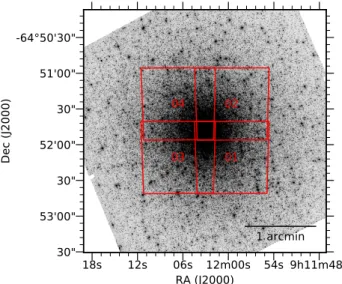
The central region of the cluster is covered by a mosaic
con-sisting of the four pointings shown in Fig. 1. The data were
obtained with the wide field mode of MUSE, that provides a field
of view of 10×10. For this paper, we used the spectra collected
until March 2016, thus preceding the commissioning of the adap-tive optic system installed on UT4 of the VLT. Each pointing was observed at three different epochs. The observations listed
in Table 1 consisted of three exposures, offset by 90 degrees
in the derotator angle. The individual exposures were processed
with the standard MUSE pipeline (Weilbacher et al. 2012,2014)
which was also used to create a combined data cube for each observation. The total integration time per observation is 495 s. The spectra of the individual stars were extracted from the
dat-acube using the PAMPELMUSE software described inKamann
et al.(2013). The extraction of the spectra relies on the existence of a photometric catalog that includes astrometry and photom-etry of sources in the field of view. For NGC 2808, we used the HST data from the Advanced Camera for Surveys (ACS) of
Galactic globular clusters (Sarajedini et al. 2007;Anderson et al.
2008). The resulting spectra cover the 4750−9350 Å wavelength
range with an average spectral resolution of∼2.5 Å, although this
varies slightly across the wavelength range (Husser et al. 2016).
2.2. Photometry
To create the chromosome map, we used the photometric data published in the astrophotometric catalogs of the HST UV
Glob-ular cluster Survey (HUGS) presented byNardiello et al.(2018).
Three versions of the catalogs are available for each cluster, cor-responding to three different methods of extracting the data (see Bellini et al. 2017b). For our multiple populations study involv-ing RGB stars, we used the catalogs correspondinvolv-ing to method 1, which is optimal for bright stars.
In a first step, we clean the HST photometry following the
9h11m48s
54s
12m00s
06s
12s
18s
RA (J2000)
30"
53'00"
30"
52'00"
30"
51'00"
-64°50'30"
Dec (J2000)
01
02
03
04
1 arcmin
Fig. 1. Position of the four pointings of MUSE observations. The background shows an HST/ACS F606 image of NGC 2808.
Table 1.Summary of MUSE observations of NGC 2808.
Pointing RA Dec Obs. date Seeing
(UT) (00) 1 09:11:59.574 −64:52:11.13 2014-12-18 08:06:36 1.04 2014-12-19 07:37:20 0.80 2016-03-13 02:48:52 0.82 2 09:11:59.562 −64:51:26.13 2014-12-18 08:09:55 1.10 2014-12-19 07:40:42 0.84 2016-03-13 03:01:24 0.90 3 09:12:06.639 −64:52:11.06 2014-12-18 08:13:15 1.10 2014-12-19 07:44:05 0.82 2016-03-14 00:49:53 0.90 4 09:12:06.623 −64:51:26.13 2014-12-18 08:16:35 1.32 2014-12-19 07:47:27 0.76 2016-03-14 01:01:56 0.84 procedure allows the selection of stars with well-measured pho-tometry according to their photometric error, the shape of their PSF and the quality of their point spread function (PSF) fit during extraction. Our final photometric sample includes only stars that pass the selection criteria for these three parameters in all four filters involved in the construction of the chromosome maps. Although this decreases the number of stars left to work with in the subsequent steps, the resulting chromosome maps are cleaner and the different populations are less likely to be contam-inated by stars with uncertain photometry. The chromosome map
was constructed following the method described inMilone et al.
(2017). We defined the RGB envelope along magnitude bins in
the F814W filter in a way that the blue fiducial line is at the 10th percentile and the red fiducial line at the 90th percentile. The
transformation from the CMD (mF814W,mF275W −mF814W) and
pseudo-CMD (mF814W,CF275W,F336W,F438W) to the chromosome
map requires a value for the width of the RGB, which we com-pute as the mean difference between the red and blue fiducial lines defining the RGB envelope.
Figure 2 shows our chromosome map of the cluster. Our
chromosome map is very similar to the one presented inMilone
et al.(2017) even if we did not correct the photometry for
dif-ferential reddening. Following the classification ofMilone et al.
(2017), the stars of a globular cluster can be divided into two
main groups in the chromosome map. The population 1 stars are found at the bottom of the chromosome map, around the
(0,0) position, while population 2 stars extend above1. However,
a handful of clusters, such as NGC 2808, host a more complex population of RGB stars and our selection of four populations
(P1–P4) is based on those identified in Milone et al. (2015).
When defining the populations, we aim at selecting stars that can be clearly assigned to one of the populations, thus we leave out stars whose positions are scattered around in the chromosome map. Along with the chromosome map, we also plot the
posi-tion of the stars in two different CMDs. The mF336W−mF438W
color provides a clear distinction between the population 1 and 2
stars as defined byMilone et al.(2017). Even though the
popula-tion 2 stars in NGC 2808 hold distinct sub-populapopula-tions, they are not discernible in this particular color. Although previous
stud-ies have divided our P1 in subgroups (Milone et al. 2015;Lardo
et al. 2018), we consider these stars as a single population and
will discuss the subdivisions within P1 in Sect.4.3.
3. Methods
Studies on the abundances of RGB stars in globular clus-ters have mostly been performed using high resolution
(R∼20 000−40 000) spectra (see, e.g.,Carretta et al. 2006and
following papers in that series). In order to reliably derive abun-dances of individual elements in these stars, it is necessary to resolve the lines of interest to avoid uncertainties due to blending. With their low resolution, the MUSE spectra are not well-suited for such an analysis on individual stars. However the lack in resolution can be compensated, to some extent, by the large amount of stars we have in our sample. After match-ing our MUSE sample with the stars in the chromosome map of NGC 2808, we obtained a sample of more than 1100 RGB stars with an assigned population. Our approach is thus to com-bine the spectra of all stars in a given population and use the resulting high signal-to-noise (S/N) spectrum to represent the whole population. We then searched for abundance variations by comparing the spectra of the different populations. Assess-ing chemical abundances from our populations spectra, however, is not a straightforward task. Measuring absolute abundances would be hampered by the fact that many lines are strongly blended, either with other photospheric lines or with interstellar absorption (e.g., the sodium D doublet). Instead we attempt to estimate differential abundances between the populations using the “primordial” population (P1) as a reference. We present a description of the different steps required to achieve this goal in the following subsections.
3.1. Atmospheric parameters determination
Atmospheric parameters are obtained for all individual spectra
following a procedure similar to that described inHusser et al.
(2016). Firstly, we find an isochrone (fromMarigo et al. 2017)
that best matches the HST photometry (F606W, F606W-F814W) fromSarajedini et al.(2007). For NGC 2808, the best-matching
isochrone has an age of 12 Gyr and [M/H] =−0.93. Secondly,
we deriveTeff and loggvalues for all stars by finding the
near-est point on the isochrone in the CMD. These values (and the mean metallicity of the cluster) are then used to get a template spectrum from the Göttingen spectral library of PHOENIX
spec-tra (Husser et al. 2013) and perform a cross-correlation. Finally,
1 We note thatMilone et al.(2017) used the term generation instead of population and referred to them as 1G and 2G stars.
Fig. 2.Chromosome map and CMDs of NGC 2808 with its four populations. The stars plotted in gray are not included in a population. the atmospheric parameters from the isochrone and the radial
velocity from the cross-correlation are used as initial values to run a full-spectrum fit against the full grid of PHOENIX spectra
using the spectrum fitting frameworkspexxy2. The best fit
pro-videsTeff, [M/H],vrad, and a model for the telluric lines for all
observed spectra. The surface gravity is kept fixed to the value
from the isochrone during this process because loggcannot be
well constrained using low-resolution spectra.
All stars in our sample have up to three observed spectra, so we combine the results from the fits of the individual spec-tra to get final parameters for every star. During this step, we evaluate the reliability of each spectrum following the method
described in Sect. 3.2 ofGiesers et al.(2019). This method
eval-uates the quality of the observed spectra based on S/N, extraction results, and radial velocity measurements. The main difference withGiesers et al.(2019) is that we require the reliability (Rtotal value) on the radial velocity to be at least 50% (instead of the more restrictive 80% required for the binary studies). In the end,
the parameters (Teff and [M/H]) obtained from the individual
spectra of a given star satisfying the reliability criteria are used
to compute the weighted average values that are adopted asTeff
and [M/H] of the star. 3.2. Spectral combination
In order to get a good, high S/N spectrum for every star, we combine all its observed spectra. At first, we remove the telluric lines from the raw spectra by dividing them by the telluric model obtained in the full-spectrum fit. Because the extracted spectra from the MUSE cubes are not perfectly flux calibrated, the full-spectrum fit also produces a polynomial that describes the difference between the observed spectrum and the model (i.e., similar to a continuum if the models were normalized). We also divide each spectrum by this polynomial to get rid of the uneven
continuum (see, e.g., Fig. 16 of Husser et al. 2016). Then we
shift all spectra to rest-frame using the obtained radial velocity and resample them to the same wavelength grid. Finally, we co-add the individual spectra of each star, using their S/N value as weight.
We create the populations spectra by adding the fluxes of each star. Because the exposure time is similar for all stars and 2 https://github.com/thusser/spexxy
the observed spectra are flux calibrated, the brighter stars have a higher flux and a higher S/N than the fainter stars. Therefore the direct summation of the fluxes ensures that the lower S/N spectra contribute less to the final population spectrum and pro-vides a natural S/N weighting. During the combination process, we reject stars for which our membership probability, based on
metallicity and radial velocity (seeKamann et al. 2018), is below
80%3 and also stars that are identified as emission line objects
(Göttgens et al. 2019b). We also excluded from our sample stars
whose spectrum has a S/N < 20. Because we intend to model
the RGB stars for abundance variations, we also excluded the
most luminous stars (logg < 1.0 andTeff < 4500 K) at the tip
of the RGB where sphericity, wind, and non-LTE effects are expected to be important and our synthetic spectra might not be appropriate. After applying this selection, our sample consists of 1115 RGB stars included in the four populations.
3.3. Computation of synthetic spectra
We computed synthetic spectra with varying elemental abun-dances using the latest version of the SYNSPEC code (version
53, I. Hubeny, priv. comm.; Hubeny & Lanz 2011, 2017) in
combination with the atmospheric structures of the PHOENIX models from the Göttingen spectral library. SYNSPEC is a gen-eral spectrum synthesis program that solves the radiative transfer equation for a given atmospheric structure. It was originally developed to be used in conjunction with TLUSTY, a non-LTE
stellar atmosphere code (Hubeny & Lanz 1995), but it can also
readily use an input model in the Kurucz’sATLASformat, a
fea-ture we made use of by converting the PHOENIX models into the ATLAS format. The latest version of SYNSPEC has been upgraded to provide a better treatment of molecular opacities that are important for the computation of cool stars spectra (Hubeny et al., in prep.). We used the atomic and molecular line lists pro-vided with the TLUSTY and SYNSPEC codes that are based on the Kurucz data. By comparing some of our synthetic spec-tra with the PHOENIX specspec-tra, we realized that the updated
atomic data for FeI(Kurucz 2014) and NdI(Den Hartog et al.
2003) retrieved from the VALD database (Ryabchikova et al.
2015) provided a better match and we updated the line lists
accordingly. For the lines of interest in the context of abundance 3 We note that only one star was rejected as a non-member.
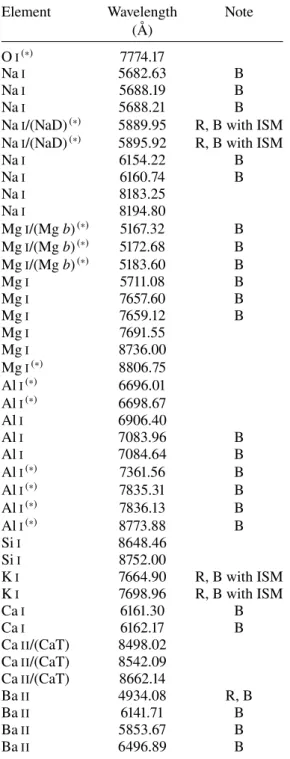
Table 2.Atomic lines of interest covered by the MUSE wavelength range.
Element Wavelength Note
(Å)
OI(∗) 7774.17
NaI 5682.63 B
NaI 5688.19 B
NaI 5688.21 B
NaI/(NaD)(∗) 5889.95 R, B with ISM NaI/(NaD)(∗) 5895.92 R, B with ISM
NaI 6154.22 B NaI 6160.74 B NaI 8183.25 NaI 8194.80 MgI/(Mgb)(∗) 5167.32 B MgI/(Mgb)(∗) 5172.68 B MgI/(Mgb)(∗) 5183.60 B MgI 5711.08 B MgI 7657.60 B MgI 7659.12 B MgI 7691.55 MgI 8736.00 MgI(∗) 8806.75 AlI(∗) 6696.01 AlI(∗) 6698.67 AlI 6906.40 AlI 7083.96 B AlI 7084.64 B AlI(∗) 7361.56 B AlI(∗) 7835.31 B AlI(∗) 7836.13 B AlI(∗) 8773.88 B SiI 8648.46 SiI 8752.00 KI 7664.90 R, B with ISM KI 7698.96 R, B with ISM CaI 6161.30 B CaI 6162.17 B CaII/(CaT) 8498.02 CaII/(CaT) 8542.09 CaII/(CaT) 8662.14 BaII 4934.08 R, B BaII 6141.71 B BaII 5853.67 B BaII 6496.89 B
Note.Transitions marked with an(∗)were used to derive abundance dif-ferences. B – Blended with other strong lines (at the MUSE resolution), R – Resonance lines.
variations (see Table2), we verified, and updated if necessary,
their atomic data following the VALD and NIST (Kramida et al.
2018) databases.
For every atomic element inspected, we computed synthetic spectra with varying abundances of the given element in steps of 0.25 dex. This was done using the PHOENIX model
atmo-sphere at [M/H] =−1.0, which is very close to the average [M/H]
that we obtained for the RGB stars in NGC 2808 (−1.03 dex,
see Sect.4.1). As for the models used to derive the atmospheric
parameters, we assumed a scaled-solar metallicity for the abun-dance of all other elements. A set of synthetic spectra (with
varying abundances) was interpolated for every star at its Teff
and loggvalue. In order to combine the synthetic spectra using
appropriate weights, we multiplied the normalized model spec-tra of each star by the average flux of its MUSE spectrum. The procedure results in one set of spectra with varying abundance for each population.
3.4. Equivalent widths measurements
We measured equivalent width (EW) differences of spectral lines by integrating over the residuals obtained when subtracting the
spectrum of P1 from that of the other populations (see Sect.4.2).
By working with EW differences, we eliminate the contributions of blended features whose strength can be assumed to be con-stant between the populations (e.g., Fe lines). We also eliminate the contribution of the interstellar medium (ISM) component of the sodium D (NaD) lines, assuming the stars of each population
are equally distributed in the field of view. AlthoughWendt et al.
(2017) found that the strength of the NaD (and KI) ISM varies
across the field of view in NGC 6397, the preliminary results for NGC 2808 do not show a strong spatial variation (Wendt et al., in prep.). We computed the EWs using a trapezoidal integral because most of the residuals are too coarsely sampled to fit them with a line profile. The errors on the EWs are estimated by doing a similar exercise over spectral regions of constant strength between the populations. We selected 12 such refer-ence regions and used the average of their EW differrefer-ences (in absolute value) as uncertainty, resulting in uncertainties between
8−13 mÅ depending on the population.
4. Results
4.1. Stellar parameter distributions
Figure 3 shows the cumulative distribution functions in Teff,
logg, and [M/H] of the stars included in each of the four
popula-tions as obtained from the fitting procedure described in Sect3.1.
The parameter distributions of the populations are overall very
similar. One conspicuous difference is seen in the Teff
distri-bution of P4 that appears to contain hotter stars on average. This population has been considered as the most He-enhanced
population in NGC 2808 (Milone et al. 2015) and stars having
different helium content also have differentTeff and logg at a
given luminosity (Sbordone et al. 2011). In fact He-enhanced
stars are expected to be hotter at a given luminosity andMilone
et al.(2015) estimated aTeff difference of about 100 K between the most He-enriched population (equivalent to our P4) and the population having a primordial helium content (equivalent to our P1). As for the difference in surface gravity, they estimated a more marginal change of about 0.05 dex. The difference in
Teff that we observe between P1 and P4 (95 K at the median
value of the distribution) is comparable to the expected effect and could be an indirect signature of the He-enhancement.
How-ever, as seen in the loggdistribution, P4 is lacking stars at the
luminous (and thus cold) end of the RGB. Recomputing theTeff
difference between P1 and P4 including only stars with logg>
2 resulted in a smaller value of 70 K. A few clusters are known to have populations with different [Fe/H] and this would be seen
in the metallicity distributions (Husser et al. 2019). However, the
stars in NGC 2808 are expected to have the same iron content (Carretta et al. 2006) and that is reflected in the similar average metallicity that we obtained for each population.
4600 4800 5000 5200 5400 5600 5800 6000
T
eff[K]
0.0
0.5
1.0
CDF
P 1 (N=270) P 2 (N=301) P 3 (N=419) P 4 (N=125)1.0
1.5
2.0
2.5
3.0
3.5
log g
0.0
0.5
1.0
CDF
1.6
1.4
1.2
1.0
0.8
0.6
[M/H] [dex]
0.0
0.5
1.0
CDF
P 1 (M/H -1.03) P 2 (M/H -1.04) P 3 (M/H -1.03) P 4 (M/H -1.02)Fig. 3.Cumulative distributions inTeff, logg, and [M/H] of the stars
included in the four populations of NGC 2808. The number of stars included in each population is indicated in the legend of theupper panel
while the average [M/H] value for each population is indicated in the legend of thelower panel.
4.2. Abundance variations among the populations
We first searched for abundance variations by comparing the population spectra of NGC 2808, as well as those of other clus-ters, over the full MUSE wavelength range. This allowed us to
identify spectral features that varied between the spectra. Table2
includes a list of lines for which we have detected variations, either in NGC 2808 or in another cluster from our sample. The transitions marked with an asterisk were used in the quantitative analysis. The spectra were normalized by fitting the continuum over selected wavelength ranges, that are the same for each spectrum, and overplotted along with their flux differences (or
residuals) in Figs.4–6. The differences in flux are always
com-puted with respect to the spectrum of P1 (∆F = FPx−FP1).
Along with the residuals we also indicated, for each population,
a 3σconfidence range, obtained from the (3σ-clipped) standard
deviation of the flux differences over the wavelength interval.
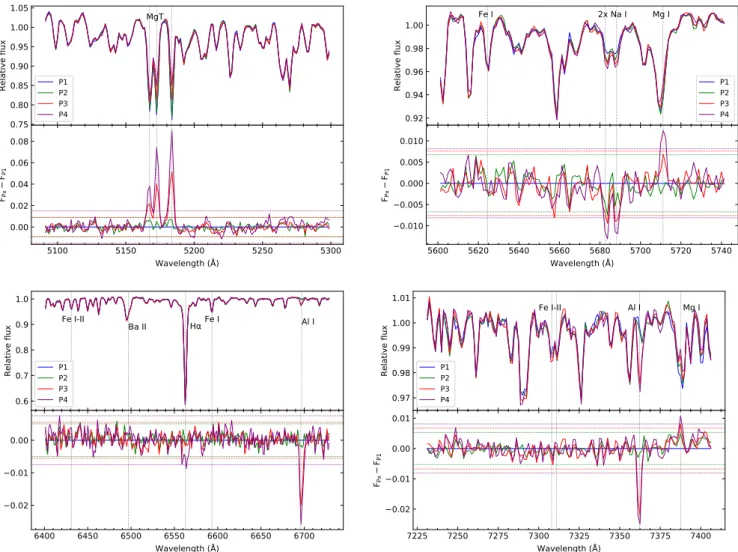
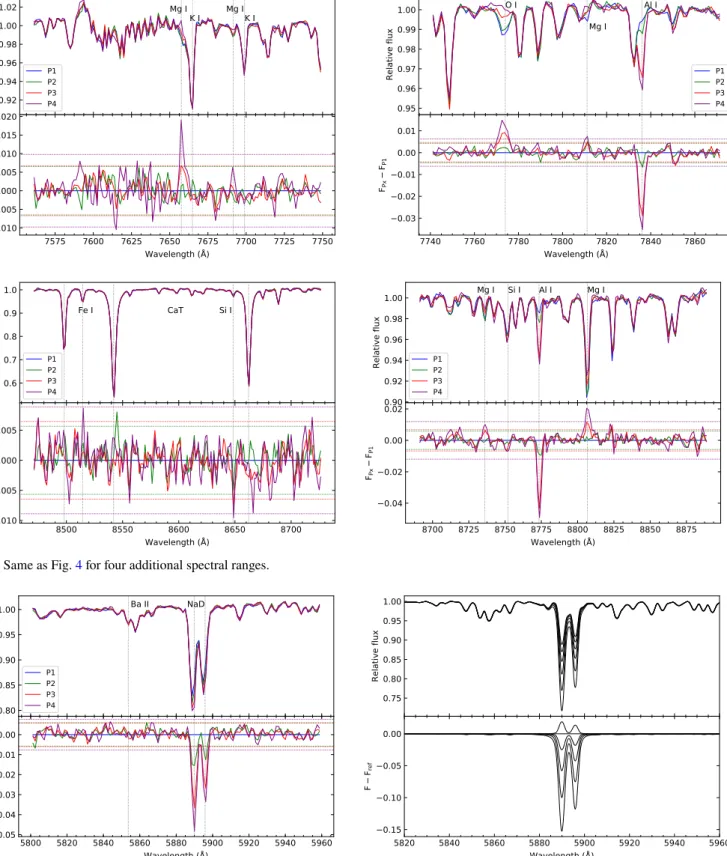
We included in Figs.4 and5 a selection of the most
interest-ing spectral ranges showinterest-ing some dramatic variations in Mg, Al and O. The quality of our combined spectra even allows us to see marginal differences in the residuals of a few weaker and/or strongly blended Mg lines. Over these wavelength ranges, we confidently detected differences of 1% in relative flux. In the fol-lowing subsections, we discuss our observations and abundance measurements for various elements.
4.2.1. Na-O anticorrelation
The most conspicuous sodium feature in the MUSE spectra are the NaD lines. Changes in the strength of these lines between the populations are clearly visible, with the sodium lines increasing
in strength from P1 to P4 (Fig.6). Even though the NaD doublet
is blended with interstellar absorption, the residuals are peak-ing at the exact wavelength of the transition. This is also seen in our other GCs and indicates that we properly retrieve the pho-tospheric variations. We also observe a small variation in the
NaIλλ5682, 5688 lines (see Fig.4) even though these lines are
blended with other transitions of similar strength, notably from Fe and Si. As expected from the well established Na-O
anticor-relation, the strength of the OI(λ7774.2) line decreases from P1
to P4 (see Fig.5).
In order to translate the differences seen in these lines into abundances, we measured the EWs of the O and NaD
resid-uals following the method described in Sect.3.4 and used the
synthetic population spectra described in Sect.3.3. We did not
use the other Na doublet in our quantitative analysis because the residuals are weak. The synthetic spectra were first convolved
with the MUSE line-spread function (Husser et al. 2016) and
the EWs of the lines of interest were computed in the same way as for the observed spectra. An example of the synthetic spectra computed for P1 with varying abundances of sodium is shown in
the right panel of Fig.6. To reproduce the EW differences
mea-sured from the observed spectra one must assume an abundance for the reference population (P1). For that we relied on the
abun-dances measured byCarretta et al.(2009) andCarretta(2014) as
reported byMilone et al.(2015), in their Table 2. Our P1 being
equivalent to the population B ofMilone et al.(2015), we set the
sodium abundance of P1 to that of the cluster’s metallicity (one tenth solar) and the oxygen abundance to [O/Fe] = +0.30. We
considered a variation of±0.05 dex in the abundance of the
ref-erence population to obtain an uncertainty on its EW. For each line, the EW of that line at the P1 abundance was subtracted from the curve of growth of the remaining populations. These curves of growth, representing the EW differences as function of abun-dances, were then used to estimate the abundance differences of a given line, for each population.
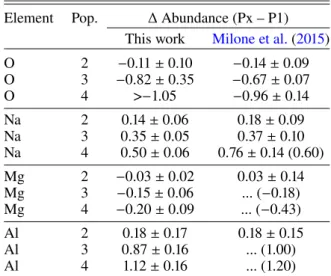
The resulting differential abundances are reported in Table 3
in the form of [Elem/Fe]Px–[Elem/Fe]P1. As a reference, we
also provide the abundance differences obtained from the values
listed in Table 2 ofMilone et al.(2015) when considering their
population B as the reference population. Our abundances for sodium are in good agreement with the literature values. As for oxygen, the “bump” in the continuum of P4 required us to set the EW of the oxygen line in P4 to zero, meaning that the EW difference adopted for P4 was zero minus the EW of P1. Using the integral over the residual in that particular case would lead to an overestimated EW difference. Thus we could not constrain very well the oxygen variation in this population. Our lower limit for P4 is somewhat too high, due to the fact that the O line in our models do not disappear completely at low abundances
([O/M] = −1.0), although their EW is of comparable to the
uncertainties (∼13 mÅ).
4.2.2. Al-Mg anticorrelation
The magnesiumbtriplet and MgIλ8806.75 are the two
diagnos-tic features for Mg variations in the MUSE spectra. Magnesium is clearly depleted in P3 and P4 and the residuals are well
above the 3σ limit. On the other hand we do not detect Mg
variations between P1 and P2. The variations in aluminum are anti-correlated with those of magnesium. The Al lines increase in strength from P1 to P4 with a steeper increase between P2 and P3. This “bimodality” in aluminum abundances was also
observed byCarretta et al.(2009) (see their Fig. 6) in the dozen
0.75 0.80 0.85 0.90 0.95 1.00 1.05 Relative flux MgT P1 P2 P3 P4 5100 5150 5200 5250 5300 Wavelength (Å) 0.00 0.02 0.04 0.06 0.08 FPx FP1 0.92 0.94 0.96 0.98 1.00 Relative flux Mg I 2x Na I Fe I P1 P2 P3 P4 5600 5620 5640 5660 5680 5700 5720 5740 Wavelength (Å) 0.010 0.005 0.000 0.005 0.010 FPx FP1 0.6 0.7 0.8 0.9 1.0 Relative flux Al I Ba II H Fe I-II Fe I P1 P2 P3 P4 6400 6450 6500 6550 6600 6650 6700 Wavelength (Å) 0.02 0.01 0.00 FPx FP1 0.97 0.98 0.99 1.00 1.01 Relative flux Al I Mg I Fe I-II P1 P2 P3 P4 7225 7250 7275 7300 7325 7350 7375 7400 Wavelength (Å) 0.02 0.01 0.00 0.01 FPx FP1
Fig. 4.Comparisons between the spectra of the four populations in NGC 2808. The residuals on the bottom panels are plotted as the difference between the flux of a given population and that of P1 (FPx–FP1). The horizontal dotted lines represent the 3σvalue of the residuals of each population over the plotted range.
The quantitative analysis was performed similarly to that of the Na and O lines. For magnesium, we used three regions to compute EWs, a first region including the two bluest lines of the
Mg b triplet (λλ5167, 5173) and the other two regions
includ-ing the third Mg b line (λ5183) and the line at 8806.8 Å. The
Mg abundance of P1 was set to [Mg/M] = +0.38 and the Al abun-dance of P1 to that of the cluster’s metallicity. For aluminum,
we used the four spectral lines displayed in Figs.4 and5. The
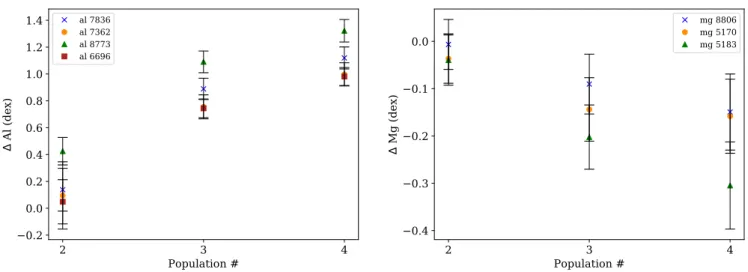
differential abundances obtained from the various lines are
plot-ted in Fig.A.1and the values reported in Table3were obtained
from the average of the different lines. The abundance
differ-ences reported in Table3are also illustrated in Fig.7. InMilone
et al.(2015), only stars from their populations B and C (corre-sponding to our P1 and P2) have Al and Mg abundances. For P3 and P4, we used instead the average abundances listed in Table 7 ofCarretta(2015), using the I1 and I2 populations as equivalent of our P3, and the E population for our P4. Although the indi-vidual abundance values obtained from the different lines are not
perfectly consistent (Fig.A.1), the trend across the populations is
similar and the average abundances are in good agreement with the literature values. Only our abundance variation of Mg in P4
does not reach the depletion of approximately−0.4 dex found by
Carretta(2015).
Carretta(2015) also observed an anticorrelation between the Si and Mg abundances, but with a relatively small variation in
the silicon abundances (∼0.2 dex). This is much smaller than
that of the other elements (Al, Mg, O, and Na) and thus more difficult to observe in our spectra. Few silicon lines are strong or relatively well isolated in our spectra, but small features in the
residuals could be identified with two Si lines (λλ8646, 8752).
Their behavior is as expected with the lines being stronger in P3
and P4 (see Fig.5).
4.2.3. Elements without variations
Three of the investigated atomic elements do not show variations between the populations: K, Ca, and Ba. Star-to-star scatter in
potassium abundances are normally not observed in GC (Takeda
et al. 2009;Mucciarelli et al. 2017) but, interestingly, NGC 2808 is one of the two clusters (along with NGC 2419) where the K abundance has been observed to anti-correlate with O and Mg
while correlating with Na and Al (Mucciarelli et al. 2015).
How-ever the K abundance variation is relatively small (∼0.25 dex)
and the correlation with Mg not particularly strong (see Fig. 12 ofCarretta 2015). In the MUSE spectra, the K resonance lines are blended with their interstellar components as indicated by
the blue-shifted position of the observed K lines in Fig.5(such
a shift is also visible in the NaD lines). The potassium lines are also close to strong telluric absorption that is not perfectly accounted for in our telluric models. This discrepancy explains
0.92 0.94 0.96 0.98 1.00 1.02 Relative flux K I K I Mg I Mg I P1 P2 P3 P4 7575 7600 7625 7650 7675 7700 7725 7750 Wavelength (Å) 0.010 0.005 0.000 0.005 0.010 0.015 0.020 FPx FP1 0.95 0.96 0.97 0.98 0.99 1.00 Relative flux O I Al I Mg I P1 P2 P3 P4 7740 7760 7780 7800 7820 7840 7860 Wavelength (Å) 0.03 0.02 0.01 0.00 0.01 FPx FP1 0.6 0.7 0.8 0.9 1.0 Relative flux CaT Si I Fe I P1 P2 P3 P4 8500 8550 8600 8650 8700 Wavelength (Å) 0.010 0.005 0.000 0.005 FPx FP1 0.90 0.92 0.94 0.96 0.98 1.00 Relative flux Mg I Al I Mg I Si I P1 P2 P3 P4 8700 8725 8750 8775 8800 8825 8850 8875 Wavelength (Å) 0.04 0.02 0.00 0.02 FPx FP1
Fig. 5.Same as Fig.4for four additional spectral ranges.
0.80 0.85 0.90 0.95 1.00 Relative flux NaD Ba II P1 P2 P3 P4 5800 5820 5840 5860 5880 5900 5920 5940 5960 Wavelength (Å) 0.05 0.04 0.03 0.02 0.01 0.00 FPx FP1 0.75 0.80 0.85 0.90 0.95 1.00 Relative flux 5820 5840 5860 5880 5900 5920 5940 5960 Wavelength (Å) 0.15 0.10 0.05 0.00 F Fref
Fig. 6.Left panel: same as Figs.4and5but for the NaD range.Right panel: NaD range in the synthetic spectra of P1 with [Na/M] varying from
−0.25 to +1.00 by step of 0.25 dex. The residuals at the bottom are plotted with respect to the spectrum having [Na/M] = 0.00, as assumed for the primordial population.
the feature seen on the blue side of KI λ7664 (see also Fig. 6
of Husser et al. 2016). These are not ideal conditions to detect small variations as those expected for the potassium lines. It is nevertheless worth pointing out that despite the residual telluric features, we detect variations in the Mg line at 7659 Å
(see Fig.5).
We do not see variations in the residuals of the Ca triplet
(CaT) lines, which is in agreement with the results ofCarretta
(2015) who reported no variations in Ca abundances related
with the populations. Finally, while barium shows abundance variations in a handful of GC, this does not appear to be the case in NGC 2808 as none of the Ba lines we inspected display
Table 3.Abundance differences between the populations of NGC 2808.
Element Pop. ∆Abundance (Px – P1)
This work Milone et al.(2015)
O 2 −0.11±0.10 −0.14±0.09 O 3 −0.82±0.35 −0.67±0.07 O 4 >−1.05 −0.96±0.14 Na 2 0.14±0.06 0.18±0.09 Na 3 0.35±0.05 0.37±0.10 Na 4 0.50±0.06 0.76±0.14 (0.60) Mg 2 −0.03±0.02 0.03±0.14 Mg 3 −0.15±0.06 ... (−0.18) Mg 4 −0.20±0.09 ... (−0.43) Al 2 0.18±0.17 0.18±0.15 Al 3 0.87±0.16 ... (1.00) Al 4 1.12±0.16 ... (1.20)
Notes. The values in parenthesis are estimated from the abundances of Carretta(2015). 1.0 0.5 0.0 O (dex) 0.0 0.2 0.4 N a ( de x) 0.3 0.2 0.1 0.0 Mg (dex) 0.00 0.25 0.50 0.75 1.00 1.25 A l ( de x) 1 2 3 4 4 3 21
Fig. 7. Anticorrelations between the Na-O (left) and Al-Mg (right) abundances. The population numbers are indicated on the top axes. variations. We did not find literature on the Ba abundances of RGB stars in this cluster, however, barium abundances were measured in HB stars and found to be consistent with a constant
value (Marino et al. 2014).
One last interesting feature is the Hαline, for which the
resid-ual detected in P4 is consistent with the previous observations
(see Sect. 4.1) that this population contains hotter stars, since
the Balmer lines become stronger with increasingTeff. Because
they are believed to be enhanced in helium, the stars belong-ing to P4 are expected to be not only hotter, but also to have slightly lower surface gravities (by 0.05 dex). We made sure that this would not significantly change our abundance determina-tions by re-computing the synthetic spectra of P4 using a lower
surface gravity. The abundances derived with these “lower logg”
spectra were differing only by 0.01−0.02 dex compared to the
results listed in Table 3. For the three other populations, their
Hαlines are remarkably similar (Fig.4). In fact, the whole
spec-tra of the four populations are extremely similar, besides the lines affected by abundance variations, indicating that they are mini-mally affected by the differences in their underlying distributions
inTeffand logg.
4.3. A closer look at the primordial population
Milone et al. (2015) identified five populations based on the chromosome map and CMDs of NGC 2808. The additional pop-ulation comes from a subdivision of poppop-ulation 1 stars in two
groups that they identified as Population A and B. Figure8shows
0.6
0.4
0.2
0.0
0.2
F275W F814W0.2
0.1
0.0
0.1
0.2
0.3
0.4
0.5
C
F275 W 2 F3 36 W + F4 38 W P4 P3B P3A P2B P2A P1B P1AFig. 8. Chromosome map of NGC 2808 including additional subdi-visions. The population 1 is divided in P1A and P1B following the nomenclature ofMilone et al.(2015). Populations 2 and 3 are also each separated in two subgroups. The population groups are listed in the leg-end from the group on top of the chromosome map (P4) to that at the bottom (P1A).
our chromosome map updated with this additional subdivision among the P1 stars. Indeed some GCs, such as NGC 2808, have a
P1 that is rather extended along thex-axis (∆F275W−F814W), while
for some other clusters the extension is much more restricted (Milone et al. 2017). Comparisons between observed and syn-thetic photometry suggested that the extent of the P1 stars is mostly due to variations in helium abundances (with He
increas-ing toward the left in chromosome maps; Milone et al. 2018;
Lardo et al. 2018). However such He variations in stars that would otherwise have a rather homogeneous composition is challenging to explain via the current enrichment mechanisms
proposed in the literature (Bastian & Lardo 2018). An
alterna-tive possibility suggested to explain the photometric spread of
P1 stars is variations in iron abundance (Milone et al. 2015;
Marino et al. 2019). In the case of NGC 2808, it is unfortunate
that no star from theCarretta(2015) sample could be associated
with the Population A stars ofMilone et al.(2015), thus
spectro-scopic information was lacking concerning that intriguing group
of stars. It is only recently thatCabrera-Ziri et al. (2019)
mea-sured abundances of light elements in six stars found along the P1 of NGC 2808 (including three likely belonging to PA) and found the abundances to be homogeneous among the six objects. Given the state of the current debate concerning the cause of the P1 spread in the chromosome map and the rather myste-rious status of the population A stars in NGC 2808, we explored this further with the MUSE spectra. We created spectra for the population 1A (including 79 stars) and 1B (189 stars) and com-pared them as we did for P1 to P4. The resulting spectra and
residuals are presented in Fig.A.2. As expected from the recent
findings ofCabrera-Ziri et al.(2019), we do not detect significant
variations in any of the spectral lines investigated. Measurement of the EW differences between P1A and P1B and their com-parison with synthetic model spectra, as done in the previous
0.0
0.2
0.4
N
a (
de
x)
0.00
0.25
0.50
0.75
1.00
1.25
A
l (
de
x)
0.4
0.2
0.0
F275W F814W1.0
0.5
0.0
O
(d
ex
)
0.4
0.2
0.0
F275W F814W0.3
0.2
0.1
0.0
M
g
(d
ex
)
1
2A
2B
3A
3B
4
4
3B
3A
2B
2A
1
Fig. 9.Abundance variations measured for O, Na, Mg and Al plotted against the median pseudo-color ∆F275W−F814W of the populations. The errors on thex-axis represent the 1σdispersion in peusdo-color distribution of the given population. The population numbers are indicated on the top axes. subsection, confirmed that the differences are consistent with no
abundance variations. By considering the uncertainties on the
measured EWs (∼16 mÅ), we estimated the abundance
varia-tions between P1A and P1B to be:−0.08±0.2 dex for O, 0.03±
0.07 dex for Na, 0.04±0.23 dex for Al and 0.02±0.05 dex for
Mg. This supports the hypothesis that the color variation among the P1 stars could be related to helium, whose abundance is noto-riously difficult to quantify via spectroscopic analysis. As for the possible presence of an iron spread among the population 1 stars,
it will be discussed inHusser et al.(2019).
4.4. Abundance variations across the chromosome map To investigate the possibility of abundance variations across the chromosome map and within populations, we further divided P2
and P3 in two subgroups as indicated in Fig. 8. For these four
additional populations, we created population spectra, measured EW differences and translated these EW differences into abun-dance differences following the method described in the previous sections. We used again P1 as reference population. We show
the resulting abundances in Fig.9. The abundances are plotted
with respect to the median pseudo-color ∆F275W−F814W (x-axis
on the chromosome map) of each population, with the
error-bars on∆F275W−F814W representing the standard deviation of the
distribution in pseudo-color.
Although the uncertainties on O and Mg abundances are large, a gradual trend in these elements abundances is seen when moving across the chromosome map. We note however that for these two elements, the abundances of the P2A group appear to be the same as that of the primordial (P1) population. This behavior in NGC 2808 is similar to what is seen in Fig. 13 of Marino et al.(2019); the stars at the “bottom” of P2 (sharing a
similar∆F275W−F814Wthan the P1 stars) have similar abundances
in Mg and O.
Na and Al abundances display an increasing trend when moving to the left of the chromosome map. We see a dras-tic increase in the abundance of Al between the 2B and 3A populations. This further supports the presence of a gap in Al abundances between P2 and P3. We recall that this is also seen
in the abundances measured by Carretta (2015) and Carretta
et al. (2018) where there is a difference of ∼0.7 dex between the Al abundance of their P2 and I1 groups. As for the trend in sodium, there is also some evidence of discreet changes between the populations.
5. Conclusion
We used the spectra of more than 1100 RGB stars in NGC 2808 collected with the MUSE integral field spectrograph to look at the abundance variations among the multiple stellar popu-lations of the cluster. We used the pseudo two-color-diagram (or chromosome map) to optimize the separation of the stars in their respective populations according to the classification
pre-sented inMilone et al.(2015). Because of their low resolution,
the MUSE spectra are not optimal for performing abundance analysis on individual stars. Therefore, we followed a different approach and combined the spectra of all stars within a given population to obtain one high S/N spectrum per stellar popu-lation. By comparing the spectra of the different populations, we readily detected variations in the spectral lines of Na, O, Al, and Mg following the expected Na-O and Al-Mg anticorrela-tions. We measured equivalent widths for a set of spectral lines to perform a differential abundance analysis and estimated abun-dance differences between the populations. Our overall results for the abundance variations of Na, O, Al, and Mg compare well with what is expected from literature. Interestingly, we found a sharp variation in aluminum abundance between two of the populations (P2 and P3). Considering that we worked with low-resolution spectra, used a different approach, and
dif-ferent spectral lines, thanCarretta et al.(2006,2018) andCarretta
(2015) to make our measurements, we find the agreement quite
remarkable.
We also examined the properties of the stars belonging to two subgroups (P1A and P1B) forming the primordial population (P1). Based on the photometric properties of these stars, previous investigations suggested that the extension of the P1 stars in chromosome maps can be explained by variations in
investigation of the P1A and P1B stars did not reveal significant variations in O, Na, Al, or Mg, indicating that these elements have homogeneous abundances. Our findings are in line with the
recent work ofCabrera-Ziri et al.(2019) who did not detect
vari-ations in the abundances of light elements among the primordial population, although their sample included only six objects.
Finally, even though our method does not provide abun-dances as precise as those obtained from high-resolution spec-troscopy of individual stars, we can obtain reliable estimates of the abundance variations between populations. But most impor-tantly, the sheer amount of spectra collected in the last years as part of the MUSE GC survey allows us to readily detect vari-ations in line strength between different populvari-ations spectra. This also provides flexibility in terms of defining populations and searching for abundance variations accross the chromosome maps. Following the method used for NGC 2808 in this paper, we will further explore the chemical properties of the RGB stars in other clusters included in the MUSE survey that present an interesting set of populations, such as NGC 7078, NGC 1851, and
ωCentauri.
Acknowledgements.We would like to thank I. Hubeny for his sharing his
lat-est version of SYNSPEC. We also thank D. Nardiello for sharing with us the ID matches between the HUGS and ACS catalogs. We acknowledge fund-ing from the Deutsche Forschungsgemeinschaft (grant DR 281/35-1 and KA 4537/2-1) and from the German Ministry for Education and Science (BMBF Verbundforschung) through grants 05A14MGA, 05A17MGA, 05A14BAC, and 05A17BAA. S.K. and N.B. gratefully acknowledge financial support from the European Research Council (ERC-CoG-646928, Multi-Pop). N.B. also gratefully acknowledges financial support from the Royal Society (University Research Fellowship). J.B. acknowledges support by FCT/MCTES through national funds by grant UID/FIS/04434/2019 and through Investigador FCT Con-tract No. IF/01654/2014/CP1215/CT0003. This work has made use of the VALD database, operated at Uppsala University, the Institute of Astronomy RAS in Moscow, and the University of Vienna. This research has made use of NASA’s Astrophysics Data System.
References
Anderson, J., Sarajedini, A., Bedin, L. R., et al. 2008,AJ, 135, 2055
Bacon, R., Accardo, M., Adjali, L., et al. 2010,SPIE Conf. Ser., 7735, 773508
Bastian, N., & Lardo, C. 2018,ARA&A, 56, 83
Bellini, A., Milone, A. P., Anderson, J., et al. 2017a,ApJ, 844, 164
Bellini, A., Anderson, J., Bedin, L. R., et al. 2017b,ApJ, 842, 6
Cabrera-Ziri, I., Lardo, C., & Mucciarelli, A. 2019,MNRAS, 485, 4128
Carretta, E. 2014,ApJ, 795, L28
Carretta, E. 2015,ApJ, 810, 148
Carretta, E., Bragaglia, A., Gratton, R. G., et al. 2006,A&A, 450, 523
Carretta, E., Bragaglia, A., Gratton, R., & Lucatello, S. 2009,A&A, 505, 139
Carretta, E., Bragaglia, A., Gratton, R. G., et al. 2010,A&A, 516, A55
Carretta, E., Bragaglia, A., Lucatello, S., et al. 2018,A&A, 615, A17
Cummings, J. D., Geisler, D., Villanova, S., & Carraro, G. 2014,AJ, 148, 27
Den Hartog, E. A., Lawler, J. E., Sneden, C., & Cowan, J. J. 2003,ApJS, 148, 543
Giesers, B., Dreizler, S., Husser, T.-O., et al. 2018,MNRAS, 475, L15
Giesers, B., Kamann, S., Dreizler, S., et al. 2019, A&A, in press, https://doi.org/10.1051/0004-6361/201936203
Göttgens, F., Weilbacher, P. M., Roth, M. M., et al. 2019a,A&A, 626, A69
Göttgens, F., Husser, T.-O., Kamann, S., et al. 2019b, A&A, in press, https://doi.org/10.1051/0004-6361/201936485 Gratton, R., Sneden, C., & Carretta, E. 2004,ARA&A, 42, 385
Gratton, R. G., Carretta, E., & Bragaglia, A. 2012,A&ARv, 20, 50
Han, S.-I., Lee, Y.-W., Joo, S.-J., et al. 2009,ApJ, 707, L190
Hubeny, I., & Lanz, T. 1995,ApJ, 439, 875
Hubeny, I., & Lanz, T. 2011, Astrophysics Source Code Library [record ascl:1109.022]
Hubeny, I., & Lanz, T. 2017, ArXiv e-prints [arXiv:1706.01859]
Husser, T.-O., Wende-von Berg, S., Dreizler, S., et al. 2013,A&A, 553, A6
Husser, T.-O., Kamann, S., Dreizler, S., et al. 2016,A&A, 588, A148
Husser, T.-O., Latour, M., Brinchmann, J., et al. 2019, A&A, submitted Kamann, S., Wisotzki, L., & Roth, M. M. 2013,A&A, 549, A71
Kamann, S., Husser, T. O., Dreizler, S., et al. 2018,MNRAS, 473, 5591
Koch, A., Grebel, E. K., & Martell, S. L. 2019,A&A, 625, A75
Kramida, A., Ralchenko, Yu., Reader, J., & NIST ASD Team 2018, NIST
Atomic Spectra Database (ver. 5.6.1),https://physics.nist.gov/asd
(Gaithersburg, MD: National Institute of Standards and Technology) Kurucz, R. L. 2014, Robert L. Kurucz on-line database of observed and predicted
atomic transitions
Lardo, C., Salaris, M., Bastian, N., et al. 2018,A&A, 616, A168
Larsen, S. S., Brodie, J. P., Grundahl, F., & Strader, J. 2014,ApJ, 797, 15
Lee, J.-W. 2019,ApJ, 872, 41
Marigo, P., Girardi, L., Bressan, A., et al. 2017,ApJ, 835, 77
Marino, A. F., Milone, A. P., Sneden, C., et al. 2012,A&A, 541, A15
Marino, A. F., Milone, A. P., Przybilla, N., et al. 2014,MNRAS, 437, 1609
Marino, A. F., Milone, A. P., Renzini, A., et al. 2019,MNRAS, 487, 3815
Martell, S. L., & Grebel, E. K. 2010,A&A, 519, A14
Martocchia, S., Cabrera-Ziri, I., Lardo, C., et al. 2018,MNRAS, 473, 2688
Massari, D., Lapenna, E., Bragaglia, A., et al. 2016,MNRAS, 458, 4162
Milone, A. P. 2016,IAU Symp., 317, 170
Milone, A. P., Bedin, L. R., Piotto, G., et al. 2008,ApJ, 673, 241
Milone, A. P., Marino, A. F., Piotto, G., et al. 2013,ApJ, 767, 120
Milone, A. P., Marino, A. F., Piotto, G., et al. 2015,ApJ, 808, 51
Milone, A. P., Piotto, G., Renzini, A., et al. 2017,MNRAS, 464, 3636
Milone, A. P., Marino, A. F., Renzini, A., et al. 2018,MNRAS, 481, 5098
Monelli, M., Milone, A. P., Stetson, P. B., et al. 2013,MNRAS, 431, 2126
Mucciarelli, A., Bellazzini, M., Merle, T., et al. 2015,ApJ, 801, 68
Mucciarelli, A., Merle, T., & Bellazzini, M. 2017,A&A, 600, A104
Nardiello, D., Libralato, M., Piotto, G., et al. 2018,MNRAS, 481, 3382
Niederhofer, F., Bastian, N., Kozhurina-Platais, V., et al. 2016,A&A, 586, A148
O’Malley, E. M., & Chaboyer, B. 2018,ApJ, 856, 130
Piotto, G., Bedin, L. R., Anderson, J., et al. 2007,ApJ, 661, L53
Piotto, G., Milone, A. P., Anderson, J., et al. 2012,ApJ, 760, 39
Piotto, G., Milone, A. P., Bedin, L. R., et al. 2015,AJ, 149, 91
Ryabchikova, T., Piskunov, N., Kurucz, R. L., et al. 2015,Phys. Scr, 90, 054005
Sarajedini, A., Bedin, L. R., Chaboyer, B., et al. 2007,AJ, 133, 1658
Sbordone, L., Salaris, M., Weiss, A., & Cassisi, S. 2011,A&A, 534, A9
Schiavon, R. P., Zamora, O., Carrera, R., et al. 2017,MNRAS, 465, 501
Takeda, Y., Kaneko, H., Matsumoto, N., et al. 2009,PASJ, 61, 563
Weilbacher, P. M., Streicher, O., Urrutia, T., et al. 2012,SPIE Conf. Ser., 8451, 84510B
Weilbacher, P. M., Streicher, O., Urrutia, T., et al. 2014,ASP Conf. Ser., 485, 451
Wendt, M., Husser, T.-O., Kamann, S., et al. 2017,A&A, 607, A133
Appendix A: Additional figures
2
3
4
Population #
0.2
0.0
0.2
0.4
0.6
0.8
1.0
1.2
1.4
A
l (
de
x)
al 7836 al 7362 al 8773 al 66962
3
4
Population #
0.4
0.3
0.2
0.1
0.0
M
g
(d
ex
)
mg 8806 mg 5170 mg 5183Fig. A.1.Abundances differences obtained from the Al (left panel) and Mg (right panel) lines for the three populations. The abundances are expressed as [X/Fe]Px– [X/Fe]P1.
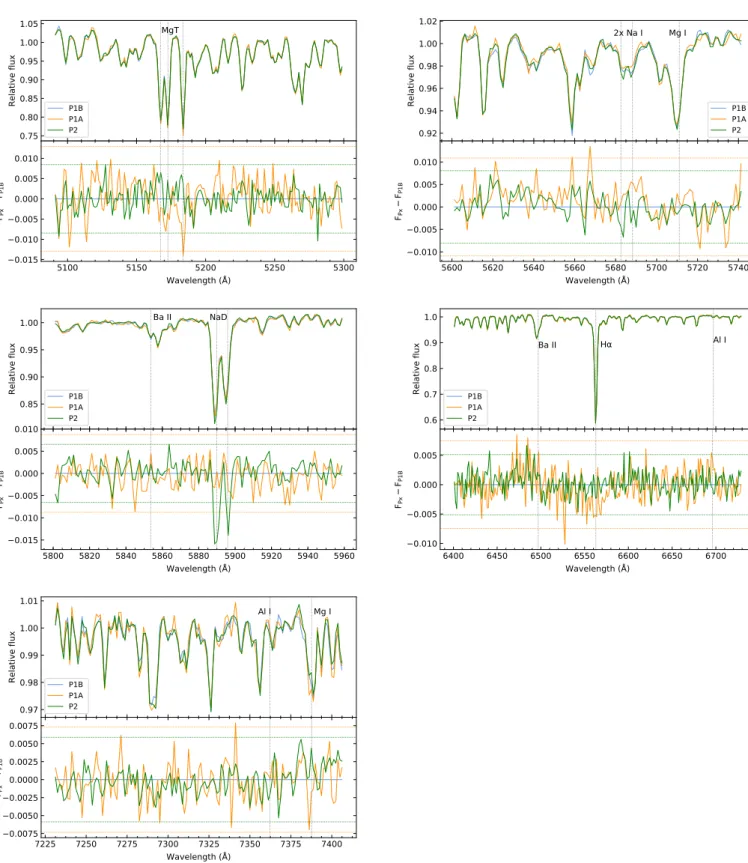
0.75 0.80 0.85 0.90 0.95 1.00 1.05 Relative flux MgT P1B P1A P2 5100 5150 5200 5250 5300 Wavelength (Å) 0.015 0.010 0.005 0.000 0.005 0.010 FPx FP1B 0.92 0.94 0.96 0.98 1.00 1.02 Relative flux Mg I 2x Na I P1B P1A P2 5600 5620 5640 5660 5680 5700 5720 5740 Wavelength (Å) 0.010 0.005 0.000 0.005 0.010 FPx FP1B 0.85 0.90 0.95 1.00 Relative flux NaD Ba II P1B P1A P2 5800 5820 5840 5860 5880 5900 5920 5940 5960 Wavelength (Å) 0.015 0.010 0.005 0.000 0.005 0.010 FPx FP1B 0.6 0.7 0.8 0.9 1.0 Relative flux Al I Ba II H P1B P1A P2 6400 6450 6500 6550 6600 6650 6700 Wavelength (Å) 0.010 0.005 0.000 0.005 FPx FP1B 0.97 0.98 0.99 1.00 1.01 Relative flux Al I Mg I P1B P1A P2 7225 7250 7275 7300 7325 7350 7375 7400 Wavelength (Å) 0.0075 0.0050 0.0025 0.0000 0.0025 0.0050 0.0075 FPx FP1B .
Fig. A.2.Comparisons between the spectra of the population A and B in NGC 2808. As a reference we also show the spectrum of P2. The residuals on the bottom panels are plotted as the difference between the flux of population 1A (or 2) and 1B (FPx– FP1B). The horizontal dotted lines represent the 3σvalue of the residuals.
0.92 0.94 0.96 0.98 1.00 1.02 Relative flux K I K I Mg I Mg I P1B P1A P2 7575 7600 7625 7650 7675 7700 7725 7750 Wavelength (Å) 0.010 0.005 0.000 0.005 0.010 FPx FP1B 0.95 0.96 0.97 0.98 0.99 1.00 1.01 Relative flux O I Al I Mg I P1B P1A P2 7740 7760 7780 7800 7820 7840 7860 Wavelength (Å) 0.005 0.000 0.005 0.010 FPx FP1B 0.6 0.7 0.8 0.9 1.0 Relative flux CaT Si I P1B P1A P2 8500 8550 8600 8650 8700 Wavelength (Å) 0.005 0.000 0.005 FPx FP1B 0.90 0.92 0.94 0.96 0.98 1.00 Relative flux Mg I Al I Mg I Si I P1B P1A P2 8700 8725 8750 8775 8800 8825 8850 8875 Wavelength (Å) 0.015 0.010 0.005 0.000 0.005 0.010 FPx FP1B

![Fig. 3. Cumulative distributions in T eff , log g, and [M/H] of the stars included in the four populations of NGC 2808](https://thumb-us.123doks.com/thumbv2/123dok_us/1439311.2692760/7.892.64.422.116.560/fig-cumulative-distributions-eff-stars-included-populations-ngc.webp)