W&M ScholarWorks
W&M ScholarWorks
Dissertations, Theses, and Masters Projects Theses, Dissertations, & Master Projects
Spring 2017
An Evaluation of the Vccs Developmental Math Redesign from A
An Evaluation of the Vccs Developmental Math Redesign from A
Faculty Perspective
Faculty Perspective
Michael Frank AdkinsCollege of William and Mary - School of Education, [email protected]
Follow this and additional works at: https://scholarworks.wm.edu/etd Part of the Education Commons
Recommended Citation Recommended Citation
Adkins, Michael Frank, "An Evaluation of the Vccs Developmental Math Redesign from A Faculty Perspective" (2017). Dissertations, Theses, and Masters Projects. Paper 1499449918.
http://doi.org/10.21220/W4ZT09
This Dissertation is brought to you for free and open access by the Theses, Dissertations, & Master Projects at W&M ScholarWorks. It has been accepted for inclusion in Dissertations, Theses, and Masters Projects by an authorized administrator of W&M ScholarWorks. For more information, please contact [email protected].
i
AN EVALUATION OF THE VCCS DEVELOPMENTAL MATH REDESIGN FROM A FACULTY PERSPECTIVE
A Dissertation Presented to
The Faculty of the School of Education The College of William and Mary in Virginia
In Partial Fulfillment
Of the Requirements for the Degree Doctorate of Education
By
Michael F. Adkins II May 2017
ii
AN EVALUATION OF THE VCCS DEVELOPMENTAL MATH REDESIGN FROM A FACULTY PERSPECTIVE
by Michael F. Adkins II Approved May 2017 by Pamela L. Eddy, Ph.D. Committee Chair Thomas J. Ward, Ph.D. Heather D. Wathington, Ph.D.
iii
TABLE OF CONTENTS
Acknowledgements ... vii
List of Tables ... viii
List of Figures ...x
Abstract ... xi
Half Title Page ... xiii
CHAPTER I: INTRODUCTION ...1
The Problem Statement ...2
Completion agenda ...3
Developmental math crisis ...4
Developmental math as a barrier to completion ...4
Focus on programs and interventions, not change ...5
Change ...5
VCCS Developmental Math Redesign ...8
Evaluation Questions ...9
Evaluation Framework ...10
Step one ...12
Step four ...12
Step five ...13
Purpose of the Study ...13
Significance...14
Overview of the Methodology ...15
Definition of Terms...15
Assumptions ...17
Delimitations ...18
Limitations ...19
Summary ...19
Overview of the Dissertation ...20
CHAPTER II: LITERATURE REVIEW ...21
Community Colleges ...22
Functionalist perspective ...23
Class-reproduction perspective ...24
Relative autonomy perspective ...25
Synthesis of perspectives ...26
Developmental Education ...29
Debate over developmental math...30
Developmental math courses are ineffective ...31
Critique ...32
Claim a ...33
Claim b ...34
Claim c ...34
Summary ...35
iv
Developmental math pipeline ...38
Developmental math interventions ...39
Categories of promising interventions ...40
Redesigned developmental math courses ...42
Summary ...42
VCCS Developmental Math Redesign ...43
The Developmental Education Task Force ...45
The Developmental Math Redesign Team ...46
The Developmental Math Curriculum Team ...47
Placement in MTE units...48
Developmental math courses ...49
Developmental Math Outcomes ...51
HB 1184 ...53
Summary ...54
Change Theory ...55
Kezar’s change theory summary ...55
Scientific management ...58
Evolutionary ...59
Political ...60
Social cognition ...61
Cultural ...62
Institutional and neo-institutional ...63
Summary ...64
Kotter’s change model ...65
Social cognition ...65
Political ...66
Scientific management ...66
Cultural ...66
Summary ...67
Logic Model of the Redesign ...67
Summary ...72
CHAPTER III: METHODOLOGY ...73
Context ...73 Program Description ...77 Participants ...77 Data Sources ...78 Data Collection ...80 Data Analysis ...82
Evaluation question one ...83
Evaluation question two ...83
Evaluation question three ...84
Evaluation question four ...84
Ethical Considerations ...86
Propriety ...86
v
Feasibility ...87
Accuracy ...87
Protection of human subjects ...87
The role of the researcher ...88
Design Issues ...88
Summary ...88
CHAPTER IV: RESULTS ...90
Sample...90
Survey Item’s Relationship to Kotter’s Model ...94
Evaluation Question One ...98
Model fit...102
Model reliability...103
Evaluation Question Two ...104
Factor structure ...111
Hybrid factors ...112
Urgency/Empowerment ...113
Evaluation Question Three ...114
Evaluation Question Four ...115
Summary ...119
CHAPTER V: EXECUTIVE SUMMARY ...122
Evaluation Question One ...123
Discussion of the results ...124
Implications for practice ...127
Future research ...129
Evaluation Question Two ...130
Discussion of the results ...130
Implications for practice ...133
Future Research ...135
Evaluation Question Three ...136
Discussion of the results ...136
Implications for practice ...140
Future Research ...140
Evaluation Question Four ...141
Discussion of the Results ...141
Implications for practice ...143
Future research ...144
Critique of the Research Study ...144
Sample...144
Methods...145
Execution ...145
Conclusion ...146
Appendix A: First Survey ...151
vi
Appendix C: Final Survey ...158
Appendix D: Email Sent to Faculty During Data Collection ...165
Appendix E: VCCS College Abbreviations and Full Names ...168
Appendix F: Permission to Use Copyrighted Material for Table 5 ...169
References ...172
vii
ACKNOWLEDGMENTS
I would like to thank the following people for their help and support while working on this dissertation.
Ruth Adkins – for your never ending love, encouragement, and support in completing my doctoral work even though it took longer than I thought.
Frankie and Cariann Adkins – for being my motivation to keep working even when I didn’t want to.
Dr. Betsy Harrison – for our talks about your doctoral experience, and your professional mentorship, insight, and friendship.
Dr. Pam Eddy – for the come to Jesus talks, your brilliance, invaluable feedback, consistent support, and expertise.
Dr. Tom Ward – for loving statistics and taking the time to talk with me about the fundamentals of the analysis.
Dr. Heather Wathington – for being a great teacher, and inspiring me to continue my education to the doctoral level.
Thank you all so much! Mike
viii
LIST OF TABLES
Table 1: Pre-2010 Developmental Math Redesign Literature ...36
Table 2: Post-Developmental Math Redesign Literature (2010-Present) ...37
Table 3: Timeline for the VCCS Developmental Math Redesign ...44
Table 4: Pre and Post-redesign Developmental Math Student Outcomes ...52
Table 5: Characteristics of the Six Schools of Thought related to Change ...57
Table 6: Alignment Between Kezar’s (2014) Schools of Thought and Kotter’s (2012) Model ...65
Table 7: Demographic Characteristics of the VCCS in 2009 and 2015 ...74
Table 8: Crosswalk Table: Alignment of Survey Statements and Questions with the Study’s Evaluation Questions ...82
Table 9: Overview of Data Analysis ...86
Table 10: Comparison of the Institutional Makeup of the Population Sample and Respondents ...92
Table 11: Demographic Breakdown by Gender, Employment Status, and Years of Teaching ...93
Table 12: Breakdown of Survey Questions and their Relationship to the Factors of Urgency, Communication, and Empowerment ...96
Table 13: CFA Model Fit Summary ...102
Table 14: CFA Model Fit Comparison ...102
ix
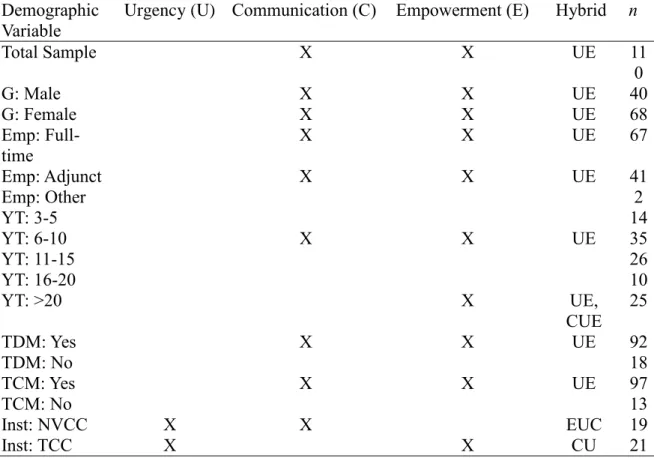
Table 16: Factor Structure and % of Variance Explained from Principal Axis Factor Analysis with Varimax Rotation by Demographic Variables ...106 Table 17: Summary of Findings from EFA Analysis ...111 Table 18: Comparison of Factor Means...115 Table 19: Results of Independent Samples T-test for Gender, Taught a Developmental
Math Course, and Taught a College Math Course ...117 Table 20: ANOVA Results for Employment Category and Years Taught by
Faculty ...118 Table 21: Post Hoc Analysis for Significant Between-Groups Results for Employment
Category ANOVA ...118 Table 22: Summary of Results in Chapter Four ...121
x
LIST OF FIGURES
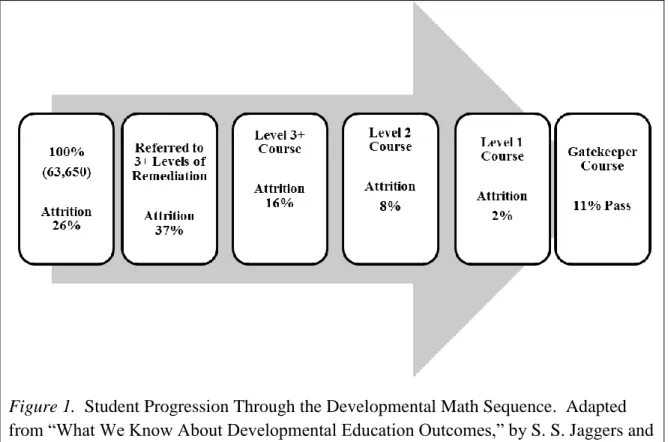
Figure 1: Student Progression Through the Developmental Math Sequence ...38
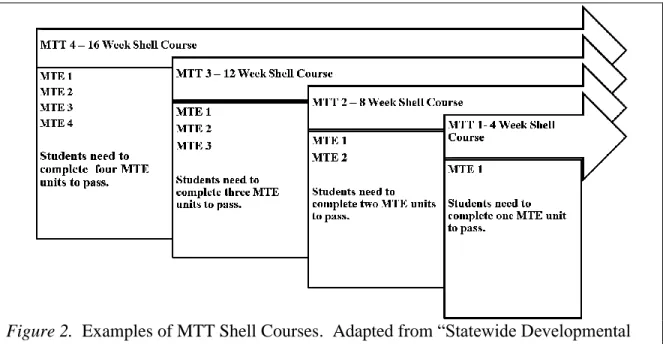
Figure 2: Examples of MTT Shell Courses ...51
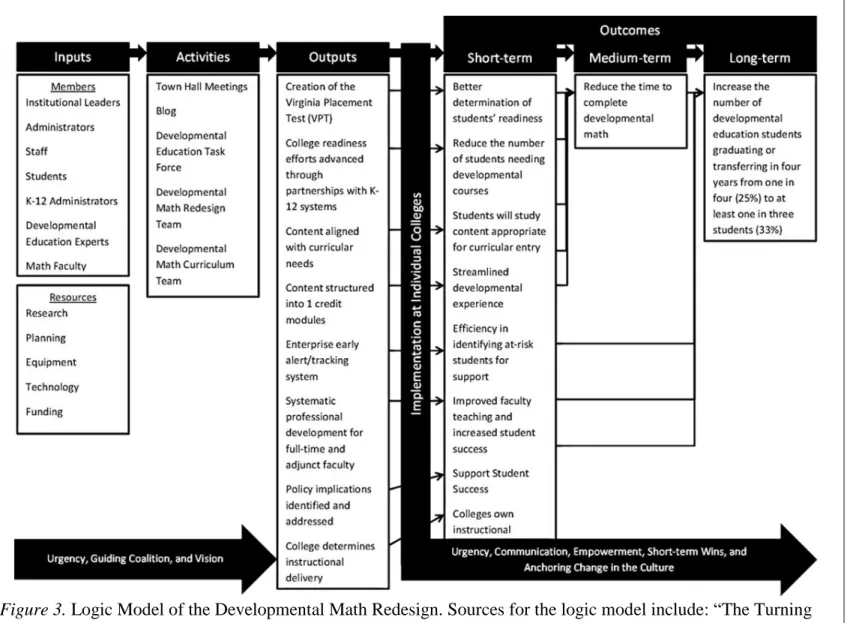
Figure 3: Logic Model of the Developmental Math Redesign ...70
Figure 4: Map of the Virginia Community College System ...76
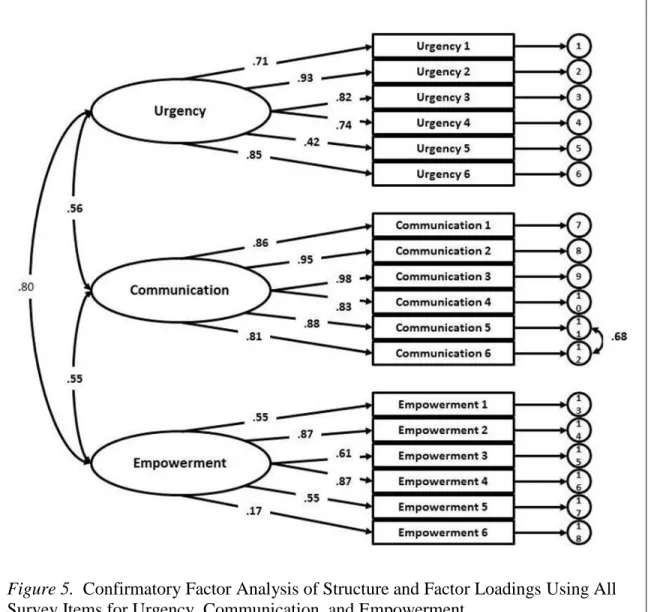
Figure 5: Confirmatory Factor Analysis of Structure and Factor Loadings Using All Survey Items for Urgency, Communication, and Empowerment ...100
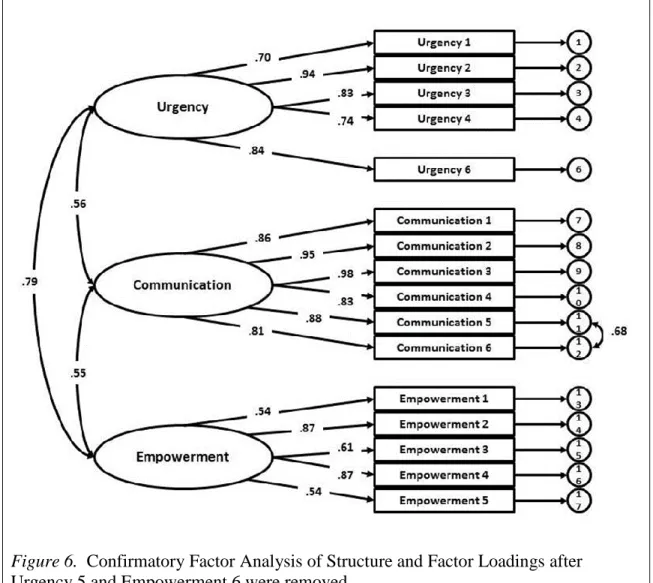
Figure 6: Confirmatory Factor Analysis of Structure and Factor Loadings after Urgency 5 and Empowerment 6 were removed ...101
xi
ABSTRACT
Community colleges face an environment that requires them to increasingly focus on completion while simultaneously maintaining open admissions (Sydow & Alfred, 2013). Developmental math courses are a linchpin in improving college completion because approximately 60% of community college students are placed into
developmental math courses, yet very few of those students make it through
developmental courses and on toward degree completion (Bailey, 2009; Developmental Math Redesign Team, 2010).
In 2009, the Virginia Community College System (VCCS) embarked on a system-wide redesign of developmental math courses (Developmental Education Task Force, 2009). However, such large-scale system change means challenges and previous experience highlights that approximately 50% – 80% of change initiatives fail to meet their goals (Black, 2013).
This study evaluated the change process used to implement the VCCS developmental math redesign. A uniquely created survey based on Kotter’s (2012) change model was used to determine if faculty observed sound change practices at their institutions during the redesign. Using confirmatory factor analysis, the findings suggest that faculty saw evidence of Kotter’s (2012) change model in the implementation of the redesign. There were differences in how faculty perceived the change processes based on different demographic characteristics.
xii
There was evidence that Kotter’s (2012) model was fully implemented in the redesign, and there were some significant differences in faculty perceptions of
Empowerment. This study concluded that positively framing the results of the redesign at the system level could have improved student outcomes and that it would be wise for colleges to assess the change processes they use.
xiii
AN EVALUATION OF THE VCCS DEVELOPMENTAL MATH REDESIGN FROM A FACULTY PERSPECTIVE
1
CHAPTER I: INTRODUCTION
Modern community colleges are forced to navigate multiple contradictory conditions. For example, accomplishing the goals of both access and completion create what Sydow and Alfred (2013) label the ultimate expression of paradox for community colleges. “In the short span of a decade, the interests of federal and state governments and foundations have coalesced to encourage a paradigm shift for community colleges from one emphasizing access to one emphasizing completion” (Sydow & Alfred, 2013, p. 52). This paradigm shift is significant because it is requiring community colleges to think about their mission differently and to change the way that they have historically operated. Instead of merely thinking of how to get students into college, institutions must now focus more on how to get students out of college. The goal of completion requires a different set of actions as a result.
The paradox of balancing access and completion is paralleled by the recent focus on developmental math. Almost two out of three community college students are unprepared for college-level math courses (Bailey, 2009; Jaggars, Hodara, Cho, & Xu, 2015). Underprepared students are routinely placed into developmental courses designed to help ready them for college-level math courses; yet, only a small number of those students make it through their required developmental sequences and into in a college-level math course (Bailey, 2009; Jaggers & Stacey, 2014). An even smaller number of developmental math students actually pass a college math course (Bailey, 2009; CCRC, 2014). According to Merseth (2011), “nowhere in the community college curriculum is
2
the failure rate of graver concern that the developmental mathematics courses” (p. 32). Community college leaders are increasingly pressured to grapple with the developmental math problem by external stakeholders such as state and federal governments and
foundations focused on improving student outcomes, particularly completion (Sydow & Alfred, 2013). Even though this paradigm shift should not be surprising because
completion rates in community colleges are historically low, it does pose new problems for institutions that traditionally focused on being accessible to students with low academic preparation (Bragg & Durham, 2012).
The Problem Statement
Historically, the community college’s open door mission targeted increased access to higher education for those with limited postsecondary options. Cohen and Brawer (2008) suggested U.S. community colleges’ focused on access because “the United States has been more dedicated to the belief that all individuals should have the opportunity to rise to their greatest potential. Accordingly, all barriers to individual development should be broken down” (p. 11). An emphasis on providing access to higher education has historical roots in the report of the Truman Commission, which in 1947 recommended that higher education should be more accessible and equitable (Gilbert & Heller, 2013).
Given the community colleges’ emphasis on open admissions policies, many students start their college career underprepared for college work. Developmental education programs have historically been used to ramp up underprepared students’ preparation for college coursework since colonial times (Attewell, Lavin, Domina, & Levey, 2006). Developmental education is critical for making community colleges
3
accessible to students who have historically been excluded from higher education (Cohen & Brawer, 2008). Indeed, community colleges enroll the greatest percentage of minority students, low-income students, and returning adult students of all the types of institutions of higher education (Mullin, 2012; NCES, 2015a). Developmental education has been at the center of a national debate concerning community colleges’ need to change.
However, there is little empirical evidence to guide leaders in choosing interventions that work best to help achieve student success, particularly in improving completion and a college degree attainment (Bailey, 2009; Rutschow & Schneider, 2011).
Completion agenda. Stakeholder perceptions about the importance of access to
higher education are changing as state funding for education is becoming scarce (F. C. Fowler, 2013). Stakeholders are now more concerned about holding colleges more accountable in how their use of public funds translates to student outcomes (Cohen & Brawer, 2008; F. C. Fowler, 2013). Specifically, many programs and associations, including Achieving the Dream (2016), American Association of Community Colleges (AACC) (McPhail & AACC, 2011), Bill and Melinda Gates Foundation (2010), Complete College America (2014), and the Lumina Foundation (Matthews, 2015), are encouraging community colleges to focus on improving degree completion while simultaneously providing access to all.
State and federal governments have also focused on completion because of the tangible benefits associated with degree attainment; projections of future workforce needs; and the desire to improve international competitiveness (Baum, Ma, & Payea, 2013; Matthews, 2015; Sydow & Alfred, 2013; U.S. Department of Education [USDoE], 2006; White House, 2010). College completion affects our national prosperity and
4
should be an important area of focus for community colleges because they serve students who have traditionally been excluded from reaping the economic and personal benefits associated with completion (Mullin, 2012; USDoE, 2006). Indeed, many states are creating Performance Based Funding mechanism that ties institutional funding to completion targets (Freidel, Thornton, D’Amico, & Katsinas, 2013).
Developmental math crisis. The focus on completion from stakeholders and
pundits has drawn attention to the deeper issues inherent in developmental education programs. Community college students are typically less academically prepared, which results in the need for developmental coursework. However, many researchers contend that enrollment in developmental math courses negatively impacts students’ completion (Bailey, 2009; Martorell & McFarlin, 2010). Almost 60% of community college students are referred to developmental math courses (Bailey, 2009; Bailey, Jeong, & Cho; 2010). Yet, only 27% of students who took developmental courses passed a college math course, while 72% of the students who chose to skip the developmental courses passed a
gatekeeper college math course (Bailey et al., 2010). The data suggest that current developmental math courses are not helping students succeed in making progress towards completion as intended (Bailey, 2009; Jaggers & Stacey, 2014). What remains unknown is if different approaches to developmental math result in significantly different success rates (Rutschow & Schneider, 2011).
Developmental math as a barrier to completion. Because so many students are placed into developmental math and fail to make it through the developmental sequence, researchers have suggested that the traditional developmental math sequence is a
5
Developmental coursework consumes students’ time and financial aid while providing few, if any, benefits. Failing to complete developmental coursework can jeopardize a student’s financial aid eligibility, and taking the courses wastes finite Pell Grant money.
For community colleges to maintain their open access mission and simultaneously improve completion, they will have to make significant changes in the way that they place and move students through the developmental math sequence to ensure that
students gain an understanding of the math content they need and maintain their financial aid.
Focus on programs and interventions, not change. Even though researchers have focused their attention on deficiencies plaguing developmental math sequences (Bailey, 2009; Bailey et al., 2010; Hern, 2012), little, if any, of the discussion in the literature addresses how college and system leaders should go about implementing programmatic change concerning developmental math. Kezar (2014) observed that leaders, and in this case researchers as well, focus on interventions while ignoring the change process. This singular focus on interventions is problematic because most change initiatives fail (Black, 2013). If community colleges are going to make changes in
developmental math that will positively impact student outcomes, stakeholders within the organizations will need to be cognizant of the change process, and intentionally manage it to bring about expected outcomes (Kezar, 2014; Kotter, 2012).
Change. The need for organizational change to improve institutional
effectiveness and the difficulties associated with it are not specific to community
colleges. All organizations have to adapt and change to survive and succeed in fulfilling their missions (Drucker, 1994; Kotter, 2012). The need to change can often be attributed
6
to a shift in an organization’s relationship to its external or internal environment
(Drucker, 1994; Kezar, 2014; Kotter, 2012), which changes the organization’s context for operation. Often these changes are necessary because of organizational crisis. As
Drucker (1994) argued,
The assumptions on which the organization has been built and is being run no longer fit reality…These are the assumptions that shape any organization’s behavior, dictate its decisions about what to do and what not to do, and define what the organization considers meaningful results. (pp. 95 – 96)
Drucker (1994) labeled these assumptions an organization’s theory of the business (p. 96, emphasis in the original text). When the organization’s theory of the business no longer
fits reality, it compromises the organization’s ability to fulfill its mission.
Kotter (2012) predicted that more organizations will be forced to revise their theory of the business and change as they are “pushed to reduce costs, improve the quality of [their] products and services, locate new opportunities for growth, and increase [their] productivity” (p. 3). The need for organizations to change in response to
macroeconomic forces will only intensify over the next few decades. Thus, given the prospects of continuous organizational change (Black, 2013; Eckel, Hill, & Green, 1998; Kezar 2014; Kotter, 2012), the ability to change will become increasingly important to organizations’ abilities to fulfill their missions and meet their stakeholders’ needs. This is the exact situation in which community colleges find themselves. Changes in
stakeholder expectations emphasizing completion—while still expecting access—force community college leaders to rethink their theory of the business. Reforming
7
The problem to date is that the research focused on change clearly shows that organizations are notoriously bad at making intentional changes (Black, 2013; Kotter, 2012). Currently, between 50% and 80% of change efforts fail (Black, 2013; Kotter, 2012). According to Black (2013), the fact that so many change initiatives fail is important to note because:
If the failure rate were 30 percent, we might attribute it to the failings of less motivated and skilled managers. But at 50 – 80 percent, this means that there are many motivated, skilled and otherwise successful leaders who are nonetheless falling short of their organizational change objectives. (“Failure Rate,” para. 1) Thus, even effective leaders fail to successfully institute change the majority of the time even when there is a compelling need. What we do know is that successful change initiatives “tend to be associated with a multistep process that creates power and motivation sufficient to overwhelm all sources of [organizational] inertia…[and] this process is never employed effectively unless it is driven by high quality leadership” (Kotter, 2012, p. 21).
So why do so many change initiatives fail? Change efforts fail to create enough power and motivation to overcome organizational inertia. Eckel, Green, Hill, and Mallon (1999b) suggested that this is because the change process is hard to comprehend and manage. Kezar (2014) further suggested that leaders fail to make significant changes because they focus their attention on interventions and programs; they emphasize what needs to be changed. However, these same leaders often ignore the change process; they ignore how they are going to make the needed change happen, or they use oversimplified and ineffective models of change, which are unable to overcome inertia. One example
8
Kezar (2014) offered is that leaders often assume that people will change simply because they are told, or because they are provided with evidence that change is necessary. In reality, people rarely change as a result of a rational argument (Kezar, 2014; Kotter, 2012). Thus, for community colleges to implement successful change, leaders will need to focus on the change process, use effective theories based on research, and find
innovative ways to gather feedback to tweak their change processes when necessary, because organizational change is complex and never straight forward (Black, 2013; Eckel, Hill, & Green, 1998; Fullan, 2001; Kezar, 2014; Kotter, 2012).
Critical to the change process is the concept of double-loop learning; here, leaders put processes in place to take a second look at how an organization is operating and question underlying assumptions (Morgan, 2006). Evaluating the change process gives leaders and change agents a second look to better understand if the change process is unfolding how they intended.
As organizations, community colleges are no strangers to change. Throughout their history, they have continuously added to their mission as they strive to meet the needs of their communities and increasingly provide more educational opportunities for their students. However, these changes have often been incremental and focused more on providing access to educational opportunities. Now, community colleges are currently facing a changing environment in which shifting stakeholder expectations demand exponential change (F. C. Fowler, 2013; Sydow & Alfred, 2013).
VCCS developmental math redesign. Starting in 2009, the Virginia
Community College System (VCCS) initiated a developmental math redesign as part of its strategic planning process to develop the system’s strategic plan, Achieve 2015. The
9
redesign was initiated with the formation of The Developmental Education Task Force (DETF), which looked at data concerning developmental mathematics across the VCCS. The DETF found that approximately 52% of the new program placed students were placed in developmental math courses and that approximately 36% of the students in transfer curriculums passed a gatekeeper math course. The DETF determined there was a need to redesign developmental mathematics, which resulted in the creation of the
Developmental Mathematics Redesign Team (DMRT). The DMRT was formed to handle the specifics of redesigning developmental mathematics. Recommendations from the DMRT resulted in the system-wide implementation of redesigned developmental math courses in spring 2012.
Evaluation Questions
The evaluation questions guiding this study include:
Evaluation question 1: What factors do development math faculty perceive as critical in the redesign of the math curriculum?
Evaluation question 2: How do these factors differ by demographic characteristics such as:
gender;
employment category;
years of teaching experience; and,
if the faculty member has taught a college-level math course?
Evaluation question 3: What are developmental math faculty perceptions of the change process during the redesign regarding the role of Urgency, Communication, and Empowerment?
10
Evaluation question 4: How do developmental math faculty perceptions of the role of Urgency, Communication, and Empowerment differ by demographic
characteristics such as: gender;
employment category; institution;
years of teaching experience;
if the faculty member had taught a developmental math course before the redesign;
and if the faculty member has taught a college-level math course? It is important to note that this study does not question whether change has occurred during the VCCS developmental math redesign. There have been significant changes in the way that students are placed due to the creation of the Virginia Placement Test (VPT), and the structure and content of developmental math courses. Instead, this study seeks to understand math faculty perceptions of the change process, as they are responsible for implementing the changes created at a system level. Specifically, the survey addresses math faculty opinions regarding the need to change, opinions of the Communication used during the implementation of the developmental math redesign, and opinions concerning whether faculty felt empowered to implement redesigned
developmental math courses.
Evaluation Framework
This study uses a sub-set of Kotter’s (2012) eight-step change framework to understand faculty opinions of the change process used in the developmental math
11
redesign. Kotter developed his framework using data collected in studying hundreds of organizations, the majority of these in the business sector, involved in intentional change efforts. Like Black (2013), Kotter (2012) determined that within his sample of
organizations, the majority of change efforts fail. The eight steps of Kotter’s (2012) framework represent what he determined to be the steps that successful organizations engaged in to make organizational changes successful. Kotter’s steps include:
1. Establishing a sense of Urgency; 2. Creating a guiding coalition; 3. Developing a vision and strategy; 4. Communicating the change vision;
5. Empowering employees for broad-based action; 6. Generating short-term wins;
7. Consolidating gains and producing more change; 8. Anchoring new approaches in the culture.
Kotter argues that all steps are important for successful change to occur. Kotter’s (2012) change framework was chosen as this study’s evaluation framework because its linear step approach best aligned with the overall process used by the VCCS during the redesign. However, this study is focused on only part of that overall change process, specifically the perceptions of math faculty during a specific time period. The survey instrument used in this study focused only on steps one (Urgency), four
(Communication), and five (Empowerment) because, while the overall change process looks most like Kotter’s (2012) model, faculty would have only participated in steps one, four, and five.
12
Step one. The intention of the first step in the model is to make sure that Urgency
is high amongst a large enough group of people (Kotter suggested 75% or higher) and that complacency is low. Urgency is important because when change agents do not feel there is a sense of Urgency they “will find a thousand ingenious ways to withhold cooperation from a process that they sincerely think is unnecessary or wrongheaded” (Kotter, 2012, p. 38). Understanding more about the level of Urgency felt by math faculty regarding the redesign provides important information about the potential success of the change. For example, if only a small portion of the math faculty felt a sense of Urgency, Kotter (2012) would argue that the change process rested on a weak foundation. Kotter (2012) believes that the majority of change efforts fail before they even get started because there is not a great enough sense of Urgency. Kotter’s (2012) step one—
establishing a sense of Urgency—was used to better understand faculty perception concerning the need to redesign developmental math.
Step four. Kotter’s (2012) step four – communicating the change vision –
focuses on how Communication can impact organizational members’ actions because the power of a change vision is unleashed when the majority of participants have a common knowledge of the goals and direction of the change initiative. In Kotter’s (2012) model, Communication is multifaceted and often overlooked in the change process. Good Communication is simple, repeated using multiple media, modeled by leader’s actions, and two-way within the organization (Kotter, 2012). For the current study, this step will be used to better understand faculty opinions of the Communication they received during the redesign. Communication is key to the success of any change initiative, and if good practices concerning Communication are not used, the success of the change initiative
13
can be negatively impacted. It is important for change leaders at the VCCS to understand how faculty perceived the Communication they received regarding the developmental math redesign and to determine if the Communication strategies are sufficient to enact change in student outcomes.
Step five. According to Kotter (2012), “the purpose of step five is to empower a
broad base of people to take action by removing as many barriers to the change vision as possible...Four [obstacles] can be particularly important: structures, skills, systems, and supervisors” (p. 106). So, empowering employees for broad-based action is really focused on how change agents share power with others in the organization and how faculty are supported in ways that allow them to actually change operations and practices. For this research, knowing how faculty perceives the level of power they have to make change can highlight ways to leverage change and can identify things that faculty perceive as barriers in their ability to make needed changes to improve courses for students. Step five is intended to indicate whether faculty feel they have the skills to implement redesigned developmental math courses and whether faculty think that leaders and supervisors within the organization support the change initiative.
Purpose of the Study
The purpose of this study is to conduct an evaluation of faculty perceptions of the change process used for the VCCS developmental math redesign. Evaluating faculty perspectives of the change process is vital because faculty makes up the operating core (Mintzberg, 1980) of the developmental math enterprise in the sense that they physically implemented the developmental math redesign and are responsible for the majority of the work associated with developmental education. The evaluation was conducted by using a
14
survey instrument based on Kotter’s (2012) change framework, which will be
administered to Virginia community college math faculty in order to better understand their opinions on the change process. This research study also tested the reliability and validity of the survey instrument.
Significance
This study has the potential to help community colleges and community college systems focus on the change process they use to rethink and redesign their developmental math offerings. Mechanisms such as the survey instrument in this study allow
organizations to participate in double loop learning by providing data for implementers to have and reflect on. Reflecting on the data provides implementers the chance to change incorrect assumptions about the change process and improve it (Morgan, 2006). Leaders and stakeholders involved in the change effort need to understand how the change process is working in order to make adjustments to improve the implementation of developmental math reforms.
Goudas and Boylan (2012) argued that developmental interventions work
differently at different institutions based on the way that they are implemented. Because implementation impacts developmental math student outcomes, all stakeholders who are committed to improving community college student completion in developmental math courses, college math courses, and degrees and certificates have a vested interest in understanding, assessing, and improving the college’s change process. When considering that lasting change may take as long as 10 years, as Kotter (2012) suggests, focusing on planning, evaluating, and improving the change process is important for both those
15
currently redesigning and preparing to redesign their developmental offerings. The instrument developed during this study will help leaders accomplish those tasks. Overview of Methodology
This study utilized a self-created survey instrument based on Kotter’s (2012) change steps one (Urgency), four (Communication), and five (Empowerment). The unit of analysis was individual VCCS math faculty. I used quantitative methods to evaluate the results. Descriptive mean Likert scores were used to determine average faculty responses to individual survey statements. Exploratory factor analysis was used to make sure that the questions used in the survey cluster together and represent each of Kotter’s (2012) steps which they were intended to represent. ANOVAs were completed to determine if there are differences between respondents based on demographic
characteristics. The survey went through two rounds of feedback from expert panels to improve the wording and face validity of the instrument.
Definition of Terms
Change: includes two different levels. First-order change “involves minor
improvements” (Kezar, 2014, p. 49). First-order change is also referred to as incremental change, whereas second-order change includes when “underlying values, assumptions, structures, processes, and culture need to be addressed for change to happen” (Kezar, 2014, p. 49). Second-order change is also referred to as transformational change.
Change Agent: the primary implementer of the change initiative. Change agent and faculty is used interchangeably within this study.
16
A college-level math course(work): math course(work) intended to transfer to a four-year institution and meet the math requirements for a Bachelor of Arts or Science degree.
Community College: “any institutions regionally accredited to award the associate
in arts or the associate in science as its highest degree” (Cohen & Brawer, 2008, p. 5).
Completion: when a student finishes a college degree or certificate.
Developmental math course(work): course(work) designed to prepare a developmental math student for college-level math coursework.
Developmental math student: a student who is placed into a developmental math course based on initial placement test scores.
Exit Points: any point at which a student can exit the developmental math sequence. For example, students starting two levels below college math or English face five exit points before completing the college-level course. They must 1) pass the first course, 2) choose to enroll in the next course, 3) pass the second course, 4) choose to enroll in the college-level course, and 5) pass that course (Hern, 2012, p. 61).
Frame: “is a mental model [or map] – a set of ideas and assumptions – that you
carry in your head to help you understand and negotiate a particular territory” (Bolman & Deal, 2008, p. 11).
Operating Core: “includes all those employees who themselves produce the basic
products and services of the organization, or directly support their production” (Mintzberg, 1980, p. 323).
Sequence: “a process that begins with initial assessment and referral to
17
course that in principle completes the student’s preparation for college-level studies” (Bailey et al., 2010, p. 1).
Stakeholder(s): “any person, group, or organization that can place a claim on…[a community college’s] attention, resources, or output, or is affected by that output” (Bryson, 2011, p. 48).
System: also referred to as community college system or state-wide system describes the organization and governance structure of community colleges. All 23 colleges in the VCCS are part of the same system led by a chancellor. Even though the system office allows colleges within the VCCS to generally operate autonomously, the system office does mandate certain activities and set certain policies for all colleges in the system. All colleges in the VCCS were mandated to implement the redesigned
developmental math courses.
Theory of the business: “Assumptions that shape any organization's behavior, dictate its decisions about what to do and what not to do, and define what the
organization considers meaningful results” (Drucker, 1994, pp. 95 – 96). Assumptions
There are a number of assumptions inherent in this study. The main assumption is that the three steps (Urgency, Communication, and Empowerment) from Kotter’s (2012) model can best help to understand faculty perspectives of the change process and evaluate it. One can change structures, programs, curriculum, and reporting lines, but for change agents to effectively implement a change initiative they need to believe that there is a compelling need to make the change, receive constant effective Communication regarding the direction and purpose of the change, and be empowered to do what is
18
required of them to implement the changes. In essence, changing an organization is tied directly to changing individuals’ mental maps and the way that they make sense of the problem being addressed and the proposed solution (Senge, 1990). Since the VCCS used a change process that closely lined up with Kotter’s (2012) model, this study also
assumes that the VCCS’s planned change process was sound. Linked with the idea that changing individuals is necessary for organizations to create second-order change (Kezar, 2014) is the assumption that change agents’ opinions of the change process are important indicators for determining whether a change process is effective. So while in practice it appears that the VCCS used a sound change process, the real question is if faculty perceived it that way.
Delimitations
This study is specifically delimited to focusing on understanding the perspectives of full and part-time developmental math faculty members currently employed by the VCCS who taught anytime from Fall 2011 to the Fall 2013 semesters. There are two main reasons for focusing on developmental math. First, more students test into developmental math and fewer make it through the developmental math sequence compared to developmental English (Bailey et al., 2010). Second, developmental math courses were the first to be redesigned in Virginia’s developmental education redesign.
The reason for exclusively surveying math faculty is that they are the primary implementers of redesigned developmental math courses. They are the operating core of developmental math education, which means they are the primary doers of the work and in this case the primary change agents (Mintzberg, 1980). Focusing specifically on the
19
faculty in Virginia provides some continuity in the study because states use different change processes to undergo their developmental math redesigns.
Limitations
One limitation of focusing on including only math faculty is that it eliminates many different stakeholders who have a vested interest in and perspectives about the developmental math redesign. Virginia community colleges are part of a fairly tightly coupled system (Weick, 1976), so observations of the change process within Virginia will not necessarily translate to states without community college systems or with loosely coupled systems.
Another limitation is the historical nature of this study, the primary activity involving the implementation of the developmental math redesign happened between the start of the Fall 2011 Semester and the end of the Fall 2013 Semesters. Because time has elapsed since the beginning of the redesign efforts, faculty observations and sensemaking may be different now that faculty have had time to reflect on the process (Weick, 1995). Retroactive sensemaking is a natural part of processes in which individuals make sense of new changes.
Summary
Change is difficult, and in many instances organizations fail to make the changes that they need (Kezar, 2014; Kotter, 2012). Community colleges are currently being called on by a multitude of stakeholders to change their theory of the business by
improving college completion (Sydow & Alfred, 2014). Community colleges’ success in meeting this challenge is directly related to their ability to move more students through the developmental sequence and college-level math.
20
Too many students are excluded from earning college credentials because developmental math courses are failing to meet their needs. A number of community colleges and community college systems have decided to try and redesign their developmental math programs, however, those organizations are more focused on implementing specific interventions and programs rather examining the change process they use to implement their developmental math redesigns. This study used a survey specifically developed for this study, based on particular steps of Kotter’s (2012) change process, which was used to evaluate the change processes used during developmental math redesigns. The results of this evaluation will allow system leaders to understand how the change process was interpreted and implemented by those directly charged with making changes to developmental math programs.
Overview of the Dissertation
Chapter II includes a detailed review of the literature concerning developmental mathematics redesign initiatives, the process and curriculum used by the VCCS, and an overview of the literature on change. ChapterIII covers the study’s methods in a more comprehensive manner. Chapter IV reviews the findings, and finally, chapter V includes the discussion and conclusion of the study.
21
CHAPTER II: LITERATURE REVIEW
Studying change within the Virginia Community College System’s (VCCS) Developmental Math Redesign requires an understanding of the community college context. Specifically, it is important to review the various theoretical lenses that
researchers have used to understand how these institutions operate, and the multiple often contradictory roles community colleges have played in the history and structure of U.S. higher education. The role that community colleges play in the structure of higher education provides context for understanding how developmental math courses provide access to higher education
The review of the developmental education literature focuses on developmental education in general, and math in particular. The history, rationale, current research, and divergent opinions concerning developmental math provide evidence that there is a gap in the literature regarding the role of the change process in developmental math reform. Researchers have focused on looking at what needs to change in developmental math, but not how colleges need to implement change. A historical account of the process used during the VCCS Developmental Math Redesign is provided to add context for
understanding change at the system level, the goals of the redesign, and what individual colleges were expected to do in implementing redesigned developmental math courses. Reviewing the change literature presents an overview of change theories and introduces Kotter’s (2012) change model in more detail. I argue that the steps in Kotter’s (2012) model appropriately represent the logic used to guide the activities of the redesign.
22 Community Colleges
Community colleges are a vital part of the U.S. system of higher education. During the 2012 -2013 academic year, public 2-year institutions enrolled 10,128,642 students compared to public 4-year institutions, which enrolled 9,677,077 undergraduate students that equate to 51% of the students enrolled in public higher education (NCES, 2015b). Community colleges are the primary access point to public higher education for students in the United States due to their low cost and location in communities
throughout the nation that provides ease of attending college. This trend of access
persists in Virginia as well with 281,976 students attending one of the 23 public two-year colleges in the VCCS, compared to the 253,359 students attending the state’s public four-year institutions. Virginia community colleges serve more students across the
commonwealth than any other type of post-secondary institution (NCES, 2015b). In general, community colleges serve a greater portion of students with risk factors such as minority status, low-income, and first-generation students (Mullin, 2012; NCES, 2015a).
The creation and expansion of the American community college movement is a phenomenon that has had a lasting impact on the structure and ethos of the American higher education system (Witt, Wattenbarger, Gollattscheck, & Suppiger, 1994). On one hand, community colleges have made more room in higher education for students that have traditionally been excluded (Dougherty, 1988; Witt et al., 1994). Without community colleges more that 10 million students might not have access to a college education. Community colleges and their proponents have championed educational equality and the importance of providing all a chance at social and economic mobility through college access, as the Truman Commission recommended (Cohen & Brawer,
23
2008; Witt et al., 1994). Key stakeholders such as community members, state
government officials, and business leaders were so convinced that community colleges would add value to local communities that at the peak of their expansion in the 1960s approximately one new community college was founded each week (Witt et al., 1994).
On the other hand, though community colleges have provided greater access to higher education, there are researchers who argue they do not provide economic and social mobility. In the community college literature, there are three distinct schools of thought concerning community colleges. These different schools of thought or
perspectives include differing interpretations of the history and motivation behind the community college movement and make different claims about the outcomes and social implications of community colleges. These perspectives include functionalism, class-reproduction, and relative autonomy (Dougherty, 1988).
Functionalist perspective. The functionalist perspective regarding the role of
community colleges focuses on the way these institutions operate within the context of higher education. In the functionalist view, community colleges provide the economy with skilled labor and individuals with social mobility (Dougherty, 1988). According to Dougherty (1988):
Most commentators have taken a functionalist view of the community college, applauding it as the product of a broad social movement to meet the fundamental need of society for expanded higher education opportunity and labor training for the economy. They have noted approvingly the finding that community colleges have become a crucial port of entry into higher education for working-class and nonwhite students. (pp. 351-352)
24
According to the current enrollment data, this assessment of the role of community colleges is true; more students enter college through public two-year colleges than any other type of post-secondary institution. There is historical evidence that the community college expansion was part of a broad social movement (Witt et al., 1994). Not only have more students accessed higher education through community colleges than any other type of institution (NCES, 2015b), the colleges have also provided educational opportunities for students that were traditionally excluded from higher education (Brint, 2003;
Dougherty, 1988; Mullin, 2012). According to the functionalist analysis, as long as community colleges provide access as a means to achieving positive student outcomes, such as social and economic mobility, they are working as intended and making a positive contribution to society. Others offer a different perspective.
Class-reproduction perspective. Over the last three decades, the positive view
of community colleges has been questioned by a small number of researchers
(Dougherty, 1988). These researchers argue that community college expansion has been encouraged by elites that wish to reproduce existing class relations (Beach, 2009; Brint, 2003; Brint & Karabel, 1989; Dougherty, 1988). These researchers argue that
community colleges’ success in providing broad access to higher education and attracting low-income and minority students ultimately has a negative impact on society
(Dougherty, 1988). The negative impact is that community colleges divert these students away from earning 4-year degrees, which would provide greater economic benefits. Community colleges divert students by first attracting students away from 4-year institutions and then tracking them into educational pathways that do not lead to a bachelor’s degree. Clark (1960) labeled this process “cooling out” because students’
25
educational expectations and goals are “cooled” as they are tracked into vocational programs by counselors and advisors (p. 569).
Brint and Karabel (1989) draw many of their conclusions from data that suggests 70% of community college entrants have a goal of earning a 4-year credential, but only about 15% actually accomplish it (Brint, 2003). They infer and provide evidence that community colleges keep students from reaching their educational goals by diverting them into educational pathways, such as vocational programs, that do not lead toward a 4-year degree. According to Brint and Karabel (1989), community colleges hinder social and economic mobility in support of the current social structure by taking those on the lowest rungs of the social ladder and keeping them there (Brint, 2003; Dougherty, 1988). This perspective argues that community colleges are not living up to their espoused missions because they are not helping students achieve the desired outcome of earning a college degree, but rather keeping them from it.
Relative autonomy perspective. Dougherty (1988) suggested that both the
functionalism and class reproduction arguments are flawed. Neither a broad social movement, as functionalism argues, nor elites’ interest in class reproduction, as class reproduction argues, can completely explain the rapid and widespread expansion of the community colleges throughout the United States. Dougherty (1988) argued instead that community colleges spread because government officials have relative autonomy over many of the solutions they choose to provide to meet stakeholder needs. Dougherty (1988) suggested that the structure of community colleges aligned with education
administrators’, politicians’, and key stakeholders’ interests. This perspective takes a less dualistic view of community colleges’ as either good or bad. According to Dougherty
26
(1988), the origins of the community college and its expansion should be seen as value neutral. The community college was simply an organizational solution that aligned with individuals’ interests.
Synthesis of perspectives. One plausible explanation for the co-existence of the
three perspectives is that they emphasize different institutional realities occurring in practice simultaneously. Witt and colleagues (1994) suggested that the broad social movement which functionalists attribute to community college expansion was actually the synthesis of two different movements. One was the populist movement that emphasized the need for broad access to higher education to provide citizens
opportunities for economic and social mobility; the other was an elitist movement, which wished to keep unprepared students from entering universities (Witt et al., 1994).
Populists saw community colleges as a means to meeting their political agenda by providing access, and elites saw community colleges as a means to reach their goals by providing a buffer to weed out students who were unprepared for university studies (Witt et al., 1994). In their inception, community colleges were intended to meet the needs of these seemingly contradictory movements by simultaneously extending and limiting access to higher education. This confirms the narrative of both functionalism and class reproduction. Sydow and Alfred (2014) explained that there are numerous paradoxes, or incongruous states, that exist within community colleges. The functionalist and class-reproduction schools of thought highlight one of those paradoxes.
Dougherty’s (1988) account of relative autonomy of community colleges adds richness to our understanding of these institutions by identifying key stakeholders in the creation and expansion of community colleges, while at the same time highlighting
27
another paradox that Sydow and Alfred (2014) identified. Namely, community colleges often try to be everything for everyone (Cohen & Brawer, 2008; Dougherty & Townsend, 2006). This broad view of the mission was desirable for state government officials that saw community colleges as an institution that aligned with many stakeholders needs and their own policy goals (Dougherty, 1988; F. C. Fowler, 2013). However, community colleges are rarely provided the funding necessary to fulfill their multiple functional missions well (Sydow & Alfred, 2014).
All three perspectives highlight the differing views on community colleges and the many voices that also appear in the recent discussion of development math. If community colleges are going to continue to provide access to all, as proponents of functionalism suggest, community colleges are going to needed to provide developmental math instruction to provide access for students who are academically underprepared in math (Goudas & Boylan, 2012). Yet, if community colleges are going to improve outcomes for students rather than diverting them away from four-year institutions, they are going to have to improve the outcomes of students in developmental math courses, as class-reproduction scholars suggest (Bailey, 2009). Lastly, community colleges need to focus on stakeholders’ wants and needs if they are going to stay relevant, as Dougherty’s (1988) relative autonomy emphasizes. All of the stakeholders identified by each school of thought have a relevant interest in the issues facing community colleges today (Sydow & Alfred, 2014), but according to Dougherty and Townsend (2006) community colleges are:
Rooted in the essential contradictions of U.S. society. This is a society deeply divided by class, race, gender, and other factors. These divisions show up in the
28
community college in debates about preserving open access while maintaining academic excellence and in conversations about meeting students’ needs for broad-based occupational skills and employers’ desires for skills more narrowly tailored to their particular interests. These contradictions have divided the community college almost from its inception, and will likely continue to do so. (p. 10)
These deep divides and contradictions also rear their head in the developmental mathematics literature (Bailey, Jaggers, & Scott-Clayton, 2013; Goudas & Boylan, 2012, 2013). For the purposes of this study, I am inclined to agree with scholars who argue that there is a crisis because developmental math courses are not producing the desired
outcomes; this line of reasoning necessitates a drastic change in developmental math offerings. I agree with this perspective because the research supports it; the data discussed later in this literature review shows how the majority of outcomes for developmental math are either negative or null effects.
Researchers argue that we are in the midst of a developmental math crisis (Levin & Calcagno, 2007). Boatman (2010) suggested improving math literacy is the most important factor in improving the nation’s global competitiveness. Those noting the crisis in developmental math are aligned with the class reproduction school of thought; the argument here is that by focusing on outcomes in conjunction with attention to access requires drastic changes in the way that developmental math courses are designed and taught. Others argue that evidence of developmental math crisis is tentative at best and that empirical data shows mixed rather than definitive results (Goudas & Boylan, 2012). These researchers are aligned with the functionalist school of thought and argue that
29
developmental education is working as intended by providing access to college math and enabling developmental math students to fair as well in college math courses as students that did not take college math (Goudas & Boylan, 2012). The following section reviews in more detail literature related to community college developmental education.
Developmental Education
Historically, developmental coursework was used as an intervention for students with weak academic skills, in fact, “remedial courses have been a regular part of the curriculum at Ivy League universities and other colleges from the Colonial period to the present” (Attewell et al., 2006, p. 888). Researchers have even written articles about colleges’ attempts to rectify students’ academic weaknesses since the mid-nineteenth century (Rutschow & Schneider, 2011). The important point is developmental education is not a new practice or a new topic of discussion. However, the number of students entering community colleges underprepared for college coursework is rising, and this trend is likely to hold in the future because of changing student demographics (Sydow & Alfred, 2014)
The history of developmental education shows that remedial support was created as a common sense solution to help academically underprepared students by providing them with the fundamental English and math skills they would need to be successful in college-level work (Attewell et al., 2006; Martorell & McFarlin, 2010). Martorell and McFarlin (2010) suggested that the debate over developmental education is very similar to the debate in labor economics over policies to improve the human capital of low-skilled workers. One side of the debate argues that little can be done to improve human capital after an individual reaches a certain age because skills build on skills and effective
30
interventions have to be implemented early in life. The other side argues that some second chance programs have contributed to positive outcomes for low skill workers even though the interventions did not happen at an early age.
Developmental education can certainly be labeled a second chance intervention designed to help underprepared students succeed in college; because of this, some stakeholders question whether developmental courses should even be offered at all (Calcagno & Long, 2008). Some argue that developmental courses should not be offered or subsidized by the state because these courses cover skills that students should have already learned during their k-12 education (Calcagno & Long, 2008). The argument given is that by providing developmental courses the state and by extension taxpayers are required to pay for students to learn basic skills twice. This argument seems particularly salient since there are serious question about whether or not developmental coursework actually helps students in college math (Martorell & McFarlin, 2010)
Debate over developmental math. Focused attention on developmental
education has sparked considerable debate in the developmental math literature (Calcagno & Long, 2008). The debate has been contentious and politically charged (Attewell et al., 2006). The argument revolves around the paradox of access and
completion and is further complicated by community colleges’ scarce funding (Sydow & Alfred, 2014). Traditionally, community colleges have focused on access to higher education through open-admissions policies as functionalists suggest they should. Class-reproduction scholars focused national attention on the importance of outcomes such as degree attainment and transfer while arguing that community colleges were failing students in those areas (Brint, 2003; Brint & Karabel, 1989). Stakeholders’ emphasis on
31
accountability for community colleges and higher education has only increased as time has passed (Sydow & Alfred, 2014).
At the same time, there has been a dramatic divestiture in higher education by state governments (Delaney & Doyle, 2007; F. C. Fowler, 2013; SCHEV, 2009). Community colleges have been particularly hard hit by funding cuts because, in general, their funding model depends more on state funding than four-year institutions (Mullin, 2014; Palmer, 2008; Sydow & Alfred, 2014). Funding scarcity has made developmental education a target for scrutiny and researchers have focused on trying to figure out if developmental math is a good investment for community colleges, states, and ultimately taxpayers.
For comprehensive community colleges, developmental education can be considered a part of the functional mission of the institution (Dougherty & Townsend, 2006). In fact, some researchers, such as Goudas and Boylan (2012), contend that the debate over the effectiveness of developmental education is an attack on community colleges themselves. Goudas and Boylan (2012) argued that the literature, which characterizes developmental education as ineffective, is leading some policy makers to take action that represents “a radical shift in the history of developmental
education…[which] all educators should be extremely concerned about” (p. 11). This view of developmental math reform as radical is strikingly different from the assessment of many researchers looking specifically at the outcomes associated with developmental math.
Developmental math courses are ineffective. Multiple researchers maintain that
32
methodologically weak or suffered from severe methodological flaws, which limited the researchers’ ability to draw causal inferences about the effectiveness of developmental education courses (Bailey et al., 2013; Calcagno & Long, 2008;; Martorell & McFarlin, 2007; Martorell & McFarlin, 2010). To address this research shortcoming, a group of scholars focused on conducting a number of different studies utilizing experimental and quasi-experimental methods to try and draw causal relationships between participation in developmental math courses and desired outcomes (Bailey et al., 2013).
The most common assessment provided by these researchers is that
developmental math courses are ineffective in helping students (Bailey et al., 2013; Calcagno & Long, 2008; Martorell & McFarlin, 2007; Martorell & McFarlin, 2010). One of the more popular methodologies employed in researching the influence or causal relationship for developmental math and student outcomes is the regression discontinuity (RD) design, which compares students just above and just below the cutoff line for developmental courses (Bailey et al., 2013). The intention of the RD design is to
examine the outcomes of statistically similar students to see if there is an added benefit to taking developmental math courses while maintaining a robust sample. Bailey and colleagues (2013) maintain that RD studies are superior to other methodologically sound studies using propensity score matching because RD studies do not require perfect matches for comparison and therefore do not discard a large portion of the sample as studies using propensity score matching tend to do.
Critique. However, these more rigorous methodologies have been criticized by some researchers. The most direct critique of this body of research was published by Goudas and Boylan (2012) in an article titled “Addressing Flawed Research in
33
Developmental Education.” In their article, Goudas and Boylan (2012) called into question many of the assumptions, conclusions, and even intentions of researchers utilizing the regression discontinuity methodology. This critique highlights how
contentious and politically charged the debate is. In their response to this article Bailey et al. (2013) fairly and accurately sum up Goudas and Boylan’s (2012) critique by stating:
Alexandros Goudas and Hunter Boylan (2012) aimed several criticisms at this body of work, with the key claims being that: (a) we unfairly portray
developmental education as ineffective because it does not lead to outcomes
better than those of college-ready students; (b) we ignore several studies showing positive results; and (c) we overgeneralize from results that are only valid for students near the developmental cutoff scores. These three claims are woven into a broader critique that we have "cherry picked" negative results, neglected
methodological problems with the studies yielding such results, and ignored positive results in order to advance our own reform agenda. (p. 18)
Goudas and Boylan’s (2012) account implies that the researchers who claim that developmental math courses are ineffective are confused, intentionally misleading, or misinterpreted. Bailey et al. (2013) addressed the three main criticisms made by Goudas and Boylan (2012) and provided a strong argument for accepting the literature base that has shown developmental education needs to be redesigned and that current outcomes for students in developmental math classes have been and are destined to be poor.
Claim a. Goudas and Boylan (2012) introduce their first claim by arguing the purpose of developmental education is to help students with deficient academic skills prepare to be successful in college. So, researchers should not be looking for positive
34
outcomes, but rather similar outcomes to those who did not take developmental math courses (Goudas & Boylan, 2012). Goudas and Boylan (2012) insisted that if students who complete developmental math courses have similar outcomes to those that were not required to take them, then developmental math courses are working as intended.
Bailey et al. (2013) maintained, however, that Goudas and Boylan (2012) would be correct only if the researchers were comparing dissimilar students. The regression discontinuity studies in particular and other recent research on developmental education, in general, have focused on comparing statistically similar students. Thus, if
developmental math courses are effective they should show evidence of producing some positive outcomes for the student participating in these courses. If there are no positive outcomes, then the students would have fared the same whether or not they took the developmental course. If students would have the same outcomes whether or not they took developmental coursework, there is no need for community colleges to invest in developmental education or for students to waste their time and financial aid participating in them (Bailey et al., 2013).
Claim b. In their second claim, Goudas and Boylan (2012) listed several articles that were left out of the discussion by RD researchers. Bailey et al. (2013) explained that some were not included because they focused on students at 4-year colleges rather than community college students, had methodological problems because they compared students who are not equivalent, or did not fundamentally change the overall assessment of developmental math courses.
Claim c. Goudas and Boylan’s (2012) last claim is that RD research is more