DEVELOPMENT OF PRESERVICE ELEMENTARY TEACHERS’ SCIENCE SELF- EFFICACY BELIEFS AND ITS RELATION TO SCIENCE CONCEPTUAL
UNDERSTANDING
_______________________________________ A Thesis
presented to
the Faculty of the Graduate School at the University of Missouri-Columbia
_______________________________________________________ In Partial Fulfillment
of the Requirements for the Degree Doctor of Philosophy
_____________________________________________________ by
DEEPIKA MENON
Dr. Troy Sadler, Thesis Supervisor MAY 2015
© 2015 Deepika Menon
The undersigned, appointed by the dean of the Graduate School, Have examined the dissertation entitled
DEVELOPMENT OF PRESERVICE ELEMENTARY TEACHERS’ SCIENCE SELF- EFFICACY BELIEFS AND ITS RELATION TO SCIENCE CONCEPTUAL
UNDERSTANDING Presented by DEEPIKA MENON
A candidate for the degree of
DOCTOR OF PHILOSOPHY OF LEARNING, TEACHING AND CURRICULUM – EMPHASIS IN SCIENCE EDUCATION
And hereby certify that, in their opinion, it is worthy of acceptance.
________________________________________________________________ DR. TROY D. SADLER, CHAIR
________________________________________________________________ DR. PATRICIA J. FRIEDRICHSEN ________________________________________________________________ DR. MARK J. VOLKMANN ________________________________________________________________ DR. MEERA CHANDRASEKHAR ________________________________________________________________ DR. KAREN KING
DEDICATION
To the Almighty Lord: Mother of Knowledge Saraswati Maa – for showing the light To my son Rayan for all your smiles and giggles that put all my worries away To my husband Sunil for all the love, care and support throughout this journey To my parents for always believing in me and showing me the path that leads to light
ii
ACKNOWLEDGEMENTS
My doctoral program and dissertation writing has been an incredible journey and many individuals have supported me throughout this adventure. I take this opportunity to acknowledge them for their guidance and support along the way.
First, I would like to thank my advisor Dr. Troy Sadler for believing in me. Thank you for all the encouragement, support and bringing back my self-confidence, especially when I was almost giving up. Thank you for pushing my thinking to see beyond the obvious, and for all the conversations and feedback that always opened my mind to dig deeper to the ideas. Thank you for being a great mentor and inspiration and a great example of a scholar. I would take on any opportunity to work with you in many more years to come.
I would like to thank Dr. Pat Friedrichsen and Dr. Mark Volkmann for all the support and valuable advices to better shape this study. Furthermore, the ways in which you challenged my thinking during my coursework on PCK and inquiry as a teaching practice, and the lessons learned would continue to shape my research in years to come. I would also like to thank Dr. Debi Hanuscin for giving me opportunity to work with preservice and classroom elementary teachers from where I developed interest of pursuing research in physics teacher education.
I would like to thank Dr. Meera Chandrasekhar and Dr. Karen King for your willingness to serve on my committee. Your work and interest in the field of physics-education has always inspired me. It has been my privilege to work with each of you and I look forward to continue to work with each of you in future as well.
Sandi, Abell, thank you for your ‘College Science Teaching’ class which
iii
Thank you for making graduate students work hard in the program, the fruits of such hard work is what we all are enjoying now and for many more years to come.
I want to thank Will Romine for providing valuable advice and feedback at each stage of the quantitative analysis process. Thank you for your friendship and
encouragement throughout this journey.
I would also thank Emily Walter for being such a great support in my ups and downs, for your Thanks-giving and Christmas dinners that always made me and my family feel at home. Thank you for giving me feedback on my writing every now and then.
I would also like to thank Deanna Lankford for your motivation to keep me on task. I always enjoyed our conversations and you always had great ideas to offer. I look forward to many more conversations with you.
A big thank you to my parents for understanding me that I want to go to USA for further studies. I know how hard it has been for you as I being the only daughter. Thank you for all your sacrifices that you have made to make me grow as a responsible person.
Last but not the least, I thank my family: I would like to thank my husband Sunil for putting up with me all the time, for bearing my tantrums but yet standing with and for me every time. Thank you for your love and care always. Above all, I thank my son Rayan – you are the sweetest baby, for all your smiles that put my worries away. I know that I could have spent more time with you and I always wanted to, but you were so cooperative as if you understood deep inside that mommy has work to take care of. You and your dad are awesome and I love you guys the most.
iv TABLE OF CONTENTS Page ACKNOWLEDGEMENTS……….ii TABLE OF CONTENTS………iv LIST OF TABLES………..ix LIST OF FIGURES………....xi ABSTRACT………...xii CHAPTERS 1. THE PROBLEM………...1 Introduction………..1
Operational definition of important terms in the study………4
Research Issues………6
Teacher Self-Efficacy and Preservice Science Teacher Preparation……...6
Teacher Self-efficacy and Science Content Knowledge………..8
Specialized Content Courses as Authentic Contexts for Exploration………11
Theoretical Framework………...13
Social Cognitive Theory………13
Self-efficacy-byproduct of Social Cognitive Theory……….15
Problem Statement……….16 Research Questions………18 Question 1………..……18 Question 1a………...….18 Question 1b………18 Rationale ………...18 Question 2………..……19 Question 2a………19 Question 2b………....19 Question 2c………19 Rationale………19
Significance of the Study………...20
Summary of Chapters………22
2. LITERATURE REVIEW………..24
v
Literature Review Organization……….25
Inclusion and Exclusion Criteria for Articles………26
Search of Research Articles………...26
Teacher Self-Efficacy as a Construct……….27
Four Sources of Self-Efficacy………29
Instruments to Assess Teacher Self-Efficacy………31
Research studies on measuring preservice teachers’ science self-efficacy……...33
Impact of Science Methods Courses on Science Self-efficacy…………..34
Impact of Science Methods Course Experiences on Self-Efficacy……...37
Impact of Science Experiences on Preservice Teachers’ Self-Efficacy…45 Impact of Science Content Courses on Self-efficacy………48
Impact of Science Teacher Preparation Programs on Self-efficacy……..51
Concluding Remarks………..53
3. METHODOLOGY………55
Introduction………....55
Organization of the Chapter………...55
Research Questions………56
Question 1………..56
Question 1a………56
Question 1b………56
Significance of Question Order……….56
Question 2………..57
Question 2a………57
Question 2b………57
Question 2c………57
Research Design………57
The Pragmatic Approach………...58
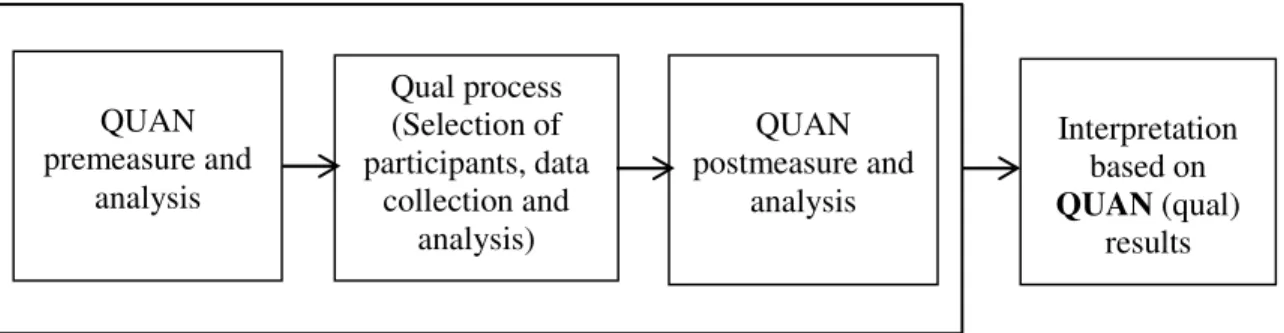
Embedded Mixed Methods Design………59
Phases of Embedded Mixed Methods Design………...60
Research Context……….. 62
Population and Sampling………...63
Data Collection………..65
Quantitative Sources – Instruments………...67
Science Teaching Efficacy Belief Instrument ………...67
Validity and Reliability………..68
Physical Science Concept Test………..69
Building the Physical Science Concept test………...70
vi
Item Selection-Content Validity………72
Construct Validity (Pilot-test)………74
Factor Analysis………..75
Item Difficulty Index……….75
Point Biserial Coefficient (rpbis)……….. 76
Reliability Coefficient (Cronbach’s α)………..76
Qualitative sources……….77
Interviews………...77
Observations………..80
Data Analysis……….81
Stage 1-Quantitative Analysis………83
Stage 2-Qualitative Analysis……….84
Stage 3-Quantitative Analysis………86
Descriptive Analysis……….86
Repeated Measures MANOVA………....87
Assumptions………..87 Effect Size……….88 Cohen’s D……….89 Research Question 2……….89 Correlational Analysis………..90 Partial Correlation……….90 4. RESULTS……….91 Introduction………91
Research Question 1 and Sub-Question………....92
Question 1………..92
Question 1a………92
Quantitative Results………...92
Repeated Measures MANOVA………...93
Effect Size………...94
Quantitative Gains of the Selected Sample………95
Qualitative Findings………...97
Science Teacher Self-Image………..98
Initial Picture at the Beginning of the Course………...98
Final Picture Towards the end of the Course………..100
Enhanced Confidence for Teaching Science………...104
Persistent Challenges………...108
Transforming Content for an Elementary Classroom…………..108
vii
Complexities Involved with Classroom Teaching………...111
Long-term Impact of the Course………..112
Question 1b………..113
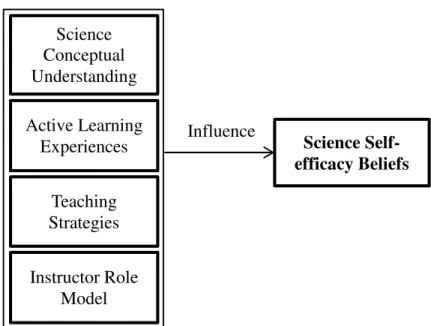
Contributors to Science Self-efficacy Beliefs……….114
Enhanced Science Conceptual Understandings and Increased Confidence………115
Enhanced Science Conceptual Understandings and Positive Shifts in Attitudes………116
Active Learning Experiences Increased Confidence and Provided Potential Ideas………117
Teaching Strategies as Exemplars for Future Science Teaching……….122
Learning Cycle Approach………123
Multiple Representations of the Content……….124
Instructor as a Role-Model………..126
Instructor’s Enthusiasm for Science Teaching………126
Questioning Strategy and Explanations………...127
Genuine Interest in Student Learning………..128
Research Question 2 and Sub-Question………...129
Research Question 2………129
Research Question 2a………..129
Research Question 2b………..129
Research Question 2c………...129
Findings of Research Question 2 and Sub-parts………..130
Pearson Product-Moment Correlation……….130
Partial Correlation………131
Summary of Findings………...131
5. DISCUSSION………..133
Review of Purpose of Study………133
Discussion of the Findings………...137
Development of Science Self-efficacy Beliefs………137
Science Self-efficacy and Science Conceptual Understanding………...138
Factors to Facilitate Self-efficacy………142
A Comparison with Bandura’s Sources of Self-efficacy……….147
Challenges………149
Limitations………...151
Implications of the Study……….152
Implications for Science Teacher Preparation Program………..153
viii
Implications for Future Research……….156
Conclusion………...157
APPENDIX A STEBI-B (Instrument)……….159
B Physical Science Concepts………...161
C Selection of items based on science concepts and assessment goals…………...162
D Physical Science Concept Test Version A………...165
E Item Analysis (Version A)………..167
F Physical Science Concept Test-Version B………..168
G Item Statistics (Version B)………...176
H Interview questions (Part 1)……….177
I Interview questions (Part 2)……….178
REFERENCES………180
ix
LIST OF TABLES
Table page 1.1 Empirical studies on investigating preservice teachers’ science
self-efficacy beliefs in science methods course……….37
1.2 Empirical studies on investigating factors effecting preservice teachers’ science self-efficacy beliefs in science methods course……….44
1.3 Empirical studies on investigating impact of prior science experiences in shaping preservice teachers’ science self-efficacy beliefs……….47
1.4 Empirical studies on investigating impact of science content courses on preservice teachers’ science self-efficacy beliefs……….50
1.5 Empirical studies on investigating impact of science preparation program on preservice teachers’ science self-efficacy beliefs………...53
2 Assumptions of the pragmatic approach………59
3 Criteria for selecting the design: Embedded mixed-methods………60
4 Alignment of research questions with various data sources………..65
5 Reliability coefficient for PSTE and STOE subscales…………...………69
6 Selected instruments for building Physical Science Concept Test………72
7 Example of concepts aligned with assessment goals……….73
8 Stages of data analysis for answering specific research questions………81
9 Descriptive statistics on variables for self-efficacy and conceptual understanding………93
10 Multiple analysis of variance………...94
11 Univariate Tests for All Measures………...95
12 Cohen’s D Effect Size………95
13 Science teacher self-image of group participants………101
x
15 Transforming content for an elementary class as a challenge
posed by participants………108 16 Self-doubt on content preparedness as a challenge posed by participants……...110 17 Complexities involved with classroom as a challenge posed by participants….112
18 Correlations between PSTE, STOE and Content……….………130
19 Partial correlations controlling for time………...………147 20 General comparison between studies on STEBI scores………...148
xi
LIST OF FIGURES
Figures page 1 Theoretical Framework: The relationship between the conceptual
understanding of physical science and science self-efficacy beliefs………...23 2 Representation of the difference between efficacy expectations and
outcome expectations………...27 3 Four modes of self-efficacy and outcome expectancy………...46 4 The three phases of the overall embedded mixed methods design of
the study including three phases………..97 5 Pre- and post-PSTE average percentages of participants from all groups…113 6 Categories and its connections to the self-efficacy beliefs across groups….115 7 Factors contributing towards self-efficacy beliefs………143
xii ABSTRACT
Self-efficacy beliefs that relate to teachers’ motivation and performance have been an important area of concern for preservice teacher education. This study used a mixed-methods approach to investigate the changes in preservice elementary teachers’ science self-efficacy beliefs and the factors associated in a specialized elementary physics content course. In addition, the study is one of few to investigate the relationship between the changes in science self-efficacy beliefs and changes in physical science conceptual understanding. Participants included fifty-one preservice elementary teachers enrolled in two term of the physical science content course.
Data collection and analysis procedures included both qualitative and quantitative measures. Data collection included implementation of Science Teaching Efficacy Belief Instrument-B (STEBI-B) (Bleicher, 2004) and Physical Science Concept Test as pre- and post-test, two semi-structured interviews with 18 participants (nine each semester), classroom observations and artifacts. A pre-post, repeated measures multivariate analysis of variance (MANOVA) design was used to test the significance of differences between the pre- and post-surveys across time. Results indicated statistically significant gains in participants’ science self-efficacy beliefs on both scales of STEBI-B - personal science teaching beliefs and outcome expectancy beliefs. Additionally, a positive moderate relationship between science conceptual understandings and personal science teaching efficacy beliefs was found.
Post-hoc analysis of the STEBI-B data was used to select 18 participants for interviews. The participants belonged to each group representing the low, medium and high initial levels of self-efficacy beliefs. Participants’ responses indicated positive shifts
xiii
in their science teacher self-image and confidence to teach science in future. Four categories that represented the course-related factors contributing towards science self-efficacy beliefs included: (1) enhanced science conceptual understandings, (2) active learning experiences, (3) teaching strategies, and (4) instructor as a role-model. Findings suggest that despite of the nature of prior science experiences preservice elementary teachers previously had, an exposure to a course that integrates relevant science content along with modeled instructional strategies can positively impact science self-efficacy beliefs. While some course elements such as active learning experiences and teaching models seemed to impact all groups positively, the low group participants were particularly influenced by the multiple representations of the content and the course instructor as a role model. These findings have important implications for preservice science teacher preparation programs.
1 CHAPTER 1 THE PROBLEM
Introduction
“Teachers of science will be the representatives of the science community in their classrooms, and they form much of their image of science through the science courses that they take in college.” (National Science Education Standards, National Research Council (NRC), 1996, p. 61)
Science education reform strives to ensure that all preservice science teachers demonstrate high quality science instruction in their future teaching. The new approach to K-12 science education suggested by the Next Generation Science Standards (NGSS Lead States, 2013) and its guiding framework (NRC, 2011) emphasize that all learners should develop a strong foundation of science content focusing on disciplinary core ideas, scientific practices and crosscutting concepts. In order to meet these demands, preservice teachers must undergo similar experiences of learning science content in ways they are expected to teach in future. Science educators who espouse this position argue that teachers teach the way they are trained (Anderson, Smith & Peasley, 2000), thus fulfillment of these expectations requires rigorous training of preservice teachers in their teacher preparation programs.
A number of policy documents (American Association for the Advancement of Science (AAAS), 1993; NRC, 1996; NRC, 2012) recommend improvement in K-12 science instruction through Standards outlined in these documents. The central goal of achieving high quality teaching standards in K-12 classroom require major reforms in teacher education programs (National Science Foundation, 1996). The National Science Education Standards emphasize that“Current reform effort in science education requires a substantial change in teaching practices of how science is being taught at all levels”
2
(NRC, 1996, p. 56). While other professional agencies continued to provide guidelines to meet the demands of ever-changing, complex and diverse society, the No Child Left Behind Act (2001) mandate calls for highly qualified elementary science teachers. The document defines “highly qualified teacher (HQT) as one holding a bachelor’s degree in the core academic area such as math, science, English language arts etc. and demonstrates subject matter competence (content knowledge) in the core subject(s) she/he teaches” (No Child Left Behind Act, 2001, p. 1). As a result, teacher educators are under tremendous pressure to prepare a pool of high-quality science teachers capable of meeting the needs and demands of their diverse classrooms.
Despite the calls for reforms to be made in preservice programs, research highlights concerns regarding effective preservice science education (Appleton, 2003; Howes, 2002; Mulholland & Wallace, 2001). Additionally, a common theme across research on elementary science education suggests that elementary teachers are reluctant to teach science (Abell & Roth, 1992; Appleton, 2003; Gess-Newsome, 1999). In
general, research studies attribute three reasons for such avoidance of science in elementary classrooms: (1) a lack of sufficient background (Dobey & Schafer, 1984; McDermott, 1990; Schoeneberger & Russell, 1986), (2) a lack of confidence to teach it (Appleton, 2003; Crowther & Bonnstetter, 1997), and (3) a traditional structure of undergraduate science courses (Crowther & Bonnstetter, 1997; McDermott, Shaffer & Constantinou, 2000).
The reports from various national surveys also reflect concerns regarding the quality of elementary science instruction. The report from the 1985-1986 National survey of elementary teachers specifies that only 15% were confident enough to teach physical
3
science (Weiss, 1987). This percentage dropped to 14% in the report from the 2000 National survey (Fulp, 2002). Survey results from the 2000 National Survey of Science and Mathematics Education revealed that less than 18% of the elementary teachers felt qualified to teach physical science, and only 24% for teaching any science (Weiss, Banilower, McMahon & Smith, 2001). Despite the calls and systemic reform initiatives to improve science teaching in elementary classrooms (AAAS, 1993; No Child Left Behind, 2000; NRC, 1996; van Driel, Beijaard & Verloop, 2001); only 17% of the elementary teachers felt prepared to teach physical science and 33% for teaching any science (Banilower et al. 2013; Trygstad et al., 2013). Furthermore, both anecdotal evidence as well as research suggest that among all the sciences to be taught in elementary classrooms, physical science is neglected the most (Atwarter, Gardner, & Kight, 1991; Darling-Hammond & Hudson, 1990; McDermott, 1990).
Reform recommendations for preservice model programs include: specialized content courses (NRC, 1996) to enhance science content knowledge of preservice elementary science teachers (DeTure, Gregory, & Ramsey, 1990; Duran, McArthur, & Van Hook, 2004; Hall, 1992), especially physical science (McDermott, 1990,
McLougnlin & Dana, 1999), promotion of active learning through inquiry-based
practices (Duran, et al., 2004; Messina, DeWalter, & Stetzer, 2004; NRC, 1996), improve preservice teachers’ confidence (Dresser, 1988; McLoughlin & Dana, 1999) as well as beliefs and attitudes regarding science teaching (Hall, 1992; Stephans, McClurg, & Beiswenger, 1995; Friedrichsen, 2001), and improve science self-efficacy beliefs
4
Heath, Perlmutter, & Elder, 2011; Leonard, Barnes-Johnson, Dantley, & Kimber, 2011; Yilmaz-Tuzun, 2008).
While much research has been conducted in each of the aforementioned areas, this study focuses on two major areas: (1) science self-efficacy beliefs and (2) science conceptual understandings with regard to preservice elementary teacher education. Both science self-efficacy beliefs and science content knowledge influence preservice
teachers’ future teaching performances. This study was designed to investigate preservice elementary teachers’ science self-efficacy beliefs as well as to provide a logical
understanding of the relationship between their science conceptual understanding and science efficacy beliefs. This study builds on Bandura’s (1977) definition of self-efficacy as “beliefs,” as discussed in the following section.
Operational Definition of Important Terms in the Study
The self-efficacy construct, derived from Social Cognitive Theory, was first conceptualized by Bandura (1977) as a judgment of individuals’ own capabilities to perform necessary actions that they believe could lead to desired results. Bandura
proposed that self-efficacy consists of two distinct dimensions: personal science teaching efficacy beliefs (PSTE) relates to individual’s ability to execute actions required to achieve desired goals, and science teaching outcome expectancy (STOE) relates to individuals’ judgment of the anticipated results their performances may produce. For the purposes of this study, the term “science self-efficacy” refers to (1) the beliefs that shape teachers’ abilities to make decisions regarding classroom science teaching and (2) beliefs that their science teaching will produce their desired student learning outcomes (Bandura, 1977; 1982; Tschannen-Moran, Hoy, & Hoy, 1998).
5
In this investigation, the definition of “science content knowledge” comes from National Science Education Standards (NRC, 1996, 2012). It is defined as a scientific knowledge-base consisting of facts, theories, concepts and principles (NRC, 1996) as well as “integration of the knowledge of scientific explanations” (NRC, 2012). In the context of this study, “specialized content course” refers to science content courses specifically designed for preservice elementary teachers who learn to integrate understanding of science concepts with the pedagogical models as advocated by the national reform efforts (Crowther & Bonnstetter, 1997).
This study investigated the changes in science self-efficacy beliefs of preservice elementary science teachers in the context of a specialized physics content course. Also, the study examined the relationship between preservice elementary teachers’ science self-efficacy and the conceptual understanding of physics concerning topics aligned with elementary grade-level science such as electricity and magnetism and force and motion. The following sections identify the key research issues relevant to this exploration (the relevance of science self-efficacy beliefs in preservice teacher preparation and
relationship between teachers’ science content knowledge and science self-efficacy beliefs). Additionally, Chapter I includes a detailed discussion of specialized content courses and the rationale for using them as a context for the investigation of the research issues. The chapter includes a theoretical framework used for the study, the problem statement on which the study is based, the specific research questions and sub-questions investigated along with a rationale for them. The chapter concludes with the significance of the study as well as a summary paragraph.
6
Research Issues
Teacher Self-Efficacy and Preservice Science Teacher Preparation
Literature on educational beliefs places self-efficacy as a subset of a broader belief structure that influences individuals’ judgment and actions (Nespor, 1987; Pajares, 1992). With regard to the teaching profession, several researchers relate these belief systems to the development of positive attitudes as well as to teachers’ behavior (Nespor, 1987; Pajares, 1992). This interrelationship among teachers’ beliefs, attitudes and
teachers’ classroom behavior has been the topic of great interest in the science education research community. These beliefs have been highly influential in teachers’ classroom practices (Pajares, 1992), and deserve more investigation.
With Bandura’s claims that self-efficacy beliefs are the strongest predictors of motivation and performance (Bandura, 1986), there is consensus among researchers involved with preservice teacher education that the beliefs held by preservice elementary teachers are carried along their way to future classrooms (Enochs & Riggs, 1990; Ramey-Gassert & Schroyer, 1992). For example, Appleton and Kindt’s (2002) study confirmed that beginning teachers with low confidence preferred to use reading and writing
strategies such as worksheets over hands-on activities to teach science. Studies on teacher behavior suggest that teachers with low science self-efficacy prefer authoritarian
approaches to teaching (Bandura, 1997; Palmer, 2006), which hinder effective science instruction. Additionally, low efficacious teachers tend to rely on books and prescribed material, which limit students’ thinking and creativity to understand science concepts (Ramey-Gassert & Schroyer, 1992).
7
The present descriptions of elementary science education demonstrate that classroom teachers lack knowledge and skill to teach science through reform-based practices (Tilgner, 1990), which brings serious concerns on how these classroom elementary teachers are trained during their preservice programs. A number of studies document that preservice teachers are often subjected to formal science coursework typically based on ineffective science practices, consequently creating their negative attitudes and beliefs towards science teaching (Mulholand & Wallace, 1996; Rice & Roychoudhury, 2003). Most of preservice science coursework consists of traditional lecture, reading books and completing worksheets that promote rote memorization (Rice & Roychoudhury, 2003) and leads to poor science knowledge (Stevens & Wenner, 1996; Trundle, Atwood & Christopher, 2002). These negative experiences along with
inadequate science content preparation damage the confidence-level of preservice teachers (Jarrett, 1999; Mulholand & Wallace, 2001). Furthermore, these experiences either inhibit future science teaching or influence prospective teachers to an extent that they tend to avoid teaching elementary science completely (Appleton & Kindt, 1999). Although some researchers argue that beliefs about teaching and learning are set firmly by the time prospective elementary teachers enter preservice programs and are difficult to amend (Kagan, 1992; Pajaras, 1992), others suggest that effective science experiences may help to address some of the concerns and apprehensions about their ability to teach science (Gencer & Cakiroglu, 2007; Mulholland & Wallace, 2001). Several researchers argue that designing high quality science coursework has the potential to shape preservice teachers’ pre-existing beliefs (Mulholland and Wallace, 2001) and to enhance both personal self-efficacy beliefs as well as beliefs in their actions
8
leading to successful outcomes (Cantrell et al., 2003). One hypothesis is that the more positive the impact on preservice teachers’ science self-efficacy beliefs throughout their coursework, the more they are likely to positively influence the student achievement in their future classrooms.
Because self-efficacy is influential to student learning (Bandura, 1997), studying teachers’ beliefs have important implications for research in curriculum, instruction and classroom practices. The study was designed to provide a greater understanding of how preservice science experiences play a key role in shaping science self-efficacy beliefs that influence future teaching and provide insights for improved preservice elementary
teacher preparation. Because teacher self-efficacy is one of the major determinants of effective future science teaching, this study aimed to investigate how preservice teachers’ science self-efficacy beliefs improved during their exposure to a particular physical science content course.
Teacher Self-efficacy and Science Content Knowledge
While there has been an emphasis on preparing elementary teachers in a way that they feel confident in the science content knowledge as outlined by National Science Education Standards (NRC, 1996), science content provided to preservice teachers in terms of the breadth and the depth in science coursework has raised concerns on how well-prepared these teachers feel to teach science. The Standards (NRC, 1996; 2012) state that science content preparation should enable preservice teachers to develop a strong foundation of science content in order to fulfill the demands of diverse learners in their future classrooms. Not only are elementary teachers required to meet state science curriculum standards, but they are expected to facilitate scientific understanding through
9
inquiry-based learning processes. In order to meet these demands, preservice teachers need similar experiences of learning science content in the way they are expected to teach in future. Also, there is a general consensus that a lack of such background knowledge in science often leads to the development of anxiety and fear towards science, affecting self-efficacy and the confidence to teach it (Appleton, 2006; Tilgner, 1990).
With science content knowledge as one of the limiting factors for effective science instruction, several attempts have been made to understand the linkage between science content knowledge, attitudes, and beliefs held by preservice teachers. Related literature posits that integrated science content and methods courses that blend science content and pedagogy together effectively enhance self-efficacy beliefs (Bleicher & Lindgren, 2005; Tosun, 2000); however, the effect of science content knowledge by itself on science self-efficacy beliefs is debatable (Tosun, 2000). Moreover, while research has consistently shown that preservice science methods courses build on inquiry-based learning environments positively influence attitudes and confidence (Friedrichsen, 2001; Hall, 1992; Reisetter, Bruning and Veomett, 1998), little is known about the relationship between teachers’ science conceptual understanding and self-efficacy beliefs.
A few studies have been conducted related to the impact of science content courses on changes in preservice teachers’ attitudes or self-efficacy (Ginns, Tulip,
Watters & Lucas, 1995; Morrell & Carroll, 2003; Watters & Ginns, 1995). Findings from these studies provide recommendations for effectiveness of content courses rather than providing any clear picture of the relationship between science conceptual understanding and self-efficacy beliefs. A handful of studies that are directed toward understanding the role that content knowledge may play in affecting preservice science self-efficacy beliefs
10
provide conflicting results, further providing impetus for conducting this present study. For instance, a few studies show that the quality of high school science experiences along with the number of science courses taken in preservice teacher preparation programs enhance their confidence levels (Jarrett, 1999; Moore & Watson 1999); others claim that additional science content courses may not necessarily have contributed towards science conceptual understanding (Wenner, 1993, 1995).
Only two studies have attempted to directly explore the correlation between the science conceptual understanding and science self-efficacy beliefs, but they revealed contrary results. While findings from the study conducted by Schoon & Boone (1998) revealed that the preservice teachers’ scores on a science test significantly correlated with both areas of science self-efficacy beliefs, results from study conducted by Bleicher & Lindgren (2005) revealed that conceptual understanding correlates with personal science self-efficacy but not with science teaching outcome expectancy beliefs. Together, these studies do not demonstrate a consistent relationship between changes in science
conceptual understanding and changes in science self-efficacy beliefs, which are important issues for teacher preparation.
This study examined the relationship between changes in preservice teachers’ physical science conceptual understanding and changes in science self-efficacy beliefs in the context of a physical science content course. Over the years science educators have argued that increases in scientific knowledge bases subsequently influence self-efficacy beliefs. The study attempted to explore this contention to illustrate the role that science content knowledge plays in influencing self-efficacy beliefs.
11
Specialized Content Courses as Authentic Contexts for Exploration
In the past few decades, teacher educators have realized that traditional science content courses have failed to promote preservice teachers’ understanding of science and their confidence to teach science in the future (McLoughlin & Dana, 1999; Watters & Ginns, 2000). Researchers’ suggestions include improving preservice science content training through specialized science course work closely aligned with the elementary classroom curricula (McLoughlin & Dana, 1999; Morrell & Carroll, 2003). Additionally, such courses have been designed to incorporate inquiry and constructivist views on learning, provide explicit connections to the real world, and to provide opportunities to observe reform-based pedagogical models of teaching science (Lee & Krapfl, 2002; McLoughlin & Dana, 1999). Furthermore, the purpose of creating such courses were two-fold: (a) to stimulate learning by adopting ‘less is more’ approach and (b) to build on elementary science teaching self-efficacy beliefs necessary to teach effectively (Boone & Gabel, 1998; Dresser, 1988; McDermott, 1974; McLoughlin & Dana, 1999).
This literature documents several attempts made to re-design science content courses in all disciplines; however, much attention has been directed toward
implementing specialized physical science content courses. Specifically, the literature provides ample evidence that traditional physics courses taken by education majors fail to provide the “type of preparation required for teaching physics” effectively (McDermott, Shaffer & Constantinou, 2000, p. 411). Recent studies on specialized content courses provide empirical evidence indicating the effectiveness of specialized content courses, the impact of such innovative courses on students’ perceptions, student achievement, student retention, self-efficacy beliefs, confidence and attitudes towards science
12
(Friedrichsen, 2001; McLoughlin & Dana, 1999; Trundle et al., 2007). Of particular interest for the present study are those empirical research studies that specifically investigate the impact of specialized content courses on preservice teachers’ science content knowledge, self-efficacy beliefs and confidence.
Two research studies were found that specifically reported that experiences in specialized content course enhanced preservice teachers’ confidence in science (Friedrichsen, 2001; Lee & Krapfl, 2002). The purpose of these studies was to
assess/evaluate the newly-designed content courses in terms of being effective to bring sound conceptual understanding of science concepts as well as to build on confidence levels. However, neither of these studies explored changes in conceptual understanding or changes in self-efficacy beliefs in these contexts. Additionally, both studies utilized qualitative measures for analyzing participants’ claims in interviews about the impact of innovative course on their perceptions of being prepared to teach in future. Other research studies have also relied only on participants’ interviews to explore their perceptions regarding these contexts (Doster et al., 1997; Duran et al., 2004; McLoughlin & Dana, 1999).
The interrelationship between content knowledge and self-efficacy beliefs has been suggested in literature but has not been systematically explored in the context of specialized content courses. That being the case, due to the professional context in which science content knowledge is gained along with overt experiences with teaching models; a specialized content course serves as an appropriate research setting for this study. The purpose of this study was to investigate the relationship between preservice teachers’
13
science conceptual understanding and self-efficacy beliefs before and after taking a specialized physical science content course.
The focus of this study is illustrated in Figure 1. The specialized content course, which is the research context for the study, has been designed to fulfill two aims: (1) to enhance preservice teachers’ science content expertise and (2) modeling appropriate instructional strategies by presenting the content in the context of pedagogy. Although, science content knowledge is a vast domain that consists of subdomains such as physical science, life sciences, and Earth sciences and so on, for the purposes of this study
preservice teachers’ physical science content knowledge was investigated. Along with subject matter knowledge and pedagogical skills, it is expected that the course is able to bring desired changes in prospective teachers’ science self-efficacy beliefs as they view themselves as future science teachers. Of particular interest to this present study was whether there is an interrelationship between changes in conceptual understanding of physics and science self-efficacy on both scales, PSTE and STOE. The target of the present investigation is highlighted by boxed area in the figure 1.
Theoretical Framework Social Cognitive Theory
Social cognitive theory postulates that human functioning is determined by the interaction of three factors: a) personal factors such as beliefs, b) behavior, and c) environmental influences (Bandura, 1986). The theory offers a rich blend of both
behavioristic and cognitive theories of learning, which emphasize learning as a product of interplay between cognitive, behavioral and contextual factors. This model of three
14
interrelated factors that influence human behavior is called triadic reciprocal causation (Bandura, 1977).
Bandura directed this theory to understand cognitive processes and suggested that learning influenced by the relationship between the three variables: personal, behavior, environmental. This relationship was called as ‘reciprocal determinism’ (Bandura, 1978). This is further explained through the links between each of the influential factors. For instance the link between personal and behavior factors suggests that individual’s beliefs, self-perceptions, and thought process influences their behavior. Applying the theory to teacher education, personal beliefs may influence learning and motivation that ultimately affects outcomes in terms of the effort future teachers may put forth with regard to their own teaching (Bandura, 1989).
The second link between personal and environmental factors suggests that the beliefs and expectations as well as cognitive competencies could be shaped by social influences. In educational setting, modeling instruction, social persuasion and positive feedback will produce desired changes in learners’ beliefs about themselves as well as enhance their outcome expectations (Bandura, 1989). The final relationship in the triad provides relationship between behavior and environmental factors which suggest that behavior is shaped by the environmental factors and vice-versa as these links are bi-directional and not unibi-directional. Applying to preservice teacher education, for instance, student-centered classrooms help increase students’ motivation to put all effort in
learning how to teach. Similarly, constructive feedback provided by teacher motivates students to achieve their learning goals.
15
Self-efficacy-byproduct of Social Cognitive Theory
Derived from Social Cognitive theory, self-efficacy has emerged as an influential construct suggesting that human behavior and functioning is affected by the beliefs people hold. These beliefs have a tendency to change while individuals interact with the environment in which they function (Bandura, 1993).
Self-efficacy beliefs play a major role in determining teachers’ science teaching practices that include the choice of instructional activities, organization of science lessons, and their preparation to handle challenging situations (Bandura, 1997). Applied to elementary science teaching, researchers have suggested that highly efficacious teachers are more successful as science teachers (Appleton & Kindt, 2002), willing to take challenges teaching science (Ramey-Gassert, Shroyer & Staver, 1996), and are committed to teaching science (Riggs & Enochs, 1990). Additionally, teachers having high senses of self-efficacy are more likely to incorporate inquiry-based practices to their teaching, thus making extensive efforts to create learner-centered environments in their science classrooms (Watters & Ginns, 1990).
Self-efficacy beliefs are situation, context and subject-matter specific (Bandura, 1997, Tschannen-Moran et al., 1998). This suggests that the self-efficacy beliefs that elementary teachers may hold for subjects other than science may have little effect on their science teaching efficacy beliefs. Science teaching demands a great deal of effort and time for elementary teachers to put into designing inquiry-based lessons as opposed to using strategies based on reading and writing (Appleton & Kindt, 1999). High self-efficacy helps teachers to find a fine balance between their own roles as science teachers in elementary classrooms and them being confident that their students are learning.
16
This research study is shaped by Social Cognitive Theory proposed by Bandura (1977) derived from the social learning perspective and focusses on determining
preservice teachers’ self-efficacy beliefs, how they change, and what factors cause these beliefs to change within the context of specialized physics content course. The
specialized content course is a classroom framed in social constructivist perspective that offers favorable environment that could potentially shape self-efficacy beliefs. The framework of social cognitive theory is well suited for the study as it helps to understand the process of learning in the educational setting. The framework of social cognitive theory served as a guiding lens to understand preservice elementary teachers’ experiences within the science content course and their perceptions about science and science
teaching, how their science self-efficacy beliefs are shaped through the interaction between personal, behavior and environmental factors within the context of the course.
Problem Statement
Science education reform strives to ensure that all preservice science teachers demonstrate high quality science instruction in their future teaching. Not only are
elementary science teachers expected to teach the way described by the National Science Education Standards (1996, 2012) but they are also to cover the science content aligned with the curriculum standards. Many science educators argue that teachers tend to teach the way they are trained (Anderson, Smith & Peasley, 2000), thus science educators are need to ensure that preservice teachers are trained in their teacher preparation programs in ways that ensure effective future science teaching. Despite the calls for reforms to be made in teacher education programs, numerous research studies have pointed out that
17
preservice teachers lack adequate preparation as well as the confidence to teach science (Appleton, 2006; Ramey-Gassert & Schroyer, 1992; Tilgner, 1990).
Because self-efficacy is influential to student learning (Bandura, 1997), studying teachers’ beliefs have implications for research in curriculum, instruction and classroom practices. Science self-efficacy beliefs are a particularly important issue in science education; the idea provided one rationale of this study. The study was designed to provide a greater understanding of how preservice science experiences play a key role in shaping science self-efficacy beliefs that influence future teaching and to provide insights for improved preservice elementary teacher preparation.
In the science teaching context, researchers have identified self-efficacy as an influential construct (Enochs & Riggs, 1990). Literature concludes that teachers with inadequate science background tend to have low science teaching self-efficacy beliefs (Rubeck & Enochs, 1991). Although research studies have proposed several factors that contribute towards science self-efficacy beliefs, science content knowledge is prominent among them. However, there is lack of empirically-based research to provide clear evidence of interrelationships between science conceptual understanding and science self-efficacy beliefs. Furthermore, investigations have yet to be conducted in settings, such as specialized content courses, where the primary aim is to build on preservice teachers’ confidence by teaching the science content relevant to their future teaching. This study aimed to provide empirical evidence to understand some of these contentions. The findings of this study provide a deeper understanding of the relationships between conceptual understanding and science efficacy beliefs, two major determinants for successful science teaching.
18
Research Questions Question 1
How do preservice elementary teachers’ science self-efficacy beliefs (personal science teaching self-efficacy-PSTE beliefs and science teaching outcome expectancy- STOE) change during a specialized physics content course?
Question 1a
Is there a significant change in science self-efficacy (PSTE and STOE) beliefs of preservice elementary teachers participating in the specialized physics content course? Question 1b
What factors associated with the specialized physics content course contribute to changes in preservice elementary teachers’ science self-efficacy (PSTE and STOE) beliefs?
Rationale
Literature on efficacy beliefs emphasize that preservice teachers’ self-efficacy beliefs can be shaped through effective science preparation programs (Gunning & Mensah, 2011). Since science content courses are integral part of teacher training, it is reasonable to assume that experiences within these courses can impact science self-efficacy beliefs. A considerable amount of research studies on self-self-efficacy have been conducted in a variety of contexts, demonstrating enhancement in self-efficacy beliefs (Bautista, 2011; Morrell & Carroll, 2003; Narayan & Lamp, 2010). However, a handful of research studies have been directed towards investigating changes in self-efficacy beliefs in the context of content courses. Thus, above research questions examined the changes in science self-efficacy beliefs as well as the key factors that are responsible for
19
such changes. An analysis of such beliefs in the context of content courses is of particular importance to the science education community and make a significant contribution towards science teacher preparation, especially in the content-specific areas. Question 2
What is the relationship between preservice elementary teachers’ science self-efficacy beliefs and science conceptual understanding?
Question 2a
What is the relationship between preservice elementary teachers’ science self-efficacy beliefs (PSTE and STOE) and conceptual understanding of physics prior to participation in the specialized physics course?
Question 2b
What is the relationship between preservice elementary teachers’ science self-efficacy beliefs (PSTE and STOE) and conceptual understandings of physics after their participation in the specialized physics content course?
Question 2c
What is the relationship between changes in science self-efficacy beliefs (PSTE and STOE) and changes in conceptual understandings of physics?
Rationale
The above set of research questions examined the interrelationship between preservice teachers’ self-efficacy and conceptual understanding of physical science. While several researchers propose that increase in science content knowledge contributes towards increase in science teacher efficacy (Cantrell et al., 2003; Leonard et al., 2011; Yilmaz-Tuzun, 2008), these contentions are not supported by evidence-based research.
20
Above research questions are targeted to provide empirical evidence to some of these claims. Research question 2a specifically investigated the relationship between preservice teachers’ preconceptions about science content and their prior beliefs about science teaching before the preservice teachers participate in the content course.
Researchers argue that specialized content courses present science content material in an investigative manner that could potentially shape preservice teachers’ preexisting beliefs resulting in enhanced confidence and appreciation towards science and science teaching (Duran et al., 2004; McLoughlin & Dana, 1999). Research question 2b investigated the relationship between self-efficacy beliefs possessed by preservice teachers and their science conceptual understanding after the completion of the instruction.
It is reasonable to expect that there might be changes in preservice teachers’ self-efficacy beliefs and conceptual understanding of the targeted science topics during the course; however, whether or not these two are related needs thorough investigation. Research question 2c specifically investigated the relationship between the changes in self-efficacy beliefs on both scales and changes in science conceptual understanding. Understanding the relationship between changes in science self-efficacy beliefs and science conceptual understanding provided important directions for preservice teacher education reform.
Significance of the Study
One of the greatest concerns in the science education community for the past few decades is to achieve scientific literacy for all students (AAAS, Benchmarks, 1991; 1993; Project, 2061). Of considerable concern is that significant numbers of elementary
21
teachers describing their preservice teacher preparation as ineffective, leaving them unprepared to teach science (Gess-Newsome, 1999; Nachtigall, 1990; Tilgner, 1990). Reform movements have raised questions about the way science instruction is taking place in preservice content training, particularly about the impact of traditional physical science content courses (McDermott, 1990). With regard to such reforms, the science teacher educators emphasize that preservice teachers’ beliefs about science serve as a lens through which they view themselves as future science teachers. However, there has always been a debate on whether or not mandating additional content coursework has the potential to enhance future elementary teachers’ science self-efficacy beliefs.
This study is significant in that the results provide a clear understanding of the relationship between preservice teachers’ science conceptual understanding and their science self-efficacy beliefs associated with participation in a specialized physics content course. The investigation of this relationship provide evidence of the extent to which science conceptual understanding contributed toward preservice teachers’ confidence to teach it. Rather than assuming any nature of links that may exist between science content knowledge and science self-efficacy beliefs, this study provides empirical evidence of such interrelationships through systematic investigation. The results of this study add important information to the field of preservice teacher education which currently lacks research-based evidence of the relationship between changes in science conceptual understanding and changes in science self-efficacy beliefs due to the inclusion of a specialized science content course for elementary education majors.
22
Summary of Chapters
This chapter provides the description of the problem, rationale for research questions and significance of the study in terms of its contribution to the field of science education. Chapter 2 provides the review of the relevant literature. Chapter 3 includes the research design and the details of the methodology that will be employed for this
research. Chapter 4 reports the results of the research questions. Chapter 5 includes discussion of the study, limitations of the study, implications of the results, and suggestions for future research avenues in the area of preservice teacher preparation.
23
Figure 1. Theoretical Framework: Adapted from Shulman (1986) and Bandura (1997). The relationship between the conceptual understanding of physical science and science self-efficacy beliefs. Influences Relates to Focus of the study Includes Influences Personal Science Teaching Efficacy Science Teaching Outcome Expectancy Science Content Knowledge Includes Includes Relates to Specialized Content Courses Science Self-Efficacy
24 CHAPTER 2 LITERATURE REVIEW
Introduction
Over the past three decades, educational researchers have recognized that
teachers’ self-efficacy strongly influences the instructional processes (Guskey & Passaro (1994). As a result, the investigation of elementary teachers’ self-efficacy beliefs has been of considerable focus of research in science teacher education. Earlier literature on self-efficacy grew out of Bandura’s conceptualization of self-efficacy construct as beliefs that influence one’s thought processes that guide subsequent actions in pursuit of the desired goal (Bandura, 1986; 1993). Following the identification of self-efficacy as a valuable psychological construct in teacher education, assessment of self-efficacy became a priority among researchers in the field. Research literature documents several attempts toward the construction of valid measures of teacher self-efficacy scales for both
inservice and preservice teachers.
Ever since the development of instrument called Science Teaching Efficacy Belief instrument (STEBI) specific to elementary science teaching (Riggs & Enochs, 1990), a significant amount of studies have been conducted to explore preservice and inservice elementary teachers’ beliefs in a variety of contexts during teacher education programs. Moreover, the purpose of such extensive research conducted with regard to self-efficacy beliefs varied from investigating the effectiveness of innovative preservice methods and content courses (Brand & Wilkins, 2007) to exploring the factors that influence self-efficacy beliefs in a particular course setting (Narayan & Lamp, 2010).
Based on Bandura’s construct of self-efficacy, the purpose of this study was two-fold. The study was primarily concerned with how preservice teachers’ self-efficacy
25
beliefs change during the specialized science content course. Additionally, the study explored the relationship between science conceptual understanding and science self-efficacy beliefs. This review of existing literature was crucial for the purposes of the study in order to understand a holistic picture on past and present research regarding science self-efficacy beliefs in the field of teacher education.
Literature Review Organization
First section of this review begins with the meaning of self-efficacy beliefs as proposed by Bandura and some of the other definitions that reinforce Bandura’s definition of self-efficacy. The section also includes sources of self-efficacy and its relevance to preservice teacher population and literature on development of various instruments for assessing self-efficacy beliefs. Next, the second section presents research literature on studies relevant to elementary preservice science teacher education only. More specifically, the section systematically covers seminal research work on self-efficacy beliefs in the context of science methods courses, science content courses and overall preservice teacher preparation programs. Each of these sections present synthesis of the research literature under emerging themes that provide the overview of the factors that play key role in shaping self-efficacy beliefs. Research studies supporting each theme are addressed under each major theme. Under these sections, explicit attention was given to the research studies that suggest differing claims to the notion of how science content knowledge and self-efficacy beliefs are related. Finally, the chapter concludes with the summary of literature review including three themes and short discussion on how the present study contributes to the literature on science education and preservice teacher education.
26 Inclusion and Exclusion Criteria for Articles
Based on the focus of the study, three limiting factors were used as criteria for the inclusion or exclusion of articles. First, the studies focusing on exploring science self-efficacy beliefs of elementary preservice teachers were given preference over inservice elementary science teachers. However, seminal studies related to inservice elementary teachers or preservice secondary teachers are mentioned at times in support of assertions existing in the science self-efficacy research literature. Second, while there is abundant literature on self-efficacy, articles from peer-reviewed journals are included. The articles from practitioner journals are not included because they either demonstrated an
instructional strategy or suggested inquiry lessons where self-efficacy was implicitly addressed as one of the outcomes. Only research-based articles that either used self-efficacy as a framework or lens to guide the study or as a construct investigated in the study were included. Third, although numerous research studies have been conducted in various disciplines that have adapted self-efficacy as a framework, studies specific to the science discipline and preservice teachers’ science self-efficacy beliefs are included. Search of Research Articles
In the first round of search, articles were identified through a keyword search in databases including ERIC, Wilson Web (including Education Full Text), Wiley online library (including School Science & Mathematics), as well as through searches in science education journals such as the Journal of Science Teacher Education, Journal of
Elementary Science Education, Journal of Research in Science Teaching, and Journal of Psychology. Another round of searches included keyword searches and phrases such as: efficacy and preservice elementary teachers, science methods courses and
self-27
efficacy, science content courses and impact of self-efficacy on preservice teachers in Web search engine called Google Scholar. The articles selected were published between the years 1990-2013, with few exceptions including articles published between the years 1977-1989 found in the microfiche section in university library. Because self-efficacy emerged as a powerful construct in science teacher education over the past 35 years, few articles before that era were only available in microfiche.
Teacher Self-Efficacy as a Construct
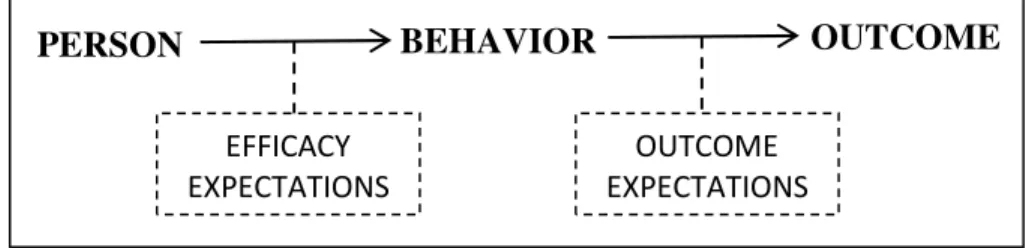
Self-efficacy as a construct was first conceptualized by Bandura (1977) as judgment of one’s capabilities that the actions performed will lead to a successful outcome. According to Bandura, the concept of self-efficacy beliefs consists of two distinct dimensions, outcome expectation and self-efficacy expectation. While outcome expectation is person’s belief that their behavior will produce desired outcomes, self-efficacy expectation is the person’s confidence to execute actions in a way to achieve desired goal (See Figure 2).
Figure 2.Representation of the difference between efficacy expectations and outcome expectations (Bandura, 1977).
Based primarily on Bandura’s identification of one’s behavior as dependent on outcome expectancy and sense of self-efficacy, Ashton and Webb (1982) developed a multidimensional model of self-efficacy. They extended Bandura’s theory to teachers and identified that the two dimensions, namely, teaching efficacy and personal efficacy
BEHAVIOR OUTCOME PERSON EFFICACY EXPECTATIONS OUTCOME EXPECTATIONS
28
account for individual teacher differences in performing actions or making decisions regarding their own teaching. Gibson and Dembo (1984) applied both Bandura’s and Ashton &Webb’s theory to develop the questionnaire called Teacher Efficacy Scale and attempted to provide validation to the construct of teacher efficacy, which they defined as a “variable accounting for individual differences in teacher effectiveness” (p. 569). Their analysis of 208 elementary teachers’ responses on the questionnaire confirmed two-dimensionality of self-efficacy. Following this, Dembo and Gibson (1985) identified teachers’ sense of efficacy as a predictor of teacher’s classroom behavior that has
significant impact on students’ achievement. Consistent with Bandura, Guskey & Passaro (1994) suggested that both dimensions of teacher self-efficacy are highly significant in elementary classrooms, especially science teaching, but act independently of each other. For instance, elementary teachers (especially beginning teachers) might expect that certain actions and classroom behaviors performed well will bring desired results in student learning (high outcome expectancy) but might not have sufficient confidence to execute those actions (low personal efficacy).
Several other studies attempted to build a comprehensive theoretical meaning of self-efficacy as well as to develop a valid instrument to measure it. Self-efficacy was further conceptualized as a dynamic construct that could potentially change with
experiences gained, and has a “mobilization component” (Gist & Mitchell, 1992, p. 185) that helps individuals to adapt themselves to fit in complex situations (Bandura & Wood, 1989; Gist & Mitchell, 1992). Gist and Mitchell (1992) further defined self-efficacy as the “judgment about task capability that is not inherently evaluative” (p. 185). They extended the construct of self-efficacy into organizational behavior by proposing a model
29
of efficacy that provides understanding of “complexity and malleability” of self-efficacy construct (p. 183). Consistent with the Bandura’s theory of self-self-efficacy, Tschannen-Moran et al., (1998) defined teacher efficacy as teachers’ beliefs that shape their abilities to execute certain actions in desired situations, which can bring desired results. They proposed that teacher efficacy is context specific, situational and subject-matter specific. For instance, elementary teachers might be committed to teach other subjects effectively than science because they might perceive their science teaching as inadequate to help students attain higher levels of academic achievement.
Four Sources of Self-Efficacy
Bandura (1997) proposed four major sources of self-efficacy that play roles in determining self-efficacy expectations for an individual to perform a specific action (See Figure 3). The first factor, enactive mastery experiences, are supposed to impact self-efficacy beliefs to a larger extent as compared to other factors such as vicarious experiences, verbal persuasion and emotional arousal (Bandura, 1995; 1997). Mastery experiences are a person’s own experiences of being successful in the past that not only add to person’s self-confidence to succeed in similar situations but also increase coping efforts in challenging situations. Vicarious experience, the second source of information on self-efficacy, is the belief in oneself to succeed after seeing evidence of others striving through similar situations and being successful. The third factor, verbal persuasion, refers to positive feedback received from others on their performance or “placebo effect” (Bandura, 1977, p. 198) that increases individual’s performance skills. Finally, the fourth source of self-efficacy, called emotional arousal, refers to one’s physiological and
30
an individual’s performance tasks. In a more recent study, Palmer (2006b) proposed three additional sources of self-efficacy along with Bandura’s sources: content cognitive mastery, cognitive pedagogical mastery and stimulated modeling. He also specified self-efficacy as an “accurate indicator of performance” where low efficacious persons tend to avoid the activity while high efficacious persons are enthusiastic and continue to make efforts to complete the task successfully.
Figure 3. Four modes of self-efficacy and outcome expectancy. Adapted from Dembo and Gibson (1985).
Several research studies have adapted Bandura’s sources of self-efficacy as a framework to understand the impact of various course interventions as well as the contribution of each source towards changes in preservice teachers’ science self-efficacy beliefs. The literature states some of the mastery experiences as either authentic
experience gained within the courses (Gunning & Mensah, 2011) such as carrying on inquiry-based hands-on science investigations, classroom discussions, creating their own science lesson plans (Mulholland & Wallace, 2001), or successful classroom practices (Bandura, 1982; 1997; Bautista, 2011; Tschannen-Moran et al., 1998) in student teaching
Outcome Expectancy Teacher Performance Mastery Experiences Vicarious Experiences Verbal Persuasion Physiological and Affective States Self-efficacy
31
and field experiences, and opportunities to reflect on their own teaching (Brand & Wilkins, 2007).
Vicarious experiences may include preservice teachers’ observing either other teachers’ successful performance in an actual classroom or watching videos of other teachers using effective science teaching models followed by reflection and discussion on different aspects of their teaching (Bautista, 2011; Gunning & Mensah, 2011). They may also include preservice teachers video-taping their own teaching practices followed by thorough reflection (Bautista, 2011) to understand critical elements for future teaching. Other than these experiences, preservice science teachers’ confidence is greatly enhanced by verbal persuasion, including positive feedback and encouragement received from science instructors, their own peers, school supervisors and family support (Bandura, 1997; Bautista, 2011). Finally, physiological and affective states of individual preservice teachers influence their ability to handle stress and anxiety while teaching science in the classroom (Bandura, 1997; Bautista, 2011; Gunning & Mensah, 2011). All these
experiences collectively determine how well preservice teachers are prepared to teach science effectively in their future classrooms (See Figure 3).
Instruments to Assess Teacher Self-Efficacy
With the growing realization of self-efficacy as an important construct in teacher education (Gist & Mitchell, 1992), systematic efforts were made for developing valid and reliable instruments to measure self-efficacy beliefs (Bleicher, 2004). The earlier attempts to establish construct validity of self-efficacy includes development of the instrument by Gibson and Dembo (1984) to investigate the relationship between teacher self-efficacy and teacher classroom behaviors. The 30-item scale called Teacher Efficacy scale (TES)