eCommons@AKU
School of Nursing & Midwifery
Faculty of Health Sciences
June 2013
Validity and reliability testing: Urdu translated
modified Response to Symptoms Questionnaire.
Saleema A. Gulzar
Aga Khan University, [email protected]
Tazeen S. Ali
Aga Khan University, [email protected]
Khurshid Khowaja
Aga Khan University
Aamir Hameed
Aga Khan University, [email protected]
Debra Kay Moser Debra Kay Moser Debra Kay Moser
Follow this and additional works at:
http://ecommons.aku.edu/pakistan_fhs_son
Part of the
Nursing Midwifery Commons
Recommended Citation
Gulzar, S. A., Ali, T. S., Khowaja, K., Hameed, A., Debra Kay Moser, D. D. (2013). Validity and reliability testing: Urdu translated modified Response to Symptoms Questionnaire..2013, 23(6), 383-387.
INTRODUCTION
Approximately 17.5 million deaths are attributed to acute coronary events each year worldwide; 80% of these deaths occur in developing countries.1 Over the past
few decades, the epidemiological transition has taken place in developing countries including Pakistan, leading to an increasing trend of cardiovascular diseases in these countries.2,3In Pakistan, cardiovascular mortality
accounts for 12% of all deaths.4 Delay in reporting of
acute coronary syndrome (ACS) symptoms, i.e. pre-hospital delay, contributes to the high mortality associated with ACS.5 Reducing the pre-hospital delay
time is important for any given set of symptoms; however, its significance increases in instances of ACS. Despite the widely acknowledged significance of pre-hospital delay in determining the clinical outcomes in ACS, quite prolonged delay times have been reported
among ACS patients in various developed and developing countries.6-10 A median pre-hospital delay
time of 3 hours has been reported among Pakistani acute myocardial infarction (AMI) patient population.11,12
In view of the key significance of pre-hospital delay in ACS, it was deemed important to identify the factors associated with pre-hospital delay, specifically among Pakistani ACS patient population. None of the tools was available in Urdu language, or tested on Pakistani population to fulfill this purpose. Therefore, response to the symptoms questionnaire (RSQ) was identified as the one that may help to fulfill the study purpose. However, the RSQ was primarily in English language and this was the first time ever that it was being translated into Urdu, to be used as a source of data collection from Pakistani ACS patients. Therefore, it was imperative to test its validity and reliability in Pakistani context.
RSQ was first developed in 1995.13It was then adapted
by Dracup and Moser in 1997.7 The content and face
validity of the English version of the RSQ has been established by expert cardiologists and cardiology nurses.14,15 RSQ measures a wide range of factors
associated with pre-hospital delay in acute coronary syndrome (ACS). It has been extensively used in many different populations and settings.15-18 By now, it has
already been translated in Arabic language from the original English version.
Originally, the RSQ consisted of 14 questions. The first question was about the date and time of the onset of
Validity and Reliability Testing: Urdu Translated Modified
Response to Symptoms Questionnaire
Saleema Allana1, Tazeen Ali2, Khurshid Khowaja4, Aamir Hameed Khan3and Debra Kay Moser5
A
BSTRACTObjective:To determine validity and reliability of the Urdu translated, modified “Response to symptoms questionnaire” (RSQ) among acute coronary syndrome (ACS) patients in Karachi.
Study Design:A qualitative, tool validation study.
Place and Duration of Study: Two tertiary care hospitals in Karachi, the Aga Khan University Hospital, Karachi and the Karachi Institute of Heart Diseases, from December 2010 to April 2011.
Methodology: After making certain modifications, the original tool in English was translated into Urdu. Next, five cardiology experts evaluated the tool for its content and face validity. Test retest and inter rater reliabilities were computed for the RSQ using 5% of the total sample size of the parent study.
Results: Sufficient conceptual and semantic equivalence was found between the Urdu and English versions of the modified RSQ. Content validity index was calculated to be 1 for both relevance and linguistic clarity. Test retest and inter rater reliabilities were calculated to be 95.9% and K = 0.97, respectively.
Conclusion:The Urdu translated modified RSQ has sufficiently acceptable content validity, test retest and inter rater reliability; hence, it should be used by the researchers for the evaluation of factors associated with pre-hospital delay among Urdu speaking ACS patient populations.
Key words: Content validity index. Test retest reliability. Inter rater reliability. Urdu translated version. Response to symptoms questionnaire.
1 School of Nursing and Midwifery, The Aga Khan University,
Karachi.
2 Department of Community Health Sciences / Medicine3,
The Aga Khan University Hospital, Karachi.
4 Director Nursing Services and Assistant Hospital Director
Al-Noor Hospital, Al-Ain, Dubai.
5 University of Kentucky, College of Nursing, USA.
Correspondence: Ms. Saleema Allana, Senior Instructor at The Aga Khan University, School of Nursing and Midwifery, Karachi.
E-mail: [email protected]
ACS symptoms. Question numbers two to seven were multiple choice questions regarding the place, and witness of symptom onset; initial behavioural response of the patient to the symptoms; response of attendants to the patients' symptoms; and patients' attribution of the symptoms to cardiac or non-cardiac causes. The next five questions were formulated as Likert scale type questions, where one indicated no agreement with the statement, and five indicated complete agreement with the given statement; these questions were about how much the specific cognitive and affective factors contributed to their delay. The thirteenth question asked the respondents to rate their discomfort at the time of ACS symptom onset, on a scale of 0 (no discomfort) to 10 (extreme discomfort). In the fourteenth question, the respondents had to indicate if they had knowledge about thrombolytics or not.
The purpose of this study was to determine the validity and reliability testing of the Urdu translated, modified RSQ, using content validity index (CVI) as a measure of validity and test retest and inter rater reliabilities as measures of reliability.
METHODOLOGY
The validity and reliability testing was done as part of a larger study, determining the factors associated with pre-hospital delay among ACS patients in Karachi, Pakistan. The larger or the parent study was approved by the Ethics Review Committee (ERC) of a tertiary care hospital in Karachi. Permission for data collection was also obtained from the sites of data collection.
Anonymity was ensured through the use of codes on questionnaires rather than identity revealing information like name, residential address etc. Participants' right of self-determination was ensured by providing all the information related to the study, before seeking consent from them.
The experts including a cardiologist, the tool developer, and an epidemiologist reviewed the RSQ and suggested few changes in the questionnaire that are listed below; these modifications were made with permission from Dr. Moser (the original tool developer).
First of all, it was suggested to add a sociodemographic form and a clinical data form to the RSQ as identified from literature.
Secondly, the questions were categorized under respective headings of cognitive factors, affective factors, behavioural factors and contextual factors etc. The responses of attendants to the patients' symptoms were grouped together under the respective headings. Some questions were added to the original question-naire. One of the additional questions, that is, question number two, was in relation to the time taken by the patient to make the decision to seek care. Similarly,
question number four was also added, which was in relation to the time when patient reached the general physician (if sought consultation from the general physician). Additionally, four more questions were added at the end of the RSQ, under the heading of 'other factors', which may have influenced the pre-hospital delay time in ACS patients, particularly in the Pakistani context. The questions asked the participants to rate on a Likert scale of one to five, the importance of the following factors in relation to their delay: being worried about the expenses of treatment, distance of patient's residence from the hospital, delayed arrival of ambulance, and delay due to being caught-up in traffic. The appropriateness of these added questions to the Pakistani context was verified by the experts (the tool developer, a cardiologist, and an epidemiologist). Finally, under the heading of affective factors, a statement “You delayed because you feared what might happen” was modified into a question which read as “How much did you fear the consequences of your symptoms?” in order to ensure consistency of language within the category.
After making the above mentioned modifications, the RSQ was translated in Urdu language by a bilingual (English and Urdu) language expert. The conceptual equivalence, which is one of the requisites of instrument translation,19was verified by a cardiologist who was well
versed both in English and Urdu.
The translated version of the RSQ was then back translated into the source language i.e. English, by a cardiology nurse who had bilingual expertise; the back translator was blinded to the words of the English version of the RSQ. Through back translation, semantic equivalence of the translated tool with the original tool was assured.19
For content validation, 5 experts from the field of cardiology were selected. Three of them were cardiology nurses, including a clinical nurse specialist (CNS) working at the Coronary Care Unit for 16 years; head nurse of the Coronary Care Unit, with 8 years experience of being a cardiology nurse; and the clinical nurse instructor (CNI) of the Coronary Care Unit, with 4 years experience in cardiology. Two of the experts were the cardiology physicians, one of whom was a cardiologist while the other was a senior cardiology fellow. The criteria used for the expert review were 'relevance of the questions' and 'clarity and appro-priateness of language for the target population'. Rating scale was developed for each criterion as per the guidelines derived from Polit and Beck.19 Both the
scales were four point Likert scales whereby 1 = not relevant or not clear, 2 = somewhat relevant or clear, 3 = quite relevant or clear and 4 = highly relevant or very clear.
Finally, the experts were asked to rate on both the scales after due explanation and to give suggestions for the improvement of the questions. All of the experts' ratings were critically evaluated and were matched with the subjective comments that they had provided for the improvement of the questions. Experts' suggestions were further discussed with the research team and those found to be valid were incorporated into the questionnaire.
The modified questionnaires were given back to the experts for rating. After obtaining the experts' final ratings on 'relevance' and 'linguistic clarity', the CVI was calculated.19
Reliability testing for the Urdu translated modified RSQ was done by collecting data for 5% of the total sample (n=249) from the larger study i.e. 12 and 13 patients, respectively. As part of the study's eligibility criteria, such ACS patients were selected who were cognitively sound and who did not have memory problems. The sampling method used for test retest reliability was convenience sampling, based on patients' stay in hospital after 48 hours of their first interview. The patient recruitment for inter rater reliability was done randomly. Data collection sites were two tertiary care hospitals in Karachi (the Aga Khan University Hospital, Karachi and the Karachi Institute of Heart Diseases); the duration of data collection was from December 2010 to April 2011. Data was collected for the sociodemographic (age, gender, marital status, educational status, household monthly income, and status of house), and clinical characteristics (diagnosis; history of hypertension, diabetes, angina, and previous coronary intervention; smoking status; and family history of heart disease) of the study participants.
For measuring test retest reliability, data was collected twice, with a difference of 48 hours between the two instances of data collection with the same participants. In order to calculate the inter rater reliability, the questionnaire was filled by both the primary investigator (PI) and the research assistant (RA) simultaneously, for the same participant. The PI was a cardiology nurse doing her graduate studies in Nursing, and she was well aware of the study as it was her own graduate thesis. The RA was a pharmacist with prior knowledge in relation to the ACS symptoms; moreover, she was rigorously trained by the PI in relation to each question in the questionnaire, through explanation and rehearsals.
The sociodemographic and clinical characteristics of the participants mentioned above were analyzed using descriptive statistics. Mean and standard deviation values were calculated for age and household monthly income. Frequencies and percentages were
calculated for the rest of the sociodemographic and clinical variables i.e. for gender; marital status; educational status; status of house; diagnosis; history of hypertension, diabetes, angina, and previous coronary intervention; smoking status; and family history of heart disease.
The CVI was calculated through the procedure described by Polit and Beck (2008).19First, item content
validity indexes (I-CVIs) were calculated for each item in the questionnaire, by dividing the number of experts who had given a rating of either 3 or 4 by the total number of expert raters. In the next step, all I-CVIs were averaged to calculate the scale content validity index (S-CVI). The test retest reliability was calculated by dividing the number of similar observations obtained with a difference of 48 hours, by the total number of observations. The inter rater reliability was calculated through the application of Cohen's Kappa. The data of the participants, for whom two raters had filled the questionnaires simultaneously, was entered into Statistical Package for Social Sciences (SPSS) version 19 and Cohen's Kappa was calculated as a measure of inter rater agreement. A p-value of 0.05 or less was considered as statistically significant.
RESULTS
In the first step of establishing content validity, the CVI of the tool was calculated based on the experts' rating, which came out to be 0.94 for 'relevance' and 0.9 for 'linguistic clarity'. Based on the experts' feed-back, changes were made in the questionnaire. After incorporating the feedback, the final CVI of the tool was calculated to be 1 for both 'relevance' and 'linguistic clarity' of the items.
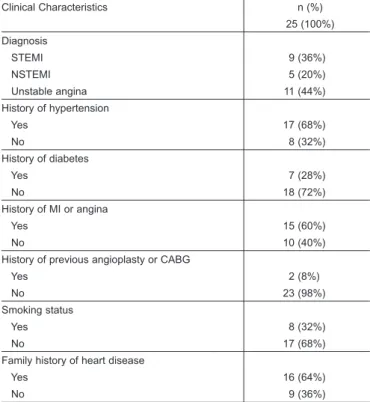
In total, a sample of 25 patients was utilized to test reliability of the tool. The mean age of the participants was 54.2 ± 11.23 years. 52% of the participants were males; whereas, 48% of them were females. Among the study participants, 44% were un-educated; while, 56% were educated. The clinical characteristics of the participants revealed that 36% of the participants suffered through ST segment elevation myocardial infarction (STEMI); whereas, 64% of them have had either non-ST segment elevation myocardial infarction (NSTEMI) or unstable angina. 68% of the participants were hypertensives, 60% had a previous history of myocardial infarction (MI) or angina, and 64% had a positive family history of heart disease. The demo-graphic and clinical characteristics of the study participants are highlighted in Table I and II, respectively. The test retest reliability for the Urdu translated modified RSQ came out to be 95.9%. The Cohen's Kappa for inter rater reliability was calculated to be K = 0.97 at p-value < 0.001 (Tables III and IV).
DISCUSSION
The RSQ was translated into the Urdu language for the very first time, therefore, relevance of the questions for the Pakistani context, and their clarity for an average Pakistani was in question. Testing the content validity of the Urdu translated RSQ proved to be a rewarding decision, as it resulted into quite an improvement of the tool, both in terms of relevance and linguistic appropriateness of the questions. Many questions were simplified, rearranged, divided or deleted as per the experts' suggestions. Moreover, some new questions were added according to the Pakistani context and some existing questions were modified so as to meet the contextual requirements. The end result was a simplified, understandable, relevant and contextually appropriate tool. The final CVI of one is an excellent validity index as per the literature.19These findings are
consistent with the English version of RSQ.7
Moreover, the decision to evaluate the test retest reliability was based on the postulation that there may be chances of recall bias associated with the participants' accounts, as they were being interviewed within 48 hours of their admission to the hospital, after the acute coronary event. Test retest reliability testing assured that the element of recall bias could not affect the findings significantly as the test retest reliability came out to be sufficiently good i.e. 95.9%.19 This finding is
consistent with the English version of RSQ.15
Adequately good test retest reliability can be attributed to the techniques of data collection, which helped the participants to recall the event accurately on both instances of data collection. For instance, the time of the onset of symptoms was verified in relation to a daily routine ritual, for instance meal time, and bed time etc. Moreover, linguistic simplicity of the questions also helped the participants to adequately understand the questions and to recall appropriately, on both instances of data collection.
Furthermore, inter rater reliability was done to assure that there were minimal differences between the ratings of the two raters i.e. the primary investigator and the data collector. RSQ was found to have a good inter rater reliability.19,20 The inter rater reliability of the Urdu
translated version of RSQ is consistent with the English version of RSQ.15Such good inter rater reliability can be
explained by the fact that the data collector was trained rigorously by the researcher; therefore, both PI and data collector had similar understanding of the questions and responses. Moreover, clarity and objectivity of the tool also played its due part in ensuring a good inter rater reliability.
Saleema Allana, Tazeen Ali, Khurshid Khowaja, Aamir Hameed Khan and Debra Kay Moser
Table I:Demographic characteristics of participants.
Demographic characteristics n (%) 25 (100%) Mean age 54.2 ± 11.23 years* Gender Male 13 (52%) Female 12 (48%) Marital status Married 20 (80%) Single 1 (4%) Widowed 4 (16%)
Educational status (years of education completed)
No education 11 (44%) 1 – 5 years 0 (0%) 6 – 10 years 8 (32%) 11 – 15 years 5 (20%) 16 – 20 years 1 (4%) Mean household monthly income Rs. 22,360 ± 13825.94* Status of house
Owned 15 (60%)
Rented 10 (40%)
* Mean ± standard deviation
Table II:Clinical characteristics of participants.
Clinical Characteristics n (%) 25 (100%) Diagnosis STEMI 9 (36%) NSTEMI 5 (20%) Unstable angina 11 (44%) History of hypertension Yes 17 (68%) No 8 (32%) History of diabetes Yes 7 (28%) No 18 (72%) History of MI or angina Yes 15 (60%) No 10 (40%)
History of previous angioplasty or CABG
Yes 2 (8%)
No 23 (98%)
Smoking status
Yes 8 (32%)
No 17 (68%)
Family history of heart disease
Yes 16 (64%)
No 9 (36%)
Table III:Inter rater reliability; rater 1 * rater 2 cross tabulation (SPSS output). Rater 2 Total 1.00 2.00 3.00 4.00 Rater 1 1.00 43 1 0 0 44 2.00 0 33 1 0 34 3.00 0 0 30 0 30 4.00 0 0 1 21 22 Total 43 34 32 21 130
Table IV:Cohen's Kappa calculation (SPSS output).
Value Asymp. Std. Approx. Tb Approx. Sig.
Erroraa
Measure of Kappa agreement 0.969 0.018 18.753 0.000 N of valid cases 130 – – –
CONCLUSION
The Urdu translation of RSQ has excellent CVI, inter rater and test retest reliabilities. It is recommended that the Urdu translated version of the modified RSQ should be used in future studies to explore the factor associated with pre-hospital delay among Urdu speaking ACS patient populations.
Acknowledgement: The authors would like to acknowledge the following experts who helped the authors with content validity: Dr. Imran Iftikhar (Consultant Cardiologist), Dr. Nabeel Jaffery (Consultant Cardiologist), Ms. Mehrunnissa Imran (Clinical Nurse Specialist, Critical Care), Ms. Anita Khowaja (Head Nurse, Coronary Care Unit), Mr. Rao Farooque (Clinical Nurse Instructor, Coronary Care Unit).
REFERENCES
1. World Health Organization. WHO country office in Pakistan [Internet]. 2007. Available from: http://www.emro.who.int/ pakistan/programmes_ncd.htm
2. Ghaffar A, Kazi BM, Salman M. Health care systems in transition III. Pakistan, part I: an overview of the health care system in Pakistan. J Public Health Med 2000; 22:38-42.
3. Lopez AD, Mathers CD, Ezzati M, Jamison DT, Murray CJ. Global burden of disease and risk factors [Internet]. 2006. Available from: http://files.dcp2.org/pdf/GBD/GBDFM.pdf 4. Ahmad K. Facing-up to Pakistan's cardiovascular challenge.
Lancet 2002; 359:859.
5. De Luca G, Suryapranata H, Ottervanger JP, Antman EM. Time delay to treatment and mortality in primary angioplasty for acute myocardial infarction: every minute of delay counts. Circulation
2004; 109:1223-5. Epub 2004 Mar 8.
6. Dracup K, Moser DK. Treatment-seeking behaviour among those with symptoms and signs of acute myocardial infarction.
Heart Lung 1991; 20:570-5.
7. Dracup K, Moser DK. Beyond sociodemographics: factors influencing the decision to seek treatment for symptoms of acute myocardial infarction. Heart Lung 1997; 26:253-62.
8. Noureddine S, Adra M, Arevian M, Dumit NY, Puzantian H, Shehab D, et al. Delay in seeking health care for acute coronary syndromes in a Labanese sample. J Transcult Nurs 2006; 17:341-8.
9. Okhravi M. Causes for pre-hospital and in-hospital delays in acute myocardial infarction at Tehran teaching hospitals. Aust Emerg Nurs J 2002; 5:21-6.
10. Xavier D, Pais P, Devereaux PJ, Xie C, Prabhakaran D, Reddy KS, et al. Treatment and outcomes of acute coronary syndromes in India (CREATE): a prospective analysis of registry data.
Lancet 2008; 371:1435-42.
11. Habib S, Noor A, Madni A, Zaman KS. Delays in thrombolytic therapy among patients with ST-elevation myocardial infarction presenting to a tertiary care hospital. Pak J Cardiol 2006; 17: 29-39.
12. Khan MS, Jafary FH, Faruqui AM, Rasool SI, Hatcher J, Chaturvedi N, et al. High prevalence of lack of knowledge of symptoms of acute myocardial infarction in Pakistan and its contribution to delayed presentation to the hospital. BMC Public Health 2007; 7:1-8.
13. Burnett RE, Blumenthal JA, Mark DB, Leimberger JD, Califf RM. Distinguishing between early and late responders to symptoms of acute myocardial infarction. Am J Cardiol 1995; 75: 1019-22.
14. McKinley S, Moser DK, Dracup K. Treatment-seeking behaviour for acute myocardial infarction symptoms in North America and Australia. Heart Lung 2000; 29:237-47.
15. Moser DK, McKinley S, Dracup K, Chung ML. Gender differences in reasons patients delay in seeking treatment for acute myocardial infarction symptoms. Patient Educ Couns
2005; 56:45-54.
16. Banks AD, Dracup K. Are there gender differences in the reasons why African Americans delay in seeking medical help for symptoms of an acute myocardial infarction? Ethn Dis 2007; 17: 221-7.
17. Noureddine S, Arevian M, Adra M, Puzantian H. Response to signs and symptoms of acute coronary syndrome: differences between Lebanese men and women. Am J Crit Care 2008; 17: 26-35.
18. Noureddine S. Patterns of responses to cardiac events over time. J Cardiovasc Nurs 2009; 24:390-7.
19. Polit DF, Beck CT, editors. Nursing research: generating and assessing evidence for nursing practice. 8th ed. Philadelphia:
Lippincott Williams & Wilkins; 2008.
20. Burns N, Grove SK, editors. The practice of nursing research: Appraisal, synthesis, and generation of evidence. 6th ed. Texas: