February 2003
Workgroup on Substance Abuse
Self-Help Organizations
Self-help organizations for alcohol and drug problems:
Towards evidence-based practice and policy
This paper is based primarily on the discussions of a workgroup on
alcohol and drug-related self-help organizations held at a meeting
funded by The Substance Abuse and Mental Health Services
Administration (SAMHSA), U.S. Department of Health and Human
Services and The Mental Health Strategic Healthcare Group, U. S.
Department of Veterans Affairs (VA). The coordinators and members
of the workgroup are listed at the end of this document
.
The conclusions in this document do not necessarily represent official
views of SAMHSA, the VA, or the organizations with which any
author or commentator on this paper are affiliated.
Acknowledgment
Keith Humphreys, Ph.D., Director, VA Program Evaluation and Resource Center, and Associate Professor of Psychiatry, Stanford University
Stephen Wing, M.S.W., Acting Associate Administrator for Alcohol Policy, SAMHSA
Dennis McCarty, Ph.D., Professor, Oregon Health and Science University
John Chappel, M.D. , Professor of Psychiatry, University of Nevada Lewis Gallant, Ph.D., Executive Director, NASADAD
Beverly Haberle, MHS, Project Director, Pennsylvania Recovery Organization PRO-ACT
A. Thomas Horvath, Ph.D., President, SMART Recovery Lee Ann Kaskutas, Dr. P.H., Scientist, Alcohol Research Group
Thomas Kirk, Ph.D., Commissioner, Connecticut Dept. Of Mental Health and Addiction Services
Daniel Kivlahan, Ph.D., Director, VA CESATE
Alexandre Laudet, Ph.D., Principal Investigator, National Development and Research Institute, Inc.
Barbara S. McCrady, Ph.D., Professor II, Rutgers University A. Thomas McLellan, Ph.D. Professor, University of Pennsylvania Jon Morgenstern, Ph.D., Vice-President, CASA
Mike Townsend, M.S.S.W., Director, Kentucky Division of Substance Abuse Roger Weiss, M.D., Associate Professor of Psychiatry, Harvard Medical School
Sonya A. Baker, Program Manager, Santa Barbara Council on Alcoholism and Drug Abuse/Community Recovery Network
T. Robert Burke, Trustee, Stanford University
Herman Diesenhaus, Senior Evaluation Specialist, CSAT
Dona M. Dmitrovic, Exec. Director, Pennsylvania Recovery Organizations Alliance
R. John Gregrich, Chief, Treatment Branch, Office of National Drug Control Policy Tom Hill, Senior Policy Associate, Health Systems Research
Mike Hilton, Health Scientist Administrator, NIAAA
George Kosniak, Deputy Director, National High Intensity Drug Trafficking Area Program, Office of National Drug Control Policy
John Mahoney, Former Deputy Administrator, HRSA
Kate Malliarakis, Former Branch Chief for Specific Drugs, Office of National Drug Control Policy
J. Paul Molloy, Chief Executive Officer, Oxford House, Inc. Harold Perl, Chief, Health Services Research Branch, NIAAA Rick Sampson, Director, Alliance Project
Richard Suchinsky, Associate Chief Consultant for Addictive Disorders, VA Mental Health Strategic Healthcare Group
Workgroup on Substance Abuse
Self-Help Organizations
Coordinators Member Other individuals who commented on this document and/or workgroup deliberationsContent
EXECUTIVE SUMMARY 1
PURPOSE AND BACKGROUND 4
Goal... 4
Development Process... 4
Terminology ... 4
The nature and status of addiction self-help organization in the u.s... 5
RESEARCH ON THE EFFECTIVENESS AND COST-EFFECTIVENESS OF ADDICTION-RELATED SELF-HELP ORGANIZATIONS 10
Synthesis of effectiveness research results ...15
POTENTIAL IMPLICATIONS FOR CLINICIANS TREATMENT PROGRAMS AND POLICYMAKERS 1
Clinicians and treatment program directors...17
Potential implications for policymakers ...21
CONCLUSION 28
Self-help groups constitute a significant part of the de facto system of care for
alcohol and drug problems in the United States. This document reviews evidence
on the effectiveness of such self-help groups and presents potential implications for
clinicians, treatment program managers and policymakers. The document is based
on the conclusions of an expert workgroup, review of the scientific literature, and
the comments of many individuals with knowledge of self-help groups, addiction
treatment, and public policy.
Key findings about the status of self-help groups in the United States were:
(1) They are the most frequently accessed resource for alcohol and other drug
problems, (2) Over six million adults a year have contact with addiction self-help
groups, (3) Organizations based on the “twelve steps” (e.g., Alcoholics Anonymous)
are larger and more available than non-12-step organizations,
(4) Important alternatives to traditional drug and alcohol self-help groups exist both
for individuals desiring a different approach, and, for individuals experiencing a
comorbid serious psychiatric disorder.
Key findings from the research on the effectiveness of self-help groups were:
(1) Longitudinal studies associate 12-step self-help group involvement with
reduced substance use and improved psychosocial functioning, (2) Twelve step
self-help groups significantly reduce health care utilization and costs, (3)
Self-help groups are best viewed as a form of continuing care rather than as a
substitute for acute treatment services, (4) Randomized trials with coerced
populations suggest that Alcoholic Anonymous (AA) combined with
professional treatment is superior to AA alone, (5) Non-12-step self-help groups
have not been subjected to longitudinal outcome evaluation but it is reasonable
to suspect they also benefit members.
Potential implications for clinicians and treatment program managers were:
(1) Clinicians should use empirically-validated self-help group referral methods,
(2) Clinicians should support a variety of self-help group and
treatment-facilitated pathways to recovery, (3) Efforts to train clinicians about facilitating
self-help group involvement should include incentives for changing clinical
practice and should be sensitive to cultural diversity, (4) Self-help group
referrals should occur in non-specialty health care settings as well as in
addiction treatment programs, (5) Clinicians should recognize and communicate
to patients that many individuals recover through AA, but others recover
through self-help groups other than AA, or, without attending any self-help
group at all, (6) Even treatment programs that label and represent themselves as
“12-step oriented” should evaluate whether their current program practices
actively support involvement in 12-step self-help groups.
Potential policy opinions, based both on the scientific literature and on policy
in self-help clearinghouses, (2) Making public facilities and institutions self-help
group friendly, (3) Disseminating information on self-help groups, (4) Adopting
the principle of “informational parity”, (5) Creating and supporting innovative
services that promote self-help group involvement, (6) Credentialing and training
healthcare professionals in linking patients to help groups, (7) Fostering
self-help organizations for under-served populations, (8) Expanding opportunities for
self-help organizations in criminal justice settings, (9) Discouraging the use of
self-help groups as a replacement for treatment, (10) Expanding research on drug
and alcohol self-help groups, (11) Expanding residential self-help options,
(12) Supporting opportunities for family members of addicted people to be
involved in mutual help organizations.
Implementing strategies such as the above has significant potential to strengthen
alcohol and drug self-help organizations. This in turn would enhance the
effectiveness of the national response to the serious public health problem of
Self-help organizations are an important resource for addressing substance abuse,
a serious public health problem that contributes to 500,000 deaths and over $400
billion in economic costs in the United States each year.1 This white paper
summarizes key research findings on addiction-related self-help groups and
assesses their implications for direct service providers, treatment programs, state
agencies and policymakers.
This paper is drawn primarily from the conclusions of a workgroup of national
experts on substance abuse self-help organizations that met November 6-7, 2001,
in Washington, D.C. The information from the workgroup was supplemented by
review of scientific publications, and by the comments of workgroup participants,
observers, self-help group members, and other stakeholders on earlier drafts of
this report.
Addiction and addiction-related refer to all substance-related problems,
including dependence on alcohol, illicit drugs, or nicotine, as well as being in a
close relationship with a person who has such problems (e.g., a spouse or parent).
Self-help group/organization refers to non-professional, peer-operated
organizations devoted to helping individuals who have addiction-related
problems. The term “mutual help group” is also sometimes used to reflect the
fact that group members give and receive advice, encouragement and support.
PURPOSE AND BACKGROUND
GoalDevelopment Process
Self-help groups do not charge fees and should not be equated with professional
treatment services.
Twelve-step organizations refers to those self-help groups that rely on a
particular philosophy of recovery that emphasizes the importance of accepting
addiction as a disease that can be arrested but never eliminated, enhancing
individual maturity and spiritual growth, minimizing self-centeredness, and
providing help to other addicted individuals (e.g., sharing recovery stories in
group meetings, sponsoring new members). Alcoholics Anonymous (AA) and
Narcotics Anonymous (NA) are the best known of the subset of self-help
organizations that rely on the twelve steps.
Americans participate in a variety of self-help groups for chronic health problems,
including Alzheimer’s disease, diabetes, cardiovascular disease, obesity, and
serious mental illness. Self-help group participation is common, with 18% of
American adults having attended a self-help group at some point in their life and
7% having done so in the previous 12 months.2 Addiction-related problems are
the most common concern that leads people to attend a self-help group, about 6%
of Americans participated for this reason sometime in their lifetime and about 2%
did so in the previous 12 months. Over two million Americans are currently
members of an addiction-related self-help group and over six million will seek
help from such groups in any given year.2 In fact, Americans make more visits to
self-help groups for substance abuse and psychiatric problems than they do to all
mental health professionals combined.3
The nature and status of addiction self-help organizations in the U.S.
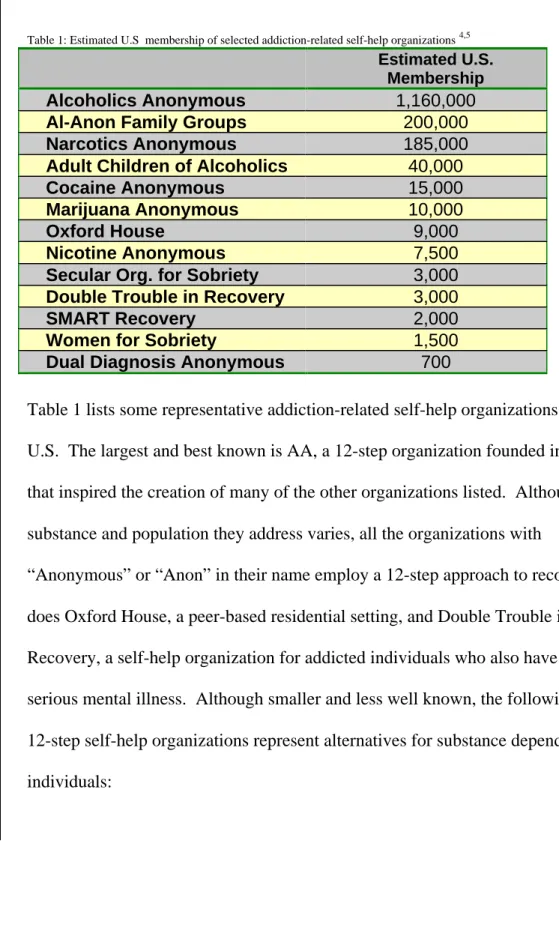
Table 1: Estimated U.S membership of selected addiction-related self-help organizations4,5 Estimated U.S.
Membership
Alcoholics Anonymous 1,160,000
Al-Anon Family Groups 200,000
Narcotics Anonymous 185,000
Adult Children of Alcoholics 40,000
Cocaine Anonymous 15,000
Marijuana Anonymous 10,000
Oxford House 9,000
Nicotine Anonymous 7,500
Secular Org. for Sobriety 3,000
Double Trouble in Recovery 3,000
SMART Recovery 2,000
Women for Sobriety 1,500
Dual Diagnosis Anonymous 700
Table 1 lists some representative addiction-related self-help organizations in the
U.S. The largest and best known is AA, a 12-step organization founded in 1935
that inspired the creation of many of the other organizations listed. Although the
substance and population they address varies, all the organizations with
“Anonymous” or “Anon” in their name employ a 12-step approach to recovery, as
does Oxford House, a peer-based residential setting, and Double Trouble in
Recovery, a self-help organization for addicted individuals who also have a
serious mental illness. Although smaller and less well known, the following
non-12-step self-help organizations represent alternatives for substance dependent
Secular Organization for Sobriety embraces rationality and scientific knowledge
and does not include any spiritual content. The organization believes that
abstinence can be achieved through group support and through making sobriety
one’s priority in life.
Smart Recovery views excessive use of alcohol and other drugs as a maladaptive
behavior rather than a disease. Its goal is to use scientifically informed
cognitive-behavioral techniques to enhance members’ motivation to abstain, ability to cope
with cravings, capacity to identify and modify irrational thinking, and judgment to
balance momentary and enduring satisfactions.
Women For Sobriety was founded in 1976 to help women alcoholics recover
through a positive, feminist program that encourages increased self-worth and
enhanced emotional and spiritual growth. It emphasizes the value of having
all-female groups to improve members’ self-esteem and facilitate their self-discovery.
In addition, another mutual help organization may present an alternative for those
who abuse alcohol but are not dependent on it:
Moderation Management is a self-help group network of about 500-1000 people
who have decided to reduce or stop their drinking and make other positive lifestyle
changes. Founded in 1993, it operates under the premise that problem drinking,
under control. Moderation Management is the only organization mentioned in this
document that generally attracts individuals with relatively minor (non-dependent)
substance problems.6
In addition to varying in approach, philosophy, and size, self-help organizations also
vary in their governance structure, organizational traditions (e.g., willingness to
accept outside financial support, encouragement of lifetime membership) and racial
and ethnic diversity. These differences notwithstanding, none of the above
organizations charge fees, require appointments, or place limits on number of visits.
Members can therefore attend them indefinitely if they wish. This point is critically
important in light of the emerging conception that addiction is best treated as a
chronic health problem, akin to diabetes and hypertension in its desired
management.7 Acute care interventions (e.g., hospitalization) are important for
addressing immediate medical needs, for stabilization, and for encouraging
engagement in continuing care, but they do not in themselves cure chronic health
problems. Rather, chronic health problems are managed by lower intensity supports
over time. 8 Self-help groups are an important enduring support for recovery from
the chronic health problem of substance dependence, and complement rather than
compete with acute care interventions.
A final important point about self-help organizations is that their growth can be
fostered or limited by external forces. For example, AA experienced a significant
highly favorable article. More generally, non-profit self-help clearinghouses have
referred many potential members to self-help groups and have facilitated the
founding of many groups. Clinician referrals also result in a significant number of
people affiliating with self-help organizations; similarly, negative clinician
attitudes can discourage participation. And finally, a number of countries,
including Australia, Canada, Germany, Poland and Japan have provided funding
for the infrastructure of self-help organizations and have successfully promoted
their growth.5
Several conclusions emerge from this description of self-help organizations that have
implications for clinicians, agencies and policy makers:
Ø A diverse set of self-help organizations has developed for all substances of significant public health concern.
Ø Collectively, these self-help organizations are both appealing and affordable to a broad spectrum of people.
Ø Clinical, agency, and governmental procedures and policy influence the prevalence, organizational stability, and availability of addiction-related
self-help groups.
Summary of Status of U.S. Self-Help Groups
The effectiveness of interventions for substance abuse must be
understood in light of two facts. First, like other chronic health
problems,7 addictive disorders are difficult to resolve and no
intervention produces complete and permanent abstinence in all cases, or
even in a majority of them. Second, financial resources for addiction
treatment are always constrained, such that any judgment about whether
an intervention is valuable needs to consider its costs as well as its
effectiveness.
The “effectiveness” of self-help organizations can be conceptualized in a
number of ways (e.g., how fast an organization grows, how it handles
change, whether its members are satisfied with it). However, most
clinicians, agency directors and policy makers are interested primarily in
two specific questions about effectiveness: (1) Does self-help group
participation reduce substance abuse and if so at what fiscal cost?, and
(2) Do self-help groups benefit members and society in addition to
potentially reducing substance use per se?
Most outcomes research on addiction mutual help groups focuses on
AA, with NA being the next most commonly studied organization. Very
RESEARCH ON THE EFFECTIVENESS AND
COST-EFFECTIVENESS OF ADDICTION-RELATED
SELF-HELP ORGANIZATIONS
little outcomes research has been conducted on non-12-step based
self-help groups. An additional important caveat is that almost every study
in this area has been conducted on adults, leaving the possible effects
of groups on adolescent substance users a much understudied question.
Although considered by some to be the most rigorous scientific test of
effectiveness, there are only three randomized controlled trials of
community-based self-help groups. All were conducted on AA and all
used coerced samples. The first, conducted in the late 1960s, showed
that, compared with individuals assigned to a treatment program or no
treatment, a court order to attend five AA meetings did not reduce
number of arrests for chronic drunkenness. 9 Unfortunately, this study
gathered no information on alcohol use9 per se. The other two trials
studied a range of outcomes, and compared AA alone to professional
treatments combined with AA attendance. 10 Both suggested worse
clinical outcomes for AA alone, one in terms of more individuals
dropping out and the other in terms of number of relapses over time. At
the same time, individuals assigned to AA alone in both of these trials
improved in absolute terms from baseline, and had significantly lower
health care costs over time than did those individuals assigned to
treatment plus AA.
Because randomized trials involve only a small and unrepresentative
quasi-experiments, i.e., assessed outcomes over time among otherwise similar
individuals who did or did not become involved in an addiction-related
mutual help groups. Using this approach, one research team studied
887 substance dependent patients treated in inpatient programs that
strongly emphasized the importance of 12-step self-help group
involvement with those of 887 individuals treated in inpatient programs
that had no such emphasis.11 At treatment intake, the two groups of
patients were comparable on treatment history, alcohol and drug
problems, psychiatric problems, demographic variables, and motivation.
At one-year follow-up, those who were encouraged to join self-help
groups were significantly more likely to be abstaining from drugs and
alcohol. Further, these patients also relied more on self-help groups and
less on further treatment services for support after discharge, reducing
their health care costs by almost $5000 a year. This study was
conducted on male patients, most of whom were African-American or
Hispanic. Hence, it is worth mentioning that very similar clinical
outcomes and cost-offset findings were found in a separate study
conducted with several hundred alcohol-abusing individuals, most of
whom were Caucasian and about half of whom were female.12
A third type of study examines the correlation between self-help group
involvement and substance use, with or without a comparison group of
non-participants, and sometimes without a longitudinal design for
tracking change over time. Almost all such studies find that AA
reduced consumption, fewer alcohol dependence symptoms), and that
NA/CA attendance is associated with better drug-related outcomes.5
These same studies also show that members who engage in other group
activities in addition to attending meetings -- reading program literature,
sponsoring new members, applying the twelve steps to daily life – are
more likely to abstain from substances than are individuals who do not
engage in these activities. Yet such correlational studies do not prove
that the self-help group caused the positive outcome from a purely
scientific standpoint; they show only that there was a positive outcome.
Finally, although treatment is not a help group, some studies of
self-help influenced treatments provide relevant evidence. The best known
of these studies is Project MATCH, which randomly assigned alcohol
dependent patients to one of three treatments delivered over a
three-month period. 13 Treatments were manual-guided 12-step facilitation
therapy, cognitive-behavior therapy and motivational enhancement
therapy. One year post-treatment outcomes were largely similar for
patients in all three conditions in terms of increased days of abstinence,
as well as reduced average number of drinks consumed per day.
Individuals treated in 12-step facilitation therapy attended significantly
more 12-step self-help group meetings and were more likely to have
maintained continuous abstinence. Patients receiving 12-step
facilitation continued to have higher rates of continuous abstinence three
years after treatment, and, when compared with patients receiving
Finally, regardless of assigned treatment condition, more 12-step
self-help group attendance was associated with better outcomes.
Encouraging results were also found in a major clinical trial addressing
cocaine dependent patients. The Collaborative Cocaine Treatment Study
found that patients randomly assigned to group and individual
counseling sessions in which they were strongly encouraged to attend
self-help groups showed more consistent attendance and more
consecutive months of cocaine abstinence during follow-up compared
with the other three treatments, which included only
professionally-administered therapies.14
Three other studies of self-help influenced treatment warrant mention. A
study of drug dependent patients found that those randomly assigned to an
aftercare program incorporating a self-help-style group and network of
supportive former patients were about 40% less likely to relapse over the
next six months compared with those receiving usual aftercare.15 A
second study found that alcohol dependent patients randomly assigned to
an experimental treatment program that emphasized peer responsibility
and mutual help had higher treatment engagement and dramatically lower
health care costs at 1-year follow-up.16 A third study randomly assigned
adult substance dependent patients who had been raised by substance
Children of Alcoholics or didactic education classes about substance
abuse.17 Those patients who were assigned to self-help groups were
significantly less likely to use drugs and alcohol after treatment discharge.
The studies described above suggest that self-help group involvement
reduces substance use and also lowers health care costs. These and a
number of other research projects have also documented other benefits of
self-help group participation, including enhanced self-efficacy, improved
social support, reduced depression and anxiety, and more effective coping
with stress. The benefits of addiction self-help groups thus seem to extend
beyond reductions in substance use per se.
The research cited above focuses on AA and NA. Many of the findings
may generalize to other mutual help organizations. Research has not been
undertaken to date to investigate this hypothesis, however.
A significant body of research has documented an association between
12-step self-help group participation and positive outcomes, and, has
suggested mechanisms by which these positive outcomes are generated.
In addition, there are approximately 2 million Americans that have
“voted with their feet” by joining addiction-related self-help groups,
sometimes in the face of ambivalence by clinicians. Many
improvements remain to be made in self-help group research, but at
Synthesis of effectiveness research results
present the following represent reasonable conclusions based on the
existing research:
Ø Longitudinal studies associate Alcoholics Anonymous and Narcotics Anonymous participation with greater likelihood of abstinence,
improved social functioning, and greater self-efficacy. Participation
seems more helpful when members engage in other group activities in
addition to attending meetings.
Ø Twelve step self-help groups significantly reduce health care utilization and costs, removing a significant burden from the health
care system.
Ø Self-help groups are best viewed as a form of continuing care rather than as a substitute for acute treatment services (e.g., detoxification,
hospital-based treatment, etc.).
Ø Randomized trials with coerced populations suggest that AA combined with professional treatment is superior to AA alone.
Ø Non-12-step self-help groups have not been subjected to longitudinal outcome evaluation but it is reasonable to suspect they also benefit
The foregoing indicates that addiction-related mutual help organizations
likely contribute significantly to public health and also lower health care
costs. Clinicians, treatment providers, and policymakers may therefore
wish to develop and implement practices and policies that increase the
likelihood that addicted individuals will seek out mutual help
organizations, and, that these organizations will become more prevalent
and accessible to a broad array of people. The remainder of this paper
presents potential courses of action, focusing first on clinicians and
treatment programs, and then turning to policymakers.
Clinicians and treatment program directors
Many people believe that all American substance abuse treatment
programs are based on the twelve steps and that all clinicians in them are
already promoting self-help groups, so there is really nothing that could
be done to make treatment programs better at facilitating self-help group
involvement. Research does not support these assumptions. Even
practitioners who describe themselves as “12-step oriented” consider
only a subset of 12-step processes important for clients. Further, few
professionals report operating from a pure 12-step approach, preferring
POTENTIAL IMPLICATIONS FOR CLINICIANS,
TREATMENT PROGRAMS AND POLICYMAKERS
instead an eclectic mix of approaches, e.g., 12-step,
cognitive-behavioral, motivational interviewing, psychodynamic, family systems,
etc. These findings have been confirmed in videotape studies of
psychotherapy sessions, which show counselors emphasizing some
aspects of the 12 steps, such as AA affiliation, and not emphasizing
others, such as spirituality.18 When counselors do attempt to support
12-step self-help group involvement, they rarely use empirically-supported
methods. Finally, many clinicians are not even aware of alternatives to
12-step self-help groups. There is thus a great deal of improvement to
be made in these areas.
Research has clearly demonstrated that when clinicians use
empirically-validated techniques to support mutual help group involvement, it is far
more likely to occur.14,19 Educating clinicians about such techniques
may be helpful in some cases, but in general, merely providing
empirically-supported treatment guidelines to clinicians rarely changes
their practice patterns significantly. Changing the behavior of clinicians
is a significant challenge upon which addiction researchers are only
beginning to focus significant attention.
In addition to changing clinical behavior, efforts to promote self-help
patients' transition from treatment to self-help groups. Some treatment
providers see self-help groups negatively, positing that they may foster
unhealthy dependence or detract from personal autonomy. Other
providers think that AA is the only self-help organization that exists or is
the only intervention of any value. Other misconceptions include the
belief that all self-help organizations have a spiritual component, or that
spirituality must be central for every member of AA, NA and other
12-step groups. In reality, there are many pathways to recovery involving a
variety of self-help groups and treatments.20 Hence, provider education
must address both attitudes and behaviors in order to create a successful
interface of clinicians with a broad self-help group network.
Any professional education strategy along these lines must recognize
two important points. First, most investigations have focused on
specialty substance abuse treatment providers and researchers thus know
little about how non-specialty providers (e.g., emergency room
physicians) refer addicted patients to self-help groups, or for that matter
if they do so at all. Second, any effort to change clinical behavior,
regardless of the treatment specialty concerned, must be sensitive to the
diversity of patients. Some substance abuse self-help organizations, for
example SMART Recovery, Women for Sobriety and Moderation
Management have an almost entirely Caucasian, middle class
proportion of people of color, but individual chapters of these
organizations may not necessarily be diverse. Clinicians should be
sensitive to potential patient discomfort among patients going to a
self-help group with few or no people of their racial or ethnic background.
Relatedly, gay and lesbian patients may prefer specialty meetings (such
as AA offers), and clinicians should be aware of this and also of where
such meetings are held. In summary, because of cultural differences
(e.g., in spiritual beliefs, expectations about self-disclosure) and other
diversity issues, all self-help organizations may not be equally appealing
or helpful to all patients. These and other diversity issues need to be
thoughtfully addressed.
The following strategies could be employed by individual clinicians, clinical
supervisors, and program directors:
Ø Clinicians should use empirically-validated methods (e.g., twelve-step
facilitation counseling, motivational enhancement techniques) when seeking to
foster self-help group engagement.
Ø Given the variety of pathways to recovery, clinicians should have a menu of treatment and self-help group options available for use when selecting care
alternatives in consultation with the client and other stakeholders.
Potential Strategies
Ø Efforts to train clinicians about facilitating self-help group involvement should include incentives for changing clinical
practice and should be sensitive to cultural diversity.
Ø Effective referrals to addiction self-help groups should occur in both non-specialty and specialty health care programs.
Ø Clinicians should recognize and communicate to patients that many individuals recover through AA, but others recover through
help groups other than AA, or, without attending any
self-help group at all.
Ø Even treatment programs that label and represent themselves as “12-step oriented” should evaluate whether their current program
practices actively support involvement in 12-step self-help groups.
Potential implications for policymakers
A number of countries outside of the U.S. have implemented policies
designed to foster the growth of mutual help organizations.10 In the
U.S., some treatment systems, states and federal agencies have also
attempted such initiatives. As with all policies, efforts in this area will
face challenges at both the state and national level related to funding,
coordination and implementation. In addition, there is an added concern
particular to this area. Any efforts to support self-help organizations
must recognize that by tradition, 12-step organizations do not accept
direct outside financial support. Even for self-help organizations that
do, it is important not to bureaucratize or co-opt what is essentially a
grassroots movement. These challenges are worth meeting because of
the potential for self-help groups to be a cost-effective intervention for
addiction.
Like self-help organizations themselves, the self-help supportive
infrastructure varies in strength and organization from place to place.
Non-profit organizations known as “self-help clearinghouses” exist in
some areas, and provide information about, referrals to, and technical
support for mutual help organizations for addictions and other health
problems. Help-lines and human service agencies in some parts of the
country also provide information on self-help groups.
“Recovering” counselors and alumni groups at addiction treatment
centers are an additional important component of self-help
group-supportive infrastructure. In the wake of managed care and changes in
may be weakening in strength, thereby requiring other concerned health
care professionals to become involved in the process. Whether
individuals not in recovery have the knowledge and skills to facilitate
connections between addicted patients and self-help groups is unknown.
Given the above context, it may be desirable to implement policies that could
strengthen the infrastructure supporting mutual help organizations. The following
policy efforts have been implemented in some nations or states, and might be
replicated in other contexts.
Ø Invest resources in self-help clearinghouses. These organizations
can support a broad variety of alcohol and drug-related self-help
groups without violating the traditions of those that do not accept
funding.
Ø Make public facilities and institutions self-help group friendly.
This includes not only allowing groups to use space for meetings,
but also inviting them to hold groups in settings where they may
not have a historical presence, for example some clinics, hospitals,
religious organizations, and community centers.
Ø Disseminate information on self-help groups. Government
Potential Strategies
agencies and interested non-governmental organizations could post
lists of self-help organizations on their web sites and/or provide
links to web sites operated by self-help organizations that provide
such information. Such dissemination efforts could also provide
information on evidence-based practices related to self-help groups
as a recovery resource.
Ø Adopt the principle of “informational parity”. Dissemination
efforts of all forms should include information on the full range of
mutual help group alternatives. As long as mutual help groups are
voluntary in nature, respect the civil rights of participants, address
substance abuse, are not professional treatments mislabeled as
self-help groups, and have some evidence of effectiveness, they should
be included on listings of drug and alcohol self-help groups.
Ø Create and support innovative services that promote self-help
group involvement. Examples include the recovery coaches funded
through the Arizona Medicaid program and a program in
Philadelphia that provides funds to an organization that accepts
responsibility for transitioning the individual into self-help groups.
Similarly, SAMHSA's Center for Substance Abuse Treatment
(CSAT) launched the Recovery Community Services Program to
peer-to-peer services. Examples of services under this new
program include recovery coaching and mentoring, peer case
management, peer education in life skills (e.g., parenting,
communication) and health topics, assistance and referral with
housing, employment, education, and related activities.
Ø Credential and train healthcare professionals in linking patients to
self-help groups. Because staff with strong connections to local
self-help groups may not be present in all settings, all health care
professionals should have some knowledge about how to refer
patients effectively to groups.
Ø Foster self-help organizations for under-served populations. New
York State’s Mental Health Empowerment Project successfully
assisted consumers of mental health services to organize self-help
groups for dually-diagnosed people. Similar programs, that provide
support without professionalizing or bureaucratizing self-help
groups, might be tried with other underserved groups, such as
adolescents and residents of rural areas.
Ø Expand opportunities for self-help organizations in criminal
Ø offenders in conjunction with treatment in correctional facilities and in the community. For example, invitations might be given
to groups to hold meetings in juvenile detention facilities, jails,
prisons, probation services, and parole departments. Given the
coercive nature of treatment in criminal justice settings, program
directors and clinicians should avoid forcing clients to participate
in self-help groups when it is not appropriate, and should offer
alternatives to such clients.
Ø Discourage the use of self-help groups as a replacement for
treatment. Research shows that many clients require the support
both of treatment programs and of self-help groups. Using the
success of self-help groups as a pretext for delaying or reducing
support for treatment services is therefore inappropriate.
Addiction self-help organizations typically see themselves as an
ally, rather than as a competitor to professional treatment
programs; other stakeholders in this area should adopt the same
perspective.
Ø Expand research on drug and alcohol self-help groups. Evaluation
research on both 12-step and non-12 step self-help groups should
Ø mechanisms through which self-help groups effect change, and on policy interventions that might promote technology transfer and
self-help group involvement. Establishing a National Center for
Research and Technology Transfer on Self-Help Groups and
Addiction could provide an important focus for such activities.
Ø Expand residential self-help options. Oxford House is a national
program with over 850 peer-managed houses. Connecticut and
California also have successful residential models of peer-managed
services for addicted individuals. Fostering the development of
more self-help based housing could be a cost-effective strategy for
providing recovery-supportive environments for substance
dependent individuals, including those who are homeless.
Ø
Support opportunities for family members of addicted people to beinvolved in mutual help organizations. One of the discoveries of
CSAT’s recovering communities program was that families do not
always feel a part of the recovering person’s involvement in a
self-help organization. Accordingly, all of the above efforts should
include a focus on family members and family-focused mutual
Addiction self-help organizations are a major resource for addicted
individuals, as well as for those who treat addicted people, work with them,
and care about them. Research to date suggests that self-help groups can be
beneficial, but also cautions that we have much more to learn about how
they work and how they can be supported through clinical, agency, and
policy actions. The strategies presented herein are therefore a set of initial
steps and are neither the final word nor a panacea. Yet they do hold
significant promise of strengthening addiction self-help groups and thereby
helping more individuals recover from drug and alcohol problems.
Notes and References
1 Horgan C, Skwara KC, & Strickler G. (2001). Substance abuse: The nation’s number one health problem. Princeton, NJ: The Robert Wood Johnson Foundation.
2 The most detailed and reliable survey data on drug and alcohol self-help groups can be found in the following two scientific articles: Kessler RC, Mickelson KD, & Zhao S. (1997). Patterns and correlates of self-help group membership in the United States. Social Policy, 27, 27-46; Room R, & Greenfield, T. (1993). Alcoholics Anonymous, other 12-step movements and psychotherapy in the US population, 1990. Addiction, 88, 555-562.
3 Kessler RC. et al. (1997). Differences in the use of psychiatric outpatient services between the U.S. and Ontario. New England Journal of Medicine, 336, 551-557.
4 White, B., & Madara, E. (1998). The self-help sourcebook: Your guide to community and online support groups, 6th Edition. Denville, NJ: American Self-Help Clearinghouse.
5 Humphreys, K. (In press). Circles of Recovery: Self-help organizations for addictions. International Research Monographs on Addiction, Cambridge University Press, UK.
6 Humphreys, K., & Klaw, E. (2001). Can targeting non-dependent problem drinkers and providing internet-based services expand access to assistance for alcohol problems?: A study of the Moderation Management self-help/mutual aid organization. Journal of Studies on
Alcohol, 62, 528-532.
7 McLellan, A. T., Lewis, D. C., O’Brien, C. P., & Kleber, H. D. (2000). Drug dependence, a chronic medical illness: Implications for treatment, insurance, and outcomes evaluation.
Journal of the American Medical Association, 284, 1689-1695.
8 Humphreys K, & Tucker J. (2002). Towards more responsive and effective intervention systems for alcohol-related problems. Addiction, 97, 126-132.
9 Ditman KS, Crawford GG, Forgy EW, Moskowitz H, & Macandrew C. (1967). A controlled experiment on the use of court probation for drunk arrests. American Journal of
Psychiatry, 124, 64-67
10 Brandsma, J. M., Maultby, M.C., & Welsh, R. J. (1980). Outpatient treatment of
alcoholism: A review and comparative study. Baltimore, MD: University Park Press; Walsh DC, Hingson RW, & et. al. (1991). A randomized trial of treatment options for alcohol-abusing workers. The New England Journal of Medicine, 325, 775-782.
11 Humphreys K, & Moos RH. (2001). Can encouraging substance abuse inpatients to participate in self-help groups reduce the demand for outpatient aftercare?: A quasi-experimental study. Alcoholism: Clinical and Experimental Research,25, 711-716.
12 Humphreys K, & Moos R. (1996). Reduced substance abuse-related health care costs among voluntary participants in Alcoholics Anonymous. Psychiatric Services, 47, 709-713.
13 Many of the main findings of Project MATCH are described in these two publications: Project MATCH Research Group (1997). Matching alcoholism treatments to client heterogeneity: Project MATCH posttreatment drinking outcomes. Journal of Studies on
Alcohol, 58, 7-29; Babor, T., & Del Boca, F. (In press). Treatment matching in alcoholism.
Cambridge, UK: Cambridge University Press.
14 The overall design of the CCTS is described in: Crits-Cristoph P, Siqueland L, Blaine J. et al. (1999). Psychosocial treatments for cocaine dependence: National Institute on Drug Abuse Collaborative Cocaine Treatment Study. Archives of General Psychiatry, 56, 493-502. Self-help group-related results are described in the most detail in two papers by Roger
Weiss and colleagues: (2000). Self-help group attendance and participation among cocaine dependent patients. Drug and Alcohol Dependence, 60, 169-177; (1996). Self-help activities in cocaine dependent patients entering treatment: Results from the NIDA collaborative cocaine treatment study. Drug and Alcohol Dependence, 43, 79-86.
15 McAuliffe, W. E. (1990). A randomized clinical trial of recovery training and self-help for opiod addicts in New England and Hong Kong. Journal of Psychoactive Drugs, 22, 197-209.
16 Galanter, M. (1984). Self-help large group therapy for alcoholism: A controlled study.
Alcoholism: Clinical and Experimental Research, 8, 16-23.
17 Kingree J, & Thompson M. (2000). Mutual help groups, perceived status benefits, and well-being: A test with adult children of alcoholics with personal substance abuse problems.
American Journal of Community Psychology, 28. 325-342.
18 Morgenstern, J., & McCrady, B. S. (1993). Cognitive processes and change in disease-model treatment. In BS McCrady & WR Miller (Eds.), Research on Alcoholics Anonymous: Opportunities and alternatives (pp. 153-166). New Brunswick, NJ: Rutgers Center of
Alcohol Studies.
19 Sisson RW, & Mallams JH. (1981). The use of systematic encouragement and community access procedures to increase attendance at Alcoholics Anonymous and Al-Anon meetings.
American Journal of Drug and Alcohol Abuse, 8, 371-376.; Nowinski J, Baker S, & Carroll
K. (1995). Twelve-step facilitation therapy manual: A clinical research guide for therapists treating individuals with alcohol abuse and dependence. NIAAA (NIH Publication #94-3722): Rockville, MD.
20 Fletcher, A. (2001). Sober for Good: New solutions for drinking problems. Boston: Houghton Mifflin; see also research by Patricia Penn and Audrey Brooks (2000) in Journal
of Rational-Emotive and Cognitive-Behavioral Therapy, 18, 197-208 suggesting that for dual
diagnosis patients, twelve-step oriented treatment may reduce substance abuse more
effectively, whereas SMART recovery oriented treatment may reduce psychiatric symptoms more effectively.