ePub
WU
Institutional Repository
Alyssa Schneebaum and Bernhard Rumplmaier and Wilfried Altzinger
Gender in Intergenerational Educational Persistence Across Time and Place
Article (Accepted for Publication) (Refereed)
Original Citation:
Schneebaum, Alyssa and Rumplmaier, Bernhard and Altzinger, Wilfried (2015) Gender in
Intergenerational Educational Persistence Across Time and Place. Empirica, 42 (2). pp. 413-445.
ISSN 1573-6911
This version is available at: http://epub.wu.ac.at/5721/
Available in ePubWU: September 2017
ePubWU, the institutional repository of the WU Vienna University of Economics and Business, is
provided by the University Library and the IT-Services. The aim is to enable open access to the scholarly output of the WU.
This document is the version accepted for publication and — in case of peer review — incorporates referee comments. There are differences in punctuation or other grammatical changes which do not affect the meaning.
Gender in Intergenerational Educational
Persistence Across Time and Place
Alyssa Schneebaum, Bernhard Rumplmaier, Wilfried Altzinger∗Department of Economics
Vienna University of Economics and Business
February 2015
Abstract
Primarily using data from the 2010 European Social Survey, we analyze inter-generational educational persistence in 20 European countries, studying cross-country and cross-cluster differences; changes in the degree of intergenerational persistence over time; and the role of gender in determining educational persistence across gen-erations. We find that persistence is highest in the Southern and Eastern European countries, and lowest in the Nordic countries. While persistence in the Nordic and Southern countries has declined over time, it has remained relatively steady in the rest of Europe. Our analysis highlights the importance of a detailed gender anal-ysis in studying intergenerational persistence, finding that mothers’ education is a stronger determinant of daughters’ (instead of sons’) education and fathers’ education a stronger determinant of the education of their sons. For most clusters, declines in intergenerational persistence over time are largely driven by increasing mobility for younger women.
JEL Classifications: J62, I24, I38, D63
Key Words: Intergenerational Persistence; Educational Attainment; Educational Welfare States; Europe; Gender
∗
Corresponding author: Alyssa Schneebaum, [email protected]. The research leading to these results has received funding from the European Commission’s Seventh Framework Programme FP7/2007-2013 under grant agreement no. 290647.
1
Introduction
Since as far back as the time of Sir Francis Galton (1869; 1889), there has been little doubt that descendants inherit at least some of their characteristics from their parents. Today, the questions around intergenerational persistence of social and economic outcomes are mainly not about its existence; instead, researchers are more interested in measuring
its extent, its causes, and its development over time.1
Economists have traditionally concentrated their studies of intergenerational persis-tence on the transmission of income and wealth, whereas the intergenerational persispersis-tence ofeducational attainment has first become a more popular topic only over the last several decades. These two sets of outcomes – financial and educational – are certainly related, and the mechanisms which promote or distill their intergenerational persistence may be similar. Public policies which tax bequests and those which guarantee free and equal ed-ucation to all, for example, promote social and economic success based on meritocracy as opposed to inheritance. A completely hands-off political system could be more likely to result in very high intergenerational persistence in both spheres as parents would pass on all advantages (and disadvantages) they themselves faced to their children.
This paper studies three dimensions of intergenerational educational persistence, the third of which being the central contribution of this paper. First, we look at differences in persistence across 20 European countries. Existing studies have found great variation in both income and educational persistence around the world (see e.g. Solon, 2002; Hertz et al., 2007), and we replicate this work for an extended list of European countries with newer data. Second, we analyze changes in the strength of the persistence over time, asking how the degree of the persistence has changed for descendants born in 1920 versus 1985, and the points between. We show these developments over time for clusters of countries and by gender, which reveals a very interesting story of the drivers of change in persistence over time.
Third, the main contribution of this work is the introduction of an extensive analysis of the role of gender in intergenerational educational persistence. We ask how intergen-erational persistence in education differs when we consider various combinations of the gender of the parents and descendants (father-son; father-daughter; son; mother-daughter). This element of the analysis essentially asks whether men’s and women’s edu-cational outcomes are more closely related to those of their mothers or fathers, which could provide interesting insight into the process and determinants of educational attainment. Finally, we provide an integration of the three dimensions of intergenerational mobility: differences across countries, by gender, and over time. The economic conditions and social mores which assign particular (and distinctive) roles to men and women have evolved such that women’s formal education is more valuable and economically worthwhile than ever
1
There is, of course, also the question of the optimal level of intergenerational persistence, which this paper does not address. For an excellent review of the history of thought on intergenerational mobility in economics, which does deal with this question, see Piketty (2000).
before, and we see significant differences in persistence and its development over time for men versus women. We show that prior studies which have ignored or skimmed over gender have missed much of the detail about the elements of intergenerational persistence that we provide here. Differences in intergenerational persistence across time and place by gender jump out of the data. This paper discusses the relevance of these gender-specific findings for understanding intergenerational educational persistence.
2
Theoretical Background and Literature Review
Children inherit some of their characteristics from their parents; this is true of social and economic characteristics as well as genetic traits. At least in part because of the social, economic, and cultural capital transmitted across generations, children of highly educated parents are more likely to be highly educated themselves compared to children of less edu-cated parents, and lower-eduedu-cated parents are more likely to raise a lower-eduedu-cated child. The classic application of the human capital model to explaining why this is the case by Becker and Tomes (1979; 1986) says that descendants’ income is positively correlated with parental income due in large part to parents’ investments in their descendants’ education. Solon (2004) makes important extensions to this analytical model to study differences in intergenerational persistence over time and across countries, finding that intergenerational persistence is positively related to the “heritability of income-related traits, the efficacy of human capital investment, and the earnings return to human capital,” and negatively re-lated to public investments in human capital (p. 38). The current paper can be seen as an empirical supplement to Solon’s (2004) model: while we do not test the causal relationship between intergenerational persistence and the socioeconomic and political characteristics he defines, we present measures of persistence for different countries, country clusters, and intergenerational gender pairs, which may be related to them. Some of this analysis is systematic replication of earlier work, but we add what turns out to be a crucial piece of the story of persistence of educational attainment across generations: the role of parental and descendant gender.
The models in Becker and Tomes (1979; 1986) and Solon (2004) focus on the role of hu-man capital in intergenerational persistence, but it is important to note that (dis)advantages are transmitted across generations not only via investments in human capital. Esping-Andersen (2005, p. 14) states that it might not be unequal investments in children’s education alone that drive intergenerational persistence, but instead that “[i]t is in early
childhood that parental transmission is key.” Cultural and social capital2 are transmitted
to children from their earliest days and influence their social, economic, and educational success throughout their lives. Cultural capital includes style of speech, physical appear-ance, skills, knowledge, attitudes, and formal educational training. How parents project themselves in the world and to their children, then, has meaningful consequences on the
2
behaviors that children learn for themselves. The various forms of capital interact with each other; more of one makes the others more easily accessible. Thus parental advan-tages are passed to children in part through investments in descendants’ human capital and additionally through the culture of the family and its social networks. Indeed Chetty et al. (2014a) found that areas of the United States with higher levels of social capital – as measured by higher voter turnout rates, higher percentages of households who return their Census form, greater participation in community organizations, more religiosity, and lower crime rates – have higher degrees of intergenerational income mobility.
Of course it is extremely difficult, if not impossible, to measure most factors of an individual’s cultural or social capital; those measures used in the Chetty et al. (2014a) study, for example, simply serve as proxies for such kinds of capital. Empirical research on intergenerational persistence of social and economic outcomes can focus instead on the relatively reliable and easy-to-measure data on educational attainment. Like every empirical research study, this approach has its limitations; educational attainment does not tell the whole story of one’s economic and social success. However, measuring the intergenerational persistence of educational attainment can provide important information about the inheritance of cultural, social, and human capital. Aside from education being an important measure of well-being in its own right, parental education levels can be a contributor to their permanent income levels, which have a much more positive role than current income in determining descendant outcomes (see e.g. Carneiro and Heckman, 2005)
This study, as many others in the literature, will look at the association between
parental and descendant education, without seeking a causal relationship to explain how parents’ outcomes affect those of their descendants. There is a growing literature on the causal effects of parental circumstances on the success of their descendants, which applies a variety of methods to find intergenerational relationships. These studies provide important information about the mechanisms behind intergenerational persistence by teasing out the effects of “nature” versus “nurture,” asking if it is social or biological factors which are the source or medium of the transmission. Three main methods to identify causal relation-ships can be found in the literature. Twin studies examine the effect of the difference in the education levels of sets of identical twins on their children’s educational attainment, which is effective because the identical twin parents have the same genetic make-up but different social (educational) characteristics. Adoptee studies, recognizing that there is no genetic transmission between adoptees and their adoptive parents, ask if there is a re-lationship between educational attainment across generations despite this lack of genetic reproduction. Finally instrumental variable (IV) studies often use an educational reform as an IV for education, providing a causal interpretation of the parent-child educational attainment relationship while working around endogeneity issues. An outstanding review and analysis by Holmlund et al. (2011) shows, however, that measuring “causal” effects with these three different techniques, even on the same dataset, can lead to drastically dif-ferent results. They find that measuring causal intergenerational relationships by studying
sets of twin parents shows positive effects of fathers’ education on descendant outcomes, but almost no effect from mothers. At the same time, studying adoptees produces very weak intergenerational relationships, and an educational reform IV estimation shows that it is the mothers’ education which has the strongest effect on descendant outcomes. It is thus unclear that “causal” studies are unequivocally preferable in studying intergenera-tional persistence. Instead, the methods employed should depend on the research question involved. In this paper, we are looking for simple correlations between parental and de-scendant education, which are valuable to know in and of themselves – even if there can be no causal interpretation of our results.
Why study intergenerational educational persistence, instead of looking at the
persis-tence of income across generations? Right now, the literature on the intergenerational
persistence of income is much larger than that on educational attainment (see Blanden (2013) for a survey of both). However, measuring the intergenerational persistence in edu-cational attainment rather than in income offers some crucial advantages. For three main reasons, education is a more reliable outcome to measure than income. First, since income changes through different life stages, obtaining reliable information about lifetime earnings is difficult, at best. Instead, education offers a more straightforward measure of economic and social status that generally remains constant after a certain age (Nguyen et al., 2005), and education can be a better measure of permanent income than income observed at one point or even over the course of several years (Carneiro and Heckman, 2005). Second, reporting income – or any monetary measure – is subject to response bias, in which respon-dents systematically under- or over-report their income (Bielby et al., 1977). Individuals may be less inclined to misreport their educational attainment, as it is a less cut and dried measure of present well-being than income is. Finally, survey respondents, who are gener-ally the descendants in the intergenerational persistence literature, are much more likely
to know their parents’ level of education than their parents’ income at any point in time,
producing less recall bias (see e.g. Nguyen et al., 2005; Black and Devereux, 2011). Thus
we measure how similar descendants’ educational attainment is to their parents’.3
One goal of this paper is to give a general overview of how public policy may be associ-ated with intergenerational educational mobility (without looking for a causal relationship). Speaking more broadly about intergenerational persistence, Becker and Tomes (1986, p. 3) say that “[t]he degree of regression toward or away from the mean in the achievements of children compared to those of their parents is a measure of the degree of equality of opportunity in a society.” In other words, societies which have higher intergenerational persistence in social and economic outcomes such as education provide less equal oppor-tunity to their members than those with less persistence. While there is some degree of immobility in educational attainment in all countries around the world (see e.g. Hertz et
3
Another option slowly growing in the literature would be to measure the persistence of self-reported
well-beingacross generations. A recent study shows that results across Europe are similar to the results we get in this paper, even along the gender dimension (Molina et al., 2011).
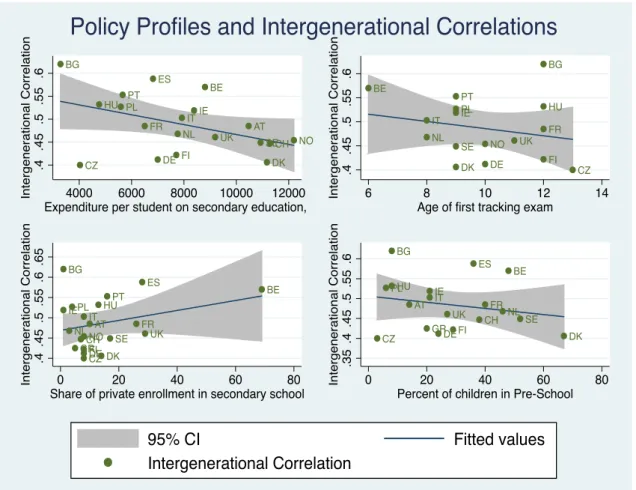
al., 2007), differences in policy structures and institutional arrangements across countries may be helpful in preventing or supporting intergenerational persistence. Most readers will be familiar with what has been called the “Great Gatsby Curve” (Corak, 2013), which shows that countries with higher levels of income inequality are also those with strong intergenerational persistence. Again this relationship is not causal, but there is an associa-tion between these characteristics of a society; it suggests that structural and instituassocia-tional differences across countries may be related to intergenerational persistence. To the extent that this is true, we may expect differences in persistence across countries or clusters of countries with similar policy profiles. Consider, for example, figure 1. Here we have plotted the intergenerational correlations we calculate below (the method for which is discussed in detail in section 3) against several different policy measures in the 20 European countries studied here. The intergenerational correlation is negatively related to public expenditure per student on primary education, the age at which students take the first exam which tracks them into different educational career paths, and the share of children enrolled in pre-school. The latter are based on numbers of pre-school enrollment of children under the age of 3 years in 2012. Finally the intergenerational correlations are positively related to the share of students enrolled in private secondary schools. All of these data are from recent years since consistent data for a time period of 40 years starting from the 1940s are not available. Consequently this relationship depicted in figure 1 is not causal yet it sug-gests that some relationship between social policy and intergenerational persistence exists for the 20 countries studied. Indeed the work of Andrews and Leigh (2009) shows that more unequal countries of the 1970s were less likely to have experienced social mobility by the late 1990s. We do not attempt to prove that relationship here, but we often present
our findings in terms of country clusters with similar policy profiles.4
— Figure 1 about here —
If there is a relationship between social policy and intergenerational persistence, we may expect to see changes in the degree of intergenerational persistence over time as well as across countries, as relevant social policy evolves. Policies aimed at creating more equal chances for all members of society and increasing efforts to create welfare systems during the last century addressed some of the factors that influence social transmission. For example, the expansion of publicly funded and freely available schooling and school supplies to Austrian children in the 1970s corresponded with a significant decline in intergenerational educational persistence after that time (Fessler et al., 2012). To identify these changes over time, we study persistence in educational attainment for different age groups, thus
4
The calculation of the intergenerational correlations employed in these graphs is described in section 3 below; they are the same as those presented in table 2. The data on expenditure per student come fromUNESCO, 2014; on the age of the first tracking exam from the European Commission (2012); on pre-school enrollment from Eurostat (2012); and on private enrollment from the The World Bank (2014). These data are based on their values in 2010, since data for these policy issues are not systematically available for the times in which our respondents were in school.
allowing us to identify temporal changes. Interestingly, the influential work of Hertz et al. (2007), which compares educational persistence over time for 42 countries, does not find a time trend of either rising or falling intergenerational correlation of education on a global basis. However, Hertz et al. (2007) study just a 50 year time-trend, similar to Chetty et al. (2014b), who study changes in mobility in the U.S. since the 1970s. In the resuts section below, we show correlations for descendants born as far back as 1920 to investigate the development of intergenerational persistence over a longer period of time.
Perhaps the most original aspect of this paper is the analysis of the role of gender in intergenerational educational persistence. In the existing literature, economists have largely ignored gender; most studies look only at the educational outcomes of fathers and their sons. Corak (2013, p. 81) notes that “[i]t is not that studies of mothers, daughters, and the marriage market do not exist, only that father-son analyses are more common
and permit a broader set of cross-country comparisons.” While analyzing the role of
gender in intergenerational persistence complicates the story, there is enough theoretical and empirical reason to believe that the degree and source of the persistence differs based on the gender of the parent and descendant in question and that these differences are an important element in the overall picture of intergenerational persistence. Further, when and where differences exist, we may be able to comment on the degree of inequality of opportunity for women versus men.
Two theoretical frameworks from economics and sociology shed light on why there might be differences in educational persistence across generations depending on the gender of the parent and the descendant studied. The first is the household production model which first appeared in Becker and Tomes (1979; 1986) and was further developed by Chiswick (1988) and Gang and Zimmermann (2000) to account for the role of mothers’ labor force participation in the intergenerational transmission of human capital. Here mothers alone are responsible for the home production of children’s education – a highly stylized aspect of the model which nevertheless parallels the empirical reality of mothers spending more time in education with their children than fathers (Leibowitz, 1974; Zick et al., 2001; Sayer et al., 2004). The model further says that fathers’ education is important to their descendants’ educational attainment only in that the fathers’ higher education increases their earnings capacity, and some of the higher earnings are used to invest in the descendants’ education. Mothers’ education affects their children’s educational attainment both through earning income and through direct household production, which are considered substitutes. As a mother’s education increases, the opportunity cost of her home production increases, and she spends less time at home educating her children. Thus the model predicts that father’s education has a more positive impact than mothers’ on the educational attainment of the descendants.
A shortcoming of the household production model is that it does not distinguish
be-tween male and female descendants. Thus a second theory of how gender matters in
within a household, can serve as a useful amendment to the household production model. Theory on socialization and role models suggest that some social and behavioral charac-teristics are transmitted from one generation to the next (Haveman and Wolfe, 1995). A relevant example is gender role attitudes, which are attitudes about how men and women “ought” to behave. Among other things, these attitudes prescribe norms about the im-portance and appropriateness of educational attainment for men and women. Gender role attitudes are passed from one generation to the next (Farre and Vella, 2013). In transmit-ting their ideas about gender and educational attainment to their children, parents with traditional educational attainments, i.e. where the father is more highly educated than the mother, are more likely to encourage their sons to obtain higher education than they are to encourage their daughters. Similarly, more highly educated mothers are likely to encourage their daughters to obtain more education. Some preliminary support for this idea can be found in basic tabulations of the 2010 European Social Survey data we describe and employ below: when fathers have more education than mothers, daughters average only 12.9 years of education, while sons average 13.6 years of education. When mothers are more highly educated than fathers, on the other hand, daughters average 13.4 years of education, compared to 13.1 for sons. Other findings in the literature for Austria using Markovian transmission matrices and uni- and multivariate analyses further support this theory of gender role socialization in intergenerational educational persistence (Fessler and Schneebaum, 2012).
These two theories of the relevance of gender in intergenerational educational persis-tence, while partly in competition with each other, both suggest that the persistence in intergenerational educational attainment will differ by the gender of the parent and the descendant involved. A crucially important difference in the two models is that the house-hold production model does not differentiate results based on the gender of the descendant. While the household production model predicts that fathers are more important for both sons and daughters, the role-model theory would imply a stronger effect of the same-gender parent on the descendant. We therefore test the hypothesis that intergenerational persistence in educational attainment will differ by the gender of the parent and descen-dant. Further, we integrate the gender, country clusters, and over-time dimensions of the analysis to see how gender may have mattered differently in different places across time. This exercise reveals for example not only how intergenerational mobility has changed over time by gender, but also whether different developments in country clusters originated in distinctive gender trends.
3
Data and Methods
3.1 Data
Our data come from the 2010 European Social Survey (ESS) (Norwegian Social Science Data Services, 2010), which was the fifth and (in terms of parental and descendants’
educa-tion) most comprehensive wave of the survey.5 The ESS collects data on the International
Standard Classification of Education (ISCED) level of education achieved for each respon-dent and the responrespon-dents’ mothers and fathers. We converted these data on the ISCED level of education into the number of years of schooling necessary to obtain that level of education in the respondents’ countries. We did this by matching the ISCED code with the United Nations Educational, Scientific and Cultural Organization (UNESCO) data on school years needed for ISCED level achievement (UNESCO, 2012). Although there are differences in educational systems and the level of detail collected about educational attainment across countries in the ESS, converting the ISCED levels into the minimum number of years needed for a respondent’s education allows us to make the survey as objec-tive and homogeneous as possible. This conversion creates a more continuous measure of educational attainment, which further allows us to calculate intergenerational educational associations and correlations (see section 3.2 below). Blanden (2013, pp. 44-45), following Dearden et al. (2002), points out that measuring educational achievement with the number of years in education is not ideal for a study of intergenerational associations/correlations, because it assumes that the relationship between the educational attainment of the parent and descendant generation is linear and monotonic. However, Blanden (2013) goes on to show that a comparison of two international studies, one which used years of education to obtain intergenerational associations/correlations (Hertz et al., 2007) and the other which used academic degrees obtained to measure an intergenerational association of education (Chevalier et al., 2013b), yields fairly highly positively correlated results.
We include only respondents aged 25 or older in our study, to minimize the number of cases in which the respondents were still studying at the time of the survey. For most of the analysis, a sample of those aged 25-65 is used, to focus on people still in the labor market; the exception is the analysis of time trends in intergenerational correlations, where we study all descendants up to 90 years of age. We use only observations for which we have information on the educational attainment for both the mother and the father of the descendant. In total we observe 14,514 (11,291) men and 16,218 (12,424) women between 25-90 (25-65) in 20 different countries. All results are calculated using the design weight provided in the ESS.
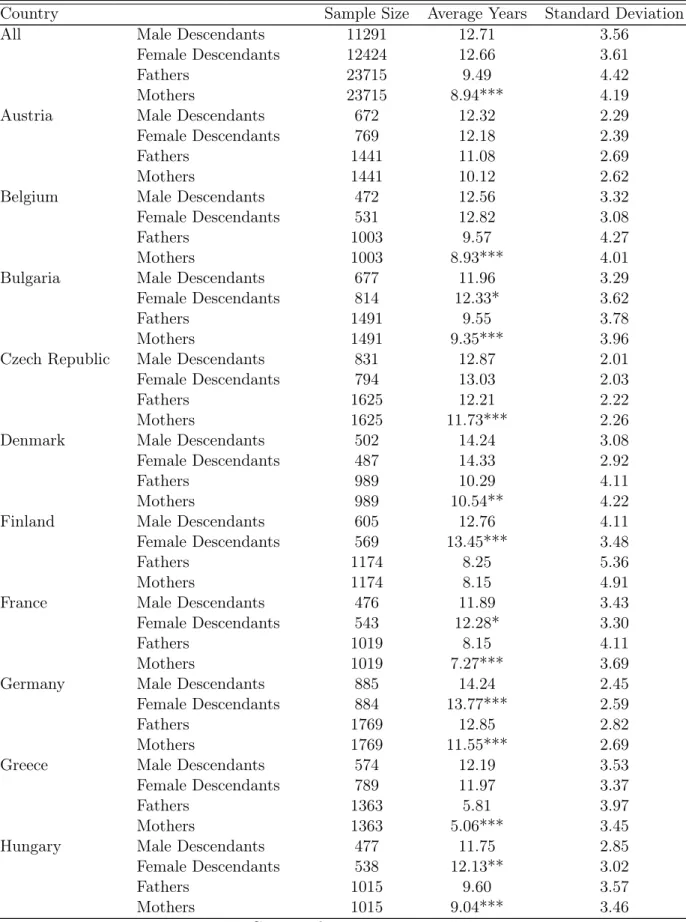
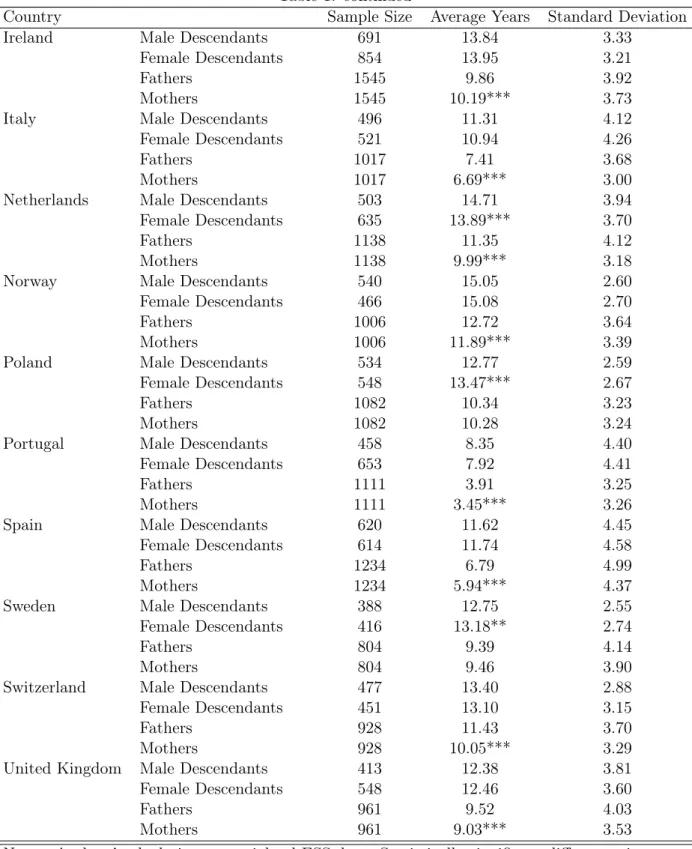
As shown in table 1, both men and women in the descendant population are more highly educated than those in the parent generation; sons and daughters have, on aver-age, more than three years more education than their same-gender counterparts in the 5Italy did not participate in the survey after round 2 (2004) and the round 5 data were not available for Austria at the time of this analysis, so we used data from rounds 2 and 4 for these countries, respectively.
older generation. Men in both generations completed more years of schooling than women, yet women are closing the gap and the overall difference between sons and daughters is only marginal. In most countries, the daughters have completed more years of schooling than the sons, with the only exceptions being some of the Continental and Southern coun-tries (Austria, Germany, Greece, Italy, Netherlands, Portugal and Switzerland). For the parental generation, the situation is completely different: the mothers almost always have fewer years of education than the fathers. Only in Denmark, Ireland, and Sweden, mothers have on average more years of education than fathers.
— Table 1 about here —
Cross-country differences in mean schooling years are profound. Norway’s men and women aged 25-65 have an average of 15.05 and 15.08 years of education, respectively, the highest average in the dataset. On the other hand, men and women in Portugal have only 8.35 and 7.92 years of education, respectively. Portugal is the only country whose average years of education for the descendants is under ten years, but there are quite a few countries in which the parents have less than ten years of education. These cross-country differences are due in part to different education systems and different program lengths, meaning that an identical ISCED-level in two different countries can be obtained from a different number of schooling years. Our educational year averages are slightly higher than those published by United Nations Development Program (2013, p. 144) for all countries, very likely because our mean education years are limited to people aged 25-65, which excludes older and thus generally less educated people. Based on this comparison, our schooling years seem reasonable.
In every country in Europe, the average level of educational attainment from one gen-eration to the next has increased. At the same time, the distribution of educational attain-ment has become narrower in the younger generation, meaning that there is less variation in the years of education obtained by the respondents compared to their parents. This becomes important in calculating intergenerational persistence, as explained in the next section.
3.2 Intergenerational Associations and Correlations
We measure the strength of the persistence of educational attainment in one generation to the next by calculating intergenerational educational associations and correlations. The
model used to estimate an intergenerational educational associationβˆcan be written as
Edi =α+ ˆβEip+εi ∀i= 1,2, . . . , N (1)
whereEidis the educational attainment of descendanti, andEip is the average educational
attainment of both parents (father and mother) of descendant i, and εi is a normally
provides a level effect, indicating the descendant’s education if the parents had zero years
of schooling. The OLS estimateβˆis
ˆ β =ρdp
σd
σp
(2)
where σd and σp represent the standard deviation in the educational distribution of the
descendant and parent populations, respectively, andρdp is the correlation coefficient
be-tween the descendant and parent populations. This exposition makes it clear that a change
inβˆmay not necessarily be due to a change in the relationship between the educational
attainment of the two generations: a change in the distribution of the educational
at-tainment of either descendants or parents would also change the associationβˆ. Since the
distribution of educational attainment has changed drastically from one generation to the next in practically every country in our dataset (see table 1), the association would give the wrong impression about the actual intergenerational educational mobility, overstating it when the standard deviation of the distribution of the descendant population’s educational attainment is higher than the parents’, and understating if it is larger for the parents.
Therefore, we estimate intergenerational educational correlationsγ and focus our
anal-ysis on these estimates. These correlations normalize the educational attainment of a population by the standard deviation of their educational distribution (see e.g. Black and Devereux, 2011; Blanden, 2013), thus eliminating the possibility that the intergenerational relationship is driven by distributional changes over time:
Eid σd =α+ ˆγE p i σp +εi ∀i= 1,2, . . . , N. (3) By calculating these educational correlations, we are able to compare the strength of the relationship between parental and descendant educational attainment across countries and over time, although the distribution of educational attainment in these various subpopu-lations may be quite different.
Finally, in calculating gender-specific associations and correlations, we model the
rela-tionship between the educational attainment of a descendant andboth their mother and
father.6 We use both parents’ educational attainment (separately, while controlling for
the other (see e.g. Gang and Zimmermann, 2000)) in order to be able to tease out the gender-specific nature of intergenerational persistence. Including the education level of both parents gives us the effect of an additional year of a parents’ educational attainment on their child’s education, net of assortative mating effects. Since our research question deals specifically with the different effects of mothers’ and fathers’ education, it is
impor-6
Indeed most studies use only the education level of the father. Many earlier studies which estimated a joint effect of mothers and fathers dealt with differences in the education level of the two parents by taking the average of both the father’s and the mother’s education to build the parental education variable (e.g. Hertz et al., 2007), or by summing the years of education of both parents together (e.g. Oreopouos et al., 2006). In an Austrian study, Fessler et al. (2012, pp. 77-78) say that due to assortative mating of the parents, taking the average or taking the maximum of the parents’ education leads to very similar results.
tant to control for assortative mating effects by including both parents’ education in the same estimation. One drawback of this approach is that there is likely strong collinearity between the parents’ schooling. It remains, however, a better option than leaving one partner out, averaging parental education, or summing parental education, because we are explicitly interested in the effects of both mothers’ and fathers’ education on descendant education net of assortative mating effects. Including the educational attainment of both parents means that the partial effects of both parents will be lower than if we had estimated results for each parent separately. We thus model
Eid=α+ ˆβ1Eif + ˆβ2Eim+ ˆβ3(Eif ∗δ) + ˆβ4(Eim∗δ) + ˆβ5(δ) +εi ∀ i= 1,2, . . . , N (4)
for the gender specific intergenerational associations and
Eid σd =α+ ˆγ1E f i σf + ˆγ2E m i σm + ˆγ3(E f i σf ∗δ) + ˆγ4(E m i σm ∗δ) + ˆγ5(δ) +εi ∀ i= 1,2, . . . , N (5)
for the gender-specific intergenerational correlations, where Ef is the educational
attain-ment of the father and Em is that of the mother, and δ is a dummy variable equal to 0
for sons and1for daughters. We interact parental education with the gender dummy
vari-able to capture the differing relationship of parental (mother and father) education with
descendant education for sons and daughters. βˆ1 (γˆ1) will give us the intergenerational
association (correlation) between the educational attainment of fathers and sons; β2ˆ (γ2ˆ)
for mothers and sons;β1ˆ + ˆβ3 (γ1ˆ + ˆγ3) for fathers and daughters; andβ2ˆ + ˆβ4 (γ2ˆ + ˆγ4) for
mothers and daughters. Lastly, βˆ5 (γˆ5) is the coefficient on a control variable for gender,
which is positive (negative) when daughters have higher (lower) education than sons.
3.3 Country Clustering
Some countries are more alike than others in their social welfare state policies regard-ing education. As discussed above, the strength of the intergenerational persistence of education may be related to social policy which promotes meritocratic ideals (or not). We thus analyze intergenerational educational mobility in countries alone and as a part of so-called “country clusters” which have similar education policy profiles, to get a sense of any relationship between intergenerational persistence and policy systems.
Our clustering approach links public welfare systems and the educational system fol-lowing the country-clustering typology of Esping-Andersen (1990). This approach assumes that a trade-off between educational spending and spending on other welfare policies exists, in particular that states decide whether to spend money on education policy now to avoid having to make transfers afterwards (because education should presumably protect people from needing public support later on) or to focus on social insurance programs instead
of education. Esping-Andersen (1990) defines three types of welfare states: the liberal or Anglo-Saxon model, which invests mainly in education; the conservative-corporatist or Continental model, which tends towards social insurance; and the social-democratic or Nordic model, which invests in both welfare policies.
Apart from these three “worlds of welfare capitalism,” several scholars have proposed additions to the typology, with many of them including a Southern or Mediterranean type of welfare state cluster (Ferrera, 1996; Bonoli, 1997). This Mediterranean group of coun-tries are characterized by fragmented social security systems and high reliance on family structures for social and economic welfare (Ferrera, 1996). Finally, the question of whether the Eastern European countries can be incorporated into the existing clusters or whether they form a distinctive group of their own has been a matter of discussion. Fenger (2007) uses hierarchical cluster analysis to classify Central and Eastern European countries, find-ing overall support for a separate Eastern European cluster despite differences within the cluster. This cluster can be characterized by strong state investment in education and social equality due to the collectively communist past, but which has faced relatively low economic growth (Fenger, 2007, p. 24). Thus despite strong state investment, the com-paratively poor economic performance of these Eastern or “New Member State” countries (Crafts and Toniolo, 1996) may be a barrier to distilling intergenerational persistence.
Thus we use a five-type model of welfare states, including an Anglo-Saxon cluster (Ireland and the UK), a Nordic cluster (Denmark, Finland, Norway, and Sweden), a Con-tinental cluster (Austria, Belgium, France, Germany, the Netherlands, and Switzerland), a Southern cluster (Greece, Italy, Portugal, and Spain) and an Eastern European cluster
(Bulgaria, Czech Republic, Hungary, and Poland).7 As documented in the existing
litera-ture, the countries within each cluster share a similar welfare system and therefore provide hints regarding the relationship between different welfare and education policies and inter-generational educational persistence. Nevertheless, differences in the specific configuration of social and educational policy across countries within a cluster still exist; these differences are discussed in further detail below.
4
Empirical Results
4.1 Intergenerational Educational Persistence by Country and Cluster
We begin the analysis of our empirical results with an examination of intergenerational persistence across countries and country clusters. Table 2 presents the intergenerational educational correlations between parents and their working-age (25-65) descendants in 20 European countries. We focus our description on the correlations presented in table 2 instead of the associations, because, as described in section 3.2, the correlations give a
7
When performing analyses by cluster, we take averages of the results for each country in the cluster, which gives each country an equal “weight” in determining cluster-level effects, regardless of differences in population sizes across countries in a cluster.
better measure of persistence across generations, since they eliminate the possibility that the intergenerational relationship is based in part on structural changes to the educational
distribution across generations.8
— Table 2 about here —
The bottom row of table 2 shows that the intergenerational correlation between all parents (taken as the average of the two parents’ education) and all descendants (equation 3) is rather high, at 0.486. Thus, after accounting for differences in the distribution of educational attainment across generations, parents with one year of schooling over their generation’s mean will raise children with one half year of schooling abive their genera-tion’s mean. This estimate is consistent with those of Hertz et al. (2007); in the thirteen countries that their analysis has in common with this one, they get an average correlation of 0.40. Their estimate is lower than our overall estimate because our analysis includes seven additional countries, all of which have higher intergenerational correlations.
Table 2 reveals that intergenerational educational persistence is quite different across our five country clusters. The educational correlation between all parents and all descen-dants is the lowest in the Nordic cluster, at 0.433, while it is 0.478 for the Continental and 0.490 for the Anglo-Saxon clusters. The highest correlations are found in the Eastern and Southern clusters, with intergenerational correlations of 0.520 and 0.517, respectively. These results indicate quite a bit of variation of intergenerational educational mobility across Europe.
Looking more closely at the correlations at the country level reveals that the four Nordic nations are all among those countries with the lowest intergenerational correlations. Furthermore, the intergenerational correlations in the four Nordic countries are rather similar, ranging from just 0.406 (Denmark) to 0.454 (Norway). The two Anglo-Saxon countries (the UK at 0.461 and Ireland at 0.519) show similar (to each other) but distinctly higher (than the Nordic countries) correlations. The other clusters do not reveal these clear similarities inside the clusters themselves.
Some countries within the Continental cluster have a similar intergenerational corre-lation (the range for Austria, France, the Netherlands and Switzerland is between just 0.447 and 0.485), but Belgium shows comparatively high persistence (0.570), and Ger-many shows remarkably low persistence (0.412). These exceptions may be related to the particular structure of the educational system and the labor market responses to education in these two countries. In Germany, vocational training and an emphasis on apprentice-ships result in less pronounced differences in wage returns to higher education as in other countries, diminishing benefits to descendants of highly educated parents there (Martins and Pereira, 2004). In Belgium, on the other hand, larger returns to education result in 8The associations are shown in table A.1 in the appendix. For almost all countries and clusters, the correlation between parent’s and descendant’s educational attainment is higher than the association. This result occurs because the standard deviation of the parental educational distribution is generally larger than in the descendant population (see equation 2 and the relevant descriptive statistics in table 1).
stronger income benefits of having higher education, making it potentially more difficult for descendants of less educated parents to progress (OECD, 2008, tables A10.2 and A10.6).
The Southern countries are among the least mobile ones, but with especially high correlations for Portugal (0.553) and Spain (0.588). However, one nation in this relatively high-persistence cluster, Greece, places in the group of the most mobile countries in all of Europe, with an intergenerational correlation of 0.425. It is unclear why persistence in Greece is so low.
Finally, the countries in the Eastern cluster have the highest correlations, but again there are two extremes. On the one hand, this generally highly persistent cluster contains the Czech Republic, which turns out to be the most mobile country in this dataset with an intergenerational correlation of just 0.400. On the other hand, the cluster also contains Bulgaria, which is the the least mobile country in the sample with an intergenerational correlation of 0.620. The Eastern cluster should be interpreted with care because of the heterogeneous economic and social circumstances of the countries in this cluster. How-ever, three of our four Eastern European nations rank similarly with respect to the very high level of intergenerational persistence, and the exception of the Czech Republic may be related to the fact that the Czech Republic boasts distinctly lower levels of income inequality and poverty rates than the other three Eastern countries (Eurostat, 2014a;b). These measures of inequality are often associated with, although not necessarily a cause of, less intergenerational persistence, as displayed in the “Great Gatsby Curve.” Less economic inequality may be associated with less intergenerational persistence because more equality provides children with more equal opportunities, regardless of the family they were born into.
Overall, we observe quite strong variation in the intergenerational correlations across country clusters, with results ranging from 0.400 in the Czech Republic and 0.406 in Den-mark, to 0.588 in Spain and 0.620 in Bulgaria. It is clear that there is educational persis-tence in all European countries. The cluster-level analysis shows the Nordic cluster is the least persistent, and the Eastern and Southern clusters are the most.
4.2 Changes in Intergenerational Educational Persistence Over Time
The previous sub-section analyzed intergenerational educational persistence in Europe for people of working age (25-65). While illuminating, these findings are limited to this age group. In this section, we broaden our analysis to the population of respondents between 25 and 90 years old, and examine how the intergenerational educational correlation has developed over time. This analysis studies the correlation between all descendants and all parents (regardless of gender), where parental education years are taken to be the average of a descendant’s mother’s and father’s educational attainment. The results must be interpreted with some care, because sample sizes, especially for the oldest cohorts, are often small.
co-horts; thus all people born in a certain year) in each country cluster, with a fitted line with
slopeτ to show the development of the correlation over time.9 The Nordic and Southern
clusters show a clear and statistically significant decline in intergenerational mobility over time, while there has not been a significant change in the intergenerational educational correlation for adults between the ages of 25 and 90 in the three other clusters.
— Figure 2 about here —
In the Nordic cluster, there was a clear decline in intergenerational persistence from about 0.500 for those aged 90 to 0.350 for respondents aged 25. For the Southern countries, there is also a significant drop in the correlations, starting from the highest point of all clusters (0.600) and going down to slightly above 0.400 for the 25 year-old descendants. These results are highly statistically significant. In the Eastern, Continental and Anglo-Saxon clusters, the level of intergenerational persistence has not changed much over time, but with a slight downward trend in the Continental and Anglo-Saxon clusters and a constant trend in the Eastern cluster. Note that there are significant changes over time in some individual countries within these clusters (see figure A.1), but there is no consistent pattern for the cluster as a whole.
There is greater variation in the intergenerational correlation over age in some clus-ters compared to others. The correlations in the Eastern cluster huddle fairly consistently around 0.500 over time, with more variation for the older groups. The same is true in the Continental cluster, but at slightly lower correlations. The Anglo-Saxon and Southern clusters show the greatest variation in correlations over time, especially for older age co-horts, which could be due to the smaller number of observations of descendants aged 65 and above. The general downward trends in the Continental, Nordic, Anglo-Saxon and Southern clusters fit the policy profile of those clusters with which the persistence might be related: over the last ninety years, access to education has expanded. Interestingly, there is no such similar evidence for the Eastern European countries in our sample, implying that despite aiming at societal equality via state socialism, educational persistence has remained steady for almost a century. Yet we note that our sample of Eastern Europe is restricted to only four countries, which each have unique developments of educational persistence. However, looking at the trend on the country level (see appendix figure A.1), one sees that – with the exception of Bulgaria – intergenerational persistence has decreased over time in all Eastern European countries.
We see significant changes to intergenerational educational persistence over time in the Nordic and Southern countries, with the youngest cohorts in the Southern cluster now reaching correlation rates similar to those in other clusters, despite the relatively high persistence faced by older descendants in that cluster.
9The OLS equation employed to fit the line isγ
ac =α+τ1ageac+εac, whereγ are intergenerational
educational correlations,αis a constant term andε is an error term with the usual properties for every age groupa in each countryc. The cluster correlations are taken as the average of the τ coefficients for the cluster.
4.3 The Gendered Nature of Intergenerational Educational Persistence
Table 2 presents intergenerational educational correlations by the gender of the parent and the descendant, in the columns titled father-son, mother-son, father-daughter, and
mother-daughter. These are the estimates for γ1, γ2,γ1+γ3, and γ2+γ4 from equation
5, respectively. The last column of the table, titled female, gives the coefficients for the
dummy variable on the gender of the descendant (γ5in equation 5), showing whether being
female is linked with a higher (positive value) or lower (negative value) education than that of the male descendants.
The differences in the intergenerational correlations across gender-pairs are rather strik-ing. Across Europe, fathers are more influential for the education of the sons than mothers are, in the sense that the persistence of educational outcomes between fathers and sons is higher than for any other gender pair: the averages across Europe show that the correla-tion between fathers and sons (0.331) is higher than between mothers and sons (0.185). Fathers’ educational attainment also appears to be more important for sons than it is for daughters (across Europe the intergenerational correlation is 0.331 compared to 0.259). This is not the case in Belgium, the Netherlands, Switzerland, Italy, Portugal, and the UK (confirming the results for the UK in Chevalier et al. (2013a)), although these differences are quite small, except for in Italy. These overall results support the gender role theory discussed in section 2, in which descendants learn gender-appropriate skills and compe-tencies from their parents and are more likely to follow in the educational steps of their same-gender parent. Here sons are more likely to be like their fathers.
Similarly, the relationship between the educational attainment of mothers and their daughters is stronger than between mothers and their sons. The average correlation of educational years between mothers and daughters is 0.290, compared to 0.185 between mothers and sons. It is rather remarkable that only in Belgium, Finland, and the UK, the persistence between mothers’ and sons’ educational attainment is stronger than between mothers and daughters, and in the latter two countries, those differences are very small. On average, the correlation between fathers’ and daughters’ education (0.259) is weaker than between mothers and daughters (0.290), and although there is variation on a country level, this is true for all Eastern and Nordic countries.
The household production model discussed in section 2 predicts that fathers’ increased educational attainment always has a positive effect on the (genderless) children’s educa-tional attainment, while an increase in mothers’ educaeduca-tional attainment has an ambiguous effect. Our results show that the hypothesis is correct, insofar that fathers’ increased ed-ucational attainment has a positive effect on children’s eded-ucational attainment, and this effect is generally (but not always) stronger than that of mothers’ increased education. The results further show, though, that there are seemingly systematic differences in the strength
of the intergenerational persistence based on the gender of the parentand descendant in
is more strongly related to daughters’. In general, though, sons’ education is more strongly related to their parents’ education than that of daughters. While in many countries it is the fathers whose educational attainment is strongly correlated to the education levels of both sons and daughters, in the Nordic and Eastern countries it is mothers’ education that appears to be more strongly correlated with daughters’ education.
4.4 An Integration of the Results
After having examined differences in intergenerational persistence by country and coun-try cluster, age, and gender separately in sections 4.1-4.3, we now integrate these three dimensions of socio-demographic difference into a single analysis. Figure 3 shows the devel-opment of the average intergenerational correlation for five-year cohorts by country clusters over time, for men and women separately. These age cohorts are larger (five years instead of one year) than those used in section 4.2 because the split by gender makes the sample sizes too small for single year analyses in some years. Thus, to get more representative
results, we use five-year cohorts.10
A line fitting the equationγcg=αcg+ Φ∗cohortbirthyearscg+εcg for the subsamples
of each country-cluster cand gender g predicts the intergenerational correlation γ by age
cohort.
— Figure 3 about here —
A first result from figure 3 is that intergenerational educational persistence varies greatly by country cluster, gender, and age, and that its development over time is very different for these different socio-demographic groups. For all ten groups shown in figure 3, educational
persistence has either stayed the same or sunk over time (negativeΦ), but persistence has
not increased. Male descendants in the Eastern cluster are the only exception, showing
a slightly positive Φ (rising persistence over time), though this result is not statistically
significant. In half of the countries, the change in the persistence over time is small and statistically insignificant, while in the others – such as women in the Southern cluster – the development is very strongly negative and statistically significant. Thus these three socio-demographic groups experience the strength of the change in intergenerational educational persistence over time quite differently.
Further, there are differences in the degree of intergenerational persistence that mem-bers of these ten groups face at any point in time. For the descendants who were born between 1980 and 1985, the degree of intergenerational correlation took on a large range of values across clusters, from about 0.300 for women in the Nordic cluster to about 0.550 for men in the Eastern cluster. Similarly, when the respondents were born between 1920 and 1930, the persistence also varied tremendously across country cluster: men of that age in
10
Since there are some cases in which there are no men or women over born before 1930 in a country or a cluster, we use an eleven–year cohort (born between 1920-1930) for this group.
the Nordic cluster faced intergenerational correlations of about 0.425, while women in the Southern cluster faced much higher persistence, at about 0.650. Even within a cluster, men and women faced different degrees of intergenerational persistence; only in the Continental cluster do men and women have similar correlations all along the age distribution.
Finally, figure 3 shows thenecessity of including all three of these dimensions of
differ-ence into an analysis of the determinants of intergenerational persistdiffer-ence. In figure 2 and the accompanying discussion in section 4.2, we saw that there was a statistically significant drop in intergenerational persistence over time in the Nordic and Southern clusters. When we look more closely at the gendered nature of these changes using figure 3, though, we see that it is only female descendants who experienced declining intergenerational persis-tence over time; the men in these clusters show no significant change in persispersis-tence over time. Thus, while figure 2 provided insight regarding differences in changes over time by cluster, including the gender analysis in figure 3 provided a more complete account of how intergenerational persistence changed over time, and for whom. Women “catching up” in educational attainment have driven much of the improvement of educational mobility in Europe.
5
Discussion and Conclusions
This analysis of intergenerational educational persistence across Europe has shown that people’s educational attainment is influenced by that of their parents. Across Europe, an additional year of education for parents is correlated with an additional half year of edu-cation for descendants. However, this estimate is the average intergenerational correlation across Europe; indeed the strength of the relationship between parental and descendant education differs greatly by country, over time, and by gender.
The analysis by country cluster reveals that there are noticeable differences across clus-ters. The cluster classification system originally developed by Esping-Andersen (1990) and discussed in chapter 3.3 is based on welfare state regimes, which appear to be at least somewhat associated with outcomes in intergenerational educational persistence. A focus on both education and social insurance policies, as in the Nordic countries, is related to lower intergenerational persistence. Both the Continental cluster, which focuses more on social insurance, and the Anglo-Saxon cluster, which makes more initial investments in education, have higher intergenerational correlations, suggesting that a focus on either policy alone may not be especially effective in reducing intergenerational persistence. Fi-nally, the Southern countries, which rely on family structures rather than public policies, and the Eastern countries, who have less developed welfare systems, have the highest levels of intergenerational persistence.
Taking the analysis of the clusters several decades back by looking at those born in 1920 and afterwards, we find that intergenerational educational persistence has decreased in Nordic and Southern countries, while there has been no significant change over time
in the rest of Europe. However, a more detailed analysis of developments over time by gender gives a more nuanced story. In the Anglo-Saxon cluster it is only men who show a significant decrease in their intergenerational educational persistence; in the Continen-tal cluster both men and women experienced a significant decline in the intergenerational persistence; and the Eastern European countries, as already mentioned, reveal no signif-icant change in persistence over time. On the other hand, in the Nordic and Southern countries the downward trend we observe for the entire cluster is very clearly driven by decreases in intergenerational persistence for women. Indeed the persistence has not signif-icantly changed for men in either of these clusters and persistence for men in the Southern countries remains relatively high.
Across Europe, it is the fathers whose education is the critical determinant of sons’ educational attainment, while mothers’ educational attainment matters most for their daughters’ education. In most countries, fathers’ education is also more influential for the educational attainment of the sons than for that of the daughters. Yet daughters are especially dependent on the education of their mothers in the Nordic and Eastern countries, as well as in a handful of other countries around Europe. These results show that the gender of both the parent and the descendant is crucially important in passing on educational advantages or disadvantages from one generation to the next. The household production model discussed in section 2 therefore does not adequately predict the relationship between parental and descendant education. This may be because the model does not reflect the modern reality of women’s high labor force participation and changing social norms, which increasingly hold fathers responsible for children’s education as much as mothers. Instead, the patterns of the strength of the intergenerational correlations by gender suggest that gender role attitudes and role models within a household are important in determining people’s educational attainment, as descendants are most likely to follow in their same-gender parents’ educational footsteps.
These findings can have important implications for policy aimed at reducing and elim-inating the gender wage gap and gender-based occupational segregation. These gaps are explained in large part by women’s occupational choice, labor market supply (the number of hours spent in the labor market), and labor market discrimination. For all these reasons (which also overlap each other), women’s investment in higher education does not pay off as much as men’s because more women engage in part-time work or are segregated into lower-paying industries and occupations. Public policy offering universal and high quality child care can help bridge the gap between high education and labor market equality for women. First, child care can be made high-quality, by demanding more highly educated caregivers, and providing high-paying jobs for highly educated employees – who are, in that sector, mainly women. Second, it would promote women’s employment in other sec-tors which demand highly educated workers with flexible schedules by providing care for their children while they are at work. Thus women’s labor market supply could increase and women could become more willing to enter traditionally male fields. At the same
time, the stereotype of women being uncommitted to work would fade as their opportuni-ties to do more work expand. These changes could reduce discrimination against women, further enhancing the first two effects. The children of these highly educated mothers – and especially daughters, following the results in this paper – would benefit by positive gains to their own education, by having more income in the household, by receiving better childcare, and by having a positive role model in the household. Thus a virtuous circle of women’s advancement in the labor market could develop.
Not only the daughters would benefit from these policies. Sons are also often con-strained by the financial restrictions of their parents, and those benefits would positively affect them, too. Especially but not exclusively in the case of single mothers, universal child care can help reduce the risk of child poverty by increasing mothers’ ability to work
and provide sufficient financial resources. The sonsand daughters would then benefit and
face more educational opportunities, leading to higher intergenerational mobility. The pos-itive effect of early education programs on a child’s later outcomes are widely recognized (Heckman, 2008; Schütz et al., 2008; Cunha and Heckman, 2009; Currie and Almond, 2011; OECD, 2010). Insufficient supply or a lack of quality of these programs leads to restricted chances for children to benefit from them, and makes it more difficult for mothers to work and contribute to household income. Consequently, early childhood programs and their link with female employment may help explain the lower intergenerational persistence in the Nordic countries. It is not the education system alone which provides more equal
op-portunities than in other countries, but instead the joint investment in (early childhood)
education and social policies to support families and avoid poverty, especially child poverty (Esping-Andersen, 2004). Hence, the higher rate of female employment caused by universal high-quality child care and lower child poverty rates might be an important aspect of the Nordic countries’ lower intergenerational persistence.
The positive results for the Nordic countries – low persistence, which has become even lower over time – suggest that other countries looking to reduce their intergenerational persistence may benefit from considering Nordic social policy. Investing in universal welfare policies instead of focusing on either educational or social insurance policies alone or relying largely on family structures, together with a less unequal society, are associated with the lowest intergenerational mobility.
An important lesson from this paper is that the intergenerational persistence in edu-cational outcomes is variable and depends on institutional context and historical period. Thus, it can be changed: movement towards more meritocratic ideals (hence lower inter-generational persistence) will be a matter of social commitment to these goals; not just for reasons of fairness but to support and preserve European wealth, prosperity and its welfare systems it is of utmost importance to realize the full productive potential of each and every individual – men and women alike.
References
Andrews, Dan and Andrew Leigh, “More inequality, less social mobility,” Applied Economics Letters, 2009,16, 1489–1492.
Becker, Gary S. and Nigel Tomes, “An equilibrium theory of the distribution of income
and intergenerational mobility,” Journal of Political Economy, 1979,87, 1153–1189.
and , “Human Capital and the Rise and Fall of Families,” Journal of Labor Economics,
1986,4 (3), 1–39.
Bielby, William T., Robert M. Hauser, and David L. Featherman, “Response errors of black and nonblack males in models of the intergenerational transmission of
socioeconomic status,” American Journal of Sociology, 1977, 82(6), 1242–1288.
Black, Sandra E. and Paul J. Devereux, “Recent Developments in Intergenerational
Mobility,” in Orley Ashenfelter and David Card, eds., Handbook of Labor Economics,
Amsterdam: Elsevier, 2011, pp. 1487–1541.
Blanden, Jo, “Cross-Country Rankings in Intergenerational Mobility: A Comparison of
Approaches From Economics and Sociology,” Journal of Economic Surveys, 2013,27(1),
38–73.
Bonoli, Giuliano, “Classifying Welfare States: a Two-Dimensional Approach,” Journal of Social Policy, 1997, 26(3), 351–372.
Bourdieu, Pierre, “The Forms of Capital,” in John Richardson, ed.,Handbook of Theory and Research for the Sociology of Education, New York: Greenwood Press, 1986, pp. 241– 258.
Carneiro, Pedro and James J. Heckman, “Human Capital Policy,” in James J.
Heck-man and Alan B. Krueger, eds., Inequality in America: What Role for Human Capital
Policies?, Cambridge: MIT Press, 2005, pp. 77–240.
Chetty, Raj, Nathaniel Hendren, Patrick Kline, and Emmanuel Saez, “Where is the Land of Opportunity? The Geography of Intergenerational Mobility in the United States,” Technical Report, The Equality of Opportunity Project June 2014a.
, , , , and Nicholas Turner, “Is the United States Still a Land of Opportunity? Recent Trends in Intergenerational Mobility,” Technical Report 19844, National Bureau of Economic Research January 2014b.
Chevalier, Arnaud, Colm Harmon, Vincent O’Sullivan, and Ian Walker, “The
impact of parental income and education on the schooling of their children,”IZA Journal
of Labor Economics, 2013a, 2(8).
, Kevin Denny, and Dorren McMahon, “Intergenerational Mobility and
Educa-tional Equality,” in Peter Dolton, Rita Ashplund, and Erling Barth, eds.,Education and
Inequality Across Europe, London: Edward Elgar, 2013b, pp. 260–281.
Chiswick, Barry R., “Differences in Education and Earnings across Racial and Ethnic
Groups: Tastes, Discriminations, and Investments in Child Quality,” Quarterly Journal
Corak, Miles, “Income Inequality, Equality of Opportunity, and Intergenerational
Mobil-ity,” Journal of Economic Perspectives, 2013,27(3), 79–102.
Crafts, Nicholas and Gianni Toniolo, “Postwar Growth: An Overview,” in Nicholas
Crafts and Gianni Toniolo, eds., Economic Growth in Europe Since 1945, Cambridge:
Center for Economic POlicy Research, 1996, pp. 1–37.
Cunha, Flavio and James J. Heckman, “The Economics and Psychology of Inequality
and Human Development,” Journal of European Economic Association, 2009, 7 (2-3),
320–364.
Currie, Janet and Douglas Almond, “Human Capital Development Before Age 5,” in
David Card and Orley Ashenfelter, eds., Handbook of Labor Economics, Vol. 4,
Amster-dam: Elsevier Science Publishers, 2011, pp. 1315–1486.
Dearden, Lorraine, Steven McIntosh, Michal Myck, and Anna Vignoles, “The
Returns to Academic and Vocational Qualifications in Britain,” Bulletin of Economic
Research, 2002,54(3), 249–274.
Esping-Andersen, Gøsta,The Three Worlds of Welfare Capitalism, Oxford: University of Oxford Press, 1990.
, “Unequal opportunities and the mechanisms of social inheritance,” in Miles Corak, ed.,
Generational Income Mobility in North America and Europe, Cambridge: Cambridge University Press, 2004.
, “Social Inheritance and Equal Opportunity Policies,” Maintaining Momentum, 2005,
pp. 14–30.
European Commission, “Key Data on Education in Europe,” Technical Report 2012.
Eurostat, “Social Protection and Inclusion,” http://epp.eurostat.ec.europa.eu/ portal/page/portal/employment_social_policy_equality/social_protection_ social_inclusion/indicators/investing_children 2012. Accessed 16 January 2015.
, “Gini coefficient of equivalised disposable income,” http://epp.eurostat.ec.europa.
eu/tgm/table.do?tab=table&init=1&language=en&pcode=tessi190&plugin=1 2014. Accessed 4 August 2014.
, “People at risk of poverty and social exclusion,”http://epp.eurostat.ec.europa.eu/
tgm/refreshTableAction.do?tab=table&plugin=1&pcode=t2020_50&language=en 2014. Accessed 4 August 2014.
Farre, Lidia and Francis Vella, “The Intergenerational Transmission of Gender Role
Attitudes and its Implications for Female Labour Force Participation,” Economica, 2013,
80, 219–247.
Fenger, H.J.M., “Welfare Regimes in Central and Eastern Europe: incorporating
post-communist countries in a welfare regime typology,” Contemporary Issues and Ideas in
Social Sciences, 2007, 3(2).
Ferrera, Maurizio, “The Southern Model of Welfare State in Social Europe,” Journal of European Social Policy, 1996, 6 (1), 17–37.