CHAPTER 4
Current and Future
Technical Capabilities
Stephen J. Lukasik
I
nformation systems are vulnerable to attack, as evidenced by the rapidly growing number of system intrusions. Current protection ca-pabilities allow for relatively limited degrees of defense or deterrence, making attack relatively easy and defense relatively difficult. This chapter outlines technical measures that could help to identify and track intruders into computer systems and networks. But in addition to deploying specific technologies, a new international regime will be required to reduce the ability of intruders to hide behind the frequently slow and incompatible processes under which defenders must operate when different sovereign nations are involved in the investigation of an intrusion.nations, but there are other steps that, without government-to-gov-ernment agreements, will fit naturally into the open and cooperative environment that has characterized the Internet to date. Such mea-sures, undertaken directly by the users who, by definition, live in “Internet-time,” can be accomplished more rapidly than those where formal international agreements must be agreed to and implemented. Thus, in spite of the rapid rate of growth of system intrusions, there is the prospect of being able to make significant improvements in system security on a time scale that matches that of the problem.
The focus here is on criminal violators, including terrorists who seek to attack and destroy elements of society. A different, and poten-tially more severe, threat is where the attacker is a sovereign state. That class of attack, constituting what is called information warfare, is beyond the scope of the discussion here and of the Draft Interna-tional Convention presented in Chapter 6.
1. The Internet and Its Governance
The Internet provides the basis for the global information infrastruc-ture, and it increasingly provides connectivity for a wide range of other infrastructures. To the extent that the Internet manifests vulnerabilities that cannot be addressed through unilateral measures, changes in its governance may be desirable. This requires examining existing anisms that can effect change. To the extent that these change mech-anisms prove to be incapable of protecting the Internet, other ap-proaches will be needed to protect this global resource.
Internet Structure and Function Are Determined by its Developers
The Internet is governed through the voluntary activities of the tech-nical people who develop and extend its functionality.1Internet users 1. See Michael A. Erlinger, “Internet Protocols for Protection Against Cyber Crime,” presentation at the Conference on International Cooperation to Combat
adopt its protocols to be able to communicate with others; vendors implement its protocols in their hardware and software products be-cause the user market requires it; technical experts extend the Internet based on their research and analyses. Thus, although the provision of Internet services has become a major business, the Internet’s core spec-ifications and their implementations are maintained and developed by its users acting through a governance structure that is little changed in concept from the way its founding academic researchers proceeded thirty years ago. Even the businesses that use the Internet or provide its communication facilities are not, as organizations, part of the group that develops and maintains the Internet’s technical specifications, although those specifications must change to keep up with new tech-nologies that are deployed. This may be changing, as more constitu-encies demand to be heard, but the fundamental processes through which the Internet operates have stood the test of time and are not likely to be abandoned lightly.
The Internet runs on the basis of network protocols, agreements on how information should appear in a message, how that information is to be interpreted, and the format of that message. The Internet is managed, developed, and operated by a hierarchy of volunteer orga-nizations. The Internet Architecture Board (IAB), the Internet Engi-neering Task Force (IETF), the Internet EngiEngi-neering Steering Group (IESG), and the various IETF Working Groups are the primary groups responsible for the development of the Internet.
The IETF, the engineering, development and standardization arm of the Internet Architecture Board (IAB), is a self-organized group dedicated to the continued development of the protocols and standards that form the basis of the Internet. The IETF’s mission includes: iden-tifying and proposing solutions to operational and technical problems in the Internet, specifying protocols and architecture to solve such technical problems, making recommendations to the Internet
Engi-Cyber Crime and Terrorism, Hoover Institution, Stanford University, Stanford, Cal-ifornia, December 6–7, 1999.
127 Current and Future Technical Capabilities
neering Steering Group (IESG) regarding the standardization of pro-tocols and protocol usage in the Internet, and providing a forum for the exchange of information within the Internet community.
The IETF is organized into eight areas of interest, one of which is security. Each area is headed by an Area Director, who oversees the various working groups—the creators of Internet specifications—that consist of all parties having a stake in the protocol under consideration. A charter sets the agenda and timetable for the group’s work. Working groups focus on developing a protocol specification, but sometimes they serve to delineate some current practice. Working groups are established based on a recognized need and they terminate when the work called for by their charter is completed.
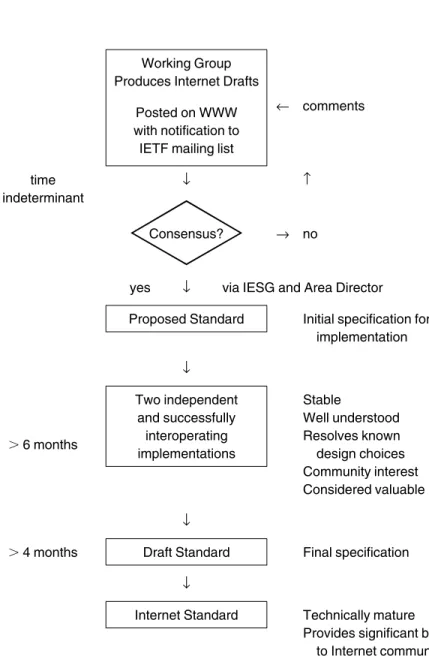
The IETF standardization process is well defined.2 The process starts with a working group producing a series of documents called Internet Drafts that are posted on the WorldWideWeb3 with notifi-cation to the IETF mailing list. Based on comments received, the work-ing group can decide that an Internet Draft reflects a consensus view. At this point the working group asks the IESG, through its Area Di-rector, to make the Internet Draft a Proposed Standard RFC.4A Pro-posed Standard specification is advanced only if it is stable, represents the resolution of known design choices, is well understood, has re-ceived significant community review, and appears to enjoy enough community interest to be considered valuable. Thus a Proposed Stan-dard RFC is viewed as the initial specification from which implemen-tations should be developed.
After a minimum of six months the working group can ask that the Proposed Standard RFC be moved to the level of Draft Standard RFC. The requirement for such a change is based on the existence of two independent and interoperable implementations from different code bases and on sufficient successful operational experience. Such
2. See S. Bradner, “The Internet Standards Process—Revision 3,” RFC 2026 (October 1996), available at具http://www.ietf.org/rfc/rfc2026.txt典.
3. See具http://www.ietf.org/ID.html典. 4. See具http://www.ietf.org/rfc.html典.
implementation experience may well uncover the need for changes to the specification. It is the implementation and experience requirement that differentiates the Internet standardization process from other standards activities. Implementations are used to prove the utility and precise operation of the specification.
After a minimum of four months a Draft Standard can be moved to an Internet Standard. Internet Standards are characterized by a high degree of technical maturity and by the understanding among its de-velopers that the specified protocol or service provides significant ben-efit to the Internet community. This process is shown in Figure 1. Security issues were not of concern for the original Internet specifica-tions. Cyber crime per se is not currently an IETF agenda item. Ad-dressing cyber crime would have to be stated as an issue in protocol design.
The Internet Involves Both Physical and Information Architectures
There are two views of Internet architecture. The most common is that the Internet is a set of linked computer hardware, software, and com-munication facilities.5 In this view, security is a matter of protecting that hardware and software against theft, damage, or denial of service. A second view is that the Internet links a collection of information. Though not as easily understandable as that of physical architecture, certain features of its information architecture are becoming clearer. First, just as the physical Internet embodies a meta-architecture that embraces the interconnection of heterogeneous networks through the processes described above, so does the information system embody a meta-architecture that embraces heterogeneous information systems. Robert Kahn and Robert Wilensky in their introduction to this general notion describe the digital object as the basic architectural element in
5. See Robert E. Kahn and Stephen J. Lukasik, “Fighting Cyber Crime and Terrorism: The Role of Technology,” presentation at the Stanford Conference, De-cember 6–7, 1999.
129 Current and Future Technical Capabilities
Working Group Produces Internet Drafts
Posted on WWW with notification to IETF mailing list
← comments time indeterminant ↓ ↑ Consensus?
6
→ no ↓yes via IESG and Area Director Proposed Standard Initial specification for
implementation ↓ ⬎6 months Two independent and successfully interoperating implementations Stable Well understood Resolves known design choices Community interest Considered valuable ↓
⬎4 months Draft Standard Final specification
↓
Internet Standard Technically mature Provides significant benefit
to Internet community
the global information system, with each object having a unique and persistent identifier.6
Finally, the architecture assumes the existence of certain systems that can speak with authority on specific information issues. For ex-ample, is the following digital object subject to a claim of copyright in the United States? Or, regarding authenticity, what is the following organization? Or, are the bona fides of this organization accurate? While some entities may have their authority conferred by law, others will develop it by superior performance in the marketplace.
Given the existence of a meta-architecture for information sys-tems, the Internet will embrace many of them, all different in some aspects. Today, the most widely used information systems are those that rely on access to files on specific machines. The older File Transfer Protocols (FTP) and the current Web protocols are examples of infor-mation system protocols, but because neither one allows for persistent access over time through unique identifiers, one can expect the spec-trum of information systems in the future to range from those that are strictly informal, with possibly transitory information, to those that have more formality.
Defining the Internet
The broad term “information infrastructure” covers a range of private, public, and national capabilities. I focus here on the information sys-tems that constitute the Internet and exclude separate national syssys-tems used by sovereign nations for the operation of their government, and facilities owned or operated by private entities that are separate from public facilities. I do, however, include both physical aspects and the information and service aspects that are not necessarily physical.
6. See Robert Kahn and Robert Wilensky, “A Framework for Distributed Digital Object Services,” available at 具http://www.cnri.reston.va/cstr/arch.html典; see also “The Handle System,” available at 具http://www.cnri.reston.va/cstr.html#archi tecture典.
131 Current and Future Technical Capabilities
Within the United States, the Federal Networking Council has adopted the following definition of the term “Internet”:7
Internet refers to the global information system that:
(i) is logically linked together by a globally unique address space based on the Internet Protocol (IP) or its subsequent extensions/ follow-ons;
(ii) is able to support communications using the Transmission Control Protocol/Internet Protocol (TCP/IP) suite or its subsequent extensions/follow-ons, and/or other IP-compatible protocols; and
(iii) provides, uses, or makes accessible, either publicly or pri-vately, high level services layered on the communications and related infrastructure described herein.
An important element of this definition is the reference to “subsequent extensions/follow-ons.” The dynamic character of networking tech-nology suggests the need for a continuing review mechanism to ensure that basic conceptual underpinnings are not inadvertently changed with the passage of time. A second important element is the inclusion of high-level services within the definition. More than simply the phys-ical devices and telecommunications capabilities that constitute the underlying network, one must view the global information system in its totality.
Abusing, Misusing, and Attacking the Internet
The Internet, after undergoing a twenty-year period of development and use by academic researchers, took on a different aspect when it was opened up to commercial users in the late 1980s. The environment quickly changed from one directed to the open and cooperative use of its information resources and services by a narrowly defined set of users to one where the new users sought privacy in their communica-tions, and protection of their intellectual property, and expected to receive a choice of reliable services at costs set competitively.
7. See Federal Networking Council, October 24, 1995, available at 具http:// www.fnc.gov典.
The new users display a varied set of behaviors. Some are business competitors or bargain-seeking consumers who are not above stealing intellectual property or services. Others are irresponsibly playful, and they set loose viruses and other malicious code or they deface web sites or destroy data files. Still others are criminals who use the Internet to perpetrate fraud, theft, and extortion. Terrorists, noting the increasing dependence of many societies on the Internet, may use it as a target or channel for the expression of their views, or to harass, coerce, or destroy social institutions. National security analysts translate these same concerns into the domain of strategic attacks on sovereign states. Such abuses and attacks may use the Internet to reach other targets, or they may target the Internet itself. The first category uses the Internet to attack defined entities, such as a particular computer, the infor-mation contained within it, or the service it provides, thereby causing harm to those dependent on those entities. The second category, at-tacking the Internet itself, intends to degrade or deny parts of its contents and capabilities to large numbers of users.
Compounding these difficulties are several related factors. As in-formation technology becomes increasingly powerful, so do the attack tools that become available. These tools are distributed to would-be attackers using the Internet itself, much in the way that poisons spread through an organism in its bloodstream. By increasing the power of their users, the tools allow a larger number of individuals, less skilled than the tool creators, to damage information systems. This progres-sion of increasingly sophisticated attacks is illustrated in Table 1.
Benign Causes of Disruption and Lack of Robustness Further Complicate Protection
Excluded from the concept of network abuse are failures that inad-vertently result from acts of nature, wear and tear or other usage, approved maintenance and operations status monitoring, and diag-nostic activities of network operators. These are considered part of the normal operational environment and part of the terms and
con-133 Current and Future Technical Capabilities
table 1
The Increasing Sophistication of Computer and Network Attacks
Year Attack mechanism
1982 Password guessing 1984 Self-replicating code 1985 Password cracking
1986 Exploiting known vulnerabilities 1988 Disabling audit mechanisms 1989 Use of back doors in programs 1990 Hijacking sessions
1991 Sweepers 1992 Packet sniffers 1993 Stealth diagnostics 1994 Packet spoofing
1995 Graphic user interfaces for attack tools 1996 Automated probes and scans
1997 Denial of service 1998 Web attacks 1999 Macro viruses 2000 Distributed attacks
Source: Thomas A. Longstaff, “International Coordination for Cyber Crime and Terrorism in the 21st Century,” presentation at the Conference on International Cooperation to Combat Cyber Crime and Terrorism, Hoover Institution, Stanford University, Stanford, California, December 6–7, 1999.
ditions for use of the network that are made explicit in either employ-ment contracts or service agreeemploy-ments. The focus of this discussion is on deliberate acts, not accidents, although the possibility of civil or criminal negligence cannot be excluded.
At the current level of networking technology numerous problems will arise from the inherent lack of robustness of the system and even of incompetence on the part of its users and operators. These unfor-tunate realities can have consequences as harmful and costly as those caused by deliberate conduct, but they are not addressed.8
8. See K. C. Claffy, “Traffic Observation in a Stateless Data Networking Envi-ronment,” presentation at the Stanford Conference, December 6–7, 1999.
Protecting Individual Computers
As with any form of private property, protecting a single computer is primarily the responsibility of its owner. An owner may seek assistance from appropriate government agencies and jurisdictions, according to the national laws applying to the locations and the activities involved. The broader the impact of such attacks, the greater will be the case for public involvement. Where the information, operation, and impact of an attack involve entities from more than a single sovereign state, which is often the case, the appeal for help may extend to the inter-national community of nations and organizations.
International actions can be as simple as supporting the resolution of civil contract disputes. In other cases they may involve the exchange of information relating to computer crimes, or suspected crimes, or to anomalies in computer operation. It is conceivable that personal in-formation relating to the citizens of one nation might be provided to entities in other countries, such as alerts, warnings, modes of penetra-tion, identities and aliases, and the like. In some cases assistance in the resolution of attacks on individual computers can involve disclosures of personal information that may raise concerns about the require-ments of privacy.9 A balance between property rights and those of personal privacy must be achieved. A possible approach to this prob-lem, involving the use of automated techniques, is discussed later.
Protecting the Global Information Infrastructure
A very different circumstance arises when the information infrastruc-ture itself, in whole or in part, is the target of attack. In this case, the jurisdiction in which such attacks occur is more complicated than for attacks on individual targets, and international agreements become increasingly important. Infrastructure “capabilities” are abstractions, substantially different from their physical manifestations; they depend
9. See Ekaterina A. Drozdova, “Civil Liberties and Security in Cyberspace,” Chap. 5 of this volume, for a fuller discussion of privacy rights.
135 Current and Future Technical Capabilities
on multiple locations and jurisdictions (including the oceans and space) and, most important, have properties and capabilities that, rather than being simply resident in any of its parts, grow out of their collective existence. Without explicit agreements dealing with the pro-tection of the network, global protective actions may be limited to those common to all jurisdictions taken together. This least common denominator will not, in general, provide the greatest amount, or even adequate amounts, of global protection.
For protection to be adequate, the shared global system should have the capacity to detect and identify violators with sufficient ac-curacy to deter them through the prospect of being indicted, prose-cuted, and punished, or otherwise caused to pay a price for having initiated an attack. To achieve this degree of effectiveness will require creating appropriate tools, procedures, and organizations, not only to satisfy these aims but also to satisfy national authorities that their sovereign rights and the rights of their citizens are protected.
Although in some situations bilateral international interactions may be all that is required to deal with an attack on the Internet itself, in many others multinational action will be required. Certainly a global attack on the entire information system would require a coor-dinated worldwide response, and such a prospect is properly a subject for political consensus on how best to respond. At a minimum, the governing policies and processes will need to be established in advance.
2. Defending Information Systems
Against Cyber Attack
For a realistic assessment of future prospects for the defense of infor-mation infrastructures against cyber attack, the current state of prac-tice provides a starting point. In addition to the art and science of system defense, we should examine those areas that security profes-sionals feel could provide the greatest leverage in blunting future at-tacks.
The View from the Defender: Prepared Defense
In the case of a prepared defense there is a secured network with a perimeter involving, for example, firewalls, virtual private networks, and/or challenge response systems.10This perimeter is monitored by an information protection staff using a combination of automated and semiautomated tools. An effective perimeter defense implies that the modes of possible attack are known a priori and that methods are in place to detect the signatures of these attacks. Early warning of an attack might, for example, come from monitoring the TCP, UDP, and ICMP activities occurring on in-bound packets.11Early warning could also come from automated searching for key words in the internals of network traffic that would generally indicate an attempt to gain access to systems or privileges not permitted from outside the secured perim-eter.12This could in addition include the routine scanning of attached files in e-mail, which can contain known viruses or suspicious execut-able programs.
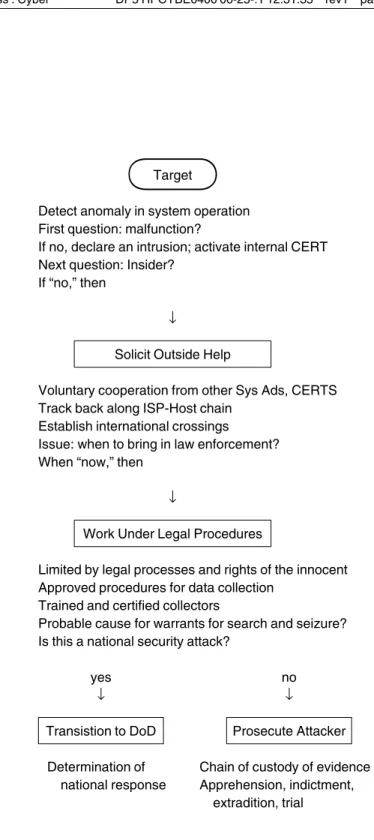
A potential attack may be indicated to the information protection staff via e-mail, pager, or other means. At this point, the information protection staff must ascertain whether the alert is real or a false alarm. This is done in several ways, and is somewhat dependent on what information is captured or buffered at the firewall. Essentially, the team must look manually at the information collected by the auto-mated monitoring system in order to make an initial assessment. Ad-equate evidence may or may not be available, but in either case, in
10. See Steven D. Rizzi, “Is Technology the Answer to Infrastructure Protection?” presentation at the Stanford Conference, December 6–7, 1999.
11. For a discussion of TCP, UDP, ICMP, and other protocols, see Douglas Comer, 1Internetworking with TCP/IP(Upper Saddle River, N.J.: Prentice-Hall, 1995).
12. “Internals” refers to the content of networked information. This could be the actual text of an e-mail, the graphics in a computer file, the audio or video of a teleconference, or the audio of a telephone call routed over a computer network. By contrast, “externals” refers to the routing information that is contained in the message that identifies the source and destination without providing detailed information of the message content.
137 Current and Future Technical Capabilities
order to support both evidence collection and better situation assess-ment, the security staff will increase the amount of auditing and data collection being done at the perimeter.
If the increased monitoring and auditing process confirms a sus-pected attack on the network, rapid engagement of additional pro-cesses is necessary. Engagement typically will require disaster prepa-ration and warning, contingency plan execution, system isolation, and ultimately denial of access to the attacker. The security staff must move quickly to determine the nature of the intrusion, as well as to intervene to deny access to the attacker. During this period of the engagement, security personnel will trace the origin of the attack. In most cases, a serious attack will not have originated from the source that has been monitored; the real attacker will be located one or more “hops” away. That means that the defenders must attempt to contact security per-sonnel at the apparent attack source to see if the attack is originating from that location or from some other “hop.” This tracing period may take time, and prove difficult, since the only contact information that is usually available is from the personnel at the point of initial contact and the attack may not occur during business hours.
For these reasons, it is usually difficult for security staffs to trace a multiple “hop” attack, and the urge to deny the attacker access, either through the operating system or the firewall/router, is hard to resist. Having an automated way of tracing such attacks would be of great use, for it would increase the number of successful traces and would thus enhance deterrence.
Denial of access to attackers results in the immediate ending of any intrusion, but attackers frequently eliminate the evidence of their activities on some number of the intervening “hops,” or they may place confusing or contradictory evidence in log files that would sug-gest to investigators that the attack came from somewhere other than the true origin. Sometimes the various “hops” along the way are out-side the country boundaries of the computers under attack, creating the further difficulty of additional barriers such as different laws, languages, and time zones.
For most practical purposes, the average security staff that is well prepared for an attack of this nature will be in the position to detect, investigate, and terminate the intrusion, yet because of the “network of networks” nature of the Internet, detailed investigation leading to the location of an attacker is not likely to take place without the involvement and cooperation of law enforcement, Internet Service Providers (ISPs), and telecommunications providers. Unfortunately, this seldom occurs simply because the amount of work necessary to coordinate and carry out an investigation outweighs the value of find-ing the attacker—or at least it would require the group attacked to admit publicly that it had been attacked. These issues could be prac-tically solved if we had an automated method for tracing attacks, particularly one that would protect the identity of the institution under attack.
Hasty Defense Is More Difficult
In many cases, the attack as launched has not been prepared for, and so the defenders must mount a hasty defense—not an easy task. Though the defenders know that something has happened, they may not be sure what, how, when, who, or why, but in all likelihood, speed is of the essence because evidence may be lost at any time. Usually the first step in such situations is to analyze what systems and/or networks may have been affected so that computer backups for those systems can be immediately secured and duplicated. A team may set to work analyzing the data contained on those backups, looking for clues to how the attack occurred. Additionally, the security staff may make duplicates of audit and transactions logs, as well as network traffic and/or firewall logs. At this point, the security staff will increase the level of auditing and monitoring conducted on the network, in order to collect improved evidence in the event of further attack. This may best be done with computers that are dedicated to “sniffing” packets off the network and storing the packets on removable media. Unfor-tunately, in the case of the hasty defense, it may or may not be clear
139 Current and Future Technical Capabilities
whether the attack occurred from outside or inside—that is, the at-tacker may possibly be an authorized user, operating inside the net-work.
In the process of analyzing the attack, defenders may discover some unique aspect that is characteristic to the attack—for example, certain accounts are used, a particular time of day, and so on. That may be difficult, however, since many computer networks are complicated interconnections of heterogeneous equipment with numerous ways in which they can be accessed. In addition, it is necessary to characterize the attack, and this characterization will form the basis by which investigators will review data, looking for possible intrusions or unau-thorized accesses. The process of analyzing the network topology (how computers interact or interconnect with others on the network) may also be of assistance.
This correlation must lead to the development of a profile for the intruder that can be used to search through the large volumes of historical as well as current data, looking for further evidence of in-trusion. Ultimately, the endgame in the hasty defense is locating the attacker through a more and more detailed approximation of the “attack signature.” Continued refinement of this signature through the collection of a significant number of intrusions helps to identify the attacker, even when normal means to gain access to the computer systems in question are used—such as signing into the system using a stolen user name and password. Once a sufficiently discriminating signature has been developed, the hasty defense takes on the nature of the prepared defense, and defenders can continue to investigate and/ or terminate the attacker’s access.
Automated search tools are important to detect intrusions in the large volumes of data involved in normal network operation. Since this produces a number of sessions that contain possible events that must be reviewed individually by investigators, review at this level requires the detailed reading of interactions between users, computers, and other users. Most of these sessions, as one would expect, are those of legitimate users so technology could be of enormous value here, if
it could provide a means to detect and track unauthorized users with-out requiring investigators to read message internals. The response process, as seen by the defender, is shown in Figure 2.
Tracking Packets
One mechanism to identify tracks through the network could be fa-cilitated by routers and the Internet service providers who operate them.13As indicated in Figure 2, if every time a packet left a router, the packet contents were fingerprinted, for example, by a checksum-ming or other mechanism implemented in hardware, one network could verify with its neighboring network that a packet with a specific fingerprint passed through the network at a given time.14This finger-print could also be passed to the next network or destination system, which could then use the fingerprint to identify a specific packet, and each network on a hypothetical reverse path could then be queried to determine if it carried that particular packet. This, of course, could generate a very large amount of auxiliary data, which would, depend-ing on how long it would be retained, have to be logged and stored, either by the routers or in repositories associated with them. (See Figure 3.)
A variant on this approach would keep statistical track of packet fingerprints over designated time frames, for example, over ten-minute periods, so that, with relatively much less storage, it could be deter-mined with certainty that a given packet fingerprint did not pass through that network during that time frame. Although such a system would not be able to determine whether a given packet actually did pass through a network, it could be used to establish the negative.
If it were established that a given packet fingerprint was seen by
13. See Kahn and Lukasik, “Fighting Cyber Crime and Terrorism.”
14. Such a fingerprint, also called a “Message Digest” by Rizzi (“Is Technology the Answer?”) could be a cryptographic operation that takes an arbitrarily large input string and produces a relatively unique numeric representation. In other words, con-tent information, that is, internals, are reduced to a number. The algorithm would be chosen so that it would be difficult to infer the input string from the fingerprint.
141 Current and Future Technical Capabilities
Target
9
Detect anomaly in system operation First question: malfunction?If no, declare an intrusion; activate internal CERT Next question: Insider?
If “no,” then
↓
Solicit Outside Help
Voluntary cooperation from other Sys Ads, CERTS Track back along ISP-Host chain
Establish international crossings
Issue: when to bring in law enforcement? When “now,” then
↓
Work Under Legal Procedures
Limited by legal processes and rights of the innocent Approved procedures for data collection
Trained and certified collectors
Probable cause for warrants for search and seizure? Is this a national security attack?
yes
↓
no
↓
Transistion to DoD Prosecute Attacker Determination of
national response
Chain of custody of evidence Apprehension, indictment,
extradition, trial
Sender
9
↓ ISP ISP ISP R4
↓ R4
↓ R4
↓ ↑ ← ←First router fingerprints packet. Intermediate routers retain record of fingerprint, and pass fingerprint to next router
Sender can decline to be fingerprinted
ISP
4
R↓
Receiver
9
← Recipient is given packet and its fingerprint should trace be needed Recipient can decline packets not accompanied by a fingerprint, or treat them with greater suspicion.N networks en route from host A to host B at a given time, that might be sufficient evidence to require disclosure of service-level information retained by host B that is correlated with the specific packet fingerprint, assuming it still existed. This information could then be used to cor-relate with the corresponding information in host A, which never had access to the packet fingerprint in the first place and therefore could not have initiated the inquiry. However, host A could initiate a reverse query based on received packets from host B, whose packet fingerprint host B was not privy to. This would let host A take the lead in identi-fying the reverse channel, and let host B take the lead in identiidenti-fying the forward channel. If executed effectively, this would have an impact similar to the impact that accessing billing records has in tracing use of the telephone system and would be a useful tool for enabling cyber attackers to be identified and located.
A similar suggestion is made by Stephen Rizzi, who notes that technology for privacy-protecting packet tracing would also be desir-able.15All too often an intrusion event is not investigated extensively because current manual methods do not allow for timely or privacy-protected tracing of multihop attacks. Technology is needed to support near-realtime automated tracing of multihop attacks. Such technology should protect the identity of the institution requesting the trace, to avoid undesired publicity, and in addition, the tracing algorithm should not directly use internals of the message to trace the origin. Such an architecture could be accomplished by the installation of a “trace server” on each registered domain subnet.
With time, such a server could be as important as a firewall. To be useful, all networks willing to support a trace capability would have such a server. The trace server would keep track of all incoming and outgoing traffic, and reduce those exchanges to time-stamped records with origin, destination, and a message digest, such as the fingerprint mentioned above. All this information would be encrypted using the
15. Ibid.
public key of a clearinghouse.16A tracing request would originate from a subscriber to the clearinghouse, again, encrypted using the public key of the clearinghouse with a query stating the perceived origin of the attack, the date/time range, and a message digest of suspect com-munications. The automated system at the clearinghouse would then begin a series of queries to trace servers of networks implicated in the attack. The automated clearinghouse matches up the outgoing traffic of one network with incoming traffic of another, tracing the commu-nications until the point of origin is reached.
The communication channels and information resources used for coordinating investigation of attacks must be separate from the infor-mation resources that are the targets of attack, and they must receive special protection. This can be accomplished through an overlay on the network, but its functionality and points of origin must be limited to avoid compromise of the overlay itself. Clearly, the design and operation of such channels is a matter for international cooperation. As noted earlier, a need exists for anonymous communications be-tween incident responders under some conditions, which suggests that care be taken in implementing such “back-channel” facilities.
Integration of Defensive Technologies
Current defenses against a cyber attack include prevention mecha-nisms such as firewalls, intrusion detection and response components, and security management applications, but a lack of communication and coordination between vendors’ security components limits their effectiveness in large heterogeneous environments. Key technical and organizational issues limiting coordinated cyber defense across ad-ministrative and national boundaries can be identified, and challenges
16. A clearinghouse is an objective third-party organization that is considered a trusted recipient of information from member parties. A clearinghouse makes relevant information available to all parties without divulging source information that could violate the privacy of participating members.
145 Current and Future Technical Capabilities
in achieving agreements between international organizations on how these technologies can be integrated are substantial.
Automated response to intrusions is a major need for defending critical systems. Vendors have developed products that support intru-sion response.17 These products use proprietary protocols and are limited by an architecture that requires all response decisions to be made at a central controller. Because an adversary can take actions at computer speeds, systems must react at comparable speeds, implying the absence of human intervention.
Current tracking mechanisms have significant limitations, espe-cially when applied to large heterogeneous environments such as the information infrastructure.18First, intrusion detection systems detect local intrusion symptoms and can only react locally, for example, by reconfiguring local boundary controllers and hosts. Because an at-tacker may cross many network boundaries, a local response by the target cannot identify or mitigate the true source of the attack. Second, even if intrusion detection systems were capable of communicating with boundary controllers near the attacker, there is no common lan-guage for remotely instructing them to handle selected traffic. It is also unlikely that intrusion detection systems would know enough about all such devices to be able to reconfigure them remotely using low-level, device-specific commands. Nor is it likely that the owners of such devices would allow it. Third, if intrusion “symptoms” are de-tected in different areas of an internetworked environment by different intrusion detection systems, current technology lacks the infrastruc-ture and protocols for pooling this information to allow intrusion correlation and to develop and promulgate a coordinated response.
Current research is providing a framework that allows the
inte-17. See: Network Associates, “Active Security,” available at 具http://www.nai. com/asp_set/products/tns/activesecurity/acts_intro.asp/典; Internet Security Systems, “RealSecure,” available at 具http://www.iss.net/prod/典; AXENT Technologies, “In-truder Alert,” available at具http://www.axent.com/product/smsbu/ITA/典.
18. See Randall Smith, “Coordinated Cyber Defense,” presentation at the Stan-ford Conference, December 6–7, 1999.
gration of detection and response components, thereby enabling ex-perimentation with automated response strategies.19The Intruder De-tection and Isolation Protocol (IDIP) has been shown to be capable of providing cooperative tracing of intrusions across network bounda-ries, blocking intrusions at boundary controllers near attack sources, using device-independent tracing and blocking directives, and cen-tralizing reporting and coordination of intrusion responses.
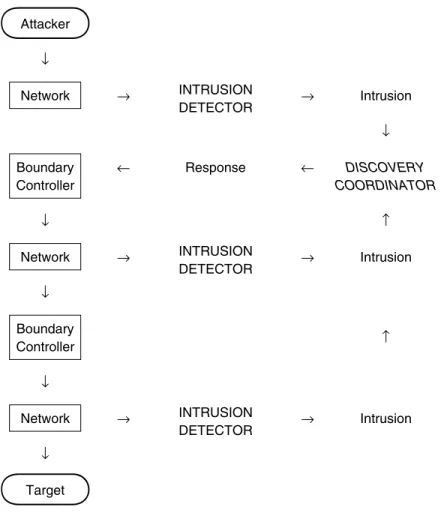
Figure 4 shows system architecture that incorporates the IDIP. Each network in an administrative domain—for example, a company intranet—has an intrusion detector. Networks are connected through boundary controllers. In the example shown, an attacker, having le-gitimate access to his own network, intrudes upon two more remote networks where he is noted as an intruder. Intrusion reports are for-warded to a central discovery coordinator who is able to discern the attack path. The discovery coordinator issues a response instruction to the boundary controller closest to the attacker. The attacker is thereby identified and either an automated or a manual response can be initiated. Software components that have been successfully inte-grated using the IDIP are shown in Table 2.
To support communication between the varied IDIP components requires a flexible and extensible language. IDIP uses the Common Intrusion Specification Language (CISL) developed using the Common Intrusion Detection Framework (CIDF) as the language for describing attacks and responses.20This language includes terms for describing the blocking actions used in the current IDIP implementation, and it can be extended to support additional responses as they are developed. Currently, IDIP uses only two actions: block and allow. These can be
19. SeeProtocol Definition Intruder Detection and Isolation Protocol Definition, Interim Technical Report (CDRL A005), Boeing Document No. D658-10732-1, Jan-uary 1997; Dynamic Cooperating Boundary Controllers, Final Technical Report (CDRL A003), Boeing Document No. D658-10822-1, February 1998;Adaptive Sys-tem Security Policies Preliminary Assessment(CDRL A005), Boeing Document No. D658-10821-1, February 1998.
20. See Rich Feiertag et al., “A Common Intrusion Specification Language,” June 1999, available at具http://www.gidos.org/典.
147 Current and Future Technical Capabilities
Attacker
9
↓ Network INTRUSION DETECTOR → → Intrusion ↓ Boundary Controller ↓ Response ← ← DISCOVERY COORDINATOR ↑ Network ↓ INTRUSION DETECTOR → → Intrusion Boundary Controller ↓ ↑ Network ↓ INTRUSION DETECTOR → → Intrusion Target9
Fig. 4. Intrusion Detection and Isolation Protocol (IDIP) system architecture.
used with various objects (for example, users, processes, messages, or connections) to cause a number of different responses. A “block user” message, for example, is interpreted as a request to stop that user from doing anything; a “block user and connection” message is interpreted as a request that the user be prevented from using the specified con-nection. Connection information includes protocol, source address, source port, destination address, and destination port. Response mes-sages can also include a specification of when to start and stop such actions.
An IETF working group is currently investigating standards for communications between intrusion detection components. One of the proposed standards is CIDF. The major modifications needed are a limitation of the type of information communicated, definition of data formats and exchange procedures for sharing information of interest with intrusion detection and response systems and the management systems that may need to interact with them, and the integration of the protocol into the TCP/IP suite of protocols. The requirements specification is currently an Internet Draft and has been forwarded to the IESG for publication. Other documents to be produced relate directly to the protocol: a definition of the data items desired in the messages to be exchanged; a definition of the message format; and a protocol for communicating the messages.
Coordinated Response to an Attack
Responses should be in proportion either to the damage already done or to the potential for future damage. Thus damages need to be as-sessed. When the attacker is inside, no external aid need be solicited, unless domestic law enforcement or other investigatory organizations are brought in. If the attacker is outside, the first question is whether he is located in the target’s country; for if the attack is from or through another country, international cooperation will be needed. Further-more, if the foreign country is the point of origin of the attack rather than a pass-through country, response will be different, because the
149 Current and Future Technical Capabilities
table 2
Software Components That Have Been Integrated Through the Intruder Detection and Isolation Protocol (IDIP)
Boundary controllers Intrusion detection systems Host-based responders
NAI Gauntlet娃Internet Firewalla
Net Squared Network Radarb
NAI Labs Generic Software Wrappers Prototypec
Secure Computing Corporation Sidewinder娃 Firewalld
SRI EMERALD BSM and EMERALD FTP Monitors Prototypee
TCP Wrappersf
Linux Routerg UC Davis Graphical Intrusion
Detection System (GRIDS) Prototypeh
IP Filteri
aSee具http://www.nai.com/asp_set/products/tns/intro.asp典. bSee具http://www.NetSQ.com/Radar/典.
cSee T. Fraser et al., “Hardening COTS Software with Generic Software Wrappers,”
Proceedings of the 1999 IEEE Symposium on Security and Privacy, Oakland, Calif., May 1999.
dSee具http://www.securecomputing.com/典.
eSee Ulf Lundqvist and Phillip A. Porras, “Detecting Computer and Network Misuse
Through the Production-Based Expert System Toolset (P-BEST),” Proceedings of the 1999 IEEE Symposium on Security and Privacy, Oakland, Calif., May 1999.
fSee具http://www.nai.com/asp_set/products/tns/intro.asp典. gSee具http://www.linux.org/典.
hSee S. Saniford-Chen et al., “GRIDs—A Graph-Based Intrusion Detection System
for Large Networks,” Proceedings of the 19th National Information Systems Security Conference, October 1996.
iSee具http://coombs.anu.edu.au/⬃avalon/ip-filter.html典.
required investigation can impinge on its sovereignty. Greater coop-eration can be expected if the foreign state is itself a victim or is an uninvolved transit country.
Need for a Global Incident Response Capability
Clearly, information exchange and interaction among many parties is necessary for producing comprehensive approaches and solutions to
table 2
(continued)
Boundary controllers Intrusion detection systems Host-based responders
NAI Labs ARGuE Prototypej
Oregon Graduate Institute StackGuardk
NAI Labs Multiprotocol Object Gateway Prototypel
Odyssey Research Associates CORBA Immune System Prototypem
NAI CyberCop娃Server and CyberCop Monitorn
Internet Security Systems RealSecure娃o
jJ. Epstein, “Architecture and Concepts of the ARGuE Guard,” Proceedings of the
15th Annual Computer Security Applications Conference, Phoenix, Ariz., December 1999.
kC. Cowan et al., “StackGuard: Automatic Adaptive Detection and Prevention of
Buffer-Overflow Attacks,” Proceedings of the 7th USENIX Security Conference, San Antonio, Tex., January 1998.
lSee G. Lamperillo, “Architecture and Concepts of the MPOG,” NAI Labs reference
no. 0768, June 1999.
mSee “Computational Immunology for Distributed Large Scale Systems,” available
at具http://www.oracorp.com/Projects/Current/CompImm.htm典.
nSee具http://www.nai.com/asp_set/products/tns/intro.asp典. oSee具http://www.iss.net./prod/典.
system intrusions. The need is to support a global incident response effort and thereby to reduce the number and extent of computer se-curity incidents. The Computer Emergency Response Team Coordi-nation Center (CERT/CC) at Carnegie-Mellon University provides one basis for such a capability.21This Center, established by the U.S. De-partment of Defense in the late 1980s, has extensive practical experi-ence in the conduct of violations of computer security. Incident re-sponse and computer security teams consist of practitioners and technologists who have operational experience but may lack authority to make policy and security decisions for their organizations. A
re-21. See Longstaff, “International Coordination for Cyber Crime and Terrorism.”
151 Current and Future Technical Capabilities
sponse team may not have sufficient staff to respond effectively to all security incidents. At this time there is no infrastructure to support a coordinated global incident response effort, although there are some components that could form the basis of such an infrastructure.
A variety of issues must be addressed when considering how to promote an effective global incident response infrastructure. These include which organizations will coordinate and participate in the development effort, how current groups and forums can fit their mis-sions and objectives into an agenda to create a global infrastructure, and what possible structures and mechanisms might be required in the future.
The 1999 Melissa virus attack underscores the lack of such a global response structure for incident response. Because individual teams focused on individual or national response needs, there was no oper-ational global response effort. Although the Forum of Incident Re-sponse and Security Teams (FIRST) played an essential role in the early identification of the problem through reports shared among its mem-ber teams and was therefore able to notify others, it lacks the opera-tional mission and funding necessary to facilitate further responses; almost four days elapsed from the initial activity report to solicitation and receipt of status reports and generation of the global activity summary. Even so, the resulting summary provided the needed global perspective on impacts and spread of remedial activity.
A global response capability can be achieved by building on exist-ing incident response and security teams. Successful resolution of in-ternational incidents has been possible when the following elements were in place:
• A common terminology between parties involved in the inci-dent to include iinci-dentification of the intruder’s modus operandi, the technical attack details, and the identification of the targets • Knowledge of the technical skills of all parties involved in
resolving the incident
• Existing agreements on how incidents of a variety of types will be handled
• An understanding of the common and conflicting societal is-sues surrounding the incidents
Such an approach is not necessarily dependent on international agree-ments or treaties between governagree-ments, but government-to-govern-ment agreegovernment-to-govern-ments can significantly improve the effectiveness with which incidents are resolved.
FIRST is a possible basis for such an expanded international tech-nical cooperation. Organized in the early 1990’s, FIRST consists of more than eighty incident response and security teams from nineteen countries. It provides a closed forum for these teams to share experi-ences, exchange information related to incidents, and promote pre-ventive activities. Although other teams exist that are not yet FIRST members, and new teams are constantly being established, the labor-intensive nature of incident response and the growing number of in-cidents leave the world with a dearth of capability. FIRST is a volun-tary organization that provides an introduction service and meeting place for teams to establish trusted interactions, but since it lacks operational elements it cannot provide the necessary coordinated global effort or meet other needs, such as a more open flow of sensitive information and close collaboration to respond to widespread events. Overcoming these shortcomings will require appropriate policies and procedures, formal contractual agreements among its member orga-nizations, and documented procedures to serve as guidance for new entrants.
Beyond formal structure, what is needed is a way to build on personal trust relationships to achieve organizational trust. Gaining entry to the incident response community can be a difficult and lengthy process; the community is ready to embrace new members, but it is wary of interacting with new teams until an existing member of the trusted community can vouch for them. A global incident response capability is difficult to build rapidly, but national boundaries, which
153 Current and Future Technical Capabilities
provide a demarcation for policies, procedures, and jurisdiction for information exchange, are a natural starting point. Response teams that cross national boundaries, such as incident response teams for multinational corporations, are another useful basis for international cooperation. Above all, there must be participation and cooperation among governments, law enforcement agencies, commercial organi-zations, the research community, and practitioners who have experi-ence in responding to computer security incidents.
Different Viewpoints of Victims and Law Enforcers
Rapid collection of forensic evidence is needed by both victims and police.22Police seek to identify the attacker; the victim has the task of cleaning the attacked hosts and getting them back into operation. With limited technical resources, the defender’s efforts must be divided among learning the extent of the invasion, reconfiguring hosts to be resistant to future attacks, getting the hosts back on-line, and helping law enforcement agents track down the attackers. Even though the evidence gathered at these first steps is often too vague to prove a defendant’s guilt, it can provide probable cause for further investiga-tion. Rarely does an attacker explicitly give away his or her identity. Either the “smoking gun” evidence is found on the attacker’s own computer, or is observed through interception of a data stream while a crime is being committed.
Once law enforcement agencies have collected evidence from the scene of the crime, the evidence must then be combined with the evidence collected by the defender. This should show that the evidence collected from the crime scene is directly tied to evidence collected from the intrusion site. Items found at the scene such as lists of user-names and passwords, computer and network addresses, help screens from attacked applications, and so on, can be correlated with evidence stored by the defender that documents the intrusions. To be usable in
22. See William Cheswick, “Internet Forensics and Cyber Crime in Court,” pre-pared for the Stanford Conference, December 6–7, 1999.
court, evidence collected by the defender must be properly collected and stored.
Usually law enforcement and the victim will keep a write-locked copy of each disk image dump. A growing number of tools are avail-able for examining and processing image dumps. Speed is essential because ISPs generally keep their logs for only a few days. In the U.S., ISPs generally require a subpoena before supplying log data to law enforcement agencies. But they will preserve log data, which may normally be kept for only two or three days, in anticipation of a subpoena. Evidence collected at the scene of the crime will provide additional clues for what to look for in the defender’s historical data, so that eventually, a comprehensive profile can be developed to re-analyze the data, documenting information to support prosecution.
Computer Forensic Issues in Law Enforcement
Log-keeping is an important part of dealing with the Internet. Logs help identify usage patterns, administrative and configuration errors, misuse, and attacks. Mailers keep logs to help identify sources of spam mail. Firewalls log rejected packets. Authentication servers record count usage, and DHCP servers record caller ID information, ac-counts, and IP addresses assigned. ISP records of this sort are partic-ularly important in tracing attacks back to their source. Such logs, kept in the ordinary course of business, are admissible in court. How-ever, since nearly all computer forensic evidence is machine-readable, it is subject to easy and undetectable editing. Governments have to deal with this obvious possibility.
Providing access to logs is a source of tension for ISPs, particularly those who do not wish to become involved in legal actions. If logs are discarded routinely, without backup, the investigatory process will have less information to utilize. Logs to handle routine problems such as mailing errors are seldom needed for more than a week. On the other hand, firewall logs of suspicious activity are preserved on a WORM drive, where they remain available indefinitely.
155 Current and Future Technical Capabilities
Bulk backups and disk image copies may provide usable and ad-missible evidence if the chain of evidence is preserved. CD-ROMs are useful for preserving evidence, though they lack the capacity to deal with current online storage technology. Newer technology such as once DVD disks should help. Image backup tapes need a write-protect switch to prevent inadvertent overwrites that can be sealed at the time of the dump. Although a switch can be defeated with a mod-ified tape reader, there are cryptographic solutions to this problem as well, since cryptographic checksums verify that data have not been tampered with. There are also time-stamping services that can verifia-bly time-stamp a checksum without revealing the actual data.23
Possession of username and password files is illegal in the U.S.24 Password files are access devices, and the mere presence of several of these files on a defendant’s computer is illegal, even if there is no evidence that they have been cracked. However, the use of a username/ password pair is not proof that the owner is at fault, since accounts are easy to steal and many sites offer free e-mail accounts with user-selectable account names. Nor is possession of code evidence that it has been used. Although idiosyncrasies of code may be suspicious, it has been difficult for law enforcement agencies to prove that particular code was actually used. This has been a crucial problem in prosecu-tions. Code idiosyncrasies may strengthen a case, but software is often widely known. Further complicating prosecution is the fact that cyber crime usually involves innocent third parties.
Issues Surrounding ISPs
Internet Service Providers are the entry point to cyberspace. On one side of the ISP is the “user,” the arena of private property, civil rights against unreasonable search and seizure, rights to privacy, and due process. The other side of the ISP can be characterized as “commons,”
23. See S. Haber and W. S. Stornetta, “How to Time-Stamp a Digital Document,”
Journal of Cryptology3 (1990/91): 99–112. 24. 18 U.S.C. § 1029.
something shared, and hence something where the rights of various entities are not absolute but must be balanced against the common good. Damage to the commons affects all who use it. This balancing of rights and responsibilities is a matter of process, which can be voluntary or may be subject to various domestic and international laws and agreements.
Law enforcement agencies need help from ISPs, regardless of their location. They will want real-time access to packet streams and au-thentication to tap specific sessions, giving stronger links between the user and criminal activities. Some ISPs assist in these matters when they can, but it is a difficult job. The growth of the Internet leaves hardware running at full speed, with few spare facilities for this activ-ity. For a busy router, some kind of hardware assist will be necessary, and this can only be provided by the router manufacturers, and only in response to ISP or legal requirements. Since this would increase the costs of the router, it may take legislation similar to the CALEA re-quirements for the telephone system.25Such requirements would have to be international to be effective, and in the long run they will prob-ably not work, for the ubiquitous encryption that is coming will frus-trate many of these efforts. The new generation of CPUs, driven by such needs as voice recognition and game graphics, have adequate power to apply strong encryption to network traffic streams, and there is little hope that even a government will have the resources to pene-trate these sessions directly. Even weakened or broken cryptography presents a large economic obstacle to real-time wiretaps; 40-bit en-cryption is considered weak, but it is not easily amenable to real-time cracking. High-performance hardware is required to extract even plaintext packets from packet streams.
The Fifth Amendment to the U.S. Constitution complicates the question of whether a defendant can be forced to reveal passwords and unlock cryptographic keys. Other complications arise when an
25. See Commission on Accreditation for Law Enforcement Agencies 具http:// www.calea.org典.
157 Current and Future Technical Capabilities
ISP is itself under investigation. Specific circuit identifications can be obtained from telephone companies to determine connectivity, but the extent to which one can trust the logs of an ISP that may itself be compromised, possibly inadvertently, is unclear. Given an IP address, there are still questions about the actual location of the computer at the time of the alleged crime, and the identity of the actual user.
The Wide Range of Responsibilities of ISPs
From the standpoint of the ISP, it must, as a first priority, protect its own hardware, software, and databases from compromise, meet con-tractual commitments to its customers, maintain the continuity of its business, and guard against liabilities arising from allegations of neg-ligence.26Attacking routers and switches can compromise the entire network infrastructure, and such attacks are heavily defended against, though how effectively remains to be established.27In addition, ISPs must help protect their customers from accidental and malicious ac-tions on the Internet. Finally, they may be seen to have some sort of responsibility, at least implied, to the global community to protect it from the accidental or malicious actions of their customers. These responsibilities are difficult to fulfill in the face of rapidly changing technologies—which imply frequent upgrades in systems; rapidly growing market demands that require frequent upgrades in capacity, rapid changes in the ability of hackers and criminals to compromise networks and computers, and rapid changes in security technology that must be assessed and in which investments must be made.
ISPs cannot ignore security issues, but selecting and implementing appropriate security measures in a timely manner while maintaining high traffic throughput to the Internet nevertheless requires a high degree of cooperation among ISPs and communication providers. The
26. See Barry R. Greene, “ISP Security Issues in Today’s Internet,” presentation at the Stanford Conference, December 6–7, 1999.
27. See “Improving Security on Cisco Routers,” available at 具http:// www.cisco.com/warp/public/707/21.html典.
open management environment in which the Internet operates and the dedication of its vendors and operators to meeting the needs of its users requires the balancing of these opposing tendencies of coopera-tion in protecting the commons and in competicoopera-tion among themselves. The maintenance of this environment is under severe pressure, how-ever, as the Internet and the number of its users expands. A central consideration, as we move to protect the Internet and its users, is that while doing good, we should also do nothing that will limit its potential for continued growth.
A Proactive Program for Internet Security
Given these considerations, a statement of best common practices for ISPs is needed.28Such a document, or family of documents addressing recommended practices to various degrees of depth, should be pre-pared and updated to reflect current business and technical trends. This is the proper task of an industry or trade association. Adherence would be voluntary, although in view of the tradition of service to Internet users, one might expect it to be adopted for reasons of effi-ciency and economy. Should risk management through insurance be-come widespread, such best common practices could naturally assume the role of minimum standards for insurability and protection against allegations of negligence.
Security research and product development is undertaken by ISP hardware and software vendors and this can be expected to increase the level of protection in deployed information networks. A desirable result would be for differences in security to become a market differ-entiator for ISPs, much as price, quality and reliability of service, and ease of use are today. There are a number of vendor roles including close interaction of router vendors’ operations staff with those of ISPs; providing personnel for product support emergency reaction teams; having product development staff working with customers on new
28. See “BCPs for ISPs—Essential IOS Features Every ISP Should Consider,” available at具http://www.cisco.com/public/cons/isp/documents/典.
159 Current and Future Technical Capabilities
features; providing security consultants for assistance with countering attacks, undertaking audits, and prosecuting intruders; and staff who track hacker communities.29
3. Automation of Computer and
Network Protection
Labor-intensive approaches to computer and network security can use automated tools and techniques to improve their speed and efficiency. Timeliness will minimize losses due to attacks; efficiency will enable more protection to be provided for a given level of resources applied; scaling to accommodate the growing number of attacks can, in prin-ciple, be achieved; and privacy for innocent users can be enhanced to a degree through automated rather than manual screening of traffic. All too frequently, the requirement for privacy conflicts with the need for protection; once people have exhausted their ability to protect themselves, they must appeal for assistance, and this inevitably in-volves some sacrifice of privacy. Nevertheless, it is reasonable for victims of cyber intrusion to expect their protectors to tread as softly as possible, and that those seeking protection have options as to how much protection they will receive and what price, in terms of loss of privacy, they are willing to pay.
Tools to Automate Protection
Automated tools can improve protection in various ways. For exam-ple, if information is only accessible by reference to its unique identifier or handle, the ability to collect and analyze data on system use can be greatly augmented. At a minimum, the ability to establish the presence of a user at a given place in the global information system will be critical for evidentiary purposes, recognizing also that the ability to
29. See “Product Security Incident Response Teams (PSIRT),” 具http://www. cisco.com/warp/public/707/sec_incident_response.shtml典.
challenge such evidence and contest differing points of view or inter-pretations will also be needed.30
One class of tools, noted earlier, are those that detect intrusion and other unauthorized uses of network and computer systems and high-level services. These will range from the more obvious tasks of checking log-ins to be sure they match authorized users, to running software agents on the machine to detect other software agents that may arrive without authorization. Agents that are able to detect the presence of, and oppose, other agents may be a possible countermea-sure.
Another class of tools for protection would monitor current usage of all relevant machine resources and look for unusual patterns. Peri-odic checks of user identity might be warranted. Compared with tra-ditional password protection schemes, cryptographic log-in systems provide considerable increases in protection against unauthorized ac-cess. Unlike the traditional password systems, cryptographic log-ins are not vulnerable to playback attacks and other attacks that involve stealing passwords. Alternate systems based on public key encryption can be used to authenticate users.
Automation of protection could be implemented in the network, tracking patterns of usage in real-time and alerting system operators to unusual conditions for manual or semiautomated review. Another automated approach to preserving privacy would be to package sus-pected sessions and e-mail them to the user to verify that it was indeed that user who was actually at the keyboard for that session.
Timely Tracking
Pursuing an attacker can reduce future exploitation of system vulner-abilities. Rapid response will minimize compromise and contain dam-age that may have occurred. This would require the cooperation of
30. See Joseph Betser. “Tracking Cyber Attacks,” presentation at the Stanford Conference, December 6–7, 1999. See also the contributions by Rizzi and by Kahn and Lukasik.
161 Current and Future Technical Capabilities
automated software modules en route from and at the attack source. It would also require trust among the cooperating organizations and technical activities that are in place to facilitate such automated com-munication among software modules.31
There are several meanings of “timely.” One is “session time,” the time during which the intruder is logged-in. Information collected during this time will enable tracking most easily since all the links in the attacker’s path are open, but this sort of tracking requires not only an unusual degree of readiness but also technical capability. Once the intruder is no longer on-line, traces of the surreptitious activity, other than any changes made or code purposely left behind, are—if the intruder is skilled—likely to have been erased.
A second time period of importance is the transaction clearing time, that is, the time between the on-line action by the intruder and when the intruder’s desired goal is achieved. This will depend on such things as the organizations and business processes involved, the cal-endar date, and the objectives of the attack. In some cases, the intruder can achieve the goal while still on-line; in others, actions will be re-quired by other organizations to bring the act to fruition.
Another time period is the “revisit” interval of the attacker. From penetration experiments, we recognize that attacks are not single iso-lated events but frequently consist of multiple intrusions to collect information about the system, to undertake various test and practice actions, or to exploit a vulnerability repeatedly.32 For the intruder,
31. See M. Wood, “Intrusion Detection Message Exchange,” IETF Draft, October 1999; D. Schnackenberg, K. Djahandari, and D. Sterne, “Infrastructure for Intrusion Detection and Response” (forthcoming: DARPA Information Survivability Confer-ence and Exposition (DISCEX), Hilton Head Island, S.C., 2000); R. Smith et al., “Multi Community Cyber Defense,” DARPA Information Assurance and Survivabil-ity Principal Investigator Meeting, Phoenix, Ariz., August 1999; Smith, “Coordinated Cyber Defense.”
32. See Raymond Parks, G. Schudel, and Bradley Wood, “Modeling Behavior of the Cyber-Terrorist,” presentation at the Stanford Conference, December 6–7, 1999; B. Wood and G. Schudel, “Red Team Experiments 9901 and 9907,” DARPA Infor-mation Assurance and Survivability Principal Investigator Meeting, Phoenix, Ariz., August 1999.