TH72015
433MHz
FSK/ASK Transmitter
Features
Fully integrated PLL-stabilized VCO
Frequency range from 380 MHz to 450 MHz
Single-ended RF output
FSK through crystal pulling allows modulation from DC to 40 kbit/s
High FSK deviation possible for wideband data transmission
ASK achieved by on/off keying of internal power amplifier up to 40 kbit/s
Wide power supply range from 1.95 V to 5.5 V
Very low standby current
On-chip low voltage detector
High over-all frequency accuracy
FSK deviation and center frequency independently adjustable
Adjustable output power range from -12 dBm to +10 dBm
Adjustable current consumption from 3.4 mA to 10.6 mA
Conforms to EN 300 220 and similar standards
10-pin quad flat no lead (QFN) package
Ordering Code
Product Code Temperature Code Package Code Option Code Packing Form Code
TH72015 K LD BAA-000 RE
TH72015 K LD BAA-000 TU
Legend:
Temperature Code: K for Temperature Range -40°C to 125°C
Package Code: LD for DFN
Packing Form: RE for Reel, TU for Tube Ordering example: TH72015KLD-BAA-000-RE
Application Examples
Tire Pressure Monitoring System (TPMS)
Remote Keyless Entry (RKE)
Automatic Meter Reading (AMR)
Alarm and security systems
Garage door openers
Home and building automation
Low-power telemetry
Wireless access control
Pin Description
top view O UT VEE VCC V EE PSEL ENTX FSKDTA FSKSW ROI ASKDTAGeneral Description
The TH72015 FSK/ASK transmitter IC is designed for applications in the European 433 MHz industrial-scientific-medical (ISM) band, according to the EN 300 220 telecommunications standard; but it can also be used in any other country with similar frequency bands.
The transmitter's carrier frequency fc is determined by the frequency of the reference crystal fref. The
integrated PLL synthesizer ensures that each RF value, ranging from 380 MHz to 450 MHz, can be achieved by using a crystal with a reference frequency according to: fref = fc/N, where N = 32 is the PLL feedback
TH72015
433MHz
FSK/ASK Transmitter
3901072015 Page 2 of 20 Data Sheet
Document Content
1
Theory of Operation ... 3
1.1 General ... 3 1.2 Block Diagram ... 32
Functional Description ... 3
2.1 Crystal Oscillator ... 3 2.2 FSK Modulation ... 4 2.3 Crystal Pulling ... 4 2.4 ASK Modulation ... 52.5 Output Power Selection... 5
2.6 Lock Detection ... 5
2.7 Low Voltage Detection ... 5
2.8 Mode Control Logic ... 6
2.9 Timing Diagrams ... 6
3
Pin Definition and Description ... 7
4
Electrical Characteristics ... 8
4.1 Absolute Maximum Ratings ... 8
4.2 Normal Operating Conditions ... 8
4.3 Crystal Parameters ... 8
4.4 DC Characteristics ... 9
4.5 AC Characteristics ... 10
4.6 Output Power Steps ... 10
5
Typical Operating Characteristics ... 11
5.1 DC Characteristics ... 11
5.2 AC Characteristics ... 14
6
Test Circuit ... 17
6.1 Test circuit component list to Fig. 18 ... 17
7
Package Description ... 18
7.1 Soldering Information ... 18
7.2 Recommended PCB Footprints ... 18
8
Standard information regarding manufacturability of Melexis products with
different soldering processes ... 19
9
ESD Precautions ... 19
TH72015
433MHz
FSK/ASK Transmitter
1 Theory of Operation
1.1 General
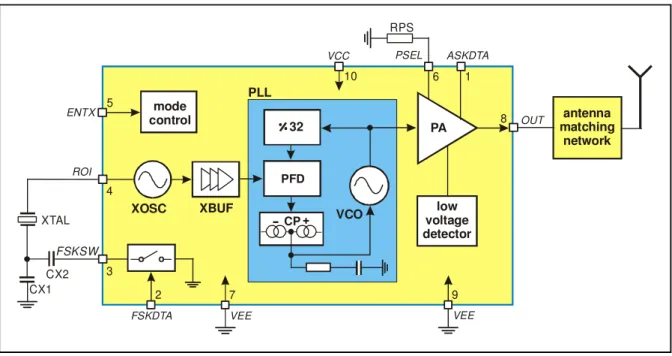
As depicted in Fig.1, the TH72015 transmitter consists of a fully integrated voltage-controlled oscillator (VCO), a divide-by-32 divider (div32), a phase-frequency detector (PFD) and a charge pump (CP). An internal loop filter determines the dynamic behavior of the PLL and suppresses reference spurious signals. A Colpitts crystal oscillator (XOSC) is used as the reference oscillator of a phase-locked loop (PLL) synthesizer. The VCO’s output signal feeds the power amplifier (PA). The RF signal power Pout can be
adjusted in four steps from Pout = –12 dBm to +10 dBm, either by changing the value of resistor RPSor by
varying the voltage VPS at pin PSEL. The open-collector output (OUT) can be used either to directly drive a
loop antenna or to be matched to a 50Ohm load. Bandgap biasing ensures stable operation of the IC at a power supply range of 1.95 V to 5.5 V.
1.2 Block Diagram
Fig. 1: Block diagram with external components
2 Functional Description
2.1 Crystal Oscillator
A Colpitts crystal oscillator with integrated functional capacitors is used as the reference oscillator for the PLL synthesizer. The equivalent input capacitance CRO offered by the crystal oscillator input pin ROI is about 18pF. The crystal oscillator is provided with an amplitude control loop in order to have a very stable frequency over the specified supply voltage and temperature range in combination with a short start-up time.
CX1 FSKDTA antenna matching network XOSC PA XBUF VCO PLL CP PFD 32 OUT PSEL RPS FSKSW ROI XTAL CX2 VEE 7 VEE 9 2 8 6 4 3 1 ASKDTA low voltage detector 10 VCC mode control ENTX 5
TH72015
433MHz
FSK/ASK Transmitter
3901072015 Page 4 of 20 Data Sheet
fmin fc f fmax eff CL eff CL R1 C1 C0 L1 XTAL CL CX1 CRO CX1+CRO (CX1+CX2) CRO CX1+CX2+CRO
2.2 FSK Modulation
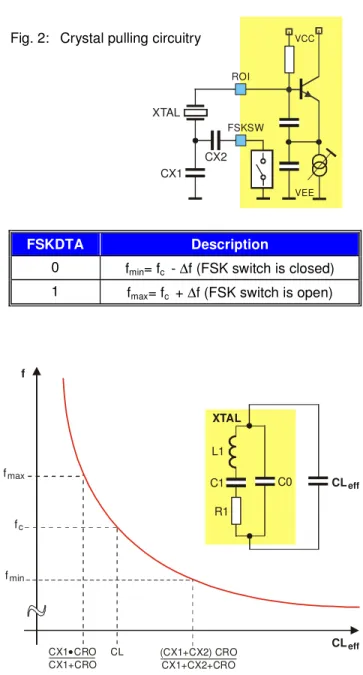
FSK modulation can be achieved by pulling the crystal oscillator frequency. A CMOS-compatible data stream applied at the pin FSKDTA digitally modulates the XOSC via an integrated NMOS switch. Two external pulling capacitors CX1 and CX2 allow the FSK deviation ∆f and the center frequency fc to be
adjusted independently. At FSKDTA = 0, CX2 is connected in parallel to CX1 leading to the low-frequency component of the FSK spectrum (fmin); while at FSKDTA = 1, CX2 is deactivated
and the XOSC is set to its high frequency fmax.
An external reference signal can be directly AC-coupled to the reference oscillator input pin ROI. Then the transmitter is used without a crystal. Now the reference signal sets the carrier frequency and may also contain the FSK (or FM) modulation.
Fig. 2: Crystal pulling circuitry
FSKDTA Description
0 fmin= fc - ∆f (FSK switch is closed)
1 fmax= fc + ∆f (FSK switch is open)
2.3 Crystal Pulling
A crystal is tuned by the manufacturer to the required oscillation frequency f0 at a given load
capacitance CL and within the specified calibration tolerance. The only way to pull the oscillation frequency is to vary the effective load capacitance CLeff seen by the crystal.
Figure 3 shows the oscillation frequency of a crystal as a function of the effective load capacitance. This capacitance changes in accordance with the logic level of FSKDTA around the specified load capacitance. The figure illustrates the relationship between the external pulling capacitors and the frequency deviation.
It can also be seen that the pulling sensitivity increases with the reduction of CL. Therefore, applications with a high frequency deviation require a low load capacitance. For narrow band FSK applications, a higher load capacitance could be chosen in order to reduce the frequency drift caused by the tolerances of
the chip and the external pulling capacitors. Fig. 3: Crystal pulling characteristic
For ASK applications CX2 can be omitted. Then CX1 has to be adjusted for center frequency.
CX2 VCC XTAL CX1 ROI FSKSW VEE
TH72015
433MHz
FSK/ASK Transmitter
2.4 ASK Modulation
The PLL transmitter can be ASK-modulated by applying a data stream directly at the pin ASKDTA. This turns the internal current sources of the power amplifier on and off and therefore leads to an ASK signal at the output.
ASKDTA Description
0 Power amplifier is turned off 1 Power amplifier is turned on (according
to the selected output power step)
2.5 Output Power Selection
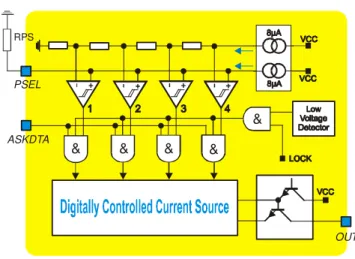
The transmitter is provided with an output power selection feature. There are four predefined output power steps and one off-step accessible via the power selection pin PSEL. A digital power step adjustment was chosen because of its high accuracy and stability. The number of steps and the step sizes as well as the corresponding power levels are selected to cover a wide spectrum of different applications.
The implementation of the output power control logic is shown in figure 4. There are two matched current sources with an amount of about 8 µA. One current source is directly applied to the PSEL pin. The other current source is used for the generation of reference voltages with a resistor ladder. These reference voltages are defining the thresholds between the power steps. The four comparators deliver thermometer-coded control signals depending on the voltage level at the pin PSEL. In order to have a certain amount of ripple tolerance in a noisy environment the comparators are provided with a little hysteresis of about 20 mV. With these control signals, weighted current sources of the power amplifier are switched on or off to set the desired output power level (Digitally Controlled Current Source). The LOCK, ASK signal and the output of the low voltage detector are gating this current source.
Fig. 4: Block diagram of output power control circuitry There are two ways to select the desired output power step. First by applying a DC voltage at the pin PSEL, then this voltage directly selects the desired output power step. This kind of power selection can be used if the transmission power must be changed during operation. For a fixed-power application a resistor can be used which is connected from the PSEL pin to ground. The voltage drop across this resistor selects the desired output power level. For fixed-power applications at the highest power step this resistor can be omitted. The pin PSEL is in a high impedance state during the “TX standby” mode.
2.6 Lock Detection
The lock detection circuitry turns on the power amplifier only after PLL lock. This prevents from unwanted emission of the transmitter if the PLL is unlocked.
2.7 Low Voltage Detection
The supply voltage is sensed by a low voltage detect circuitry. The power amplifier is turned off if the supply voltage drops below a value of about 1.85 V. This is done in order to prevent unwanted emission of the transmitter if the supply voltage is too low.
ASKDTA & & & PSEL & & RPS OUT
TH72015
433MHz
FSK/ASK Transmitter
3901072015 Page 6 of 20 Data Sheet
2.8 Mode Control Logic
The mode control logic allows two different modes of operation as listed in the following table. The mode control pin ENTX is pulled-down internally. This guarantees that the whole circuit is shut down if this pin is left floating.
ENTX Mode Description
0 TX standby TX disabled 1 TX active TX enable
2.9 Timing Diagrams
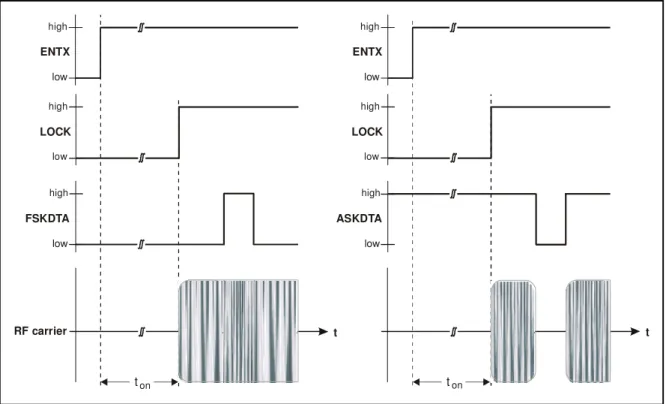
After enabling the transmitter by the ENTX signal, the power amplifier remains inactive for the time ton, the
transmitter start-up time. The crystal oscillator starts oscillation and the PLL locks to the desired output frequency within the time duration ton. After successful PLL lock, the LOCK signal turns on the power
amplifier, and then the RF carrier can be FSK or ASK modulated.
Fig. 5: Timing diagrams for FSK and ASK modulation
RF carrier low low high high LOCK FSKDTA t low high ENTX ton low low high high LOCK ASKDTA t low high ENTX ton
TH72015
433MHz
FSK/ASK Transmitter
3 Pin Definition and Description
Pin No. Name I/O Type Functional Schematic Description
1 ASKDTA input
ASK data input, CMOS compatible with operation mode dependent pull-up circuit TX standby: no pull-up TX active: pull up 2 FSKDTA input FSK data input, CMOS compatible with operation mode dependent pull-up circuit
TX standby: no pull-up TX active: pull up 3 FSKSW analog I/O
XOSC FSK pulling pin, MOS switch
4 ROI analog I/O
XOSC connection to XTAL, Colpitts type crystal oscillator
5 ENTX input
mode control input, CMOS-compatible with internal pull-down circuit
6 PSEL analog I/O
power select input, high-impedance comparator logic TX standby: IPSEL = 0
TX active: IPSEL = 8µA
7 VEE ground negative power supply
8 OUT output
power amplifier output, open collector
9 VEE ground negative power supply
10 VCC supply positive power supply
1.5kΩ 1 0: ENTX=1 1: ENTX=0 ASKDTA 1.5kΩ 2 0: ENTX=1 1: ENTX=0 FSKDTA FSKSW 3 ROI 4 36p 36p 25k ENTX 5 1.5kΩ PSEL 6 1.5kΩ 8µA OUT 8 VEE VEE VCC
TH72015
433MHz
FSK/ASK Transmitter
3901072015 Page 8 of 20 Data Sheet
4 Electrical Characteristics
4.1 Absolute Maximum Ratings
Parameter Symbol Condition Min Max Unit
Supply voltage VCC 0 7.0 V
Input voltage VIN -0.3 VCC+0.3 V
Storage temperature TSTG -65 150 °C
Junction temperature TJ 150 °C
Thermal Resistance RthJA 49 K/W
Power dissipation Pdiss 0.12 W
Electrostatic discharge VESD human body model (HBM)
according to CDF-AEC-Q100-002
±2.0 kV
4.2 Normal Operating Conditions
Parameter Symbol Condition Min Max Unit
Supply voltage VCC 1.95 5.5 V
Operating temperature TA -40 125 °C
Input low voltage CMOS VIL ENTX, DTA pins 0.3*VCC V
Input high voltage CMOS VIH ENTX, DTA pins 0.7*VCC V
XOSC frequency fref set by the crystal 11.9 14 MHz
VCO frequency fc fc = 32 • fref 380 450 MHz
FSK deviation ∆f depending on CX1, CX2
and crystal parameters ±
2.5 ±40 kHz
FSK Data rate R NRZ 40 kbit/s
ASK Data rate R NRZ 40 kbit/s
4.3 Crystal Parameters
Parameter Symbol Condition Min Max Unit
Crystal frequency f0 fundamental mode, AT 11.9 14 MHz
Load capacitance CL 10 15 pF
Static capacitance C0 7 pF
Series resistance R1 70 Ω
TH72015
433MHz
FSK/ASK Transmitter
4.4 DC Characteristics
all parameters under normal operating conditions, unless otherwise stated; typical values at TA = 23 °C and VCC = 3 V
Parameter Symbol Condition Min Typ Max Unit
Operating Currents
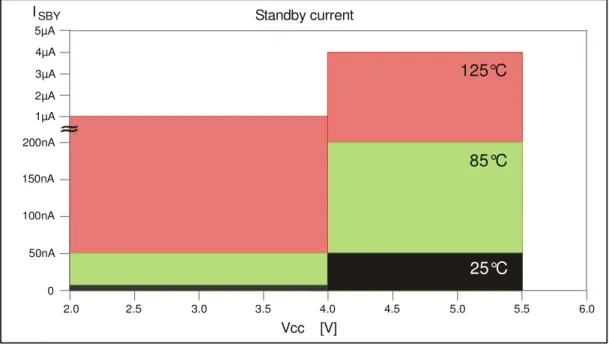
Standby current ISBY ENTX=0, TA=85°C 0.2 200 nA
ENTX=0, TA=125°C 4 µA
Supply current in power step 0 ICC0 ENTX=1 1.5 2.5 3.8 mA
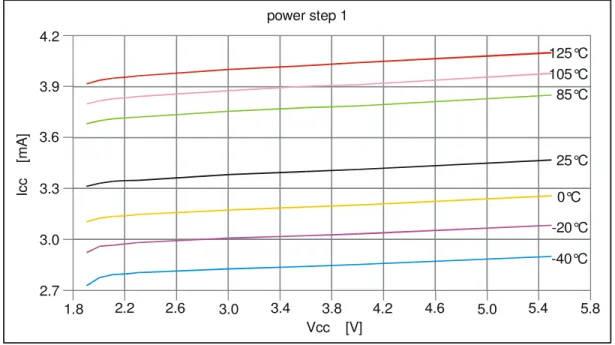
Supply current in power step 1 ICC1 ENTX=1 2.1 3.4 4.9 mA
Supply current in power step 2 ICC2 ENTX=1 3.0 4.6 6.2 mA
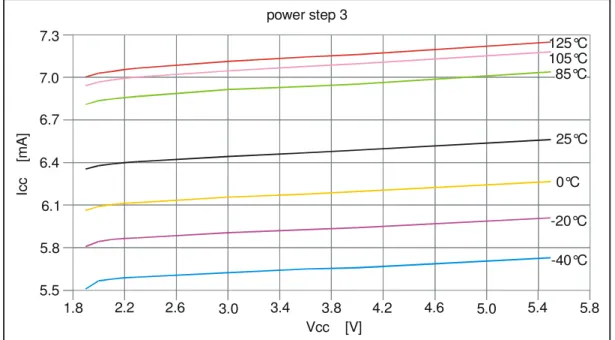
Supply current in power step 3 ICC3 ENTX=1 4.5 6.5 8.5 mA
Supply current in power step 4 ICC4 ENTX=1 7.3 10.6 13.3 mA Digital Pin Characteristics
Input low voltage CMOS VIL ENTX, DTA pins -0.3 0.3*Vcc V
Input high voltage CMOS VIH ENTX, DTA pins 0.7*VCC VCC+0.3 V
Pull down current ENTX pin
IPDEN ENTX=1 0.2 2.0 20 µA
Low level input current ENTX pin
IINLEN ENTX=0 0.02 µA
High level input current DTA pins
IINHDTA FSKDTA=1
ASKDTA=1
0.02 µA Pull up current
DTA pins active
IPUDTAa FSKDTA=0,
ASKDTA=0, ENTX=1
0.1 1.5 12 µA Pull up current
DTA pins standby
IPUDTAs FSKDTA=0,
ASKDTA=0, ENTX=0
0.02 µA
FSK Switch Resistance
MOS switch On resistance RON FSKDTA=0
ENTX=1
20 70 Ω
MOS switch Off resistance ROFF FSKDTA=1
ENTX=1
1 MΩ
Power Select Characteristics
Power select current IPSEL ENTX=1 7.0 8.6 9.9 µA
Power select voltage step 0 VPS0 ENTX=1 0.035 V
Power select voltage step 1 VPS1 ENTX=1 0.14 0.24 V
Power select voltage step 2 VPS2 ENTX=1 0.37 0.60 V
Power select voltage step 3 VPS3 ENTX=1 0.78 1.29 V
Power select voltage step 4 VPS4 ENTX=1 1.55 V Low Voltage Detection Characteristic
TH72015
433MHz
FSK/ASK Transmitter
3901072015 Page 10 of 20 Data Sheet
4.5 AC Characteristics
all parameters under normal operating conditions, unless otherwise stated;
typical values at TA = 23 °C and VCC = 3 V; test circuit shown in Fig. 18, fc = 433.92 MHz
Parameter Symbol Condition Min Typ Max Unit
CW Spectrum Characteristics
Output power in step 0 (Isolation in off-state)
Poff ENTX=1 -70 dBm
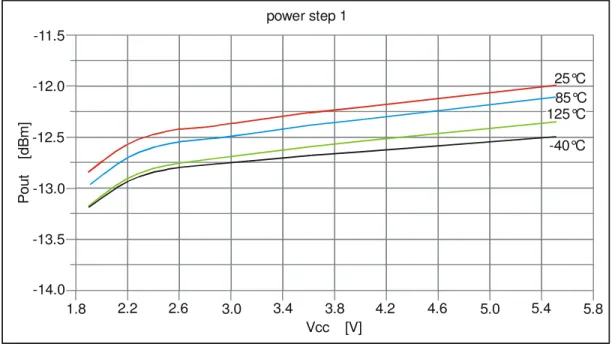
Output power in step 1 P1 ENTX=1 -13 -12 -10 1) dBm
Output power in step 2 P2 ENTX=1 -3.5 -3 -1.5 1)
dBm Output power in step 3 P3 ENTX=1 2 3 4.5 1) dBm
Output power in step 4 P4 ENTX=1 4.5 8 10 1)
dBm Phase noise L(fm) @ 200kHz offset -88 -83 dBc/Hz
Spurious emissions according to EN 300 220-1 (2000.09) table 13 Pspur 47MHz< f <74MHz 87.5MHz< f <118MHz 174MHz< f <230MHz 470MHz< f <862MHz B=100kHz -54 dBm f < 1GHz, B=100kHz -36 dBm f > 1GHz, B=1MHz -30 dBm Start-up Parameters
Start-up time ton from standby to
transmit mode
0.8 1.2 ms
Frequency Stability
Frequency stability vs. supply voltage dfVCC ±3 ppm Frequency stability vs. temperature dfTA crystal at constant temperature ± 10 ppm 1) output matching network tuned for 5V supply
4.6 Output Power Steps
Power step 0 1 2 3 4
TH72015
433MHz
FSK/ASK Transmitter
Ic c [m A ] 1.8 2.2 2.6 3.0 3.4 power step 0 -40°C -20°C 0°C 25°C 85°C 105°C 125°C Vcc [V] 2.2 1.8 2.6 3.0 3.4 3.8 4.2 4.6 5.0 5.4 5.8 Vcc [V] 2.0 2.5 3.0 3.5 4.0 4.5 5.0 5.5 6.0 Standby current SBY I 0 50nA 150nA 100nA 200nA 1µA 2µA 3µA 4µA 5µA125°C
85°C
25°C
5 Typical Operating Characteristics
5.1 DC Characteristics
Fig. 6: Standby current limits
TH72015
433MHz
FSK/ASK Transmitter
3901072015 Page 12 of 20 Data Sheet
-40°C -20°C 0°C 25°C 85°C 105°C 125°C 1.8 2.2 2.6 3.0 3.4 3.8 4.2 4.6 5.0 5.4 5.8 Ic c [m A ] 2.7 3.0 3.3 3.6 3.9 4.2 power step 1 Vcc [V] Ic c [m A ] 3.8 4.2 4.6 5.0 5.4 1.8 2.2 2.6 3.0 3.4 3.8 4.2 4.6 5.0 5.4 5.8 0°C 25°C 85°C 105°C 125°C -20°C -40°C Vcc [V] power step 2
Fig. 8: Supply current in power step 1
TH72015
433MHz
FSK/ASK Transmitter
Ic c [m A ] 5.5 5.8 6.1 6.4 6.7 7.0 7.3 0°C 25°C 85°C 105°C 125°C -20°C -40°C 2.2 2.6 3.0 3.4 3.8 4.2 4.6 5.0 5.4 5.8 1.8 Vcc [V] power step 3 0°C 25°C 85°C 105°C 125°C -20°C -40°C 1.8 2.2 2.6 3.0 3.4 3.8 4.2 4.6 5.0 5.4 5.8 Ic c [m A ] 9.0 9.5 10.0 10.5 11.0 11.5 12.0 Vcc [V] power step 4Fig. 10: Supply current in power step 3
TH72015
433MHz
FSK/ASK Transmitter
3901072015 Page 14 of 20 Data Sheet
5.2 AC Characteristics
• Data according to test circuit in Fig. 18
Fig. 12: Output power in step 1
Fig. 13: Output power in step 2
2.2 2.6 3.0 3.4 3.8 4.2 4.6 5.0 5.4 Vcc [V] 1.8 -13.0 -13.5 -14.0 -12.5 -12.0 -11.5 -40°C 125°C 25°C 85°C 5.8 power step 1 P o u t [ d B m ] -40°C 125°C 25°C power step 2 -4.0 -3.0 -2.0 -1.0 Vcc [V] 1.8 2.2 2.6 3.0 3.4 3.8 4.2 4.6 5.0 5.4 5.8 85°C P o u t [ d B m ]
TH72015
433MHz
FSK/ASK Transmitter
Fig. 14: Output power in step 3
Fig. 15: Output power in step 4
1.8 2.2 2.6 3.0 3.4 3.8 4.2 4.6 5.0 5.4 Vcc [V] 1.0 2.0 3.0 4.0 0 5.0 -40°C 125°C 85°C 25°C 5.8 power step 3 P o u t [ d B m ] 1.8 2.2 2.6 3.0 3.4 3.8 4.2 4.6 5.0 5.4 5.8 Vcc [V] power step 4 P o u t [ d B m ] 4.0 6.0 8.0 10.0 2.0 12.0 -40°C 125°C 85°C 25°C
TH72015
433MHz
FSK/ASK Transmitter
3901072015 Page 16 of 20 Data Sheet
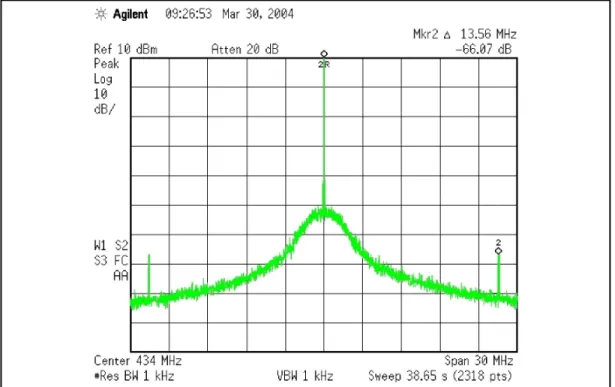
Fig. 16: RF output signal with PLL reference spurs
TH72015
433MHz
FSK/ASK Transmitter
6 Test Circuit
Fig. 18: Test circuit for FSK and ASK with 50 Ω matching network
6.1 Test circuit component list to Fig. 18
Part Size Value @315 MHz Tolerance Description
CM1 0805 5.6 pF ±5% impedance matching capacitor
CM2 0805 10 pF ±5% impedance matching capacitor
CM3 0805 82 pF ±5% impedance matching capacitor
LM 0805 33 nH ±5% impedance matching inductor, note 2
LT 0805 33 nH ±5% output tank inductor, note 2
CX1_FSK 0805 12 pF ±5% XOSC FSK capacitor (∆f = ±28 kHz), note 1
CX1_ASK 0805 27 pF ±5% XOSC ASK capacitor, note 1
CX2 0805 33 pF ±5% XOSC capacitor (∆f = ±28 kHz), note 1
only needed for FSK
RPS 0805 see para. 4.6 ±5% power-select resistor
CB0 1206 220 nF ±20% blocking capacitor
CB1 0805 330 pF ±10% blocking capacitor
XTAL HC49/S 13.56000 MHz ±30ppm calibr.
±30ppm temp.
fundamental wave crystal,
CL = 12 pF, C0, max = 7 pF, R1 = 60 Ω
Note 1: value depending on crystal parameters
RPS CX2 XTAL CB0 CX1 CB1 CM2 OUT CM1 CM3 LM A S K D T A F S K D T A F S K S W V E E V E E E N T X R O I V C C P S E L O U T LT 2 3 1 V C C E N T X G N D 2 3 4 1 G N D A S K _ D T A F S K _ D T A G N D 2 1 G N D V C C 6 7 8 9 10 5 4 3 1 2
TH72015
433MHz
FSK/ASK Transmitter
3901072015 Page 18 of 20 Data Sheet
7 Package Description
The device is RoHS compliant.
A A 1 A3 D E 1 5 6 1 0 e b E2 D2 L 0.36 0.2 25x45° 0.2 3 expos ed pad
Exposed pad not connected to internal GND. It sh ould not be connecte d to the PC B.
It can be with or withou t fingers.
Fig. 7: 10L QFN 3x3 Dual all Dimensions in mm D E D2 E2 A A1 A3 L e b min 2.85 2.85 2.23 1.49 0.80 0 0.20 0.3 0.50 0.18 max 3.15 3.15 2.48 1.74 1.00 0.05 0.5 0.30
all Dimensions in inch
min 0.112 0.112 0.0878 0.051 0.0315 0
0.0079 0.0118 0.0197 0.0071
max 0.124 0.124 0.0976 0.055 0.0393 0.002 0.0197 0.0118
7.1 Soldering Information
• The device is qualified for MSL1 with soldering peak temperature 260 deg C according to JEDEC J-STD-20.
7.2 Recommended PCB Footprints
all Dimensions in mm Z G D2th E2th X Y CPL e min 3.55 1.9 3.2 1.3 0.25 0.7 0.3 0.5 max 3.90 2.3 3.6 1.7 0.30 1.0 0.5all Dimensions in inch
min 0.1398 0.0748 0.1260 0.0512 0.0098 0.0276 0.0591 0.0197 max 0.1535 0.0906 0.1417 0.0669 0.0118 0.0394 0.0197
Fig. 8: PCB land pattern style
solder stop solder pad e X Y CPL E2th D2th Z G 1 5 6 10
TH72015
433MHz
FSK/ASK Transmitter
8 Standard information regarding manufacturability of Melexis
products with different soldering processes
Our products are classified and qualified regarding soldering technology, solderability and moisture sensitivity level according to following test methods:
Reflow Soldering SMD’s (Surface Mount Devices) • IPC/JEDEC J-STD-020
Moisture/Reflow Sensitivity Classification for Nonhermetic Solid State Surface Mount Devices (classification reflow profiles according to table 5-2)
• EIA/JEDEC JESD22-A113
Preconditioning of Nonhermetic Surface Mount Devices Prior to Reliability Testing (reflow profiles according to table 2)
Wave Soldering SMD’s (Surface Mount Devices) and THD’s (Through Hole Devices) • EN60749-20
Resistance of plastic- encapsulated SMD’s to combined effect of moisture and soldering heat
• EIA/JEDEC JESD22-B106 and EN60749-15
Resistance to soldering temperature for through-hole mounted devices
Iron Soldering THD’s (Through Hole Devices) • EN60749-15
Resistance to soldering temperature for through-hole mounted devices
Solderability SMD’s (Surface Mount Devices) and THD’s (Through Hole Devices) • EIA/JEDEC JESD22-B102 and EN60749-21
Solderability
For all soldering technologies deviating from above mentioned standard conditions (regarding peak temperature, temperature gradient, temperature profile etc) additional classification and qualification tests have to be agreed upon with Melexis.
The application of Wave Soldering for SMD’s is allowed only after consulting Melexis regarding assurance of adhesive strength between device and board.
Melexis is contributing to global environmental conservation by promoting lead free solutions. For more information on qualifications of RoHS compliant products (RoHS = European directive on the Restriction Of the use of certain Hazardous Substances) please visit the quality page on our website:
http://www.melexis.com/quality.aspx
9 ESD Precautions
Electronic semiconductor products are sensitive to Electro Static Discharge (ESD).
TH72015
433MHz
FSK/ASK Transmitter
3901072015 Page 20 of 20 Data Sheet
10 Disclaimer
Devices sold by Melexis are covered by the warranty and patent indemnification provisions appearing in its Term of Sale. Melexis makes no warranty, express, statutory, implied, or by description regarding the information set forth herein or regarding the freedom of the described devices from patent infringement. Melexis reserves the right to change specifications and prices at any time and without notice. Therefore, prior to designing this product into a system, it is necessary to check with Melexis for current information. This product is intended for use in normal commercial applications. Applications requiring extended temperature range, unusual environmental requirements, or high reliability applications, such as military, medical life-support or life-sustaining equipment are specifically not recommended without additional processing by Melexis for each application.
The information furnished by Melexis is believed to be correct and accurate. However, Melexis shall not be liable to recipient or any third party for any damages, including but not limited to personal injury, property damage, loss of profits, loss of use, interrupt of business or indirect, special incidental or consequential damages, of any kind, in connection with or arising out of the furnishing, performance or use of the technical data herein. No obligation or liability to recipient or any third party shall arise or flow out of Melexis’ rendering of technical or other services.
© 2012 Melexis NV. All rights reserved.
For the latest version of this document, go to our website at
www.melexis.com
Or for additional information contact Melexis Direct: Europe, Africa, Asia: America:
Phone: +32 1367 0495 Phone: +1 248 306 5400
E-mail: [email protected] E-mail: [email protected]