3
R.
44lton Gilbert
P. Alton Gilbert is an assistant vice president at the Federal Pesenie Bank of St. Louis. Dawn M. Peterson provided research assistance.
Payments System Risk: What Is It
and What Will Happen If We Try
To Reduce It?
0TH commercial banks and the Federal Re-serve assume a certain amount of risk in partici-rating in the payments system. This paper
pro-vides an introduction to payments system risk and the public policy issues involved in limiting the risk. Using simple balance sheet entries to illus-trate, the paper will examine how policies in-tended to reduce payments system risk would affect banks and bank customers.
PAYMENTS SYSTEM RISK: WHAT IS
IT?
Many banks overdraw their reserve accounts at the Federal Reserve during part of each business day as they process payments within the pay-ments system. The Federal Reserve is concerned about the extent of this intraday credit for several reasons. First of all, since it does not charge inter-est on the inti-aday credit it extends, it is providing this overdraft facility at no cost to banks and, thus, may he overused by banks. Second, and more im-portant, it is possible, though unlikely, that a bank could fail while its reserve account is overdr-awn. In this event, the Federal Reserve would become a general creditor of the failed bank. Finally, the Fed is concerned with the risk that banks assume
through their participation
in private wire transfersystems. Current Federal Reserve policy is
de-signed to limit the risk assumed by Reserve Banks as well as commercial banks who participate in
private systems
for their electronic payments. Seeappendix
1for a description of that policy.)
Federal Reserve Iiavlight Overdrn/i
Risk anti the Operation of Fedwire
While various types of transactions affect the reserve balances of banks, daylight overdt-afts gen-erally reflect large transactions through Fedwire, the wire transfer system operated by the Federal Reserve System. Institutions with reserve or clear-ing accounts at a Reserve Bank may transfer their reserve balances to other institutions that have similar accounts. These transfer-s, which averaged $605
billion per business day in
1987, areprocessed electronically thi-ough Fedwire. Federal Reserve Banks transfer reserves to re-ceiving banks even if the reserve balance of the sending bank is insufficient to cover the transfers. Transfers over Fedwire are “final” when the receiv-ing banks are notified of the transfers. Thus, if a sending bank should fail while its reserve account was over-drawn, the Federal Reserve would have no claim on banks that received reserves fi-omn the failed bank over Fedwire.
U.S. Treasury and agency securities also are transferred among banks over Fedwire. Ownership
records
of these securities are maintained in each
Federal Reserve Bank’s computer system. Banks
can transfer securities held in their names to other
institutions through these computers, a system
called “book-entry.” A transfer of securities in
book-envy
formcan be arranged either in
con-junction with a transfer of reserves of equal value
or as a separate transaction. Such securities trans-actions contribute to daylight overdrafts, since
typically the reserve accounts of banks are debited
when their book-entry securities accounts are
credited. Transfers of book-entry securities over
Fedwire averaged $312 billion per day in 1987.
The Federal Reserve measures its exposure to
payments system risk by simply summing the
maximum daylight overdraft each day across all
banks. In
1987, the Fed’s exposure to daylight overdrafts averaged $112 billion, approximately 53 percent of which can be attributed to transactions involving book-entry government securities.’ Somespecific features of this
risk measureshould be
noted. First, unlike conventional
risk measures,the Federal Reserve’s measure does not
incorpo-rate the probability that a bank
willfail while in an
overdraft
position or the probability of Fed losses
in such situations Since the Federal Reserve has
never incurred a loss on daylight overdrafts, the
probability of losses in the future are quite low.
Second, it exceeds the actual sum of reserve
account overdrafts at any point during the day;
the maximum overdrafts of individual banks
typi-cally occur at different times during the day.
Third, it represents the loss that the Federal
Re-serve would incur on a given day if all banks
with overdrawn reserve accounts failed when their overdrafts were at maximum levels and theFed-eral Reserve recovered nothing.
Systemic Risk and the Operation of
CHIPS
The Clearing House Interbank Payments System
(CHIPS) is an electronic payment system operated
by the New York Clearing House. It currently is the
only private electronic payment system in
opera-tion in the United States. CHIPS has about
140members, which include U.S-chartered banks and
foreign banks. Members of CHIPS send and receive
payment messages during the day; no funds are
actually transferred to cover these payment
mes-sages, however, until the end of the day. Net
obli-gations are settled at day’s end through Fedwire
transfers in the reserve accounts of CHIPS
partici-pants. Banks in net debit positions on CHIPS at
the end of the day (value of payment messages
sent exceeds the value of payment messages
re-ceived) transfer funds
fromtheir accounts at
Re-serve Banks to a reRe-serve account maintained by
the clearing house at the Federal Reserve Bank of
New York, while banks in net credit positions
re-ceive reserve transfers from that account. The
value of payment messages processed by CHIPS
averaged $555 billion per day in 1987.
Systemic risk refers to the risk that the failure of
one bank will cause one or more other banks to
fail.
One way that this could happen is
throughparticipation in CHIPS. If a bank fails while in a net debit position on CHIPS, other- CHIPS participants
could suffer losses as well, depending on the
pro-cedures in force for dealing
withsuch a default.
Payments over Fedwire, in contrast, involve no
systemic risk. The Federal Reserve would absorb
any losses resulting
fromfailures by banks with
overdrawn reserve accounts
-The Federal Reserve measures the payments
system risk assumed by CHIPS participants as the
sum of their
maximum net debit positions during
the day on CHIPS. This measure averaged $43.7
billion in 1987.
To relate this measure to systemic risk is
dif-ficult, however; under current CHIPS rules,
pay-ment messages do not reflect intraday extensions
of credit among banks but
provisionalpayments
which may be unwound at the end of the day. If a
bank could not cover its net debit position on
CHIPS at the end of the day, all payment
messages
to
and fromthat bank would be canceled; new net
debit and credit positions would then be
calcu-lated for the remaining CHIPS participants, and
payments would be made to cover these revised
positions. Unwinding CHIPS payments because of
a defaulting bank, however, could expose the
re-maining CHIPS participants to losses if their
de-‘Daylight overdrafts attributed to transactions in book-entry securities are calculated as follows. A bank is in a net credit position on book-entry securities transfers if the value of securi-ties transferred to the bank’s book-entry securisecuri-ties account exceeds the value of securities transferred out of that account to other banks. The book-entry overdraft of a bank for each day equals its largest net credit position on securities transfers that occurs while the reserve account of the bank is overdrawn.
‘In conventional definitions, risk is specified in terms of the probability distribution of returns on an investment. Under one definition, risk may be measured as the variance of the distribu-tion of returns. See Rothschild and Stiglitz (1970).
positors had withdrawn balances credited to their
accounts during the day based on payment
mes-sages from
the defaulting bank. These banks in
turn may be unable to recover the funds
with-drawn by their depositors during the day.’
Federal Reserve Policy on Payments
System Risk
In recent years, the Federal Reserve Board has
taken actions to limit its
ownrisk and the systemic
risk involved in CHIPS. The Federal Reserve
in-duced CHIPS to require each bank in its system to
establish bilateral net debit limits with each other
CHIPS participant, beginning in 1984. Under
an-other program that went
intoeffect in March 1986,
the Federal Reserve requires banks to set limits on
their daylight overdrafts across Fedwire and
CHIPS. (See appendix 1 for details of these
poli-cies .1 The Fed is currently studying proposals to
establish an explicit or implicit price for daylight
overdrafts of reserve accounts.
HOW
PAYMENTS
AFFECT RISK
This section uses simple balance sheets of
hy-pothetical banks to illustrate how transactions
through the payments system affect the exposure
of the Federal Reserve and commercial banks to
potential losses. The illustrations involve federal funds transactions and transactions among CHIPS participants. Appendix 2 illustrates how the
pay-ment practices of banks that serve governpay-ment
securities dealers and those that issue and redeem
commercial paper affect their reserve overdrafts.
Federal Funds Transactions
Banks that
borrowfederal funds overnight are
concerned primarily about their reserve balances
as of the end of the day, rather than
duringthe
day, for
tworeasons. First, the Federal Reserve is
more tolerant of daylight overdrafts of reserve
accounts than of negative reserve balances at the
close of business. Second, the intraday reserve
balances do not count toward meeting reserve
requirements; only those balances held at the end
of the business day do.
Banks that borrow overnight federal funds
typi-cally receive reserves from the lending banks over
Fedwire
late in the day; they return the requisite
reserve balances the following morning. Such
5
transfers can cause the borrowing
banksto
over-draw their reserve balances during the day.
The balance sheet entries in table I illustrate
how federal funds transactions affect the risk
borne by the Federal Reserve
-Each bank beginsthe day with deposits of $100 and reserves of $10.
With a 10 percent reserve ratio, excess reserves are
zero.
During the previous business day, Bank A
borrowed $25 from Bank B through the federal
funds market. Before the end of business on the previous day, Bank B transferred $25 over Fedwire from its reserve account to the account of Bank A.
This transaction created a liability for Bank A
(fed-eral funds purchased) and shifted $25 of the assets
of Bank B
fromreserve balances to federal funds
sold.
The
firsttransaction by Bank A in the current
day is a transfer of $25
fromits reserve account to
the reserve account of Bank B, returning the funds
it had borrowed overnight; this eliminates the
liability of federal funds purchased by Bank A.
Since the balance in the reserve account of Bank A
was only $10 at the start of the day, the transfer of
$25 makes its reserve account
overdrawnby $15.
This presents no problem for Bank A, howet?er,
since it plans to borrow $25 through the federal
funds market later in the day to eliminate its
re-serve overdraft and meet its rere-serve requirement
of $10.
If Rank A borrows the $25 in the federal funds
market, the lending bank(s) will transfer the
re-serves to the account of Bank A in the afternoon.
Given the time gap between the transfer of funds
to lending banks in the morning and the transfer
of reserves to Bank A in the afternoon, the Federal
Reserve effectively lends $15 to Bank A during part of the business day by permitting the reserve overdraft.
The Fed is a general creditor of Bank A while its
reserve account is overdrawn. To illustrate the risk
it assumes in permitting daylight overdrafts,
sup-pose that participants in the federal funds market
find out that the value of Bank A’s assets have
de-clined by $15 just
afterBank A transfers $25 to
Bank B.
Afterthis information becomes known,
Bank A will be unable to borrow reserves in the
federal funds market at prevailing market rates.
The agency that chartered Bank A must decide
whether it is solvent
-If Bank A is declared solvent
and has assets to pledge as collateral, it could
‘The legal status of claims by the banks against their depositorsin such situations is currently unclear. See Mengle (1989).
If the Federal Reserve had known that Bank A was in poor financial condition, it would have required the bank to pledge collateral against its overdrafts.’ By requiring collateral, the Fed shifts the risk to other parties. Suppose, in this case, that
Bank A had pledged $15of its riskiess assets to the
Feder-al Reserve to cover its overdrafts. When the
bank fails, the Fed would hold the $15 in collateral
Transactions Among GHJPS
Participants
In the case illustrated in table 1, the Federal Reserve assumes the risk. Banks also assume risk by participating in CHIPS. The interbank risk
expo-sures created through
the processing of payment
messages through CHIPS are illustrated in table 2. In the first transaction of the day, a depositor of
Bank A sends $25 to a depositor of Bank B in the
‘Task Force (1988), pp. 65—69
receive a loan from the Federal Reserve to cover its reserve overdraft. If the supeMsory agency
de-clares Bank A insolvent, it will
be closed. If Bank A
is closed and liquidated, the depositors get fir-st
claim on the Silo of “other assets.” In this case,
the Federal Reserve will receive$10against the $15
overdraft of the reserve account and) thus, will
lose $5.
to cover any losses. The loss of $5
would he borneby uninsured
depositors or the Feder-al Deposit Insurance Corporation FOIC). Thus, requiring collateral against reserve over-drafts does not nec-essarily protect the public sector; it may simply shift the loss from the Federal Reserve to the FDIC.I N’’ “~‘“// ‘N N,/N’’, / // / / ‘ / 77 /,‘1, 7’ / Nt ,‘
77
,‘ 4’ N 4 / N’ “ç~’/ 77/ N ‘/t N’ N’ ‘~,,
“777’’ , ~ / “ ~ \N’’ ,,~N / 1 ‘/ ,,4 — / 4/~/ ,, // — /,
/ ~4 ‘ N’4’t “N/’ ~ /~ N ~ / N” _ //7 ‘N’ / ~T’~
/ _~~::
/ N N*nEks*to~*ph~sfcrotunosmrcHIpSN
/B$sesM~jfstM*fl/
N’ N / ‘/ N N N N // N\ N~Bai~t
/ 7,t/’~, N//7///NN N \‘ “s’Sews
‘N, ~/fle~a~efta
“ “ “*1W
Cttr
‘N //C/NN/ // N N’ 7 “ N N ~ N’3/t$SN N ~ 77 NN’N N / /‘ N N Nr4Bok**a*fl~It8*BV~t*JIP$
N N N ‘~N7~”(~ ~I*nkB~
‘1,‘fr’
~ 4~ NN’ N’~ //“~ ‘ N ‘~
?i~h~~
‘~1
\‘NS~25 / \N \‘~‘N” ‘/,‘ ~, t N 7 N N’1ReS~77’
/ \/77 N.~ØGTS\ “ N “‘~ N’>&\SS*btS
\N’44N/ ~4tClhN N ‘~‘ ‘7, N N’ ‘“t77’’ ‘~“‘ N’’’~ \‘ Nt/N•\NN\NN N \‘‘NY/’W$~’/ / ‘NNN”•\* NN 77 N~;j4
~ N i~4NN N N N / N \,\ N ~ / ~ /N N~ss*c~
N~ N Nflesets
N~
N N N Nstzsfie,sewes
N / N N N~át
Nrecewable
asbast ‘N” ‘N2$
NE~4btaN NhSF~J~
10
N ~ ,“N’’ \NN~/ N / N
‘N \N/ NN N\\~N\\ N’ /
tsfl~tt~
N_\NNtq~o NNN N’N NN ~N NN N~
1 N N N
form of a wire tr’ansfer over CHIPS. Bank A debits
the deposit account of that customer for $25.
Be-cause
banksdo not report their balance sheets on
an intraday basis, there is no official term for the
offsetting liability entry in this transaction. In this
case, we will call it “reserves payable.” For Bank B,
deposit liabilities and an asset item called ‘re-serves receivable” each increase by $25.
In the next transaction, a depositor of Bank B
directs it to send $25 to a customer of Bank C.
After
the second transaction, Bank B is even with
CHIPS. If there were no more transactions over
CHIPS that day involving Bank B, the settlement
for CHIPS transactions would have a zero impact
on the reserve account of Bank B. Bank A, in
con-trast, would have its reserve account debited for
$25, while Bank C would have its account credited
by $25. Bank A would have to increase its reserve
balance before the time for settlement of CHIPS
payments to facilitate settlement.
Suppose that, before the end of the day, adverse
publicity prevents Bank A
from borrowing$25 in
the federal funds market. This situation could
create a liquidity problem for Bank B
-If Bank A
cannot obtain sufficient reserves to cover its net
debit position on CHIPS, current rnles call for
unwinding all transactions involving Bank A and
settling the transactions among the remaining
CHIPS participants. This settlement would involve
a transfer of $25 in reserves from Bank B to Bank C.
Such a net settlement cannot take place, however,
because Bank B has only
$10 in its reserve
ac-count. Thus, unless the Federal Reserve lends $25
to Bank A or Bank B, all CHIPS transactions for the
day would be canceled.
Simulation exercises indicate that the
unwind-ing of transactions with one large CHIPS
partici-pant that cannot meet its payment obligations
would make a high percentage of other
partici-pants unable to meet their commitments on
CHIPS without additional reserves.’ In these
exer-cises, some banks that become illiquid have no
direct transactions
withthe defaulting bank. Thus,
as illustrated in table 2, a default by Bank A keeps
Bank C
fromreceiving its payments over CHIPS,
because the default by Bank A makes Bank B
illiquid.
As the central hank, the Federal Reserve is
re-sponsible for preventing such a liquidity crisis. In
our example, the Fed could lend reserves either to
Bank A or Bank B. If it considers Bank A to be
sol-vent, it could lend the $25 and take collateral. The $25 added to the reserve account of Bank A
facili-tates the net settlement on CHIPS. If Bank A turns
out to be insolvent, the collateral protects the
Fed-eral Reserve from loss, transferring it instead to the
general creditors and the FDIC.
Alternatively, the Federal Reserve could prevent
a liquidity crisis by lending $25 to Bank B, allowing
Bank B to meet its required reserves and CHIPS
obligation to Bank C. Even if the Fed prevents a
liquidity crisis by lending
$25to Bank B, the
de-fault of Bank A could make Bank B insolvent. This is an example of systemic risk involved in the op-eration of the payments system. Suppose that the
transfer of $25 fr’om Bank B to Bank C is initiated
by the depositor of Bank B who received
$25fromBank A. Bank B makes this transfer’ before
discov-ering the default by Bank A. At ths time, it is not
clear whether the courts would permit Bank B to
regain these fundsfrom its depositor? If Bank B’s
loss exceeds $10, it is bankrupt.
Suppose, instead, that this depositor- of Bank B
holds the extra $25 in its demand deposit account
at Bank B until the end of the day. The transfer of
reserves from Bank B to Bank C was initiated by a different depositor of Bank B. When Bank A’s de-fault is discovered, Bank B could cancel the $25 in
reserves receivable and reverse the $25 credit to its
demand deposit liabilities. In this case, the
un-winding of the CHIPS transaction has no adverse effect on the net worth of Bank B,
THE EFFECTS OF POSSIBLE
CHANGES IN POLICY
Changes in policy on payments system risk are
being discussed within the Federal Reserve
Sys-tem and the private sector. This section illustrates
the effects of
twopossible policy changes: explicit
fees on reserve account overdrafts and
interest-earning r-eserve balances required to cover part or
all of daylight overdrafts?
Federal Reserve policymakers have indicated
that such changes would be adopted only after
CHIPS has developed arrangements for ensuring
the execution of payments on that system that
they consider acceptable.s This section also
illus-trates the implications of such
an arrangement for
banks.
Explicit Pricing of Daylight Overdrafts
of Reserve Accounts
One way to reduce Federal Reserve risk would
be to charge a fee on daylight overdrafts. If the fee
were high enough, banks would reduce the size of
their overdrafts by changing their practices for’
making payments.
Responses of
Banksto Pricing Daylight
Over-drafts
—Perhaps the easiest and least expensive
change for most of the relatively large banks would
involve routing more of their wire transfers of
funds through CHIPS rather than Fedwire. There
are other ways for banks to reduce their reserve
account
overdrafts. They could purchase more oftheir federal funds as term federal funds or under
rollover arrangements that involve paying a daily
rate but eliminating the daily transfer of ieserve
balances. Pricing
total daylight overdrafts of re-serve balances (including book-entry overdrafts)would impose costs on the clearing banks, which
they would pass on to the government securities dealers they serve. The dealer-s could reduce book-entry daylight overdrafts by building smaller- in-ventories of securities dur-ing the day or’ holding larger inventor-ies overnight. Banks that act as agents in issuing commer-cial paper could charge
‘Humphrey (1986). ‘Mengle (1989).
‘For discussions of these possible changes from Federal Re-serve sources, see Belton, et al. (1987), Corrigan (1987), Johnson (1988), Task Force (1988) and Mengle, et at. (1987).
For discussions of these issues by those in the private sector, see Flannery (1987), Faulhaber, et at. (1989) and Large Dollar Payments System Advisory Group (1988). Governor Wayne D. Angell of the Federal Reserve Board has proposed another approach to revising policy on payments system risk. Under
the Angell proposal, the Federal Reserve would prohibit day-light overdrafts. Transfers of reserves that would make the reserve balance of a bank negative would be funded as dis-count window loans. To provide banks incentives to hold enough reserves to prevent overdrafts, the Federal Reserve would pay interest on excess reserves, but at a rate below the discount rate. See VanHoose (1988).
‘Johnson (1988), p. 15.
9
issuers for the fees on overdrafts or delay pay-ments to issuers until they receive paypay-ments from purchasers.
Effects in Financial Markets — Pricing daylight
overdrafts could have a variety of indirect effects in the financial markets. Banks that lend in the
over’-night federal funds market could find that their
reserves are being returned later the following day. The time value of intraday reserves might lead to the development of an intraday federal funds mar-ket, with lenders making reserve balances available to borrowers for only part of the business day. Some analysts think this could lead to greater variability in an overnight federal funds rate and other interest i-ates.°
Banks could limit the size of their- daylight over-drafts by delaying wire transfers of funds for- de-positors that do not demand immediate delivery
of funds; or, the might charge an extra fee to
de-positors that demand immediate delivery.
Clearing banks would charge government secu-rities dealers for the cost of the fee on daylight overdr-afts. Government securities dealers, in turn, would increase the transaction costs of buying
and selling gover-nment securities. Interest rates
on government securities would rise somewhat
relative to yields on alternative investments, in-creasing the Treasury’s cost of servicing the na-tional debt.
How banks react to daylight overdraft fees could affect market yields on other financial instru-ments. For instance, the fee on overdrafts would increase the costs to banks acting as agents for fir-ms that issue cornmner-cial paper. The r-esponses
by the agent banks could increase the costs
to
fir’ms of raising funds by issuing commercial paper.”
Supplemental Balance Requirement
The Federal Reserve could impose an implicitprice on daylight overdrafts by requiring the banks
that overdraw their reserve accounts to hold sup-plemental reserve balances. These requirements
would be set to cover part or all of their daylight
overdrafts. The suggested interest rate to be paid
on the supplemental balances would be slightly
below the federal funds rate, thus creating an op-portunity cost of holding supplemental reserves. This cost would have the same implications for
bank behavior
andfinancial markets as an equal
explicit fee on daylight overdrafts.
The implications of a supplemental reserve re-quir-ement can be examined by adjusting the bal-ance sheet entries in table 1. In this case, Bank A would be required to increase its average end-of-day reserve balance by $15. A reserve balance of
$25at the start of the day would eliminate the risk
of Federal Reserve loss because Bank A’s reserve
balance would not fall below zeio after the $25
transfer.
The method by which Bank A r’aises the $15
supplemental balance affects the distribution of
potential losses among participants in the banking
industry. Suppose, for example, Bank A sold some
assets to obtain the $15 in additional reserves. This
response would raise the risk-adjusted capital
r-atio of Bank A, unless it shifted the remaining
$110
of other- assets into categories with
higher-risk weights. A rise in Bank A’s higher-risk-adjusted capi-tal ratio would reduce the FDIC’s potential losses.”
Suppose, instead, that Bank A r’aises the515
in
supplemental reserves by increasing federally
insured deposits from $100
to $115.This responsewould increase the potential losses faced by the
FDIC.”
Bank A also could raise the additional $15 in the
term federal funds market. The claims of those selling term federal funds to Bank A would he subordinate to the claims of Bank A’s depositors. Thus, the supplemental balance requirement
would shift risk to those banks supplying the term
‘Task Force (1988), pp. 103—14.‘°Toillustrate the potential effects on the cost of issuing commer-cial paper, suppose the Federal Reserve charges 100 basis points at an annual rate on the maximum daylight overdraft of each bank. See Mengle, et al. (1987) for the basis for such a rate. If an agent bank continues the timing of payments de-scribed in appendix 2 in issuing and redeeming commercial paper, the overdrafts fee would cost $54.79 per $1 million of commercial paper issued and redeemed. If the banks pass this cost on to the issuers, the annual cost of raising funds by issuing commercial paper every 30 days would rise by 7 basis points.
“A risk-based capital ratio is calculated as a measure of capital divided by weighted assets, with weights assigned as approxi~
mations to relative risk. Reserves have a weight of zero. See “Proposals for International Convergence” (1988).
“Assume that these additional federally insured deposits have a zero reserve requirement. To illustrate the implications for FDIC risk, suppose that after Bank A transfers $25 to Bank B, there is a public announcement of events that reduce the value of the assets of Bank A by $15. Bank A fails and the FDIC becomes the receiver. As receiver, the FDIC obtains assets worth $110 and assumes liabilities of $115, for a net loss of $5.
In this case, therefore, the supplemental balance requirement shifts risk from the Federal Reserve to the FDIC.
federal funds, increasing the systemic risk in the banking system.
Of course, supplemental balance requirements also would give banks an incentive to reduce the size of the intraday movements in their reserve balances, since the interest rate paid on the bal-ances would be below the marginal return on other assets and below the interest rate on federal funds. The supplemental balance requirement would be i-educed to the extent that a bank kept its reserve balance positive throughout the busi-ness day. Suppose, for instance, that Bank A changes its intraday pattern of payments so that, with the supplemental requirement of $15, its reserve balance never falls below $5. The Federal Reserve might reduce its supplemental balance requirement to $10, thus reducing the opportunity cost of Bank A.
Provisions for Settlement flnalitr of
Payments over CHIPS
Settlement finality would involve procedures for ensuring the execution of payments (avoid un-winding payments involving a defaulting bank) and the allocation of losses in the event of a de-fault by a CHIPS participant.” If losses are spr-ead widely among CHIPS participants, the failurvt of a CHIPS participant to meet its payment obligation would probably not cause other banks to fail.
The implications of settlement finality arrange-ments for payarrange-ments system risk are illustrated
using the balance sheet entries in table 2. In this
illustration, CHIPS is presumed to have formed a
bankers’ bank, which is a cooperative venture that
performs banking services for CHIPS members. This institution processes payment messages for its members as debit and credit entries to their
demand deposit accounts at the bankers’ bank.’1
The illustration is based on some general princi-ples of settlement finality arrangements that have been consider-ed for several years.”
The hypothetical ar-r’angement requires mem-bers of CHIPS as a group to pledge enough collat-eral with their bankers’ bank to cover the largest net debit position of any one participant. This is based on the idea that a default by one large par-ticipant would disrupt the oper-ation of CHIPS. Since there has never been a default by a CHIPS participant, however, a default by one large partic-ipant is an unlikely event. Collateral requirements for CHIPS participants in excess of the largest net debit of an individual CHIPS participant could he interpreted as an excessive degree of precaution.
In table 2,the largest net debit position is $25.
To cover this position (and to allow some margin
for- error), CHIPS requires each of the three banks to pledge $10 of their interest-earning assets with CHIPS in the form of Treasury securities.
Suppose that after CHIPS processes the transac-tions described in table 2, an announcement
indi-cates a$15loss in the value of Bank A’s assets.
tinder the settlement finality arrangement, CHIPS would use the collateral posted by its participants to raise $25, either by selling part of the collateral
“Discussions of the finality of payments on private wire transfer systems mention three aspects of finality. Sender finality makes each message over the payments system final when sent. Payment messages cannot be canceled later in the day. The rules for payment messages on CHIPS include sender finality.
Settlement finality refers to procedures that would ensure the settlement of payments if a participant defaults on its net debit at the end of the day. CHIPS does not have settlement finality procedures in place at this time. Under current procedures, CHIPS would cancel all payments by the bank that defaults, as well as all payments to that bank, and calculate new net debit or credit positions for the remaining participants. This section illustrates the implications of adopting a form of settlement finality.
Under receiver finality, credits to the deposit accounts of the customers of CHIPS participants would be final when the receiving banks receive payments messages over CHIPS. If a sending bank defaults, the receiving bank would have no recourse to its depositors. CHIPS rules do not include receiver finality. For additional discussion of these aspects of the finality of payments, see Humphrey (1986) and Belton, et al. (1987). “CHIPS has considered developing a bankers’ bank to ensure that payment obligations over CHIPS would be treated as net rather than gross obligations in the case of a default by a CHIPS participant. See Kantrow (1988)-To illustrate the
signifi-cance of the distinction between gross and net obligations, suppose a bank fails while it is in a net credit position on CHIPS payments. If CHIPS obligations are treated legally as net obligations, CHIPS participants would make a payment to the receiver of the failed bank for the amount of the net debit position. The receiver of the failed bank might sue CHIPS participants based on gross obligations. Under a successful suit by the receiver, those that had sent payment messages to the failed bank would have to pay the gross amount of those payments, and those who received payment messages from the failed bank would become its general creditors for the amount of the gross transfers from the failed bank. This treat-ment of CHIPS participants would increase the recovery rate of the failed bank’s other general creditors. There have been no such cases to indicate whether the courts would uphold pay-ments to the receiver based on gross paypay-ments.
Suppose, in contrast, that CHIPS payments are processed through demand deposit accounts at the bankers’ bank for
CHIPS. Under that arrangement, the only claim of the receiver of the failed bank would be for the positive balance of the failed
bank in its demand deposit account at the bankers’ bank. “Mengle (1989).
11
or using the securities as collateral for a loan at the Federal Reserve discount window. CHIPS
would then transfer the $25to the reserve account
of Bank
B, facilitating the payment from Bank B to
Bank C. In turn, the bankers’ bank of CHIPS would hold the $10 in collateral posted by Bank A and
have a$15claim against Bank A as a general
credi-tor-. Losses on the$15 claim against Bank A would
thus he spread between Bank B and Bank C. Nei-ther bank would be forced into bankruptcy by a complete loss on the $15 claim.
From the Federal Reserve’s perspective, this settlement finality arrangement is better than the procedure that currently would be used to deal
with a default by a CHIPS participant —
unwind-ing payments involvunwind-ing the bank. If this settlement finality arrangement were in place, the unwinding of payments, which would disrupt the flow of payments in the economy, could be avoided. If a discount window loan was necessary to avoid a liquidity crisis in the banking system, the collat-eral would be available through the CHIPS
organi-zation. The Federal Reserve would not have to
decide which banks should receive discount win-dow loans.
By making the risk to CHIPS participants more explicit, the arrangement would give CHIPS
partic-ipants stronger incentives to exclude banks in
relatively poor- financial condition fiom their sys-tem. Banks that are excluded would route their wrre transfers through Fedwire, thus reducing
systemic risk. Finally, the spreading of potential losses would limit the chances of the failure of one bank causing others to fail. It is not possible to determine whether the risk of bank failure is lower under current CHIPS pr-ocedures or under this proposed procedure for settlement finality. Such a
comparison depends on the extent to which
de-positors of CHIPS participants draw down the
intraday credits to their demand deposit accounts and the success that banks would have in collect-ing from those depositors in case of a default by a CHIPS participant.
CONCLUSIONS
Allbanks assume some risk by participating in
the payments system. The payment pr-actices that
generate this risk were developed in an
environ-ment in which ther-e was no interest charge on
intraday credit amid, until recently, no constraints on the magnitude of intraday credit. There have been no losses to the Federal Reserve or’ to
mcm-hers of private wire transfer systems resulting from the daylight credit exposures. The Federal Re-serve, however’, has adopted a policy on payments system risk which includes limits on the daylight over-drafts of individual banks.
The Fed has been considering possible changes in its policy to reduce its own risk and provide incentives for banks to change the payment prac-tices that tend to create the intraday risk expo-sures. One proposed approach involves a fee on
daylight overdrafts of reserve accounts. A second
appr-oach, which involves an implicit price on
daylight overdrafts, requir-es additional reserve
balances at the banks which regularly overdr’aw their- reserve accounts during the day. The Federal Reserve would pay interest on these supplemental reserve balances at a rate just below the federal funds rate, tinder either-approach, CHIPS would be required to work out an arrangement that is satisfactory to the Federal Reserve to ensur-e the finality of its payments.
The objective of changing the policy on pay-ments system risk is to reduce the risk of the Fed-eral Reserve without creating a large increase in
systemic risk— the risk that the failure of one
bank will cause the failtrr-e of other banks, thus disr-upting the operation of the payments system. The type of settlement finality ar-rangement de-sired by the Federal Reserve would ensure the
execution of payments over CHIPS in the event of
a default by a CHIPS participant and spread any losses so widely among other CHIPS par-ticipants that one bank failure is unlikely to lead to the
fail-ure of other CFIIPS participants.
REFERENCES
Association of Reserve City Bankers. Report ofthe Working Group of the Association of Reserve City Bankers on Book-Entry Daylight Overdrafts (June 1986).
Belton, Terrence M., et al. “Daylight Overdrafts and Payments System Risk,” Federal Reserve Bulletin (November 1987), pp. 839—52.
Corrigan, E. Gerald. Financial Market Structure: A Longer View (Federal Reserve Bank of New York, January 1987). Faulhaber, Gerald R., Almarin Phillips, and Anthony M.
Santo-mero. “Payment Risk, Network Risk and the Role of the Fed,” in David B. Humphrey, ed., U.S. Payment System: Efficiency, Risk and the Ro/e of the Federal Reserve System
(Kluwer, 1989).
Flannery, Mark J. “Paymetits System Risk and Public Policy,” Mimeo, University of North Carolina at Chapel Hill, November 30,1987.
Humphrey, David B. “Payments Finality and Risk of Settlement Failure,” in Anthony Saunders and Lawrence J. White, ed., Technology and the Regulation ofFinancial Markets (Lexing’ ton Books, 1986).
Johnson, Manuel H. “Challenges to the Federal Reserve in the Payments Mechanism,” Issues in Bank Regulation (Summer 1988), pp. 13—16.
Kantrow, Yvette D. “Big NY Banks May Spin Off Chips Net-work,” American Banker (June 27, 1988), pp. 1, 23. Large-Dollar Payments System Advisory Group. A Strategic
Plan for Managing Risk in the Payments System, Report to the Payments System Policy Committee of the Federal Reserve System, Board of Governors of the Federal Reserve System, August 1988.
Mengle, David L. “Legal and Regulatory Reform in Electronic Payments: An Evaluation of Finality of Payment Rules,” in David B. Humphrey, ed., U.S. Payment System: Efficiency, Risk and the Role of the Federal Reserve System (Kluwer, 1989).
Appendix I
Mengle, David L., David B. Humphrey, and Bruce J. Sum’ mers. “Intraday Credit: Risk, Value and Pricing,” Federal Reserve Bank of Richmond Economic Review (January/ February 1987), pp. 3—14.
“Proposals for International Convergence of Capital Measure-ment and Capital Standards.” Issues in Bank Regulation (Winter 1988), pp. 3—12.
Rothschild, Michael, and Joseph E. Stiglitz. “Increasing Risk: I. A Definition,” Journal ofEconomic Theory (September 1970), pp. 225—43.
Task Force on Controlling Payments System Risk. Controlling Risk in the Payments System, Report to the Payments System Policy Committee of the Federal Reserve System, Board of Governors of the Federal Reserve System, August 1988. VanHoose, David. “The Angell Proposal: An Overview,” staff
paper, Board of Governors of the Federal Reserve System (June 1988).
Current Federal Reserve Policy on Payments
System Risk
Currently, the Federal Reserve uses specific
limits on daylight overdrafts of
reserveaccounts
and net debit positions on private wire transfer
systems to reduce payments system risk. The
lim-its on net debit positions apply to any private
wiretransfer system that settles the net positions of its
participants through transfers of balances in
re-serve
or clearing accounts at Reserve Banks. Since
CHIPS is the only such system in operation, the
following description refers only to it, but would
apply to any such systemn developed in the future.1
Bilateral Net Credit Limits on CHIPS
The Federal Reserve requires each participant
on CHIPS to set a limit on its net credit position on
message transfers with each of the other’ partici-pants in the system. Funds transfer- messages that
violate these bilateral net credit limits are rejected
by the computer- system that processes payment
messages. CHIPS participants have had bilateral
credit limits since October
1984.Sender Net Debit Caps on CHIPS
The Federal Reserve requires CHIPS to establish
limits on the net debit positions of each
partici-pant with
allother participants on the system
CHIPS sets this liniit for each participant at 5
per-cent of the sum of all bilateral credit limits for that
participant extended by all other CHIPS
partici-pants.
2
CHIPS established these sender net debit
caps in October 1985.
Cross-System Caps
Each bank that occasionally has daylight reserve overdrafts is required to adopt a cap on its
cross-system daylight overdraft. Cross-cross-system refers to
the daylight overdraft position on Fedwir-e and
CHIPS. The relevant over-draft position for this cap
is the sum of a bank’s funds-related overdraft of its
reserve account and
its net debit position on
CHIPS at each moment during the day. Each bank
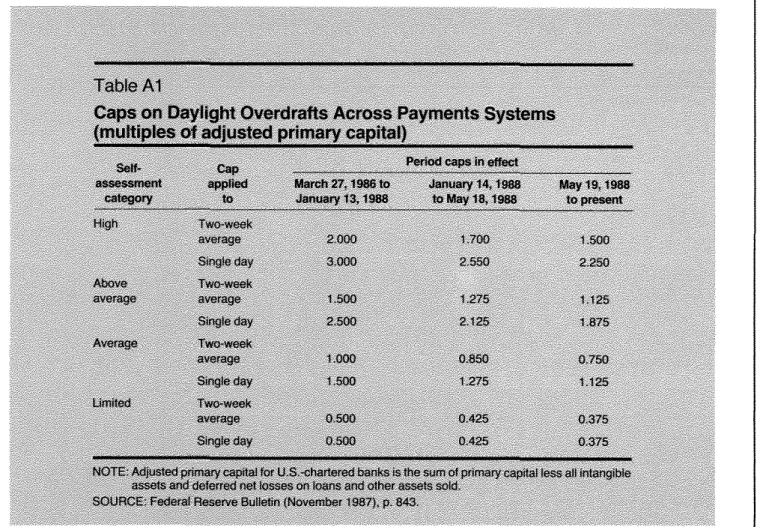
sets its cap by placing itself in one of the possible
categories indicated in table Al; banks are
directed
to
consider their- creditworthiness, credit policies
and operational control and procedures. Each
possible rating has corresponding caps for’ both the one day and two-week average maximum day-light overdraft, each as a percentage of primary
adjusted capital. These percentages have been
‘For an analysis of the effects of these credit limits on daylight overdrafts and the operation of the payments system, see Bel-ton, et al. (1987).
‘There are additional details involved in determining these limits. See Belton, et al. (1987).
Table Al
Caps on Daylight Overdrafts Across Payments Systems
(multiples of adjusted primary capital)
Self- Cap Period caps in effect
assessment applied March 27.1986 to January 14. 1988 May 19.1988 category to January 13, 1988 to May 18, 1988 to present
High Two-week average 2000 1 700 1.500 Single day 3 000 2 550 2 250 Above Two-week average average 1.500 1 275 1 125 Single day 2 500 2.125 1.875 Average Two-week average 1.000 0.850 0.750 Single day 1500 1275 1.125 Limited Two-week average 0 500 0 425 0 375 Single day 0500 0.425 0.375
NOTE: Adjusted primary capital for U.S -chartered banks is the sum of primary capital less all intangible assets and deferred net losses on loans and other assets sold
SOURCE: Federal Reserve Bulletin (November 1987). p 843
r-c11tir(’clcj’cr unit Inn ii ike tilt-ui nircini tlltrti~riii minI lllr~‘zrjue ni iic,ol~n_nun scrurnIim’~cii’chlccj RI rciilsln’anflhiigOWI’dl’ZiIt’,. liii’ .irrmrtitii nil the hauL. Ibis sum’p e\t’mpts nIa~’
light o~irdrills genier’zuVcl ihr’mnigiist’i’Llr tin’s , ..— ...-. .. .. .. —‘ . -.. tnztnsatlioirs Irvin LIII’ hunt’, mrpcisnd In the calls
‘hire i’m’dei’uh lim’,,er\e hra~,nhhv~wdliii,, ihislinictimur Ill n’alctilali ~gliii’ n’mhm’~aniuInnt’asrlr’m’ nil mj~n’iciialts Icr ,n~rind cii’.r tniniilli4 tint’ nni,ii’kct liii’ I .~,.Lmr\tnnnInii’tit
tint crmss—s\’stt’nli tdiiS. liii i”tclmial Hcsc’r’ic—tints ‘,m’rini itips.
- ‘..~ - ‘ ‘. . ‘ . 525 lv,i mhvinrmiturol Bank BHi lilt’ vein via~ii’i’
. , . ti’anislen’. Sinre liii initial nesm’nm’ ji,danncr is ouR
sIn,
tilt’ 515 ln’.iiisii’r mike’, lilt n’msrn\m’ WtiJIinil tnthurL \ m,~mn’mlu’zitvnmlii,’ S!5. ‘s ill tilnlm’ I inn thin’ ln-’,t.
ttiie li’anr,,lm’u’scii hind’, lorclepnrsilnn’s ‘18’ izitiw an auiuioLunii’errlen)I vi a “IS mler’iimieiii Liii’ ~ahut’ nil
rank’, Iii rnr,’drar~111(11’ t’t’~efli’ artoiinfl.-,. astable lint asset’,nil hunk \ ~~dHihdmm tIm’
h’edera!
Re’ \1 lhnn’,tu’.unn-’, ‘,di
Table A2
Risk Created by Transferring Depositor’s Funds over Fedwire
Balance sheets at start ofday:Bank A Bank B
Reserves $10 Deposts 5100 Reserves S 10 Deoosils 5100
Other Net Other Net
-assets 100 worth IQ assems 100 won1: 10
BankAsends$25of depositor’s money to BankBover Fedwure:
BankA Bank B
A few banks incur lan-ge daylight overdrafts be-cause of the transactions they conduct for
cus-tomers that deal
in
U.S.gover-nment securities.These tr’ansactions warrant special examination. A few large banks (called clearing banks) specialize in serving government securities dealers; these banks generate a large share of the total daylight overdr-afts of bank reserve accounts. in the second
quarter of1988 for example, four clearing banks
accounted for about70percent of the daylight
overdrafts attributable to transactions in book-entry securities.
Business Practices of Dealers and Clearing
Banks
— Government securities dealers who buyand sell securities for their customers have no direct access to the book-entry system for’ transfer-ring ownership of government securities. Instead, they maintain book-entry securities accounts and demand deposit accounts with commercial banks
Daylight overdrafts of the clearing banks’ reserve accounts reflect the practices of the government securities dealers in managing their inventories of governments securities. Dealen’s hold large inven-tories of securities during the day to meet the anticipated demands of their customers. To mini-mize the cost of holding the inventories, the deal-ers sell most of their secum-ities by the end of the day through repurchase agreements. The inves-tors who enter into these agreements “own” the secur’ities overnight and “resell” them to dealers early the next day. Thus, the dealers build their’ inventories of government securities in the mon-n-ing of each business day by receivmon-n-ing securities returned by the overnight repo investors and buy-ing
additional securities offered for sale.’
The following featur-es of the business practices of government securities dealers explain why they genen-ally wait until early afternoon to begin
run-For a more complete discussion of the practices of clearing banks and dealers, see Association of Reserve City Bankers (1986).
Securities Transfers
that serve as their clearing banks for securitiestransfers.
15
ning down their inventory of securities. Salesmen for a dealer make commitments to deliver specific securities to its customers by the end of the day.
The dealer is then vulnerable to losses if it cannot
fulfillthese commitments. The customer-s receive
inter-est on the pr’ornised securities for that day, even if the dealer does not make delivery. The customer’s, however, make payments to the deal-ers only when the securities are delivered. The dealer would fail to make delivery if it could not locate the desired secun’ities in its inventory or in the market, or if it sent the wrong securities to a customer’ and had them returned. Each dealer attempts to minimize the probability of such
‘fails” by waiting until earls’ after-noon to dim-ect its clearing bank to send its securities to the book-entry accounts of the banks that serve the cus-tomers that have bought them.
Another reason the dealers hold their securities
until early afternoon involves potential profits
from special orders. On some days, certain issues of government securities ar’e in relatively high
demand. The dealers can make larger profits if
they have securities available to meet these special orders. In contrast to the specific requirements for special orders, dealers may substitute a wide vari-ety of securities as acceptable collateral for repos.
Effects
on lntraday Reserve Balances
—These dealer practices affect the intraday patterns
of their demand deposit balances and the reserve
balances of the clearing banks that senve them. When a m’epo investor’ retur-ns the securities to the dealer-, then-c is an increase in the securities ac-count of the dealer- at its clearing bank and an equal reduction in its demand deposit account. On the books of the Federal Reserve, there is an increase in the securities in the book-entry ac-count of the clearing bank and a n’eduction in the r-eserve account of the cican-ing hank. The same transactions occur’ when the dealer buys securi-ties to hold in its inventory that day. The dealer builds its inventory of securities by oven-dr-awing its demand deposit account during the day. The dealers do not control the timing of these inflows of securities to their’ accounts and the outflows from their demand deposit accounts, since the party that holds the securities initiates the transfer of securities and r-esen’ves through the F’edwir’e system.
The process of overdrawing r’eserve and deposit accounts is reversed later’ in the day as the dealer-s sell their inventor-ies of securities. The reserve
accounts of the clearing banks rise as the
book-entry securities are transferred to the accounts of other banks and reserve balances are simultane-ously transferred to the accounts of the clearing
banks. The timing of tr’ansactions in book-entry
securities for the dealers causes
thereserve
ac-counts of the clearing banks to be overdrawn by
billions of dollar-s during part of the day.
Implications for Risk— The clearing banks
extend credit to government securities dealers during the day by allowing them to overdraw their demand deposit accounts. The banks limit their
risk by obtaining a lien against the securities held
for’ the account of the dealers. Thus, a clearing bank could claim the securities credited to the account of a dealer’ to cover any losses on its de-posit overdraft
The Federal Reserve has considered various methods of establishing liens against the securi-ties in the book-entry accounts of banks but has not initiated such collateral arrangements. Thus, the Fed is vulnerable to losses on the full amount
of a bank’s reserve oven-draft, whether the overdraft was generated through funds transfers or
transac-tions in book-entry securities?
The risk implications of book’entry overdrafts can be illustrated by examining the balance sheet entries in table AZ. Bank A is a clearing bank for’ a governments securities dealer. The dealer receives
$25in book-entry securities and has its demand
deposit account debited by $25, leaving it over-drawn at that time. Suppose the dealer goes
bank-rupt after this
transaction is completed. Bank A
claims the $25 in securities that were credited to the securities account of the dealer to cover any possible losses on the deposit overdraft. The bank is spared any losses, and the Federal Reserve suf-fers no losses.
‘Ibis hook-entry daylight oven-dr-aft, however, does leave the Federal Reserve vulnerable to a loss on the reserve overdraft. Suppose that after’ the dealer’ receives the $25 in book-entry securities, there is an announcement that implies a $15 loss in the value of the other assets of Bank A, as in the other illustrations. Under current an’angements, the Fed has no claim on the $25 in book-entry securities that had been transferred to Bank A, to offset its $5 loss. Thus, collateral agreements be-tween clearing banks and the dealer’s make Fed-er-al Reserve losses due to defaults by government securities dealer-s unlikely, but the daylight reserve
2
Task Force (1988), p. 69. ~TaskForce (1988), p. 70—72.
N\N\\ ~ \~N N NN\//N~ \k\\ ~
N N N N
TabtaA~
N N N N N N NN
~ffeçttofhsüinà Conner
the
Ba*
*a~ScesftIetsat*itetsy
N NN NN N~ N \NN < NN
aankA~
\\N NN Dep ~ ~ $Wt~
flesn~
$ 0
$100\assets
\tO
\Ot* ttb
Bp*Atcanskrs$zsloBanK B
t drtetttoIheacc*untotthelltmthat*sueflO$tmertmal past’C
BatilcA.~
~ ~8artB
Beses
$1Depesrts
$*bG
fisservea
$>aa Depos NN ~. .0th
Na~~\.
~\rocewaS
\.:.26
N00
:
N\~.1O \N~ N, \OGWO)-th Ataá~lsStwoto$me(cmajpapar ‘ N’ . N’~nkA,,
‘‘ ~NBat,’
‘,‘,,~C’,
$tODe OR “ Re~ N ,‘ N ~ ‘\\ rSeew4b~e 0 , Oworth’ ‘‘0Ot~r
‘ N‘Net
, N ‘ ‘ ‘ QQy~ ~~‘N ‘‘~ ‘ N N ‘ N Noverdn’afts of the clearing banks expose the Fed to potential losses in the event of large, unantici-pated declines in the value of the assets of the
clearing banks themselves.
A lien by the Federal Reserve against the book-entry securities in the accounts of the clearing banks might have little practical significance in limiting Fed risk. Suppose the public learns during the day that a clearing bank maybe bankrupt. Would the Federal Reserve suddenly seize the book-entry securities in the account of the clear-ing bank? Doclear-ing so would disrupt the business of
the government securities dealer’s served by the cleaning bank and, given the high concentration of business among clearing banks, would disrupt
trading in the whole government securities mar-ket. The Fed and the other federal supervisory authorities have been reluctant to close large
com-4
Fonadiscussionof howdaylight overdraftsreflect transactions
in commercial paperand otherfinancial instruments,see
Large-Dollar Payments System AdvisoryGroup (1988).
mercial banks because of their effects on other-depository institutions arid the financial markets
in general. A lien on the
book-entry securities of banks might make the supervisory authorities more reluctant to close a large hank that also serves as a clearing bank for’ government securities dealers.Issuing and Redeeming Commercial
Paper
The timing of payments by banks involved in
issuing and redeeming commercial paper- cn-eates
reserve over-drafts.4 Several banks act as agents for
firms that issue commercial paper’. The agent banks collect funds from those purchasing the commercial paper- and transfer’ them to the
ac-counts of those firms issuing the paper. When the
paper’ matures, the agent banks collect fr’om the
17
paper issuers and make payments to the holders of the paper.
When a firm issues commercial paper, the agent
bank generally pays the firm before it receives
payment from those buying the paper. During the period between the payment to the issuer and the receipts from the purchasers, the reserve account of the agent bank falls by the amount of the funds raised by issuing the commercial paper. The re-serve balance of the agent bank also falls by the
face amount of the issue when
the paper matures; the agent bank generally makes payment to those holding the paper before receiving payment from the issuer’.The effects of these transactions on the balance
sheet of the agent bank are illustrated in table A3. A firm raises $25 by issuing commercial paper. Bank A is the agent bank, and both the issuer and purchaser’ of the paper have their demand deposit accounts at Bank B. Early in the day on which the commer-cial paper is issued, Bank A transfer’s $25
to Bank B, to be credited to the demand deposit
account of the issuer. After- that transaction, the
reserve account of Bank A is overdrawn by$15.
In
this example, the offsetting transaction is a $25 increase in an account called “reserves r’eceiv-able.” Later that day, the purchaser of the paper arranges for Bank B to send $25 to Bank A over Fedwire, eliminating the reserve overdraft by the end of the day. As in the other balance sheets, the
Federal Reserve is a general creditor of Bank A
while its reserve account is overdrawn.