ASMs in Service Oriented Architectures
Michael Altenhofen, Andreas Friesen, Jens Lemcke (SAP Research, CEC Karlsruhe, 76131 Karlsruhe, Germany{firstname.lastname}@sap.com)
Abstract: We give a survey on work we did in the past where we have successfully applied the ASM methodology to provide abstract models for a number of problem areas that are commonly found in Service Oriented Architectures (SOA). In particular, we summarize our work on (1) service behavior mediation, (2) service discovery, and (3) service composition, showing that the corresponding solutions can be described as variations of a fundamental abstract processing model—theVirtual Provider.
Key Words: process mediation, service discovery, workflow composition Category: D.2.1, H.4.3, I.6.5
1
Introduction
The term Service Oriented Architecture (SOA) has gained an increasing pop-ularity as an architectural blueprint for designing flexible information systems. SOAs are built from autonomous functional entities,services, which inter-operate through well-defined, message-based interfaces that abstract from both program-ming languages and implementation platforms.
The most prominent incarnation of this architectural blueprint is based on the technical specification set defined by the World Wide Web Consortium (W3C) where services expose their functionality as so-called Web1 services. The cor-responding W3C technical report on the Web Services Architecture [see W3C 2004] describes a basic engagement model that identifies, among others, the fol-lowing three fundamental entities: the service requester invoking functionality from a serviceproviderthrough message exchanges. The definition of these mes-sage exchanges has been published and thus can be retrieved through a public servicediscovery service.
Although the underlying principles are not radically new, the SOA style has given raise to a lot of research in the recent years which tries to address the following problems:
Service Mediation.
What if requester and provider do not perfectly agree on the interaction protocol? Is there a way tomediate[see Wiederhold 1997] in heterogeneous scenarios where mismatches may occur both on the message content and the message flow level?
1 The technical specifications in this area make heavily use of other specifications issued by the W3C that are related to the World Wide Web, e.g. using HTTP as one possible transport protocol for Web service messages, hence the nameWebservices.
Service Discovery.
Given a number of advertised service descriptions, which one fits best the requesters’ needs, both in functional and non-functional terms?
Service Composition.
How can new service functionality be exposed by composing it from available services?
For these problems, we developed formal ASM [see B¨orger and St¨ark 2003] models that have been described individually in detail in other publications [see Altenhofen et al. 2005, Friesen and B¨orger 2006, Lemcke and Friesen 2007]. In this paper, we give a survey of these solutions while emphasizing their strong rela-tionship through one fundamental abstract model, the so-calledVirtual Provider. In [Section 2] we introduce the Virtual Provider model, which allows the con-struction of mediators, especially for protocol mismatches. This VP model has also formed the basis for our semantic service discovery specification which be described in [Section 3]. In [Section 4], we then report on our achievements concerning automatic service composition. Finally, we relate our work to other approaches found in the literature in [Section 5] before we conclude in [Section 6].
2
Service Mediation through Virtual Providers
2.1 Informal Model of Virtual Providers
The general architecture of the Virtual Provider (VP) component is based on the assumption that we mostly deal with two-way conversations using the Request-Reply pattern [see Hohpe and Woolf 2003]: Theservice requestersends a message (request) to the provider, which, in turn, returns a message (an answerorreply) to the requester. These two-way messages are exchanged via appropriate message channels. The Virtual Provider can now be seen as an intermediary component
(orproxy) in the communication model that intercepts the message flow between
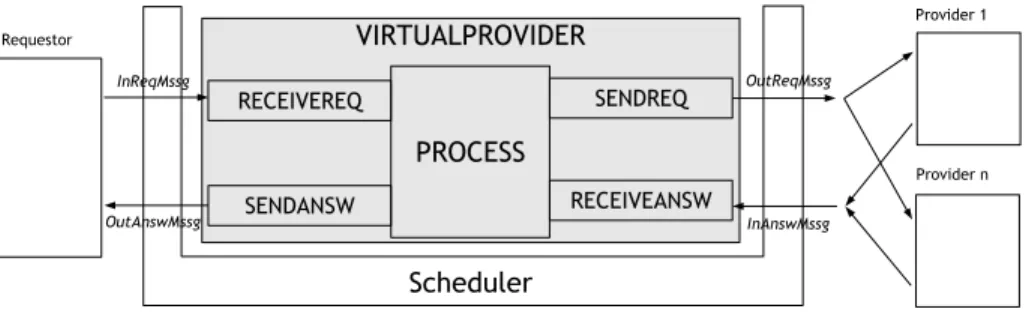
the parties involved, thus being able to compensate mismatches in the interaction protocols that these different parties expect. From the requester’s point of view it acts like a provider, hence the nameVirtual Provider. This core functionality of the VP leads to the architecture in [Fig. 1], where we abstract from scheduling and message-passing functionality.
For the overall execution model we follow the SOA assumption that the mes-sage exchange between the service requester and the service provider carries all information to establish and maintain context and state, i. e., there is no out-of-band communication between the interacting parties. Processing an incoming request can only be done throughonecontrol structure, namely afinite sequence of subrequests, but with a significant modification: Each sequential subrequest can itself be further decomposed into an arbitrary large set ofparallel outgoing requests which can be forwarded independently of each other. With this, we
Figure 1:Virtual Provider Architecture.
end up with a simple hierarchical processing structure of so-calledseq/par trees, that allows us to describe rich interaction schemes in a modular fashion. More sophisticated control flows can be achieved via VP composition as we will see in [Section 2.3]. Note that this way of structuring the control flow may lead to a dif-ferent decomposition of the message exchange with requesters and providers than using the various control structures that are available in standard orchestration languages, such as BPEL4WS [see Andrews et al. 2003]: The overall processing sequence can be derived from the dependencies between subsequent messages (later requests may require parts from replies to former requests), but within a sequencing stepi we group the outgoing requests that independently contribute to the result ofi. With the expressive power of control structures in BPEL4WS, process designers are free to choose among a set of alternative approaches will eventually make it harder to identify these dependencies and, thus, to detect inconsistencies or errors.
2.2 Formal Model of Virtual Providers
Based on the architecture outlined in [Fig. 1], we have defined the VP as a modular abstract machine [see Altenhofen et al. 2005]:
MODULEVirtualProvider=
chooseM ∈ {ReceiveReq,SendAnsw,Process,SendReq,ReceiveAnsw}
M
The first machine ReceiveReq is used to receive service request messages
(elements of a setInReqMssgof legal incoming request messages) from requesters. Once a new incoming message has been fully received, a new internal request object is created which is appropriately initialized with an internal representa-tion of the relevant data extracted from the request message. This particularly includes status information which is used to trigger further request processing:
ReceiveReq(inReqMsg) =
ifReceivedReq(inReqMsg)then if NewRequest(inReqMsg)then
CreateNewReqObj(inReqMsg,ReqObj)
else
letr=prevReqObj(inReqMsg)in
RefreshReqObj(r,inReqMsg)
Request processing is handled in the Process submachine, which builds
up and processes the seq/par tree for the current request objectcurrReqObj. It uses theSubProcessIteratorsubmachine to iterate over the sequence in that
tree, forwarding the parallel subrequests for each sequential step and ultimately collecting the answers from all subrequests. If all outstanding answers have been received, the answer to the overall request will be compiled and returned to the service requester:
Process(currReqObj) =
ifstatus(currReqObj) =started then
SubProcessIterator(currReqObj)
ifstatus(currReqObj) =compileAnswer then
CompileOutAnswMsgfor currReqObj
status(currReqObj) :=deliver where
CompileOutAnswMsgforo=
if AnswToBeSent(o)then
SentAnswToMailer(outAnsw2Msg(outAnswer(o))) :=true compileAnswer=yes(FinishedSubReqProcessg)
In aSubProcessIteratorstep, the immediate subrequests ofcurrReqObj
will be processed in order, as defined by an iterator over that finite set of
se-quential subrequests SeqSubReq(currReqObj).
SubProcessIterator(currReqObj) = InitializeIterator(currReqObj)seq IterateSubReqProcessg(currReqObj)
untilFinishedSubReqProcessg where
yes(FinishedSubReqProcessg) =compileAnswer
no(FinishedSubReqProcessg) =initStatus(IterateSubReqProcessg)
The processing of a single (sequential) subrequest seqSubReq is de-fined as follows: For each element s of the set of parallel subsubrequest
ParSubReq(seqSubReq) ofseqSubReq, it starts toFeedSendReqwith a request
message fors, namely by settingSentReqToMailer(outReq2Msg(s)) totrue. Here, outReq2Msg(s) transforms the outgoing request into the format for an outgo-ing request message, which has to be an element of OutReqMssg. Since these request messages are processed independently of each other, FeedSendReq
elaborates simultaneously for eachs anoutReqMsg(s). Simultaneously, the ma-chine alsoInitializes the to be computedAnswerSet(seqSubReq) before
WhenAllAnswersReceived, a submachineConcludeSteplets the iterative
sub-processProceedToNextSubReq.
While waitingForAnswers,i. e. the predicate AllAnswersReceived is not yet true,ReceiveAnsw inserts for everyReceivedAnsw(inAnswMsg) the retrieved
internal answer(inAnswMsg) representation intoAnswerSet(seqSubReq) of the current sequential subrequestseqSubReq, which is supposed to be retrievable as
requester of the incoming answer message.
IterateSubReqProcessg=
ifstatus(currReqObj) =initStatus(IterateSubReqProcessg)then FeedSendReqwithParSubReq(seqSubReq(currReqObj))
Initialize(AnswerSet(seqSubReq(currReqObj)))
status(currReqObj) :=waitingForAnswers ifstatus(currReqObj) =waitingForAnswers then
ConcludeStep
where
FeedSendReqwithParSubReq(seqSubReq) =
foralls∈ParSubReq(seqSubReq)
SentReqToMailer(outReq2Msg(s)) :=true
ConcludeStep=
if AllAnswersReceived then
ProceedToNextSubReq
status(currReqObj) :=Nxt(status(currReqObj))
Nxt(waitingForAnswers) =testStatus(FinishedSubReqProcessg)
For the definition ofReceiveAnswwe use as parameter theAnswerSet
func-tion. It provides for everyrequester r, which may have triggered sending some subrequests to subproviders, the AnswerSet(r), where to insert (the internal representation of) eachanswer contained in the incoming answer message:
ReceiveAnsw(inAnswMsg,AnswerSet)1 =
ifReceivedAnsw(inAnswMsg)then
insertanswer(inAnswMsg) intoAnswerSet(requester(inAnswMsg))
Finally, the two machines that forward requests to provides and return com-piled answers back to the service requester are defined symmetrically:
SendAnsw(outAnswMsg,SentAnswToMailer) =
ifSentAnswToMailer(outAnswMsg)then
Send(outAnswMsg)
SendReq(outReqMsg,SentReqToMailer) =
ifSentReqToMailer(outReqMsg)then
Send(outReqMsg)
1 Without loss of generality we assume this machine to be preemptive (i. e. ReceivedAnsw(inAnswMsg) gets false by firingReceiveAnswforinAnswMsg).
2.3 Complex VP Models
In those situations where the simple execution model of a single VP turns out to be insufficient, one way to construct more complex control structures is through cascading VP instances via composition: This is achieved by connecting the sending and receiving communication interfaces in an appropriate fashion:
SendReq of VPi with the ReceiveReq of VPi+1, which implies that in
the message passing environment, the types of the setsOutReqMssg ofVPi
andInReqMssg ofVPi+1 match (via some data mediation).
SendAnswof VPi+1 with the ReceiveAnsw of VPi, which implies that
in the message passing environment, the types of the setsOutAnswMssg of
VPi+1 andInAnswMssg ofVPi match (via some data mediation).
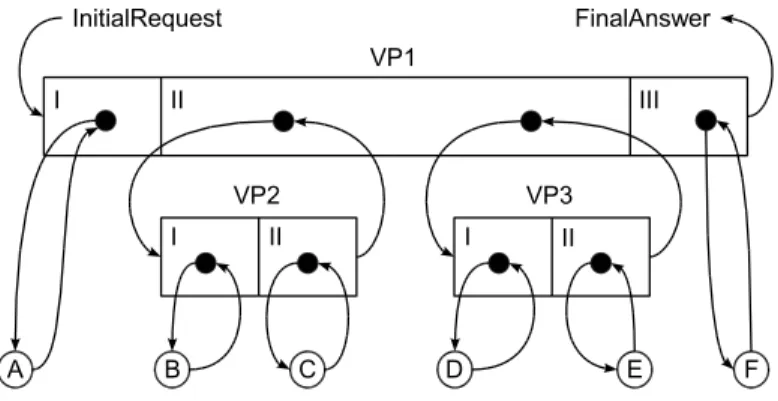
Figure 2:A Complicated Control Flow Example.
For example, the control flow of [Fig. 2] can be realized by a composition of three VPs as indicated in [Fig. 3]: Upon the InitialRequest, VP1 sends a first subrequest for A, followed by sending two parallel requests to subproviders VP2 and VP3 respectively, whose answers in turn trigger VP1 to send the final subrequest for F before eventually providing its FinalAnswer. VP2 and VP3 themselves can be structured sequentially, VP2 handling the request sequence B and C, and VP3 handling the sequence D and E, respectively. Note that these two sequences (and in particular their termination behavior) are independent of each other. Without the possibility to compose our VPs, the only way to realize such a structured control flow would be via programming the corresponding internal VP behavior.
Furthermore, one could extend the VP model by replacing the simple com-munication patterns with more complex ones. ReceiveReq and SendAnsw
are identified in [Barros and B¨orger 2005] as basic bilateral service interac-tion patterns, namely as mono-agent ASM modules Receive and Send. The FeedSendReq submachine together withSendReqin Processrealise an
in-stance of the basic multilateral mono-agent service interaction pattern called
OneToManySend in [Barros and B¨orger 2005], whereas the execution of ReceiveAnsw in IterateSubReqProcessg until AllAnswersReceived is an
instance of the basic multilateral mono-agentOneFromManyReceivepattern
Figure 3:Virtual Provider Composition.
applications by enriching the communication flow structure built from basic ser-vice interaction patterns as analyzed in [Barros and B¨orger 2005].
3
Service Discovery
It actually turned out that the underlying abstract processing model of the VP could be easily extended to serve different application scenarios. For instance, in the context of the DIP project we had the task to provide a specification for a distributed semantic web service (SWS) discovery framework for Web services modeled in Web Service Modeling Ontology (WSMO). The termsemanticis used here to indicate that the service discovery should not be based on syntactical, e. g., keyword based search, but rather on matching semantically describedgoals (e. g., WSMO goals) with semantic annotations of web services (e. g., WSMO capability descriptions). The overall solution is specified as a distributed archi-tecture, where a service discovery providerwill either distribute goal queries to peer entities or will forward a query to a local discovery engine. For both enti-ties in this architecture, the specifications could be directly derived from the VP model by fairly simple refinements. The main reason for distributing semantic discovery services is the computationally very expensive semantic matchmaking procedure of discovery goals and web service capability descriptions.
Notational changes: Since the SWS discovery framework deals with
dis-covery goals instead of requests, all artifacts in the VP model that relate to requests have been renamed appropriately; e. g. ReceiveReq has been turned
into ReceiveGoal, SendAnsw turned into SendSetOfWS, Process turned into
ProcessGoal, currReqObj turned into currReqGoal, etc. Hence, at the highest
level of abstraction the SWS Discovery Service Provider has been derived from the original VP by applying a simple renaming procedure:
chooseM ∈ {ReceiveGoal,SendSetOfWS,ProcessGoal,SendGoal} ∪ {ReceiveSetOfWS}
M
In our SWS discovery framework the same goal query is distributed with-out any changes to different locations (service discovery providers). The service discovery providers reply with sets of discovered web service descriptions which only need to be subsequently aggregated into a global set of discovered web ser-vice descriptions representing the total answer to the original discovery query. This leads to asimplified control sequence, i. e., discovery goal queries are simply forwarded to peer entities. Thus, the sequential part of theseq/par treeis always of length 1, making the subprocess iteration step simpler, see the upper part of [Fig. 4]. Finally, query forwarding requires somerefinementsof the VP model in order to deal with exceptions (most notably loop detections and time outs), see the gray shaded part of [Fig. 4].
Figure 4:Refinement ofProcess(Goal)ASM.
In detail, the definition in [Fig. 4] expresses that each call ofProcessGoal
for a started goal object currGoalObj triggers to FeedSendGoal with a
goal query to be sent out for every relevant discovery location l of the
cur-rent currGoalObj. Those immediate goal queries, elements of a set
ParGoal-Query(currGoalObj), are assumed to be processable by other discovery ser-vice providers independently of each other, FeedSendGoal elaborates
si-multaneously for each l an outGoalMsg(l). Simultaneously,ProcessGoal
up-dates the status of currGoalObj to status(currGoalObj) := waitingForAnswers, where currGoalObj remains until AllAnswersReceived or BreakCondition be-comes true. ProcessGoal call for a loopDetected updates the status of
cur-rGoalObj to status(currGoalObj) := compileAnswer. As long as during
Break-Condition(currGoalObj)isfalse,ReceiveSetOfWSinserts for every
Received-SetOfWS(inSetOfWSMsg)the retrieved internal setOfWS(inSetOfWSMsg)
rep-resentation into SetOfWS(currGoalObj) of the currently processed goal cur-rGoalObj, which is supposed to be retrievable as goal of the incoming an-swer message. Once ProcessGoal finds BreakCondition(currGoalObj) or
Al-lAnswersReceived(currGoalObj) becomes true then currGoalObj assumes
sta-tus value compileAnswer. Once, ProcessGoal finds status(currGoalObj) has
value compileAnswer it compiles from currGoalObj (which allows to access
SetOfWS(currGoalObj)) an answer of the current discovery location and
up-dates the status ofcurrGoalObj tostatus(currGoalObj) := deliver. For the sake of comparison with the original version of theProcessmachine we also provide
here the textual definition of the ProcessGoal.
ProcessGoal(currGoalObj) =
ifstatus(currGoalObj) =startedthen
FeedSendGoalwithParGoalQuery(currGoalObj)
status(currGoalObj) :=waitingForAnswers ifstatus(currGoalObj) =loopDetected then
status(currGoalObj) :=compileAnswer
ifstatus(currGoalObj) =waitingForAnswersthen if BreakCondition(currGoalObj)then
GenerateException(currGoalObj)
status(currGoalObj) :=compileAnswer else
if AllAnswersReceived(currReqObj)then status(currGoalObj) :=compileAnswer ifstatus(currGoalObj) =compileAnswerthen
CompileOutSetOfWSMsgfromcurrGoalObj
status(currGoalObj) :=deliver
Exhaustive motivation for the proposed distributed semantic service discov-ery framework and full treatment of the model refinements is described in [Al-tenhofen et al. 2006].
4
Service Composition
Our work on protocol mediation with the VP has eventually led to a new ap-proach forservice composition. We interpret multi-party communications as an orchestration problem, i. e., finding a mediator that could steer the interactions among those parties, where one party is considered the initiator of the conversa-tion defining the required interface. For this, we have developed a mathematical model of (Web) services based on ASMs and a composition algorithm that is able to construct an transactional execution plan that guarantees that any possible execution trace in that plan will reach an expected end state for all parties, i. e., either a success or recovery state [see Lemcke and Friesen 2007]. Since all arti-facts in that model are specified as ASMs, we can actually simulate the execution plan in the CoreASM execution engine [see Farahbod et al. 2005].
4.1 Enriched VP Model
In order to create the implementation of a VP ensuring transactional behav-ior, we need to use a more detailed representation of requester, providers and orchestration which we give in this section. In addition, we line out how the ex-tended definitions correlate with the original VP ASMs defined in [Section 2.2]. Corresponding ASMs carry the same name as the original with an asterisk at-tached (∗).
4.1.1 Handling of Requester and Providers
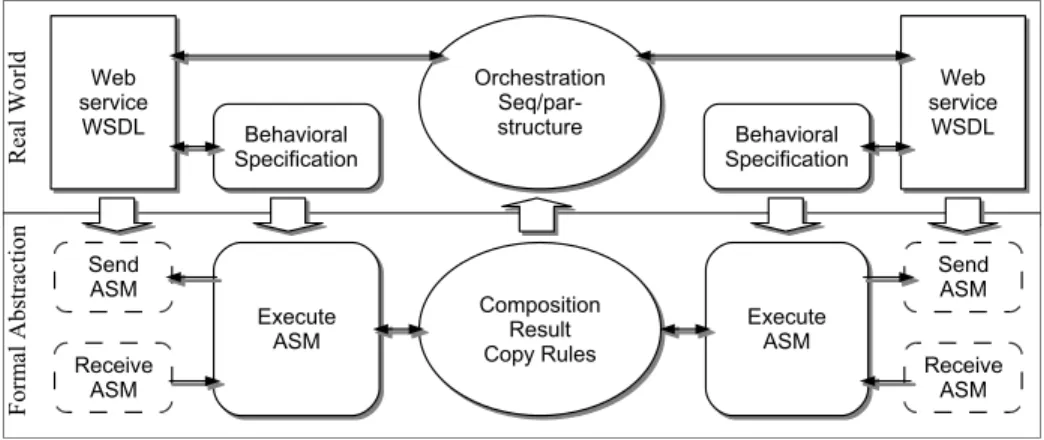
For the sake of generating the VP implementation, we treat the required interface defined by the initiator of a conversation as a special Web service interface among the interfaces of all provider Web services. This fact is represented in [Fig. 5] by just referring to participant of the orchestration as Web services rather than requester and providers.
It is important to differentiate two possible views on the required interface. 1. The outside world later invoking the VP sees the requester like a regular,
passive Web service that can be triggered by sending an initial message. Thus, its first action from the outside point of view must involve some receiving activity.
2. The providers see the requester as the only proactive Web service among themselves that later on triggers the execution of the VP. Thus, its first action from theinside point of view must involve some sending activity. In all diagrams showing the participants of an orchestration, and for generating the implementation of the VP, we use the inside view. Between both the inside and the outside view can easily be converted by swapping the direction of all communications.1
4.1.2 Web Services
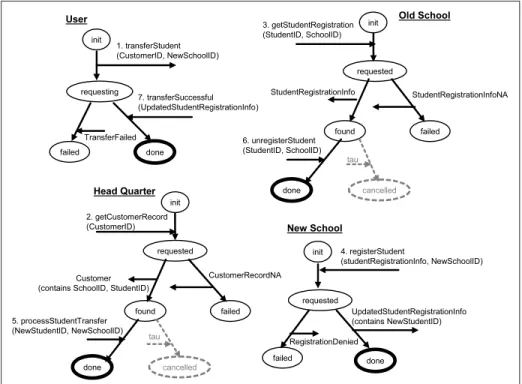
For us, a Web service is defined via a set of possible input and output messages, referred to as input and output variables (IN and OUT), a set of states (S), and a state transition function (ST). Please note that the Web service definition includes business process information by the state transition function. We cur-rently restrict ST to a bipartite, directed tree. Bipartite means that input and output transitions alternate. Multiple input transitions leaving the same state model a user-determined decision. Multiple output transitions model service be-havior out of the user’s sphere of influence. We refer to this as non-deterministic behavior. [Fig. 6] shows four exemplary Web services.
Figure 5:Two views on the interaction model.
WebService := IN,OUT,S,sinit,ST
IN,OUT,S . . . sets of input and output variables and states
sinit ∈ S
ST = STin∪STout STin : S×(2IN\ { ∅ })→S STout : S×(2OUT\ { ∅ })→S
We refuse business logic encoded into Web service behavior. Messages whose content influences subsequent Web service behavior must be classified into dif-ferent variables. We are hence only interested in a variable’s status rather than its value and introduce the varState function.
varState : {(wsId,v)→status: wsId∈ID,v ∈(INwsId∪OUTwsId), status∈ {undef,initialized,processed} }
We now define the execution of Web services. As denoted in [Fig. 5], a Web service interface is abstracted by the ASMs SendReq∗ and ReceiveAnsw∗.
The ASMsSend∗ andReceive∗ contained are hooks to access the underlying
Web service implementation.
SendReq∗(wsId)≡
do forall{(I,spost) : (spre,I,spost)∈STwsId
in } if wsState(wsId) =spost
andvarState(wsId,i1) = initializedand. . . andvarState(wsId,i|I|) = initializedthen
Send∗(wsId,I)
foralli∈I dovarState(wsId,i) := processed where
Figure 6: Example repository. The whole picture represents one Web service repository. Underlined text denotes the ID of a Web service. Each graph describes a Web service’s behavior as a finite state machine. Thereby, ellipses denote states, arrows between states denote state transitions, and arrows leaving or arriving at state transitions denote output or input messages. Text at messages starting with a capital letter denotes a variable name. The “tau”-transitions are virtual transitions (“syntactic sugar”). They translate as follows. The pre-state is a final, unsuccessful state. The transition and its posterior state do not exist.
SendReq∗ differs fromSendReqin that it potentially sends multiple
vari-ables that belong to the same message, and it checks for the correct current state of the corresponding Web service before sending the message. The check
SentAnswToMailer is implemented by requiring every variable’s state to be
initialized.
ReceiveAnsw∗(wsId)≡
do forall{(spre,O) : (spre,O,spost)∈STwsIdout } if wsState(wsid) =spreandReceive∗(wsId,O)then
forallo∈OdovarState(wsId,o) := initialized where
ReceiveAnsw∗ again differs from ReceiveAnswin that it checks for the
correct Web service state and maintains individual variable states. The corre-sponding concept to the notion of the AnswerSet used in [Section 2.2] is the state space of Web services and variables that is maintained and accessed from all Web service models in the scope of one orchestration. This can also be seen in theUpdateBeliefASM which defines the actual behavior of a Web service
based on its state transitions.
UpdateBelief(wsId)≡ do forall(spre,V,spost)∈STwsId
ifwsState(wsid) =spre
andvarState(wsId,v1) = initializedand. . . andvarState(wsId,v|V|) = initializedthen
wsState(wsId) :=spost where
vx ∈V, x = 1..|V|
TheUpdateBeliefmachine does not have a direct equivalent in the
origi-nal VP ASMs, because the origiorigi-nal definition did not talk about states of Web services. Since we have to update the VP’s belief of the progress of the Web services in the system, theUpdateBeliefmachine has to be invoked at
appro-priate times during the execution of theProcessmachine.
4.1.3 Communication
In the previous section, we have introduced a mathematical definition of Web services. In this section, we show how we represent communication between different Web services. Since we now have to refer to Web services and their variables in a global manner, we need to add a unique identification to each such statement. We thus introduce two sets that uniquely identify states and variables of specific Web services.
WSState := {wsId→wsState: wsId ∈ID,wsState∈SwsId} Variable := {(wsId,v) : wsId ∈ID,v ∈(INwsId∪OUTwsId)}
Correspondingly, we define a possible communication as a tuple of a globally unique output variable of one Web service and a globally unique input variable of another Web service.
VarAss := {((wsId1,o),(wsId2,i)) : wsId1,wsId2∈ID, wsId1 =wsId2,o∈OUTwsId1,i ∈INwsId2}
Based on the Web service state and variable assignment definitions, we now define a concrete communication as a copy rule: CopyRule :=S,A, S ⊆ WSState, A⊆VarAss. The following is an example for a copy rule stating to copy the value of CustomerID from the User to the Head Quarter Web service when
all Web services are in their initial state and the User Web service has started, see [Fig. 6].
cps10= ({(U,requesting),(O,init),(H,init),(N,init)},
{((U,CustID),(H,CustID))})
As denoted, the execution of a copy rule corresponds to changing the states of the variables involved. Since a copy rule contains multiple assignments of vari-ables, it may triggers the further sending of multiple messages via the respective
SendReq∗ ASMs. The effect of this behavior strongly corresponds with the
functioning of the SubProcessIteratormachine defined in [Section 2.2].
SubProcessIterator∗(rules⊆CopyRule)≡ do forall(states,varAss)∈rules
ifwsState(wsId1) =s1 and. . .
andwsState(wsId|states|) =s|states|
andvarState(wsIdout1,o1) = initializedand. . .
andvarState(wsIdout|varAss|,o|varAss|) = initialized andvarState(wsIdin1,i1) = undefand. . .
andvarState(wsIdin|varAss|,i|varAss|) = undefthen do forall((wsIdout,o),(wsIdin,i))∈varAss
varState(wsIdin,i) := initialized where
(wsIdk,sk)∈states, k = 1..|states|
((wsIdoutn,on),(wsIdinn,in)), n= 1..|varAss|
4.1.4 Orchestration
In the former sections, we have presented mathematical models for Web ser-vices and their communication. The alternating triggering of the SendReq∗
and ReceiveAnsw∗ abstract state machines is the orchestration of the
respec-tive set of Web services and thus the implementation of the Virtual Provider. This functionality corresponds to theProcessmachine of [Section 2.2].
Process∗(cg∈CompGoal,A⊆VarAss)≡
choose{M : M ≡UpdateBelief(wsId) ∨
M ≡SubProcessIterator∗(rules),wsId∈ids(cg),
rules=ReachCompGoal(cg,A)}
M
Through the way we defined the copy rules and their execution, we ensure that the behavior ofProcess∗resembles the processing of the seq/par-structure
introduced in [Section 2.2]. Firstly, a copy rule contains a set of variable as-signments that may trigger multiple Web services. Thus, copy rules implement parallel invocation of Web services. Secondly, only after all Web services have responded, the next copy rule may fire. This is ensured via belief over the states of the variables and Web services. Thus, copy rules implement sequencing of the parallel Web service invocations. The only missing piece in the definition
above is the actual creation of the copy rules. This will be done by the machine
ReachCompGoal which will be explained in the following section.
For completeness, we reformulate the VP module using the enriched VP ASMs from this section. Please note that the ASMs ReceiveReq and SendAnsware missing in the new module definition below. The reason is that
we handle requestors the same way as providers. Thus, the functionalities of
ReceiveReq andSendAnsware covered byReceiveAnsw∗andSendReq∗,
respectively.
MODULEVirtualProvider∗(cg∈CompGoal,A⊆VarAss)≡
choose{M : M ≡Process∗(cg,A) ∨
M ≡SendReq∗(wsId) ∨ M ≡ReceiveAnsw∗(wsId),wsId ∈ids(cg)}
M
4.2 VP Generator
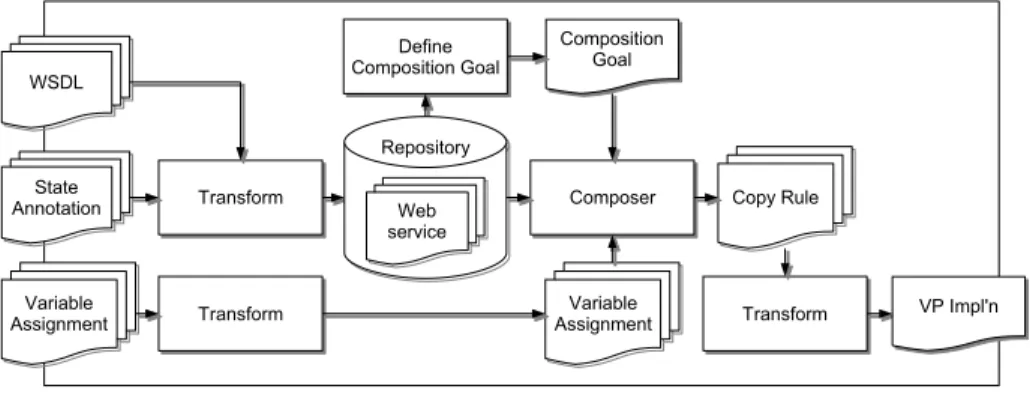
[Fig. 7] shows the architecture of the VP generator. In the environment of a service-oriented architecture, the inputs to the VP generator would be WSDL files, an annotation of their states as well as the allowed variable assignments. The transform blocks in the picture convert the inputs to the internal represen-tations described in the former section. We do not detail the real-world repre-sentation of variable assignments, because there is no standard for this to our knowledge. In the following, we walk through the remaining components of our composition system.
4.2.1 Repository
The central element of our algorithm is a repository to store the set of Web services to be composed. The repository assigns a unique ID to each Web ser-vice contained: Repository := 2ID×WebService. A repository should only include a single requester. A requester is a Web service whose first action is sending an output message. [Fig. 6] shows a set of Web services that make up an exemplary repository. The User Web service acts as requester.
4.2.2 Define Composition Goal
The correctness of a composition can be defined based on the states that all participating Web services can potentially reach in the end of the execution of the orchestration. Such a set of states is called Goal. We differentiate between primary goals (PrimGoal) and recovery goals (RecGoal). Both types of goals are used to describe the requirements of a correct orchestration (CompGoal). We define an orchestration to be correct if and only if it has the following properties.
Each execution results in a system state that is part of the composition goal. There must be a theoretic execution the leads to a system state defined as one of the primary goals.
By this definition, we ensure transactionality of the Web services. One thus has the possibility to specify that either all Web services have to reach a suc-cessful state or no Web service must reach a sucsuc-cessful state. For our student transfer example it would be bad if the Old School successfully unregistered a student, but the New School failed in registering the student.
CompGoal := PrimGoal,RecGoal
PrimGoal ⊆ Goal . . . set of primary goals RecGoal ⊆ Goal . . . set of recovery goals
Goal := 2{wsId→wsState:wsId∈ID,wsState∈SwsId}
We illustrate the goal definition by giving possible primary and recovery goals for the Web services of our example repository in [Tab. 1].
4.2.3 Composer
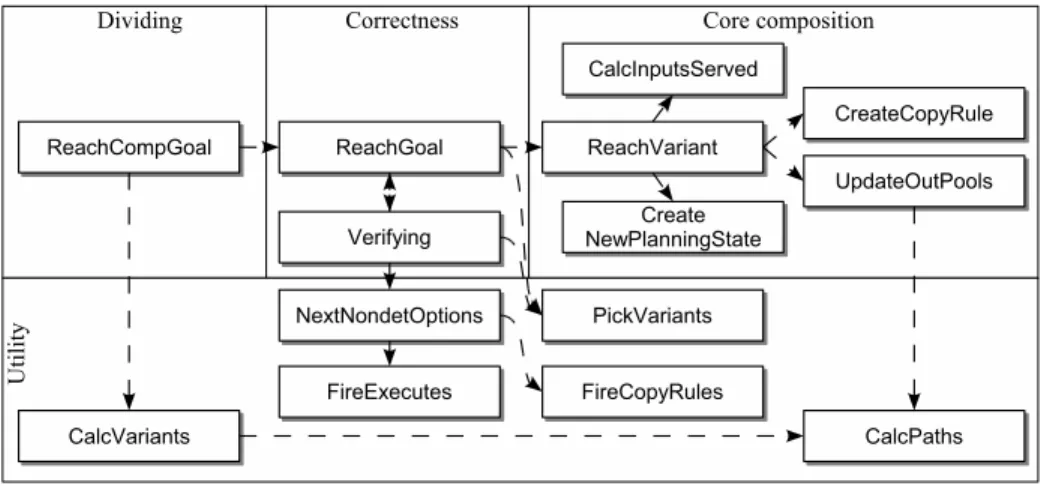
This section describes the composition algorithm in detail by a set of ASMs. Each ASM represents a module of the algorithm. The interaction of all modules is depicted in [Fig. 8]. The following sections concentrate on the dividing part, the correctness part, and the main module of the core composition part of [Fig. 8]. [Section 4.2.3.1] reduces the problem of composing complex Web services to the composition of smaller units. [Section 4.2.3.2] explains how our algorithm ensures a correct composition by properly ordering the composition of the smaller units.
ID User OldSchool HeadQuarter NewSchool
pg1 done done done done
rg8 failed init failed init
rg10 failed failed failed init rg12 failed cancelled failed init rg16 failed failed cancelled init rg26 failed init failed failed rg28 failed failed failed failed rg30 failed cancelled failed failed rg34 failed failed cancelled failed rg36 failed cancelled cancelled failed
Table 1:Exemplary goals.
The smaller units are then composed by the core of our composition algorithm. [Section 4.2.3.3] gives a high-level overview of the core composition algorithm.
Figure 8:ASM Modules of the composer.
4.2.3.1 Dividing the composition problem.
In this section, we show how to break down the composition problem into smaller pieces. The definition of these pieces bases on the different potential execution paths through the state transitions of the single Web services in reaching their final states. We call the set consisting of exactly one potential execution path of each participating Web service aVariant := 2{wsId→Transs:wsId∈ID,Transs⊆STwsId}.
The ASM starting the composition is calledReachCompGoal. The purpose
of the ReachCompGoal machine is to initialize our composition algorithm.
First, is identifies possible Web service executions (CalcVariants) and hands
them over to ReachGoal. Second, it defines that the composition can only
be successful if at least one primary goal can be achieved by providing the primary goals to ReachGoal. It also ensures that every possible execution of
the resulting copy rules ends in one of the composition goals (CompGoal). If it is not possible to generate a correct orchestration for any of the primary goals, the result is the empty set. Third, since ReachGoal is invoked recursively
for some kind of simulation that is introduced later on, we need to keep track of the current state of the simulation and thus introduce a simulation state: SimState := 2WSState. The computation is started by calling ReachGoal with
the initial states of all Web services as a starting point (initialSs).
4.2.3.2 Computing correct orchestrations.
For one variant, the creation of copy rules can be achieved by our core compo-sition algorithm (ReachVariant) which is explained in the following section.
The copy rules created by ReachVariant ensure that the given goal can be
reached in this variant. Due to potential non-deterministic behavior of the par-ticipating Web services, it may happen that the execution of the orchestration leaves one of the Web services’ path along the variant, or even leave the path to its final state that is part of the defined goal. The result of our composition has to ensure that in such a case an alternative path is taken that leads to any other desired final state. This is ensured by Verifying. With this high-level
understanding, we first go in detail through the implementation ofReachGoal.
Second, we explainVerifyingand third, we detail the simulation of the created
copy rules that is part ofVerifying.
Reach goal. The aim of ReachGoal is to return copy rules ensuring a
cor-rect orchestration for at least one of the givengoals only considering the given variants (vnts). For this, it first identifies all variants (goalVnt) that lead to
the goals (CalcVariants). Second, it tries to compose each of the variants
(ReachVariant). This results in some copy rules (regCopyRules). Third, the
algorithm creates copy rules (altCopyRules) for each non-deterministic branch in the theoretic execution of regCopyRules (Verifying). The created copy rules
ei-ther provide a correct orchestration of that branch, orVerifyingfails (altFail).
If a correct orchestration could be generated for at least one variant in the end, the corresponding copy rules (oneVariantCopyRules) are finally returned.
Verifying. Through ReachVariant in ReachGoal, we ensure that a
However, this path of execution may depend on the non-deterministic behav-ior of other Web services that cause a deviation from this path. For this case,
Verifying ensures that there exists a successful composition for each
non-deterministically deviating path. The result of Verifying is either the set of
copy rules that ensure the successful composition, or a notification of failure if no successful composition exists for all non-deterministic deviations.
4.2.3.3 Core composition algorithm overview.
In this section, we give a high-level explanation of our core composition algo-rithm. Our core composition algorithm works iteratively from the final states of each Web service to their initial states. Therefore, we need to keep track of the current state of the backchaining and thus introduce a planning state: PlState := 2WSState×{IN,OUT}. The composition algorithm takes the following in-puts.
A variant of the possible Web service executions, i. e., a specific execution path for each participating Web service.
An initial planning state, derived from the given goal. A set of possible variable assignments.
The general idea of the composition is to create copy rules for matching outputs and inputs of different Web services in the current planning state (ps) and to add them to the setcopyRules(CreateCopyRule). After this has been
done, the planning state will proceed toward the initial states of the Web services (CreateNewPlanningState) and the algorithm reiterates. The composition
of a variant is aborted if no valid composition could be achieved (fail), the planning state consists of only initial states (done) or the composition came to a dead end, i. e., the planning state remained the same for two iterations. The latter case may occur if not all output variables of a service are consumed by other services. During composition, such a Web service’s planning state will not proceed any further toward its initial state.
Further detail can be found in [Lemcke and Friesen 2007]. We rather stick with this high-level description and provide an example in the next section.
4.2.4 Example
The first call ofReachVariantis triggered byReachCompGoal. The result
is a set of copy rules that may lead the orchestration of the exemplary Web services to the primary goalpg1 as defined above.
cpg1 = ({(U,requesting),(O,found),(H,found),(N,done)},
{((N,UpdRegInfo),(U,UpdRegInfo)),((H,Customer),(O,StudID)), ((H,Customer),(O,SchoolID)),((N,NewStudID),(H,NewStudID)), ((U,NewSchoolID),(H,NewSchoolID))});
cps8 = ({(U,requesting),(O,found),(H,found),(N,init)},
{((O,StudRegInfo),(N,StudRegInfo)), ((U,NewSchoolID),(N,NewSchoolID))}); cps9 = ({(U,requesting),(O,init),(H,found),(N,init)},
{((H,Customer),(O,StudID)),((H,Customer),(O,SchoolID))}); cps10 = ({(U,requesting),(O,init),(H,init),(N,init)},
{((U,CustID),(H,CustID))})
Now, we simulate the execution of the copy rules above. We find out that the first non-determinism occurs in Web serviceH after executingcopyRuleps10.
The option is{(U,requesting),(O,init),(H,failed),(N,init)}. Subsequently, the reachable, allowed goals arerg8,rg10, rg12,rg26,rg28 andrg30.
allowedGoal1= rg8 ={(U,failed),(O,init),(H,failed),(N,init)} allowedGoal2=rg10={(U,failed),(O,failed),(H,failed),(N,init)} allowedGoal3=rg12={(U,failed),(O,cancelled),(H,failed),(N,init)} allowedGoal4=rg26={(U,failed),(O,init),(H,failed),(N,failed)} allowedGoal5=rg28={(U,failed),(O,failed),(H,failed),(N,failed)} allowedGoal6=rg30={(U,failed),(O,cancelled),(H,failed),(N,failed)} For a successful composition, it is required that at least one variant for each of the options can be successfully composed. Since the behavior of each Web service is represented as a tree in our example, the number of goals directly determines the number of variants. For our case, this means that at least one of the allowed goals must be successfully composable. Our algorithm finds out that composition might be possible only forrg8. We list the copy rules below.
crg8= ({(U,requesting),(O,init),(H,failed),(N,init)},
{((H,Fail),(U,Fail))});
cps12= ({(U,requesting),(O,init),(H,init),(N,init)},
{((U,CustID),(H,CustID))})
The simulation of the copy rules above reveals no more non-determinism. Thus, we can continue our simulation of the original copy rules. The next non-deterministic option we find is{(U,requesting),(O,failed),(H,found),(N,init)}. The allowed, reachable goals arerg16andrg34.
allowedGoal7=rg16={(U,failed),(O,failed),(H,cancelled),(N,init)} allowedGoal8=rg34={(U,failed),(O,failed),(H,cancelled),(N,failed)} From the goals, onlyrg16can be reached. We give the copy rules below.
crg16 = ({(U,requesting),(O,failed),(H,found),(N,init)},
{((O,Fail),(U,Fail))});
cps14 = ({(U,requesting),(O,init),(H,found),(N,init)},
cps15= ({(U,requesting),(O,init),(H,init),(N,init)},
{((U,CustID),(H,CustID))})
Simulating the copy rules above yields no more non-determinism. Thus, we continue the simulation of the original copy rules and find the last non-deterministic option ({(U,requesting),(O,found),(H,found),(N,failed)}). The only reachable, allowed goal is rg36. We give the copy rules resulting from its composition below. The copy rules for this option do not contain any new non-determinism.
allowedGoal9=rg36 = {(U,failed),(O,cancelled),(H,cancelled),(N,failed)} crg36 = ({(U,requesting),(O,found),(H,found),(N,failed)},
{((N,Fail),(U,Fail))});
cps17 = ({(U,requesting),(O,found),(H,found),(N,init)},
{((O,StudRegInfo),(N,StudRegInfo)), ((U,NewSchoolID),(N,NewSchoolID))}); cps18 = ({(U,requesting),(O,init),(H,found),(N,init)},
{((H,Customer),(O,SchoolID)),((H,Customer),(O,StudID))}); cps19 = ({(U,requesting),(O,init),(H,init),(N,init)},
{((U,CustID),(H,CustID))})
At this stage, our algorithm has ensured that the primary goal for the ex-ample (pg1) could be reached and there exist deterministic resolutions for each non-deterministic deviation from the intended execution path to an allowed re-covery goal. Therefore we can claim that the example is successfully composable. The copy rules our algorithm returns contain the copy rules for reaching the primary goal and all non-deterministic deviations from the intended path, i. e., all copy rules shown in this section.
5
Related Work
The innovation of our approach lies in providing a coherent framework to specify service mediation, service discovery, and service composition. The idea to use the ASM modeling framework for providing a high-level specification of service medi-ators has been stimulated by work carried out in the EU-funded research project DIP.1 There, ASMs had been used to describe bothWSMO choreographiesand WSMO orchestrations, but the technical report [Scicluna et al. 2006] actually did not specify how such a choreography would be linked up to a corresponding orchestration other than by sharing some states. Although perfectly legal from
a conceptual point of view, we felt that this coupling was actuallytoo looseand that a more rigid model would be needed, especially when it comes to (formally) proving system properties. Further investigation of the problem revealed that we were actually looking for a model that could be used to describeservice behavior mediators, i. e., mediation on the message flow level.
Regarding the distributed model for semantic service discovery, we can now find publications that describe a similar architectural approach [see Arabshian and Schulzrinne 2006, Bianchini et al. 2008], although none of them provides a formal execution model.
It turns out that service mediation and service composition can be seen as two perspectives on the same task. The task to map a requested interface with multiple provided interfaces is called service mediation. The task to compile an orchestration of a set of provided interfaces with certain properties that represent the added value of the generated application is called service composition. In our case, following a specific requested interface is one of those properties.
In this respect, approaches to service mediation and service composition are related to our service mediation formalization and VP generator. The type of service mediation and composition we pursue most appropriately falls under the category of workflow composition as we observe complex behavioral requirements of the provided and requested interfaces. Related approaches include work per-formed using pi-calculus, e.g. [Puhlmann 2006], others use merged finite state machines [see K¨uster et al. 2007] or similar representations. These approaches on the one hand concentrate on merging workflows but have on the other hand no facility for exception management or complex goal definition. Consequently, our approach is most related to [Pistore et al. 2005] which uses model checking on a finite state representation of joined abstract BPEL models. The drawback of this solution is that its computation is in the range of seconds to minutes due to the use of general purpose tools. Our approach in contrast does not compute a joined finite state machine, but operates on the ASM specification directly. Thus, we can reach better performance in the range of fractions or a few seconds by avoiding the state space explosion.
We would like to note that process composition as performed utilizing AI planning mostly assumes atomic services—i. e. without complex behavioral re-quirement [see Rao and Su 2004]. The work carried out in schema matching [see Shvaiko and Euzenat 2005] is somewhat orthogonal, yet complementary, to our approach as it is concerned with relating data formats of every two participants to each other. We abstract from this in two ways. (1) When presenting our for-mal model of service mediation, the VPs’ implementation may indeed contain some code mapping data structures to one another. Our formalization rather fo-cuses on the sec/par structure of the communication protocol. (2) When talking about service composition, we have to assign matching input to output variables
as one of the prerequisites to start the automatic composer. This however is not concerned with the actual data structure or values, but rather concentrates on the fact that data from some variable Ahas to be assigned to some variableB on theconceptual level. The actual copying of the run-time values fromAtoB on thetechnical level may indeed include a complex value mapping which is out of scope of our work, but addressed, e. g., in [Drumm et al. 2007].
6
Conclusion
In this paper, we have presented our work on formal models for protocol me-diation, service discovery, and service composition generating a transactional execution plan.
Each of our technologies individually extends the original service-oriented architecture with features important to real-world applications. (a) Our formal model for mediation allows to theoretically prove that a requested interface can be implemented by the provided interfaces [see Altenhofen et al. 2006]. (b) Our approach for service discovery allows to distribute the discovery transparently to the traditional discovery request and provisioning interfaces. This is done by im-plementing the traditional discovery request interface via a VP that distributes the request to multiple instances of the traditional discovery provisioning inter-face. We thus seamlessly integrate with existing discovery infrastructure. (c) Our VP generator is capable of creating an orchestration that links requested and provided interfaces based on user-defined transactional requirements.
The combination of our technologies has the potential to implement compli-cated, desirable features of service-oriented architectures. (a) With the subse-quent invocation of discovery and composition, we can prove whether there is an orchestration for a requested interface based on the discovered services. For this, we would have to automate the goal definition by upfront naming successful and unsuccessful states in our Web service specifications that then would be used to generate potential primary and recovery goals. (b) If we interlink the compo-sition with discovery the other way around, we are able to implement dynamic discovery of provider services at the runtime of our VP, as this is proposed in some semantic Web use cases.
In addition to the integration of our techniques as described, future work on the individual components may include the following. (a) Our VP generator allows to define variable assignments that involve complex message transforma-tions to be considered during the composition process. In a real implementation of our approach, generic mediators performing those transformations should be known upfront and incorporated into the seq/par-structure the VP generator creates. This allows for an extreme flexibility in the services that can be or-chestrated to fulfill a requested interface. (b) In the case that no orchestration
could be generated out of the given provided interfaces for the given requested interface, we could extend the VP generator to propose missing mediator inter-faces necessary to complete the composition. The mediation interinter-faces would in a second step have to be implemented by a human programmer.
References
[Altenhofen et al., 2006] Altenhofen, M. ; B¨orger, E. ; Friesen, A. ; Lemcke, J.: A high-level specification for virtual providers. In: International Jour-nal of Business Process Integration and Management. Inderscience Publishers Special Issue 2006 (2006)
[Altenhofen et al., 2005] Altenhofen, M. ; B¨orger, E. ; Lemcke, J.: An Execution Semantics for Mediation Patterns. In: Proc. of 2nd WSMO Implementation Workshop WIW’2005. Innsbruck, Austria : CEUR Workshop Proceedings, June 6-7 2005. – URL CEUR-WS.org/Vol-134/lemcke-wiw05.pdf. – ISSN 1613-0073, online CEUR-WS.org/Vol-134/lemcke-wiw05.pdf. – ISSN 1613-0073
[Andrews et al., 2003] Andrews, T. ; F., Curbera ; H., Dholakia ; Goland, Y. ; Klein, J. ; F., Leymann ; Liu, K. ; Roller, D. ; Smith, D. ; Thatte, S. ; Trickovic, I. ; Weerawarana, S.: Business Process Execution Lan-guage for Web Services (BPEL4WS). Specification Version 1.1, 5 May 2003. URL http://download.boulder.ibm.com/ibmdl/pub/software/dw/ specs/ws-bpel/ws-bpel.pdf, 2003. – Technical Report
[Arabshian and Schulzrinne, 2006] Arabshian, K. ; Schulzrinne, H.: An Ontology-based Hierarchical Peer-to-Peer Global Service Discovery System.
In:Journal of Ubiquitous Computing and Intelligence (JUCI) (2006)
[Barros and B¨orger, 2005] Barros, A. ; B¨orger, E.: A Compositional Framework for Service Interaction Patterns and Communication Flows. In: Lau, K.-K. (Eds.) ; Banach, R. (Eds.):Formal Methods and Software Engineering. Proc. 7th International Conference on Formal Engineering Methods (ICFEM 2005) Ed. 3785, Springer, 2005, pp. 5–35
[Bianchini et al., 2008] Bianchini, D. ; De Antonellis, V. ; Melchiori, M.: Flex-ible Semantic-based Service Matchmaking and Discovery. In: World Wide
Web Journal (2008). – URL http://www.springerlink.com/content/
4514473142836174/
[B¨orger and St¨ark, 2003] B¨orger, E. ; St¨ark, R. F.: Abstract State Machines. A Method for High-Level System Design and Analysis. Springer, 2003
[Drumm et al., 2007] Drumm, Christian ; Lemcke, Jens ; Oberle, Daniel: Busi-ness Process Management And Semantic Technologies. In: Cardoso, Jorge (Eds.) ; Hepp, Martin (Eds.) ; Lytras, Miltiadis D. (Eds.):The Semantic Web:
Real-World Applications from Industry Ed. 6. Springer, 2007, pp. 209–239. –
[Farahbod et al., 2005] Farahbod, R. ; Gervasi, V. ; Gl¨asser, U.: CoreASM: An extensible ASM execution engine. In:Proc. of the 12th Intl Workshop on Abstract State Machines. Paris, France, 2005
[Friesen and B¨orger, 2006] Friesen, A. ; B¨orger, E.: A high-level specifica-tion for Semantic Web Service Discovery Services. In: ICWE ’06: Workshop proceedings of the sixth international conference on Web engineering, 2006 [Hohpe and Woolf, 2003] Hohpe, G. ; Woolf, B.: Enterprise Integration
Patterns: Designing, Building, and Deploying Messaging Solutions. Boston, MA, USA : Addison-Wesley Longman Publishing Co., Inc., 2003. – ISBN 0321200683
[K¨uster et al., 2007] K¨uster, Jochen M. ; Ryndina, Ksenia ; Gall, Harald: Gen-eration of Business Process Models for Object Life Cycle Compliance. In: Alonso, Gustavo (Eds.) ; Dadam, Peter (Eds.) ; Rosemann, Michael (Eds.): BPM Ed. 4714, Springer, 2007, pp. 165–181. – ISBN 978-3-540-75182-3 [Lemcke and Friesen, 2007] Lemcke, J. ; Friesen, A.: Composing
Web-service-like abstract state machines (ASMs). In: Workshop on Web Service Compo-sition and Adaptation (WSCA07). 2007 IEEE International Conference on Web Services, ICWS 2007., 2007
[Pistore et al., 2005] Pistore, Marco ; Traverso, Paolo ; Bertoli, Piergiorgio ; Marconi, Annapaola: Automated Synthesis of Composite BPEL4WS Web Services. In: ICWS, IEEE Computer Society, 2005, pp. 293–301. – ISBN 0-7695-2409-5
[Puhlmann, 2006] Puhlmann, Frank: Why Do We Actually Need the Pi-Calculus for Business Process Management? In: Abramowicz, Witold (Eds.) ; Mayr, Heinrich C. (Eds.): BIS Ed. 85, GI, 2006, pp. 77–89. – ISBN 3-88579-179-X
[Rao and Su, 2004] Rao, Jinghai ; Su, Xiaomeng: A Survey of Automated Web Service Composition Methods. In: Cardoso, Jorge (Eds.) ; Sheth, Amit P. (Eds.):SWSWPC Ed. 3387, Springer, 2004, pp. 43–54. – ISBN 3-540-24328-3 [Scicluna et al., 2006] Scicluna, J. ; Polleres, A. ; Roman, D.: Ontology-based Choreography and Orchestration of WSMO Services. WSMO Technical Report 2006. 2006. – URLhttp://www.wsmo.org/TR/d14/v0.2/
[Shvaiko and Euzenat, 2005] Shvaiko, Pavel ; Euzenat, J´erˆome: A Survey of Schema-Based Matching Approaches. In:J. Data Semantics IV, 2005, pp. 146– 171
[W3C, 2004] W3C:Web Services Architecture. W3C Working Group Note. 11 Feb 2004. – URLhttp://www.w3.org/TR/2004/NOTE-ws-arch-20040211/ [Wiederhold, 1997] Wiederhold, G.: Mediators in the Architecture of Future
Information Systems. In: Huhns, Michael N. (Eds.) ; Singh, Munindar P. (Eds.): Readings in Agents. San Francisco, CA, USA : Morgan Kaufmann, 1997, pp. 185–196