Demirovic, A. (2013)The interaction between equity and credit risks.
PhD, University of the West of England. Available from: http://eprints.uwe.ac.uk/21581
We recommend you cite the published version. The publisher’s URL is:
http://eprints.uwe.ac.uk/21581/
Refereed: No
(no note)
Disclaimer
UWE has obtained warranties from all depositors as to their title in the material deposited and as to their right to deposit such material.
UWE makes no representation or warranties of commercial utility, title, or fit-ness for a particular purpose or any other warranty, express or implied in respect of any material deposited.
UWE makes no representation that the use of the materials will not infringe any patent, copyright, trademark or other property or proprietary rights.
UWE accepts no liability for any infringement of intellectual property rights in any material deposited but will remove such material from public view pend-ing investigation in the event of an allegation of any such infrpend-ingement.
THE INTERACTION BETWEEN
EQUITY AND CREDIT RISKS
Amer Demirovic
A thesis submitted in partial fulfilment of the requirements of
the University of the West of England, Bristol
for the degree of Doctor of Philosophy
Bristol Business School
University of the West of England
Bristol
This copy has been supplied on the understanding that it is copyright material and that no quotation from the thesis may be published without proper
Acknowledgments
The completion of a PhD thesis is always a great challenge. Doing it on a part-time basis, and away from the campus seems almost impossible. In my case, it would have been very difficult for me to complete this work without the support and flexibility of my supervisors, Professor Jon Tucker and Professor Cherif Guermat. They greatly helped me throughout the entire process, from the collection of data, through the development of empirical models, to the formulation of conclusions. As if that was not enough, they recommended me for the UWE Completion Bursary which enabled me to attend UWE for two months and speed up the completion of the thesis by at least a year. I am also thankful to UWE for awarding me the bursary, and to Dr. Helen Frisby and the friendly staff at the Graduate School Office for superbly administering the entire process.
A full-time job and a part-time PhD leaves you no time for anyone else. For this, I would like to express my gratitude to my family for their unconditional support; my girlfriend Azra (who has become a wife during the process) for managing to stay with me during these four years and actually helping by adding references to RefWorks; my close friends for remaining close friends despite having barely seen me over these last four years; my colleagues at the HJPC BiH for doing my job during my leaves to attend UWE; and last but certainly not the least my friend, Ermin Mulabdic, for proofreading the thesis.
Abstract
Equity anddebt are two distinct classes of securities in terms of investing risks and potential return, buttheir value depends on the same underlying assets of the firm and therefore the risk-return tradeoff of each security should be systematically related. Following a review of the principal theoretical approaches to the measurement of equity and credit risks,this thesis utilizes a sample of matched firm-level equity and corporate bond data to examine three aspects of risk interaction. First, it investigates the importance of idiosyncratic and systematic equity risks in determining the credit spread on corporate bonds. Second, the thesis investigates how equity and credit risks themselves impact upon the correlation between equity and bond returns. Finally, the thesis examines whether the credit sensitive information contained within financial accounting data is fully reflected in equity prices. The empirical approach adopted in this thesis is to relate the credit spread and the conditional correlation between equity and bond returns with both equity and credit risk indicators and financial accounting variables. This methodological approach enables an extension of the existing literature on several dimensions, leading to a number of empirical results which have important theoretical and practical implications for the integrated management of equity and credit risks. Consistent with existing empirical studies, equity and credit risks are found to exert a positive impact upon the credit spread. Surprisingly, equity volatility is found to significantly outperform the distance to default in terms of explanatory power. Further, the impact of equity volatility increases monotonically as the distance to default narrows. The conditional correlation between equity and bond returns is found on average to be positive and to vary over time, peaking during the 2007 financial crisis. Finally, an increase in credit risk has a positive impact upon the correlation while an increase in equity risk is found to strengthen the correlation only if the firm’s credit risk is high.
Table of Contents
List of Tables ... V List of Figures ... IX
CHAPTER 1 ... 1
1.1. Introduction... 1
1.2. Background and Rationale ... 2
1.3. Objectives and Contributions of the Thesis ... 4
1.4. Structure of the Thesis ... 5
1.5. Methodological Considerations ... 6
1.5.1. Equity Risk ... 6
1.5.2. Credit Risk ... 7
1.5.3. Regression Analysis ... 7
1.6. Main Research Questions ... 8
CHAPTER 2 ... 9
2.1. Introduction... 9
2.2. The Structural Approach ... 10
2.3. Limitations of the Structural Approach ... 14
2.4. Estimation of the Structural Model ... 15
2.4.1. Estimating Unobservable Value of Firm’s Assets and the Volatility of Assets ... 15
2.4.2. Choosing Default Point and Time Horizon ... 19
2.4.3. Estimating the Expected Growth in the Assets Value ... 21
2.5. Extensions of the Structural Model ... 22
2.5.1. Early Default ... 23
2.5.2. Stochastic Interest Rate ... 25
2.5.3. Stochastic Default Barrier... 28
2.5.4. Mean-Reverting Leverage Ratio ... 30
2.5.5. Jump Diffusion ... 31
2.5.6. Stochastic Volatility ... 32
2.5.7. Endogenous Default Barrier ... 33
2.6. Summary ... 34
CHAPTER 3 ... 36
3.1. Introduction... 36
3.2. A Basic Model for Equity Prices ... 36
3.3. Equity Risk and Return Trade-Off ... 38
3.4. Equity Value Determinants ... 41
3.4.1. Capital Assets Pricing Model ... 41
3.4.2. Multi-Factor Models ... 46
3.5. The Equity Premium ... 54
3.5.1. Equity Premium Determinants ... 55
3.5.2. Time Variation of the Equity Premium and its Implications ... 57
3.5.3. Estimation of the Equity Premium ... 60
3.6. Equity Volatility ... 62
3.6.1. Estimation of the Equity Volatility ... 62
3.6.2. Volatility Components ... 67
CHAPTER 4 ... 72
4.1. Introduction... 72
4.2. Literature Review and Development of Hypotheses ... 74
4.2.1. Relationship between the Credit Spread and Equity Volatility ... 75
4.2.2. Relationship between the Credit Spread and Distance to Default ... 77
4.2.3. Systematic and Idiosyncratic Equity Risks as Determinants of Credit Risk ... 78
4.2.4. Interaction between Equity Volatility and the Distance to Default ... 80
4.2.5. Relationship between the Credit Spread and Common Factors ... 81
4.3. Methodology ... 83
4.3.1. Credit Spread ... 83
4.3.2. Bond Issue Characteristics ... 85
4.3.3. Equity Volatility ... 85
4.3.4. Equity Returns ... 86
4.3.5. Distance to Default ... 88
4.3.6. Panel Data Analysis ... 89
4.4. Data ... 91
4.5. Summary ... 96
CHAPTER 5 ... 98
5.1. Introduction... 98
5.2. The Relationship between the Credit Spread and Equity Volatility ... 99
5.2.1. Unit Root Analysis ... 99
5.2.2. The Constant Coefficient Model ... 100
5.2.3. The Cross-sectional Fixed Effects Model... 103
5.2.4. The Period Fixed Effects Model ... 106
5.2.5. The Two-way Fixed Effects Model ... 110
5.3. The Relationship between the Credit Spread and the Distance to Default of Merton (1974) ... 112
5.3.1. The Constant Coefficient Model ... 112
5.3.2. The Cross-sectional Fixed Effects Model... 114
5.3.3. The Period Fixed Effects Model ... 115
5.3.4. The Two-way Fixed Effects Model ... 117
5.4. Systematic and Idiosyncratic Equity Volatility as Determinants of the Credit Spread... 119
5.5. The Interaction between Equity Volatility and Credit Risk in Explaining Variations in the Credit Spread ... 126
5.6. The Relationship between the Credit Spread and Common Factors ... 130
5.7. Changes in the Credit Spread ... 137
5.8. Robustness of the Results ... 139
5.8.1. Equity Volatility Modelled as an Asymmetric EGARCH Process ... 139
5.8.2. Firm Size ... 140
5.8.3. Bond-specific Variables ... 142
5.9. Summary ... 144
CHAPTER 6 ... 149
6.1. Introduction... 149
6.2.2. Equity Volatility and the Correlation between Equity and Bond
Returns ... 153
6.2.3. Credit Risk and the Correlation between Equity and Bond Returns .... 154
6.2.4. Interaction between Equity Volatility and the Distance to Default ... 156
6.2.5. Common Factors and the Correlation between the Equity and Bond Returns ... 157
6.3. Methodology ... 160
6.3.1. Equity and Bond Returns ... 160
6.3.2. Conditional Correlation between the Equity and Bond Returns ... 160
6.3.3. Equity Volatility ... 162
6.3.4. Distance to Default ... 163
6.3.5. Equity Systematic Returns and Volatility ... 163
6.3.6. Bond Issue Characteristics ... 164
6.3.7. Panel Data Analysis ... 165
6.4. Data ... 166
6.5. Summary ... 167
CHAPTER 7 ... 169
7.1. Introduction... 169
7.2. The Conditional Correlation between the Equity and Bond Returns ... 170
7.3. The Relationship between Equity Volatility and the Correlation between the Equity and Bond Returns ... 173
7.3.1. The Constant Coefficient Model ... 174
7.3.2. The Cross-sectional Fixed Effects Model... 175
7.3.3. The Period Fixed Effects Model ... 176
7.4. The Relationship between the Distance to Default of Merton (1974) and the Correlation between the Equity and Bond Returns ... 178
7.4.1. The Constant Coefficient model ... 178
7.4.2. The Cross-sectional Fixed Effects Model... 179
7.4.3. The Period Fixed Effects Model ... 182
7.5. The Interaction between the Equity Volatility and Credit Risk in Explaining Variations in the Correlation between the Equity and Bond Returns ... 183
7.6. The Relationship between Common Factors and the Correlation between the Equity and Bond Returns ... 186
7.7. Robustness of the Results ... 190
7.7.1. The Correlation between the Equity and Bond Returns Modelled as an Asymmetric Diagonal VECH Process ... 190
7.7.2. The Firm Size ... 191
7.7.3. Bond-specific Variables ... 192
7.8. Summary ... 194
CHAPTER 8 ... 199
8.1. Introduction... 199
8.2. Literature Review and Development of Hypotheses ... 200
8.2.1. Accounting-based Indicators of Credit Risk ... 200
8.2.2. Comparing the Impact of Accounting and Market based Measures on the Credit Spread ... 203
8.2.3. The Incremental Information Value of Financial Accounting Data ... 204
8.3.1. Credit Spread and Bond Characteristics ... 206
8.3.2. Accounting Variables... 207
8.3.3. Market-based Variables ... 209
8.3.4. Panel Data Analysis ... 210
8.4. Data ... 211
8.5. Summary ... 213
CHAPTER 9 ... 216
9.1. Introduction... 216
9.2. The Correlation between the Financial Accounting Ratios and the Credit Spread ... 217
9.3. The Relevance of Financial Accounting Variables in the Measurement of the Credit Spread ... 219
9.3.1. The Constant Coefficient Model ... 219
9.3.2. The Cross-sectional Fixed Effects Model... 223
9.3.3. The Period Fixed Effects Model ... 225
9.3.4. The Two-way Fixed Effects Model ... 227
9.4. The Relevance of Equity Market-based Indicators of Credit Risk in the Measurement of the Credit Spread ... 229
9.4.1. The Constant Coefficient Model ... 229
9.4.2. The Cross-sectional Fixed Effects Model... 232
9.4.3. The Period Fixed Effects Model ... 234
9.4.4. The Two-way Fixed Effects Model ... 236
9.5. The Incremental Relevance of Financial Accounting Variables in the Measurement of the Credit Spread ... 238
9.5.1. The Constant Coefficient Model ... 239
9.5.2. The Cross-sectional Fixed Effects Model... 241
9.5.3. The Period Fixed Effects Model ... 243
9.5.4. The Two-way Fixed Effects Model ... 244
9.6. Robustness of the Results ... 245
9.7. Summary ... 248
CHAPTER 10 ... 252
10.1. Introduction ... 252
10.2. Main Findings and Contributions ... 253
10.2.1. The measurement of credit risk ... 253
10.2.2. The measurement of equity risk ... 255
10.2.3. Empirical findings ... 256
10.3. Limitations of the Thesis ... 264
10.4. Further Research ... 265
References ... 267
List of Tables
Table 4.1. Number of firms and observations in the sample ... 93 Table 4.2. Descriptive statistics of the data series ... 93 Table 5.1. Probability values of panel unit-root tests for the credit spread ... 100 Table 5.2. The relationship between equity volatility and the credit spread:
the constant coefficient model ... 101 Table 5.3. A panel unit-root test analysis of the residuals from regressing the
credit spread on equity volatility ... 102 Table 5.4. Asymmetry in the relationship between equity volatility and the
credit spread ... 103 Table 5.5. The relationship between equity volatility and the credit spread:
the cross-sectional fixed effects model ... 104 Table 5.6. Redundant fixed-effects tests ... 105 Table 5.7. The relationship between equity volatility and the credit spread:
the cross-sectional random effects model ... 106 Table 5.8. Test of random-effects specification ... 106 Table 5.9. The relationship between equity volatility and the credit spread:
the period fixed effects model... 108 Table 5.10. The relationship between equity volatility and the credit spread
within the time sub-samples ... 109 Table 5.11. The relationship between equity volatility and the credit spread:
the two-way fixed effects model ... 111 Table 5.12. The relationship between the distance to default and the credit
spread: the constant coefficient model ... 112 Table 5.13. Panel unit-root test analysis of residuals from regressing the credit spread on the distance to default ... 113 Table 5.14. The relationship between the distance to default and the credit
spread: the cross-sectional fixed effects model ... 114 Table 5.15. Redundant fixed-effects tests ... 115 Table 5.16. The relationship between the distance to default and the credit
spread: the period fixed effects model ... 116 Table 5.17. The relationship between the distance to default and the credit
spread in the time sub-samples ... 116 Table 5.18. The relationship between the distance to default and the credit
spread: the two-way fixed effects model ... 118 Table 5.19. The relationship between the credit spread and
systematic/idiosyncratic equity volatility implied by the CAPM: the constant
Table 5.20. The relationship between the credit spread and systematic/idiosyncratic equity volatility implied by the CAPM:
the cross-sectional fixed effects model ... 122 Table 5.21. The relationship between the credit spread and
systematic/idiosyncratic equity volatility implied by the CAPM: the two-way
fixed effects model ... 123 Table 5.22. The relationship between the credit spread and
systematic/idiosyncratic equity volatility implied by the Fama and French
three factor model: the constant coefficient model ... 124 Table 5.23. The relationship between the credit spread and
systematic/idiosyncratic equity volatility implied by the Fama and French
three factor model: the cross-sectional fixed effects model ... 125 Table 5.24. The relationship between the credit spread and
systematic/idiosyncratic equity volatility implied by the Fama and French
three factor model: the two-way fixed effects model ... 126 Table 5.25. Interaction between equity volatility and the distance to default
in explaining variations in the credit spread ... 128 Table 5.26. The relationship between the credit spread and equity volatility
across distance to default groups ... 129 Table 5.27. Bivariate correlation coefficients between the credit spread and
firm-level and common risk factors ... 132 Table 5.28. The relationship between the credit spread and common factors ... 134 Table 5.29. The performance of firm-level and common factors in explaining
the credit spread ... 135 Table 5.30. The difference in the performance of firm-specific and S&P 500
index based measures of systematic risk ... 137 Table 5.31. The significance of equity volatility and the distance to default in
explaining changes in the credit spread ... 139 Table 5.32. EGARCH equity volatility and the credit spread ... 139 Table 5.33. EGARCH equity volatility and the credit spread in time subsamples .. 140 Table 5.34. The significance of equity volatility and the distance to default in
explaining changes in the credit spread when controlling for firm size ... 142 Table 5.35. The significance of equity volatility and the distance to default in
explaining changes in the credit spread when controlling for bond duration
and issue size ... 143 Table 7.1. Descriptive statistics of the correlation series ... 171 Table 7.2. Percentage of significant coefficients at the 5% level in the
correlation equations of Diagonal VECH models ... 173 Table 7.3. The impact of equity volatility upon the correlation between the
Table 7.4. The impact of equity volatility upon the correlation between the
equity and bond returns: the cross-sectional fixed effects model ... 176 Table 7.5. The test for the redundancy of the fixed-effects ... 176 Table 7.6. The impact of equity volatility upon the correlation between the
equity and bond returns: the period fixed effects model ... 177 Table 7.7. The impact of the distance to default upon the correlation between the equity and bond returns: the constant coefficient model ... 179 Table 7.8. The impact of the distance to default and the correlation between
the equity and bond returns: the cross-sectional fixed effects model ... 179 Table 7.9. The impact of the distance to default upon the correlation between the equity and bond returns, after controlling for the level of distance to default ... 181 Table 7.10. The impact of the distance to default (for observations with the
value less than 4) upon the correlation between the equity and bond returns: the cross-sectional fixed model ... 182 Table 7.11. The impact of the distance to default upon the correlation between the equity and bond returns: the period fixed effects model ... 183 Table 7.12. The interaction between the equity volatility and the distance to default in explaining variations in the correlation between equity and bond returns ... 184 Table 7.13. The relationship between equity volatility and the correlation between the equity and bond returns across distance to default groups ... 186 Table 7.14. The relationship between common factors and the correlation
between the equity and bond returns ... 188 Table 7.15. The relationship between the firm’s exposure to systematic risks
and the correlation between the equity and bond returns ... 189 Table 7.16. Robustness check: modelling the correlation between the equity
and bond returns as an Asymmetric Diagonal VECH process ... 191 Table 7.17. Robustness check: controlling for the firm size ... 192 Table 7.18. Robustness check: controlling for the bond duration and the bond issue size ... 193 Table 8.1. Accounting variable definitions ... 208 Table 8.2. Mean values of explanatory variables conditioned on the credit
spread ... 213 Table 9.1. Descriptive statistics of the financial accounting ratios... 218 Table 9.2. The correlation matrix between the credit spread and the financial
accounting ratios ... 219 Table 9.3. The univariate relationship between the credit spread and the
accounting ratios: the constant coefficient model ... 220 Table 9.4. The impact of leverage on the univariate relationship between the
Table 9.5. The multivariate relationship between the credit spread and the
financial accounting ratios: the constant coefficient model ... 223 Table 9.6. The univariate relationship between the credit spread and financial accounting variables: the cross-sectional fixed effects model ... 224 Table 9.7. The multivariate relationship between the credit spread and the
financial accounting variables: the cross-sectional fixed effects model ... 225 Table 9.8. The univariate relationship between the credit spread and the
financial accounting variables: the period fixed effects model... 226 Table 9.9. The multivariate relationship between the credit spread and the
financial accounting variables: the period fixed effects model... 227 Table 9.10. The univariate relationship between the credit spread and financial accounting variables: the two-way fixed effects model ... 228 Table 9.11. The multivariate relationship between the credit spread and
financial accounting variables: the two-way fixed effects model ... 229 Table 9.12. The univariate relationship between the credit spread and market-based indicators of credit risk: the constant coefficient model ... 230 Table 9.13. The multivariate relationship between the credit spread and
market-based indicators of credit risk: the constant coefficient model ... 232 Table 9.14. The univariate relationship between the credit spread and market-based indicators of credit risk: the cross-sectional fixed effects model ... 233 Table 9.15. The multivariate relationship between the credit spread and market-based indicators of credit risk: the cross-sectional fixed effects model ... 234 Table 9.16. The univariate relationship between the credit spread and market-based indicators of credit risk: the period fixed effects model ... 235 Table 9.17. The multivariate relationship between the credit spread and market-based indicators of credit risk: the period fixed effects model ... 236 Table 9.18. The univariate relationship between the credit spread and market-based indicators: the two-way fixed effects model ... 237 Table 9.19. The multivariate relationship between the credit spread and
market-based indicators: the two-way fixed effects model ... 238 Table 9.20. The incremental information value of the financial accounting
variables: the constant coefficient model ... 241 Table 9.21. The incremental information value of financial accounting
variables: the cross-sectional fixed effects model ... 242 Table 9.22. The incremental information value of financial accounting
variables: the period fixed effects model ... 244 Table 9.23. The incremental information value of financial accounting
variables: the two-way fixed effects model ... 245 Table 9.24. The incremental information value when controlling for the bond
List of Figures
Figure 2.1. The structural model ... 13
Figure 3.1. The efficient mean-variance portfolio ... 39
Figure 3.2. Time variations in realized equity premium (annual, 1871-2009) ... 58
Figure 3.3. Time variations in realized equity premium (1871-2009, 10-year moving average) ... 58
Figure 3.4. Moving average volatility of the S&P 500 index from January 1990 to January 2010 ... 63
Figure 3.5. News impact curve of the GARCH and the TGARCH models ... 67
Figure 4.1. Median of the credit spread series ... 94
Figure 4.2. Median of the equity volatility series ... 95
Figure 4.3. Median of the distance to default series ... 95
Figure 6.1. Sensitivity of the values of equity and debt to changes in the value of the firm’s assets ... 151
Figure 6.2. Sensitivity of the values of equity and debt to changes in the volatility of firm’s assets ... 152
Figure 7.1. The mean correlation between the equity and bond returns estimated by the symmetric and asymmetric Diagonal VECH models ... 172
CHAPTER 1
INTRODUCTION
1.1. Introduction
This thesis investigates three aspects of the relationship between equity and credit risks. First, it examines the importance of idiosyncratic and systematic equity risks in determining the credit spread on corporate bonds. The existing literature focuses on the relationship between the credit spread and the volatility of equity returns in excess of market return, hence ignoring the differences of firms’ exposure to systematic risks. This study fills this gap in the literature by decomposing the equity volatility into systematic and idiosyncratic components and assessing their relationship with the credit spread.
Second, the thesis investigates how equity and credit risks impact upon the correlation between equity and bond returns. The existing studies investigate the unconditional relationship between the credit spread or the bond yield and the variables deriving from the structural model of Merton (1974). This study estimates the conditional correlation between equity and bond returns, and then examines the determinants of this correlation. This approach enables a more thorough analysis which extends the existing empirical evidence on determinants of the correlation between equity and bond returns.
Finally, the thesis examines whether the credit sensitive information contained within financial accounting data is fully reflected in equity prices. A limited number of existing studies that focus on the relevance of accounting data in credit markets examine the incremental information value of financial accounting data in explaining bankruptcies, credit ratings or the credit default swap premiums. This study extends the existing literature by considering the relevance of accounting data in explaining variations in the credit spread on corporate bonds.
The empirical analysis is conducted on a large US data sample covering more than 15 years and consisting of over 350 firms and 700,000 daily observations. The remainder of this chapter briefly explains the background, contributions, structure of the thesis, research methodology and main research questions.
1.2. Background and Rationale
Equity instruments (shares) are exposed to market or systematic risk, which is inherent in the entire market, as well as the specific risks associated with particular shares. However, finance theory implies that investors should only be compensated for bearing market risk. Specific risks are diversifiable and therefore exposure to these risks should not be rewarded.
Debt instruments are exposed to credit risk or the probability that the debt will not be repaid. They enjoy a higher repayment priority when compared with equity. However, this reduced risk is accompanied by limited upside potential in the value of such instruments as debt investors are generally entitled only to receive the principal amount and the stream of promised interest payments.
Whilst there are significant differences between equity and debt instruments, their value depends on the same underlying assets of the firm and therefore their risk-return relationship should be systematically related. The theoretical relationship between market and credit risk is fully defined by Merton (1974) in his groundbreaking structural approach, based on the option pricing theory of Black and Scholes (1973), which treats a firm’s equity capital as a derivative instrument written on its assets.
Acknowledging the limited liability of equity holders, equity can be considered as a call option on a firm’s assets with the value of debt as the strike price. The difference between the value of a firm’s assets and debt indicates its credit risk. The economic incentive of equity holders to hold a firm’s assets decreases as their value falls and approaches the value of debt, resulting in a higher credit risk. Bankruptcy occurs when the value of assets drops to the point where it is equal to the value of debt. At this point, equity holders have no incentive to hold firm’s assets and therefore surrender them to lenders, thereby causing bankruptcy.
The structural model of Merton (1974) provides an analytical solution for the value of any security depending on the value of firm’s assets as well as the probability of default and the credit spread in case of debt securities. Furthermore, the structural model fully describes the relationship between the value of equity and debt securities of the same firm. Intuitively, an increase in the market value of equity has a positive impact upon the value of debt since it decreases quasi-market value leverage by definition. The sensitivity of the value of debt relative to the changes in the value of equity increases as the leverage or the ratio of debt over equity approaches unity. In other words, the sensitivity of the value of debt to changes in equity value is highest when the firm is already in distress.
An increase in the volatility of equity increases the probability that the leverage will approach unity and trigger default. Therefore, the structural model predicts a negative correlation between the volatility of equity and the value of debt. However, this relationship is highly nonlinear. Similar to the marginal change in equity value, the marginal change in the volatility of equity impacts upon the value of debt more when the default is more probable.
The structural model is fundamentally based on the assumption that capital markets are efficient. This assumption has several important implications of which the most important is that all credit-relevant information is already reflected in equity prices. Furthermore, the credit and equity markets are perfectly integrated under this assumption.
The structural model provides a set of empirically testable predictions which have an academic as well as a practical importance. From an academic perspective, the structural model is widely utilized and it is one of the most important theoretical finance models, hence the novel evidence of its empirical performance is an important contribution to the existing literature. From a practical perspective, a better understanding of the relationship between equity and debt risk enables an improvement in the integrated management of these risks which, as Hartmann (2010) notes, remains a challenge for industry practitioners as well as financial supervisors.
1.3. Objectives and Contributions of the Thesis
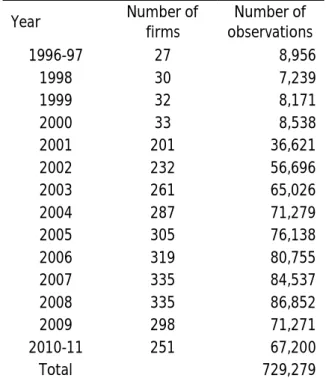
There are a limited number of empirical studies which examine the relationship between equity and debt securities. Furthermore, the existing studies are in general based on a limited data samples, spanning short time periods. This thesis is underpinned by a large sample consisting of over 350 firms and 700,000 daily observations covering almost 15 years, and including the period of the recent financial crisis which, according to most recent studies, started in August 2007. The large data sample enables a more robust regression analysis and examination of empirical results.
The main objectives of this thesis are to examine the following three aspects of the relationship between equity and debt securities:
1. The relationship between the credit spread on corporate bonds and equity risk. The existing studies of the relationship between the credit spread and equity volatility focus on the volatility of equity returns in excess of the market return, implying that the sensitivity to market movements or beta is equal in cross-section. This study extends the existing literature by considering the significance of idiosyncratic as well as systematic equity risks in explaining the variations in the credit spread. The Fama and French (1993) three factor model is utilized to decompose equity volatility into its idiosyncratic and systematic components. The credit spread is then regressed on the equity volatility components in a set of panel data models. Furthermore, the structural model explicitly controls for the level of credit risk and empirically examines the interaction between the level of credit risk and equity volatility. 2. The correlation between equity and corporate bond returns . While the existing
studies generally focus on the unconditional correlation, this thesis uses a bivariate Generalized Autoregressive Conditional Heteroscedasticity (GARCH) model to estimate the conditional correlation between equity and bond returns, and then examines how equity volatility and credit risk affect the correlation in a set of panel data models. This approach enables a deeper regression analysis as well as an insight into the time properties of the correlation between equity and bond returns.
3. The relevance of accounting data in the measurement of the credit spread . This part of the thesis investigates whether financial accounting variables contain any credit sensitive information not yet reflected in equity market based measures of credit risk. The incremental information value of such accounting variables is assessed by considering their significance in explaining the variations in the credit spread in conjunction with the distance to default, and the latter, according to the structural model, is a sufficient measure of credit risk. A limited number of existing studies examine the incremental information content of financial accounting data in explaining bankruptcies, credit ratings and, more recently, the credit default swap spreads. This study makes an important contribution by documenting the incremental information content of the spread of corporate bonds in explaining the credit.
1.4. Structure of the Thesis
The thesis is divided into ten chapters. Following this introductory chapter, Chapter 2 examines the structural approach to credit risk modelling. After briefly presenting the seminal model of Merton (1974), the chapter discusses the limitations, estimation and extensions of the structural model in the extant literature.
Chapter 3 reviews the seminal approaches to the valuation of equity. After reviewing each equity value model, the chapter examines the determinant of equity premium, the time variations within it, and the estimation of the equity premium.
The study of the relationship between the credit spread and systematic and idiosyncratic equity risks is presented in Chapters 4 and 5. Chapter 4 reviews the existing literature, develops hypotheses, and presents the methodology of this thesis, along with the data sample. The empirical analysis is conducted by regressing the credit spread on equity volatility, the distance to default of Merton (1974) and a set of control variables. The regression results are presented in Chapter 5.
The study of the correlation between equity and bond returns is presented in Chapters 6 and 7. The hypotheses and methodology are developed in Chapter 6. The empirical
correlation between equity and bond returns, and results of regressing the correlation on equity volatility, the distance to default and common risk factors.
The study of the relevance of the financial accounting data in the measurement of credit spread is presented in Chapters 8 and 9. The literature review, hypotheses and research methodology is presented in Chapter 8. The significance of the market based indicators (i.e. the distance to default and equity volatility) and financial accounting variables in explaining variations in the credit spread is considered separately and jointly. The empirical finding are presented in Chapter 9.
Finally, Chapter 10 summarises the salient findings from the three empirical studies, discusses their theoretical and practical implications, and draws conclusions. The thesis ends with a discussion of the main limitations of the thesis and suggestions for further research.
1.5. Methodological Considerations
1.5.1. Equity Risk
A decomposition of equity returns into systematic and idiosyncratic components is required in order to examine the relationship between the corporate credit spread and the changes in the systematic and idiosyncratic equity risks. One approach to the decomposition (e.g. Campbell and Taksler, 2003; Cremers et al. 2008) is to assume that all firms’ loadings on systematic risks are equal, and therefore consider equity returns in excess of a major equity index to be idiosyncratic returns. Since the assumption that all firms have equal exposure to systematic risks is unrealistic, this thesis uses a bivariate GARCH model to estimate the correlation between the firm-level equity returns and systematic risk factors. The systematic equity returns are considered to be the expected returns implied by the Capital Asset Pricing Model (Sharpe, 1964; Lintner, 1965; Mossin, 1966) and the three factor model of Fama and French (1993). The idiosyncratic returns are considered to be the difference between the observed returns and the expected returns.
Equity risk is measured as the volatility of equity returns, commonly estimated as the standard deviation of equity returns over an arbitrary number of preceding days. The GARCH modelling is an alternative approach to the estimation of equity volatility. A GARCH model treats the current equity volatility as a function of innovations in the equity returns and the past volatility. Unlike the standard deviation, GARCH models fully captures the time-series behaviour of equity volatility. Therefore, throughout this thesis, the equity volatility is estimated by GARCH models.
1.5.2. Credit Risk
The structural approach of Merton (1974) is the most important theoretical approach to credit risk modelling. The structural model expresses credit risk as the difference between the market value of firm’s assets and the book value of firm’s debt relative to the volatility of firm’s assets. The basic structural model has been extended by a number of authors to account for stochastic interest rates, a mean-reverting leverage ratio and other features. The extended structural models are much more complex to estimate and there is no evidence that any of them fully address the empirical weaknesses of the basic structural model. This thesis therefore utilizes the basic structural model to estimate credit risk.
1.5.3. Regression Analysis
The data set consists of matched equity, bond and accounting variables for n different firms over t consecutive time periods. This two-dimensional feature of the dataset implies that the econometric analysis should be undertaken within the panel analysis framework. A basic panel date model assumes that the data is homogeneous in cross-section and therefore estimates a single equation for the entire dataset.
This basic panel model, referred to as the constant coefficient model, can be extended to account for differences in behaviour across firms and through time. A cross-sectional fixed effects panel model allows the intercept to vary across firms and captures the unobserved factors which are firm-specific but constant over time. Similarly, a period fixed effects panel model captures the unobserved factors which are time-specific but common across firms. Finally, a two-way fixed effects models controls for the firm and
time-specific unobserved factors. The empirical phenomena this thesis focuses on are examined in a full set of panel date models.
The research methodology is fully described in chapters 4, 6 and 8.
1.6. Main Research Questions
The specific hypotheses are outlined in each of the methodological chapters (chapters 4, 6 and 8). The main research questions can be outlined as follows:
1. How do the changes in systematic and idiosyncratic equity volatility affect the credit spread on corporate bonds?
2. How do the changes in equity volatility and credit risk affect the relationship between equity and bond returns?
3. Do financial accounting data have any incremental information value in explaining changes in the credit spread, when considered in conjunction with equity volatility and the distance to default of Merton (1974)?
Answering these three research questions is the task of Chapters 5, 7 and 9 respectively. Each of these chapters is preceded by a methodology chapter. However, for completeness, major issues relating to the measurement of the credit and equity risks are reviewed first. These are dealt with in Chapters 2 and 3 respectively. The next chapter examines the structural approach to credit risk modelling.
CHAPTER 2
THE THEORETICAL FRAMEWORK FOR CREDIT RISK MEASUREMENT
2.1. Introduction
The measurement of credit risk has been one of the most important topics in finance. The earliest studies used accounting variables to assess the credit risk and classify firms into different credit groups. In one of the first studies, Beaver (1966) found that key leverage and cash flow ratios of non-defaulted firms differed significantly from the ratios of defaulted firms. He also found that these ratios were highly significant in predicting a firm’s failure to service its contractual obligations. Beaver’s study inspired a number of researchers to greatly improve performance of accounting-based models by using better statistical methodology and variables that serve as better proxies for credit risk.
Accounting-based and other models do not, however, take into account the fact that markets continuously assess credit risk. Market prices of shares and bonds continuously change as new information arrives. A change in a firm’s outlook will immediately reflect on its share and bond prices. Therefore, all information about credit as well as equity risk is contained in market prices of securities.
This shortcoming is addressed by Merton (1974) who builds on the option pricing theory of Black and Scholes (1973) to develop the original framework for the structural approach to the valuation of credit risk.
The structural model treats debt and equity securities as derivatives written on a firm’s assets, so it presents a unique framework for the analysis of interaction between credit and equity risk. The objective of this chapter is to review the basic structural model, main extensions addressing its limitations and approaches to the implementation.
2.2. The Structural Approach
The debt of a firm can be considered as a contingent claim on firm’s assets. Taking into account limited responsibility of equity holders, they will have an economic incentive to keep control of the firm’s assets only if their market value exceeds the value of debt. If the opposite is true, equity holders will turn the firm’s assets to the creditors. Therefore, equity holders can be viewed as holders of a call option written on firm’s assets with exercise price equal to the value of debt implying that the firm would go bankrupt when the market value of its assets reaches the level of debt. The value of equity at maturity of debt can be expressed as:
m ax(0, )
E = A-D (2.1)
where
A is the value of firms’ assets D is the book value of firm’s debt
Following the same logic, the creditors have an obligation to purchase firm’s assets at the price that equals the value of debt. Their position, therefore, is similar to the short position in a put option. The value of debt at maturity can be expressed as:
m in ( , )
D = D A (2.2)
This resemblance of firm’s equity and debt to the call and put options enables the use of the option pricing methodology to estimate the default probability and therefore to value the debt. Under the efficient market hypothesis, the market prices of securities reflect all available information and therefore this approach gives the best possible estimate of credit risk.
Merton’s (1974) model is derived based on the following assumptions: 1. capital markets are perfect, i.e.
a. assets are divisible, there are no taxes or transaction costs
b. there are sufficient number on investors with comparable wealth levels so that each investor believes that as many assets as wanted can be bought at the market price
c. there is a market for borrowing and lending at the same rate of interest d. short-sale of all assets, with full use of the proceeds, is allowed
2. assets are traded continuously in time
3. the theorem of Modigliani and Miller (1958) that firm’s capital structure is irrelevant to its value holds
4. the interest rate term-structure is flat and known with certainty and 5. the value of assets follows the following diffusion stochastic process:
( - )
t t t t
dA
=
a d
Adt
+
s
AdX
(2.3)where
α is the instantaneous expected rate of return on firm’s assets δ is the payout rate to equity and debt holders
σ is the instantaneous volatility of the return on firm’s assets and dX is the standard Wiener process / Brownian motion
Under the above assumptions, Black and Scholes (1973), and Merton (1974) show that the value of any claim f contingent on the value of firm’s assets A and time t must satisfy the following parabolic differential equation (Black and Scholes, 1973; Merton, 1974):
2 2 2 2
1
0
2
Af
f
f
A
rA
rf
t
s
A
A

+
×

+

- =


(2.4)Solving the above equation with the boundary conditions stated in Equation (2.1), i.e. the value of equity at the maturity of debt equals the difference between the asset value and debt or zero if firm’s assets are worth less than the debt value, Black and Scholes (1973), and Merton (1974) show that the value of equity is as follows:
1 2
( )
rT( )
t t t
E
=
A N d
-
De
-N d
(2.5)where:
A is the value of firm’s assets
D is the book value of firm’s liabilities T is the time to maturity of debt R is the risk-free rate
2 1 1 ln( ) 2 t A t A A r T D d T s s æ ö +ç + ÷ è ø = 2 1 A
d
= -
d
s
T
σ is the annualized volatility of returns on firm’s assets.
Acknowledging the fact that the asset value is the sum of the values of debt and equity, the value of debt is given by:
t t t
D
= -
A E
(2.6)Alternatively, as shown by Black and Scholes (1973), and Merton (1974), the market value of debt can be obtained by solving Equation (2.4) with the boundary condition given in Equation (2.2):
,
( )
2(
1)
rT
t MP t t
D
=
D e
-N d
+
A N
-
d
(2.7)where all variables are as defined in Equation (2.5). The market value of debt is the principal value discounted at the risk-free rate increased by the compensation for the credit risk (i.e. the credit spread):
( ) , t t r c T t MP t
D
=
De
- + (2.8)Using (2.7) and (2.8), the credit spread is given by:
2 1 1 ln ( ) t ( ) t rT t A c N d N d T D e -é ù = - ê + - ú ë û (2.9)
In his seminal paper, Merton (1974) notes that the assumption of perfect capital markets can be substantially weakened and the purpose of the interest rate assumption is to clearly distinguish credit risk form interest rate risk. The Modigliani-Miller theorem is not necessary, as it is actually proved to be a part of the formal derivation of the structural model. The assumption of the assets valuation process is crucial. It requires assets returns to be serially independent in accordance with the efficient market hypothesis of Samuelson (1965) and Fama (1970).
The main concept underpinning the structural model is intuitively depicted on the following illustration.
Figure 2.1
The structural model
The distance between the current market value of assets and the book value of liabilities illustrates the initial leverage. The book value of liabilities is referred to as the default point because, it is assumed that the firm defaults when the assets value drops to the book value of liabilities. At that point, the claim the equity holders have on firm’s assets becomes worthless, so they turn firm’s assets to creditors. As the above figure clearly illustrates, the analysis of credit risk in the structural model is essentially the evaluation of the firm’s value, which is assumed to follow the diffusion stochastic process. The normal distribution of the assets value at the horizon follows from the assumption that the value of the assets evolves according to the diffusion stochastic process given in Equation (2.3). The expected rate of return on firm’s assets drifts the value of assets upward, and thus decreases the probability of default. The volatility of the assets value is, besides the leverage, the most important parameter. An increase in volatility of the assets would increase the probability that the assets value would end up below the book value of liabilities at the horizon triggering default. It should be noted that the structural model takes into account only assets insolvency, while firms usually fail to meet their debt obligations due to cash flow insolvency.
Another notable approach to the measurement of the credit risk is the reduced-form approach which, instead of modelling the process of assets value, uses debt securities directly to estimate the default probability. Classic works in this field include Jarrow, Lando and Turnbull (1997), and Duffie and Singleton (1999). Unlike the structural model, reduced-form models do not have a firm structural form. This ensures tractability and good empirical fit of reduced forms models. On the other hand, the possibility to choose a functional form of the model necessarily introduces subjectivity. This may lead to empirical results that exhibit strong in-sample fitting properties but are inappropriate for drawing conclusions about the population properties. Finally, reduced-form models do not directly link the values of firm’s debt and equity. They, therefore, do not provide a comprehensive and theoretically appealing framework for the analysis of interaction between equity and credit risks.
2.3. Limitations of the Structural Approach
As Anderson and Sundaresan (2000) note, the structural model is attractive on theoretical grounds because it links the valuation of different financial claims on firms’ assets with economic fundamentals. Since all claims derive their value from the same assets they are systematically correlated. It is possible, therefore, to use values of one class of securities to estimate the value of another. By theoretically explaining the relationships between claims on firm’s assets, the structural model provides a framework for analysis of the relationship and interaction between different financial instruments and markets.
Despite its great appeal, the empirical evidence in support of the structural model has been mixed at best. Researchers generally report that the structural model generates much lower credit spreads than those observed. The inability of the structural model to generate realistic credit spreads can be attributed to simplifying assumptions used to derive the model, difficulties in estimation of parameters required for the implementation as well as more profound reasons that question the rationale of using the diffusion stochastic equitation given in Equation (2.3) as a model for the assets valuation process.
The most important drawback stems from the assumption that the assets value evolves continuously as described by Equation (2.3). As illustrated above, the default probability and therefore the credit spread is implied by the volatility of assets value and the difference between the asset value and the debt value. This difference divided by volatility is usually referred to as the distance to default. Due to the fact that continuously evolving value of assets needs time to change significantly, the default probability in short time is close to zero. The structural model therefore does not take into account the risk of large changes in values of assets. This is probably one of the main reasons why the structural model generates a lower credit spread than those observed.
Another drawback of the structural model is that the default can only occur at the maturity of debt and the default is assumed only when the total assets value reaches the debt value. In addition to this cause of bankruptcy, dubbed as the assets insolvency, the firm can default because of cash-flow insolvency. Ignoring cash-flow insolvency is probably another significant reason for the prediction of systematically lower credit spreads than those observed in the market.
Another obvious drawback is that the structural model is derived under the assumption that the interest rate term structure is flat and known with certainty. Besides being unrealistic, this assumption rules out the correlation between the interest rate and the value of the firm. This correlation is potentially important as the cross-sectional differences in the sensitivity of firms’ values to the change in the interest rate may exist. Sweeney and Warga (1986), for example, provide evidence that the changes in the risk-free rate affect equity returns and that this effect is much stronger for the utility companies than for the whole market.
2.4. Estimation of the Structural Model
2.4.1. Estimating Unobservable Value of Firm’s Assets and the Volatility of
Assets
used to derive the structural model. Firms usually have different forms of equity (e.g. common shares, preferential shares, restricted shares etc.) and debt (bank term debt, short-term debt, straight bonds, convertible bonds etc.) in their capital structures. Due to the fact that not all components of the firm capital are traded, the market value of a firm’s assets cannot be directly observed. The empirical research is usually based on public firms with actively traded shares, so this problem is scaled down to the estimation of the market value of debt. A closely related issue is the estimation of assets volatility, which is also not directly observable. Campbell and Taksler (2003), for example, take the book value of debt as a proxy for its market value and assume two extreme scenarios for the volatility of debt. In the first scenario, the volatility of debt is assumed to be zero and in the second, it is considered to be equal to the volatility of equity. They note that these extreme scenarios are not realistic and call for further research.
A more sophisticated approach to estimating the assets value and volatility is to take advantage of the derivative nature of equity and use the option pricing theory to obtain two equations with two unknown variables (assets value and volatility). The first equation is the call option pricing formula given in Equation (2.5), i.e.:
1 2
( )
rT( )
E A N d
=
-
De N d
-where
E is the value of equity A is the asset value D is the debt value
σ2 is the annualized standard deviation of asset returns r is the risk-free interest rate
N is the cumulative density of the standard normal distribution T is the time to maturity of debt
Assuming that the firm’s equity value follows the same stochastic diffusion process as the asset value, its dynamics under the risk-neutral probability measure can be described by:
t t E t t
dE rE dt
=
+
s
EdX
(2.10)where:
r is the risk-free interest rate
σ
E is the annualized standard deviation of returns on the equitydX is the standard Wiener process
The equity is a function of time and the asset value, i.e.
E
t=
f V t
( , )
t . Therefore, Itô’sLemma can be applied to get:
2 2 2 ( , ) ( , ) 1 ( , ) ( , ) ( ) 2 ( ) t t t t t t t A t A t t t t f A t f A t f A t f A t dE A r A dt A dX t A A A d d s d s d d d é ¶ ù =ê + + ú + ¶ ë û (2.11)
The comparison of the coefficient multiplying the Brownian processes in the two preceding equation gives the following identity:
( , )
t E t t A tf A t
E
A
A
d
s
s
d
=
(2.12)Equations (2.5) and (2.12) form a system of two equations with two unknown variables (the asset value and its volatility). Therefore, it is possible to solve these two equations simultaneously and obtain estimates for the asset value and the asset volatility. This appears to be most frequently used method for estimation of unobservable assets value and volatility. It is advocated by major text books (e.g. Hull 2006, Saunders 1999), and widely used in academic studies (e.g. Ronn and Verma (1986), Hillegeist et al. (2004), Das and Hanouna (2009), Cooper and Davydenko (2003), Delianedis and Geske (2003), and Campbell, Hilscher and Szilagyi (2007)).
Another approach is to adopt an iterative procedure. In this approach, the volatility of equity, which can be estimated from historical daily prices of equity, is initially considered as the volatility of assets. This makes it straightforward to estimate the value of assets, which remain the only unknown variable in the equation. The standard deviation of the estimated values of assets serves as the volatility of assets in the next iteration. The procedure is repeated until the estimates of the volatility of assets from
(2003), and Duffie, Saita and Wang (2007). Also, this approach is used in a commercial implementation of the structural model by Moody’s KMV (Crosbie and Bohn, 2003). In support of the iterative approach, Crosbie and Bohn (2003) of Moody’s KMV note that the estimates obtained by the system of equations method hold only instantaneously. This implies that these estimates would be acceptable if the leverage of firms was constant. However, they note that the leverage of firms is not constant, but experience significant changes. Industrial firms usually increase their leverage as they approach default, whereas the leverage of financial firms behaves exactly the opposite. Therefore, they conclude that the system of equations method is unlikely to yield reasonable results. Bharath and Shumway (2008) provide results that are inconsistent with this claim. They find that the computationally intensive iterative approach does not improve model performance.
Duan (1994) proposes a third approach. He points to drawbacks of estimating assets value and volatility by simultaneously solving two equations as presented above, and proposes using the maximum likelihood method instead. He argues that the former method considers assets volatility as constant and independent of assets value and time. Also, in his view, the two equations that are simultaneously solved are essentially the same equation which makes one of them redundant. Finally, the two equations method does not provide confidence intervals for estimated values of assets and volatility.
Duan (1994) considers observed time series of equity prices as a sample of transformed data with the call option pricing equation defining the transformation. The maximum likelihood method is used to find values of assets and volatility which maximises the likelihood of obtaining equity prices in the sample. Interestingly, Duan notes that his method provides identical estimates of as those yielded by the iteration method employed.
Wong and Li (2004) emphasize the importance of the method for estimating market value of assets and associated volatility. They point that the use of book value of debt as a proxy for its market value overestimates the value of assets and therefore the implied bond values, and conclude advocating the maximum likelihood method.
Ericsson and Reneby (2005) estimate three versions of the structural model and run simulations to investigate whether the performance of models depend on the method for estimating assets value and volatility. They find that the maximum likelihood method clearly dominates the system of equations method and that the latter performs so poorly that it may be a cause for empirical failures in implementation of the structural model. In addition to yielding unbiased and relatively efficient parameters, they point to the maximum likelihood method that allows straightforward derivation of the probability distribution and thus confidence intervals of parameters.
Suo and Wang (2006) use the maximum likelihood method to estimate the assets value and volatility using equity as well as bond prices. When bond prices are used, they find that estimated assets volatility is unreasonably high and that the estimation process does not converge for most of the observations in their sample.
2.4.2. Choosing Default Point and Time Horizon
The structural model envisages a firm with simple capital structure consisting of equity and a zero coupon bond. In this setting, the firm defaults if its assets are worth less than the bond’s face value when the bond matures. As already mentioned, firms’ capital structures are much more complex. Virtually all balance sheets contain current liabilities, short-term loans, long-term loans, bonds and other classes of liabilities. Maturities and other details on firms’ liabilities are not easily accessible. Therefore, a choice of the default point and the maturity of liabilities is not straightforward, and may influence empirical results.
As a minimum, the default point should include all liabilities that are due during the period for which the default probability is modelled. The other extreme is to include total liabilities, because the firms usually pay interest or coupons on all liabilities. It should be also taken into account that the ability of firms to refinance their debt depends on the total leverage.
A review of the literature shows that the most common choice for the default point is the book value of total liabilities. This choice is adopted by Campbell and Taksler (2003), Huang and Zou (2008), Eom et al. (2004), Tarashev (2005), Ericsson et al. (2005), and
Hillegeist et al. (2004). In its commercial implementation of the structural model, Moody’s KMV assumes that the default point amounts to the short-term liabilities and a portion of long-term liabilities (Dwyer and Su, 2007). Following this approach, Vassalou and Xing (2004) use the short-term debt plus half of the long-term debt and argue that this choice adequately captures the financing restraints of firms. They examine the sensitivity of their results to the choice of the proportion of the long-term debt included in the calculation and find it not large enough to significantly alter their results. Das and Hanouna (2009) also take into account only fifty per cent of the long-term debt.
The choice of default point should be related to the choice of the time horizon over which the default probability is modelled. If the long-term liabilities are included in the default point then their maturity should play an important role in choosing the time horizon. Otherwise the model would potentially overestimate the default probability of firms financed with more long-term liabilities. Although the extension of the structural model to longer terms is pretty straightforward, the literature review shows that it is common to estimate a default probability for a period of one year, e.g. Du and Suo (2003), Hillegeist et al. (2004), Bharath and Shumway (2008).
The relationship between the time horizon and the default probability is highly nonlinear. It is initially positive and then turns negative as the growth in assets values outweighs the increase in assets volatility due to the extension of the time horizon. Therefore, the time extension from the standard one-year model is likely to impact empirical results. Campbell, Hilscher and Szilagyi (2007) provide a similar empirical support for this argument. They report that the significance of the distance-to-default variable in their logit regression depends on the time horizon. Also, the coefficient of the distance-to-default variable takes the expected negative sign only when the time horizon is extended for two or three years. Delianedis and Geske (2003) try to overcome this issue by assuming that a maturity of firms’ short-term and long-term liabilities is one year and ten years respectively. Huang and Huang (2003) use the duration of liabilities and Cooper and Davydenko (2003) consider the timeframe as an endogenous variable and choose the value which makes the modelled credit spread consistent with the observed credit spread.
2.4.3. Estimating the Expected Growth in the Assets Value
According to the assumed dynamic of the value of assets, described by the stochastic differential Equation (2.3), the expected growth in the value of assets or drift per unit of time isα-δ, where α is the instantaneous expected rate of return on firm’s assets and
δ is the payout rate to the equity and debt holders. The expected rate of return on firm’s assets αcan be considered to consist of two components, the risk-free rate r and the assets risk premiumξ. This expands the expression for the expected assets growth rate to r+ξ-δ and brings down the estimation of assets growth rate to the estimation of the assets risk premium and the assets payout ratio.
A higher assets growth rate implies that the value of assets drifts away from the value of debt at a faster pace. This causes the distance to default to widen and therefore lowers the probability of default as clearly depicted in Figure 2.1. Similarly to the assets value and volatility, the expected asset premium and payout rates are not directly observable. In his seminal paper, Merton (1974) shows that the value of a derivative written on a firm’s assets does not depend on the expected growth in the asset value or the risk preference of investor. In this risk-neutral setting, returns are discounted at the risk-free rate which makes the estimation of the asset risk premium unnecessary. This argument provides the theoretical justification for the use of risk-neutral probability of default.
The literature identifies different approaches to estimation of the asset value growth rate. Using the risk-neutral probability and therefore avoiding the estimation of the asset risk premium is the most straightforward approach. The payout rate is computed as the weighted average of bond's coupon rate and dividend yield where the weights are derived from the leverage ratio. This approach is utilized by Ericsson et al. (2005), Huang and Zhou (2008), and Campbell and Taksler (2003).
An alternative approach, used by Vassalou and Xing (2004) and Eom et al. (2004), is to use the average change in the estimated value of assets as a proxy for the drift parameter. This approach eliminates the need for estimation of the expected growth rate and the payout ratio separately, because both rates are reflected in the average change in the asset value. Bharath and Shumway (2008) follow a similar approach. They
average change in the estimated asset value, in the iterative procedure discussed in the previous section. Similarly, Suo and Wang (2006), as well as Ericsson and Reneby (2004) use the maximum likelihood method to estimate the drift parameter alongside the assets value and the volatility of assets.
Another notable approach is found in the widely cited paper of Huang and Huang (2003). They derive the asset risk premium from the equity premium estimated in the regression analysis by Bhandari (1988). As the payout rate, they take the weighted average between the average historical dividend yield (four per cent according to Ibbotson Associates, 2002) and the average historical coupon rate which they estimate at nine per cent. Applying weights given by the average leverage ratio for S&P 500 index firms provides them with the payout rate of six per cent. Leland (2004) follows a similar approach and assumes a payout rate of six per cent and an asset risk premium of four per cent. Besides computing the payout rate in the usual manner, Ericsson et al. (2005) consider it to be an exogenous variable taking values of zero or six per cent. Finally, a proxy for the rate of return on firm’s assets may be an accounting variable. Patel and Pereira (2005) use the ratio of earnings before interest and taxes to total assets as a proxy for the expected rate of return on firm’s assets and they follow Huang and Huang (2003) in assuming the six per cent payout rate.
2.5. Extensions of the Structural Model
Merton’s (1974) seminal paper inspired further research on credit risk modelling based on the asset valuation process. As a result, a number of extensions of the original structural model have been proposed. Major works aimed to improve the model’s performance by relaxing the model’s assumptions and a better modelling of the asset valuation process. Although the mathematical derivation of these models is to a great extent more complex than that of the original structural model, the basic idea remains the same: once the stochastic process for the asset value is specified, it is possible to compute the probability that the asset value will be lower or higher than the pre-specified default point over any period of time.