A MODEL PROPOSAL TO
DETERMINE A
CROWD-CREDIT-SCORING
Antonio Moreno-Moreno, Universidad de Sevilla, Sevilla, Spain E-mail: [email protected] Emma Berenguer, Universidad Pablo de Olavide, Sevilla, Spain E-mail: [email protected] Carlos Sanchís-Pedregosa, Universidad de Sevilla, Sevilla, Spain E-mail: [email protected] Universidad del Pacífico, Lima, Peru E-mail: [email protected] Received: July, 2018 1st Revision: August, 2018 Accepted: October, 2018 DOI: 10.14254/2071-789X.2018/11-4/4ABSTRACT. Crowdlending is gaining importance as a financial option and is democratizing access to capital markets. However, the key factors that drive investors to choose a given project requires further research. Some authors have identified certain isolated factors, but a holistic approach is needed. To fill this gap, we identified 10 success factors allowing us to build a crowdlending success model. The model leads to establishing the concept of crowd-credit-scoring, in others words, understanding which criteria “crowds” follow when lending money and how different these criteria are from those applied by banking executives. Results will be very useful to establish the crowd-credit-scoring concept. In others words, which are the criteria follow by the “crowd” to lend money and how different are this criteria to the banking executives’ ones.
JEL Classification: G23,
G41. Keywords: Crowdsourcing, crowdfunding, crowdlending, peer-to-peer, credit scoring. Introduction
Following the financial crisis of 2008, banks and other traditional financial institutions began to restrict loans causing a drop in available credit for individuals and companies. To fill this gap, various forms of alternative financing began to thrive all over the world. Among them, crowdfunding experienced a rapid growth and was forecast to have a major role in project financing (Assenova et al., 2016). The development of new technologies and the Internet contributed to this phenomenon, accounting for already 94.000 million Euros in the United Sates and 33.000 million Euros in China. In Europe, the volume is lower and almost exclusively limited to the United Kingdom. In 2015, the total alternative finance market volume in Europe reached 5,431 million euros, 81% of which was attributable to the British market. Specifically, peer-to-peer (P2P) and peer to business (P2B) lending have been growing the most (Zhang et al., 2016).
Moreno-Moreno, A., Berenguer, E., & Sanchís-Pedregosa, C. (2018). A model proposal to determine a crowd-credit-scoring. Economics and Sociology, 11(4), 69-79. doi:10.14254/2071-789X.2018/11-4/4
Crowdlending allows people to lend and borrow funds directly through an online intermediary without the mediation of financial institutions. It has become a viable alternative to traditional sources, representing a democratic access to capital markets that limits gender or geographic discrimination (Mollick & Robb, 2016). Since the first online P2P lending platform Zopa was established in the United Kingdom in 2005, many other platforms have emerged such as: Prosper Market-place, PPDai, Lending Club, Funding Circle, Smava, AuxMoney, etc. These platforms employ simi-lar lending procedures (Chen, Lai & Lin, 2014). In general, the potential user intending to borrow or lend must create an account providing personal information. Borrowers deemed creditworthy are invited to create their borrowing listings. The list-ings essentially consist of loan requests that specify the amount they seek, the max-imum interest rate they’ll pay, and other optional information, such as free format descriptions of loan purposes. Lenders make lending decisions according to the list-ing information and the borrower’s personal information displayed on the platform. When the borrower is a company, individual lenders also pay attention to the economic information provided by the firm (Cumming & Hornuf, 2017). In sum-mary, we can establish than crowdlending is the most popular type of crowdfunding thanks to the lower interest rates for borrowers and the low defaults rates that lend-ers suffer (Lin et al, 2013). The growing popularity is also due to the fact that crowdlending more easily connects projects and financing, reduces transaction costs and allows the partici-pation of a large number of people.
Despite the benefits of crowdlending, substantial information asymmetry has been recognised to affect the market’s efficiency and is considered to be an important problem. This asymmetry exposes lenders to riskier investments and tends to distort their bidding decisions (Yum, Lee, & Chae, 2012). However, other researchers argue that market inefficiency induced by information asymmetry can, to a certain extent, be alleviated by other factors such as the disclosure of the borrower’s financial and personal information or the development of mutual trust between users (Herzenstein, Dholakia & Andrews, 2011; Iyer et al., 2009; Pope & Sydnor, 2011). According to this, a borrower’s solvency or a loan’s purpose is relevant criteria for a granting decision, but additional information also enters into the decision process. Scholars have identified that lenders make inferences about the borrowers’ credibility not just from hard information, such as direct repayment ability or likelihood of default, but also from non-standard signals, especially when the borrower has a poor credit rating (Iyer et al., 2009).
In these circumstances, it is important to identify which factors drive investors to choose the project they will support. Some authors have already singled out some isolated factors (Herzenstein, Dholakia, & Andrews 2011) yet a holistic understanding is lacking. Though reward-based crowdfunding has already been researched (Hobbs, Grigore, Molesworth & Hobbs, 2016), there are differences with crowdlending (Beaulieu, Sarker & Sarker, 2015). To fill this gap, a literature review on crowdlending, both P2P and P2B, was conducted in order to identify the success factors of this particular type of crowdfunding. The time period covers until summer 2018.
Results led to establishing a crowdlending success factor model. The methodology used is described in the next section, followed by the results of the literature review. The crowdlending success factor model is then proposed and described, finally concluding with the contributions and limitations of this study.
1. Methodological approach
A comprehensive literature review was conducted of articles addressing crowdlending success factors published in journals relating to Economics Management, Marketing, Accounting, Finance or Computer Science Although the recommended time period to cover for this type of review is 15 years (Jesson, Jill, & Matheson, 2011) no period limitations were applied because of the novelty of the topic. Articles were searched for in the Web of Science database using a systematic and rigorous process consisting of successive iterations and the consequent refining of the keywords used in the search. Final keywords used were: “crowdlending”, “peer-to-peer lending” and “peer-to-business lending”. We used these keywords to limit our study to crowdlending, thus eliminating references based on reward crowdfunding which have been more broadly studied (Agrawal et al., 2015).
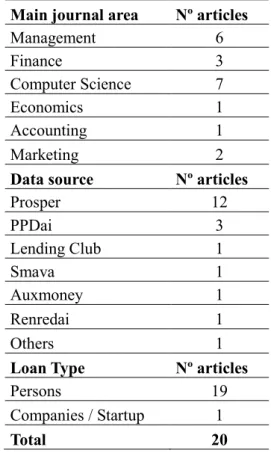
At the end of this process, 38 articles were identified of which 20 were pre-selected after reading their abstracts and evaluating the relevance of their topics. All of them were used to mine interesting complementary information such as data sources, kinds of loans and journal specializations (Table 1). The aim was to use this information to contextualize the studies and help draw additional conclusions.
Table 1. Number of articles per journal specialization, crowdlending platform and loan types
Main journal area Nº articles
Management 6 Finance 3 Computer Science 7 Economics 1 Accounting 1 Marketing 2
Data source Nº articles
Prosper 12 PPDai 3 Lending Club 1 Smava 1 Auxmoney 1 Renredai 1 Others 1
Loan Type Nº articles
Persons 19
Companies / Startup 1
Total 20
Source: own compilation
The 20 chosen papers were analyzed in detail to identify crowdlending success factors. Nevertheless, some of the identified factors were found to have no effect on funding success. Because of that, we set up a score system whereby the factor was marked with (1) if a significant effect was found, (0) if no significant effect was found or (-1) if a negative significant effect was found. This analysis allowed us to compile a list of funding success
factors (Table 2). Once in possession of this information, it was possible to propose a research model. The results of the literature review are presented in the next section.
2. Conducting research and results
Firstly, the literature review clearly revealed how incipient research was in the field of crowdlending, naturally because of the novelty of the phenomenon: the oldest paper dated back to 2011, and very few studies addressed the question of which factors led to its success. Regarding journals’ field of specialization, it was surprising to observe that Management and IT journals were more likely to publish related papers than Finance journals. Selected papers were also found to come from Marketing, Economy and Ac-counting journals. This interesting question should not be overlooked: though crowdlending is a financial tool, it seems to have implications in other fields of re-search. Another important finding was that most of the papers analyzed focused on personal loans (P2P) instead of on business (P2B). Chen et al. (2014) pointed out that trust determined willingness to lend to micro and small enterprises in China. Regarding data, 66% of studies were found to have used the same data source, i.e. the Prosper.com platform, followed by the PPDai (16%) platform, which are mainly directed towards personal loans. It seems, therefore, that there are few studies on peer to business lending. In addition, these platforms operate in a limited number of countries studies addressing diverse cultural environments are lacking. Crowdfunding has succeeded in democratizing finance by offering investment opportunities to non-institutional investors. These individual investors make their investment decisions according to different criteria obtained from three main sources: borrowers, the crowdlending platform and themselves (lender’s factors).
Following our literature review, we identified 10 success factors in crowdlending projects. Table 2 shows a compilation of the different papers and the factors to which they refer. They can be divided basically into three groups: borrower factors, platform information and lender factors.
2.1. Borrower’s factors 2.1.1. Info offered
Compared to other types of electronic marketplaces that use feedback and reputation systems based on previous experiences, in lending platforms few borrowers have track records of previous repaid loans. This makes any available information (personal or financial) on borrowers even more important in platforms. Sonenshein, Herzenstein and Dholakia (2011) studied how the identity claim influenced lending decisions. The identity claim is the way in which individuals describe themselves to others. In crowdlending platforms, borrowers have a single opportunity to present a convincing public image. The authors suggest that identity claims that emphasize moral or trustworthy behavior result in a favorable lending decision. Financial information provided by borrowers also seems to have a positive impact on funding success. Feng, Fan, and Yoon (2015) provided evidence that the greater the financial disclosure, the higher the funding success rate. This suggests that alleviating information asymmetry improved market efficiency. Dorfleitner et al. (2016) analyzed different aspects of the description text and the probability of successful funding. Specifically, they focused on spelling errors, text length and the presence of social and emotional keywords in the text. These authors found that these factors significantly increased the probability of funding. Michels (2012) showed that voluntary disclosures, usually consisting in unverified personal information, affected funding success. Relating to data obtained from Prosper
platform, the author found that this additional information increased the bidding activity and consequently reduced the loan’s interest rates which lead to funding success.
Table 2. Success factors found in the literature review
Papers/Results
Borrower Platform Lender
Inf o of fe red B or row er s e xpe rt ise T rus tw or thy a ppea ran ce T rus t i n Pla tf or m Loan ch ar act er ist ics C redi t s cor e T rus t i n bor row er H er d beh avi our D em og raph ic a nd Soc ia l I nf o Sam e geog raph ica l a rea (Han et al., 2018) 1 1 1 (Dorfleitner et al., 2016) 1
( Chen, Zhou and Wan, 2016) 0
(Liu, Brass, Lu and Chen, 2013) 0
(Lin and Viswanathan, 2016) 1
(Feng et al., 2015) 1 1 1
(Malekipirbazari and Aksakalli, 2015) 1
(Chen, Lai, and Lin 2014) 1
(Barasinska and Schaefer, 2014) 0
(Ramcharan and Crowe, 2013) 1
(Luo and Lin, 2013) 1
(Lin, Prabhala and Viswanathan, 2013) 1 1
(Duarte, Siegel and Young, 2012) 1
(Michels, 2012) 1 (Liu and Zhang 2012) 1
(Pope and Sydnor, 2011) 0
(Sonenshein et al., 2011) 1
(Sonenshein et al., 2011) 1 (Yum et al., 2012) 1
(Herzenstein et al., 2011) 1
Total 4 1 3 1 4 2 1 3 0 1
* (-1) if negative effect; (0) if no effect; (1) if positive effect Source: own compilation
2.1.2. Expertise
Borrowers in this market can also design their loans based on their preferences, in-stead of accepting the terms dictated by lenders. Efficiency in obtaining a loan can vary significantly across borrowers according to how much experience they have. Borrowers with
more experience of online borrowing can be in a better position to design loans more efficiently (Feng et al., 2015).
2.1.3. Trustworthy appearance
Duarte, Siegel, and Young (2012) examine whether appearance-based judgments about individual borrowers’ trustworthiness affect investors’ lending decisions. To do so, they used uploaded photographs of borrowers. They found that borrowers with a more trustworthy appearance had a higher probability of obtaining funds. Sonenshein, Herzenstein, and Dholakia (2011) evaluated how social media accounts influenced lenders’ decisions on loaning money to borrowers.
2.2. Platform’s factors
2.2.1. Trust in platform
Trust is particularly important when markets are inefficient, such as in the case of crowdlending sites, which suffer from information asymmetry. Crowdlending carries a risk, especially for lenders, so it is very important to identify credible borrowers and choose the right lending intermediary (D. Chen et al., 2014). This choice is based on whether the intermediary is safe for the transaction and whether it provides high-quality services. This topic increases its impact from Lending Club scandal (Chiavaro et al., 2018) but, for the moment, it seems to be an isolated case.
2.2.2. Loan Characteristics
The characteristics of the listed loans such as the interest rate, the loan amount, and the loan period are the essential elements determining lenders’ investment decisions because they are the major determinants of the profit to be generated by the investments.
For example, a higher interest rate offered by the listed loan can generate a higher return to the lenders, so they are likely to bid for the loan. However, a higher interest rate might also be interpreted as a signal of a riskier loan, especially in a market with a high degree of information asymmetry. Lenders may therefore be less interested in loans with higher interest rates (Yum et al., 2012). The size of the loan request can also determine its attractiveness since many lenders would prefer small loans to larger loans for risk management purposes. Be-sides, the loan volume can act as a secondary indicator of the borrower’s credibility (Feng et al., 2015). Lenders might also prefer shorter loan periods under equivalent conditions be-cause it allows for more liquidity. Liquidity can be a particularly critical issue in the online lending market because many lenders are individuals rather than financial institutions. (Lin et al., 2013) showed that it is difficult for loans to get fully funded over longer periods.
2.2.3. Credit Score
Popular social lending platforms rely on the credit scores provided by a cooperating credit reporting agency (Experian, TransUnion, etc). Most lenders, therefore, base their investment strategy on these traditional financial credit scores provided by external agencies. Lenders thus prefer to lend money to the safest borrowers which they mark with the highest FICO (A publicly traded corporation that produces scoring models) scores or grades. This is a very important factor since identifying true creditworthiness of a potential loan borrower is
vital for healthy functioning of social lending markets. Nevertheless, Malekipirbazari and Aksakalli (2015) identified a new methodology that outperforms the FICO credit scores. Ramcharan and Crowe (2013) found evidence that house price fluctuations appeared to have a large effect on the supply of credit. In their study, they found that the cost of credit is higher and the availability of credit lower for homeowners in states with declining house prices. This evidence suggests that asset price fluctuations can play an important role in determining credit conditions.
2.3. Lender’s Factor
2.3.1. Trust in borrower
Trust in borrower is of vital importance for lending success. Nevertheless, due to crowdlending features, lender’s trust in the borrowers is based on first impressions so the quality of the borrower’s loan request is crucial here (Chen et al., 2016). Literature has found that this is not a determinate factor (Liu et al., 2013).Interactions with other lenders (Social Capital) are also very important. Personal networks can be extremely useful when it is difficult to assess a borrower’s credibility. People are expected to be more likely to lend money to friends, whom they feel they know and trust (Lin et al., 2013). However, Liu, Brass, Lu, and Chen (2013) support that there is a negative impact in the success rate of loans when borrowers get found from their own friends.
2.3.2. Herd behavior
This factor basically consists in a greater likelihood of bidding in auctions when there are more bids. Investors exhibit deficits in self-confidence when making decisions and are more likely to be influenced by other investors’ decisions in unstable markets. Relating to lenders, we identified “Herd behavior”, as one of the most important factors in our list because it was pointed out as significant by three authors (Luo & Lin, 2013; Liu & Zhang, 2012; Herzenstein, Dholakia, & Andrews, 2011).
2.3.3. Demographic and Social Information on Borrowers
The borrowers’ personal information such as age, gender, and race can help lenders to evaluate the borrowers’ reliability. There is abundant research showing that lenders discriminate against borrowers due to demographic factors; however, the effect of demographic information on the success rate seems to be mixed across different studies (Barasinska & Schaefer, 2014).
2.3.4. Same geographical area
Home bias refers to the phenomenon where agents (businesses, funds, etc.) are more likely to conduct transactions with parties who are geographically closer to them, either in the same country or the same state, rather than those outside. The effect of geography has been studied in many disciplines such as economics and finance. Lin and Viswanathan (2016) apply this question to crowdlending and highlight that a loan is more likely to be granted when both, borrowers and lenders, are established in the same geographical area. Following this idea, we developed a model that summarizes the different factors that lead an individual investor (lender) to fund a project, shown in Graph 1.
Our study revealed that crowdlending is a complex issue that depends on multiple elements stemming from the three actors involved: borrowers, lenders and platforms. Success in obtaining funding depends on the interaction between these different factors. For example, lenders will invest in the projects they trust, but their perception of trust may come from borrowers, from the platform or from both. It is, therefore, very difficult to dissociate success factors since they are inter-related.
Graph 1. Model of loan success factors in crowdlending platforms Source: own data
Conclusion
We have conducted a literature review of crowdlending considering both P2P and P2B. Our study reveals that crowdlending is a complex issue that depends on multiple elements and that success in obtaining funding depends on the interaction between these different factors. Specifically, we have identified 10 success factors for funding projects classifying them into three categories: borrowers’, lender’s and platform’s factors. A model with this success factors was presented.
Among them, the factors that seem to influence more the investors are the info of-fered by borrowers and the loan characteristics, followed by trust; in the platform and in the appearance of the borrower. Trust is one of the key factors as could be verified after the Lending’s Club scandal. After resignation of the CEO in may 2016 accused of questionable lending practices and conflict of interests Lending Club experienced a 60% stock price drop in 15 days. Those days a dip in investments was noticed but the investor base remained confident. According to its info, in 2018, investments have bounced back. Herd behavior was also found as a key factor to invest in a project, while demo-graphic and social info seemed to have no impact at all. So, according to our model, financial criteria such as asset values (Ramcharan and Crowe, 2013), credit scores (Malekipirbazari and Aksakalli, 2015) or loan
characteristics (Yum et al., 2012) represent only one part of a more complex system of decision-making. This includes trusting the borrower (Chen et al., 2014), which can help borrowers with a bad credit scoring to obtain a loan in fair conditions. In traditional banking, these kinds of factors are not taken into account by loan decision makers. In addition, our model includes the democratization of access to capital highlighted by Mollick and Robb (2016). Our main contribution is to offer a holistic approach to the factors that lead to success in funding crowdlending projects presenting a model.
The proposed model can be considered to be a starting point to understand what factors affect investment decisions in crowdlending; however, the identified pattern cannot be generalized because the vast majority of studies draw their conclusions based on data from Anglo-Saxon countries. We believe, therefore, that it is necessary to test these results in other contexts such as in Europe (excluding the United Kingdom) where traditional investment mechanisms are more widespread, and other regions like Asia or Africa. In addition, according to findings from the literature review, some of the factors included in the model do not seem to have a significant effect on funding success. As this research topic is incipient, more empirical research is needed to test whether these factors are relevant or not to obtain funds successfully. Finally, platforms investigated are not homogenous, so it is difult to compare to the greatest extend to make the decisions about the success model of the lending process.
In this scenario, identified factors affecting the lenders’ investment decisions should be empirically tested using real data. To do so, different measurements of funding success could be used such as: the funding period or the number of inves-tors per project (Feng et al., 2015). Furthermore, it would be interesting to use a variety of platforms from different countries, such as FundingCircle, Lendix or MytripleA. Our future research will focus on these questions.
References
Agrawal, A., Agrawal, A., Catalini, C., & Goldfarb, A. (2015). Crowdfunding : Geography , Social Networks , and the Timing of Investment Decisions Crowdfunding : Geography , Social Networks , and the Timing of Investment Decisions, 24(May 2016), 253–274. https://doi.org/10.1111/jems.12093
Assenova, V., Best, J., Cagney, M., Ellenoff, D., Karas, K., Moon, J., … Sorenson, O. (2016). The present and future of crowdfunding. California Management Review, 58(2), 125– 135. https://doi.org/10.1525/cmr.2016.58.2.125
Barasinska, N., & Schaefer, D. (2014). Is Crowdfunding Different? Evidence on the Relation between Gender and Funding Success from a German Peer-to-Peer Lending Platform. German Economic Review, 15(4), 436–452. https://doi.org/10.1111/geer.12052
Beaulieu, T., Sarker, S., & Sarker, S. (2015). A conceptual framework for understanding crowdfunding. Communications of the Association, (June). Retrieved from http://aisel.aisnet.org/cgi/viewcontent.cgi?article=3866&context=cais
Chen, D., Lai, F., & Lin, Z. (2014). A trust model for online peer-to-peer lending: a lender’s perspective. Information Technology and Management, 15(4), 239-254. https://doi.org/10.1007/s10799-014-0187-z
Chen, X., Zhou, L., & Wan, D. (2016). Group social capital and lending outcomes in the financial credit market: An empirical study of online peer-to-peer lending. Electronic
Commerce Research and Applications, 15, 1–13.
Chiavaro, J., Saunderson, C., Chiavaro, J., Esposito, N., Saunderson, C., Macera, M., & Ketchum, T. (2018). Disruption within Alternative Lending Global Financial Markets and Institutions Group 6.
Cumming, D. J., & Hornuf, L. (2017). Marketplace Lending of SMEs. SSRN Electronic Journal. https://doi.org/10.2139/ssrn.2894574
Dorfleitner, G., Priberny, C., Schuster, S., Stoiber, J., Weber, M., de Castro, I., & Kammler, J. (2016). Description-text related soft information in peer-to-peer lending - Evidence from two leading European platforms. Journal of Banking and Finance, 64, 169–187. https://doi.org/10.1016/j.jbankfin.2015.11.009
Duarte, J., Siegel, S., & Young, L. (2012). Trust and credit: The role of appearance in peer-to-peer lending. Review of Financial Studies, 25(8), 2455–2483. https://doi.org/10.1093/rfs/hhs071
Feng, Y., Fan, X., & Yoon, Y. (2015). Lenders and Borrowers’ Strategies in Online Peer-To-Peer Lending Market: an Empirical Analysis of Ppdai.Com. Journal of Electronic
Commerce Research, 16(3), 242–260. Retrieved from
http://search.ebscohost.com/login.aspx?direct=true&db=iih&AN=109373789&site=eho st-live
Han, J. T., Chen, Q., Liu, J. G., Luo, X. L., & Fan, W. (2018). The persuasion of borrowers’ voluntary information in peer to peer lending: An empirical study based on elaboration likelihood model. Computers in Human Behavior, 78, 200–214. https://doi.org/10.1016/j.chb.2017.09.004
Herzenstein, M., Dholakia, U. M., & Andrews, R. L. (2011). Strategic Herding Behavior in Peer-to-Peer Loan Auctions. Journal of Interactive Marketing, 25(1), 27–36. https://doi.org/10.1016/j.intmar.2010.07.001
Hobbs, J., Grigore, G., Molesworth, M., & Hobbs, J. (2016). Success in the management of crowdfunding projects in the creative industries. https://doi.org/10.1108/IntR-08-2014-0202
Iyer Asim Ijaz Khwaja Erzo P Luttmer Kelly Shue, R. F. (2009). Screening in New Credit Markets Can Individual Lenders Infer Borrower Creditworthiness in Peer-to-Peer Lending? AFA Denver Meetings, (August), 42. https://doi.org/10.2139/ssrn.1570115 Jesson, Jill, Lydia Matheson, and F. M. L. (2011). Doing your literature review: Traditional
and systematic techniques. SAGE.
Lin, M., Prabhala, N., & Viswanathan, S. (2013). Judging borrowers by the company they keep: friendship networks and information asymmetry in online peer-to-peer lending. Management Science, 59(1), 17–35. https://doi.org/10.1287/mnsc.1120.1560
Lin, M., & Viswanathan, S. (2016). Home Bias in Online Investments: An Empirical Study of an Online Crowdfunding Market. Management Science, 62(5), 1393–1414. https://doi.org/10.2139/ssrn.2219546
Liu, D., Brass, D., Lu, Y., & Chen, D. (2013). Friendships in online peer-to-peer lending: Pipes, prisms, and relational herding. MIS Quarterly, 39(3), 729–724.
Liu, P., & Zhang, J. (2012). Rational Herding in Microloan Markets. Management Science, 58(5), 892–912. https://doi.org/doi:10.1287/mnsc.1110.1459
Luo, B., & Lin, Z. (2013). A decision tree model for herd behavior and empirical evidence from the online P2P lending market. Information Systems and E-Business Management, 11(1), 141–160. https://doi.org/10.1007/s10257-011-0182-4
Malekipirbazari, M., & Aksakalli, V. (2015). Risk assessment in social lending via random forests. Expert Systems with Applications, 42(10), 4621–4631. https://doi.org/10.1016/j.eswa.2015.02.001
Michels, J. (2012). Do Unverifiable Disclosures Matter? Evidence from Peer-to-Peer Lending. The Accounting Review, 87(4), 1387–1415.
Mollick, E., & Robb, A. (2016). Democratizing Innovation and Capital Access: The Role of
Crowdfunding. California Management Review, 58(2), 72–87.
https://doi.org/10.1525/cmr.2016.58.2.72
Pope, D. G., & Sydnor, J. R. (2011). What ’ s in a Picture ? Evidence of Discrimination from Prosper . com. The Journal of Human Resources, 46(1), 53–92. https://doi.org/10.3368/jhr.46.1.53
Ramcharan, R., & Crowe, C. (2013). The impact of house prices on consumer credit: Evidence from an internet bank. Journal of Money, Credit and Banking, 45(6), 1085– 1115. https://doi.org/10.1111/jmcb.12045
Sonenshein, S., Herzenstein, M., & Dholakia, U. M. (2011). How accounts shape lending decisions through fostering perceived trustworthiness. Organizational Behavior and Human Decision Processes, 115(1), 69–84. https://doi.org/10.1016/j.obhdp.2010.11.009 Yum, H., Lee, B., & Chae, M. (2012). From the wisdom of crowds to my own judgment in microfinance through online peer-to-peer lending platforms. Electronic Commerce Research and Applications, 11(5), 469–483. https://doi.org/10.1016/j.elerap.2012. 05.003
Zhang, B., Wardrop, R., Ziegler, T., Burton, J., Garvey, K., Lui, A., & James, A. (2016). SUSTAINING MOMENTUM In Partnership with. The 2nd European Alternative Finance in Industry Report, (September).