FAiluRE to ACt
The economic impacT
of current Investment trends In
surface TransporTaTion
infrasTrucTure
This report was prepared for the American Society of Civil Engineers by Economic Development Research Group, Inc.
American Society of Civil Engineers 1801 Alexander Bell Drive
Reston, Virginia, 20191-4400 World Headquarters 101 Constitution Avenue, NW Suite 375 East Washington, DC 20001 Washington Office [email protected] www.asce.org/reportcard
Economic Development Research Group, Inc. 2 Oliver Street, 9th Floor
Boston, MA 02109 www.edrgroup.com
2
|
List of Figures and Tables2
|
Preface3
|
Executive Summary7
|
Section 1 IntroductIon9
|
Section 2 the Infrastructure shortfall13
|
Section 3 Wages, Value added, IndustrIal output, and Jobs21
|
Section 4 regIonal ImplIcatIons24
|
Section 5 dIVersIon of traffIc due to congestIon26
|
Section 6 the natIonal modal fundIng gap31
|
Section 7 ImplIcatIons of maIntenance fundIng (and a fundIng gap)32
|
Section 8 conclusIons and further research34
|
About the Study: Sources and Methods36
|
Endnotes37
|
AcknowledgmentsFailure to act
The economic impacT
of current InVestment trends In
surface TransporTaTion
infrasTrucTure
This report seeks to provide an objective analysis of the economic implications of the United States’ continued underinvestment in infrastructure. The Report Card for America’s Infrastructure, published every four years by the American Society of Civil Engineers, grades the current state of 15 national infrastructure categories on a scale from A through D for gradations of excellent to poor, and F for failing. This report answers the question “So what?” In terms of economic performance, what does a D mean? What does an F mean?
This report is part of a project that is structured around four reports to assess implications for the productivity of industries, national competitiveness, and effects on house-holds given the present trends of infrastructure investment. Together, these reports cover 9 of the 15 categories addressed by the ASCE Report Card for America’s Infrastructure.
This report on surface transportation encompasses highways, bridges, rail, and tran-sit. Subsequent reports will address water and wastewater delivery and treatment, energy transmission, and airports and marine ports. Thus, when reading this report, it is important to bear in mind that the impacts it discusses exclude any economic impacts from continuing current investment trends for water, waste-water, energy, and airport and marine port
★
|
figures and tables
★
|
Preface
Figures
1 National Funding Gap by Mode
2 Car and Truck Reliability Costs: Highway 3 Change in U.S. Jobs in 2040 Attributable
to Transportation Infrastructure Deficiencies 4 Pattern of Reassignments from Congested
Interstates, 2010–2040
5 Development of Deficiencies by Mode
Tables
1 The Mounting Cumulative Cost of Deficient and Deteriorating Surface Infrastructure Imposed on Americans
2 Summary of Impacts on Economic Performance Over Time
3 Pavement Deficiencies for Cars and Trucks by Facility Type, 2010
4 Cumulative Travel Time and Reliability Costs Due to Congestion, 2010–2040 5 Top 20 Countries and Economies
Ranked by the Quality of Roads and Railroads 6 U.S. Commodity Export Reductions in Dollars,
2020 & 2040
7 U.S. Commodity Export Reductions by Percentage, 2020 & 2040
8 Congestion and Pavement Deficiency by Region, 2010
9 Passenger Mode Reliance by Region, 2010 10 Development of Deficiencies by Mode 11 Transit Mode Breakdown of Percent
VMT Operating on Deficiencies Over Time Given Current Funding Levels
12 Total Costs Due to Deficient and Deteriorating Infrastructure
13 Maintenance Needs in Billions of Constant 2010 Dollars
eXecutiVe suMMarY
The nation’s surface transportation infrastruc-ture includes the critical highways, bridges, railroads, and transit systems that enable people and goods to access the markets, services, and inputs of production essential to America’s economic vitality. For many years, the nation’s surface transportation infrastructure has been deteriorating. Yet because this deterioration has been diffused throughout the nation, and has occurred gradually over time, its true costs and economic impacts are not always immediately apparent. In practice, the transportation fund-ing that is appropriated is spent on a mixture of system expansion and preservation projects. Although these allocations have often been suf-ficient to avoid the imminent failure of key facilities, the continued deterioration leaves a significant and mounting burden on the U.S. economy. This burden will be explored further in this report.Deteriorating conditions and performance impose costs on American households and busi-nesses in a number of ways. Facilities in poor condition lead to increases in operating costs for trucks, cars, and rail vehicles. Additional costs include damage to vehicles from deteriorated roadway surfaces, imposition of both additional miles traveled, time expended to avoid unus-able or heavily congested roadways or due to the breakdown of transit vehicles, and the added cost of repairing facilities after they have deteriorated as opposed to preserving them in good condi-tion. In addition, increased congestion decreases the reliability of transportation facilities, mean-ing that travelers are forced to allot more time for trips to assure on-time arrivals (and for freight vehicles, on-time delivery). Moreover, it increases environmental and safety costs by exposing more
time, they will increasingly detract from the abil-ity of American households and businesses to be productive and prosperous at work and at home.
This report is about the effect that surface transportation deficiencies have, and will continue to have, on U.S. economic performance. For the purpose of this report, the term “defi-ciency” is defined as the extent to which roads, bridges, and transit services fall below standards defined by the U.S. Department of Transpor-tation as “minimum tolerable conditions” (for roads and bridges) and “state of good repair” for transit1. These standards are substantially lower than ideal conditions, such as “free-flow2,” that are used by some researchers as the basis for highway analysis. This report is about the effect these deficiencies have, and will continue to have, on U.S. economic performance.
In 2010, it was estimated that deficiencies in America’s surface transportation systems cost households and businesses nearly $130 billion. This included approximately $97 billion in vehicle operating costs, $32 billion in travel time delays, $1.2 billion in safety costs and $590 million in environmental costs.
In 2040, America’s projected infrastructure deficiencies in a trends extended scenario are expected to cost the national economy more than 400,000 jobs. Approximately 1.3 million more jobs could exist in key knowledge-based and technology-related economic sectors if sufficient transportation infrastructure were main-tained. These losses are balanced against almost 900,000 additional jobs projected in tradition-ally lower-paying service sectors of the economy that would benefit by deficient transportation (such as auto repair services) or by declining productivity in domestic service related sectors
deteriorating infrastructure will increase by 82% to $210 billion, and by 2040 the costs will have increased by 351% to $520 billion (with cumulative costs mounting to $912 billion and $2.9 trillion by 2020 and 2040, respectively). Table 1 summarizes the economic and societal costs of today’s deficien-cies, and how the present values of these costs are expected to accumulate by 2040. Table 2 provides a summary of impacts these costs have on eco-nomic performance today, and how these impacts are expected to increase over time.
Cost of DefiCienCies
Performance area in 2010 by 2020 by 2040
Pavement and Bridge Conditions $10 $58 $651
Highway Congestion $27 $276 $1,272
Rail Transit Conditions $41 $171 $370
Bus Transit Conditions $49 $398 $659
Inter-City Rail Conditions $2 $10 $20
totAL Cost to sYsteM UseRs $130 $912 $2,972
*Present value of cost stream in billions of constant 2010 Dollars
SOURCE EDR Group analysis using Transportation Economic Impact System (TREDIS), 2011 NOTE Totals may not add due to rounding.
table
2
★ summary of impacts on economic Performance over time (billions of 2010 dollars)cumulative cumulative
imPact of Deficiencies imPact by 2020 imPact by 2040
Personal Income –$930 –$3,135
US Value Added (Impact on GDP) –$897 –$2,662
SOURCE LIFT/INFORUM model, University of Maryland. Calculations by University of Maryland using the personal consumption expenditure deflator. Income loss exceeds GDP because the deterioration of infrastructure has a disproportionately
The avoidable transportation costs that hinder the nation’s economy are imposed primarily by pavement and bridge conditions, highway con-gestion, and transit and train vehicle conditions that are operating well below minimum tolerable levels for the level of traffic they carry. If the nation’s infrastructure were free of deficient conditions in pavement, bridges, transit vehi-cles, and track and transit facilities, Americans would earn more personal income and industry would be more productive, as demonstrated by the gross domestic product (value added) that
table
1
★ the Mounting Cumulative Cost of Deficient and Deteriorating surfacewill be lost if surface transportation infrastruc-ture is not brought up to a standard of “minimum tolerable conditions.” As of 2010, the loss of GDP approached $125 billion due to deficient surface transportation infrastructure. The expected losses in GDP and personal income through 2040 are dis-played in Table 2.
Across the U.S., regions are affected differently by deficient and deteriorating infrastructure. The most affected regions are those with the largest concentrations of urban areas, because urban high-ways, bridges and transit systems are in worse condition today than rural facilities. Peak commut-ing patterns also place larger burdens on urban capacities. However, because the nation is so depen-dent on the Interstate Highway System, impacts on interstate performance in some regions or area types are felt throughout the nation. Nationally, for highways and transit, 630 million vehicle hours traveled were lost due to congestion in 2010. This total is expected to triple to 1.8 billion hours by 2020 and further increase to 6.2 billion hours in 2040.3 These vehicle hours understate person hours and underscore the severity of the loss in productivity.
The specific economic implications of the further deterioration of the U.S. national surface transportation system are as follows:
«
«
Deficient surface transportation infrastruc-ture will cost Americans nearly $3 trillion by 2040, as shown in Table 1, which repre-sents more than $1.1 trillion in added business expenses and nearly $1.9 trillion from house-hold budgets.«
«
This cost to business will reduce the productivity and competitiveness ofAmerican firms relative to global competitors. Increased cumulative cost to businesses will reach $430 billion by 2020. Businesses will have to divert increasing portions of earned income to pay for transportation delays and vehicle repairs, draining money that would otherwise be invested in innovation and expansion.
events, educational opportunities, and restau-rant meals, reduce health related purchases along with other expenditures that affect quality of life, in order to pay transportation costs that could be avoided if infrastructure were built to sufficient levels. Increased cumulative costs to households will be $482 billion in 2020.
«
«
The U.S. will lose jobs in high value, high-pay-ing services and manufacturhigh-pay-ing industries. Overall, this will result in employee income in 2040 that is $252 billion less than would be the case in a transportation-sufficient economy. In general three distinct forces are projected to affect employment:n First, a negative impact is due to larger costs of transportation services in terms of time expended and vehicle costs. These costs absorb money from businesses and households that would otherwise be directed to investment, innovation and “quality of life purchases.” Thus, not only will business and personal income be lower, but more of that income will need to be diverted to transportation related costs. This dynamic will create lower demand in key economic sectors associated with busi-ness investments for expansion and research and development, and in consumer sectors. n Second, the impact of declining business productivity, due to inefficient surface transportation, tends to push up employ-ment, even if income is declining. Productivity deteriorates with infrastructure degradation, so more resources are wasted in each sector. In other words, it may take two jobs to complete the tasks that one job could handle without delays due to worsening surface transportation infrastructure.
n Third, related to productivity effects, degrad-ing surface transportation conditions will generate jobs to address problems created by worsening conditions in sectors such as
«
«
Overall job losses are mitigated by more people working for less money and less productively due to the diminished effec-tiveness of the U.S. surface transportation system. Recasting the 2020 and 2040 initial job impacts based on income and productivity lost reduces worker effectiveness by an addi-tional 27% (another 234,000 jobs). By 2040, this drain on wages and productivity implies an additional 115% effect if income and pro-ductivity were stable (another 470,000 jobs).«
«
By 2040 the cost of infrastructure deficien-cies are expected to result in the U.S. losing more than $72 billion in foreign exports in comparison with the level of exports from a transportation-sufficient U.S. economy. These exports are lost due to lost productivity and the higher costs of American goods and services, relative to competing product prices from around the globe.approach and methodology
In the research for this report, establishing future transportation conditions under present trends were models used by the Federal High-way Administration (FHWA) and the Federal Transit Administration (FTA) to determine transportation sufficiency, costs, conditions and performance, and were buttressed by a literature review. For the details of the methods used, see the appendix.
The overall needs and deficiencies found were compared against the investment trends reported in federal highway statistics, the U.S. Department of Transportation (USDOT) 2008 Conditions and Performance Report, and the 2007 National Surface Transportation Pol-icy and Revenue Study Commission report for consistency and reasonableness, allowing for different data years and sources. The analysis presented in this report is intended to describe the implications of unmet needs in national economic terms, and is not offered as a substitute for more specific national, state, or
metropoli-objective and limits of This study
The purpose of this study is limited to present-ing the economic consequences of continupresent-ing investment in America’s surface transportation infrastructure on a trends-extended basis. It is not intended to propose or imply prescriptive policy changes. In recent years, many solutions have been offered to address the deteriorating condition and performance of America’s surface transportation infrastructure. Examples include changing the mix of investment between fixed-rail transit and roadways, expanding “rubber tire” transit (e.g., bus and/or van), implementing variable time tolling policies to limit peak hour highway traffic, demand management strate-gies to shift the time of travel or otherwise limit demand for the transportation system, leveraging broadband technology to expand telecommut-ing and reduce commuttelecommut-ing traffic, changtelecommut-ing land use regulations to generate densities and mixes of land uses that reduce transportation demand, and expanding the nation’s highway network. This analysis is intended to explain the relationship between the failing surface transportation infrastructure and its effect on the U.S. economy. It is clear that some combination of these or other solutions is necessary on multistate, regional, and national levels to address the well-documented needs.
Moreover, because this study’s purpose is to address the consequences of current investment trends, it does not include the potential economic impacts of construction that would be required to, at least in part, address identified surface transpor-tation infrastructure deficiencies. Recent studies have asserted that every $1 billion invested in high-way construction generates approximately 30,000 temporary jobs in the national economy, and spending for transit projects generates 24,000– 41,000 temporary jobs, depending on geography and blend of spending between new construc-tion, maintenance, and vehicle replacement.4 An analysis that includes the economic impacts of construction and how new investment will affect
introduction
1
the analysis presented in this report illustrates how different types of surface transportation infrastructure deficiencies affect the u.s. economy, and will continue to do so in the future. this report highlights not only how deficient surface transportation systems impose costs on households and businesses but also how these costs relate to the productivity and competitiveness of industries, as well as the prosperity of households.
the bases for this report’s economic analysis include docu-mentation of surface transportation deficiencies in 2010, recent investment trends in surface transportation infrastructure, and extending these trends to 2040. the need to maintain the exist-ing surface transportation system, to serve the needs of a changexist-ing population and industry composition in the next 30 years, and the projected investments to accomplish all these tasks; have highly significant implications for industry’s competitiveness and perfor-mance, as well as standards of living for american households.
The main sections of this report cover six key topics:
«
«
the shortfall of infrastructure investment;
«
«
the implications of this shortfall for national
economic performance;
«
«
regional transportation and economic implications;
«
«
Implications of lower speeds on interstate highways;
«
«
funding gaps by mode; and
«
«
Implications of maintenance funding shortfalls.
The final sections include conclusions and a discussion of future research needs. An appen-dix explains the sources and methodology used in detail.
objective and limits of This study
The purpose of this study is limited to present-ing the economic consequences of continupresent-ing investment in America’s surface transportation infrastructure on a trends-extended basis. It is not intended to propose or imply prescriptive policy changes. In recent years, many solutions have been proposed to address the perceived worsening of America’s infrastructure. Solutions
put forward have included changing the mix of investment between fixed-rail transit and roadways, expanding “rubber tire” transit (e.g., bus and/or van), implanting variable time toll-ing policies to limit peak hour highway traffic, leveraging broadband technology to expand telecommuting and reduce commuting traf-fic, changing land use regulations and thereby generating densities and transit-oriented devel-opment, and prudently expanding our highway network. This analysis demonstrates that the nation’s surface transportation infrastructure is failing to sustain the economy and a combina-tion of these or other solucombina-tions are necessary on multistate, regional and national levels.
Moreover, because our purpose in this study is to address the consequences of current invest-ment trends, this study does not include the potential economic impacts of construction that would be required to, at least in part, address identified surface infrastructure deficiencies. Recent studies, for example, have asserted that every $1 billion invested in highway construc-tion generates approximately 30,000 temporary jobs in the national economy, and spending for transit projects generates 24,000–41,000 temporary jobs, depending on geography and the blend of spending between new construc-tion, maintenance and vehicle replacement.5 The focus of this study on current trends means that spending for surface transporta-tion infrastructure above or different than these trends is effectively zero. This statement is not intended to disregard the economic impacts of constructing new surface transportation infrastructure. An analysis that includes the economic impacts of construction and how new investment will affect economic performance will vary depending on the mix of solutions that are implemented.
This analysis demonstrates that the nation’s
surface transportation infrastructure is failing to
sustain the economy and a combination of these
or other solutions are necessary on multistate,
regional and national levels.
investment of roughly $220 billion annually (2010 dollars) is needed from 2010 to 2040, based on unit costs, minimum tolerable conditions,6 and data sources consistent with current application
of federal highway, bridge, and transit investment models. this breaks down to an average investment of approximately $196 billion per year for highway pavements and bridges, including $161 billion for congestion mitigation7 and $35 billion for preservation
of existing facilities. in addition, $25 billion per year in transit capital infrastructure investment (including rolling stock as well as trackage, terminals, and roadways for access) is needed.
approximately 37% of this highway and bridge investment and 25% of this transit investment will be needed simply to resolve existing deficiencies of almost $74 billion that are already affecting the u.s. economy. the remainder is needed to prevent deficiencies from recurring or getting worse over time. Figure 1 shows the funding gap by highway, bridge and transit programs today, in 2020 and in 2040.8 as illustrated in Figure 1, the funding gaps for
highways and transit are expected to increase through 2040, and the increase in the transit gap will be more pronounced than the highway gap. if present trends continue, the funding gap for rail and bus transit, seen as 41% in 2010, is expected to increase to 55% by 2040. the expected gap in highway funding, 48% in 2010, is expected to increase to 54% by 2040 (see Figure 1 for data sources.)
tHe infrastructure sHortfall
2
Figure
1
★
national Funding Gap by Modesources EDR Group analysis using 2010 USDOT Highway Economic Requirements System for States (HERS-ST) and 2008 Highway Performance Monitoring System (HPMS) data, USDOT Transit Economic Requirements Model (TERM), and 2010 National Transit Database.
note Dollars and percentages represent cumulative capital funding and expected gaps based on present trends ($billions 2010).
0%
10%
20%
30%
40%
50%
60%
70%
80%
90%
100%
% Unfunded
a
Highway 2040 Highway 2020 Highway 2010 Transit 2040 Transit 2020 Transit 2010 0.0% 0.5% 1.0% 1.5% 2.0% 2.5% n% Funded n% UnfundedThe costs of deteriorating infrastructure are measured in terms of vehicle miles traveled (VMT) subject to deficient pavement and bridge conditions, the percentage of vehicle miles and hours experiencing congestion, and the percentage of transit revenue miles traveled on infrastructure (including tracks and structures, systems stations and vehicles) that are known to be in less than a state of good repair (considered “marginal” or “poor” ratings in the Transit Economic Requirements, TERM, model).
Deficient pavement imposes significant costs on the U.S. economy and will continue to do so unless the U.S. is able to fully clear its backlog of unmet pavement preservation needs. Unfunded needs are passed on to America’s businesses
and households. Overall, 31% of the nation’s vehicle miles of travel use deficient pavement, resulting in higher vehicle operating costs and lower safe travel speeds for all vehicles, and creating the potential for damaged goods moved by truck, or longer routings for trucks in cases where trucks must be detoured due to pavement weight restrictions. Pavement deficiencies affect 38% of vehicle miles traveled on interstates and 30% VMT on non-interstate functional classes (arterials, collectors, etc). Deficient pavement is more of a problem in urban than rural areas, with 47% of urban interstate VMT experiencing deficient pavement and 15% of rural interstates. Table 3 presents a snapshot of current conditions, showing the degree to which cars and trucks on
$11 billion $123 billion $344 billion $70 billion $754 billion $2,743 billion $8 billion $90 billion $416 billion $63 billion $756 billion $3,248 billion
% vmT on
FaciliTy Type DeFicienT pavemenT
Urban Freeway 46%
Urban Non-Freeway 37%
Rural Freeway 14%
Rural Non-Freeway 10%
source EDR Group Analysis using 2010 USDOT Highway Economic Requirements System for States (HERS-ST) and 2008 Highway Performance Monitoring System (HPMS) data
Table
4
★ cumulative travel time & reliability costs Due to congestion, 2010-2040(billions of 2010 dollars)
vehicle Type 2010 2020 2040
Cars $4.1 $39.4 $175
Trucks $7.5 $69.6 $165
source EDR Group analysis using Transportation Regional Economic Impact System (TREDIS), 2011
Table
3
★ Pavement Deficiencies for cars and trucks by Facility type, 2010Figure
2
★ car and truck reliability costs: Highway (billions of 2010 dollars)source EDR Group using Transportation Economic Impact System (TREDIS), 2011.
$0
$25
$50
$75
$100
$125
$150
$175
$200
$225
$250
$275
$300
$325
$350
$375
$400
B
A
2040 2020 2010 nCars nTrucksdifferent facility types are affected by today’s pavement deficiencies.
In addition to deficient pavements, 18% of the nation’s vehicle miles of travel occur on roads without sufficient capacity to carry current traffic levels. Congestion is considered part of the impact of infrastructure deterioration because it results from designs that were adequate for past levels of traffic but can no longer support the intended level of service. Congestion affects both the speed and reliability of highways for cars and trucks, imposing the costs of additional travel time, higher operating costs due to operating cars and trucks in stop-go conditions, and the interruption in business operations due to less reliable overall travel times. (For example, more congested roads are more likely to be susceptible to unpredictable recurring congestion peaks,
are more likely to have crashes, and are likely to have much longer delays when crash or weather incidents cause delay.) Approximately 34% of interstate VMT and 12% of arterial VMT have deficient capacity today. More than 40% of urban interstates experience capacity deficiencies, whereas only 6% of rural interstates experience this problem.
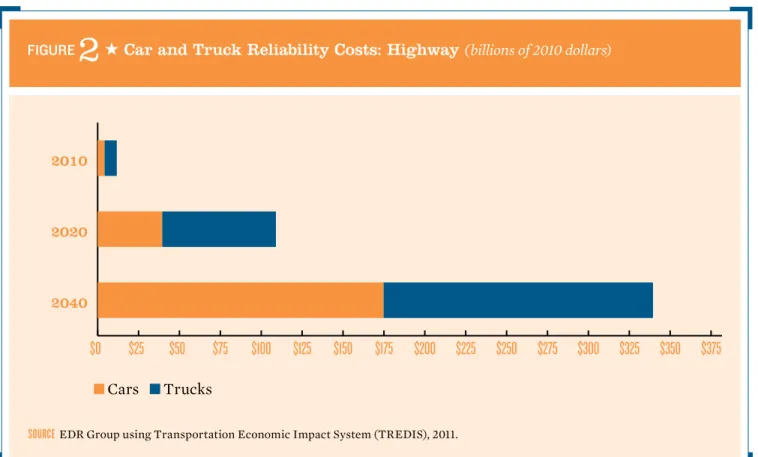
Congestion on urban interstates is the most significant and fastest growing source of transportation inefficiency on America’s surface transportation system, and is expected to impose significantly greater costs in the future than it does today. Table 4 and Figure 2 show how congestion on urban and rural facilities results in travel time and reliability costs9 today and how these costs are expected to grow in the future.
Wages, Value added, industrial
outPut, and Jobs
3
By 2040, america’s deteriorating surface transportation
infrastructure is expected to cost the nation’s economy more than 400,000 jobs. although infrastructure deficiency creates jobs in sectors such as auto and bus repair, retail sales of gasoline, services and parts purchased due to the deficiencies and decreased productivity per worker, critical job opportunities are lost in highly skilled and well-compensated nontransportation sectors throughout the economy. the sectors losing the most employment include high-value professional, business and medical sectors, as well as sectors such as restaurants, entertainment and other amenities, which must be forgone by households when a larger share of the household budget must go toward transportation. Figure 3 shows those industries in which jobs will be gained and lost to the u.s. economy in 2040 due to deficient infrastructure compared with 2040 conditions if the surface transportation system was maintained to minimum tolerable conditions/state of good repair.
–1,000,000
–800,000
–600,000
–400,000
–200,000
0
200,000
400,000
600,000
A
Knowledge Based Industries Whoelsale Trade Entertainment Other Durable Manufacturing Non-Durable Manufacturing Other Services Construction & Utilities Durable Materials & Products Natural Reasources Retail Trade Automobile Repairs Transportation Service ProvidersSOURCE LIFT/Inforum model, University of Maryland, 2011; and Transportation Economic Impact System (TREDIS) used by EDR Group.
NOtE: Natural resources include mining, agriculture, forestry and fishing. Other durable
manufacturing includes electrical and nonelectrical machinery, instruments, and transportation equipment. Nondurable manufacturing includes chemicals, drugs, plastics and synthetics, rubber and leather products, food processing, textiles, apparel, and miscellaneous manufacturing. Entertainment includes restaurants, bars, amusements, and movies. Knowledge-based services include computer and data-processing services, educational services, finance, insurance and real
Figure
3
★ Change in U.S. Jobs in 2040 Attributable toThe effect of infrastructure deficiencies on America’s job composition has a profound impact on the everyday lives of households and families. The total annual income for employ-ees in the knowledge-based industries sector (which loses the most jobs) is $2.8 trillion, compared with annual income for employees in the transportation sector of $471 billion. Over-all, industry sectors gaining jobs as a result of infrastructure deficiencies in 2040 have an average annual income level of 28% less than the income level of those sectors losing jobs.
By requiring Americans to take lower-paying jobs to support the needs of deficient infrastructure, transportation shortfalls have a significant effect on personal income for all Americans. By 2040, it is estimated that Americans will be earning a total of $252 bil-lion less than would have been possible if all infrastructure had been sufficient. Although American households earn less because of infrastructure deficiencies, the same house-holds have to spend more of what they do have on transportation, instead of other household expenditures. By 2040, American households will be not only earning less in income; they will also be spending $54 billion more on trans-portation costs than they would with a fully sufficient system.
Surface transportation deficiencies limit the types of jobs available to Americans, and affect how productive Americans can be in their work. Overall, by 2040, it is expected that American firms will be generating $232 bil-lion less in value added than they would if all surface transportation infrastructure were sufficient. The loss of potential value added attributable to deteriorating surface infrastruc-ture is most concentrated in the Mid-Atlantic region, costing roughly $69 billion.
international competitiveness
When deficient infrastructure makes U.S. firms less productive, the U.S. economy overall is also globally less competitive. The operating, reliability, travel time, safety, and environmen-tal costs of a deficient transportation system affect the cost structure and competitiveness of firms operating in the U.S. Due to costs imposed by deficient infrastructure, in 2020 the U.S. economy is expected to export $28 billion less in goods than would have been the case with sufficient infrastructure, and in 2040 exports are expected to be $72 billion less.
The United States ranks 19th in the quality of its roadways and 18th in the quality of its rail infrastructure, according to a 2009–10 executive opinion survey for 139 countries conducted by the World Economic Forum (Table 5). Maintaining, if not improving, these conditions will be important in maintaining (or improving) the nation’s overall export position.
With deteriorating surface transporta-tion infrastructure, United States exports of products and services will face elevated price pressures in two ways:
1. Exporting firms directly experience higher transportation costs with their own truck fleet for shipments to the Mexican and Canadian borders or to an airport or seaport; and
2. Exporting firms absorb price increases related to transportation costs on some portion of intermediate supplies that arrive by truck and go into a final product. Those intermediate supplies may be domestically produced, or they may be foreign imports that must incur a land-bridging cost from an airport or seaport, or from the Canadian or Mexican borders.
If the condition of surface transporta-tion does not stabilize at current levels, 79 of 93 tradable commodities are expected to
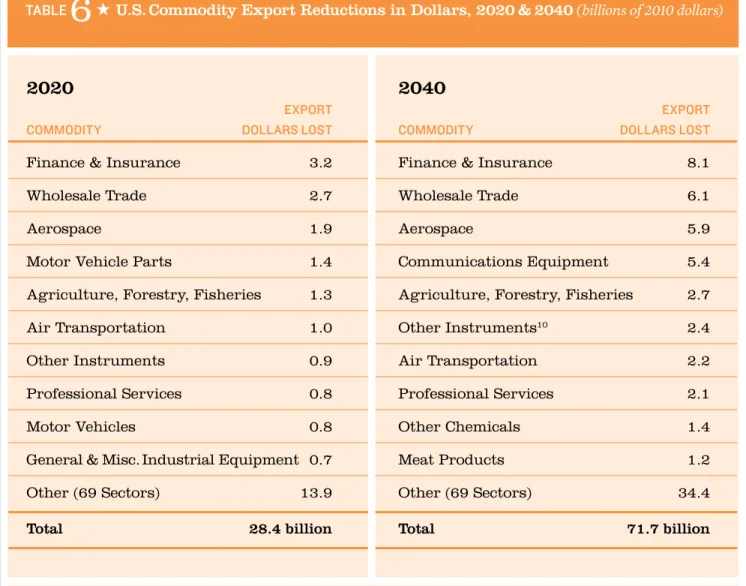
experience lower export transactions in 2020 and 2040. Table 6 shows the 10 commodities in each year that will lose the export sales expected under current conditions.
The largest dollar export losses by com-modity are the result of both the scale of projected export production and the expected impact from deficient surface transportation. Transportation deficiencies affect the production process by increasing costs of receiving goods. It also makes access to markets more expensive, and therefore less competitive, including market reach to Canada and Mexico, and in surface access to airports and seaports. In addition, some large knowledge-based activities (such as finance and insurance) that export services abroad, account for a sizable dollar loss.
The total national export value lost is $28 billion in 2020 and $72 billion in 2040—rela-tive to the expected base case economies in those years. U.S. commodities that lose the largest proportion of their exports are shown in Table 7. The table shows commodities irrespective of the volume of exports (that dimension is captured in Table 6), and illus-trates the percent of impact per commodity.
In 2020, the 10 commodities that are expected to lose the highest levels of export
dollars account for 53% of the export value lost by the aggregated 79 commodities and 52% in 2040. Moreover, many exports shown on the 2020 and 2040 tables, both in terms of percent declines and dollar losses, are key technology sectors that drive national innovation. These include machinery, communications equipment, medical devices, transportation equipment, aero-space, other instruments and chemicals.
innovative surface Transportation
infrastructure investments
This report focuses on the economic conse-quences stemming from the expected state of the U.S. surface transportation system under a pres-ent trend investmpres-ent scenario and the levels of investments required for attaining minimum tol-erable conditions for highways and bridges and the state of good repair for transit systems. How-ever, other aspects of infrastructure investment fall outside this framework. (For more details on this section’s topic, see the technical appendix.) These include new technologies or innovative remixes of existing technologies.
As an example of a new technology, high-speed rail addresses the issue of how investments in both new infrastructure (tracks and re-rationalization of existing railroad rights of way) and new transportation technology (advanced transportation equipment and associ-ated communications) can transform intercity passenger transportation and the economies of the metropolitan areas they connect.
Most of America’s major economic com-petitors in Europe and Asia—including Japan, Germany, France, Spain and Great Britain, as well as rapidly developing and developed countries such as China, Taiwan, and South Korea—have already invested in and are reap-ing the benefits of improved competitiveness from their intermetropolitan high-speed rail sys-tems. Simply continuing to invest in the nation’s existing transportation infrastructure may not be enough to maintain its standing in the global
most of america’s major economic competitors
in europe and asia have already invested
in and are reaping the benefits of improved
competitiveness from their intermetropolitan
high-speed rail systems.
Quality of roads Quality of railroads
ranK counTry/economy ranK counTry/economy
1 Singapore 1 Switzerland
2 France 2 Hong Kong
3 Switzerland 3 Japan
4 Hong Kong 4 France
5 Germany 5 Germany
6 United Arab Emirates 6 Singapore
7 Austria 7 Finland
8 Portugal 8 Taiwan, China
9 Denmark 9 Netherlands
10 Oman 10 South Korea
11 Luxembourg 11 Belgium
12 Chile 12 Denmark
13 Finland 13 Spain
14 South Korea 14 Sweden
15 Namibia 15 Austria
16 Taiwan, China 16 Canada
17 Canada 17 Luxembourg
18 Sweden 18 united states
19 united states 19 United Kingdom
20 Spain 20 Malaysia
source World Economic Forum, “Executive Opinion Survey,” as reported in The Global Competitiveness Report 2010–2011,
Table
5
★ top 20 countries and economies ranked by thetable
6
★
U.S. Commodity Export Reductions in Dollars, 2020 & 2040 (billions of 2010 dollars)2020
2040
export export
Commodity dollars lost Commodity dollars lost
Finance & Insurance 3.2 Finance & Insurance 8.1
Wholesale Trade 2.7 Wholesale Trade 6.1
Aerospace 1.9 Aerospace 5.9
Motor Vehicle Parts 1.4 Communications Equipment 5.4
Agriculture, Forestry, Fisheries 1.3 Agriculture, Forestry, Fisheries 2.7
Air Transportation 1.0 Other Instruments10 2.4
Other Instruments 0.9 Air Transportation 2.2
Professional Services 0.8 Professional Services 2.1
Motor Vehicles 0.8 Other Chemicals 1.4
General & Misc. Industrial Equipment 0.7 Meat Products 1.2
Other (69 Sectors) 13.9 Other (69 Sectors) 34.4
Total 28.4 billion Total 71.7 billion
Other Instruments includes photographic and photocopying equipment, automatic environmental controls, industrial
process variable instruments, totalizing fluid meters and counting devices, electricity and signal testing instruments, analytical laboratory, instruments, watch, clock, and other measuring and controlling devices, and laboratory apparatus and furniture.
SOURCE LIFT/INFORUM Model, University of Maryland, based on calculations by EDR Group using the Transportation Economic Impact System (TREDIS).
A second example of technology change is Magnetic Levitation (maglev) Systems, which have been under development and review in the U.S. and abroad for many years. Both high-speed intercity and low-high-speed urban systems have been developed and tested—primarily in Germany, Japan, South Korea, and China. A high-speed maglev system has been built and is currently in operation between downtown Shanghai and the Pudong International Air-port. Other airport connector systems have been planned for Munich and are under con-sideration in several Middle Eastern countries. A maglev system is currently being planned between Geneva and Lausanne, and another between Berne and Zurich.
An example of applying existing tools is rethinking various forms of intercity transport and investing in things like intercity rail with airport connections (not necessarily high speed, but rail at speeds that effectively compete with autos), particularly to address the mobility and access requirements within and between an entire tier of small and mid-sized urban areas. There may even be express, scheduled bus ser-vice that would work.
In this case, it is not so much “new” technol-ogy that is needed, but new thinking of how to use existing technologies to ease travel, par-ticularly for commuting and the 100–500 mile trip. At the present time, the average American commute is worse than that in many European nations and a new mix of existing transporta-tion and other technologies could be part of a solution. 12
mitigation
This report contrasts a transportation system funded at levels comparable to today’s lev-els with a fully funded system to assess the degree to which U.S. economic conditions are affected by current and projected infra-structure deficiencies. “Trends extended” is
with today’s priorities, and not acting to make significant improvements in areas that are cur-rently unfunded, or addressing future needs for which there is no evident funding source. How-ever, the 2007 National Surface Transportation Policy and Revenue Study Commission report suggests that even current levels assumed in this report’s economic analysis may not be sus-tainable. 13 The magnitude of needs found by the analysis in this report generally concurs with the magnitudes found by the Policy and Rev-enue Study Commission; though, this report does not attempt to quantify the additional loss to the U.S. economy if funding levels were to decline because of increasing future revenue shortfalls.
For many years, federal surface transporta-tion legislatransporta-tion and statewide planning have placed an emphasis on the preservation of existing assets.14 For highways, pavement and bridge preservation has been a priority, as implemented by states with a “fix it first” pol-icy to protect existing assets. The funding and emphasis for bridge preservation also increased in the wake of the I-35 bridge collapse in Min-neapolis in the summer of 2007. The priority placed on highway and bridge funding shows that transportation investment can make a difference, with the Federal Highway Adminis-tration (FHWA) reporting pavement conditions
This report contrasts a transportation system
funded at levels comparable to today’s levels with
a fully funded system to assess the degree to
which u.s. economic conditions are affected by
current and projected infrastructure deficiencies.
table
7
★
U.S. Commodity Export Reductions by Percentage, 2020 & 2040 (billions of 2010 dollars)2020
2040
Percentage of exPorts Percentage of exPorts
commodity lost (by value) commodity lost (by value)
TV, VCR, radios, phonographs, etc.11 6% Communications equipment 11%
Apparel 5% TV, VCR, radios, phonographs, etc. 5%
Motor vehicle parts 4% Ships & boats 3%
Agricultural fertilizers & chemicals 3% Ophthalmic goods 3%
Other transportation equipment 3% Agricultural fertilizers & chemicals 3%
Stone, clay & glass 3% Rubber products 2%
Ophthalmic goods 3% Motor vehicle parts 2%
Special industry machinery 2% Government enterprises 2%
Shoes & leather 2% Other transportation equipment 2%
Service industry machinery 2% Apparel 2%
SOURCE LIFT/INFORUM Model, University of Maryland, based on calculations by EDR Group using the Transportation Economic Impact System (TREDIS).
NOtE TV, VCR, radios and phonographs includes household audio and video equipment. number of structurally deficient or functionally
obsolete bridges declined from 34% in 1996 to 27.6% in 2006. This progress has left the bulk of deficiency cost in the form of unmet transit needs and rising highway congestion.
If the preservation investments described above had not been made, the economic burden of deficient infrastructure would be signifi-cantly greater than we have found for today and in the future. If the Highway Trust Fund and
other sources are unable to continue today’s funding levels, then the loss of jobs, personal income, and value added will be beyond the losses we have quantified. However, if trans-portation investment levels rise in areas that support building and maintaining minimum tolerable conditions across the system, national jobs, income, and GDP can rise to the levels we have found and quantified in this study.
regional iMPlications
4
implications of Deficiencies
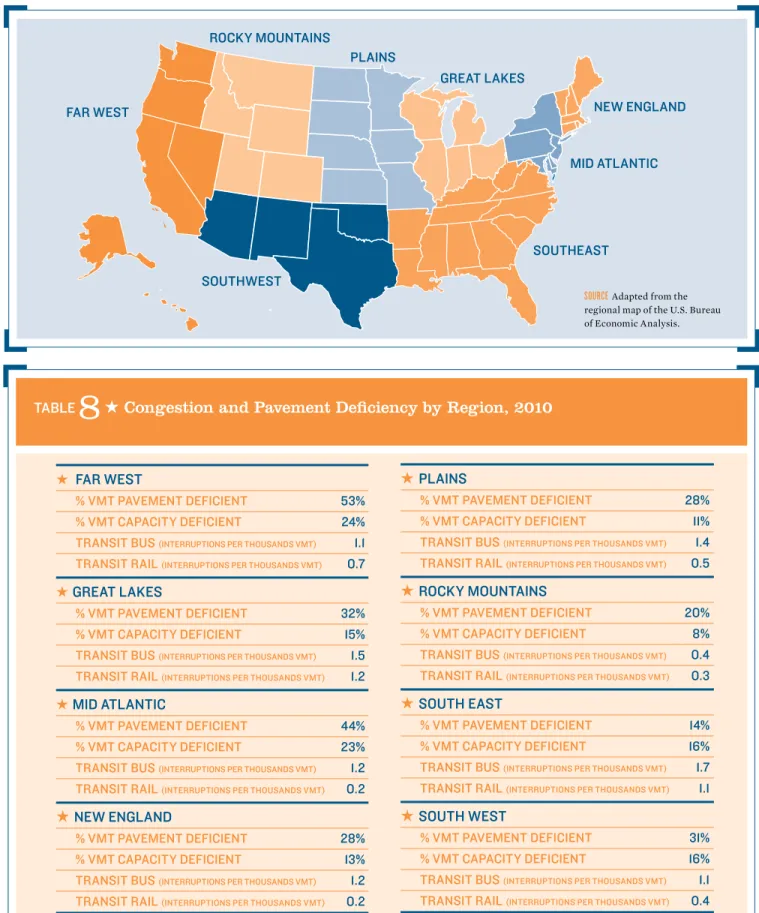
The relative severity of different types of defi-ciencies that occurred in 2010 for each region of the United States due to deficient and dete-riorating infrastructure is shown in Table 8.
Regions of the U.S. with large cities, high densities, and high concentrations of urban interstates and freeways experience the most direct costs of deficient transportation infra-structure in the form of urban congestion. The New England and Far West regions today have congestion levels accounting for 23% and 24% of VMT, respectively. Furthermore, areas with higher densities, more transit-dependent
The deficient and deteriorating trans-portation conditions described above translate into losses in the American econ-omy throughout the 50 states and every industrial sector of the economy. Of the jobs lost due to deteriorating infrastructure, the impact was the greatest in the Mid-Atlan-tic region, followed by the Far West region. These regions are most affected because of their high concentration of congested, urban-ized areas, and their high dependence on urban interstates, freeways, and transit sys-tems, which are among the most deficient according to federal highway and transit statistics.
each region of the u.s. and each industry of the american economy is affected in different ways by the costs imposed by substandard and deteriorating infrastructure. the most affected regions are those with the largest concentrations of urban areas, given that urban highways, bridges, and transit systems are in poorer condition today than are rural facilities. Peak commuting patterns also place larger burdens on urban capacities. However, because america is so dependent on the interstate Highway system, impacts on interstate performance in some regions or area types are felt throughout the nation. regions are illustrated by the map on page 22.
table
8
★
Congestion and Pavement Deficiency by Region, 2010★ FaR WeSt
% VMt PaVeMent DeFicient 53%
% VMt caPacity DeFicient 24%
tRanSit buS (inteRRuPtionS PeR thouSanDS VMt) 1.1 tRanSit Rail (inteRRuPtionS PeR thouSanDS VMt) 0.7 ★GReat laKeS
% VMt PaVeMent DeFicient 32%
% VMt caPacity DeFicient 15%
tRanSit buS (inteRRuPtionS PeR thouSanDS VMt) 1.5
tRanSit Rail (inteRRuPtionS PeR thouSanDS VMt) 1.2 ★MiD atlantic
% VMt PaVeMent DeFicient 44%
% VMt caPacity DeFicient 23%
tRanSit buS (inteRRuPtionS PeR thouSanDS VMt) 1.2 tRanSit Rail (inteRRuPtionS PeR thouSanDS VMt) 0.2 ★ neW enGlanD
% VMt PaVeMent DeFicient 28%
% VMt caPacity DeFicient 13%
tRanSit buS (inteRRuPtionS PeR thouSanDS VMt) 1.2 tRanSit Rail (inteRRuPtionS PeR thouSanDS VMt) 0.2
★ PlainS
% VMt PaVeMent DeFicient 28%
% VMt caPacity DeFicient 11%
tRanSit buS (inteRRuPtionS PeR thouSanDS VMt) 1.4 tRanSit Rail (inteRRuPtionS PeR thouSanDS VMt) 0.5 ★RocKy MountainS
% VMt PaVeMent DeFicient 20%
% VMt caPacity DeFicient 8%
tRanSit buS (inteRRuPtionS PeR thouSanDS VMt) 0.4 tRanSit Rail (inteRRuPtionS PeR thouSanDS VMt) 0.3 ★ South eaSt
% VMt PaVeMent DeFicient 14%
% VMt caPacity DeFicient 16%
tRanSit buS (inteRRuPtionS PeR thouSanDS VMt) 1.7 tRanSit Rail (inteRRuPtionS PeR thouSanDS VMt) 1.1 ★South WeSt
% VMt PaVeMent DeFicient 31%
% VMt caPacity DeFicient 16%
tRanSit buS (inteRRuPtionS PeR thouSanDS VMt) 1.1 tRanSit Rail (inteRRuPtionS PeR thouSanDS VMt) 0.4 FaR WeSt RocKy MountainS PlainS GReat laKeS SoutheaSt neW enGlanD MiD atlantic SouthWeSt
Source Adapted from the regional map of the U.S. Bureau of Economic Analysis.
Table
9
★
Passenger Mode reliance by region, 2010 (Per capita)★ plains
auTo vmT 2,892
TrucK vmT 392
passenger bus Trips 258
passenger rail Trips 16
DemanD response Trips 115
★ rocKy mounTains
auTo vmT 2,721
TrucK vmT 327
passenger bus Trips 39
passenger rail Trips 8
DemanD response Trips 5
★ souTh easT
auTo vmT 2,936
TrucK vmT 353
passenger bus Trips 43
passenger rail Trips 5
DemanD response Trips 16
★ souTh WesT
auTo vmT 2,812
TrucK vmT 423
passenger bus Trips 429
passenger rail Trips 32
DemanD response Trips 170
★ Far WesT
auTo vmT 2,555
TrucK vmT 238
passenger bus Trips 725
passenger rail Trips 74
DemanD response Trips 197
★ greaT laKes
auTo vmT 2,580
TrucK vmT 349
passenger bus Trips 423
passenger rail Trips 57
DemanD response Trips 147
★ miD aTlanTic
auTo vmT 2,170
TrucK vmT 203
passenger bus Trips 1,036
passenger rail Trips 668
DemanD response Trips 182
★ neW englanD
auTo vmT 2,568
TrucK vmT 175
passenger bus Trips 405
passenger rail Trips 176
DemanD response Trips 186
Different reliance and
vulnerabilities by modes
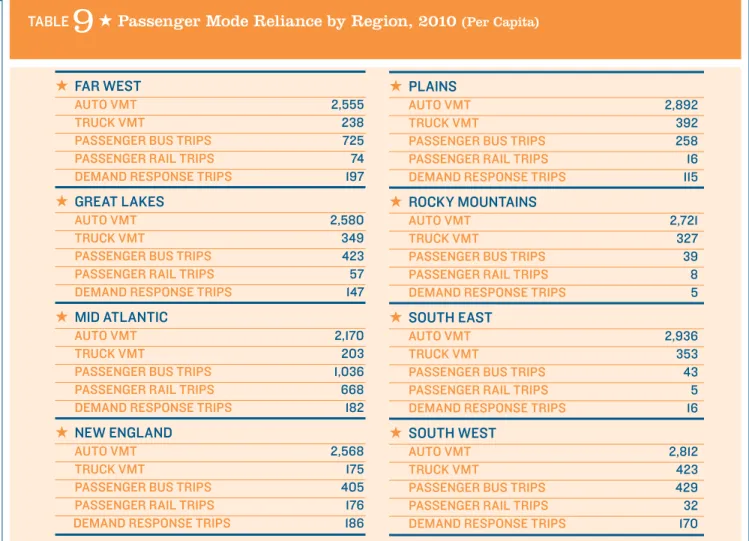
Regions with a larger percentage of urban-ized areas are more directly affected by the travel time and operating impacts of defi-cient highways and transit systems. Rural regions are affected more by the routing effects of deficient interstates, and by fund-ing shortfalls in demand response transit systems. Table 9 compares the reliance of dif-ferent regions of the U.S. on difdif-ferent types of surface transportation infrastructure and services (per capita). Overall, lower-density regions like the Rocky Mountains and the Great Plains have more vehicle miles of travel
per capita, whereas higher-density regions like New England and the Mid-Atlantic states have less VMT per capita, but are subject to more congestion due to the density of population and traffic. Furthermore, the higher-density regions of New England and the Mid-Atlantic states have significantly more transit trips per capita, and are therefore likely to be more sensitive to the costs of deficient transit.
rural regions are affected more by the routing
effects of deficient interstates, and by funding
shortfalls in demand response transit systems.
diVersion of traffic
due to congestion
5
urban interstate capacities have not kept pace with demand in urban areas, and speeds on u.s. interstates in urban areas in 2010 were 10 miles per hour less than they would be if the system were built to minimum tolerable engineering standards for projected traffic levels.15 in 2020 this ‘speed deficit’ will
grow to 13 miles per hour and 16 miles per hour in 2040. Because of significantly deteriorating interstate
speeds through America’s major cities, increas-ing levels of interstate traffic are relyincreas-ing on lower-level arterials, in both urban and rural areas to access the nation’s trade centers.16 The urban and rural arterial routes absorbing the majority of this traffic from a deficient urban interstate system typically have lower design speeds and standards than the interstates, and are subject to higher crash rates and other costs. In 2010, it is estimated that 18% of urban interstate traffic was diverted to lower classi-fied systems, and 6% of rural interstate traffic was diverted.
Figure 4 shows that while congestion and VMT growth are increasingly concentrated in urban areas—the costs and performance impli-cations of these deficiencies are affecting rural and outlying areas as well, and often result in significantly higher VMT and vehicle hours of travel (VHT), especially for trucks and trans-continental moves than would otherwise be the case. These projected changes draw attention
and even nonurban arterials (shown as smaller lines in the background in Figure 6), most of which are absorbing some share of the intercity traffic that is shown to be diverted when urban interstate and freeway speeds are affected by congestion. Thus, the routing effects of deficiencies in the interstate system cannot be isolated to only urban areas where deficiencies occur but also affect all the differ-ent regions of the U.S., both urban and rural.
Figure 4 does not show traffic growth over time, but instead shows the change in rout-ing that occurs due to urban bottlenecks on the interstate system. At current funding lev-els, the reassignment of interstate traffic to lower classified systems creates an additional 360 million urban VHT and 104 million rural VHT in 2010, and will increase to 22 bil-lion urban VHT and 6 bilbil-lion rural VHT in 2020, and 34 billion urban VHT and 6 billion rural VHT by 2040. Most of the routes gain-ing traffic are state arterial routes with lower capacities, design speeds, and design
stan-Figure
4
★
Pattern of reassignments from congested interstates, 2010–2040source: Calculations by EDR Group using synthesis of three sources: HERS-ST, for the magnitude of speed effects deficiencies on different urban and rural functional systems; FAF3, which provides network and baseline truck routing; and finally CUBE Voyager, which enables us to see how the Blue: Highways that will be avoided all or in part due to extreme congestion
tHe national Modal funding gaP
6
the united states carries a backlog of $3 trillion in unfunded surface transportation needs, including a $2.2 trillion backlog for highways and bridges and $86 billion in unfunded transit capital infrastructure needs.17 this backlog does not include the
cost of providing access to transit to the significant number of americans who do not currently have access to fixed route transit and/or demand response transit. approximately 15% of transit revenue miles occurring in 2010 are on vehicles with a state of good repair of “fair” or “poor.” in addition, 31% of passenger car vehicle miles of travel occurred on roadways with less than minimum tolerable pavement conditions and 18% of passenger car trips occurred on congested roads.18 By 2040, the proportion
of transit revenue miles occurring on less than “good” vehicles will rise to 33%, and the 18% of passenger car VMt traveled in congested conditions will rise to 36%. table 10 and Figure 5 summarize the percentage of vehicle or revenue miles, by mode subject to deficiencies today, and how these deficiencies are expected to carry into the future.19
Figure
5
★
Development of Deficiencies by Mode 20100%
20%
40%
60%
80%
100%
B A Demand-Response Transit Bus Transit (Fixed Route) Rail Transit Trucks (Capacity) Passenger Cars (Capacity)0.0% 0.5% 1.0% 1.5% 2.0% 2.5% 2020
0%
20%
40%
60%
80%
100%
B A Demand-Response Transit Bus Transit (Fixed Route) Rail Transit Trucks (Capacity) Passenger Cars (Capacity)0.0% 0.5% 1.0% 1.5% 2.0% 2.5%
0%
20%
40%
60%
80%
100%
B A
Demand-Response Transit Bus Transit (Fixed Route) Rail Transit Trucks (Capacity) Passenger Cars (Capacity)
0.0% 0.5% 1.0% 1.5% 2.0% 2.5%
n% of VMT Sufficient Infrastructure
n% of VMT Deficient Infrastructure
Deficiencies by Mode at today’s Funding levels
% oF vmT suFFicienT % oF vmT DeFicienT
year vehicle Type inFrasTrucTure inFrasTrucTure
2010 Passenger Cars (capacity/congestion) 82% 18%
Trucks (capacity/congestion) 82% 18%
Rail Transit 89% 11%
Bus Transit (fixed route) 84% 16%
Demand-Response Transit 84% 16%
2020 Passenger Cars (capacity/congestion) 76% 24%
Trucks (capacity/congestion) 76% 24%
Rail Transit 90% 10%
Bus Transit (fixed route) 77% 23%
Demand-Response Transit 28% 72%
2040 Passenger Cars (capacity/congestion) 64% 36%
Trucks (capacity/congestion) 64% 36%
Rail Transit 84% 16%
Bus Transit (fixed route) 70% 30%
Demand-Response Transit 32% 68%
source EDR Group analysis using 2010 USDOT Highway Economic Requirements System for States (HERS-ST)
Table
10
★ Development of Deficiencies by Mode It should be noted that in the case of transit, deficiencies may compound among modes, with fixed-route transit bus or demand response vehicles also operating in congested conditions on deficient pavements.Because of today’s backlog, in 2010 16.2% of transit bus VMT occurred in suboptimal condi-tions (and this is expected to increase to 30% in 2040), 16% of demand-response bus VMT are
on deficient vehicles today (expected to increase to 68% in 2040), 7% of light rail VMT are on deficient vehicles today (expected to increase to 22% in 2040), and 11.2% of other rail vehicles are deficient (expected to increase to 15.8% in 2040). Table 9 shows the percentage of tran-sit VMT carried on deficient infrastructure in 2010 and percentages expected for anticipated demands in 2020 and 2040. Table 11 and
year TransiT Type % suFFicienT % DeFicienT
2010 Bus Transit (fixed route) 84% 16%
Demand Response (para-transit) 84% 16%
Light Rail 93% 7%
Other Rail 89% 11%
2020 Bus Transit (fixed route) 77% 23%
Demand Response (para-transit) 28% 72%
Light Rail 86% 14%
Other Rail 90% 10%
2040 Bus Transit (fixed route) 70% 30%
Demand Response (para-transit) 32% 68%
Light Rail 78% 22%
Other Rail 84% 16%
source EDR Group analysis using USDOT Transit Economic Requirements Model (TERMS) and 2010 National Transit Database.
TransiT Type vehicle Type 2010 2020 2040
Bus Passenger Bus $49 $398 $659
Rail Passenger Rail $41 $171 $370
totals $90 $568 $1,029
source EDR Group using Transportation Economic Impact System (TREDIS), 2011. note Totals may not add due to rounding
Table
12
★ total costs Due to Deficient and Deteriorating infrastructure (billions of 2010 dollars) Table11
★ transit Mode Breakdown of Percent VMt operating on DeficienciesFigure 5 show how the deficiencies for tran-sit modes are expected to increase from 2010 to 2040, assuming today’s funding levels. It should be noted that the deficiency of demand response fleets will rise disproportionately as the aging population places increasing demand on paratransit services for the nondriving pop-ulation. This is especially important for the nation’s economy, as the ability of this rapidly growing segment of the population to partici-pate in consumer and labor markets will be adversely affected if demand-response ser-vices are not sufficient to keep pace with rising demand.
Regardless of the type of transit, defi-cient transit fleets are more susceptible to interruptions in service, costing households and businesses time and reliability due to
unanticipated delay when interruptions occur. In 2010, there were more than 430 interruptions per revenue mile on passenger bus services, 57 interruptions per revenue mile on demand-response services, 349 interruptions per mile on light rail, and 123 interruptions per mile on other rail services. As transit fleets become increasingly deficient relative to demand, inter-ruptions and their costs are expected to impose an increasing burden on the economy, espe-cially in the growing demand-response transit sector, which serves nondriving (and often nonurban) populations with fewer alterna-tive transportation options. In addition to more likely interruptions, deficient transit vehicles are also less fuel and energy efficient, resulting in increased operating costs per mile, placing addi-tional cost on the American economy.
Overall, deficiencies in bus transit (fixed-route and demand-response) are estimated to have imposed $49 billion in cost on the Ameri-can economy in 2010. It is anticipated that by 2020, the present value of cumulative bus tran-sit deficiency costs will near $400 billion, and will reach nearly $680 billion by 2040. Defi-ciencies in rail transit vehicles are estimated to have imposed more than $41 billion in costs to the U.S. economy in 2010, and cumulatively will have exceeded $170 billion by 2020 and will have reached nearly $370 billion by 2040. Table 12 shows how the overall economic costs of transit deficiencies will increase in the U.S. economy to 2040.
as transit f leets become increasingly deficient
relative to demand, interruptions and their costs
are expected to impose an increasing burden on
the economy, especially in the growing
demand-response transit sector, which serves nondriving
(and often nonurban) populations with fewer
alternative transportation options.
supporTeD by currenT
year oF neeD ToTal neeD FunDing level % FunDeD
Cumulative to 2020 $68 $59 87%
Cumulative to 2040 $172 $126 73%
average annual $5.7 $4.2 75%
Maintenance needs are a critical aspect of highway investment requirements, and are expected to increase over time. Unmet maintenance needs speed up the deteriora-tion of infrastructure and may bring about the costs and adverse economic impacts given in this report on a faster timetable, and with magnitudes exacerbated beyond what is included in the formal economic analy-sis of unmet capital improvement needs. Unmet maintenance needs also often pres-ent themselves as urgpres-ent needs, and divert investment from more long-term invest-ments of the type that would ultimately be required to overcome many of the costs and adverse impacts explored in this report. When infrastructure maintenance, repairs,
and improvements are not fully funded, short-term “band-aid” solutions are often implemented to enable the infrastructure to continue functioning at less than minimum tolerable conditions. When these short-term solutions are implemented, in addition to the user cost of operating the deficient infrastruc-ture, the cost of operating and maintaining the infrastructure is greater than it would be if the infrastructure were in proper condition. Table 13 gives an estimate of how mainte-nance needs may develop over time, and how unmet needs may increase if today’s funding levels do not change.
Table
13
★ Maintenance needs in Billions of constant 2010 Dollars(assuming current capital investment levels)
iMPlications of Maintenance
funding (and a funding gaP)
7
conclusions and furtHer researcH
8
The cost of continuing to fund improvements for America’s surface transportation system at current levels produces a mounting bur-den of deficiency, which shifts economic costs to the next generation of American house-holds and businesses. This burden takes the form of higher costs of doing business, fewer opportunities for firms to invest, and less dis-posable income for families. The burden also compromises America’s competitive position in the world’s economy and leads to lower overall profitability for most business sectors. Although today’s funding levels have been
effective in gradually improving highway pavement and bridge conditions, the mount-ing costs imposed by deficient transit and urban congestion will continue to accrue long into the future. Furthermore, today’s funding levels do not account for important demo-graphic shifts. From 2010 to 2040, the U.S. population is expected to grow by one-third, and the proportion of Americans age 75 years and older is expected to nearly double. This aging population will increasingly depend on demand-response transit systems. Projected demographic shifts are shown in Table 14.
populaTion percenTage 0F householDs civilian jobs year (millions) populaTion 75+ (millions) (millions)
2010 310 6% 118 142
2020 341 7% 131 162
2040 406 11% 157 190
sources The total number jobs is calculated from various sources, with the Bureau of Labor Statistics being the primary source. Population data were obtained from the U.S. Census, and the population projections are guided by the projections of the
The analysis presented in this report represents a general, “sketch-level” understanding of how different types of surface transportation infra-structure deficiencies affect the U.S. economy, and will continue to do so in the future. Although there is a clear adverse impact of doing nothing beyond “business as usual” to address Ameri-ca’s substantial backlog of highway, transit, and rail transportation needs, there are opportuni-ties for significantly more research that can lend greater understanding to the issues raised in this report. A key area for future research is devel-oping best practices for state-level planning and programming efforts to incorporate forward-looking asset management and performance benchmarking tools like the FHWA Highway Economic Requirements for States (HERS-ST, highways), National Bridge Investment Analysis System (NBIAS, bridges), and the FTA Transit Economic Requirements Model (TERM, transit) used in this report in conjunction with economic impact and trade models of the type also used in this analysis. This report is intended to highlight not only how infrastructure deficiencies impose costs on the economy, but also how these costs relate to the productivity and competitiveness of industries as well as the prosperity of house-holds. Further research in best practices for consistently incorporating this relationship as a regular part of transportation planning and pro-gramming is encouraged to build on the work of this report.
Another area for future research pertains to determining the truly efficient level of invest-ment in surface transportation infrastructure. Although this report establishes the degree and manner in which deficient surface trans-portation assets weaken the national economy, more research is needed to establish break-even funding levels at which these adverse eco-nomic impacts outweigh the effects of incurring improvement costs associated with transpor-tation investment. Furthermore, the analysis
the efficiency of prioritizing transportation invest-ment around projects of national or (multistate) regional significance may provide leverage to mini-mize the ongoing impact of unmet needs.
This report has established that transporta-tion deficiencies, and their costs, have a significant impact on exports, productivity, and the competi-tiveness of industries. The findings on international competitiveness point to a potential emerging area of research into the comparative economic advan-tages of infrastructure sufficiency in the global trade environment. Further research needs to be conducted into how major U.S. trading part-ners and international competitors measure and benchmark transportation performance, and the comparative efficiencies of foreign surface trans-portation systems relative to the U.S. may affect industrial competitiveness and the terms of trade.
The findings of this study also suggest the merit of future research on the role and sufficiency of the Interstate Highway System, and specifically in the impact of urban capacity deficiencies on national intrastate traffic flows. The findings leading to this report suggest that capacity deficiencies on urban interstates will be a leading driver of transporta-tion cost in the U.S. economy to 2040, and also can have traffic assignment effects placing demands on urban arterial and rural facilities. Understand-ing the true national transportation performance and economic impacts of deteriorating levels of ser-vice on urban interstates and freeways is critical for appropriately responding to difficult investment choices for the U.S. surface transportation system.
Finally, the findings regarding transit suffi-ciency points to a need for more research into the adequacy of today’s demand-response fleets for a growing nondriving population. Although consid-erable research has been done on transportation alternatives for this segment of the population, further research is needed into the system-level economic impacts of different levels mobility and demand-response transit sufficiency, as well as economic and performance trade-offs when
invest-sources and methods
Although there is no single model or data source accounting for all the findings in this report, the economic analysis represents a high-level syn-thesis of the University of Maryland’s LIFT/ INFORUM global trade and economic impact model, with a user cost analysis based on the Transportation Economic Development Infor-mation System (TREDIS), which was developed by EDR Group and is currently being used in 40 U.S. states and Canadian provinces.
The basis for establishing future transporta-tion conditransporta-tions under present trends investment scenarios was based on widely accepted models of transportation sufficiency, costs, conditions and performance, and buttressed by a literature review.
Highway needs and anticipated future defi-ciencies (and performance levels) at different funding levels are based on an application of 2010 HERS-ST using 2008 HPMS data from each of the 50 states using the default minimum tolerable conditions, unit costs, run specifi-cations, and parameters provided with the HERS-ST software. HERS-ST default param-eters were adjusted to assume system expansion needs would not exceed a maximum of 16 lanes (represented in the fully funded or sufficient base case), and no “high-cost lanes” highway widening would be considered as a need in cases where the HPMS sample had considered widen-ing infeasible. In such cases, preservation needs were assumed to accrue, but widening was not counted as among the needs.
Consequently, the analysis assumes that some level of congestion will occur, even with a fully funded system and the fully funded base case does not assume “free-flow” conditions. In addition, when developing the transportation analysis for this report, we deliberately avoided including costs of catastrophes similar to the I-35 bridge collapse. In other words, we assumed that infrastructure failure results in congestions and vehicle costs, but not national-level tragedies. Overall, this approach is consistent with avoid-ing a “gold-plated” infrastructure investment scenario, and is consistent with the ASCE Report Card for America’s Infrastructure. Furthermore, the traffic growth rates in state HPMS files were controlled not