SEVENTH FRAMEWORK PROGRAMME
Project Number: FP7-ICT-2007-1 216863
Project Title: Building the Future Optical Network in Europe (BONE)
CEC Deliverable Number: FP7-ICT-216863 /D21.1 Contractual Date of Deliverabl: 31/03/08
Actual Date of Delivery: 10/05/08
Title of Deliverable: D21.1: Report on planned activities
Work package contributing to the Deliverable:
WP21: Topical Project on Service Oriented Optical Network Architectures
Nature of the Deliverable R Dissemination level of Deliverable PU Editors:
Partner / names
UEssex / Dimitra Simeonidou IBBT / Mario Pickavet Abstract:
This document is the first deliverable of the WP21 “Topical Project on Service Oriented Optical Network Architectures”. This report contains the planned activities into the BONE project.
There are seventeen partners involved in this work-package and seven joint activities are proposed. Moreover, at least seven mobility actions are planned during the two years of the project.
Disclaimer
The information, documentation and figures available in this deliverable, is written by the BONE (“Building the Future Optical Network in Europe) – project consortium under EC co-financing contract FP7-ICT-216863 and does not necessarily reflect the views of the European Commission
Table of Contents
DISCLAIMER ... 2
TABLE OF CONTENTS... 3
1.
EXECUTIVE SUMMARY ... 4
2.
INTRODUCTION ... 5
3.
PARTICIPANTS ... 5
4.
JOINT ACTIVITIES... 6
4.1 Coupling the Application Layer Protocol Mechanisms with the Optical Network to Provide Application Aware Networking ...7
4.2 Programmable Service Composition Algorithms for Service Oriented Optical Networks...8
4.3 UNI Extensions for Service Oriented Optical Networks ...9
4.4 Photonic Grid Dimensioning and Resilience ...10
4.5 Impact of services on optical switch architectures and control ...11
4.6 Green Optical Networking...12
4.7 Cloud Routing...13
1. Executive
Summary
This document is the first deliverable of the work package “Topical Project on Service Oriented Optical Network Architectures”. As the title of this deliverable says, this report contains the planned activities into the BONE project.
There are seventeen partners involved in this work-package and 7 joint activities are proposed. The topics covered by this WP will propose service-oriented network architectures that will be enabled by an underlying optical transport network capable of dynamic and agile resource allocation. The optical transport layer will provide the basic mechanisms for reserving resources, and an optical service layer will build a set of services over the basic optical transport layer.
2. Introduction
The main objective of the work package “Service Oriented Optical Network Architectures” Study how the optical architectures can be exploited and enhanced to realise service oriented architectures.. This first deliverable defines the activities planned into this “Network of Excellence”.
In section three, this report provides a list of the partners involves in the work package as well as the joint activities in which they are involved. In section four, it focuses on the description of the joint activities. Finally, the last section concludes this report.
3. Participants
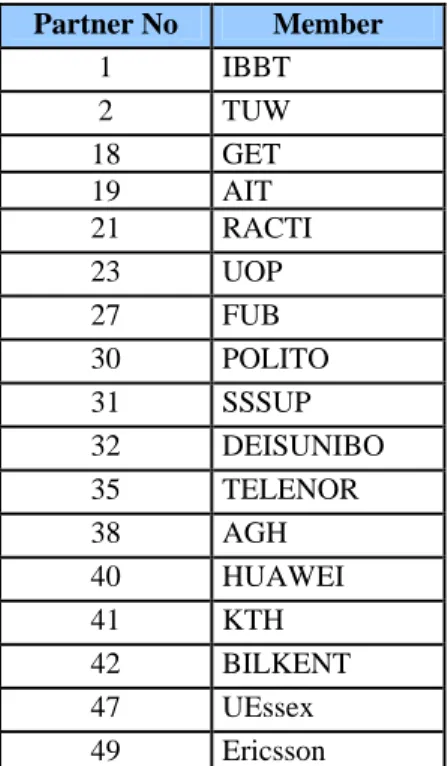
There are seventeen partners collaborating in this work package. Table 1 shows the list of participants involved. A detailed description of the joint activities is provided in the following chapter.
Partner No Member 1 IBBT 2 TUW 18 GET 19 AIT 21 RACTI 23 UOP 27 FUB 30 POLITO 31 SSSUP 32 DEISUNIBO 35 TELENOR 38 AGH 40 HUAWEI 41 KTH 42 BILKENT 47 UEssex 49 Ericsson
4. Joint
Activities
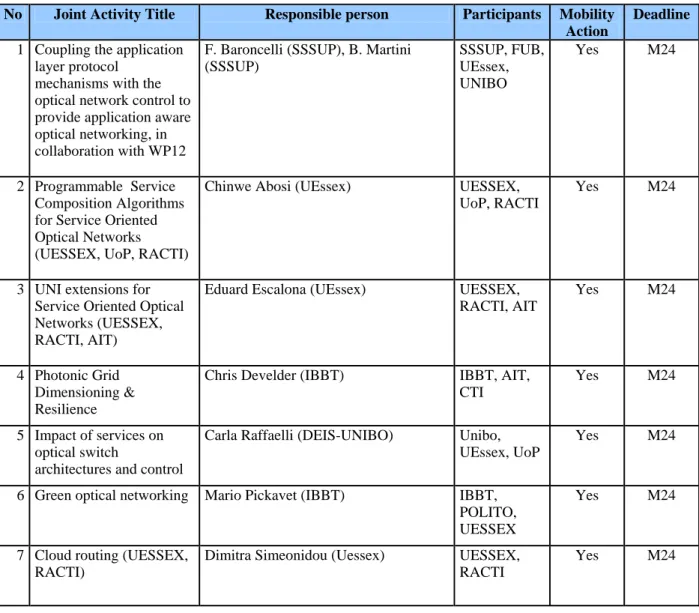
This chapter describes the joint activities that will be carried out in this work package. The following table shows key information about these joint activities:
No Joint Activity Title Responsible person Participants Mobility Action
Deadline 1 Coupling the application
layer protocol mechanisms with the optical network control to provide application aware optical networking, in collaboration with WP12
F. Baroncelli (SSSUP), B. Martini (SSSUP) SSSUP, FUB, UEssex, UNIBO Yes M24 2 Programmable Service Composition Algorithms for Service Oriented Optical Networks (UESSEX, UoP, RACTI)
Chinwe Abosi (UEssex) UESSEX,
UoP, RACTI
Yes M24
3 UNI extensions for Service Oriented Optical Networks (UESSEX, RACTI, AIT)
Eduard Escalona (UEssex) UESSEX,
RACTI, AIT
Yes M24
4 Photonic Grid Dimensioning & Resilience
Chris Develder (IBBT) IBBT, AIT,
CTI
Yes M24
5 Impact of services on optical switch
architectures and control
Carla Raffaelli (DEIS-UNIBO) Unibo,
UEssex, UoP
Yes M24
6 Green optical networking Mario Pickavet (IBBT) IBBT,
POLITO, UESSEX
Yes M24
7 Cloud routing (UESSEX, RACTI)
Dimitra Simeonidou (Uessex) UESSEX,
RACTI
Yes M24
Table 2: Summary list of the planned joint activities
As it is depicted in the above table, seven joint activities with at least seven mobility actions are planned for this work package. The duration of most of the joint activities covers the two years of the project.
4.1 Coupling the Application Layer Protocol Mechanisms with the
Optical Network to Provide Application Aware Networking
Participants: SSSUP, FUB, UEssex, UNIBO Responsible person:
F. Baroncelli (SSSUP), B. Martini (SSSUP) Description:
The objective of this activity is to evaluate theoretically the possible exploitation of service platform architectures for dynamic network configuration for high-bandwidth and QoS-guaranteed connectivity set-up and for session management and finally demonstrate them through a testbed. This activity has been conceived to operate in collaboration with WP21. The theoretical activities will be carried out in WP12 will most experimental results will be realized within the framework of WP21.
Although there has been substantial progress in the technology of management and measurement platforms, there is a big semantic-gap between parameters handled by network devices and parameters used by the user applications in commercial platforms such as SIP. Application-to-network mapping is the key-point needed to fill this semantic-gap and dynamically provision QoS-enabled network services to qualified user applications. Specifically this “mapping” process translates Application-Layer requests generated by application session signalling, e.g. SIP, into technology-specific and self-consistent directives used to configure network devices. Moreover, in networks that involve different network technologies, the service provisioning of an user-application-request needs a concatenation of different mapping to realize a real end-to-end network configuration.
Specifically, an heterogeneous network scenario will be considered comprising OBS and IP/MPLS as core network technologies and Ethernet as aggregation network technology. In this scenario a mapping will be investigated to classify application services, a Mapping-module, based on QoS needs classification, will be developed and it will be used in conjunction with a SIP proxy to provide an End-to-End connection provisioning through a self-consistent network device configuration using the Service Oriented Optical Network (SOON) prototype.
The SOON architecture enable a direct interfacing between qualified IT applications and the network for the invocation of QoS-enabled and high-bandwidth connectivity services thanks to a distributed signalling among designated “service nodes” that fulfil service requests issued by applications while masking the implementation details of transport network from the abstract request of the service.
Some experimental test will be carried out to validate the complete architecture. Outcome of the joint research activity:
Proposal of a network-centric service-oriented architectures to facilitate user and application access to abstracted levels of information regarding offered network and non-network services. Advanced network services will be enabled by an underlying dynamic optical layer.
Design and prototype implementation of the Service Element (SE) interfacing the service platforms and optical network control plane and offering service, network resource and non-network resource abstraction and co-ordination;
Validation of the concept and developments in a test-bed involving advanced applications, network, and IT infrastructures;
The partners involved in this joint activity will benefit of the complementary experience in this field. SSSUP will focus mainly on architectures and the result of its testbed built on top of commercial routers, UNIBO will bring his competence on SIP protocol, FUB has a multivendor testbed, while UEssex has an optical testbed already developed and available since the two editions of e-photon/ONE. A Mobility plan has been already planned for a three month period of a Ph.D. student of Scuola Superiore S.Anna staying at Essex University. Targeted call for papers:
IM or NOMS, JSAC or JON (open call or special issues, depending on opportunities) Deadline: M24
4.2 Programmable Service Composition Algorithms for Service
Oriented Optical Networks
Participants: UESSEX, UoP, RACTI
Responsible person: Chinwe Abosi (UEssex)
Description: The main objective of this joint activity is to define the algorithms required for dynamic and optimised end-to-end service provisioning for a service oriented network. These algorithms will encompass abstraction, virtualisation, and matchmaking techniques to handle diverse service descriptions while being independent of details of the underlying optical transport network. Two interfaces will be defined. A user-to-service interface will facilitate interaction between client and user-to-service layer and a resource-to-user-to-service interface will facilitate communication between the service layer and the underlying resources independent of operator, technology or location. The reconfigurable abstraction algorithms will be defined to provide uniform access to a wide range of existing underlying optical technologies and emerging services. Virtualisation algorithms will facilitate the orchestration of network and non network resources to handle the diverse services. Both algorithms will be governed by end-user application and providers preferences and recommendations.
Targeted call for papers:
GLOBECOM, ECOC, INFOCOM, BROADNETS
4.3 UNI Extensions for Service Oriented Optical Networks
Participants: UESSEX, RACTI, AITResponsible person: Eduard Escalona (UEssex)
Description:
The purpose of this activity is to:
-Identify the requirements for a User to Network Interface (UNI) to support Optical Service Oriented Architectures.
-Define interoperable procedures for an efficient communication between services (client/applications) and network comprising:
-Negotiation -Service request -Service advertisement
-Propose the necessary extensions that enable the defined procedures.
The outcome of this activity is the definition and description of a set of extensions applicable to signalling and routing protocols between user and network which empower the network for Service Oriented Architectures
Targeted call for papers:
Conferences: IEEE GLOBECOM 2008, ONDM 2009, ICTON 2009
4.4 Photonic Grid Dimensioning and Resilience
Participants: IBBT, AIT, RACTIResponsible person:
Chris Develder ([email protected]) Description:
This joint activity focuses on photonic Grids, which aim at providing cost and resource efficient delivery of network services with possibly high data rate, processing and storage demands, for a geographically widely distributed user base. To fulfill that promise, fundamental questions need to be addressed, including (re)designing the architecture of a flexible optical layer and routing/scheduling algorithms. Previous work addressed some of these issues (see e.g. the JP-G activities within ePhoton/ONe), yet some largely unexplored topics in this photonic Grid context exist:
• Dimensioning: how to figure out the amount of infrastructure (communication/network, processing and storage resources) that needs to be installed or reserved for Grid applications?
• Resilience schemes: how to guarantee robustness of the Grid against various types of failures?
A major difference with traditional optical transport networks (typically based on shortest-path routing for transferring data from source to destination) is the anycast routing principle. In a grid scenario, a user’s interest typically lies in successful job execution subject to certain predetermined requirements. Since multiple processing and/or storage locations likely exist in the network, the exact location and network route used is of less importance to the user. Anycast routing specifically enables users to transmit data for processing and delivery, without assigning an explicit destination. The Anycast algorithms, decide the network, the processing and the storage resources that will be used for a job’s execution, in a way that is transparent to the end user. This approach is especially useful for delivering consumer-oriented services over an optical network to a large number of users.
The objectives of this joint activity are to address these fundamental and challenging research questions in such an optical Grid supporting anycast services:
• Dimensioning: Network dimensioning algorithms capable of optimizing network topology, resource capacity and resource placement will be designed and evaluated. Processing and storage resources dimensioning strategies will be also examined. In judging the relative optimality of the different approaches, simulations will be used. Various optical switching paradigms can be considered.
• Resilience schemes: To study and propose algorithms and strategies for providing reliable Grid operation. Based on a general analysis to provide resiliency in optical Grid environments, we will define protection and restoration strategies, and present specific case studies.
Outcome of the joint research activity: The major outcome of the joint work will be novel dimensioning and resilience strategies, which we aim to disseminate via publications (both in journals and international conferences). The complementarity of the partners involved will allow for a deeper insight in all issues involved (ranging from scheduling algorithms and networking protocols to physical layer issues) than possibly achievable by each of the groups by themselves.
Targeted call for papers: Possible target conferences are (with their deadlines): ECOC2009 (April 2009), OFC2009 (Oct. 2008), ONDM2009, Broadnets2009 (April 2009), GRID2009, CCGRID2009 etc. We will also aim for joint journal publications, e.g. PNET (quarterly deadlines).
Timescale:
Apr.- Aug. 2008: Basic Grid Dimensioning algorithms
Aug.-Dec. 2008: Identification of candidate Grid resilience schemes Jan.-Apr. 2009: Grid dimensioning with resilience
Participants: UNIBO, Essex, UoP
Responsible person:
Carla Raffaelli – DEIS-UNIBO
Description: The objective of this joint activity is to investigate which options are available and feasible in optical packet switches to support service profile and requirements as can be foreseen in future internet. The impact of this joint activity will be an in depth understanding of how service characteristics can be taken into account to optimize optical switch design.
Our studies starts form the concern that next generation optical networks will be built following new architectural models that will facilitate efficient traffic aggregation, grooming and switching at appropriate time scales, optimizing the utilization of switching resources at the optical nodes. The optical control plane and dynamic resource allocation play a key role in this context.
In addition, multi-granular switching nodes have been shown to offer significant performance enhancements (in terms of capacity, complexity/cost and power consumption) serving as switching nodes in the context of this novel network architecture. The impact of service requirements and traffic models on the resource allocation algorithms needs to be investigated. Specifically, time-varying traffic matrices, delay requirements, management of service granularity, multicasting should be considered.
Moreover switch control algorithms are required to cope with the new traffic characteristics and to efficiently manage switch resources in time and wavelength domains. Scheduling algorithms for resource allocation within the switch should be tuned at the high transfer speeds expected.
The following topics will be part of this activity:
-investigation of switch architecture to support multi-granular traffic
-definition of related scheduling algorithms and evaluation of time constraints imposed by switch architectures on processing time
-scalability analysis of the switch architectures proposed -loss and delay performance evaluation
-investigation of the impact of new models of services on optical switching architectures and control
joint experiments: Simulation of feasible switch architectures will be performed with different service constraints and assumptions.
Performance evaluation of switch architecture will be obtained and discussed in a service aware switch design perspective.
Outcome of the joint research activity: The partners involved in this joint activity will benefit of complementary experience on optical packet switching. In particulare DEIS-UNIBO will contribute with expertise in switch architectures, in scheduling algorithms and simulation and analysis of switch performance. Essex will offer the possibility to investigate service paradigm and related optical traffic.
Targeted call for papers: ICC2009, September 2008/ Globecom 2009, JON
Deadline: M24
Planned mobility actions: Michele Savi from DEIS-UNIBO will visit Essex Labs, starting in May 2008, six months.
4.6 Green Optical Networking
Participants: IBBT, PoliTo, UEssexResponsible person: Mario Pickavet Description:
Today’s ICT realizes many energy-reducing measures, through communication services replacing energy-greedy processes. A typical example of this is the replacement of multiple flights to a common meeting place by tele-conferencing. On the other side, it is becoming more and more clear that ICT is a significant energy consumption on its own in our society. This growing consciousness, together with the ever rising energy prices and EU initiatives to reduce the emission of greenhouse gases drastically in the next decade, is urging for research efforts on green networking.
The main objectives of this joint activity are to estimate the energy footprint of ICT in general and optical networks in particular, and to present networking solutions that could allow today’s and future communication services through a more modest energy consumption. Photonic technologies are offering very low communication costs, and information can be easily transferred over long distances using existing or future fiber-based infrastructures and technologies. The cost of transporting energy is becoming large with respect to the cost of transporting information, so that it is possible to devise strategies to move information to be processed and network resources (processors, storage, etc.) close to energy sources (power plants) and away from urban areas, in which space, cooling, and power supply are very costly.
To get a clear view on the energy footprint of ICT, it is important to investigate the worldwide situation today and the expected trend in the coming decade. Not only the use phase of ICT equipment, but also the (energy-intensive) production phase must be taken into account. The energy efficiency of various communication media like optics, electronics, wireless, etc. will be comparatively studied. The power consumption of terminals (e.g., personal computers) and of the network infrastructure (e.g., switches and routers) will be estimated, and possible power-aware architectures for these devices will be proposed, in which subsystems can be powered on and off according to usage requirements. The design of telecommunication infrastructures can be made aware of energy consumption; portions of the network can be kept in power off mode in light traffic conditions, and information can be migrated, using virtualization techniques, on powered-on resources. As a minimal goal, network protection resources can be kept in stand-by mode, and powered only when faults occur.
Energy-friendly optical networking solutions will be investigated in this joint task.
Two main research directions are envisaged: how to reduce the power consumption of the current network devices and how to make the future Internet architecture power-aware.
An example of the first topic is to devise incentives for users to power-off terminals in off-work times. Another example is the estimation of power consumption of devices like routers and switches, and the impact of turning off portions of the network which are not heavily used. Since bandwidth is not in general a critical constraint in the optical context, we think that it is possible to obtain an energy-saving improvement in current optical networks by redirecting the traffic on a limited number of links and nodes.
Taking into account the second topic (future networks power-aware), a typical example is the design of a service plane architecture that considers end-to-end energy consumption as part of the network service offering.
Another possible track is the application of optimization techniques with power-consumption constraints for the topology design of an optical network. Close to our objectives is also the problem of positioning servers (or network resources in general) in order to minimize the direct and indirect power consumption costs.
Outcome of the joint research activity: The partners involved in this joint activity will benefit of the complementary experience in this field. IBBT will concentrate on the energy footprint estimations for ICT in general and optical networking in particular. UEssex will investigate suitable service plane architectures. PoliTO will contribute with energy-aware network design strategies and algorithms, and with estimation of power consumptions of current networking infrastructures.
Targeted call for papers: ECOC 2008/2009, Globecom 2009, JON Deadline: M24
Participants: UEssex, UoP
Responsible person: Dimitra Simeonidou
Description :
Recently, there has been a lot of talk about Cloud versus Grid computing and their influence in shaping the future network infrastructure. Both Grid and Cloud computing allow to locate computing resources anywhere in the world. No longer does the computer (whether it is a PC or supercomputer) have to be collocated with a user or institution. Main differences are:
Grid computing: Sharing the unused resources of many computers in a network in order to process a problem at the same time (alone or in collaboration).
Cloud computing: Moving away from individual desktops and relying on Web-based applications to handle computing chores.
Grids are mainly addressing the scientific user utilising advanced network services (i.e. Bandwidth on Demand). Scientists are willing to share their compute infrastructures. Clouds are geared more for the smaller user and support virtualization and Web service interfaces. Virtualization, which optimizes a network by combining its available resources, aims to provide user control of both the computation and network facilities. Clouds are provided by commercial infrastructure/service providers (Google, Amazon, eBay, Microsoft, IBM...). The common point for both approaches is their reliance on high speed optical networks. Grids need the bandwidth and the dynamics of optical networks in order to provide advanced and flexibly reconfigurable infrastructure for international research and collaboration supporting the big challenges in science. Cloud computing providers will use high bandwidth optical networks in order to co-locate computing resources in remote locations (i.e. secure sites, renewable energy sites). Optical network researchers are facing big challenges in delivering the necessary technologies for supporting Grid and Cloud network services. Such services will change the Internet in much the same way as Grid and cloud computing is changing computation and cyber-infrastructure today. This JA workshop will debate the pros and cons of both approaches and will present the challenges (research and implementation) for our community.
Targeted call for papers:
1 Journal (JON, JLT) and 1 conference paper (OFC 2010, Broadnets 2010)
5. Conclusions
The proposal of joint activities and their research criteria adequately cover all the planned research objectives for this work package indicated in the BONE technical annex. If these planned activities follows the steps described in their proposal, this work package will fulfill the objectives defined in the project proposal. Publications in international conferences and journals are almost assured thanks to the amount of partners and their expertise. Moreover, mobility actions, which will be carried out into this work package, will increase the interaction among the research groups involved in the work package, which is a secondary objective of this Network of Excellence.