Cumulant-Based Automatic Modulation Classification
Over Frequency-Selective Channels
1
Fatima Adly,
1Sami Muhaidat,
2Paul D. Yoo
1Dept. ECE, Khalifa University of Science and Technology, Abu Dhabi, U.A.E 2Centre for Electronic Warfare, Information and Cyber, Cranfield University
Defence Academy of the United Kingdom, Shrivenham, U.K {fatima.alshawish, sami.muhaidat}@kustar.ac.ae,[email protected]
Abstract— Automatic modulation classification (AMC), being an integral part of multi-standard communication systems, allows for the identification of modulation schemes of detected signals. The need for this type of blind modulation classification process can be evidently seen in areas such as interference identification and spectrum management. Consequently, AMC has been widely recognized as a key driving technology for military, security, and civilian applications for decades. A major challenge in AMC is the underlying frequency selectivity of the wireless channel, causing an increase in complexity of the classification process. Motivated by this practical concern, we propose the use ofk -nearest neighbor (KNN) classifier based on higher-order of statistics (HOS), which are calculated as features to distinguish between different types of modulation types. The channel is assumed to b multipath frequency-selective and the modulation schemes considered are {2, 4, 8} phase-shift keying (PSK) and {16, 64, 256} quadrature amplitude modulation (QAM). The simulation results confirmed the superiority of this approach over existing methods.
I. INTRODUCTION
Automatic modulation classification (AMC) is an intermediate stage between signal detection and data demodulation, with many military and civilian applications in areas such as spectrum surveillance and cognitive radio communications [1]. The modulation characteristics of the received signal are identified blindly, which is a challenging task, especially if the received signal is corrupted by noise and fading. In real-life scenarios, the receiver experiences a limited knowledge of several transmitted signal parameters, including, signal power, carrier frequency, phase/frequency offset, symbol rate, and, in some cases, the channel conditions, e.g., whether it is time-varying/unvarying, frequency-selective fading channel [2].
Current AMC methods fall into two major groups, namely the likelihood-based (LB) and feature-based (FB) approaches [3–5]. LB methods theoretically generate optimal solutions in order to identify the modulation scheme of the received signal. Multiple hypotheses are evaluated using the likelihood function of the received signal, and the classification decision is made by comparing the likelihood function against a threshold. Several tests can be adopted when using this approach, such as the average likelihood
ratio test (ALRT), generalized likelihood ratio test (GLRT), or a hybrid ratio test combing aspects of ALRT and GLRT. The problem with LB solutions is the increased computational complexity due to the number of unknowns that must be integrated in the likelihood function. Furthermore, it is worth noting that the performance of such methods is also affected by model mismatch phenomena, such as phase/frequency offset, residual channel effect, or timing errors.
In contrast, FB method require no prior knowledge about the received signal, but instead it extracts a set of features from the signal and makes the classification decision based on those made features. FB methods may generate a semi-optimal solution, rather than the optimal one, but with the benefit of much lower computational complexity. The simpler FB solutions also have a higher working efficiency because they are easily implemented, and are more resistant towards model mismatch.
Previous AMC research has focused on single input single output (SISO) and multiple input multiple output (MIMO) systems over flat fading channels. However, typical channel conditions are frequency-selective; however, the research covering MIMO systems over frequency-selective channels is very limited [6]. Motivated by this, we present a novel AMC technique targeting MIMO systems using the FB approach. The features chosen for this application were based on higher order of statistics (HOS) including cumulants and moments for their favorable properties and ability to resist additive white Gaussian noise (AWGN). Three types of cumulants were used to distinguish between six different types of modulation schemes namely {2, 4, 8} phase-shift keying (PSK), and {16, 64, 256} quadrature amplitude modulation (QAM). The extracted features were then fed into a k-nearest neighbor (KNN) classifier to be trained, and later to be used to make the classification decision on new data points.
The rest of the paper is organized as follows. Section II provides a brief overview of related work in the recent literature. Section III describes the signal model. Section IV provides a description of the proposed technique in terms of feature extraction and classification. Section V shows the
experimental results and compares them with other models. Section VI lists our conclusions.
II. RELATEDWORK
In the past few years, many researchers have explored the concept of using higher order of cumulants as underlying features for signal identification and classification. In one example, an algorithm was developed that estimates the cumulants from the received signal as well as various unknown parameters which are solved using a non-linear least squares technique [7]. However, as the number of unknown parameters increases, the number of equations also increases, adding unnecessary computational complexity. The authors in [7] tested their algorithm for systems operating over Rayleigh frequency selective channels, to classify amplitude-shift keying (ASK), binary PSK (BPSK) and QAM signals. However, the accuracy at a signal-to-noise ratio (SNR) of 3 dB did not exceed 80%. In another study, fourth-order cumulants were used as classification features [1]. The algorithm started with channel estimation and compensation using independent component analysis (ICA), followed by cumulant extraction form the received signal. The modulation schemes considered were {2, 4, 8} PSK and 16 QAM, and the achieved classification accuracies for each modulation scheme at 3 dB were 99.85, 95.80, 94.55 and 93.90, respectively. A combination of higher order of cumulants with decision tree classifiers for multipath fading channels has also been investigated, assuming a Rayleigh fading channel, where the line-of-sight path was assigned a power of 1, and the remaining channel taps were assigned a variance ofσ2= 0.05 [3]. At 3 dB, and when using a 4-tap multipath channel and 2000 symbols, this algorithm achieved ~75% classification accuracy, and when using a 10-tap channel with 4000 symbols, the accuracy dropped to ~60%. A similar study involved the use of cumulants for multipath channels using the modulation schemes {4, 16, 64} QAM and {2, 4} PSK [5]. The channel was assumed to be a Rayleigh fading channel with channel tap powers similar to the ones used before [3]. For the 4-tap channel, the overall accuracy for classifying QAM-modulated signals was ~70%, whereas for PSK-modulated signals it was ~85%. When the number of channel taps was increased to 10, the classification accuracy dropped to 60% and 80% for QAM and PSK, respectively.
III. SYSTEMMODEL
The wireless communication system considered in this paper can be described as shown in Eq. (1):
ݎ(ఒ)(݇) =∑ୀିଵ∑ିଵୀℎ(݈)ݔ(ఒ)(݇ െ ݈) ݓ(݇) (1)
wherentandnrare the number of transmitting and receiving antennas, respectively. The system is a 2×2 MIMO,i.e. nt= nr= 2. Furthermore,ݔ(ఒ)(݇) are the transmitted modulated symbols from thef-thantenna, which are selected randomly and independently from the λ-th modulation schemes. We assumed that all modulation modulation-scheme constellation symbols use unity average power per symbol,
i.e. ܧ ቂหݔ(ఒ)(݇)หଶቃൌ ͳ.And ℎ(݈) represents a frequency-selective Rayleigh faded wireless transmission link between the transmitting and receiving antennas, with L being the channel length. Finally,ݓ(݇)is the AWGN with zero-mean and varianceσ2.
The received signal will pass through channel estimation and equalization before demodulation. After demodulation, different cumulants will be extracted from the received signal to be used as underlying features for classification. Fig. 1 shows the system block diagram.
Fig. 1 System block diagram for the algorithm described herein. IV. PROPOSEDCUMULANT-BASEDMODEL We use a pattern-recognition approach to classify different modulation schemes. We first extract features from the received signal, and then analyze them by the classifier to make the mapping decision between the features and the modulation scheme they represent. HOS is now widely used to provide features for AMC. However, many researchers have focused on the second and fourth order of cumulants, and on modulation schemes with orders not higher than M=16. Accordingly, we use cumulants and modulation schemes of higher orders than discussed in the literature. We propose using fourth-order and eighth-order cumulants for the identification of {2, 4, 8} PSK and {16, 64, 256} QAM modulation schemes by using a KNN classifier. A. Feature Extraction
The features extracted from the received signal are two types of fourth-order cumulants and an eighth-order cumulant. The cumulants in general are defined using a zero-mean random variablex, which is associated with the transmitted sequenceݔ(݇)[8], as shown in Eq. (2–4).
ܥସǡ௫ൌ ܿݑ݉ ሼݔǡݔǡݔǡݔሽ (2)
ܥସଶǡ௫ൌ ܿݑ݉ ሼݔǡݔǡݔ∗ǡݔ∗} (3)
ܥ଼ǡ௫ൌ ܿݑ݉ ሼݔǡݔǡݔǡݔǡݔǡݔǡݔǡݔሽ (4)
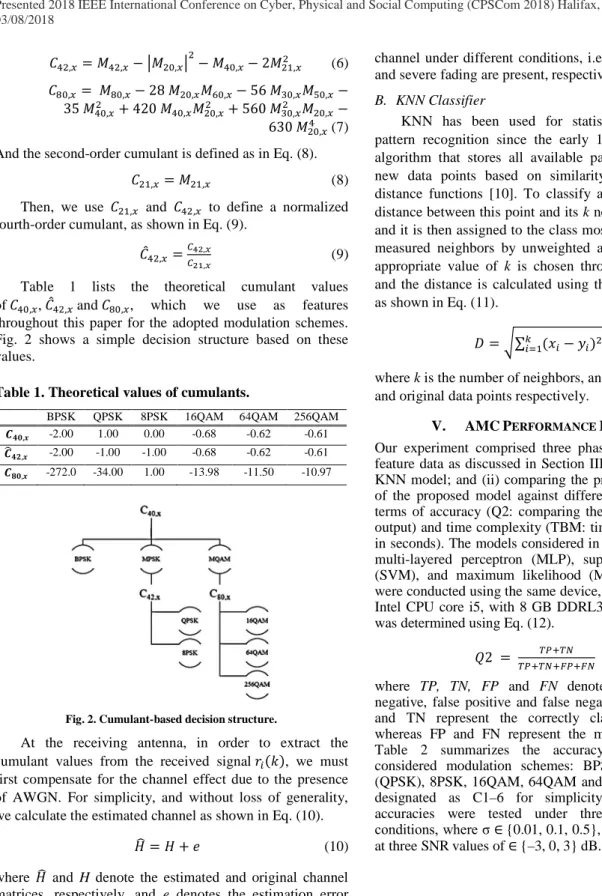
According to the moment-to-cumulant formula, the above functions can be expressed as shown in Eq. (5–7) [8,9].
ܥସଶǡ௫ൌ ܯସଶǡ௫െ หܯଶǡ௫หଶെ ܯସǡ௫െ ʹܯଶଵǡ௫ଶ (6)
ܥ଼ǡ௫ൌ ܯ଼ǡ௫െ ʹͺ ܯଶǡ௫ܯǡ௫െ ͷܯଷǡ௫ܯହǡ௫−
͵ͷܯସǡ௫ଶ ͶʹͲܯସǡ௫ܯଶǡ௫ଶ ͷͲܯଷǡ௫ଶ ܯଶǡ௫−
͵Ͳܯଶǡ௫ସ (7)
And the second-order cumulant is defined as in Eq. (8).
ܥଶଵǡ௫ൌ ܯଶଵǡ௫ (8)
Then, we use ܥଶଵǡ௫ and ܥସଶǡ௫ to define a normalized fourth-order cumulant, as shown in Eq. (9).
ܥመସଶǡ௫=రమǡೣమభǡೣ (9)
Table 1 lists the theoretical cumulant values ofܥସǡ௫,ܥመସଶǡ௫andܥ଼ǡ௫, which we use as features throughout this paper for the adopted modulation schemes. Fig. 2 shows a simple decision structure based on these values.
Table 1. Theoretical values of cumulants.
BPSK QPSK 8PSK 16QAM 64QAM 256QAM
,࢞ -2.00 1.00 0.00 -0.68 -0.62 -0.61
,࢞ -2.00 -1.00 -1.00 -0.68 -0.62 -0.61
ૡ,࢞ -272.0 -34.00 1.00 -13.98 -11.50 -10.97
Fig. 2. Cumulant-based decision structure.
At the receiving antenna, in order to extract the cumulant values from the received signalݎ(݇), we must first compensate for the channel effect due to the presence of AWGN. For simplicity, and without loss of generality, we calculate the estimated channel as shown in Eq. (10).
ܪ ൌ ܪ ݁ (10)
whereܪand H denote the estimated and original channel matrices, respectively, and e denotes the estimation error represented as a Gaussian complex vector with zero-mean,
and variance σ = [0.01, 0.1, 0.5] in order to study the
channel under different conditions, i.e. when low, tolerated and severe fading are present, respectively.
B. KNN Classifier
KNN has been used for statistical estimation and pattern recognition since the early 1970s. It is a simple algorithm that stores all available patterns, and classifies new data points based on similarity measures, such as distance functions [10]. To classify a new data point, the distance between this point and itskneighbors is evaluated, and it is then assigned to the class most common among all measured neighbors by unweighted average (voting). The appropriate value of k is chosen through cross-validation, and the distance is calculated using the Euclidean distance as shown in Eq. (11).
ܦ ൌ ටσ ሺݔୀଵ െ ݕ)ଶ (11)
wherekis the number of neighbors, andxiandyiare the new and original data points respectively.
V. AMC PERFORMANCEEVALUATION Our experiment comprised three phases: (i) collecting the feature data as discussed in Section III; (ii) constructing the KNN model; and (ii) comparing the predictive performance of the proposed model against different popular models in terms of accuracy (Q2: comparing the predicted and actual output) and time complexity (TBM: time to build the model in seconds). The models considered in this comparison were multi-layered perceptron (MLP), support vector machine (SVM), and maximum likelihood (ML). All experiments were conducted using the same device, a 64-bit OS, 2.6 GHz Intel CPU core i5, with 8 GB DDRL3 RAM. The accuracy was determined using Eq. (12).
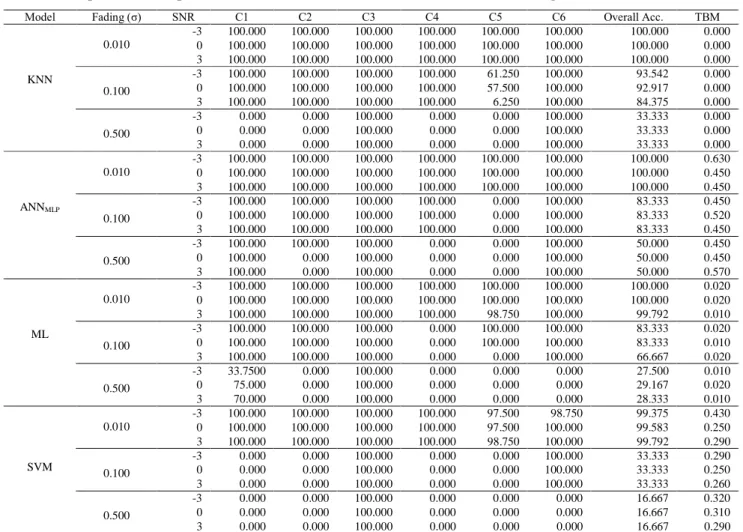
ܳʹൌ ்ା்ே ାிାிே்ା்ே (12) where TP, TN, FP and FN denote true positive, true negative, false positive and false negative, respectively. TP and TN represent the correctly classified data points, whereas FP and FN represent the misclassification rates. Table 2 summarizes the accuracy achieved for the considered modulation schemes: BPSK, quadrature PSK (QPSK), 8PSK, 16QAM, 64QAM and 256QAM, which are designated as C1–6 for simplicity. The classification accuracies were tested under three different channel
conditions, where σ ∈ {0.01, 0.1, 0.5}, and each was studied
Table 2. Comparison of the performance of our KNN model with other machine-learning models.
Model Fading (σ) SNR C1 C2 C3 C4 C5 C6 Overall Acc. TBM
KNN 0.010 -3 100.000 100.000 100.000 100.000 100.000 100.000 100.000 0.000 0 100.000 100.000 100.000 100.000 100.000 100.000 100.000 0.000 3 100.000 100.000 100.000 100.000 100.000 100.000 100.000 0.000 0.100 -3 100.000 100.000 100.000 100.000 61.250 100.000 93.542 0.000 0 100.000 100.000 100.000 100.000 57.500 100.000 92.917 0.000 3 100.000 100.000 100.000 100.000 6.250 100.000 84.375 0.000 0.500 -3 0.000 0.000 100.000 0.000 0.000 100.000 33.333 0.000 0 0.000 0.000 100.000 0.000 0.000 100.000 33.333 0.000 3 0.000 0.000 100.000 0.000 0.000 100.000 33.333 0.000 ANNMLP 0.010 -3 100.000 100.000 100.000 100.000 100.000 100.000 100.000 0.630 0 100.000 100.000 100.000 100.000 100.000 100.000 100.000 0.450 3 100.000 100.000 100.000 100.000 100.000 100.000 100.000 0.450 0.100 -3 100.000 100.000 100.000 100.000 0.000 100.000 83.333 0.450 0 100.000 100.000 100.000 100.000 0.000 100.000 83.333 0.520 3 100.000 100.000 100.000 100.000 0.000 100.000 83.333 0.450 0.500 -3 100.000 100.000 100.000 0.000 0.000 100.000 50.000 0.450 0 100.000 0.000 100.000 0.000 0.000 100.000 50.000 0.450 3 100.000 0.000 100.000 0.000 0.000 100.000 50.000 0.570 ML 0.010 -3 100.000 100.000 100.000 100.000 100.000 100.000 100.000 0.020 0 100.000 100.000 100.000 100.000 100.000 100.000 100.000 0.020 3 100.000 100.000 100.000 100.000 98.750 100.000 99.792 0.010 0.100 -3 100.000 100.000 100.000 0.000 100.000 100.000 83.333 0.020 0 100.000 100.000 100.000 0.000 100.000 100.000 83.333 0.010 3 100.000 100.000 100.000 0.000 0.000 100.000 66.667 0.020 0.500 -3 33.7500 0.000 100.000 0.000 0.000 0.000 27.500 0.010 0 75.000 0.000 100.000 0.000 0.000 0.000 29.167 0.020 3 70.000 0.000 100.000 0.000 0.000 0.000 28.333 0.010 SVM 0.010 -3 100.000 100.000 100.000 100.000 97.500 98.750 99.375 0.430 0 100.000 100.000 100.000 100.000 97.500 100.000 99.583 0.250 3 100.000 100.000 100.000 100.000 98.750 100.000 99.792 0.290 0.100 -3 0.000 0.000 100.000 0.000 0.000 100.000 33.333 0.290 0 0.000 0.000 100.000 0.000 0.000 100.000 33.333 0.250 3 0.000 0.000 100.000 0.000 0.000 100.000 33.333 0.260 0.500 -3 0.000 0.000 100.000 0.000 0.000 0.000 16.667 0.320 0 0.000 0.000 100.000 0.000 0.000 0.000 16.667 0.310 3 0.000 0.000 100.000 0.000 0.000 0.000 16.667 0.290
The results in Table 2 confirm the robustness of the KNN classifier. When the channel suffers from very low fading, almost all models show a nearly 100% correct classification rate (CCR). However, the KNN classifier outperformed all other models when the fading effect was
increased (σ = 0.1), showing a CCR >93% compared to
83%, 83% and 33% for the MLP, ML and SVM models, respectively. With severe channel fading, all models (including KNN) suffered a large decline in the CCR. Regarding the time complexity, it is clear that the KNN classifier is the fastest algorithm, with almost zero seconds required to build the model.
I. CONCLUSION
We have developed a low-complexity AMC approach based on HOC. Three values of cumulants were extracted from the received signal, and were used to classify six modulation schemes. The extracted features were then fed into a KNN classifier to be trained. This approach was found to be practical at low SNR values, and it showed promising results even in the presence of fading as compared to other models considered in this paper, or
described in the literature. The performance of the models was evaluated under different channel conditions, and for different SNR values, with the KNN classifier showing the highest CCR in most cases, and the lowest time complexity in all cases.
REFERENCES
[1] M. Mühlhaus, et al. Automatic modulation classification for MIMO systems using fourth-order cumulants.IEEE Vehicular Technology Conf. (VTC Fall).2012.
[2] H. Xiao,et al.Support Vector Machine Based Automatic Modulation Classification for Analog Schemes. Int. J. on Comput. Science and Tech.,vol. 2, no. 1, pp. 44–49, 2012. [3] P. Shih, and D-C. Chang. An automatic modulation
classification technique using high-order statistics for multipath fading channels.IEEE 11th Int. Conf. on ITS Telecom. (ITST),pp. 691–695, 2011.
[4] A. Swami, and B. Sadler. Hierarchical digital modulation classification using cumulants.IEEE Trans. on Comm.,vol. 48, no. 3, pp. 416–429, 2000.
modulation classification using cumulant features for communications via multipath channels.IEEE Trans. on Wireless Comm.,vol. 7, no. 8, pp. 3098–3105, 2008. [6] M. Marey, and O. Dobre. Blind Modulation Classification
Algorithm for Single and Multiple-Antenna Systems Over Frequency-Selective Channels. IEEE Signal Processing Letters,vol. 21, no. 9, pp. 1098–1102, 2014.
[7] S. Amuru, and C. da Silva. Cumulant-based channel estimation algorithm for modulation classification in frequency-selective fading channels.IEEE MILITARY
COMMUNICATIONS CONFERENCE, 2012-MILCOM,
2012.
[8] M. Aslam, Z. Zhu, and A. Nandi. Automatic modulation classification using combination of genetic programming and KNN.IEEE Trans. on Wireless Comm.,vol. 11, no. 8 pp. 2742–2750, 2012.
[9] K. Takeyasu, Y. Higuchi, and K. Imura. Simplified Machine Diagnosis Techniques by Impact Vibration Using Higher Order Cumulants of Absolute Deterioration Factor.Int. J. of Info.,vol. 2, no. 2, pp. 99–105, 2007. [10] N. Suguna, and K. Thanushkodi. An improved K-nearest
neighbor classification using Genetic Algorithm.Int. J. of Computer Science Issues,vol. 7, no. 2, pp. 18–21, 2010.