Contents lists available atSciVerse ScienceDirect
Artificial Intelligence
www.elsevier.com/locate/artintBagging and Boosting statistical machine translation systems
✩
Tong Xiao
a, Jingbo Zhu
a, Tongran Liu
b,
∗
aCollege of Information Science and Engineering, Northeastern University, Shenyang 110819, China
bKey Laboratory of Behavioral Science, Institute of Psychology, Chinese Academy of Sciences, 10A Datun Road, Chaoyang District, Beijing 100101, China
a r t i c l e
i n f o
a b s t r a c t
Article history: Received 15 March 2011
Received in revised form 5 October 2012 Accepted 15 November 2012
Available online 12 December 2012 Keywords:
Statistical machine translation Ensemble learning
System combination
In this article we address the issue of generating diversified translation systems from a single Statistical Machine Translation (SMT) engine for system combination. Unlike traditional approaches, we do not resort to multiple structurally different SMT systems, but instead directly learn a strong SMT system from a single translation engine in a principled way. Our approach is based onBaggingandBoostingwhich are two instances of the general framework of ensemble learning. The basic idea is that we first generate an ensemble ofweaktranslation systems using a base learning algorithm, and then learn astrongtranslation system from the ensemble. One of the advantages of our approach is that it can work with any of current SMT systems and make them stronger almost “for free”. Beyond this, most system combination methods are directly applicable to the proposed framework for generating the final translation system from the ensemble of weak systems. We evaluate our approach on Chinese–English translation in three state-of-the-art SMT systems, including a phrase-based system, a hierarchical phrase-based system and a syntax-based system. Experimental results on the NIST MT evaluation corpora show that our approach leads to significant improvements in translation accuracy over the baselines. More interestingly, it is observed that our approach is able to improve the existing system combination systems. The biggest improvements are obtained by generating weak systems using Bagging/Boosting, and learning the strong system using a state-of-the-art system combination method.
©2012 Elsevier B.V. All rights reserved.
1. Introduction
Machine Translation (MT) is one of the oldest sub-fields in Natural Language Processing (NLP) and Artificial Intelligence (AI). During the last decade, statistical approaches have received a growing interest in machine translation, showing state-of-the-art performance for many language pairs. To date, several Statistical Machine Translation (SMT) paradigms have been developed, including phrase-based SMT[58], hierarchical phrase-based SMT[14], and syntax-based SMT[20,23,32,39,66]. Al-though these systems and approaches are of competitive translation quality, they have different strengths and weaknesses. For example, phrase-based approaches are very powerful in local reordering that is inherent in phrase translations, but have limited capabilities in dealing with long distance phrase dependencies. On the other hand, syntax-based approaches charac-terize the movement of hierarchical structures by linguistic notions of syntax, but suffer from the errors of syntactic parsers and structure divergence between languages. By offsetting weaknesses with strengths of other systems, combination is a
✩ This article is an extended version of a conference paper (Xiao et al., 2010[109]). Substantial differences are: we present a new method (Bagging) for improving single SMT engines (Section 3); we present significant extensions of the experimental studies on the proposed methods (Section 4); and we present more detailed analysis of the related work (Section 5) and discussions on several important issues (Section 6).
*
Corresponding author. Tel.: +86 10 64854533. E-mail address:[email protected](T. Liu).0004-3702/$ – see front matter ©2012 Elsevier B.V. All rights reserved. http://dx.doi.org/10.1016/j.artint.2012.11.005
Fig. 1.Illustration of different ways to generate diversified translation outputs for system combination.
desirable way to achieve higher translation accuracy than does any individual system. Therefore, it is beneficial to explore approaches that combine different systems as well as their outputs and produce better translations. Recently, motivated by the GALE program,1 multiple SMT systems have been developed by different consortiums, and more and more studies are focused on combining multiple SMT systems to further advance the final consortium system.
The basic idea of system combination is to extract or generate a translation by voting from an ensemble of translation outputs. Depending on how the translation is combined and what voting strategy is adopted, several methods can be used for system combination. For example, sentence-level combination[49] simply selects one from original translations, while more sophisticated methods, such as word-level/phrase-level combination[76,88], can generate new translations differing from any of the original translations.
One of the key factors in system combination is the diversity in the ensemble of translation outputs [69]. To obtain diversified translation outputs, most combination systems require multiple translation engines based on different models[6, 76,89](see Fig. 1(a)). Although various SMT systems/models have been utilized for system combination, previous approaches only use the ensemble of existing systems at hand, rather than generating the ensemble of different systems in a principled way. Moreover, due to the high cost of developing and tuning SMT systems, these approaches might not be very good choices when multiple SMT engines cannot be accessed. In this case, it is worth exploring alternatives that combine translation systems built from a single translation engine instead (Fig. 1(b)).
In this article, we address the issue of how to generate an ensemble of diversified translation systems from a single translation engine in a principled way. Our contribution is two-fold:
•
We present a simple and effective approach to learning a strong translation system from a single SMT engine using Bagging and Boosting.•
We present a comprehensive evaluation of Bagging and Boosting on SMT system combination, and demonstrate their effectiveness in improving translation quality for three types of SMT models and several existing system combination methods.In our approach, we first generate a diverse ensemble ofweak translation systems(orweak systemsfor short) by manipu-lating a distribution over the training data, and then combine them to produce astrong translation system(orstrong system for short). To obtain the ensemble, a sequence of weak systems is generated from a base system in an iterative manner. In each iteration, a new weak system is learned with respect to a distribution over training samples. Two strategies are adopted to maintain the distribution: generating different versions of the training set by using sampling with replacement (as in Bagging), or changing the distribution to focus more on the training samples that are relatively poorly translated by previous weak systems (as in Boosting). After all the weak systems are collected, astrongtranslation system is finally built from the ensemble of weak translation systems using various system combination methods.
Such an approach has several benefits. First of all, as no restriction is made on what type of translation engines we learn from, it can work with any SMT systems and make them stronger almost “for free”. Moreover, current system combination methods are directly applicable to generating the strong system from the ensemble of weak systems. This means that we can re-use existing system combination methods for the final system generation in the proposed framework, rather than developing new methods. In addition, our approach is very “cheap” from the engineering standpoint. All we need is a slight modification of the weight training module, while keeping other components unchanged in current SMT pipeline (if the system combination method has already been repaired for selecting/generating the final translation from the ensemble).
Our experiments are carried out on Chinese–English translation in three state-of-the-art SMT systems, including a phrase-based system [40,110], a hierarchical phrase-based system [14] and a syntax-based system [39,70]. These systems are evaluated on the NIST MT evaluation test sets. Experimental results show that our approach leads to significant improve-ments in translation accuracy over the baseline systems. More interestingly, it is observed that the proposed approach is very helpful in improving existing system combination methods. For example, the biggest improvements are obtained by gen-erating weak systems using Bagging/Boosting, and learning the strong system using a state-of-the-art system combination
method. When combining three types of translation engines, our approach finally results in an absolute improvement of over 1.9 BLEU points over the baselines on all the evaluation sets.
The rest of the article is structured as follows. Section 2 briefly introduces the background knowledge of SMT and ensem-ble learning. Section 3 describes our approach to generating and combining diversified translation systems with Bagging and Boosting. Then, Section 4 presents experimental evaluation of our approach. After reviewing the related work in Section 5, some interesting issues are discussed in Section 6. Finally, the article is concluded with a summary and outlook of further work.
2. Background
2.1. Log-linear model and statistical machine translation
Given a source string f, the goal of machine translation is to translate f into a target stringe. In SMT, this problem can be stated as: we find a target stringe∗ from all possible translations by the following equation:
e∗
=
arg maxe Pr
(
e|
f)
(1)where Pr
(
e|
f)
is the probability that eis the translation of the given source string f. To model the posterior probability Pr(
e|
f)
, most SMT systems utilize the log-linear model proposed by Och and Ney[81]:Pr
(
e|
f)
=
exp(
M m=1λ
m·
hm(
f,
e))
eexp(
M m=1λ
m·
hm(
f,
e))
(2) where {hm(
f,
e)
|
m=
1, . . . ,
M}
is a set offeatures, andλ
m is thefeature weightcorresponding to them-th feature.hm(
f,
e)
can be regarded as a function that maps each pair of source string f and target stringeinto a real number, andλ
mcan be regarded as the contribution ofhm(
f,
e)
to Pr(
e|
f)
. Ideally,λ
mindicates the pairwise correspondence between the featurehm
(
f,
e)
and the overall score Pr(
e|
f)
. A positive value ofλ
mindicates a correlation betweenhm(
f,
e)
and Pr(
e|
f)
, while a negative value indicates an inversion correlation.In this article, we use u to denote a model that has M fixed features {h1
(
f,
e), . . . ,
hM(
f,
e)
}
, useλ
= {
λ
1, . . . , λ
M}
to denote the M parameters of u, and use u(
λ
)
to denote an SMT system based on u with parametersλ
. In a general SMT pipeline,λ
is learned on a training (or tuning) data set2 to obtain an optimized weight vectorλ
∗ as well as an optimized systemu(
λ
∗)
. To learn the optimized weight vectorλ
∗,
λ
is usually optimized according to an objective function that (1) takes the translation quality into account; (2) and can be automatically learned from MT outputs and reference translations (or human translations). For example, we can use BLEU[84], a popular metric for evaluating translation quality, to define an error function and learn optimized feature weights using the minimum error rate training method.In principle, the log-linear model can be regarded as an instance of the discriminative model which has been widely used in NLP tasks[8,86,101]. In contrast with modeling the problem in a generative manner[13], discriminative modeling frees us from deriving the translation probability for computational reasons and provides capabilities to handle the features that are able to distinguish between good and bad translations[68]. In fact, arbitrary features (or sub-models) can be introduced into the log-linear model, even if they are not explained to be well-formed probabilities at all. For example, we can take both phrase translation probability and phrase count (i.e., number of phrases used in a translation derivation) as features in such a model. As the log-linear model has emerged as a dominant mathematical model in SMT in recent years, we choose it as the basis of this study.
2.2. Ensemble learning
Given a model (e.g., the log-linear model mentioned above), many individual statistical systems with different param-eters (e.g., different features weights in the log-linear model) can be learned, and the “best” system is in general selected according to some criteria. Though widely used, this paradigm suffers from two problems. First, we have to decide which
one is the best. The answer is not so straightforward when more than one candidate systems meet the criteria. The situation
is even more severe when the learning algorithm is prone to different local optimal and/or no sufficient training data is provided. Second, potentially-valuable information may be lost by discarding those less-successful systems. In many cases, the discarded candidate system may successfully handle some samples, though it does not obtain the best performance over the whole data-set. A natural solution to these problems is employing multiple systems and combining their predictions.
Ensemble learningis such a family of learning approaches, which is motivated by the fact that errors can be complemented
by other correct predictions[87]. In ensemble learning, anensembleis viewed as a collection ofmember systems(or
compo-nent systems), which can be combined to obtain a stronger generalization ability than the individual systems making up the
ensemble. Generally, member system is also called weak system, and the ensemble of weak systems is called strong system.
2 The data set used for weight training is generally calleddevelopment setortuning setin the SMT community. In this article, we use the termtraining setto emphasize the training of the log-linear model.
Typically, an ensemble is built in two ways. First, a number of weak systems are learned using abase learning algorithm
(or base learner). Then, the resulting weak systems are combined to generate a strong system. To learn a good ensemble,
a widely-adopted principle is that the weak systems in the ensemble should be bothaccurateanddiverse[43,45,59,83]. In general, learning accurate individual system is task-oriented: there is no “best” learning algorithm for all the problems; and we need to select an appropriate learning algorithm for a specified task. Therefore, most ensemble learning approaches focus more on generating and combining a diverse and complementary set of weak systems[10,50,91,106]. To introduce diversity into the ensemble, there are many choices [3,52,71,105], such as subsampling training samples, manipulating outputs of weak systems and injecting randomness in base learning algorithm. Among them, two most popular methods for creating accurate and diverse ensemble are Bagging [10] and Boosting [91]. These methods are based on resampling techniques which obtain different distributions of training set for each of the individual systems. Previous work has demonstrated that both Bagging and Boosting are effective for classification systems[7,10,11,25,37]. However, there have been few empirical and/or theatrical studies with MT systems (especially with MT system combination).
2.3. Adapting Bagging and Boosting to SMT
We believe that Bagging and Boosting are promising in SMT for several reasons. First, ensemble learning is a well-studied topic in Machine Learning (ML). Previous studies have shown that Bagging and Boosting have very nice theoretical proper-ties, which leads to good ability in reducing both training error and generalization error[82,92]. Moreover, empirical testing has verified the effectiveness of these methods in several NLP tasks, such as text categorization[94] and natural language parsing[48]. It also indicates the potential power of Bagging and Boosting in MT. In addition, ensemble learning methods address boththe statistical problem andthe computational problemwhich most SMT systems suffer from. As stated in [21], the statistical problem refers to the case that the learning algorithm has to select 1-best result from several equally-good systems. For example, translations generated by different SMT systems are sometimes of very competitive translation quality (e.g. comparable BLEU scores). Obviously, voting from these systems can reduce the risk of missing the “best” translation. The computational problem actually refers to the search problem in SMT. As ensemble learning can be regarded as a pro-cedure of multi-path search in a general search framework[90], it is considered to be useful in reducing search errors. In a sense, both the statistical problem and the computational problem indicate some sort of variance for a statistical learning system. Dietterich[21]summarized them asoutput varianceandcomputational variance, respectively. He further pointed out that the success of ensemble methods can be attributed to their ability in reducing the variance of learning algorithm. Many experimental studies have confirmed this argument[3,52,71,105], and imply a potential application of Bagging and Boosting in SMT.
While Bagging and Boosting have been extensively investigated in machine learning, their adaptation to SMT is not a trivial task. The first issue is how to build an ensemble of diverse SMT systems. Modern SMT systems are very complex systems which rely on several components to generate final translation. Training this type of system is not simple in either theoretical or engineering aspect. Moreover, the training criterion of SMT system is very different from that used in classifi-cation task. For example, BLEU, the well-known evaluation metric used in defining SMT training criterion, is a discontinuous and non-differentiable function, which leads to very different optimization algorithms from those used in classification. An-other issue is how to combine SMT systems. In classification tasks, the search space is a predefined set of labels. By contrast, SMT systems search for the best translation in an extremely large (or almost infinite) set of target-language sentences. As a result, we have to use very different ways for combining SMT systems, which are usually much more complicated than the simple voting strategy used in classification systems.
Although a few past studies have tried to introduce Bagging and Boosting into SMT [30,62], they fail to establish a general connection between Bagging/Boosting and SMT. Some of them restrict themselves to specific SMT engines[62], and others focus only on late-stage re-ranking which suffers greatly from search errors[30]. To our knowledge, it is rare to see systematic and extensive testing of Bagging and Boosting in SMT. In this article we address all these issues. In particular, we present a general solution to adapting Bagging and Boosting to SMT (Section 3), as well as a systematic and empirical study on Bagging and Boosting SMT systems (Section 4).
3. Boosting and Bagging single translation engines
3.1. Overview
We begin by denoting the combination model as v. Then we define v(
·
)
to be acombination systemwhich combines a number of input member systems. The input of function v(·
)
is an arbitrary number of SMT systems, and the output is a “new” system that selects or generates the “best” translation from thek-best outputs of the input systems. By using these notations, the task of system combination can be defined as: given T SMT systems {u1(
λ
∗1), . . . ,
uT(
λ
∗T)
}
, we build a new translation system v(
u1(
λ
∗1), . . . ,
uT(
λ
∗T))
from {u1(
λ
∗1), . . . ,
uT(
λ
∗T)
}
. Herev(
u1(
λ
∗1), . . . ,
uT(
λ
∗T))
is the combination system which combines translations from the ensemble of the output of each individual member systemui(
λ
∗i)
. As discussed in Section 1, the diversity among outputs of member systems is an important factor contributing to the success of system combination. To obtain diversified member systems, traditional approaches concentrate more on using structurally differentInput: an SMT modelu, a combination modelv, a training setSconsisting ofmsamples (denoted as {(f1,r1), . . . , (fm,rm)}where fiis thei-th source sentence), andriis the set of reference translations forfi.
Output: a strong translation system
1. Initialize:D1(i)=1/mfor alli=1, . . . ,m 2. Fort=1, . . . ,T
a) Training: Train a weak systemu(λ∗t)on {(fi,ri)}using distributionDt
b) Re-weighting: Generate a new distributionDt+1by updatingDt
3. Output the final (strong) system:
v(u(λ∗1), . . . ,u(λ∗T))
Fig. 2.Overview of our approach.
member systems, that is, for any ux anduyin {u1
,
u2, . . . ,
uT}
, we haveux=
uy. However, this constraint condition cannot be satisfied when multiple translation engines are not available.In this article, we argue that the diversified member systems can also be generated from a single engine u
(
λ
∗)
in a principled way. The first issue that arises is how to adjust the training parameters to obtain different SMT systems. In the general pipeline of SMT training [14,58], there are several key steps that affect the resulting system, for example, word alignment, phrase/rule extraction, parameter estimation, weight training (or tuning) and so on. As these training steps are mutually correlated, it is difficult to adjust them all together. Instead, a better method is to vary one training step at a time and keep others unchanged. Motivated by this idea, we focus more on the weight training (or tuning) for learning SMT systems, and obtain diversified member systems using different weight training results. We choose weight training as the base learning procedure because it has great impact on training log-linear model-based systems [79]. Moreover, since weight training is a late-stage sub-routine in the training pipeline, it could result in a more efficient method to generate diversified SMT systems, without calling early-stage sub-routines, such as word alignment. It is worth noting that, although we will restrict ourselves to weight training for our discussion and experiments, the approach presented in this article could handle a more general case where diversified member systems are generated by adjusting the parameters in early training steps.3Then, assumingu1
= · · · =
uT=
u, our goal can be stated as: to find a series ofλ
∗i and build a combined system from {u(
λ
∗i)
}
. To do this, we propose an approach to generating and combining multiple translation systems using Bagging and Boosting. Like standard algorithms in ensemble learning, such as AdaBoost[37,92], this approach uses weak systems to form a strong system by repeatedly calling a base learner on different distributions over the training samples.Fig. 2 is an overview of our approach. Given a training set S consisting ofm training samples {(f1
,
r1), . . . , (
fm,
rm)}
, our approach learns a group of diverse SMT systems on different distributions {Dt(
i)
|
t=
1, . . . ,
T}
over S, where Dt(
i)
denotes the sample weighton the i-th training sample. The key point here is that our approach maintains a set of sample weights {Dt(
0), . . . ,
Dt(
m)
}
and adjusts them after each weak system is learned with the base learning algorithm. Initially all the samples have equal weights. A succession of weak systems are then generated iteratively by: (1) training a new weak system u(
λ
∗t)
usingDt; (2) and generating a new distribution Dt+1 using Bagging or Boosting-based weight updatingmethods. In this article these two procedures are called training andre-weighting, respectively. Finally, a strong system is built from {u
(
λ
∗i)}
that are obtained in the previous steps.Obviously, the approach presented in Fig. 2 follows the general framework of Bagging and Boosting [10,35,37,52,82]. However, both algorithms are originally designed for classification tasks that differs greatly from machine translation in natural language processing. When applying Bagging and Boosting to SMT system combination, we need to reconsider the following fundamental issues:
•
Member system generation: How should each weak system (or member system) be induced? In traditional SMT paradigm, alltraining samples are equally weighted and the SMT training is not influenced by sample weights. Improved methods are required for generating diversified weak systems using different distributions over the training set.
•
Sample re-weighting: How should each distribution be chosen on each round? In our approach, the sample distribution isrequired to be changed for generating different weak systems. Thus we need to investigate methods to adjust the weights of certain samples according to some criteria, such as criteria that concentrate more on the samples with relatively low translation quality.
•
Strong system generation: How should the weak systems (or member systems) be combined to form a strong system?Differingfrom classification systems, SMT systems do something like ranking a list of translation candidates (or a translation lattice).4 It is not so straightforward to combine the k-best outputs by reusing the simple voting strategy adopted in
3 We will give a discussion on this issue in Section 6.4.
4 In traditional classification tasks[7], the possible labels for a given input can be enumerated efficiently. Therefore, the combination of classification
systems is very trivial: given an input sample, we score each label by individual systems, and simply select the highest-scoring one as the output by voting. However, in machine translation, it is intractable to generate all potential translations due to the extremely high complexity in decoding[54]. Instead, the system combination is performed on a limited sub-space of all translations (such ask-best translations and translation lattice) produced by member systems, which results in complex combination schemes.
classifier combination. So we also need to consider how to select or generate the final translation from the ensemble of k-best outputs produced by member systems.
To fit Bagging and Boosting into SMT system combination, all three of the above issues need to be addressed. In the rest of this section, we describe our solutions in detail.
3.2. Base learning algorithm
To optimize the feature weights, we choose Minimum Error Rate Training (MERT), an optimization algorithm introduced by Och[79], as the base learning algorithm in this work. The basic idea of MERT is to search for the optimal weights by minimizing a given error metric on the training set, or in other words, maximizing a given translation quality metric. Let F
=
f1. . .
fmbemsource sentences,u(
λ
)
be an SMT system, E(
u(
λ
))
=
e∗1. . .
e∗mbe the translations produced byu(
λ
)
, andR
=
r1. . .
rm be the reference translations whereri= {
ri1, . . . ,
riN}
. The objective of MERT can be defined as:λ
∗=
arg min λErr
Eu(λ)
,
R (3)whereErris anerror ratefunction. Generally,Erris defined with an automatic metric that measures the number of errors inE
(
u(
λ
))
with respect to the reference translations R. Since any evaluation criterion can be used to defineErr, MERT can seek a tighter connection between the feature weights and the translation quality. However, involving MT evaluation metrics generally results in an unsmoothed error surface, which makes the straightforward solution of Eq. (3) not trivial. To address this issue, Och[79]developed a grid-based line search algorithm to approximately solve Eq. (3) by performing a series of one-dimensional optimizations of the feature weight vector, even ifErris a discontinuous and non-differentiable function. While Och’s method cannot guarantee to find the global optima, it has been recognized as a standard solution to learning feature weights for current SMT systems due to its simplicity and effectiveness.Like most state-of-the-art SMT systems[15,57], in this work we choose BLEU[84]as the accuracy measure to define the error function used in MERT.5However, the method described above cannot work in our case because the learning procedure is not sensitive to the distribution Dt
(
i)
. That is, we cannot use MERT to generate different SMT systems on different distributions {Dt(
i)
}
by optimizing standard BLEU scores directly. To handle this problem, we modify the original definition of BLEU so that the error is measured with respect to the distributionDt(
i)
and MERT can accept weighted training samples accordingly. In this article the modified version of BLEU is calledweighted BLEU(WBLEU). It has the following form6:WBLEU
Eu(λ)
,
R=
BPEu(λ)
,
R×
4 q=1 Precisionq Eu(λ)
,
R1
/4 (4) where BPEu(λ)
,
R=
exp 1−
max 1,
m i=1Dt(
i)
min1jN{|
g1(
ri j)
|}
m i=1Dt(
i)
|
g1(
e∗i)
|
(5) Precisionq Eu(λ)
,
R=
m i=1Dt(
i)
|
gq(
e∗i)
∩
(
Nj=1gq(
ri j))
|
m i=1Dt(
i)
|
gq(
e∗i)
|
(6) Here gn(
s)
is the multi-set7 of all n-grams in a string s. In the above definition, BP(
E(
u(λ)),
R)
is the brevity penalty. mi=1Dt
(
i)
min1jN{|
g1(
ri j)
|}
andmi=1Dt(
i)
|
g1(
e∗i)
|
are the effective reference length and the length of MT output overthe weighted training samples, respectively. According to this formulation, the translation would be penalized when its length is shorter than the effective reference length.
The second factor on the right-hand side of Eq. (4) indicates then-gram precision. Here
mi=1Dt(
i)
|
gq(
e∗i)
|
is the num-ber ofn-grams in the MT output, and mi=1Dt(
i)
|
gq(
ei∗)
∩
(
Nj=1gq(
ri j))
|
counts the clipping presents of n-grams in the reference translations. As all then-grams ine∗i and{
ri j}
are weighted by Dt(
i)
, then-gram precision is affected more by the samples with large Dt(
i)
. In other words, if a training sample has a larger weight, the correspondingn-grams will have more impact on the overall scoreWBLEU(
E,
R)
and the training sample will gain more importance in MERT.Obviously, the original definition of BLEU is a special case of WBLEU when all the training samples are equally weighted. This also means that the training on the first round (i.e., t
=
1)
actually makes no difference from the traditional SMT training. So the first weak systemu(
λ
∗1)
can be regarded as thebaselinesystem generated by our approach.5 Although BLEU is used for our study, our approach is applicable to other popular metrics, such as NIST score[24]and mWER[78]. 6 Here we use the NIST-version BLEU where theeffective reference lengthis the length of the shortest reference translation. 7 We follow[16]to define the multi-sets: given a multi-setX, we use #
X(a)to denote the number of timesaappears inX. Then:
|X| = a
As the weighted BLEU is used to measure the translation accuracy on the training set, the error rate function is defined to be:
Err
Eu(λ)
,
R=
1−
WBLEUEu(λ)
,
R (7)3.3. Re-weighting
Once a weak system is learned, our approach updates the weights of samples so that it can focus more on a different distribution in the next round of system training. This procedure takes a weak system and a distribution of training set as input and generates a new distribution for training the following system. To adjust the distribution over training samples, we use two methods that are inspired by two types of algorithms: those that adjust the distribution of the training set without knowing the performance of previous weak system (as in Bagging), and those that adaptively adjust the distribution based on the performance of previous weak system (as in Boosting).
3.3.1. Bagging-based Re-weighting
Bagging, or Bootstrap aggregating, is one of the most effective and simplest methods in ensemble learning [10]. As a special case of model averaging, it promotes model variance by using different versions of a bootstrapped training set, i.e., sampling training set with replacement. Each version of the training set is then used to train a different model. Although Bagging is originally designed for classification and usually used to improve decision tree models [10,11,25], it has been successfully applied to many types of models of classification or regression, and has been recognized as one of the state-of-the-art ensemble learning algorithms. In this work we apply Bagging to sample re-weighting. The following pseudo-code describes the Bagging-based re-weighting algorithm for our approach.
Bagging-based Re-weighting Algorithm
Input: a training setSofmsamples
Output: a set of sample weights{Dt(i)|i=1, . . . ,m}overS 1 FunctionBaggingBasedReweighting(S)
2 fori=1tomdo
3 Dt(i)=0
4 m=m×τ determine the rounds of sampling 5 forj=1tomdo sampling formtimes
6 i=DrawSample(1,m) draw a sample with replacement 7 Dt(i)=Dt(i)+1/m re-weighting
8 return{Dt(i)}
9 FunctionDrawSample(1,m)
10 returna random number between 1 andm
Given a training set S consisting of m samples, the algorithm produces a distribution over S by drawing m samples uniformly from S. If a sample with index i is drawn from S
,
Dt(
i)
will be updated by adding a number of 1/
m. Finally the resulting sample weight has a form of Dt(
i)
=
x/
m, where xis an integer ranging from 0 tom.x=
0 means that the sample is not selected as the training sample and will not affect the training of following weak system.τ
is a real-valued parameter that controls the number of active samples in the training set. In this work it chooses values in the range of(
0,
1]
.Theoretically, Bagging is effective only if the base learning algorithm is unstable [11], that is, a small change in the training set can result in large changes in the learned weak system. Theinstabilityof learning algorithms has been studied in classification [11,12]. In this article, we discuss the issue in the context of SMT. Instead of presenting a theoretical analysis, we give an empirical study on this issue in the evaluation section (Section 4.7), followed by a further discussion in Section 6.3.
3.3.2. Boosting-based Re-weighting
Boosting is a method that is introduced by Schapire[91]for boosting the performance of weak learning algorithms. Like Bagging, Boosting adjusts the sample weights to perform weak system training on different distributions over training set. Beyond this, Boosting differs sequentially from Bagging, since it changes the sample weights based on the weak system generated previously. The basic idea of Boosting is straightforward: it places the most weight on the samples on which the preceding weak systems perform poorly, and thus forces the weak system learner to focus on the “harder” samples. Boosting has several advantages[92]: it is simple and easy to implement; it requires no prior knowledge about the base learning algorithm; and it has very nice theoretical properties, such as the good bounds on both training error and generalization error[29,72,73]. Due to these advantages, we choose Boosting as another re-weighting method in this work. The following pseudo-code shows the Boosting-based re-weighting algorithm for our approach.
Boosting-based Re-weighting Algorithm
Input: a training setSofmsamples, current sample weights{Dt(i)|i=1, . . . ,m}, the newly-generated weak systemu(λ∗t). Output: a new set of sample weights{Dt+1(i)|i=1, . . . ,m}overS
1 FunctionBoostingBasedReweighting(S,{Dt(i)},u(λ∗t)) 2 ε=GetErr(u(λt∗),S) 3 set α=12ln 1+ε ε (8) 4 fori=1tomdo 5 update Dt+1(i)= Dt(i)·exp(α·loss(i)) Zt re-weighting (9)
whereloss(i)is the loss on thei-th sample, andZtis the normalization factor 6 return{Dt+1(i)}
7 FunctionGetErr(u(λ∗),S)
8 returnerror rate ofu(λ∗)onS
This algorithm increases the weights of the samples that are relatively poorly translated by the current weak system so that the MERT-based learner can focus on hard samples in next round. A larger updated weight Dt+1
(
i)
indicates that thecorresponding sample impacts more on the training of following weak system. Equation (9) shows the update rule with two parameters
α
andloss(i)
in it.The main effect of
α
is to scale the weight updating (e.g., a largerα
means a greater update). Once a weak system is received, the algorithm calculates the corresponding error rateε
(line 2) and chooses the parameterα
as in Eq. (8). Intuitively,α
can be regarded as a measure of the importance that thet-th weak system gains in Boosting. As is defined in Eq. (8),α
gets larger asε
gets smaller, and always has a positive value.8 In this way, a weak system with a smaller error rate would affect more on the weight updating.loss(i) is the loss on the i-th sample. For eachi, let
{
ei1, . . . ,
eik}
be thek-best translation candidates produced by the current weak system. The loss function is defined to be:loss
(
i)
=
BLEU(
eˆ
i,
ri)
−
1 p p j=1 BLEU(
ei j,
ri)
(10)where BLEU(e
,
r)
is a function that returns the smoothed sentence-level BLEU score [65] of the translation e with re-spect to the reference translations r, and eˆ
i is the oracle translation which is selected from {ei1, . . . ,
eik}
in terms of BLEU(ei j,
ri)
. BLEU(eˆ
i,
ri)
is the oracle BLEU score and indicates the upper-bound performance of the system on the i-th sample. pj=1BLEU(
ei j,
ri)/
p is the average BLEU score of the top-p translation candidates generated by the MT system. Herepis a parameter that controls how many translation candidates are involved in calculating the loss. Intuitively, Eq. (10) defines a “distance” of the MT output from the oracle translation. A large “distance” means a large cost that we guess the top-p translation candidates instead of the oracle translation. By integratingloss(i) into Eq. (9),loss(i)’s value accounts for the magnitude of weight update, that is,Dt(
i)
gets a large update when the current weak system produces poor translations for thei-th sample. Note that the definition of the loss function here is similar to that used in[17] where only the top-1 translation candidate (i.e., p=
1)
is taken into account.3.4. Strong system generation
In the last step of our approach, a strong translation system is built from the ensemble of weak systems. This procedure is exactly the same as traditional system combination, i.e., given a set of translation candidates generated by multiple systems, we select the “best” candidate as the final output or generate a new translation that are “better” than any of them. Therefore, all of current system combination methods are applicable to the strong system generation in our case. In this work we consider three types of methods for learning the final translation from the outputs of member systems:
•
Sentence-level combination. Sentence-level combination (orhypothesis selection) is one of the simplest instances of systemcombination, and has been successfully employed in several MT systems[26,49]. Its idea is straightforward: given a pool of translation candidates, the final translation is generated by choosing the most promising candidate from the pool according to certain criteria. For example, we can select the candidate that agrees most with other candidates by using n-gram matching scores[49]. Also, Minimum Bayes-Risk (MBR) decoding[41]is applicable to our case for selecting the minimum risk translation ofk-best list generated by a single translation engine[60]or multiple translation engines[42].
•
Word-level/phrase-level combination. Unlike sentence-level combination, word-level/phrase-level combination can gener-ate new translations differing from any of the original translations. While many word-level/phrase-level combination methods exist, we choose confusion networks in this work due to their superiority in recent system combination tasks[6,76,89]. In system combination based on confusion networks, a primary translation is first chosen as a backbone (or skeleton) and aligned with other translation candidates. Then, a new search space is constructed from those backbone-aligned translation candidates. The final consensus translation is generated via a voting procedure of a feature-based model. In this work we take confusion network-based combination as a more sophisticated alternative to sentence-level combination.
•
Re-ranking. Re-ranking is a very popular approach to improving the performance of single translation engines. Basically,re-ranking can be cast as a special instance of multi-pass decoding in SMT [56]. In the first pass, a set of translation candidates are generated using individual models and local features. Then, in the second pass, these translation candi-dates are ranked according to an additional model with the use of more global features. Though re-ranking is originally developed to re-rank the k-best list generated by a single MT system, it can work on selecting the best translation from multiple k-best lists in our case because all the member systems generated by Bagging/Boosting are based on the same model and feature set. Here we choose re-ranking as an additional method for final system generation. Note that re-ranking is of no use when multiple structurally different systems are provided, and thus cannot be employed to combine systems based on different base models.
4. Experiments
Our experiments are conducted on the NIST Chinese–English translation tasks9in three SMT systems.
4.1. Base systems
The first system is aphrase-basedsystem with two reordering models, including the maximum entropy-based lexicalized reordering model proposed in[110] and the hierarchical phrase reordering model proposed in[40]. In addition to the re-ordering features, we use most standard features adopted in current state-of-the-art phrase-based systems[57,58], including bidirectional phrase translation probabilities, bidirectional lexical weights, ann-gram language model, target word penalty and phrase penalty. In our system all phrase pairs are limited to have source length of at most 3, and the reordering limit is set to 8 by default.10
The second system is an in-house reimplementation of theHierosystem which is based on the hierarchical phrase-based model proposed by Chiang[14]. The basic feature set used in our implementation is designed according to[15].
The third system is asyntax-basedsystem based on the string-to-tree model[39,70]. In this system, both minimal GHKM and SPMT rules are extracted from the bilingual text, and larger rules are generated by composing two or three minimal GHKM and SPMT rules. The feature design is mainly based on a state-of-the-art MT system described in[70]. For example, we use the bidirectional lexical and phrase-based translation probabilities (4 features), a syntactic feature – root normalized conditional probability, ann-gram language model, target word penalty, rule penalty and three binary features – lexicalized rule; low-frequency rule; composed rule. For integratingn-gram language model into decoding efficiently, rules containing more than two variables are binarized using the synchronous binarization method[108,112].
All three of the above systems are built using the NiuTrans open-source SMT toolkit [107]. To achieve state-of-the-art performance, we further advance these systems in three ways: (1) we use an additional feature that counts the high-precision lexicon mappings involved in each translation derivation11; (2) we add a word deletion feature so that the systems can learn how often word deletion is performed; (3) and we use four specialized translation modules to translate date, time, name and byline respectively, and insert their translations into the SMT systems.
To obtain baseline performance for comparison, we use the system produced by our approach when the number of iterations (i.e., T
)
is set to 1. We train each system for 5 times using MERT with different initial values of feature weights to generate a group ofbaseline candidates, and then select the best-performing one from the group as the final baseline system (i.e., the starting point in Bagging and Boosting) for the following experiments.4.2. System combination methods
As stated in Section 3.4, the strong system generation is doing something rather similar to system combination, and many methods are available for learning the final translations from the output ensemble of member systems. On the other hand, our approach is inspired by traditional system combination, and it is well worth a comparison of our Bagging/Boosting-based approaches and other counterparts in the general SMT combination framework. In our experiments we choose several system combination and re-ranking methods to build (1) baselines in our experiments (Sections 4.4, 4.10 and 4.12); and
9 http://www.itl.nist.gov/iad/mig//tests/mt/.
10 Our in-house experimental results show that this system performs slightly better than Moses[57]on Chinese–English translation tasks.
11 In this work the high-precision lexicon mapping is identified by using the Chinese–English Translation Lexicon Version 3.0 (LDC catalog number:
(2) experiment with various alternatives of strong system generation (Section 4.11). In the following, we present more details about the system combination and re-ranking methods used in our experiments.
•
Default method. A sentence-level combination method is chosen as the default method of strong system generation inour proposed framework. Let Hall be the union set of thek-best translations of member systems. This method selects the final translation based on the following scoring function
e∗
=
arg max e∈Hall T t=1β
t·
φ
t(
e)
+
ψ (
e,
Hall)
(11)where
φ
t(
e)
is the log-scaled model score ofein thet-th member system, andβ
t is the corresponding feature weight which implies the importance of thet-th member system.ψ(
e,
Hall)
is a consensus-based scoring function which has been successfully adopted in SMT system combination[26,49,63]. The computation ofψ(
e,
Hall)
is based on a linear combination of a set ofn-gram consensuses-based features, namelyn-gram agreement and disagreement features. In this work the n-gram agreement and disagreement features are exactly the same as those used in [26], and range from unigram to 4-gram. Since all the features in the above model are combined linearly, we use MERT to optimize the associated feature weights on the same data set used for learning member systems.12The major advantage of sentence-level combination is its simplicity and effectiveness. For example, previous work has demonstrated that, though very simple, it can achieve comparable performance with more sophisticated methods on several tasks[26]. Hence we choose it as the default solution to the final translation generation of our approach in the following experiments.•
Minimum Bayes-Risk(MBR) decoding. MBR is another popular technique that is useful in selecting the most promisingtranslation from an ensemble of translation candidates. The MBR approach is originally developed for automatic speech recognition[41]and has recently been applied to SMT[60,111]. The basic idea of MBR is to seek the best translation with the least expected loss under a probabilistic model[9]. It provides a very simple way to consider various error metrics in selecting the best translation fromk-best outputs. For example, we can incorporate the error criterion (e.g., BLEU) into the loss function and make use ofn-gram agreement between different candidates during decoding. In our experimental comparison, we follow the system presented in[60]to build our MBR baseline. We use the BLEU-inspired loss proposed in[103] to implement the loss function. We choose this loss function because it has been successfully applied to several state-of-the-art SMT systems[61,103].
•
System combination using confusion network and indirect HMM(IHMM)alignment. The third combination method is basedon confusion networks. It builds confusion networks using the indirect HMM alignment model presented in[46]. Unlike traditional HMMs that are trained via Maximum Likelihood Estimation (MLE), IHMMs learn their parameters indirectly from a variety of sources, such as word surface/semantic similarity and distance-based distortion penalty. By using a similarity model for synonym matching and a distortion model for word ordering, this approach shows state-of-the-art performance on the NIST Chinese–English translation tasks, even significantly outperforms its counterpart that uses the Translation Error Rate (TER)-based alignment[46]. In our experiment, we adopt the same setting as that used in[46]. The skeleton is selected using MBR, where TER[102]is used as the loss function. All hypotheses are assigned a uniform posteriori probability. For confusion network decoding, word posteriors, a 5-gram language model score and target word penalty are used as features and combined in a log-linear fashion.
•
System combination using confusion network and METEOR alignment. We also consider another combination method thatbuilds confusion networks using the METEOR alignment. This method has been implemented in an open-source toolkit
[47] which is one of the most successful combination systems in WMT shared tasks.13Instead of aligning to a single skeleton, it treats single best outputs from each system symmetrically. The METEOR aligner[4]is used to align 1-best translations from each individual system. In our experiment, we run Heafield and Lavie’s system in its default setting.14
•
Boosted re-ranking. As discussed in Section 3.4, re-ranking is also a good choice for generating the final translationfrom thek-best outputs of member systems. One of the related approaches we consider here is the boosted re-ranking approach proposed by Duh and Kirchhoff [30]. They use Boosting to improve theirk-best re-ranking result without any additional features. Unlike our approach, they do not generate diverse translation candidates using Bagging or Boosting, but directly learn an ensemble of re-rankers from a (fixed)k-best output of a single SMT system. As their
12 Note that the total number of features used in this model may be relatively large for MERT. For example, when 30 member systems are provided, there
are 38 features in total (30 members systems plus 8n-gram agreement and disagreement features). However, it is well known that MERT does not work well if a large number of features are involved in optimization[17]. To address this issue, we modify the original MERT program with some tricks. The basic idea is that we divide the features into a few groups of features, and optimize each feature group at a time rather than optimizing those features all together. For example, in our implementation, we first optimize then-gram agreement and disagreement features. Then, we divide the remaining features into three groups (with ten features in each group), and call MERT to optimize each group of features respectively. Once each feature group is optimized, we repeat this process for a number of rounds until the change of feature weights is below a pre-defined threshold. In this way, we keep the number of features in each MERT run at a reasonable level. Though it is more time-consuming, this method works well in our sentence-level combination system and obtains a very stable convergence.
13 http://www.statmt.org/wmt10/. 14 http://kheafield.com/code/memt/.
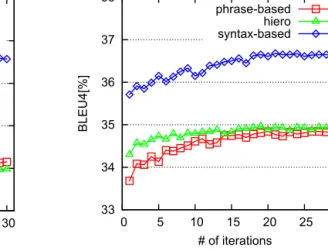
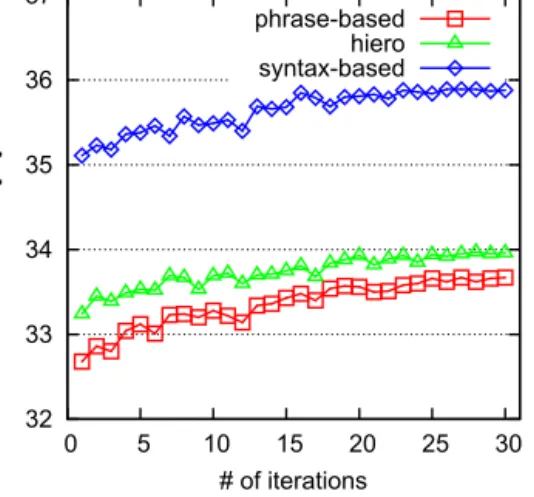
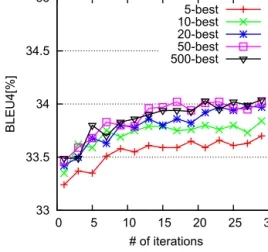
Fig. 3.BLEU score of Bagging on the development set. Fig. 4.BLEU score of Bagging on the test set of MT04.
approach requiresk-best candidates generated by only one SMT system, its training and inference are very fast. So, in our experiment, we also implement Duh and Kirchhoff’s approach for comparison.
•
Discriminative re-ranking. Discriminative re-ranking is another straightforward solution to re-rankingk-best translations,and has been widely adopted in MT. In the general framework of discriminative re-ranking, we first choose a number of features to indicate whether a candidate should be ranked better than others. Then we employ a discriminative model to make use of these features and generate the final ranking result. In our implementation, we follow the approach presented in [97]. In addition to the features used in our baseline systems, we use three additional features for re-ranking, including IBM model 1, POS-based language models (bi-gram–5-gram), and matched parentheses/quotation marks. These features have been proved to be very effective in MT hypotheses re-ranking[80].
4.3. Experimental setup
Our bilingual data consists of 138K sentence pairs (3.2M Chinese words and 4.1M English words) extracted from the FBIS data set.15GIZA
++
16is employed to perform the bi-directional word alignment between the source and target sentences, and the final word alignment is generated using the grow-final-diag method. All the word-aligned sentence pairs are then used to extract phrase tables, synchronous grammars, and reordering models for the SMT systems. A 5-gram language model is built on the Xinhua portion of the English Gigaword corpus17 in addition to the target-side of the bilingual data. Berkeley Parser18 is used to generate the English parse trees for rule extraction of the syntax-based system. The data set used for weight training in our approach comes from the NIST MT03 evaluation set (919 sentences). To speed up MERT, all the sentences with more than 20 Chinese words are removed. The test sets are the NIST evaluation sets of MT04 (1788 sentences), MT05 (1082 sentences) and MT06 (1664 sentences). The translation quality is evaluated in terms of case-insensitive NIST version BLEU metric. Statistical significance test is conducted using the bootstrap re-sampling method proposed in[55].For all three base systems described above, we use a CKY-style decoder with beam search and cube pruning [51] to decode new Chinese sentences. By default, both the beam size (or beam width) and the size of k-best list are set to 20.19 For our Bagging/Boosting-based approach, the maximum number of iterations is set to 30, and p(Eq. (10)) is set to 5. 4.4. Evaluation of translations
First we investigate the effectiveness of our approach on improving single translation engines. Figs. 3–6 show the BLEU curves of the Bagging-based approach on the development and test sets for the three SMT systems, where theX-axis is the iteration number and theY-axis is the BLEU score of the final system generated by our approach. The points at iteration 1 stand for the performance of the baseline systems. We see, first of all, that all three types of SMT systems are improved on the development set as well as on the test sets. For all these systems, over 0.5 BLEU improvements are achieved after 8 iterations, and the BLEU scores tend to converge to stable values after 20 iterations. This trend also holds in Figs. 7–10 where
15 LDC catalog number: LDC2003E14. 16 http://code.google.com/p/giza-pp. 17 LDC catalog number: LDC2003T05. 18 http://code.google.com/p/berkeleyparser/.
19 In our implementation, beam size=20 means that only the top-20 best hypotheses according to model score are kept and the rest are discarded on
Fig. 5.BLEU score of Bagging on the test set of MT05. Fig. 6.BLEU score of Bagging on the test set of MT06.
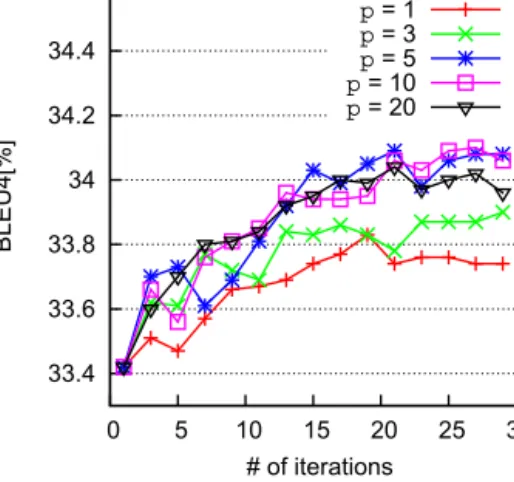
Fig. 7.BLEU score of Boosting on the development set. Fig. 8.BLEU score of Boosting on the test set of MT04.
Fig. 9.BLEU score of Boosting on the test set of MT05. Fig. 10.BLEU score of Boosting on the test set of MT06.
the BLEU curves of the Boosting-based approach are plotted. More interestingly, it is observed that our approach seems to be more helpful to the phrase-based system than to the Hiero system and the syntax-based system. For the phrase-based system, it yields an improvement of over 0.6 BLEU points just after three iterations on all the data sets.
Tables 1–3 show more detailed evaluation results for our approach, where the BLEU scores at iteration 2, 5, 10, 15, 20 and 30 are reported. For comparison, we also report the results of various baselines:
Table 1
Summary of the evaluation results (BLEU4[%]) for the phrase-based system.+or++ =significantly better than the first five baselines or all eight of the baselines (significance level is 0.05).
BLEU4[%] (the phrase-based system)
MT03 (Dev) MT04 (Test) MT05 (Test) MT06 (Test)
Bagging Boosting Bagging Boosting Bagging Boosting Bagging Boosting
Baseline 33.21 33.68 32.68 30.59 Baseline+Fulldev 33.02 33.89 32.83 31.00 Baseline+600best 33.32 33.93 32.84 30.76 Baseline+Batch 33.54 33.88 32.77 30.92 Baseline+Timefirst 33.37 33.70 32.90 30.68 MBR 33.39 33.88 32.86 30.74 Boosted Re-ranking 33.21 33.66 32.87 30.89 Discriminative Re-ranking 33.13 33.76 32.91 30.58 Our approach Iteration 2 33.41 33.78 34.08 34.33+ 32.86 33.51++ 30.75 31.17 Iteration 5 33.61 33.95 34.13 34.32+ 33.12 33.33+ 31.08 31.33 Iteration 10 33.73 34.14++ 34.61++ 34.68++ 33.28 33.42+ 31.27 31.35 Iteration 15 33.95 33.99+ 34.74++ 34.78++ 33.43+ 33.46++ 31.52++ 31.45++ Iteration 20 33.99++ 34.09++ 34.84++ 35.11++ 33.56++ 33.56++ 31.57++ 31.45++ Iteration 30 34.11++ 34.12++ 34.82++ 35.16++ 33.67++ 33.76++ 31.55++ 31.59++ Table 2
Summary of the evaluation results (BLEU4[%]) for the Hiero system.+or++ =significantly better than the first five baselines or all eight of the baselines (significance level is 0.05).
BLEU4[%] (the Hiero system)
MT03 (Dev) MT04 (Test) MT05 (Test) MT06 (Test)
Bagging Boosting Bagging Boosting Bagging Boosting Bagging Boosting
Baseline 33.42 34.30 33.24 30.62 Baseline+Fulldev 33.35 34.43 33.45 30.99 Baseline+600best 33.48 34.46 33.39 30.75 Baseline+Batch 33.46 34.51 33.34 30.90 Baseline+Timefirst 33.50 34.30 33.30 30.77 MBR 33.54 34.55 33.42 30.73 Boosted Re-ranking 33.30 34.48 33.20 30.85 Discriminative Re-ranking 33.33 34.19 33.37 30.90 Our approach Iteration 2 33.60 33.71 34.57 34.48 33.45 33.52 30.91 30.81 Iteration 5 33.68 33.73 34.73 34.48 33.53 33.44 31.06 30.83 Iteration 10 33.68 33.75 34.79 34.65 33.69 33.75++ 31.23 31.02 Iteration 15 33.80 34.03+ 34.83 34.88 33.75 33.98++ 31.18 31.20 Iteration 20 33.93+ 34.17+ 34.88 35.00+ 33.93++ 34.04++ 31.36++ 31.29++ Iteration 30 33.98+ 34.05+ 34.93+ 34.99+ 33.96++ 34.05++ 31.36++ 31.30++
•
Baseline: the naive baseline which is generated in the first iteration of our approach.•
Baseline+
Fulldev: the baseline system whose feature weights are optimized on the full set of development data, instead of the sentences of constrained length (20 words).•
Baseline+
600best: the baseline system with the k-best list size of 600 which equals to the maximum number of translation candidates accessed in our approach (20-best outputs of 30 member systems).•
Baseline+
Batch: we run MERT for as many times as there are iterations of Bagging/Boosting (30 times in this experi-ment). We then treat each MERT run as a member system, and apply the proposed approach to those MERT runs. This method results in a baseline of running MERT in batch mode.•
Baseline+
Timefirst: the baseline system which runs in the same amount of time as the final systems generated by Bagging/Boosting.20•
MBR: the MBR system which runs on thek-best list of 600 translation candidates.21•
Boosted Re-ranking: the re-ranking system based on the approach presented in[30]. The iteration number of boosted re-ranking is set to 30, which is the same as that used in our approach.20 To do this, we enlarge the beam width until the execution time (or decoding time) is equal to or more than that of the system generated using
Bagging/Boosting. This method results in a beam width of 450 for all three of the SMT engines in our experiments.
21 Note that thek-best MBR method is used in our experiment, while recent studies have reported that the lattice-based method[61,103]is relatively
more powerful in the MBR paradigm. Here we choosek-best MBR because all the systems in this set of experiments generate the final translation from the k-best list of translation candidates, and it is fair to compare these approaches in the same setting ofk-best output of MT system. The issue of lattice-based MBR will be discussed in Section 7.
Table 3
Summary of the evaluation results (BLEU4[%]) for the syntax-based system.+or++ =significantly better than the first five baselines or all eight of the baselines (significance level is 0.05).
BLEU4[%] (the syntax-based system)
MT03 (Dev) MT04 (Test) MT05 (Test) MT06 (Test)
Bagging Boosting Bagging Boosting Bagging Boosting Bagging Boosting
Baseline 35.84 35.71 35.11 32.43 Baseline+Fulldev 35.55 35.90 35.30 32.85 Baseline+600best 35.95 35.88 35.23 32.58 Baseline+Batch 36.00 36.01 35.23 32.81 Baseline+Timefirst 35.89 35.82 35.13 32.76 MBR 35.99 35.91 35.35 32.53 Boosted Re-ranking 35.80 35.71 35.28 32.49 Discriminative Re-ranking 35.80 35.45 35.37 32.44 Our approach Iteration 2 36.13 36.16 35.91 36.10 35.23 35.46 32.66 32.78 Iteration 5 36.15 36.03 36.15 35.92 35.38 35.27 32.75 33.09 Iteration 10 36.39 36.14 36.15 36.39 35.49 35.47 32.95 33.15 Iteration 15 36.45+ 36.36 36.50++ 36.46+ 35.68 35.53 33.20++ 33.43++ Iteration 20 36.52++ 36.44+ 36.61++ 36.79++ 35.81+ 35.77+ 33.20++ 33.36+ Iteration 30 36.57++ 36.52++ 36.65++ 36.81++ 35.88++ 35.71++ 33.27++ 33.46++
•
Discriminative Re-ranking: the discriminative re-ranking system that runs on the same k-best list used in MBRand Baseline+
600best.As can be seen from Tables 1–3, our approach outperforms all eight of the baselines. In particular, we have the following observations:
(1) BLEU improvement overBaseline
We see that both the Bagging-based and Boosting-based approaches achieve statistical significant BLEU improvements after 15 iterations, and generally achieves the highest BLEU scores after 20 iterations. For the phrase-based system, over 0.7 BLEU improvements are obtained after 10 iterations. The largest BLEU improvement of the phrase-based system is over 1 BLEU point. These results show again that our method is relatively more effective for the phrase-based system than for the other two systems, and thus confirms the observation we got in Figs. 3–10.
(2) Bagging vs. Boosting
Also, Tables 1–3 make a comparison of the Bagging-based and based approaches. We see that the Boosting-based approach outperforms the Bagging-Boosting-based approach in most cases. This result indicates that the member system learner can benefit from knowing the performance of the previous member system. However, the performance differ-ence between the two approaches is small (less than 0.2 BLEU points). This suggests an interesting fact that Bagging, though very simple, is still effective in improving single translation engines.
(3) Bagging/Boosting vs.Baseline
+
FulldevIn a sense, Baseline
+
Fulldevcan be regarded as another reasonable baseline since the setting of our approach (Bag-ging/Booting) should not affect MERT for the baseline systems which run fine with sentences of unconstrained length. In our experiment, we observe that scaling the development data to the full set of MT03 provides a more stable con-vergence for MERT. This benefits the baseline systems, especially on the test sets. For example, for all three of the SMT systems, Baseline+
Fulldevobtains about+
0.4 BLEU improvements over its counterpartBaseline on the test sets of MT06, and offers a stronger baseline performance for our comparison. Compared toBaseline+
Fulldev, our approach still shows significant improvements on most of the data sets.(4) Bagging/Boosting vs.Baseline
+
600bestThe result ofBaseline
+
600bestshows that the access to largerk-best lists is useful in improving the baseline systems. However, the improvement achieved byBaseline+
600bestis modest compared to that achieved byBoosting-30Iterations. This supports the fact that the SMT systems can benefit more from the diversified outputs of member systems than from largerk-best lists produced by a single system.(5) Bagging/Boosting vs.Baseline
+
BatchandBaseline+
TimefirstBaseline
+
Batch andBaseline+
Timefirst can be viewed as two enhanced baselines which make comparable efforts onthe search problem as Bagging/Boosting. Both of them show improvements overBaselineon all the evaluation sets due to the fewer search errors they make during decoding. However, Bagging and Boosting still significantly outperforms
Baseline
+
BatchandBaseline+
Timefirst, which implies a stronger ability in reducing search errors. An interesting findinghere is that the translation quality can be improved by combining different MERT runs on the same development set. This observation reflects some sort of training instability in SMT, and confirms the result reported in recent studies on MERT run selection and hypothesis testing[18].
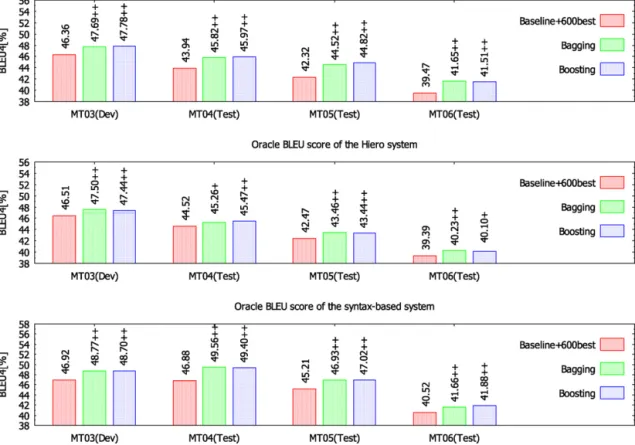
Fig. 11.Oracle BLEU scores of the phrase-based system, the Hiero system and the syntax-based system.+or++ =significantly better thanbaseline+ 600best(significance level is 0.05 or 0.01).
(6) Bagging/Boosting vs. MBR and re-ranking
The MBR and re-ranking methods are also reasonable baselines for our comparison because they are well known for their ability in improving single translation systems. As shown in the tables, though they outperform other baseline sys-tems in some cases, the improvements are much less than those of the Bagging-based and Boosting-based approaches. These results support our argument that introducing diversified translations into candidate set is relatively more useful in improving single translation engines. Moreover, the comparison betweenBoosted Re-rankingand our approach draws an interesting conclusion that applying Boosting to re-ranking might be too late to access good-quality translations, and thus limits the capability of Boosting in MT. But this is essentially due to the shortcoming of re-ranking and would not be a problem of Boosting. Another interesting observation is that our default method of strong system generation and the MBR method seem to be more effective in improving our SMT systems, in comparison with re-ranking approaches. We attribute it to the use of consensus-based features which have been successfully used in system combination, but are generally absent in traditional re-ranking systems.
4.5. Evaluation of oracle translations
In the second set of experiments, we evaluate the oracle performance on the k-best lists of various systems, with a primary goal of studying the impact of our approach on upper-bound performance.
We choose Baseline
+
600best as the baseline for comparison since it explores the equal number of translation candi-dates as that of our approach. Fig. 11 shows the result, whereBagging andBoosting stand for the ensemble of translation candidates generated by the Bagging-based approach and Boosting-based approach, respectively. As expected, the oracle performance ofBagging andBoosting is significantly higher than that of Baseline+
600best. This result indicates that our approach provides “better” translation candidates for final translation selection than enlarging the size ofk-best lis