New Jersey’s
Interdistrict
Public School Choice Program
Program Evaluation and Policy Analysis
Institute on Education Law and Policy
Rutgers University – Newark
123 Washington Street
Newark, New Jersey 07102
The Institute on Education Law and Policy
to promote education reform and improvement through research, policy
analysis and public discussion
to mobilize lawyers, scholars and education practitioners to address
complex and controversial issues in education law and policy in a
comprehensive, in-depth manner
to improve public understanding of these issues
to serve as a center for learning and innovative thinking about legal and
public policy issues relating to education.
While issues affecting New Jersey's urban students and educators are the Institute's
primary focus, those issues are addressed in the context of the state's wide diversity
and with an eye toward their ramifications for the nation as a whole.
at Rutgers-Newark is New Jersey's premier center for interdisciplinary research
and innovative thinking on education law and policy. Its mission is:
New Jersey’s
Interdistrict Public School Choice Program
Program Evaluation and Policy Analysis
Contents
Tables and Graphs ... ii
Executive Summary ...1
Introduction... 9
Program Description ... 10
Impact of the Program... 28
Issues Arising During Pilot Implementation ... 35
School Choice Policy Issues ...41
Conclusion and Recommendations ...51
Appendix A: Choice Students, 2001-02 to 2005-06 ... 55
Appendix B: School Choice Aid, FY 2001 to FY 2007... 56
Appendix C: Decreases in Core Curriculum Standards Aid to Sending Districts, 2001 and 2002 ...57
Appendix D: Racial Composition, Sending Districts, 2005-06 ... 59
References... 62
Tables and Graphs
Table 1: Per-Pupil School Choice Aid Amounts ...12
Table 2: Interdistrict Public School Choice Program Enrollment ...14
Table 3: Racial/Ethnic Mix Choice Students and Statewide ...14
Table 4: Socioeconomic Mix Choice Students and Statewide...14
Table 5: Choice Districts 2005-06 ...15
Table 6: Choice Districts’ Specialized Programs...16
Table 7: Choice District Resident Enrollment Growth/Decline ...17
Table 8: Sending Districts With More Than 10 Resident Students Attending Choice Districts 2005-06...21
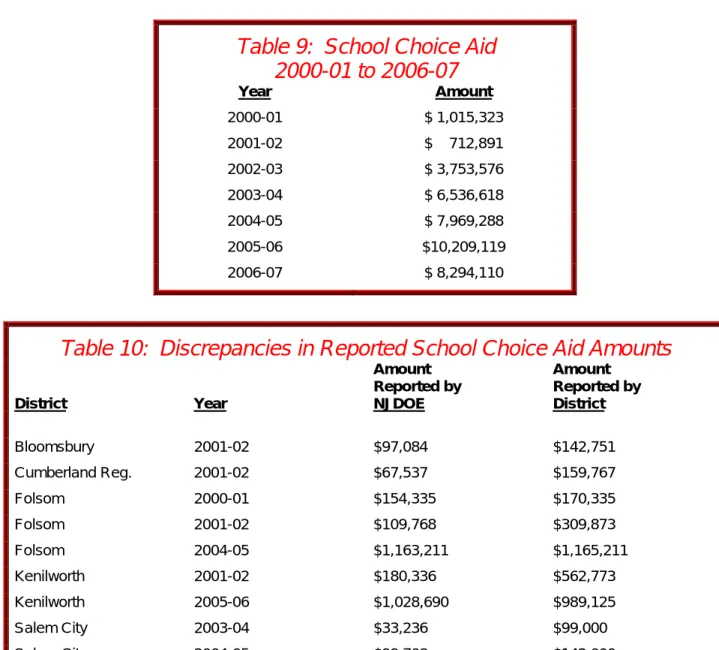
Table 9: School Choice Aid 2000-01 to 2006-07... 24
Table 10: Discrepancies in Reported School Choice Aid Amounts... 24
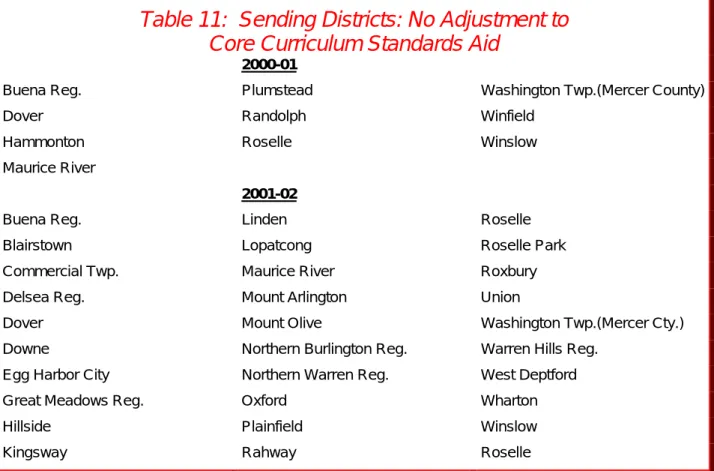
Table 11: Sending Districts: No Adjustment to Core Curriculum Standards Aid... 27
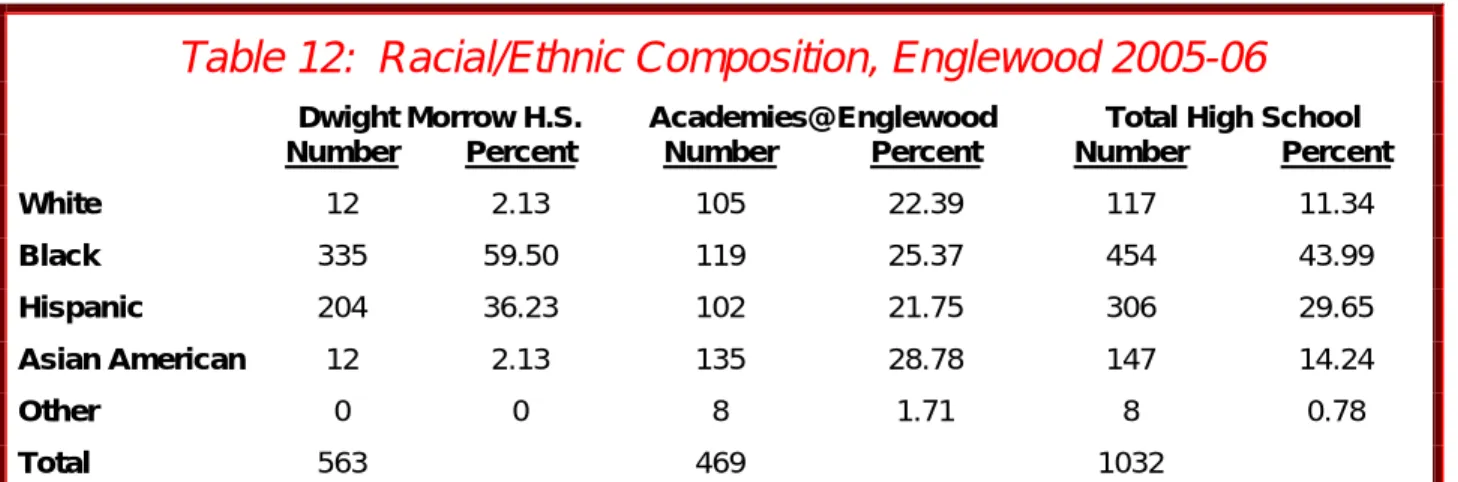
Table 12: Racial/Ethnic Composition, Englewood 2005-06 ... 32
Table 13: Sending-Receiving Arrangements... 39
Graph 1: Choice Student Enrollment...19
Graph 2: Pupil Proficiency Levels, Choice Districts and Sending Districts ASK4 Language Arts Literacy ... 22
Graph 3: Pupil Proficiency Levels – Choice Districts and Sending Districts ASK4 Mathematics... 22
Graph 4: Pupil Proficiency Levels – Choice and Sending Districts HSPA Mathematics ... 23
Executive Summary
This report has been prepared under contract with the New Jersey Department of Education, with support from the Department and the Joint Committee on the Public Schools of the New Jersey State Legislature. It provides an evaluation of the pilot program authorized by the Interdistrict Public School Choice Program Act. Specifically, to the extent possible with available data, it includes an analysis of the program’s size, scope and funding; its fiscal, educational and racial/ethnic impact;
implementation issues that have arisen in the course of the pilot; other school choice policy issues; and alternative funding provisions for interdistrict public school choice.
Based on this analysis, we make the following findings and recommendations:
• The Interdistrict Public School Choice Program has had positive results.
• Interdistrict public school choice has served some, but not all, of the purposes identified by the Department of
Education at the outset of the pilot.
• The pilot program’s impact has been limited by its small size.
• If interdistrict choice is to continue to rely on voluntary participation, the state should offer effective incentives for district participation.
• Targeting choice could allow it to provide greater choice opportunities to underserved groups of students.
• Whether interdistrict public school choice is voluntary or mandatory, it will require an expenditure of state funds.
• If interdistrict choice is to continue in any form, its funding mechanism should be reviewed.
• Consistency among the state’s choice programs would provide for a more rational state policy, and probably should be the goal on each issue unless particular policy considerations dictate otherwise on particular points.
Program Description
Basic Provisions, Size and Scope of the Program. The Interdistrict Public School
Choice Program (“the Program”) was authorized by the New Jersey Legislature in 1999, by the Interdistrict Public School Choice Program Act (“the Act”). The Act limited the Program to one choice district per county and no more than ten choice districts for the first year, no more than 15 for the second year, and no more than 21 for the third, fourth and fifth years. Funding was provided for a sixth year by the 2005
appropriations act and for a seventh year by the 2006 appropriations act.
Designation as a “choice district” is voluntary. A district that wishes to become a choice district must submit an application to the Commissioner of Education for approval. Designation as a “sending district” occurs upon the exercise of choice by any resident student; districts may not prohibit their students from participating in the Program (other than in exceptional
circumstances), but they may, by resolution, limit the percentage of their students enrolling in choice district schools.
Choice districts receive a form of state aid, called “school choice aid,” for each choice student. They do not count choice students in their enrollments for purposes of determining eligibility for core curriculum standards aid, but they do count those students, pursuant to the Act, “for the purpose of calculating all other forms of aid provided under the Comprehensive Educational Improvement and Financing Act [CEIFA].” Such “other forms of aid” include, among others, special education aid and transportation aid.
Sending districts do not receive any school choice, but the Act provides that sending districts that receive core curriculum standards aid are to continue to receive that aid, in declining amounts, for the first three years of each student’s participation. This provides a form of “impact aid,” or cushion, for sending districts that are eligible for core curriculum standards aid. Districts ineligible for that aid have no such cushion.
Enrollment in the Program grew from 96 students in ten choice districts in 2000-01 to 1006 students in 16 choice districts in 2005-06. The 1006 students who participated in the
Program in 2005-06 resided in 122 sending districts. These are their characteristics:
• 49.8% are male 50.2% are female
• 43% are in grades K through 8 57% are in grades 9 through 12
• 58.4% are Caucasian 12.6% are Asian 12.3% are Black 12.1% are Hispanic
• 7.7% are eligible for special education services
• 29% reside in DFG A school districts 25% reside in DFG B school districts 21% reside in DFG CD school districts 6% reside in DFG DE school districts 8% reside in DFG FG school districts 5% reside in DFG GH school districts 6% reside in DFG I school districts. Four choice districts had more than 100 choice students each attending their schools. In three districts, choice students made up more than 25 percent of the student population in the grades they are permitted to attend, while in six other districts they made up two percent or less of the student population in those grades. Resident enrollments have grown in some of the choice districts during the period of their participation in the Program, while in others they have declined.
The choice districts, as a group, have a range of pupil proficiency rates as measured by state-mandated tests. They also cover the
socioeconomic gamut. With one exception, the districts with the largest numbers of choice students receive large portions of their choice students from districts with the same or lower DFG designations. Choice districts with small choice student populations receive students from districts in the same or higher DFG. There are no choice districts in five of the state’s counties – Essex, Middlesex, Mercer, Somerset and Sussex. In four counties – Bergen, Cape May, Gloucester and Warren – more than one district has applied for choice designation and the Commissioner has been required to reject applications because of the statutory limit of one choice district per county.
Over the course of the Program, participating students have resided in 141 school districts throughout the state. As of 2003-04, 63 school
districts had adopted resolutions limiting their students’ participation in the Program. Twenty-six districts had more than ten students enroll in another district under the Program in 2005-06. Only three of those districts (Little Ferry, Maurice River and Woodbine) had more than two percent of their students do so.
Like the choice districts, the 26 sending districts with more than ten participating students cover the socioeconomic gamut, although they are more heavily weighted at the lower end, with eight of these districts in DFG A and seven others in DFG B. Eighteen of the 26 districts send their students to choice districts with higher DFG designations, four send their students to districts with lower DFG
designations, and four send their students to districts with the same DFG designation. Also like the choice districts, the 26 sending districts with more than ten participating students have a range of pupil proficiency rates, but a smaller number of these districts have proficiency rates above the state average and a larger number have rates below the average.
State Spending. State funds appropriated for
the Program and distributed to choice districts as school choice aid have grown steadily over the course of the Program except for a dip in the second year. They exceeded $10 million only in 2005-06.
Other state aid to choice districts has been affected by the “freeze” on aid to all school districts, which has kept aid at 2001-02 levels for the past five years. Because of the “freeze,” categorical aid to choice districts, including transportation aid and special education aid, has not increased, even where enrollments and services have expanded as a result of interdistrict choice.
Whether those aid amounts have been frozen at levels that reflect choice student enrollments –
i.e., whether choice districts received categorical
aid at levels reflecting choice student enrollments for the first two years of the Program, 2000-01 and 2001-02, before the freeze – is a matter of dispute between NJDOE and choice districts. The Department’s Office of School Finance maintains that choice students were counted in aid calculations; some districts maintain that they were not; documentation provided for this report does not definitively support either position.
As to aid to sending districts, since core
curriculum standards aid for all school districts has been “frozen” since 2002, the amount of such aid granted to sending districts has not been affected by the Program in the last five years. In other words, because of the “freeze,” the provision of the Act calling for sending districts’ aid to decline over the first three years of their students’ participation in the Program has not been implemented. Moreover, even before the “freeze,” many sending districts had no decrease in their core curriculum standards aid, notwithstanding the terms of the Act. According to the NJDOE Office of School Finance, although some districts had no net decrease in aid, aid calculations for those years reflected enrollment decreases caused by interdistrict transfers. Documentation provided for this report has not been sufficient to verify this position.
Impact of the Program
Impact on Choice Districts and Their Students. Choice districts are almost
unanimous in their support of the Program and their reports of its positive fiscal and educational impact. Only one district reports that the Program has had a detrimental effect.
School choice aid has been a substantial source of revenue for choice districts. The districts report that this revenue has permitted them to hire additional staff, reduce class sizes and offer new programs, and avoid tax increases and program cuts that other districts have been forced to endure as a result of freezes and decreases in other forms of state aid. They also attribute other improvements to participation in the Program, including innovation and
flexibility, new and enhanced programs and services at all grade levels, reorganization of staff to institute a “team approach,” and strong financial condition enabling one district to pass a bond referendum.
Most of the choice districts report that choice students generally have integrated well into their schools, and have presented no special problems or needs related to their choice status.
Individual student achievement data has not been collected; therefore, the Program’s educational impact on individual students has not been evaluated for this report.
The Program has had an impact on racial/ethnic balance in some choice districts, but no such impact in others. In five districts (Brooklawn, Kenilworth, Lower Township, Passaic County
Manchester Regional and South Harrison) choice student enrollment has increased the percentage of minority students in the overall enrollment; in one district (Salem) choice student enrollment has increased the percentage of white students; and in another district
(Cumberland Regional), choice student enrollment has varied in the six years of participation in the Program, increasing the percentage of minority students in some years and the percentage of white students in other years.
Impact on Sending Districts. Data and
information obtained from the Department of Education indicate that the Program’s fiscal impact on sending districts has been more positive than negative, and the impact on racial/ethnic composition in those districts has been minimal.
Because, as discussed above, core curriculum standards aid to sending districts has not been reduced in the last five years, sending districts have received their full allocation of core curriculum standards aid based on enrollment counts that include students who are not enrolled in their schools. This can only be considered a positive impact, or an unintended windfall, for those sending districts. In this respect the Program has not been implemented in accordance with the original legislative intent. Consequently, we cannot determine the fiscal impact the Program would have had on sending districts if the Program had been implemented as intended.
No information has been obtained for this report regarding the Program’s educational impact, if any, in sending districts. Because the number of choice students residing in each sending district is small – as discussed above, only three districts had more than two percent of their resident enrollment participating in the Program in 2005-06 – it is reasonable to conclude that the Program has had little or no significant impact on instructional program, class size, course offerings or staffing in the vast majority of the state’s school districts (other than choice districts).
Available data does allow an assessment of impact on racial/ethnic balance in the sending districts. That data indicates that the Program has had little or no impact on sending districts’ racial composition. Specifically, interdistrict transfers under the Program have resulted in more than a one percent increase or decrease in
any racial/ethnic group’s percentage of
enrollment in only one of the 26 districts in the state with more than ten resident students participating in the Program.
Issues Arising During Pilot Implementation
Regulatory changes adopted by the State Board of Education in 2004 responded to certain issues that had arisen in the course of the Program up to that point. Those issues included student eligibility, sending district procedures and choice district procedures.
Other issues have arisen that warrant further consideration if interdistrict choice is to continue, and that suggest a need for statutory, rather than regulatory, change. Those issues include the application procedure; eligibility of kindergarten students, eleventh- and twelfth-grade students, and students who have not been enrolled in public schools; limited choice availability in counties where the designated choice district serves fewer than all grades; and the appropriate recipient of “impact aid” where, even without the Program, students would not attend school in the district of residence, but rather in another district pursuant to a sending-receiving agreement.
Another issue is whether districts may, or should, implement programs to encourage greater participation by resident students in programs open to both resident and choice students, and whether they may establish different selection criteria for resident students and choice students, for the purpose of achieving desegregation. The Commissioner of Education has recommended that one district, Englewood, implement such a program. To the extent that the recommendation is, in fact, a requirement to establish different selection criteria for resident and choice students, it raises the issue of whether the Commissioner has the authority to require the district to act in a manner
inconsistent with Program regulations (which require equal treatment of resident students and choice students). It also raises the question of whether a program such as that recommended by the Commissioner would be consistent with state and federal law.
As to the first question, the Commissioner’s recommendation appears to be within her statutory authority, so that any action taken pursuant to the recommendation probably would be permissible as long as it is otherwise consistent with state and federal law. As to the
second question, a United States Supreme Court decision expected within the next year could provide more guidance on whether programs or policies established for the purpose of achieving a racially diverse student body are permitted by the United States Constitution. The Court’s decision could clarify the extent to which the Program, and other public school programs and policies, may serve as tools for achieving or maintaining racial or ethnic diversity under federal law.
New Jersey also has its own independent source of law in favor of school desegregation, a
provision of the state constitution. Criteria such as those recommended by the Commissioner are consistent with, and arguably required by, state law. However, if the United States Supreme Court rules that such criteria contravene the federal constitution, such a ruling could preempt New Jersey’s state constitutional law. Until the Court provides clarification, a policy in keeping with established principles of federal law could be adopted. These principles are, generally, that racial and ethnic balance may be considered along with other factors in choice districts’ selection criteria as long as they are not dispositive factors, they are not applied mechanistically or in such a way that they amount to a quota, and the manner in which they are given consideration is narrowly tailored to the goal of achieving diversity.
School Choice Policy Issues
Does Interdistrict Public School Choice Serve a Beneficial Purpose? Several
beneficial purposes that could be served by choice were identified by the Department of Education when the Program was initiated. These purposes included: to provide greater choice to parents and students in selecting a school which best meets the needs of the student and thus improves educational opportunities for New Jersey citizens; to improve the degree to which the education system is responsive to parents and students; to improve education and enhance efficiency by allowing a redistribution of students where some districts are
overcrowded and others are underenrolled; and to improve quality by creating a healthy
competition among school districts.
Data provided by the Department of Education and choice districts suggest that the Program has been successful, to some degree, in serving two of the stated purposes, providing greater choice and making the state’s education system more
responsive to parents and students; and that it has been less successful as to the others, redistributing students from overcrowded to under-enrolled districts and creating healthy competition among school districts. The data further suggest that the Program’s impact in each area has been limited by its small size.
Providing Greater Choice. For the 1006
students participating in 2005-06, the Program certainly has provided greater choice. It has provided those students with opportunities to attend school free of charge in districts other than their districts of residence, where no such opportunities existed previously. Based on the fact that more than 50 percent of all choice students in 2005-06 resided in DFG A or B districts, it appears that the Program has provided greater choice particularly for students at lower socioeconomic levels. However, based on the fact that the percentages of blacks and Hispanics among choice students were lower than their percentages in the statewide public school population, it appears that the Program has not served those students as well as others. On the other hand, the Program has provided choice opportunities to Asian students to a greater extent than their proportion of the statewide student population. And based on the fact that the percentage of choice students with disabilities is considerably lower than their percentage of the statewide public school population, it appears that the Program has not served this group as well as others either. While no specific data as to unmet demand is available, some choice districts report that they receive frequent inquiries from parents seeking to participate in the Program, although others have not filled all available spaces and do not receive many such inquiries. The Department of Education also reports receiving such calls almost daily from parents in districts that are not conveniently located near any choice district with space available for additional choice students. This suggests that the Program clearly has provided some greater choice, enough to meet demand in some areas of the state but not in others.
Making the State’s Education System More Responsive to Parents and
Students. Similarly, the Program has made the
state’s education system more responsive to the needs and wishes of participating choice students and their parents. The extent to which the Program has made the system in general more responsive has been limited by its size and
the resources available to choice districts. There may have been some “ripple effect” in sending districts and elsewhere, by which schools have become more responsive to students’ needs and wishes, but no evidence of such an effect has been reported.
Enhancing Efficiency by Redistributing Students. To the extent that the Program has
shifted students from overenrolled schools or districts to districts with otherwise declining or stagnant enrollments or filled classrooms that otherwise would have been half empty, it may be said to have enhanced efficiency. To the extent that it has allowed schools to remain open that otherwise would have closed due to insufficient enrollment, it may be said to have detracted from rather than enhanced efficiency. Reports from the choice districts suggest that efficiency, as measured by redistribution of students, is neither enhanced nor reduced by the Program. More than half the choice districts have seen their resident enrollments increase, rather than decline, during the period of their participation in the Program, indicating that the Program has not particularly served the purpose of shifting students to districts with declining enrollments. Moreover, more choice districts report reducing than increasing class size as a result of the Program. Those reductions may not have enhanced efficiency, but they are reported as educational benefits. The districts also report adding staff, course offerings and other
activities, likewise as educational benefits. The Program seems to have been more successful in enhancing educational programs than
redistributing students from overenrolled to underenrolled schools or districts.
Improving Quality by Creating Healthy Competition. Whether the Program has
allowed choice districts to improve their educational programs “by creating healthy competition” is hard to say. Choice districts have enhanced their educational programs because they have had additional funds, in the form of school choice aid, but there is no evidence that they did so in order to “beat the competition.”
Whether sending districts have responded to the competition created by the Program is also hard to say. Since only three districts have had more than two percent of their students enroll
elsewhere under the Program, it appears to have had little effect, competitive or otherwise, on most sending districts. This is particularly true
since losing students to the Program has had little or no fiscal impact on sending districts, as discussed above. The Program’s small size also probably has impeded its ability to create a true competitive market for choice options.
Would the Program Serve These Purposes Better if it Were Expanded or Modified? Theoretically, if the Program were
considerably larger, it could contribute more to “healthy competition” in the “education
marketplace.” If all students in the state could choose where to attend school without regard to district boundaries and districts received additional aid for every nonresident student, districts would theoretically compete for those students and that aid. This theory has been put into practice in some states. However, the experience of other states suggests that merely authorizing districts to open their schools does not automatically create a thriving market or serve all students.
Beyond the theoretical competitive effect, would the beneficial purposes identified at the
Program’s outset be better served if the Program were expanded or modified? Expansion
certainly would provide greater choice to a greater number of students and presumably would make the state’s educational system more responsive to that greater number. It would not enhance efficiency by redistributing students to a greater degree unless the Program were modified to specifically address redistribution, such as by limiting choice districts to those with declining enrollments. And expansion probably would not provide greater choice to students in underserved groups unless the Program were modified to target those groups.
Aside from the purposes enumerated at the Program’s outset, expanding choice for its own sake is also worth considering. New Jersey offers choice to its public school students to a much lesser degree than other states. That alone suggests that there may be unmet demand for greater interdistrict public school choice. One way to expand interdistrict choice is to make district participation mandatory rather than voluntary, or to combine a voluntary program, available in all districts for all
students, with a mandatory program targeted to specific districts, schools or students. A fully voluntary program also could result in some expansion, but suburban districts are not likely to respond in large numbers to a voluntary program without some incentive.
The most likely incentive, of course, is financial. In fact, the school choice aid provided to choice districts and the improvements made possible by that aid are the Program’s strongest selling points. Especially with increasing pressures on school district budgets and demands for
property tax relief, offering generous amounts of state aid in exchange for participation in an interdistrict public school choice program could be quite effective.
Financial incentives have been sufficient to sustain suburban district participation in interdistrict choice programs in at least two other states, Missouri and Michigan, and both states’ programs may provide models worth considering in New Jersey.
Michigan’s experience has not been all positive, however. Its statewide open enrollment
program is supported with state aid that “follows the child”; i.e., participating districts receive the amount of aid that students’ districts of
residence would receive but for their exercise of choice and districts of residence lose that aid with each interdistrict transfer. This “zero-sum game” of state aid, in which one district’s gain is another’s loss, has resulted in a loss of aid for several of the state’s mid-size cities and some of the districts in greatest need.
This suggests that financial incentives may, in fact, be too effective – so effective that they detract from other education reform and improvement efforts, and that measures to encourage participation in interdistrict choice may need to be tempered with measures to soften the impact on sending districts. It also suggests that incentives for low-wealth districts to create high-quality magnet programs, to attract students from higher-wealth districts to their schools, should be considered. Such programs could help cushion the fiscal impact of the loss of some of their own students to higher-wealth districts and also promote diversity. Whether to modify the Program to target underrepresented racial or ethnic groups is another complex issue. Even if the legality of race-conscious admissions were more settled, any specific targeting measure would need to be examined to ensure that it in fact served the desired purpose and that it was narrowly tailored to do so without inordinately
disadvantaging students who were not members of the targeted groups. Interdistrict choice programs established for the purpose of enhancing diversity are, at least arguably,
required by our state constitutional law against racially segregated schools. They would, however, require careful monitoring and oversight.
Federal Law and Policy on Public School Choice. An additional reason to consider
expanding the Program is that interdistrict public school choice is encouraged, if not required, by federal law. The No Child Left Behind Act (NCLB) requires intradistrict choice to be offered to any student in a school
designated “in need of improvement” for two or more consecutive years or designated
“persistently dangerous”; it requires interdistrict choice to be offered “to the extent practicable” when there are no intradistrict spaces available; and it requires that if transfer options are limited, they should be targeted to the lowest-achieving low-income students. Establishing a state policy in conformance with the federal law may be reason enough to expand the Program. As a practical matter, however, because of the large number of designated schools in some areas of the state, simply offering greater options for interdistrict choice where space is available would not necessarily result in significantly greater exercise of the transfer option. In areas with fewer designated schools, expanding interdistrict choice in a manner consistent with NCLB could increase the options available for eligible students, but the number of such students is relatively small.
Asserted Constitutional Rights to School Choice. Lawyers for plaintiff schoolchildren in
a recently filed lawsuit, Crawford v. Davy, claim that interdistrict public school choice – and “private school choice” – are not only desirable but constitutional entitlements for children in “failing” public schools.
While the suit could proceed for years before a ruling is issued on the merits and it is too early to predict the outcome (except to note that it is certain to be vigorously defended, several legal defenses are foreseeable, and similar claims have failed in other states), two different policy responses are possible: either to take no action on interdistrict public school choice or private school choice while the suit is pending, awaiting a ruling on the merits; or to attempt to preempt court action by giving careful consideration to reauthorizing the Program and expanding interdistrict choice, even if the ultimate decision is against reauthorization or expansion. The courts may be more likely to defer to the
judgment of the legislative and executive branches if they have given serious consideration to the issues.
The executive and legislative branches also could give consideration to “private school choice” – vouchers providing public funds for students to attend private schools – but that aspect of the lawsuit raises several additional legal and policy issues which should cause policymakers to tread lightly.
School Choice Funding. If interdistrict
public school choice is to continue in New Jersey, the Program’s funding mechanism should be reviewed. Interdistrict choice programs in other states have a variety of funding provisions, as do other school choice programs in this state. Some of those provisions may be worth considering.
The Act has several funding provisions, the combined effect of which is not entirely clear. The complexity and ambiguity of these provisions are reason enough to review their continued desirability. Additionally, to the extent that funding is provided through core curriculum standards aid under CEIFA, it should be reviewed in any event in the course of the long overdue review of the state’s system of school finance.
Four specific funding issues should be considered. The first is whether interdistrict
public school choice should be revenue- and funding-neutral, i.e., whether an interdistrict choice program should involve any net cost to the state (other than the cost of administration).
Under the Act, the Program is not “zero-sum”; it involves state expenditures for school choice aid and “impact aid.” If funding for school choice were “zero-sum,” the exercise of choice should, in itself, have no net cost. In tight budget times, this may be the only kind of program that is realistically possible. As the Michigan experience has shown, however, the fiscal impact on sending districts can be considerable, so that some additional state expenditure to cushion the impact on those districts may be desirable.
A more subtle aspect of this question is whether school choice aid amounts should be based on the per-pupil amounts otherwise received by the choice district or the sending district. Under the Act, aid amounts are determined by the DFG of the choice district; those in DFG A or B receive greater per-pupil aid amounts than others. To the extent that aid amounts reflect the needs of
resident students, school choice aid amounts arguably should be based on the amounts received by districts of residence, and aid should transfer with students when they transfer to choice districts.
Modifying the Program to set the choice aid amount at the level otherwise applicable to the sending district could provide a financial incentive for higher-wealth districts to accept students from lower-wealth districts. On the other hand, it could provide a disincentive for lower-wealth districts to serve as choice districts. The second funding issue is whether school
choice aid amounts should vary based on student characteristics. The Act has no
provision to this effect. Varying aid amounts would allow the state to target the program for the benefit of certain groups of students, such as those currently enrolled in schools designated “in need of improvement” or those whose transfer would improve the racial or ethnic balance of the sending or receiving district. The third funding issue is the funding
mechanism: whether interdistrict school choice
should be funded with state aid or with transfers of funds from sending districts to receiving districts, or a combination of the two.
While the Act provides for state funding, some other states fund interdistrict choice with interdistrict transfers of funds, and other choice programs in our own state, including charter schools and vocational schools, are at least partly supported with local funding. To the extent that interdistrict choice were supported with interdistrict transfers of funds, it would be less susceptible than a state-funded program to annual state budget pressures, although local pressures may be just as great in some school districts. Local or interdistrict funding also makes sense conceptually if interdistrict choice is conceived as “open enrollment,” in which students attend school in the districts of their choice and districts accept students from any district, without any state involvement. On the down side, the reliability of local funding may vary substantially among sending districts, some of which may not provide timely transfers of funds. Another variation would be to support interdistrict choice at some basic expenditure level with interdistrict transfers of funds, and provide additional support in the form of state aid for transfers of students in targeted groups.
The fourth funding issue is transportation funding: whether choice districts, sending
districts or parents should be responsible for the cost of transporting choice students. As
discussed, the Act provides that choice districts are responsible for transportation and are to receive state transportation aid. In many states, parents are required to pay the transportation costs associated with interdistrict choice. Among states that provide transportation or subsidies for interdistrict choice students, most provide that transportation is the responsibility of districts of residence. Requiring districts of residence to be responsible for transportation also would be more in keeping with provisions applicable to other choice programs in New Jersey. Given that sending districts carry this burden for vocational and charter schools and state transportation aid is supposed to be provided to ease the burden in any event, relieving choice districts of the transportation requirement is worth considering, as an additional way to encourage districts to accept nonresident students.
On all the funding issues discussed here, consistency among the state’s choice programs would provide for a more rational state policy and should be the goal on each issue unless particular policy considerations dictate otherwise on particular points. In this regard, reviewing issues such as the method of calculating state aid for interdistrict public school choice, the mechanism for providing that aid, and particular elements such as
transportation aid may provide an opportunity to review comparable issues in other choice programs in order to develop one rational statewide school choice policy.
More broadly, it should not go unnoticed that these issues arise at a time when the state is engaged in a comprehensive review of its school finance system. Reviewing funding issues that have arisen in the context of interdistrict choice also may provide an opportunity to consider the appropriate role of choice in public education and broader issues of school finance. The notion of state aid “following the child,” for instance, raises issues of both school choice policy and school finance. Thus, while the Interdistrict Public School Choice Program may be limited in size and scope, it has provided policy makers an opportunity to consider some very large,
complex education policy issues. For that alone, the state’s pilot experience with interdistrict public school choice has been worthwhile.
Introduction
This report has been prepared under contract with the New Jersey Department of Education (NJDOE), with support from NJDOE and the Joint Committee on the Public Schools of the New Jersey State Legislature.
In accordance with the contract, the report provides an evaluation of the pilot interdistrict public school choice program authorized by the Interdistrict Public School Choice Program Act, N.J.S.A. 18:36B-1 et seq. It is intended to fulfill the requirement of N.J.S.A. 18A:36-11b for an evaluation of the pilot program.
Specifically, to the extent possible with available data, this report provides an analysis of the program’s size and scope; state funding for the program; its fiscal, educational and racial/ethnic impact; and implementation issues that have arisen in the course of the pilot. It also discusses the role of interdistrict public school choice in the state’s effort to increase options and flexibility for parents and students while sustaining educational improvement, and the impact of interdistrict choice – both actual and potential – on efforts to achieve efficiency, equity and racial/ethnic balance.
The evaluation presented here is based on publicly available information and data, ongoing research on school choice conducted by the
Rutgers-Newark Institute on Education Law and Policy,1 data provided by NJDOE and school
districts participating in the Program as choice districts, and discussions with staff of NJDOE and participating districts. Twelve of 16 choice districts responded to survey questions, some with extensive data and comments. No other primary data collection has been conducted. The principal author of the report is Brenda Liss, Executive Director of the Institute on Education Law and Policy. She received substantial input and assistance from Paul Tractenberg and Alan Sadovnik, respectively Founding Director and Associate Director of the Institute; from research assistants Martin Malague, Eric Bueide, Beth Ferlicchi, Elizabeth Morrison and Marshall Steinbaum; and from program coordinator Mia Kissil.
We wish to acknowledge the substantial assistance provided by NJDOE program staff responsible for program oversight, particularly Anne Schettino Casale. While this report has been prepared with state funding at the request of NJDOE, all findings, conclusions and recommendations in the report are those of the Institute on Education Law and Policy, and the Institute takes sole responsibility for the report’s contents.
Program Description
Legislative and Regulatory History The Interdistrict Public School Choice Program (“the Program”) was authorized by the New Jersey Legislature in 1999, by the Interdistrict Public School Choice Program Act (“the Act”), L. 1999, c. 413, effective January 18, 2000. In fact, the Program had been initiated prior to the Act’s adoption, by regulations promulgated by
NJDOE under authority provided by the Comprehensive Educational Improvement and Finance Act (“CEIFA”), N.J.S.A. 18A:7F-1 et seq. R. 1999, c. 343, effective October 4, 1999; see 31 N.J.R. 1664(a); 31 N.J.R. 2918(a). The purpose of the Program, as stated in the regulations as first promulgated, was as follows:
The choice program is necessary to provide greater choice to parents and students in selecting a school which best meets the needs of the student and thus improves educational opportunities for New Jersey citizens. The choice program has the
potential to improve the degree to which the education system is responsive to parents and students. It can also improve education and enhance efficiency by allowing a
redistribution of students where some districts are overcrowded and others are under-enrolled. Finally, it can improve quality by creating a healthy competition among school districts. [N.J.A.C. 6A:12-1.1, 31 N.J.R. 2918.]
The regulations and the Act provided for a pilot program to begin in the 2000-01 school year. Although neither explicitly limited the pilot program to five years in duration, this clearly was the intent. The Act authorized
appropriations in the amounts of $1.6 million annually for the first two years of the program and $3 million annually for the third, fourth and fifth years, “or such other amounts as may be necessary.” N.J.S.A. 18A:36B-12. While the Act envisioned expiration of the pilot rather than indefinite continuation, it provided that any student enrolled in a designated school in a choice district upon expiration of the Program “shall be entitled to remain” in that school until graduation. N.J.S.A. 18A:36B-13.
The Act has not been amended since its adoption. The Program has continued beyond its five-year term, however. Funding was provided for a sixth year, 2005-06, by the 2005 appropriations act (L. 2005, c. 132) and for a
seventh year, 2006-07, by the 2006
appropriations act (L. 2006, c. 45) in an amount sufficient to permit currently participating students to continue but to provide for no net growth.
The regulations, N.J.A.C. 6A:12-1.1 et seq., have been amended three times since the Program’s inception. In 2000, technical changes were made in several provisions to provide
clarification and ensure consistency with the Act. R. 2000, c. 477, effective December 4, 2000; 32 N.J.R. 3201(a), 32 N.J.R. 4255(a). In 2001, the subchapter on pupil transportation was repealed and readopted as part of N.J.A.C. 6A:27, which pertains to pupil transportation generally. R. 2001, c. 17, effective January 2, 2001; 32 N.J.R. 3695(a), 32 N.J.R. 33 N.J.R. 31(a). In 2004, the entire chapter was readopted with amendments. R. 2004, d. 376, effective September 10, 2004; 36 N.J.R. 2593(a), 36 N.J.R. 4443(a).
Basic Provisions
Choice Districts. The Act provides that a
“choice district” is a public school district established pursuant to chapter 8 or 13 of Title 18A (i.e., a local or regional school district) authorized under the Program to open a school or schools to students from other districts. N.J.S.A. 18:36B-2. Choice districts are also sometimes referred to as “receiving districts.” The Act limits the number of choice districts statewide to no more than ten in the first year of the program, no more than 15 in the second year, and no more than 21 in the third, fourth and fifth years. It further limits the number to no more than one per county in any year. N.J.S.A. 18A:36B-3.
Designation as a choice district is voluntary. A district that wishes to become a choice district must submit an application to the Commissioner of Education. Among other things, the
application must describe the programs and schools in which the district proposes to implement a choice program, the proposed application process and any admissions criteria, and the district’s provisions for a parent
information center by which it will publicize the program to prospective participants. The application also must state, by grade level, the number of openings for students to participate in the program. N.J.S.A. 18:36B-4. The Commissioner is required to evaluate choice
district applications in accordance with five criteria: fiscal impact on the district, quality and variety of academic programs offered in the district, “potential effectiveness” of the student application process and admissions criteria, the “impact on student population diversity in the district,” and “the degree to which the program will promote or reduce educational quality in the district and the sending districts.” N.J.S.A. 18A:36-5.
Sending Districts. The Act refers to the
district of residence of each participating student as a “sending district.” N.J.S.A. 18A:36-2. Sending districts may limit the percentage of their students enrolling in choice district schools under the Program. The Act authorizes (but does not require) sending district boards of education, to limit participation, by resolution, to two percent of the number of students per grade level per year or seven percent of the total number of students enrolled in the district. It further authorizes sending district boards, by resolution, to set limitations exceeding these percentages, up to a maximum of ten percent of the number of students per grade level per year and 15 percent of the total number of students enrolled in the district, “subject to approval by the Commissioner upon a determination that the resolution is in the best interest of the district’s students and that it will not adversely affect the district’s programs, services, operations, or fiscal conditions, and that the resolution will not adversely affect or limit the diversity of the remainder of the student population in the district who do not participate in the program.” N.J.S.A. 18A:36B-8b.
Student Eligibility. In order to be eligible to
participate in the Program, a student must be in kindergarten through grade nine at the time of application (i.e., in the year prior to enrollment in the choice district) in a public school in his or her district of residence. The student must have attended school in the district of residence for at least one year prior to enrolling in the choice program. N.J.S.A. 18:36B-7a.
If a choice district receives more applications for a designated school than there are openings, it is required to conduct a lottery to determine the selection of students. It may, however, give selection preference to siblings of choice students. N.J.S.A. 18A:36B-7b. It also may establish “reasonable criteria” for evaluation of prospective students; but it shall not
discriminate on the basis of athletic ability,
intellectual aptitude, English language
proficiency, status as a handicapped person, or any other basis prohibited by State or federal law. Id.2
More specifically regarding students with disabilities, the Act provides that “a choice district shall not prohibit the enrollment of a student based upon a determination that the additional cost of educating the student would exceed the amount of additional State aid received as a result of the student’s enrollment,” but it “may reject the application for enrollment of a student who has been classified as eligible for special education services … if that student’s individualized education program could not be implemented in the district, or if the enrollment of that student would require the district to fundamentally alter the nature of the
educational program, or would create an undue financial or administrative burden on the district.” N.J.S.A. 18A:36B-7c.
Once enrolled in a designated choice school, a choice student is entitled to continue there through graduation without reapplying for admission each year. (The Act contains no provision regarding suspension, expulsion or other discipline of choice students.) The student is also permitted to transfer back to a school in the sending district or apply to a different choice district. N.J.S.A. 18:36B-7e.
Student Population Diversity. The Act
mentions student population diversity in several provisions, and indicates an intent to maintain diversity in all school districts affected by the Program. In addition to the nondiscrimination provision cited above (N.J.S.A. 18A:36B-8b) and the requirement, discussed earlier, that the Commissioner consider diversity in the review of choice district applications (N.J.S.A. 18A:36B-5), the Act requires that districts seeking choice district designation include “an analysis of the potential impact of the program on student population diversity in all potential participating districts and a plan for maintaining diversity in all potential participating districts, which plan shall not be used to supersede a court-ordered or administrative court-ordered desegregation plan.” N.J.S.A. 18A:36B-4a(4). The Act also gives the Commissioner broad authority to “take appropriate action, consistent with State and federal law, to provide that student population diversity in all districts participating in a choice district program is maintained.” N.J.S.A. 18A:36B-4b. Such action may include:
• directing a choice district to take appropriate steps to successfully implement the district’s plan for maintaining student population diversity;
• restricting the number of choice students from a sending district or the authority of a choice district to accept choice students in the future; and
• revoking approval of the choice district. The Act specifies that “student population diversity” shall include, but not be limited to, ethnic, racial, economic and geographic diversity. Id.
Transportation. Choice student eligibility for
transportation or aid in lieu thereof is essentially the same as for other students. The Act states that transportation or aid in lieu thereof shall be provided to any elementary choice student who lives more than two miles from “the receiving district school of attendance” and to any secondary choice student who lives more than two and a half miles from such school, provided that the receiving district school is not more than 20 miles from the residence of the pupil. N.J.S.A. 18A:36B-9; see also N.J.S.A. 18A:39-1
et seq. The Act further states that transportation
or aid in lieu thereof shall be the responsibility of the choice district (rather than the district of residence or parents of choice students), and that choice districts are to receive transportation aid as provided in CEIFA, N.J.S.A. 18A:7F-25.
See N.J.S.A. 18A:36B-8a.
State Aid to Choice Districts. Choice
districts do not count choice students in their enrollments for purposes of determining their eligibility for core curriculum standards aid.
However, they receive “school choice aid” for each choice student. The Act provides that the amount of school choice aid to be provided for each choice student is the weighted per-pupil T & E amount established pursuant to CEIFA or, for choice districts in district factor groups A or B, the weighted per-pupil maximum T & E amount. N.J.S.A. 18A:36B-8; see also N.J.S.A. 18A:7F-12 as to the T & E amount. This has been understood to refer to the T & E amount or maximum T & E amount applicable to the choice district rather than the sending district. Thus, choice districts in DFG A or B receive school choice aid based on the maximum T & E amount even if the students for whom they receive the aid reside in districts in higher DFGs; and choice districts in higher DFGs receive the aid based on the T & E amount – rather than the maximum – even if the students for whom they receive the aid reside in DFG A or B districts. Since 2001-02 the per-pupil school choice aid amounts have been as shown in Table 1.
The Act authorizes annual appropriations of school choice aid in the amount of $1.6 million for the first two years of the program and $3 million for the third, fourth and fifth years of the program, “or such other amounts as may be necessary,” as mentioned above. N.J.S.A. 18A:36B-12a. The authorized appropriations are to be distributed “for the purpose of funding school choice aid … for choice students from a sending district that does not qualify for core curriculum standards aid pursuant to [CEIFA].” As to aid for other students, CEIFA itself was amended by the Act to provide for “school choice aid awarded for pupils from a sending district that receives core curriculum standards aid.” N.J.S.A. 18A:7F-11.
Table 1:
Per-Pupil School Choice Aid Amounts
DFG A & BDistricts All Other Districts
Elementary (1-5) $8,309 $7,913 Middle School (6-8) $8,605 $8,195 High School (9-12) $9,221 $8,782
Thus, while it is not entirely clear, it appears that the amounts stated in N.J.S.A. 18A:36B-12a were not intended to reflect the full cost of state aid for the Program. Rather, they were intended as the amounts to be provided for choice students from those districts – about a third of all districts in the state – that are ineligible, pursuant to CEIFA, for core curriculum standards aid.
Choice districts do count choice students in their enrollments, pursuant to the Act, “for the purpose of calculating all other forms of aid provided under [CEIFA].” N.J.S.A. 18A:36B-8a. Such “other forms of aid provided under CEIFA” include, among others, special education aid (N.J.S.A. 18A:7F-19) and transportation aid (N.J.S.A. 18A:7F-25). They do not, however, include Abbott parity aid or supplemental program aid, since those forms of aid have their legislative authorization only in annual
appropriations acts rather than CEIFA. Since neither the Act nor CEIFA provides that choice students are to be counted in the same manner as resident students for purposes of calculating Abbott parity aid or supplemental program aid, Abbott districts participating in the Program as choice districts do not receive those forms of aid for choice students.
State Aid to Sending Districts. There is no
form of aid comparable to school choice aid for sending districts. However, CEIFA, as amended by the Act, provides that sending districts are to include choice students in their enrollment counts for purposes of determining eligibility for core curriculum standards aid for the first three years of each student’s participation in the Program, with partial credit for each student, in declining amounts over the three years.
Specifically, N.J.S.A. 18A:7F-13 provides that choice students shall be included in the
enrollment counts of their districts of residence, as follows:
.75 in the first year of the pupil's attendance; .50 in the second year of the pupil's
attendance;
.25 in the third year of the pupil's attendance; and
.00 in the fourth year of the pupil's attendance.
The effect of this provision is that, in the first three years of any student’s participation in the Program, a sending district eligible for core
curriculum standards aid is to continue to receive that aid for that student, but at a reduced level as a result of the partial count of the student. The continued aid, though reduced, apparently was intended as a form of “impact aid” for eligible sending districts, to cushion the negative fiscal impact of the Program. Districts that receive no core curriculum standards aid as a result of their statutory aid calculation receive no “impact aid” either.
Another provision of the Act, N.J.S.A. 18A:36B-12b, also refers to core curriculum standards aid for sending districts. It provides for annual appropriations of additional amounts of such aid to offset any increase in the local share resulting from the adjustment to the enrollment count authorized by the provision discussed above, N.J.S.A. 18A:7F-13.
Program Size and Scope
Enrollment in the Program has grown from 96 students attending schools in ten choice districts in 2000-01 to 1006 students attending schools in 16 choice districts in 2005-06. Enrollment figures for each year are shown in Table 2.
Choice Students. The 1006 students
participating in the Program in 2005-06 resided in 122 sending districts. Of those students, 500 (49.8 percent) were male and 505 (50.2 percent) female; 428 (43 percent) were in grades 1 through 8 and 578 (57 percent) in grades 9 through 12. Seventy-seven (7.7 percent) were eligible for special education services (as compared to the statewide special education population, 16.5 percent).3
The annual enrollment totals, and the racial/ethnic mix of choice students and comparison with statewide percentages are shown in Tables 2 and 3. The socioeconomic mix, based on the DFG designation of choice students’ districts of residence, and comparison with statewide percentages are shown in Table 4. In some choice districts (notably Kenilworth, Brooklawn and Folsom) choice students have been selected by lottery, as the number of applicants for admission has been greater than available spaces in every year of the districts’ participation in the Program, while in others (Salem, Stafford Township and Washington Township) there have been fewer applicants than available spaces in every year. In one district (Kenilworth) choice students are required to live in the county in which the district is located. In one district (Englewood),
Table 2:
Interdistrict Public School Choice Program
Enrollment
Year Choice Students Choice Districts
2000-01 96 10 2001-02 291 11 2002-03 461 13 2003-04 737 14 2004-05 795 15 2005-06 1006 16
Table 3: Racial/Ethnic Mix
Choice Students and Statewide
Choice Students Statewide*
Caucasian 589 / 58.4% 56.5% Black 124 / 12.3% 17.6% Hispanic 122 / 12.1% 18.2% Asian 127 / 12.5% 7.5% Native American 5 / 0.004% 0.2% Unknown/Other 41 / 4.4%
* Source:NJDOE, 2005-2006 Enrollment,
http://www.state.nj.us/njded/data/enr/enr06/county2.htm.
Table 4: Socioeconomic Mix
Choice Students and Statewide
Choice Students Statewide*
DFG A 293 / 29% 17.7% DFG B 248 / 25% 10.9% DFG CD 207 / 21% 9.5% DFG DE 65 / 6% 13.6% DFG FG 83 / 8% 12.5% DFG GH 53 / 5% 14.4% DFG I 57 / 6% 17.5% DFG J 0 / 0% 3.9%
* Source: NJDOE, NJDOE Department of Education District Factor Groups (DFG) for School Districts,
they are accepted through a competitive
admissions process. In two districts (Englewood and Cumberland Regional) they are required to participate in a particular specialized program, and in another (Upper Freehold Regional) they must express interest in such a program on their application but are not required to participate in the program once enrolled. In all other choice districts there are no such eligibility or other requirements.
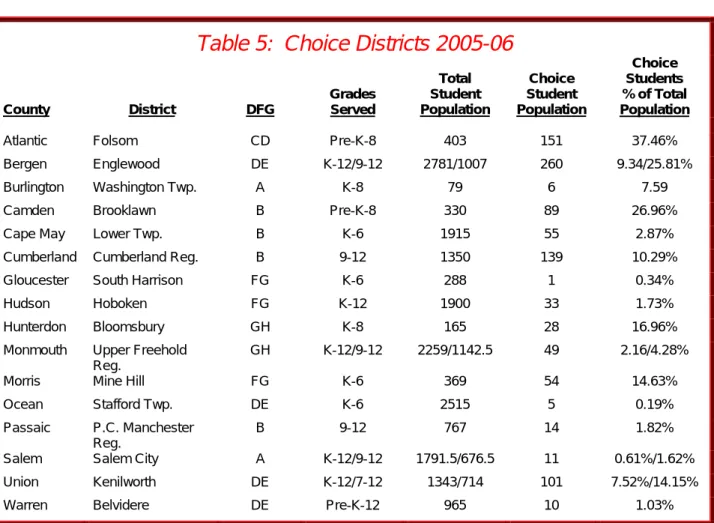
Choice Districts. Table 5 lists the 16 school
districts that served as choice districts in 2005-06. (Additional data regarding these districts appears in Appendix A.) Of those districts, six serve grades K-12 (one of the six limits its choice program to grades 9-12, another to grades 7-12), eight serve elementary grades only (preK-8, K-6 or K-8), and two serve grades 9-12. Three are regional school districts.
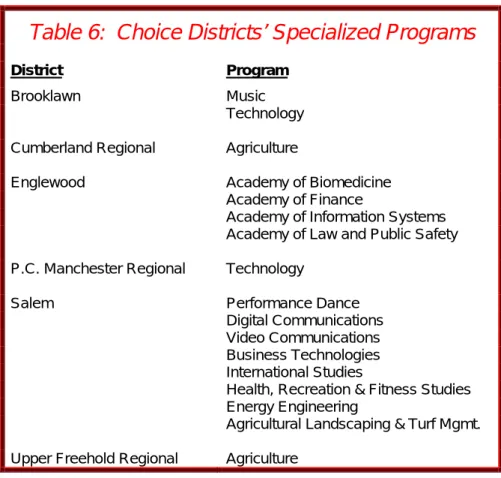
Four of the choice districts (Folsom, Englewood, Cumberland Regional and Kenilworth) had more than 100 choice students attending their schools. In three of the districts (Folsom, Englewood and Brooklawn), choice students made up more than 25 percent of the student population in the grades they are permitted to attend; but in six other districts (South Harrison, Hoboken, Passaic County Manchester Regional, Stafford Township, Salem City and Belvidere), choice students made up two percent or less of the student population in those grades. As shown in Table 6, five of the districts
(Brooklawn, Cumberland Regional, Englewood, Salem and Upper Freehold Regional) offer specialized career-oriented magnet programs. Passaic County Manchester Regional also has a specialized technology program.
Table 5: Choice Districts 2005-06
County District DFG Grades Served Total Student Population Choice Student Population Choice Students % of Total Population
Atlantic Folsom CD Pre-K-8 403 151 37.46%
Bergen Englewood DE K-12/9-12 2781/1007 260 9.34/25.81%
Burlington Washington Twp. A K-8 79 6 7.59
Camden Brooklawn B Pre-K-8 330 89 26.96%
Cape May Lower Twp. B K-6 1915 55 2.87%
Cumberland Cumberland Reg. B 9-12 1350 139 10.29%
Gloucester South Harrison FG K-6 288 1 0.34%
Hudson Hoboken FG K-12 1900 33 1.73%
Hunterdon Bloomsbury GH K-8 165 28 16.96%
Monmouth Upper Freehold Reg.
GH K-12/9-12 2259/1142.5 49 2.16/4.28%
Morris Mine Hill FG K-6 369 54 14.63%
Ocean Stafford Twp. DE K-6 2515 5 0.19%
Passaic P.C. Manchester Reg.
B 9-12 767 14 1.82%
Salem Salem City A K-12/9-12 1791.5/676.5 11 0.61%/1.62%
Union Kenilworth DE K-12/7-12 1343/714 101 7.52%/14.15%
Table 6: Choice Districts’ Specialized Programs
District ProgramBrooklawn Music
Technology Cumberland Regional Agriculture
Englewood Academy of Biomedicine Academy of Finance
Academy of Information Systems Academy of Law and Public Safety P.C. Manchester Regional Technology
Salem Performance Dance
Digital Communications
Video Communications
Business Technologies
International Studies
Health, Recreation & Fitness Studies
Energy Engineering
Agricultural Landscaping & Turf Mgmt. Upper Freehold Regional Agriculture
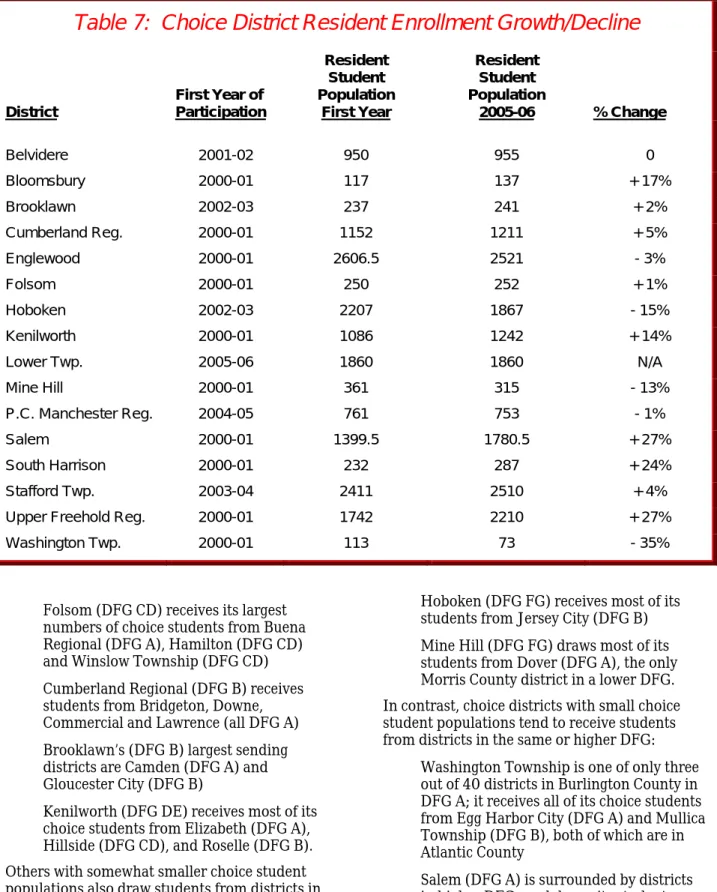
The choice districts are all fairly small districts – indeed, some are very small. Their 2005-06 resident enrollments, not counting choice students, ranged from a high of 2,521 (Englewood) to a low of 73 (Washington Township, Burlington County). Resident enrollments have grown in some of the choice districts during the period of their participation in the Program, while in others they have declined. As shown in Table 7, nine of the 16 choice districts have experienced increases in their resident student enrollments; five have experienced decreases; and two have had no significant change.
The choice districts, as a group, have a range of pupil proficiency rates based on state-mandated tests. As shown in the graphs on pages 24 to 26 (in which choice districts’ proficiency rates are compared with those of sending districts), five of the 14 choice districts serving fourth graders had proficiency levels above the state average on the 2005 ASK4 language arts literacy assessment, eight had proficiency levels below the state average and one was at the state average. On the 2005 ASK4 mathematics assessment, six choice districts had proficiency levels above the state average and eight below. Of the eight choice
districts serving high school students, four had proficiency levels above the state average on the 2005 HSPA language arts assessment and four below. On the 2005 HSPA mathematics assessment, three had proficiency levels above the state average and five below.4
The choice districts also cover the much of the socioeconomic gamut, although none is in the highest socioeconomic category. Two are in district factor group (DFG) A, four in DFG B, one in DFG CD, four in DFG DE, three in DFG FG, and two in DFG GH. Those with the largest numbers of choice students fall in the DFG range B through DE: Englewood (DE), Folsom (CD), Cumberland Regional (B), Kenilworth (DE) and Brooklawn (B). With one exception, the districts with the largest numbers of choice students all receive large portions of their choice students from districts with the same or lower DFG classifications:
• Englewood (DFG DE) receives its largest numbers of choice students from
Bergenfield (DFG FG, the only exception), Fairview (DFG A), Hackensack (DFG CD), Little Ferry (DFG CD), and Palisades Park (DFG CD).
Table 7: Choice District Resident Enrollment Growth/Decline
District First Year of Participation Resident Student Population First Year Resident Student Population 2005-06 % Change Belvidere 2001-02 950 955 0 Bloomsbury 2000-01 117 137 + 17% Brooklawn 2002-03 237 241 + 2% Cumberland Reg. 2000-01 1152 1211 + 5% Englewood 2000-01 2606.5 2521 - 3% Folsom 2000-01 250 252 + 1% Hoboken 2002-03 2207 1867 - 15% Kenilworth 2000-01 1086 1242 + 14% Lower Twp. 2005-06 1860 1860 N/A Mine Hill 2000-01 361 315 - 13% P.C. Manchester Reg. 2004-05 761 753 - 1% Salem 2000-01 1399.5 1780.5 + 27% South Harrison 2000-01 232 287 + 24% Stafford Twp. 2003-04 2411 2510 + 4%
Upper Freehold Reg. 2000-01 1742 2210 + 27%
Washington Twp. 2000-01 113 73 - 35%
• Folsom (DFG CD) receives its largest numbers of choice students from Buena Regional (DFG A), Hamilton (DFG CD) and Winslow Township (DFG CD)
• Cumberland Regional (DFG B) receives students from Bridgeton, Downe, Commercial and Lawrence (all DFG A)
• Brooklawn’s (DFG B) largest sending districts are Camden (DFG A) and Gloucester City (DFG B)
• Kenilworth (DFG DE) receives most of its choice students from Elizabeth (DFG A), Hillside (DFG CD), and Roselle (DFG B). Others with somewhat smaller choice student populations also draw students from districts in lower DFGs:
• Hoboken (DFG FG) receives most of its students from Jersey City (DFG B)
• Mine Hill (DFG FG) draws most of its students from Dover (DFG A), the only Morris County district in a lower DFG. In contrast, choice districts with small choice student populations tend to receive students from districts in the same or higher DFG:
• Washington Township is one of only three out of 40 districts in Burlington County in DFG A; it receives all of its choice students from Egg Harbor City (DFG A) and Mullica Township (DFG B), both of which are in Atlantic County
• Salem (DFG A) is surrounded by districts in higher DFGs and draws its students from those surrounding districts.
This does not, alone, establish a causal connection between choice districts’ DFG designations and the size of their choice student populations, but it suggests that districts with higher socioeconomic levels than their neighbors tend to attract larger numbers of choice
students.
Most choice districts enroll students from a handful of contiguous or nearby sending districts. One district, Englewood, is an
exception: in 2005-06 Englewood enrolled 260 choice students from 46 different sending districts. Those sending districts are located throughout Bergen County (and this may be more of a reflection of the number of districts in Bergen County than Englewood’s choice
program) and, a few, in Passaic and Hudson counties.
Just as important as this analysis of choice districts is the fact there are no choice districts in five of the state’s counties: Essex, Middlesex, Mercer, Somerset and Sussex. One district in one of those counties (Trenton, Mercer County) submitted applications for choice designation in 2000 and 2001, but its application was rejected by the Commissioner of Education both times. In the four other counties, no districts have applied to participate in the Program. One district in Sussex County (Fredon) expressed interest in 2002 but did not submit an application.
The Commissioner has suggested that the reason for this lack of participation may be the fact that no districts in these counties have experienced declining enrollment since 2000. The
Commissioner’s annual report on the Program for 2003-04 states, “There are some counties in which every school district is experiencing increased student enrollment. These districts have no room for out-of-district students and thus are ineligible to become choice districts.”5
Declining enrollment is not a statutory eligibility requirement (indeed, as discussed above, some choice districts have experienced increased resident enrollment during the period of their participation in the Program), but the
Department’s regulations provide that eligible districts must have “classroom space available.” N.J.A.C. 6A:12-2.1.
While in some counties no district has applied for choice designation, in four counties more
than one district has applied and the Commissioner has been required to reject applications because of the statutory limit of one choice district per county. Those counties include Bergen (Midland Park in addition to the designated district, Englewood), Cape May (Dennis Township, Cape May City and Middle Township as well as the designated district, Lower Township), Gloucester (Clayton and Kings Regional as well as the designated district, South Harrison) and Warren (North Warren Regional, Warren Hills and Franklin Township as well as the designated district, Belvidere). The Department of Education also reports receiving informal inquiries from districts in Burlington, Camden and Monmouth counties, which already have des