Overview of GermEval Task 2, 2019 Shared Task on the Identification of
Offensive Language
Julia Maria Struß Potsdam University of Applied Sciences Kiepenheuerallee 5 14469 Potsdam [email protected] Melanie Siegel Darmstadt University of Applied Sciences Max-Planck-Str. 2 64807 Dieburg [email protected] Josef Ruppenhofer Leibniz Institute for German Language R5, 6-13 68161 Mannheim [email protected] Michael Wiegand Leibniz ScienceCampus Heidelberg/Mannheim [email protected] Manfred Klenner University of Zurich Andreasstrasse 15 8050 Zurich [email protected] Abstract
We present the second edition of the GermEval Shared Task on the Identifica-tion of Offensive Language. This shared task deals with the classification of German tweets from Twitter. Two subtasks were continued from the first edition, namely a coarse-grained binary classification task and a fine-grained multi-class classification task. As a novel subtask, we introduce the classification of offensive tweets as explicit or implicit.
The shared task had 13 participating groups submitting 28 runs for the coarse-grained task, another 28 runs for the fine-grained task, and 17 runs for the implicit-explicit task.
We evaluate the results of the systems sub-mitted to the shared task. The shared task homepage can be found athttps:// projects.fzai.h-da.de/iggsa/ 1 Introduction
The idea of social media was originally to enable an open exchange of information and opinions be-tween people and thus to support communication. This idea of social participation is massively dis-turbed by current trends: Where an open exchange of views on political issues was possible, forums are increasingly inundated by offensive language. In many cases it is no longer possible to moderate forums without technical support.
The second GermEval Shared Task on the Iden-tification of Offensive Language is intended to ini-tiate and foster research on the identification of offensive content in German language microposts. Offensive comments are to be detected from a set of German tweets. We focus on Twitter, since tweets can be regarded as a prototypical type of micropost.
GermEval is a series of shared task evaluation campaigns that focus on natural language process-ing for the German language. Since 2014, there were shared tasks on named entity recognition, lex-ical substitution, sentiment analysis, hierarchlex-ical classification of blurbs, and identification of offen-sive language. These shared tasks have been run informally by self-organized groups of interested researchers and were endorsed by special interest groups within the German Society for Computa-tional Linguistics (GSCL).
This paper will give a short overview on related work in§2. We will then describe the task in§3 and the data in§4. 13 teams participated in the shared task. We give an overview of their approaches and results in§5, and offer our conclusions in§6.
2 Related Work
For a recent overview of related work on the de-tection of abusive language, we refer the reader to Schmidt and Wiegand (2017) and Mishra et al. (2019). In what follows, we will briefly discuss related shared tasks as well as datasets for German.
• GermEval 2018 - To our knowledge this was the first shared task on the detection of
offen-DistributedunderaCCBY-NC-SA4.0 license.
Originally published in: Preliminary proceedings of the 15th Conference on Natural Language Processing (KONVENS 2019), October 9 – 11, 2019 at Friedrich-Alexander-Universität Erlangen-Nürnberg. - München [u.a.]: German Society for Computational Linguistics & Language
Technology und Friedrich-Alexander-Universität Erlangen-Nürnberg, 2019. Pp. 352-363
sive language that included German language data. (Wiegand et al., 2018b)
• SemEval 2019 - Task 5 (HatEval) concerned multilingual (English and Spanish) detection of hate speech against immigrants and women in Twitter. The two subtasks addressed binary classification (hateful or not) and the classifi-cation of the target harassed as individual or generic. (Basile et al., 2019)
• SemEval 2019 - Task 6 (OffensEval 2019) was a shared task on identification and classi-fication of offensive language in social media. The dataset contains 14,000 English tweets. The subtasks were to identify offensive tweets, to categorize them, and to identify the targets of the offensive posts. (Zampieri et al., 2019) • Kaggle’s 2018 Toxic Comment Classification Challenge1 was a shared task in which com-ments from the English Wikipedia are to be classified. There were 6 different categories of toxity to be identified (i.e.toxic,severe toxic,
obscene,insult,identity hateandthreat). The categories were not mutually exclusive. • The TRAC shared task on aggression
identi-fication (Kumar et al., 2018) included both English and Hindi Facebook comments. Par-ticipants had to detect abusive comments and to distinguish betweenovertly aggressive com-mentsandcovertly aggressive comments. • The shared task on Automatic Misogyny
Iden-tification (AMI) (Fersini et al., 2018) is jointly run by IberEval2 and EVALITA3. It exclu-sively focused on the detection of misogy-nist tweets on Twitter. There were two sub-tasks. Task A addressed the identification of misogynist tweets, while Task B focused on the categorization of misogynist tweets (i.e.
Discredit,Derailing,Dominance,Sexual Ha-rassment & Threats of Violence, Stereotype & Objectification,ActiveandPassive). Both IberEval and EVALITA included a task on En-glish tweets. IberEval also included a task on Spanish tweets while EVALITA also featured a subtask on Italian tweets.
1
https://www.kaggle.com/c/jigsaw-toxic-comment-classification-challenge
2https://sites.google.com/view/
ibereval-2018
3http://www.evalita.it/2018
Most existing datasets of offensive language con-tain English data, such as the dataset described by Waseem and Hovy (2016). With regard to publicly-available German datasets for this task, we only know of Ross et al. (2016) who present a dataset of about 500 tweets which has been annotated regarding hate speech. The authors employed a binary categorization scheme. The dataset from Ross et al. (2016) may be too small for some data-hungry learning-based approaches. Being consid-erably larger, the German dataset produced for the GermEval shared tasks 2018 and 2019 with about 12,000 tweets in total should be a better alternative for such approaches.
3 Task Description
Participants were allowed to participate in one, two or all three subtasks and to submit at most three runs per task.
3.1 Subtask 1: Coarse-grained Binary Classification
Subtask 1 was to decide whether a tweet includes some form of offensive language or not. The tweets had to be classified into the two classes OFFENSE and OTHER. The OFFENSE category covered abu-sive language, insults, as well as merely profane statements.
3.2 Subtask 2: Fine-grained 4-way Classification
The second subtask involved four categories, a non-offensive OTHER class and three sub-categories of what is OFFENSE in subtask 1. In the case of PROFANITY, profane words are used, however, the tweet does not want to insult anyone. This typi-cally concerns the usage of swearwords (Scheiße,
Fucketc.) and cursing (Zur H¨olle! Verdammt!etc.). This can be often found in youth language. Swear-words and cursing may, but need not, co-occur with insults or abusive speech. Profane language may in fact be used in tweets with positive sentiment to express emphasis. Whenever profane words are not directed towards a specific person or group of persons and there are no separate cues of INSULT or ABUSE, then tweets are labeled as simple cases of PROFANITY.
In the case of INSULT, unlike PROFANITY, the tweet clearly wants to offend someone. INSULT is the ascription of negatively evaluated qualities or deficiencies or the labeling of persons as unworthy
(in some sense) or unvalued. Insults convey dis-respect and contempt. Whether an utterance is an insult usually depends on the community in which it is made, on the social context (ongoing activity etc.) in which it is made, and on the linguistic means that are used (which have to be found to be conventional means whose assessment as insulting are intersubjectively reasonably stable).
And finally, in the case of ABUSE, the tweet does not just insult a person but represents the stronger form of abusive language. By abuse we define a special type of degradation. This type of degrading consists in ascribing a social identity to a person that is judged negatively by a (perceived) majority of society. The identity in question is seen as a shameful, unworthy, morally objectionable or marginal identity. In contrast to insults, instances of abusive language require that the target of judg-ment is seen as a representative of a group and it is ascribed negative qualities that are taken to be universal, omnipresent and unchangeable charac-teristics of the group. (This part of the definition largely co-incides with what is referred to as abu-sive speech in other research.) Aside from the cases where people are degraded based on their member-ship in some group, we also classify it as abusive language when dehumanization is employed even just towards an individual (i.e. describing a person as scum or vermin etc.).
3.3 Subtask 3: Implicit vs. Explicit Classification
Implicit offensive language is a form of offensive language where the expression of hate, condemna-tion, inferiority etc. as directed toward an explicitly or implicitly given target has to be inferred from the ascription of (hypothesised) target properties that are insulting, degrading, offending, humiliating etc. Rather than explicitly expressing their aversion, the writers hint at something degrading, i.e. their tweets imply that the target is unworthy etc.
Offensive tweets that use figurative language such as irony or sarcasm, or a play of words also count as implicit. Implicit offensive statements sometimes are only interpretable in their context. Also, inappropriate casual language while address-ing a serious topic is subsumed under implicit of-fensive language.
The following examples4illustrate our notion of
4These are examples from the GermEval 2018 corpus. We left misspellings untouched.
implicitness:
1. Dem Kommentar entnehme ich das auch ihre Schaukel als Kind zu nahe an der Wand ges-tanden hat.(From the commentary I can see that your swing was too close to the wall as a child.)
2. Fl¨uchtlinge fliehen nach Deutschland parallel dazu lassen sie ihre Familien in der Heimat sterben sehr ehrenhaft .... . (Refugees flee to Germany at the same time they let their fam-ilies die in their homeland very honourable ...)
3. Der arme ... Trauma jeden Tag , Sehnsucht nach Familiennachzug , kein eigenes Haus ... nachvollziehbar ... ! (The poor ... Trauma every day, longing for family reunion, no own house)
4. Es gibt nur ein Maas das ist ein Mittelmass und heisst auch so @HeikoMaas (There is only one Maas that is a mediocrity and is also called so @HeikoMaas)
5. Also ich habe bei dem Herrn eine deutliche Alters Demenz gesehen. (Well I’ve seen that this man has an obvious age dementia) In example 1, it is the potential negative effect of a hypothesised situation that makes the reader understand the ascription of stupidity. Examples 2 and 3 are cases of sarcasm and irony, respectively. Neither is it honourable to leave someone in a dan-gerous situation (example 2) as the tweet states nor does a refugee suffer trauma just because they do not possess a house in their new host country (example 3). In example 4, a phonetic similarity between a name (Maas, the name of a German min-ister) and a negative concept (Mittelmaß, eng. medi-ocrity) suggests inferiority of the target (Maas). In example 5, the modal particle (also, eng.well) and a social distance indicating phrase (dem Herrn, eng.
this man) are inappropriate in a discussion on such a topic (Demenz, eng.dementia). An honest diag-nosis of a disease does not use such casual markers. If the target is implicit, this might be an indicator of implicitness, but it is neither a necessary nor a sufficient condition. If a tweet comprises both implicit and explicit offensive language, we choose EXPLICIT as a label.
3.4 Evaluation Metrics
We evaluate the classification performance by the common evaluation measuresprecision,recall, and
F-score. These measures are computed for each of the individual classes in the three subtasks. For each task, we also compute themacro-average pre-cision, recall and F-score as well as the accuracy. We rank systems by their macro-average scores. We do not use accuracy for the ranking since in all three subtasks the class distribution is fairly imbalanced. Accuracy typically rewards correct classification of the majority class.
An evaluation tool computing all of the above mentioned evaluation measures on the three sub-tasks of the shared task was provided by the orga-nizers prior to the release of the training data. It is publicly available and can be downloaded via the webpage of the shared task.
4 Data Set
As for last year’s task, Twitter was the source for our data collection. The reasons why we chose Twitter are a) that unlike other sources, Twitter contains a much higher proportion of offensive language (Wiegand et al., 2018a) and b) that, given the Twitter terms of service, we are able to make our collection publicly available.
4.1 Data Collection
The bulk of the available training data consisted of the training and test data from the first iteration of the shared task in 2018. We newly collected and annotated this year’s test data but also some further training data. To do so, we used the same approach to data collection that we had developed for the first iteration. That is, we sampled tweets from the timeline of various users rather than sam-pling randomly or on the basis of query term-based sampling. The latter two alternatives prove to be either too sparse in yielding offensive instances or too biased and lacking in variety.
We started by heuristically identifying users that regularly post offensive tweets. By sampling from the user’s timeline, we obtained offensive tweets that exhibited a more varied vocabulary than we would have obtained by sampling by pre-defined query terms. It also enabled us to extract a substan-tial amount of non-offensive tweets since only very few users post offensive content exclusively.
Since the majority of last year’s data came from the extreme right-wing spectrum and the dominant
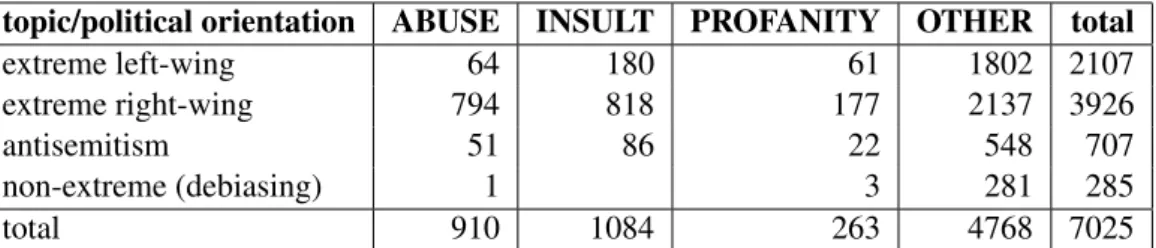
topic concerned migration, we explicitly added timelines of users from the extreme left-wing spec-trum to the 2019 data. Additionally we identified timelines discussing antisemitism in order to in-crease the topic variance in the data. Most of the user timelines considered for this topic can be as-signed to the right-wing spectrum, but we also in-cluded timelines of users from other political direc-tions, however we could not identify any timelines that can be assigned to the extreme left-wing spec-trum concentrating on the topic. An overview of the data distribution with respect to the political orientation is given in Table 1.
Although this extraction process prevents the data set from becoming biased towards specific topics trending at the point in time when the ex-traction is run (a problem one typically faces when extracting data from the Twitter stream), we still found certain topics dominating our extracted data. However, this was not as extreme in the 2019 data as it was in the 2018 data, probably due to delib-erately incorporating timelines of users from dif-ferent political extremes. Most of the extracted offensive tweets in 2018 concerned the situation of migrants or the German government. The tweets not considered offensive, however, often addressed different topics. In the 2019 data we still found a stronger representation of certain political parties and some of their representatives, the government and the German state as well as some minorities in the offensive categories. For example, the politi-cian namesStegnerandMaasand the abbreviation
BRDstanding for ‘Federal Republic of Germany’ were much more often observed in offensive tweets. Since these high-frequency words undoubtedly do not represent offensive terms, we decided to de-biasour data collection by adding further tweets from the already collected timelines, belonging to the class OTHER and containing these terms. If this was not sufficient we added timelines from different political orientations to balance the topic over the classes (see Table 1). Because it was not always possible during the debiasing process to identify user timelines focusing on relevant topics from a different political spectrum, we also sam-pled further arbitrary tweets containing the terms in question. We specifically sought tweets from across the entire political spectrum. We also delib-erately included tweets from users that regularly post highly-critical but inoffensive tweets with re-spect to the above topics. Otherwise, our data
col-topic/political orientation ABUSE INSULT PROFANITY OTHER total extreme left-wing 64 180 61 1802 2107 extreme right-wing 794 818 177 2137 3926 antisemitism 51 86 22 548 707 non-extreme (debiasing) 1 3 281 285 total 910 1084 263 4768 7025
Table 1: Distribution of topics/political orientation of the user timelines in the 2019 data lection would allow classifiers to do well simply
by recognizing offensive content as the combina-tion of negative polarity and particular topics (e.g.
Stegner,MaasorBRD).
When sampling tweets from Twitter, we also imposed certain formal restrictions on the tweets to be extracted (cf. Wiegand et al. (2018b)). They had to be a) written in German, b) contain at least five ordinary alphabetic tokens, c) contain no urls and d) be no retweets. These restrictions are mainly designed to speed up the annotation process (cf. §4.2) by removing tweets that are not relevant to the gold standard.
In splitting our data collection into training and test set, we made sure that any given user’s com-plete set of tweets was assigned to either the train-ing set or the test set. This was done to avoid a situation where classifiers could benefit from learn-ing user-specific writlearn-ing styles or topic biases.
The data collection was also divided up in such a manner that the training and test sets have a similar class distribution. This is one of the major pre-requisites for supervised learning approaches to work effectively.
The third subtask is based on the GermEval2018 data, namely those tweets from the 2018 shared task that are classified as abuse or insult (profanity was left out, because it is by definition explicit offensive language).
4.2 Annotation
4.2.1 Subtasks 1 and 2
Overall, we collected 7,025 new tweets for the 2019 Shared Task. Each of them was manually annotated by one of the organizers of the shared task. All annotators are native speakers of German.
In order to measure inter-annotation agreement, a sample of 300 tweets were annotated by all the annotators independently. We removed all tweets that were marked as HUNH or EXEMPT by at least one annotator. HUNH was used for incom-prehensible utterances. We do not require that a
sentence is perfectly grammatically well-formed and correctly spelled to be included in our data. However, if a sentence is so erroneous that the an-notator does not understand its content, then this sentence was labeled as HUNH and removed. This label also applies if the sentence is formally correct but the annotator still does not understand what is meant by this utterance. Tweets that were marked EXEMPT were ones that only contain abuse or insults representing the view of somebody other than the tweeter; utterances which depend on non-textual information; utterances that are just a series of hashtags and/or usernames, even if they indicate abusive speech (e.g. #crimigrants or #rapefugees); or utterances that are incomplete.
On the remaining 206 tweets, an agreement of
κ=0.59 was measured between the four annota-tors. It can be considered moderate (Landis and Koch, 1977). All remaining tweets of the gold standard were only annotated by one of the four annotators.
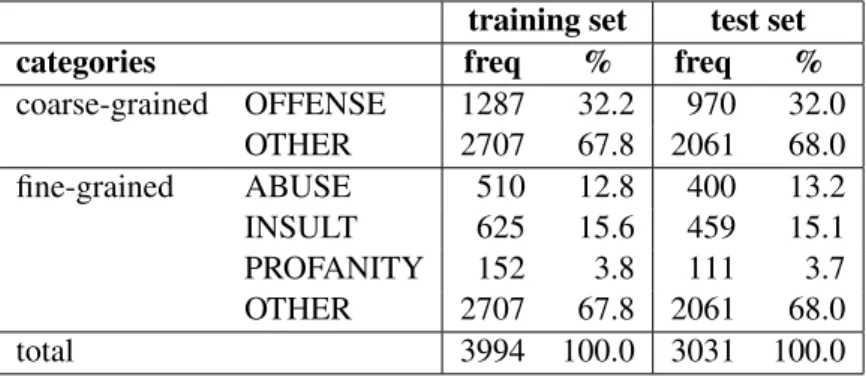
Table 2 displays the class distribution among the 2019 training and the test set. It comes as no surprise that non-offensive tweets represent the ma-jority class. The most frequent subtype of offensive language are cases of (common) insult followed by abuse. By far the smallest category are profane tweets.
4.2.2 Subtask 3
After an initial phase, where we set up the guide-lines, we chose 300 offensive tweets and four an-notators classified each tweet as either implicit or explicit offensive language.
Our intention in this first round was to raise a common understanding of implicitness. After har-monization, 247 of the 300 tweets were classified as explicit offensive language (82.33%) while 52 (17.33%) were deemed to be implicit. See Table 3 for pairwise Kappa values.
As we expected, the annotation of implicitness is not an easy task. Accordingly, the agreement is
training set test set
categories freq % freq %
coarse-grained OFFENSE 1287 32.2 970 32.0 OTHER 2707 67.8 2061 68.0 fine-grained ABUSE 510 12.8 400 13.2 INSULT 625 15.6 459 15.1 PROFANITY 152 3.8 111 3.7 OTHER 2707 67.8 2061 68.0 total 3994 100.0 3031 100.0
Table 2: Class distribution on the 2019 training and test set
B C D
A 0.60 0.46 0.54
B 0.48 0.52
C 0.37
Table 3: Pairwise Kappa: 4 annotators, 300 tweets moderate (most of the time). Two annotators, A and B, almost reached a substantial agreement, while annotators C and D only have a fair agreement. We thus decided to let A and B carry out a substantial part of the annotation.
The annotation of additional 1,800 examples re-sulted in a Kappa value of 0.51. After harmoniza-tion, the Kappa value of A and the gold standard was 0.60, while those of B and the gold standard was 0.82. The rest of the 2,890 tweets (600) were annotated by C and D. The agreement there was 0.42.
freq % training set IMPLICIT 259 13.20
EXPLICIT 1699 76.80 test set IMPLICIT 134 14.37 EXPLICIT 798 75.63 Table 4: Class distribution subtask 3 Table 4 shows the class distribution for the train-ing and the test data. The whole corpus com-prises 8,541 tweets, 2,888 are offensive (33.81%) of which 393 (13.6%) were implicitly offensive. 4.3 Data Format
Our data is distributed in the form of tab-separated value files. An example row representing one tweet for subtasks 1 and 2 is shown in Table 5. As the task is focused only on the linguistic aspect of offensive language, each tweet is represented only by its text
in column 1. Meta-data contained in Twitter’s json files was not used. The text column is followed by the coarse-grained label in column 2 and the fine-grained label in column 3. Note that we applied no preprocessing to the tweet text with one exception: as shown in Table 5, line breaks were replaced with the special 5-character string|LBR|so that each tweet could be stored on one line.
For subtask 3 the data from 2018 was used. In order to provide for an additional layer distinguish-ing explicit from implicit offensive language, we added an additional column. Three labels are used: IMPLICIT, EXPLICIT or OTHER, see Table 6. 4.4 Sanity checks
To make sure empirically for subtasks 1 and 2 that the combination of last year’s data with this year’s data was sensible and there were no crucial differ-ences that would actually harm performance, we performed an internal pre-test using last year’s win-ning system by TU Vienna (Padilla Montani and Sch¨uller, 2018). We used all of last year’s data as well as this year’s new training data as the training set and tested on the new 2019 test set.
We performed a second sanity experiment after the task’s evaluation phase because it was only then noticed that there were erroneous labels on items of the 2019 training set. Altogether about 2.9% of the labels were affected: 15 cases of the class ABUSE, 28 cases of the class INSULT and 74 cases of the class OTHER. The PROFANITY class was not affected. We repeated the sanity check on a corrected version of the dataset to evaluate if the errors might have substantially harmed results in the competition.
The results for the initial sanity check on the original, slightly erroneous data are denoted by the rows coarseeand fineein Tables 7 and 8, while the
@Ralf Stegner Oman Ralle..dich mag ja immer noch keiner. Du willst das die Hetze gegen dich aufh¨ort?|LBR|Geh in Rente und verzichte auf die 1/2deiner Pension
OFFENSE INSULT
Table 5: Data format for subtask 1 and 2 (2019 dataset) Der einzige, der sich noch dar¨uber freut, dass Merkel auf
ihrem Stuhl klebt|LBR|ist der beginnende Dekubitus.
OFFENSE INSULT IMPLICIT Table 6: Data format for subtask 3 (2018 dataset)
by the rows rows coarsec and finec. Overall, the
results for these sanity checks are very similar to the system’s results on last year’s tasks, regardless of whether we the training set includes a slight number of errors or not. (The corrected version of the training set is also now publicly available from the shared task homepage.)
For subtask 3, no sanity checks were needed.
5 Submissions and Results
The full set of results for all three subtasks is avail-able at the shared task website.
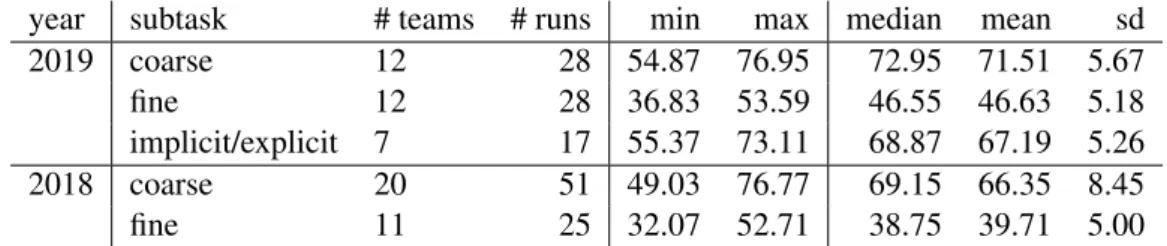
Table 9 presents descriptive statistics for the scores produced in this year’s and last year’s it-erations of subtask 1 and 2. For subtask 1, coarse-grained classification, we can see that this year the participants’ scores are more tightly clustered, yielding a lower standard deviation. For subtask 2, the fine-grained task, there was no similar develop-ment.
5.1 Coarse-grained Classification
We received 28 different runs from 12 teams for the binary classification into OFFENSE vs. OTHER. For lack of space, we only show the best 15 runs in Table 10. Compared to the previous year, this year’s winning F-score is higher, but very slightly so (76.95 vs. 76.77). Of course, these number can-not be compared directly as they involved different training and test sets.
5.2 Fine-grained Classification
For the second subtask we received 28 different runs from 12 teams for the fine-grained classifica-tion. For lack of space, we only show the best 10 runs in Table 11. Compared to last year’s results, the winning score is higher by about 0.9% F-score. As in the case of the coarse grained subtask, this cannot be readily interpreted without further inves-tigation.
5.3 Implicit vs. Explicit Classification
Seven groups participated in subtask 3, which was a difficult subtask. Although the best accuracy was 86.77% with a F-score of 73.11, the numbers for the class IMPLICIT were low, the best F-score being 53.93. The subtask is difficult due to the skewed distribution of that class, just 13.9% of the offensive tweets are labeled as implicit.
5.4 General Conclusions Drawn from the Evaluation
5.4.1 System Design
Although in terms of absolute F-scores, the best performing system on all 3 subtasks was a sys-tem that employed some form of the latest trans-former based language model BERT (Devlin et al., 2019) (i.e.UPB on subtasks 1 and 2; hpiDEDIS
on subtask 3), at least on subtasks 1 and 2 there were systems which did not incorporate BERT (i.e.
TUWienKBS on subtask 1 andFoSILon subtask 2) but still performed very well (that is within 1% point of the top performing system). Only on sub-task 3 is there a larger difference between the best performing system and the best system not employ-ing BERT, i.e.FoSIL, with a gap of more than 3.5% points.
BERT seems to be generally effective. All 3 teams that participated in the shared task and incor-porated some form of BERT (UPB,hpiDEDISand
bertZH) were among the top performing systems. The variation of BERT that consistently outper-formed the other ones is a model pre-trained on 6 million German tweets (UPB). The other two teams just fine-tuned the existing pre-trained models.
Surprisingly, for all 3 subtasks there is no sys-tem among the top 3 teams which employs stan-darddeep-learning architectures, such as LSTMs or CNN. Instead, withFoSILwe still find systems that are based on traditional classifiers, such as SVMs. This year’s results are also mostly
consis-OFFENSE OTHER average
P R F P R F P R F
coarsee 67.23 69.18 68.19 85.29 84.13 84.71 76.26 76.65 76.46
coarsec 68.20 68.76 68.48 85.24 84.91 85.08 76.72 76.84 76.78
Table 7: Results of sanity checks on error-containing and clean test data in coarse setting
P R F fine e ABUSE 47.29 41.50 44.21 INSULT 44.71 36.82 40.38 OTHER 83.33 88.26 85.72 PROFANITY 42.02 45.05 43.48 average 54.34 52.91 53.61 fine c ABUSE 47.41 41.25 44.12 INSULT 45.76 38.78 41.98 OTHER 83.65 88.40 85.96 PROFANITY 43.10 45.05 44.05 average 54.98 53.37 54.16 Table 8: Results of sanity checks on error-containing and clean test data in fine-grained set-ting
tent with last year’s results: the best performing systems incorporated some form of word embed-dings and some information on the subword level (e.g. character n-grams). Ensemble methods may be effective (TUWienKBS) but they seem not to be a crucial ingredient for high scores. The same holds for task-specific lexicons. Of the 3 top-performing systems on the 3 subtasks, onlyFoSILemployed that type of information.
In subtask 3, the best performing systems ( hpi-DEDIS, UPB, rank 1-5 with various runs) were using BERT as a resource (fine-tuned it). Of the 7 participants, 5 used neural approaches (including BERT), i.e. RNN (inriaFBK), CNN (fkie,HAU) and LSTM (fkie). Two worked with German Fast-Text (RGCL,FoSIL), one also considered a Random Forest approach and one also submitted a SVM based run.
5.4.2 Task and Data
With regard to subtask 1, if we compare the differ-ence between the F-score of the best performing system to the median between this year (median: 72.95; best system: 76.95) and last year (median: 69.15; best system: 76.77), we find that the median has risen appreciably (by more than 3% points) while the best score has maintained its level of per-formance. From that we may conclude that the
average system that took part in this year’s edition of the shared task is notably stronger than last year.
In terms of the best overall scores that have been achieved in subtasks 1 and 2 in this year’s edition of the shared task, there is hardly any improvement. We re-trained last year’s winning system on this year’s training data and compared the classifica-tion on this year’s test data (cf. Tables 7 and 8) with the best performing system in this year’s com-petition (cf. Tables 10 and 11). Surprisingly, we obtained only marginally worse results with last year’s system (subtask 1: 76.46 vs. 76.95; subtask 2: 53.61 vs. 53.95). Given that this year’s training set was larger, this could mean one of two things. First, the additional data might not have helped even though test and training data were otherwise similar because the system was not able to make use of relevant features. Alternatively, the increase in data this year might have been offset by the new data being more difficult so that overall the system reached only the same level of performance as last year. These questions can best be addressed by running the same system on various combinations of this and last year’s data, which unfortunately is outside the scope of this overview paper.
All in all, these results underline that the problem of offensive language detection is far from solved. It also suggests that a thorough error analysis is required. Only thus can we learn which systematic errors even the best performing systems make and, hopefully, get ideas how to devise new methods which even solve these types of phenomena.
6 Conclusion
In this paper, we described the second edition of the GermEval Shared on the Identification of Offensive Language. The shared task comprised three tasks, a coarse-grained binary classification task, a fine-grained multi-class classification task and a novel classification task in which explicit tweets had to be separated from implicit ones. In total, 13 groups participated in the shared task submitting 28 runs for each of the first two subtasks and 17 runs for the last subtask.
year subtask # teams # runs min max median mean sd 2019 coarse 12 28 54.87 76.95 72.95 71.51 5.67 fine 12 28 36.83 53.59 46.55 46.63 5.18 implicit/explicit 7 17 55.37 73.11 68.87 67.19 5.26 2018 coarse 20 51 49.03 76.77 69.15 66.35 8.45 fine 11 25 32.07 52.71 38.75 39.71 5.00
Table 9: Summary statistics for overall macro F1-scores in the three subtasks and as a reference the figures of last year’s edition
While for the third subtask, the data of the pre-vious edition were augmented by the classification scheme of this new task, for the first and second subtask, completely new tweets were added to the collection. For these two subtasks, we added about 4,000 manually labeled training tweets. Similar to last year, much care was taken in order to provide a relatively unbiased dataset. Unlike the data from the previous edition, the new data also contain of-fensive language originating from other areas than the extreme right.
Approaches that were effective in last year’s edition, such as supervised classifiers using word embeddings, subword information and ensemble methods, also proved effective in this year’s edi-tion. However, similar effectiveness without less task-specific design could be achieved by classi-fiers based on the recent BERT model.
Surprisingly, the best system of this year’s sys-tem on the coarse-grained task is on a par of last year’s winning system. This result again underlines the difficulty of this task. Further error analyses should be carried in order to determine which types of errors even the best performing systems incur. This would hopefully provide fruitful research di-rections for future work.
Acknowledgments
We are grateful to the large number of participants whose enthusiastic participation made GermEval 2019 a success. We would like to thank Joane Am-rhein for maintaining the shared task home page and mailing lists and supporting the evaluation pro-cess. We would also like to thank Sophia Conrad (BA student), Andreas S¨auberli (BA student) and No¨emi Aepli (PhD student) for their contribution to subtask 3. All annotators are native speakers of German. We also thank the Konvens 2019 confer-ence organizers for their support. Michael Wiegand was supported by the Leibniz ScienceCampus “Em-pirical Linguistics and Computational Modeling”,
funded by the Leibniz Association under grant no. SAS-2015-IDS-LWC and by the Ministry of Sci-ence, Research, and Art (MWK) of the state of Baden-W¨urttemberg.
References
Valerio Basile, Cristina Bosco, Elisabetta Fersini, Deb-ora Nozza, Viviana Patti, Francisco Manuel Rangel Pardo, Paolo Rosso, and Manuela Sanguinetti. 2019. Semeval-2019 task 5: Multilingual detection of hate speech against immigrants and women in twitter. In Proceedings of the 13th International Workshop on
Semantic Evaluation, pages 54–63.
Jacob Devlin, Ming-Wei Chang, Kenton Lee, and Kristina Toutanova. 2019. BERT: Pre-training of deep bidirectional transformers for language under-standing. InProceedings of the 2019 Conference of the North American Chapter of the Association for Computational Linguistics: Human Language
Tech-nologies, Volume 1 (Long and Short Papers), pages
4171–4186, Minneapolis, Minnesota, June. Associa-tion for ComputaAssocia-tional Linguistics.
Elisabetta Fersini, Paolo Rosso, and Maria Anzovino. 2018. Overview of the task on automatic misog-yny identification at ibereval 2018. InIberEval@
SEPLN, pages 214–228.
Ritesh Kumar, Atul Kr. Ojha, Shervin Malmasi, and Marcos Zampieri. 2018. Benchmarking aggres-sion identification in social media. InProceedings of the First Workshop on Trolling, Aggression and
Cyberbullying (TRAC-2018), pages 1–11, Santa Fe,
New Mexico, USA, August. Association for Compu-tational Linguistics.
J. Richard Landis and Gary G. Koch. 1977. The Measurement of Observer Agreement for Categori-cal Data. Biometrics, 33(1):159–174.
Pushkar Mishra, Helen Yannakoudakis, and Ekaterina Shutova. 2019. Tackling Online Abuse: A Survey of Automated Abuse Detection Methods. arXiv
e-prints, August.
Joaquın Padilla Montani and Peter Sch¨uller. 2018. TUWienKBS at GermEval 2018: German Abusive Tweet Detection. Proceedings of GermEval 2018,
submission Accuracy OFFENSE O THER av erage team runID percent correct total P R F P R F P R F 1 UPB coarse 1 79.38 2406 3031 66.26 72.47 69.23 86.45 82.63 84.50 76.35 77.55 76.95 2 UPB coarse 3 79.38 2406 3031 66.26 72.47 69.23 86.45 82.63 84.50 76.35 77.55 76.95 3 UPB coarse 2 79.64 2414 3031 67.53 70.10 68.79 85.67 84.13 84.90 76.60 77.12 76.86 4 TUW ienKBS coarse 1 80.04 2426 3031 69.73 66.49 68.07 84.57 86.41 85.48 77.15 76.45 76.80 5 TUW ienKBS coarse 2 79.94 2423 3031 69.34 66.91 68.10 84.68 86.07 85.37 77.01 76.49 76.75 6 FoSIL coarse 2 79.54 2411 3031 67.68 69.07 68.37 85.30 84.47 84.89 76.49 76.77 76.63 7 FoSIL coarse 1 79.25 2402 3031 66.73 70.10 68.38 85.59 83.55 84.56 76.16 76.83 76.49 8 hpiDEDIS coarse 2 78.69 2385 3031 64.86 72.89 68.64 86.45 81.42 83.86 75.66 77.15 76.40 9 hpiDEDIS coarse 3 79.71 2416 3031 70.66 62.58 66.38 83.29 87.77 85.47 76.98 75.18 76.06 10 hpiDEDIS coarse 1 76.97 2333 3031 61.54 74.74 67.50 86.78 78.02 82.17 74.16 76.38 75.26 11 inriaFBK coarse 2 78.55 2381 3031 67.74 62.99 65.28 83.14 85.88 84.49 75.44 74.44 74.93 12 hshl coarse 1 78.39 2376 3031 68.00 61.34 64.50 82.61 86.41 84.47 75.30 73.88 74.58 13 inriaFBK coarse 1 78.55 2381 3031 69.18 59.48 63.97 82.11 87.53 84.73 75.65 73.51 74.56 14 rgcl coarse 2 77.96 2363 3031 81.72 40.10 53.80 77.26 95.78 85.53 79.49 67.94 73.26 15 rgcl coarse 3 77.37 2345 3031 83.49 36.49 50.79 76.37 96.60 85.30 79.93 66.55 72.63 Table 10: Top 15 runs for subask 1: coarse-grained classification submission accuracy AB USE INSUL T O THER PR OF ANITY av erage team runID percent correct total P R F P R F P R F P R F P R F 1 UPB fine 1 73.61 2231 3031 44.04 60.00 50.79 49.49 32.03 38.89 84.69 88.55 86.57 55.88 17.12 26.21 58.53 49.42 53.59 2 FoSIL fine 2 71.36 2163 3031 42.57 58.75 49.37 45.30 45.10 45.20 85.88 82.63 84.22 46.15 16.22 24.00 54.98 50.67 52.74 3 FoSIL fine 1 72.02 2183 3031 42.60 58.25 49.21 46.81 38.34 42.16 84.60 85.30 84.95 53.33 14.41 22.70 56.83 49.08 52.67 4 bertZH fine 2 74.46 2257 3031 55.29 45.75 50.07 48.09 41.18 44.37 83.43 90.15 86.66 33.75 24.32 28.27 55.14 50.35 52.64 5 UPB fine 2 71.66 2172 3031 43.33 58.50 49.79 43.51 39.43 41.37 85.67 84.13 84.90 45.10 20.72 28.40 54.40 50.70 52.48 6 UPB fine 3 73.57 2230 3031 45.61 54.50 49.66 47.21 36.82 41.37 84.69 88.55 86.57 45.00 16.22 23.84 55.63 49.02 52.11 7 TUW ienKBS fine 2 71.86 2178 3031 45.36 41.50 43.34 44.78 38.34 41.31 82.62 87.19 84.84 40.21 35.14 37.50 53.24 50.54 51.86 8 bertZH fine 1 73.38 2224 3031 54.55 43.50 48.40 43.42 40.96 42.15 82.63 89.33 85.85 41.18 18.92 25.93 55.44 48.18 51.55 9 TUW ienKBS fine 1 73.18 2218 3031 46.20 38.00 41.70 49.82 30.94 38.17 80.58 91.80 85.82 46.38 28.83 35.56 55.75 47.39 51.23 10 hpiDEDIS fine 3 70.04 2123 3031 44.94 47.75 46.30 39.19 48.58 43.39 85.19 81.76 83.44 40.68 21.62 28.24 52.50 49.93 51.18 Table 11: Top 10 results for subtask 2: fine-grained classification
14th Conference on Natural Language Processing (KONVENS 2018), Vienna, Austria September 21, 2018.
Bj¨orn Ross, Michael Rist, Guillermo Carbonell, Ben-jamin Cabrera, Nils Kurowsky, and Michael Wo-jatzki. 2016. Measuring the Reliability of Hate Speech Annotations: The Case of the European Refugee Crisis. In Proceedings of the Workshop on Natural Language Processing for
Computer-Mediated Communication, pages 6–9, Bochum,
Ger-many.
Anna Schmidt and Michael Wiegand. 2017. A Survey on Hate Speech Detection using Natural Language Processing. InProceedings of the EACL-Workshop on Natural Language Processing for Social Media
(SocialNLP), pages 1–10, Valencia, Spain.
Zeerak Waseem and Dirk Hovy. 2016. Hateful sym-bols or hateful people? predictive features for hate speech detection on twitter. In Proceedings of the
NAACL student research workshop, pages 88–93.
Michael Wiegand, Josef Ruppenhofer, Anna Schmidt, and Clayton Greenberg. 2018a. Inducing a Lexi-con of Abusive Words – A Feature-Based Approach.
InProceedings of the Human Language Technology
Conference of the North American Chapter of the
ACL (HLT/NAACL), New Orleans, USA.
Michael Wiegand, Melanie Siegel, and Josef Ruppen-hofer. 2018b. Overview of the GermEval 2018 shared task on the identification of offensive lan-guage. Proceedings of GermEval 2018, 14th Confer-ence on Natural Language Processing (KONVENS 2018), Vienna, Austria September 21, 2018, pages 1 – 10. Austrian Academy of Sciences, Vienna, Aus-tria.
Marcos Zampieri, Shervin Malmasi, Preslav Nakov, Sara Rosenthal, Noura Farra, and Ritesh Kumar. 2019. Semeval-2019 task 6: Identifying and cate-gorizing offensive language in social media (offen-seval). InSemEval@NAACL-HLT.
7 Appendix
group id authors affiliation paper title InriaFBK Michele Corazza,
Stefano Menini, Elena Cabrio, Sara Tonelli and Serena Villata
Inria, France and Fondazione Bruno Kessler, Italy
InriaFBK Drawing Attention to Of-fensive Language at Germeval2019
hshl Kristian Rother and
Achim Rettberg Hochschule Hamm-Lippstadt, Germany with Naive Bayes and Logistic Re-German Hatespeech classification gression hshl at GermEval 2019 -Task 2
fkie Theresa
Krumbiegel Fraunhofer FKIE, Ger-many FKIE - Offensive Language Detec-tion on Twitter at GermEval 2019 FraunhoferSIT Inna Vogel and
Roey Regev Fraunhofer InstituteSIT, Germany FraunhoferSIT at GermEval 2019:Can Machines Distinguish Be-tween Offensive Language and Hate Speech? Towards a Fine-Grained Classification
bertZH Tim Graf and Luca
Salini University of Zurich,Switzerland bertZH at GermEval 2019: Fine-Grained Classification of German Offensive Language using Fine-Tuned BERT
FoSIL Florian Schmid, Justine Thielemann, Anna Mantwill, Jian Xi, Dirk Labudde and Michael Spranger
University of Applied Sciences Mittweida, Germany
FoSIL - Offensive language classifi-cation of German tweets combining SVMs and deep learning techniques
h da Isabell B¨orner, Midhad Blazevic, Maximilian Ko-mander and Margot Mieskes
Darmstadt University of Applied Sciences, Germany
2019 GermEval Shared Task on Of-fensive Tweet Detection h da sub-mission
HAU Johannes Sch¨afer, Tom De Smedt and Sylvia Jaki
University of Hildesheim, Germany and University of Antwerp, Netherlands
HAU at the GermEval 2019 Shared Task on the Identification of Offen-sive Language in Microposts: Sys-tem Description of Word List, Sta-tistical and Hybrid Approaches
UPB Andrei Paraschiv
and Dumitru-Clementin Cercel
University Politehnica of Bucharest, Roma-nia
UPB at GermEval-2019 Task 2: BERT-Based Offensive Language Classification of German Tweets hpiDEDIS Julian Risch, Anke
Stoll, Marc Ziegele and Ralf Krestel
Hasso Plattner Insti-tute, Heinrich Heine University D¨usseldorf and University of Pas-sau, Germany
hpiDEDIS at GermEval 2019: Of-fensive Language Identification us-ing a German BERT model HUIU Melanie Andresen,
Melitta Gillmann, Jowita Grala, Sarah Jablotschkin, Lea R¨oseler, Eleonore Schmitt, Lena Schnee, Katharina Straka, Michael Vauth, Sandra K¨ubler and Heike Zinsmeister Universit¨at Hamburg (Germany), Universitt Bamberg (Germany), Indiana University (USA)
The HUIU Contribution for the Ger-mEval Shared Task 2
TUWienKBS19 Joaqun Padilla Montani and Peter Sch¨uller
TU Wien, Austria TUWienKBS19 at GermEval Task 2, 2019: Ensemble Learning for Ger-man Offensive Language Detection
RGCL Alistair Plum,
Tharindu Ranas-inghe, Constantin Orasan and Ruslan Mitkov
University of
Wolver-hampton, UK RGCL at GermEval 2019: Offen-sive Language Detection with Deep Learning