University of Pennsylvania
ScholarlyCommons
Departmental Papers (CIS)
Department of Computer & Information Science
6-2010
Privacy Issues in Scientific Workflow Provenance
Susan B. Davidson
University of Pennsylvania, [email protected]
Sanjeev Khanna
University of Pennsylvania, [email protected]
Sudeepa Roy
University of Pennsylvania, [email protected]
Sarah Cohen Boulakia
Universite Paris Sud (Paris XI)
Follow this and additional works at:
http://repository.upenn.edu/cis_papers
Part of the
Computer Sciences Commons
Davidson, S., Khanna, S., Roy, S. & Boulakia, S., Privacy Issues in Scientific Workflow Provenance,WAND2010
ACM COPYRIGHT NOTICE. Copyright © 2010 by the Association for Computing Machinery, Inc. Permission to make digital or hard copies of part or all of this work for personal or classroom use is granted without fee provided that copies are not made or distributed for profit or commercial advantage and that copies bear this notice and the full citation on the first page. Copyrights for components of this work owned by others than ACM must be honored. Abstracting with credit is permitted. To copy otherwise, to republish, to post on servers, or to redistribute to lists, requires prior specific permission and/or a fee. Request permissions from Publications Dept., ACM, Inc., fax +1 (212) 869-0481, [email protected].
This paper is posted at ScholarlyCommons.http://repository.upenn.edu/cis_papers/669
For more information, please [email protected].
Recommended Citation
Susan B. Davidson, Sanjeev Khanna, Sudeepa Roy, and Sarah Cohen Boulakia, "Privacy Issues in Scientific Workflow Provenance", . June 2010.
Privacy Issues in Scientific Workflow Provenance
Abstract
A scientific workflow often deals with proprietary modules as well as private or confidential data, such as
health or medical information. Hence providing exact answers to provenance queries over all executions of
the workflow may reveal private information. In this paper we first study the potential privacy issues in a
scientific workflow – module privacy, data privacy, and provenance privacy, and frame several natural
questions: (i) can we formally analyze module, data or provenance privacy giving provable privacy guarantees
for an unlimited/bounded number of provenance queries? (ii) how can we answer provenance queries,
providing as much information as possible to the user while still guaranteeing the required privacy? Then we
look at module privacy in detail and propose a formal model from our recent work in [11]. Finally we point to
several directions for future work.
Disciplines
Computer Sciences
Comments
Davidson, S., Khanna, S., Roy, S. & Boulakia, S., Privacy Issues in Scientific Workflow Provenance,
WAND
2010
ACM COPYRIGHT NOTICE. Copyright © 2010 by the Association for Computing Machinery, Inc.
Permission to make digital or hard copies of part or all of this work for personal or classroom use is granted
without fee provided that copies are not made or distributed for profit or commercial advantage and that
copies bear this notice and the full citation on the first page. Copyrights for components of this work owned
by others than ACM must be honored. Abstracting with credit is permitted. To copy otherwise, to republish,
to post on servers, or to redistribute to lists, requires prior specific permission and/or a fee. Request
permissions from Publications Dept., ACM, Inc., fax +1 (212) 869-0481, or
.
Privacy Issues in Scientific Workflow Provenance
[Position Paper]
Susan B. Davidson, Sanjeev Khanna,
Sudeepa Roy
Department of Computer and Information Science, University of Pennsylvania
Philadelphia, PA 19104, USA
{susan, sanjeev,
sudeepa}@cis.upenn.edu
Sarah Cohen Boulakia
Laboratoire de Recherche en Informatique Université Paris-Sud
91405 Orsay cedex, France
ABSTRACT
A scientific workflow often deals with proprietary modules as well as private or confidential data, such as health or medical informa-tion. Hence providing exact answers to provenance queries over all executions of the workflow may reveal private information. In this paper we first study the potential privacy issues in a scientific work-flow –module privacy,data privacy, andprovenance privacy, and frame several natural questions: (i) can we formally analyze mod-ule, data or provenance privacy giving provable privacy guarantees for an unlimited/bounded number of provenance queries? (ii) how can we answer provenance queries, providing as much information as possible to the user while still guaranteeing the required priva-cy? Then we look at module privacy in detail and propose a formal model from our recent work in [11]. Finally we point to several directions for future work.
1.
INTRODUCTION
Provenance in scientific workflows is of great interest, as evidenced by several recent workshops and surveys on the topic. A number of tools to capture, query, and manage provenance have also been developed in workflow systems such as myGrid/Taverna [24], Ke-pler [7], and VisTrails [15]. By maintaining information about the processing steps used to produce a data item, as well as the param-eter settings and intermediate data items passed between steps, the validity and reliability of data can be better understood and results be made reproducible.
However, making complete provenance information available may raise privacy concerns. For example, intermediate data may contain sensitive information, such as the social security number or a med-ical record of an individual. Although using the data in an analysis may be acceptable, revealing the data itself would be a breach of privacy. A processing step (ormodule) may also be proprietary, and therefore allowing a user to see its inputs and outputs over a large number of executions could violate privacy by revealing its behav-ior. Finally, details of how modules in the workflow are connected
Permission to make digital or hard copies of all or part of this work for personal or classroom use is granted without fee provided that copies are not made or distributed for profit or commercial advantage and that copies bear this notice and the full citation on the first page. To copy otherwise, to republish, to post on servers or to redistribute to lists, requires prior specific permission and/or a fee.
WANDSIndianapolis, IN, USA, June 6th, 2010
Copyright 2010 ACM 978-1-4503-0188-6 ...$10.00.
may be private, and therefore showing how data is passed between modules would reveal the structure of the workflow. There is there-fore a trade off between the amount of provenance information that can be revealed and the privacy guarantees of the data and modules comprising the workflow.
While the problem of answering user queries over a private source of information has been extensively studied (see, for example, [12], [25]), these results do not address core aspects of privacy in work-flows. For instance, a commonly used idea is to introducenoise
in the answer to a query. However, in scientific workflows the accuracy of revealed intermediate data is critical, and thus adding noise to the output of a module is undesirable. On the other hand, if intermediate data is revealed with any meaningful precision over a large number of executions of the workflow, the user may learn the behavior of private modules in the workflow.
Hence, addressing privacy in workflows requires a formal notion of privacy and suitable mechanisms for hiding provenance infor-mation to attain a required privacy guarantee. In this paper, we will call the part of the workflow or executions of the workflow that are revealed to the user a privacy-preserving view. Clearly, providing a view which consists only of the inputs to and outputs from the workflow, with all details of the workflow execution hid-den in a “black box” composite module, guarantees any privacy requirements. However, it does not reveal any provenance infor-mation. This leads to a natural optimization problem which we call thesecure-view problem- how to find a privacy-preserving view of the workflow which maximizes the provenance information re-vealed to the user. In our current research, we focus on obtaining a mathematical model of privacy in workflows with respect to dif-ferent private components and finding exact or good approximate solutions to the secure-view problem.
Related Work.
Privacy-preserving data mininghas received considerable attention in recent years (see surveys [1, 28], and the references therein). Here, the goal is to hide individual data attributes while retaining the suitability of the data for mining patterns. For example, the technique ofanonymizing datamakes each record indistinguish-able from a large enough set of other records in certain identifying attributes [27, 21, 3]. Privacy preserving approaches have been s-tudied forsocial networks[19, 4, 25, 9],auditing queries[23, 22] and in other contexts. Another widely used technique is that of
data perturbationwhere some noise (usually random) is added to the the output of a query or to the underlying database. This tech-nique is often used instatistical databases, where a query computes some aggregate function on the dataset [2, 12]. Privacy in
statisti-cal databases is often quantified using the framework ofdifferential privacy, which requires that the output distribution isalmost invari-ant to the inclusion of any particular record (see, for example, the surveys [13, 14]).
The problem of preserving privacy in a workflow has been con-sidered in the papers [10, 17, 16]. In [10], the authors discuss a framework to output apartialview of a workflow that conforms to a given set of access permissions on the connections between modules and data on input/output ports. In particular, the authors define specifications forport level security(for data values pro-duced or consumed by ports of modules),channel level security
(for the presence of edges between modules) andtask level secu-rity(for all input/output data of a module or sub-workflow). The problem of ensuring the lawful use of data according to some spec-ified privacy policies has been considered in [17, 16], even when access control on the data has been enforced. The relationships a-mong data and module sets, and their properties relevant to privacy, is specified by a policy language. Workflow systems incorporated with privacy awareness properties enable scientists to ensure da-ta privacy throughout the dada-ta analysis process. However, to the best of our knowledge, a formal study of privacy issues specific to workflows with provable privacy guarantees has not yet been stud-ied. Although the above papers address privacy issues in scientif-ic workflows, the privacy notions are somewhat informal, and no guarantees on the quality of the solution are provided in terms of their privacy and utility.
Secure provenancefor workflows has been studied [20, 8, 18]. Here the goal is to ensure that provenance information has not been forged or corrupted, and a variety of cryptographic and trusted computing techniques are proposed. The secure provenance prob-lem is quite different from that of privacy in workflow provenance, where the goal is to ensure that privacy is maintaned while still maximizing the user’s utility in terms of provenance information.
Contribution and Organization.
The contribution of this paper is a discussion of privacy issues in workflow provenance, and a description of an approach for preserv-ing module privacy in workflows with provable guarantees.
We start by describing our workflow model in Section 2, and discuss privacy issues in workflow provenance in Section 3. In Section 4, we highlight our recent work [11], which provides a for-mal definition of module privacy in a workflow and an approach to guarantee privacy while maximizing the provenance information revealed. We discuss several interesting and challenging open prob-lems regarding privacy in workflows in Section 5, and conclude in Section 6.
2.
WORKFLOW MODEL
We describe an abstract model that captures the workflows consid-ered in most of workflow systems (e.g. MyGrid, Taverna, Vistrails, etc). A workflow can be thought of as a program, producing a set offinal output datafrom a set ofinitial input datain anexecution. Internally, a workflow system comprises a set ofmodules(i.e. pro-grams) with input and output data ports. A module receives initial input data or data generated by other modules on its input ports and sends its output data or generates final data on its output ports; data items sent by a module to another module are calledintermediate data. Parameterscan also be specified for modules and, for uni-formity, are considered to be initial inputs as well. In this paper, we assume that the connections form anacyclicgraph on the
mod-ules, which is common in many of the aforementioned workflow systems [15, 24].
Figure 1: Example of a workflow execution
An example of a workflow is shown in Figure 1 which (for sim-plicity) uses boolean data and functions. There are two initial input datad1andd2on edgese1ande2, respectively,d5,d6on edgese6
ande7are the final output data. The three modules in the workflow
arev1,v2andv3. Their underlying functions f1,f2and f3are
de-fined as follows: (a)f1computes two intermediate datad3andd4,
whered3=d1 andd4=d1∨d2, (b) f2=d3⊕d41 and produces
one output datad5which is 1 iffd3#=d4, (c) the other output data
d6=1−d4is produced byf3. Note that the datad4produced by
v1 acts as input to bothv2andv3; in general, a data output by a
module can act as input to multiple modules as well as (possibly) be a final output data. We call this phenomenondata sharing. Note that a data item cannot be output by more than one module. Also, observe that a workflow may be a multigraph: in this example,v1
sends two datad3andd4tov2.
Figure 1 also shows a sample execution of the workflow when
d1=0 andd2=1 are the initial inputs; thend3=0,d4=1,d5=1
andd6=0. In this execution, the provenance ofd6=0 includes
data valuesd1=0,d2=1 and d4=1, and modules v1 and v3.
On the other hand, the provenance ofd5=1 includes data values
d1=0,d2=1,d3=0 andd4=1, and modulesv1andv2.
Given a workflow, we assume that there is aworkflow owner
and auser. The owner decides which components (data and mod-ules) in the workflow are private for this user. The user can execute the workflow on different initial input data anarbitrarynumber of times. The user is always able to see the initial input data and the final output data. Further, the user wants to see some of the inter-mediate data as the response to a provenance query. However, the owner may or may not grant the user access to some of the inter-mediate data to ensure the privacy of the private components in the workflow. We say that a data ishiddenif the user isnotgranted the access to see the corresponding data value for all executions of the workflow, otherwise the data isvisible. Note that the user can always see the connections with the unique identifiers of the data, only the value of the data may be hidden. The private components of the workflow and their desired privacy level can be specific to a particular user; in our current work we have considered a single us-er and leave the problem of handling multiple usus-ers with diffus-erent private components, i.e. handling more generalrole based access control, for future work.
1a⊕bdenotes the XOR ofaandb: Ifa,bare two bits,a⊕b=1
3.
MOTIVATING EXAMPLES AND
PRIVA-CY ISSUES
Let us first consider some real life scenarios with potential privacy concerns.
Example 1.A module fin a medical diagnosis workflow detects the presence of a diseaseX by taking as input a set of patient at-tributes (eg. age, gender, smoking habit, blood pressure etc.) and produces as output the probability that the patient has a particu-lar disease. Thefunctionalityof this module, represented by its input-output behavior(I,f(I)), may be highly sensitive. However, if a large enough set of such pairs are publicly available, thenf(I) could be exactly or approximately calculated for some patient in-putI, which may be socially, legally, or morally unacceptable. The module may also correspond to a proprietary or private algorithm, and the owner may be concerned that some approximation of the algorithm could be reverse-engineered, or that the relative impor-tance of attributes inIcould be revealed, by exposing its function-ality.
Example 2. In a microarray experiments biologists must cope with variation in experimental conditions which is unrelated to the biological differences they seek to understand.Normalizationis an attempt to compensate for experimental variation to enable the bi-ological differences between samples to be more clearly seen. Mi-croarray companies (and companies who provide the robots used to perform the experiments) therefore provide software to normalize results obtained using their chips/robots, which may then be used in scientific workflows. However, the software frequently uses pri-vate dataobtained from experiments performed by other groups using the software, which should not be revealed.
Example 3.With the exponentially growing number of sequenced genomes that are becoming available, techniques forfunctional an-notation– determining the function or role of each protein in a genome – have become important. To provide annotations of good quality, annotation workflows are being developed. One such anno-tation workflow may take as input a protein sequence and produce an annotation expressed using a set of Gene Ontology (GO) terms. In one such workflow, three modules are used: (i) ModuleM1
com-pares the input protein sequence to the sequences of other genomes that have already been annotated, and provides the annotation of the closest protein found; (ii) ModuleM2searches for domains and
outputs the set of sequences representing domains found in the pro-tein (each domain may have its own function); (iii) ModuleM3
lo-cates the sequence in the genome as a whole to make sure that the sequence is complete, and completes it if not. These three tasks can be performed in different orders (either sequentially or in parallel), and some of the tasks may be skipped under certain conditions; in one workflow execution onlyM1may be executed, while in another
execution of the workflow bothM1andM2may be executed in
par-allel. For example, ifM2provides only one sequence (the protein
is composed of one single domain) then the annotation provided by
M1is the final output. Otherwise the original result obtained byM1
is flushed, andM1is executed for all the sequences provided byM2;
the final output is the union of the sets of GO terms of each domain. The creator of the workflow may be willing to reveal the modules used in the workflow, but not the order in which they are executed since this influences the efficiency of their annotation. In this case the algorithm used in the workflow, or the provenance information of any annotated genomes is private information.
Motivated by the above examples and the privacy model given in [10], we list three types of privacy issues in scientific workflows:
Module Privacy: The functionality of one or more modules in a workflow may be private information, as described in Example 1. In other words, the user should not be able to guess with a specified degree of certainty the output f(x)of modulef for any inputxto that module. Workflow modules may also involve proprietary code or algorithms, in which case the algorithm to compute the function
fmay be private information.
Data Privacy:A module may consult a private database and out-put data containing sensitive personal information, e.g. a medical record or proprietary experimental results (see Example 2). While the module cannot be used in isolation, it could be used as an in-ternal component of a workflow, or packaged within acomposite
module in which its output data is desensitized by a downstream module. Thus data flowing between modules in a workflow ( inter-mediate data) may contain private data. For example, in Example 1 the value of f(I)could be private.
Provenance Privacy:Details of how a particular data product has been generated in an execution of the workflow may also be private (see Example 3).
To further illustrate these three privacy issues, consider the example workflow in Figure 1. Suppose that modulev2is proprietary, i.e.
the function f2is not known and is private. Thenmodule privacy
requires that no adversarial user should be able to guess the value of f2(d3,d4)with high probability for any given assignment of the
bitsd3 andd4. Fordata privacy, ifd5 is a private data then the
value ofd5should not be revealed with high probability in any
ex-ecution. Note the difference between module and data privacy: For module privacy, we may reveal the value ofd5as long as we do not
know the values ofd3,d4such that f2(d3,d4) =d5. However, for
data privacyd5can never be revealed. Finally,provenance privacy
ford5means that how the valued5=1 has been generated in this
execution (i.e. the graph itself in Figure 1) must be kept private. In the next section we highlight our recent work on module priva-cy [11], in which the functionality of each module in the workflow is considered private.
4. PRESERVING MODULE PRIVACY
In [11] we model module privacy for workflows in whichall mod-ules are private and the user has no apriori knowledge of their func-tionality2. Although requiring all modules to be private is a restrict-ed case, the privacy issues are already complex and yield significant insight into handling the more general case in which some modules may be public (i.e. not private).
It is easy to see that if information about all intermediate data is repeatedly given for multiple executions of a workflow on different initial inputs, then partial or complete functionality of modules may be revealed. As an example, suppose that the provenance data for modulev3includes the following: For inputd1=0,d2=1,d4=1
andd6=0, while for inputd1=0,d2=0,d4=0 andd6=1. This
reveals the functionf3(i.e. f3(0) =1 andf3(1) =0).
Our mechanism to achieve privacy of modules in a workflow is tohide a carefully chosen subset of intermediate data, thereby lim-iting the amount of provenance data shown to the user. Users will
2Thefunctionalityof a module with an underlying functionfrefers
to the input-output behavior of the module (i.e., the(x,f(x))pairs for all possible inputsxto the module) andnotthe underlying al-gorithm to compute the function f.
always be able to see input and output data for the workflow as a whole, since they are able to run the workflow. An alternative approach commonly used in privacy preserving data mining tech-niques is to add noise to the answer of a query to meet the required privacy level. While adding noise is reasonable for scenarios like statistical databases, where the goal is to preserve the answer to the query within some precision, adding noise to output data for work-flow modules destroys the integrity of the data and undermines re-peatability of the experiment. We therefore choose to hide data rather than add noise.
We also assume that the user can see all connections or edges between modules in the workflow; only thevalues(data) associated with certain edges are hidden. Note that they will be hidden inall
executions of the workflow.
We start by formalizing the notion of Γ-privacy of a module when it is not part of a workflow (standalone module privacy) as well as when it is a component of a workflow (in-network module privacy). Although it would seem that standalone module privacy should be enough, the interactions between modules in a network make the in-network setting more complex.
Informally, we say that a standalone module is Γ-private for some parameterΓ>0 w.r.t the information visible to the user, if given any inputxto the module, the actual value of f(x)is indis-tinguishable from at leastΓ−1 other potential values of f(x)(this also implies that the user can guess the correct output f(x)with probability at most 1Γ). This definition is similar to the concept of!-diversity [21], which resolves some problems ofk-anonymity [27]3. For example, consider modulev
1withf1(d1,d2) = (d3,d4),
whered3=d1,d4=d1∨d2; i.e. f1(0,0) = (0,0), f1(0,1) = (0,1),
f1(1,0) = (1,1)and f1(1,1) = (1,1). If we hide the output datad3
ord4, without any apriori knowledge of the function f1, any input
can be mapped to at least two different outputs. For example, when
d3is hidden thenf1(0,0)can be mapped to either(0,0)or to(1,0))
and the user can guess the correct output only with probability12. More precisely, aconsistentfunction forf1with respect to a set
ofhiddeninput and output data preserves the input-output mapping with respect to the set ofvisible data. An example of a consistent functiongforf1with respect to the hidden data{d3}isg(d1,d2) = (d3=1−d1,d4=d1∨d2). We say that hidingd3guaranteesΓ
-privacy for standalone modulev1whereΓ=2, since for any
assign-ments of input datad1,d2, the range!gg(d1,d2)≥Γ=2, where
the union is taken over all consistent functionsgwith respect to the hidden datad3 for f1. It can be shown that even if the user
is allowed to see all executions of f1projected to the visible data,
the actual value off(x)is indistinguishable from at least one more value (i.e. he cannot guess the correct output of any input with probability more than12).
Thestandalone privacy requirementof each module in a work-flow can be specified in the most general form as a list of pairs of input-output data sets (calledset constraints) that need to be hidden to ensureΓ-privacy. In our example, the sets{d3}or{d4}ensures
2-privacy forv1. A more succinct, but less expressive,
representa-tion is to specify a list of pairs of numbers calledcardinality con-straintsfor each module. Hiding at least as many input and output data as specified in any one of the cardinality constraint pairs guar-antees standalone privacy for that module . For example, hiding any 1 output data guarantees 2-privacy forv1.
We assume that the standalone privacy requirement of a
mod-3The notion of privacy according tok-anonymity is that, for each
x, there areΓ−1 otherx& such that (x,f(x)) and (x&,f(x&)) are indistinguishable w.r.t the visible information. However, it may not be sufficient to hide the value off(x)if there is not enough diversity in thef(x&)values, for example, if f(x&) =f(x)for all suchx&
ule is given by the module designer, who has complete knowledge of its functionality. However, note that in many real life scenarios the number of input and output data of a module is typically small. Therefore, given a table completely specifying the the inputs and outputs of the module, it may be possible to calculate the the stan-dalone privacy requirement of a module by considering all possible combinations of input and output data.
The in-networkΓ-privacy of a module is defined similarly: For
anyinput toanymodule in the workflow, the user should not be able to guess the correct output of the module with probability>
Γ. The notion of consistent function is extended to a sequence of consistent functions for the modules in the workflow. Note that we still consider privacy of individual modules in the workflow, but that interactions between modules in the workflow can potentially reveal more information than in the standalone case.
For example, supposed4is hidden in the workflow depicted in
Figure 1. Consider functionsg1= (d1,d1∨d2),g2=d3⊕d4and
g3=d4. It can be verified that the visible bits produced by these
functions are identical to those produced by f1,f2,f3, in any
exe-cution of the workflow. Therefore,g='g1,g2,g3(is a consistent
sequence of functions for the workflow, with respect to the hidden datad4.
Although a sequence of consistent functions for the network is always consistent for the individual standalone modules with re-spect to the same set of hidden bits, the reverse is not true. In par-ticular, a sequence of consistent functions for a set of standalone modules with respect to a set of hidden bits does not guarantee that the same sequence is consistent in a network setting, when the same set of bits is hidden.
Consider the following example – we defineg='g1,g2,g3(,
whereg1=f1,g2=d3⊕d4 andg3= f3. Note thatg1,g2,g3are
consistent functions for f1,f2,f3 respectively with respect to the
hidden datad4. However,g1,g2,g3isnot a consistent sequence
of functions for the workflow with respect to the hidden datad4.
In this case, ifd1=0,d2=0, then f1(d1,d2) = (d3=0,d4=1),
f2(0,1) =d5=1, whereasg1(d1,d2) = (d3=0,d4=1),g2(0,1) =
d5=0. Butd1,d2andd5are parts of initial input and final output
data, and hence are always visible. This makesg='g1,g2,g3(
in-consistent with the workflow with respect to the hidden datad4.
Returning to the notion of in-network module privacy, letv1,· · ·,vn be modules in a workflow. We say that a modulevihas in-network
Γ-privacy with respect to a set of hidden bitsSif!g='g1,...,gn(gi(x)≥
Γ, where the union is over all consistent sequence of functions for the workflow with respect to a hidden set of bitsS. While stan-dalone module privacy can be naturally captured in terms of hiding input and output bits at the module level, the notion of in-network privacy of a module is inherently linked to the topology of the net-work representing the net-workflow as well as the functionality of the modules.
In general, it appears that in-network privacy of modules requires us to consider the input-output behavior of all modules given all possible initial inputs. This may be computationally infeasible if the individual data items come from an unbounded or infinite do-main, even if the number of data items in the initial input is small.
The first question we address in [11] is whether this global pri-vacy requirement can be captured in terms of the local standalone privacy requirements of individual modules. Then we define a nat-ural optimization problem, which we callthe secure-viewproblem, as follows:what is the minimum cost of intermediate data that can be hidden while guaranteeing all modules in the workflow have in-networkΓ-privacy for some given parameterΓ>0? In this prob-lem thecostof a data item indicates the utility lost to the user in terms of provenance information when the data item is hidden. The
versions of secure-view problem, where the requirements for indi-vidual modules are either specified as explicit set constraints or as cardinality constraints, are shown to be NP-hard, even assuming u-nit cost and no data sharing. This motivates us to give poly-time
approximation algorithms4for these problems.
5.
FUTURE WORK
There are numerous promising directions for future exploration. The first question that arises is what happens when both public and private modules can constitute the workflow. If a module ispublic
with known underlying function f, then given any inputxto the module f(x)can be computed. We can easily construct workflows where the presence of such modules provably compromises privacy of private modules.
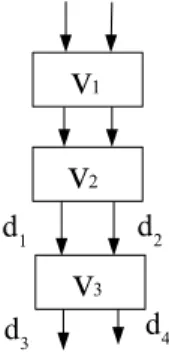
For example, suppose in Figure 2 that modulesv1,v3are private
with unknown functionality but that modulev2is public, with
un-derlying function f2which is a constant function (eg. f2= (0,0)
for all assignments of its inputs). Since the final output data bits
d3,d4 are always visible, this causes a privacy breach for the
pri-vate modulev3on inputd1=0 andd2=0.
Figure 2: An example workflow wherev1,v3are private
mod-ules andv2is a public module
Thus handling privacy in this more general setting requires ei-ther identifying natural restrictions on the behavior of public mod-ules (for example, one-one and/or onto functions), or introducing a parameter in the privacy requirement of the private modules which depends on some property of the public modules.
A more ambitious question will be to generalize the notion of private and public modules. For example, how we can guarantee that the prior knowledge of a user on the functionality of each mod-ule in the workflow does not change significantly given access to executions of the workflow on different inputs?
Another interesting open problem is to study whether a privacy definition similar todifferential privacy[13, 14] is possible in the settings of workflows. A differentially private mechanism answer-ing queries from a statistical database guarantees that the output distribution of the mechanism isalmostthe same on two neighbor-ingdatabases that differ in at most one record, thereby ensuring that the privacy of any single record remains the same whether or not it participates in the database. However, in the settings of workflows and the privacy issues we are considering, there is no obvious no-tion of “neighborhood” since excluding any single module or data
4An algorithm is said to be aµ(n)-approximation algorithmfor
some non-decreasing functionµ(n):N+→Nif on every input of
sizenit computes a solution where the value is within a factor of
µ(n)of the optimal algorithm.
from a workflow can change the entire semantics of the workflow. A suitable query mechanism must also be explored since just hiding or revealing a single data value may not suffice.
So far we have only focused on preserving module privacy. How-ever, exploring the mathematical models for data-privacy in work-flow is another open problem. Note that existing techniques for p-reserving data privacy in statistical and relational databases do not directly extend to preserving data privacy in workflows, since stan-dard provenance queries in workflows require revealing exact data values. As discussed earlier, adding noise reduces the repeatability of experiments involving scientific workflows. Also, just hiding a data value or denying a particular query may not be sufficient to ensure data privacy due to the dependence of data values on other modules and data in the workflow.
There may also be mechanisms other than hiding individual data items that can be used to guarantee privacy, for example, clustering portions of the workflow intocomposite modules [5]. It will be interesting to create a formal privacy model using clustering, and study issues such as if a privacy-preserving clustering preserves the mutual data dependency among the intermediate data not hidden inside clusters [5, 6, 26].
Other examples of future research directions include studying privacy in the presence of loops and forks (i.e. parallel module executions over elements of an input set), and handling multiple users with different privacy components corresponding to different permissions with possible collusions between users.
6. CONCLUSIONS
In this paper we discussed privacy issues in workflows, and briefly described a formalization of module privacy which gives high-quality solutions to the optimization problem that tries to maximize the u-tility of provenance data while preserving module privacy in the workflow. We also suggested several promising directions for fu-ture exploration in this very new area of workflow privacy.
Acknowledgments: We thank the anonymous reviewers for their detailed comments which helped to improve the presentation of this paper. This research was supported in part by NSF grant: IIS-0803524.
7. REFERENCES
[1] Privacy-preserving data mining: Models and algorithms.
www.charuaggarwal.net/toc.pdf, 33(1):50–57, 2004. [2] N. R. Adam and J. C. Worthmann. Security-control methods
for statistical databases: a comparative study.ACM Comput. Surv., 21(4):515–556, 1989.
[3] G. Aggarwal, T. Feder, K. Kenthapadi, S. Khuller,
R. Panigrahy, D. Thomas, and A. Zhu. Achieving anonymity via clustering. InPODS, pages 153–162, New York, NY, USA, 2006. ACM.
[4] L. Backstrom, C. Dwork, and J. M. Kleinberg. Wherefore art thou r3579x?: anonymized social networks, hidden patterns, and structural steganography. InWWW, pages 181–190, 2007.
[5] O. Biton, S. Cohen-Boulakia, S. Davidson, and C. Hara. Querying and managing provenance through user views in scientific workflows. InICDE, 2008.
[6] O. Biton, S. B. Davidson, S. Khanna, and S. Roy. Optimizing user views for workflows. InICDT, pages 310–323, 2009. [7] S. Bowers and B. Ludäscher. Actor-oriented design of
scientific workflows. InER, 2005.
[8] U. Braun, A. Shinnar, and M. Seltzer. Securing provenance. InUSENIX HotSec.
[9] A. Campan and T. M. Truta. A clustering approach for data and structural anonymity in social networks. InPinKDD, 2008.
[10] A. Chebotko, S. Chang, S. Lu, F. Fotouhi, and P. Yang. Scientific workflow provenance querying with security views.WAIM, pages 349–356, July 2008.
[11] S. B. Davidson, S. Khanna, D. Panigrahi, and S. Roy. Preserving module privacy in workflow provenance. Technical Report MS-CIS-10-22, Dept. of Computer and Information Science, University of Pennsylvania, May 2010. [12] I. Dinur and K. Nissim. Revealing information while
preserving privacy. InPODS, pages 202–210, New York, NY, USA, 2003. ACM.
[13] C. Dwork. Differential privacy: A survey of results. In
TAMC, pages 1–19, 2008.
[14] C. Dwork. The differential privacy frontier (extended abstract). InTCC, pages 496–502, 2009.
[15] J. Freire, C. T. Silva, S. P. Callahan, E. Santos, C. E. Scheidegger, and H. T. Vo. Managing rapidly-evolving scientific workflows. InIPAW, 2006.
[16] A. Gil, W. K. Cheung, V. Ratnakar, and K. kin Chan. Privacy enforcement in data analysis workflows. InPEAS, 2007. [17] Y. Gil and C. Fritz. Reasoning about the appropriate use of
private data through computational workflows. InIntelligent Information Privacy Management, Papers from the AAAI Spring Symposium, pages 69–74, March 2010.
[18] R. Hasan, R. Sion, and M. Winslett. Introducing secure provenance: problems and challenges. InStorageSS, pages 13–18, New York, NY, USA, 2007. ACM.
[19] A. Korolova, R. Motwani, S. U. Nabar, and Y. Xu. Link privacy in social networks. InCIKM, pages 289–298, New York, NY, USA, 2008. ACM.
[20] J. Lyle and A. Martin. Trusted computing and provenance: Better together. InTaPP ’10: 2nd Workshop on the Theory and Practice of Provenance, 2010.
[21] A. Machanavajjhala, D. Kifer, J. Gehrke, and M. Venkitasubramaniam. L-diversity: Privacy beyond k-anonymity.ACM Trans. Knowl. Discov. Data, 1(1):3, 2007. [22] R. Motwani, S. U. Nabar, and D. Thomas. Auditing sql
queries. InICDE, pages 287–296, 2008.
[23] S. U. Nabar, B. Marthi, K. Kenthapadi, N. Mishra, and R. Motwani. Towards robustness in query auditing. InVLDB, pages 151–162. VLDB Endowment, 2006.
[24] T. Oinnet al.Taverna: a tool for the composition and enactment of bioinformatics workflows.Bioinformatics, 20(1), 2003.
[25] V. Rastogi, M. Hay, G. Miklau, and D. Suciu. Relationship privacy: output perturbation for queries with joins. InPODS, pages 107–116, 2009.
[26] P. Sun, Z. Liu, S. B. Davidson, and Y. Chen. Detecting and resolving unsound workflow views for correct provenance analysis. InSIGMOD ’09: Proceedings of the 35th SIGMOD international conference on Management of data, pages 549–562, New York, NY, USA, 2009. ACM.
[27] L. Sweeney. k-anonymity: a model for protecting privacy.
Int. J. Uncertain. Fuzziness Knowl.-Based Syst., 10(5):557–570, 2002.
[28] V. S. Verykios, E. Bertino, I. N. Fovino, L. P. Provenza, Y. Saygin, and Y. Theodoridis. State-of-the-art in privacy preserving data mining.SIGMOD Rec., 33(1):50–57, 2004.