Master Thesis in Business Administration Management Accounting Spring Term 2012 Tutors: Christian Ax Elin Larsson
B
UDGETING AND
B
USINESS
I
NTELLIGENCE
-
A qualitative study about budgeting and
Business Intelligence in relation to the
ongoing budget debate
A
CKNOWLEDGEMENTSThis thesis has been written during ten executive weeks at the University of Gothenburg, School of Business, Economics, and Law. We would like to thank our tutors Christian Ax and Elin Larsson who during the course of the thesis have offered their guidance and constructive criticism. We would also like to thank our respondents; Gunilla Myrén at Elfa International, Christer Karlsson at IKEA Components, Anna Hansson at Mölnlycke Health Care, and Stefan Sjöberg at Pipelife for taking their time to be interviewed and provide us with valuable data. Finally, we would also like to thank Wiveka Sund at IKEA IT.
Gothenburg, June 2012
____________________ ____________________
M
ASTERT
HESIS INB
USINESSA
DMINISTRATION Title: Date: Authors: Tutors: Key Words:Budgeting and Business Intelligence – a qualitative study about budgeting and Business Intelligence in relation to the ongoing budget debate
Spring Term 2012
Jenny Jönsson and Sandra Åkerlund Christian Ax and Elin Larsson
Management Accounting, Budgeting Process, Traditional (fixed) Budget, Rolling Forecasts, the relevance of the Budget, Information Technology, Business Intelligence.
A
BSTRACTBackground and Problem Discussion
The world we are living in is becoming more and more globalized. Organizations are competing worldwide and in order to be part of the development, it is crucial for organizations to respond to the changes. At the same time, there is a debate about the relevance of the budget which has created an intense discussion on budgeting. Critics mean that the budget is an outdated means of control that consumes a considerable amount of resources and time from organizations. There are also those who suggest that the budget in itself is no problem, but that the use of budgets is the determining factor in whether or not the budget is useful for organizations. This thesis aims to investigate if Information Technology, more specifically Business Intelligence, has had any effects on budgeting in organizations. Business Intelligence is a decision support system that can help organizations manage their data and improve the decision making. The purpose is to give another perspective on the budget debate by examining if it is possible that Business Intelligence has had any effects on the budgeting process, and if Business Intelligence is a contributing reason to why organizations have not abandoned their budget.
The research question is as follows:
• What link is there between Business Intelligence and the Budgeting Process in the context of the ongoing budget debate?
Methodology This thesis has been conducted by collecting data from four medium sized and large organizations in Sweden within diverse industries that in one or another way are using Business Intelligence in their budgeting process.
Results and Conclusions
This thesis has found that Business does affect the budgeting process in relation to the ongoing budget debate. The effects that have been found are time savings, increased adaptability, more efficient processes, increased flexibility, and improved decision making. All of these effects can be related to the ongoing budget debate.
T
ABLE OFC
ONTENTS1
I
NTRODUCTION... 1
1.1BACKGROUND...1 1.2PROBLEM DISCUSSION...2 1.3RESEARCH QUESTION...3 1.4PURPOSE...3 1.5CONTRIBUTION...3 1.6STRUCTURE...3
2
F
RAME OFR
EFERENCE... 4
2.1THE BUDGETING PROCESS...4 2.1.1 Traditional Budgeting ...4 2.1.2 Rolling Forecasts ...5
2.2CRITICISM OF THE BUDGETS...6
2.3BUSINESS INTELLIGENCE...6
2.3.1 Tools and Functions ...7
2.4LINK BETWEEN BUSINESS INTELLIGENCE WITH THE BUDGETING PROCESS...8
3
M
ETHODOLOGY... 11
3.1CHOICE OF ORGANIZATIONS...11
3.1.1 Elfa International AB ...11
3.1.2 IKEA Components ...11
3.1.3 Mölnlycke Health Care ...11
3.1.4 Pipelife ...12
3.2CHOICE OF RESPONDENTS...12
3.2.1 Elfa International ...12
3.2.2 IKEA Components ...12
3.2.3 Mölnlycke Health Care ...12
3.2.4 Pipelife ...13
3.3INTERVIEWS...13
3.4INTERVIEW GUIDE...13
4
E
MPIRICALD
ATA... 15
4.1ELFA INTERNATIONAL...15
4.1.1 How do Elfa International use Business Intelligence in the Budgeting Process? ...15
4.1.2 What are the effects from using Business Intelligence in the Budgeting Process?...16
4.2IKEACOMPONENTS...17
4.2.1 How do IKEA Components use Business Intelligence in the Budgeting Process? ...17
4.2.2 What are the effects from using Business Intelligence in the Budgeting Process?...17
4.3MÖLNLYCKE HEALTH CARE...19
4.3.1 How do Mölnlycke Health Care use Business Intelligence in the Budgeting Process? .19 4.3.2 What are the effects from using Business Intelligence in the Budgeting Process?...20
4.4PIPELIFE...21
4.5SUMMARY OF EMPIRICAL DATA...23
5
A
NALYSIS... 24
5.1HOW DO ORGANIZATIONS USE BUSINESS INTELLIGENCE IN THE BUDGETING PROCESS?...24
5.2WHAT ARE THE EFFECTS FROM USING BUSINESS INTELLIGENCE IN THE BUDGETING PROCESS? ...25
5.2.1 Time Savings ...26
5.2.2 Increased Adaptability ...27
5.2.3 More efficient processes...27
5.2.4 Flexibility ...28
5.2.5 Decision Making ...28
5.2.6 Increased Revenues and Decreased Costs ...30
5.2.7 Participation...30
6
C
ONCLUSION... 32
6.1CONCLUDING DISCUSSION...32
6.2SUGGESTIONS FOR FURTHER RESEARCH...33
R
EFERENCES... 34
ARTICLES...34
BOOKS...35
ELECTRONIC SOURCES...36
A
PPENDIX1
-
I
NTERVIEWG
UIDET
ABLE OFF
IGURES FIGURE 1:STRUCTURE OF THESIS...3FIGURE 2:BUSINESS INTELLIGENCE AS A CONTINUOUS PROCESS...6
I
1
I
NTRODUCTIONn the Introduction, the background of the problem will be presented. A problem discussion will lead to the research question, the purpose and the contribution. As a concluding part of the Introduction, the structure of the thesis will be presented.
1.1
B
ACKGROUNDIn almost all organizations one of the keystones in Management Accounting is budgeting (Ekholm & Wallin, 2000; Hansen, Otley & Van der Stede 2003; Libby & Lindsay, 2010). In the past decades there has been a debate about the budget where its relevance has been questioned (Hansen, Otley & Van der Stede 2003). Critics argue that budgeting is a time consuming process and that the budget is not adapted to changes in the competitive environment and hence quickly gets outdated. There is also the critique that budgets are not attached to the strategic objectives of organizations and that it is considered to be used as a means to evaluate how well the targets of the budget have been met (Hansen, Otley & Van der Stede 2003).
In order to investigate the actual use of budgets, Libby and Lindsay (2010) made research on the relevance of the budget in organizations. Their research shows that, despite the criticism towards the budget, budgets are still used. Further on, budgets are more often improved to avoid some of the criticisms related to it rather than abandoned (Libby & Lindsay, 2010). The same finding is supported by Ekholm and Wallin (2000) who made similar research. According to Libby and Lindsay (2010), there are several reasons why budgets are not abandoned by organizations. One reason is how budgets are actually used; if used correctly, budgets are likely to be useful for the organization. Another reason is that organizations consider the budget to be more helpful than harmful; that is, the budget seems to create more value than it takes out of the organization. Ekholm and Wallin (2000) argue that complementing the budget with alternative systems is another reason to why organizations do not abandon the budget.
As mentioned earlier, budgeting is a central part of Management Accounting. Just like budgeting, Information Technology is related to Management Accounting in how the management of an organization can be affected by Information Technology tools (Nilsson & Olve, 2006). Organizations today are competing worldwide, and new technologies have had implications for the way that organizations are being managed (Seal, Garrison & Noreen 2006). The development of Information Technology has the potential to create new possibilities for organizations to achieve both more – and more precise – data. One of the concepts that have grown in use among organizations during the past two decades is Business Intelligence, which is a decision support system that can help organizations to manage their data and improve their decision making (Negash & Gray, 2008; Chaudhuri, Dayal & Narasayya 2011). The development of Business Intelligence has been supported by declining costs in managing and storing huge amounts of data (Chaudhuri, Dayal & Narasayya 2011). According to Search Data Management (2006, 1), Business Intelligence can be defined as:
“Business intelligence is a broad category of applications and technologies for gathering, storing, analyzing, and providing access to data to help enterprise users make better business decisions. Business Intelligence applications include the activities of decision support systems, query and reporting, online
analytical processing (OLAP), statistical analysis, forecasting, and data mining”.
Despite the criticism towards the budget and the increased competition, organizations are able to increase the efficiency in their operations with help of Business Intelligence. This may affect the budgeting process in a positive way and thus make organizations more competitive and able to make the right decisions (Chou, Tripuramallu & Chou 2005; De Leon, Rafferty & Herschel 2012; Negash & Gray, 2008).
1.2
P
ROBLEMD
ISCUSSIONThe increasing use of Information Technology has the potential to bring advantages and disadvantages for the organization (Tonchia & Quagini, 2010). With the development of Information Technology, it is crucial for organizations to be able to respond to and interpret the data extracted from various systems. Today’s complex Information Systems give organizations an increased flexibility, which makes it possible to find new ways of organizing and achieving work tasks (Nilsson & Olve, 2006). Organizations’ dependence on Information Technology is growing, and in order to stay competitive it is important that management accountants have access to and are able to understand how to handle Information Technology tools (Augusto Casas, 2008).
The budget is the outcome of the budgeting process, which is a constantly evolving process (Merchant & Van der Stede, 2012). According to Orlando (2009), the budgeting process is surrounded by the people, processes, and tools used in the budgeting process, and all three aspects are dependent on each other. The tools are where Information Technology comes in and may be possible to affect the budgeting process.
As of today, there are some difficulties experienced in the budgeting concerning a frustration with planning tools. The frustration mainly concerns the difficulties in using Excel spreadsheet, which is the most commonly used planning tool, and the impossibility to drill down into data (Orlando, 2009).
“While Excel or other spreadsheet programs are excellent financial tools, they are not necessarily optimized for budgeting (Orlando, 2009, p. 48).
As mentioned before, new technologies have had implications for the way that organizations are being managed (Seal, Garrison & Noreen 2006). Studies have also shown that organizations are improving, rather than abandoning, their budgets. One of the reasons might, according to Libby and Lindsay (2007), be that organizations realize that using the budgets correctly makes them valuable in the organization. If Excel spreadsheets are not necessarily optimized for budgeting, perhaps Business Intelligence as an Information Technology tool can change the way that organizations handle their data in the budgeting process. As studies have shown that organizations are not actually abandoning their budgets and the use of Business Intelligence has increased, it would be interesting to investigate whether there is a correlation between the use of Business Intelligence and the fact that organizations are not abandoning their budgets. Is it possible that Business Intelligence is a contributing reason to why organizations stay loyal to the budget?
1.3
R
ESEARCHQ
UESTIONThe problem discussion above leads to the following research question:
• What link is there between Business Intelligence and the Budgeting Process in the context of the ongoing Budget Debate?
In order to answer the overall research question, the following questions need to be answered:
• How do organizations use Business Intelligence in the Budgeting Process? • What are the effects from using Business Intelligence in the Budgeting Process?
1.4
P
URPOSEThere is an ongoing debate about the relevance of the budget and this thesis aims to investigate if Information Technology, more specifically Business Intelligence, has had any effect on budgeting in organizations. The purpose is to give another perspective on the budget debate by examining if it is possible that Business Intelligence has had any effect on the budgeting process and if Business Intelligence is a contributing reason to why organizations have not abandoned their budget.
1.5
C
ONTRIBUTIONThe practical contribution of this thesis is to be a guide for organizations thinking about implementing a planning tool in Business Intelligence. The theoretical contribution is to investigate if the use of data obtained with Business Intelligence has any significant effect on the budgeting process. With this thesis, the authors aim to contribute to the debate about the relevance of the budget by investigating if Business Intelligence has had any effect on why organizations have not abandoned the budget. The intention is to give a new perspective on the debate of the relevance of the budget.
1.6
S
TRUCTUREAs the figure below shows, the thesis will be divided into six chapters. The Introduction will offer the reader a comprehensive understanding of the topic of this thesis starting off with a background, problem discussion, research question, purpose, and contributions to research. Besides this, the Introduction will include the structure of the thesis. Following this, the Methodology will be presented, i.e. how the data in this thesis has been obtained. Thereafter, the Frame of Reference, which includes theories from the field of budgeting and Business Intelligence, will be presented. The Empirical Data will consist of material obtained from interviews with four medium sized and large organizations located in Sweden.
With the use of the Frame of Reference and the Empirical Data, the Analysis will present the findings in this thesis. The last chapter, the Conclusions, will give the reader a comprehensive understanding of the most important findings. It will also include suggestions for further research.
I
2
F
RAME OFR
EFERENCEn the Frame of Reference, the chosen theories will be presented. The theories will be used in order to answer this thesis’ research question together with the Empirical Data.
2.1
T
HEB
UDGETINGP
ROCESSThe budget is one of the control instruments that are usually associated with Management Accounting. Control instruments are required for organizations to be able to govern in the direction of established objectives and results (Ax, Johansson & Kullvén 2009). According to Blumentritt (2006), the budgeting process unites the planning, responsibility and objectives in an organization. The budgeting systems combine the administrative process, information flows, and routines and it exists in all organizations in one way or another (Merchant, 1981).
All organizations require some type of planning for their operations, and the extent of planning is affected by how complex the operation is (Ax, Johansson & Kullvén 2009). The main function of the budgeting process is to clarify the directions the organization wants to achieve through the financial planning (Merchant & Van der Stede, 2012). According to Lagerstedt and Tjerneld (1991), budgets increase the possibility for organizations to measure how well their objectives are met. This enables managers to measure the performance and the efficiency among their employees (Lagerstedt & Tjerneld, 1991). The budgeting process is constantly being processed during the year and its design can vary between organizations (Ax, Johansson & Kullvén, 2009; Merchant & Van der Stede, 2012). According to Bunce, Fraser and Woodcock (1995), the budgeting process begins with management setting forecasts, objectives and limitations for the costs. The budgeting process can be divided into three phases that includes budget creation, budget follow up and budget analysis (Ax, Johansson & Kullvén, 2009; Merchant & Van der Stede, 2012).
There are both external and internal factors that can influence the budgeting process; an external factor is how the economic environment looks and internal factors are human behavior and organizational culture (Senge, 1988). The budgeting process can vary in small and large organizations. The difference depends on that larger organizations generally focus on the coordination that is usually found in smaller organizations. Smaller organizations instead often focus on the planning process since it is important to detect changes in time as they may affect the organization’s liquidity.
2.1.1TRADITIONAL BUDGETING
What is referred to as the traditional budget can also be called the fixed budget. The ambition with the budget is to achieve the organization’s objectives that have been established (Anthony & Govindarajan, 2007). Instead of focusing on one specific cost that is too high, which are most common, organizations need to focus on several important parameters in their budgets (Finney, 1993). What is included in the definition of a budget can vary from organization to organization; according to Ax, Johansson and Kullvén (2009), there is no clear and generally accepted definition of what a budget should include. As concerns the economic consequences for a future period, a budget expresses the expectations and commitments for an organization. As mentioned before, the
budgeting process can be divided in three phases; budget creation, budget follow up and budget analysis. The budget creation involves developing the budget. According to Ax, Johansson and Kullvén (2009), the basis for the budgets can either be estimates of future revenues or future costs, whereas Lagerstedt and Tjerneld (1991) mean that sales statistics are the basis for the budget. The budget follow up compares the budgeted values with the actual outcomes. The third phase, the budget analysis, gives organizations the possibility to learn from the execution of budgets for future periods. The budgeting process involves the entire organization and is based on the organization’s strategy to plan the operation for future periods. According to Anthony and Govindarajan (2007), the budgeting process is a negotiation between management and various divisions where revenues and costs for coming years are planned. Budgets are used as a tool for planning, coordinating and controlling; the budget can also be used to create internal and external control over an organization (Lindvall, 2001). With the budget, it is able to encourage better performance among employees and enable faster decision making. If targets are not met, the responsibility can be questioned.
De Leon, Rafferty and Herschel (2012), mean that traditional budgeting is often limited to spreadsheets and, as mentioned before, discuss the advantages of using rolling forecasts. The budgeting process includes people, processes, and tools and all three aspects are dependent on each other (Orlando, 2009). Concerning the tools, Orlando (2009), believes that Information Technology may be possible to affect the budgeting process. Some difficulties are experienced today as there is a frustration concerning planning tools that Information Technology might be able to reduce. The frustration mainly concerns the difficulties in using spreadsheet, which is the most commonly used planning tool. Some of the difficulties is that using spreadsheets are time consuming, lead to frequent errors, involve difficulties in rolling up figures, and lead to an inability to create “what if”- scenarios. Another frustration concerns the impossibility to drill down into data and get answers on why things happened. Orlando (2009) means that, even though spreadsheets are not necessarily optimized for budgeting, they are excellent planning tools.
2.1.2ROLLING FORECASTS
The main alternative to traditional budget is often monthly or quarterly based forecasting which have become more common among organizations (Arterian 1998 see Ekholm & Wallin 2000, p. 521; Hope & Fraser 1999 see Ekholm & Wallin 2000, p. 521). Howell (2004) means that the budgeting process should be seen as the first phrase in the organization’s future. With rolling forecasts, organizations are able to see their planning in a more distant perspective. A forecast is an estimation of likely situations; the purpose unlike the budget is to reflect the reality (Gurton, 1999 see Ekholm & Wallin 2000, p. 521). A forecast can be created for any time period and is generally updated when new information indicates changed circumstances (Gurton, 1999 see Ekholm & Wallin 2000, p. 521). Rolling forecasts entail that organizations are able to solely follow up the new forecast and not all those that previously have been made (Hope & Fraser, 2003). When new forecasts are made, it is possible to look back. The possibility to see what past years have given in outcomes and expectations of future development makes it possible for organizations to specify values for the last twelve months, the latest forecast and the new forecast. Forecasts include a detailed plan that is easy to work with and constantly gives management a current comprehension of the organization’s position and future.
The advantages with forecasts are that they are more flexible than traditional budgets and that follow ups are not as strict and periodic (Anthony & Govindarajan, 2007). Other
advantages are that forecasts are updated more continuously which means that it is easier to follow up the organization’s development. The disadvantages with rolling forecasts may be the uncertainty among managers since the forecasts may constantly change.
2.2
C
RITICISM OF THEB
UDGETSThere are several researches that criticize the relevance of budgets, although they are still used and organizations more often have shown to improve rather than abandon them (Libby & Lindsay, 2010). A reason for not abandoning the budget can be that organizations consider budgets not to be more harmful than helpful and that the budgets are perceived to be value adding. Another reason is that the budgets are likely to be useful for organizations assuming that they are used in the correct manner; if budgets are designed appropriately they have the potential to be highly effective in organizations (Libby & Lindsay, 2007). Organizations also attempt to improve their budget by complementing it with alternative systems such as rolling forecasts (Ekholm & Wallin, 2000).
Wallander (1999), criticize the budget and call it an “unnecessary evil”. Hansen, Otley and Van der Stede (2003) as well as Wallander (1999), argue that the budgeting process makes organizations centralized and bureaucratic, which prevents organizations to adapt to changes in the competitive environment, and hence quickly becomes outdated. Wallander (1999), argue that the budget quickly becoming outdated depends on what the organizations planned a year ago are not as relevant in the situation they find themselves in today.
Hansen, Otley and Van der Stede (2003) as well as Hope and Fraser (2003), consider a lot of disadvantages with budgeting. Some of the disadvantages is that budgeting is time consuming, not attached to organizations strategic objectives, focuses on reducing costs instead of creating value, difficult to use, limits liability and creates little value in relation to the time it takes to compile it. Other disadvantages are that employees’ divisional budget can be more important than the budget for the entire organization; the budget is sub optimized (Ax, Johansson & Kullvén, 2009).
2.3
B
USINESSI
NTELLIGENCEIn order to make the right decisions in the future as, for examples, concerns investment decisions and head hunting, it is important to plan the operations (Ax, Johansson & Kullvén 2009). Business Intelligence is a decision support system that is often used as a basis for decision making (Davenport, 2010; Shollo & Kautz, 2010). Common for several definitions found in Shollo and Kautz’s (2010) research is that Business Intelligence is often referred to a continuous process. The process is described as gathering and storing data, which by analysis is transformed into information and later on transformed into knowledge that is to be used in decision making. Data in itself is of no use, therefore it is important for organizations to know how to transform data to information and turn it into valuable knowledge. The decisions can be improved with Business Intelligence if the data is used in a correct manner (Shollo & Kautz, 2010).
Figure 2: Business Intelligence as a continuous process (Source: Shollo & Kautz, 2010).
According to Davenport (2010), there is a need for a strong link between information and how it is used in decision making. In order to more clearly connect these two factors, Davenport (2010), has created a four-step process. The first step involves deciding how tightly information will be applied in the decision making process. Secondly, the organization needs to develop and provide the information and as a third step, the decision process will be designed. The final step includes the actual decision making and assuring that information is used by the decision makers involved (Davenport, 2010).
2.3.1TOOLS AND FUNCTIONS
There are many functions that are possible to make with Business Intelligence. The functions of Business Intelligence that are mostly used in practice are reports and ad hoc reports (Knightsbridge, 2006). A report is a formatted and interactive report for which scheduling and distribution capabilities can be applied; for example if the user wishes to receive a certain report every month. Another function often used are ad hoc queries, which can be made when users are interesting in
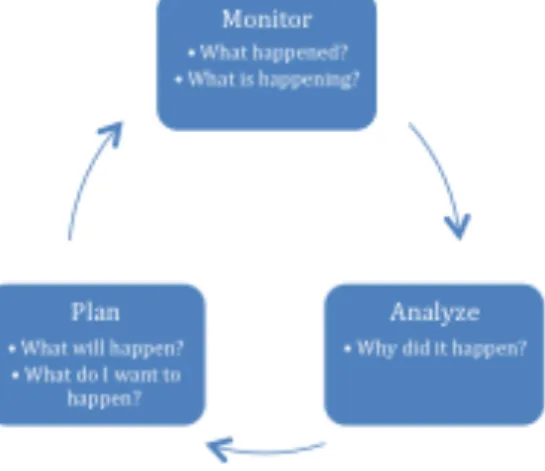
deciding themselves what the interesting variables are to investigate and create their own ad hoc analysis depending on the current situation. With the use of the data that is being accessed by Business Intelligence, organizations are able to answer several different questions that they may have. These above stated tools answer the question of “What happened?”. Figure 3 shows a comprehensive image of the potential with Business Intelligence. For the budgeting process, the most interesting function of the figure is found under the box called Plan.
Figure 3: Areas of use with Business Intelligence (Source: Authors’ own model, 2012).
Another function with Business Intelligence is the possibility to drill down figures in order to find answers on questions that would otherwise be more difficult to answer. With Business Intelligence the user has the potential to drill down and answer both simple and complex questions which improve the budgeting process. Examples of questions that may be answered are what happened and when did it happen. It may also be able to answer questions like why did it happen and what will the effects be if it happens again. The former questions can be answered by using reports and creating ad hoc analysis. The latter ones can be answered using more complex analytical methods such as statistical analysis, forecasting, and predictive modeling that are more forward-looking (Negash & Gray, 2008).
As with any other system, there are both advantages and disadvantages with Business Intelligence. As the competition grows and the globalization makes it possible to attain products from all over the world, the need for organizations to respond to and adhere to these changes in order to stay competitive grows. As of this, the use of Business Intelligence is becoming more and more critical to the daily operations of firms. Important to remember, according to Herschel and Jones (2005) is that only a portion of the information needed exists in computers; most of the valuable information rest as intellectual assets in the minds of the users.
2.4
L
INK BETWEENB
USINESSI
NTELLIGENCE WITH THEB
UDGETINGP
ROCESSOrganizations use the traditional budget as part of their financial planning. The process is, according to De Leon, Rafferty and Herschel (2012), often time consuming, demanding and has disadvantages in that it does not respond to changes in the business environment. There is a risk that the budget is used as a performance measurement tool and that managers try to change or adopt the budget during the course of the year to fit the budgeted targets and thus adhere to the budget (De Leon, Rafferty & Herschel, 2012). With new technologies and planning tools, organizations are able to improve their approach to planning. A more flexible planning allows for new risks and opportunities to be identified. The possibility to gather data from several source systems and store in one integrated data warehouse makes it possible for users to access data that was formerly locked away (De Leon, Rafferty & Herschel, 2012).
By having access to data that are derived from various functional departments such as sales, production, and accounting the user will have insight into how the business is performing based on several functional areas (De Leon, Rafferty & Herschel, 2012). De Leon, Rafferty and Herschel (2012) as well as Negash and Gray (2008) mean that Business Intelligence can be applied for a more flexible and accurate rolling forecasts. Negash and Gray (2008) also mean that traditional budgeting and the budgeting process can be more flexible when Business Intelligence is used. Leaving the traditional budgeting and moving to rolling forecasts driven by Business Intelligence leads, according to De Leon, Rafferty and Herschel (2012) to a process that is more aligned with business operations and the strategic planning of the organization.
As mentioned earlier, the critics of the budgets means that budgeting make organizations centralized and bureaucratic which prevents organizations to adapt to changes in the competitive environment and hence quickly makes the budgets outdated (Hansen, Otley & Van der Stede 2003; Wallander, 1999). According to Nilsson and Olve (2006), organizations are able to access an almost unlimited amount of data with new Information Technology systems. How organizations uses this possibility can affect their efficiency and competitiveness. The risk however is information overload, which means that it can be difficult for organizations to identify the most essential information. Another consequence that information overload can lead to is according to Nilsson and Olve (2006), and Wallander (1999), that it may lead to decisions being centralized which can cause inadaptability in the organization.
According to Wallander (1999), the criticism that the budget quickly can become outdated depends on that what the organizations planned a year ago is not as relevant in the current situation. With Business Intelligence it is possible to access multidimensional data sources, which makes the data more updated and easier to obtain, and this data in turn is a basis for decision making (Chou, Tripuramallu & Chou 2005). Business Intelligence is separated from traditional reporting tools most often used in organizations, such as spreadsheets. Since Business Intelligence improves the structure and format, it has the potential to increase the comparability between data. The user can choose one type of structure for the data to be more comparable unlike spreadsheets where the data have different types of structure and can be difficult to compare.
The reason that organizations does not abandon the budget can depend on that it is more helpful than harmful, that it is perceived to be value adding and that budgets are likely to
be useful for organizations assuming that they are used in the correct manner (Libby & Lindsay, 2010). Even though Business Intelligence provides accessibility to data and the possibility to extract data, it is crucial that the user have enough knowledge (Negash & Gray, 2008). Only having access to data, which Business Intelligence extracts from a data warehouse, is not enough; using Business Intelligence requires that the user has the appropriate knowledge and is able to interpret the data correctly.
If budgets are designed appropriately they can be highly effective in organizations (Libby & Lindsay, 2007). Negash and Gray (2008) mean that in order to achieve efficiency with Business Intelligence it needs to be structured so that it is possible to apply the use of it in the organizations. An implementation of a Business Intelligence system involves more than only purchasing software and hardware. The implementation of a Business Intelligence system is a complex mission that requires a suitable infrastructure and resources for a long period from the organization (Yeoh & Koronios, 2010). Further on, Yeoh and Koronios (2010) mean that Business Intelligences a complex system that requires the right level of knowledge. In order to take the most out of Business Intelligence and have an efficient data loading, it is important to perform Business Intelligence tasks incrementally when new data is available (Chaudhuri, Dayal & Narasayya 2011).
Business Intelligence is used to increase organizations’ competitiveness by gathering data. Organizations are able to make tactical and strategic decisions if they interpret the data correctly. This also means that the processes improve and the efficiency increases when data is interpreted correctly (Negash & Gray, 2008). According to De Leon, Rafferty and Herschel (2012) as well as Hansen, Otley and Van der Stede (2003) and finally Hope and Fraser (2003), the disadvantages with the budgeting process is that it is time consuming. When Business Intelligence is used correctly it is possible for organizations to achieve efficiency that leads to time savings (Negash & Gray, 2008). The time savings become even clearer if Business Intelligence is complemented with a planning tool for Business Intelligence (Negash & Gray, 2008).
According to Clark, Jones and Armstrong (2007), organizations may increase their revenues and reduce their costs when they use Business Intelligence in the budgeting process. This entail that the profits will also increase dependent on what the organization knows about the customers, suppliers and the market that enables the organization to make the right decisions (Clark, Jones & Armstrong 2007). Negash and Gray (2008) mean that organizations are able to become more efficient in their strategic and tactical decisions when using Business Intelligence in the budgeting process and this may affect the organization’s revenues and costs.
By involving more people in the budgeting process; the efficiency is able to improve (Lyne, 1988; Merchant & Van der Stede, 2012) by improved attitudes from employees and a more efficient daily work. The commitment of employees for the organizations objectives is also able to improve (Merchant & Van der Stede, 2012). According to Negash and Gray (2008), Business Intelligence makes it possible for the data to reach more people, which may affect the participation in the organization. However, too much participation of employees could lead to lower efficiency and a higher cost than usefulness (Fernandez-Revuelta Perez & Robson, 1999; Schmidt, 1992). Higher participation of employees may also cause that focus will be on reducing costs rather than on allocation (Hope & Fraser, 2000). The reason that the allocation can be influenced negatively is
because some divisions possess a higher negotiating power and thus are able to obtain more resources than other (Hope & Fraser, 2000).
Concerning the effects of Business Intelligence, organizations are able to influence the effect of Business Intelligence (Bhushan, 2010; Clark, Jones & Armstrong 2007). According to Bhushan (2010), Business Intelligence can, if it is used correctly, provide important data for more tactical and strategic decisions. The budgeting process can be affected by Business Intelligence, by becoming more efficient (De Leon, Rafferty & Herschel, 2012). Business Intelligence combines technologies, tools, people skills and business processes to make these decisions. Negash and Gray (2008) state that even though Business Intelligence provides accessibility to data it is crucial that the user have enough knowledge to interpret the data correctly. Concerning the effects Business Intelligence can have in organizations, Clark, Jones and Armstrong (2007) agree that it depends on how and in which manner an organization chooses to use it. Using Business Intelligence correctly has the potential to affect organizations’ performance since it gives organizations the opportunity to higher control and measurement of their performance (Clark, Jones & Armstrong 2007). Clark, Jones and Armstrong (2007) also mean that it is important to use Business Intelligence in an effective manner if the organization wants to get advantages from their Business Intelligence implementation.
I
3
M
ETHODOLOGYn the Methodology, the criteria for the choice of organizations and respondents will be presented as well as the four organizations and respondents that have been
interviewed. Further on the interviews and the interview guide will be presented.
3.1
C
HOICE OF ORGANIZATIONSIn this thesis, four interviews with medium sized and large organizations in Sweden within diverse industries were conducted. One thing that was discussed before choosing the organizations was the fact that the focus should primarily be on employees in the same type of industry. The reason for this criterion was because in previous research, the organizations have been in the same industries and most of the organizations have only been using Business Intelligence for a few years. However, more important was the fact that the organizations use Business Intelligence in the budgeting process. To ensure that all organizations were using Business Intelligence in the budgeting process, the interview began with questions about the use of Business Intelligence. None of the organizations are noted on the stock market, which is a strategic choice made in order to achieve a better comparability between the organizations.
Concerning Business Intelligence tools, no strategic choice has been made concerning which vendor the organizations should use. However, after conducting the interviews, it was clear that all four organizations use an IBM Cognos system. This is not surprising as IBM is one of the largest vendors on the Business Intelligence market. Looking back at the Empirical Data obtained, this outcome was positive since it may increase the comparability between the organizations. The four organizations are presented below. 3.1.1ELFA INTERNATIONAL AB
Elfa International AB was established in 1948 and is the parent company of the Elfa Group. The group is market leading among the Nordic countries in the storage industry and is found in seven countries in Europe; Sweden, Norway, Finland, Denmark, France, Germany, and Poland. Elfa International employs around 650 people (Elfa International, 2012).
3.1.2IKEACOMPONENTS
IKEA Components is a part of the IKEA Group, which was first established under the name “Modul Service” in 1986. IKEA Components offers furniture components for products that are sold at IKEA’s department stores. IKEA Components is a corporation with purchasing and sales divisions, which has three divisions in Älmhult, Slovakia, and China. (IKEA Components, 2012).
3.1.3MÖLNLYCKE HEALTH CARE
Mölnlycke Health Care was established in 1998 and is a world leading producer of single use surgical and wound care products and a service provider to the health care sector. The organization has more than 7000 employees all over the world (Mölnlycke Health Care, 2012).
3.1.4PIPELIFE
Pipelife International is a leading European producer of plastic pipe plumbing systems headquartered in Vienna, Austria. The group operates in 29 countries and has 30 factories. In Sweden, Pipelife has two production centers; in Ölsremma and Ljung (Pipelife, 2012).
3.2
C
HOICE OFR
ESPONDENTSThe criteria for the respondents for this thesis were controllers that worked with the budgeting process in Business Intelligence. Due to time limitations, personal contacts were used to find relevant organizations. In this thesis, the focus is on the user who is defined as an employee working with tasks related to the budget and who comes in contact with Business Intelligence in their profession. The reason for this is because this thesis is investigating the link between Business Intelligence and the budgeting process in the context of the ongoing budget debate.
The controllers that have been interviewed are Gunilla Myrén at Elfa International AB, Stefan Sjöberg at Pipelife, Christer Karlsson at IKEA Components and Anna Hansson at Mölnlycke Health Care. Initially, an interview was conducted with a controller called Wiveka Sund at IKEA IT who is employed at a division where Business Intelligence is used. Unfortunately, this division did not use Business Intelligence in the way that was intended to investigate in this thesis. However, Wiveka recommended another controller that was more suitable for our thesis; Christer Karlsson at IKEA Components. The probability that the same thing would occur in some of the other interviews was also there. This is a consequence of conducting a strategic selection, but we do not see this as something negative since Wiveka was friendly and recommended someone better suited. The four controllers are presented below.
3.2.1ELFA INTERNATIONAL
The respondent at Elfa International AB is Gunilla Myrén who since 2010 is employed as Finance Coordinator Business Applications. Gunilla’s main work tasks are to coordinate Enterprise Resource Planning systems and this is also where she comes in contact with Business Intelligence in her daily work. When Elfa International implemented Business Intelligence in March 2011, Gunilla participated in the pre study by investigating the need among employees. Further on, she was the project leader for the Business Intelligence implementation. Elfa International uses Cognos Business Intelligence as their Business Intelligence solution.
3.2.2IKEACOMPONENTS
The respondent at IKEA Components, Christer Karlsson, has worked at IKEA Components for 11 years. Since 2006 Christer is employed as Business Controller. His work tasks are mainly to act as a bridge between business and finance. He makes analyses of the results, budget prognosis, price settings, and some of the work tasks involve handling risks and currencies. IKEA Components use a planning tool for Business Intelligence; Cognos Planning, which among all is used to handle the budget and prognosis, and build reports.
3.2.3MÖLNLYCKE HEALTH CARE
The respondent at Mölnlycke Health Care, Anna Hansson, has worked with controlling at Mölnlycke Health Care for 1, 5 years. Anna conducts analyses on product sales, volume
growth, and prices. Further on, Anna makes prognosis for both production and finance. Concerning Business Intelligence, Mölnlycke Health Care uses Cognos Planning. Several of the assignments in Anna’s work are built around Business Intelligence and the type of data that can be obtained from Business Intelligence systems.
3.2.4PIPELIFE
The respondent at Pipelife is Stefan Sjöberg who is employed as a Business Controller since 2007. Today he works mainly with various types of projects with mostly external and internal reporting and budgeting. When Stefan started to work at Pipelife in 2007, his interpretation was that some employees did not fully think of the Business Intelligence system to be trustworthy and reliable. Today Pipelife uses Cognos Business Intelligence as their Business Intelligence solution.
3.3
I
NTERVIEWSAs the organizations are located on disperse locations in Sweden and since this thesis is due to time constraint, the interviews were held over telephone. In order to avoid differences in quality and outcome, it was important to try to use the same course of actions for all interviews. However, when the opportunity came to have a personal interview with one of the respondents this chance was taken. Even though three interviews were held over the telephone and the fourth was held in personal, this thesis has not been biased towards one organization over another.
The interviews took between 45 minutes to a little over an hour, and all four interviews went better than expected. However, the interview technique was improved over time, which meant that the last interview gave more than the first one. This meant that those who were interviewed latter did not have to answer as many additional questions as the first ones. The outcome of this are that conducting test interviews before the real interviews may have impacted the results of the interviews and increased the quality of the responses. The interview guide worked well during the interviews; it resulted in interesting discussions and answers. After the interviews, the answers were sent to the respondents to confirm that the answers were correct. At the same time the interviews were complemented with some additional questions that needed to be answered. The results of the interviews are presented in the Empirical Data where each organization’s results are presented separately. In the Analysis, the results are then analyzed with the Frame of Reference.
3.4
I
NTERVIEWG
UIDEThe Frame of Reference is the base of the interview guide and the questions have been divided in two areas; Business Intelligence and the budgeting process. The interview guide begins with general questions and then proceeds, as mentioned earlier, with questions about Business Intelligence. This was made in order to ensure that the respondents actually use Business Intelligence in their budgeting process. By the end of the interviews, the respondents were told to rank some advantages and disadvantages with using Business Intelligence in their budgeting process. In the Empirical Data this is not included as tables but summarized in the text. The reason is that the answers were similar and thus including tables would not affect the readers’ interpretation of the thesis. Concerning Elfa International and the fact that they have only used Business Intelligence about one year makes it difficult to draw as many conclusions as for the rest of the organizations that have used Business Intelligence for a while. Despite this, interesting effects have been
noticed and thus Elfa International is included in this thesis. Since this thesis does not concern a sensitive topic, the interview guide was sent out ahead to the respondents. In the rest of the thesis the respondents are named by the organizations although it is the respondents’ opinions; the reason is that it is easier for the readers to distinguish the different organizations without having to remember the actual names of the respondents. As mentioned earlier, the base of the interview guide is the Frame of Reference. To answer the research question, the base of the interview guide was the budgeting process and the effects that Business Intelligence has had on the budgeting process. The operationalization of the interview guide became obvious with question 23 in the interview guide;”What difference do you experience in the Budgeting Process since you started to use Business Intelligence in the organization?”. The answer to this question can be measured with the following theories in the Frame of Reference; Negash and Gray (2008) mean that organizations are able to become more efficient in their strategic and tactical decisions when using Business Intelligence in the budgeting process and this may impact the organizations’ revenues and costs. The possibility to gather data from several source systems and store in one integrated data warehouse makes it possible for users to access data that was formerly locked away (De Leon, Rafferty & Herschel 2012). This is a concrete example of how the Empirical Data is weighed towards the Frame of Reference.
I
4
E
MPIRICALD
ATAn the Empirical Data, the results from the interviews will be presented separately for all four organizations.
4.1
E
LFAI
NTERNATIONALThe result from the interview with Gunilla Myrén at Elfa International will be presented below.
4.1.1HOW DO ELFA INTERNATIONAL USE BUSINESS INTELLIGENCE IN THE BUDGETING
PROCESS?
Elfa International uses the traditional fixed budget. The budgeting process is to a large extent directed from top management; it is fully directed when it comes to time frames and deadlines. Even if the employees consider the budgeting process to take a lot of time, the process is under timely pressure, which Elfa International believes can depend on the fact that the organization use tools that are not considered very efficient.
In March 2011, Business Intelligence, or more specifically Cognos Business Intelligence, was implemented at Elfa International. The organization has chosen to implement its Business Intelligence solution gradually and hence not reached the point where it is time to investigate whether it would be useful to implement a planning tool. The reason that Elfa International chose to first implement one tool is because Business Intelligence is such a complex system, which takes time to implement. It was, further on, such a new system for the organization that Elfa International did not want to make it more difficult than it already was for the users to learn a new system. Implementing too much at one time is considered to be difficult to learn and it would probably not lead to the same effects.
Elfa International talks about two tools in Business Intelligence; the first one is the analysis part, which the organization has already implemented. This answers questions on what has happened and what the figures looked like the previous year. Since this tool is used to withdraw sales statistics to the budgeting process, it is used indirectly in the budgeting process. The specific functions that are used mostly in Business Intelligence is ad hoc analysis since this is often easier to make in Business Intelligence compared to in the Enterprise Resource Planning system. Another function often used is to look at the sales figures through dashboards, which give a comprehensive overview of sales in different types of graphs. The second part is the planning tool, which can be used, in the budgeting process and for which Elfa International will make a pre study in order to investigate the demand for such a tool.
The respondent at Elfa International believes that Business Intelligence is an accepted system in the organization, however there is a demand for more tools to perform more activities with Business Intelligence. This is because the system is considered more efficient than solely using an Enterprise Resource Planning system. Elfa International is thinking about implementing a planning tool for Business Intelligence and thus a pre study shall be conducted in order to investigate what solutions and tools exist on the market. Today Elfa International has the possibility to get an outcome of previous figures of the budget to Excel spreadsheets to be used as a reference when filling in the new figures to the next budget, which is used as a basis for the budgeting process. However, Elfa
International wishes that it would be possible to take this one step further by implementing a planning tool in their Business Intelligence solution.
Elfa International does not use Business Intelligence directly in the budgeting process but it is used to extract sales statistics that are used in the budgeting process. Elfa International uses Excel spreadsheet as one of the tools in their budgeting process. In the budgeting process, data is transferred from Business Intelligence to Excel spreadsheets, which is later on sent to all corporations in the group. Each twelve of the corporations that exist in the Elfa Group has an Excel spreadsheets template where the prognoses are compiled manually. The budget is first set for each corporation to later on be consolidated to the Elfa Group. This is a complex process as many things need to be taken into consideration, for example what currencies that are used at each corporation. In order to save time, a tool for handling the budgeting process is desired in the organization. This tool would replace the Excel spreadsheets solution that is used today.
4.1.2 WHAT ARE THE EFFECTS FROM USING BUSINESS INTELLIGENCE IN THE
BUDGETING PROCESS?
Although Elfa International has not used Business Intelligence for a long time, they have noticed some time savings as a result of using Business Intelligence in their budgeting process. In the ranking, the time savings is ranked high compared with other advantages with Business Intelligence. But Elfa International believes that “In order to get to the large time savings we must implement an application for handling the budgeting process, that is replacing the current Excel solution” (G. Myrén, personal communication, 14 may, 2012).
Since Elfa International has only had Business Intelligence since March 2011, they believe that it is difficult to estimate the outcome of the implementation. They have noticed some differences in the processes but they do not believe they have been able to make the budgeting process more efficient with Business Intelligence. Even though Elfa International ranks efficient processes high, this depends on that they believe that the process would be more efficient if they had a planning tool in Business Intelligence. This depends on the fact that they have not yet implemented a specific planning tool in Business Intelligence but instead chosen to implement one Business Intelligence tool at a time. However, Elfa International believes that a specific planning tool would affect the budgeting process by saving more time than Business Intelligence does today. They further on believe that it would make the budgeting process more efficient.
Elfa International experiences that their budgeting process has become more flexible and updated after implementing Business Intelligence. After implementing Business Intelligence, Elfa International experienced that the budgeting process become easier to handle. Further on, Elfa International means that when it comes to sales, Business Intelligence is a factor to why the decision making has improved in their budgeting process. The accessibility to updated data and the possibility to get figures in a more efficient manner has affected the budgeting process positively due to more correct data. More people at Elfa International are gradually getting access to the Business Intelligence solution. This entails that more people will be able to find data themselves, without having to go to the Finance Department to find some specific data. This has recently been implemented and thus all are not yet habit users of Business Intelligence, which can complicate the search for data. However, on the question of whether the participation has increased due to the Business Intelligence implementation, the answer is no.
Elfa International explicitly mentions that they do not see any disadvantages of using Business Intelligence. The only thing that possibly could be seen as a disadvantage is that implementing Business Intelligence is a time consuming process. When it comes to increased revenues or decreased costs, Elfa International has not noticed any significant difference that could depend on Business Intelligence.
4.2
IKEA
C
OMPONENTSThe result from the interview with Christer Karlsson at IKEA Components will be presented below.
4.2.1 HOW DO IKEA COMPONENTS USE BUSINESS INTELLIGENCE IN THE BUDGETING
PROCESS?
IKEA Components has left the traditional annual budget in favor of rolling forecasts that are updated six times per year. The organization is consistently updated with new forecasts every second month, which entails that every second month two months are eliminated and replaced with two new months. Since the forecasts are made every second month, there are not often any large changes during this short period. This is considered to be flexible and decrease the work load of the entire budgeting process as compared to when traditional budgets were used. The accounting year starts in September and during the year six forecasts are conducted. IKEA Components is mainly directed through guided principles and cost frames. If these cost frames are not followed or are overstepped; permission is required from top management.
In 2006, IKEA Components implemented a Business Intelligence solution, Cognos Business Intelligence. In 2008, the planning tool Cognos Planning, which is a Business Intelligence system made for budgeting, forecasting and building reports was implemented. Data from source systems, such as the Enterprise Resource Planning system M3, is collected in a data warehouse and transferred to Cognos Planning where it is possible to build reports, such as income statements. Around 30-40 persons are involved in the budgeting process at IKEA Components and they are able to participate and affect the budgeting process in one or another way. However the controllers own the solution and have the overall responsibility of the budgeting process.
IKEA Components states that a lot of the work tasks that were formerly performed in Excel spreadsheet are today made with Business Intelligence. This is considered to be both more efficient, time saving and lead to less errors being made than compared to before. They mean that it is important that the data warehouse has the data that the organization needs since the data is transferred to the Business Intelligence solution and thus the basis for what reports are built on. They mean that, as long as the data is in the data warehouse, any kind of report can be built. IKEA Components states; “If the information is in the data warehouse, we are able to build any kind of report” (C. Karlsson, personal communication, 7 may, 2012).
4.2.2 WHAT ARE THE EFFECTS FROM USING BUSINESS INTELLIGENCE IN THE
BUDGETING PROCESS?
IKEA Components means that there is a difference in time consumed in the budgeting process after implementing Business Intelligence and has thus ranked time saving high compared to other advantages in the budgeting process that can depend on Business Intelligence. This does not only depend on that IKEA Components started to use Business
Intelligence and a planning tool for Business Intelligence in their budgeting process. The difference also depends on that the organization has gone from using traditional budgets to using rolling forecasts. IKEA Components experiences that, compared to rolling forecasts, traditional budgeting was time consuming and not adapted to changes.
IKEA Components means that the possibility to drill down into data, more updated data and an increased flexibility has improved processes and increased the efficiency in their budgeting process. Efficiency is an effect that is ranked high. Some of the functions that IKEA Components previously used in Excel spreadsheet for their budgeting process are today being made using Business Intelligence since the latter is considered more efficient and create fewer mistakes. IKEA Components means that this can depend on that it is easy to make mistakes when using Excel spreadsheets since it does not have the same structure and function as Business Intelligence. Another reason is that several of Excel spreadsheets are used at the same time, and then it is difficult to know which one is the last updated. With Business Intelligence there is only one version, and IKEA Components therefore means that it is easier to use Business Intelligence instead of Excel spreadsheets. Concerning participation, IKEA Components believes that this has always been prevalent in the budgeting process and thus this has not increased due to the Business Intelligence implementation, neither has the access to data.
IKEA Components considers their rolling forecasts to be more flexible and updated than the traditional budgets, partly due to the change of budgeting method. However, it also depends on the fact that the organization has started to use both Business Intelligence and a planning tool for Business Intelligence in their budgeting process. IKEA Components means that flexibility is the most important effect of using Business Intelligence in the budgeting process. Using rolling forecasts at IKEA Components has also led to better quality and a structure that is easier to update. Moving gradually from Excel spreadsheet to focusing more on using Business Intelligence, which is experienced to be user friendly, has lead to better structure and flexibility. Another advantage experienced is that there is only one version that always is updated in the same format for all users, which decreases the confusion among employees of knowing which the latest version is. IKEA Components experiences that with Business Intelligence, the planning process has changed since Business Intelligence has increased the flexibility and the organization is able to track reasons to problems with the possibility to drill down into data. This makes it easier to take actions on issues under the condition that it is used correctly.
IKEA Components experiences that Business Intelligence has lead to better decision making, with the condition that it is used correctly. The possibility to drill down into data has affected the decision making process positively since it opens up for new data to be attained.
IKEA Components means that, in order for reports to be created correctly, some kinds of reports require a certain level of knowledge. If the user’s knowledge is not sufficient, there is a risk for defaults in the report. This in turn can affect the outcome by drawing analyses that are not substantial enough. It is important to have the right level of knowledge to use Business Intelligence in a correct manner otherwise there is a risk to make the wrong decisions. IKEA Components states the need for a user friendly portal unless there is a risk that too many reports are created that are of no use for the organization. This may lead to information overload. IKEA Components means that if the Business Intelligence solution is not user friendly; this may cause that the advantages of using Business Intelligence are not fully adapted. In the latest version of Business Intelligence, some of
the possibilities and functions have been eliminated in order to avoid information overload. Two important aspects of the Business Intelligence solution are clear definitions and reports that are easy to handle. In order to have enough competence in house and not be too dependent on external consultancy agencies, IKEA Components has its own Business Intelligence division consisting of four people that act as a supporting and developing function. This enhances and strengthens the knowledge of Business Intelligence in the whole organization.
IKEA Components believes that Business Intelligence is accepted in the organization. First, there was a suspicion towards the system and that the data would not be correct. However, soon the organization discovered that it was not often any wrong with the system itself- rather it was the data transferred from the Enterprise Resource Planning system that was wrong. Thus, Business Intelligence has been accepted with time; this depends, according to the respondent at IKEA Components, on that the organization has listened to the users and taken cautions in order to adjust Business Intelligence to make it more user friendly. People have also realized that it is a good system in that it gives much useful data.
The disadvantage that IKEA Components ranks the highest is, as mentioned above, the risk of having access to too many possibilities; also called information overload. This can be an issue if the users do not possess enough knowledge to handle the system, which can undermine the advantages of the Business Intelligence. After Business Intelligence was implemented, IKEA Components has not noticed any difference as concerns their revenues and costs that they believe depends on Business Intelligence.
4.3
M
ÖLNLYCKEH
EALTHC
AREThe result from the interview with Anna Hansson at Mölnlycke Health Care will be presented below.
4.3.1 HOW DO MÖLNLYCKE HEALTH CARE USE BUSINESS INTELLIGENCE IN THE
BUDGETING PROCESS?
When it comes to the financial budget, Mölnlycke Health Care uses traditional budgets with accounting year January to December. In order to make this work, planning is crucial Mölnlycke Health Care is generally one year ahead with the planning of the budgeting process which makes it a long and complex process with long time periods. The first draft for the budgeting schedule 2013 came in January 2012, which includes a calendar with dates when parts of the budget need to be handed in and when reviews need to be made. Some of the financial data are started to be updated rolling, on a 12 to 24 months’ basis. The most difficult thing with budgeting in large organization such as Mölnlycke Health Care is considered to be all the consolidations that need to be made. The budgeting process is directed from top, which means that what everybody makes is specified in order for the organization to be able to deliver on time. Mölnlycke Health Care has a specified budgeting process due to the budget’s long time horizons. As for all large organizations, figures sometimes need to be adapted which can increase the time spent on the budgeting process. Mölnlycke Health Care considers expected sales as important parameters of their budgeting process.
Mölnlycke Health Care uses a Business Intelligence system, Cognos Business Intelligence, and a planning tool attached to the Business Intelligence solution called Cognos Planning. “You cannot manage a large corporation without Business Intelligence
because then you have no idea what you are doing” (A. Hansson, personal communication, 10 may, 2012). Mölnlycke Health Care uses Excel spreadsheet together with the planning tool for Business Intelligence. The latter is used as the basis for the budgeting process, however much of the pre work is still made in Excel spreadsheets. Sometimes the figures are handled in the Business Intelligence solution; sometimes they are pre managed in Excel spreadsheet to later on be transferred to Business Intelligence. The data is often exported from Business Intelligence to Excel spreadsheet to be processed and manually sent to the Business Intelligence tool. There are also spreadsheet reports that, when the user presses a Refresh button automatically downloads the latest figures from Business Intelligence. Mölnlycke Health Care means that the advantages with Business Intelligence are the possibility of being able to handle the same format with Business Intelligence – as compared to spreadsheet. This decreases the risk for defaults and it is also considered to be easier to compare figures in reports when they are in the same format.
4.3.2 WHAT ARE THE EFFECTS FROM USING BUSINESS INTELLIGENCE IN THE
BUDGETING PROCESS?
Mölnlycke Health Care means that they have noticed time saving as an effect of using Business Intelligence and a planning tool for Business Intelligence in their budgeting process and thus ranked this as one of the positive effects. However this is not the most important effect that they have noticed since starting to use Business Intelligence and a planning tool for Business Intelligence in their budgeting process.
Mölnlycke Health Care means that the processes have become more efficient through the p