The Development of Knowledge Audit for Knowledge Management Programs to Improve Organizational Performance
Korakot Chamnanchang1 Wasin Liampreecha2 [email protected] Abstract
Knowledge management recognizes as an important driver of organizational performance. And one of the first important steps in the knowledge management programs is to conduct knowledge audit. This paper explains the importance of knowledge audit in enhancing the knowledge management processes. The paper then illustrates the knowledge audit framework to explain the components of knowledge management factors, knowledge audit, knowledge management processes, and organizational performance in the examination. By utilizing the knowledge audit framework, organization will understand the basic contents of knowledge audit and implement an effective knowledge audit to help improve organization performance.
Keywords: Knowledge Audit, Knowledge Management, Organizational Performance Introduction
Knowledge has become more important in business world. Organizations are paying more attention to the important of knowledge and concerning the value human resources. To establish a core competency for survival, individuals and organizations need to focus on maintaining and enhancing their knowledge (Metaxiotis, Ergazakis and Psarras, 2005, pp. 6-18). Therefore, knowledge management, the primary process for an organization, is explored to determine what knowledge they know and what they do not know (Cheung, et al., 2007, pp. 140-158). Various studies show that successful knowledge management programs which can help business gain and sustain a competitive advantage (Anantatmula and Kanungo, 2010, pp. 100-113); improve organizational performance (Ishaq and Dominic, 2010); enhance organization
learning (Buckley and Carter, 2000, pp. 55-71). In order to manage knowledge assets, the organizations have to know the source of the knowledge and the usage and creation of these assets within the organization (Cheung, et al., 2007, pp. 140-158).
Unfortunately, knowledge management failures rate is considerably high (Hylton, 2002). Guptara (2000, pp. 26-9) pointed out that this may be because the organizations had lack of the knowledge on knowledge management and their organization’s knowledge. The failure of knowledge management initiatives over the past years has received much discussion among knowledge management professionals and business analysts (Storey and Barneet, 2000, pp. 145-150; Braganza and Mollenkramer, 2002, pp. 23-33; Hylton, 2002). For instance, knowledge management professional Thomas A. Stewart in his paper “The Case against Knowledge 1Master student in Business Administration, Faculty of Business, Economics and Communications
2Assistant Professor, Department Business Administration, Faculty of Business, Economics and Communications 25
Management” stated that organizations wasted billions of dollars on knowledge management because they failed to determine what knowledge they need, or how to manage it (Stewart, 2000 as cited in Hylton, 2002). Due to high risk of losing money, it is too difficult and risky for organizations to implement knowledge management programs because the organizations may not successfully launch and maintain of knowledge management initiatives (Gold, Malhotra and Segars, 2001, pp. 185-214).
To fill this gap, a key to understand the success and failure of knowledge management within organization is a knowledge audit. It is an important step for any knowledge management programs or initiatives because a knowledge audit can help to provide accurate identification, qualification, measurement and assessment of the tacit and explicit knowledge in the organization (Hylton, 2002). The purpose of this paper is to look deeply into the concepts of knowledge audit which have an influence on knowledge management processes and to provide a framework linking knowledge management factors, knowledge audit tools, knowledge management processes, and organizational performance. Why knowledge management programs fail?
Many organizations have launched knowledge management initiatives and programs to improve their organizational performance and gain competitiveness. The outcomes of the successful knowledge management implementation have been reported either in terms of financial performance improvement or the higher of
customer appreciation (Chua and Lam, 2005, pp. 6-17). For these reasons, knowledge management has gained more interest and attention from practitioners, researchers and organizations. However, there were many failures in knowledge management programs. Due to the misunderstanding of knowledge management, about 84 percent of the knowledge management programs failed worldwide because the organizations were unable to manage a large number of factors affecting the success of knowledge management program implementations (Alhamoudi, 2010).
Malhotra (2004, pp. 577-599) argued that the inadequacy of knowledge management program frequently defined as inputs for enhancing business performance and the discrepancies between the value created and the value demanded by customers are two main reasons of the knowledge management program failures. Liebowitz (2001, pp. 1-6) further addressed more about knowledge management failures which there are generally three major reasons including the mis-alignment between knowledge management strategy and organization mission, the lack of top management support, and the poorly-designed knowledge management program. Hylton (2002) also explained the causes of the failures such as the unclear objectives, ineffective communication, commitment, immeasurable benefits, for instance.
The omission of knowledge audit was argued to contribute to the failures explained above. The failure rate of knowledge management program could be reduced with the adoption of knowledge audit (Hylton, 2002). Thus, knowledge audit is vital to organizations in order to improve the 26
Management” stated that organizations wasted billions of dollars on knowledge management because they failed to determine what knowledge they need, or how to manage it (Stewart, 2000 as cited in Hylton, 2002). Due to high risk of losing money, it is too difficult and risky for organizations to implement knowledge management programs because the organizations may not successfully launch and maintain of knowledge management initiatives (Gold, Malhotra and Segars, 2001, pp. 185-214).
To fill this gap, a key to understand the success and failure of knowledge management within organization is a knowledge audit. It is an important step for any knowledge management programs or initiatives because a knowledge audit can help to provide accurate identification, qualification, measurement and assessment of the tacit and explicit knowledge in the organization (Hylton, 2002). The purpose of this paper is to look deeply into the concepts of knowledge audit which have an influence on knowledge management processes and to provide a framework linking knowledge management factors, knowledge audit tools, knowledge management processes, and organizational performance. Why knowledge management programs fail?
Many organizations have launched knowledge management initiatives and programs to improve their organizational performance and gain competitiveness. The outcomes of the successful knowledge management implementation have been reported either in terms of financial performance improvement or the higher of
customer appreciation (Chua and Lam, 2005, pp. 6-17). For these reasons, knowledge management has gained more interest and attention from practitioners, researchers and organizations. However, there were many failures in knowledge management programs. Due to the misunderstanding of knowledge management, about 84 percent of the knowledge management programs failed worldwide because the organizations were unable to manage a large number of factors affecting the success of knowledge management program implementations (Alhamoudi, 2010).
Malhotra (2004, pp. 577-599) argued that the inadequacy of knowledge management program frequently defined as inputs for enhancing business performance and the discrepancies between the value created and the value demanded by customers are two main reasons of the knowledge management program failures. Liebowitz (2001, pp. 1-6) further addressed more about knowledge management failures which there are generally three major reasons including the mis-alignment between knowledge management strategy and organization mission, the lack of top management support, and the poorly-designed knowledge management program. Hylton (2002) also explained the causes of the failures such as the unclear objectives, ineffective communication, commitment, immeasurable benefits, for instance.
The omission of knowledge audit was argued to contribute to the failures explained above. The failure rate of knowledge management program could be reduced with the adoption of knowledge audit (Hylton, 2002). Thus, knowledge audit is vital to organizations in order to improve the
outcomes of their knowledge management programs.
What is a knowledge audit?
Knowledge audit is considered as the crucial first step prior to the introduction of any knowledge management programs, as it could help examining the readiness (Choy, et al., 2004, pp. 674-682). The knowledge audit provides a tool to help organization discovering all important aspects in implementing knowledge management programs (Paramasivan, 2003, pp. 498-560). Furthermore, the knowledge audit process will depict the interplay between people and knowledge in an organization as well as the organization readiness for transforming to be a knowledge-oriented organization (Perez-Soltero, et al., 2007, pp. 7-23).
Knowledge audit is believed to provide an organization a more effective way to implement their knowledge management programs. According to Liebowitz, et al. (2000, pp. 3-11), the current state of knowledge usage and the needs for implementing knowledge management program will be defined in the process of knowledge audit. Then, knowledge gap as well as knowledge sharing and creating behaviors will be defined. The results of the knowledge audit will provide the understanding of organization’s knowledge strengths and weaknesses (Serrat, 2008). In addition, an examination of organization’s strategy, culture, and technology should also be included during the process of knowledge audit (Chowdhury, 2006).
Liebowitz, et al. (2000, pp. 3-11) and Andrew (2005) have stressed the important of a knowledge audit process in identifying a knowledge management strategy. The audit
process includes the assessment of organization by identifying what knowledge is required, available, and missing.
In a nutshell, knowledge audit can serve as an effective tool for an organization in investigating the sound requirements of knowledge management implementation. The gap between the knowledge available and the knowledge needed will be identified. Thus, organization will have better understanding about the current stage of knowledge sharing and creating process which, in turns, will help avoid the implementation failure (Paramasivan, 2003, pp. 498-506). It should also be noted that the term knowledge audit is defined differently from the traditional concept of an audit. It was defined as the qualitative investigation of the organization’s knowledge health while the general meaning of an audit is the performance evaluation against a standard (Robertson, 2005).
Why carry out a knowledge audit?
Knowledge management was argued to create sustainable competitive advantages, improve customer satisfaction, enhance decision-making, and so forth (Chuang 2004; Yeh 2005, pp. 35-42). Thus, it is important to an organization in applying knowledge audit to gain more insights into their current understanding about knowledge management process (Paramasivan, 2003, p. 505).
Even though there are various purposes of a knowledge audit, most common objective is to provide tangible evidence of current stage of knowledge management process and the area of improvement (Asian Develop Bank, 2008). Davenport and Prusak (1998) stated that 27
knowledge audit can be used to evaluate and design an organization’s R&D and innovation programs and policies which help supporting all knowledge processes. Knowledge audit can also be used to plan human resources development programs.
Mainly, the purpose of knowledge audit is to determine the status of an organization – what knowledge is available and needed, how it is shared and used, for instance (Gourova, Popov and Todorova, 2010, pp. 113-116). The aim of audit process is to clarify the effectiveness of knowledge management process.
A knowledge audit framework
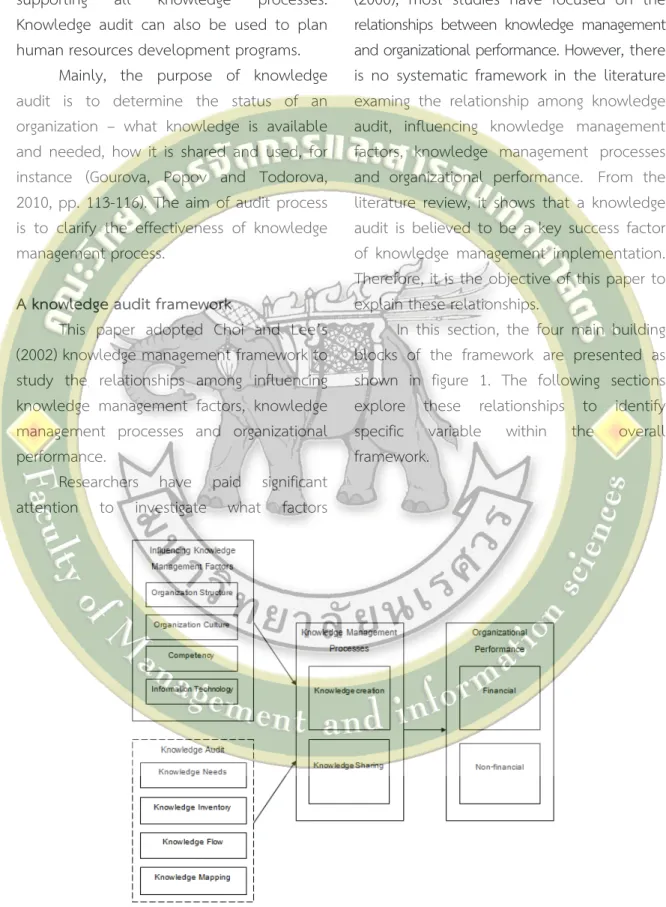
This paper adopted Choi and Lee’s (2002) knowledge management framework to study the relationships among influencing knowledge management factors, knowledge management processes and organizational performance.
Researchers have paid significant attention to investigate what factors
important to the success of knowledge management. According to Lee and Choi (2003), Lee and Yang (2000) and Teece (2000), most studies have focused on the relationships between knowledge management and organizational performance. However, there is no systematic framework in the literature examing the relationship among knowledge audit, influencing knowledge management factors, knowledge management processes and organizational performance. From the literature review, it shows that a knowledge audit is believed to be a key success factor of knowledge management implementation. Therefore, it is the objective of this paper to explain these relationships.
In this section, the four main building blocks of the framework are presented as shown in figure 1. The following sections explore these relationships to identify specific variable within the overall framework.
Figure 1: Knowledge Audit Framework (Adopted from Choi & Lee, 2000)
1. Influencing knowledge management factors
Various factors influencing the success of knowledge management have been identified in the previous literature. These factors are organization structure,
organization culture, competency,
and information technology as included in this framework.
1.1 Organization Structure
Davenport and Prusak (1998) explained that the success of knowledge management can be influenced by the appropriate organization well structure. The organization structure can promote or impede knowledge sharing within an organization (Nonaka and Takeuchi, 1995). For example, structures promoting individualistic behavior can hinder knowledge sharing since people tend to hoard information (O’Dell and Grayson, 1998, pp. 154-175). Hence, organization structure and incentive systems should be designed in a way to promote collaboration across business departments and encourage knowledge sharing for example: a modular organization design, a hypertext organization design (Gold, Malhotra and Segars, 2001, p. 194).
1.2 Organization culture
Organization culture, which determines value and belief system of an organization, is considered to be the most crucial input to successful knowledge management and organizational learning (Janz and Prasarnphanich, 2003, pp. 351-384; Figallo, 2002). An appropriate culture should be established in order to encourage people to create and share knowledge within an organization (Holsapple and Joshi, 2001, pp. 39-54). Trusting culture was seen as one
important aspect in promoting information sharing (Ruppel and Harrington, 2001, pp. 37
-49). Especially, interpersonal trust or trust between co-workers is believed to influence knowledge sharing (Politis, 2003, pp. 55-66)
1.3 Competency
Lee and Choi (2003, p. 182) stated that people is one of the most important aspect in knowledge management. Knowledge management is a process to provide people in an organization with technology allowing them to effectively collect, store, utilize and share knowledge (Hylton, 2002). Evidently, competency is difficult to be elicited and takes a considerable amount of time to develop (Chase 1997, pp. 38-49). Thus, organizations may choose to hire new employee with a desirable set of competency (Stonehouse and Pemberton, 1999, pp. 131-144).
1.4 Information technology
The importance of information technology in promoting the success of knowledge management has been in the center of the debate among academia (Borghoff and Pareschi, 1997, pp. 835-842). A solid foundation of information technology infrastructure served as a platform allowing employees to share knowledge cross the organization (Hasanali, 2002). Typically, information technology is utilized to facilitate collaboration in order to create a new body of knowledge (Lee and Choi, 2003, p. 190), It is a tool allowing employees to effective create, retrieve, and analyze data in order to transform them into knowledge (Ruggles,
1997). Its role is to coordinate and integrate the entire process of knowledge management (Alavi and Leider, 1999, pp. 1 -37).
knowledge audit can be used to evaluate and design an organization’s R&D and innovation programs and policies which help supporting all knowledge processes. Knowledge audit can also be used to plan human resources development programs.
Mainly, the purpose of knowledge audit is to determine the status of an organization – what knowledge is available and needed, how it is shared and used, for instance (Gourova, Popov and Todorova, 2010, pp. 113-116). The aim of audit process is to clarify the effectiveness of knowledge management process.
A knowledge audit framework
This paper adopted Choi and Lee’s (2002) knowledge management framework to study the relationships among influencing knowledge management factors, knowledge management processes and organizational performance.
Researchers have paid significant attention to investigate what factors
important to the success of knowledge management. According to Lee and Choi (2003), Lee and Yang (2000) and Teece (2000), most studies have focused on the relationships between knowledge management and organizational performance. However, there is no systematic framework in the literature examing the relationship among knowledge audit, influencing knowledge management factors, knowledge management processes and organizational performance. From the literature review, it shows that a knowledge audit is believed to be a key success factor of knowledge management implementation. Therefore, it is the objective of this paper to explain these relationships.
In this section, the four main building blocks of the framework are presented as shown in figure 1. The following sections explore these relationships to identify specific variable within the overall framework.
Figure 1: Knowledge Audit Framework (Adopted from Choi & Lee, 2000)
1. Influencing knowledge management factors
Various factors influencing the success of knowledge management have been identified in the previous literature. These factors are organization structure,
organization culture, competency,
and information technology as included in this framework.
1.1 Organization Structure
Davenport and Prusak (1998) explained that the success of knowledge management can be influenced by the appropriate organization well structure. The organization structure can promote or impede knowledge sharing within an organization (Nonaka and Takeuchi, 1995). For example, structures promoting individualistic behavior can hinder knowledge sharing since people tend to hoard information (O’Dell and Grayson, 1998, pp. 154-175). Hence, organization structure and incentive systems should be designed in a way to promote collaboration across business departments and encourage knowledge sharing for example: a modular organization design, a hypertext organization design (Gold, Malhotra and Segars, 2001, p. 194).
1.2 Organization culture
Organization culture, which determines value and belief system of an organization, is considered to be the most crucial input to successful knowledge management and organizational learning (Janz and Prasarnphanich, 2003, pp. 351-384; Figallo, 2002). An appropriate culture should be established in order to encourage people to create and share knowledge within an organization (Holsapple and Joshi, 2001, pp. 39-54). Trusting culture was seen as one
important aspect in promoting information sharing (Ruppel and Harrington, 2001, pp. 37
-49). Especially, interpersonal trust or trust between co-workers is believed to influence knowledge sharing (Politis, 2003, pp. 55-66)
1.3 Competency
Lee and Choi (2003, p. 182) stated that people is one of the most important aspect in knowledge management. Knowledge management is a process to provide people in an organization with technology allowing them to effectively collect, store, utilize and share knowledge (Hylton, 2002). Evidently, competency is difficult to be elicited and takes a considerable amount of time to develop (Chase 1997, pp. 38-49). Thus, organizations may choose to hire new employee with a desirable set of competency (Stonehouse and Pemberton, 1999, pp. 131-144).
1.4 Information technology
The importance of information technology in promoting the success of knowledge management has been in the center of the debate among academia (Borghoff and Pareschi, 1997, pp. 835-842). A solid foundation of information technology infrastructure served as a platform allowing employees to share knowledge cross the organization (Hasanali, 2002). Typically, information technology is utilized to facilitate collaboration in order to create a new body of knowledge (Lee and Choi, 2003, p. 190), It is a tool allowing employees to effective create, retrieve, and analyze data in order to transform them into knowledge (Ruggles,
1997). Its role is to coordinate and integrate the entire process of knowledge management (Alavi and Leider, 1999, pp. 1 -37).
2. Knowledge audit
Knowledge audit helps ensure that an organization would achieve its desired outcomes from knowledge management processes (Paramasivan, 2003, p. 501). As discussed previously, knowledge audit stressed the importance of identifying knowledge availability and the required knowledge for creating value to the organization (Gourova, Popov and Todorova, 2010, p. 115). The knowledge audit process involves needs analysis, knowledge inventory, knowledge mapping, knowledge flow and gap analysis employed to identify strengths and weaknesses in the knowledge management process (Hylton, 2002). In addition to that, the outcomes of the audit process would lead to the area of improvement such as what to be improved or eliminated. Paramasivan (2003, p. 505) has developed knowledge audit instruments with the details discussed below.
2.1 Knowledge need
The objective of knowledge need analysis is to identify knowledge required in the future to support business objectives by examining the needs from people, team and processes (Chowdhury, 2006). During the knowledge need identification process, people would also learn their needed knowledge (Hawryszkiewycz, 2005). They would understand more about skills and competency required in their jobs and for the organization (Asian Develop Bank, 2008). This identification process is an important part of knowledge sharing since it reveals the gap between the current status and the requirements of knowledge (Skyrme, 2002).
2.2 Knowledge inventory
Knowledge inventory is a process of identifying and organizing both explicit and tacit knowledge assets in the organization (Cheung, et al., 2007, p. 150). After the known and missing knowledge are identified, knowledge creation and sharing can begin (Dataware Technologies, 1998). Mostly, organizations do not have full understanding about their sources of organization knowledge. The discovery of the organization knowledge sources will allow them to know the most effective way to store and share knowledge (Huber, 1991, pp. 88-115). The outcomes of this process will be compared with the results of the knowledge need analysis to provide a more accurate picture of the knowledge gaps (Serrat, 2008). Sources of organization knowledge and the needs of knowledge can help an organization to manage knowledge management process in order to better support decision-making (Tiwana, 2002).
2.3 Knowledge flow
Knowledge flow is a process to analyze the movement of knowledge within the organization (Perez-Soltero, et al., 2007, p. 13). It helps determine how people in an organization seek the knowledge needed, share their knowledge (Tiwana, 2002). After they locate the knowledge needed, they can acquire and share that knowledge. The analysis of knowledge flow shows the usage and sharing of knowledge within an organization (Stevens, 2000).This analysis pays particular attention to people, processes and the system (Gourova, Antonova and Todorova, 2009, pp. 605-619). For people, people’s attitude towards habits, experience, behaviors, and skills in knowledge sharing are examined. For the 30
process, it analyzes the interplay between individual daily business and the flow of knowledge. For the system, the analysis deals with technical infrastructure including systems and its accessibility, ease of use, and current usage (Chowdhury, 2006).
2.4 Knowledge mapping
Mapping organization knowledge is considered to be important step in a knowledge audit (Liebowitz, 2005, pp. 76-86). A knowledge map depicts the sources, flows, storage of organization knowledge (Perez-Soltero, et. al., 2007; Liebowitz, 2005). It is important for an organization to build a knowledge map because it could improve knowledge sharing and effective communities of practice (Grey, 1999).
As discussed in the section above, knowledge audit tools are crucial to knowledge management processes. They help an organization utilize the existing knowledge assets. The audit process begins by identifying knowledge needs and the desired knowledge. Then, the process of knowledge inventory building helps discovery the sources of knowledge in organization. Next, the analysis of knowledge flow allows an organization to understand how people create, share, acquire, and use knowledge or the movement of knowledge within the organization. Lastly, creating knowledge mapping is the tool providing a visual of how knowledge is created, stored, used, and shared. Thus, it can be postulated that knowledge audit tools can provide a solid foundation for establishing more effective knowledge management processes.
3. Knowledge management processes Knowledge management can be seen to consist of several processes (Alavi and Leidner, 1999, pp. 1-37). Davenport, De
Long and Beers (1998, pp. 43-57) presented four key knowledge management processes including locating existing knowledge, creating new knowledge, packaging the created knowledge, and externally using existing knowledge. Alavi and Leidner (1999, pp. 1-37) also classify the knowledge management process consisting of the process of creating the knowledge, the process of storing and retrieving the knowledge, the process of transferring knowledge, and the process of applying the knowledge. This paper followed Choi and Lee (2000) model which focused only on knowledge creation process and knowledge sharing process.
3.1 Knowledge creation
Knowledge creation is a continuous process which people share their knowledge within an organization and between organizations (Bloodgood and Salisbury, 2001, pp. 55-69). Developing new knowledge or replacing existing knowledge are also considered knowledge creation (Alavi and Leidner, 1999, pp. 1-37). Nonaka, Toyama and Nagata (2000, pp. 1-20) claimed that knowledge creation can build a sustainable competitive advantage because it would result in new innovation or development. In Nonaka and Konno (1998, pp. 40-54) they proposed a model explaining 4 modes of knowledge creation: socialization, externalization, combination, and internalization. The socialization mode is a process of acquiring a new tacit knowledge from others’ tacit knowledge through experiences sharing or socializing among the organization members. The externalization mode is a process of transforming tacit knowledge into explicit knowledge developing best practices or lesson learned. 31
The combination mode is to create a new explicit knowledge from existing explicit knowledge. Finally, the internalization mode is a process of creating a new tacit knowledge from explicit knowledge from learning through learned lessons.
3.2 Knowledge sharing
Knowledge sharing can help an organization create value-added benefits (Liebowitz, 2001, pp. 1-6). Lesser (2001, pp. 831-841) provided evidence that a group of organization members who are involved in sharing and learning their same interests can help improve organization performance. Knowledge sharing can happen at various levels (Alavi and Leidner, 2001, pp. 107-136). Knowledge sharing was defined as a process of creating and sharing knowledge to others (Tannenbaum and Alliger, 2000). By sharing of personal experience, it also creates organization knowledge. Nonaka, Toyama and Nagata (2000, pp. 1-20) argued that a sharing of existing knowledge and creating of new knowledge are two major mutual tasks for management. Davenport, De Long and Beers. (1998, pp. 43-57) also claimed that a successful knowledge management program usually pay significant attention to knowledge creation and knowledge sharing.
4. Organizational performance Knowledge management processes is now becoming more important for improving organizational performance. However, it is proved to be difficult in measuring the organization benefits gained from implementing knowledge management (Gooijer, 2000, pp. 303-310). Mostly, organizational performance is evaluated in term of effectiveness and efficiency representing the level of achievement against the objectives set forth (Flynn, Hoverd and
Brazier, 1990, pp. 128-141). Organization performance could be measured in terms of organization learning, profitability, or the financial benefits in knowledge (Lee and Choi, 2003). Several studies have found the positive relationship between knowledge management and organizational performance metrics such as cost saving, productivity and customer’s satisfaction etc. (Darroch, 2005, pp. 101-115; Afiouni, 2007, p. 124; Fugate, Stank and Mentzer, 2009, pp. 247-264). Conclusion
Knowledge has become the biggest potential weapon for an organization to achieve business goal. Organizations attempt to improve their performance through better use of knowledge and seek for a new way to sustain their competitiveness. Most organizations launched knowledge management initiatives or programs without the assessment of their readiness. Those initiatives or programs often ended up in failure. Knowledge audit is believed to be a key first step in any knowledge management processes to examine organization’s knowledge needs, existing knowledge resources, knowledge flow, and knowledge gap analysis.
This paper explores the area of knowledge audit by reviewing the concepts of audit tools, knowledge management processes and organizational performance. As it became clear, in practice, a knowledge audit is the implementation of a set of tools that are used to help organization better manage knowledge management processes and provides a greater understanding to the factors contributing to a successful knowledge management program. In light of this, a successful knowledge management 32
program will help the organizations improve their performance in many ways such as customer satisfaction, product/service innovations, time to market, cost saving, competitive positioning or market share.
As a knowledge audit is developed for knowledge management processes efforts
to help better managing the knowledge management programs, this paper offers knowledge audit framework, which seeks to help the organizations to understand the larger picture of knowledge management in order to help sustain long-term business success.
References
Afiouni, F. (2007). Human resource management and knowledge management: A road map towards improving organisational performance. Journal of American Academy of Business, 11(2), 124.
Alavi, M. and Leidner, D. (1999). Knowledge management systems: issues, challenges, benefits.
Communications of the Association for Information Systems, 1(7), 1-37.
Alavi, M. and Leidner, D. (2001). Review: Knowledge management and knowledge management systems: Conceptual foundations and research issues. MIS Quarterly, 25(1), 107-136. Alhamoudi, S. (2010). Strategic knowledge management system in public sector in Saudi
Arabia: an adaptation of the Balance Scorecard. Doctoral dissertation Ph.D., University of Portsmouth,Hampshire.
Anantatmula, V. and Kanungo, S. (2010). Modeling enablers for sucessful km implementation.
Journal of Knowledge Management, 1(14), 100-113.
Andrew, K. (12 January 2005). Conducting a knowledge audit masterclass. Workshop organized by Ark Group Asia: Singapore.
Asian Develop Bank. (February, 2008). Auditing the lessons architecture, Retrieved May 18, 2012, from http://www.adb.org/document/studies/auditing-lessons-archiecture/IN371-07.asp
Bloodgood, J. M. and Salisbury, Wm. D. (2001). Understanding the influence of organizational change strategies on information technology and knowledge management strategies.
Decision Support Systems, (31), 55-69.
Borghoff, U. M. and Pareschi, R. (1997). Information technology for knowledge management.
Journal of Universal Computer Science, 3(8), 835-842.
Braganza, A. and Mollenkramer, G. J. (2002). Anatomy of a failed knowledge management initiative: lessons from PharmaCorp’s Experiences. Knowledge and Process Management, 9(1), 23-33.
Buckley, P.J. and Carter, M.J. (2000). Knowledge management in global technology markets: Applying theory to practice. Long-Range Planning, 33(1), 55-71.
Chase, R. (1997). The knowledge-based organization: An international survey. Journal of Knowledge Management, 1(1), 38–49.
Cheung, C. F., et al. (2007). A systematic approach for knowledge auditing: A case study in transportation sector. Journal of Knowledge Management, 11(4), 140-158.
Choi, B. and Lee, H. (2000). Knowledge management and organizational performance. INFORMS & KORMS, 1105-1113.
Chua, A. and Lam, W. (2005). Why KM projects fail: A multi-case analysis. Journal of
Knowledge Management, 9(3), 6-17.
Chowdhury, N. (2006). Knowledge audit: Overview and sample questionnaire. Retrieved May,3 2012, from http://www.kmtalk.net/k_audit_KMtalk.doc
Choy, S. Y., Lee, W. B. and Cheung, C.F. (2004). A systematic approach for knowledge audit analysis: Integration of knowledge inventory, mapping and knowledge flow analysis.
Journal of Universal Computer Science, 10(6), 674-682. 34
Chuang, S.(2004). A resource-based perspective on knowledge management capability and competitive advantage: an empirical investigation. Retrieved March 16, 2012, from http://www. Elsevier.com/locate/eswa
Darroch, J.(2005). Knowledge management, innovation and firm performance.Journal of
Knowledge Management, 9(3), 101-115.
Dataware Technologies. (1998). Seven steps to implementing knowledge management in
your organization. Retrieved June23, 2012, from http://www.dataware.com
Davenport, H., De Long, D. W. and Beers, M. C.(1998). Successful knowledge management
project. Sloan Management Review, 39(2), 43-57.
Davenport, T. H. and Prusak, L.(1998). How organizations manage what they know. Harvard
Business School Press, Boston.
Figallo, C.(2002). Building the knowledge management network—best practices: tools and
techniques for putting conversation to work. New York: John Wiley & Sons Inc.
Flynn, M., Hoverd, T. and Brazier, D.(1990). Formaliser - an interactive support tool for Z. In
Nicholls, J. E. (Ed.). Z User Workshop(pp. 128-141). Springer, Heidelberg.
Fugate, B. S., Stank, T. P. and Mentzer, J.T.(2009). Linking improved knowledge management
to operational and organizational performance. Journal of Operations Management,
27(3), 247-264.
Gooijer, D. J.(2000). Designing a knowledge management performance framework. Journal of
Knowledge Management, 4(4), 303 – 310.
Gold, A. H., Malhotra, A. and Segars, A. H.(2001). Knowledge management: An organizational
capabilities perspective. Journal of Management Information Systems, 18(1), 185–
214.
Gourova, E., Antonova, A. and Todorova, Y.(2009). Knowledge audit concepts, processes and
practise.WSEAS Transactions of Business and Economics, 6(12), 605-619.
Gourova, E., Popov T. and Todorova, Y.(2010). Technology platform for knowledge audit.
TELE-INFO'10 Proceedings of the 9th WSEAS international conference on Telecommunications and informatics. Stevens Point: Wisconsin.
Grey, D.(1999). Knowledge mapping: A practical overview. Retrieved July 5, 2012, from
http:// www.itconsultancy.com/extern/sws/knowmap.html
Guptara, P.(2000). Why knowledge management fails: how to avoid the common pitfalls.
Knowledge Management Review, 9, 26-9.
Hasanali, F.(2002). The critical success factors of knowledge management. Retrieved May 9,
2012, from http://www.apqc.org/portal/apqc/ksn
Hawryszkiewycz, I. T.(4-5 July 2005). Providing Agent Support for Collaborative Systems: Using
a Domain Oriented Design Method. In third International Conference on
Information Technology and Applications (ICITA 2005). Sydney: Australia.
Holsapple, C. W. and Joshi, K. D.(2001). Organizational knowledge resources. Decision Support
Systems, 31(1), 39–54.
Huber, P.G.(1991). Organizational learning: The contributing processes and the literatures.
Organizational Science, 2(1), 88-115.
Hylton, A.(2002). A KM initiative is unlikely to succeed without a knowledge audit.
Retrieved March2, 2012, from http://[email protected]
Ishaq, O. and Dominic, P. (June 2010). Conceptualization of the antecedents and impacts of
kms utilization: A preliminary framework. In International Symposium on
Information Technology 2010. Kuala Lumpur: Malaysia.
Janz, B. D. and Prasarnphanich, P.(2003). Understanding the antecedents of effective
knowledgemanagement: The importance of a knowledge-centered culture.Decision
Sciences, 34(2), 351–384.
Koulopoulos, T. and Frappaolo, C.(1999). Smart things to know about knowledge
management, Capstone, Dover, Connecticut.
Lee, C. and Yang, J. (2000). Knowledge Value Chain. Journal of Management Development,
19(9), 783-793.
Lee, H. and Choi, B.(2003). Knowledge management enablers, processes, and organizational
Performance: an integrative view and empirical examination. Journal of
Management Information Systems, 20(1), 179-228.
Lesser, E. J.(2001). Communities of practice and organizational performance.IBM Systems
Journal, 40(4), 831-841.
Liebowitz J., et al. (2000). The knowledge audit. Knowledge and Process Management,7(1),
3-11.
Liebowitz, J.(2001). Knowledge management and its link to artificial intelligence.Expert
Systems with Applications, 20(1), 1-6.
Liebowitz, J.(2003). Addressing the human capital crisis in the federal government; A
knowledge management perspective. Butterworth-Heinemann, Elsevier: Oxford.
Liebowitz, J.(2005). Linking social network analysis with the analytic hierarchy process for
knowledge mapping in organizations. Journal of Knowledge Management, 9(1),
76-86.
Malhotra, Y.(2004). Why knowledge management system fail? Enablers and constraints of
knowledge management in human enterprises, in Holsapple, C.W. (Ed.), Handbook of
knowledge management,(577-599). Springer-Berlag: Berlin.
Metaxiotis, K., et al. (2005). Exploring the world of knowledge management: agreement and
disagreement in the academic/practioner community. Journal of knowledge
management, 9(2), 6-18.
Nonaka, I. and Konno, N. (1998). The concept of “ba” building a foundation for knowledge
creation.California Management Review, 40(3), 40-54.
Nonaka, I. and Takeuchi, H.(1995). The knowledge-creating company: how japanese
companies created the dynamics of innovation. New York: Oxford University Press.
Nonaka, I., Toyama, R. and Nagata, A.(2000). A firm as a knowledge-creating entity: a new
perspective on the theory of the firm.Oxford Journal: Industrial and Corporate
Change, 9(1), 1-20.
O'Dell, C. and Grayson, J.(1998). If only we knew what we know: Identification and transfer of
internal best practices. California Management Review, 40(3), 154-175.
Paramasivan, T.(2003).Knowledge audit.The Chartered Accountant. 52(5), 498-506.
Perez-Soltero, A., Barcelo-Valenzuela, M., G.Sanchez-Schmitz, F., Martin-Rubio, J., Palma
-Mendez, T. and Vanti, A, A. (2007).A model and methodology to knowledge auditing
considering core processes.ICFAI Journal on Knowledge Management, 5(1), 7-23.
Politis, J. (2003). The connection between trust and knowledge management: what are its
implications for team performance. Journal of Knowledge Management, 7(5), 55-66.
Robertson, S. (2005). Knowledge audit. Retrieved May 23, 2012, from http://www.
Library.nhs.uk
Ruggles, R. L.(1997). Knowledge tools: using technology to manage knowledge better.
Retrieved March 15, 2012, from http://www.cbi.cgey.com/pub/docs/KnowledgeTools.
Ruppel, C. P. and Harrington, S.J. (2001) Sharing Knowledge through Internet: A Study of
Organizational Culture and Internet Implementation.IEEE Transactions on
Professional Communication, 44(1), 37-49.
Serrat, O. (2008). Auditing knowledge, knowledge solutions. Retrieved June 2, 2012, from
http://www.adb.org/.../Knowledge.../Auditing-Knowledge.pdf
Skyrme, J. D.(2002). Knowledge management: Approaches and Policies. Retrieved July 25,
2012, from http://www.entovation.com/timeline
Stonehouse, G. H. and Pemberton, J. D. (1999). Learning and knowledge management in the
intelligent organization. Participation and Empowerment: An international Journal,
7(5), 131-144.
Storey, J. and Barnett, E. (2000). Knowledge management initiative learning from failure.
Journal of Knowledge Management, 4(2), 145-150.
Tannenbaum, S. I. and Alliger G. M. (2000). Knowledge management: Clarifying the key
issues. Burlington, MA.
Teece, D. J.(2000). Strategies for Managing Knowledge Asset: The Role of Firm Structure and
Industrial Context. Long Range Planning, 33(1), 35-54.
Tiwana, A. (2002). The knowledge management toolkit: Orchestrating IT, strategy, and
knowledge platforms. Upper Saddle River, New Jersey: Prentice Hall.
Wexler, M. (2001). The who, what, and why of knowledge mapping. Journal of Knowledge
Management, 5 (3), 249-264.
Yeh, YMC. (2005). The Implementation of Knowledge Management System in Taiwan’s Higher
Education. Journal of College Teaching & Learning, 2(9), 35-42.
Paramasivan, T.(2003).Knowledge audit.The Chartered Accountant. 52(5), 498-506. Perez-Soltero, A., Barcelo-Valenzuela, M., G.Sanchez-Schmitz, F., Martin-Rubio, J., Palma
-Mendez, T. and Vanti, A, A. (2007).A model and methodology to knowledge auditing
considering core processes.ICFAI Journal on Knowledge Management, 5(1), 7-23.
Politis, J. (2003). The connection between trust and knowledge management: what are its
implications for team performance. Journal of Knowledge Management, 7(5), 55-66.
Robertson, S. (2005). Knowledge audit. Retrieved May 23, 2012, from http://www.
Library.nhs.uk
Ruggles, R. L.(1997). Knowledge tools: using technology to manage knowledge better.
Retrieved March 15, 2012, from http://www.cbi.cgey.com/pub/docs/KnowledgeTools.
Ruppel, C. P. and Harrington, S.J. (2001) Sharing Knowledge through Internet: A Study of
Organizational Culture and Internet Implementation.IEEE Transactions on
Professional Communication, 44(1), 37-49.
Serrat, O. (2008). Auditing knowledge, knowledge solutions. Retrieved June 2, 2012, from
http://www.adb.org/.../Knowledge.../Auditing-Knowledge.pdf
Skyrme, J. D.(2002). Knowledge management: Approaches and Policies. Retrieved July 25,
2012, from http://www.entovation.com/timeline
Stonehouse, G. H. and Pemberton, J. D. (1999). Learning and knowledge management in the
intelligent organization. Participation and Empowerment: An international Journal,
7(5), 131-144.
Storey, J. and Barnett, E. (2000). Knowledge management initiative learning from failure.
Journal of Knowledge Management, 4(2), 145-150.
Tannenbaum, S. I. and Alliger G. M. (2000). Knowledge management: Clarifying the key
issues. Burlington, MA.
Teece, D. J.(2000). Strategies for Managing Knowledge Asset: The Role of Firm Structure and
Industrial Context. Long Range Planning, 33(1), 35-54.
Tiwana, A. (2002). The knowledge management toolkit: Orchestrating IT, strategy, and
knowledge platforms. Upper Saddle River, New Jersey: Prentice Hall.
Wexler, M. (2001). The who, what, and why of knowledge mapping. Journal of Knowledge
Management, 5 (3), 249-264.
Yeh, YMC. (2005). The Implementation of Knowledge Management System in Taiwan’s Higher
Education. Journal of College Teaching & Learning, 2(9),35-42.