A Study into the Challenges of Subtitling English into Arabic
Kamal Taher Furgani
A thesis submitted in partial fulfilment of the requirements of Liverpool John Moores University for the degree of Doctor of Philosophy
II
Abstract
This study examines the quality of subtitles from English into Arabic. The motivation behind selecting this topic area is that subtitling of English language programmes into Arabic is under-researched. Therefore it is in need of further research in order to enhance subtitlers’ skills and performance.
The study explores the main challenges that translators face in the subtitling of English language films into Arabic and addresses the key issues, by examining the common features hindering audio-visual translation and highlighting particular cultural limitations intrinsic to translation for Arabic speaking audiences, assuming that particular fundamentals of translation theory can be beneficial in overcoming the linguistics, technical and cultural challenges. A qualitative approach is adopted in the study. The rationale for adopting a qualitative research approach is related to the purpose of the study, the nature of the problem and research questions. Thus the study data have been collected using a thematic questionnaire for general viewers who are interested in watching subtitled programmes to gauge their perceptions on the current quality of English into Arabic subtitling.
The findings of this study have practical contribution to enhance the quality of subtitling. They also benefit academic research through expanding the literature in the field of subtitling which in turn will benefit future researchers.
III
Acknowledgments
All praises and thanks are due to Allah the most gracious and most merciful, who generously provided me health, strength, tolerance and knowledge to complete this exciting PhD journey.
I would like to thank my director of study Ms Brigitte Hordern for her valuable advice and comments.
My greatest gratitude and thanks go to my former director of study Dr Karim Menacere for his invaluable advice, support and constructive feedback.
I would like to extend my thanks to my second supervisor Dr Scott Foster for his assistance and support.
My thanks also go to my third supervisor Ms Sue Hill for her useful comments My sincere appreciation and honour go to my dear loving, brothers and sisters, who have always been there to support and encourage me in my journey in every way possible.
Finally, and most importantly to my beloved family, to my beloved wife for her sacrifice and limitless ways of help, by providing me with love, encouragement, support and for being always there for me.
To my four adorable children Aws, Jouri, Aasef and Mohammed for continually encouraging me during the hardest times, challenging me to reach my full potential. I love and cherish you all. Thank you for all the love and support you have shown me over the years.
IV
Declaration
This submission is my own work and contains no material previously published or written by another person nor material which has been accepted for the award of any other degree or diploma of the University or other institute of higher learning, except where due acknowledgement has been made in the text, in the United Kingdom or overseas.
V
Dedication
VI Contents Abstract ... II Acknowledgments ... III Declaration ... IV List of tables ... X List of figures ... XI List of Abbreviations ... XII
Chapter One ... 1
Introduction ... 2
1.1 Aim of the study ... 3
1.2 Background of the study ... 3
1.3 An overview of key subtitling literature... 6
1.4 Statement of the research problem ... 14
1.5 Research questions ... 16
1.6 Research objectives ... 17
1.7 Rationale of study ... 17
1.8 Gaps and expected contribution to knowledge ... 18
1.9 Structure of the study ... 18
Chapter Two ... 20
Literature Review ... 21
2.1 Models and types of audio – visual translation (AVT) ... 21
2.1.1 Types of subtitling ... 25
2.1.2 Subtitling vs dubbing ... 28
2.2 The use of AVT methods in Europe. ... 31
2.3 The use of subtitling in the Arab world ... 33
2.4 The concept of subtitling ... 34
2.5 Written translation vs. screen translation (subtitling) ... 38
2.5.1 The concept of translation in Arabic sources ... 41
2.5.2 Forms of translation ... 42
2.6 A brief overview of the evolution of audio-visual research ... 48
2.7 Theories of translation and their relevance to subtitling ... 52
2.7.1 Pre-linguistic theory ... 54
2.7.1.1 Word-for-word translation theory... 55
2.7.1.2 Free translation theory ... 57
2.7.2 Non-discourse translation theories. ... 58
VII
2.7.2.2 Catford’s approach ... 60
2.7.3 Discourse-related translation studies ... 63
2.7.3.1 De Beaugrande model, 1978 ... 63
2.7.3.2 Koller’s model ... 64
2.7.3.3 Vinay and Darbelnet model ... 66
2.7.3.4 House’s translation quality assessment model ‘TQA’ ... 67
2.7.3.5 Baker’s theory ... 70
2.7.3.6 Hatim and Mason model ... 72
2.7.3.7 Bayars’ classification of equivalence... 74
2.7.4 The debate over the term equivalence ... 75
2.8 The challenge of culture in translation ... 76
2.8.1 The importance of grasping culture by translators ... 78
2.9 Subtitling challenges. ... 82
2.10 Summary and gaps in the literature ... 96
Chapter Three ... 100
Methodology and Methods ... 101
3.1 Research methods of the study ... 101
3.1.1 Justification of the selection of research method for this study ... 103
3.1.2 Research instrument of this study ... 105
3.1.3 Qualitative vs. quantitative questionnaires ... 106
3.2 Design of the research questionnaire... 108
3.2.1 Sampling population selection ... 109
3.3 Sampling population of the study ... 114
3.3.1 Justification of the sampling methods ... 116
3.3.2 Types of snowball method ... 117
3.3.3 Advantages and disadvantages of snowball sampling technique ... 118
3.4 Pilot study ... 119
3.4.1 Response rate of the pilot Study ... 120
3.4.2 Response rate of the main study ... 121
3.5 Reliability and validity of the study questionnaire ... 121
3.5.1 Ethical considerations... 124
3.5.2 Generalizability ... 124
3.6 Summary of the chapter ... 125
Chapter Four ... 127
VIII
4.1 Introduction... 128
4.2 The Analysis of Data ... 129
4.3 The TQA model adapted in the analysis ... 131
4.4 Linguistic challenge assessment ... 131
4.4.1 Assessment of use of local dialects in subtitling ... 144
4.5 Cultural challenges assessment ... 145
4.5.1 Idioms, proverbs, quotes, prayers, and humour ... 146
4.5.2 Offensive use of language with reference to God ... 165
4.5.3 Offensive language and swear words ... 171
4.6 Technical challenge assessment ... 177
4.7 Summary of the Analysis ... 179
Chapter Five ... 181
Discussion and interpretation of the Study Findings ... 182
5.1 Introduction... 182 5.2 Study Participants ... 183 5.3 Discussion of Findings... 183 5.3.1 Linguistic Findings. ... 184 5.3.2 Cultural Findings. ... 197 5.3.3 Technical Findings ... 211
5.4 Summary of the Chapter ... 213
Chapter Six ... 215
Conclusion and recommendations ... 216
6.1 Introduction... 216
6.2 Summary of literature findings ... 216
6.3 Summary of study findings ... 217
6.3.1 Introduction... 217
6.3.2 Summary of the study questionnaire findings ... 219
6.3.3 Summary of linguistic quality findings ... 219
6.3.4 Summary of cultural quality findings ... 221
6.3.5 Summary technical quality findings ... 224
6.4 Conclusion ... 225
6.5 Recommendations ... 226
6.6 Limitations of the study ... 228
6.7 Contribution of the study ... 229
IX 6.7.2 Practical contribution ... 230 6.8 Future research ... 231 6.9 Final Comment ... 232 Bibliography ... 233 Appendices ... 258
The study questionnaire (Arabic version) ... 258
The study questionnaire (English version) ... 276
X
List of tables
Table2. 1 Models and types of audio–visual language transfer ... ..23 Table 3. 7 Number of pilot study questionnaire copies……….………... 120
XI
List of figures
Figure2. 1 RE-voicing and subtitling...25
Figure2. 2 Interlingual transfer ...27
Figure2. 3 House’s TQA model ...70
Figure2. 4 Culture relations ...78
Figure2. 5 Study theoretical framework ...99
Figure 3. 3 Sampling methods………. 113
FIgure 3. 4 Snowball sampling techniques ... 117
Figure 4. 2 TQA model for analysis ... 131
XII
List of Abbreviations
AVT……… Audio Visual Translation MSA……….………..Modern Standard Arabic SL ………..Source Language ST………..……… …….Source Text TL……… ……Target Language TT……….Target Text TQA………... Translation quality assessment
Chapter One
Introduction
2
Introduction
The appearance of satellite channels in the Arab world since the 1990’s, the substantial increase in communication and the amount of viewing time have led to the import of a large number of foreign programmes, to attract viewers as well as to fill in time and make various programme schedules. The main obstacle that hinders viewers from enjoying these programmes is the language barrier. Audio-visual translation (AVT) i.e. subtitling and dubbing, seems to be the medium that enable the understanding of foreign programmes. This relies on an adequate knowledge of the source language (SL) as the language always reflects the culture of the people who speak it, and is always inseparable from culture (Menacere, 1999; Gamal, 2008).
Many academics assert that subtitling, as a subject area is relatively new. It has evolved into a fully-fledged practice only recently and as De Meo (2010:19) points out that the area of AVT such as subtitling, interpreting and dubbing “has only recently fully been recognized in translation study research as previously it was merely considered as an inferior form of adaptation”.
In the Arab world, there is little research about the challenges and problems of subtitling particularly on culture-bound words or phrases, when subtitling, from English to Arabic or vice versa. In contrast, there is a growing interest in AVT research in many European countries such as Italy and Spain, this interest is due to the common use of technology such as electronic games, internet, and DVDs (De Meo, 2010).
3
1.1 Aim of the study
This study aims to examine the challenges of subtitling English into Arabic. It highlights the constraints facing the subtitler in terms of information processing and explores the complex nature of one of the most intricate forms of translation which is subtitling. The study also assesses the quality of Arabic subtitles of English language films.
It starts by investigating the common features of audio-visual translation. This study argues that elements of theoretical knowledge of translation can be beneficial in understanding the root problems of subtitling.
This research focuses on film subtitling, as dubbing will be beyond the scope of this study. It examines the challenges that the audio-visual translators face in their attempts to subtitle English language films into Arabic. In addition, it explores the challenges of rendering culture-specific words.
1.2 Background of the study
The first attempt to translate the discourse of the actors to the audience started just a short time after the invention of films. They began with “intertitles” i.e.
“texts, drawn or printed on papers, recorded and placed between sequences of the film. They were first seen in 1903 as epic, descriptive titles in Edwin S. Porter’s Uncle Tom`s Cabin” (Ivarsson, 1992:1).
The lack of a spoken dialogue was the main limitation in the primary cinema therefore the filmmakers had to depend mainly “on visual semiotics to construct an experience of artistic expression for the benefit of their audience”
4
Similarly, Nornes, (2007:89-90) argues the initial film was considered as a soundless medium as “stories were told through visual means. The actor’s only resource was his or her body”.
At the time of intertitles, it was not difficult to solve the translation difficulties of films. A translator used to give an immediate interpretation of the intertitles, or the original titles were removed, decoded, recorded and re-inserted.
Sound film was released in 1927 and the audiences could listen to the film actors’ dialogue, so intertitles put between scenes disappeared and new problems and challenges emerged. The introduction of sound according to Perez-Gonzalez, (2014) had an important effect on the semiotic fabric of the new ‘talking pictures’ or ‘talkies’ and as Jacobs (1968:435) stresses “the public, fascinated by the novelty, wanting to be sure they were hearing what they saw, would have felt that a trick was being played on them if they were not shown the words coming from the lips of the actor”.
Solving the problem of the sound of film was a key point for the filmmakers in order to find a way to transfer the meaning to other languages therefore gain new cinema markets. Norway, Sweden, Hungary, and France were the pioneers in developing methods for subtitling. In January 1929 the first attested showing of a sound film with French subtitles, was the Jazz Singer in Paris. Later in the same year the Singing Fool film opened in Copenhagen with Danish subtitles. After that the subtitling industry grew and developed rapidly and new techniques were used to show on screen texts (Gottlieb, 2002).
5
Subtitling is considered more common than dubbing; although in the past few years, the dubbing of foreign TV series mainly from Spanish and more recently from Turkish into Arabic has gained popularity because it provides a chance for the masses to enjoy these TV series without language barriers (Gamal ,2008).
Although the subtitling industry is encouraged by some governments as it provides the opportunity for people to access and interact with other cultures and to learn another language while watching foreign programmes, it was not considered as an academic field of study as Gamal (2009:3) states “AVT was neither taught nor considered as a specialisation of translation studies”. This can explain the low output of academic papers published in peer-reviewed translation journals.
Many studies claim, that professional subtitlers’ training as well as familiarity with both SL and TL culture can reduce the cultural boundaries. Present debates concentrate on the quality of the translation on screen (subtitling). The training of subtitlers and the development of subtitling standards that best suit the native viewership is always a necessity. As the application of audio-visual translation increases with the opportunities provided by technology, audio-visual translation (AVT) studies seek to involve not only linguists, translators and sociologists but also the cinema, broadcasting and advertising industries.
It could be argued that for clarity and conciseness subtitlers should follow certain translation processes such as breaking the SL message into several understood units, then translating them one by one, using simple common words, phrases, and expressions which are easily understandable. To modify
6
the subtitles into fluent and smooth TL written texts the subtitler also should use known words, use as few words as possible and use equivalent colloquial and idiomatic expressions when possible. Subtitles must also be clear and easily comprehensible for audiences (Li Kao, 2011).
As there is no perfect translation, translators and subtitlers should take into account the influence words have in the target culture and always interpret SL cultural concepts into TL acceptable equivalent terms in order to convey the nearest proper meaning (Baker1992).
1.3 An overview of key subtitling literature
Subtitling as a research topic has only recently started to generate some interest from academics as well as practitioners as it has been neglected by translators and translatology scholars (Reich, 2006).
The breadth and scope of the literature related to subtitling is less extensive than that of translation. Many definitions of subtitling have been provided. Most converge on it being a form of translation. In general, subtitles are written forms of the dialogue or commentary in films, television programmes, video games which are usually shown at the lower part of the screen. Subtitles can also be a form of written translation of a dialogue in another language or in the same language, with or without additional interpretation to assist viewers who are deaf and hard-of-hearing to follow the dialogue, or people who are unable to comprehend the spoken dialogue or who have accent recognition problems.
7
Many researchers such as Luyken, et al. (1991), Diaz-Cintas and Rameal (2008), Gambier (2003) and Perego (2003) emphasise subtitling of foreign programmes and films as an area of translation. It is a part of a broader field of AVT which includes dubbing, voiceover and audio description. Subtitling is divided into two types: intralingual subtitling within the same language, for the deaf and hard of hearing (also called captioning) and interlingual between two different languages. Intralingual subtitling consists of transferring spoken dialogue into written form of the same language i.e. to change mode but not language (Baker, 1998), whereas interlingual subtitling is across languages for foreign-language films and television programmes and it normally means a shift in mode and language (Dries, 1995).
Subtitling is not just a translation of the dialogue, but also of meaningful language features in films such as signs, letters, captions and other written words. When a film has much written language and dialogue happening together, this can result in some very difficult choices for the subtitler as he/she needs to explain every meaningful unit (Diaz-Cintas and Rameal, 2008).
There is a general agreement among many academics that subtitling is a form of translation and as Diaz-Cintas and Rameal, (2008:8) point out that subtitling is a type of translation that involves providing a written text normally in the bottom of screen that tries to narrate “the original dialogue of the speakers, as well as the discursive elements that appear in the image (letters, inserts, graffiti, inscriptions, and the like) and the information that is contained on soundtrack (songs, voices off)”
8
Gambier (2003) considers subtitling as one of several audio-visual language translations which take place between oral dialogue and written text. Similarly, for Perego (2003) subtitling is the interpretation of the verbal source language text of an audio-visual product into a written text which is placed-over the image of the original product, usually at the lowest part of the screen. Gottlieb (1992) described subtitling as written texts of film or TV dialogue, appearing instantaneously on the screen. Luyken, et al. (1991) conclude that subtitling and dubbing are part of translation. Nevertheless, there are distinctive features that make them dissimilar from written translation. In written translation, the whole text is transferred and substituted by the new text. On the other hand, the screen programme message is expressed by several fundamentals such as image, acting, sound or a language as Reich, (2006) points out that unlike written translation where footnote can be used, the subtitler is surrounded by space restrictions that make adding explanations where necessary a very complicated task.
This above argument suggests that subtitling is a form of translation, with more restrictions than written translation and like voice-over, presents the translated and source languages simultaneously; nevertheless it transfers speech into writing without changing the source sound track.
As media with translation is still a relatively new discipline in terms of research, subtitling was not investigated in depth until 1995. However, significant attention to the study of audio-visual translation has been received recently, and a growing number of studies have started to emerge to investigate the challenges of subtitling. Subtitling and dubbing are the main ways to make
9
most films and TV programmes comprehensible to different language speakers (Li Kao, 2011).
AVT is an umbrella term for the meaning transfer that takes place between a source text ST and a target text TT, the recent improvement of the AVT quality is related to the help provided by research conducted in this topic area. Nevertheless, the AVT quality is affected by reductions that affect the subtitling quality of foreign programmes, such as the change of medium, channels, and code, i.e. the change from spoken register to written register. As a result, spoken features of the source language are often omitted. Reductions also may be due to the selection criteria characteristic because of the time and space allowed for subtitling (Assis - Rosa, 2001).
Censorship is an additional factor for subtitling reduction and as Scandura (2004) indicates there are reasons for censorship on subtitling in some countries, such as politics, political correctness, religion, taboo and self-censorship. The censorship factors increased significantly in the Arab world due to the conservative Islamic culture and therefore create additional challenges to subtitlers from English into Arabic.
Several recent studies suggest that although subtitling and translation share a similar goal which is to make information from SL available in TL, subtitling is rather distinctive because it requires specific techniques which are not applicable in translation. For example, Kruger (2008:8) argues that skills, which are needed for subtitling, are different from those required for translation. “Subtitling requires all the skills that other modes require in terms of text analysis, subject expertise, language awareness of context, quality
10
control and so forth”. The subtitler should also be able to apply these skills within very rigid constraints of time and space, while adhering to specific conventions of quantity and form, mastering and applying these skills take a long time (Kruger, 2008)
Despite the new interest of research in AVT, research does not cover all aspects of subtitling. Some recent related studies were carried out to explore subtitling procedures in the light of cultural studies highlighting subtitling as a cultural practice, and they pointed out the need for further research in this regard to solve subtitling problems (Espindola, and Vasconcellos, 2006; Perez-Gonzales; 2014 and Suzanne and Tiokou, 2015).
Unlike subtitling, translation as a practice started long time ago and the literature in the field of translation is extensive, as there are ongoing broad debates. In his seminal work Newmark (1976) believes that the first translation goes back to 3000 BC, in the old Egyptian kingdom, where the first two languages have been found. It is also believed that early translation for the Bible was from Hebrew to Aramaic, Greek and later Latin then into more than 450 languages, and has been translated into over 2,500 languages. During the Middle Ages, translation was discouraged. However, there were some fragmentary old English Bible translations from Latin. Translation was used significantly in 300 BC when the Romans took over many elements of Greek culture (Newmark, 1976).
The Old Testament was translated ‘in formal written form’ from Hebrew into Greek about 250 BC by more than 70 translators. In the West, the Church mainly used Latin after the end of the second century and informal
11
interpretations were made. Printing was invented in 1443 and the commencement of the Protestant Reformation in 1517 encouraged great interest in Bible translation (Newmark, 1976).
As subtitling the field of written translation evolved rapidly in the twentieth century (the age of translation), many studies have been conducted and many theories have been created, a variety of linguistic, philological, ideological approaches to translation have been used such as dynamic equivalence translation and formal equivalence (literal translation) to overcome the special difficulty of translation (Guthrie, 2010).
The early Arabic translations go back to the time of the Syrians who translated a considerable amount of heritage books that belong to the period of Paganism in the first half of the second century AD. Their adapted translation was influenced by the Greeks as they were more literal and faithful to the original (Zakhir, 2008).
Unlike subtitling, translation in the Arab world has had a considerable interest and translation activity was encouraged in the time of the early Islamic era as the period of the prophet Mohamed was one of the most important era for translation history, the spread of Islam during Righteous Caliphs and the contact with non-Arabic speaking people such as Jews, Romans, Persians and others encouraged them to search for translators and to support the learning of foreign languages (Zakhir, 2008).
The Ruler Caliph Al- Mansour continued the work of the by Righteous Caliphs supporting foreign language learning and translation activities. Therefore
12
translation was improved during the period of the Abbasid state (750-1250). ‘Bait Alhikma’ (the Home of Knowledge) was built by Caliph Al-Mansour in the city of Baghdad which was considered as the greatest translation institution of the time. This period also was distinguished by its noteworthy variations in Arabic translations such as the translation of the Holy Qur’an as the emphasis was on the translation of meaning rather than literal translation (Zakhir, 2008).
As translation progressed by the passage of time, many obstacles have been developed and the research in this field became necessity to understand and consider them. It was argued (Culler 1976 cited in Baker, 1992) that translation among languages would not be difficult, if languages are just a nomenclature for a set of general thoughts. “One would simply replace the French name for a concept with the English name” (Baker, 1992:10). The linguistic problems are the problems of non- equivalence at word level such as culture–specific concepts, and above word level such as collocations, proverbs, idioms and fixed expressions, in addition to grammatical equivalence, and textual equivalence (Baker, 1992).
Newmark, (1988) argues that each language has its own culturally-specific features that make translators require some strategies to overcome this challenge. This problem constitutes a challenge for the translator or subtitler in their work, and of course there are techniques to overcome these problems. Translation by the dictionaries’ definitions consists of changing from one state or form to another. “It is the structural part of language which is actually seen in print or heard in speech” (Larson, 1998:3). Translation is basically a change of form i.e. the real words, phrases, clauses, sentences, paragraphs, etc. This
13
change of form should be done preserving the original meaning of the word or the sentence (Larson, 1998).
Nida and Taber (1969:26), believe that “the process of translation consists of reproducing in the translation language the closest natural equivalent of the source language message firstly in terms of meaning and secondly in terms of style”. This could be achieved by transferring the meaning of the SL into TL preserving the structure and the style of the original rather than just literal translation of words.
Brisling (1976:1) asserts that the translator should transfer the effect of the original and considers translation as “the transfer of thoughts and ideas from one language (source) to another (target), whether the languages are in written or oral form.” This constitutes a great challenge to the translators and subtitlers.
In fact, the subtitlers’ task is more complicated than the translators’, because subtitles are so limited in space and time. The result is that the content of the dialogue has to be cut down to fit in the subtitles size. Not only that, but the content has to be translated, and the subtitles also have to be ‘spotted’ or timed carefully to match the dialogue. There is a real art to this, and it takes much training and practice. All forms of translation including subtitling face similar challenging areas such as linguistic and cultural problems, with more technical restrictions in audio-visual translation rather than written translation, and this creates additional challenges to the subtitlers.
14
1.4 Statement of the research problem
In AVT, the difficulties which emerge are rather comparable to those of literary translation with the additional stress that the trustworthiness issue is imposed by restrictions that lie beyond words or languages. However, in written translation faithfulness is associated with two significant points, the SL or the TL, and as Neves, (2004:135) argues in AVT “fidelity is particularly due to an audience that is in need of communicative effectiveness, rather than in search of artistic effect as is the case of literary translation - or of exact equivalence – as happens with technical translation”.
The main difficulties that complicate the subtitler’s task are as follows: -
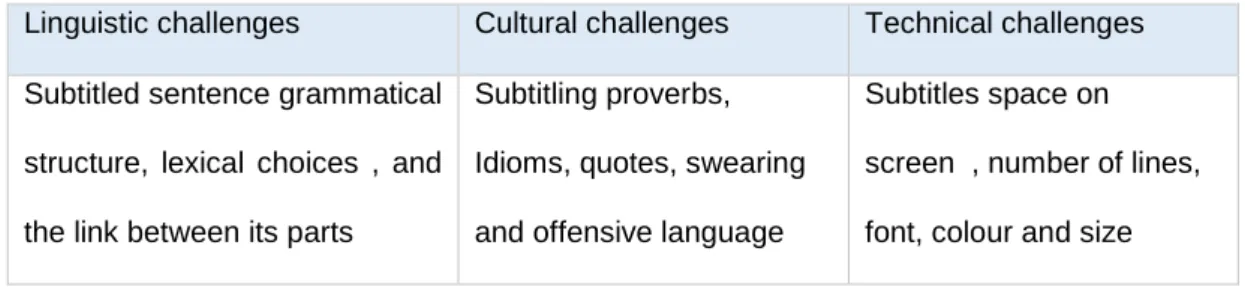
Linguistic challenges: These can be problems of syntax, lexical choice, and
collocations. This is due to the scale of the differences that exist between Arabic and English at the structural level. Some areas of experience may be lexicalised and distributed completely differently (Menacere, 1999). For example, words which have no equivalence or unknown in Arabic, also the word order which is more flexible in Arabic than English (VSO Vs SVO), moreover; different word orders are possible (SVO, OSV, VSO). The way words collocate in English is different from Arabic. All these difficulties create a big challenge for the subtitlers, where additional technical limitations are found, and the effect of them is considerable.
Cultural-related words and phrases difficulties: Bridging the cultural gap
between source language (SL) and target language (TL) is the most important challenge of the translator and this gap appears significant in subtitling when
15
translating cultural patterns such as idioms, proverbs, humour, swear words, name of places, food, and cultural events.
The cultural gap has always “produced the most far-reaching misunderstandings among readers” (Nida and Reyburn, 1981:2). As for languages with little cultural similarities such as Arabic and English, the problems and difficulties increase significantly.
Technical problems: These are problems which are related to the outer
appearance of subtitles such as font typeface and distribution, font size, colour and speed number of words and number of subtitles lines. De Linda and Key (1999) argue that the dialogue should be summarised to fit the limited space available on the screen and the reading ability of different viewers. So the subtitlers’ task goes beyond the translating process but they must be aware of technical aspects for instance the subtitler is constrained by space limitation and word count imposes certain restrictions when subtitling. So it is crucial that these problems and difficulties should be investigated to enhance subtitling.
Segmentation which is line breaks between subtitles is an important factor for subtitling because it enables good understanding and develop reading ability “If segmentation is done into a noun or verb phrase, rather than smaller units of sentences or clauses” (Orero,2004:151). Good segmentation is usually based on the making of well-ordered syntactic sentences. “Spotting and segmentation can also contribute to rendering the prosodic feel of a passage”
16
Space is also very important in subtitling and plays a vital role in this process and as Thawabteh, (2011:37) argues, “a space in need is a friend indeed can be true for professional subtitlers. And every single space is highly needed for other communicative purposes”
Lack of standardisation due to Arabic varieties: different regional varieties
of Arabic are spoken throughout Arab countries such as in Egypt, Algeria, and Libya. Therefore subtitling should be conducted in standard Arabic language otherwise it will not be understood by many Arab people as regional varieties are different in terms of vocabularies, and grammar. However, following the standard Arabic language grammatical rules while subtitling is not easy and constitutes a problem to the subtitlers.
This study aims to analyse the above subtitling problems and make recommendations based on the findings of this study on how to overcome subtitling challenges.
1.5 Research questions
In order to address the challenges of English into Arabic subtitling, this study has formulated the following research questions:
Why the current English into Arabic subtitling is not up to the standard level
What are the perceived problems and constraints that affect the quality of current English into Arabic subtitling?
17
1.6 Research objectives
In order to answer the above questions, the following research objectives will be set:
To critically review the theories, concepts and models of subtitling and translation.
To compare and contrast subtitling with other forms of translation and outline briefly the evolution and development of subtitling research.
To identify and analyse the perceived problems and constraints of the Arabic subtitling from English language films through perceptions and opinions of viewers of subtitled films.
To make recommendations based on the findings of this study on how to improve the quality of subtitling English into Arabic.
1.7 Rationale of study
This study responds to an urgent need to expand the literature on subtitling and translating Arabic/ English which is under-researched. The purpose of this study is closely related to the nature of the problems and challenges facing subtitlers from English into Arabic.
It is worth mentioning that American films are the most dominant subtitled films and the most viewed in the Arab world, thus other English language films and programmes will be beyond the scope of this study.
18
1.8 Gaps and expected contribution to knowledge
There is little research regarding subtitling problems in general and from English into Arabic in particular, and viewers-oriented research is very rare. This study has three main practical implications. Firstly, it will benefit English/Arab subtitlers, based on findings of this study which will contribute to address the problems highlighted. Secondly, this study will also bridge the gaps of the knowledge and benefit academic research through expanding the little literature in the field of subtitling which in turn will benefit future researchers. Thirdly, as there are no particular theories and models for quality of subtitling, the study will provide a platform by shaping a specific model of subtitling which can be developed and improved in future in order to minimise the subtitles constraints and challenges.
1.9 Structure of the study
This study consists of six chapters as follows: -
Chapter one: presents the aim of the study, a brief background of study, an overview of the key literature, the statement of the problem, research questions, research objectives, and the rationale of the study.
Chapter two: provides a brief overview of the evolution of subtitling, critical review of the theories concepts, processes of subtitling and establishes the link between subtitling to some common translation theories. Furthermore, it draws a comparison between subtitling and
19
written translation. It also provides a summary and identifies gaps of literature.
Chapter three: Discusses the appropriate methodology and methods, i.e. the study philosophy as well as the methods used in this study. It explains and justifies the methodology used and the tools used to collect data.
Chapter four: presents and analyses the data collected for this study.
Chapter five: Discusses the study findings and draws conclusions. It also explains and interprets the data and findings of the study as well as develop a model.
Chapter six: provides the study conclusions, highlights the limitations and provides recommendations and suggestions for further research.
20
Chapter Two
Literature Review
21
Literature Review
This chapter discusses the forms of AVT in order to understand the notion, the purpose, the nature and the process of this form of translation in general and subtitling in particular. The main aim of this chapter is to critically review a number of different definitions of subtitling to understand the concept, models, and theories of this process of audio-visual translation. It compares and contrasts different authors’ views on subtitling, and assesses causes of conflicting views. Furthermore, this chapter identifies patterns and trends of subtitling; some common translation theories and their relevance to subtitling; finally, it provides a summary and highlights gaps in subtitling research.
2.1 Models and types of audio – visual translation (AVT)
It is believed that the first attempt to transfer the meaning of a film appeared on screen in 1903. It was named ‘intertitles’ and was introduced between the different scenes in silent films as a means to reflect the dialogue between the actors. The text was drawn or written on a piece of paper; consequently, the paper was imaged and edited between the scenes. The term ‘subtitle’ was used for the first time in 1909. However, it was rare to place subtitles at the lower part of a screen on which a moving image was projected (Diaz-Cintas and Remael, 2007).
22
In the beginning of the 20th century, it was common for performers to speak
the dialogue directly behind the screen during the screening of a film. This was called ‘double version’ and this was an early subtitling (Gottlieb, 1997). Karamitroglou, (2000) claims that the first sound film, ‘The Jazz Singer’ was screened in theatres in the United States of America in 1927. The films’ language was the main obstacle for American films to be exported to foreign countries. The solution was found between 1929 and 1933 in the form of dubbing and subtitling. Gottlieb (1997) describes further alternative procedure of AVT i.e. viewing a film in the cinema at the same time as listening to a voice translation of the film discourse through small earphones. This technique permits the viewer to hear the original dialogue along with a translated version of the dialogue, without disturbing the image by means of subtitles. However, this technique according to Gottlieb, (1997) was not preferred as subtitling and dubbing were the norms in western countries.
In order to make audio-visual programmes understandable to spectators unfamiliar with the language of the programme, diverse methods of language transmission on the screen have been mandatory since the beginning of the cinema industry.
According to Diaz (2009) there are two main translation methods of the spoken language of the original TV programme: the first is re-voicing method i.e. to keep the original dialogue as a spoken dialogue, the original dialogue is substituted by a new soundtrack in the target language. The replacement may be total whereby the original discourse cannot be heard, as in lip synchronization dubbing and narration, or partial, when the original soundtrack
23
can still be heard in the background, as in voice over and interpreting. All these modes are available to the profession and some of them are more suitable to particular audio- visual categories than others. Lip sync dubbing, for instance is basically used in the translation of films and TV series and sitcoms, documentaries, interviews and programmes on current affairs.
Re-voicing is “the replacement of a program’s voice track by a version, either of the same or new dialogue, translated into another language or dialect.
(Luyken et al., 1991:39). Perez-Gonzalez, (2014:19) views re-voicing as “a
generic term encompassing a range of spoken translation methods, including simultaneous interpreting, free commentary and narration”. He (2014) argues that there are also other types of re-voicing which is usually dealt with and described separately such as a voice-over and lip-synchronized dubbing.
The following table adopted from Perez-Gonzalez, (2014:20) illustrates briefly these types:
Table2. 1 Models and types of audio–visual language transfer
Simultaneous interpreting Is normally a live versioning method used to translate
films or documentaries in settings where more
elaborate forms of re-voicing are not an option
Free commentary A re-voicing technique performed on the spot by presenters
or commentators broadcasting a high profile event.
Narration is a live or pre-recorded form of oral transfer aiming to
provide a summarised but faithful and carefully scripted rendition of the original speech
24
Luyken, et al. (1991) argue that the most common problems of re-voicing are accent and dialect as areas of origin class can be conveyed in a different way and this difference may cause a difficulty in translation to other languages and cultures.
The process of re-voicing in the case of animation is easier than the other cases as the sound track is recorded before animation, re-voicing can be significantly assisted by “re-animating close-up lib-sync sequences. This is only feasible if two or more language versions are produced by the originator of the animated programme, thus introducing the inverse transfer process of audio-visual productions” (Luyken, et al. 1991:84).
Luyken, et al. (1991) point out three possible methods for re-voicing: open terrestrial transmission along with a videotape, simulcasting, that openly transmitting the programme in its original form and, in addition, transmitting the re-voiced sound-track by radio. They also state that re-voicing will continue to have different forms, from the expensive lip-sync dubbing to the much cheaper free commentary. And the method chosen depends mainly on the kind of programme which is being broadcasted. “The requirements of a sophisticated drama are obviously different from those of a brief news commentary. Further, the method selected is inevitably closely related to economic considerations”
(Luyken, et al. 1991:85).
The second language transfer method is subtitling i.e. to keep the original soundtrack and to shift from the spoken to the written mode by adding text to the screen. Subtitling is generally viewed as a progressed variety of the “primitive intertitles, subtitles are snippets of written text superimposed on
25
visual footage that convey a target language versions of the source speech”. (Perez-Gonzalez, 2014:16)
Subtitles are mostly summarised translations of original dialogue (or on screen translation) which appear as lines of text usually located near to the bottom of the screen. The subtitles appear and disappear at the same time as the original dialogue or text. Subtitles can be of more than one language and can be classical i.e. in complete sentences and coordinated with the original dialogue. This type of subtitles is the most widely used. However, there is another type of subtitles i.e. summarized subtitles and they are normally used in educational programmes and sometimes in films (Luyken, et al., 1991).
These two methods can be illustrated by this figure: - (adapted from Luyken et al, 1991)
Figure2. 1 Re-voicing andsubtitling
SL speech (Re-voicing) TL written translation
TL verbal interpretation (subtitling)
(Source : Luyken et al. 1991)
2.1.1 Types of subtitling
There are two types of subtitling the first, interlingual subtitling that is the technique which is used to translate the meaning of foreign TV programmes and films into the audience’s native language (the focus will be on this type since it is related to the study). The second type of subtitling is intralingual subtitling that is used for deaf and hard-of-hearing. This intralingual technique
26
is also, according to Gottlieb (2005) considered as a screen translation “screen translation is not necessarily interlingual-with dubbing, subtitling and voice- over as three dominant types. Catering for special audiences, subtitling for the deaf and hard of hearing and audio description also qualify as screen translation” (Gottlieb, 2005:45).
Intralingual subtitling is “a technique in which a re-speaker listens to the original sound of a live programme or event and re-speaks it, including punctuation marks and some specific features for the deaf and hard of hearing audience”
(Romero-Fresco, 2011:1)
Self-description is also another technique of AVT which is intended for blind or sight-impaired viewers that describes what is happening on screen. It is usually for domestic TV programmes to satisfy the local needs.
Gottlieb (2004:219) argues that all types of interlingual transfer share one main quality that is “verbal messages are recreated in another language”, though he distinguishes two types of this transfer ‘Isosmiotic translation’ and ‘Diasemiotic Translation’. Isosmiotic translation uses the same semiotic channel (channel of expression) as the original, and therefore conveys speech as speech and writing as writing. This means that processes as varied as conference interpreting, post-synchronization (dubbing), technical translations, and literary translation are all examples of isosmiotic translation. On the other hand, translations that cross over from writing to speech (semiotic translation), or as in the case of subtitling from speech to writing (diasemiotic translation) (Gottlieb, 2004).
27
Interlingual transfer can be better illustrated with this figure adopted from Gottleib, (2004:220)
Figure2. 2 Interlingual transfer
SL SPEECH Interpreting, dubbing and voice over TL SPEECH
Subtitling
Written translation
SL WRITING TL WRITING
(Source Gottleib, 2004)
According to many studies, language transfer practice such as voice over, dubbing, and subtitling differs not only from one country to another, but sometimes varies within the same country depending on the broadcast medium (cinema or television) or the target public (general public, cinema- enthusiast public, young people, public with accessibility problems).
Gottlieb (2004) highlights six different patterns of subtitling that apply in subtitling countries i.e. Firstly, from a foreign language to the local common language: in countries such as Denmark, Sweden, Norway, Iceland, the Faroe
28
Islands, the Netherlands, Portugal, Estonia, Slovenia, Croatia, Romania, Greece, Cyprus, Argentina, and Brazil. Secondly, from a foreign language to two local languages such as Finland (Finnish and Swedish), Belgium (Flemish and French), and Israel (Hebrew and Arabic). This kind is common in cinemas (Bilingual subtitling). Thirdly, from minority languages to the common language such as Gaelic and Welsh into English, from the popular language to a migrant language such as Hebrew into Russian, and from non-preferred languages to the preferred language such as South Africa and India into English. Finally, replacing the original dialogue with voice-over of local language such as Latvian and Russia.
2.1.2 Subtitling vs dubbing
Subtitling and dubbing are two different approaches for AVT. The two techniques have different properties and according to many scholars such as Dires (1995) and Serban (2004), they have not received an adequate consideration in translation studies. The core purpose of dubbing is to make the audiences feel as if they are listening to the original dialogue as it is the approach in which “the foreign dialogue is adjusted to the mouth and movements of the actor in the film” (Dires, 1995:45).
According to Serban (2004) dubbing has some advantages as it does not track attention from the scene and provides the perfect form of film translation in terms of accuracy. The problem with dubbing is that it may include loss of the original dialogue and it is costly compared with subtitling. Dubbing also creates cultural problems in some conservative societies and as an Indonesian author Ali, (1997 cited in Perez-Gonzalez, 2014:22) argues dubbing can “create gaps
29
in family communication. It can ruin the self- image of family members as a result of adopting foreign values that are ‘indonesianized”
On the other hand, subtitling is considered as the most accepted, slightly mediated technique that comprises the least interference with the original (Szarkowska, 2005). As the soundtrack is preserved, subtitling provides the flavour of the foreign languages as well as the sense of other culture. Subtitling enhances the language learning (Serban, 2004) and provides a good understanding of a film and as Mera (1999:75) argues that to listen to the speech of the actors “not only facilitates understanding in terms of the specific dialogue or plot structure, but gives vital clues to statuses, class and relationship”. It is also an adequate method for the hard-of-hearing, immigrants and tourists (Serban, 2004).
Information processing is normally affected by both dubbing and subtitling and as Wissmath et al. (2014:115) argue programme dialogue and sound are normally lost in dubbing whereas subtitling carry eye-tracking elements as it covers parts of the screen, therefore “subtitling might result in loss of information as the dialogues are condensed, parts of the screen are covered with text, and attention might be drawn away from the centre of the screen”. The argument against the use of subtitles is that they attract attention away from the middle of the scene. However, research on eye-tracking has found that the attention is usually moved unconsciously and efficiently from the scene to the subtitles and vice versa. Moreover, subtitles are followed even if the discourse is accessible in the viewer’s language (Wissmath et al., 2014).
30
Unlike dubbing, subtitles are also used as a means to enhance language learning (Kovacs, 2013). Koolstra and Beentjes (1999) argue subtitles improve learning meanings, terms, pronunciation, syntax and vocabulary. For Koolstra and Beentjes (1999) subtitling is better than dubbing for many reasons such as the cheaper cost, the actor’ original voices, which positively affect understanding and the most significant is that it could result in incidental language learning. Nevertheless, a number of fears about subtitling have been highlighted by Koolstra and Beentjes (1999) i.e., distracting audiences and difficulty may be created for poor readers and children because it is usually fast. In addition, Diaz-Cintas (2005) claims that even though subtitling is a decent language teaching tool, many people cannot benefit from it because of the high price. Zanon (2006) argues that subtitling has many advantages; it encourages students and makes them secure and self-confident. In addition, it may help language students to review their vocabulary and recognise new lexis. Zanon (2006) also states that although subtitling has many advantages, the problems of subtitling should not be ignored. For instance, reading subtitles may progressively become a habit and gives false confidence for language learners.
As subtitling and other language transfer methods are widely used to bridge the languages gap in foreign programmes (Zanon, 2006 and Diaz-Cintas, 2005), it is important to understand the use of subtitling against other AVT forms in many European countries. The following section gives a brief idea about the use of these methods in Europe.
31
2.2 The use of AVT methods in Europe.
A final report titled (Study on the use of Subtitling) requested by the European Commission issued in 2011, indicates that audio-visual translation practice is used most widely in Europe. The report highlights the use of different language transfer practices in European countries as follows:
Dubbing is used extensively in Eastern Europe countries whereas it is used to diverse degrees in countries like France (French-speaking) and Switzerland (French and Italians peaking). It is widely used in Italy, Austria, Germany, Spain, and Belgium.
Dubbing considered as a leading practice for American European films in Spain. As all European box-office films released in 2009, 53% were produced only in a dubbed form and 29% were in both dubbed and subtitled forms. The number of American films produced only in a dubbed form is greater, about 69% of the total. Spain includes independent communities that have a special language other than Spanish. Some of these groups have particular language transfer practices. “In Catalonia, for example, the 'Ley del Ciné Catalàn' (Catalan Cinema Act) adopted by the Autonomous Parliament of Catalonia on 30 June 2010, establishes that a foreign film released to box offices must have the same percentage of prints dubbed in Catalan as in Spanish” (Li Kao,2011:7).
Dubbing is the main language transfer method in Italy (about 63% of US films and 89% of European films), although some films are also produced in a subtitled form, the most extensive method is the ‘dual version’: foreign films in France, whether American or European, are usually produced in a number of
32
both subtitled and dubbed designs. Yet, very few cinemas broadcast the films in both forms (2.3% for American films and 3.5% for European films). Most programmes and films are dubbed (around 53% of cinemas for European films and 82% for American films). It can consequently be claimed; the dubbing practice is predominant in this country.
Dubbing is the main transfer practice nevertheless some films are produced in both forms in Germany. Subtitling is a demand of some parts of the viewers, mainly for art-house films. In Austria, methods of language transfer are related to those in Germany. Though dubbing remains the most common practice for television broadcasting in Hungary, it is gradually moving to subtitling.
There is a progressive shift to subtitling methods in the CzechRepublicas all European films produced in 2009 were subtitled and approximately 75% of American films were broadcast in subtitled form and just 25% were produced in both subtitled and dubbed forms. Subtitling in Croatia is a very common method; nevertheless, a few “foreign movies are distributed in dubbed form or in both dubbed and subtitled versions” (the final report on the use of subtitling, 2011). Bilingual subtitling is common in some countries such as Belgium, Finland Luxembourg and Switzerland. The case of Switzerland is special as ‘French and Italian speaking Swiss’ like dubbing while ‘German-speaking Swiss’ prefer subtitling.
In fact, dubbing is the common language transfer method in eleven countries: Austria, Belgium (French-speaking), Czech Republic, France, Germany, Hungary, Italy, Slovakia, Spain, Switzerland and Turkey. Voice-over is dominant in four countries: Poland, Bulgaria, Latvia and Lithuania. It is
33
practiced to a lesser extent in Estonia as well, where one third of programmes are broadcast in voice-over and the remainder with subtitles.
Subtitling is used in the countries such as Belgium, Croatia, Cyprus, Denmark, Estonia, Finland, Greece, Iceland, Ireland, Netherlands, Norway, Portugal, Romania, Slovenia, Sweden and the United Kingdom.
Dubbing and subtitling for foreign programmes are widely used in Europe. In the Arab world subtitling and dubbing are also common nowadays as it will be briefly presented in the following section.
2.3 The use of subtitling in the Arab world
According to Gamal (2008) Egypt was the pioneer in subtitling foreign films as the first subtitled films in the Arab world emerged in Egypt in 1932. Gamal (ibid) states that although the circumstances of the early stages of Arab subtitling of foreign programmes was not expedient, dubbing was not the first choice at that time in Egypt because dubbing “was deemed too dangerous to the cinema industry in Egypt” (Gamal, 2008:2). Accordingly, subtitling was considered as the best choice to preserve the Egyptian film industry from foreign competitors. Subtitling also provides an easier and cheaper alternative than dubbing.
Gamal (2008) also adds that the censorship body usually deals strictly with three core concerns in film subtitling, since a large number of foreign films are imported from America (i.e. swear words, sexual references, and violence) to ensure that are translated appropriately.
34
Subtitling is a means of transferring the programme messages into the target language and it has been defined in a number of ways. The idea of subtitling will be discussed in the following section.
2.4 The concept of subtitling
Perez-Gonzalez (2014) views subtitling as a new and developed version of the basic intertitles, and defines subtitling as pieces of written text placed over the lowest part of the screen and used to convey meaning of SL programme message into TL
Perez-Gonzales (2014:16) also adds that in countries where more than one language “co-exist bilingual subtitles’ convey two language versions of the same source fragments, one in each line of the subtitle”.
Subtitling (screen translation) is one of the common AVT methods which refers to the process of written translated texts produced through screen such as TV, cinema, and computer screen (Diaz-Cants and Remael, 2007).
Luyken, et al. (1991:39) defines subtitles as summarised written texts that carry the meaning of the foreign programme message at the lowest part of the screen, they “appear and disappear to coincide in time with the corresponding portion of the original dialogue and are almost always added to the screen image at a later date as a post-production activity”.
The above definition draws an overall picture of this process with its main features. First; that subtitling is a real form of translation, second that subtitling unlike written translation is brief, third; that it coincides with the SL dialogue, and finally that subtitling has extra technical features rather than other forms
35
of translation. Gottlieb, (2004:220) uses more specific terms to describe the same notion of subtitling “a diasemiotic translation in polysemiotic media (including films, TV, video and DVD) in form of one or more lines of written text presented on the screen in sync with the original dialogue”. Subtitles deal with the verbal words that are heard and seen, as they occur in tandem with dialogue inseparable from the sounds and the images of the film (Bannon, 2010).
Subtitling as process is a technique to make films and TV programmes comprehensible in foreign languages. This technique is considered by Luyken, et al., (1991) and Egoyan and Balfour, (2004) as exceptional dexterity: “subtitling is a dynamic craft. It can never achieve conveyor-belt uniformity because the subtitler is always faced with a multiplicity of choices. These are, in the main, linguistic and technical options” (Luyken, et al .1991:41). Subtitles are an exceptional and compound formal device that provide the viewer with interactive degree of access and communication, (Egoyan and Balfour, 2004). In addition, this is the way subtitles offer a viewer of a film or TV programme an admission to another world.
It is clear from previous definitions that subtitling is very important as it is one of the main two ways to translate a foreign programme and it cannot be constant, because of the linguistic, cultural and technical difficulties.
It was argued by Gilbert, (2010) (cited in Bannon, 2010:2) that “subtitling is cross-media transference of meaning and message: the process involves a double conversation traversing from one language to another and from one
36
Schioldger, et al. (2008) provides some technical details on this re-presenting dialogue, as he considers subtitling is a summarised textual translation of a dialogue or a commentary in TV programmes. This textual translation flows simultaneously or interacts through a number of semiotic channels i.e. the visual and auditory signs and codes of a film. Therefore, subtitles are diamestic translations with a polysemiotic nature as they communicate through more than one channel at the same time. This means that subtitles permit the target viewers to have contact with the original dialogue and the subtitles at the same time; accordingly, it is an obvious translation.
Schioldger, et al. (2008) and Tviet, (2009) all agree that subtitling is a translation. Schioldger, et al. (2008) consider subtitling (unlike dubbing) as a clear translation and distinguishes between overt and covert translation. Overtness refers to whether translation is overt (subtitling) or covert (dubbing). Tviet, (2009:95) states that “subtitling is normally a better approach to screen translation than, for instance dubbing, as the original mood and atmosphere of the ST is kept in subtitling”.
Subtitling is a language transmission, which takes place between a source language SL and a target language TL. This transfer goes through concurrent channels such as sound, image, and writing. It is the transfer from a spoken dialogue to a written text in a film or TV programme. According to Ying-Ting (2001), subtitles include a diversity of ‘semiotic modes’ that give the form to the film transcript and the subtitled film text subtitles deal with the spoken word. They occur in tandem with dialogue, inseparable from the sounds and images of the film, as (Ying-Ting, 2001, cited in Bannon, 2003:2) claims that all
37
semiotic modes are available and it is important for the subtitler to grasp the meaning not just from the dialogue but also from different modes of the programme.
The concept of the semiotic mode of subtitling is defined as “the material substance which is worked on or shaped over time by culture into an organized, regular, socially specific meaning of representation, i.e. a meaning -making resources or a mode” (Kress et al. ,2001:15). The concept of multimodality is also described by Kress and Van Leeuwen, (1996) as follows: written and verbal language usually occurred as one type in the whole of modes participated in construction of any text verbal or written. Verbal text can be also graphic not just spoken joining with non-spoken modes of the programme message. For instance, “facial expression, gesture, posture and other forms of self- presentation”. (Kress and Van Leeuwen, 1996:39)
Although, new audio-visual technology provides help to overcome the semiotic mode of subtitling, this method, which consists of more than one modes, always constitutes a problem for subtitlers, and much research should be devoted to study these modes in order to help producing acceptable subtitling.
Ying-Ting, (2006) considers certain theoretical points about mode and multimodality are devolved: modes are not always obtainable to or overtly understood by the audience as they have different direct and indirect meaning. As all modes have unambiguous social evaluations and difficulties, meaning capabilities of modes are reliant on the applied requirements of different groups and on different common backgrounds. All modes senses are created via their connection with each other and their interlacing in the communicative
38
context. Modes are not still but changeable as they are formed, shaped, and transferred according to the requirements of social semiotic processes.
Accordingly, five semiotic modes are frequently represented in the film text: the verbal mode, the printed mode, the mode of music, the mode of sound effects and the mode of moving images (Ying-Ting, 2006).
Gottlieb (1994b) considers polysemiotic as a more precise term than either audio-medial and multi-media, which was introduced in order to widen the denotation of audio-medial. Both iso- and diasemiotic transfer are still interasemiotic, because the semiotic system, namely cultural language remains the same.
In conclusion, most of authors agree that subtitling is a form of translation by means of transferring the meaning between two languages. Nevertheless, some authors consider subtitling as an adaptation as it includes change in modes to fit a new condition or environment and unlike other forms of translation, subtitling has special technical features that complicate the task of subtitlers and makes it different. The following section aims to compare and contrast written translation and subtitling, their concepts, differences and similarities to understand what distinguishes subtitling from written translation.
2.5 Written translation vs. screen translation (subtitling)
There are many different interpretations of what constitutes translation as it has been defined in a number of ways. Some scholars consider translation as a science while others view it as a craft. Translation as a process has been defined in similar and dissimilar ways. For Newmark (1981:7) translation is “a
39
craft consisting in the attempts to replace a written message and/or a statement in one language by the same message and/or a message in another language”. For Ghazala, (1995:1) it is “all the process and methods used to convey the meaning of the SL into the TL”. “It is the actual process of decoding the source language text and encoding the target language text” (Shaheen, n.d:14).
Catford, (1965) argues that translation is “the replacement of textual material in one language by equivalent material in another language”. It is clear from the definition that culture has not been taken into consideration by Catford, as he describes the translation process as just the replacing of SL text by another text in TL.
Nevertheless, Hatim and Mason, (1991:1) consider culture as an important factor in translation when defining translation. They stress that translation is a
“communicative process which takes place within a social context”. They consider it as “a useful test case for examining the whole issue of the role of language in social life and creating a new act of communication of a previously existing one” (Hatim and Mason, 1991:1).
Al-Jahiz, (1969 cited in Zakhir, 2012:4) also emphasises the cultural and linguistic component in translation: "the translator should know the structure of the speech, habits of the people and their ways of understanding each other."
In his two books, (Al- Hayawan (1969) and Al- Bayan wa al-tabyin, (1968), he highlights the significance of the translation revision as a vital step in the translation process and puts forward a formal extensive range of theories.
40
Sancher (2009:36) defines translation as “a process, an operation, and an act of transferring. It is mainly a skill, a technology that can be acquired in the meantime; it often involves using language in a creative manner so that it is also an art”.
Gottlieb (1994:219) argues that subtitling is a form of translation that has special characteristics such as polysemiotic media, i.e. two or more semiotic channels (in case of film media) take part to the message and diasemiotic form of translation, “because of the shift from the oral to the written mode. Most other forms of translation are isosmotic, e.g. dubbing or literary translation”.
Subtitles are brief unlike written translation and “the original is accessible at the same time as the translation” (1994:219).
However, there is a strong debate over whether translation is a science or an art as some academics do not consider translation as a science such as Chukovskii (1984:93) who claims “translation is not only an art but a higher art”. Zaixi (1997:339-340) argues that translation is “a process, an operation, a technology that can be acquired. In the meantime, it often involves using language in a creative manner so that it is also an art; however it is by no means a science”.
Bassnett (1991:37) affirms that translation is a science as the “process of translation, attempting to clarify the question of equivalence and examining what constitutes meaning within that process. But nowhere is there a theory that pretends to be normative”.
41
Translation for Nida (1969) is creating the closest natural equivalent as he states that translation is “producing in the receptor language the closest natural equivalent of source language message, first in terms of meaning and secondly in terms of style” (Nida, 1969:12). Nida’s definition supports the view that translation is a craft, and many translation components should be taken into consideration when translating in order to create an acceptable translated version.
Nida’s components are classified by Hatim and Munday (2004) as cognitive, linguistic, visual, and cultural i.e. preserving the meaning and the form of the source language.
2.5.1 The concept of translation in Arabic sources
In general, the idea of translation in the Arabic language carries similar meaning to that in English. For Al-Humaidan (n.d:14)
ﺔﻐﻠﻟﺎﺑ كﻟذو رﯾﺳﻔﺗﻟاو ﺢﯾﺿوﺗﻟاو نﯾﯾﺑﺗﻟا ﻲھ ﺔﻣﺟرﺗﻟا ﺎﮭﺳﻔﻧ
ﺎھرﯾﻏ ﺔﻐﻠﺑ وا .
‘Translation is clarifying, explaining and interpreting in the same language or another