Data Outsourcing
Jonathan L. Dautrich and Chinya V. Ravishankar University of California, Riverside
{dautricj,ravi}@cs.ucr.edu
Abstract. Three recently proposed schemes use secret sharing to sup-port privacy-preserving data outsourcing. Each secret in the database is split into n shares, which are distributed to independent data servers. A trusted client can use any k shares to reconstruct the secret. These schemes claim to offer security even when kor more servers collude, as long as certain information such as the finite field prime is known only to the client. We present a concrete attack that refutes this claim by demonstrating that security is lost in all three schemes whenk or more servers collude. Our attack runs on commodity hardware and recovers a 8192-bit prime and all secret values in less than an hour fork= 8.
1
Introduction
As cloud computing grows in popularity, huge amounts of data are being out-sourced to cloud-based database service providers for storage and query man-agement. However, some customers are unwilling or unable to entrust their raw sensitive data to cloud providers. As a result, privacy-preserving data outsourc-ing solutions have been developed around anhonest-but-curiousdatabase server model. In this model, the server is trusted to correctly process queries and man-age data, but may try to use the data it manman-ages for its own nefarious purposes. Private outsourcing schemes keep raw data hidden while allowing the server to correctly process queries. Queries can be issued only by a trusted client, who has insufficient resources to manage the database locally. Most such schemes use specialized encryption or complex mechanisms, ranging from order-preserving encryption [1], which has limited security and high efficiency, to oblivious RAM [2], which has provable access pattern indistinguishability but poor performance. Three recent works [3–5] propose outsourcing schemes based on Shamir’s se-cret sharing algorithm [6] instead of encryption. We refer to these works by their authors’ initials, HJ [3], AAEMW [4], and TSWZ [5], and in aggregate as the HAT schemes. The AAEMW scheme was also published in [7]. In secret sharing, each sensitive data element, called asecret, is split into nshares, which are dis-tributed tondata servers. To recover the secret, the client must combine shares from at leastkservers. Secret sharing has perfect information-theoretic security when at mostk−1 of thenserverscollude (exchange shares) [6].
Since secret sharing requires only k multiplications to reconstruct a secret, proponents argue that HAT schemes are faster than encryption based schemes.
N. Cuppens-Boulahia et al. (Eds.): DBSec 2012, LNCS 7371, pp. 145–160, 2012. c
Other benefits of the HAT schemes include built-in redundancy, as onlykof the nservers are needed, and additive homomorphism, which allows SUM queries to be securely processed by the server and returned to the client as a single value. Each of the HAT schemes makes two security claims:
Claim 1. The scheme achieves perfect information-theoretic security when at mostk−1 servers collude.
Claim 2. When k or more servers collude, the scheme still achieves adequate security as long as certain information used by the secret sharing algorithm, namely a primepand a vectorX, are kept private, known only to the client. It is doubtful that the HAT schemes truly fulfill Claim 1, as they sort shares by secret value, which certainly reveals some information about the data [8]. Fur-ther, the AAEMW scheme [4] uses correlated coefficients in the secret sharing algorithm instead of random ones, which also contradicts this claim. Neverthe-less, for the purposes of this work, we assume that Claim 1 holds.
We are primarily concerned with evaluating Claim 2, which asserts that even k or more colluding servers cannot easily recover secrets. Claim 2 is stated in Sect. 4.5 of [3], Sect. 3 of [4], Sects. 2.2 and 6.1 of [5], and Sect. 3 of [7].
1.1 Our Contribution
Our contribution is to demonstrate that all three HAT schemes [3–5] fail to fulfill Claim 2. We give a practical attack that can reconstruct all secrets in the database whenkservers collude, even when pandX are kept private. Our attack assumes that the servers know, or can discover, at leastk+ 2 secrets. To limit data storage costs,kis kept small (k≈10), so discoveringk+ 2 secrets is feasible (see Sect. 4.2). All three HAT schemes argue that they fulfill Claim 2, so our result provides a much-needed clarification of their security limitations.
The TSWZ scheme [5] argues that if pis known, secrets could be recovered. However, it provides no attack description, and argues that large primes are prohibitively expensive to recover. Our attack recovers 8192-bit primes in less time than [5] needed to recover 32-bit primes. In fact, we can generally recover large primes in less time than the client takes to generate them (Sect. 5.1).
In Sect. 2 we review Shamir’s secret sharing algorithm and how it is used for private outsourcing. In Sect. 3 we give assumptions and details of our attack, and we show how to align shares and discover secrets in Sect. 4. We give experimental runtime results in Sect. 5, and discuss possible attack mitigations in Sect. 6. We discuss related work in Sect. 7 and conclude with Sect. 8.
2
Data Outsourcing Using Secret Sharing
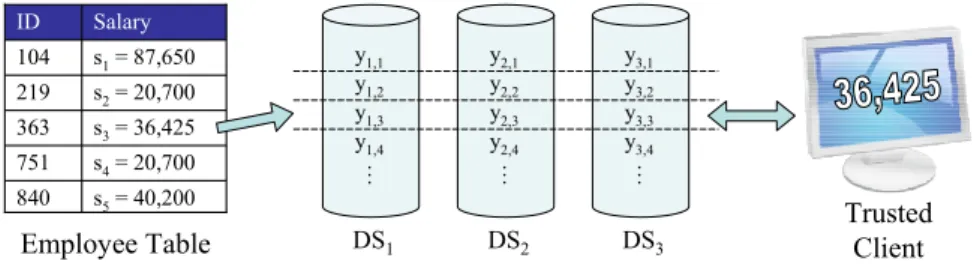
We now review Shamir’s secret sharing scheme and show how it is used for private data outsourcing in the HAT schemes [3–5]. We use an employee table withmrecords as our driving example, where queries are issued over the salary attribute. Each salary s1, . . . , sm is a secret that is shared among the n data
\ \ \ \ « \ \ \ \ « \ \ \ \ « '6 '6 '6 V V V V V 6DODU\ ,' 7UXVWHG &OLHQW (PSOR\HH7DEOH
Fig. 1.Secret (salary) data from an employee table is split into shares and distributed to multiple data servers. A trusted client queries shares from the data servers and combines them to recover the secrets.
2.1 Shamir’s Secret Sharing
Shamir’s secret sharing scheme [6] is designed to share a single secret valuesj amongnservers such that shares must be obtained from anykservers in order to reconstructsj. The scheme’s security rests on the fact that at leastkpoints are needed to uniquely reconstruct a polynomial of degreek−1. Theoretically, the points and coefficients used in Shamir’s scheme can be taken from any field
F. However, to use the scheme on finite-precision machines, we requireFto be the finite fieldFp, wherepis a prime.
To sharesj, we choose a prime p > sj, andk−1 coefficients a1,j, . . . , ak−1,j
selected randomly fromFp. We then construct the following polynomial: qj(x) =sj+
k−1
h=1
ah,jxh modp (1)
We then generate a vector X = (x1, . . . , xn) of distinct elements inFp, and
for each data serverDSi, we compute theshare yi,j=qj(xi). Together,xi and yi,j form a point (xi, yi,j) through which polynomialqj(x) passes.
Given anyksuch points (x1, y1,j), . . . ,(xk, yk,j), we can reconstruct the
poly-nomialqj(x) using Lagrange interpolation:
qj(x) = k i=1
yi,ji(x) modp (2)
wherei(x) is the Lagrange basis polynomial:
i(x) =
1≤j≤k,j=i
(x−xj)(xi−xj)−1 modp (3) and (xi−xj)−1 is the multiplicative inverse of (
xi−xj) modulop. The secret sj is the polynomialqj evaluated atx= 0, so we get:
sj = k i=1
Given only k < k shares, and thus only k points, we cannot learn anything about s, since for any value of s, we could construct a polynomial of degree k−1 that passes through all k points. Thus Shamir’s scheme offers perfect, information-theoretic security against recoveringsjfrom fewer thankshares [6].
2.2 Data Outsourcing via Secret Sharing
We now describe the mechanism used by all three HAT schemes to support private outsourcing via secret sharing. We first choose a single prime pand a vectorX, which are the same for all secrets and will be stored locally by the client. For each secretsj, we generate coefficientsa1,j, . . . , ak−1,j, and produce a
polynomialqj(x) as in (1). We then useqjto splitsjintonsharesy1,j, . . . , yn,j,
whereyi,j=qj(xi), and distribute each shareyi,j to serverDSi, as in Fig. 1. An important distinction is that the AAEMW scheme performs secret sharing over the real number field R, so there is no p to choose. However, since the scheme must run on finite precision hardware, any implementation will suffer from roundoff error. Our attack works overR, and is efficient because the field is already known. However, we expect that in practice, the AAEMW scheme will switch to a finite fieldFp, so we do not treat it as a special case.
When the client issues a point query for the salarysj of a particular employee, he receives a share from each of thenservers. Using any k of these shares, he can recoversj using the interpolation equation (4). Other query types, including range and aggregation queries, are supported by the HAT schemes. We give some relevant details in Sect. 2.4, but the rest can be found in [3–5].
X andpare re-used across secrets for two reasons. First, storing distinctXor pon the client for each secret would require at least as much space as storing the secret itself. Second, when the sameXandpare used, the secret sharing scheme has additive homomorphism. That is, if each serverDSi adds sharesyi,1+yi,2,
and we interpolate using those sums, the recovered value is the sum s1+s2.
With additive homomorphism, when the client issues a SUM query, the server can sum the relevant shares, and return a single value to the client, instead of returning shares separately and having the client perform the addition. Using a differentX orpfor each secret breaks additive homomorphism.
2.3 Security
IfX andpare public, andkor more servers collude, then the HAT schemes are clearly insecure, as the servers could easily perform the interpolation themselves. On the other hand, if at mostk−1 servers collude, and coefficients are chosen independently at random fromFp, then the servers learn nothing about a secret by examining its shares, and Claim 1 is fulfilled.
The HAT schemes state that by keepingX[3, 4] andp[5] private, they achieve security even whenkor more servers collude (Claim 2). Our attack shows that anykcolluding servers can recover all secrets in the database, even whenXand pare unknown (Sect. 3), contradicting Claim 2.
2.4 Supporting Range and Aggregation Queries
We can use the mechanisms that support range and SUM queries in the HAT schemes to reveal the order of the shares on each server according to their corre-sponding secret values. We then use these orders to align correcorre-sponding shares across colluding servers, and to discover key secret values (see Sect. 4).
The AAEMW scheme [4] crafts coefficients such that the shares preserve the order of their secrets. The HJ and TSWZ schemes [3, 5] both use a single B+tree
to order each server’s shares and facilitate range queries. TSWZ assumes the tree is accessible to all servers, while HJ assumes it is on a separate, non-colluding index server. HJ obscures share order from the servers, but we can reconstruct it by observing range queries over time (see Sect. 4.3).
3
Attack Description
We now show that the HAT schemes are insecure whenkor more servers collude, even ifX andpare kept private. Our attack efficiently recovers all secret values (salaries in Fig. 1) stored in the database, and relies on the following assumptions:
1. At leastk servers collude, exchanging shares or other information.
2. The number of serversk and the number of bits b in prime pare modest: k≈13,b ≈213. None of the HAT schemes give recommended values for k orb, with the exception of a brief comment in [4] alluding to 16-bit primes originally suggested by Shamir. In practice, primes with more than 213bits take longer for the client to generate than for our attack to recover, and the cost of replicating data to every server keepsksmall.
3. X andpare unknown, and are the same for each secret (see Sect. 2.2). 4. Each set of k corresponding shares can be aligned. That is, the colluding
servers know which shares correspond to the same secret, without knowing the secret itself. We can align shares if we know share orders (see Sect. 4.1). 5. At leastk+ 2 secrets, and which shares they correspond to, are known or can be discovered. Since k is modest, knowing k+ 2 secrets is reasonable, especially when the number of secretsmis large (see Sect. 4.2).
In Sect. 6, we show that modifying the HAT schemes to violate these assumptions sacrifices performance, functionality, or generality, eroding the schemes’ slight advantages over encryption based techniques.
3.1 Recovering Secrets Whenp Is Known and X Is Private
As a stepping stone to our full attack, we show how to recover secrets ifp is already known. Without loss of generality, lets1, . . . , sk be known secrets, and
let DS1, . . . ,DSk be the colluding servers. For each secret sj, we have shares y1,j, . . . yk,j, generated by evaluatingqj(x) atx1, . . . , xk, respectively. We
there-fore have a system ofk2 equations of the form
yi,j=sj+hk−=11ah,jxhi modp,
xi, givingk2 equations in k2 unknowns. Thus, it would seem we can solve for the relevant values ofX, which would allow us to recover the remaining secrets. Unfortunately, the system is non-linear, so naively solving it directly requires expensive techniques such as Groebner basis computation [9].
Instead, we can recover the remaining secrets without solving for X. Con-sider the following system of equations obtained by applying the interpolation equation (4) to each of theksecrets:
y1,11(0) +y2,12(0) +· · ·+yk,1k(0)−s1≡0 (modp)
y1,21(0) +y2,22(0) +· · ·+yk,2k(0)−s2≡0 (modp)
..
. (5)
y1,k1(0) +y2,k2(0) +· · ·+yk,kk(0)−sk ≡0 (modp)
If we treat each basis polynomial valuei(0) as an unknown, we getkunknowns 1(0), . . . , k(0), which we callbases, ink linear equations. Since we knowp, we
can easily solve (5) using Gaussian elimination and back-substitution. We can then use the bases to recover the remaining secrets in the database via (4).
We can construct (5) since we know that all shares from a given server DSi were obtained from the samexi, and thus should be multiplied by the same base i(0). The client could obscure the correspondence between shares by mixing shares among servers, but would be forced to storeiwith each share in order to properly reconstruct the secret. To completely hide the correspondence,iitself would need to be padded and encrypted, which is precisely what secret sharing tries to avoid. Further, mixing the shares would break additive homomorphism.
3.2 Recoveringp WhenX and pAre Private
Letb be the number of bits used to representp. We can easily haveb >26, so
enumerating possible values forpis not practical. However, we can recoverpby exploiting known shares and thek+ 2 known secrets. Our attack identifies two composites δ1 and δ2 both divisible by p (p|δ1, p|δ2), such that the remaining
factors of δ1, δ2 are largely independent. We then take δ to be the greatest
common divisor of δ1 and δ2, and factor out small primes fromδ, leaving us
withδ=pwith high probability. Oncepis known, we can use the attack from Sect. 3.1 to recover the bases and the remaining, unknown secrets.
Computingδ1, δ2. Without loss of generality, we lets1, . . . , sk+2be the known
secrets. To compute δγ, γ ∈ {1,2}, we consider the system of interpolation equations for secrets sγ, . . . , sγ+k as in (5), represented by the following (k+
1)×(k+ 1) matrix: ⎡ ⎢ ⎢ ⎢ ⎢ ⎢ ⎣ y1,γ y2,γ · · · yk,γ −sγ y1,γ+1 y2,γ+1 · · · yk,γ+1 −sγ+1 .. . . .. ... y1,γ+k−1 y2,γ+k−1 · · · yk,γ+k−1 −sγ+k−1 y1,γ+k y2,γ+k · · · yk,γ+k −sγ+k ⎤ ⎥ ⎥ ⎥ ⎥ ⎥ ⎦ (6)
Since p is unknown, we cannot compute inverses modulo p and thus cannot divide as in standard Gaussian elimination. However, we can still convert (6) to upper triangular (row echelon) form using only multiplications and subtractions. We start by eliminating coefficients for1(0) from all but the first row (j=γ).
To eliminate1(0) from rowj > γ, we multiply the contents of rowγthrough by
y1,j, and of rowjbyy1,γ, producing a common coefficient for1(0) in both rows.
We then subtract the multiplied rowγ from the multiplied rowj, canceling the coefficient for1(0). Row 1 is left unchanged, but rowjnow has coefficient 0 for
1(0), and coefficient (yi,j)(y1,γ)−(yi,γ)(y1,j) fori(0), i≥2:
⎡ ⎢ ⎢ ⎢ ⎣ y1,γ y2,γ · · · −sγ 0 (y2,γ+1)(y1,γ)−(y2,γ)(y1,γ+1) · · · (−sγ+1)(y1,γ)−(−sγ)(y1,γ+1) .. . . .. ... 0 (y2,γ+k)(y1,γ)−(y2,γ)(y1,γ+k) · · · (−sγ+k)(y1,γ)−(−sγ)(y1,γ+k) ⎤ ⎥ ⎥ ⎥ ⎦ We then repeat the process, eliminating successive coefficients from lower rows, until the matrix is in upper triangular form:
⎡ ⎢ ⎢ ⎢ ⎢ ⎢ ⎣ y1,γ y2,γ · · · yk,γ −sγ 0 c2,γ+1 · · · ck,γ+1 ck+1,γ+1 .. . . .. ... 0 0 · · · ck,γ+k ck+1,γ+k 0 0 · · · 0 δγ ⎤ ⎥ ⎥ ⎥ ⎥ ⎥ ⎦ (7)
We useci,j values to denote constants. In the last row of (7), the coefficient for everyi(0) is 0, so the row represents the equationδγ ≡0 (modp). Thus,p|δγ.
Size ofδ1, δ2. As coefficients for successivei(0) are eliminated, each non-zero cell below theith row is set to the difference of products of two prior cell values, doubling the number of bits required by the cell. Thus, the number of bits per cell in (7) is given by: ⎡
⎢ ⎢ ⎢ ⎢ ⎢ ⎣ b b · · · b b 0 21b· · · 21b 21b .. . . .. ... 0 0 · · · 2k−1b2k−1b 0 0 · · · 0 2kb ⎤ ⎥ ⎥ ⎥ ⎥ ⎥ ⎦
As a result, each ofδ1, δ2has at most 2kbbits. This is closely related to the result
that in the worst case, simple integer Gaussian elimination leads to entries that are exponential in the matrix size [10].
Recovering p from δ1, δ2. Since δ1, δ2 have 2kb bits, and p has only b bits,
it is likely thatδ1, δ2 both have some prime factors larger than p, so factoring
them directly is not feasible. Instead, we takeδ=gcd(δ1, δ2), where gcd is the
greatest common divisor function, which can be computed using the traditional Euclidean algorithm, or more quickly using Stein’s algorithm [11].
Since δ1 and δ2 were obtained using different elimination orders and sets of
secrets, they rarely share large prime factors besidesp, so all other prime factors ofδ should be small. Thus, we can factorδ by explicitly dividing out all prime factors with at most β bits, leaving behind only p, with high probability. We know thatpis larger than all shares, so to avoid dividing outpitself, we never divide out primes that are larger than the largest known share. We have found empirically that the probability that δ1, δ2, as computed above, share a factor
with more thanβ bits can be approximated by 2(k−2)/42β+1 k for the values of β, k
we are interested in (Sect. 5.2). Our attack fails ifδ1, δ2share such a factor, but
we can make the failure rate arbitrarily low by increasingβ.
3.3 Attack Complexity
Sinceδ1 andδ2 are both (2kb)-bit integers, the time required to findgcd(δ1, δ2)
is inO(22k
b2) [11]. As
k grows, storing δ1, δ2 and computing their gcd quickly
become the dominant space and time concerns, respectively. Thus, recoveringp has space complexityO(2kb) and time complexityO(22k
b2).
Recovering the bases, oncepis known, has space complexityO(k2
b) for storing the matrix, and time complexity dominated either by computing O(k3) b-bit integer multiplications during elimination, orO(k) modular inverses during back-substitution. Clearly, these costs are dominated by the costs of recoveringp. Once pand the bases have been recovered, the time spent recovering a secret is the same for the colluding servers as it is for the trusted client.
3.4 Example Attack fork = 2
We now demonstrate our attack on a simple dataset withm= 6 records shared over n = k = 2 servers. We choose the 6-bit prime p = 59 and select x1 =
17, x2= 39. We then generate secrets, coefficients, and shares as follows:
s1= 18 a1,1= 18 q(x1, s1) = 29 q(x2, s1) = 12 s2= 36 a1,2= 5 q(x1, s2) = 3 q(x2, s2) = 54 s3= 22 a1,3= 17 q(x1, s3) = 16 q(x2, s3) = 36 s4= 10 a1,4= 28 q(x1, s4) = 14 q(x2, s4) = 40 s5= 39 a1,5= 31 q(x1, s5) = 35 q(x2, s5) = 9 s6= 57 a1,6= 51 q(x1, s6) = 39 q(x2, s6) = 40
We assume s1, s2, s3, s4 are known. We first generate the matrix in (6) using
s1, s2, s3 (γ= 1), and do the following elimination to get δ1= 307980:
⎡ ⎢ ⎣ 29 12 −18 3 54 −36 16 36 −22 ⎤ ⎥ ⎦→ ⎡ ⎢ ⎣ 29 12 −18 0 1530−990 0 852 −350 ⎤ ⎥ ⎦→ ⎡ ⎢ ⎣ 29 12 −18 0 1530 −990 0 0 307980 ⎤ ⎥ ⎦
We do the same withs2, s3, s4 (γ= 2) to getδ2=−33984: ⎡ ⎢ ⎣ 3 54 −36 16 36 −22 14 40 −10 ⎤ ⎥ ⎦→ ⎡ ⎢ ⎣ 3 54 −36 0 −756 510 0 −636 474 ⎤ ⎥ ⎦→ ⎡ ⎢ ⎣ 3 54 −36 0 −756 510 0 0 −33984 ⎤ ⎥ ⎦
We then compute δ = gcd(δ1, δ2) = 2124, and factor δ by dividing out the
small prime factors 2·2·3·3, to getp= 59, as expected. Now we can recover the bases using the following system of equations as in (5):
291(0) + 122(0)−18≡0 (mod 59)
31(0) + 542(0)−36≡0 (mod 59)
We eliminate1(0) from the second equation, giving 552(0)≡46 (mod 59). We
then compute the inverse (55)−1 (mod 59) = 44, giving
2(0) = 46·44 mod 59 =
18. We then back-substitute to get1(0) = 42. To verify, we compute s5and s6
using (4), givings5 = 35·42 + 9·18 (mod 59) = 39, ands6 = 39·42 + 40·18
(mod 59) = 57, as expected.
4
Aligning Shares and Discovering Secrets
In order to mount our attack, we must be able toalign shares across colluding servers. That is, given the set of shares from each ofkservers, we must be able to identify which subsets ofk shares, one from each server, were obtained from the same polynomialqj (1), even if we do not know the secret value sj itself. Further, we must know, or be able to discover, at leastk+ 2 secret values and the subset of k shares to which they correspond. We now show how we can satisfy these assumptions for the HAT schemes [3–5] using knowledge ofshare order.
In the AAEMW [4] and TSWZ [5] schemes, the shares on each server are explicitly, totally ordered (Sect. 2.4). The share order sorts the shares in non-decreasing order of their corresponding secrets. If two shares are obtained from distinct polynomials, but the same secret, they have the same relative order on each server. In the HJ scheme [3], shares are totally ordered, but the order is hidden from the data servers. In this case, we can infer a partial share order by observing queries over time.
4.1 Aligning Shares
When the total share order on each data server is known, we simply align thejth share from each server. If only a partial order is known, as in the HJ scheme, the alignment of some shares will be ambiguous. To recover secrets for such shares, we must either try multiple alignments, or wait for more queries to arrive, and use them to refine the partial order and eliminate the ambiguity (see Section 4.3).
4.2 Discoveringk+ 2 Secrets
We have shown that given k+ 2 secrets and their corresponding shares, our attack can recover all remaining secrets. This weakness is a severe limitation of the HAT schemes, and contradicts Claim 2 (Sect. 1). In practice,km, where mis the number of secrets, so assumingk+ 2 known secrets is reasonable. Our attack is independent of the mechanism used to discover these secrets.
Simple methods for learning k+ 2 secrets include a known plaintext attack, where we convince the trusted client to insertk+ 2 known secrets, and a known ciphertext attack, where the client reveals at leastk+ 2 secrets retrieved by some small range query. Since shares are ordered according to their secret values, we can easily identify which subsets of shares from the query go with each secret.
We can also infer secret values using share order. Consider an employee table with secret salaries, as in Fig. 1. If at leastk+ 2 employees earn a well-known minimum-wage salary, then the share order reveals that the firstk+2 shares have this known salary. Alternatively, there may bek+ 2 employees who anonymously post their salaries. If we can estimate the distribution of salaries in the database, we can guess roughly where the known salaries fall in the order, and run the attack for nearby guesses until we get a solution with a recoverable prime and recovered secrets that fit the expected order.
4.3 Inferring Order in the HJ Scheme
If a scheme hides the share order from the data server, share alignment and secret discovery become harder. The HJ scheme [3] stores the share order for each data server on a single index server that ostensibly does not collude with any data servers. The client sends each query to the index server, and the response tells the client which shares to request from each data server.
In the simplest case, we can align shares by observing point queries, which return only one share from each server. If the colluding servers all observe an isolated request for a single share at the same time, they can assume the shares satisfy a point query, and thus that they all correspond to the same secret. Given enough point queries, we can align enough shares to mount our attack. However, if point queries are rare, this technique will take too long to be useful.
More generally, we can order shares on each server by observing overlapping range queries. In the HJ scheme, a range query appears to the data server as set of unordered share requests. Since range queries request shares that have secrets inside a given range, we know that secrets of requested shares are contiguous. We use this information to order shares according to their secret values.
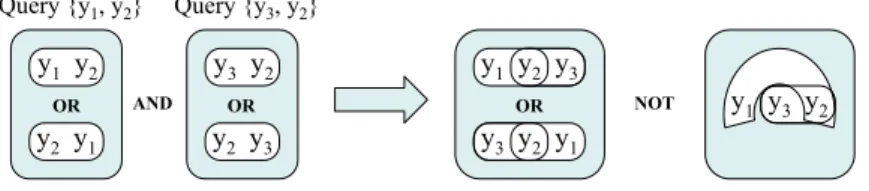
Consider an example where a client issues two range queries to the same data server. The first query returns shares{y1, y2}, and the second, shares{y3, y2}.
Each query is a range query, so the server knows that no secret can fall between the secrets ofy1 andy2 or of y3 andy2. Since y2 appears in both queries, the
server knows that the secret ofy2comes between the secrets ofy1andy3, but is
not sure whether the secret ofy1 or ofy3is smaller. Thus, the true share order
contains either subsequencey1y2y3 ory3y2y1, and we say that the server knows
25 \ \ \ \ 25 \ \ \ \ 25 \ \ \ \ \ \ \ \ \ 4XHU\^\\` 127 $1' 4XHU\^\\`
Fig. 2.Range queries indicate that the secrets of shares y1, y2 are contiguous, as are those ofy3, y2. Thus, the secret ofy2 falls between the secrets of y1 andy3, though eithery1ory3 may have the smallest secret.
We can extend this technique to additional range queries of varying sizes. Given enough queries, we can reconstruct the entire share order on each server up to symmetry. The full reconstruction algorithm uses PQ-trees [12], but is out of scope for this paper. We can link reconstructed share orders across servers, and thereby align shares, by observing that if a query issued to one data server requests thejth share, then the same query must also request thejth share from every other server. If we use the share order to discover secrets, we must make twice as many guesses, since we still only know the order up to symmetry.
5
Attack Implementation and Experiments
We implemented our attack in Java, and ran each of our attack trials using a single thread on a 2.4GHz IntelR CoreTM2 Quad CPU. All trials used less
than 2GB RAM. We used two datasets. The first consists ofm = 1739 maxi-mum salaries of Riverside County (California, USA) government employees as of February, 2012 [13]. The second is a set ofm= 105salaries generated uniformly
at random from the integer range [0,107). 5.1 Time Measurements
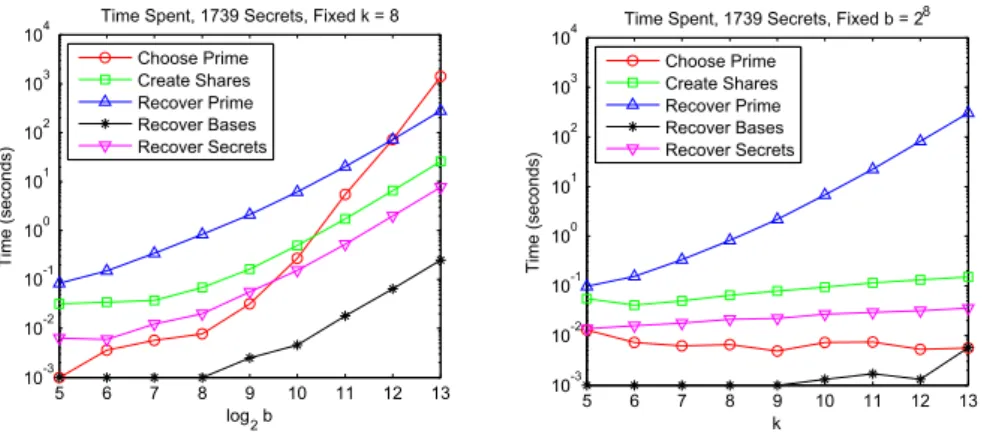
Our first set of experiments measures the time required to run the full attack as described in Sect. 3. Each experiment varies the number of serversk or the number of bitsb in the hidden primep. The total number of serversn has no effect on the attack runtime, so we let n = k. All times are averaged over 10 independent trials, and averages are rounded up to a 1ms minimum. In each trial, we divide out primes with at mostβ = 16 bits (Sect. 3.2), and we successfully recoverp, allkbases (i(0) values), and allmsecrets.
Each plot gives the times spent by the client finding a randomb-bit primep and creating k shares for each of them secrets. We then plot the times spent by the colluding servers recoveringp and the k bases. We also give the time spent recovering allm secrets, which is the same for the colluding servers as it is for the client. From Sect. 3.3, we know that the time needed to recoverpis inO(22k
b2). Thus, incrementing
kor log2b increases prime recovery time by a factor of 4. Sincek and log2b have similar effects on prime recovery time, we plot against log2b instead ofb on thexaxis.
7LPH6SHQW6HFUHWV)L[HGN ORJE 7 LP H VH FRQGV &KRRVH3ULPH &UHDWH6KDUHV 5HFRYHU3ULPH 5HFRYHU%DVHV 5HFRYHU6HFUHWV
Fig. 3.Riverside dataset times, variedb
7LPH6SHQW6HFUHWV)L[HGE N 7 LP H VH FR Q G V &KRRVH3ULPH &UHDWH6KDUHV 5HFRYHU3ULPH 5HFRYHU%DVHV 5HFRYHU6HFUHWV
Fig. 4.Riverside dataset times, variedk Figures 3 and 4 plot times using the Riverside dataset with fixedb= 28 and k = 8, respectively. Figures 5 and 6 give corresponding times for the random dataset. Times to create shares and recover secrets are proportional tom, and so are higher for the larger, random dataset. Times to generatep, recoverp, and recover bases depend only onb andk, and so are dataset-independent.
Figures 3 and 5 show that when k is held constant, increasing b costs the client more than it costs the colluding servers. Both prime recovery and modular multiplication take time proportional tob2, so prime recovery time is a constant
factor of share generation time. Further, the time to choose a randomb-bit prime using the Miller-Rabin primality test is inO(b3) [14], so as
bgrows past 212, the
cost to generate p quickly outstrips the cost to recover it. Thus it is entirely impractical to thwart our attack by increasingb.
In the TSWZ scheme [5], the measured time to recover a prime with less than 25bits was over 1500 seconds. In contrast, our method recovers primes with 213 bits in under 500 seconds on comparable hardware, fork= 8. As long askb, as is likely in practice, our method is far faster.
7LPH6SHQW 6HFUHWV)L[HGN ORJE 7 LP H VH FRQGV &KRRVH3ULPH &UHDWH6KDUHV 5HFRYHU3ULPH 5HFRYHU%DVHV 5HFRYHU6HFUHWV
Fig. 5.Synthetic dataset times, variedb
7LPH6SHQW 6HFUHWV)L[HGE N 7 LP H VH FRQGV &KRRVH3ULPH &UHDWH6KDUHV 5HFRYHU3ULPH 5HFRYHU%DVHV 5HFRYHU6HFUHWV
Figures 4 and 6 show that when b is fixed, most times are inO(k), with the exception of prime recovery time, which is inO(22k). Thus, by increasingk, the attack can be made arbitrarily expensive at a relatively small cost to the client. However, as we discuss in Sect. 6, evenk= 10 may be impractical.
5.2 Failure Rate Measurements
Since we only factor out small primes with at mostβbits (Sect. 3.2), our attack fails ifδ1, δ2 share any prime factor, other than p, that has more than β bits.
Thus, our attack’s failure raterf is the probability thatδ1/p, δ2/pshare a prime
with more than β bits. Since δ1, δ2 are not independent random numbers, it is
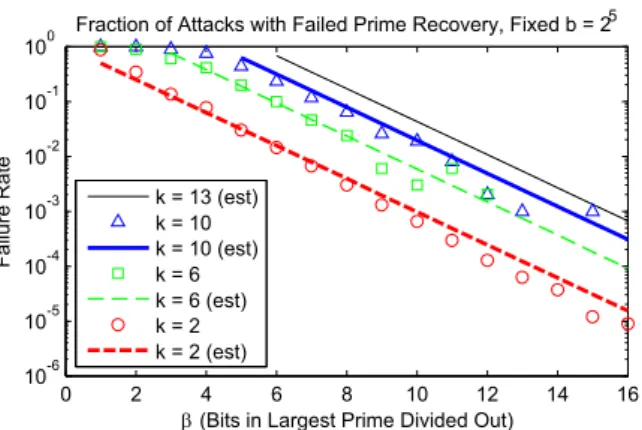
difficult to computerf analytically, so we measure it empirically. The results of our experiment are shown in Fig. 7.
We found that rf is largely independent ofb, but depends heavily onk and β. To measurerf, we conducted several trials in which we generated a prime p ofb= 32 bits, and ran our attack using k+ 2 randomly generated secrets. For k= 2, we ran 106trials, and were able to get meaningful failure rates up through
β≈16. Trials with largerkwere much more expensive, so we only ran 103trials
fork= 6 andk= 10, and the results are accurate only through β≈10. From our results, we derived the approximate expression rf ≈ 2(k−2)/4
2β+1 k. We
then plotted this estimatedrf in Fig. 7, denoted byest. The approximation is adequate for the range ofβwe’re considering. The dependence ofrf on 2−(β+1)is
expected, as the probability that a factor ofβ+ 1 bits found in one randomd-bit number is found in another randomd-bit number is roughly 2d−(β+1)2d = 2−
(β+1).
The nature of the dependence onkis unclear, but it may be related to the fact thatkof thek+ 1 equations used to compute δ1 are also used to computeδ2.
Using our approximation for rf, we estimate the worst-case failure rate for our timing experiments, where β = 16 and k = 13, to be rf ≈ 2(13−2)/4
216+1 13 =
2−14.2513≈6
.67×10−4. If necessary, we can lower
rf further by increasingβ. )UDFWLRQRI$WWDFNVZLWK)DLOHG3ULPH5HFRYHU\)L[HGE E%LWVLQ/DUJHVW3ULPH'LYLGHG2XW )D LOX UH 5 D WH N HVW N N HVW N N HVW N N HVW
6
Attack Mitigations
We now discuss possible modifications a client can make to the HAT schemes that may improve security. In order to mitigate our attack, a modification must cause at least one of the attack assumptions listed in Sect. 3 to be violated. Assumption: At LeastkServers Collude. The simplest way to thwart our attack is to ensure that no more thank−1 servers are able to collude. Only in such cases can secret sharing schemes hope to achieve perfect, information-theoretic security. However, if the number of colluding servers must be limited, secret sharing schemes cannot be applied to the honest-but-curious server threat model commonly used for data outsourcing [1, 2, 8, 15, 16].
Assumption:b, kModest. In Sect. 5, we showed that increasingbcosts the client more than it costs the colluding servers, so a largebis impractical. With limited resources, we successfully mounted attacks for k = 13 in under 500 seconds, so k must be substantially larger (k >20) to achieve security in practice. For each server, the client pays a storage cost equal to that of storing his data in plaintext. Ifk≥10, the combined storage cost exceeds that of many encryption-based private query techniques [1, 2, 15], so increasingkis also impractical. Assumption: Same X, p for Each Secret. Storing a distinct X or prime pon the client for each secret is at least as expensive as storing the secret itself. An alternative is to use a strong, keyed hash hj to generate a distinct vectorX = hj(X) for each secretsj. Using this method, each secret requires different basis polynomials for interpolation, so mounting an attack would be much harder. Unfortunately, it also eliminates additive homomorphism, removing support for server-side aggregation, which is cited as a reason for adopting secret sharing. Assumption: Corresponding Shares can be Aligned. Hiding share order from data servers as in [3] can hinder share alignment, but if the scheme supports range or point queries, share alignment can eventually be inferred (Sect. 4.3). Schemes could use re-encryption or shuffling to obscure order as in [2], but the cost of such techniques outweighs the performance advantages of secret sharing. Assumption:k+ 2 Known Secrets. It is difficult to keep all secrets hidden from an attacker. Known plaintext/ciphertext attacks for small amounts of data are always a threat, and if we known the real-world distribution of the secrets, we can guess them efficiently (Sect. 4.2). The client could encrypt secrets before sharing, but doing so adds substantial cost and eliminates additive homomorphism.
7
Related Work
Privacy-preserving data outsourcing was first formalized in [16] with the intro-duction of theDatabase As a Service model. Since then, many techniques have been proposed to support private querying [1, 2, 15, 17, 18], most based on spe-cialized encryption techniques. For example, order-preserving encryption [1] sup-ports efficient range queries, while [15] supsup-ports server-side aggregation through
additively homomorphic encryption. Other schemes are based on fragmentation, where only links between sensitive and identifying data are encrypted [17, 18].
As far as we know, the schemes we discuss in this paper [3–5, 7] are the first to use secret sharing to support private data outsourcing, though secret sharing has been used for related problems, such as cooperative query processing [19]. Prior works, such as [8], have addressed various security issues surrounding data outsourcing schemes, but as far as we know, ours is the first to reveal the specific limitations of schemes based on secret sharing.
8
Conclusion
Private data outsourcing schemes based on secret sharing have been advocated because of their slight advantages over existing encryption-based schemes. Such advantages include security, speed, and support for server-side aggregation. All three outsourcing schemes based on secret sharing [3–5] claim that security is maintained even whenkor more servers collude. To the contrary, we have shown that all three schemes are highly insecure when k or more servers collude, re-gardless of whetherX andpare kept secret.
We described and implemented an attack that reconstructs all secret data when onlyk+ 2 secrets are known initially. In less than 500 seconds, our attack recovers a hidden 256-bit prime fork≤13 servers, or an 8192-bit prime fork≤8. We discussed possible modifications to mitigate our attack and improve security, but any such modifications sacrifice generality, performance, or functionality.
We conclude that secret sharing outsourcing schemes are not simultaneously secure and practical in the honest-but-curious server model, where servers are not trusted to keep data private. Such schemes should only be used when the client is absolutely confident that at mostk−1 servers can collude.
Acknowledgements. This work was supported in part by contract number N00014-07-C-0311 with the Office of Naval Research.
References
1. Agrawal, R., Kiernan, J., Srikant, R., Xu, Y.: Order preserving encryption for numeric data. In: Proc. ACM SIGMOD, pp. 563–574 (2004)
2. Stefanov, E., Shi, E., Song, D.: Towards practical oblivious RAM. In: Proc. NDSS (2012)
3. Hadavi, M., Jalili, R.: Secure Data Outsourcing Based on Threshold Secret Sharing; Towards a More Practical Solution. In: Proc. VLDB PhD Workshop, pp. 54–59 (2010)
4. Agrawal, D., El Abbadi, A., Emekci, F., Metwally, A., Wang, S.: Secure Data Man-agement Service on Cloud Computing Infrastructures. In: Agrawal, D., Candan, K.S., Li, W.-S. (eds.) Information and Software as Services. LNBIP, vol. 74, pp. 57–80. Springer, Heidelberg (2011)
5. Tian, X., Sha, C., Wang, X., Zhou, A.: Privacy Preserving Query Processing on Secret Share Based Data Storage. In: Yu, J.X., Kim, M.H., Unland, R. (eds.) DASFAA 2011, Part I. LNCS, vol. 6587, pp. 108–122. Springer, Heidelberg (2011)
6. Shamir, A.: How to share a secret. Communications of the ACM, 612–613 (1979) 7. Agrawal, D., El Abbadi, A., Emekci, F., Metwally, A.: Database Management as a
Service: Challenges and Opportunities. In: Proc. ICDE Workshop on Information and Software as Services, pp. 1709–1716 (2009)
8. Kantarcıoˇglu, M., Clifton, C.: Security Issues in Querying Encrypted Data. In: Jajodia, S., Wijesekera, D. (eds.) Data and Applications Security 2005. LNCS, vol. 3654, pp. 325–337. Springer, Heidelberg (2005)
9. Buchberger, B., Winkler, F.: Gr¨obner bases and applications. Cambridge Univer-sity Press (1998)
10. Fang, X., Havas, G.: On the worst-case complexity of integer gaussian elimination. In: Proceedings of the 1997 International Symposium on Symbolic and Algebraic Computation, pp. 28–31. ACM (1997)
11. Stein, J.: Computational problems associated with racah algebra. Journal of Com-putational Physics 1(3), 397–405 (1967)
12. Booth, K.S., Lueker, G.S.: Testing for the consecutive ones property, inter-val graphs, and graph planarity using PQ-tree algorithms. J. Comput. System Sci. 13(3), 335–379 (1976)
13. County of riverside class and salary listing (February 2012),
http://www.rc-hr.com/HRDivisions/Classification/tabid/200/ItemId/ 2628/Default.aspx
14. Rabin, M.: Probabilistic algorithm for testing primality. Journal of Number The-ory 12(1), 128–138 (1980)
15. Mykletun, E., Tsudik, G.: Aggregation Queries in the Database-As-a-Service Model. In: Damiani, E., Liu, P. (eds.) Data and Applications Security 2006. LNCS, vol. 4127, pp. 89–103. Springer, Heidelberg (2006)
16. Hacig¨um¨u¸s, H., Iyer, B., Li, C., Mehrotra, S.: Executing SQL over encrypted data in the database-service-provider model. In: Proc. ACM SIGMOD, pp. 216–227 (2002)
17. Ciriani, V., De Capitani di Vimercati, S., Foresti, S., Jajodia, S., Paraboschi, S., Samarati, P.: Keep a Few: Outsourcing Data While Maintaining Confidentiality. In: Backes, M., Ning, P. (eds.) ESORICS 2009. LNCS, vol. 5789, pp. 440–455. Springer, Heidelberg (2009)
18. Nergiz, A.E., Clifton, C.: Query Processing in Private Data Outsourcing Us-ing Anonymization. In: Li, Y. (ed.) DBSec 2011. LNCS, vol. 6818, pp. 138–153. Springer, Heidelberg (2011)
19. Emekci, F., Agrawal, D., Abbadi, A., Gulbeden, A.: Privacy preserving query pro-cessing using third parties. In: Proc. ICDE, p. 27. IEEE (2006)