Development of an effective phytosanitary regulatory
information management system framework for WTO
SPS compliance
By
Marianna Theyse
Submitted to the Faculty of Natural and Agricultural Sciences
Department of Microbiology and Plant Pathology
University of Pretoria
in partial fulfilment of the requirements for the degree
M.Inst. (Agrar) Plant Quarantine
Supervisor: Prof. L. Korsten
DECLARATION
I, the under signed hereby declare that the work reported herein is the result of my original research findings.
ACKNOWLEDGEMENTS
I wish to express my deepest gratitude and appreciation to my supervisor Prof. Lise Korsten whose academic support and continued guidance made this study possible. I would also like to extend my appreciation to Ms Daleen Muller and Ms Amelita Lombard of the Department of Microbiology and Plant Pathology for their administrative support and assistance.
Special thanks to the management and personnel of the National Plant Protection Organisation of South Africa who participated in the Phytosanitary Capacity Evaluation surveys, shared ideas and supported further aspects of this study.
I would like to thank the Commonwealth Secretariat: Special Advisory Services Division for sponsoring the SPS Workshop in 2008 in Malawi and also acknowledge the participants of the workshop whose inputs ensured the successful completion of the Phytosanitary Capacity Evaluation for Malawi.
A special thanks to Dr David Keetch for his inputs and contributions to the Phytosanitary Capacity Evaluation for Malawi.
DEDICATION
This thesis is dedicated to Renier for his love, patience and support during my studies and to my parents who are always there to motivate and encourage.
TABLE OF CONTENT
LIST OF FIGURES x
LIST OF TABLES xi
LIST OF ACRONYMS xii
1. Introduction 1 1.1. Objective 1 1.2. Specific aims 2 1.3. Relevance Statement 2 1.4. Outline of dissertation 5 1.5. Literature cited 7
2. Literature review on International Plant Protection Convention
and related capacity evaluation tools
2.1. Introduction 9
2.2. The concept of phytosanitary capacity 11
2.3. Purpose of the Phytosanitary Capacity Evaluation tool 13
2.4. Usefulness of the Phytosanitary Capacity Evaluation 14
tool
2.5. Reviews of the Phytosanitary Capacity Evaluation tool 16
2.6. Other capacity evaluation tools 19
2.6.1. World Organisation for Animal Health Evaluation 19
Of Performance of Veterinary Services tool
2.6.2. Guidelines to assess capacity building for national 20
food control systems
2.6.3. Biosecurity Toolkit 21
2.6.4. Performance, Vision, Strategy 24
3. South Africa: A Best Practice Model for compliance with Article 7 on Transparency of the World Trade Organisation Agreement on the Application of Sanitary and Phytosanitary Measures
3.1. Introduction 29
3.2. Material and Methods 32
3.2.1. Publication of regulations 32
3.2.2. National Enquiry Points 33
3.2.3. General notification requirements 34
3.2.4. Notification procedures 37
3.2.5. Notification procedures when emergency 39
actions are required
3.2.6. Transparency of special and differential treatment 39
3.2.7. World Trade Organisation Agreement on the 40
Application of Sanitary and Phytosanitary
Measures Workshops on Transparency
3.2.8. Research methodology 41
3.2.9. Analysis of the existing national notifications 41
Mechanism of South Africa
3.2.10. A Phytosanitary notifications mechanism 43
3.3. Results 44
3.3.1. A national Enquiry Point and National Notification 44
Authority for South Africa
3.3.2. Technical competent authorities in Department of 46
Agriculture
3.3.3. Recommended national coordinating mechanism 48
for outgoing phytosanitary notifications
3.3.4. Recommended national coordinating mechanism 51
for incoming notifications
3.4. Discussion 54
4. South Africa: A phytosanitary capacity evaluation for compliance with International Plant Protection Convention requirements
4.1. Introduction 59
4.1.1. Overview of the International Plant Protection 59
Organisation
4.1.2. Responsibilities of a National Plant Protection 60
Organisation
4.2. Material and Methods 61
4.2.1. Project purpose and evaluation tool design 61
4.2.2. Research methodology 61
4.3. Results 62
4.3.1. Phytosanitary legislative and regulatory framework 62
4.3.2. Sanitary and phytosanitary institutional capacity 70
and human resources
4.3.3. Pest and disease diagnostic capabilities 77
4.3.4. Pest risk analysis capacity 81
4.3.5. Surveillance and pest eradication capacity 89
4.3.6. Capacity to establish and maintain Pest Free Areas, 93 Places and Sites of Production
4.3.7. Inspection systems and points of entry or exit control 94
4.3.8. Export certification systems 99
4.3.9. Pest reporting 101
4.4. Discussion 104
4.4.1. Logical Framework Analysis and recommendations 104 for strengthening national regulatory phytosanitary
capacity
4.4.1.1 Phytosanitary Legislative and 105
Regulatory Framework
4.4.1.2. Human Resources and facilities 106
4.4.1.4. Institutional aspects 110
4.5. Literature cited 112
5. Comparison study of national phytosanitary capacities
of South Africa and Malawi
5.1. Introduction 114
5.1.1. Research mandate and purpose 114
5.1.2. Context and institutional environment 115
5.1.2.1. Economic and political overview 115
5.1.2.2. National agricultural policies 116
5.1.2.3. Membership of international 119
Organisations and regional trade obligations
5.1.2.4. Legal Frameworks 121
5.1.2.5. Institutional Frameworks for 123
phytosanitary regulatory services
5.1.2.6. Phytosanitary capacity building projects 124
5.2. Material and methods 125
5.3. Results 125
5.3.1. Country background 125
5.3.2. Phytosanitary Legislative and Regulatory Framework 127
5.3.3. Human resources and facilities 127
5.3.4. Pest Risk Analysis 131
5.3.5. Inspections and surveillance 132
5.4. Discussion 134
5.6. Literature cited 136
ANNEX
1. PHYTOSANITARY CAPACITY EVALUATION LOGFRAME 140
MATRIX – SOUTH AFRICA
2. PHYTOSANITARY CAPACITY EVALUATION LOGFRAME 147
LIST OF FIGURES
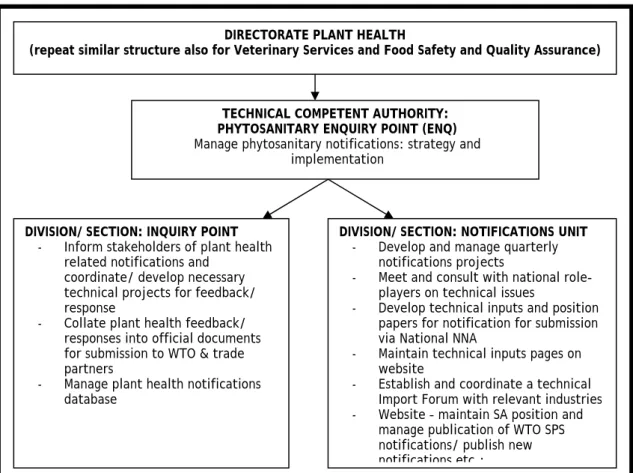
1. Proposed National Notifications Authority in Department of Agriculture 45
2. Recommended structure of a technical competent authority 47
3. Recommended National Coordinating mechanism for outgoing 51
phytosanitary notifications
4. Recommended National Coordinating mechanism for incoming 53
phytosanitary notifications
5. Functional Units of the National Plant Protection Organisation of 71
South Africa
6. Steps in applying for an import permit from the National Plant 83
LIST OF TABLES
1. Number of approved posts in the Directorate Plant Health (April 2008) 74
2. Number of approved posts in the Agricultural Product Inspection 75
Services (April 2008)
3. Diagnostic expertise in the National Plant Protection Organisation 79
of South Africa (April 2008)
4. Diagnostic expertise outside National Plant Protection Organisation 80
of South Africa (April 2008)
5. Pest risk analysis expertise in the National Plant Protection 86
LIST OF ACRONYMS
ADMARC Agricultural Development and Marketing
Corporation of Malawi
ALOP Appropriate level of protection
APIS Directorate Agricultural Product Inspection Services
ARC Agricultural Research Council of South Africa
BCOCC Border Control Operational Coordinating Committee
CABI CAB International
CBD Convention on Biological Diversity
“the Code” Terrestrial Animal Health Code
Codex Codex Alimentarius Commission
CPM Commission on Phytosanitary Measures
DEAT Department of Environmental Affairs and Tourism
DOA Department of Agriculture
DOH Department of Health
DDA Doha Development Agenda
DPH Directorate Plant Health
DVS Directorate Veterinary Services
ENQ National Enquiry Point
EWS Early Warning Systems
FAO Food and Agriculture Organisation
FSQA Directorate Food Safety and Quality Assurance
FTA Free trade Agreement
GATT General Agreement on Tariffs and Trade
GIS Geographical Information Systems
GMO Genetically modified organism
HIPC Highly Indebted Poor Countries
HPLC High Performance Liquid Chromatography
IAPSC Inter-Africa Phytosanitary Council
IICA Inter-American Institute for Cooperation on Agriculture
IICA-PVS Inter-American Institute for Cooperation on
Agriculture Performance, Vision, Strategy
IMF International Monetary Fund
IPP International Phytosanitary Portal
IPPC International Plant Protection Convention
ISPM International Standard for Phytosanitary Measures
ISSB International Standard-setting Body
IWG-TA Informal Working Group on Technical Assistance
KIMS Knowledge and Information Management Systems
NNA National Notifications Authority
Log-Frame matrix Logical Framework Matrix
LUSM Directorate Land Use and Soil Management
MEPC Malawi Export Promotion Council
MIPA Malawi Investment Promotion Agency
NDA Non Destructive Assay
NEPAD New Partnership for Africa’s Development
NPP CP National Plant Protection Contact Point
NPPPIS National Plant and Plant Product Inspection
Services
NPPO National Plant Protection Organisation
NPPOZA South African National Plant Protection Organisation
NRT New Revised Text of the IPPC
NTBs non-tariff barriers
OAU Organisation of African Unity
OECD Organisation for Economic Co-operation and
Development
OIE World Organisation for Animal Health
OIE-PVS International Office of Epizootics Evaluation on the
ISTA International Seed Testing Association
OEWG-BNPC Open Ended Working Group on Building National
Phytosanitary Capacity
PCE Phytosanitary Capacity Evaluation
PIP Pest Information Package
PPECB Perishable Product Export Control Board
PRA Pest Risk Analysis
PRGF Poverty Reduction and Growth Facility of Malawi
RBM Reserve Bank of Malawi
RPPO Regional Plant Protection Organisation
SA Republic of South Africa
SACU South African Customs Union
SADC South African Development Community
SANDF South African National Defence Force
SAPS South African Police Service
SARS South African Revenue Service
SOP Standard Operation Procedures
SPS Sanitary and Phytosanitary
TBT World Trade Organisation Agreement on Technical
Barriers to Trade
UNDP United Nations Development Programme
UPOV International Union for the Protection of New
Varieties
USDA-APHIS ATRIP United States Department of Agriculture - Animal
and Plant Health Inspection Service African Trade and Investment Policy
USAID United States Agency for International Development
WHO World Health Organisation
WTO World Trade Organisation
WTO SPS Agreement World Trade Organisation’s Agreement on the
CHAPTER ONE
Introduction
1.1. Objective
The main purpose of the National Plant Protection Organisation (NPPO) of South Africa is to protect agriculture and the environment in its territory from potentially harmful pests and diseases that could enter the country with imported plants and plant products. The NPPO cooperates with industry role-players to ensure that consignments of plants and plant products destined for export comply with the import requirements of trading partners. Senior officials from the Department of Agriculture (DOA) attend the World Trade Organisation’s Sanitary and Phytosanitary (WTO SPS) Committee meetings in Geneva together with the Geneva based delegate at South Africa’s Mission to the World Trade Organisation (WTO). Senior officials from the NPPO may form part of such a South African delegation when the WTO SPS Committee meeting’s agenda contains phytosanitary issues that are relevant to South Africa. The NPPO of South Africa is furthermore responsible for the development and implementation of national phytosanitary capacities in accordance with the country’s membership of the International Plant Protection Convention (IPPC) and the World Trade Organisation Agreement on the Application of Sanitary and Phytosanitary Measures (WTO SPS Agreement).
This study analyses and evaluates the current phytosanitary regulatory capacity of South Africa in terms of its compliance with the transparency requirements of the WTO SPS Agreement and in term of the standard-setting and implementation requirements of the IPPC. Capacity evaluations are done in order to develop and propose corrective measures and mechanisms to address the gaps and shortcomings that were identified.
The recommendations for improvement is used to guide the development of effective phytosanitary regulatory capacities in South Africa and forms a framework to guide further development of relevant information management systems for WTO SPS compliance.
The study includes a comparative study between the phytosanitary regulatory capacities of the NPPO of a developing country Member, namely South Africa, and the NPPO a least developed country Member, namely Malawi.
1.2. Specific aims
This study aims to:
a. Develop a Best Practice Model for South Africa for compliance with WTO
SPS Transparency principles
b. Complete a Phytosanitary Capacity Evaluation for South Africa
c. Make specific recommendations to the NPPO of South Africa to
strengthen phytosanitary capacity in terms of IPPC requirements
d. Complete a Phytosanitary Capacity Evaluation for Malawi.
e. Compare the phytosanitary capacities of South Africa and Malawi to
inform decisions by the respective governments to focus further capacity building initiatives in order to improve WTO SPS compliance.
1.3. Relevance Statement
The ability to protect human, animal and plant life and health, as defined in the
World Trade Organisation’s Agreement on the Application of Sanitary and Phytosanitary Measures (WTO SPS Agreement) is high on the agenda of Member countries (WTO, 1994). The growing impact of globalization and increased agricultural trade creates more potential for the spread and introduction of pests and diseases. Animal and plant pests and diseases not only affect food safety and security, but also threaten biological diversity and the
status of natural resources. This has important consequences for agricultural economic development, especially for developing countries that are major exporters of agricultural and food products.
The WTO SPS Agreement was negotiated during the WTO Uruguay Round of trade negotiations to address the concern that gains made to negotiate freer
trade in agricultural commodities may be eroded if Members use arbitrary or
unjustified technical barriers to protect domestic industries from imports (WTO, 1995). It is a legally binding instrument that came into force for developed
country Members as of January 1995, for developing country Members as of
January 1997 and for least-developed country Members as of 2000 (WTO,
2005). The WTO SPS Agreement aims to facilitate free trade that is also safe.
Members are allowed to give food safety, animal and plant life and health priority over trade considerations provided that there is a demonstrable scientific justification for Member country’s SPS measures. A set of rules, principles and benchmarks is provided to ensure that SPS measures are scientifically justified and not disguised as trade restrictions. The WTO SPS Agreement also provides procedures and criteria for the assessment of risk. Members have a sovereign right to determine their own appropriate level of health protection.
Members of the WTO are encouraged to harmonise their national SPS regulations with the international standards, guidelines, or recommendations, developed by the three standard setting bodies cited as the International Plant Protection Convention (IPPC), the World Organisation for Animal Health (OIE) and the Codex Alimentarius Commission (WTO, 1994). All three these international standard-setting bodies existed prior to the WTO SPS Agreement
and they operate independent thereof. Members of each international
setting body are encouraged to participate in international and regional standard-setting programmes and initiatives. National SPS regulatory systems need to not only be able to withstand the challenges of accessing new markets, protecting
human, animal and plant life and health and the environment, but also participate and represent its interests and concerns in international standard-setting forums.
Some Member countries are still adjusting to the new disciplines established by the WTO SPS Agreement and are in the process of developing the adequate SPS regulatory capacities to implement these disciplines (WTO, 2005). It is generally accepted that a country’s SPS regulatory capacity must be able to meet SPS requirements in the international trade arena, implement trade obligations and participate in international SPS related forums (USAID, 2003). Several studies provided evidence that the inability to meet the SPS measures of trading partners constitute non-tariff barriers to agricultural and food exports of developing countries (Henson et al., 2000, Gebrehiwet et al, 2007, Nyangito et al, 2003 and Rudaheranwa et al, 2003). Effective SPS regulatory services can contribute to economic growth by protecting agricultural and environmental resources, protecting public health, adding value to agricultural products and expanding and diversifying the agricultural sector (USAID, 2003).
The agricultural sector of the Republic of South Africa experienced dramatic growth in response to a changing economic policy environment from protectionist statutory intervention and support of agriculture prior to the mid-nineties, to deregulation and liberalisation and an open economy thereafter. The 2007 Strategic Plan for South African agriculture aimed to address historical divisive dualism in policy and service delivery through three core strategies namely, to enhance equitable access and participation in agriculture, improve global competitiveness and profitability and to ensure equitable resource management in the sector (DOA, 2007). These strategic goals and greater integration in world agricultural trade underscores the need for the South African agricultural policies that favour, amongst others, SPS compliance support systems.
South Africa has been a contracting party to the General Agreement on Tariffs and Trade (GATT) since 13 June 1948 and a member of the WTO since its
establishment on 1 January 1995. The WTO SPS Agreement entered into force with the establishment of the WTO. South Africa is also a member of the IPPC, OIE and Codex Alimentarius Commission. A huge responsibility therefore exists for the country’s regulatory institutions to effectively facilitate safe agricultural trade and stay abreast with international developments within the SPS environment. It is imperative for South Africa to continue to monitor its SPS regulatory systems with the view of enhancing its capacities to be able to (1) support domestic industry to comply with the import requirements of trading partners, (2) develop and implement effective SPS measures to protect human, animal and plant life and health, and (3) to participate in trade discussions of SPS standard-setting bodies and the WTO.
South Africa has been a signatory member of the IPPC since 6 December 1951 and deposited its instrument of ratification on 21 September 1956. In November 1997 the Food and Agriculture Organisation (FAO) Conference approved wide-ranging amendments to the IPPC. In accordance with Article XIII paragraph 4 of the Convention, the New Revised Text (NRT) of 1997 came into force on 2 October 2005 (IPPC, 1997). The South African government assessed its national regulatory structure for phytosanitary services in terms of the obligations of the NRT of the IPPC. Following this assessment a process of restructuring started in 2005 as far as financial resources allowed. The current NPPO structure was established on 1 April 2006 as a result of restructuring within the Department of Agriculture (DoA).
1.4. Outline of dissertation
In Chapter Two, South Africa’s SPS national Enquiry Point and National Notification Authority capacities were evaluated according to the requirements of WTO SPS Agreement Article 7 on Transparency with the aim of developing a new effective and sustainable model for a national mechanism to ensure compliance with Article 7 on Transparency of the WTO SPS Agreement.
Because of the lack of current SPS capacities in the DoA, a proposed Best Practice Model for compliance with WTO SPS Transparency was developed.
At the time of the CPM meeting in April 2007, the PCE had been applied by 60 countries (WTO, 2008). In Chapter Three the Phytosanitary Capacity Evaluation (PCE) tool of the IPPC is used for the first time to evaluate the phytosanitary regulatory capacity of South Africa. This evaluation entails a thorough assessment of the NPPO of South Africa with the purpose to identify specific strengths and weaknesses relating to current structure and capacities. Effective information management and record-keeping is an important responsibility of a NPPO and part of the IPPC requirements of any phytosanitory regulatory service. Based on the findings and results of the PCE Logical Framework Analysis a list of prioritised recommendations to improve phytosanitary capacity to in the NPPO of South Africa is presented.
A SPS workshop was held in Malawi mainly to validate data gathered during
three field visits as part of the Commonwealth Secretariat project entitled
“Establishment of a Malawian Best Practices Model to address Sanitary and
Phytosanitary Requirements for Plant Health”. This data is captured in a
Phytosanitary Capacity Evaluation (PCE) Tool and the study focuses on the completion of a PCE for Malawi. A PCE Logical Framework Analysis was compiled and in Chapter Four the results of the PCE studies for South Africa and Malawi are compared. The aim of this comparative study is to determine the difference in capacity levels of the two countries of which South Africa is a developing country and Malawi is a Least Developed Country. The difference in phytosanitary capacity levels should inform decisions by the respective governments to focus further capacity building initiatives in order to improve compliance with the WTO SPS Agreement.
1.5. Literature cited
DoA (2007). Strategic Plan for the Department of Agriculture for 2007.
Department of Agriculture (DOA) of South Africa, Pretoria, South Africa
Gebrehiwet, Y., Ngqangweni, S. & Kirsten, J.F. (2007). Quantifying the trade
effect of sanitary and phytosanitary regulations of OECD countries on South African food exports. Agrekon, 46 (1). Pp 23 – 39.
Henson, S.J., Loader, R., Swinbank, A., Bredhal, M. and Lux, N. (2000). The
impact of sanitary and phytosanitary measures on developing countries. Center for Food Economics Research, University of Reading, UK.
IPPC (1997). New Revised Text of the International Plant Protection Convention
(IPPC). Food and Agriculture Organisation of the United Nations, Rome, Italy.
Nyangito, H.O., Olielo, T. and Magwaro, D. (2003) Improving Market Access
through Standards Compliance: A Diagnostic and Road Map for Kenya, in J.S.
Wilson and V.O Abiola (eds), Standards and Global Trade: A Voice for Africa.
The International Bank for Reconstruction and Development/ The World Bank, USA.
Rudaheranwa, N., Matowu, F. and Musinguzi, W. (2003). Enhancing Uganda’s
Access to International Markets: A focus on Quality, , in J.S. Wilson and V.O
Abiola (eds), 2003 Standards and Global Trade: A Voice for Africa. The
International Bank for Reconstruction and Development/ The World Bank, USA.
USAID (2003). Trade capacity building and Sanitary and phytosanitary Control: A
Resource Guide. USAID, Washington. [http://.www.nathaninc.com/NATHAN/files/ccPageContentdocfilename353691526
WTO (1994). WTO Agreement on the Application of Sanitary and Phytosanitary Measures. World Trade Organisation, Geneva, Switzerland
WTO (1995). Trading into the future. World Trade Organisation, Geneva,
Switzerland.
WTO (2008). G/SPS/GEN/821: Overview of SPS capacity evaluation tools.
Committee on Sanitary and Phytosanitary Measures, World Trade Organisation, Geneva, Switzerland.
CHAPTER TWO
Literature review on International Plant Protection Convention
and related capacity evaluation tools
2.1. Introduction
The protection of human, animal and plant life and health, as defined in the
Agreement on the Application of Sanitary and Phytosanitary Measures (WTO SPS Agreement) of the World Trade Organisation is high on the agenda of developed and developing countries as the growing impact of `globalization and increased trade results in increased opportunity for the spread and introduction of pests and diseases. This spread and introduction of pests and diseases not only affects food safety and security, but also threatens biological diversity and the status of natural resources which in turn has important consequences for agricultural economic development. For example, if a new quarantine pest enters South Africa for which no internationally accepted mitigation options exist,
such as the fruit fly Bactrocera invadens, it would impact on food security
because agricultural production of its host plants would be affected and it would have major implications for the country’s export markets. Trading partners may prohibit all exports from South Africa based on the “precautionary principle” of the WTO SPS Agreement until proof can be provided that the pest has been eradicated, or until certain affected areas can be officially declared pest free by means of surveillance or an internationally accepted mitigation treatment can be developed (WTO, 2000).
According to Gebrehiwet et al. (2007) stringent SPS standards have also proliferated as a result of the Uruguay Round Agreement on Agriculture (URAA) when tariff reduction shifted the focus to non-tariff barriers (NTBs). However, the WTO SPS Agreement stipulates that countries should base their sanitary and phytosanitary (SPS) measures on international standards and recommendations but also permits countries to raise national phytosanitary measures above the
international level provided that it is scientifically justified, non-discriminatory and based on the phytosanitary risk.
International Standards for Phytosanitary Measures (ISPMs) are developed within the framework of the International Plant Protection Convention (IPPC) and with the purpose of securing common and effective action to prevent the spread and introduction of pests of plants and plant products (IPPC, 1997). Member countries use ISPMs to develop and establish national phytosanitary measures in order to protect plant health and life from risks associated with imported agricultural commodities.
Contracting parties of the IPPC undertake to adopt legislative, technical and administrative measures for the purpose of securing common and effective action to prevent the spread and introduction of pests of plants and plant products. It is the responsibility of each contracting party to provide, to the best of its competencies, an official National Plant Protection Organisation (NPPO) (IPPC, 1997).
Developing and least developed countries with inadequate phytosanitary capacity are increasingly faced with the challenges of protecting plants and the environment, participating and representing their interests and concerns in international standard-setting forums and meeting the requirements of international legal commitments. Because of limited resources and expertise the economic interests and trade of developing countries, such as South Africa, are impeded.
Members of the IPPC are required to establish a National Plant Protection Organisations (NPPO). The responsibilities of a NPPO include the issuance of phytosanitary certificates, the inspection of consignments and regulated articles, the disinfestation or disinfection of consignments to meet phytosanitary requirements and surveillance with the objective of reporting occurrence,
outbreak and spread of pests, including the control of those pests. NPPOs are also responsible to conduct pest risk analysis, maintain pest free areas and areas of low pest prevalence, to ensure phytosanitary security of consignments after certification, training and development of staff, information management within its territory, research within the field of plant protection, the issuance of phytosanitary regulations and the provision of a national plant protection contact point (IPPC, 1997).
2.2. The concept of phytosanitary capacity
The concept of “Capacity” refers to the ability of individuals, organisations and
systems to perform functions effectively, efficiently and in a sustainable manner (UNDP, 1998). Capacity may be quantitative e.g. number of staff or may be expressed in qualitative terms e.g. technical skills of staff and the quality of their performance (Canale, 2007). Phytosanitary capacity in South Africa therefore relates to the ability of the phytosanitary system, of which the NPPO is part of, to perform the appropriate functions as stipulated in its international obligations and national legislative and policy frameworks with the ultimate goal of protecting plant health and life, and the environment.
A capacity building need is interpreted as the gap between “what is” and “what
should be” and capacity needs can be identified based on the difference between the current capacity and the desired future capacity (Canale, 2007).
Canale (2007) describes the levels and the dimensions in which phytosanitary capacity exits as:
a. the system or environment level in which organisations, groups and
individuals operate with dimensions such as policies, laws, regulations and standards, as well as mechanisms for management, communication and coordination;
b. organisations and groups within the system level with dimensions such as the mission, structure, operational procedures, human resources, financial resources, information resources and infrastructure; and
c. individuals within organisations and groups level with dimensions such as
knowledge, skills, competencies, experience and ethics.
The UNDP (2008) defines capacity building, as it is now often referred to as capacity development, as “the process through which individuals, organisations and societies obtain, strengthen and maintain the capabilities to set and achieve their own development objectives over time”.
During the IPPC Open Ended Working Group on Building National Phytosanitary Capacity (OEWG-BNPC) meeting held in December 2008 a concept paper was developed on the definition of national phytosanitary capacity (IPPC, 2008). The proposed definition for national phytosanitary capacity is “the ability of individuals, organisations, and systems of a country to perform functions effectively and sustainably in order to protect plants and plant products from pests and to facilitate trade, in accordance with the IPPC”. The paper lists the following concepts to form the basis for the proposed definition of national phytosanitary capacity:
a. National phytosanitary capacity refers to the combined knowledge and
functions of many entities, not just the NPPOs;
b. The reference to systems indicates that individuals and organisations
should cooperate and communicate formally and informally on national, regional and international levels;
c. Though the functions that need to be performed are technical, legal,
administrative and managerial the capacity should also include the ability to apply knowledge, skills and tools that are appropriate to these functions;
d. It is recognised that phytosanitary capacity changes over time and each
e. National policies and international obligations that may or may not be directly related to plant health considerations will influence phytosanitary capacity;
f. Aspects that contribute to the sustainability of the performance of
phytosanitary functions include: the enabling environment, private-public partnerships, staff retention programmes, mobilisation of resources, viable plans for plant health and trade and national commitment to sustainable phytosanitary capacity
g. Though the definition refers to abilities to protect plants and plant products
from pests it supports bio-security and therefore also contribute to other national and international goals that deal with the protection of biodiversity, food security and poverty reduction; and
h. The IPPC reference in the definition aligns it with the IPPC Convention on
Phytosanitary Measures New Revised Text (IPPC,1997).
2.3. Purpose of the Phytosanitary Capacity Evaluation tool
The Phytosanitary Capacity Evaluation (PCE) Tool was one of the first SPS capacity evaluation tools that was developed in 1999 and originated from a pilot project conducted by New Zealand. The project developed a questionnaire to assess phytosanitary capabilities and identify needs and priorities. It was piloted in six countries namely Cook Islands, Fiji, Solomon Islands, Indonesia, Bangladesh and Vietnam (WTO, 2008a). A multilingual version of the PCE tool was made available in Arabic, French, Spanish and English in 2004 (IPPC, 2005).
The PCE tool assists NPPO’s to assess their phytosanitary capacity needs in relation to the implementation of the rights and responsibilities of the IPPC and the implementation of International Standards for Phytosanitary Measures (ISPM’s). The PCE tool was modified over time to take into account new ISPM’s and is a significant component of the Strategic Direction No4 (The development
of the phytosanitary capacity of Members by promoting the provision of technical assistance) and Article XX of the IPPC NRT (IPPC, 2006).
Needs assessment is an essential first step in the process to improve phytosanitary capacity and the PCE provides for a diagnostic tool to help contracting parties to assess the strengths and weaknesses of its phytosanitary regulatory system as well as to identify priority areas for improvement.
The rationale for the PCE is based on the following considerations (Canale, 2004):
a. Current needs of a national phytosanitary system can be estimated by a
measure of its capacity to meet international obligations of the country in an efficient and sustainable manner; and
b. This phytosanitary capacity can be measured through an inventory of the
functions and resources that must be available to the country’s regulatory services to be able to comply with each of the ISPMs and to implement the major categories of activities established under the IPPC.
2.4. Usefulness of the Phytosanitary Capacity Evaluation tool
According to Canale (2004), the IPPC PCE is a technical assistance tool that:
a. provides for self-assessment of national weaknesses and the identification
of priorities by a national group of experts that is followed by validation by a larger group representing all the actors of the national phytosanitary system, thereby promoting national awareness and consensus;
b. focuses attention of national experts on important issues and facilitates
analysis of the phytosanitary system in a systematic manner; and
c. reduce the variation among judgements of experts facing the same
The PCE tool comprises of 614 questions and covers 11 areas of phytosanitary capacity that includes legislative and regulatory framework, institutional capacity and human resource skills, pest and disease diagnostic capabilities, pest risk analysis, surveillance and pest eradication, Pest Free Areas, Places and Sites of Production, inspection systems and points of entry or exit control, export certification systems and pest reporting capacity. It facilitates the identification and prioritisation of organisational phytosanitary needs in order to develop strategies and plans to improve export, import and national control.
The PCE tool addresses communication, information management and human resources and capacities that are necessary for national phytosanitary regulatory services to meet international phytosanitary obligations, especially in areas such as risk assessments that form the basis of imposing SPS measures. It also highlights the needs for adequate information management that is important to ensure phytosanitary data integrity.
The WTO SPS Agreement Article 10 recognises the special needs of developing countries in the preparation and application of SPS measures (WTO, 1994). The IPPC provides technical assistance to developing countries in order to increase their phytosanitary capacity. In particular, the IPPC encourages technical support to developing countries in order to improve the effectiveness of their NPPOs and to increase the potential for developing countries to realise the benefits of safe trade.
The IPPC PCE tool is used to identify and prioritise areas of national phytosanitary capacity that may be addressed through technical assistance and cooperation projects. It is primarily a diagnostic tool to gauge the gap between the current situation and what is needed to meet the requirements of international standards for phytosanitary measures.
The PCE results provide a country and it’s NPPO with a technically sound basis for determining strengths and weaknesses of the NPPO to function effectively within the WTO SPS environment. This enables the NPPO to develop and strengthen well conceived programmes that are prepared to address the capacity gaps.
2.5. Reviews of the Phytosanitary Capacity Evaluation tool
The IPPC Interim Commission on Phytosanitary Measures (ICPM) at its 6th
Session in 2004 requested that a study be undertaken to determine the impact of the application of the PCE regarding national capacity building (IPPC, 2006). The CAB International (CABI) was contracted to do a study that addresses the following areas:
a. Critical assessment of the PCE as a needs assessment tool, with
recommendations for enhancements;
b. Review of the educational values of the tool in training and awareness
raising;
c. Assessment of the impact on strategic planning at national level
d. Assessment of the impact on other organisations internationally
including the IPPC, FAO and donor and development organisations.
In December 2006 an IPPC Informal Working Group and Technical Assistance (IWG-TA) recommended the update of the PCE tool to ensure consistency with newly adopted international standards for phytosanitary measures. The IWG-TA supported the PCE evaluation report and the technical recommendations made by CAB International (CABI) on the improvements for a more functional and appropriate PCE tool. Mr Felipe Canale was contracted to revise PCE according to the recommendations of the IWG-TA and CABI.
The IPPC Commission on Phytosanitary Measures (CPM) at its 2nd session in
particular on national strategic planning, justification for budgetary allocation, legal frameworks, training and awareness. It also noted that the PCE results were not regularly used for seeking external funding for phytosanitary capacity building (IPPC, 2007a). The CPM decided in 2007 that the analysis on the application of the PCE tool by an Informal Working Group on the PCE should continue.
In August 2007 an IPPC Informal Working Group on Technical Assistance (IWG-TA) reviewed the first draft of the revised PCE tool that was drafted by Mr Felipe Canale in 2007 (IPPC, 7007b). The revised version of the PCE was tentatively named “PCE 2008” and was updated to include the most recently adopted ISPMs. Its structure was rearranged into a stratified framework so that the user may follow the tool on a modular basis and go deeper into details only when needed.
The IPPC Commission on Phytosanitary Measures (CPM) at its 3rd session in
2008 noted the need for a comprehensive capacity building strategy to address
the needs of developing country Members. The CPM in 2008 proposed that an
open ended working group undertake the task of developing a draft capacity building strategy to allow for broad participation (IPPC, 2008a).
In December 2008 an Open Ended Working Group on Building National Phytosanitary Capacity (OEWG-BNPC) that compromised of 40 delegates from all FAO regions and relevant international organisations met to develop (IPPC, 2008b):
a. a draft concept paper for a capacity building;
b. a draft capacity building strategy ; and
The OEWG-BNPC recognised in its report of the December 2008 meeting (IPPC, 2008b), amongst others, that:
a. the implementation of international standards is complex and that a gap
exists between the development and the implementation of standards;
b. there are many aspects to phytosanitary capacity and different
perspectives at international, regional and national level that play a role;
c. lack of resources should not influence capacity building and partners are
needed to obtain resources;
d. more tools in addition to PCE are needed to evaluate national
phytosanitary capacity;
e. regional approaches are needed to utilise regional expertise;
f. a phytosanitary capacity strategy should ensure that training strengthens
institutions and not only individuals;
g. improved coordination and cooperation with donors is needed;
h. a definition of phytosanitary capacity is needed and should be applicable
to individual countries;
i. a phytosanitary capacity strategy should be based on the uniqueness of
the IPPC and its comparative advantage in the phytosanitary arena;
j. implementation of standards should have a regional focus and Regional
Plant Protection Organisations (RPPOs) should play a role;
k. IPPC visibility should be increased in order to help obtain resources; and
l. the IPPC should be aware that a one size fits all approach will not work
for the overall phytosanitary capacity strategy.
The OEWG-BNPC recommended that the IPPC moves forward by addressing the six strategic areas outlined in the draft phytosanitary capacity building strategy, namely:
a. Assessment of country phytosanitary needs and development of national
phytosanitary action plans
b. Advise or assist countries in establishing systems for standards
c. Facilitate improved coordination and communication
d. Implement appropriate structures in the IPPC and mobilise resources
e. Advocacy
f. Sustainability of the capacity building strategy
The strategic area dealing with assessment of country phytosanitary needs recommends further activities to develop methods and tools to help countries assess and prioritise their phytosanitary needs, including GAP analysis. This may be done though implementation of PCE improvements from the CABI review. The OEWG-BNPC recommended that reviews of the World Organisation for Animal Health Evaluation on the Performance of Veterinary Services (OIE-PVS) tool and Inter-American Institute for Cooperation on Agriculture Performance, Vision, Strategy (IICA-PVS) approach will assist in developing a new and more comprehensive Gap analysis process for phytosanitary needs (IPPC, 2008b).
2.6. Other capacity evaluation tools
2.6.1. World Organisation for Animal Health Evaluation of Performance of Veterinary Services tool
The World Organisation for Animal Health (OIE) began collaboration with the Inter-American Institute for Cooperation on Agriculture (IICA) on capacity evaluation tools in 2003 and developed the OIE-PVS (WTO, 2008a). This tool is designed to:
a. assist veterinary services establish their level of performance relative to
quality standards in the Terrestrial Animal Health Code (the Code);
b. establish priorities for strategic initiatives to improve performance in key
OIE-PVS evaluations are conducted by trained and certified OIE experts upon
request of Members. The OIE works with Members to develop proposals for
investment by donors.
The OIE-PVS contains four fundamental components:
a. human, physical and financial resources, and the ability to attract
resources and retain professionals with appropriate technical and leadership skills;
b. technical authority and capability to address current and new issues that
include prevention and control of biological disasters based on scientific principles;
c. sustained interaction with stakeholders, to stay on course and carry out
relevant joint programmes and services; and
d. ability to access markets through compliance with existing standards and
implementation of new disciplines such as harmonization, zoning and compartmentalisation.
Qualitative levels of advancement are described for each critical competency as it is set out in the Code. The OIE is examining the possibility of extending the OIE-PVS to provide a similar framework for evaluating aquatic animal health services (WTO, 2008a).
2.6.2. Guidelines to assess capacity building for national food control systems
The FAO considers the assessment of capacity needs in food safety and biosecurity as an essential first step in the process of strengthening capacity (WTO, 2008b). The FAO Guidelines to assess capacity building for national food control systems’ capacity assessment step involves:
a. review and analysis of existing capacity of the food control system;
b. define desired future improved situation; and
The next step involves development of a capacity building strategy and action plan that would address the identified capacity needs and gaps. Needs assessment assist governments to set priorities, organise their work, improve the use of resources and raise additional resources.
FAO Guidelines exist to assess the capacity in core elements of a national food control system and to identify related capacity building needs and include the following modules for assessment:
a. food control management;
b. food legislation;
c. food inspection;
d. official food control laboratories;
e. food safety and quality information, education and communication (IEC)
Each module provides step-by-step guidance and a participatory methodology for self assessment.
These FAO Guidelines build on and complement the United Nations World Health Organisation (WHO) Guidelines for strengthening national food control systems (WTO, 2008b). The FAO Guidelines focus on government agencies and food control authorities responsible for food safety and quality rather than verifying whether or not international standards are met by the food industry.
2.6.3. Biosecurity Toolkit
Biosecurity is defined as an approach to analyse and manage risks that exist in food safety, animal and plant life and health, and associated environmental risks. Traditionally biosecurity was managed on a sectoral basis whilst roles and responsibilities were distributed across different sectors and agencies. This highlighted a need for an integrated approach to biosecurity (FAO, 2007a).
In order to develop an integrated national biosecurity system the first step is to conduct a national biosecurity capacity needs assessment. The advantage of the process is that it assists countries to identify national priorities that will enhance biosecurity and ensure that capacity building activities are demand driven and tailored to specific needs (FAO, 2007a).
The FAO Guide to assess biosecurity capacity may be used for conducting biosecurity needs analysis (FAO, 2007b). The purpose of the FAO Guide is to:
a. raise awareness about the synergies and interdependencies of
biosecurity;
b. assess current biosecurity capacity and performance;
c. generate a vision of medium-term biosecurity;
d. identify biosecurity needs and options
The Guide’s assessment is informed by the following principles (FAO, 2007b):
a. biosecurity concerns different parts of government;
b. biosecurity sector goals are interrelated
c. different countries and sectors are at varying stages in their ability to
address biosecurity issues; and
d. no universal model for an integrated approach for capacity building
exists.
Biosecurity capacity is the ability of relevant organisations to perform functions effectively, efficiently and sustainable in order to protect human, animal, plant life and health and to protect associated aspects of the environment and contribute to its sustainable use.
The components of capacity can be classified into system levels and biosecurity organisational levels (FAO, 2007b).
The Biosecurity Toolkit system levels include: a. Policies
b. Legislation
c. Organisational arrangements
d. Communication and information exchange
The Biosecurity toolkit organisational levels include:
a. Scientific research and advise
b. Quarantine and certification
c. Risk profiling and priority setting
d. Inspection, verification and enforcement
e. Diagnostic services
f. Emergency preparedness and response
g. Standard setting and implementation
h. Monitoring and surveillance
The process of biosecurity assessment and capacity building has four steps:
a. Preparatory step
b. Receiving and analysing existing biosecurity capacity and performance
c. Developing a shared vision of desired future biosecurity
d. Identifying biosecurity capacity needs and options to address them
High level support is required to do a full national biosecurity assessment. There must be an agreement on the purpose, scope and process to be followed. This is crucial as biosecurity cuts across authorities and responsibilities in different competent authorities. Cross-sectoral participation and collaboration in the assessment is essential.
Once the assessment is concluded the outputs is designed into a biosecurity strategy which should translate into policy. The policy should translate into and
clearly outline the goals and the objectives. Links should be established between biosecurity sectors which may then present a framework for collaboration.
Expected benefits from using the FAO Biosecurity Toolkit include:
a. Improved decision and policy making
b. Enhanced allocation of available resources
c. Greater ability to attract new sources of funding for biosecurity activities
d. Improved ability to comply with requirements of international agreements
2.6.4. Performance, Vision, Strategy
The Inter-American Institute for Cooperation on Agriculture (IICA) developed a Performance, Vision, Strategy (IICA-PVS) approach in collaboration with the OIE that extends beyond the animal health area (WTO, 2008a). Four different versions of the PVS have been developed to evaluate:
a. national veterinary services
b. national food safety services
c. internationalisation of government services
d. national plant health protection organisations
The IICA-PVS is meant to be more than just a diagnostic tool but is a process that may be used in active or passive modes depending on the level of commitment of the users and the official services to improve national services over a period of time. In passive mode the IICA-PVS is used to raise awareness, improve understanding and teach different sectors the basic components and critical competencies required for adequate and effective functioning of national services. It may also be used to foster dialogue, adopt common language for discussion and develop a shared vision.
In the active mode the IICA-PVS is used to assess performance, explore differences and identify priorities. Public sector participation and leadership is
crucial to ensure that actions happen. Investments are made and commitments fulfilled. Success and continuation is assured when private-public partnerships exist.
2.7. Literature cited
Canale, F. (2004). Phytosanitary Capacity Evaluation (PCE) and its application in
developing countries. FAO report. [http://www.fao.org - February 2008].
Canale, F. (2007). Review of the Phytosanitary Capacity Evaluation. Report to
IWG-TA. Food and Agriculture Organisation of the United Nations, Rome, Italy
FAO (2007a) FAO Biosecurity Toolkit Part 1 Biosecurity principles and
components. Food and Agriculture Organisation of the United Nations, Rome, Italy.
FAO (2007b) FAO Guide to assess biosecurity capacity. Food and Agriculture
Organisation of the United Nations, Rome, Italy
Gebrehiwet, Y., Ngqangweni, S. & Kirsten, J.F. (2007). Quantifying the trade
effect of sanitary and phytosanitary regulations of OECD countries on South African food exports. Agrekon, 46 (1). Pp 23 – 39.
IPPC (1997). New Revised Text of the International Plant Protection Convention
(IPPC). Food and Agriculture Organisation of the United Nations, Rome, Italy.
IPPC (2005). ICPM2005/22. Report on the Phytosanitary Capacity Evaluation
tool. Food and Agriculture Organisation of the United Nations, Rome, Italy. [http://www.fao.org December 2007]
IPPC (2006). CPM2006/20: Analysis of the Application of the Phytosanitary
Capacity Evaluation Tool (PCE). Food and Agriculture Organisation of the United Nations, Rome, Italy. [http://www.fao.org December 2007]
IPPC (2007a) Second Session of the Commission on Phytosanitary Measures Report. Food and Agriculture Organisation of the United Nations, Rome, Italy [http://www.fao.org December 2007]
IPPC (2007b) Draft Report of the Informal Working Group on Technical
Assistance and Phytosanitary Capacity Evaluation. Food and Agriculture
Organisation of the United Nations, Rome, Italy [http://www.fao.org October
2007]
IPPC (2008a) Third Session of the Commission on Phytosanitary Measures
Report. Food and Agriculture Organisation of the United Nations, Rome, Italy [http://www.fao.org December 2007]
IPPC (2008b) Open Ended Working Group on Building National Phytosanitary
Capacity (OEWG-BNPC). Final report. [ http://www.ippc.int – January 2009]
UNDP (1998). Capacity assessment and development in a systems and
strategic management context. Technical Advisory paper No 3. Bureau for Development Policy, United Nations Development Programme
UNDP (2008). Supporting capacity development: the UNDP approach. UNDP
Capacity Development, Group Bureau for Development Policy
WTO (1994). WTO Agreement on the Application of Sanitary and Phytosanitary
Measures. World Trade Organisation, Geneva, Switzerland
WTO (2000). WTO Agreement on the Application of Sanitary and Phytosanitary
WTO (2008a). G/SPS/GEN/821. Overview of SPS capacity evaluation tools. Committee on Sanitary and Phytosanitary Measures, World Trade Organisation, Geneva, Switzerland
WTO (2008b). G/SPS/GEN/831. FAO capacity evaluation tools for food safety,
biosecurity and plant protection. Committee on Sanitary and Phytosanitary Measures, World Trade Organisation, Geneva, Switzerland
CHAPTER THREE
South Africa: A Best Practice Model for compliance with Article
7 on Transparency of the World Trade Organisation
Agreement on the Application of Sanitary and
Phytosanitary Measures
This chapter evaluates South Africa’s existing SPS national Enquiry Point and National Notification Authority according to the requirements of WTO SPS Agreement Article 7 on Transparency with the aim of developing a new effective and sustainable model for a national mechanism to ensure compliance with Article 7 on Transparency of the WTO SPS Agreement.
3.1. Introduction
The WTO SPS Agreement concerns the application of SPS measures and each Member country has the sovereign right to determine the level of protection of human, animal or plant health or life that it considers to be appropriate. The appropriate level of protection is determined based on assessments of risks
involved but should not arbitrarily or unjustifiably discriminate between Members
where identical or similar conditions prevail. Members must ensure that the SPS
measures they choose to implement are least restrictive to trade. Members
must apply SPS measures without unjustified discrimination to domestically and foreign produced products according to the National Treatment principle of the WTO SPS Agreement (WTO, 1994).
The WTO SPS Agreement defines SPS measures as measures that are applied to:
a. protect human or animal life from risks from additives, contaminants,
toxins or disease –causing organisms in their food;
c. protect animal or plant life from pests, diseases, or disease-causing organisms; and
d. prevent or limit other damage to a country caused by the introduction and
spread of pests and includes measures taken to protect the health of fish, wild fauna and flora.
Measures for animal welfare, consumer interest protection and environmental protection, other than those mentioned in paragraph 2.1 (a) to (d), are not covered by the WTO SPS Agreement (WTO, 2002).
Harmonisation of SPS measures provide the necessary health protection based on scientific evidence and at the same time improve trade flows (WTO, 1994). In
order to harmonize SPS measures on as wide a basis as possible, Members are
encouraged to base their measures on international standards, guidelines and recommendations developed by the International Plant Protection Convention (IPPC) and World Organisation for Animal Health (OIE) and Codex Alimentarius
Commission, where these exist. However, Members may maintain or introduce
stricter SPS measures if there is scientific justification, or as a consequence of an appropriate risk assessment. The SPS Agreement provides procedures and criteria for the assessment of risk and the determination of appropriate levels of
protection. Based on the principle of equivalence, WTO Members are expected
to accept the SPS measures of other Members if the other Member or exporting
country can demonstrate that its measures achieve the same appropriate level of
protection as that of the importing country. Members should also recognize
disease- or pest free areas that may not correspond to political boundaries and adapt product requirements accordingly (WTO, 1994).
The WTO SPS Agreement’s precautionary principle that is contained in Article
5.7 permits Members to omit the regular procedures for setting SPS measures
when insufficient scientific evidence exists. This may be done with the provision that these SPS measures that they are only provisional and that more objective
assessment will be carried out when additional information becomes available in order to review the emergency measures accordingly. Members should notify provisional measures when they are imposed and again when these measures are amended. In case of an urgent health risk Members may skip the step that involves notifying the draft regulation, impose the appropriate measure and then
notify the measure “immediately”. .Members are required to designate a central
government authority responsible for the implementation of the WTO SPS notification procedures and should establish “enquiry points” to provide trading partners with any SPS related information they may require. The SPS Agreement also includes provisions on control, inspection and approval procedures (WTO, 1994).
The WTO SPS Agreement is subject to the unified dispute settlement procedures
of the WTO. Members may challenge a SPS requirement of a trading partner in
terms of its compliance to the WTO SPS Agreement. Bilateral consultations are encouraged but if no satisfactory solution can be found the complainant can request the WTO SPS Committee to establish a panel. The panel seeks scientific and technical advice from experts and relevant international organisation to resolve the dispute (WTO, 1994).
Special and differential treatment for developing and least developed Members
means that these countries may be granted longer time-frames for compliance with some or all of the WTO SPS obligations upon request. The special needs of
developing and least developed Members should be taken into account and the
WTO SPS Agreement calls for technical assistance to these Members to enable
them to strengthen their SPS protection (WTO, 1994). It is expected that developing countries would especially benefit from the WTO SPS Agreement because it provides an international framework for SPS arrangements among countries, irrespective of their political and economical strength or technological capacity (WTO, 2002).
Consumers are benefited as the WTO SPS Agreement helps ensure food safety and encourages the use of scientific information in this regard. Exporters of agricultural products benefit from the elimination of unjustified barriers to their products which thereby reduce the uncertainty about conditions for selling to a specific market. Importers of agricultural products also benefit from greater certainty regarding their national import control measures as the basis for SPS measures which restrict trade are made clearer by the WTO SPS Agreement (WTO, 2002). The principle of scientific justification that forms the basis for challenging unjustified SPS measures provides assurance of safe imports in respect of protecting the life and health of humans, animals and plants within the scope of the WTO SPS Agreement (WTO, 2002).
Article 12.7 of the WTO SPS Agreement provides that the Committee on Sanitary
and Phytosanitary Measures “shall review the operation and implementation of
this Agreement three years after the date of entry, and thereafter as the need arises” (WTO, 1994). The first Review of the WTO SPS Agreement was completed in March 1999 and the second Review was completed in June 2005. To date no Member has proposed any changes to the basic provisions of the WTO SPS Agreement and no Member has yet questioned the WTO SPS Agreement’s science-based requirements, the encouragement of harmonisation with international standards or its obligations regarding transparency (WTO, 2005).
3.2. Materials and Methods
3.2.1. Publication of regulations
According to Article 7 of the WTO SPS Agreement, WTO Members are required
to notify any changes in their SPS measures and provide relevant information to
other Members according to the requirements of Annexure B of the WTO SPS
Agreement is used with the aim of achieving a greater degree of clarity, predictability, and information about trade policies, rules and regulations of
Members. Members implement this concept by using SPS notifications to inform
other Members of new or changed regulations.
Members of the WTO are required to ensure that the publication of SPS regulations such as laws, decrees or other instruments which are generally applicable and are similar in character to the instruments referred to in Annex B and that have been adopted, are published promptly in such a manner to enable
interested Members to become acquainted with them (WTO, 2002). Members
should allow reasonable time interval between the publication of a SPS
regulation and its entry into force in order to allow other Members to adapt their
products and methods of production according to the amended or new requirements of the importing country. At the Doha Round, commonly known as
the Doha Development Agenda (DDA), Members decided that the “longer
timeframe” given to developing countries to comply with trading partners’ new
SPS measures and the “reasonable interval” in this respect should be
understood as a period not less than 6 months (Baker, 2006). The entry into force of new SPS measures that contribute to trade liberalization should not be unnecessarily delayed.
3.2.2. National Enquiry Points
Each WTO Member must ensure that at least one national Enquiry Point (ENQ)
is established in accordance with the WTO SPS Agreement (WTO, 1994) to
provide official responses to questions from interested Members and to make
relevant documents available. The text of the WTO SPS Agreement states that Members should designate one enquiry point. Some Members have chosen to establish three ENQs with one in the respective competent authority for plant health, animal health and food safety, and this has been tolerated by other Members.
Information and copies of documents that should be made available by Members
include:
a. SPS regulations proposed or adopted in its territory;
b. control and inspection procedures, production and quarantine treatment,
pesticide tolerances, food additive approval procedures applied in its territory;
c. risk assessment procedures, and determination of the appropriate level of
protection (ALOP); and
d. participation and/ or membership to international and regional SPS
organisations and systems, bilateral and multilateral agreements and arrangements within the scope of WTO SPS and texts of such agreements and arrangements.
3.2.3. General notification requirements
A revision of the notification procedures was carried out by SPS Committee at its meeting of 2 April 2002. The handbook “How to apply the Transparency Provisions of the SPS Agreement” was prepared by the Secretariat in 2000, and revised in 2003. This handbook provides guidelines on the establishment and operation of notification authorities and enquiry points (WTO, 2005).
At its meeting in 2002, the SPS Committee adopted the provision relating to the format and procedures of notification of the conclusion of equivalence
agreements between Members further to the Decision on Equivalence. This
means that ENQ’s are obliged to provide information, upon request, on the participation in any bilateral or multilateral equivalence agreements of the
Member concerned and should notify other Members through the Secretariat of
the measure(s) recognized to be equivalent and of the products affected by this recognition (WTO, 2002).