Personal resources in the Job Demands-Resources model:
The influence of proactive behavior, assertiveness, and
worker flexibility.
Document: Master thesis
Author: T. Slöetjes
First assessor: Dr. A.P.E. Ouweneel
Second assessor: Prof. Dr. A.W. Taris
Utrecht University
2
Samenvatting
Dit onderzoek bestudeert de relaties tussen werkeisen, werkgerelateerde energiebronnen,
uitputting en bevlogenheid. Op basis van de Conservation of Resources theory, en het Job Demands-Resources model was de verwachting dat eisen van het werk een positieve relatie zou hebben met uitputting en met bevlogenheid, dat werk gerelateerde energiebronnen een positieve relatie zou hebben met bevlogenheid en een negatieve met uitputting, en dat werkeisen en werk gerelateerde energiebronnen positief zouden samenhangen met persoonlijke hulpbronnen. Ten tweede werd verwacht dat persoonlijke hulpbronnen negatief zou samenhangen met uitputting en positief met bevlogenheid. Ten derde werd verwacht dat persoonlijke hulpbronnen de relaties van werkeisen en werk gerelateerde energiebronnen, met zowel uitputting als bevlogenheid gedeeltelijk zou mediëren.
Het onderzoek was uitgevoerd onder 2318 werknemers. De resultaten van de analyse van de modellen met Structural Equation Modeling (SEM) bevestigde alle hypothesen. Uit de resultaten bleek dat persoonlijke hulpbronnen (proactief gedrag, assertiviteit en werknemer flexibiliteit) positief samenhangt met bevlogenheid en negatief met uitputting. Deze bevindingen bevestigen de rol van proactief gedrag, assertiviteit en werknemer flexibiliteit als persoonlijke hulpbronnen in het J-DR model. Verder is er ook gevonden dat persoonlijke hulpbronnen de relaties van werkeisen en werk gerelateerde energiebronnen, met zowel uitputting als bevlogenheid gedeeltelijk medieert. Deze bevindingen ondersteunen de aannames van de Conservation of Resources theorie.
3
Abstract
This study examines the relationships between job demands, job resources, personal resources, burnout and work engagement. On the basis of Conservation of Resources theory, and the Job Demands-Resources model it was hypothesized that job demands would relate positively to exhaustion and work engagement, that job resources relate positively to work engagement and negatively to exhaustion, and that job demands and resources would relate positively to personal resources. Secondly, it was expected that personal resources would relate negatively to exhaustion and positively to work engagement. Thirdly, it was hypothesized that personal resources would partially mediate in the relationships of job resources and demands with work engagement and exhaustion.
The study was conducted among 2318 employees. Results of structural equation modeling analyses supported all the hypotheses. Specifically, it was found that personal resources (proactive behavior, assertiveness, and worker flexibility) related positively to work engagement and negatively to exhaustion. These findings confirm the role of proactive behavior, assertiveness and worker flexibility as personal resources in the J-DR model. In addition, it was found that personal resources partially mediates the relations of job resources and demands with work engagement and exhaustion. These findings support the assumption of Conservation of Resources.
4
1. Introduction
In times of financial despair and rising unemployment rates, people are glad to have a job and hold on to it. Even when they experience negative effects of cutbacks on working conditions and payment. In general, it can be said that employees have less job security during an economic crisis (Pfeffer, 2007), which has a negative effect on the productivity and well-being of employees (Sverke, Hellgren & Näswall, 2002).
Research has revealed two important predictors of employee productivity and well-being, namely burnout (Schaufeli & Bakker, 2004) and work engagement (Schaufeli, Taris, & Bakker, 2006; Xanthopoulou, Bakker, Demerouti, & Schaufeli, 2009). Burnout is defined as a syndrome of emotional exhaustion (Maslach 1982). Work engagement is defined as a positive, fulfilling, work-related state of mind (Schaufeli & Bakker, 2004). Furthermore empirical studies have shown that job demands are important determinants of burnout (Demerouti, Bakker, Nachreiner, and Schaufeli , 2001; Schaufeli & Bakker, 2004) and that job resources are important determinants of work engagement (Schaufeli & Bakker, 2004; Xanthopoulou, Bakker, Demerouti & Schaufeli, 2007; Xanthopoulou et al., 2009). In addition, personal resources (e.g., self-efficacy, organization-based self-esteem) play an equally important role as job resources in explaining work engagement and exhaustion (Xanthopoulou, et al., 2007; Xanthopoulou, et al., 2009).
In the current economic circumstances organizations need to change fast, because they need to adapt to contain a certain amount of fit with the environment. The same is said for employees. Employees who go beyond narrow task requirements and who approach work proactively by taking initiative and actively pursuing their goals (proactive behavior) are better able to adapt to changing circumstances (Crant, 2000; Parker, 2000). Rapid change of organizations bring consequences for employees, in form of loss of job resources (e.g. decreased payment, loss of autonomy). According to conservation of resources (COR) theory, people seek to obtain, retain, and protect their resources (Hobfoll, 2001). Hence, it is especially salient for employees to express and stand up for their own rights, feelings and ideas, while give consideration to the rights, feelings and ideas of the other (employer) (assertiveness) (Hargie, 2011). To complement, Tannenbaum, Salas, and Cannon-Bowers (1996; in Molleman & Van Beukel, 2007) argued that organizations maintaining traditional structures, wherein boundaries between jobs are solid and impermeable, are less capable of responding to rapid change. Along this line of thought
5 Tannenbaum, et al. (1996) suggested that worker flexibility, involving role changing and role overlap, would create a more adaptable workforce which is positively related to organization performance (Molleman & Van Beukel, 2007).
Altogether, the central aim of the present study is to expand the knowledge on the role of personal resources (proactive behavior, assertiveness and worker flexibility) in predicting burnout and work engagement. Using the Conservation of Resource (COR) theory (Hobfoll, 1989; 2001) as the fundamental theory behind the Job Demands-Resources (JD-R) model (Demerouti, et al., 2001), I examined how employees mobilize their resources and investigated whether job demands, job resources, personal resources, exhaustion and work engagement are related to each other. The knowledge produced by the present study can be used to design training programs for employees, with a focus on protecting and bringing in new resources, or as a tool for selection and recruitment, by mapping the personal resources of (potential) employees.
1.1 COR theory
According to Conservation of Resources (COR) theory (Hobfoll, 2001), people seek to obtain, retain, and protect that which they value, e.g. material, social, personal, or energetic resources. Resources are defined as those objects, personal characteristics, conditions, or energies that are valued by the individual or that serve as a means for attainment of these objects, personal characteristics, conditions, or energies (Hobfoll, 1989). The COR theory proposes that stress experienced by individuals can be understood in relation to potential or actual loss of resources. According to Hobfoll (1989) Psychological stress is defined as a reaction to the environment in which there is (a) the threat of a net loss of resources, (b) the net loss of resources, or (c) a lack of resource gain following the investment of resources. Further research of Hobfoll and Shirom (2000) revealed that individuals with greater pools of resources are less susceptible to resource loss and that individuals who do not have access to strong resource pools are more likely to experience increased loss (“loss spiral”). Individuals fall into loss spirals, because they lack the resources to offset loss. Individuals tend to use the resources they have to prevent loss of other resources. In the attempt to preserve their resources, people deplete other resources. This is the beginning of, and will eventually lead to further decreases in the resource reserves and a continuation of the loss spiral (Hobfoll, 1989). Also, research has found evidence that strong resource
6 pools lead to a greater likelihood that individuals will seek opportunities to risk resources for increased resource gains (“gain spiral”) (Hobfoll and Shirom, 2000). In conclusion, Hobfoll promotes the opportunity of bringing in new resources, but also mentions that the gain of resources in itself has a modest effect, but acquires its saliency in the context of resource loss (Hobfoll, 2002). In the context of these economical harsh times, it is probable that most employees are confronted with loss of resources and it is especially important to bring in new resources or change the way people experience the loss of their resources, to prevent individuals from falling in to a loss spiral. In order to bring in new resources or change the way employees experience their loss of resources, it is fundamental to explore the resources available. To do this, I used a resource model with an extensive focus on resources in the context of working conditions, namely the Job Demands-Resources (JD-R) model, developed by Demerouti et al. (2001).
1.2 Job Demands-Resources Model
Job demands refer to those physical, psychological, social, or organizational aspects of the job that require sustained physical and/or psychological (i.e., cognitive or emotional) effort and are therefore associated with certain physiological and/or psychological costs (Demerouti, et al., 2001). Studies have shown that job demands are important determinants of burnout (Demerouti, et al., 2001; Schaufeli & Bakker, 2004). According to Maslach (1982) burnout is defined as a syndrome of emotional exhaustion, depersonalization and reduced personal accomplishment. People who experience burnout are exhausted and cynical about their work and personal contribution to their work (Bakker, Demerouti & Euwema, 2005).
Job resources refer to those physical, psychological, social, or organizational aspects of the job that either/or (1) reduce job demands and associated physiological and psychological costs; (2) are functional in achieving work goals; (3) stimulate personal growth, learning and development. Research findings show that job resources are important determinants of work engagement and exhaustion (Schaufeli & Bakker, 2004; Xanthopoulou, et al., 2007; Xanthopoulou, et al., 2009). Work engagement is defined as a positive, fulfilling, work-related state of mind that is characterized by vigor, dedication and absorption (Schaufeli & Bakker, 2004). Engaged employees have high levels of energy, are enthusiastic about their work, and they are often fully immersed in their job so that time flies (Macey & Schneider, 2008).
7 The JD-R Model describes two main processes. The first of which is the erosion process: job demands (e.g., workload, emotional demands and mental demands) cause burnout (emotional exhaustion and cynicism), which in turn leads to negative organizational outcomes, such as: health problems, turnover intentions, and decreased in-role performance (Demerouti, et. al, 2001; Schaufeli & Bakker, 2004). The second of which is the motivational process: job resources (e.g., feedback, rewards, autonomy, supervisory coaching and opportunities for professional development) cause work engagement (Schaufeli & Bakker, 2004), which in turn leads to positive organizational outcomes, such as: customer satisfaction (Salanova, Agut, & Peiró, 2005), in-role performance (Schaufeli, Taris, & Bakker, 2006; in Xanthopoulou, et al., 2009), and financial returns (Xanthopoulou, Bakker, Demerouti, & Schaufeli, 2009). On basis of the above research on the relation between job demands and exhaustion and job resources and work engagement, I formulated my first three hypotheses:
Hypothesis 1a: Job demands (workload, emotional and mental demands) relate positively to exhaustion.
Hypothesis 2a: Job resources (autonomy, supervisory coaching and opportunities for professional development) relate positively to work engagement (vigor and dedication). Hypothesis 2b: Job resources relate negatively to exhaustion.
In recent years research on the JD-R model has been focused on the role of personal resources. Xanthopoulou, Bakker, Demerouti & Schaufeli (2007) confirmed that personal resources can function an independent component of the JD-R model and that engagement may be enhanced by personal resources, in addition to job resources (Salanova, Bakker & Llorens, 2006). Personal resources are aspects of the self that are generally linked to resiliency and refer to individual’s sense of their ability to control and impact upon their environment successfully (Hobfoll, Johnson, Ennis & Jackson, 2003). Research findings describe the identification of several different personal resources who all relate positively to work engagement and negatively to exhaustion, namely self-efficacy, organizational based self-esteem, optimism (Xanthopoulou et al., 2007) resilience, active coping style (Bakker & Demerouti, 2008), and psychological capital, which consist out of four resources (optimism, self-efficacy, resilience, and hope) (Luthans, Avey, Avolio, Norman & Combs, 2006; Vink,
8 Ouweneel & Le Blanc, 2011). Three resources who are important for employees to adapt to organizational change, and have not yet been thoroughly investigated as such, are proactive behavior, assertiveness and worker flexibility.
1.3 Proactive behavior
Proactive behavior is defined as “taking initiative in improving current circumstances or creating new ones; it involves challenging the status quo rather than passively adapting to present conditions” (Crant, 2000). According to Parker (2000), proactive behavior implies an active approach toward work and aims at improving given work methods and procedures as well as developing personal prerequisites for meeting future work demands. Because proactive behavior is broadly defined, it encompasses a wide variety of constructs including, but not limited to, voice behavior (Van Dyne & LePine, 1998), taking charge (Morrison & Phelps, 1999), creativity (Zhou & George, 2001), network building (Thompson, 2005), engagement in learning activities (Frese et al., 1996), and career-related initiative (Seibert, Kraimer & Crant, 2001).
Theoretically, proactive behavior may lead to increased engagement through, for example, the development of improved work strategies and increased levels of intrinsic and extrinsic motivation (Dikkers, Jansen, Lange, Vinkenburg, and Kooij (2010). However, the overall literature on the relation between proactive behavior and engagement is ambiguous. Sonnentag (2003) found that psychological recovery during leisure time predicted higher work engagement, which in turn positively predicted proactive behavior. In addition to these findings, results from a study of Salanova & Schaufeli (2008) suggest that instead of directly affecting proactive behavior, job resources indirectly affect proactivity via increasing levels of work engagement, thus confirming the role of proactive behavior as an outcome of work engagement. The researchers mention that an alternative model that assumes a mediating role of proactive behavior between job resources and work engagement, did not fit the data well (Salanova & Schaufeli, 2008).
In contradiction with the above research findings, Hakanen, Perhoniemi, and Toppinen-Tanner (2008) found that job resources is positively related to proactive behavior and that proactive behavior is positively related to work engagement and therefore a possible determinant of engagement. Theoretically, job resources relate positively to proactive behavior, because autonomy fosters initiative and opportunities for professional
9 development provide a framework for showing initiative. Also, Dikkers, et al. (2010) studied the role of proactive personality as a personal resource in the JD-R model. The results showed that proactive employees reported increased levels of engagement 18 months later; thus confirming that proactivity may function as a personal resource (Dikkers et al., 2010). However, the distinction between proactive behavior and proactive personality may be a confounding factor, it seems clear that proactivity in general has a positive relations with work engagement. Empirical evidence for this can be found in the fact that people with proactive personalities are likely to engage in proactive behavior (Seibert, et al. 2001). Therefore, I expect that job resources are positively related with personal resources (proactive behavior). And that personal resources (proactive behavior) are positively related with work engagement and negatively related with exhaustion.
1.4 Assertiveness
Assertiveness involves standing up for personal rights and expressing thoughts, feelings and beliefs in direct, honest, and appropriate ways which respect the rights of other people (Lange & Jakubowski, 1976; in Hargie, 2010). Theoretically, assertive employees are better equipped to protect their resources (and the resources of others), because they stand up for their rights (and respect the rights of others). As such, it is theoretically plausible that assertiveness prevents burnout and promotes work engagement. Recent findings suggest that individuals who are predisposed to taking initiative frequently (proactive behavior), do so by offering suggestions to identify an opportunity or improve a situation; in other words, it is often necessary to articulate ideas in order to bring them to fruition (Fuller, Marler & Hester, 2006). In order to functionally articulate ideas one has to be assertive. Hence, if the employee is proactive in addition to being assertive, the employee is more likely to be effectively proactive, which has a positive influence on bringing in new resources. According to Bindl and Parker (2010) proactive employees actively anticipate on the future. Therefore, if resource loss is likely to happen in the future, proactive employees anticipate by bringing in new resources. This is in line with COR theory (Hobfoll, 2002; 2011) which states that resources can form resource caravans, which tend to generate new resources. Proactive behavior and assertiveness may form a resource caravan which is very likely to bring in new resources.
10 However, the direct relation between assertiveness and respectively engagement and exhaustion remains relatively undocumented. Research findings of Nagy (1985) suggest that burnout is not directly affected by assertiveness. Other studies of stress and assertiveness (Petrie & Rotheram, 1982) and of assertiveness and life events (Schill, Toves, & Ramanaiah, 1981; in Nagy, 1985) have suggested that assertiveness might buffer the effects of stress. In conclusion, more evidence has been found to suspect a negative relation between assertiveness and exhaustion than a positive relation or no relation. On the basis of the above literature, I expect a negative relationship between personal resources (proactive behavior and assertiveness) and exhaustion, a positive relationship between personal resources (proactive behavior and assertiveness) and exhaustion, a positive relationship between job resources and personal resources (proactive behavior and assertiveness).
1.5 Worker Flexibility
Worker flexibility is defined as the ability to adjust behavior to given circumstances. It implies the overlapping skills of employees and therefore, it assumes multi-functionality of employees. Worker flexibility involves specific behavior as: to replace one another in case of absenteeism, to assist an overloaded colleague, or to share workloads. According to Molleman and Van Beukel (2007), all these behaviors will contribute to efficiency and performance.
Considering that worker flexibility implies the overlapping skills and multi-functionality of employees, a flexible employee shares qualifications and knowledge within the organization, with the goal to increase the overlap in skills and multi functionality of other employees. Research findings of Volpe, Cannon-Bowers, Sales, and Spector (1996) suggest that if workers share qualifications and knowledge fields, they have a more common frame of reference, which facilitates the communication within a group, reduces misunderstandings and coordination problems, and therefore enhances the quality of team performance. Thus, worker flexibility has a positive effect on team performance. In more general terms Agrell and Gustafson (1996; in Molleman & Van Beukel, 2007) argue that if team members understand the depths of each other’s work, they will be more capable to provide adequate feedback. Therefore, they increase the chance to learn from each other, which is likely to contribute to productivity in the long run. In short, worker flexibility is
11 thought to result in improvements in terms of performance and leads to more effective group functioning (Cordery, 1996; in Molleman & Van Beukel, 2007). In addition, teams with flexible team members have less absenteeism and turnover and are more adaptable to changing patterns of work demand (Fry, Kher, & Malhotra, 1995; Molleman & Slomp, 1999). Other research findings indicate that worker flexibility is positively related to efficiency and quality outcomes; higher levels of worker flexibility were associated with higher levels of perceived contribution of flexibility to efficiency and quality (Molleman & Van Beukel, 2007).
The current research is focused on exploring the relationship between worker flexibility and exhaustion and engagement. Up until now, there has been very limited research findings reported in the literature. However, there are studies who report that the fit of worker and workplace flexibility is related to engagement. Pitt-Catsouphes and Matz-Costa (2012) report that, in general, employees who are able to act flexible to match the organizational changes (workplace flexibility) are significantly more engaged, compared to those who are not able to match the workplace flexibility. Also, flexibility can mitigate the effects of stress by providing workers with more control over the way they work, since stress is less related to the specific work tasks than to degree of control workers have over their work (Halpern, 2005). In conclusion, flexible employees are better equipped to counter the changes in workload and demands of work as an individual and in teams. As such, they are better able to protect personal and job resources and are less vulnerable to exhaustion and more likely to experience work engagement. This is in concordance with COR theory; people who are better able to protect resources, prevent themselves from falling into a ‘loss-spiral’ (Hobfoll, 2002).
In general, proactive employees want to take initiative and focus on exploring new opportunities, therefore they are more likely to engage in a broad spectrum of situations, in comparison with a passive employee. In order to function in new situations, it is essential to adapt. Hence, a certain amount of flexibility is positive for proactive employees and may enhance the effectively of proactive employees. In conclusion, worker flexibility may form a resource caravan with proactive behavior and assertiveness. In addition, a certain amount of workload and demands triggers opportunities to show proactive behavior, assertiveness, and flexibility. To complement this, Karasek (1979) argued that employees in a profession which combines high demands with high decision latitude, are more satisfied with their job
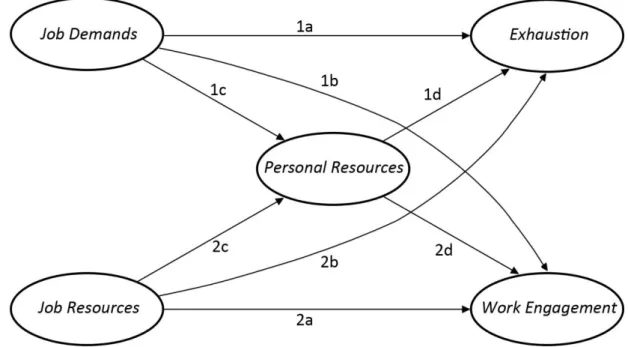
12 and are more productive. Thus, I expect job demands to have a positive relation with proactive behavior, assertiveness, worker flexibility and work engagement. Taken together, I formulate the following hypotheses (also, see Figure 1.):
Hypothesis 1b: Job demands relate positively to work engagement. Hypothesis 1c: Job demands relate positively to personal resources
(proactive behavior, assertiveness and worker flexibility). Hypothesis 1d: Personal resources relate negatively to exhaustion.
Hypothesis 1e: The positive relationship between job demands and exhaustion is partially mediated by personal resources. Hypothesis 1f: The negative relationship between job demands and work
engagement is partially mediated by personal resources. Hypothesis 2c: Job resources relate positively to personal resources. Hypothesis 2d: Personal resources relate positively to work engagement. Hypothesis 2e: The positive relationship between job resources and work
engagement is partially mediated by personal resources. Hypothesis 2f: The negative relationship between job resources and
exhaustion is partially mediated by personal resources.
Figure 1. The conceptual research model with hypotheses of direct relations.
Note. Only hypotheses of direct effects are presented in the figure. The indirect hypotheses consist of direct hypotheses: hypothesis 1e consists of 1a,c,d; hypothesis 1f consists of 1b,c, and 2d; hypothesis 2e consists of 2a,c,d; hypothesis 2f consists of 2b,c, and 1d.
13
2. Method
2.1 Procedure and participants
The present study has been conducted via an interactive website. In return for filling in the questionnaire participants received a feedback report on their scores. In total, 2318 participants filled in the questionnaire, of which 50.4% was female. The average age was 43.42 years (SD = 11.01). The average working experience was 18.75 years (SD = 11.38). The average level of education of the participants was high, 79.1% finished higher education or scientific education. Participants worked mostly in ICT (18.9%), education (16.5%), government (15.1%), or health care (12.8%).
2.2 Measures
The Cronbach’s alpha coefficients of al studied variables were between .80 and .93. therefore all variables had a very good internal consistency (>.80) according to Nunally and Bernstein (1994).
Job Demands
Workload was assessed with a five-item scale developed by Veldhoven & Meijman (1994). A typical item is “Do you have too much work to do?” The internal consistency of the scale (Cronbach’s α = .90) was very good. Emotional demands were measured with the six-item scale of Veldhoven & Meijman (1994), including “Do you face emotionally charged situations in your work?” The internal consistency of the scale was very good (Cronbach’s α = .80). Mental Demands were assessed with a five-item scale developed by Veldhoven & Meijman (1994). A typical item is “Does your work demand a lot of concentration?” The internal consistency of the scale was very good (Cronbach’s α = .87). All job demands items were scored on a five-point scale, ranging from (1) ‘never’ to (5) ‘always’.
Job Resources
Autonomy was measured with a three-item scale developed by Bakker, Demerouti, and Verbeke (2004), based on Karasek’s (1985) job content instrument (e.g., ‘‘Do you have control over how your work is carried out?”). The internal consistency of the scale was very good (Cronbach’s α = .85). Supervisory coaching was measured with a five-item Dutch
14 adaptation (Le Blanc, 1994) of Graen and Uhl-Bien’s (1991) scale (e.g., ‘‘My supervisor uses his/her influence to help me solve my problems at work”). The internal consistency of the scale was very good (Cronbach’s α = .91). Opportunities for professional development were measured with a four-item scale constructed by Bakker, Demerouti, Taris, Schaufeli, and Schreurs (2003). An item is ‘‘My work offers me the possibility to learn new things”. The internal consistency of the scale was very good (Cronbach’s α = .86). All job resources items were scored on a five-point scale, ranging from (1) ‘never’ to (5) ‘always’, except the opportunities for professional development items, where the scale ranged from (1) ‘totally disagree’ to (5) ‘totally agree’.
Personal Resources
Proactive behavior was measured with the seven-item ‘personal initiative’ scale developed by Frese, Fay, Hilburger, Leng and Tag (1997), which included: “I immediately take the initiative when others do not.” The internal consistency of the scale was very good (Cronbach’s α = .82). Assertiveness was measured with a ten-item scale developed by Schaufeli (2010) which included: “I do not hesitate to put forward my view, when in a meeting.” The internal consistency of the scale was very good (Cronbach’s α = .86). Worker flexibility was measured with a ten-item scale developed by Schaufeli (2010) which included: “If my work requires that I change my schedule than I am willing to change it.” The internal consistency of the scale was very good (Cronbach’s α = .86). All the items of the three above personal resources were scored on a five-point scale, ranging from (1) ‘totally disagree’ to (5) ‘totally agree’. All negative keyed items were recoded.
Exhaustion
Exhaustion was measured with the five-item subscale of the Dutch version (Schaufeli & Van Dierendonck, 2000) of the Maslach Burnout Inventory–General Survey (Schaufeli, Leiter, Maslach, & Jackson, 1996). This subscale includes five items, such as “I feel emotionally drained from my work.” The internal consistency of the scale was very good (Cronbach’s α = .91). All the items of the exhaustion scale were scored on a six-point scale, ranging from (0) ‘never’ to (6) ‘always’. All negative keyed items were recoded so that higher scores refer to a higher score on the construct.
15
Work engagement
Work engagement was measured with the nine-item version of the Utrecht Work Engagement Scale (UWES; Schaufeli et al., 2006a). The UWES reflects three underlying dimensions, which are measured with three items each: Vigor (e.g., ‘‘At my work, I feel bursting with energy”), Dedication (e.g., ‘‘My job inspires me”), and Absorption (e.g., ‘‘I get carried away when I am working”). High scores on all three dimensions indicate high work engagement. Items were scored on a scale ranging from (0) ‘never’ to (6) ‘always’. In this research only the dimensions of vigor and dedication were used to estimate work engagement. The internal consistency of the scales vigor (Cronbach’s α = .91) and dedication (Cronbach’s α = .93) was very good.
2.3 Data analyses
Firstly, the means, standard deviations, Cronbach’s alpha coefficients and bivariate correlations between the variables were calculated with SPSS version 20.0.
Secondly, Confirmatory Factor Analysis (CFA) was performed to determine the distinction of the psychological constructs of job resources, job demands, personal resources, work engagement and exhaustion. Specifically, three CFA models were compared. The first model (M1) is a one-factor measurement model with sixteen indicators, workload, emotional demands, mental demands, autonomy, supervisory coaching, opportunities for professional development, proactive behavior, assertiveness, worker flexibility, vigor, dedication and five items of the exhaustion scale. The second model (M2) is a two-factor model. The two factors are negative wellbeing and positive wellbeing. The indicators of negative wellbeing are workload, emotional demands, mental demands and the five items from the exhaustion scale. The indicators of positive wellbeing are autonomy, supervisory coaching, opportunities for professional development, proactive behavior, assertiveness, worker flexibility, vigor and dedication. The third model (M3) is a five-factor model where job demands (workload, emotional demands and mental demands), job resources (autonomy, supervisory coaching and opportunities for professional development), personal resources (proactive behavior, assertiveness, and worker flexibility), exhaustion (five items of the exhaustion scale) and work engagement (vigor and dedication) are five separate factors. CFA has been conducted with the AMOS-software version 20.0.
16 Thirdly, I used AMOS to conduct Structural Equation Modeling (SEM) to test all the hypotheses. Five models (M1 – M5) were tested; The first model (M1) assumes no mediation and only obtains direct paths from job demands to exhaustion, job resources to work engagement, personal resources to exhaustion, and personal resources to work engagement. The second model (M2) assumes mediation of personal resources in the relation between job demands and exhaustion. Therefore, a direct path (job demands to personal resources) was added to the model on top of the direct paths of Model 1. The third model (M3) assumes mediation of personal resources in both the relation between job demands and exhaustion, and in the relation between job demands and work engagement. Therefore, a direct path (job demands to work engagement) was added to the model. The fourth model (M4) assumes mediation of personal resources in the relation between; job demands and exhaustion, job demands and work engagement, and job resources and work engagement. Another direct path (job resources to personal resources) was added to the model. The fifth model (M5) assumes mediation of personal resources in the relation between; job demands and exhaustion, job demands and work engagement, job resources and work engagement, and in the relation between job resources and exhaustion. In order to test this another direct path (job resources-exhaustion) was added to the model. The fifth model (M5) is the final research model. All non-significant paths have been excluded from this model.
The fit of the models was assessed with the Chi-square (χ²) statistic, the Root Mean Square Error of Approximation (RMSEA), and the Goodness of Fit Index (GFI). However, the probability of rejecting a hypothesized model increases when sample size increases, because χ² is sensitive to sample size. To overcome this problem, the computation of relative goodness-of-fit indices is strongly recommended (Bentler, 1990). Three relative goodness-of-fit indices were computed: the Comparative Fit Index (CFI), the Incremental Fit Index (IFI), the Normed Fit Index (NFI). The first is particularly recommended for model comparison purposes (Goffin, 1993). For each of these fit indices, values of .90 or higher represent acceptable fit and values of .95 or higher are an indication of good fit (Hu & Bentler, 1999). The only exception is the RMSEA, for which values between .09 and .08 indicate an acceptable fit to the data and lower than .08 indicate good fit to the data (MacCallum, Browne & Sugawara, 1996). Furthermore, I controlled for the 90% confidence intervals of the RMSEA. A narrow confidence interval is an indication for good precision of
17 the RMSEA (MacCallum et al., 1996). Additionally, the Akaike Information Criterion (AIC; Akaike, 1987) has been calculated. The AIC has been used to compare the different models in their fit to the model. The lowest AIC value indicates the best fit (Akaike, 1987).
Finally, parametric bootstrap analysis was conducted to test whether personal resources have a mediating effect in the relation between job demands and exhaustion, job demands and work engagement, job resources and work engagement, and job resources and exhaustion, respectively. Bootstrap analysis is a resampling method which estimates the properties of an estimator (such as its variance and standard error) by measuring those properties when sampling from an approximating distribution (Preacher & Hayes, 2008). Bootstrapping is useful to test indirect effects, because the focus of (parametric) bootstrapping is on the distribution in the data set and not on the distribution via a normal distribution. Therefore, bootstrapping can better approximate the standard error and distribution (Shrout & Bolger, 2002). The bootstrap analysis is based on 2000 samples. The mediation effect is confirmed by the bootstrap analysis when the confidence interval does not contain zero.
3. Results
3.1 Preliminary analyses
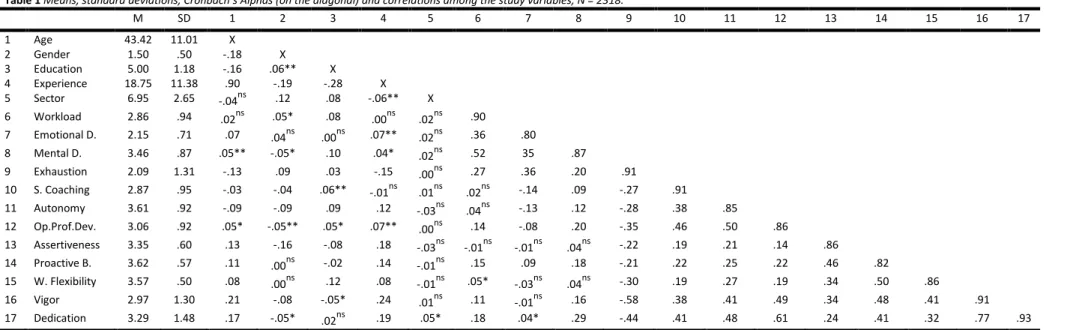
Means, standard deviations, Cronbach’s alpha coefficients, and bivariate correlations among the studied variables are presented in table 1. All correlations were in the expected direction and significant.
The results of the CFA supported the representation of the five factors: job demands, job resources, personal resources, exhaustion and work engagement, in the model as distinct factors, since the five factor model (M3) fitted better to the data than the one-factor model (M1) Δχ² (10) = 5865.13, p < .001), and the two factor model (M2) (Δχ² (9) = 2418.12, p < .001). The five factor model had an acceptable fit to the data (χ² (94) = 1530.83; RMSEA = .08; GFI = .92; CFI = .92; IFI = .92; NFI = .92; AIC = 1614.83). The results of the CFA are presented in table 2.
1 Age 43.42 11.01 X 2 Gender 1.50 .50 -.18 X 3 Education 5.00 1.18 -.16 .06** X 4 Experience 18.75 11.38 .90 -.19 -.28 X 5 Sector 6.95 2.65 -.04ns .12 .08 -.06** X 6 Workload 2.86 .94 .02ns .05* .08 .00ns .02ns .90 7 Emotional D. 2.15 .71 .07 .04ns .00ns .07** .02ns .36 .80 8 Mental D. 3.46 .87 .05** -.05* .10 .04* .02ns .52 35 .87 9 Exhaustion 2.09 1.31 -.13 .09 .03 -.15 .00ns .27 .36 .20 .91 10 S. Coaching 2.87 .95 -.03 -.04 .06** -.01ns .01ns .02ns -.14 .09 -.27 .91 11 Autonomy 3.61 .92 -.09 -.09 .09 .12 -.03ns .04ns -.13 .12 -.28 .38 .85 12 Op.Prof.Dev. 3.06 .92 .05* -.05** .05* .07** .00ns .14 -.08 .20 -.35 .46 .50 .86 13 Assertiveness 3.35 .60 .13 -.16 -.08 .18 -.03ns -.01ns -.01ns .04ns -.22 .19 .21 .14 .86 14 Proactive B. 3.62 .57 .11 .00ns -.02 .14 -.01ns .15 .09 .18 -.21 .22 .25 .22 .46 .82 15 W. Flexibility 3.57 .50 .08 .00ns .12 .08 -.01ns .05* -.03ns .04ns -.30 .19 .27 .19 .34 .50 .86 16 Vigor 2.97 1.30 .21 -.08 -.05* .24 .01ns .11 -.01ns .16 -.58 .38 .41 .49 .34 .48 .41 .91 17 Dedication 3.29 1.48 .17 -.05* .02ns .19 .05* .18 .04* .29 -.44 .41 .48 .61 .24 .41 .32 .77 .93
Note I. Emotional D. = emotional demands; Mental D. = mental demands; S. Coaching = Supervisory Coaching; Op.Prof.Dev. = Opportunities for Professional Development; Proactive B. = Proactive Behavior; W. Flexibility = Worker Flexibility.
Note II. All correlations are significant at p < .001. Exceptions have been marked with the following: * p < .05.
** p < .01.
ns
= Not significant
Table 2 Goodness-of-fit indices of the competing CFA models, N = 2318.
# Model χ² df RMSEA GFI CFI IFI NFI AIC Comparison Δχ² Δ df
1 One-Factor Model 7395,96 104 .17 .61 .61 .61 .61 7459,96 M1 – M3 5865.13 10
2 Two-Factor Model 3948.95 103 .13 .80 .79 .79 .79 4014.95 M1 – M2 2418.12 1
3 Five-Factor Model 1530.83 94 .08 .92 .92 .92 .92 1614.83 M2 – M3 3447.01 9
Note I. χ² = Chi-square; df = degrees of freedom; RMSEA = root mean square error of approximation; GFI = goodness-of-fit index; CFI = comparative fit index; IFI = incremental fit index; NFI = normed fit index; AIC = Akaike Information Criterion.
comparisons. The results with respect to the fit of the models indicated that the fifth model (M5) (χ² (94) = 1530.83; RMSEA = .08; GFI = .92; CFI = .92; IFI = .92; NFI = .92; AIC = 1614.83) had a significant better fit to the data than fourth model (M4) (Δχ² (1) = 301.50, p < .001), the third model (M3) (Δχ² (2) = 637.53, p < .001), the second model (M2) (Δχ² (3) = 664.46, p
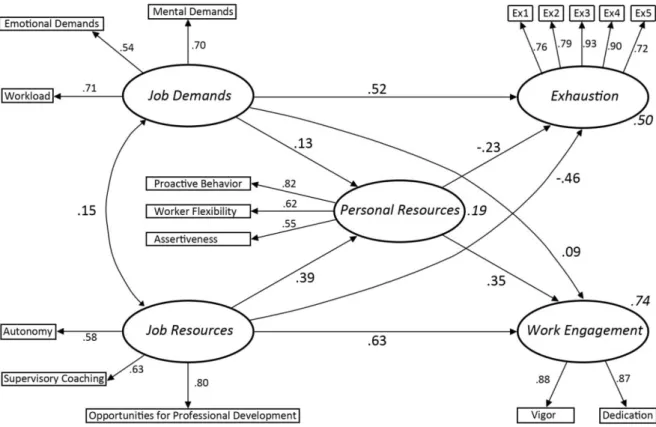
< .001), and the first model (M1) (Δχ² (4) = 728.86, p < .001). The fifth model (M5) is the final model and is presented in Figure 2.
Figure 2. The final model (M5) with partial mediation of personal resources in the
relation between job demands/resources and exhaustion/work engagement. Note I. Only standardized path coefficients are presented in the figure.
Note II. All path coefficients presented were significant at p < .001.
The results of the final model showed that all direct paths were significant. The results of the bootstrap analyses (table 4) confirmed these results, because all tested confidence intervals did not include zero.
Firstly, the results of the direct effects in the energetic erosion process showed a moderate positive relation (γ = .52, p < .001) between job demands and exhaustion, a weak positive relation (γ = .13, p < .001) between job demands and personal resources and a weak
20 negative relation (γ = -.23, p < .001) between personal resources and exhaustion. Thus, confirming hypotheses 1a, 1c, and 1d. Secondly, the results considering indirect effects in the energetic erosion process showed a very weak negative indirect effect (γ = -.03) of job demands on exhaustion. This indicates that the positive relationship between job demands and exhaustion is partially mediated by personal resources, because both the direct effects and indirect effects were significant (p < .001). In coherence with the above findings, results showed a very weak positive direct relation (γ = .09, p < .001) between job demands and work engagement and a very weak positive indirect effect (γ = .05) of job demands on work engagement. These results indicate that the positive relationship between job demands and work engagement is partially mediated by personal resources, because both the direct effects and indirect effects were significant (p < .001). Hence, I confirmed hypotheses 1b, 1e and 1f. Thirdly, the results considering the direct effects in the motivational process showed a strong positive relation (γ = .63, p < .001) between job resources and personal resources, a moderate positive relation (γ= .39, p < .001) between job resources and personal resources, and a moderate positive relation (γ = .35, p < .001) between personal resources and work engagement. Therefore, hypotheses 2a, 2c, and 2d were confirmed. Fourthly, results considering the indirect effects in the motivational process showed a weak positive indirect effect (γ = .14) of job resources on work engagement. These results indicate that the positive relationship between job resources and work engagement was partially mediated by personal resources, because both the direct effects and indirect effects are significant (p
< .001). In addition, the results of the direct relation between job resources and exhaustion showed a moderate negative relation (γ = -.46, p < .001). Together with the results of the indirect effect of job resources on exhaustion (a weak negative indirect effect, γ = -.09 p < .001), these results indicate that the negative relationship between job resources and exhaustion is partially mediated by personal resources, because both the direct effects and indirect effects were significant (p < .001). As such, hypotheses 2b, 2e and 2f were confirmed. Finally, the final model explained 50% of the variance in exhaustion, 19% of the variance in personal resources, and 74% of the variance in work engagement, respectively.
1 No mediation 2259.69 98 .10 .89 .88 .88 .88 2335.68 M1 – M5 728.86 4
2 Mediation JD-EX 2195.29 97 .10 .90 .89 .89 .88 2273.30 M2 – M5 664.46 3
3 Mediation JD-EX, JD-WE 2168.36 96 .10 .90 .89 .89 .89 2248.36 M3 – M5 637.53 2
4 Mediation JD-EX, JD-WE, JR-WE 1832.33 95 .09 .91 .91 .91 .90 1914.33 M4 – M5 301.50 1 5 Mediation JD-EX, JD-WE, JR-WE, JR-EX 1530.83 94 .08 .92 .92 .92 .92 1614.83
Note I. JD = job demands; JR = job resources; PR = personal resources; WE = work engagement; EX = exhaustion; χ² = Chi-square; df = degrees of freedom; RMSEA = root mean square error of approximation; GFI = goodness-of-fit index; CFI = comparative fit index; IFI = incremental fit index; NFI = normed fit index; AIC = Akaike Information Criterion.
Note II. All chi-squared (χ²) and delta chi-squared coefficients (Δχ²) were significant at p < .001.
Table 4 Direct, indirect and total relations between variables of the final model (M5).
Relations Bootstrap analysis Confidence interval (95%)
# γ Standard Error Lower boundary Upper boundary
Direct effects:
1 Job demands and exhaustion .52 .03 .47 .56
2 Job demands and work engagement .09 .02 .06 .13
3 Job demands and personal resources .13 .04 .07 .19
4 Job resources and work engagement .63 .02 .59 .67
5 Job resources and exhaustion -.46 .03 -.51 -.41
6 Job resources and personal resources .39 .03 .34 .44
7 Personal resources and exhaustion -.23 .03 -.28 -.18
8 Personal resources and work engagement .35 .03 .30 .39
Indirect effects via personal resources:
9 Job demands, exhaustion -.03 .01 -.05 -.02
10 Job demands, work engagement .05 .01 .03 .07
11 Job resources, work engagement .14 .01 .12 .16
12 Job resources, exhaustion -.09 .01 -.11 -.07
Total effects:
13 Job demands and exhaustion .49 .02 .45 .52
14 Job demands and work engagement .14 .02 .10 .18
15 Job demands and personal resources .13 .04 .07 .19
16 Job resources and work engagement .77 .02 .74 .80
17 Job resources and exhaustion -.55 .02 -.59 -.51
18 Job resources and personal resources .39 .03 .34 .44
19 Personal resources and exhaustion -.23 .03 -.28 -.18
20 Personal resources and work engagement .35 .03 .30 .39
Note I. Only standardized values are presented in this table. Note II. All direct and indirect effect were significant with p < .001.
resources (proactive behavior, assertiveness, and worker flexibility) in predicting burnout and work engagement. Using the Conservation of Resource (COR) theory (Hobfoll, 1989; 2001) as the fundamental theory behind the JD-R model (Demerouti et al., 2001), I examined whether personal resources mediate the relationship between job demands and job resources on the one hand and burnout and work engagement on the other hand.
The findings show that personal resources partially mediate the relation between job demands and exhaustion (1e) and work engagement (1f), and the relation between job resources and work engagement (2e) and exhaustion (2f). In other words, employees who experience high workload, emotional demands and mental demands, are more likely to experience exhaustion (1a) more engagement (1b), and are more likely to act proactive, assertive, and flexible (1c). Also, employees who experience autonomy at work, supervisory coaching and opportunities for professional development, experience more engagement (2a), less exhaustion (2b) and are more likely to act proactive, assertive, and flexible (2c). In addition, employees who are proactive, assertive, and flexible experience less exhaustion (1d) and more engagement (2d).
4.1 Theoretical Contributions
In the present study, I found support for a unique contribution of the personal resources proactive behavior, assertiveness, and worker flexibility, over and above the impact of job demands and job resources on burnout and engagement. Moreover, I found interactions of these personal resources with job demands and job resources, which effect burnout and engagement. In short, I found that employees who are better able to stand up for own rights (assertiveness), anticipate on resource loss by actively searching for new resources (proactive behavior), and are better able to adapt to changing organizational circumstances wherein resource loss will be evident (worker flexibility), will be more successful in protecting themselves from resource loss and the consequences (loss spiral and burnout). This is in line with COR theory (Hobfoll, 2002), which states that resource gain is especially salient in context of resource loss. Additionally, the acquiring of new resources enriches the resource pool of employees, which has a positive influence on the resilience of employees,
23 because employees who have greater resource pools are less susceptible to resources loss (Hobfoll, 2002).
The present study is one of the first to show that perceived proactive behavior, assertiveness, and worker flexibility as a personal resource, can help in further explaining associations of job demands and resources with exhaustion and engagement. The value of proactive behavior, assertiveness, and worker flexibility is that they reinforce the impact of job resources (e.g. autonomy) and/or are triggered by (low) external job demands (e.g. workload) in decreasing burnout and increasing engagement. More specifically, these findings indicate that employees who experience autonomy at work, receive supervisory coaching and feedback, and have opportunities for professional development are more likely to develop proactive behavior, assertiveness, and worker flexibility, which in turn has a positive effect on work engagement and a negative effect on exhaustion. Altogether, these findings support the COR theory on ‘resource caravans’ (Hobfoll, 2002; 2011), which states that the existence of resources tends to generate other resources. In this case, autonomy, supervisory coaching, and opportunities for professional development form a resource caravan. The existence of these resources increases the chance that employees will develop proactive behavior, worker flexibility, and assertiveness, if so these resources can join the resource caravan. Thus, the existence of job resources clearly generates personal resources, which has a positive effect on engagement and a negative effect on exhaustion. In addition, the evidence of the partial mediation of personal resources in the positive relation between job demands and exhaustion, and in the positive relation between job demands and work engagement, suggests that employees who experience high workload, emotional demands and mental demands are a little bit more likely to act proactive, assertive, and flexible and therefore they experience a little bit more exhaustion and engagement. However, the effect sizes of the effects found in these relations are very weak. As such, the conclusions drawn from these findings are a point of discussion.
Furthermore, because this study tested personal resources as one construct, this does not allow us to assume anything with regard to specific effects of the individual resources proactive behavior, assertiveness, and worker flexibility on exhaustion and work engagement. However, there is reason to assume the direction of an effect. For example, the directions of the effect of personal resources on work engagement suggests that proactive behavior is a determinant (Dikkers, et al., 2009), rather than an outcome
24 (Salanova & Schaufeli, 2008) of work engagement. In contrast, research of Hakanen, et al. (2008) describes that proactive behavior may act as a determinant as well as an outcome of work engagement. They argue that the two constructs form a gain spiral (Hobfoll, 2011), wherein both constructs mutually and positively influence each other over time (Hakanen, et al., 2008). This is in line with the Broaden-and-Build theory of Frederickson (2000), which states that positive emotions broaden people’s momentary thought-action repertoires and build their enduring personal resources. People are more likely to experiment, play and be creative if they experience positive emotions. This kind of initiative and creative activity fosters new ideas, novel solutions, and optimal functioning (Fredrickson, 2000). In short, proactive employees experience more work engagement, which develops more proactive behavior.
Finally, the evidence of the present study also replicates previous studies (e.g., Demerouti et al., 2001; Schaufeli & Bakker, 2004) on the role of job demands as main determinants of exhaustion and the role of job resources as main determinants of work engagement (e.g., Schaufeli & Bakker, 2004; Xanthopoulou et al., 2007; Xanthopoulou et al., 2009). The results show that employees who experience high workload, emotional and mental demands have an increased chance of becoming exhausted and eventually increase their chances on developing burnout (Demerouti et al., 2001). High workload, emotional demands and mental demands deplete resources of employees, which leads to stress and eventually exhaustion. The results also show that employees who experience autonomy at work, receive supervisory coaching and high-quality feedback, and have opportunities for professional development are more likely to be vigorous and dedicated in their professions (Schaufeli & Bakker, 2004). In short, those employees are likely to show higher levels of engagement. In general, the reason why job resources both have motivational potential and can act as buffers in the exhaustion process, is that resources prevent stress by balancing out job demands. According to the matching hypothesis, specific resources buffer the effects of matching demands (Bakker, Hakanen, Demerouti & Xanthopoulou, 2007). For example, supervisor coaching may influence the effect of emotional demands by showing appreciation and support and therefore puts the demands in another perspective.
25
4.2 Limitations and Future Research Directions
The present study has shown some promising results with regard to the personal resources proactive behavior, assertiveness, and worker flexibility. Nonetheless, there are certain limitations as well. Firstly, the cross-sectional design allows the estimation and prediction of outcomes, however strictly speaking, it does not allow conclusions about causality, because no effects over time were tested. For example, in order to test gain spirals of engagement and proactive behavior, and resource caravans of opportunities for development and proactivity, empirical evidence on reciprocal relationships and on changes in means over time (minimum of three measurement moments) are essential (Salanova, Schaufeli, Xanthopoulou & Bakker, in press, 2010). Thus, to make more valid conclusions it is recommended to use a longitudinal design in future research.
Secondly, the observations were based solely on self-reports, which might have inflated the relationships among the variables. Although most studies in the field exclusively rely on self-reports, and the experiences of the employee are important measures, some variables can be assessed with more objective measures. For example, supervisory coaching can be assessed by observer ratings based on job analysis. Thus, to exclude common method variance, it is recommended to replicate the study with the use of more objective measures, such as observations and interviews.
Thirdly, the present study is based on a somewhat homogeneous sample, because the average level of education was high. The average level of education is related to the average level of intelligence (Ganzach, 1998). In general, people who are intelligent have more cognitive resources available and are better able to make strategic choices (Judge, Colbert & Ilies, 2004). Therefore, intelligent employees are able to consciously and strategically manage their resources, as so they are more likely to make use of their personal resources. This might affect the way they experience job demands and resource loss and gain. Therefore, it is possible that the average level of intelligence of the participants influences the relations between the variables. These possibilities should be tested in future research. For now, the level of education limits the generalizability of the results to a population of high level of education/intelligence.
Fourthly, the large sample size (2318 participants) enhances the chance of relations to be significant. For example, the direct relation between job demands and work
26 engagement is significant, but the effect size is very small and as such no solid conclusions can be drawn from it.
Finally, the testing of personal resources as one construct does not allow me to assume anything with regard to specific effects of the individual resources proactive behavior, assertiveness, and worker flexibility on exhaustion and work engagement. In future research it is recommended to test all three resources individually in the JD-R model so that specific mediation and possibly moderator effects of the three resources can be charted.
4.3 Practical Implications
Practitioners can use the findings of this study to counter exhaustion and promote engagement in their organization by consciously regulating the balance between demands and resources. Of special importance is the gain of resources, since it is especially salient in context of resource loss (Hobfoll, 2002; 2011). Therefore practitioners who plan cutbacks or reorganization within the organization, that increase the demands on employees and/or decrease the resources of employees, will do best to plan a parallel action with a focus gaining new resources. For example, when the financial crisis has forced the organization to shrink in size, this might result in an increase in the workload and a decrease in autonomy for employees. In this situation it would be wise to try to increase opportunities for development and make sure that flexible and proactive behavior is rewarded in some way. This fosters the development of these personal resources, so that the balance between demands and resources can be restored.
Moreover, practitioners can use the specific findings of this study to support and develop training programs for employees in proactive behavior, assertiveness, and worker flexibility. Assertiveness can be enhanced by specific training. In addition, worker flexibility can be enhanced by promoting the shearing of task and job related knowledge within the organization (Volpe et al., 1996). This can be accomplished by specific policies (e.g., working in diverse teams) or by developing cross-organizational training programs, which promote task and job related contact. This increases the chance employees will help each other and increases their ability to adapt to organization changes. Furthermore, it is useful for practitioners to develop an organizational framework or culture that promotes proactive behavior. Nothing is more disappointing than to have initiatives which is not supported by
27 the organization, or is blocked by organizational restrictions. According to Hobfoll (2011), organizations must focus on creating passageways for the resource caravans. Caravan passageways for organizations are the environmental conditions that support, foster, enrich, and protect the resources of individuals, sections or segments of workers, and organizations in total, or that detract, undermine, obstruct, or impoverish people’s or group’s resource reservoirs (Hobfoll, 2011). Specific policies can be made to create good passageways. For example, proactive behavior should be supported by supervisors and colleagues. This increases the chance of proactive behavior in the future, because effective proactive behavior leads to work engagement, which leads to more proactive behavior in time (Hakanen et al., 2008). Therefore, a training program for proactive behavior and responding to proactive behavior (assertiveness and worker flexibility) would be worth investigating.
Additionally, practitioners can use the findings of this study to create a tool for selection and recruitment of employees. The assessment of (personal) resources of (potential) employees is important for practitioners, so they can make an substantiated and accurate decision of which employee best fits the position available.
4.4 Conclusion
This study successfully expanded the knowledge on personal resources in the JD-R model (Demerouti, et al., 2001), by showing that proactive behavior, assertiveness, and worker flexibility play a significant role in predicting work engagement and exhaustion. Personal resources can form resource caravans with job resources as autonomy, supervisory coaching, and opportunities for professional development. The main message for practitioners is that job and personal resources lead to engaged workforces, who seem able to mobilize additional resources to prevent resource loss and promote resource gain. Therefore, organizations should focus on creating resourceful work environments and on training programs that enhance effective use of resources.
28
References
Agrell, A., & Gustafson, R. (1996). Innovation and creativity in work groups. In M.A. West (Ed.), Handbook of work group psychology. 317–344. New York: Wiley.
Akaike, H. (1987), “Factor analysis and AIC,” Psychometrika, 52, 317-332. Arbuckle, J.L. (2005), Amos 6.0 User’s Guide, Chicago, IL: SPSS Inc.
Bakker, A. B., & Demerouti, E. (2008). Towards a model of work engagement. Career Development International, 13 (3), 209-223.
Bakker, A. B., Demerouti, E. & Euwema, M.C. (2005). Job resources buffer the impact of job demands on burnout. Journal of occupational health psychology, 10, 2, 170-180. Bakker, A. B., Demerouti, E., Taris, T., Schaufeli, W. B., & Schreurs, P. (2003). A multi-group
analysis of the job demands–resources model in four home care organizations.
International Journal of Stress Management, 10, 16–38.
Bakker, A. B., Demerouti, E., & Verbeke, W. (2004). Using the job demands–resources model to predict burnout and performance. Human Resource Management, 43, 83–104. Bakker, A. B., Hakanen, J. J., Demerouti, E., & Xanthopoulou, D. (2007). Job resources boost
work engagement particularly when job demands are high. Journal of Educational Psychology, 99, 274–284.
Bentler, P.M. (1990). Comparative fit indexes in structural equation models. Psychological Bulletin, 107, 238–246.
Blyton, P., & Morris, J. (1992). HRM and the limits of flexibility. In P. Blyton & P. Turnbull (Eds.), Reassessing human resource management. 116–130. London: Sage. Cordery, J.L. (1996). Autonomous work groups and quality circles. In M.West (Ed.),
Handbook of Work Group Psychology. (pp. 225–246). Chichester: Wiley. Crant J. M. (2000). Proactive behavior in organizations. Journal of Management, 26,
435-462.
Demerouti, E., Bakker, A. B., Nachreiner, F., & Schaufeli, W. B. (2001). The werkeisen– resources model of burnout. Journal of Applied Psychology, 86, 499–512.
Dikkers, J. S. E., Jansen, P. G. W., de Lange, A. H., Vinkenburg, C. J., & Kooij, D. (2010).
Proactivity, job characteristics, and engagement: A longitudinal study. Career Development International, 15(1), 59-77.
Frese, M., Kring, W., Soose, A., & Zempel, J. (1996). Personal initiative at work: Differences between East and West Germany. Academy of Management Journal, 39, 37–63. Frese, M., Fay, D., Hilburger, T., Leng, K., & Tag, A. (1997). The concept of personal initiative:
Operationlization, reliability and validity in two German samples. Journal of Occupational and Organizational Psychology, 70, 139–161.
Fry, T.D., Kher, H.V., & Malhotra, M.K. (1995). Managing worker flexibility and attrition in dual resource constrained job shops. International Journal of Production Research, 33, 2136–2179.
Fuller, J. B., Marler, L. E., & Hester, K. (2006). Promoting felt responsibility for constructive change and proactive behavior: Exploring aspects of an elaborated model of work design. Journal of Organizational Behavior, 27(8), 1089-1120.
Gaillard, A.W.K. (2003). Stress, productiviteit en gezondheid (2nd Ed.). Amsterdam: Uitgeverij
Nieuwe zijde.
Ganzach, Y. (1998). Intelligence and job satisfaction. Academy of Management Journal, 41, 526-539.
Goffin, R.D. (1993). A comparison of two new indices for the assessment of fit of structural equation models. Multivariate Behavioral Research, 28, 205–214.
29 Hakanen, J.J., Perhoniemi, R. and Toppinen-Tanner, S. (2008), Positive gain spirals at work:
from job resources to work engagement, personal initiative and work-unit innovativeness, Journal of Vocational Behavior,73 (1), 78-91.
Halpern, D. F. (2005). How time-flexible work policies can reduce stress, improve health, and save money. Stress and Health: Journal of the International Society for the Investigation of Stress, 21, 157-168.
Hargie, O. (2011). Skilled Interpersonal Communication. Research, Theory and Practice. 5th edition. Sussex, Routledge.
Hobfoll, S. E. (1989). Conservation of resources: A new attempt at conceptualizing stress.
American Psychologist, 44(3), 513–524.
Hobfoll, S. E. (2001). The influence of culture, community, and the nested-self in the stress process: Advancing Conservation of Resources theory. Applied Psychology: An International Review, 50(3), 337–370.
Hobfoll, S. E. (2002). Social and psychological resources and adaptation. Review of General Psychology, 6(4), 307–324.
Hobfoll, S. E. (2011). Conservation of resource caravans and engaged settings. Journal of occupational and Organizational Psychology, 84, 116–122.
Hobfoll, S. E., Johnson, R. J., Ennis, N., & Jackson, A. P. (2003). Resource loss, resource gain, and emotional outcomes among inner city women. Journal of Personality and Social Psychology, 84, 632–643.
Hobfoll, S.E. and Shirom, A. (2000). Conservation of resources theory: applications to stress and management in the workplace. In: Golembiewski, R.T. (Ed.), Handbook of Organization Behavior, 2nd Revised Edition, pp. 57–81. Marcel Dekker, New York. Hu, L. and Bentler, P.M. (1999), “Cutoff criteria for fit indexes in covariance structure
analysis: conventional criteria versus new alternatives,” Structural Equation Modeling, 6, 1-55.
Judge, T. A., Bono, J. E., Erez, A., & Locke, E. A. (2005). Core self-evaluations and job and life satisfaction: The role of self-concordance and goal attainment. Journal of Applied Psychology, 90, 257–268.
Judge, T. A., Colbert, J. E., & Ilies, R. 2004. Intelligence and leadership: A quantitative review and test of theoretical propositions. Journal of Applied Psychology, 89, 542-552. Karasek, R. A. (1979). Job demands, job decision latitude and mental strain. Administrative
Science Quarterly, 24, 285-308.
Karasek, R. A. (1985). Job Content Questionnaire and user's guide. Lowell: University of Massachusetts Lowell, Department of Work Environment.
Le Blanc, P. (1994). De steun van de leiding: Een onderzoek naar het leader member exchange model in de verpleging [Support from leaders: A study on the leader member exchange model among nurses]. Amsterdam: Thesis Publishers.
Luthans, F., Avey, J. B., Avolio, B. J., Norman, S. M., & Combs, G. M. (2006). Psychological capital development: Toward a micro-intervention. Journal of Organizational Behavior, 27, 387–393.
Luthans, F., Avolio, B., Avey, J. B., & Norman, S. M. (2007). Psychological capital: Measurement and relationship with performance and job satisfaction. Personnel Psychology, 60, 541–572.
Luthans, F., Norman, S. M., Avolio, B. J., & Avey, J. B. (2008). The mediating role of psychological capital in the supportive organizational climate–employee performance relationship. Journal of Organizational Behavior, 29, 219–238