An adaptive turbo-shaft engine modeling method based on
PS and MRR-LSSVR algorithms
Wang Jiankang
a, Zhang Haibo
a,*
, Yan Changkai
a, Duan Shujing
b,
Huang Xianghua
aa
College of Energy and Power Engineering, Nanjing University of Aeronautics and Astronautics, Nanjing 210016, China bAviation Motor Control System Institute, Aviation Industry Corporation of China, Wuxi 214063, China
Received 22 October 2011; revised 20 December 2011; accepted 19 March 2012 Available online 16 January 2013
KEYWORDS Adaptive engine model; Least square support vector regression machine; Modeling method; Parameter selection; Turbo-shaft engine
Abstract In order to establish an adaptive turbo-shaft engine model with high accuracy, a new modeling method based on parameter selection (PS) algorithm and multi-input multi-output recur-sive reduced least square support vector regression (MRR-LSSVR) machine is proposed. Firstly, the PS algorithm is designed to choose the most reasonable inputs of the adaptive module. During this process, a wrapper criterion based on least square support vector regression (LSSVR) machine is adopted, which can not only reduce computational complexity but also enhance generalization performance. Secondly, with the input variables determined by the PS algorithm, a mapping model of engine parameter estimation is trained off-line using MRR-LSSVR, which has a satisfying accu-racy within 5&. Finally, based on a numerical simulation platform of an integrated helicopter/ turbo-shaft engine system, an adaptive turbo-shaft engine model is developed and tested in a certain flight envelope. Under the condition of single or multiple engine components being degraded, many simulation experiments are carried out, and the simulation results show the effectiveness and valid-ity of the proposed adaptive modeling method.
ª2013 CSAA & BUAA. Production and hosting by Elsevier Ltd.
1. Introduction
Unlike a fixed-wing aircraft, a helicopter has a direct mechan-ical link with its turbo-shaft engine, so the coupling reaction
between the helicopter and the engine is obvious, and a dy-namic response of the engine will give a significant influence on the helicopter’s agility and conventional performance.1,2 Usually, an engine may inhale large quantities of sand or va-por with salt when a helicopter works in terrible conditions, such as near the ground or a sea-level state. Over time, the deteriorations of engine components caused by various physi-cal faults (e.g., foreign object damage, blade erosion and cor-rosion, worn seals, excess clearances, and so on) may be ever-increasing so that the operation and control of the engine are inaccurate or misleading, even having a serious influence on the helicopter’s flight quality. Therefore, it is remarkably attractive to build an onboard adaptive engine model, which * Corresponding author. Tel.: +86 25 84892201 8401.
E-mail addresses: [email protected] (J. Wang),
[email protected](H. Zhang).
Peer review under responsibility of Editorial Committe of CJA.
Production and hosting by Elsevier
Chinese Society of Aeronautics and Astronautics
& Beihang University
Chinese Journal of Aeronautics
[email protected]www.sciencedirect.com
1000-9361ª2013 CSAA & BUAA. Production and hosting by Elsevier Ltd.
http://dx.doi.org/10.1016/j.cja.2012.12.020
Open access under CC BY-NC-ND license.
can detect engine components’ deteriorations and meantime provide engine performance tracking in real time, including turbine rotor speed, stall margin and power, etc.3,4
At home, there have been few formal studies about adap-tive modeling methods of turbo-shaft engines. Only Ref. 4 introduces a technique using Kalman filter based on rotor/tur-bo-shaft engine. Kalman filter is the most popular method for engine parameter estimation abroad, which can acquire a set of tuners that would adapt a state variable model to match ac-tual observations (hence driving the residuals to zero, on the average), derived by the residuals formed by the output of an embedded piecewise simplified engine model and the actual observed measurements.5However, due to multi-step iterative calculations, Kalman filter must cost much more time to achieve an optimal estimation. In order to improve real-time ability, some literatures have proposed another method based on data, i.e., neural network, which can finish engine parame-ter estimation with a short period of computing time.6 But
neural network also has obvious drawbacks: its solution is eas-ier to trap to the local extremum, and its generalization ability also needs to be improved. As a consequence, the applications of Kalman filter and neural network to parameter estimation of aero-engines is somewhat restricted.
In recent decades, another algorithm based on data, named support vector machine (SVM), has been applied in the field of machine learning.7In comparison with neural network, SVM is built on a so-called structural risk minimization principle which holds good generalization performance, but its training complexity burden, called the quadratic programming, is expensive. As a variation, the least square support vector ma-chine (LSSVM) has been proposed,8which uses equality con-straints instead of inequality ones and squared errors as the loss function to mitigate the training complexity. However, LSSVM is not sparse compared with normal SVM, which blocks its predicted speed. On the basis of LSSVM, various de-rived algorithms such as SMO-based pruning methods for sparse LSSVM (SMO-LSSVM), fast sparse approximation for LSSVM (FSA-LSSVM), reduced least squares support vec-tor regression (R-LSSVR), recursive reduced least squares sup-port vector regression (RR-LSSVR), etc., have been proposed to realize the sparseness or improve real-time ability of algo-rithms.9–11RR-LSSVR gains advantage over common sparse tricks,10since it is involved in the whole constraints generated
by all training patterns after combining the iterative strategy11 with the reduced technique9 in the modeling process. Mean-time, RR-LSSVR needs smaller scale subset, which shortens predicting time and strengthens sparseness. Inspired by above illustrations, a deterioration estimator design scheme based on RR-LSSVR is taken into account. However, RR-LSSVR is only suitable for single-output systems. For a multi-output problem, it needs many separate RR-LSSVR modules to per-form, which makes the algorithm more complex and increases the number of training patterns. Additionally, it cannot con-sider the comprehensive actions of multi-output variables to select training patterns. In this paper, an algorithm, called mul-ti-input multi-output recursive reduced least square support vector regression (MRR-LSSVR), is proposed. Compared with RR-LSSVR, MRR-LSSVR can select less and better sup-port vectors to solve multi-output problems owing to consider-ing the comprehensive actions of multi-output variables.
With the aid of MRR-LSSVR, online and real-time nonlin-ear relationship between an engine’s measurable variables (i.e.,
dependent variables) and its performance deteriorations can be created. However, it is still a key problem which dependent variables can be selected as the inputs of the parameter estima-tion module. The choice directly affects whether the adaptive model can accurately track or not.
In recent years, parameter selection (PS) has become the fo-cus of numerous research studies in areas where datasets with tens or hundreds of variables are available. The main draw-back in PS resides in its combinatorial nature, turning into a non-deterministic and poly-nominal hard problem. The use of an exhaustive search method is unpractical for large num-bers of variables. Therefore the design of efficient methods and reliable criteria becomes crucial in the data analysis work-flow. Generally, PS algorithms are grouped into two main cat-egories: (1) filter methods, which select variables independently to the predictor, and (2) wrapper methods, in which the way of selecting variables is related to the predictor’s performance. Because the purpose of PS is to eliminate irrelevant variables to enhance the generalization performance and curtail the computational complexity, the wrapper methods outperform the filter ones. Ref.12put forward a wrapper criterion which ranks variables based on the generalization ability of LSSVR. In this paper, based on multi-input multi-output LSSVR, a PS algorithm with the wrapper criterion for an adaptive engine model is proposed.
As a result, utilizing PS and MRR-LSSVR algorithms, an adaptive turbo-shaft engine model is developed in a certain flight envelope. Through case studies on an integrated helicop-ter/turbo-shaft engine numerical simulation platform with a high fidelity, it is proved that the established adaptive engine model can track a real engine rapidly not only in a steady state but also during a transient operation, and perform parameter estimation for single or multiple engine performance deteriorations.
2. Simulation platform
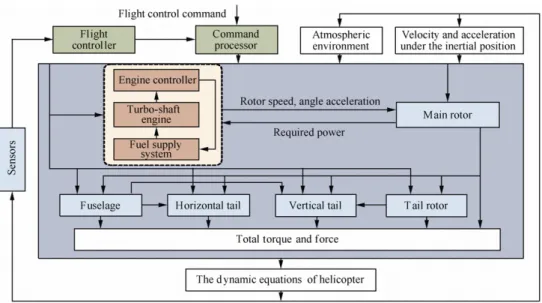
An integrated helicopter/turbo-shaft engine system13is a sort of cascade systems which have complex coupling relationships. This system is used as the simulation platform in this paper which mainly consists of the following four parts: open-loop model of helicopter, flight controller, open-loop model of turbo-shaft engine, and engine controller. The schematic dia-gram of the integrated system is depicted in Fig. 1, and the helicopter model and turbo-shaft engine model are introduced as follows.
2.1. Helicopter model
In this paper, a real-time helicopter model is built based on UH-60A Black Hawk helicopter data. This model is an unstea-dy nonlinear aerounstea-dynamic model, which contains fuselage, main rotor, tail rotor, horizontal tail, and vertical tail. Among these components, there are many complex close-coupling ac-tions (seeFig. 1). Through a series of equilibrium computa-tions and calculacomputa-tions of dynamic equacomputa-tions, such as balancing rotor model, fuselage model, and so on, the required power of the helicopter can be worked out and sent to the tur-bo-shaft engine together with some flight parameters. In Ref.
13
, a great amount of tests were performed to check the accu-racy of this helicopter model. The results prove that this model
has a good fidelity and is able to carry out digital flight simu-lations of routine missions.
2.2. Turbo-shaft engine model
Fig. 2depicts the structure of a component-level model of the turbo-shaft engine, which is established based on T700 engine data set. InFig. 2, the engine station numbers represent the in-let or outin-let of engine components.
During the engine modeling procedure, every component model of the engine is created using the engine’s thermody-namic characteristic and typical experimental data at first. Next, with the benefits of power balance, flow equilibrium, pressure equilibrium, and rotor dynamics equations, the bal-ance equations among engine components can be constructed and calculated. Finally, the Newton–Raphson iterative meth-od and once-pass-through algorithm are adopted in order to solve the steady-state engine model and dynamic engine mod-el, respectively.
3. Adaptive engine model
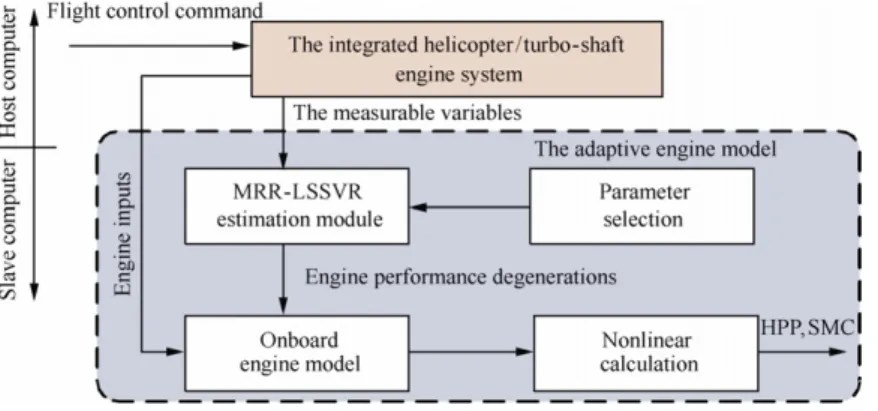
Fig. 3shows the structure diagram of the adaptive engine mod-el. This system consists of a host computer and a slave
com-puter of the two-level system. The host comcom-puter is to simulate the actual integrated helicopter/turbo-shaft engine system. The slave computer is to replace the adaptive engine model, which is used for tracking the engine’s state and esti-mating its performance deterioration in real time, including a MRR-LSSVR estimation module, an onboard nonlinear en-gine model, and a nonlinear calculation module, where the in-put of the estimation module is determined by a PS algorithm. InFig. 3, HPP represents required power of rotor and SMC the compressor stall margin.
When the integrated helicopter/engine system is working under non-nominal condition, the outputs of the MRR-LSSVR module, i.e., the values of engine performance deteri-orations, will be calculated, and the onboard engine model will be corrected immediately. In this section, firstly, the multi-in-put multi-outmulti-in-put LSSVR algorithm is concisely described, and then the PS algorithm with the wrapper criterion, the MRR-LSSVR algorithm, and the design of the parameter esti-mation module are introduced one by one as follows.
3.1. LSSVR algorithm
For a multi-input multi-output system, considering the train-ing sample set fðxi;yiÞg
N
i¼1 of size N, where xi is the input pattern, yi= [yi,1yi,2 yi,M] is the corresponding target, and M is the number of output variables, the mathematical model of LSSVR is obtained14,15: min wm;ei;m Jðwm;ei;mÞ ¼ 1 2 XM m¼1 wTmwmþ c 2 XM m¼1 XN i¼1 e2i;m s:t:yi;m¼wT mumðxiÞ þbmþei;m ði¼1;2; ;N; m¼1;2; ;MÞ ð1Þ
wherewmrepresents the model complexity,ei,mrepresents the error between actual output and predictive value,bmis the off-set,c2R+is a regularization parameter which can control the tradeoff between the flatness of the model and the closeness to the training data, andum(Æ) is a nonlinear mapping which can transform the input data into a high-dimensional feature Fig. 2 Structure of the turbo-shaft engine.
space. In order to solve the above optimization problem, the Lagrange function without constraints can be constructed as:
Lðwm;bm;ei;m;ai;mÞ ¼J XM m¼1 XN i¼1 ai;m wTmumðxiÞ þbm þei;myi;m ð2Þ
where ai,m is Lagrange multiplier. Hence, Karush–Kuhn– Tucker (KKT) conditions of Eq.(1)can be expressed as:
oL owm ¼0!wm¼ XN i¼1 ai;mumðxiÞ oL obm ¼0!X N i¼1 ai;m¼0 oL oei;m ¼0!ai;m¼cei;m oL oai;m ¼0!wT mumðxiÞ þbmþei;myi;m¼0 8 > > > > > > > > > > > > > > > < > > > > > > > > > > > > > > > : ð3Þ
After eliminatingwmandei,m, the following linear function is obtained: 0 1T 1 K " # b a ¼ 0 Y ð4Þ where Y¼½Y1 Y2 . . . YM ¼ y1;1 y1;2 y1;M y2;1 y2;2 . . . y2;M .. . .. . .. . yN;1 yN;2 . . . yN;M 2 6 6 6 4 3 7 7 7 5 a¼½a1 a2 . . . aM ¼ a1;1 a1;2 . . . a1;M a2;1 a2;2 . . . a2;M .. . .. . .. . aN;1 aN;2 . . . aN;M 2 6 6 6 6 4 3 7 7 7 7 5 b¼½b1 b2 bM 1¼½1 1 1N1 0¼½0 0 0M1
K is the matrix whose element Kij¼kðxi;xjÞ ¼uTðxiÞ
uðxjÞ þdij=c with dij¼
1; i¼j
0; i–j
. Among all the kernel functions, Gaussian kernel k(xi,xj) = exp(ixi xji2/(2t2)) is the most popular choice, wheretrepresents the kernel parameter. In this paper, Gaussian kernel is used, and after solving Eq. (4),a and bcan be computed. For a new pattern x, the predictor of multi-input multi-output LSSVR is gotten as follows14,15:
fmðxÞ ¼ XN
i¼1
ai;mkðxi;xÞ þbmðm¼1;2;. . .;MÞ ð5Þ
3.2. PS algorithm
As for Eq.(5), a problem is still not solved, that is, which mea-surable variables of the engine will be used as input variables for the adaptive module. In this section, a wrapper criterion for ranking variables is introduced.12
After combining Eqs. (2) and (3), the equation without constraints for the Wolfe dual optimization problem can be attained: min Lðbm;ai;mÞ ¼ XM m¼1 1 2 XN i;j¼1 ai;maj;mkðxi;xjÞ þ 1 2c XN i¼1 a2 i;m " ( X N i¼1 ai;myi;mþbm XN i¼1 ai;m #) ð6Þ
And then Eq.(6)can be reformulated for convenience:
min Lðbm;amÞ ¼ XM m¼1 1 2 bm a T m 0 1T 1 K " # bm am " ( bm aTm 0 Ym ð7Þ Next, let am¼ bm aTm T and dL=dam¼0, where
m= 1,2,. . .,M, the following equation is obtained:
bm am ¼ 0 1 T 1 K " #1 0 Ym ð8Þ
Finally, substituting Eq.(8)into Eq.(7), the optimal valueL of Eq.(7)is gotten in the following:
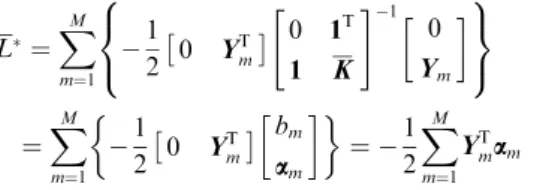
L¼X M m¼1 1 2 0 Y T m 0 1T 1 K " #1 0 Ym 8 < : 9 = ; ¼X M m¼1 1 2 0 Y T m bm am ¼ 1 2 XM m¼1 YT mam ð9Þ
If theith variable is removed,LðiÞ ¼ 1 2 PM m¼1 Y T mamðiÞ , wheream(i) is the solution of Eq.(8)without theith input var-iable. Thus, a wrapper criterion for ranking variables can be put forward12: DðiÞ ¼X M m¼1 YTmðamamðiÞÞ ð10Þ
In the process of computation, if the value ofD(i) is smaller than the value ofD(j)(j„i), the ith variable is considered to make less contribution to the optimal valueLthan thejth var-iable. As for the turbo-shaft engine in this paper, there are 20 measurable variables (i.e., inputx) for the selection, and out-put variables are y= [y1 y2 y3] = [Dcom Dgas Dpow],
whereDcomrepresents compressor flow deterioration,Dgas rep-resents gas turbine efficiency deterioration, and Dpow repre-sents power turbine flow deterioration. If L acquires the optimal value L, the estimation accuracy of the variable (Dcom,Dgas,Dpow) will be the best. And then, by removing
the ith input variable, D(i) can be calculated based on Eq. (10). According to the sequenceD(i), we can rank the variables, discard those variables with small values of D(i), and select input variables which make more contributions to L (see
Table 1) as input variables of the MRR-LSSVR estimation module.
During the selecting process, it is needed to analyze the vari-ables’ measurability at first, which shows that the varivari-ables’ val-ues are easily acquired. In the list ofTable 1, the values ofT4,p4, T41, andp41are hardly acquired because the sensor is generally not allowed to set in high-temperature parts. The remaining variables are 20 measurable variables. ConsideringT2and P2
are worked out withHandVx, andT8is equal toT46,T2,p2, andT8also have no use for selection. And then, based on the above PS algorithm, we can choose the variables which have more contributions to variable estimation from all remaining variables. At last, utilizing the debugging method, eight input variables are selected, which are x = [x1 x2 . . . x8] =
[H Vx Ng Np p3 p44 T44 T45].
3.3. MRR-LSSVR algorithm
From Eq.(5), it is clear that every training sample is support vector, so LSSVR is not sparse. Using the reduction strategies presented in Ref. 9, after letting wm¼
P
i2Sai;mkðxi;Þ and substituting it into Eq. (1) where the subset
fðxi;yiÞgi2S fðxi;yiÞg N
i¼1, andSis the index class of the useful
subset, we get the corresponding form as follows:
min Lðbm;amÞ ¼ 1 2 XM m¼1 aTmKam ( þc 2 XM m¼1 XN i¼1;i2S yi;mX j2S aj;muTmðxjÞumðxjÞbm !29 = ; ð11Þ
whereKi,j=k(xi,xj),i,j2S. LetoL/obm= 0 andoL/oai,m= 0, the following linear equation is gained:
ðRþZZTÞ b a ¼ZY ð12Þ where R¼ 0 0 T 0 K=c and Z¼ 1 T b K with Kb ¼kðxi;xjÞ; i2S; j¼1;2;. . .;N:In Eq. (13), if R+ZZT is singular, a small change R+ZZT+ 108I will find the solution.10 Therefore, for a new sample x, we can obtain R-LSSVR as follows:
fmðxÞ ¼ X
i2S
ai;mkðxi;xÞ þbmðm¼1;2;. . .;MÞ ð13Þ Because the subset {(xi,yi)}i2S in Eq.(13) is selected ran-domly, R-LSSVR is lack of sparseness or the generalization ability is degraded, so it is important to select the subset. With the iterative strategy presented in Ref.11, we can pick up the patterns which make more contributions to the optimization target to form the subset.10Reformulating Eq.(11), we have:
min L¼X M m¼1 bm aTm 0 0T 0 K=c " # " ( þ 1 T b K " # 1 KbT ! bm am 2 1 T b K " # Ym !T bm am #) ð14Þ
And Eq.(12)can be unfolded as follows: Table 1 List of variables selection.
Symbol Definition Choice
H(m) Flight altitude p
Vx(mÆs1) Forward speed
p
Ng(%) Gas turbine rotor relative speed p Np(%) Power turbine rotor relative speed p T2(K) Compressor inlet total temperature · p2(Pa) Compressor inlet total pressure · T3(K) Compressor outlet total temperature · p3(Pa) Compressor outlet total pressure p T4(K) Combustor outlet total temperature · p4(Pa) Combustor outlet total pressure · T41(K) Gas turbine inlet total temperature · p41(Pa) Gas turbine inlet total pressure · T42(K) Gas turbine outlet total temperature · p42(Pa) Gas turbine outlet total pressure · T43(K) Air-entraining section total temperature
after gas turbine
· p43(Pa) Air-entraining section total pressure after
gas turbine
· T44(K) Power turbine inlet total temperature p p44(Pa) Power turbine inlet total pressure p T45(K) Power turbine outlet total temperature · p45(Pa) Power turbine outlet total pressure p T46(K) Air-entraining section total temperature
after power turbine
· p46(Pa) Air-entraining section total pressure after
power turbine
· T8(K) Nozzle outlet total temperature · p8(Pa) Nozzle outlet total pressure ·
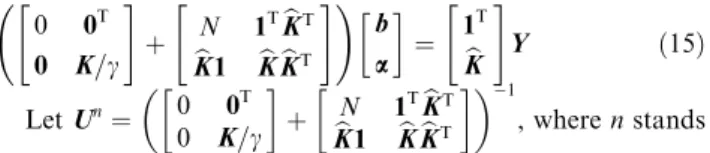
0 0T 0 K=c " # þ N 1 TKbT b K1 KbKbT " #! b a ¼ 1T b K " # Y ð15Þ LetUn¼ 0 0 T 0 K=c þ N 1TKbT b K1 KbKbT 1 , wherenstands for the nth iteration. If the qth training patternxqis chosen at the (n+ 1)th iteration, we can get Un+1 using the Sher-man–Morrison formula: Unþ1¼ U n 0 0T 0 þf b 1 bT 1 ð16Þ where f¼ kqqþ^kTq k^q ^kTq1 ^kTqKbTþk T q h i b 1 ; b¼Un 1 T^ kq kqþKbKbq " # ;kq¼ kðxq;xiÞ kðxq;xiþ1Þ .. . kðxq;xjÞ 2 6 6 6 4 3 7 7 7 5; k^q¼ kðxq;x1Þ kðxq;x2Þ .. . kðxq;xiÞ 2 6 6 6 4 3 7 7 7 5 withi,i+ 1,. . .,j2S.
And then, with the equation b n m an S;m ¼Un ^0 b YS;m , Eq.(17) will be obtained: bnmþ1 anþ1 S;m anþ1 q;m 2 6 6 6 4 3 7 7 7 5¼U nþ1 ^ 0 b YS;m ^ yq;m 2 6 6 4 3 7 7 5¼ U ^ 0 b YS;m " # 0 2 6 6 4 3 7 7 5 þf bT ^ 0 b YS;m " # y^q;m ! b 1 " # ¼ bnm an S;m 0 2 6 6 4 3 7 7 5þc bT ^ 0 b YS;m " # ^yq;m ! b 1 " # ð17Þ where^0¼PNi¼1yi;m;Ybm¼KYb m;m¼1;2;. . .;M:
In such way,U,am, andbmcan be updated efficiently, and the target function Eq.(14)becomes:
Ln¼X M m¼1 bnm an m T h i 0 0T 0 KSS=c " # þ 1 T b KS " # 1 KbT S h i! " bnm an m 2 1 b KS Ym T bnm an m # Ifan mandb n
mare fixed, andi2P= {1,2,. . .,N}S, we can get: Lnþ1¼min ai;m XM m¼1 1 2 kii=cþ ^ kTi^ki a2 i;mþr n i;mai;m ( ) ð18Þ wherern
i;m is used to denote the approximate error abouty^i;m withan
mandb n
m, which is expressed in the following:
10 rn i;m¼ y^i;m; n¼0 ^ kT i1 ^k T i Kb TþkT S;i=c h i bnm an m y^i;m; n>0 8 > < > : ð19Þ
So the optimal value of Eq.(18)is :
Lnþ1¼ X M m¼1 rn i;m 2 2 kii=cþk^Tik^i ð20Þ
Finally, if training samplexiin P subset meets the demand of mini2PLn+1,xiwill be selected as support vector. At last, ter-minate selecting patterns from P subset while max PMm¼1rn P;m
<e(eis a small positive constant) or until reaching the predefined size of support vectors (define asQ).
In the above way, for a multi-input multi-output system, after combining the iterative computation of the kernel matrix inversion with the strategy of selecting a reduced subset, the MRR-LSSVR algorithm is able to be realized, which takes the multi-output comprehensive influences on selecting sup-port vectors into consideration. Additionally, compared with RR-LSSVR at a cost ofO(2uMN), a multi-input multi-output problem can be solved with a better real-time ability using MRR-LSSVR at a cost ofO(2uN), whereO(Æ) is the computa-tion complexity, M> 1, and u is the number of input variables.
For the MRR-LSSVR estimation module in this paper, output variables arey= [y1y2y3] = [Dcom Dgas Dpow],
and eight input variables x= [x1x2 . . . x8] = [H Vx Ng Np p3 p44 T44 T45] are determined by the PS algorithm. The training dataset is picked based on the turbo-shaft engine component-level model, where the sample size
N= 2160. Additionally, it is needed to predefine the size of fi-nal support vectors or threshold valuee. At last, via the simu-lation debugging method, the training parameters of MRR-LSSVR with Gaussian kernel function are fixed as follows:
The size of final support vectorsQ= 300; The threshold valuee= 0;
The regulatorc= 218;
The kernel parametert= 1.2.
In order to prove the availability of the parameter estima-tion module, the relative errors of a test subset are dis-played inFig. 4. FromFig. 4, it can be seen that the relative errors of
Dcom,Dgas, andDpow, i.e., error-Dcomare all lower than 5&, which achieve a satisfying accuracy level.
3.4. Adaptive engine module
In this paper, the MRR-LSSVR estimation module is designed in a flight envelope of an altitudeH61000 m and a forward speedVx650 m/s, and meanwhile the flight envelope is di-vided with DH= 100 m and DVx= 5 m/s for training net-work. In every engine steady-state operation point, performance degenerations of the engine are set as follows:
Dcom¼0;0:01;0:02;0:03 Dgas¼0;0:01;0:02;0:03
Dpow¼0;0:01;0:02;0:03
Here, one thing should be pointed out: for an actual adap-tive engine model, it is necessary to take six condition param-eters (flow and efficiency deterioration) into consideration, and in this paper only three condition parameters (Dcom,Dpow, and
Dgas) are considered as an example. These three condition
parameters represent the deteriorations of three main engine components (compressor, gas turbine, and power turbine). With the groups of single or multiple deteriorations, the dy-namic training subset can be gained based on the integrated helicopter/engine system. And then, through normalizing the input x of a training sample which is added with the white noise, the MRR-LSSVR mapping module, i.e., the nonlinear mapping relationship between the input xand the output y, will be constructed based on MRR-LSSVR. According to the prominent memory and generalization ability of MRR-LSSVR, the model of engine parameter estimation can be built in every steady-state operation point.
During the realization of the MRR-LSSVR predictor, the module is turned on to track the actual engine state at first. After normalizing the above eight engine measurable parame-ters and putting them as the inputs of the MRR-LSSVR esti-mation module, the outputs of the predictor, i.e.,Dcom,Dgas, andDpow, are worked out. With this MRR-LSSVR estimator
(see Fig. 5), the onboard engine model has a good adaptive capability in this certain flight envelope.
4. Case studies
For the proposed adaptive engine model, the accuracy and generalization ability are the main problems that need careful consideration. In this paper, based on the integrated helicop-ter/turbo-shaft engine simulation system, lots of simulation experiments are carried out to verify the adaptive ability on a computer with an Intel i5 M460 (2.53 + 2.53 GHz) proces-sor and 2.0 GB memory, and the simulation step is 50 ms. In the simulation process, the engine performance deteriorations are imitated by changing the flow or efficiency of different en-gine components together. The simulation results under differ-ent operating conditions are listed as follows, where the parameters with subscript ‘‘r’’ represent the outputs of the ac-tual engine model and the ones with no subscript represent the outputs of the adaptive engine model.
4.1. Simulations with single engine performance deterioration
In this section, on the ground, the simulation tests with single engine component degenerate are implemented. Due to the limited space, we only introduce the simulation of compressor flow deterioration, whose results are similar to those of gas turbine efficiency deterioration or power turbine flow deterioration.
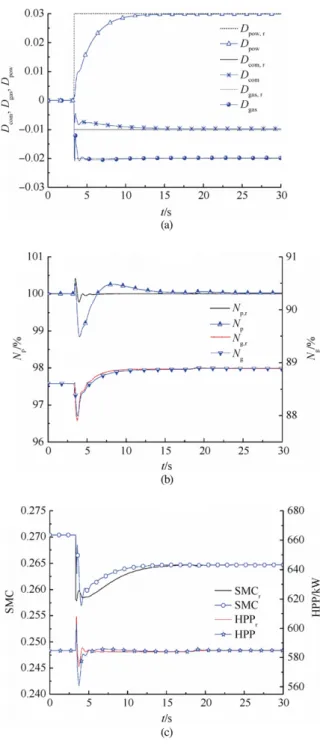
Fig. 6 is the response of compressor flow deterioration. Firstly, at the moment oft= 5 s, engine component degener-ations are set as follows: Dcom,r=0.03, Dgas,r= 0, and Dpow,r= 0. FromFig. 6(a), it can be seen that the estimated error of Dcomis only 1.2%, and Dgas andDpow are close to zero. Subsequently, after correcting the onboard engine model with the estimated error of engine health parameters, the state variables inFig. 6(b) can be obtained, whereNgandNpare gas
turbine and power turbine rotor relative speeds of the adaptive engine model. FromFig. 6(b), we can see that the state of the adaptive engine model can nearly keep in step with the actual engine state, and the dynamic response time of system is about 9 s. Finally, engine performance parameters SMC and HPP can be calculated by the nonlinear calculation module of the adaptive engine model. From Fig. 6(c), it can be seen that the relative steady-state errors of SMC and HPP are 0.1% and 0.02%, respectively, which achieve a good accuracy level. Additionally, computing time of the MRR-LSSVR module is short, below 1 ms in a simulation step, which is enough to meet the requirement of real-time ability.
4.2. Simulations with multiple engine performance deteriorations
Through above single deterioration simulations, it is obvious that the adaptive engine model has a fine adaptive ability. For multiple engine components being degraded together, some digital simulations are performed in this section.
Firstly, at the operation point ofH= 0 m andVx= 0 m/s,
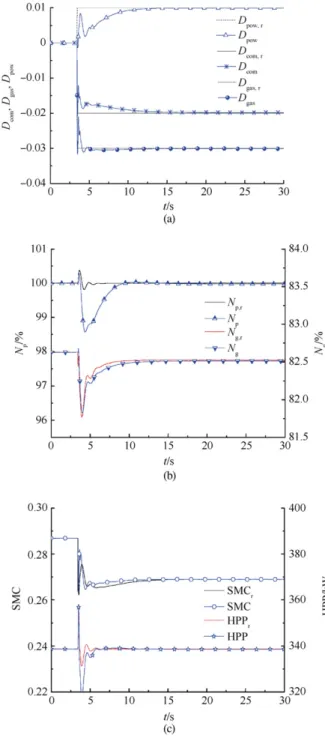
Dcom,r=0.01, Dgas,r=0.02, Dpow,r= 0.03 are set at the moment of t= 5 s. The simulation results are shown in Fig. 7. The dynamic response time of system is about 8 s. Com-pared with the preinstall deteriorations, the estimated values of
Dcom,Dgas, andDpow all attain a high accuracy level, whose
maximum relative steady-state error is 1.87%. This precision achieves the simulation level in Ref.16. Additionally, like the Fig. 5 Realization of the MRR-LSSVR estimator.
case of single deterioration, the computing time of the MRR-LSSVR module is also about 1 ms. Ultimately, the state vari-ablesNg,Npand the performance parameters SMC, HPP of the adaptive engine model can all be in step with the state of the actual engine.
Secondly, at another operating point of H= 800 m,
Vx= 30 m/s with Dcom,r=0.02, Dgas,r=0.03,
Dpow,r= 0.01, the simulation test was performed (seeFig. 8). FromFig. 8, it can be seen that the adaptive model is con-nected at the 5th second. The relative errors of estimated dete-riorations are all close to zero, where the maximum error is 1.35%. In comparison with the steady-state of the actual
en-gine, the precisions ofNg,Np, SMC, and HPP of the adaptive engine model are satisfying.
Putting the facts ofFigs. 7 and 8together, we can find that the adaptive model has a good self-correct ability both on the ground and in the high altitude.
Furthermore, in order to check the generalization ability of the proposed adaptive model in a certain flight envelope, the simulation tests at different operation points are implemented and the test results are listed inTable 2, where the operating points at H= 100 m, Vx= 12 m/s and H= 700 m,
Vx= 44 m/s are out of training samples. InTable 2,E1,max presents the maximum relative steady-state error of estimated Fig. 6 Simulations atH= 0 m,Vx= 0 m/s withDcom,r=0.03,
Dgas,r= 0,Dpow,r= 0.
Fig. 7 Simulations atH= 0 m,Vx= 0 m/s withDcom,r=0.01,
engine degenerations values, andE2,maxstands for the
maxi-mum relative steady-state error of engine performance param-eters. From simulation results of the operating points at
H= 300 m,Vx= 25 m/s andH= 1000 m,Vx= 50 m/s, the relative errors of estimated engine degenerations values are about 1%, and those of engine performance parameters are al-most zero. For the operating points out of training samples, i.e., H= 100 m, Vx= 12 m/s and H= 700 m, Vx= 44 m/s,
E1,max is also below 2%, and E2,max is close to zero. These prove that the adaptive model has a good robustness and fault-tolerant capability, which can estimate the engine deteri-orations successfully in the certain flight envelope of
H61000 m andVx650 m/s. And moreover, the computing time of the MRR-LSSVR estimation module is short, only about 1 ms. It is obvious that the adaptive model based on MRR-LSSVR can meet the requirement of real-time capability in the certain flight envelope.
Finally, as is well known, conventional Kalman filter is the estimated method depending on a state variable model, which needs much time to finish parameter estimations because of multi-step iterative calculations. Compared with Kalman filter, back propagation neural network (BP-NN) and MRR-LSSVR, as the learning method based on data, can both im-prove the computing time of engine parameter estimation dra-matically. InTable 3, simulation comparisons between BP-NN and MRR-LSSVR are listed, where the working point of
H= 0 m, Vx= 0 m/s is the design operation point, and
H= 550 m,Vx= 33 m/s is out of training samples. At the de-sign point, both BP-NN and MRR-LSSVR give high estimat-ing precisions, E1,max about 1.5% and E2,max about zero. However, at the working point ofH= 550 m,Vx= 33 m/s, in comparison with BP-NN, MRR-LSSVR can achieve a high-er precision with similar computing time due to its good gen-eralization ability. As a result, E1,maxusing MRR-LSSVR is Fig. 8 Simulations at H= 800 m, Vx= 30 m/s with
Dcom,r=0.02,Dgas,r=0.03,Dpow,r= 0.01.
Table 2 Simulation results of the adaptive engine model. Parameter H= 100 m, Vx= 12 m/s H= 300 m, Vx= 25 m/s H= 700 m, Vx= 44 m/s H= 1000 m, Vx= 50 m/s Dcom,r 0.01 0.02 0.03 0.03 Dgas,r 0.03 0.01 0.02 0.03 Dpow,r 0.02 0.03 0.01 0.03 Dcom 0.01013 0.01996 0.02997 0.03004 Dgas 0.03014 0.00994 0.02034 0.03023 Dpow 0.02025 0.02981 0.00987 0.02984 E1,max(%) 1.25 0.63 1.70 0.77 SMCr 0.25987 0.29188 0.28130 0.27076 HPPr(kW) 498.34822 356.27485 334.47487 357.22745 SMC 0.25985 0.29186 0.28106 0.27070 HPP (kW) 498.22486 356.32690 334.25888 357.10163 E2,max(&) 0.3 0.2 0.9 0.4 Computing time
About 1 ms About 1 ms About 1 ms About 1 ms
Table 3 Simulation comparisons between BP-NN and MRR-LSSVR. Parameter H= 0 m,Vx= 0 m/s H= 550 m,Vx= 33 m/s BP-NN MRR-LSSVR BP-NN MRR-LSSVR Dcom,r 0.03 0.03 0.03 0.03 Dgas,r 0.03 0.03 0.03 0.03 Dpow,r 0.03 0.03 0.03 0.03 Dcom 0.02986 0.02966 0.02734 0.02986 Dgas 0.03046 0.02997 0.02996 0.03007 Dpow 0.03053 0.03041 0.03078 0.02979 E1,max(%) 1.7 1.4 8.9 0.7 SMCr 0.26028 0.26028 0.28091 0.28091 HPPr(kW) 584.77101 584.77101 328.55633 328.55633 SMC 0.26007 0.26040 0.28064 0.28104 HPP (kW) 584.63942 584.73087 328.67836 328.47652 E2,max(&) 0.8 0.5 1.0 0.5 Computing time Below 1 ms About 1 ms Below 1 ms About 1 ms
only 0.7%, but 8.9% using BP-NN, and therefore the adaptive engine model based on MRR-LSSVR has a stronger robust-ness than the one based on BP-NN.
5. Conclusions
(1) In order to perform parameter estimation considering interactions between engine performance deteriorations while multiple engine components being degraded together, and meantime improve real-time capability of the adaptive module, the MRR-LSSVR algorithm is realized depending on the RR-LSSVR algorithm. (2) Based on multi-input multi-output LSSVR, the PS
algo-rithm with the wrapper criterion is designed to choose reasonable inputs of the MRR-LSSVR estimation module.
(3) Combining MRR-LSSVR and PS, an adaptive modeling method of turbo-shaft engines is proposed based on the simulation platform of an integrated helicopter/turbo-shaft engine system.
(4) Through plenty of simulation experiments, it is proved that the proposed adaptive engine model can track the actual engine state rapidly and exactly, where the maxi-mum relative errors of estimated engine degenerations are below 2% and the deviations of engine performance parameters are almost close to zero. In comparison with BP-NN, the proposed method can achieve a higher esti-mating precision with similar computing time about 1 ms.
Acknowledgments
This study was co-supported by Aeronautical Science Founda-tion of China (No. 2010ZB52011) and Funding of Jiangsu Innovation Program for Graduate Education (No. CXLX11_0213).
References
1. Smith BJ, Zagranski RD. Closed loop bench testing of the next generation control system for helicopter engines. In:AHS Inter-national 58th Annual Forum, Montreal, Canada; 2002.
2. Desai MC, Crainic C. Adaptive thermodynamic engine model for the next generation control system for helicopter engines. In:AHS International 58th Annual Forum, Montreal, Canada; 2002.
3. Luppold RH, Roman JR, Gallops GW, Kerr LJ.Estimating in-flight engine performance variations using Kalman Filter concepts; 1989. Report No.: AIAA-89-2584.
4. Zou XQ, Sun JG, Zhang HB. Adaptive model of rotor/turbo-shaft engine. J Beijing Univ Aeronaut Astronaut 2009;35(10):1192–6 [Chinese].
5. Kobayashi T, Simon DL, Litt JS. Application of a constant gain extended Kalman Filter for in-flight estimation of aircraft engine performance parameters; 2005. Report No.: NASA/TM 2005-213865.
6. Chen T, Sun JG. Aeroengine gas path fault diagnosis using rough sets and neural networks.J Aerospace Power2006;21(1):207–12 [Chinese].
7. Zhang ZS, Li LJ, He ZJ. Based on support vector machine fault diagnosis.J Xian Jiaotong Univ2002;36(3):618–20.
8. Suykens JAK, Vandewalle J. Least squares support vector machine classifiers.Neural Process Lett1999;9(3):293–300. 9. Lin KM, Lin CJ. A study on reduced support vector machines.
IEEE Trans Neural Netw2003;14(6):1449–59.
10. Zhao YP, Sun JG. Recursive reduced least squares support vector regression.Pattern Recognit2009;42(5):837–42.
11. Jiao L, Bo L, Wang L. Fast sparse approximation for least squares support vector machine. IEEE Trans Neural Netw 2007;18(3):685–97.
12. Zhao YP, Sun JG. Thrust estimator design based on least squares support vector regresson machine.J Harbin Inst Technol New Ser 2010;17(4):578–83.
13. Zhang HB, Yao WR, Chen GQ. Design of a numeric simulation platform for integrated turbo-shaft engine/helicopter control system.J Propul Technol2011;32(3):383–90 [Chinese].
14. Lu F, Huang JQ, Qiu XJ. Application of multi-outputs LSSVR by PSO to the aero-engine model. J Syst Eng Electron 2009;20(5):1153–8.
15. Li LJ. The study of modeling algorithm based on LS-SVM and predictive control algorithm [dissertation]. Hangzhou: Zhejiang University; 2008 [Chinese].
16. Espana MD, Gilyard GB. On the estimation algorithm used in adaptive performance optimization of turbofan engines; 1993. Report No.: NASA-TM-4551.
Wang Jiankangreceived his M.S. degree in the aerospace propulsion theory and engineering field from Nanjing University of Aeronautics and Astronautics in 2010. Since then, he has been working toward a Ph.D. degree there. His research interests include modeling, control, and fault diagnosis of aero-engines.
Zhang Haibois an associate professor in the College of Energy and Power Engineering at Nanjing University of Aeronautics and Astro-nautics. He received his Ph.D. degree from the same university in 2005. His main research interests are aero-engine modeling and control.