Knowledge Base Population Systems
Benjamin Roth
Dissertation zur Erlangung des Grades des Doktors der Ingenieurwissenschaften der Naturwissenschaftlich-Technischen Fakult¨aten der Universit¨at des Saarlandes
Thesis for obtaining the title of Doctor of Engineering of the Faculties of Natural Sciences and Technology of Saarland University
Naturwissenschaftlich-Technische Fakult¨at I Mathematik und Informatik
-(Faculty of Mathematics and Computer Science) Universit¨at des Saarlandes
Colloquium: December 22, 2014
Universit¨at des Saarlandes Saarbr¨ucken
Examination Board:
Chairman: Prof. Dr. Raimund Seidel
Universit¨at des Saarlandes
First Reviewer: Prof. Dr. Dietrich Klakow
Universit¨at des Saarlandes
Second Reviewer: PD. Dr. Fabian Suchanek
T´el´ecom ParisTech
Committee Member: Dr. Michael Wiegand
The growing amounts of textual data require automatic methods for structuring rele-vant information so that it can be further processed by computers and systematically accessed by humans. The scenario dealt with in this dissertation is known as Knowl-edge Base Population (KBP), where relational information about entities is retrieved from a large text collection and stored in a database, structured according to a pre-specified schema. Most of the research in this dissertation is placed in the context of the KBP benchmark of the Text Analysis Conference (TAC KBP), which provides a test-bed to examine all steps in a complex end-to-end relation extraction setting.
In this dissertation a new state of the art for the TAC KBP benchmark was achieved by focussing on the following research problems: (1) The KBP task was broken down into a modular pipeline of sub-problems, and the most pressing issues were identified and quantified at all steps. (2) The quality of semi-automatically generated training data was increased by developing noise-reduction methods, decreasing the influence of false-positive training examples. (3) A focus was laid on fine-grained entity type modelling, entity expansion, entity matching and tagging, to maintain as much re-call as possible on the relational argument level. (4) A new set of effective methods for generating training data, encoding features and training relational classifiers was developed and compared with previous state-of-the-art methods.
Die wachsende Menge an Textdaten erfordert Methoden, relevante Informationen so zu strukturieren, dass sie von Computern weiterverarbeitet werden k¨onnen, und dass Menschen systematisch auf sie zugreifen k¨onnen. Das in dieser Dissertation behan-delte Szenario ist unter dem BegriffKnowledge Base Population (KBP) bekannt. Hier werden relationale Informationen ¨uber Entit¨aten aus großen Textbest¨anden automa-tisch zusammengetragen und gem¨aß einem vorgegebenen Schema strukturiert. Ein Großteil der Forschung der vorliegenden Dissertation ist im Kontext des TAC KBP Vergleichstests angesiedelt. Dieser stellt ein Testumfeld dar, um alle Schritte eines anfragebasierten Relationsextraktions-Systems zu untersuchen.
Die in der vorliegenden Dissertation entwickelten Verfahren setzen einen neuen Stan-dard f¨ur TAC KBP. Dies wurde durch eine Schwerpunktsetzung auf die folgenden Forschungsfragen erreicht: Erstens wurden die wichtigsten Unterprobleme von KBP identifiziert und die jeweiligen Effekte genau quantifiziert. Zweitens wurde die Qualit¨at von halbautomatischen Trainingsdaten durch Methoden erh¨oht, die den Einfluss von falsch positiven Trainingsbeispielen verringern. Drittens wurde ein Schwerpunkt auf feingliedrige Typmodellierung, die Expansion von Entit¨atennamen und das Auffinden von Entit¨aten gelegt, um eine gr¨oßtm¨ogliche Abdeckung von relationalen Argumenten zu erreichen. Viertens wurde eine Reihe von neuen leistungsstarken Methoden ent-wickelt und untersucht, um Trainingsdaten zu erzeugen, Klassifizierungsmerkmale zu kodieren und relationale Klassifikatoren zu trainieren.
During the years of my PhD I was supported by several people, who not only made this work an invaluable learning experience, but also an enjoyable journey and an opportunity of personal growth. I am very thankful for their company in the successes and difficult challenges of this journey, and for making this ambitious undertaking an experience that I would not want to miss.
First and foremost, my thanks go to my advisor Dietrich Klakow who supported me constantly, created an atmosphere of open discussion, and who knew how to ask precise and constructive questions that were necessary so that initial ideas could take on a concrete shape. He also took a lot of time to read earlier versions of this thesis and I am thankful for the constructive criticism that helped to improve the final version. Also, during the time of my PhD, teaching the seminars on statistical methods in NLP together with him was one of the most enjoyable duties that I had.
I am very grateful for the generous support by a Google Europe Fellowship in Natural Language Processing that made my PhD possible. Additionally, I greatly profited from the inspiring time that I spent during an internship at Google Research Zurich, and I am especially indebted to Keith Hall and Enrique Alfonseca, with whom I always had a fruitful exchange of ideas and discussions of my research, even after the internship at Google was long over.
I received very important support from my colleagues in the Spoken Language Sys-tem lab at Saarland University. The constant exchange of ideas with them was inspir-ing and kept me motivated to pursue my research goals. I greatly profited both from their feedback as well as from their help with many practical issues. I am especially indebted to Michael Wiegand for the many times he helped me with developing ideas, proof-reading papers and parts of this thesis, and for the constructive collaboration on relation extraction in the food domain. A special thanks goes to Tassilo Barth for the great teamwork in turning dozens of scripts into a solid software system for relation extraction. A big thanks goes to Martin Gropp, for providing the great demo interface for the relation extraction system, and for being an invaluable help when I was struggling with the dark corners of shell scripting, linux networks and servers of all kinds. I’m very thankful to Grzegorz Chrupala and Mittul Singh for working to-gether in getting the relation extraction system ready for the submissions to the TAC
who shared with me her creativity and with whom I could enjoy culture and life. I am truly thankful to her for being so reliable and supportive. Heartfelt thanks also go to my family, and especially to my father for proofreading the thesis for stylistic improvement; to my mother, my sister and my brother, for being there for me and for supporting me in everything that I do.
Contents
List of Figures viii
List of Tables ix
1. Introduction 1
2. Overview of Relation Extraction and Knowledge Base Population 5
2.1. Linguistic Relations, Facts and Ontologies . . . 6
2.2. Automatic Content Extraction (ACE) and Knowledge Base Population (KBP) . . . 7
2.3. Open vs. Closed Schema . . . 11
2.4. Literature Overview . . . 14
2.5. Summary . . . 18
3. Distant Supervision 19 3.1. Problem Statement and Quantification . . . 20
3.2. Survey of Noise Reduction Approaches . . . 24
3.2.1. At-least-one Approaches . . . 24
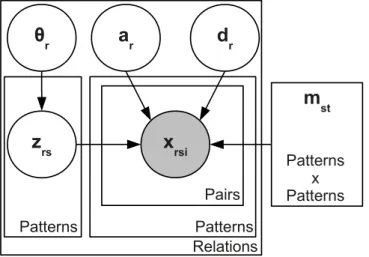
3.2.2. Connection to Predictive Redundancy Models . . . 29
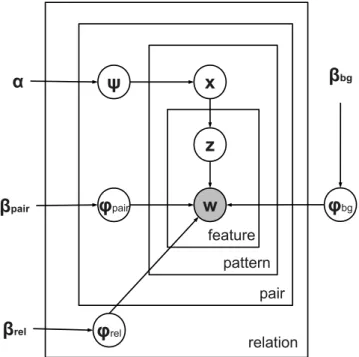
3.2.3. Hierarchical Topic Models . . . 33
3.2.4. Pattern Correlations . . . 35
3.3. Summary . . . 37
4. Better Noise Reduction: A Feature-Based Topic Model and a Novel At-Least-One Ranker 38 4.1. Hierarchical Topic Model . . . 39
4.1.1. Original Model . . . 39
4.1.2. Extended Model: Hierarchical Topic Model with Features . . . . 40
4.2. At-least-one with NilBoost . . . 41
4.3. Model Combination . . . 44
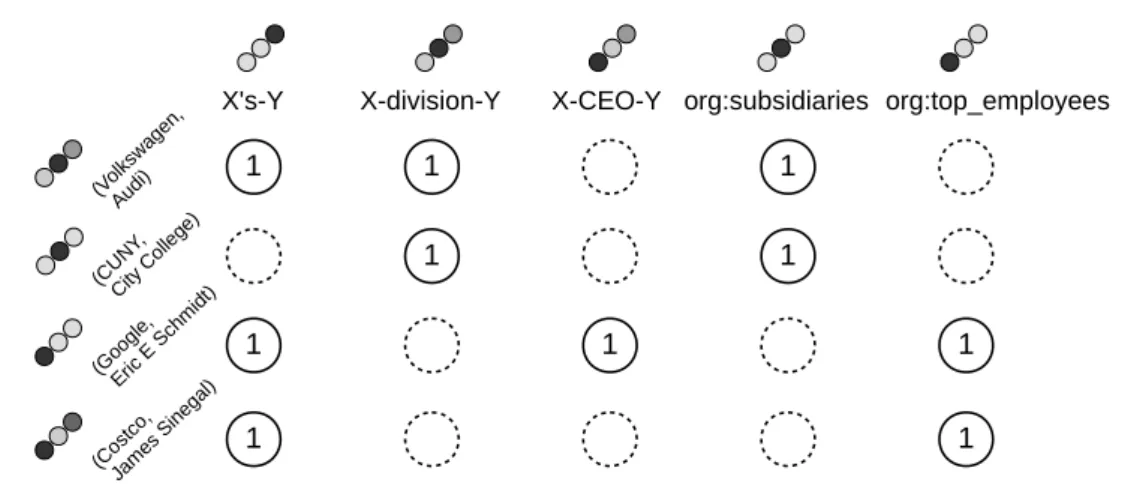
4.4. Universal Schema . . . 45
4.6. End-to-End Evaluation . . . 51
4.7. Illustration: Top-Ranked Patterns . . . 53
4.8. Summary . . . 54
5. End-To-End System 56 5.1. TheRelationFactory System . . . 59
5.2. System Components Overview . . . 60
5.3. Retrieval and Query Entity Matching . . . 63
5.3.1. Expansion Schemes . . . 64
5.3.2. Document Retrieval . . . 67
5.3.3. Evaluation of Query Expansion . . . 68
5.3.4. Candidate Generation . . . 71
5.4. Candidate Recall Analysis . . . 72
5.4.1. Tagging Analysis . . . 75
5.5. Hand-Crafted Patterns . . . 77
5.6. Influence of Hand-Crafted Patterns . . . 78
5.7. Distant Supervision SVM Classifiers . . . 79
5.7.1. Training Data . . . 79
5.7.2. Parameter Tuning . . . 82
5.7.3. Feature Set . . . 85
5.7.4. Aggregate vs. Single Sentence Training . . . 89
5.7.5. Prediction . . . 91
5.7.6. Summary . . . 91
5.8. Distant Supervision Patterns and Noise Reduction . . . 91
5.9. Alternate Names Prediction . . . 92
5.10. Post-processing and Redundancy Removal . . . 93
5.11. Non-Standard Modules . . . 94
5.12. Single Component Analysis and Ablation Analysis . . . 94
5.13. Discussion: Shallow vs. Deep Analysis . . . 97
5.14. Summary . . . 98
6. Sequence Labeling: An Alternative or Enhancement to Classifier-based
6.1. Motivation . . . 99
6.2. Experiments . . . 101
6.3. Discussion . . . 103
6.4. Summary . . . 104
7. TAC Run Characteristics and Comparison with Other End-to-End Systems 105 7.1. System Runs and Results . . . 105
7.2. Overview of Other TAC KBP Systems . . . 107
7.3. Summary . . . 111
8. Matching of Relational Arguments in the Food Domain 112 8.1. General Setup and Motivation . . . 112
8.2. Methodology . . . 114
8.3. Building the Food Graph . . . 115
8.4. Semi-supervised Graph Clustering . . . 116
8.5. Unsupervised Graph Clustering . . . 118
8.6. Experiments: Type Clustering . . . 119
8.7. Experiments: Improving Relation Extraction by using Type Clusters . . 121
8.8. Summary . . . 122
9. Outlook: The Future of Relation Extraction Evaluation 124 10. Conclusion 127 A. Appendix 130 A.1. Summary of TAC KBP Slot Descriptions . . . 130
A.2. List of Organization Suffixes . . . 133
A.3. Per-relation Results . . . 134
List of Figures
1. Wikipedia articles (snippets) with infobox (top) and without infobox
(bottom). . . 9
2. TAC KBP: Given a set of queries, return a correct, complete and non-redundant response with relevant information extracted from the text corpus. . . 10
3. TAC KBP relational schemata for the entity types person and organi-zation. . . 13
4. Distant supervision for knowledge base population (schematic overview). 20 5. MultiR in plate notation. . . 26
6. Hierarchical topic model for distant supervision. . . 33
7. Plate diagram for the Takamatsu model. . . 35
8. Feature-based hierarchical topic model. . . 40
9. Score combination by non-dominated sorting. . . 45
10. Universal Schema matrix for distant supervision training data. . . 46
11. Precision at probability thresholds. . . 49
12. Precision at recall levels. . . 50
13. Ranking-based evaluation measures. . . 51
14. Top-scored patterns for the interpolation method. . . 54
15. Simplified data-flow of the relation extraction system. . . 61
16. Detailed schematic view of the relation extraction system (without train-ing). . . 62
17. Query entity as provided by TAC. . . 63
18. Query expansion using Wikipedia link anchor text statistics. . . 65
19. Path of Freebase relation that corresponds to the TAC KBP relation org:country of headquarters. . . 80
20. Examples of extracted features. . . 86
21. Dependency parse as used for the Mintz feature extraction. . . 88
22. Potential of future relation extraction systems, relative to the methods developed in this work. . . 100
23. Two training sentences for sequence labeling. . . 101
List of Tables
1. Text snippets and gold annotations (ground truth) according to the
ACE 2008 guidelines. . . 7
2. Estimation of error rates for different corpora and relations. . . 23
3. Overview of the experimental settings of the approaches. . . 25
4. Distribution of training data and 95%-quantile for observing at least n sentences. . . 30
5. Ranking quality of extracted facts. . . 52
6. TAC Scores on Surdeanu et al. (2012) queries. . . 53
7. Examples of query expansions. . . 66
8. Influence of the different expansion schemes on end-to-end performance, basic modules (SVM classifier, hand-crafted patterns and alternate names; evaluated on 2012 TAC data). . . 68
9. Influence of the different expansion schemes on end-to-end performance, classifier module only (evaluated on 2012 TAC data). . . 69
10. Recall on candidate level for the different expansion schemes (TAC KBP 2012 data). . . 69
11. Influence of the different expansion schemes on document retrieval (TAC KBP 2012 data). . . 70
12. NER results on BBN section 22. . . 71
13. Bottleneck candidate generation 2012 queries. . . 72
14. Bottleneck candidate generation 2013 queries. . . 72
15. Recall analysis on 2013 data. . . 73
16. Percentage of missed recall attributed to different relations. . . 75
17. Comparison of the NYU hand-crafted pattern modules and the seed pattern component used in our system (LSV). . . 78
18. SVM classifiers trained with distant supervision data from Freebase pairs. 81 19. Using data from pattern matching pairs. . . 81
20. Using merged Freebase and pattern data. . . 81
21. Scores on development data. . . 85
22. Mintz features, using the same sentences as in the standard pipeline. . . 89 23. Mintz features, not using sentences that exceed a maximum length of 50. 89
24. Single sentence training. . . 90
25. Performance of single component and merged component responses. . . 94
26. Precision, Recall and F1-score of the main run configuration when re-moving single components (one at a time), as well as the F1 gain con-tributed by the respective component on top of the other components. . 95
27. End-to-end performance on TAC 2012. . . 103
28. Official (exact) scores on 2013 runs submitted by team LSV, compared with the best submitted runs of the systems most similar in design (Stanford University, New York University). . . 105
29. Performance of other participating systems in the tac 2013 evaluation, according to the overview paper (Surdeanu, 2013). . . 107
30. Food relation types and their respective frequency on the gold dataset. . 113
31. The different food types (gold standard). . . 115
32. Domain-independent patterns for building the similarity graph. . . 116
33. Comparison of different classifiers for the Food Guide Pyramid catego-rization. . . 120
34. Comparison of different classifiers distinguishing between dishes and el-ementary food items. . . 120
35. Comparison of various features (Table 36) for relation extraction. . . 122
36. Description of the feature set. . . 122
37. Per-relation results, noise-reduced distant supervision patterns module. 134 38. Per-relation results, hand-written patterns module. . . 135
39. Per-relation results, alternate-names module. . . 135
40. Per-relation results, SVM classifier module. . . 136
The immense growth of available data on the web has long been recognized as a main motivation for better data analysis and searching techniques. Yet, not only has the sheer amount of data increased, but also the number of use-cases and users that would profit from better access to the information contained in the vast amount of textual data available. The main difficulty in searching large amounts of textual data lies in the fact that it is unstructured: information can be expressed in free form with no restrictions on complexity or scope. The opposite would be a structured data repository, such as a data base with a number of tables listing information according to a specified schema.
There are several ways to access unstructured data: one form that is immediately accessible to humans is to write queries freely specifying their information needs and to display the relevant information in the original unstructured form. This is the strategy usually employed by web search engines such as Google. Another strategy that both makes information more accessible to humans and also allows computers to process the data further, e.g. as part as of a larger information system, is to bring the relevant parts of the unstructured information into a structured form of data tables with pre-specified relationships.
More and more scenarios arise which demand the tabularization of unstructured in-formation from text. They range from extending encyclopedic knowledge with struc-tured data, e.g. extending Wikipedia infoboxes (Hoffmann et al., 2010), over automatic analysis and indexing of research papers, such as in the bio-medical domain (Segura-Bedmar et al., 2013), to an increasing usage of automated and quantitative methods in the humanities, such as the extraction of relationships between fictional characters in literary works (Elson et al., 2010). This wide range of novel use-cases requires reliable, robust and well understood methods for relation extraction.
Most of the research in this dissertation is placed in the context of the Knowledge Base Population benchmark of the Text Analysis Conference (TAC KBP) organized by the National Institute for Standards and Technology (NIST).1 The problem setting for Knowledge Base Population is to search a large text collection for relevant information
given a set of queries, and to structure the retrieved information according to a pre-specified relational schema. This setup together with its extensive manually created evaluation data provides an ideal setup to examine all steps in a complex end-to-end relation extraction setting.
While much of the existing research focuses on single steps and methods in a relation extraction scenario, we aim at studying the end-to-end setting with all the aspects that are involved. The goal of this dissertation is to investigatewhat really matters for performing automatic relation extraction on a level that advances the state of the art. Our approach is therefore to commit to an evaluation setting that is well-justified and well-defined to measure progress in Knowledge Base Population and to seek to devise algorithms approaching that goal.
This dissertation is structured as follows: Chapter 2 gives an overview of previous research in relation extraction and shows the motivation for different relation extrac-tion tasks as well as underlying similarities and distinguishing features. Chapter 2 also defines the problem dealt with in this dissertation, Knowledge Base Population, as fact-centered relation extraction with a defined schema. Chapter 3 turns to the problem that for relation extraction tasks often only very little or no training data is available. As this renders supervised training unfeasible, distant supervision has been proposed, a semi-supervised scheme that uses an initial knowledge base to generate (imperfect) training examples. In Chapter 3, we describe and quantify the types of errors introduced by this training scheme and discuss existing techniques of mitigating some of the inherent problems. In Chapter 4, we propose two models for improved prediction with noisy data: a feature-based generative model and a discriminative model based on ranking constraints. We extensively evaluate those models (and their combination) and compare them with several state-of-the-art baselines.
In Chapter 5, we widen the focus and lay out the architecture of the end-to-end RelationFactory relation extraction system, which was developed in the context of this dissertation and released as open source. We evaluate, for each module, the specific impact on overall performance and motivate the resulting design choices. The pipeline is divided into two stages: (1) a recall orientedcandidate generation stage, for retriev-ing and detectretriev-ing all contexts that potentially contain information related to a query entity and (2) a precision-orientedcandidate validation stage that functions as a filter
the candidate generation stage are. We compare several schemes developed for those tasks and give a thorough analysis of the amount of recall missed during the candidate generation stage. In the second half of Chapter 5 we discuss the relational predictors developed for the candidate validation stage. Apart from the distant supervision pre-dictors already discussed in Chapter 4, the most notable component in this stage is a set of support vector machine classifiers. We extensively experimented with different settings regarding training data, parameter tuning and feature sets. The classification experiments show the advantage of shallow skip-n-gram features when compared with a more brittle state-of-the-art feature set based on dependency parsing. In Chapter 6 we discuss the possibility to extend pipelined approaches by a sequence-labeler, that can undo decisions made by earlier models. We report initial experiments with promising results.
Chapter 7 gives an overview of the 18 systems that participated in the TAC KBP 2013 evaluation campaign and discusses the different research approaches taken. Rela-tionFactory, which was top-ranked in this benchmark, is compared with other systems some of which are similar in certain design aspects (e.g. the Stanford and NYU systems (Angeli et al., 2013; Grishman, 2013)) and others which are dissimilar in the overall approach (e.g. the UMass system (Singh et al., 2013)). Chapter 8 takes a closer look at the problem of detecting relational arguments when they are not of standard en-tity types. For this purpose, we turn to the setting of relation prediction in the food domain, where no training data for learning a sequence label tagger exists. We intro-duce semi-supervised graph-based methods for propagating labeling information with as little as 10 manual seeds per category. We show that this minimally supervised categorization is beneficial to relation prediction and is competitive with another more resource-intensive method using GermaNet (Hamp and Feldweg, 1997), the German WordNet (Miller, 1995). In Chapter 9 we discuss issues pertaining to the re-usability of current knowledge base evaluation resources, and propose a setting which would evaluate the same system aspects while allowing for better re-usability.
The main contributions of this dissertation are:
• A feature-based extension to a generative noise reduction model.
• A new state-of-the-art in performance for relation extraction and knowledge-base population.
• A detailed breakdown of the impact of different modules and design choices on end-to-end performance.
• A shallow feature set that outperforms the previous state-of-the-art based on dependency parses.
• A minimally supervised graph-based method for type-clustering of non-standard named entities.
Parts of this dissertation have been published in the following research papers: • Benjamin Roth, Tassilo Barth, Grzegorz Chrupa la, Martin Gropp, Dietrich Klakow.
RelationFactory: A Fast, Modular and Effective System for Knowledge Base Population. EACL 2014.
• Michael Wiegand, Benjamin Roth and Dietrich Klakow. Automatic Food Cate-gorization from Large Unlabeled Corpora and Its Impact on Relation Extraction. EACL 2014.
• Benjamin Roth, Tassilo Barth, Michael Wiegand, Mittul Singh, Dietrich Klakow. Effective Slot Filling Based on Shallow Distant Supervision Methods. NIST Text Analysis Conference 2013.
• Benjamin Roth, Dietrich Klakow. Combining Generative and Discriminative Model Scores for Distant Supervision. EMNLP 2013.
• Benjamin Roth, Tassilo Barth, Michael Wiegand, Dietrich Klakow. A Survey of Noise Reduction Methods for Distant Supervision. CIKM 2013 Workshop on Knowledge Extraction (AKBC).
Population
Relation extraction is a wide topic, and depending on the goal or focus of research, widely varying approaches are taken. In this section, we give an overview of several aspects that determine the objects of study for a particular method. We will also define what we understand by Knowledge Base Population in the context of this dissertation and introduce two dimensions that are relevant in the context of relational analysis of text: First, whether the (relation analysis) task is defined in linguistic terms, or whether the (relation extraction) task is defined in terms offacts, irrespective of what linguistic form was used to express those facts. Second, whether the relations consid-ered fall into a pre-specified schema, or whether constructing such a schema is itself part of the task. Furthermore, in addition to the previous distinction, we use the termontology to describe all knowledge repositories that containmeta-knowledge, i.e. information about rules on how to combine other knowledge.
In the following chapter, we will position several research tasks along those lines. For example, automatic paraphrase clustering (Lin and Pantel, 2001a) would be a linguistically motivated task with an open schema, since it is defined on linguistic building blocks (short phrases) irrespective of particular instantiations and has no underlying specified schema. Knowledge Base Population on the opposite end aims at extracting content from a text describing real world events, according to a pre-defined schema. The Knowledge Base Population approach, falling into the category of extracting real world facts given a defined schema, can be formulated in the following way: Given a specific information need, expressed as a set of relations of interest, find the relevant information in a large amount of unstructured text, and return it in a structured form.
The rest of this chapter is organized as follows: In Section 2.1, we discuss the difference between relation analysis tasks that are defined in linguistic terms and those that are motivated by real world information needs. In Section 2.2, we illustrate this distinction by contrasting two evaluation benchmarks: the earlier ACE benchmark, and the recent KBP slotfilling. The difference between open schema and closed schema relation extraction is discussed in Section 2.3. Other aspects of relation extraction are
covered in a more comprehensive literature overview in Section 2.4.
2.1. Linguistic Relations, Facts and Ontologies
To clarify the scope of work in this dissertation, we first make a distinction between linguistic relations,facts and ontologies. We denote as linguistic relations those rela-tions that hold between referents in a text or discourse. Linguistic relarela-tions do not necessarily have a grounding or references outside the discourse (text) in which they are expressed (e.g. in the real world). Linguistic relations allow for abstractions suit-able for text-related tasks like textual inference (Tatu and Moldovan, 2005; Burchardt et al., 2007, 2009) or discourse analysis (Ruppenhofer et al., 2010; Louis and Nenkova, 2012; Wang et al., 2010). Semantic role labels, such as PropBank (Kingsbury and Palmer, 2002) or FrameNet annotations2 (Baker et al., 1998; Burchardt et al., 2006), as well as discourse annotations (Mann and Thompson, 1988; Hovy and Maier, 1995; Prasad et al., 2008; Petukhova et al., 2011) also denote linguistic relations. For exam-ple, in the sentence“I like to have plants on my desk” there holds a linguistic relation
on-top-ofbetween the discourse referentsplantsandmy desk. This type of relation is distinct from both factual or ontological relations as defined below.
Factual relations or facts hold between entities with a grounding outside of a dis-course expressing them (they can even exist independently of any text). They hold per-manently or can be linked to a specific point in time or period of time. Factual relations are typically stored in knowledge bases, such as data repositories that contain infor-mation about persons, products, organizations and other domains of interest. Factual relations are the object of relation extraction as understood in our work. For example, from the text“Glasgow is west of Edinburgh” a fact west-of(Glasgow, Edinburgh)
between the two non-linguistic geographical entities Glasgow and Edinburgh can be inferred. While in the above example, the connection between linguistic form and fac-tual content is relatively direct, often many facts can be inferred from the same text: “Edinburgh is the capital of Scotland” supports the facts capital-of(Edinburgh, Scotland) andlocated-in(Edinburgh, Scotland). Obviously, a connection can be established between the linguistic form, its respective linguistic relations and expressed facts. However, this connection is often based on inferences. Also, while there might be
a correlation between the linguistic form and a factual content, rarely is there a strict one-to-one correspondence. The mapping between linguistic or semantic relations and facts can also be challenging when linguistic relations are already abstractions (e.g. subject-verb-object tuples) that are devoid of additional contextual signals (such as words that add a certain aspect to a linguistic construction) necessary for recognizing facts. Semantic representations such as FrameNet are often too coarse generalizations. Ontologies(Miller, 1995; Niles and Pease, 2001) capture generalities that hold within classes of entities, relations and their typical arguments. Ontologies contain generaliza-tions and rules that allow for combining knowledge. They may also contain background knowledge, i.e. facts that are assumed to be generally known and are therefore not lin-guistically expressed. Therefore, ontologies target at covering the rules of inference, i.e. the principles of obtaining new facts from a given set of facts by combination, filtering and simplification. Automatic ontology learning approaches (Buitelaar et al., 2005; Poon and Domingos, 2010), most notably the efforts to extend WordNet (Snow et al., 2006), typically aggregate over occurrences of recurring linguistic relational patterns, rather than extract single relational instances or novel facts.
2.2. Automatic Content Extraction (ACE) and Knowledge Base Population (KBP)
Text Annotation
your priest Per-Social.Lasting(‘‘your’’, ‘‘your priest’’) a guy I knew Per-Social.Lasting(‘‘a guy I knew’’, ‘‘I’’)
He and a hunting partner Per-Social.Lasting(‘‘He’’, ‘‘a hunting partner’’) state-controlled banks Part-Whole.Subsidiary(‘‘banks’’, ‘‘state’’)
the top of the mountain Part-Whole.Geo(‘‘the top of the mountain’’, ‘‘the mountain’’) the lobby of the hotel Part-Whole.Geo(‘‘the lobby of the hotel’’, ‘‘the hotel’’)
Table 1: Text snippets and gold annotations (ground truth) according to the ACE 2008 guidelines.
The difference between linguistic relations and facts is mirrored in the two series of benchmark tasks organized by NIST: First, theAutomatic Content Extraction
(ACE) 3 task was yearly organized from 1999 to 2008 (with the exception of 2006). ACE focused on recognizing all instances of a number of linguistic relations, i.e. in a given set of texts, relationships had to be recognized between all participants in the discourse. Relation detection in ACE was only concerned with the textual level, it was not necessary that relational arguments be grounded outside a discourse, they were not connected to any knowledge base. Table 1 gives example snippets of sentences together with their relational annotations from the ACE 2008 task specifications and annotation guidelines4.
Even without knowing the exact meaning of the recognized relation, it is evident that the immediate result of such an annotation is not usable as a knowledge base independently of the annotated text. Moreover, the relations are abstractions from linguistic forms and often too general to be of interest for a knowledge base with a specific use case. For example, according to the guidelines:
“[Per-Social.Lasting] captures relationships that meet the following conditions:
1. The relationship must involve personal contact (or a reasonable assumption thereof ).
2. There must be some indication or expectation that the relationship exists outside of a particular cited interaction.”
However, in most use cases one is probably interested in more specific relationships. Even under the assumption that one is interested in a knowledge base covering exactly the same set of relations, a meaningful linking to entities grounded outside of the discourse does not seem possible for most of the cases. These problems are inherent in linguistic relational annotations.
Second, the follow-up task to ACE has been the Knowledge Base Population (KBP) track5 annually organized in association with the Text Analysis Conference (TAC), starting in 2009. TAC KBP starts with a knowledge base in mind that con-tains relations between entities. The 42 relations considered are derived from popular infobox schemata (tables of typical information for certain entity types) for Wikipedia
3http://www.itl.nist.gov/iad/mig/tests/ace/
4http://projects.ldc.upenn.edu/ace/docs/English-Relations-Guidelines_v6.2.pdf 5http://www.nist.gov/tac/tracks/index.html
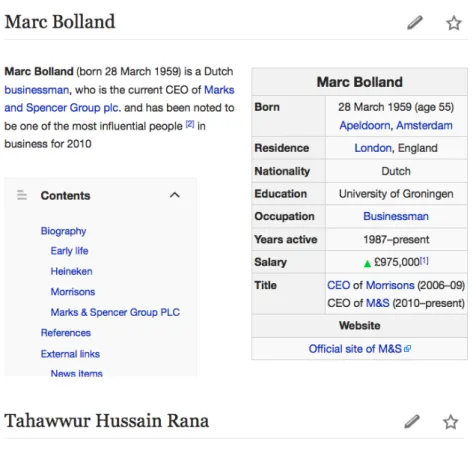
Figure 1: Wikipedia articles (snippets) with infobox (top) and without infobox (bottom).
entries about persons or organizations. This way, the relations express a real informa-tion need rather than being linguistic abstracinforma-tions. Figure 1 shows Wikipedia articles with and without infoboxes. Note that even if infoboxes are present, they can be incomplete: In the given example, the fact that Bolland was chief operating officer for Heineken until 2005 is missing from the infobox, but is mentioned later in the Wikipedia article.
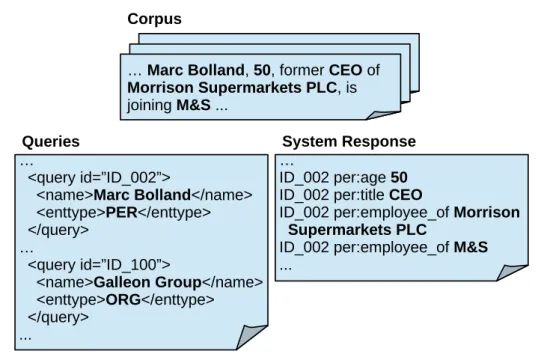
Figure 2: TAC KBP: Given a set of queries, return a correct, complete and non-redundant response with relevant information extracted from the text corpus.
To give an example of how the relations in TAC are different in their entity grounding and specificity from those in ACE, consider the social relations (relations between persons) in TAC (in contrast to the [Per-Social.Lasting] relation mentioned above for ACE). There are 5 social relations in TAC:parent, child, sibling, spouse, other family. These relations are defined in terms of states of the world, not linguistic forms, e.g. for the other family relation:
“Family other than siblings, parents, children, and spouse (or former spouse). Correct fillers for this slot include brothers-in-law, sisters-in-law, grandparents, grandchildren, cousins, aunts, uncles, etc.”6 A summary of the TAC KBP relation definitions can be found in Appendix A.1 on page 130.
Figure 2 shows a simplified example of a TAC KBP slot filling query, corpus and expected result. The task is set up as a retrieval task, specifying a query entity of given type (person or organization) which is grounded by a specified disambiguation document (the pointers for the disambiguation information have been left out in Figure
2 for simplicity). For such a query, all facts (from the set of the specified 42 relations) have to be retrieved if they are expressed in the so-called source corpus 7. Since the relations arefactual relations, grounded in entities outside of specific discourses, they could in theory be evaluated for truth independently of their textual occurrences – however, for several practical reasons it is assumed that a fact is true if and only if any of the documents in the source corpus states it so. Evaluation is less bound to linguistic form than it has been the case for ACE: any inference (including the use of world-knowledge) or signals that unambiguously pose the truth of a certain fact are valid support for the existence of that fact.8
2.3. Open vs. Closed Schema
Open schemarelation extraction refers to approaches where fact tuples are the result of clustering surface forms, i.e. sequences of words or parse-spans between relational arguments. Often, surface forms are clustered simultaneously with the entity types of the arguments (Banko et al., 2007; Bollegala et al., 2010). The aim is to automatically find a generally useful partitioning and granularity. Paraphrase finding and cluster-ing, as done in the DIRT system (Lin and Pantel, 2001a), is a linguistically motivated open schema relational analysis task. A range of open information extraction systems (OpenIE) aim at extracting facts from such clusters of surface forms. Universal Schema (Riedel et al., 2013) aims at finding an lower-dimensional vector representation ( embed-ding) from un-annotated data. Instead of providing a fixed clustering, some additional flexibility is retained since similarity between all vectors can be compared with such a representation in a smooth manner. Similar embeddings are learned by the model of Weston et al. (2013). Here arguments are vectors and relations are matrices that translate one argument into another.
To illustrate the output of a typical OpenIE system, we include below an example given by Banko et al. (2007). Here, the system outputs a set consisting of 4 argument-surface tuples which were clustered together as being synonymous. A human annotator
7
The source corpus contains more than 2 million documents, including 1,000,257 newswire documents from the Gigaword corpus and 1,099,062 documents from web text and discussion fora
8
This does not mean that systems need to attempt logical inference – rather, it gives them the freedom to use any signals present in the text, whether they support a fact directly or indirectly.
may conclude that the first tuple in fact is not synonymous to the others, and mark it accordingly.
*(Bletchley Park,was location of, Station X) (Bletchley Park,being called, Station X) (Bletchley Park,known as, Station X) (Bletchley Park,codenamed, Station X)
Evaluation is a particular challenge for open information extraction: Usually sets or pairs of paraphrases are presented to human raters, who should judge whether the paraphrases are reasonable and synonymous (Banko et al., 2007); or, human annotators are asked to find paraphrases to a given surface form (theseed) and those paraphrases are compared to the other surface forms in the automatically found cluster into which the seed falls (Lin and Pantel, 2001a). These evaluation scenarios are often inherently vague, and there is usually no evaluation of the usefulness regarding relation extrac-tion tasks where specific information needs would be clearly specified in advance. A probable use case of open schema extractions may therefore lie rather in exploratory scenarios than in applications targeting a pre-specified goal.
As the key characteristic of open relation extraction is that it is very general, the hope is that it may be an aid in a range of different settings. A further advantage is that no annotated training data is needed, the final clustering is only dependent on the input data and clustering scheme, and not on requirements of a specific task. It can therefore be said that by its generality and lack of task-specificity open schema relation extraction has similar strengths and weaknesses as linguistic relation annotation does.
Closed schemaapproaches start with identifying the relations of interest, see Fig-ure 3 for the schema used in TAC KBP Slot Filling. This can be done by describing the semantics/meaning of the relations (this corresponds to what is called intension of a concept in logic or semiotics), or by extrapolating from a sample of seed instances/facts of these relations (what might be called a partial extension of a concept). From the intensional descriptions one can engineer tailored extractors, e.g. compose surface pat-terns manually. The extensional seed facts can be the input to automatic training or generalization.
Using seed facts together with a text corpus to learn textual extractor is known as distant supervision and will be discussed in length in the subsequent chapters. Note
per:age org:alternate names per:alternate names org:city of headquarters per:cause of death org:country of headquarters
per:charges org:date dissolved
per:children org:date founded
per:cities of residence org:founded by
per:city of birth org:member of
per:city of death org:members
per:countries of residence org:number of employees members
per:country of birth org:parents
per:country of death org:political religious affiliation
per:date of birth org:shareholders
per:date of death org:stateorprovince of headquarters per:employee or member of org:subsidiaries
per:origin org:top members employees
per:other family org:website
per:parents per:religion per:schools attended per:siblings per:spouse per:stateorprovince of birth per:stateorprovince of death per:statesorprovinces of residence per:title
Figure 3: TAC KBP relational schemata for the entity typesperson andorganization.
that in TAC KBP, both intensional definitions (by the task guidelines) as well as extensions in the form of Wikipedia infoboxes (from which the definitions are derived) are provided.9 While closed schema extractors aim exactly at the desired questions,
an obvious disadvantage is the need for training data (or the tailoring of the system towards those relations).
9It is interesting, however, that for the Wikipedia infoboxes, no definitions exist (apart from their
relation names themselves), as it is the case with most relations of the publicly available Freebase knowledge base (http://www.freebase.com/). In other words, the intensional definitions for TAC KBP are the result of a human cognitive effort of generalization, i.e. induction, from the extension. Creating a system for relational prediction would correspondingly be adeductive effort.
2.4. Literature Overview
Chronologically, work on extracting structured information from text started with the (semi-)automatic construction of ontologies (Hearst, 1992), which are well-motivated by classical artificial intelligence, and turned over to more linguistically motivated tasks such as paraphrase acquisition (Lin and Pantel, 2001a) and linguistic relations such as defined in the ACE tasks (Doddington et al., 2004). With the availability of more and more information captured in text from the web, and with the need to manage this amount of information, knowledge base construction became a new focus of research. TAC KBP aims to be the standardized benchmark to measure progress in this field. As we have outlined in the previous section, the discussed tasks are related yet differ in certain aspects. In the following we will give a roughly chronological overview of the main research literature in areas related to knowledge base population.
Pioneering the field of relation extraction from text on a scale, Hearst (1992) focused on extracting instances of taxonomicis-arelations and constructing an ontology from the harvested facts. The basis of this approach are hand-crafted surface patterns (now commonly referred to asHearst Patterns after their inventor) with part-of-speech wildcards. The so-obtained resource is motivated, amongst other things, by linguistic problems and use cases such as synonym recognition and sub-categorization.
Later work has aimed at increasing the number of relations, and at finding measures of relational similarity between surface forms and relations, or even to induce the relations themselves. For measuring the relational similarity between surface forms, two general approaches are possible: First, determining the similarity between two surface forms by statistical qualities of theargument overlap linguistic patterns share. Second, takingstructural overlap of linguistic patterns (such as shared words or parse configurations) as a proxy for semantic similarity.10
The DIRT system (Lin and Pantel, 2001a,b) is an early system solving the task of defining similarity by argument overlap in order to induce clusters of paraphrases. Linguistic surface forms are represented as lexicalized dependency paths and grouped together by the so-called“extended distributional hypothesis: if two paths tend to occur
10
It should be noted that these two approaches do not exclude each other: indeed, as will be discussed in later parts of the dissertation, our own top-ranked relation extractors gather training data by argument overlap and generalize from it by structural overlap via features such as skip-n-grams.
in similar contexts, the meanings of the two paths tend to be similar”. As a similarity metric, a variant of mutual information is used that takes distributions of paths and arguments into account. The paraphrases are evaluated intrinsically based on similarity ratings, and extrinsically on a question-answering task.
Paraphrase identification can be seen as a pre-cursor toOpen Information Extrac-tion, which aims at identifying relational clusters, as if they were grouped together intuitively by a human, and representing them in a canonical form. Fader et al. (2011) showed that when no relational schema is given, and syntactic patterns are clustered by their argument overlap, the output often contains many incoherent and uninfor-mative extractions, such as extracting made(“Faust”, “a deal”) instead of made-a-deal-with(“Faust”, “the devil”). They propose additional constraints and heuristics to bring open information extraction more into the direction of what a human would intuitively be expecting. Unsupervised open schema relation extraction systems that continuously learn facts from an incoming stream of text are also known under the term of machine reading (Etzioni et al., 2006, 2011). Here, the challenges lie also in accommodating new information and in the large scale of data to be handled.
Bollegala et al. (2010) propose a co-clustering algorithm for both surface patterns and argument pairs that is efficient by adding instances sequentially (one-by-one) to the clusters. Nakashole et al. (2012) build a taxonomy of unsupervised relational pattern clusters (called pattern synsets) with semantic types. Pattern synsets are based on entity distributions. The patterns are subject to generalization, sequences are partly wildcarded making use of n-gram correlations and Frequent Itemset Mining (Agrawal and Srikant, 1995) to find n-gram combinations with large co-occurrence support. Semantic subsumption statistics are efficiently represented using a suffix tree. Another unsupervised relation clustering algorithm that combines a wide range of different similarity measures, induces argument types and can model polysemy of relational patterns is proposed in Min et al. (2012b).
Relational clustering is related to real-world tasks such as automatic headline gen-eration for news stories: Alfonseca et al. (2013) extract patterns from news headlines and documents within a thematical cluster. Latent variables are learned in a noisy-ormodel. A headline is selected by a two-step random walk from a pattern to latent variables and back to patterns. Their system performs well in an automatic evaluation,
but not with human raters. Balasubramanian et al. (2012) build a graph of unsuper-vised relations from co-occurrences in text using positive pointwise mutual information as edge-weights and cluster it using Markov clustering (Van Dongen, 2008). The eval-uation is done on identifying clusters that correspond to MUC (Chinchor et al., 1993) terrorist events.
For measuring structural rather than distributional similarity, structured kernels on syntactic analyses have been applied especially for linguistic ACE-type relations (Zelenko et al., 2003; Bunescu and Mooney, 2005; Mooney and Bunescu, 2005). The early preference for syntactic similarity rather than shallow surface similarities may be partly due to the more interesting structural properties of dependency representations. Also, since ACE relations are more linguistically defined than factual relations as in the KBP paradigm, the usage of linguistic analysis seems to be motivated. However, the observation was early made that shallow features perform better than dependency structures with kernels (Giuliano et al., 2006). Later analysis (Chan and Roth, 2011) showed that even in ACE, 80% of relational mentions are expressed in forms that are not typically assumed to be well-captured by dependency analysis. Although ACE has mainly been superseded by TAC KBP, there is some recent work on the 2005 ACE data that combines tree kernels with LSA and Brown clusters for relation prediction (Plank and Moschitti, 2013).
Downey et al. (2007) establish a ranking function for relational ranking that includes type similarity and elements akin to information retrieval metrics. Although they call their approachrelational language models, the ranking function is rather related to the Okapi bm25 metric (Robertson et al., 1995) and not to language model approaches in IR (Lafferty and Zhai, 2001).
For supervised relation extraction systems, some guidance has to be provided as to what are desirable extractions. Two approaches are notable here: guiding the system by an existing database, and guiding the system by direct human supervision, that is by providing rules or annotated data. It is evident that in all cases the aim is to keep human effort in guiding the algorithm minimal. Mintz et al. (2009) coin the termdistant supervision and are the first to use Freebase as the database to generate training data for a knowledge-base population task. The positive training data is obtained by a simple textual match of the information in the knowledge base, special
negative training data is included which is generated from entity pairs that are in none of the considered relations according to the knowledge base. A multi-class logistic classifier is used with lexical and named-entity-tag features, as well as features derived from dependency trees.
Training data that is semi-automatically generated by distant supervision is inher-ently noisy. In Alfonseca et al. (2012) a generative approach – that was developed originally for multi-document summarization (Haghighi and Vanderwende, 2009) – is used to separate noisy training examples from informative ones. Blessing and Sch¨utze (2012) use various heuristics for matching entities and for mapping between languages to increase the precision of distant supervision.
Minimally supervised algorithms aim at iteratively bootstrapping lexico-syntactic patterns and selectional restrictions from few seed examples per relation, in the ex-treme case from only one seed pattern (Kozareva and Hovy, 2010a). For bootstrapped learning, the characteristics of the seeds have been found to have a high impact on extraction quality: in (Kozareva and Hovy, 2010b) a model is developed to estimate the usefulness of seeds for bootstrapped learning.
The NELL never-ending language learner (Carlson et al., 2010) is a semi-supervised approach to knowledge base construction. Started in 2010 and seeded with an initial knowledge base, it aims at continuously and automatically incorporating new facts. In order to avoid semantic drift and to maintain a high precision of facts, the system allows for ongoing human feedback and corrections. Other semi-supervised approaches that use spectral embeddings (Bollegala et al., 2011) or lower-dimensional features from topic models (Yao et al., 2011) make use of both unlabeled and labeled training data. A classifier uses the resulting lower-dimensional feature representation, which generalizes better from training data to test data.
Although there are many relations with more than two arguments, most notably event relations (see e.g. Lee et al. (2012)), most of research on relation extraction assumes that relations are binary. It is indeed straightforward to turn n-ary relations into sets of binary relations. However, if those binary relations are not modeled jointly, information may be lost. Bollegala et al. (2013) measure similarity between ternary relations by using kernels on argument features as well as kernels on patterns for clustering them. In a similar vein, the Path Rank Algorithm (PRA) (Lao and Cohen,
2010; Lao et al., 2011) models chains of binary relation to obtain additional evidence for certain facts. PRA finds and ranks inference rules that correspond to random walks in a graph, starting at an entity (the query) and ending at another entity. In this way it can deal with relational information that is expressed by a chain of relations. Different rules (chains of relations) are experts that can be used as features in a log-linear classifier to support other relations. An extension of PRA includes syntactic surface patterns in the model and uses dimensionality reduction for additional smoothness and predictive power (Gardner et al., 2013).
The survey of relevant publications illustrates how research has focused on various interesting problems and aspects in the field of relation extraction and knowledge base population. In order to truly advance the state-of-the-art, it is necessary to identify which of the many possible research questions actually have a major impact on performance in a well defined setting. In the rest of this dissertation, we aim at thoroughly quantifying and improving those places in end-to-end relation extraction that show most potential on this difficult task.
2.5. Summary
In this chapter, we gave an overview of current tasks and approaches in the field of relation extraction. We distinguished linguistic vs. fact-based relation extraction, as well as open and closed schema approaches. We positioned the task of Knowledge Base Population, i.e. extracting and structuring textual information according to specific information needs, in a wide spectrum of challenging problems.
As we illustrated in Chapter 2, relation extraction can be formulated as the task of turning unstructured text into tabularized information. We distinguished two relation extraction paradigms: 1) open information extraction, the unsupervised clustering of entity-context tuples (Banko et al., 2007), and 2) relation extraction for a fixed relation inventory, which corresponds to the knowledge-base population (KBP) task (Ji and Grishman, 2011). One advantage of open information extraction is that it does not require annotated data. The resulting representation, however, may not always provide the most useful granularity or partitioning for a specific task. In contrast, relation extraction for a pre-specified relation inventory may be better tailored for a specific task, but requires labeled training data; however, textual annotation by hand is costly.
Databases with fact tuples such as (PERSON, born-in, CITY) are often readily available. However, there is usually no or only very little text corpora annotated ac-cording to whether a relation (e.g. born-in) is expressed in a span of text between particular entities (e.g. of types PERSON and CITY). The paradigm of distant su-pervision (DS)(Craven et al., 1999; Mintz et al., 2009) aims at providing such training data cheaply by using existing knowledge bases: Textual matches of entities from fact tuples are used to automatically generate relation contexts as training instances.
In Section 3.1 of this chapter, we will discuss specific problems that are inherent in semi-automatically generating training data by this method. Besides a qualitative characterization of those problems we will review quantitative characterizations of such problems reported in the literature and give our own estimate of the false positives in the data that is used in the context of this work. In Section 3.2 we will character-ize existing approaches to dealing with noisy distant supervision training data. We identify three main principles for noise reduction (at-least-one constraints, generative noise modeling, pattern correlations) and argue that there exist interesting parallels to redundancy modeling for relation prediction.
Knowledge Base per:city_of_birth (B. Obama, Honululu) ... (M. Jackson, Gary) … Corpus
B. Obama was born in Honululu B. Obama moved from Honululu Gary, M. Jackson's birthplace
Training Data Classifier Knowledge Base per:city_of_birth (B. Obama, Honululu) ... (M. Jackson, Gary) … (N. Chomsky, Philadelphia) Classifier Corpus
F. Hollande visited Berlin
Born in Philadelphia, N. Chomsky ...
Instance Candidates
Figure 4: Distant supervision for knowledge base population. Top, training:
Facts of the knowledge base are matched against a training corpus and noisy instances are obtained for training a classifier. Bottom, testing: The re-sulting classifier predicts relations for candidate sentences of a potentially different corpus, and new facts are added to the knowledge base.
3.1. Problem Statement and Quantification
Figure 4 shows the basic assumed workflow for distant supervision. In a first step, existing extries in a knowledge base are used to find matching argument pairs in a text corpus, and to use the respective contexts as instances for training a relational classifier. In prediction (the second step), the classifier can be used to find new
rela-tional instances from text of the same or another corpus, and populate the knowledge base with the newly extracted information. Often it is only a small fraction of the training matches that indeed express the relation of the fact tuple. For example, the arguments of the fact tuple (“Barack Obama”, born-in, “Honululu”) could match in true positive contexts like “Barack Obama was born in Honululu”, as well as in false positive contexts like “Barack Obama visited Honululu”.
There are two error cases when extracting training data: false positive and false negative errors. Afalse positivematch is produced if a sentence contains an entity pair for which a relation holds according to the knowledge base, but for which the sentence does not express the relation. The sentence is marked as a positive training example for the relation, however it does not contain a valid signal for it. False positives introduce errors in the training data from which the relational model is to be generalized. For most models false positive errors are the most critical error type, for qualitative and quantitative reasons, as will be explained in the following.
A false negative error can occur if a sentence and argument pair is marked as a negative training example for a relation (the knowledge base does not contain the argument pair for that relation), but the sentence actually expresses the relation, and the knowledge base was incomplete. This type of error may negatively influence model learning by omitting potentially useful positive examples or by negatively weighting valid signals for a relation. If a (for example generative) model does not include negative training data in learning, or if a model uses the positive instances of other relations as negatives for the relation in question, while false negatives – stemming from missing entries in the KB – influence the amount of training data, the training data are still a representative sample for the relation. For big knowledge bases such as Freebase or Wikipedia infoboxes, the amount of data generated is very big anyway, so missing training data for relations seems acceptable.
Qualitatively, the positive training data is therefore more important and many mod-els do not even make use of explicit negative data but aim to model relations only from positive examples: this is the case for all generative models (see Chapter 3.2.3), but also for the discriminative re-ranker with constraints that we propose in Chapter 4.2. Quantitatively, as will be shown below, amongst the data marked positive the percentage of errors (coined false discovery rate in statistics terminology) tends to be
much higher than the respective percentage of errors in the training data marked as negative (false omission rate).
For current state-of-the-art system architectures, we generally agree with the focus on improving onfalse positive rather thanfalse negative distant supervision errors. At the same time, we point to the theoretical possibility that false negative errors could become relevant for systems where the negative training data plays a central role in modeling. In most current systems though, the negative training data comes from simple yet effective heuristics like taking the positive instances from other relations as negative instances for a specific relation.
Work on improving distant supervision errors mostly focuses on identifying the false positives. Often, ranking functions are sought that score contexts expressing the re-lation higher than contexts matching arguments but not expressing the knowledge base relation. With such a ranking function, training data can be filtered by apply-ing a threshold, or data can be weighted accordapply-ing to the precision estimated by the function. The better the ranking function, the more good data can be retained when filtering.
When the distant supervision errors are quantified, usually the false discovery rate is estimated from manually checking samples of the distant supervision training data. Similarly, the false omission rate can be obtained by sampling directly from the corpus and by checking whether facts are expressed that are not in the knowledge base. In the following we will give an overview of error estimates that can be found in research literature (together with our own false positive estimate). Since error rates vary per re-lation and the reported estimates are taken from different corpora and sets of rere-lations, they are expected to be different.
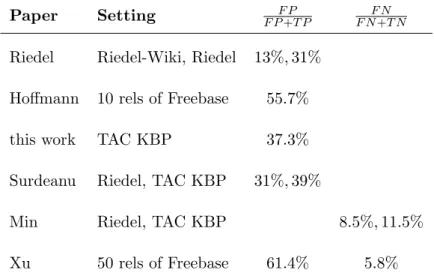
The original work on plain distant supervision (Mintz et al., 2009) does not give a quantification of the errors in the training data. Riedel et al. (2010) observe, in their analysis over samples of the relations nationality, contains and place of birth, a false discovery rate (error rate on the positive extractions) of F PF P+T P = 31% when aligning Freebase to the New York Times corpus, and a false discovery rate of 13% when aligning to Wikipedia. Hoffmann et al. (2011) sample 100 sentences each for 10 Freebase relations, and get widely varying false discovery rates on the positive extractions ranging from F PF P+T P = 11.0% to 99.8% with an average error rate of
Paper Setting F PF P+T P F NF N+T N
Riedel Riedel-Wiki, Riedel 13%,31% Hoffmann 10 rels of Freebase 55.7%
this work TAC KBP 37.3%
Surdeanu Riedel, TAC KBP 31%,39%
Min Riedel, TAC KBP 8.5%,11.5%
Xu 50 rels of Freebase 61.4% 5.8%
Table 2: Estimation of error rates for different corpora and relations.
55.7%. Min et al. (2013) provide a statistic according to which the false omission rate (error rate on the negative data), i.e. the contexts with non-matched entity pairs for TAC KBP relations is F NF N+T N = 8.5% for the Riedel et al. (2010) dataset, and 11.5% for the TAC KBP dataset (Ji et al., 2010) that was also used by Surdeanu et al. (2012)11. The false discovery rates for the Riedel and TAC KBP dataset have been
estimated at F PF P+T P = 31% and 39% respectively by Surdeanu et al. (2012). Surdeanu et al. (2012) also give an overview of the overlap of relations, i.e. the percentage of entity pairs occurring in more than one relation: it is 7.1% in the Riedel data set and relatively low with 2.8% in the TAC KBP data. Xu et al. (2013b) sample 1824 pairs from the the New York Times 2006 corpus and evaluate manually whether they express any of a set of 50 common Freebase relations. Their statistic is summarized as follows: T N = 90.1; F N = 5.5; T P = 1.7; F P = 2.7. For our own system, we evaluate the TAC KBP training data obtained from mapped Freebase relations, judge 1243 instances manually and obtain a positive error rate of F PF P+T P = 37.2%.
Table 2 summarizes these findings. Although the data sets are very different, it is consistently the case that false positive matches degrade the quality of the positive training examples. And while false negatives exist, they do obviously not provide a
11
This estimate was done on the entity-pair level, the actualF N-rate on the instance level would be lower, because for false negative pairs there are true negative matches to be expected
big fraction of the negative training data; moreover they do not play a central role in the training of most relation extraction models.
3.2. Survey of Noise Reduction Approaches
A number of different approaches have been introduced to automatically determine which training contexts, obtained from relation argument matching, aretrue positives, and which are false positives. This chapter aims at giving an overview of approaches tackling this problem (cf. Table 3). They are each based on one of the following principles:
• At-least-one constraints state at training time that at least one of the matched contexts for a pair is indeed a true positive – but not necessarily all of them (see Chapter 3.2.1). We deem it potentially fruitful to further research to contrast the at-least-one principle to other schemes applied in prediction (Chapter 3.2.2). • Hierarchical topic models are based on the idea of separating the distributions that generate relation-specific contexts from those that generate pair-specific contexts or background text (Chapter 3.2.3).
• Pattern correlations are at the heart of an approach which assumes that training contexts matching argument pairs for a relation either express that relation, or have a large overlap in argument pairs with other patterns expressing the relation. In other words, they explicitly model the fact that a pattern is matching, and exploit this to transfer probability mass to similar patterns (Chapter 3.2.4).
3.2.1. At-least-one Approaches
In the vanilla setting, distant supervision assumes all sentences containing an entity pair to be potential patterns for the relation holding between the entities. As found by Riedel et al. (2010), this assumption quickly becomes untenable when dealing with text data not directly associated with the knowledge base from which the facts are taken. In the following, we describe approaches implementing a relaxing constraint which only presumes that at least one of the entity pair occurrences is a textual manifestation of the relation (at-least-one assumption).
Author Type Baseline KB (rela-tions) Ground Truth Corpus Riedel 2010, Yao 2010 ALO plain DS,
joint model without ALO
Freebase (430)
Freebase, HR
New York Times
Hoffmann 2011
ALO Riedel 2010 Riedel 2010 Freebase,
HR
New York Times
Surdeanu 2012 ALO plain DS, Riedel 2010, Hoffmann 2011 Riedel 2010, Wikipedia in-foboxes (42) Freebase, TAC key (2010+2011)
New York Times, TAC KBP corpus (2010+2011) Alfonseca
2012
TM MLE Freebase (3) HR Web news articles
Takamatsu 2012 PC plain DS, MLE, MultiR (Hoffmann) Freebase (24) Freebase, HR Wikipedia Roth (this work) ALO TM MLE, Alfonseca 2012
Seeds for TAC relations (42)
TAC key
(2009-2011)
TAC KBP corpus (2009-2011)
Table 3: Overview of the experimental settings of the approaches covered in this survey.
Abbreviations: ALO: at-least-one; DS: distant supervision; HR: human ratings; MLE: maximum likelihood estimate of P(rel|pattern);PC: pattern correlations; TM: topic model.
Formally, the at-least-one assumption states that
“If two entities participate in a relation, at least one sentence that mentions these two entities might express that relation” (Riedel et al., 2010)
Various models are essentially based on this idea (Riedel et al., 2010; Yao et al., 2010; Hoffmann et al., 2011; Surdeanu et al., 2012; Roth and Klakow, 2013). Relation classification models are trained with an objective function that includes this con-straint. Typically, at-least-one models are multi-class models over a set of relations,
pair relation sentence Y Z X fALO f extract
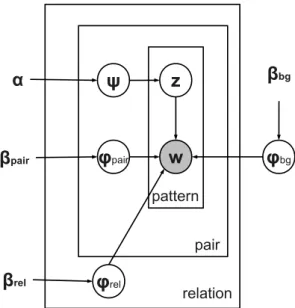
Figure 5: MultiR in plate notation. For every entity pair there are multi-class mention variables Z (one for each sentence X observed with the pair) and binary relation variables Y (one for each relation). EachZ can take on one of the relations as a value. A sentence factor scores the compatibility of the relation chosen forZ with the features of the corresponding sentence. TheY
variables are relation-specific and indicate whether a particular relation was predicted for the current pair. Mention variablesZ and relation variablesY
are connected by a dedicated factor that is 1iff the at-least-one assumption is fulfilled.
including a special NIL label to indicate that none of the relations in the knowledge base is expressed by a context.
While the underlying idea regarding noise reduction is the same for all of the at-least-one models, they differ in other assumptions about dependencies in the data, in the point at which the at-least-one constraint is used, and in their inference algorithms. The first proposed model with an at-least-one learner is that of Riedel et al. (2010). It consists of a factor graph that includes binary variables for contexts, and groups contexts together for each entity pair. An entity pair is associated with a variable that can take on a relation value or NIL. A global objective function penalizes the violations of at-least-one constraints, and SampleRank (Rohanimanesh et al., 2011) is used to infer the model.
et al. (2010). Given an entity pair, the model can predict multiple (“overlapping”) relations simultaneously. MultiR models the relation extraction as a factor graph (see Figure 5) with one connected component for each entity pair (e1, e2). For each entity
pair and relation r, there is a Boolean output variable Yr to indicate whether the relation is predicted for this entity pair. This set of output variables allows the model to predict multiple (overlapping) relations per pair. The Y variables are distantly supervised in training and they are set to 1 if the respective entity-pair relation tuple is contained in the knowledge base, and set to 0 otherwise. The connected components of the factor graph also model the per-sentence predictions: For each sentence contextXi in which the respective pair occurs, there is one relation picked from the set of relations (including a special label for no relation)R; this per-sentence choice is reflected in the
Zi variables. That is, while several relations can hold for a pair, only one relation can hold per context. The connection between the per-pair variableYr∈ {true, f alse}and the per-sentence Zi ∈ R variables is established via a dedicated at-least-one factor: This factor is 1 if the predictions for r correspond on the pair and sentence level. More formally, the at-least-one factorsfALO connecting the binary per-pair prediction variable for relation r with all per-sentence predictions Zfor the current entity pairs can be written as:12
fALO(Yr,Z) = 1 ifYr=true∧ ∃i :Zi =r 0 otherwise.
The per-sentence predictions are modeled by log-linear factors fextract based on context features φj modeling the compatibility of sentenceXi with prediction Zi:
12This is the definition off
ALOin the original publication of MultiR (Hoffmann et al., 2011). However,
we believe that there is a small error, namely that this formulation would not correctly cover those cases whereYr =f alse, since in this case the at-least-one objective is fulfilled if there exists no per-sentence prediction forr.
Therefore, the corrected version of the at-least-one factor would be:
fALO(Yr,Z) = 1 ifYr= (∃i:Zi=r) 0 otherwise.