“KNOWING IS SEEING”: THE DIGITAL AUDIO WORKSTATION AND THE VISUALIZATION OF SOUND
IAN MACCHIUSI
A DISSERTATION SUBMITTED TO THE FACULTY OF GRADUATE STUDIES
IN PARTIAL FULFILLMENT OF THE REQUIREMENTS FOR THE DEGREE OF
DOCTOR OF PHILOSOPHY
GRADUATE PROGRAM IN MUSIC YORK UNIVERSITY
TORONTO, ONTARIO
September 2017
Abstract
The computer’s visual representation of sound has revolutionized the creation of music through the interface of the Digital Audio Workstation software (DAW). With the rise of DAW-based composition in popular music styles, many artists’ sole experience of musical creation is through the computer screen. I assert that the particular sonic visualizations of the DAW propagate certain assumptions about music, influencing aesthetics and adding new visually-based parameters to the creative process. I believe many of these new parameters are greatly indebted to the visual structures, interactional dictates and standardizations (such as the office metaphor depicted by operating systems such as Apple’s OS and Microsoft’s Windows) of the Graphical User Interface (GUI). Whether manipulating text, video or audio, a user’s interaction with the GUI is usually structured in the same manner—clicking on windows, icons and menus with a mouse-driven cursor. Focussing on the dialogs from the Reddit communities of Making hip-hop and EDM production,DAW user manuals, as well as interface design guidebooks, this dissertation will address the ways these visualizations and methods of working affect the workflow, composition style and musical conceptions of DAW-based producers.
Dedication
Table of Contents
Abstract ... ii
Dedication ... iii
Table of Contents ... iv
List of Figures ... vii
Chapter One: Introduction ... 1
Literature Review... 10
Chapter Two: Looped Affordances: The History and Process of Looping with the DAW. ... 25
The Graphical User Interface (GUI) and the DAW ... 28
The Western Affordances of the DAW ... 32
Looping and Recording in the DAW ... 39
The History of Looping ... 42
Tape Looping ... 44
Time and Space ... 46
The Sights and Sounds of Looping ... 48
The Automated Process of Looping ... 56
Loops as Digital Commodities... 59
The GUI ... 75
Looping Software... 78
Conclusion ... 82
Chapter Three: “Circus Tricks with the Sound”: Play, Agency and Manipulation in the DAW. ... 84
Play ... 86
Flexibility and Fluidity ... 89
Discernability ... 97
Agency and Rendering ... 105
Manipulation and the Degree of Participation ... 115
Conclusion ... 120
Chapter Four: “Totemic Power”: Arrangement, Analysis and Performance in the DAW. ... 122
The Arrange Window ... 124
Arrangement ... 131
Analysis... 135
Performance ... 156
Distraction ... 163
Conclusion ... 166
Chapter Five: “Fish Bone”: Attack and Decay in the Creation of Drum Grooves. ... 168
Performance, Placement and Sampling ... 171
Libraries ... 183 Decays ... 193 Sidechain Compression ... 200 Silences ... 205 Trap Anticipations ... 209 Conclusion ... 211
Chapter Six: Conclusion ... 214
Future Work ... 218
Appendices ... 242
Appendix A: Looping ... 242
Appendix B: Visuals When Mixing ... 243
Appendix C: Sound as a Modular Object Falling on the Grid ... 244
Appendix D: Play ... 245
Appendix E: Rendering MIDI to Waveform ... 246
Appendix F: Dubstep Rendering ... 247
Appendix G: The Rendering of Effects ... 248
Appendix H: The Rendering of Glitches ... 249
Appendix I: The Degree of Participation ... 250
Appendix J: Cheesy, Generic and Stock Compositions... 251
Appendix K: Rendering Not Necessary ... 252
Appendix L: Waves Are More Fun. ... 253
Appendix M: Tempo Equals Space. ... 254
Appendix N: Automation ... 255
Appendix O: Arrangement Templates ... 256
Appendix P: Organization/Grouping ... 258
Appendix Q Visualization as Distraction ... 259
Appendix R: Groove ... 260
Appendix S: Head Nod (Bob) ... 263
Appendix T: Sidechaining and Trap ... 264
Appendix U: Miscellaneous ... 266
Appendix V: Music Theory ... 268
List of Figures
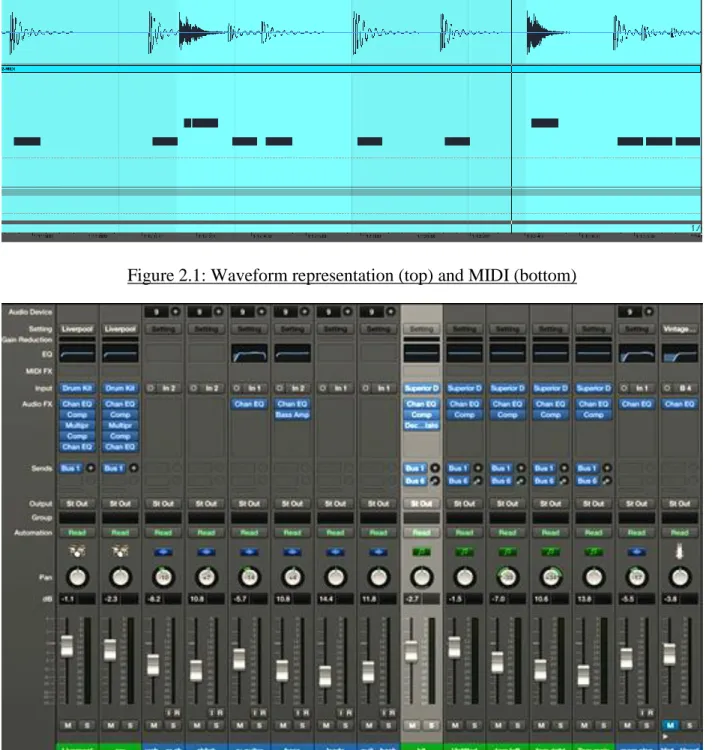
Figure 2.1: Waveform representation (top) and MIDI (bottom) ... 31
Figure 2.2: Mixer-board emulation in Logic... 31
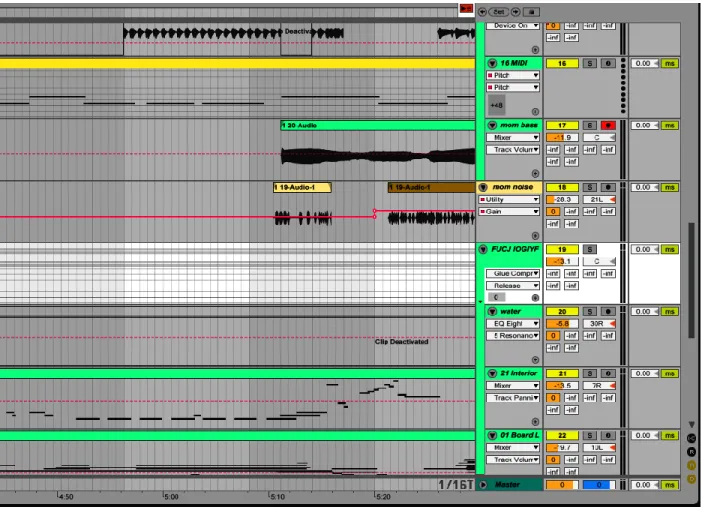
Figure 2.3: Shading in the Ableton Live’s arrange window ... 38
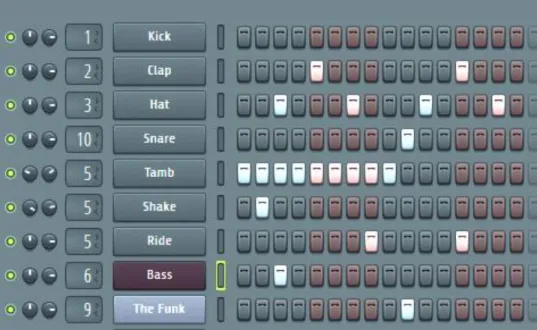
Figure 2.4: The FL Studio sequencer. ... 42
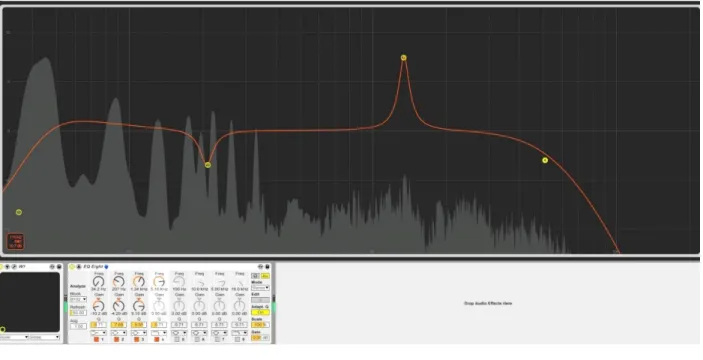
Figure 2.5: The spectrum analyzer built into the equalization effect in Ableton Live. ... 55
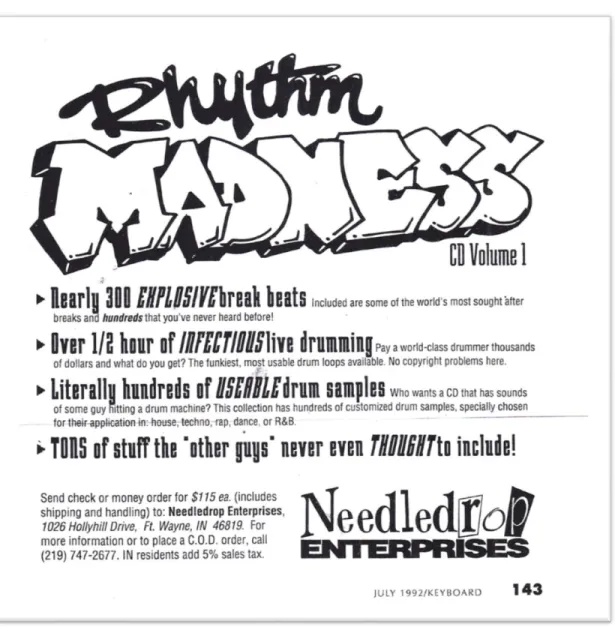
Figure 2.6: Loop ad in Keyboard Magazine ... 74
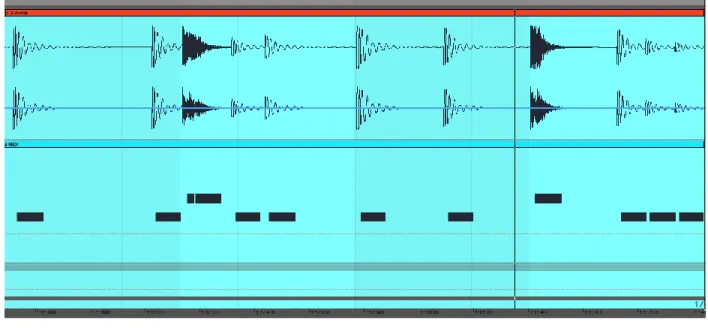
Figure 3.1: Visual representation of same drum groove in Ableton Live waveform (Top) and MIDI (Bottom) ... 100
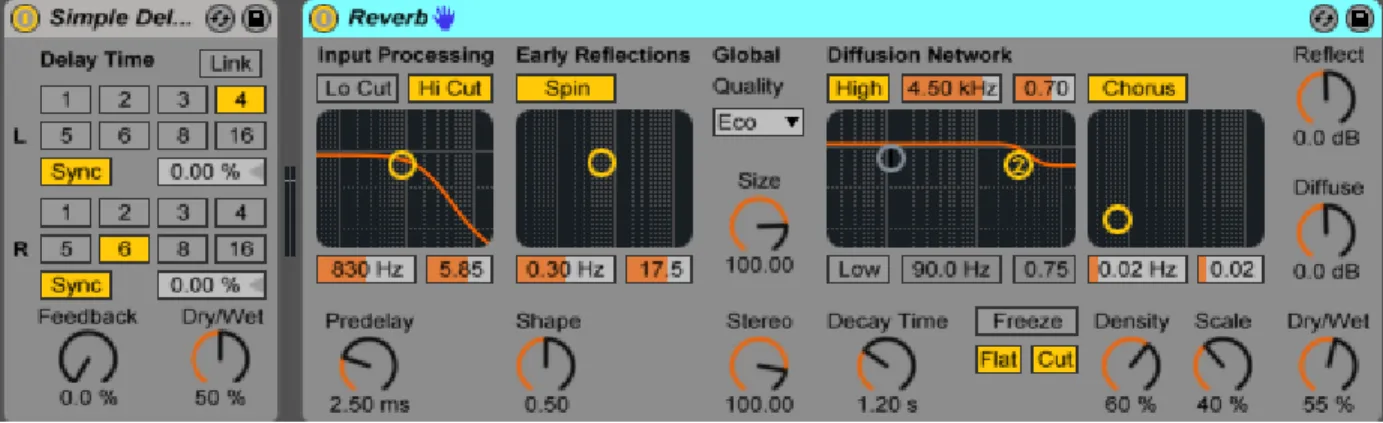
Figure 3.2: Delay and effect units in Ableton Live. ... 110
Figure 3.3a: Drum groove with no reverb ... 111
Figure 3.3b: Same drum groove with rendered reverb. ... 111
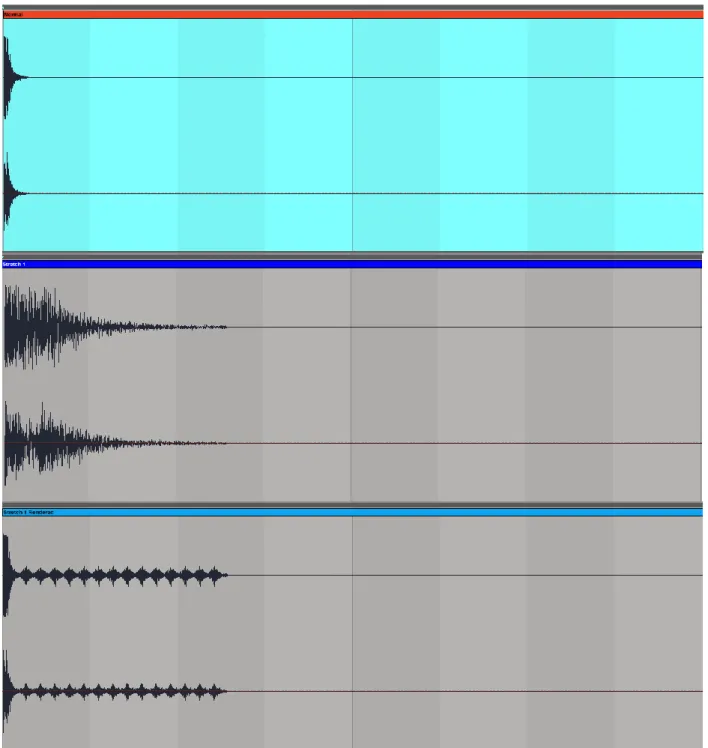
Figure 3.4: Normal drum hit (Top) drum hit stretched (Middle) stretched drum hit with glitches rendered (Bottom). ... 114
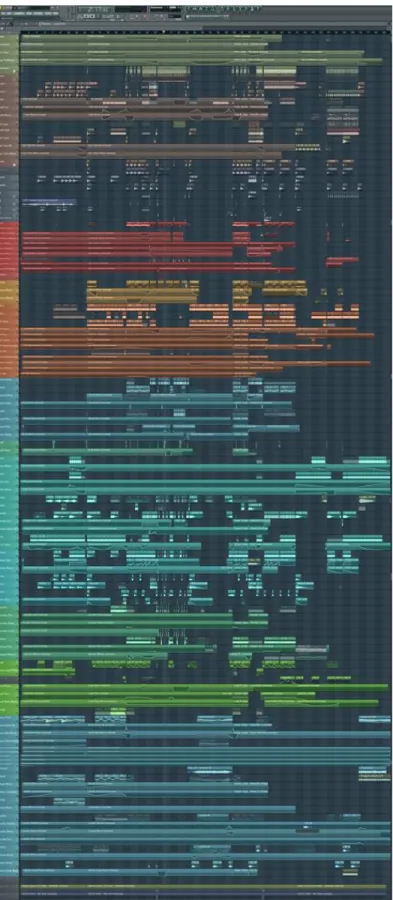
Figure 4.1: Producer Madeon’s arrange window in FL Studio ... 127
Figure 4.2: Colours and markers in Ableton Live. ... 141
Figure 4.3: Grouped tracks revealed (top) and hidden (bottom) in Ableton Live. ... 143
Figure 4.4: The playlist in Cubase ... 148
Figure 5.1: The IOIs in Burial’s “Raver” groove ... 180
Figure 5.2: Hi-hat delays in Deadmau5 sample pack (Top), Vengeance sample pack (bottom). ... 190
Figure 5.3: Messy claps from the Vengeance sample pack. ... 192
Figure 5.4: Mr. Bill “Router” percussion flammed ahead and behind the beat ... 193
Figure 5.6: Hi-hats from Deadmau5’s remix of “Harder, Better,
Faster, Stronger” ... 200
Figure 5.7: Various shapes of volume automation in Ableton Live ... 203
Figure 5.8: Preset sidechain shape in LFO Tools ... 204
Figure 5.9: Sidechained waves with the presets in LFO Tools... 204
Figure 5.10: The perfect silences in Deadmau5’s remix of “Harder, Better, Faster, Stronger” (Deadmau5). ... 208
Figure 5.11: Shaped kick drums from the Vengeance Sample Pack ... 208
Chapter One: Introduction
The Knowing Is Seeing metaphor is so firmly rooted in the role of vision in human knowing and is so central to our conception of knowledge that we are seldom aware of the way it
works powerfully to structure our sense of what it is to know something. (Lakoff and Johnson 1999, 394)
Our own lives now revolve around a more prosaic text: the computer desktop. Understanding the implications of that metaphor—its genius and its limitations—is the key to
understanding the contemporary interface. (Johnson 1997, 45)
Everybody now works with screens if they work in digital technology. It used to be that one person worked with a pencil and another person worked with a violin—totally different forms of technology—but now there is a convergence on the screen. There is something I call
screen ceremony, where work is created on the screen. —David Toop (Eshun 2000, 70)
In their seminal work Philosophy in the Flesh, George Lakoff and Mark Johnson assert, that for the majority of us, what we see holds sway over how we understand the world; knowing is equated with seeing. Acknowledging the influence of this visual bias is doubly important in our current software-based culture, in which a large part of our acquired knowledge is mediated, structured and visualized on the computer screen. An interesting arena for the examination of this brand of visualization is the music composition and recording software called the Digital Audio Workstation (DAW), as it provides a unique example of these visual structures
encroaching on a sonic art form. With the rise of DAW-based composition in popular music styles such as electronic dance music (EDM1) and hip-hop, many artists’ (who I hereafter will be
1 I am aware that as a moniker for the vast collection of genres that make up dance music, EDM is a problematic
term. Nonetheless, as many of my online informants utilize the term, throughout this dissertation, I shall also use it to represent popular styles of music created for the purposes of dancing.
calling producers) sole experience of musical creation is through the computer screen. I assert that, the particular sonic visualizations of the DAW propagate certain assumptions about music, changing aesthetics and adding new parameters that need to be accounted for in a musical
analysis. Many of these new parameters are greatly indebted to the visual structures, interactional dictates and standardizations (such as the office metaphor depicted by operating systems such as Apple’s OS and Microsoft’s Windows) of the Graphical User Interface (GUI). Whether
manipulating text, video or audio, a user’s interaction with the GUI is usually structured in the same manner—clicking on windows, icons and menus with a mouse driven cursor. In this dissertation, I will address the ways these visualizations and methods of working impact the workflow, composition style and musical conceptions of DAW-based producers. Encyclopedia Britannica states,
the GUI has replaced the arcane and difficult textual interfaces of earlier computing with a relatively intuitive system that has made computer operation not only easier to learn but more pleasant and natural. (Britannica online)
I wish to unpack the biases and influences of this pleasant and natural system, examining the effects this intuitive and visual way of interaction has on the process of DAW-based popular music producers.
For the purposes of this dissertation, I am defining a Digital Audio Workstation as a software package that utilizes graphic representations and direct manipulation (the manipulation of on-screen graphics to affect a visual—and sonic—result) to control, record as well as
manipulate audio and MIDI information. With a DAW this interaction is structured as an
emulation of the recording studio mixer board—where recordings can be separated onto multiple tracks that can be controlled with tape recorder style controls, as well as graphic representations
of faders and knobs—and sequentially order their sonic representations along a timeline—where “every musical idea that exists in the piece the composer is working on must be placed in an absolute time location” (Duignan et.al. 2005, 3). There are audio editors (such as Audacity and the earlier programs Sound Forge or Sound Designer) and loop designers (such as ReCycle) that provide graphic representations of audio (and occasionally MIDI) along a timeline; however, these packages usually allow the manipulation of one audio file at a time, versus the
manipulation of numerous audio files and MIDI information, separated into tracks, allowed by DAW packages (Audacity 2017; Madison Media Software 2005; Ludvig et.al. 2002). These audio editors excel in the editing of individual sound recordings, versus the DAW which allows recording, manipulation and composition of entire compositions with a multitude of tracks. Moreover, many of these sound editors lack the plethora of effects emulators and MIDI instrumentation that are packaged with the DAW, as well as the visual rhythmic grid that stratifies musical time.
With this in mind, I will investigate user manuals, instructional guides, YouTube videos, producer DAW files, advertisements, magazine reviews and online commentaries to unpack numerous visual methods for creating popular music in our computer-based age. Yet, it must be understood that the methods for creating music that I portray in this dissertation are a subset of the ways to interact with the DAW. There are many software-based producers who utilize all sorts of unexpectedly idiosyncratic approaches to music creation; for the most part, this dissertation will not focus on these users. I am interested in the common and widespread methods of musical creation and interaction, specifically ones that are frequently shared online, as I believe many reveal the biases and visual influences that owe a great debt to the GUI. As the
DAW becomes increasingly popular for music creation, understanding the visual impact of its graphics is an essential undertaking.
A large portion of my online sources have been obtained from content submitted by members of the online bulletin board system Reddit. Founded by Steve Huffman and Alex Ohanian in 2005, and currently owned by Condé Nast, it was estimated (as of 2012) that Reddit had 112 million unique visitors from over 195 countries (Singer et al. 2012). The Reddit website is partitioned in different areas of interest (called “subreddits”) to which users can subscribe. Within each subreddit, users can “upvote” and “downvote” posts, giving karma points. The posts with high karmic scores are featured prominently in a subreddit’s listings (where they are viewed more often), whereas lowest scoring posts are relegated to the bottom of the listings. I have taken a large portion of my examples from two subreddits, Making hip-hop and EDM production.2 These subreddits are communities where producers can ask questions, discuss their craft, share their compositions (usually through links to SoundCloud) and find other artists for collaboration. Of particular interest is the Making hip-hop “Daily Feedback thread,” which allows users to post their compositions for critique by other subscribers, the EDM production thread “How do I make this sound?,” as well as various competition threads, such as the Making hip-hop’s “Flip This
Challenge,” where users have to sample and transform a chosen song into a hip-hop track and the participants vote on the winner. As of March 2017, Making hip-hop had 37,821 subscribers and
EDM production had 86,607 (Reddit 2017; 2017a). While not every subscriber posts regularly, these subreddits are highly trafficked. For example, the Making hip hop daily feedback thread
2 For my research, I examined two weeks of posts from the Making hip-hop and EDM Production subreddits,
compiling a list of relevant search terms and topics. I then utilized those terms to search the rest of the contents of each subreddit. All Redditors post under pseudonyms and their posts are part of the public domain, searchable from Google or Reddit without the need of a Reddit account for access. I have made no attempts to contact or discern the identities of these posters.
regularly has over three hundred posts (Reddit 2017b). These subreddits also have excellent moderators who delete spam, organize the main page and ban users who do not follow the rules or are overly abusive.
I wish to frame this dissertation as a form of social media ethnography that highlights specific online discussions from two Reddit communities to reveal various influences of the visual and interactional design of the DAW (as well as the GUI) on the processes of these particular users. Although this dissertation is not a direct elucidation of the structure and social relations of these producer communities, I am providing an examination of these producers’ processes, portraying specific ways they understand and discuss music, the DAWs they use, as well as displaying the pervasive nature of my chosen examples through supplementary Reddit citations in the glossary.3 The specific software packages and ways of operating I explore during this dissertation represent the processes of many of my Reddit informants. There are plenty of other ways of creating music using software but (for the most part) those are not representative of the Reddit community of amateur producers I have chosen to study. In this instance, I have, for the most part, focused on language and concepts that can be found throughout these subreddits; yet, these ways of operating can also be found in many other online producer message boards and communities.4
During the early days of my dissertation I had an amateur rapper friend who recommended the Making hip-hop subreddit as an excellent resource for DAW related
information. After lurking on various subreddits, I began entering the Making hip-hop weekly producer “Flip this challenge” competitions. At the time, I felt this process of weekly beat
3 These supplementary examples are included in the appendices starting on page 231.
4 Other producer communities I have examined during my research are (Dogs on Acid 2017; Future Producers 2017;
creation would spark ideas for writing topics as well as give me a better understanding of the process of sample-based creation in the DAW.5 In fact, it was participating in these competitions that made me realize what an excellent resource Reddit could be for a researcher interested in creative processes. In their study of online ethnography methods, Garcia et al. contend “ethnographers will get a more authentic experience of an online setting if they jump straight into participation. In short, the ethnographer should attempt to experience the online site the same way that actual participants routinely experience it” (Garcia et. al. 2009, 59). Mary K. Walstrom utilizes the term “participant-experiencer” to describe this type of online ethnographer who gets involved within the community (Walstrom 2004, 175). I feel participating in the Reddit producer community by making beats has been invaluable in teasing out various roles the visuals play in musical creation with the DAW.
Other than the sheer size of its user base, I chose Reddit as the focus of my ethnography for several reasons. The Reddit community allows the user to subscribe to as many subreddits as they want; as a result, there is often a larger cross-pollination of ideas and methods between different producer subreddits than specific communities that are focused on one DAW or on one particular style of music. Most DAWs have their own message boards for questions and
community discussions; nevertheless, largely consisting of desperate producers with software problems these sites usually lack the wide array of tips on musical processes and discussions of producer-created compositions (Ableton 2017b; Apple 2017a; Avid Technology 2017a; Image line 2017a; Steinberg 2017a). Also, in comparison to other online producer forums Reddit has a cleaner interface, lacking the clutter of advertisements, animated gifs and non-white backgrounds
5 Throughout the research of this dissertation, I participated in 31 “Flip This Challenge” competitions (winning two
in the process, Reddit 2013; Reddit 2014). At no time did I identify myself as a researcher or solicit questions from other Redditors.
that make text a challenge to read and search6 (Dogs on Acid 2017; Future Producers 2017; IDM 2017; illmuzik 2017; KVR Audio 2017; Stones Throw Records 2017; Trance Addict 2017). Furthermore, I have not found a producer forum that has as robust a community as Reddit for sharing and discussing compositions in progress.
As a scholar interested in the creative processes of DAW-based artists, these subreddits offer a treasure trove of information. There are countless producers detailing their favourite methods for creation, arrangement and remixing, as well as offering advice on topics such as choosing the best DAW, defeating writers block and promoting music online. Speaking of World Wrestling Entertainment fan community message boards, Crystle Martin observes that
connected learning environments grow from the social support of peer and friendship networks centered on shared purpose, projects, and interests. When young people are engaged with peers in these shared contexts, they learn fluidly from each other by giving and receiving feedback and sharing knowledge in timely and task-specific ways. Seeking recognition and validation by peers also provides social motivation for acquiring skills and expertise. (Martin 2014, 11)
This type of online learning environment offers a large collection of popular DAW techniques and processes that would be impossible for an ordinary researcher to access through personal interviews or surveys. Most studies of the process of DAW-users involve a small number of producers (in the articles I have examined, anywhere from 3-17) and cannot hope to encompass the breath of information detailed online (Brooker and Sharrock 2016; Duignan 2008; Eaglestone et al. 2008; Marrington 2010; Mycroft et al. 2015; Phillips 2010; Tubb and Dixon 2014; Wilkie et al. 2010; Williams 2012). While I maintain that one-on-one interviews, video
6This might be more of a problem for this researcher than the amateur producers I am studying, as many of these
cluttered online forums give me a headache after prolonged use. Nonetheless, I believe the visual clutter can have a deleterious effect on forum users. See chapter 4 for a discussion of visual clutter and user attention. Moreover, the Reddit system of Karma points automatically puts the most popular posts at the top of the page, a boon to a researcher looking for ubiquitous methods of musical creation.
recordings of producers at work, as well as surveys are highly important—as they collect specific and detailed information of the workflow of individual producers and allow scholars to question their informants for elaboration on specific details—for an overview of processual trends, online resources cannot be beat. I believe that many of the findings in this dissertation could also point researchers to new areas of exploration in their personal interviews and surveys.
This dissertation has been largely inspired by my own musical experiences. I received a copy of the DAW Fruity Loops in Junior High, a few years after I started drumming in bands. Since then, I have always combined the two styles of music making in various ways—creating dance remixes of recordings made in my parents’ basement, for instance. However, I always considered my work with the DAW to be more akin to my experiments creating band posters and photo montages with Adobe Photoshop. While the final results of my software-based creativity encompassed two vastly distinct disciplines of art, the processes of manipulation and
experimentation were the same: scrolling through menus, using the cursor to navigate the screen, as well as selecting, highlighting, copying, cutting and pasting graphic objects. As the Canadian producer Deadmau5 declares in an online interview,
ive been making music since … i was 13? perhaps? just toyed away on a piano my [grandmother] left me, until i took an interest in computers and graphic design ... and found a way to combine both! (Deadmau5 2015)
Through visual standardization, the GUI enforces the same methods of interaction across all artistic disciplines and this standardization exerts a large influence over how music is created and conceptualized in the DAW.
Encompassing four chapters, this dissertation examines various areas in which the DAW exerts a visual influence. Chapter two examines looping and the DAW. As a formative
compositional element in many a producer’s musical style, I claim that there are many features and visual structures within the DAW dedicated to the creation of the loop. With this in mind, I will discuss the DAW’s layout and unpack various functions and representations, as well as examining the affordances of specific DAW packages and comparing their looping credentials. I will then provide a history of the loop and recording technology, investigating perceptual and conceptual features of looped recordings, portraying various musicians and genres, as well as explicating how the technologically transgressive act of looping became concretized in many of the DAW’s methods for manipulating music.
In Chapter three, I will examine the interactive visuals of the DAW. Through the GUI concept of direct manipulation, I will investigate the DAW’s visual response to interactions, focusing on the topics of play, agency and manipulation. To many users, the complexity and structure of the DAW’s visual feedback seems to impart greater feelings of control, pleasure and mastery than representations that offer less visual detail. Often, this optically influenced sense of enjoyment and agency encourages increased compositional manipulation, as well as a creative process that foregrounds free play and experimentation. Moreover, online, these manipulatory affordances of the DAW seem to partially drive an aesthetic that pushes manipulation as an important element in a successful composition.
Chapter four will address the DAW’s spatial representation of music, examining the arrange window—the space where a composition is mapped out along a timeline. Focusing on the arrange window’s interactively unique features, I will show how the DAW’s particular visualization of a composition as a compound graphical object, temporally delineated and stretched across a timeline, highlights a modular form of arrangement that centers a spatial analysis of music in the producer’s process. Assessing ways producers utilize this spatial analysis
to evaluate and label other compositions, as well as their own, I will also demonstrate ways this spatial representation intensifies the powerful feeling of transcending musical time by
transposing the common GUI trait of navigating digital environments into the world of music. This type of navigation also creates a new form of multimodal composition and performance where producers can spatially remix their compositions in real time. Finally, examining certain theories on the effects of computer usage on human learning and the crossmodal integration of the senses, I will evaluate the downside of the DAW, discussing producers who believe the computer screen can serve as a distraction and hindrance to musical composition.
Lastly, in Chapter five I will continue with my examination of the DAW’s spatialization of music by focussing on the manipulation of notes in the creation of drum grooves (rhythms that encourage dancing), revealing ways spatial representations are inculcated into a traditionally performed phenomenon. Portraying two sides of percussive notes, the attacks and decays, I will provide analyses of music created in the DAW, highlighting several methods by which producers introduce microrhythmic deviations into their compositions. I will also utilize transcriptions and waveform graphics to inspect EDM four-on-the-floor rhythms, samples from commercial libraries and trap hip-hop hi-hats in the search of the DAW’s spatial influence on groove. I will also speculate as to some of the effects of these grooves, showcasing the manipulation of note decays as a form of rhythmic anticipation and citing writings that emphasize the bodily connection to musical rhythm.
Literature Review
In my examination of ways that the visuals on the screen influence the creation of music, one discipline of great interest is software studies. Matthew Fuller states,
… Software Studies proposes that software can be seen as an object of study and an area of practice for kinds of thinking and areas of work that have not historically “owned” software, or indeed often had much of use to say about it. Such areas include those that are currently concerned with culture and media from the
perspectives of politics, society, and systems of thought and aesthetics…What we can achieve though, is to show the stuff of software in some of the many ways that it exists, in which it is experienced and thought through, and to show, by the interplay of concrete examples and multiple kinds of accounts, the conditions of possibility that software establishes. (Fuller, 2008)
While Fuller contends that through software studies it should be possible to examine “every level of the software…from installation to…class libraries of already written code,” I am less ambitious, focusing on the structures that can be seen on the screen (Fuller 2003, 143-144). In this instance, other authors provided many fascinating insights into the effects of interacting with the computer screen. Wendy Chun’s discussions of the paradoxical nature of the visual interface, as well as her analysis of direct manipulation proved influential in many of my
assertions (Chun 2011). Moreover, Rob Kitchin and Martin Dodge’s monograph, examining the connection of software to spaces in everyday life alongside various articles and collections focussing on operations, technologies and interactions in the realm of software were also very useful (Kitchin and Dodge 2011; Strate 2008; Bodker 2007; Matteas and Stern 2007; Parikka 2008; Tedre and Eglash 2008). Furthermore, authors who addressed cultural issues surrounding the software interface, examining how software changes how we tell stories, how we view the world and how we think, were invaluable in providing ideas and frameworks to apply to software-based musical creation (Murray 1997; Friedberg 2006; Norman 1991; Johnson 1997). Finally, Lev Manovich’s thorough examination of media software was particularly significant (Manovich 2013).
As an interactive product that can be utilized in a multitude of ways7, the DAW is a tricky subject for examination. To assist me in this endeavour, I utilized two frameworks for analysis that take into account the multi-layered nature of software, affordances and the space of
possibility. Coined by psychologist James J Gibson, the concept of affordances has been adapted by many scholars analyzing the process of computer interaction (Gibson 1979; Butler 2014, 71-72; Gall; Breeze, 2005, 417; Mollen et al. 2016, 366; Norman 2002, 9; Patrick-Bell 2015; Ware 2012, 20). They maintain that certain software interfaces afford a particular way of working. This is by no means the only way of working with an interface, just that, the ways the visuals and interactions are structured can foreground a particular way of operating.
Katie Salen and Eric Zimmerman’s “Space of Possibility” is another framework that captures the multifaceted nature of DAW interaction (Salen and Zimmerman 2004). In their monograph, Rules of Play: Game Design Fundamentals, they provide a primer for the field of video game design, offering concepts and methodologies for understanding interactive games. Salen and Zimmerman maintain the game designer cannot entirely dictate the actions of their players; they can only indirectly influence their choices in the game space through various techniques of interactive design. This account of video gaming, emphasizing the manifold nature of interactive software, stresses that a game can be played in a multitude of ways, some that are completely unexpected by the designer. As a framework that “bridges the distance between the designed structure and the player experience,” the concept of a space of possibility has many
7 Alongside the creation of compositions from scratch, manipulating sound entirely within the software environment
(which is usually the process of my online informants), The DAW can afford tasks such as live music and voice-over recording and synchronizing of sound to video.
benefits for the analysis of the influence of the DAW on the producer’s process (Salen and Zimmerman 2004).
This concept is particularly useful when examining the on-screen visual response to producer interactions—what Salen and Zimmerman call “discernability” (Salen and Zimmerman 2004). Like video games, the discernable visual response that the DAW presents to producers has an affect on the possible actions that are taken when creating a composition. This discernable response connects directly with the GUI concept of direct manipulation—the act of pointing at a graphic object on the screen and affecting a visible result. Several scholarly examinations on direct manipulation were utilized to connect this interactive act to the processes of producers creating music with the DAW (Hutchins et al. 1985; Löwgren 2007; Shneiderman 1983; Thomas and Calder 2005; Wang 2014). In addition, Malcolm McCullough’s assertion that direct
manipulation encourages a new style of craft in software-based graphic design helped solidify my ideas concerning the manipulation of sound in the DAW (McCullough 1996).
Other articles in the field of video game studies proved useful in analyzing producers’ propensity for playfully manipulating sonic events (Korhonen et al. 2009; Rusch 2008; Salen and Zimmerman 2004). Also, Brian Sutton-Smith’s classic monograph, unpacking the concept of play and J. P. Guilford’s concept of divergent creativity shaped my examination of many producers’ playful engagements with the DAW (Sutton-Smith 2009; Guilford 1967).
For a better understanding of the ways humans process what they hear and see, I read numerous scientific papers on crossmodal studies—the ways various modalities combine and influence one another in human perception. These papers imparted background information for my thoughts regarding the ways the DAW’s visualizations could affect the perception of musical
events (Boltz et al. 2009; Driver and Spence 1998; Falk et al. 2014; McGurk and McDonald 1976; Soto-Faraco and Alsius 2009; Spence 2011). Rob Hamilton and Ronald Rensink also furnished interesting analyses of the crossmodal effects available to music software designers, as well as the ways interfaces can visually overwhelm the user (Hamilton 2015; Rensink 2011).
Continuing in the scientific realm, Edward Tufte and P.R. Graves-Morris’ classic monograph, The Visual Display of Quantitative Information, assesses various concepts for the design of data visualizations, giving me the inspiration for my reconceptualization of the DAW as a site for analysis (Tufte and Graves-Morris 1982). Similarly, Donna Cox’s examination of data visualizations for interactive software was useful in applying an scientific and analytical bent to my review of the DAW’s on-screen representations (Cox 2006).
In the realm of interface design, several instructional manuals detailing methods for designing interactive interfaces were vital in linking many of the visual structures of the DAW to design guidelines of the GUI (Cooper et al. 2007; Johnson 2014; Mullet and Sano 1994).
Particularly useful was Chris Crawford’s inclusion of the techniques, characteristics and history of computer interaction and Ware’s discourse on visual thinking and its connection to interface design (Crawford 2003; Ware 2010; 2012).
While still an emerging field, there are quite a few articles written on various aspects of the DAW. Adam Patrick-Bell et al. investigate the influence of analog and digital hardware in the representations of the DAW (Patrick-Bell et al. 2015). Examining the processual differences between hardware and software, as well as the constraints and benefits afforded to the musician, they also speculate on the future of the DAW, believing that through the influence of the gaming industry, on-screen music creation will eventually evolve beyond the metaphor of older
recording technologies. Tellef Kvifte discusses several of the DAW’s unique features and their implications for the practice of music composition and performance (Kvifte 2010). By detailing the DAW’s relationship to gesture and performance, as well as the qualities of its executable graphic notation in comparison to standard musical notation, he highlights the blurring of the line between performance and composition endemic to this type of music software. Patrick-Bell highlights the preponderance of white male participants in the recording field as a disputation of the claim that the DAW democratizes recording technology (Patrick-Bell 2015).
Nick Prior explores the laptop as a mobile device that liberates the creation, recording and distribution of music from the traditional spaces of the recording studio and the record store (Prior 2008). He maintains that the laptop and music software “both afford and intensify music’s non-materiality and hypermobility, lubricating its diffusion into myriad spaces (virtual and face-to-face) and practices (collective and individual)” (ibid., 928). To emphasize this radical
departure from the traditional methods of record production, Prior provides a cultural analysis of
Ableton Live, stressing its unparalleled differences from other software emulations of the hardware recording studio (ibid., 912). In contrast, Sergi Jorda provides a fascinating history of computers as interactive live musical instruments. Citing “idiosyncratic programs” such as Music Mouse, M, Jam Factory and “interactive sequencers developed by the company DR. T,” he
stresses Ableton Live’s membership in a lineage that began in the 1990s (Jorda 2007, 92).
Ian Reyes argues that in the digital realm, techniques for analyzing and manipulating sound are being supplanted by non-auditory modalities. He argues that through diverse
technologies, such as the visuals of the DAW, reference speakers, room correction systems, open mixes, pre-sets, social networking sites and automatic music information retrieval systems, there is a trend in digital audio “toward producing more information about sound while reducing the
amount of critical listening needed to produce and understand that information” (Reyes 2010, 336).
Mark J. Butler provides a fascinating survey of performance, composition and
improvisation in electronic dance music, detailing various technologies (including the DAW), interviewing artists and reconceptualising the concept of musical performance for the software and DJ era (Butler 2014). Moreover, his earlier monograph offers a framework for analysis that includes transcription, detailed rhythmic analysis, as well as concepts from Western Art Music in order to depict and transmit important elements of electronic dance music (Butler 2006).
Many authors’ utilization of the DAW as a tool for visualizing and analysing various rhythmic and timbral elements assisted in structuring my own sonic visualizations of producer-created rhythms (Brøvig-Hanssen 2010; Clarke 2010; Danielsen 2010; 2012; Lacasse 2010).
Numerous examinations of the processes of DAW-based producers provided background to my writing. For instance, through video recordings of classes in session, as well as interviews with students and teachers, Marina Gall and Nick Breeze examine the “multimodal affordances” presented by music composition software in the hopes of discovering new “opportunities for students to engage in composition work in the classroom” (Gall; Breeze 2005, 415). Conversely, in an effort to improve the design of music software, Katie Wilkie et al., extracted the conceptual metaphors utilized by three musicians when discussing a piece of music and compared them to the visual metaphors utilized in the DAW (Wilkie et al. 2010). By finding the gaps between how a musician conceives of the sonic domain, versus how it is represented on the computer screen, Wilkie et al. believe they can pinpoint the locations where DAW “designs could be improved to better support musicians' understanding and tasks” (ibid., 2).
Philip Brooker and Wes Sharrock assessed video and sound recordings of two amateurs collaboratively composing with the DAW (Brooker and Sharrock 2016). Utilizing
ethnomethodology and conversation analysis to attend to the “visible and audible interactions occurring between people—talk, body orientation, pointing, gazes, and so on—and how those interactions organize the activity” of sonic creation, they consider the ways the features of the DAW influences the structure of their informants’ collaborations (ibid., 464; 476). Presenting his findings from a two-year stint of supervising six university students working with the DAW and the music composition software Sibelius, Mark Marrington attempts to address the difficulties of teaching music composition in the digital age (Marrington 2010). Through this study, he
provides examples of the multifaceted ways music composition software can influence musical creation, a process he claims is “entirely dependent upon the specific nature of the literacy that the student brings to it” (ibid.). Briefly highlighting elements such as the effects of visuals on the composition process, as well as the ways the digital realm can transcend non-digital methods of composition, Marrington’s goal was to understand the “extent to which the students themselves understood the nature of the medium they were employing and the impact it has upon their approach to writing music” (Marrington 2010).
Through ethnographic observation, Alan Williams examines the influence of the
computer monitor in the recording process (Williams 2012). Stressing the DAW’s democratizing potentials, its visual distractions as well as its conceptualization of music as a graphic sound object, Williams seeks to demonstrate ways that “the visual representation of recording
practice…has truly transformed the recording industry” (Williams 2012). Utilizing a web-based survey, Barry Eaglestone et al. tested musicians’ cognitive styles when composing, placing these informants into four possible dimensions, “global/analytic, imager/verbaliser, intuitive/sensing,
active/reflector” (Eaglestone et al. 2008, 467). The informants’ cognitive styles were then correlated to the users’ satisfaction with their music software, assessing whether their cognitive needs were met or ignored by various interfaces.
By means of personal interviews with a mixture of professional, semi-professional, hobbyist producers, musicians and recording engineers, William Phillips provides an excellent dissertation that assesses how the democratizing nature of the DAW has transformed the production and creation of music (Phillips 2010). Alongside the examination of the changing culture of the recording studio, Phillips probes many different facets of the new economies spawned by digital recording and the DAW, portraying Do-it-yourself manufacturers, the
rampant consumer condition of “gearlust,” as well as online collaborations for group-purchasing of expensive audio equipment (Phillips 2010, 184). Phillips also touches on the workflow of DAW-based producers, assessing the qualities of digital recording as well as the excess of manipulatory desire that can infect screen-based producers.
While Phillips largely covers participants who are interested in recording performers or simulating performances of rock music, Matthew Duignan focuses more intently on electronic music producers and the visual abstractions of the DAW. Through interviews and observations of seventeen professional producers, his dissertation portrays the pros, as well as the cons, of working with the abstractions presented by various DAWs (Duignan 2008). Through the in-depth examination of four classes of abstraction—process abstraction, voice abstraction, temporal abstraction and reuse and versioning abstraction—Duignan concludes his dissertation by proposing many improvements (some large and some small) to the workings as well as the representations of the DAW (ibid., 3). Building on this dissertation, Duignan et al. explore the issues that producers have with the visual abstractions of the DAW. Utilizing the same categories
as Duignan’s dissertation, this article clearly summarizes several areas in which the DAW needs improvement in its visual representation of music (Duignan et al., 2010). Finally, Duignan et. al.’s creation of a taxonomy for software sequencers aided me in my own examination of the features of the DAW (Duignan et. al. 2005).
Adam Patrick-Bell’s dissertation focuses on home studio producers through interviews and video recordings, dissecting ways four producers learn and utilize recording devices (from microphones to DAWs), as well as examining some of the implications for music educators (Patrick-Bell 2013).
Kristian Gohlke et al. seek ways to improve the DAW’s visual representations, removing excessive visual clutter while incorporating more expressive and goal-oriented visualizations, such as better global views, more extensive representation of pitch and timbre, as well as an ameliorated comparison between the before and after of a manipulation (Gohlke et al. 2010). Mycroft et al. maintain that the mixer-board emulation of the DAW quite often hinders a user’s ability to mix and navigate a composition (Mycroft et al. 2015). More specifically, they contend that scrolling interfaces, where a portion of the visual information is located off the screen, are detrimental to a producer’s workflow when mixing. To examine this assertion, they tested nine participants, utilizing three different interactive visualizations of multi-track audio (including the DAW’s representation), testing the participants with specific mix information (such as the
location of sonic representations, as well as the panning of specific audio tracks), and then timing their responses. Through “real-time computer data, video recording and unstructured and semi-structured interviews,” Ralf Nuhn et al. study the working methods of electroacoustic music composers in order to discover how composition software aids or hampers the creative process (Nuhn et al. 574).
Moving to examinations of different kinds of music software, Robert Tubb and Simon Dixon sought to emphasize a serendipitous form of software-based composition, where users could stumble upon unexpected musical combinations and manipulations (Tubb and Dixon 2014). Questioning users and logging interactions with their music app, featuring a number of different interfaces, Tubb and Dixon discovered methods to design an interface that could balance the level of control afforded over navigation and manipulation, allowing the creation of happy accidents without resorting to a completely random interaction style. Whereas David Cecchetto’s Exurbia provides an excellent example of sound manipulation software that avoids the visual emphasis of the DAW (Cecchetto 2013).
Chris Nash and Alan Blackwell provide two fascinating and in-depth articles studying the usage of music trackers, a form of music creation software that represents sonic events as
numerical values and is almost entirely controlled by the computer keyboard (Nash; Blackwell 2011; 2012). In their extensive two-year study of the workflow of over 1,000 tracker users, utilizing “interaction logging, user surveys, and a video study,” these authors explicate that the tracker’s method of interaction enables the user to create in a more fluid and virtuosic manner than those who have to deal with the complex visuals and multiple windows of the DAW (Nash and Blackwell 2012, 1).
Investigating more esoteric systems for musical performance, Thor Magnusson evaluates the constraints of performing while interacting with the computer (Magnusson 2006; 2009). As opposed to the options for control an interface affords a musician, he believes constraints are what define “the primary character” of a computer-based instrument, as they are only
“understood through engagement and experience” with the interactive system (Magnusson 2006, 71; 64).
In the area of music analysis, several authors’ explications of the metaphors we use to comprehend, analyze and discuss music provided me with an excellent base for comparison with the visual metaphors put across by the DAW (Cox 1999; Johnson and Larson 2003; Zbikowski 2002). Also, Mark Evan Bonds’ excellent history of the spatial representation of music, Martin Boykan’s repudiation of this type of representation, as well as Daniel Rosenberg and Anthony Grafton’s general history of the influence of the timeline in the spatialization of temporal events provided the scaffolding for my own analysis of the DAW’s spatial representation (Bonds 2010; Boykan 2004; Rosenberg and Grafton 2013). Steve Goodman and Julian Sefton-Green’s
examination of the timeline in sound recording, as well as video and animation software also proved invaluable (Goodman 2008; Sefton-Green 2005).
Many monographs examining the history of electronic music were assistive in compiling my dissertation. For instance, David Cronin provides an overview of the evolution of digital instruments from sequencers to software synthesizers to Ableton Live (Cronin 2008). Focussing on user interfaces, he discusses elements such as fluency, simplicity versus complexity, visual feedback and the changing definition of musical instruments in the digital realm. Moreover, through an analysis of several recordings made by pop music producer Trevor Horn between 1979 and 1985, Timothy Warner provides a detailed enumeration of the changes brought about by the rise of digital recording (Warner 2003).
In contrast, Jay Hodgson traces the history of recording practice from the 1940s to modern times. Providing numerous musical examples, he enumerates various forms of recording technology, lists their characteristics and catalogs various techniques utilized by recording engineers (Hodgson 2010). Taking a different angle, Mark Brend focuses on the 1960s, detailing the rise of electronic music in the mainstream through the stories of manufacturers, popular and
avant-garde musicians, as well as television and film composers (Brend 2012). Curtis Roads, Nick Collins and Simon Barber also offered excellent resources for historical as well as technical details regarding computer and electronic music technologies (Roads 1996; Collins 2010; Barber 2012).
A particularly illuminating history of electronic music, as well as an extensive collection of interviews with popular and avant-garde musicians, can be found in the collection
Modulations: A History of Electronic Music: Throbbing Words on Sound. Of particular interest were Chris Sharp and Kodwo Eshun’s examination of Jungle and house music, Mike Berk’s analysis of analog and digital technology, as well as Kurt Reighley’s excellent interviews with electronic musicians (Sharp 2000; Eshun 2000; Berk 2000; Reighley 2000). Finally, books detailing the accounts of specific albums and recording artists, DJs processes, as well as many excellent histories of popular electronic music, hip-hop and recording technologies served to enlighten many aspects of my dissertation (LeRoy 2007; Weingarten 2010; Emerick and Massey 2006; Brewster and Broughton 2006; Katz 2012; Reynolds 1998; Chang 2010; Milner 2009; Suisman, 2009). Furthermore, Joseph G. Schloss’s excellent ethnographic research with hip-hop producers, Tara Rodgers’ analysis of the process and aesthetics of digital samplers as well as Paul Théberge’s examination of the commodification of sounds in electronic music informed many of my thoughts on looping and digital samplers (Schloss 2004; Rodgers 2003; Théberge 1997).
Many monographs and articles helped me to understand the elusive phenomenon of groove. For instance, Charles Keil’s theory of participatory discrepancies, as well as Simon Zagorski-Thomas’ interrogation of its application in the realm of recorded sound were helpful in addressing several methods utilized by DAW-based producers to create grooving rhythms (Keil
2007; Zagorski-Thomas 2007). Vijay Iyer and Anne Danielsen’s extensive analyses of the microrhythmic deviations in the rhythms of African-American music in general, as well as specific works by James Brown, Parliament and Michael Jackson, assisted in portraying ways these stylistic deviations translated to processes on the computer screen (Danielsen 2012; 2006; Iyer 2002). Jeff Greenwald and Zagorski-Thomas also produced informative incursions into the processes and conceptualizations of groove in the areas of sample-based music and recording software (Greenwald 2002; Zagorski-Thomas 2010). Also, my survey of producers’
understanding of swing was ameliorated by the writings of several authors (Friberg and Sundströöm 2002; Honing; De Haas 2008; Kvifte 2007). Finally, other authors aided in my speculations concerning groove, the body and the effects of certain rhythmic characteristics on listeners (Burrows 2007; Butterfield 2006; Huron 2006; Zeiner-Henriksen 2010). In particular, Tiger Roholt’s highly informative monograph on the phenomenology of rhythmic nuance, which posits (amongst other things) that a groove can only be truly understood by the body, as well as Adam Parkinson’s examination of embodied listening and the computer, which asserts that listening involves the whole body, provided many fascinating tidbits for my dissertation (Roholt 2014; Parkinson 2013).
Alongside consulting many historical reviews and technical articles from Keyboard and
Electronic Musician Magazine, I also referenced numerous books that provided technical
instructions for composing utilizing various recording technologies from the DAW to audio tape (Dwyer 1971; DeSantis 2015; Edstrom 2006; Izhaki 2013; Keane 1980; Mixerman 2012;
Owsinski 2014; Roseman 2007; Sharooz and Felton 2010; Snoman 2008). To further flesh out my arguments, I pored over the instructional manuals from various DAWs, as well as other
forms of audio software (Ableton 2015; Adobe 2013; Antares 2014; Apple 2006; 2013; Avid Technology 2015; Bachmann et al., 2015; Dambrin et al. 2015; Digidesign 2008).
Lastly, various authors proved informative with regard to online ethnography, as well as the utilization of Reddit as a resource (Bergstrom 2011; Garcia et. al. 2009; Martin 2014; Walstrom 2004; Weninger et. al. 2013).
Chapter Two: Looped Affordances: The History and Process of Looping with the DAW.
Human-Computer Interface (HCI) is obviously one area that should be turned to. This is, after all, the point at which the machinations of the computer are compelled to make themselves available in one way or another to a user. The way the computer makes available such use, and
the assumptions made about what possible interactions might develop, are both fundamentally cultural. (Fuller 2003, 12)
… the digital audio workstation, through its affordances of copying, pasting and looping, assures us that it is perfectly normal to repeat the same short performance over and over in the
same track. (Magnusson 2009, 172)
Is there anything on earth that doesn't sound better looped? (Tiga 2013)
Loops—brief repeated segments of recorded sound—are a consequence of the
dissemination of audio recording. By harnessing the repetition of sonic events and subverting the temporal flow of recordings, looping artists make recorded time their own. Looping—the art of creating, combining, editing and manipulating short recorded passages as a form of musical composition—makes up a large portion of the music created with the Digital Audio Workstation. With the DAW, there are many on-screen visual structures and features designed to assist in the creation of loops. These features are constantly utilized by the hip-hop and Electronic Dance Music (EDM) producers that are the focus of my dissertation, as looping constitutes a large part of their process. Hence, through an examination of looping, I will provide an overview of the DAW’s layout, enumerating various functions and biases as well as tracing the development of automated repetition from the earliest tape loops to the on-screen looping of DAW-based artists. Alongside the influence of the studio mixer board and elements of tape recording, I contend that
the looping act has a large influence over the design, workflow and marketing of various DAWs. Through the concept of affordances, I will portray that influence, cataloguing various ways the visual structures of the DAW impact the producer and assists in the goal of creating the perfect loop.
Coined by psychologist James J. Gibson, the term affordance connects perception to action. How an animal (this includes the human animal) perceives an object or an environment is entirely dependent on the possibilities the animal believes the environment or the object affords in the way of interaction. Gibson writes,
… psychologists assume that objects are composed of their qualities. But I now suggest that what we perceive when we look at objects are their affordances, not their qualities. We can discriminate the dimensions of difference if required to do so in an experiment, but what the object affords us is what we normally pay attention to. (Gibson 1979, 133)
Thus, affordances are “perceivable possibilities for action” (Ware 2012, 18). This process is dependent on the object, as well as the viewer. Certain objects and environments emphasize particular forms of interaction, based on their physical qualities, and humans will perceive different affordances, based on their backgrounds and their needs. To Gibson, an “affordance points both ways, to the environment and to the observer” (ibid. 130). The particular affordances of an object do not dictate the only ways it can be utilized, just that the qualities of a specific object foreground particular methods of interaction. This theory has been adapted by many scholars as a method of analyzing ways certain objects emphasize various forms of interaction while minimizing others (Gall and Breeze, 2005, 417; Mollen et al. 2016, 366; Norman 2002, 9; Ware 2012, 20). The frequent example used by scholars is that of a chair. A chair affords sitting
as its most common mode of interaction; yet, a chair can also be carried or stood on. Clarke observes that to a human being
… a wooden chair affords sitting on, while to a termite it affords eating. Equally, the same chair affords use as a weapon to a human being who needs one (a illustration of the way in which an organism’s changing needs affect
affordances)—as in the archetypal barroom brawl. The relationship really is dialectical—neither simply a case of organisms imposing their needs on an indifferent environment, nor a fixed environment determining strictly delimited behavioral possibilities. (Clarke 2003, 118)
By making certain interactions easier to accomplish, the DAW’s visual structures afford certain ways of manipulating a musical composition.
With this in mind, I will first provide an overview of the DAW’s affordances, portraying the ways the software’s visual representations affect a particularly Western style of popular music composition, relating these visual structures to the Western bias present in most of the software visualizations we see everyday. The ways producers utilize the DAW also depends on their musical priorities—such as the style of music they are composing. To some users, the DAW affords the multi-track recording of rock bands, to others it affords the creation of loop-based tracks to accompany a rapper or drive a dance floor wild. While all DAWs have visual structures that assist both types of musical creation, some place more emphasis on recording, whereas others afford a more loop-based style of composition. I will address these affordances, examining several functions and operations, as well as the ways they are described in several user manuals, to portray the manipulatory and recorded emphasis supplied by various DAWs. Finally, I will focus my sights entirely on looping, depicting how the looping-act has evolved from tape loopers to the current screen-based era, commenting on these technologies’ loop-based affordances and displaying ways earlier recording technologies, as well as the looper’s misuse of
said technologies, were eventually inculcated into the workings of the DAW. In this instance, a history of looping has much to reveal about the visual structures and ways of operating afforded by the DAW and the ways these structures hold sway over the processes of current hip-hop and EDM producers. First, however, I need to introduce several features of the DAW and their representation within the Graphical User Interface.
The Graphical User Interface (GUI) and the DAW
The computer’s Graphical User Interface (GUI) is the visual representation of data as interactive icons and navigable on-screen graphics. This representation usually takes the form of a simulation of a real world system. For instance, most operating systems with their files, folders, desktops and trash bins are a graphical representation of the traditional office. Instead of
controlling the computer through code, typing in some lines to accomplish tasks, users could simply manipulate a graphic within their simulated desktop. However, the tactile immediacy of the GUI only functions if the user is familiar with the representation. People were familiar with the function of garbage bins and file folders, thus, the transition to the virtual workspace was greatly simplified. This is also true for DAWs, which adopt the mixer board representation, a highly familiar visualization for users who have worked in professional recording studios
(Duignan et al. 2004, 116). Just as with a traditional mixer board, producers can control multiple tracks, changing the volume with faders, manipulating knobs to control effects and pressing buttons to mute, solo and set-up a track to record. Another important DAW metaphor is the waveform, the visual representation of sound. Inspired by “oscilloscope displays,” the waveform shows sound amplitude vertically and the passage of time horizontally (ibid., 118). This
visualization displays the rhythmic and dynamic qualities of musical events, allowing for easy manipulation. The other major sonic representation of the DAW is MIDI (Musical Instrument
Digital Interface). MIDI encodes performance details such as pitch, rhythm, velocity (the dynamics of each note) and tempo, as well as control data such as the knob turns of an external MIDI controller. Designed by Dave Smith in 1981, MIDI was originally considered a Universal Synthesizer Interface, allowing various synthesizers to communicate musical information to one another, locking tempos, as well as sending information concerning the temporal location, frequency and the volume of each note (Collins 2010, 47). In every DAW, MIDI notes are visualized as rectangles on the “piano roll,” a grid that displays musical time on the horizontal axis and pitches (delineated by semitone) on the vertical axis (Apple 2013, 40; Ableton 2015, 138; Avid Technology 2015, 12; Bachmann et. al., 686; Dambrin et al. 2015). Thus, the length and temporal location of a MIDI note can be discerned by where it starts and how far it stretches across the horizontal axis, while its pitch can be seen by its location on the vertical axis. MIDI can be recorded utilizing an external MIDI controller (such as a keyboard) or the notes can be individually inserted by hand with a mouse. MIDI notes need to be applied to a MIDI instrument to be heard and most DAWs come packaged with various MIDI instruments (such as emulators of pianos, electric keyboards and synthesizers). There are also many third party companies who make MIDI instruments that can be purchased and easily inserted into the DAW. MIDI is a timbrally flexible way of operating as MIDI notes can easily be applied to any MIDI instrument. Utilizing virtual samplers, producers can drag their own sounds into the DAW, visualize them in the piano roll and trigger them with their MIDI keyboard, or insert the notes by hand.
All these visual representations of sound are arranged in the DAW’s arrange window, where tracks are demarcated vertically and musical time is horizontally gridded into various musical and temporal subdivisions of the producer’s choosing.8 In this area, producers can
organize their various sounds, loops and samples into a full composition. Each DAW has a different name for this area: Logic calls it the “Tracks Area,” Cubase the “Event Display,” Pro Tools the “Edit Window,” FL Studio “The Playlist” and Ableton Live the “Arrange Window” (Apple 2013, 69; Bachmann 2015, 44; Avid Technology 2015, 160; Dambrin et al. 2015; Ableton 2015, 89). Throughout this dissertation, I am going to utilize the term “Arrange Window” as an umbrella term to encompass these various titles.
In their 2016 poll, the website Music Radar lists the ten most popular DAWs: FL Studio,
Ableton Live, Cubase Pro, Logic Pro, Studio One, Reaper, Sonar, Reason, Pro Tools and Bitwig Studio (Music Radar Team 2017). For brevity’s sake, I will be focusing on: FL Studio, Ableton Live, Cubase, Logic and Pro Tools.9 These DAWs all have a similar architecture and workflow (the way they represent and structure the audio interaction). They all contain a mixer-board simulation, represent sonic events as waveforms and MIDI as well as allow producers to organize their composition in an arrange window. They are also the DAWs that seem to be mentioned the most by my Reddit informants. According to Hodgson,
I do not think it matters all that much which particular workstation Recordists ultimately choose to adopt. Almost every workstation shares most of its
functionality with every other workstation. Only the workflow, that is, the sequence of mouse clicks that are required to make use of those capacities—and particular synthesis, sampling and signal processing capabilities—change from DAW to DAW. (Hodgson 2010, 559)
Figure 2.1: Waveform representation (top) and MIDI (bottom)
While for the most part I agree with Hodgson that these DAWs do provide the same functionality for editing and recording sound, the ways particular DAWs structure their interactions, placing manipulatory emphasis on certain tasks while minimizing others, do exert an influence over the producer’s process. In the next section, I will examine the visual structures that my chosen DAWs have in common, as well as the differences that separate them, highlighting the particular biases that they transmit to their users. I believe these five DAWs provide an excellent cross section of the different affordances that on-screen visual structures can offer a producer.
The Western Affordances of the DAW
Speaking of designing video games, Matteas and Stern observe that
in interface design, Affordances are the opportunities for action made available by an object or interface. But Affordance is even stronger than implied by the phrase “made available”; in order for an interface to be said to afford a certain action, the interface must in some sense “cry out” for the action to be taken. There should be a naturalness to the afforded action that makes it the obvious thing to do. For
example, the handle on a teapot affords picking up the teapot with your hand. The handle cries out to be grasped … Thus these resources not only limit what actions can be taken “the negative form of constraint” but cry out to make certain actions obvious (the positive form of constraint). (Matteas; Stern 2007, 653)
The visual organization of the DAW affords compositions created in the style of Western popular music. The DAW cries out for producers to compose evenly-subdivided,
non-microtonal, temporally consistent music in 4/4-time. There are ways to circumvent these dictates (some easier than others), but by making certain compositional manipulations more
straightforward the DAW definitely foregrounds the creation of tracks that have a Western popular music bent. For instance, the default setting for all DAWswhen a new file is created is a 4/4-time signature at 120 beats per minute (bpm). The producer can easily change these
depending on the style, the most common bpm) in popular music is emphasized. Kitchin and Dodge write,
sophisticated applications have hundreds of functions and tools, most of which come with default settings that provide “acceptable” or “appropriate” results, from the perspective of the software designers and corporate vendors. Many users never change the defaults; some are little aware of the degree to which what they create is shaped by those defaults. The result is that the products of certain software
applications can often have a look that is identifiably shaped by the default settings. (Kitchin and Dodge 2011, 123)
Another structure that offers a Western conception of music is the MIDI piano roll, which is organized on a semitone scale. Dependent on the MIDI instrument, microtonal changes can be achieved through a pitch bend operation (controlling the pitch variation through cents or hertz), but this would require more work, and the producer would have to draw in pitch variations by hand (Ableton 2015, 331). Usually, in the DAW, microtonal changes can only be achieved by pitch shifting waveforms and not in the realm of MIDI.10 Furthermore, these microtonal operations are usually hidden from view, versus the semitonal organization of the MIDI piano roll that is constantly displayed in the producer’s field of vision.
Additionally, the grid that the DAW utilizes to visually subdivide musical time can only be set to familiar Western subdivisions of the pulse. Cubase visually subdivides their grid up to 1/128th notes and 1/64th triplets, Pro Tools: 1/64ths and Logic 1/192nds (Bachmann et. al 2015, 240; Apple 2013, 148; Avid Technology 2015, 498). All these are multiples of the common subdivisions of quarter, eighth and sixteenth notes. Creating odd subdivisions, such as
quintuplets, septuplets or nonuplets, would have to be accomplished by ear without the visual
10 When discussing microtonal deviations, the Ableton Live manual compares them to the more familiar semitones,
assistance of the grid. Similarly, creating microrhythmic deviations that do not fall within any notational subdivision have to be accomplished by turning off the grid and dragging each note manually. It is possible to create odd subdivisions and microrhythmic deviations (and this is done quite often11); nonetheless, the visual representation of the DAW affords the composition of tracks that are subdivided by the common popular music subdivisions.
The grid of the DAW also visually affords a particularly Western pop music format for arranging a track. The grid provides a clear hierarchy that puts emphasis on particular metric locations through the use of bolding and shading. In all DAWs, the beginning and ending of each bar is accentuated through bold lines. In this way, beat one of each bar can be easily discovered and temporal lengths can be measured at a glance, subtly placing emphasis on the beginnings of bars as the most important metrical division. Ableton Live provides an even more detailed visual hierarchy for its grid, placing greater significance on four and eight bar divisions of time through the use of shading. These shaded sections change depending on the level of magnification. On a close view, every other bar is shaded. When the user zooms out, the arrange window swaps to shading alternating four bar sections and upon further zooming out, eight bar sections are
alternately shaded (See Figure 2.3). In this instance, the most common divisions of popular song forms are visually stressed for ease of use, as the producer can look at the shaded or non-shaded sections and instantly know if it is a four or eight-bar division when building a song. This creates a hierarchy where these even divisions are deemed more important because they visually stand out. Johnson posits that a visual hierarchy
… allows people, when scanning information, to instantly separate what is relevant to their goals from what is irrelevant, and to focus their attention on the relevant
information. They find what they are looking for more quickly because they can easily skip everything else. (Johnson 2014)
By making these even divisions stand out, Ableton Live is reinforcing standard popular song forms through visual emphasis,12 creating a visual affordance that tells producers what is relevant to their compositional goals.
As a visual guide for the producer’s manipulations, the grid is an integral part of the process. Consequently, composing independently of the master tempo, in essence, turning off and ignoring the grid entirely, is a difficult task that is rarely discussed in producer communities. For instance, arranging a composition—copying, cutting and pasting notes, loops and sections— without the grid can be a challenge, as it is more work to ensure the ends of musical events match up with the beginning of the next ones. When creating repetitive popular music, the space of the screen can be daunting without the grid to provide a visually symmetrical guide f