Reasoning about Optimistic Concurrency
Using a Program Logic for History
Ming Fu1, Yong Li1, Xinyu Feng1,2, Zhong Shao3, and Yu Zhang11 University of Science and Technology of China 2 Toyota Technological Institute at Chicago
3 Yale University
Abstract. Optimistic concurrency algorithms provide good performance for parallel programs but they are extremely hard to reason about. Pro-gram logics such as concurrent separation logic and rely-guarantee rea-soning can be used to verify these algorithms, but they make heavy uses of history variables which may obscure the high-level intuition under-lying the design of these algorithms. In this paper, we propose a novel program logic that uses invariants on history traces to reason about op-timistic concurrency algorithms. We use past tense temporal operators in our assertions to specify execution histories. Our logic supports mod-ular program specifications with history information by providing sepa-ration over both space (program states) and time. We verify Michael’s non-blocking stack algorithm and show that the intuition behind such algorithm can be naturally captured using trace invariants.
1
Introduction
Optimistic concurrency algorithms [6, 7] allow concurrent access to shared data and ensure data consistency by performing dynamic conflict detection. These al-gorithms can be more efficient than coarse-grained lock-based synchronization if there is sufficient data independence. However, the design of the algorithms has to consider many more thread-interleaving scenarios than coarse-grained syn-chronization. The algorithms are usually complex and error-prone. Their cor-rectness is usually far from obvious and is hard to verify too.
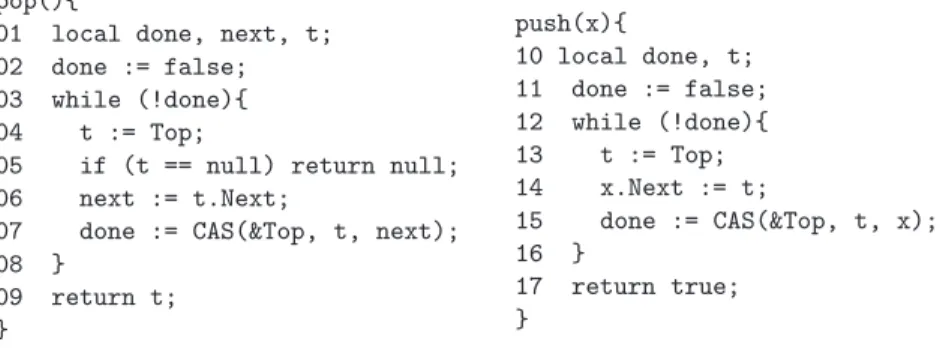
As an example, Fig. 1 shows a non-blocking stack algorithm, where a stack is implemented as a linked list pointed by theToppointer. It allows simultaneous read (line 4 and 13) and write (7, 15) of Top, and the conflict detection is done by the CAS (compare-and-swap) command. This algorithm has two subtle bugs. One is that t might be a dangling pointer when the dereference occurs in line 6. The other is the notorious ABA problem: suppose the top three nodes on the stack are A, B and C; Thread 1 callspopand reaches the end of line6; sotpoints to A and nextpoints to B; then Thread 2 comes, pops A and B, and pushes A onto the stack; Thread 1 continues to execute line 7, where the comparison succeeds andTopis set to point to B, which is no longer on the stack.
Here, we have to refer to the historical events to explain the problems above. It is not surprising that temporal reasoning is needed to argue for the correctness of such highly concurrent algorithms.
pop(){
01 local done, next, t; 02 done := false; 03 while (!done){ 04 t := Top;
05 if (t == null) return null; 06 next := t.Next;
07 done := CAS(&Top, t, next); 08 } 09 return t; } push(x){ 10 local done, t; 11 done := false; 12 while (!done){ 13 t := Top; 14 x.Next := t; 15 done := CAS(&Top, t, x); 16 } 17 return true; }
Fig. 1.A Buggy Implementation of Non-Blocking Stacks
Concurrent separation logic (CSL [13]) and rely-guarantee (R-G) based rea-soning [8] are two well-studied approaches to concurrency verification. Previous work [14, 18] has shown that they can be used to verify fine-grained and op-timistic algorithms. However, since assertions in these logics only specify pro-gram states (or state transitions in R-G reasoning), it is difficult to use them to express directly the temporal properties about the subtle interaction between threads. Instead, we have to introduce history variables to record the occurrence of certain events. This indirect approach to specifying historical events makes specifications and proofs complex, and in many cases fails to demonstrate the high-level intuition behind the design of the algorithms.
In this paper, we propose a new program logic that uses invariants on his-torical execution traces to reason about optimistic concurrency algorithms. The logic extends previous work on R-G reasoning by introducing past tense tempo-ral operators in the assertion language. It allows us to specify historical events directly without using history variables, which makes the verification process more modular and intuitive.
Although it has also been observed before that past tense operators in tem-poral logic can be used to eliminate the need of history variables [10], developing a modular logic with temporal reasoning that is able to verify modern concurrent algorithms has so far been an open problem. Our logic inherits previous work on combining R-G reasoning with separation logic [3, 19, 2] to support modu-lar verification. Separating conjunction in separation logic is now defined over assertions on execution histories instead of state assertions. The frame rule and the hide rule in the Local Rely-Guarantee (LRG) logic [2]—the keys for modular verification—are supported naturally in this new setting.
We apply our new logic to reason about Michael’s non-blocking stack al-gorithm [11] which uses hazard pointers to fix the buggy alal-gorithm in Fig. 1. We use trace invariants to capture the main intuition underlying the algorithm. The program specifications and proofs used in our logic are more intuitive than those from previous work [14]. They do not require history variables. Our logic
(Expr) E::=x|n|E+E |E-E | . . . (Bexp) B::=true|false|E=E |E6=E| . . .
(Stmts) C::=x:=E|x:=[E]|[E]:=E′ |skip|x:=cons(E, . . . , E)
| dispose(E)|ifB thenCelseC |whileB doC| hCi |C;C (Prog) W ::= t1.C1k. . .ktn.Cn (ThrdID) t ∈ Nat
Fig. 2.A Concurrent Programming Language
(Store) s ∈ PVar⇀finInt (Heap) h ∈ Nat⇀finInt (State) σ ∈ Store×Heap
(Trace)T ::= (σ0,t0) :: (σ1,t1) ::· · ·:: (σn,tn) (Trans) R,G ∈ P(Trace)
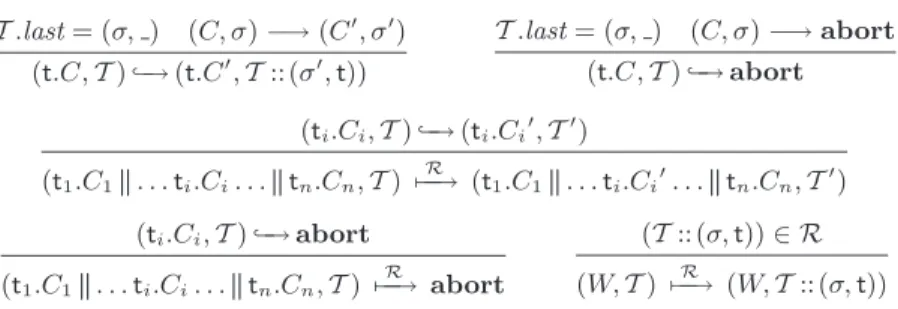
Fig. 3.Program States and Execution Traces T.last= (σ, ) (C, σ)−→(C′, σ′) (t.C,T)֒−→(t.C′,T:: (σ′,t)) T.last= (σ, ) (C, σ)−→abort (t.C,T)֒−→abort (ti.Ci,T)֒−→(ti.Ci′,T′) (t1.C1k. . .ti.Ci. . .ktn.Cn,T) R 7−−→ (t1.C1k. . .ti.Ci′. . .ktn.Cn,T′) (ti.Ci,T)֒−→abort (t1.C1k. . .ti.Ci. . .ktn.Cn,T) R 7−−→ abort (T:: (σ,t))∈ R (W,T) 7−−→R (W,T:: (σ,t))
Fig. 4.Selected Rules of Operational Semantics
also supports a new frame rule that further simplifies the proofs (e.g., for the retireNodefunction in Fig. 9) and makes the verification more modular.
2
A Concurrent Programming Language
Figure 2 shows a simple concurrent language. The statements x:=[E] and [E]:=E are memory-load and store operations respectively; cons allocates fresh memory cells, anddisposefrees a cell. The atomic block hCiexecutes C
atomically. Other statements have standard meanings. A programW contains
nparallel threads, each marked with a unique thread ID (e.g.,ti forCi). Figure 3 defines program states and execution traces. The storesis a finite partial mapping from program variables to integers; the heap hmaps memory locations (natural numbers) to integers. A program state σis a pair (s, h). An execution trace T is a (nonempty) finite sequence (σ0,t0) :: (σ1,t1) :: · · · :: (σn,tn). A pair (σi,ti) in a traceT means that a thread with ID ti reached the stateσi after executing one step from the state σi−1. Thread ID t0 can be any
(StateAssert) P, Q::=B |emph|emps |own(x)|E7→E |P∗Q| . . . (TraceAssert)p, q, R, G, I::=P |Id|[p]t |p⊲q| ⊖p|p∗q| ∃X.p| ¬p|p∨q|. . .
Fig. 5.The Assertion Language
(s, h)|=slemps iff s=∅ (s, h)|=slemph iff h=∅ (s, h)|=slown(x) iff dom(s) ={x}
(s, h)|=slE1 7→E2 iff there existℓandnsuch that
JE1Ks=ℓ,JE2Ks=n,dom(h) ={ℓ}andh(ℓ) =n σ|=slP∗Q iff there existσ1 andσ2
such thatσ1⊎σ2=σ, σ1|=SLP andσ2|=SLQ emp def= emps∧emph
Fig. 6.Semantics of Selected Separation Logic Assertions
value. We useT.last to denote the last element inT. A trace (T:: (σ,t)) in the trace setsRandG is also used to model a single-step transition by the threadt
that starts fromT and reaches a new stateσ.
Figure 4 gives selected rules modeling the operational semantics (see the technical report [4] for the complete rules). The binary relation −→ models a transition over states made by a primitive statement. The definition is standard and is omitted here. The relation ֒−→ lifts state transitions to transitions over traces. The thread ID of the executing threadt is recorded on the trace at the end of the transition. Finally, the relation 7−−→R models the transitions over traces made by programs in an environment characterized byR. HereRcontains all the possible transitions of the environment.
3
The Assertion Language
Our assertion language is defined in Fig. 5. We use separation logic assertions (P
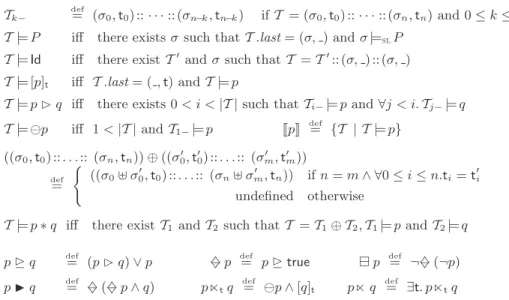
andQ) to specify program states. Following Parkinson et al. [15], we also treat program variables as resources. Semantics of some separation logic assertions are shown in Fig. 6. We useσ1⊎σ2to represent the union of the two disjoint states. Trace assertions. Trace assertionsp,q,R,GandI specify historical execution traces. Semantics of trace assertions are defined in Fig. 7. Here we use |T | to represent the length of T, and use Tk− to represent the subsequence resulting from truncating the lastkelements fromT (0≤k <|T |).
A state assertionP is viewed as a trace assertion that specifies only the last state. AssertionId says that the last two states on the trace are the same (i.e. the last state transition is an identity transition). Assertion [p]t means that the
Tk−
def
= (σ0,t0) ::· · ·:: (σn−k,tn−k) ifT = (σ0,t0) ::· · ·:: (σn,tn) and 0≤k≤n T |=P iff there existsσsuch thatT.last= (σ, ) andσ|=slP
T |=Id iff there existT′andσsuch thatT =T′:: (σ, ) :: (σ, )
T |= [p]t iff T.last= (,t) andT |=p
T |=p⊲q iff there exists 0< i <|T |such thatTi−|=pand∀j < i.Tj−|=q
T |=⊖p iff 1<|T |andT1−|=p JpK def = {T | T |=p} ((σ0,t0) ::. . .:: (σn,tn))⊕((σ0′,t′0) ::. . .:: (σ′m,t′m)) def = ( ((σ0⊎σ′0,t0) ::. . .:: (σn⊎σm′ ,tn)) ifn=m∧ ∀0≤i≤n.ti=t′i undefined otherwise
T |=p∗q iff there existT1 andT2 such thatT =T1⊕ T2,T1|=pandT2|=q pDq def= (p⊲q)∨p ♦−p def= pDtrue ⊟p def= ¬♦−(¬p) p◮q def= ♦−(−♦p∧q) p⋉tq
def
= ⊖p∧[q]t p⋉q
def
= ∃t. p⋉tq
We assume unary operators (♦−and⊖) have higher precedence than other operators.
Fig. 7.Semantics of Trace Assertions
trace satisfiespand the last state transition is made by the threadt. Assertion
p⊲ q holds over T if and only if p holds over the trace Ti− for some i and q holds ever since. It is also represented as qS p (q sincep) in the literature of temporal logic [10]. Assertion⊖pholds if and only if the trace prior to the last transition satisfiesp.JpK is the set of traces that satisfyp.
Assertionp∗q lifts separating conjunction to traces; it specifies a program trace consisting of twodisjointparts: one satisfiespand anotherq. TracesT1and
T2are disjoint if they have the same length, and for eachisuch that 0≤i <|T | the states inT1[i] andT2[i] are disjoint (see the definition ofT1⊕ T2 in Fig. 7). Other useful connectors can be defined using these primitive operators. As-sertion pDq is a weaker version of p⊲q. Assertion♦−psays thatp was once true in the history. Assertion⊟pholds if and only ifpholds at every step in the history. Assertionp ◮q says that pfirst came true in the history, and then q
came true later. Assertionp⋉tqmeans that the last transition is made by thread t, and assertionpholds prior to the transition, andqholds after it. This allows us to define the built-in ⋉operator in LRG [2].
Example 3.1. In the TL2 transactional memory protocol [1], before updating a shared memory cell, we must first acquire the corresponding lock and then increase the global version clock. This requirement (among many others in the protocol) can be defined as the following guarantee:
Gtid(x) def= ∃D, D′, T, T′. ((x7→0, D∗gt7→T)⊲(x7→tid, D∗gt7→ )) ∧(x7→tid, D∗gt7→T′) ∧(T′> T) ⋉tid(x7→tid, D′ ∗ gt7→T′)
Herexpoints to two fields, its lock and its value. The first line above says that, before the transition, the lock was acquired (it was changed from 0 to tid) when the global version clockgtwasT. Then the lock and the value have been preserved ever since, butgtmight have been changed. The second line saysgt is greater than T right before the transition. The third line says the value of x is updated by the transition. This definition also implies that the increment of gtis done after the lock is acquired.
The guarantee above refers to two events before the specified transition. In traditional R-G reasoning, the guarantee condition can only specify two states, so we have to introduce history variables to describe such historical events.
As in separation logic, a class of trace assertions that are of special interest to us are those that are precise about the last state on the trace.
Definition 3.2 (Last-State-Precise Trace Assertions). pis last state pre-cise,i.e.LPrec(p)holds, if and only if for allT,t,s,h,s1,s2,h1,h2, if s1⊆s,
s2⊆s,h1⊆h,h2⊆h,T:: ((s1, h1),t)|=pandT :: ((s2, h2),t)|=p, thens1=s2 andh1=h2.
The example below shows a last-state-precise assertionpcan specify a precise state domain that is determined dynamically by historical events. It is more powerful than a precise state assertionP in separation logic [17]. This can also be seen in our hazard-pointer-based stack example.
Example 3.3. LetI=∃X.⊖−(ℓ7→X∗true)∧(ℓ7→ ∗(X= 0∧r∨X6= 0∧emp)) wherer=x7→ ∗y7→ , thenIis a last-state-precise trace assertion. It specifies traces where the domain of the last state depends on the historical valueX ofℓ.
4
A Program Logic for History
Now we present our program logic for history, named HLRG, which extends the LRG logic [2] with trace assertions for reasoning about historical traces.
As in LRG, we use the judgmentsR;G⊢ {p}W{q}andR;G;I⊢t{p}C{q}for
well-formed programs and well-formed threadt respectively. The rely condition
R and the guarantee Gspecify the interference between the environment and the thread. The judgments say informally that starting from a trace satisfying both ⊟(R∨G)∗trueand p, if the environment’s transitions satisfyR, then W
(or C) would not abort, its transitions satisfyG, and q holds at the end if W
(or C) terminates. The invariant I specifies the well-formedness of the shared resource. Unlike in the LRG logic,R,G,I,pandqare all trace assertions now. Figure 8 gives the main inference rules. The prog rule allows us to ver-ify the whole program by verver-ifying the nparallel threads t1.C1,t2.C2,. . .,tn.Cn separately. Each threadti has exclusive access to its own private resource spec-ified bypi and qi. All threads can access the shared resource specified by r,r1 . . .rn. To verify each thread, we need to find an invariantI specifying the basic well-formedness of the shared resource.
R∨G1∨. . .∨Gi−1∨Gi+1∨. . .∨Gn;Gi;I⊢ti{pi∗r}Ci{qi∗ri} ∀i∈ {1, . . . , n} r∨r1∨. . .∨rn⇒I R;G1∨. . .∨Gn⊢ {p1∗. . .∗pn∗r}t1.C1k. . .ktn.Cn{q1∗. . .∗qn∗(r1∧. . .∧rn)} (prog) p⇒P {P}C{Q} p⋉tQ⇒G∗true IdI;G;I⊢t{p} hCi {Q} (atom)
whereIdIis defined asId∧(I⋉I). p⇒p′ IdI;G;I⊢t{p′}hCi{Q′} ⊖p∧Q′⇒q Sta({p, q}, R∗Id)
R;G;I⊢t{p} hCi {q}
(atom-r)
R;G;I⊢t{p}C{q}
Sta(r, R′∗Id) r⇒I′∗true
R∗R′;G∗G′;I∗I′⊢ t{p∗r}C{q∗r} (frame) R;G;I⊢t{p}C{q} R;G;I⊢t{p∧♦−r}C{q∧♦−r} (frameT) R;G;I⊢t{p∧(I′∗true)}C{q} ⊟(R∨G)⇒(I′∧I′′) R;G;I⊢t{p}C{q∧(I′′∗true)} (inv)
Fig. 8.Selected Inference Rules of the HLRG Program Logic
Theatom rule says that we can treatC in the atomic block as sequential code since its execution cannot be interrupted. Here the judgment{P}C{Q}can be derived following the standard sequential separation logic rules [17], which we do not show here. This rule allows us to strengthenP into a trace assertionpso that we can carry the historical information. The transition frompto Qneeds to satisfy the guaranteeG, which may have some constraints over the history traces (examples aboutGcan be found in Fig. 10 in Sec. 5).
Theatomrule uses a strong rely condition about the environment, which is an identity transition preserving the invariantIof the shared resource. To relax it, we can apply the next atom-r rule borrowed from RGSep [18]. It allows us to adjust the pre- and post-conditions so that they are both stablewith respect to the rely conditionR.
Definition 4.1 (Stability). We say a trace assertion p is stable with respect to a trace assertion q,i.e.Sta(p, q)holds, if and only if ⊖p∧q⇒p.
That is, ifpholds before the most recent transition, and the transition satisfies
q, then p holds after it. This is the standard requirement in R-G reasoning. With temporal operators, it can now be encoded as a temporal assertion. We useSta({p, q}, R) as a shorthand forSta(p, R)∧Sta(q, R).
The interesting (and new) part of this atom-r rule is the post condition
q, which is weakened from the trace assertion⊖p∧Q′. This allows us to carry information about historical events happened before this atomic transition.
The frame rule comes from LRG. It supports local reasoning and allows
C. Invariants about other resources are preserved and can be added into the specifications later. We also introduce a new frameT rule to show the frame property over “time”. Since historical traces would not affect the execution of programs, knowledge about history can be added when necessary.
The new inv rule is also very useful. It is like the reverse of the standard consequence rule in Hoare logic, since it allows us to strengthen the pre-condition, and prove a post-condition weaker than we wanted. This rule is sound because the invariants I′ and I′′ can be derived from the fact that each step of the transition satisfies R∨G, so that they can be used anywhere in the proof for free. We will demonstrate the use of frame, frameT andinv in our example in Sec. 5.
The rest of the rules are the same as those in LRG, and are not shown here. Note that in each rule we implicitly require the following properties hold.
– fence(I, R) andfence(I, G);
– p∨q⇒I∗true;
wherefence(I, p) is defined below:
fence(I, p) def
= (Id∧(I⋉I)⇒p)∧(p⇒I⋉I)∧LPrec(I).
Informally, it requires that the most recent transition is confined in a precise domain enforced by the last-state-precise assertion I. This constraint is inher-ited from LRG. Interested readers can refer to our previous work [2] to see the technical discussions about this requirement.
Semantics and soundness. The semantics of our logic and its soundness proof are similar to those of LRG. We first define the non-interference property below.
Definition 4.2 (Non-Interference). Let W =t1.C1k. . .ktn.Cn.
(W,T,R) =⇒0Galways holds.(W,T,R) =⇒m+1G holds iff¬(W,T) 7−−→R abort and the following are true:
1. for alltandσ, if(T :: (σ,t))∈ R, then for allk≤m,(W,T :: (σ,t),R) =⇒kG; 2. for all σ and i ∈ {1,. . ., n}, if (ti.Ci,T)֒−→(ti.Ci′,T:: (σ,ti)), then (T :: (σ,ti))∈ G and (t1.C1 k . . .ti.Ci′. . . ktn.Cn,T :: (σ,ti),R) =⇒k G holds for allk≤m.
Then the semantics ofR;G⊢ {p}W{q}is defined below. Theorem 4.4 shows the soundness theorem of the logic.
Definition 4.3. R;G|={p}W{q}iff, for allT such thatT |=p∧(⊟(R∨G)∗true), the following are true (where R=JR∗IdKandG=JG∗trueK):
1. if(W,T) 7−−→R ∗(skip,T′), thenT′|=q; 2. for all m,(W,T,R) =⇒mG.
Theorem 4.4 (Soundness). If R;G⊢ {p}W{q}then R;G|={p}W{q}. We show the proof in the extended technical report [4].
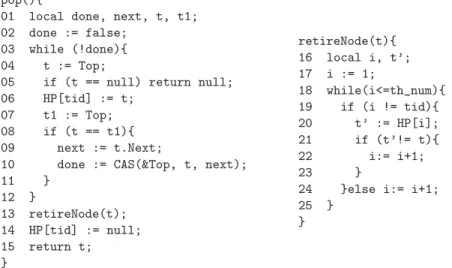
pop(){
01 local done, next, t, t1; 02 done := false;
03 while (!done){ 04 t := Top;
05 if (t == null) return null; 06 HP[tid] := t;
07 t1 := Top; 08 if (t == t1){ 09 next := t.Next;
10 done := CAS(&Top, t, next); 11 } 12 } 13 retireNode(t); 14 HP[tid] := null; 15 return t; } retireNode(t){ 16 local i, t’; 17 i := 1; 18 while(i<=th_num){ 19 if (i != tid){ 20 t’ := HP[i]; 21 if (t’!= t){ 22 i:= i+1; 23 }
24 }else i:= i+1; 25 }
}
Fig. 9.Optimistic Lock-Free Stacks with Hazard Pointers
5
Verification of Lock-Free Stacks with Hazard Pointers
We now apply HLRG to verify Michael’s lock-free stacks, which use hazard pointers [11] to address the problems with the algorithm in Fig. 1. In Fig. 9 we show the new popfunction. Thepushfunction is the same as in Fig. 1 and is omitted here. We use stack(Top, A) below to specify the shared stack, which is implemented as a linked list pointed by Top. The set A records the memory locations of the nodes on the list. It is kept to simplify our proofs. Below we useE7→E1, E2as a shorthand forE7→E1∗E+17→E2, andE7→ for∃n. E7→n. List(ℓ,∅,nil)def=emp∧ℓ=null
List(ℓ, A, n::L)def=ℓ∈A∧ ∃ℓ′.(ℓ7→n, ℓ′)∗List(ℓ′, A−{ℓ}, L)
stack(Top, A)def=∃ℓ, L.(Top7→ℓ)∗List(ℓ, A, L) (1) The algorithm fixes the ABA problem by using a global array HP, which contains a “hazard” pointer for each thread. The array is specified by Ihp(HP). HereHP+tidis the location of HP[tid], andth numis the number of threads.
Ihp(HP)def=⊛tid∈[1..th num].HP+tid7→ (2) where⊛x∈s.p(x)
def
=s=∅ ∧emp∨ ∃z.(s={z}⊎s′)
∧(⊛x∈s′.p(x))∗p(z)
and ⊎is the union of disjoint sets.
Before a racy access to the top node on the stack, a thread stores the node’s memory location into itsHPentry (lines 06-08). This announces to other threads that the node is being accessed and should not be reclaimed. When a node is suc-cessfully removed from the stack (line 10), the remover thread callsretireNode (line 13) and waits till after this node is no longer being accessed by any other
threads (i.e., not pointed by theirHPentries). Finally, it clears its ownHPentry (line 14) before it obtains the full ownership of the node (line 15).
We useremove(ℓ,Top,HP,tid) in (3) to specify that the threadtidis in the removephase: it has popped the node atℓfrom the stack, but has not reached
line 14yet. The part in front of Dsays that there was a primitive operation in history, which popped the node from the stack. TheDoperator and the assertion following it require that the removed node be pointed by the remover’s ownHP entry ever since. HereE1;E2is a shorthand for (E17→E2)∗true. The predicate
not rem(Top,HP,tid) in (4) says thattidis currently not in the remove phase.
remove(ℓ,Top,HP,tid)def= (3)
((HP+tid7→ℓ∗Top;ℓ)⋉tid(HP+tid7→ℓ∗ ∃ℓ
′
.Top;ℓ′∧ℓ6=ℓ′))
DHP+tid;ℓ∧ℓ6=null
not rem(Top,HP,tid)def=¬∃ℓ.remove(ℓ,Top,HP,tid) (4) In addition to the stack and theHParray, the popped nodes that are accessible from the hazard pointers should be viewed as shared resources as well. We use
opset(Top,HP, S, O) in (5) to iterate these shared nodes, where O is the set of pointers pointing to these nodes andS is the set of threads.
opset(Top,HP,∅,∅)def=true (5) opset(Top,HP,{tid} ⊎S, O)def=
(∃ℓ.remove(ℓ,Top,HP,tid)∧ℓ∈O∧opset(Top,HP, S, O− {ℓ})) ∨(not rem(Top,HP,tid)∧opset(Top,HP, S, O))
The invariantIbelow specifies all three parts of the shared resources.Iis a last-state-precise assertion. The domain of the shared resource depends on the historical information whether nodes are popped before or not.
Idef=∃O.opset(Top,HP,[1..th num], O)
∧(Ihp(HP)∗ ∃A.stack(Top, A)∗(⊛ℓ∈O. ℓ7→ , )) (6) Below we characterize the meaning of hazard pointers.ishazard(ℓ,Top,HP,tid) saysHP[tid] contains a “confirmed” hazard pointer ℓ, i.e.ℓwas once the top of the stack in history and the thread tid has not updated the Toppointer ever since (thoughTopmight have been updated by other threads). When the remover thread invokesretireNode on the top nodet, it scans the hazard pointers of all other threads and make sure thatishazard(t,Top,HP,tid) does not hold for each non-remover threadtid. This is specified byhazfree(t,Top,HP,tid), which says that the node thas been popped by the threadtidand other threads no longer treat it as a hazard node.
upd top(tid)def=∃ℓ, ℓ′
.(Top;ℓ⋉tidTop;ℓ′)∧ℓ6=ℓ′
ishazard(ℓ,Top,HP,tid)def= (7)
(HP+tid7→ℓ∗Top;ℓ)⊲ (HP+tid;ℓ)∧ ¬upd top(tid)
hazfree(ℓ,Top,HP,tid)def= (8)
remove(ℓ,Top,HP,tid)∧ ∀tid′
Poptid def= ∃ℓ, ℓ′
.⊖((Top;ℓ)∗(HP+tid7→ℓ)∗(ℓ7→ , ℓ′)∗List(ℓ′, , ))
∧((Top7→ℓ⋉tidTop7→ℓ′)∗Id) (line 10) Retiretid def= ∃ℓ.⊖hazfree(ℓ,Top,HP,tid)
∧(((HP+tid7→ℓ∗ ℓ7→ , ) ⋉tidHP+tid7→null)∗Id) (line 14) Reset HPtiddef= ⊖not rem(Top,HP,tid)
∧((HP+tid7→ ⋉tidHP+tid7→ )∗Id) (line 06) Pushtid def= (Top7→ℓ⋉tid(Top7→ℓ′ ∗ℓ′7→ , ℓ))∗Id (line 15in Fig. 1) Gtid def= (Retiretid∨Poptid∨Pushtid∨Reset HPtid∨Id)∧(I⋉I)
Rtid def= W
tid’∈[1..th num]∧tid6=tid’Gtid’
Fig. 10.Transitions over Shared Resources, and R-G Specifications
The call to retireNode is crucial. As we will show below, it ensures that a confirmed hazard pointer cannot be a dangling pointer, and a popped node pointed by any confirmed hazard pointers cannot show up on the stack again (thus the ABA problem is avoided).
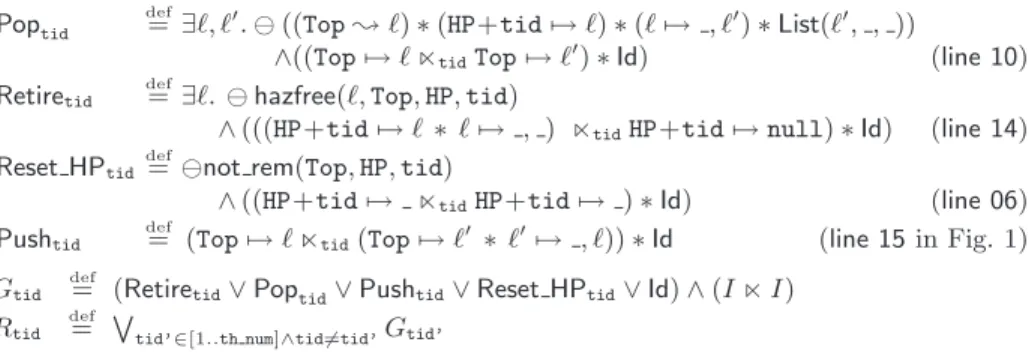
Verification of the Algorithm. We first define in Fig. 10 all the operations over the shared data structure, and show which line of the code makes the corresponding transition (read-only operations are simplyIdtransitions and are omitted). Poptid pops the top node from the stack. It requires that the hazard pointer point to the top of the stack. Retiretid sets the value of HP[tid] into null, knowing that the popped node is no longer a hazard node. Then the node
ℓ is converted logically from shared resource to private. Reset HPtid resets the hazard pointer when the threadtidfails to pop a node.Pushtidpushes aprivate node onto the stack.
We also define the rely (Rtid) and guarantee (Gtid) of the threadtid. Here
I(defined in (6)) is used to fence the domain of all possible actions. It is easy to seefence(I, Rtid) andfence(I, Gtid) are satisfied. Next we show some key trace invariants derivable from ⊟(Rtid∨Gtid). They are used when the inv rule is applied. Also they show the key intuition of the algorithm.
Invariant 1. This invariant ensures that a node pointed by a hazard pointer is either on the stack or in the setO, so it is safe to dereference a hazard pointer.
∀ℓ,tid, A, O.ishazard(ℓ,Top,HP,tid)∧opset(Top,HP,[1..th num], O) ∧(stack(Top, A)∗true)∧ℓ6=null⇒ℓ∈A∨ℓ∈O Invariant 2. If a thread tidonce held a hazard pointer pointing to the top of the stack, and the top node on the stack was popped by other threads, then the node will not be on the stack again as long as tid’s HP entry is not changed. This invariant ensures that there are no ABA problems.
∀ℓ, A, A′,tid.
(ishazard(ℓ,Top,HP,tid)∧(stack(Top, A)∗true))⊲HP+tid;ℓ
POPtid(ℓ, n, ℓ′)def
=⊖((Top;ℓ)∗(ℓ7→n, ℓ′)∗List(ℓ′, , ))
∧((Top7→ℓ⋉tidTop7→ℓ′)∗Id) pop(){
{ HP+tid7→null I}
01 local done, next, t, t1; 02 done := false;
{ HP+tid7→null
I} ∧ ¬done} {not rem(Top,HP,tid)
I∧ ¬done} loop invariant:
{ not rem(Top,HP,tid)
I∧ ¬done
∨ ∃n, ℓ′.♦−POPtid(t, n, ℓ′)∧(remove(t,Top,HP,tid)∗(t7→n, ℓ′))
I∧done} 03 while (!done){
{ not rem(Top,HP,tid) I} 04 <t := [Top]>;
05 if (t == null) return null; 06 <HP[tid] := t>;
{∃ℓ. not rem(Top,HP,tid)∧HP+tid7→ℓ
I∧t=ℓ∧ℓ6=null} 07 <t1 := [Top]>; Applyatom-randatom
{∃ℓ, ℓ′. not rem(Top,HP,
tid)∧(HP+tid7→ℓ∗Top7→ℓ′)
I∧t=
ℓ∧ℓ6=null∧t1=ℓ′
} {∃ℓ, ℓ′. ℓ=ℓ′⇒ishazard(ℓ,Top,HP,tid)
I∧t=ℓ∧ℓ6=null∧t1=ℓ
′}
08 if (t == t1){ {∃ℓ. ishazard(ℓ,Top,HP,tid)
I∧
t=ℓ∧ℓ6=null} ApplyinvwithInvariant 1
{∃ℓ, n, ℓ′
. ishazard(ℓ,Top,HP,tid)∗ℓ7→n, ℓ′
I∧t=ℓ} 09 <next := t.Next>;
{∃ℓ, n, ℓ′
. ishazard(ℓ,Top,HP,tid)∗ℓ7→n, ℓ′
I∧t=ℓ∧next=ℓ
′
} 10 <done := CAS(&Top, t, next)>; ApplyinvwithInvariant 2
11 } 12 } { ∃n, ℓ′
.♦−POPtid(t, n, ℓ′)∧(remove(t,Top,HP,tid)∗(t7→n, ℓ′)) I} 13 retireNode(t); ApplyframeandframeT
{ ∃n, ℓ′.
♦−POPtid(t, n, ℓ′)
∧(hazfree(t,Top,HP,tid)∗(t7→n, ℓ′))
I} 14 <HP[tid] := null>; Applyatom-randatom
{∃n, ℓ′ . ♦−POPtid(t, n, ℓ′) I∗(t7→n, ℓ ′) } 15 return t;
{ ♦−List(null,nil) I∧
t=null∨ ∃n, ℓ′. ♦−POPtid(t, n, ℓ′)
I∗(
t7→n, ℓ′)}
}
Ithp
def
= (Top7→ )∗Ihp(HP) IrN
def
=remove(t,Top,HP,tid)∧Ithp selfornothazard(i)def= ∀tid′∈[1..i−1].tid′=tid∨ ¬ishazard(t,Top,HP,tid′)
IrN
retireNode(t){ {IrN}
16 local i, t’; 17 i := 1;
loop invariant: {i≤th num+1∧selfornothazard(i-1)} 18 while(i<=th_num){
19 if (i != tid){ 20 <t’ := HP[i]>; 21 if (t ’!= t) {
{♦−(∃ℓ.HP+i7→ℓ∧(i6=tid∧ℓ6=t))∧selfornothazard(i-1)∧i≤th num} ApplyinvwithInvariant 3
{selfornothazard(i)∧i≤th num} 22 i := i+1;
23 }
24 }else i:= i+1; 25 }
{selfornothazard(th num+1)} { hazfree(t,Top,HP,tid)
Ithp} }
Fig. 12.Verification ofretireNode
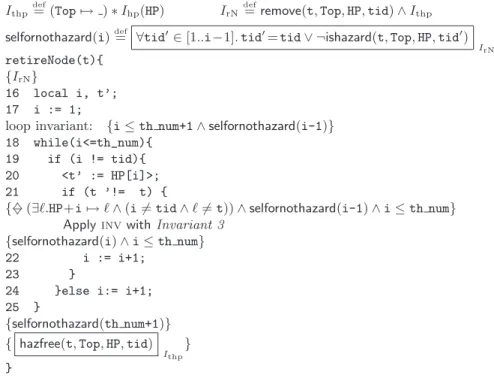
Invariant 3. This invariant justifies theretireNodeprocedure. If the threadtid popped a nodeℓ and its HPentry points to the node, then for all other thread tid’ its hazard pointer cannot point to the node and becomes a confirmed hazard pointer again if it was set to point to a different node (ℓ′) in history.
∀ℓ, ℓ′
,tid,tid′.
remove(ℓ,Top,HP,tid)∧(HP+tid′
;ℓ′)∧ℓ′6=ℓ
⊲HP+tid;ℓ
⇒ ¬ishazard(ℓ,Top,HP,tid′) We show the proof sketch forpopin Fig. 11. Here p
I is used as a shorthand for (p∗true)∧I. The precondition of poprequires that the invariantIhold over the shared resources, and that the calling thread’s HP entry be initialized to null. The post-condition saysI holds at the end; the stack was either empty or the nodetwas popped out of the stack and is now part of the local resource of the calling thread. The proof sketch forretireNodeis given in Fig. 12.
Most part of the proof simply follows the rules of the logic. The interesting part is that the specification ofretireNodedoes not mention the linked list and the nodes inopset. Neither does it need to know that the pop operation has been done (∃n, ℓ′
.♦−POPtid(t, n, ℓ′)). The knowledge can be added back by applying
theframeandframeTrules respectively before we composeretireNodewith
pop(see Fig. 11). Thepushprocedure has nothing to do with hazard pointers, thus the proof is trivial and can be seen in the extended TR [4].
6
Related Work and Conclusions
Assume-Guarantee (A-G) reasoning [12, 16] often views a concurrent program as an “invariant maintainer” instead of a “predicate transformer” [9], especially for safety verification. With this view, sequential composition of programs seems always trivial and is rarely discussed in previous work on A-G reasoning.
R-G reasoning [8], on the other hand, decomposes specifications into program invariants (R and G) and Hoare-style pre- and post-conditions, which gives us a “predicate transformer” view of programs. With this view, sequential compo-sition of programs (C1;C2) is no longer trivial. For instance, to use the post condition q of C1 as the pre-condition of C2 as in Hoare Logic, we need to ensure the stability of q. Our logic is an extension of R-G reasoning. We take this “predicate transformer” view of programs, and try to spell out the details of the verification step associated with each program construct. Also, our logic successfully combines separation logic and temporal reasoning, which gives us better modularity. The two different frame rules in our logic reflect the frame properties over space (program states) and time respectively.
Gotsman et al. [5] introduced temporal operators in RGSep [19] to reason about liveness properties of non-blocking algorithms. They do not use any past tense operators. Their temporal operators were only used in their rely and guar-antee conditions, but not in the pre- and post-conditions. Since the frame rule overRandGwas not used there, the interoperability between temporal opera-tors and separation logic operaopera-tors was not discussed.
Parkinson et al. [14] used CSL to verify safety of the same stack algorithm we verified here. The specifications makes heavy uses of history variables. We believe that our specifications reflect the intuition of the algorithm more directly. Vafeiadis [18] applied RGSep to verify several non-blocking stack algorithms, which all rely on garbage collectors to avoid the ABA problem. It is unclear how the specification of Michael’s stacks would look like in RGSep.
Conclusion. In this paper we have proposed a new program logic HLRG, which combines R-G reasoning with past tense temporal assertions to reason about optimistic concurrency algorithms. Our new logic supports modular verification, including the frame rules over both the separation logic and temporal operators. We have verified Michael’s lock-free stack with hazard pointers and show that our history logic can directly capture the high-level intuition about the algorithm.
Acknowledgments. We thank anonymous referees for their comments on this paper. Ming Fu and Yong Li are supported in part by China Scholarship Council and by National Natural Science Foundation of China under grant No. 90718026. Much of this work was done during their visits to Yale University in 2009-2010. Zhong Shao is supported in part by NSF grants CNS-0915888, CNS-0910670, and CCF-0811665. Xinyu Feng is supported in part by National Natural Science Foundation of China under grant No. 90818019.
References
[1] D. Dice, O. Shalev, and N. Shavit. Transactional locking II. InProc. 20th Int’l
Symp. on Distributed Computing (DISC’06), pages 194–208, 2006.
[2] X. Feng. Local rely-guarantee reasoning. InProc. 36th ACM Symp. on Principles
of Prog. Lang., pages 315–327. ACM Press, Jan. 2009.
[3] X. Feng, R. Ferreira, and Z. Shao. On the relationship between concurrent separa-tion logic and assume-guarantee reasoning. InProc. 16th European Symposium on
Programming (ESOP’07), volume 4421 ofLNCS, pages 173–188. Springer-Verlag,
March 2007.
[4] M. Fu, Y. Li, X. Feng, Z. Shao, and Y. Zhang. Reasoning about optimistic con-currency using a program logic for history. Technical Report YALEU/DCS/TR-1428, Dept. of Computer Science, Yale University, New Haven, CT, June 2010. http://flint.cs.yale.edu/publications/roch.html.
[5] A. Gotsman, B. Cook, M. J. Parkinson, and V. Vafeiadis. Proving that non-blocking algorithms don’t block. InProc. 36th ACM Symp. on Principles of Prog.
Lang., pages 16–28. ACM, 2009.
[6] M. Herlihy. Wait-free synchronization. ACM Trans. Program. Lang. Syst., 13(1):124–149, 1991.
[7] M. Herlihy and J. E. B. Moss. Transactional memory: Architectural support for lock-free data structures. In Proc. 20th Annual Int’l Symp. on Computer
Architecture (ISCA), pages 289–300, 1993.
[8] C. B. Jones. Tentative steps toward a development method for interfering pro-grams.ACM Trans. on Programming Languages and Systems, 5(4):596–619, 1983. [9] L. Lamport and F. B. Schneider. The “Hoare Logic” of CSP, and all that. ACM
Trans. Program. Lang. Syst., 6(2):281–296, 1984.
[10] O. Lichtenstein, A. Pnueli, and L. D. Zuck. The glory of the past. InProc. Conf.
on Logic of Programs, volume 193 ofLNCS, pages 196–218. Springer, 1985.
[11] M. M. Michael. Hazard pointers: Safe memory reclamation for lock-free objects.
IEEE Trans. Parallel Distrib. Syst., 15(6):491–504, 2004.
[12] J. Misra and K. M. Chandy. Proofs of networks of processes.IEEE Trans. Software Eng., 7(4):417–426, 1981.
[13] P. W. O’Hearn. Resources, concurrency and local reasoning. InProc. 15th Int’l
Conf. on Concurrency Theory (CONCUR’04), pages 49–67, 2004.
[14] M. Parkinson, R. Bornat, and P. O’Hearn. Modular verification of a non-blocking stack. In Proc. 34th ACM Symp. on Principles of Prog. Lang., pages 297–302. ACM Press, Jan. 2007.
[15] M. J. Parkinson, R. Bornat, and C. Calcagno. Variables as resource in hoare logics.
InProc. 21st Annual IEEE Symposium on Logic in Computer Science (LICS’06),
pages 137–146. IEEE Computer Society, August 2006.
[16] A. Pnueli. In transition from global to modular temporal resoning about programs. In K. R. Apt, editor,Logics and Models of Concurrent Systems, NATO ASI Series, pages 123–144. Springer-Verlag, 1984.
[17] J. C. Reynolds. Separation logic: A logic for shared mutable data structures. In
Proc. 17th Annual IEEE Symposium on Logic in Computer Science (LICS’02),
pages 55–74. IEEE Computer Society, July 2002.
[18] V. Vafeiadis.Modular fine-grained concurrency verification. PhD thesis, Computer Laboratory, University of Cambridge, Cambridge, UK, July 2007.
[19] V. Vafeiadis and M. Parkinson. A marriage of rely/guarantee and separation logic.