Introduction: Surgery is the standard treatment for early stage non– small-cell lung cancer (NSCLC). For medically inoperable patients, stereotactic ablative radiotherapy (SABR) has emerged as widely used standard treatment. The aim of this study was to analyze sur-vival and patterns of tumor recurrence in patients with clinical stage I NSCLC treated with surgery or SABR.
Methods: Clinical data from all subsequent fluoro-deoxyglucose positron emission tomography/computed tomography-based stage I NSCLC patients (cT1-T2aN0M0) treated with surgery or SABR at our center between 2007 and 2010 were collected. Primary end-points were overall survival and tumor recurrences/new primary lung tumors. Treatment groups were compared using multivariable Cox regression and competing risk analyses.
Results: Three hundred-forty patients treated with surgery (n = 143) or SABR (n = 197) were included. Surgical patients were younger, had a better WHO performance status and less comorbidities. After adjustment for prognostic covariables, treatment did not influence overall survival (adjusted hazard ratio [HR], SABR versus surgery 1.07; 95% confidence interval [CI]: 0.74–1.54; p = 0.73). Local con-trol and distant recurrence were equal, whereas locoregional recur-rences were significantly more frequent after SABR compared with surgery (adjusted sub-HR 2.51; 95% CI: 1.10–5.70; p = 0.028). Nodal failure (HR: 2.16; 95% CI: 1.34–3.48) and distant metastases (HR: 2.12; 95% CI: 1.52–2.97), but not local failure (HR: 1.00; 95% CI: 0.53–1.89) predicted overall survival.
Conclusions: In patients with fluoro-deoxyglucose positron emis-sion tomography/computed tomography-based stage I NSCLC, SABR confers worse locoregional tumor control because of more nodal failures compared with surgery, stressing the need to improve mediastinal and hilar staging.
Key Words: Non–small-cell lung cancer, Early stage NSCLC, Lobectomy, Stereotactic radiotherapy.
(J Thorac Oncol. 2015;10: 826–831)
L
obectomy with systematic lymph node dissection is the standard procedure for medically operable patients with stage I non–small-cell lung cancer (NSCLC), with a 5-year survival of 50% to 70%.1,2 A considerable part of patients with resectable early stage NSCLC is however medically inoperable because of frailty or severe comorbidity.3 In a cohort of 10,984 patients with early stage NSCLC, surgery was not performed in 23.3% of the white patients and 36% of the black patients. This included inoperable patients as well as patients refusing surgery.4 The most common rea-sons for medical inoperability are poor lung function, which is often seen in COPD patients, or cardiovascular comor-bidity, both of which bring about an increased risk of post-operative pulmonary complications. When withholding inoperable patients any antitumor treatment, the prognosis is poor and most of them will die because of tumor progres-sion. The 5-year overall survival in untreated patients is 6% or less.3,5From the late 1990s, technological improvements of radiotherapy planning software, verification devices, together with advanced planning-CT techniques (4D-CT) made stereo-tactic treatment of small tumor volumes with very high doses per fraction possible. With stereotactic ablative radiotherapy (SABR), higher dose in just a few fractions can be deliv-ered and surrounding tissue is much better spared than with 3D-conformal radiotherapy.6,7 In patients with stage I NSCLC, overall survival and local control rates after SABR are better compared with rates found after conventional 3D-conformal radiotherapy.8
Potential clinical advantages of SABR over surgery are the absence of an invasive procedure with possible associated complications, anesthesia, and hospital admission. However, no randomized trials comparing clinical outcomes after either procedure are available.
Several studies have been performed regarding the effect of SABR on survival and tumor control. Soldà et al.9 reviewed 45 reports analyzing SABR in patients with stage I NSCLC and found survival rates similar to those in a large matched surgical cohort.
A recent large single-center retrospective study, in contrast, found lower 3-year overall survival rates for SABR compared with surgical patients.10 Local tumor control after SABR is generally good, with previously reported rates rang-ing between 85% and 98%.9–14 Few studies were performed comparing the outcomes of a SABR cohort directly with a primarily operable surgical cohort.10,14–17
DOI: 10.1097/JTO.0000000000000483
Copyright © 2015 by the International Association for the Study of Lung Cancer
ISSN: 1556-0864/15/1005-0826
Patterns of Recurrence and Survival after Surgery or
Stereotactic Radiotherapy for Early Stage NSCLC
Liseth L. van den Berg, MD,* Theo J. Klinkenberg, MD,† Harry J. M. Groen, MD, PhD,*
and Joachim Widder, MD, PhD‡
*Department of Pulmonary Diseases, †Department of Cardiothoracic Surgery, and ‡Department of Radiation Oncology, University of Groningen, University Medical Center Groningen, Groningen, The Netherlands. Disclosure: The authors declare no conflict of interest.
Address for correspondence: Harry. J. M. Groen, MD, PhD, Department of Pulmonary Diseases, University of Groningen, University Medical Center Groningen, Hanzeplein 1, PO Box 30.001, 9700 RB Groningen, The Netherlands. E-mail: [email protected]
We performed a retrospective study in a large consecu-tive cohort of patients with clinical stage I NSCLC treated at a single university medical center with surgery or SABR, with the aim to compare survival rates and patterns of tumor recurrence. Comorbidity, age, and performance status were the factors upon which treatment allocation had been based at the multidisciplinary pulmonary oncology panel. Thus, all analyses were adjusted for these factors.
Because of patient selection, we hypothesized a signifi-cantly worse unadjusted survival for the SABR cohort that should be equalized after adjustment. Also, we expected com-parable adjusted local, locoregional, and distant tumor recur-rence rates in the SABR and surgical cohorts using competing risk analysis.
PATIENTS AND METHODS Patients
The study was conducted at the University Medical Center Groningen in the Netherlands. Because all data in this study were obtained from patient medical records and patients themselves were not involved in the study, neither approval of the Institutional Review Board nor informed consent were required according to Dutch law.
All consecutive patients treated between January 2007 and July 2010 with curatively intended surgery or SABR for proven or suspected fluoro-deoxyglucose positron emission tomography–computed tomography (FDG-PET–CT)-staged NSCLC were selected from the database.
Inclusion and Exclusion Criteria
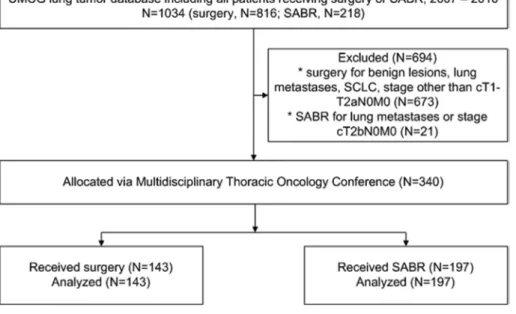
Patients with cT1-2aN0M0 tumors (less than 50 mm) according to the 7th TNM edition were included18 (Fig. 1). Staging was based on FDG-PET/CT. Furthermore, inclusion required cytological or histological confirmation of the tumor or, in absence of a pathological confirmation, a combination of imaging information requiring increased FDG-PET-uptake
and/or a growing or new lesion on CT exhibiting signs of malignancy. FDG-avid or CT-enlarged (greater than 10 mm short axis diameter) lymph nodes were examined with medi-astinoscopy or endosonography with fine-needle aspiration to confirm that their nodes are free of tumor. Patients with a pre-operatively proven benign lesion, lung metastases, small-cell lung cancer, or lymph node metastases were not included as well as patients with neoadjuvant chemotherapy or radiother-apy (Fig. 1). Patient allocation to treatment required discus-sion at the multidisciplinary pulmonary oncology panel.
Treatment Procedures
Surgery was performed via open thoracotomy (94% of the cases) or video-assisted thoracic surgery and included wedge resection, lobectomy, bilobectomy, or pneumonectomy, the lat-ter three operations with hilar and mediastinal lymph-node dis-section. SABR was based on a 4D-planning CT. The planning target volume (PTV) was defined as the envelope including the moving gross tumor volume plus a margin in all directions of 5 mm. After the institutional protocol, a risk-adapted fraction-ation schedule of 3 to 12 fractions to 60 Gy was administered using a Novalis accelerator, online position verification and correction was performed using the Exac-Trac system with a 6D-robotic couch (Brainlab, Feldkirchen, Germany).8 In brief, lesions completely surrounded by lung tissue and not located within 2 cm of the central airways received three fractions of 20 Gy. Lesions located within the 2 cm corridor of trachea and main bronchi received eight fractions of 7.5 Gy or 12 fractions of 5 Gy, whereas lesions adjacent to the thoracic wall received five times 12 Gy. During the study period, a pencil-beam dose-calculation algorithm with tissue heterogeneity correction had been used and the dose was prescribed at 80% isodose com-prising periphery of the PTV.8
Follow-Up
Patient data were extracted from the hospital patient files and supplementary information was retrieved via
telephone contact with general practitioners. Patients’ vital status was additionally obtained from the Municipal Personal Records Database with a cutoff on January 30, 2014. During follow-up, regular CT scans were made to monitor tumor recurrences 3 and 6 months after treatment, then at 6 months intervals until 2 years and yearly thereafter. FDG-PET was only performed when clinically indicated. Tumor recurrence was scored in case of greater than 20% tumor growth (after SABR), new lesions on CT or brain MRI, or a confirmatory FDG-PET showing high FDG uptake in the lesion.
Study Endpoints
The endpoints of the study were overall survival and local, nodal, locoregional (=local or nodal or both), and dis-tant tumor recurrence or new pulmonary tumors. To score local recurrence in a study comprising patients with lobec-tomy, pneumoneclobec-tomy, wedge resection, and SABR is highly challenging. In this study, local recurrence after both surgery and SABR was defined as a growing tumor in the same lobe as the primary tumor including growth at the irradiated location (the PTV) or around the surgical clips including the ipsilateral hilus. Tumor occurring in another lobe or extrathoracic tumor was defined as distant metastasis. Locoregional tumor recur-rence was defined as local recurrecur-rence as defined above plus any mediastinal or hilar lymph node metastasis.
Statistics
Overall survival was estimated using the Kaplan–Meier method. Time was taken between the date of surgery or the first fraction of SABR and date of death because of any cause or most recent date alive. To determine the role of covariables on overall survival, Cox regression analyses were performed. The following covariables were analyzed: treatment, age, sex, WHO performance score, Charlson comorbidity index, and tumor size. Significant factors were included in the able models. For tumor recurrences and metastases, multivari-able competing risk analyses with death and nontarget-type (first) recurrences as competing risk were performed. With this method, it is possible to correct for differences in inter-current death and censoring because of clinical necessities. For example, occurrence of distant metastases was a compet-ing risk for local recurrence, because imagcompet-ing to identify local recurrence had been ceased in these patients. Thus, they were no longer at risk for local recurrence, a fact that is neglected in e.g., Cox regression analysis.
RESULTS
Patient, Tumor, and Treatment Characteristics
A total of 340 patients treated with surgery (n = 143) or SABR (n = 197) were included. Patient and treatment characteristics are shown in Table 1. Patients treated with surgery were 10 years younger, had a better performance status, less comorbidity, and better lung function tests, but tumor size and clinical stage were not different. FDG-PET/ CT was used for staging in all patients, endoscopic ultra-sound and cervical mediastinoscopy were only used in 1% and 4%, respectively. Of note, in 85 of the surgical patients
(59%), no tumor tissue had been obtained before surgery, although in 59 of them (69%) one or more biopsies had been attempted. In 154 of the SABR patients (78%), no tumor tissue was obtained.
Significantly more patients in the surgical cohort had an FDG-negative primary tumor (p < 0.001). The indication for resection in these cases had been based on spiculation and tumor growth on repeated CTs.
For surgical patients, the median hospital stay was 9 days with a range of 3–111 days; in 90% of the patients, admission was less than 25 days. Stereotactic radiotherapy was exclusively administered in an outpatient setting.
In the surgical cohort, 15% of the patients received adju-vant chemotherapy and 2% had postoperative radiotherapy for incomplete resection. Only a single patient (less than 1%) had adjuvant chemotherapy after SABR (p < 0.001).
Overall Survival
Median follow-up was 61 months. Age, performance status, comorbidity, tumor size, and treatment (surgery better than SABR) were highly significant predictive factors for sur-vival at univariable analysis. After adjustment for the former factors, the difference in survival between surgery and SABR disappeared and the adjusted SABR versus surgery hazard ratio (HR) for overall survival was 1.07 (95% confidence interval [CI]: 0.74–1.54; p = 0.73). Of note, adjuvant therapy was not significantly related to overall survival. Unadjusted survival rates are shown in Table 2.
Tumor Recurrences and Occurrence of New Primaries
Local tumor control using the definition as described above was not different between SABR and surgery (adjusted sub-HR 1.21; 95% CI: 0.38–3.90; p = 0.75). Also for dis-tant recurrence, no significant difference was found between both treatments (adjusted sub-HR 1.01; 95% CI: 0.56–1.84;
p = 0.97). Treatment was not a significant factor for nodal
tumor recurrence, but a trend for more nodal recurrences after SABR was found (adjusted sub-HR 2.17; 95% CI: 0.91–5.17; p = 0.079).
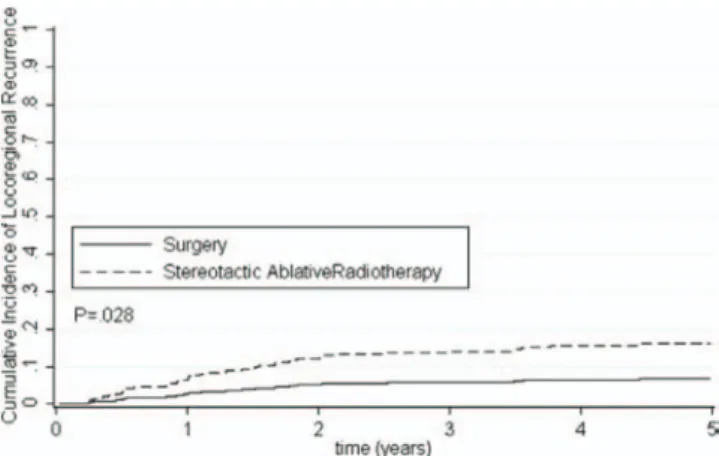
Locoregional recurrences however—local or nodal or both together—were significantly more frequent after SABR compared with surgery (adjusted sub-HR 2.51; 95% CI: 1.10– 5.70; p = 0.03; Fig. 2).
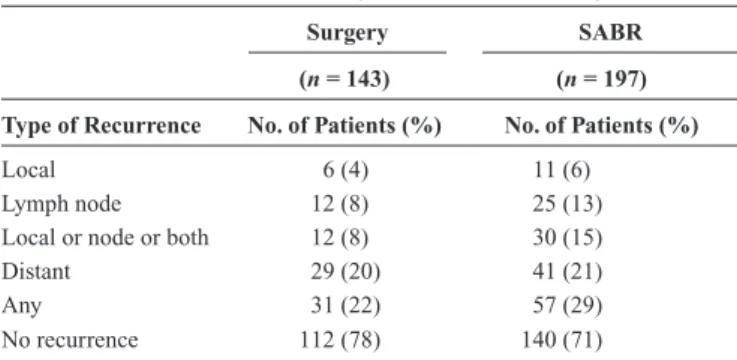
Nodal and distant metastases, but not local recurrence, were significant independent predictive factors for survival (Table 3). The gross pattern of recurrence is displayed in Table 4. Unadjusted freedom-from-tumor-recurrence rates are shown in Table 2.
DISCUSSION
For medically inoperable patients with early stage NSCLC, SABR has evolved as the preferred treatment option.19,20 There are no randomized comparative trials avail-able comparing surgery with SABR. However, such tri-als would by definition be confined to operable patients. Therefore, the evolution of SABR has been mainly triggered by promising results for local tumor control after SABR.9–14,21
The range of reported survival rates after SABR is under-standably variable because of patient selection.9 Moreover, little is known about the reasons for decreased survival after SABR: is it mainly because of comorbidity prompting medi-cal inoperability, or is it because of differences in patterns of recurrence, or to both factors. To date, few studies have accepted the challenge to compare the outcomes of a SABR cohort directly with a surgical cohort.15–17,22
Typically, younger and fitter patients with less comor-bidity and better lung function are offered surgery for solitary FDG-positive lung lesions highly suspicious for NSCLC, whereas the medically marginally operable or inop-erable patient is offered SABR. In the absence of randomized data, comparative survival and recurrence data corrected for these well-known selection parameters are the second best source to possibly inform clinical decision making. To ana-lyze survival rates, patterns of tumor recurrence after sur-gery or SABR, and the impact of recurrence patterns upon survival, we studied a consecutive cohort of patients with cT1-2aN0M0 lung tumors highly suspicious for NSCLC. Our hypothesis was that SABR, when adjusting for group differences, would be equally effective as surgery in terms of tumor control and survival.
Our study indeed showed that survival depended on age, performance status, comorbidity, and tumor size, and that adjusted overall survival after surgery or SABR was not different. Prospective single arm trials involving SABR and retrospective analyses comparing SABR with surgery have found similar overall survival rates as we have found in our study.10–12,23 A recently published review showed even similar 2- and 3-year overall survival rates after SABR and surgery.9
TABLE 1. Demographic, Clinical, and Treatment Characteristics of Included Patients (n = 340) Surgery SABR p Value (n = 143) (n = 197)
No. of Patients (%) No. of Patients (%)
Age, years <0.001 Median 67 77 Range 40–84 52–93 Sex NS Men 96 (67) 143 (73) Women 47 (33) 54 (27)
WHO performance score <0.001 0–1 143 (100) 155 (79)
2–3 0 (0) 42 (21)
Charlson comorbidity index 0.012
Median 2 2
Range 0–5 0–5
0–1 65 (45) 77 (39)
≥2 78 (55) 120 (61)
Current or former smoker 124 (87) 195 (99) <0.001
cTNM classification NS
cT1aN0M0 61 (43) 71 (36) cT1bN0M0 22 (15) 55 (28) cT2aN0M0 60 (42) 71 (36) Tumor size in mm, median
(range) 23 (5–50) 25 (5–50) NS
Tumor location NS
Right upper lobe 51 (36) 73 (37) Right middle lobe 9 (6) 9 (5) Right lower lobe 25 (18) 26 (13) Left upper lobe 36 (25) 55 (28) Left lower lobe 22 (15) 34 (17) Surgical treatment Pneumonectomy 5 (3) Lobectomy 110 (77) Bilobectomy 11(8) Wedge resection 17 (12) pTNM classification pT1aN0M0 50 (35) pT1bN0M0 23 (16) pT2aN0M0 30 (21) upstaged to >stage I: 35 (24) pT1a-2aN1M0 16 (11) pT1a-2aN2M0 11 (8) pT2bN0-2M0 8 (6) Other tumora 2 (1) Benignb 3 (2) SABR schedule 3 × 20 Gy 95 (48) 5 × 12 Gy 59 (30) 8 × 7.5 Gy 39 (20) 12 × 5 Gy 4 (2)
Follow-up time, months NS
Median 61 61
Range 43–84 43–79
aOne melanoma; one salivary gland tumor. bOne solitary fibrous tumor; two localized infections.
WHO, World Health Organization; SABR, stereotactic ablative radiotherapy; NS, not significant.
TABLE 2. Unadjusted Survival and Freedom-from-Recurrence Rates (%)
1 Year 2 Years 3 Years 5 Years
Overall survival
Surgery 91.6 80.4 68.5 58.2
SABR 88.3 76.6 56.9 31.8
Free from local recurrence
Surgery 98.3 97.2 96.0 93.0
SABR 98.9 95.9 95.1 80.0
Free from lymph node recurrence
Surgery 97.4 92.4 90.1 87.3
SABR 92.0 88.3 88.3 78.7
Free from locoregional recurrence
Surgery 97.4 92.4 90.1 87.3
SABR 90.9 85.6 84.8 77.2
Free from distant recurrence
Surgery 89.9 82.7 76.8 74.1
SABR 91.5 85.0 80.6 65.9
Free from any recurrence
Surgery 89.1 82.7 76.8 71.7
SABR 84.7 77.8 72.7 57.4
Locoregional recurrence = local or lymph node or both. SABR, stereotactic ablative radiotherapy.
Also, the largest retrospective single-center SABR analysis showed comparable survival and recurrence rates.21
Lagerwaard et al.13, who analyzed potentially operable patients having received SABR, found higher overall survival rates compared with our study because of selection of a fitter patient group. An even higher 5-year overall survival of 69.5% was found by Onishi et al.24, however, this was a cohort of 87 medically operable Japanese patients treated with SABR, who show better survival very consistently in most studies involv-ing lung cancer.
In our study, we defined local tumor recurrence as recur-rence in the same lobe as the primary tumor or at the ipsilateral hilus, and locoregional recurrence as including in addition the contralateral hilus or any mediastinal lymph node metastases. Tumor recurrence definitions are not used consistently in the literature. In most stereotactic radiotherapy or local-and-limited-resection studies, local recurrence is defined more restrictive as recurrence at the exact location of the primary tumor.23 Such a definition precludes reasonable comparisons with lobectomy series. In our study, no difference between the treatment groups was found for local recurrence (using our definition) or distant metastases. In contrast to other studies that found no increased locoregional recurrence rate after SABR compared with resec-tion,16,22 we observed a trend toward more nodal recurrences after SABR and significantly more locoregional tumor recur-rences after SABR compared with surgery. In keeping with this
result, 24% (19% were solely because of hilar and/or medias-tinal lymph nodes) of our FDG-PET-CT-based clinical stage I patients were upstaged postoperatively to higher stages based on the resected specimen (Table 1). This seems to be quite high and may partly be because of an earlier generation PET machine that was used during the time of the study, but it is in line with recent data in the literature.16,25,26 This stresses the importance of opti-mal lymph node staging especially if the nodes are not sampled at treatment (i.e., SABR or wedge resection). Even though our patients had undergone FDG-PET, still a number of them will have harvested latent metastases in hilar or mediastinal nodes, which were not treated with SABR. A major argument for sur-gery thus remains the remaining uncertainty about hilar (or mediastinal) lymph node involvement despite negative CT and FDG-PET scans. It is well known that small lymph node metas-tases are not detected by PET. A recently published study showed that the sensitivity, specificity, and accuracy of 18F-FDG-PET/ CT for assessing mediastinal lymph node metastasis with a short-axis diameter of less than 15 mm is still limited.27 As high as 18% of occult lymph node metastases in an FDG-negative hilus and mediastinum were found in another recent study, and SUV and size of primary tumor were factors predicting node-positivity.28 Therefore, to improve locoregional tumor control in patients with stage I NSCLC who are eligible for SABR, using new-generation PET and even minimally invasive mediastinal staging using E(B)US with fine needle aspiration or even medi-astinoscopy should be carefully considered to spare them poten-tial undertreatment because of neglect of nodal metastases.
A limitation of our study is its retrospective design. However, we double-checked data using information from the general practitioner and the Municipal Personal Records Database in addition to patient files. A serious limitation of the Charlson comorbidity score is that no distinction is made in severity of the comorbidity, e.g., between mild or severe pulmonary problems. Another limitation is because of use of an out-dated radiation dose calculation algorithm during the study period (pencil-beam calculation with heterogeneity cor-rection). Nowadays, Monte Carlo or collapsed cone algorithms are used resulting in higher SABR doses compared with the doses actually delivered during the studied period. Therefore, locoregional tumor control with SABR might have improved in the last couple of years. The strength of this study is the direct comparison of both survival and patterns of tumor recurrence between a large surgical and a large SABR consecutive cohort
FIGURE 2. Cumulative incidence of locoregional failure after surgery or stereotactic radiotherapy based on competing risk analysis.
TABLE 3. Multivariable Cox-Model of Factors Predicting Overall Survival
Variable Hazard Ratio 95% CI p Value
Age, per year 1.041 1.02–1.06 <0.001
Charlson comorbidity index, ≥2 vs. 0–1 1.453 1.07–1.98 0.017
WHO performance score, ≥2 vs. 0–1 2.025 1.35–3.04 0.001
Tumor size, per mm 1.013 1.00–1.03 0.061
Treatment, SABR vs. surgery 0.98 0.68–1.41 0.915
Local recurrence 0.996 0.53–1.89 0.991
Lymph node recurrence 2.163 1.34–3.48 0.002
Distant recurrence 2.123 1.52–2.97 <0.001
with a very long follow-up. Indications were discussed at a mul-tidisciplinary tumor board, all patients were staged with FDG-PET/CT, and analyses were based on clinical, not postoperative pathological staging information, which would skew the com-parison. Analyses were corrected for the factors upon which patient selection for treatment had been performed and pat-terns of recurrences were analyzed taking competing risks into account. In conclusion, patients with NSCLC at clinical stage I treated with surgery were 10 years younger, fitter and had less comorbidities than those treated with SABR. Adjusted overall survival was similar between surgery and SABR, but SABR yielded worse locoregional tumor control compared with sur-gery. This was because of more nodal failures after SABR compared with surgery. SABR is a tailor-made treatment for patients unfit for surgery, but optimal mediastinal and hilar staging remains essential for optimizing treatment decisions.
REFERENCES
1. Goldstraw P, Crowley J, Chansky K, et al.; International Association for the Study of Lung Cancer International Staging Committee; Participating Institutions. The IASLC Lung Cancer Staging Project: Proposals for the revi-sion of the TNM stage groupings in the forthcoming (seventh) edition of the TNM classification of malignant tumours. J Thorac Oncol 2007;2:706–714. 2. Darling GE, Allen MS, Decker PA, et al. Randomized trial of mediastinal lymph node sampling versus complete lymphadenectomy during pulmo-nary resection in the patient with N0 or N1 (less than hilar) non-small cell carcinoma: Results of the American College of Surgery Oncology Group Z0030 Trial. J Thorac Cardiovasc Surg 2011;141:662–670.
3. Palma D, Visser O, Lagerwaard FJ, Belderbos J, Slotman BJ, Senan S. Impact of introducing stereotactic lung radiotherapy for elderly patients with stage I non-small-cell lung cancer: A population-based time-trend analysis. J Clin Oncol 2010;28:5153–5159.
4. Bach PB, Cramer LD, Warren JL, Begg CB. Racial differences in the treatment of early-stage lung cancer. N Engl J Med 1999;341:1198–1205. 5. Raz DJ, Zell JA, Ou SH, Gandara DR, Anton-Culver H, Jablons DM.
Natural history of stage I non-small cell lung cancer: Implications for early detection. Chest 2007;132:193–199.
6. Gauden S, Ramsay J, Tripcony L. The curative treatment by radio-therapy alone of stage I non-small cell carcinoma of the lung. Chest 1995;108:1278–1282.
7. Lagerwaard FJ, Senan S, van Meerbeeck JP, Graveland WJ; Rotterdam Oncological Thoracic Study Group. Has 3-D conformal radiotherapy (3D CRT) improved the local tumour control for stage I non-small cell lung cancer? Radiother Oncol 2002;63:151–157.
8. Widder J, Postmus D, Ubbels JF, Wiegman EM, Langendijk JA. Survival and quality of life after stereotactic or 3D-conformal radiotherapy
for inoperable early-stage lung cancer. Int J Radiat Oncol Biol Phys 2011;81:e291–e297.
9. Soldà F, Lodge M, Ashley S, Whitington A, Goldstraw P, Brada M. Stereotactic radiotherapy (SABR) for the treatment of primary non-small cell lung cancer; systematic review and comparison with a surgical cohort. Radiother Oncol 2013;109:1–7.
10. Crabtree TD, Puri V, Robinson C, et al. Analysis of first recurrence and survival in patients with stage I non-small cell lung cancer treated with surgical resection or stereotactic radiation therapy. J Thorac Cardiovasc
Surg 2014;147:1183–1191; discussion 1191.
11. Verstegen NE, Lagerwaard FJ, Haasbeek CJ, Slotman BJ, Senan S. Outcomes of stereotactic ablative radiotherapy following a clinical diag-nosis of stage I NSCLC: Comparison with a contemporaneous cohort with pathologically proven disease. Radiother Oncol 2011;101:250–254. 12. Baumann P, Nyman J, Hoyer M, et al. Outcome in a prospective phase II trial of medically inoperable stage I non-small-cell lung cancer patients treated with stereotactic body radiotherapy. J Clin Oncol 2009;27:3290–3296. 13. Lagerwaard FJ, Verstegen NE, Haasbeek CJ, et al. Outcomes of
stereotac-tic ablative radiotherapy in patients with potentially operable stage I non-small cell lung cancer. Int J Radiat Oncol Biol Phys 2012;83:348–353. 14. Grills IS, Mangona VS, Welsh R, et al. Outcomes after stereotactic lung
radiotherapy or wedge resection for stage I non-small-cell lung cancer.
J Clin Oncol 2010;28:928–935.
15. Crabtree TD, Denlinger CE, Meyers BF, et al. Stereotactic body radiation therapy versus surgical resection for stage I non-small cell lung cancer.
J Thorac Cardiovasc Surg 2010;140:377–386.
16. Verstegen NE, Oosterhuis JW, Palma DA, et al. Stage I-II non-small-cell lung cancer treated using either stereotactic ablative radiotherapy (SABR) or lobectomy by video-assisted thoracoscopic surgery (VATS): Outcomes of a propensity score-matched analysis. Ann Oncol 2013;24:1543–1548. 17. Robinson CG, DeWees TA, El Naqa IM, et al. Patterns of failure after
stereotactic body radiation therapy or lobar resection for clinical stage I non-small-cell lung cancer. J Thorac Oncol 2013;8:192–201.
18. Goyal K, Einstein D, Yao M, et al. Cyberknife stereotactic body radiation therapy for nonresectable tumors of the liver: preliminary results. HPB
Surg 2010. http://dx.doi.org/10.1155/2010/309780.
19. Vansteenkiste J, De Ruysscher D, Eberhardt WE, et al. Early and locally advanced non-small-cell lung cancer (NSCLC): ESMO clinical practice guidelines for diagnosis, treatment and follow-up. Ann Oncol 2013;24: vi89–vi98.
20. Howington JA, Blum MG, Chang AC, Balekian AA, Murthy SC. Treatment of stage I and II non-small cell lung cancer: Diagnosis and management of lung cancer, 3rd ed: American College of Chest Physicians
evidence-based clinical practice guidelines. Chest 2013;143:e278S–e313S. 21. Senthi S, Lagerwaard FJ, Haasbeek CJ, Slotman BJ, Senan S. Patterns
of disease recurrence after stereotactic ablative radiotherapy for early stage non-small-cell lung cancer: A retrospective analysis. Lancet Oncol 2012;13:802–809.
22. Varlotto J, Fakiris A, Flickinger J, et al. Matched-pair and propensity score comparisons of outcomes of patients with clinical stage I non-small cell lung cancer treated with resection or stereotactic radiosurgery. Cancer 2013;119:2683–2691.
23. Timmerman R, Paulus R, Galvin J, et al. Stereotactic body radia-tion therapy for inoperable early stage lung cancer. JAMA 2010;303:1070–1076.
24. Onishi H, Shirato H, Nagata Y, et al. Stereotactic body radiotherapy (SBRT) for operable stage I non-small-cell lung cancer: Can SBRT be comparable to surgery? Int J Radiat Oncol Biol Phys 2011;81:1352–1358. 25. Robson JM, Vaidyanathan S, Cheyne L, Snee M, Franks K, Callister ME.
Occult nodal disease in patients with non-small-cell lung cancer who are suitable for stereotactic ablative body radiation. Clin Lung Cancer 2014;15:466–469.
26. Licht PB, Jorgensen OD, Ladegaard L, et al. A national study of nodal upstaging after thoracoscopic versus open lobectomy for clinical stage I lung cancer. Ann Thorac Surg 2013;96: 943–949; discussion 949–950. 27. Lu P, Sun Y, Sun Y, Yu L. The role of (18)F-FDG PET/CT for evaluation
of metastatic mediastinal lymph nodes in patients with lung squamous-cell carcinoma or adenocarcinoma. Lung Cancer 2014;85:53–58. 28. Li L, Ren S, Zhang Y, et al. Risk factors for predicting the occult nodal
metastasis in T1-2N0M0 NSCLC patients staged by PET/CT: Potential value in the clinic. Lung Cancer 2013;81:213–217.
TABLE 4. Patterns of Failure per Treatment Group (n = 340)
Surgery SABR
(n = 143) (n = 197) Type of Recurrence No. of Patients (%) No. of Patients (%)
Local 6 (4) 11 (6)
Lymph node 12 (8) 25 (13) Local or node or both 12 (8) 30 (15)
Distant 29 (20) 41 (21)
Any 31 (22) 57 (29)
No recurrence 112 (78) 140 (71)
Local, recurrence in lobe of primary tumor or ipsilateral hilus; lymph node, recurrence in any hilar or mediastinal lymph node; local or node or both = locoregional; distant, recurrence outside locoregional region; any, any of the above recurrence types.