Atlas Journal of Materials Science 1 (1): 17–23, 2014 doi: 10.5147/ajms.2014.0170
Atlas Journal of Materials Science - ISSN 2330-6831. Published By
Atlas Publishing, LP
(www
.atlas-publishing.or
g)
Experimental Study of the Influence of Shot Peening on the
Microstructure and Properties of Surface Layer of a TC21
Titanium Alloy
Y. Song
*, Z. Zhao, and F. Lu
Beijing Institute of Aeronautical Materials, Beijing 100095, P.R. China
Received: January 2, 2014 / Accepted: April 21, 2014
__________________________________________________ * Corresponding author: [email protected]
17
Abstract
The effects of shot peening on microstructure and properties of surface layer of a TC21 titanium alloy have been studied by transmission electron microscopy, electron back-scat-tered diffraction, X-ray diffraction and Nano-indentation. The results indicated that an elastic-plastic strengthening layer was formed on the surface of the TC21 alloy after the shot peening. During the deformation processing, the acti-vated slip systems were found to be in <a>, <c> and <a/c> planes with high-density dislocations formed as networks in α phase. After the shot peening, the residual stress was found in the strengthening layer, which decreased from the surface to the interior, and the thickness of the surface layer was measured about 370 μm. The hardness by nano-inden-tation measurement increased two times as compared with the original material. After the shot peening, the fraction of the low-angle boundaries between 0-10º was estimated as 59.3% at the depth of 100 μm from surface. This surface layer microstructure improved resistance of deformation of the TC21 alloy, and therefore increased its fatigue strength. Keywords: Titanium alloy, shot peening, residual stress, nano-indentation, microstructure.
Introduction
TC21 alloy is a damage tolerance titanium alloy, which ex-hibits relatively high or moderate strength with higher fracture toughness and lower fatigue crack growth rate (Feng et al., 2004; Fei et al., 2008). Consequently, it has been considered as a structural material for aircraft applications recently. TC21 alloy is a new alpha-beta (α-β) alloy that belongs to the Ti-Al-Sn-Zr-Mo-Cr-Nb-Si system. The microstructure of this alloy after heat treated in the (α+β) region is mainly net-type struc-ture. The α and β phases have the crystallographic orientation relationship: {110}α // {0001}β, {111}α // {1120}β, and {112}α // {1010}β (Ge et al., 2005).
For industrial applications, shot peening technique has been established to improve the fatigue properties of metallic materi-als for a long time. Due to its convenience in operation and fa-vourable effects, shot peening has been widely used in the aero-space industry (Wang, 1979). Many researchers focus on steels (Shiozawa and Lu, 2002), aluminum alloys (De Los Rios et al., 2000), magnesium alloys (Barry et al., 2009) and compos-ite materials (Baragetti and Guagliano, 1998) treated by shot peening. In this process, the metal near the surface undergoes large plastic deformation due to the collision of large number of shots (Harada et al., 2007). Effects of the shot peening on the metals include surface integrity state which can be described by the residual stress field (Wang, 1979; Gao et al., 2003), surface roughness (Luong and Hill, 2010) and microstructure in the surface layer that influences the fatigue strength and lifetime (Tönshoff et al., 1997). For shot peened specimens, their sur-faces show crater-like marks, which are typical repeated shot impacts, evidence of surface overlaps and sharp features that can serve as crack initiators (Luong and Hill, 2010). The sur-This is an Open Access article distributed under the terms of the Creative Commons Attribution License
(http://creativecom-mons.org/licenses/by/3.0/), which permits unrestricted use, distribution, and reproduction in any medium, provided the origi-nal work is properly cited.
18
face profile line also shows the typical features of shot peen-ing, including a large increase of roughness and irregular peaks and valleys (Luong and Hill, 2010). The residual stress profiles measured using hole drilling (Barry et al., 2009) and X-ray (Zhang and Liu, 2009) can provide the value on the surface, the maxima value in the layer and the depth of the stress. Moreover, research has been conducted to improve the fatigue property of titanium alloys by shot peening to increase the tolerance of the airplane components (Wagner, 1999; Wu et al., 2008). There are limited studies on the internal and subsurface microstruc-tures of shot peened samples studied by transmission electron microscopy (TEM) (Yamamoto et al., 2006) and focused ion beam (FIB) (Okolo et al., 2007), and a few papers showing the profile of dislocation microstructure using the electron back-scatter diffraction (EBSD) method.
This study aims to clarify the effect of shot peening on sur-face conditions, microstructure and properties of the TC21 al-loy. In this investigation, the experimental data in the depth profiles of micro-hardness, dislocation densities and dislocation configurations were obtained through nano-indentation, EBSD and TEM. The mechanical surface strengthening mechanism of the TC21 alloy was discussed.
Materials and Methods
The material tested in this work was a TC21 titanium al-loy, with chemical composition of Ti-6Al-2Sn-2Zr-3Mo-1Cr-2Nb (all wt.%). Its tensile properties were tested as 1240 MPa tensile strength, 1100 MPa yield strength (0.2% offset), 43% reduction in area and 18% elongation. The heat treatment pro-cesses were 910 oC for 1 h/AC (air cooled) + 550 oC for 6 h/AC.
The shot peening was performed by means of an injector type system using cast steel shots, with an average diameter of 0.3 mm. The Almen intensity (fA) is 0.4 mm, and the coverage of the peening procedure is 200% when the shot peening time is twice longer than the saturation time. The surface roughness of shot-peened specimen was measured by profilometry. Using an X-3000 X-ray diffractometer, residual stress was measured as a function of depth by 0-45º four point method using Ti tar-get. The diffract crystal plane was (213), and the peak positions were determined by a full width at half maximum (FWHM) technique. In order to obtain residual stress profiles, surface layers of specimen were removed step by step by electrolytic dissolution before measurement. The hardness of the samples along the cross section was conducted by Nano-indenter XP instrument, and the depth of the indentation was 400 nm.
The sample for electron backscattering diffraction (EBSD) was cut from the shot peening specimens, with dimensions of about 10X10X5 mm3, prepared by electropolishing method.
EBSD was performed using a JEOL JSM-6500F filed-emission scanning electron microscope (FE-SEM) operated at 30 kV. The corresponding data acquisition and processing were car-ried out using TSL software.
Samples for transmission electron microscopy (TEM) were cut from the surface of the shot peened specimen and then prepared by conventional method, including careful grinding (1200 grit) to produce a thin disc, followed with twin-jet
elec-tropolishing for final thinning to reach electron transparency. The electrolyte used was a 34 vol.% butyl alcohol + 6 vol.% perchloric acid + 60 vol.% methanol solution, cooled with liq-uid nitrogen to keep the temperature at -15 oC. The TEM was
undertaken using a JEOL 2010 TEM operated at 200 kV.
Results
In this investigation, we focus on the distribution of the residual stress, the microstructural change and the change of roughness in the surface layer.
Surface Toughness and Topography
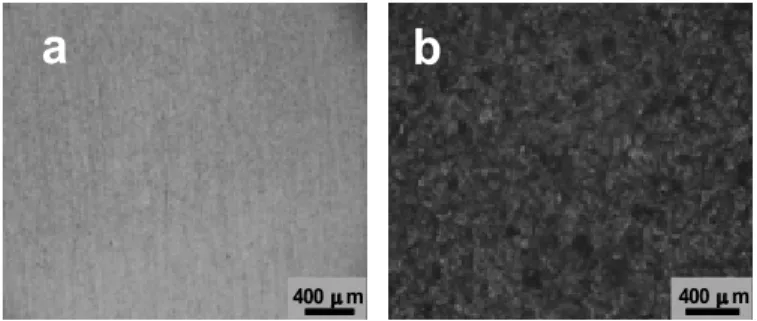
Surface roughness and topography of a component have a considerable influence on the fatigue strength. High roughness values can cause micro-stress concentration and thus the loss of fatigue strength. Roughness measurements of the TC21 alloy after shot peening have been carried out. The average rough-ness value, Ra, after shot peening up to a peening strength 0.4 A was about 1.482 μm, which was much greater than that of the untreated sample, 0.8 μm. Figure1 shows the photographs of optical microscopy of the TC21 sample before (a) and after (b) shot peening. The unpeened specimen surface is relatively smooth, without significant mechanical flaws (Figure 1a). In the shot-peened specimen, the change of roughness and topography leaves a microcrater structure due to the impact of solid balls (Wagner, 1999). It is found at some locations of the surface, the diameter of microcraters reached about 200 μm. Traditionally, such surface discontinuities are regarded as potential fatigue-crack nucleation sites in the material. However, according to some investigations, cracks were never observed initiating from the surface in shot-peened samples (Jiang et al., 2007; Linde-mann et al., 2006).
Hardness Distribution
Figure 2 indicates the distribution of nano-indentation hardness depth of the cross section of the TC21 alloy after shot peen-ing. The typical load-depth (F-h) curve, hardness and modulus curves are shown in Figure 2 (a), (b) and (c), respectively. Af-ter the shot peening treatment, the TC21 alloy has negligible changes of the modulus, but has a significant modification of
Figure 1. Topography of the TC21 alloy before (a) and after shot
peen-ing (b).
a
b
400 µm 400 µm
Atlas Journal of Materials Science - ISSN 2330-6831. Published By
Atlas Publishing, LP
(www
.atlas-publishing.or
g)
Atlas Journal of Materials Science - ISSN 2330-6831. Published By
Atlas Publishing, LP
(www
.atlas-publishing.or
19 the hardness. After shot peening, the hardness increased about
2 times than that of the unpeened specimen. The hardness of the inner specimen is 3.2 GPa, while on the shot-penned surface, 6.7 GPa (Figure 2b). The depth of the layer is roughly 0.37 mm. This can be explained by the modification of the structure near the surface caused by the shot peening.
Residual Stress Distribution
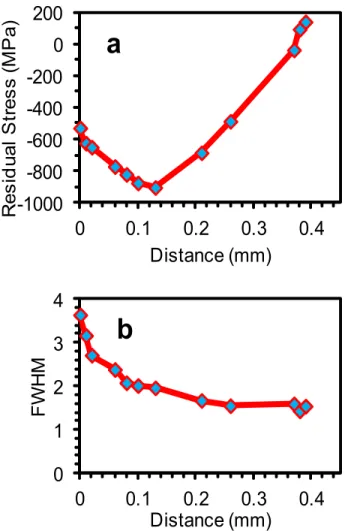
The reason for improving the fatigue life lies in the stress-induced transformation caused by the modification of the mi-crostructure of the surface. Figure 3(a) shows the effect of shot peening on residual stress profiles along the depth from the sur-face of the TC21 alloy. The results show that a deformed layer with residual stress on the sample surface is formed after shot peening. In this investigation, using a shot peening of 0.4 A, the stress of the surface is -529.3 MPa, and the compressive resid-ual stress reached the maximum of -903.5 MPa at the thickness about 0.13 mm below the surface. The depth of the deformed layer with compressive residual stress is 0.37 mm, which is similar to the hardness result. Beyond 0.37 mm, the stress be-comes tensile stress. In addition to compressive residual stress, shot peening also generate significant change of the dislocation density, which is indicated by the FWHM of X-ray diffraction (XRD) peak, as determined by X-ray peak broadening (Figure 3b). The FWHM values, up to 3.8, were measured in the surface of the sample, whereafter the FWHM value decreased rapidly. The maximum depth of the layer with the dislocation density is about 0.21 mm.
0
5
10
15
20
0
100
200
300
400
Lo
ad
,
F
(m
N
)
Depth,
h
(nm)
a
0
2
4
6
8
10
0
100
200
300
400
H
ar
d
ne
ss
(
G
P
a)
Distance from Surface (
µ
m)
b
0
50
100
150
200
0
100
200
300
400
M
o
d
ul
us
(G
P
a)
Distance from Surface (
µ
m)
c
Figure 2. Evolution of the nanoindentation of the TC21 alloy
af-ter shot peening. (a) F-h curve; (b) nanoindentation of hardness; (c) Young’s modulus.
Figure 3. Evolution of the residual stress and FWHM from surface to
inner of the TC21 alloy after shot peening. (a) Residual stress; and (b) FWHM.
-1000
-800
-600
-400
-200
0
200
0
0.1
0.2
0.3
0.4
R
es
id
ua
l S
tre
ss
(M
P
a)
Distance (mm)
a
0
1
2
3
4
0
0.1
0.2
0.3
0.4
FW
H
M
Distance (mm)
b
Atlas Journal of Materials Science - ISSN 2330-6831. Published By
Atlas Publishing, LP
(www
.atlas-publishing.or
20
Microstructure of the Surface Layer
During the shot peening process, part of the energy was stored in the material, while most of the energy facilitates for-mation of dislocations. The dislocations are randomly distrib-uted and they form dislocation boundaries. Large-area EBSD orientation maps can show clearly the distribution of the dis-location density along the distance from the surface. Figure 4 gives the percentage of deformed area in the subsurface layer of the shot peened region. This was obtained by analyzing the area of grains with high misorientations (including low-angle boundaries) inside the reference area of 460×360 μm using the option available in the EBSD analysis software TSL. Different colours mean different orientations in Figure 4(a). Figure 4(b) shows the boundary maps obtained after the boundary rebuilt by Orientation Imaging Microscopy (OIM) scanning area. The red lines indicate the 0-10º low-angle boundaries; blue lines, 10-15º boundaries; and black lines, >15º high-angle boundar-ies.
While geometry of the deformation depends on the shot peening energy, the lattice rotation solely depends on the evolu-tion of the elastic part. Shot peening direcevolu-tion is on the right-hand side of the Figure 4, which shows that there are few obvi-ous changes of the crystal orientation and grain shape of the TC21 alloy. Moreover, analysis of the orientation map could not to provide any evidence of preferential texture in the sur-face layer. However, a strong gradient change of the dislocation density was observed in the shot peened surface layer. In the corresponding boundary map (Figure 4b), it is found that the deformation width is approximate 360 μm which is consistent
with top surface observations, and the depth of significant plas-tic deformation is about 100 μm in the peened surface layer. Higher density dislocations formed at the thickness of 100 μm below the surface.
For the boundary analysis, Table 1 shows the number, length and distribution of the boundaries. The results show that the number and length of the boundary at the thickness of 100 μm below the surface is significantly higher than that at 100-360 μm thickness. Especially, the number of the 0-10º angle boundaries is the highest while the number of the 10-15º angle boundaries is lower. It means that the increase of the boundary is mainly due to the low-angle dislocation boundary (59.3%) in the surface layer after shot peening, and the percent of high angle boundary (38.8%) is lower.
The microstructure of the TC21 alloy annealed at 910 oC
+ 550 oC is basket-weave like structure, composed of α phase
with low-density dislocations and β phase consisting of a lot of secondary α phase (shown in Figure 5). This type of microstruc-ture can provide very attractive creep resistance and fracmicrostruc-ture properties, such as toughness and fatigue crack propagation re-sistance (Qu et al., 2005).
In deeper region from the shot peened surface, the structure shows a lot of single dislocations, dislocation arrays and single dislocation bands in α phase. Figure 6 and 7 show the disloca-tions microstructures at 0.5 mm from the surface.
The α phase has a hexagonal close-packed (hcp) structure and its original dislocations are always formed on the “a” plane {0001}. Its slip direction is [112 ̅0] (Xu et al., 2008). When dislocations reach a boundary, they will form the dislocation arrays. Figure 6(a) shows two dislocation arrays in the α phase plate, as indicated by arrows. When the operation vector g=[1 ̅011], the dislocation lines are visible clearly. However, when
g=[1 ̅100], the longer ones disappear, while the shorter ones are still visible. Therefore, the Burgers vector of the longer disloca-tions is b=1/3[112 ̅0], and the shorter ones, b=1/3[1 ̅21 ̅0]. From the Berghzan map of the hcp phase, these two arrays are the OC type “a” plane dislocations. Figure 6(b) is enlarged from (a), showing that the three boundary dislocations in the α phase pos-sess b=1/3[2 ̅113] and those dislocations are the OB type. In the titanium with lattice parameter ratio of c/a=1.533, dislocations can be formed on {0001}, {101 ̅0} and {101 ̅1}. Compared to the other hcp type materials, the increase of the slip planes can improve the deformation characterization of the material.
Figure 7(a) shows the single dislocation microstructure
Figure 4. Orientation and boundary maps of the TC21 alloy after the
high pressure shot peening. (a) Orientation map; (b) boundary map.
a
b
100µm
100µm
Table 1. Grain boundary results of the TC21 alloy after shot
peening.
Distance Angle Number Length Fraction
All 0-10 º 32477 28.1 0.419 10-15 º 1351 1.17 0.017 15-180 º 43619 37.8 0.563 100 μm from the surface 0-10 º 22839 19.8 0.593 10-15 º 751 0.65 0.019 15-180 º 14929 12.9 0.388 100-360 μm from the surface 0-10 º 10904 9.44 0.262 10-15 º 641 0.555 0.015 15-180 º 30031 26 0.722
Atlas Journal of Materials Science - ISSN 2330-6831. Published By
Atlas Publishing, LP
(www
.atlas-publishing.or
g)
Atlas Journal of Materials Science - ISSN 2330-6831. Published By
Atlas Publishing, LP
(www
.atlas-publishing.or
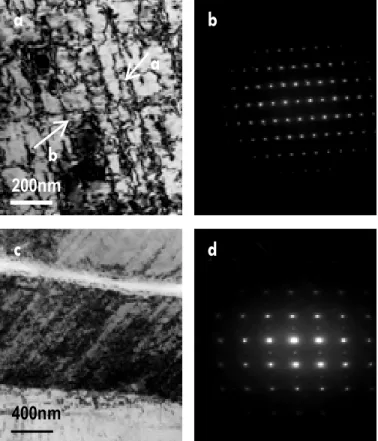
21 along the [112 ̅3] direction, in which a plane dislocations pos-sess b=1/3<112 ̅0>. Along the [21 ̅1 ̅0] direction in the Fig-ure 7(c), single dislocation band structFig-ure is observed in the α phase. Its diffraction pattern is shown in Figure 7(d). The slip plane is {0001} “a” plane of the hcp structure, because single dislocations were formed to release the energy of the material. Afterwards, the dislocations will form the dislocation bound-aries and subgrain boundbound-aries. Dislocation network structure is not found at the 0.5 mm thickness from the surface. These results demonstrate that the dislocations are primarily planar dislocations at this thickness.
Figure 8 shows the classical dislocation structure at 50 μm from surface. It is found that dense dislocation networks are formed, which are composed of dislocation bands and lots of single dislocation lines between the bands. In the [21 ̅1 ̅0] and [21 ̅1 ̅1] directions, the dislocation bands formed in two direc-tions, as indicated with a and b in Figure 8(a). The a band is formed on {0001} base plane and the b band, on the {101 ̅0} plane. Figure 8(c) shows another dislocation bands on the {101 ̅1} plane.
In the shot peening process, the dislocation networks com-posed of dislocation bands in the α phase plate. This type of microstructure is the obstacle for the crystal deformation, and therefore it increases the fatigue strength of the material. There are no twins and stacking faults observed in the surface layer.
Figure 5. Net structure of the TC21 alloy. (a) α+β structure; (b) β
phase.
Figure 6. Dislocations in the α phase at 0.5 mm thickness. (a) Bright
field image; (b) magnified image; (c) operation vector g=[1 ̅011].
400nm
200nm
a
b
400nm 400nma
b
d
c
Figure 7. Dislocations in the α phase at 0.5 mm thickness. (a) Single
dislocations; (b) g=[21 ̅1 ̅0]; (c) Single dislocation bands; (d) g=[1 ̅011].
a
b
c
d
400nm
200nm
a
b
Figure 8. Dislocation bands in the α phase after shot peening at 50
μm thickness. (a) Dislocation bands; (b) electron diffraction pattern along [21 ̅1 ̅0]; (c) dislocation band; (d) electron diffraction pattern along [101 ̅2].
a
b
2μm 400nm
Atlas Journal of Materials Science - ISSN 2330-6831. Published By
Atlas Publishing, LP
(www
.atlas-publishing.or
Discussion
The results of this work clearly indicate the great benefits of shot peening on the TC21 alloy, by the formation of a favor-able surface integrity within 370 μm of the surface, coupled microstructurally with a work hardened near-surface layer. This transformation is promoted by the high-velocity deformation in the shot peening processing.
Based on experimental results, the surface integrity state of the TC21 alloy can be modified by shot peening with 0.4 A shot peening intensity. The peening energy was stored in material to create dislocations. The shot peening processing induced a lot of dislocations on the a plane, c plane and a/c plane, as shown in Figures 6 and 7. To decrease the energy of the material, the dislocations rebuilt and formed the band structure in the α phase plate near the surface. The typical microstructure is the net type composed of the bands, as shown in Figure 8(a) and (c). This microstructure increases the stored energy of the TC21 alloy and improves the resistance of deformation of the TC21 alloy. These results clearly imply that the strength of the surface ma-terial is higher than the unpeened specimen, and such a strength decreases with the distance from the shot peened surface. The shot peening deformation induced the increase of the compres-sive residual stress (Figure 2a) and hardness (Figure 3b) of the surface material. Also, both the stress and the hardness decrease with the distance from the surface.
Half-width profile of the diffraction line (Figure 3b) as well as the dislocation density profile (Figure 4b) of the shot peened TC21 alloy have the yield plastically deformed layers of 0.15-0.20 μm. Corresponding to the residual stress distribution, the higher plastically deformation zone is within the surface and the maximum value of residual stress is -903.5 MPa at about 0.13 mm below the surface. At 0.13 mm to 0.37 mm thickness, the zone is a higher elastic deformation zone with lower de-gree of plastic deformation. As compared with the bulk material (Figure 6 and 7), the microstructure shows a lot of single dis-locations, dislocation arrays and the single dislocation bands in α phase with higher dislocation density and the residual stress level.
As the Ra values increase, the stress concentration coeffi-cient is higher and the fatigue life is very sensitive to the sur-face roughness. Some researchers (Gao et al., 2003; Lindemann et al., 2006) found that the compressive layers are deep and strong enough, so the damaging effects of notches and flaws are shifted to subsurface regions. Under these conditions, the fatigue behaviour is largely governed by the residual stress dis-tribution and the relevant deformation mechanisms occurred in the surface layer.
The work hardening primarily retards crack initiation, and it is especially effective if the fatigue damage process is crack ini-tiation controlled (Nalla et al., 2003). Moreover, the beneficial effect on fatigue life is very pronounced due to the high hard-ness, residual stress and dense dislocation structure of the shot peened surface. The fatigue test of the TC21 alloy after shot peening will be reported in a following paper.
Conclusions
The effects of shot peening on surface condition and struc-tural evolution in the TC21 alloy have been investigated. After shot peening with 0.4 A, the surface layer has been significantly changed. The hardness of the TC21 alloy increases about 2 times than that of the unpeened specimen, and the depth of the deformed layer with the residual stress is determined as 0.37 mm.
In the deformed layer, there are no significant changes of crystalline phases. The structure of the shot peened layer is composed of dense dislocation networks, as shown by the EBSD method. The dislocations formed in the a, c and a/c planes of α phase in the surface layer of the TC21 alloy after the shot peening. This microstructure can improve the resistance of deformation and increase the fatigue strength.
References
Baragetti S, M Guagliano (1998) Influence of low-intensity shot peen -ing on the fatigue strength of an Al/Al. Fatigue Fract Eng Mater Struct 21 (6) 717-726.
Barry N, SV Hainsworth, ME Fitzpatrick (2009) Effect of shot peen-ing on the fatigue behaviour of cast magnesium A8. Mater Sci Eng A 507 (1-2) 50-57.
De Los Rios ER, M Trull, and A Levers (2000) Modelling fatigue crack growth in shot-peened components of Al 2024-T351. Fatigue Fract Eng Mater Struct 23 (8) 709-716.
Fei Y, L Zhou, H Qu, Y Zhao, and C Huang (2008) The phase and microstructure of TC21 alloy. Mater Sci Eng A 494 (1-2) 166-172. Feng, L, H Qu,Y Zhao, H Li, Y Zhang, and W Zeng (2004) High tem-perature deformation behavior of TC21 alloy. J Aeronaut Mater 24 (4): 11-13.
Gao YK, F Lu, YF Yin, M Yao (2003) Effects of shot peening on fa-tigue properties of 0Cr13Ni8Mo2Al steel. Mater Sci Technol 19 (3) 372-374.
Ge P, Y Zhao, L Zhou (2005) Strengthening mechanism in β titanium alloy. Mater Rev 19 (12) 52-56.
Harada Y, K Fukaura, S Haga (2007) Influence of microshot peening on surface layer characteristics of structural steel. J Mater Process Technol 191 (1-3) 297-301.
Jiang XP, CS Man, MJ Shepard, T Zhai (2007) Effects of shot-peening and re-shot-peening on four-point bend fatigue behavior of Ti– 6Al–4V. Mater Sci Eng A 468-470 (1) 137-143.
Lindemann J, C Buque, F Appel (2006) Effect of shot peening on fa-tigue performance of a lamellar titanium aluminide alloy. Acta Ma-ter 54 (4) 1155-1164.
Luong H, MR Hill (2010) The effects of laser peening and shot peen-ing on high cycle fatigue in 7050-T7451 aluminum alloy. Mater Sci Eng A 527 (3) 699-707.
Nalla RK, I Altenberger, U Noster, GY Liu, B Scholtes, RO Ritchie (2003) On the influence of mechanical surface treatments–deep rolling and laser shock peening–on the fatigue behavior of Ti–6Al– 4V at ambient and elevated temperatures. Mater Sci Eng A 355 (1-2) 216-230.
Okolo B, F Pérez-Willard, J Hawecker, D Gerthsen, A Wanner (2007) Focused ion beam study of the effects of shot peening on the sub-surface microstructure of normalized pearlitic steel. J Mater Proc Technol 183 (2-3) 160-164.
Qu HL, YG Zhou, L Zhou, YQ Zhao, WD Zeng, L Feng, YQ Yang, 22
Atlas Journal of Materials Science - ISSN 2330-6831. Published By
Atlas Publishing, LP
(www
.atlas-publishing.or
g)
Atlas Journal of Materials Science - ISSN 2330-6831. Published By
Atlas Publishing, LP
(www
.atlas-publishing.or
J Chen, HQ Yu, H Li, YN Zhang, HC Guo (2005) Relationship among forging technology, structure and properties of TC21 alloy bars. Trans Nonferrous Met Soc China 15 (5) 1120-1124.
Shiozawa K, L Lu (2002) Very high-cycle fatigue behaviour of shot-peened high-carbon–chromium bearing steel. Fatigue Fract Eng Mater Struct 25 (8-9) 813-822.
Tönshoff HK, F Kroos, and C Marzenell (1997) High-Pressure Water Peening-a New Mechanical Surface-Strengthening Process. CIRP Ann-Manuf Technol 46 (1) 113-116.
Wagner L (1999) Mechanical surface treatments on titanium, alumi-num and magnesium alloys. Mater Sci Eng A 263 (2) 210-216.
Wang R (1979) Effect of residual stresses of shot peening on the fa-tigue behaviour of a high strength steel. Fafa-tigue Fract Eng Mater Struct 2 (4) 413-418.
Wu X, G Yang, P Ge, X Mao, B Feng (2008) Inductions of β Titanium Alloy and Solid State Phase Transition. Titan Indu Progr 25 (5) 1-6. Yamamoto T, T Takahashi, H Kimura, A Inoue (2007) Effect of
ball-milling and shot-peening on Zr55Al10Ni5Cu30 alloys. J Alloys
Compd 430 (1-2) 97-101.
Zhang X, D Liu (2009) Effect of shot peening on fretting fatigue of Ti811 alloy at elevated temperature. Inter J Fatigue 31 (5) 889-893.
23
Atlas Journal of Materials Science - ISSN 2330-6831. Published By
Atlas Publishing, LP
(www
.atlas-publishing.or