repository: http://orca.cf.ac.uk/95743/
This is the author’s version of a work that was submitted to / accepted for publication.
Citation for final published version:
Shokri, Reza, Theodorakopoulos, Georgios and Troncoso, Carmela 2016. Privacy games along
location traces: A game-theoretic framework for optimizing location privacy. ACM Transactions on
Privacy and Security 19 (4) , 11:1 -11:31. 10.1145/3009908 file
Publishers page: http://dx.doi.org/10.1145/3009908 <http://dx.doi.org/10.1145/3009908>
Please note:
Changes made as a result of publishing processes such as copy-editing, formatting and page
numbers may not be reflected in this version. For the definitive version of this publication, please
refer to the published source. You are advised to consult the publisher’s version if you wish to cite
this paper.
This version is being made available in accordance with publisher policies. See
http://orca.cf.ac.uk/policies.html for usage policies. Copyright and moral rights for publications
made available in ORCA are retained by the copyright holders.
Privacy Games along Location Traces:
A Game-Theoretic Framework for Optimizing Location Privacy
REZA SHOKRI, Cornell Tech, US
GEORGE THEODORAKOPOULOS, Cardiff University, UK
CARMELA TRONCOSO, IMDEA Software, Spain
The mainstream approach to protecting the privacy of mobile users in location-based services (LBSs) is to alter (e.g., perturb, hide, etc.) the users’ actual locations in order to reduce the exposed sensitive information. In order to be effective, a location-privacy preserving mechanism must consider both the privacy and utility requirements of each user, as well as their overall exposed locations (which contribute to the adversary’s background knowledge).
In this paper, we propose a methodology that enables the design ofoptimaluser-centric location obfus-cation mechanisms respecting each individual user’s service quality requirements, while maximizing the expected error that the optimal adversary incurs in reconstructing the user’s actual trace. A key advantage of a user-centric mechanism is that it does not depend on third party proxies or anonymizers, and so it can be directly integrated in the mobile devices that users use to access LBSs. Our methodology is based on the mutual optimization of user/adversary objectives (maximizing location privacy vs. minimizing localization error) formalized as a Stackelberg Bayesian game. This formalization makes our solution robust against
anylocation inference attack, i.e., the adversary cannot decrease the user’s privacy by designing a better inference algorithm as long as the obfuscation mechanism is designed according to our privacy games.
We develop two linear programs that solve the location privacy game and output the optimal obfuscation strategy and its corresponding optimal inference attack. These linear programs are used to design location privacy-preserving mechanisms that consider the correlation between past, current and future locations of the user, thus can be tuned to protect different privacy objectives along the user’s location trace. We illustrate the efficacy of the optimal location privacy-preserving mechanisms obtained with our approach against real location traces, showing their performance in protecting users’ different location privacy objectives. CCS Concepts:rSecurity and privacy→Privacy-preserving protocols;Mobile and wireless security; rInformation systems→Location based services;rNetworks→Network privacy and anonymity; rMathematics of computing→Linear programming;
Additional Key Words and Phrases: Location Privacy, Utility, Optimization, Game Theory
ACM Reference Format:
Reza Shokri, George Theodorakopoulos, and Carmela Troncoso. 2016. Privacy Games along Location Traces: A Game-Theoretic Framework for Optimizing Location Privacy.ACM Trans. Priv. Secur.1, 1, Article 1 (Jan-uary 2015), 30 pages.
DOI:http://dx.doi.org/10.1145/0000000.0000000
1. INTRODUCTION
The widespread use of smart mobile devices with continuous connection to the Internet has fostered the development of a variety of successful location-based services (LBSs). Even though LBSs can be very useful, these benefits come at a cost for users’ privacy. The whereabouts of users disclose aspects of their private lives that are not apparent
Authors’ addresses: Reza Shokri, Cornell Tech, #302, 111 Eight Ave. New York, US; George Theodorakopou-los, School of Computer Science and Informatics, Cardiff University, Cardiff CF24 3AA, UK; Carmela Tron-coso, IMDEA Software Institute, 28223-Pozuelo de Alarc´on, Madrid, Spain.
Permission to make digital or hard copies of all or part of this work for personal or classroom use is granted without fee provided that copies are not made or distributed for profit or commercial advantage and that copies bear this notice and the full citation on the first page. Copyrights for components of this work owned by others than ACM must be honored. Abstracting with credit is permitted. To copy otherwise, or repub-lish, to post on servers or to redistribute to lists, requires prior specific permission and/or a fee. Request permissions from [email protected].
c
2015 ACM. 2471-2566/2015/01-ART1 $15.00
at first, but can be inferred from the revealed location data [Freudiger et al. 2012; Golle and Partridge 2009; Krumm 2007].
A large body of research has focused on developing location-privacy protection mech-anisms (LPPMs) that allow users to make use of LBSs while limiting the amount of disclosed sensitive information [Beresford and Stajano 2003; Chow and Golle 2009; Freudiger et al. 2009; Gedik and Liu 2005; Hoh et al. 2007; Kalnis et al. 2007; Meyerowitz and Roy Choudhury 2009]. These protection mechanisms are based on increasing the uncertainty of the adversary about a user’s true whereabouts by hiding locations from the LBS, or sending perturbed or fake locations. However, more often than not the evaluation of these designs disregards that the adversary might have some prior knowledge about users’ movements as well as about the algorithm imple-mented by the LPPM. It has been shown [Shokri et al. 2011a] that such information allows astrategic adversaryto reduce her uncertainty on the user’s true location, and hence prior evaluations overestimate the location privacy offered by a given protection system.
Furthermore, previous work usually targets protection against localization at-tacks [Shokri et al. 2011a; Shokri et al. 2011b], i.e., to protect the users’ whereabouts when disclosing an obfuscated location to the LBS. Protecting the user’s current lo-cation is intricately bound with protecting her past and future lolo-cations. Different LBSs require the user location to be updated at different rates. Some require frequent updates, such as applications for obtaining local traffic information – e.g., Beat the Traffic, INRIX Traffic Maps, Routes & Alerts; or finding nearby points-of-interest, lo-cal events, or nearby friends – e.g., Google Maps. Others can function perfectly well with just a single location, such as Foursquare, Google Latitude / Google+ Local, or, in general, location check-in and location-tagging services that require only sporadic location exposures. The frequency of location exposures has a severe impact on the privacy protection offered by an LPPM since locations exposed in quick succession are highly correlated, leaking a lot of information that allows the adversary to reduce her uncertainty on the user’s immediate past or future whereabouts.
In this work we propose an LPPM design methodology that explicitly accounts for a strategic adversary, allowing for a more accurate estimation of the privacy protection that can be achieved by these LPPMs. The design methodology takeslocation correla-tioninto account to effectively protect a user’s location privacy along her trajectory, e.g., it provides protection against inference attacks that aim at reconstructing the user’s location in the past or predicting her location in the future based on what she shares at any moment. We focus onuser-centricLPPMs in which privacy decisions are made locally by the user, rather than by a third party that acts as an anonymizer [Gruteser and Grunwald 2003]. These LPPMs require no changes in the infrastructure nor any cooperation from other users, from third parties, or from the LBS; hence, they can be directly integrated into the mobile devices.
The goal of our methodology is to allow system designers to find the optimal LPPM against a strategic adversary who, knowing each user’s LBS access pattern, observation history, and the LPPM’s obfuscation algorithm, employs the theoretically strongest attack to infer users’ whereabouts. The challenge is to design such an op-timal protection mechanism when the inference attack, that the strategic adversary will choose depending on the mechanism being designed, is a priori unknown to the designer. To overcome this obstacle, instead of making assumptions about the adver-sary’s inference algorithm (i.e., instead of assuming limits in his power), our approach anticipates the optimal attack. Additionally, our methodology constrains the search space to LPPMs that obfuscate locations in such a way that the quality of the LBS response is not degraded below a threshold imposed by the user, hence guaranteeing
the required service quality for the user. We assume that this user-specified service quality constraint is also known to the adversary.
We formalize the problem of finding the optimal LPPM anticipating the optimal in-ference attack as an instance of a zero-sum Bayesian Stackelberggame. In this game, a leader and a follower interact strategically, with each one’s gain being the loss of the other. The leader decides on her strategy knowing that it will be observed by the follower, who will optimize his choice based on this observation. In our scenario the user is the leader and the adversary is the follower. Then, the game precisely mod-els that the adversary knows the user’s choice of protection mechanism and will use that knowledge to improve his attack’s effectiveness. We further extend the classic for-mulation of a Stackelberg game with an extra constraint to ensure that the service quality is satisfactory for the user. This enables us to find the optimal point in the tradeoff curve between privacy and service quality that satisfies users’ requirements. We prove that the solution to our location privacy games can be obtained using linear programs that must be solved by the user along the trace of her movements, since, as she reveals more of her location over time, the adversary’s knowledge and observation history evolves. Ours is, to the best of our knowledge, the first analytical framework that allows us to integrate adversarial knowledge in the design methodology of optimal user-centric privacy protection mechanisms.
We apply our methodology to design LPPMs for various scenarios in which we aim at protecting not just the current user location, but also at protecting past locations (i.e. the LPPM’s current obfuscation is chosen so as not to compromise the privacy of past locations), future locations (i.e. the current obfuscation should be compatible with potential future locations where the user might go next), and transitions between locations (i.e. obfuscations of successive locations should be chosen jointly).
We evaluate the effectiveness of the designed LPPMs using real location traces, showing that for a given user’s LBS access pattern and service-quality threshold, our game-theoretic approach enables us to simultaneously find the optimal LPPM and the optimal attack against it. We confirm that there is a trade-off between the maximum achievable privacy and the service quality but, once a certain privacy level is reached, loosening the quality requirements does not necessarily result in a privacy gain. We also find that the location-privacy advantage of the optimal LPPM over a suboptimal LPPM is larger when the quality requirement is tighter: The intuition is that, when the quality requirement is loose, both LPPMs are allowed to add so much noise that the attacker’s observation is very uninformative about the user’s true location. In contrast, when the quality requirement is tight, the optimal LPPM makes a better allocation of the limited noise it is allowed to inject.
In summary, our proposal for designing LPPMs showcases four contributions: (1) Our LPPMs assume that the adversary is strategic, because, as Shannon’s maxim
states “One ought to design systems under the assumption that the enemy will immediately gain full familiarity with them.”
(2) Our LPPMs are user-centric, needing no changes in the infrastructure, nor any trusted third-parties, because we believe that would facilitate their deployment. (3) Our LPPMs take into account that successively visited locations are correlated,
which dramatically changes the way they should be protected.
(4) Our LPPMs are optimal by design in the scenarios that they are designed for, hence they offer the best possible privacy protection against the best possible attack. We motivate and state the problem in the next two sections, and formalize the prob-lem as a Bayesian Stackelberg game between user and adversary in Section 4. We show how to design optimal protection mechanisms in different scenarios in Section 5, and evaluate our method in Section 6. We discuss the related work in Section 7.
2. MOTIVATION: LOCATION PRIVACY AGAINST STRATEGIC ADVERSARIES
This section delves into the need to consider, at the time of designing an LPPM, strate-gic adversaries that use their knowledge of user behavior, LPPM operation, and cor-relation between successively visited locations, since the use of such knowledge has great impact on the maximum level of privacy achievable.
2.1. Strategic adversaries use prior knowledge on users’ behavior and LPPM design to reduce their uncertainty
Consider a user who issues a location-based query from location (2,2),⋆, in the area depicted in Figure 1. Instead of revealing her true location, she uses an LPPM that out-puts a 3x3 square,⋆, centered on her true location. The hope is that this mechanism masks her location, making any location within the exposed square equally probable in the eyes of the attacker.
There are two problems with this naive approach. First, if the adversary has back-ground information about the user’s mobility, the probability of the user being in any location is not uniform anymore. For example, the adversary may have access to to-pographic information about the area in which the user moves, which changes the probability of the user visiting locations: The user is much more likely to be at the shore of a lake than in its middle. This probability also changes if the attacker has access to behavioral information about the user, e.g. her favorite locations reported in social networks, or demographic information such as her age, which lead to likely lo-cations of that particular demographic group. Second,if the adversary knows how the mechanism works, the probability of the user being in any location may also change. In the example above, such knowledge would completely break the user’s privacy. Upon observing the reported square, the attacker would always correctly infer that the user is located at (2,2), the center of the square.
These examples show that not considering a strategic adversary with access to back-ground knowledge leads to an overestimation of the privacy achievable by an LPPM.
2.2. Strategic adversaries use correlation to reduce their uncertainty
1 1 2 2 3 3 4 4 5 5 ⋆ ⋆ ⋆ ⋆ ⋆ ⋆ ⋆ ⋆ ⋆ ⋆
Fig. 1. A user’s real location (⋆) and obfus-cated exposed location (⋆). In principle, the at-tacker has 1 chance in 9 to accurately locate the user. However, if the attacker knows that row 1 is a lake, or that the protection mechanism al-ways produces a 3x3 square centered on the real location, then the user’s privacy is lower than naively expected.
Users’ movements are not isolated discrete events. Rather, users follow a trajectory to go from one place to another. Along this trajectory, users may query a location-based service, continuously in time or only at se-lected spots, to obtain useful information concerning the surroundings or the arrival point. However, even if not all points in the trajectory are exposed to the service provider, the correlation between consecutive positions implies that inferring just one of them reveals information about past and fu-ture ones. For instance, spatio-temporal con-straints derived from maximum user velocity may reveal with high probability the route followed by a user between two successive lo-cation exposures.
The correlation between successively shared locations depends on two factors:
randomness of user mobility patterns and LBS access frequency. The former relates to how predictable a user’s future location is given her current location. The latter
defines the rate at which the LBS provider can sample the user’s trajectory. These two factors have opposite effects on correlation: High randomness decreases correlation between successively exposed locations, since the current position contains less information about past and future events than when movements are deterministic. In contrast, high LBS access frequency increases correlation: The user has little time to move between two LBS accesses and exposed locations are nearer to each other than when access frequency is low. We now show, through a toy example, how correlation between successive locations can decrease the uncertainty of the adversary about past and/or future locations of the user.
1 1 2 2 3 3 4 4 5 5 ⋆ ⋆ ⋆ ⋆ ⋆ ⋆ ⋆ ⋆ ⋆ ⋆
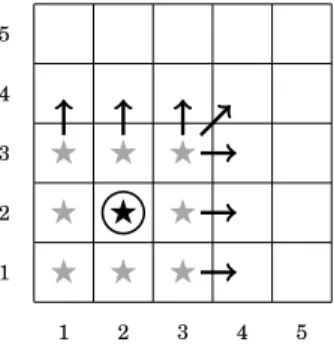
(a)Timet−1: real location (2,2) (⋆); exposed obfuscated location (2,2) (). As (2,2) was exposed, the user can only be in the bottom left 3x3 square (⋆). Since the user moves only to ad-jacent locations, at timetshe will be in the bottom left 4x4 square.
1 1 2 2 3 3 4 4 5 5 ⋆ ⋆ ⋆ ⋆ ⋆ ⋆ ⋆ ⋆ ⋆ ⋆
(b)Timet: real location (3,3) (⋆); ex-posed obfuscated location (4,4) (). As (4,4) was exposed, the user can only be in the top right 3x3 square (⋆). However, the correlation with the previous disclosure implies that the user can only be in the dotted 2x2 square.
Fig. 2. Correlation of user’s locations between timet−1and timet, reduces attacker’s uncer-tainty about the user’s current (timet) location.
Consider the example in Figure 2 where the LPPM outputs a location chosen arbitrar-ily from the 3x3 square centered on (x, y),
{(x+i, y+j), i, j ∈ {−1,0,1}}, and where in addition the user moves at most one location per time unit. At time t−1, shown in Fig-ure 2(a), the user accesses the LBS from lo-cation (2,2),⋆, and the LPPM reports obfus-cated location (2,2),. Given the reported lo-cation and the LPPM mechanism, the adver-sary can infer that the user could only have been in the bottom-left 3x3 square of loca-tions, ⋆. Moreover, since the user moves at most one location per time unit, the adver-sary knows that at time tshe will be some-where inside the bottom-left 4x4 square (as shown by the arrows in Figure 2(a)).
At time t, shown in Figure 2(b), the user accesses again the LBS from location (3,3), ⋆, reporting obfuscated location (4,4), . Naively, as in Section 2.1, the probability of the adversary correctly guessing her real lo-cation is 1/9 (any lolo-cation in the 3x3 square surrounding location (4,4), ⋆). However, re-call that the adversary knows from the ob-servation att−1that at timetthe user can only be in the bottom-left 4x4 square. Inter-secting this knowledge with the current ob-servation the adversary can deduce that the user is in the darkened 2x2 square in Fig-ure 2(b). Therefore, the probability of a cor-rect guess is 1/4, more than twice as much as the naively expected 1/9. This example highlights thatdesigning LPPMs disregard-ing correlation may reduce the privacy of the current location. We formally describe this scenario as Problem 1 in Section 5, and we also show how to optimally choose obfuscated exposed locations to avoid this situation.
Now consider the example in Figure 3,
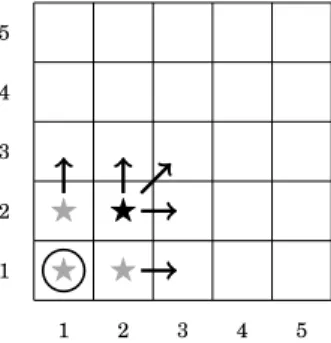
where at time t−1 (Figure 3(a)) the user is at location (2,2),⋆, but the LPPM re-ports (1,1),, instead of reporting (2,2); and at timet(Figure 3(b)) the user is at (3,3), ⋆, and the LPPM reports (4,4), . In this case, the correlation stemming from the
user’s one-location-per-time-unit movement pattern compromises the real locations at both t−1 andt: The only two-step trajectory that is compatible with the successive exposure of obfuscated locations (1,1) and (4,4) given the LPPM operation is that the user accessed the LBS from (2,2) followed by (3,3). Strikingly,designing LPPMs disre-garding correlation may retroactively compromise the privacy of past locations: the user was safe until the obfuscated location at timetwas reported. In Section 5, Problem 2, we show how to choose obfuscated exposed locations at timetso as not to compromise neither the previous nor the current location.
1 1 2 2 3 3 4 4 5 5 ⋆ ⋆ ⋆ ⋆ ⋆
(a)Timet−1: real location (2,2) (⋆); exposed obfuscated location (1,1) (). Only from the bottom left 2x2 square (⋆) can the user have produced ob-fuscated location (1,1). Since the user moves only to adjacent locations, at timetshe will be in the bottom left 3x3 square. 1 1 2 2 3 3 4 4 5 5 ⋆ ⋆ ⋆ ⋆ ⋆ ⋆ ⋆ ⋆ ⋆ ⋆
(b)Timet: real location (3,3) (⋆); ex-posed obfuscated location (4,4) (). Only from the top right 3x3 square (⋆) can the user have produced ob-fuscated location (4,4). However, the attacker correlates the previous dis-closure with the current one and con-cludes that att−1the user could only be at location (2,2), and attshe can only be at (3,3).
Fig. 3. Correlation of user’s locations between timet−1and timet, reduces attacker’s uncer-tainty about both the user’s current (timet) lo-cation and her past (timet−1) location.
The example just discussed also illustrates that the choice of obfuscated locations can af-fectfutureprivacy. Consider again the user’s predicament at time t: She reported (1,1) at time t −1 and she is now at (3,3) trying to choose an appropriate obfuscated location. Revealing (4,4) is not an option since it would reveal her real location at both t−1 andt. Hence, the unfortunate choice att−1reduces her possible choices att. In other words, fu-ture privacy may be proactively compromised by current choices. This scenario is handled as Problem 3 in Section 5, where we offer a mechanism to choose obfuscated exposed lo-cations so as not to compromise future loca-tions.
Finally, taking into account correlation be-tween successively visited places is impor-tant because transitions between locations can also be sensitive, even when the indi-vidual locations on their own might not be. For instance, visiting the bank to make a big withdrawal, and visiting a government offi-cial in charge of land development licensing may not be very sensitive if considered sep-arately, but visiting the official immediately after the bank may be much more sensitive. Another sensitive issue with transitions be-tween locations is that they reveal the di-rection of travel. For instance, the adversary may learn whether the user enters or exits a building, e.g., a hospital.
The conclusion from these examples is that it is important to take into account the correlation between exposed locations when designing LPPMs for frequently queried location-based services, in order to protect all past, current and future locations. In the fol-lowing we introduce our mechanism that al-lows to find the optimal way to expose ob-fuscated locations, i.e., maximizing privacy in the best possible way against a strategic adversary.
3. PROBLEM STATEMENT
In this section, we first explain our probabilistic framework and our assumptions about the protection mechanisms and adversary model. We conclude by sketching the prob-lem that we solve in this paper. In Table I, we summarize the notations introduced throughout the section.
3.1. User and Adversary
We consider a scenario in which users move in an area partitioned into M discrete regionsR={r1, r2,· · ·, rM}. We also assume that time is discrete and it is partitioned into different time periods (e.g., morning, afternoon). Anevent hr, tidenotes that the user is at location r ∈ R at time t ∈ T. Slightly abusing notation, time-subscripted variablertwill denote the user’s location at timet. Typical values fromRarer, ri, rj, whereas typical time-subscripted locations are rt, rt−1, rt+1. As the user moves, she connects to an LBS with which she shares her current location in order to obtain a service.
The adversary is the LBS to which the user connects, or any entity that can eaves-drop on the user-LBS communications. The adversary is passive and curious, and his aim is to discover the location of the user at the query time. He observes the loca-tions sent by the user (protected by the privacy mechanism, as described in the next subsection), and also has some external information about the user’s mobility. For sim-plicity we assume the user’s mobility is encoded as a Markov chain, although that is not mandatory. Any other model is possible, as long as it allows us to compute proba-bilities of the user visiting various (sequences of) locations.
Let ψt(r)be the probability, from the point of view of the adversary, that the user accesses the LBS at timetfrom locationr. So,P
r∈Rψt(r) = 1for any time instantt. We note that this quantity is time-dependent (i.e., users may have different access pat-terns in the morning than in the afternoon). In addition,ψt(r)can depend on previous LBS accesses that the user has made and the adversary has observed; this depen-dence on previous accesses will be shown explicitly when needed. Overall,ψt can be computed by the adversary from the combination of the user’s general mobility and her previous LBS accesses. We callψtheuser’s profileas it reflects the behavior of the user in accessing the LBS over time, as seen from the point of view of the attacker.
Note, crucially, thatψt(r)is the adversary’spriorinformation about the user’s loca-tion at timet,beforeobserving anything at timet.
3.2. Location-Privacy Protection Mechanism
As users want to preserve their location privacy when they use the LBS, they employ a local and user-centric LPPM that transforms each true location rinto a pseudolo-cation (orobfuscated location) r′ ∈ R′, which is then sent to the LBS instead of the
actual location. For simplicity, we set R′ = R, though in the most general case, R′
is the powerset ofR. Indeed, Problem 0 (Section 5) has been extended in this direc-tion [Herrmann et al. 2013]. The corresponding eventshr′, tiare termedpseudoevents
orobserved events.
The transformation fromrtor′ at timethappens probabilistically according to the location obfuscation function implemented by the LPPM: a probability distribution
ft(r′|r), which can be seen as a matrix whose rows are indexed by the locationsr∈ R and whose columns are indexed by the pseudolocationsr′ ∈ R′. For a given locationr
the functionft(r′|r)defines the probability with which the LPPM selects pseudoloca-tionr′as output.
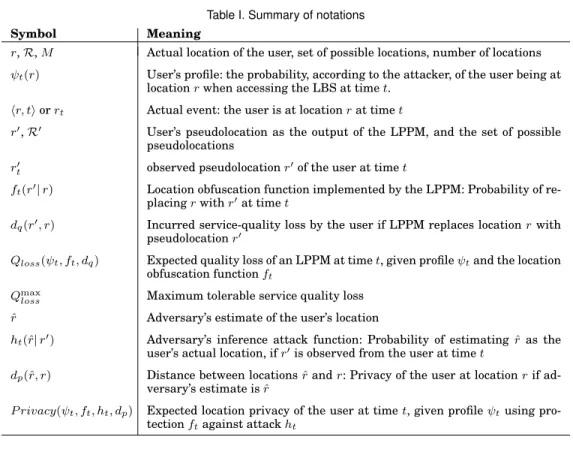
Table I. Summary of notations
Symbol Meaning
r,R,M Actual location of the user, set of possible locations, number of locations ψt(r) User’s profile: the probability, according to the attacker, of the user being at
locationrwhen accessing the LBS at timet.
hr, tiorrt Actual event: the user is at locationrat timet
r′,R′ User’s pseudolocation as the output of the LPPM, and the set of possible
pseudolocations r′
t observed pseudolocationr′of the user at timet
ft(r′|r) Location obfuscation function implemented by the LPPM: Probability of
re-placingrwithr′at timet
dq(r′, r) Incurred service-quality loss by the user if LPPM replaces locationrwith
pseudolocationr′
Qloss(ψt, ft, dq) Expected quality loss of an LPPM at timet, given profileψtand the location
obfuscation functionft
Qmax
loss Maximum tolerable service quality loss
ˆ
r Adversary’s estimate of the user’s location
ht(ˆr|r′) Adversary’s inference attack function: Probability of estimating ˆras the
user’s actual location, ifr′is observed from the user at timet
dp(ˆr, r) Distance between locationsrˆandr: Privacy of the user at locationrif
ad-versary’s estimate isˆr
P rivacy(ψt, ft, ht, dp) Expected location privacy of the user at timet, given profileψtusing
pro-tectionftagainst attackht
3.3. Service Quality Metric
In the aforementioned setting, the LBS response quality depends on the pseudoloca-tion output by the LPPM and not on the user’s actual locapseudoloca-tion. The distorpseudoloca-tion intro-duced in the observed pseudolocations determines the quality of service that the user experiences. We model the loss of service quality due to obfuscation using a distance function dq(r′, r).1 This function quantifies the dissimilarity between location r and pseudolocationr′. Its value for any pair(r, r′)depends on how the LBS under
consid-eration responds to obfuscated locations, as studied e.g. in [Micinski et al. 2013], and also on the user’s specific service-quality expectations. In many applications, the ser-vice quality can be considered inversely proportional to the physical distance between
randr′. For example, applications that find nearby points of interest could give very
different responses to rand to r′ even if they are only a couple of kilometers apart.
In contrast, there exist LBSs in which the service quality depends on other criteria, such as whetherr′is within a region of interest. For a weather forecast application, for
instance, any pseudolocationr′in the same city as the actual locationrwould result in a high quality LBS response. In general,dq can model a broad range of service quality loss functions, and it is considered as an input to our framework.
The expected quality loss Qloss due to an LPPM ft is computed as an average of
dq(r′, r)over allrandr′:
Qloss(ψt, ft, dq) = X
r,r′
ψt(r)·ft(r′|r)·dq(r′, r). (1)
1The quality loss function could also be time dependent, e.g., users could be more concerned about quality during working hours than during their free time.
We assume that users impose a maximum tolerable service quality loss,Qmaxloss, so as to prevent the obfuscation function from making the service useless for them. Formally,
Qloss(ψt, ft, dq)≤Qmaxloss. (2) This constrains the LPPM obfuscation functionft(r′|r), which must not output pseu-dolocations that, on average, result in a lower quality. We note that the influence of the thresholdQmax
loss on the LPPM depends on the function dq, hence it is also dependent on the type of the LBS the user is querying. In the case of an LBS that finds nearby points of interest, wheredq is proportional to the physical distance betweenr andr′, enforcing the quality threshold could result in ensuring a maximum allowed distance between these two locations. For the weather application, enforcing the quality thresh-old could result in setting region boundaries within which locations lead to the same forecast. For other location-based applications, the functiondq and the thresholdQmaxloss can be defined in the same vein.
3.4. Location Privacy Metric
The adversary’s goal is to infer the user’s true locationrtafter observing the LPPM’s output r′
t at timet. The adversary uses his knowledge of the user’s profileψtto run an inference attack on the observed locationr′
tin order to output estimationsˆrtof the user’s actual location. Formally, the attack result can be described as a probability dis-tribution functionht(ˆrt|r′t), which denotes the probability, according to the adversary, that the user’s true location at timetisˆrt.
We follow the definition by Shokri et al. [2011b] and quantify the user’s location privacy as the adversary’s expected error in his inference attack, i.e., the expected distortiondp(ˆr, r)between the estimated locationrˆand the true locationr. We compute the expectation over allr, r′, andˆr:
P rivacy(ψt, ft, ht, dp) = X
ˆ r,r′,r
ψt(r)·ft(r′|r)·ht(ˆr|r′)·dp(ˆr, r) (3)
The distortion function dp(.) quantifies the privacy that still persists despite the inference attack. This level of privacy depends on the locations’ semantics and also on the privacy requirements of the user (e.g., users might consider locations inside a hospital more sensitive than other places), and dp(.)must be defined accordingly. For instance, if the user wants to hide just her exact current location (as opposed to hiding a large area around her location), the appropriate distortion function could be the Discrete Metric between the estimated locationˆrand the actual locationr:
dp(ˆr, r) =
0, ifˆ
r=r
1, otherwise (4)
Substituting thisdp(.)into (3) and performing the summation, we see that the term with rˆ = r disappears, and all terms withrˆ 6= r survive withdp(ˆr, r) = 1. In other words, the resulting sum is the total probability attributed to the wrong estimations ofr, i.e., the probability of error in the estimate.
Alternatively, the user’s privacy might depend on thephysicaldistance between the estimated and actual locations. In that case, the distortion function can be equal to the Squared Euclidean distance between these locations:
dp(ˆr, r) = (ˆr−r)2 (5) In general, dp reflects the sensitivity of the user when r is estimated as rˆ. This sensitivity can be due to any semantic relation betweenrandrˆ. We assumedp is an input to our framework.
3.5. Problem Statement
Having introduced all the components of our framework, we are ready to state pre-cisely the problem that we solve. Given:
(a) a maximum tolerable service-quality lossQmaxloss imposed by the user as a bound for
Qloss, computed using the quality functiondq, and
(b) a user profile ψt, computed from the user’s mobility pattern and from her previ-ously observed locations,
we find the LPPM obfuscation functionft that maximizes the user’s location privacy as defined in (3). The solution must consider that the adversary
(a) observes the LPPM’s outputr′, and
(b) is aware of the LPPM’s internal algorithmft, and the user’s profileψt.
The adversary implements theoptimalattackhtthat estimates the true location of the user with the least distortion as measured bydp.
4. LOCATION PRIVACY GAMES
We formulate the problem of designing LPPMs that are optimal against the strongest strategic adversary as a game. In fact, the problem of finding an LPPM that offers optimal location privacy given the user’s profile, at a given time instant, is an instance of a zero-sum Bayesian Stackelberg game. In a Stackelberg game the leader, in our case the user, plays first by choosing an LPPM and committing to it by running it on her actual location. Thefollower, in our case the adversary, plays next by estimating the user’s location, knowing the LPPM that the user has committed to. It is a Bayesian game because the adversary has incomplete information about the user’s true location, and plays according to his hypothesis about this location. It is also an instance of a zero-sum game, as the adversary’s gain (or loss) is exactly balanced by the loss (or gain) of the user: the information gained (lost) by the adversary is the location privacy lost (gained) by the user, according to the location privacy metric (3). We now proceed to define the steps of the game adapted to our problem:
Step 0. At time t, Nature uses probability distribution ψt (reflecting the proba-bilistic model for the mobility and the previously observed locations of the user) to select a locationr∈ Rfor the user, from which the user accesses the LBS.
Step 1. Given the user’s locationr, the LPPM usesft(r′|r)to select a pseudoloca-tionr′∈ R′, subject tof
tcomplying with the service quality constraint (2).
Step 2. Having observed r′, the adversary selects an estimated location ˆ
r ∼ ht(ˆr|r′),ˆr ∈ R. The adversary knows the LPPM’s probability distribution
ft(r′|r); he also knows the user’s profileψt, but of course not the true locationr.
Final Step. The adversary pays an amountdp(ˆr, r)to the user. This amount repre-sents the adversary’s error (equivalently, the location privacy of the user).
The above description is common knowledge to both the adversary and the user. They both aim to maximize their payoff, i.e. the adversary tries to minimize the ex-pected amount that he will pay, while the user tries to maximize it. Next, we describe an optimization problem that formalizes the objectives of the user and of the adver-sary. We construct two linear programs that, with inputsψt, dp anddq, compute the user’s optimal choice of protection mechanism ft as well as the adversary’s optimal choice of inference attackht. We emphasize that, when we use the terms “optimalft”
and “optimalht” in this paper, we mean that they are optimalagainst each other, i.e. they form a game-theoretic equilibrium. This is the kind of solution one looks for in a game.
4.1. Optimal Strategy for the User
The adversary observes the pseudolocationr′output by the LPPM, he knows the
func-tionft(r′|r)implemented by the LPPM, and he also knows the user’s profileψt(.). Thus, he can form the posterior distribution
Pr(r|r′) = Pr(r, r′) Pr(r′) = ft(r′|r)ψt(r) P rft(r′|r)ψt(r) (6) on the true location r of the user, conditional on the observationr′. The adversary’s
objective is then to chooserˆto minimize the user’s conditional expected privacy, where the expectation is taken underPr(r|r′). The user’s conditional expected privacy for an
arbitraryˆris
X r
Pr(r|r′)d
p(ˆr, r), (7) and for the minimizingrˆit is
min ˆ r X r Pr(r|r′)dp(ˆr, r). (8) If there are multiple values ofrˆthat satisfy (8), then the adversary may randomize arbitrarily among them, including selecting one of them with probability 1. The proba-bility with whichˆris chosen in this randomization isht(ˆr|r′). Of course,ht(ˆr|r′)can be nonzero only for minimizing values ofrˆ; for all other values,ht(ˆr|r′)will be zero. When randomizing, (8) is rewritten as
X
r,ˆr
Pr(r|r′)h
t(ˆr|r′)dp(ˆr, r). (9)
Note that if there is only one value of rˆsatisfying (8), then this value is selected with probability 1 in the randomization, whereas all other values are selected with probability 0, so (9) reduces to (8). In this sense, (9) is a generalization of (8), but it should be noted that both expressions compute the same conditional expected privacy. We see that for a given r′, the user’s conditional privacy is given by (8). The prob-ability that r′ is output by the LPPM isPr(r′) = P
rft(r′|r)ψt(r). Hence, the user’s
unconditionalexpected privacy (averaged over allr′) is
X r′ Pr(r′) min ˆ r X r Pr(r|r′)d p(ˆr, r) = X r′ min ˆ r X r ψt(r)ft(r′|r)dp(ˆr, r). (10)
To facilitate the computations, we define
xr′ ,min ˆ r X r ψt(r)ft(r′|r)dp(ˆr, r). (11)
Incorporatingxr′ into (10), we rewrite the unconditional expected privacy as X
r′
xr′, (12)
which the user aims to maximize by choosing the optimalft(r′|r). The minimum oper-ator makes the problem non-linear, which is undesirable, but (11) can be transformed
to a series of linear constraints:
xr′ ≤ X
r
ψt(r)ft(r′|r)dp(ˆr, r), ∀ˆr. (13)
It turns out that maximizing (12) under (11) is equivalent to maximizing (12) under (13) [Dasgupta et al. 2008, Ch. 7, p. 224].
We construct the linear program for the user from (12) and (13). Note that variable
xr′is adecisionvariable in the linear program, i.e. it is among the quantities chosen by
the solver. This might appear counterintuitive, asxr′ is defined in (11) as a function of
ft(.), rather than as an independent variable that can be freely selected. But, because of the transformation, it is always guaranteed that (11) will hold.
The linear program for the user is the following: Chooseft(r′|r), xr′,∀r, r′in order to
Maximize X r′ xr′ (14a) subject toxr′ ≤ X r ψt(r)ft(r′|r)dp(ˆr, r),∀ˆr, r′ (14b) X r ψt(r) X r′ ft(r′|r)dq(r′, r)≤Qmaxloss (14c) X r′ ft(r′|r) = 1,∀r,andft(r′|r)≥0, ∀r, r′. (14d)
Inequalities (14b) are the series of linear constraints (13), repeated for each value of
r′; inequality (14c) reflects the service quality constraint; constraints (14d) reflect that
ft(r′|r)is a probability distribution function.
4.2. Optimal Strategy for the Adversary
To find the adversary strategy that is at a game theoretical equilibrium with the user strategy computed in (14a-14d) (i.e., the two strategies are optimal against each other), we construct and solve the linear program that is dual to (14a-14d): Choose
ht(ˆr|r′), yr,∀r, r′,ˆr, andz∈[0,∞)to
Minimize X
r
ψt(r)yr+zQmaxloss (15a)
subject to yr≥ X ˆ r ht(ˆr|r′)dp(ˆr, r)−zdq(r′, r),∀r, r′ (15b) z≥0 (15c) X ˆ r ht(ˆr|r′) = 1,∀r′,andht(ˆr|r′)≥0,∀r′,r.ˆ (15d)
Note the role of variablez: In linear programming parlance, it is theshadow price of the service quality constraint. Intuitively,z is the “exchange rate” between service quality and privacy. Its value in the optimal solution indicates the amount of privacy (in privacy units) that is lost (gained) if the service quality thresholdQmaxloss increases (decreases) by one unit of quality.
For example, ifz >0in the optimal solution, then any change∆Qmax
loss inQmaxloss will change the privacy achieved byz∆Qmax
loss. In this case, constraint (14c) is satisfied as a strict equality. In contrast, if constraint (14c) is satisfied as a strict inequality, then, intuitively, the selection offt(r′|r)has not been constrained byQmaxloss. In this case, any
(small) changes inQmax
losswill have no effect onft(r′|r), nor on the privacy achieved. So,
zwould be zero.
Note that both linear programs compute the unconditional expected privacy of the user (3), which we repeat here for convenience.
P rivacy(ψt, ft, ht, dp) = X
ˆ r,r′,r
ψt(r)ft(r′|r)ht(ˆr|r′)dp(ˆr, r). (16)
The optimal solution of each linear program results in the same value for the privacy of the user. Hence, in principle, we only need to compute one of the two to quantify the maximum level of privacy of the user. We choose to present both, because the user’s linear program incorporates the service quality constraint in a more straightforward manner, whereas the adversary’s linear program explicitly computes the “exchange rate” between service quality and privacy.
5. LPPM DESIGN IN SPECIFIC SCENARIOS
We now formalize concrete problems, starting with sporadic location exposures and continuing with the problems that were described in Section 2.2.
Compared to our description so far, the variations in the following problems have to do with the previously observed pseudolocations (which affect the attacker’s prior knowledgeψt()about his objective) and with the attacker’s objective (which may be not just be to estimate the single current locationrt, but also past locationsrt−1or future locationsrt+1, so this also affects the computation ofψt()). In other words, the central quantity that changes among the various problems is the adversary’s prior knowledge about his objective. For each particular problem, we show how to computeψt(), which can then be simply inserted into the linear programs (14) and (15). Finally, we show how one can adapt the framework for arbitrary new problems.
Problem 0: Protecting privacy of timetat timet, with no previous exposure
The user has previously not exposed any pseudolocation. Currently, at timet, the user issues her first query, and the LPPM must choose an appropriate obfuscation function that generatesr′tto protect the user’s current locationrt.
This problem is equivalent to that of sporadic location privacy, which is relevant for LBSs to which queries are sentsporadically: location check-in, location-tagging, or ap-plications for finding nearby points-of-interest, local events, or nearby friends. In these services, if there is enough time between queries, then successively exposed locations are independent of each other, i.e. previous exposures do not give any information to the attacker about the current exposure.
The relevant prior information in this case isPr{rt}and it is computed from back-ground knowledge about the area in which the user moves (e.g. ifris in the middle of a lake, then presumablyPr{rt} = 0), and also from background knowledge about the user’s mobility or habits (e.g. if the attacker knows the user’s daily mobility pattern, then att= 7amPr{rt}is high for locations around the user’s home, and at 11am it is high around the user’s workplace). If the mobility is described by a Markov chain, then
Pr{rt}can be simply read from the steady state distribution of the Markov chain.
Problem 1: Protecting privacy of timetat timet, for a given exposure att−1 At timet−1, the LPPM exposed pseudolocationr′
t−1. Currently, at timet, the user issues another query, so the LPPM must choose an appropriate obfuscationr′tto protect the user’s current locationrt. This is the problem shown in Figure 2 (Section 2.2).
The attacker, having observedr′
t−1, has a probabilistic estimate of the user’s location at timet−1, which was previously (att−1) computed asht−1(ˆrt−1|rt′−1). This estimate
must be “moved forward” to form a location estimate for time t. If we assume that the user moves according to a Markov chain mobility model, “moving forward” from
t−1to t is equivalent to multiplyinght−1(ˆrt−1|r′t−1)by the Markov chain transition matrix Pr{rt|rt−1}. Note that the Markov chain assumption is not necessary for our proposed approach; all we need is a way to compute a location estimate at timetfrom a location estimate at timet−1. We make the Markov assumption for convenience; other literature has used simpler models, based on just the velocity of the user [Ghinita et al. 2009]. Pr{rt|rt′−1}= X rt−1 Pr{rt, rt−1|r′t−1}= X rt−1 Pr{rt|rt−1}ht−1(ˆrt−1|rt′−1) (17)
FunctionPr{rt|r′t−1}, rt∈ Ris the prior information of the adversary for Problem 1. The LPPM design continues with solving the linear program as in the previous section, computingf(r′
t|rt, r′t−1)for a particular value ofr′t−1.
Note, however, that the prior information functionPr{rt|rt′−1}, and thus the designed LPPM, is different for each value of the previously exposed r′t−1. This is a formal de-scription of the obvious fact that the LPPM to be designed must depend on the exact value of the previously exposed pseudolocation.
This dependence raises the practically important issue of when to compute the ap-propriate LPPM. One choice is to precompute all LPPMs, one for each possible value of r′t−1(M in total), and then copy them to the device. This allows for performing all computations on a powerful, non-resource-constrained machine, but it requires more storage space on the mobile device. The other extreme is to compute the appropriate LPPM when the actualr′
t−1becomes known, but this means that the computation has to happen on the mobile device between timet−1 and timet. So, there is a tradeoff here, which we explore when discussing computational considerations (Section 6.2).
Of course there are intermediate solutions, such as precomputing and storing LPPMs only for the most frequent pseudolocation values. The probability of each pseu-dolocation can be computed as
Pr{r′}=X r
Pr{r}Pr{r′|r}=X r
Pr{r}f(r′|r). (18)
A variant of Problem 1 is when the latest exposure was at time t−k, for a single value of k ≥ 1. Then we compute the prior by multiplying ht−k(ˆrt−k|r′t−k) by thek -th power of -the Markov transition matrix. Note here -that, if kis large enough, then the effect of ht−k(ˆrt−k|rt′−k) disappears, and so we are back to the original sporadic problem of protecting privacy at timetwith justPr{rt}as the prior, as if there are no prior exposures. We explore this variant next, where our general aim is to quantify the effect of multiple past exposures, as opposed to just one.
Problem 1A: Exposing past pseudolocations and its effect on the adversary’s knowledge of the user’s current location
In a continuous LBS, users expose more than one pseudolocation in short order. The question is to what extent pseudolocations exposed before t−1 give information to the adversary about the user’s current (timet) location. If pseudolocations far into the past need to be taken into account, then an LPPM that protects the current location would be correspondingly more complex, as each possible combination of past expo-sures would induce a different optimal current obfuscation; in other words, a different LPPM would have to be computed for each combination.
To answer this question, we compare the sequence of priors Pr{rt}, Pr{rt|r′t−1},
Pr{rt|r′t−2},· · ·. The general term of this sequence,Pr{rt|rt′−k}is equal to
Pr{rt|r′t−k}= X rt−k Pr{rt, rt−k|rt′−k}= X rt−k Pr{rt|rt−k}ht−k(rt−k|rt′−k). (19)
The term Pr{rt|rt−k} is thek-step transition probability in a Markov chain mobility model; it is computed as thek-th power of the corresponding transition matrix.
So we see that the effect of r′
t−k on the adversary’s prior on the current location comprises two factors: (1) the uncertainty for the true locationrt−kat timet−k, which is caused by the obfuscation used at timet−k, and (2) the dissipation effect caused by thek-step transition fromt−ktot.
Problem 2: Protecting privacy of timest−1andtat timet, for a given exposure att−1 At timet−1, the LPPM exposed pseudolocationr′
t−1. Currently, at timet, the user issues another query, so the LPPM must choose an appropriate obfuscation rt′ that will protect the current location rt and will not retroactively compromise the user’s
previous location rt−1. In other words, the obfuscation r′t must be “compatible” with the previously exposedr′
t−1. This is the problem shown in Figure 3 (Section 2.2). The prior information that is available to the adversary before he observesr′
tis
Pr{rt, rt−1|r′t−1}= Pr{rt|rt−1, r′t−1}Pr{rt−1|rt′−1}= Pr{rt|rt−1}ht−1(rt−1|r′t−1). (20) The first termPr{rt|rt−1}is known from the mobility model (e.g. the Markov transition matrix), and the second termht−1(rt−1|r′t−1)is computed att−1.
Note that here the prior information is not just about the current location rt, but rather about the pair(rt, rt−1), because that pair is the information that the adversary tries to infer.
Problem 3: Protecting privacy of timest+ 1andtat timet
In this Problem, we assume that there are no past exposures of the user’s location. The user issues a query at the current timet, and her objective is to protect not only the current location, but also the location at the next time instantt+ 1.
We discussed this scenario at the end of Section 2.2, and it is motivated as follows: Disclosing the current location might not be important in and of itself, but it might make it much easier for the adversary to infer the next location, which happens to be very sensitive. For instance, the user might currently be on a street that only leads to an abortion clinic. Hence, disclosing her current location is almost equivalent to disclosing that she will go to the clinic. Symmetrically, her current location might be very sensitive, and her next (expected) location can be linked easily to her current one. For instance, she might be about to leave the abortion clinic and enter a street that is only used as the clinic’s exit. Furthermore, neither the current nor the next location might be particularly sensitive separately, but the transition from one to the other might be.
The conclusion in all these cases is that the current location must be protected jointly with the (possible) next one(s) where the user will be at timet+ 1. For this reason, the LPPM should compute at the present timetthe pseudolocations it is likely to output att+ 1, so that the current choice ofr′
t does not limit future choices. The intuition is that the LPPM should choose the current pseudolocationrt′ so that future paths that the user will likely take can be protected with pseudolocations compatible withr′
t. In this scenario, the prior information of the adversary is about the current (t) and future (t+ 1) location of the adversary:Pr{rt+1, rt}= Pr{rt+1|rt}Pr{rt}.The first term
is known from the Markov transition matrix, and the second term is, as in Problem 0, just the steady state of the Markov chain.
As noted earlier, in all four problems we can compute an appropriate prior probabil-ity distribution for the adversary’s knowledge about the target locations. This proba-bility distribution is then used as a parameter in the linear program described in the previous section. In Section 5.1 below, we see how one can write a linear program for a very general set of target locations and prior exposures.
When problems are interleaved
As the user moves, she might be facing a different problem at each time, so she would need to compute a succession of different LPPMs. For example, the first time she ex-poses a location, Problem 0 applies. Then, at the next exposure, Problem 1 or Problem 2 could apply, depending on whether the user wishes to protect just the current location (Problem 1) or both the current and the previously exposed location (Problem 2). The prior probability at each time has to be computed taking into account the past LPPMs and, most importantly, their corresponding attacks h: It is these attacks that deter-mine the attacker’s probabilistic estimate of the user’s location at each time, which is then multiplied by the transition probabilities to provide the prior probability for the next time instant.
We now compute the prior probability at timet,t≥2, in an example where the user originally computed a Problem-0 LPPM at timet = 1, and then at every subsequent time instant up to t−1 she computed a Problem-2 LPPM. She is currently (time t) interested in computing yet another Problem-2 LPPM, hence the prior probability is Pr{rt, rt−1|rt′−1}. We denote byhsporthe Problem-0 attack.
The computation of the prior proceeds as follows:
Pr{rt, rt−1|rt′−1}=Pr{rt|rt−1, r′t−1}Pr{rt−1|rt′−1}. (21) But the first term is known from the user’s mobility model: Pr{rt|rt−1, r′t−1} = Pr{rt|rt−1}. If t = 2, the second term Pr{rt−1|r′t−1} can be immediately equated to the attackhat timet−1: Pr{rt−1|rt′−1}=hsport−1(rt−1|r′t−1), as above. So this concludes the caset= 2.
To compute Pr{rt−1|r′t−1}for the caset >2, we use Bayes’ rule:
Pr{rt−1|r′t−1}= Pr{r′ t−1|rt−1}Pr{rt−1} P rt−1Pr{r ′ t−1|rt−1}Pr{rt−1} (22) Now, Pr{rt−1} is known (again from the mobility model; if the mobility is a Markov chain, then this is the steady state of the Markov chain), so we only need to compute Pr{r′ t−1|rt−1}: Pr{r′ t−1|rt−1}= X r′ t−2,rt−2 Pr{r′ t−1, rt−2, rt′−2|rt−1} = X r′ t−2,rt−2 Pr{rt′−1|rt−1, rt−2, r′t−2}Pr{rt−2, rt′−2|rt−1} = X r′ t−2,rt−2 Pr{r′ t−1|rt−1, rt−2, r′t−2}Pr{rt′−2|rt−2, rt−1}Pr{rt−2|rt−1} (23)
The first term is the LPPM functionft−1as computed at timet−1for Problem 2. The third term is known from the mobility model. The second term Pr{r′
t−2|rt−2, rt−1} is equal to Pr{r′
⋆ rt−2= (3,4) ⋆ rt−1= (4,3) ⋆ rt= (4,2) r′t−2= (3,3) rt′−1= (3,2) rt′ = (3,1) t−2 t−1 t T Past Present User’ s side Adversary’ s side opost opre atrg
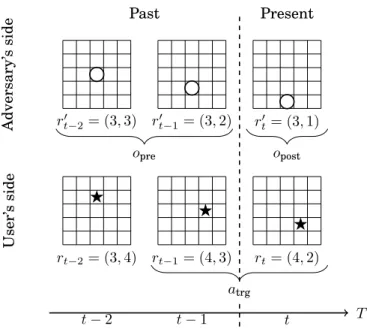
Fig. 4. A user moves from location(3,4)at timet−2, to (4,3) att−1, to(4,2)at current timet. The user wants to protect locations at timest−1andt, and these are denoted byatrg(target events). At past times
t−2andt−1, the LPPM exposed pseudolocations(3,3)and(3,2)(denoted byopre), and to protectatrgthe
LPPM currently exposes location(3,1)(denoted byopost). andr′
t−3. Knowingrt−1whenrt−2 is already known gives us no extra information on
rt−3orr′t−3. Hence, the computation of Pr{rt′−1|rt−1}is shown to be recursive: Pr{r′t−1|rt−1} =
X
r′
t−2,rt−2
ft−1(r′t−1|rt−1, rt−2, rt′−2)Pr{r′t−2|rt−2}Pr{rt−2|rt−1}. (24)
Having recursively computed Pr{r′
t−1|rt−1}, we substitute it into (22), the result of which is in turn substituted into (21) to compute the desired prior.
5.1. Location privacy for a generic objective
As we see in the previous sections, many different variants of location privacy can be formulated, depending on the adversary’s knowledge (i.e., past exposed pseudoloca-tions), and on the privacy target (i.e., on what the user wishes to protect or, equiva-lently, on what the adversary wishes to attack). Each combination leads to a different optimal LPPM. In particular, in Problems 2 and 3, we see that the privacy target does not need to be the user’s current location. It can be a pair or a tuple of locations, and this tuple might not even include the user’s current location, e.g., if the user only wants to protect a past location by choosing an appropriate pseudolocation at the current time.
We now describe generic terminology and a generic linear program for LPPM design, with the help of the example shown in Figure 4.
5.1.1. Generic LPPM parameters
—atrg denotes the target events that the user wants to protect, or equivalently, the events that the adversary wants to infer. In the example, the user wants to protect her location at timest−1andtand thusatrg= (rt−1, rt) ={h(4,3), t−1i,h(4,2), ti}.
atrg f() LPPM h() Attack opost ˆatrg P,opre f()
Fig. 5. Information available to the LPPM and the adversary: The LPPM wants to protect location(s)atrg
by producing appropriate pseudolocation(s)opost. The adversary observes the outputopostof the LPPM and,
using his knowledge of the LPPM functionf, estimatesatrg; the adversary’s estimate isaˆtrg. The prior
knowledge of the adversary and of the LPPM consists of the transition matrixP and the pseudolocations oprethat have been produced in the past.
—opre is a subset of the pseudoevents that the LPPM created and sent to the LBS up to but beforethe current time. These are the pseudoevents that matter for the estimation ofatrg: Typically, opre would be a sequence of consecutive pseudoevents
starting with a recent time instant (as old ones do not matter for estimatingatrg) and leading up to the current time. These are known both to the adversary and to the LPPM. In the example, the relevant pseudolocations were exposed at timest−1
andt−2and thusopre= (r′t−2, r′t−1) ={h(3,3), t−2i,h(3,2), t−1i}.
—opost is the pseudolocation (or set of pseudolocations) that the LPPM produces to protectatrg and that will be sent to the LBS at the current time. In the example, at current timetthe user exposes pseudolocation(3,1)thusopost= (r′t) ={h(3,1), ti}. —f(opost|atrg, opre)is the probability that the LPPM producesopost, given its knowledge
opreand the locationsatrgit is trying to protect. This function encodes the defensive
mechanism. It can be viewed as a codebook that prescribes, for each value ofatrgand
opre, a randomization over the possible values ofopost.
5.1.2. Generic privacy metric. As before, privacy is quantified as the adversary’s error in estimating the user’s true location(s)atrg. Figure 5 illustrates the information flow of events and pseudoevents to the LPPM and to the adversary. The detailed notation is as follows:
—ψ(atrg|opre)is the adversary’s prior probability distribution on the inference target
atrg, given his prior knowledgeopre. It encodes what the adversary can deduce about
atrgbeforeobserving the LPPM’s current outputopost.
—ˆatrg denotes the adversary’s estimate of atrg. Similarly to atrg, it can be seen as a
time-indexed vector whose elements belong to the setRof locations.
—h(ˆatrg|opre, opost)is the probability that the adversary estimates ˆatrg to be the true
value ofatrg, given his knowledge of prior pseudolocationsopre and given the pseu-dolocation(s)opostexposed at current timet.
—dp(ˆatrg, atrg) ≥ 0 is the privacy gain when the adversary’s estimate is ˆatrg and the true value of the inference target isatrg. It is zero only ifˆatrg=atrg.
The privacy that an LPPMf(.)achieves against an adversary implementing attack
h(.)is then the expected value ofdp(ˆatrg, atrg), given prior observationsopre: P rivacy(ψ, f, h, dp;opre) =E{dp(ˆatrg, atrg)|opre}=
X atrg,ˆatrg Pr{ˆatrg, atrg|opre}dp(ˆatrg, atrg) =X atrg opost ˆ atrg
ψ(atrg|opre)f(opost|atrg, opre)h(ˆatrg|opre, opost)dp(ˆatrg, atrg).
This formula represents the adversary’s expected estimation error.
5.1.3. Generic quality metric. The final ingredient is the quality metric:
—qtrg denotes the relevant events with respect to quality. Similarly to atrg, qtrg is a
time-indexed vector. However, its time indices are not necessarily the same as those of atrg: The locations/times that matter for quality may be different from the ones that matter for privacy.
—dq(qtrg, opost, opre)represents the quality loss whenqtrgis the true value of the quality-relevant events, the LPPM currently reportsopostand it has reportedoprein the past.
The expected quality loss caused by an LPPM f(.) is the expected value of
dq(qtrg, opost, opre)over allqtrgandopost, for a given historyopre.
5.1.4. Generic linear program. We now form the linear program that computes the opti-mal LPPM (using, as before, auxiliary variablesxopost):
We want to maximizeP
opostxopost under the constraint xopost ≤
X atrg
ψ(atrg|opre)f(opost|atrg, opre)dp(ˆatrg, atrg),∀ˆatrg, opost, (26)
under the quality constraint, X
qtrg
opost
Pr{qtrg|opre}Pr{opost|qtrg, opre}dq(qtrg, opost, opre)≤Qmaxloss, (27)
as well as the constraint (omitted) thatf should be a probability function.
6. EVALUATION
The LPPMs that we design are optimal by construction. In this section, we illus-trate their privacy-utility performance, and we also compare them against non-optimal LPPMs. We also show how the optimal attacks that we compute fare against non-optimal, but intuitive, LPPMs. We begin with LPPMs and attacks computed for the sporadic case (Problem 0), and we continue with trajectory-aware LPPMs.
6.1. Location Obfuscation for Sporadic Exposures
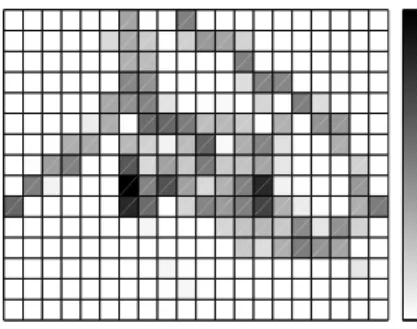
Fig. 6. Spatial histogram showing the density of users per region (in log scale) in Lausanne. Size is15.32km×7.58km, divided into20×15regions.
We use real location traces of people (in Lau-sanne, Switzerland) who use various means of transportation.2We select 11 users at
ran-dom, and we focus on their location traces during the day (8am to 8pm), when it is more probable that users use location-based ser-vices. The length of the considered traces is one month. The location area, within which they move, is divided into 300 regions. Fig-ure 6 shows the density of users across all the regions. The grayness of the cells shows the density of its corresponding region in log scale. As many of the regions are abandoned (or very rarely visited) by many individual
users, we compute each user’s profileψ(.)by considering only the 30 most popular re-gions across the whole population. This prevents sparse user profiles. A user’s profile is the normalized number of her visits to each region.
Given distance functionsdp(.)anddq(.)and service-quality loss thresholdQmaxloss, we compute the optimal LPPM and its corresponding optimal attack by solving (14a) and (15a) using Matlab’s linear programming solver. We then compare the obtained opti-mal protection mechanism and the optiopti-mal inference attack against thebasic obfusca-tion LPPMand theBayesian inference attack, respectively.
Basic Obfuscation LPPM. The basic obfuscation LPPM, with an obfuscation level
k= 1,2,3, . . ., is constructed in the following way: For each locationr, we find itsk−1
closest locations (using the Squared Euclidean distance between the centers of the regions). The LPPM functionf(.|r)will be the uniform probability distribution on the set of the k−1 selected locations together with the location r. That is, location r is replaced by each of the klocations, as a pseudolocation, with the same probability 1
k, and all other locations have probability 0. Thus, in practice, an actual location r is hidden among its k−1 nearest locations. We choose this mechanism, as it has been very popular in the literature.
Given the user profileψ(.)and quality distance functiondq(.), we use (1) to compute the expected service-quality lossQloss(ψ, f, dq)for any LPPM obfuscationf(.), whether it be optimal or not.
Bayesian Inference Attack on an LPPM. We compare the effectiveness of our
optimal attack with the Bayesian inference attack, which has been shown effective be-fore [Shokri et al. 2011b]. The Bayesian attack first computes the posterior probability of locationsPr(.|r′): Pr(r|r′) =Pr(r, r′) Pr(r′) = f(r′|r)ψ(r) P rf(r′|r)ψ(r) ,∀r∈ R. (28)
Then, it sets rˆ to the location that minimizes the expected estimation error ˆr = arg minˆrPrPr(r|r′)dp(ˆr, r). If the estimation error dp is the Squared Euclidean dis-tance, then the attack selects the conditional expected value ˆr = E[r|r′] and the
re-sulting expected estimation error is the conditional varianceVar[r|r′]. Ifd
p is the Dis-crete Metric, then the attack selects the location with the highest posterior probability
ˆ
r = arg maxrˆPr(ˆr|r′)and the resulting expected estimation error is1−Pr6=ˆrPr(r|r′). These facts follow from standard Bayesian estimation theory.
The difference between the Bayesian attack and the optimal attack is that the Bayesian attack does not take into account that the LPPM was designed to anticipate the optimal attack against it, nor that the LPPM had a quality constraint. In contrast, both of these facts are incorporated into the linear program that computes the optimal attack. As a result, the Bayesian attack is not optimal against any particular LPPM, definitely not against the optimal defense LPPM that our algorithms design.
Optimal Inference Attack on an Arbitrary LPPM.In order to make a fair
com-parison between the effectiveness of the optimal and obfuscation LPPM, we need to run the same attack on both of them. The Bayesian inference attack described by (28) can be performed against both. However, we still need to design an optimal attack against arbitrary LPPMs that have not been constructed in our game-theoretic framework.
The optimal inference attack is the one that minimizes the expected user privacy:
h(.) = arg min
h P rivacy(ψ, f, h, dp). (29) Given the user profileψ(.), an LPPMf(.)and distortion functiondp(.), the following linear program finds the optimal attackh(.). Note that, compared to (15a), there is no
User’s Profile
(1)
Optimal LPPM, over all locations
(2)
Obfuscation LPPM, over all locations
(3) Optimal LPPM. Loc(13,7)
(4)
Obfuscation LPPM. Loc(13,7)
(5)
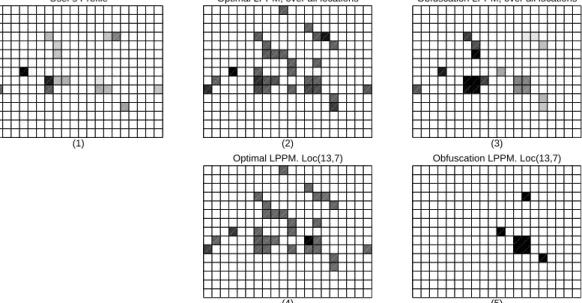
Fig. 7. Input/Output of LPPM. Profile of a user for whom the subsequent calculations are made (sub-figure 1). DistributionPr(r′)of observed pseudolocations when using the optimal LPPM with Qmax
loss =
0.8690(sub-figure 2). DistributionPr(r′)of observed pseudolocations when using obfuscation LPPM with
Qloss(ψ, f, dq) = 0.8690(sub-figure 3). Conditional distributionPr(r′|r)when using the optimal LPPM on
locationr = (13,7)(sub-figure 4). Conditional distributionPr(r′|r)when using obfuscation LPPM on
lo-cationr= (13,7)(sub-figure 5). Column 1 is the leftmost column, and row 1 is the bottom row. (Squared Euclideandp, Discrete Metricdq)
service quality constraint here, as the LPPM has been assumed to be arbitrary.
Minimize X ˆ r,r′,r ψ(r)f(r′|r)h(ˆr|r′)dp(ˆr, r) (30a) subject to X ˆ r h(ˆr|r′) = 1,∀r′,andh(ˆr|r′)≥0,∀ˆr, r′ (30b)
Tradeoff between Privacy and Service Quality. We now study the tradeoff
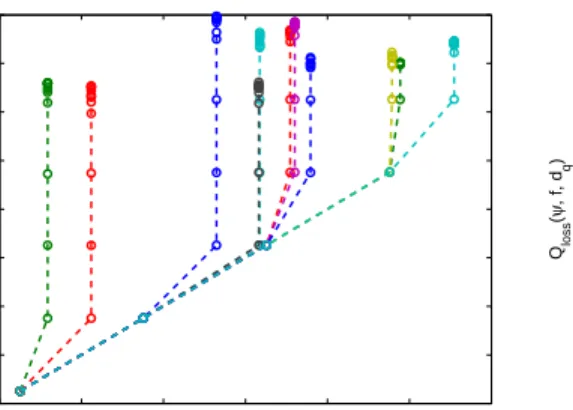
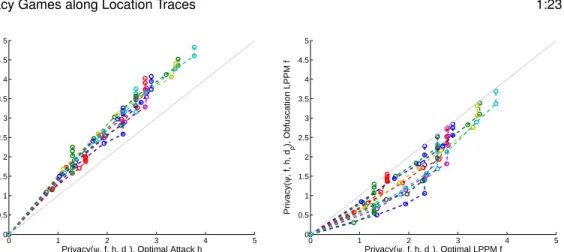
be-tween the level of privacy that the optimal LPPM provides, against the optimal attack, and the service-quality loss that it causes. We plot in Figure 8(a) the evolution of the service quality loss and the corresponding privacy achieved, as the optimal LPPM is configured with higher and higher values of service quality thresholdsQmaxloss (for users with diverse profiles). Each line in the figure represents one user and each◦represents oneQmaxloss. We plotP rivacy(ψ, f, h, dp)versusQloss(ψ, f, dq).
Unsurprisingly, with higher levels of location-privacy protection comes a significant degradation in service quality. Also, as expected, the maximum achievable location privacy strongly depends on the user profile. This is reflected by the separation be-tween the different lines. But we also see that each user’s privacy increases up to a certain level and then there is no change even when the quality threshold Qmax
loss is further increased. This is due to the presence of the optimal attack that squeezes the location-privacy gain.
This effect is further illustrated in Figure 8(b), where the service-quality loss of the optimal LPPM is plotted against the service-quality threshold. Once the optimal LPPM offers the maximal location privacy for a given user profile, loosening the service-quality constraint does not significantly change the LPPM’s underlying function f,