A N N A L S O F T H E N E W Y O R K A C A D E M Y O F S C I E N C E S Issue:The Year in Ecology and Conservation Biology
Ecosystem services provided by bats
Thomas H. Kunz,1Elizabeth Braun de Torrez,1Dana Bauer,2Tatyana Lobova,3 and Theodore H. Fleming4
1Center for Ecology and Conservation Biology, Department of Biology, Boston University, Boston, Massachusetts. 2Department of Geography, Boston University, Boston, Massachusetts.3Department of Biology, Old Dominion University, Norfolk, Virginia.4Department of Ecology and Evolutionary Biology, University of Arizona, Tucson, Arizona
Address for correspondence: Thomas H. Kunz, Ph.D., Center for Ecology and Conservation Biology, Department of Biology, Boston University, Boston, MA 02215. [email protected]
Ecosystem services are the benefits obtained from the environment that increase human well-being. Economic valuation is conducted by measuring the human welfare gains or losses that result from changes in the provision of ecosystem services. Bats have long been postulated to play important roles in arthropod suppression, seed dispersal, and pollination; however, only recently have these ecosystem services begun to be thoroughly evaluated. Here, we review the available literature on the ecological and economic impact of ecosystem services provided by bats. We describe dietary preferences, foraging behaviors, adaptations, and phylogenetic histories of insectivorous, frugivorous, and nectarivorous bats worldwide in the context of their respective ecosystem services. For each trophic ensemble, we discuss the consequences of these ecological interactions on both natural and agricultural systems. Throughout this review, we highlight the research needed to fully determine the ecosystem services in question. Finally, we provide a comprehensive overview of economic valuation of ecosystem services. Unfortunately, few studies estimating the economic value of ecosystem services provided by bats have been conducted to date; however, we outline a framework that could be used in future studies to more fully address this question. Consumptive goods provided by bats, such as food and guano, are often exchanged in markets where the market price indicates an economic value. Nonmarket valuation methods can be used to estimate the economic value of nonconsumptive services, including inputs to agricultural production and recreational activities. Information on the ecological and economic value of ecosystem services provided by bats can be used to inform decisions regarding where and when to protect or restore bat populations and associated habitats, as well as to improve public perception of bats.
Keywords: arthropod suppression; biological pest control; ecosystem valuation; insectivory; pesticide reduction; pollination; seed dispersal; sustainable agriculture
Introduction
Ecosystems consist of living organisms and their interactions with the abiotic environment (both physical and chemical). Terrestrial ecosystems in-clude forests, grasslands, deserts, wetlands, and caves. Aquatic ecosystems include rivers, streams, lakes, ponds, estuaries, and oceans. For thousands of years, both terrestrial and aquatic ecosystems have been subject to human alterations, including con-version of natural ecosystems to agricultural ecosys-tems that were needed to sustain increasing human population growth. Natural ecosystems throughout
the world have become increasingly threatened by human-generated or anthropogenic factors such as urbanization, mining, deforestation, chemical and light pollution, and invasive species. Healthy ecosys-tems are especially important in providing various regulatory processes (e.g., insect suppression, pol-lination, seed dispersal, purification of water and air, stabilization of soils, decomposition of wastes, binding of toxic substances, mitigation of diseases, mitigation of floods, and regulation of climate, etc.); products or provisions (e.g., food, fuel, fiber, and medicines); supporting processes (e.g., nutrient cy-cling, soil formation, and primary production); and
cultural benefits (e.g., aesthetic, spiritual, educa-tional, and recreational) that improve human well-being.1These processes and products are commonly referred to as ecosystem services2,3 and have been duly recognized by the United Nations Millennium Ecosystem Assessment.4,5 Ecosystem services vary depending on the ecosystems and the organisms that they constitute. In this paper, we consider the role of bats in providing ecosystem services, focusing primarily on those that both regulate and provide services needed to sustain humankind, with brief references to supporting and cultural services. One of the grand challenges that society faces is how best to identify, protect, and conserve services that are critical for human and ecosystem health.1,6
In their present form, bats have been on Earth for over 52 million years7 and during this period have diversified into at least 1,232 extant species.8,9 Bats have evolved an incredibly rich diversity of be-havioral, roosting, and feeding habits.10,11 By day, many species occupy caves and cave-like structures, such as tombs and mines;12others roost in tree cavi-ties and foliage,13sometimes modifying foliage into unique tent-like structures.14–16 By night, bats fill the skies to forage on a diversity of food items rang-ing from insects, nectar, and fruit, to seeds, frogs, fish, small mammals, and even blood.
Unfortunately, many threats face bats today. Bats in western cultures have long been subjects of dis-dain and persecution and have often been depicted in the popular media as rampant vectors of dis-ease, blood-sucking demons, ingredients of witches brew, and, at times, associated with the dark side of some religious practices.17 Common myths in-clude that bats are attracted to and become caught in women’s hair, are associated with the devil, and that extracts from the skin of bats can cure bald-ness.18,19 As with many myths and folklore, there may be some elements of truth, yet the vast majority of real or imagined images of bats often portrayed in art, poetry, books, movies, television, and the press convey them as having little redeeming value ex-cept to frighten for the sake of corporate or personal profit. By contrast, in many eastern cultures, espe-cially those that prevailed during the middle and late Qing Dynasty (1644–1911) in China, bats were con-sidered to be symbols of good fortune, such as long life, health, wealth, virtue, and serenity of mind.18,19 Today, these cultural symbols persist, but appear to be less important to modern Chinese society.20
Since their evolutionary origin, some species of bats have become locally extirpated or regionally extinct, mostly for unknown reasons.21 In recent years, increased evidence of anthropogenic activi-ties such as depletion or destruction of forests and other terrestrial ecosystems, disturbances to caves, depletion of food resources, overhunting for bush meat,22increased use of pesticides,11,23and the pro-liferation and operation of utility-scale wind energy facilities20,24–26have contributed to unintended and, in some cases, unprecedented mortality of bats. Bats that roost in caves, for example, are often disturbed by unsuspecting visitors either during maternity pe-riods or hibernation, which can lead to death or abandonment. Bats known to roost in buildings are sometimes excluded or even exterminated for per-ceived or real threats to human health, and some-times simply from unfounded fear stirred by the media.
Increased human populations and associated habitat degradation have been linked to the decline of many fruit-eating and nectar-feeding species, es-pecially of endemic taxa and certain tropical species that evolved on remote islands.27Increased human pressures by indigenous cultures in Asia, Africa, and the Pacific Islands for bush meat have also led to the local or regional extirpation of some species. The recent decline of the little brown myotis,Myotis lu-cifugus, one of the most common and widespread species in North America, has been attributed to white-nose syndrome,28an emerging disease asso-ciated with the putative fungal pathogen,Geomyces destructans,29,30 which may have been introduced from Europe.31,32
Bat biologists are often asked, “Why should we care about bats?” The simple answer is that scientists care about the fate of animals and as a consequence have invested their careers in studying and, perhaps more importantly, protecting these marvelous flying mammals. Benefits that humans inadvertently and unsuspectingly derive from bats will be forever lost or severely diminished, causing both known and unknown consequences to the ecosystems in which they have evolved.
The rich diversity of dietary habits of bats, rang-ing from species that feed on insects and other arthropods to those that feed on fruit, nectar, and flowers,10,11 provide valuable ecosystem services and, thus, are the subjects of this paper, although other species that feed on seeds, frogs, fish, small
mammals, and even blood also assume important roles in ecosystems as predators or prey in sustain-able ecosystems. Bats provide value to ecosystems as primary, secondary, and tertiary consumers that support and sustain both natural and human dom-inated ecosystems ranging from the simple to the complex. In this review, we describe the ecosystem services provided by bats that feed on insects and other arthropods, on nectar and pollen, and on fruit. Insectivorous species, largely feeding on airborne in-sects and other arthropods, suppress both naturally occurring and anthropogenically-generated insect populations (such as agricultural pest species and insects that annoy or transmit specific pathogens to humans and other mammals) and contribute to the maintenance of ecosystem stability. Frugiv-orous bats help maintain the diversity of forests by dispersing seeds across different ecosystems, often introducing novel plant species into previously dis-turbed landscapes33and to oceanic islands.34 Sim-ilarly, nectarivorous bats that visit flowers provide valued ecosystem services by pollinating plants, dis-persing pollen, and, thus, helping to maintain ge-netic diversity of flowering plants. In addition to suppressing insect populations, pollinating flowers, and dispersing seeds, insectivorous, nectarivorous, and frugivorous species may redistribute nutrients and energy through their guano to sustain terres-trial, aquatic, and cave ecosystems. Lastly, where data are available, we consider the economic value of bats to terrestrial ecosystems. While data on the economic value of bats to ecosystems are limited, we present a framework that is needed to make such as-sessments and to examine why the diverse forms of this group of mammals deserve respect, protection, and conservation.
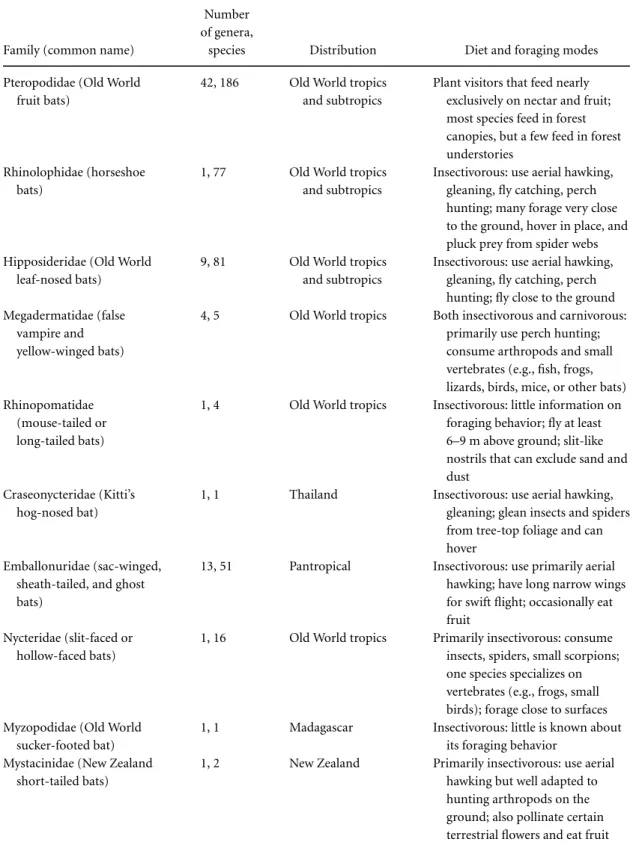
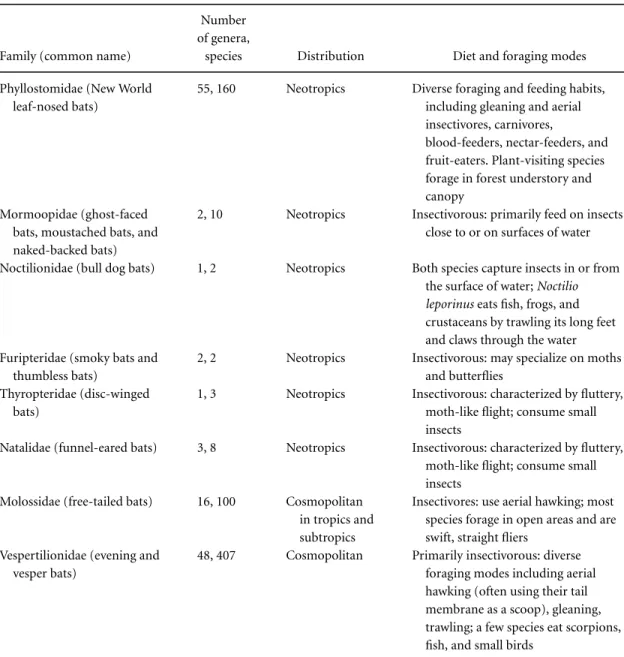
The role of bats in arthropod suppression Among the estimated 1,232 extant bat species,8over two thirds are either obligate or facultative insecti-vores (Table 1). They include species that glean in-sects from vegetation and water in cluttered forests to those that feed in open space above forests, grass-lands, and agricultural landscapes (Fig. 1). Although popular literature commonly recognizes bats for their voracious appetites for nocturnal and crepus-cular insects,35the degree to which they play a role in herbivorous arthropod suppression is not well doc-umented. In this section, we review the available lit-erature on the predator–prey interactions between
Figure 1.Brazilian free-tailed bat (Tadarida brasiliensis) fly-ing with a moth in its mouth (photo by Merlin D. Tuttle, Bat Conservation International, www.batcon.org).
bats and arthropod pests—including the magnitude of arthropod consumption by bats, the responses of prey to threats of predation, and the quantitative impacts of bats on arthropod populations—and dis-cuss the various methods used to obtain these data. This type of information could ultimately be used to estimate the ecological and economic value of bats in both natural and agricultural systems, a topic that we discuss in detail in the section on economic valuation of ecosystem services.
Dietary considerations: what’s on the menu? Foraging modes. Insectivorous bats use various methods for capturing and consuming insect prey (Table 1). Aerial hawking bats hunt prey on the fly, often scooping insects from the air with their wing or tail membrane and transferring them to their mouths.36–38 Gleaning bats, those that take prey from surfaces, generally forage in cluttered envi-ronments (e.g., dense foliage) where background echoes can mask echoes from insects.38,39 Some gleaners are able to finely discriminate targets us-ing low-intensity, broadband echolocation calls,40,41 whereas others passively listen for prey-generated sounds or use vision and/or olfaction.38 Trawling bats glean insects off the surface of water using their long feet and/or tail membrane. Fly-catching and perch-hunting bats hang from perches and wait for aerial and ground-dwelling prey, respectively. These foraging modes, however, are not mutually exclu-sive, and it is often difficult to categorize a given species.
General insect consumption. Studies of dietary habits of insectivorous bats date back many
Table 1.An ecological classification of bats, Order Chiroptera. Taxonomy follows Wilson and Reeder.241 Number
of genera,
Family (common name) species Distribution Diet and foraging modes
Pteropodidae (Old World fruit bats)
42, 186 Old World tropics and subtropics
Plant visitors that feed nearly exclusively on nectar and fruit; most species feed in forest canopies, but a few feed in forest understories
Rhinolophidae (horseshoe bats)
1, 77 Old World tropics and subtropics
Insectivorous: use aerial hawking, gleaning, fly catching, perch hunting; many forage very close to the ground, hover in place, and pluck prey from spider webs Hipposideridae (Old World
leaf-nosed bats)
9, 81 Old World tropics and subtropics
Insectivorous: use aerial hawking, gleaning, fly catching, perch hunting; fly close to the ground Megadermatidae (false
vampire and yellow-winged bats)
4, 5 Old World tropics Both insectivorous and carnivorous: primarily use perch hunting; consume arthropods and small vertebrates (e.g., fish, frogs, lizards, birds, mice, or other bats) Rhinopomatidae
(mouse-tailed or long-tailed bats)
1, 4 Old World tropics Insectivorous: little information on foraging behavior; fly at least 6–9 m above ground; slit-like nostrils that can exclude sand and dust
Craseonycteridae (Kitti’s hog-nosed bat)
1, 1 Thailand Insectivorous: use aerial hawking,
gleaning; glean insects and spiders from tree-top foliage and can hover
Emballonuridae (sac-winged, sheath-tailed, and ghost bats)
13, 51 Pantropical Insectivorous: use primarily aerial hawking; have long narrow wings for swift flight; occasionally eat fruit
Nycteridae (slit-faced or hollow-faced bats)
1, 16 Old World tropics Primarily insectivorous: consume insects, spiders, small scorpions; one species specializes on vertebrates (e.g., frogs, small birds); forage close to surfaces Myzopodidae (Old World
sucker-footed bat)
1, 1 Madagascar Insectivorous: little is known about its foraging behavior
Mystacinidae (New Zealand short-tailed bats)
1, 2 New Zealand Primarily insectivorous: use aerial hawking but well adapted to hunting arthropods on the ground; also pollinate certain terrestrial flowers and eat fruit
Table 1.Continued
Number of genera,
Family (common name) species Distribution Diet and foraging modes
Phyllostomidae (New World leaf-nosed bats)
55, 160 Neotropics Diverse foraging and feeding habits, including gleaning and aerial insectivores, carnivores,
blood-feeders, nectar-feeders, and fruit-eaters. Plant-visiting species forage in forest understory and canopy
Mormoopidae (ghost-faced bats, moustached bats, and naked-backed bats)
2, 10 Neotropics Insectivorous: primarily feed on insects close to or on surfaces of water
Noctilionidae (bull dog bats) 1, 2 Neotropics Both species capture insects in or from the surface of water;Noctilio
leporinuseats fish, frogs, and
crustaceans by trawling its long feet and claws through the water Furipteridae (smoky bats and
thumbless bats)
2, 2 Neotropics Insectivorous: may specialize on moths and butterflies
Thyropteridae (disc-winged bats)
1, 3 Neotropics Insectivorous: characterized by fluttery, moth-like flight; consume small insects
Natalidae (funnel-eared bats) 3, 8 Neotropics Insectivorous: characterized by fluttery, moth-like flight; consume small insects
Molossidae (free-tailed bats) 16, 100 Cosmopolitan in tropics and subtropics
Insectivores: use aerial hawking; most species forage in open areas and are swift, straight fliers
Vespertilionidae (evening and vesper bats)
48, 407 Cosmopolitan Primarily insectivorous: diverse foraging modes including aerial hawking (often using their tail membrane as a scoop), gleaning, trawling; a few species eat scorpions, fish, and small birds
years,42–49 but few have assessed the potential im-pacts of prey consumption on human health or natural and agricultural systems. Although it is be-yond the scope of this review, there has been con-siderable debate as to the degree of prey selection by bats.38,50 While some studies have shown indi-viduals to actively select among available prey,51–54 others have concluded that insectivorous bats are generalist predators, feeding on a wide diversity of taxonomic groups and opportunistically consum-ing appropriately sized prey accordconsum-ing to its
avail-ability within a preferred habitat.48,50,55 Insectiv-orous bat activity and diversity are strongly cor-related with arthropod abundance,56–58suggesting that bats seek out areas of concentrated prey sources. Although there is considerable variation in the rel-ative proportions consumed by different species, most insectivorous bats eat large quantities of lepi-dopterans (moths), coleopterans (beetles), dipter-ans (flies), homopterdipter-ans (cicadas, leaf hoppers), and hemipterans (true bugs).44,47,59–63Some species also eat unusual prey items such as scorpions and
spiders.64Prey size can vary from as small as 1 mm (midges and mosquitoes) to as large as 50 mm long (beetles and large moths), depending on the species of bat.52,59,60,65–68Bats often forage throughout the night, returning to their roosts to nurse young and to rest during periods of low insect activity.59,69,70
The magnitude of arthropod consumption by a bat varies considerably by species, season, and reproductive cycle. On average, insectivorous bats maintained in captivity have been estimated to con-sume up to 25% of their body mass in insects each night (Myotis lucifugus andEptesicus fuscus,46 M. lucifugusandM. thysanodes,71 Lasiurus cinereus,72 Lasionycteris noctivagans73). Under natural condi-tions, these estimates increase, most likely due to higher energy demands. Using field metabolic rates based on turnover of doubly labeled water, Kurta et al.74 estimated that at the peak night of lacta-tion, a 7.9 g little brown bat (M. lucifugus) needs to consume 9.9 g of insects (over 100% of its body mass) to account for the marked increase in energy expenditures due to this costly stage of the repro-ductive cycle.75At peak lactation, a female Brazilian free-tailed bat (Tadarida brasiliensis)can consume up to 70% of her body mass in insects each night; furthermore, she frequently culls her prey, consum-ing only the nutrient-rich abdomen of moths while discarding the wings, head, and appendages, which greatly increases feeding efficiency and hence the quantity of insects consumed.61To put this in per-spective, an average maternity colony of one million Brazilian free-tailed bats weighing 12 g each could consume up to 8.4 metric tons of insects in a single night. These studies hint at the immense capability of nightly insect consumption and at the potential role of bats in top-down suppression of arthropod populations.
Agricultural pests and pesticide use. Herbivo-rous arthropods destroy approximately 25–50% of crops worldwide.76,77 The response to these threats by modern agriculture has been predom-inantly through the application of synthetic pes-ticides, a practice that has led to many unin-tended consequences including human health risks, degradation of ecosystem function, evolved toxicity resistance by pests, and severe alterations of the dynamics of agribusiness.76,78–80 The World Re-sources Institute estimates that over 400 pest species have evolved resistance to one or more pesticides,
and that despite an increase in pesticide use, the proportion of crops destroyed by insect pests in the United States has doubled (to 13%) since the 1940s.81By eliminating beneficial invertebrate and vertebrate predators through indiscriminate use of broad-spectrum insecticides, insect species that are not normally considered pests are often elevated to pest status.80,82Efforts to curb the widespread and indiscriminate use of chemical pesticides include the promotion of biological controls.83 An estimated 99% of potential crop pests are limited by natural ecosystems,80,84 of which some fraction can be at-tributed to predation by bats. Naylor and Ehrlich80 estimated that the value of the global pest control ecosystem service ranges between $54 billion and $1 trillion, an estimate that includes reductions in both crop losses due to pests and direct/indirect costs of pesticide use. Pimentelet al.77concluded that a 50% reduction in pesticide use could be achieved with only a 0.6% increase in the cost of purchased food, provided that biological, cultural, and environmen-tal pest control technologies are used.
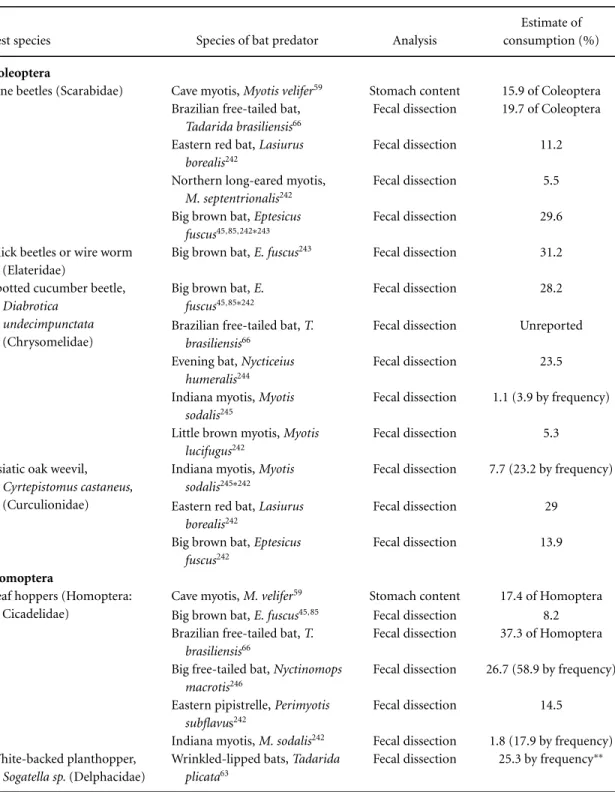
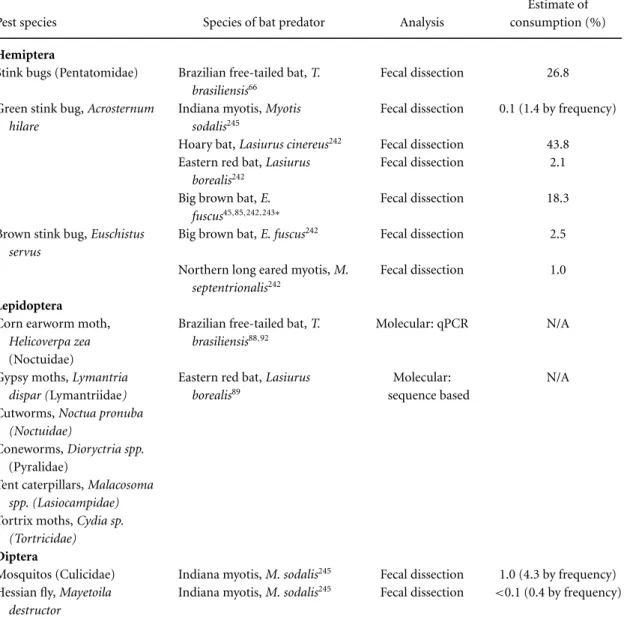
Consumption of specific agricultural pests by bats. Various species of prominent agricultural in-sect pests have been found in the diets of bats based on identification of insect fragments in fecal samples and stomach contents. These in-sects include, but are not limited to, June bee-tles (Scarabidae), click beebee-tles (Elateridae), leafhop-pers (Cicadelidae), planthopleafhop-pers (Delphacidae), the spotted cucumber beetle, (Diabrotica undecim-punctata, Chrysomelidae), the Asiatic oak weevil (Cyrtepistomus castaneus, Curculionidae), and the green stinkbug (Acrosternum hilare, Pentatomidae) (Table 2 and Appendix A).
Based on the dietary composition, minimum number of total insects per guano pellet, number of specific agricultural pest species in each pellet, and the number of active foraging days per year, Whitaker85calculated that a colony of 150 big brown bats (Eptesicus fuscus) in the midwestern United States annually consumes approximately 600,000 cucumber beetles, 194,000 June beetles, 158,000 leafhoppers, and 335,000 stinkbugs. Subsequently, assuming that each female cucumber beetle lays 110 eggs,86this average-sized bat colony could prevent the production of 33,000,000 cucumber beetle lar-vae (corn rootworms), which are severe crop pests (Appendix A). While these calculations include a
large number of assumptions and ignore various sources of natural variation, this study took the extra step of translating ecological data into a form more readily appreciated by the public. With the addition of data on corn rootworm damage to crops in the study area, an economic value for this colony could be estimated.
A common challenge in these investigations is the overwhelming lack of basic ecological informa-tion regarding foraging behavior and diet for many species of bats. For example, traditional dietary analyses through fecal or stomach contents have historically only identified arthropod fragments to the ordinal or familial level, rather than to species,46,60,69,87 and in cases where species identi-fication is possible, it has typically been restricted to hard-bodied insects, such as beetles, that re-main partially undigested. Recently, novel molecu-lar techniques have allowed detection and species identification of both hard- and soft-bodied in-sects, such as lepidopterans, within guano collected from bats.88–93 Whitakeret al.90described the de-velopment of quantitative polymerase chain reac-tion (qPCR), coupled with controlled feedings of known insects to captive bats, as an approach to estimate the number or percent volume of specific insects consumed by wild bats. qPCR has been used to document consumption of the corn earworm moth (Helicoverpa zea) and the beet armyworm (Spodoptera exigua),both major pests of corn, cot-ton, and other crops throughout the United States, by Brazilian free-tailed bats,Tadarida brasiliensis,in south-central Texas.88,90,92 Brown91 used qPCR to identify the pecan nut casebearer moth (Acrobasis nuxvorella),the hickory shuckworm moth (Cydia caryana), andH. zea moths in the diet of Brazil-ian free-tailed bats from guano collected beneath bat houses located in organic pecan orchards. This author also identified the southern green stink bug (Nezara viridula) by sequencing insect fragments found in the guano (see Appendix A).
To date, Clareet al.89 conducted the most com-prehensive dietary analysis of an insectivorous bat. These authors extracted DNA from insect fragments found in fecal samples and used a polymerase chain reaction (PCR) coupled with a sequence-based tech-nique to assess the diet of the eastern red bat, Lasiu-rus borealis,in Canada. Through comparison of fecal DNA sequences to a reference database, they were able to identify 127 prey species (5 orders, 16 families
of lepidopterans), some of which were notable agri-cultural, forest, and orchard/garden pests including gypsy moths (Lymantria dispar), tent caterpillars (Malacosoma sp.), coneworms (Dioryctria sp.), cut-worms (Noctua pronuba), snout moths (Acrobasis sp.),and tortrix moths (Cydia sp.) (see Table 2 and Appendix A). All bats were captured in a provin-cial park that was adjacent to agricultural land. Al-though this study provides unprecedented detail re-garding the diversity of insects consumed by the eastern red bat, the techniques used did not allow for quantification of pest consumption, and the au-thors did not have sufficient data to estimate the ecological or economic value of these bats to any particular ecosystem.
Direct and indirect impacts of insectivorous bats
Understanding complexities of predator–prey in-teractions. The studies reviewed in the previous sections document the consumption of herbivorous arthropods by bats; however, few studies have mea-sured their actual impacts on natural or agroecosys-tems. Top- and midlevel predators can have direct effects on herbivore communities and indirect ef-fects on plant communities through both density-mediated (consumption) and trait-mediated (behavioral) interactions.94The following sections address the research that has begun to document these interactions between insectivorous bats and their prey.
A pioneering study by Buckner dating back to the 1960s, which examined the role of vertebrate preda-tors in the biological control of forest insects,95 il-lustrates the complexities involved with assigning a value to natural predators and may serve as a template for the assessment of the ecosystem ser-vices provided by bats. Buckner asserted that three basic measurements must be made to understand a predator–prey system: density of the prey, den-sity of the predators, and the extent of destruction of prey by the predators. Few studies have thor-oughly evaluated these seemingly simple questions. Equally fundamental, but perhaps more ecologically complex, is the evaluation of an individual predator species in relation to its local ecological community. What is the predator’s capacity for consumption of the prey? What are the effects of the density of prey or the presence of alternative prey on the predator’s density and/or rate of consumption? What defense
Table 2.Examples of studies found in the literature documenting the consumption of agricultural insect pests by different species of bats, analytical methods used for dietary analysis, and estimated quantity of consumptiona
Estimate of
Pest species Species of bat predator Analysis consumption (%)
Coleoptera
June beetles (Scarabidae) Cave myotis,Myotis velifer59 Stomach content 15.9 of Coleoptera
Brazilian free-tailed bat,
Tadarida brasiliensis66
Fecal dissection 19.7 of Coleoptera
Eastern red bat,Lasiurus borealis242
Fecal dissection 11.2
Northern long-eared myotis,
M. septentrionalis242
Fecal dissection 5.5
Big brown bat,Eptesicus fuscus45,85,242∗243
Fecal dissection 29.6
Click beetles or wire worm (Elateridae)
Big brown bat,E. fuscus243 Fecal dissection 31.2
Spotted cucumber beetle,
Diabrotica undecimpunctata
(Chrysomelidae)
Big brown bat,E. fuscus45,85∗242
Fecal dissection 28.2
Brazilian free-tailed bat,T. brasiliensis66
Fecal dissection Unreported
Evening bat,Nycticeius
humeralis244
Fecal dissection 23.5
Indiana myotis,Myotis sodalis245
Fecal dissection 1.1 (3.9 by frequency)
Little brown myotis,Myotis lucifugus242
Fecal dissection 5.3
Asiatic oak weevil,
Cyrtepistomus castaneus,
(Curculionidae)
Indiana myotis,Myotis sodalis245∗242
Fecal dissection 7.7 (23.2 by frequency)
Eastern red bat,Lasiurus borealis242
Fecal dissection 29
Big brown bat,Eptesicus fuscus242
Fecal dissection 13.9
Homoptera
Leaf hoppers (Homoptera: Cicadelidae)
Cave myotis,M. velifer59 Stomach content 17.4 of Homoptera
Big brown bat,E. fuscus45,85 Fecal dissection 8.2
Brazilian free-tailed bat,T. brasiliensis66
Fecal dissection 37.3 of Homoptera
Big free-tailed bat,Nyctinomops
macrotis246
Fecal dissection 26.7 (58.9 by frequency)
Eastern pipistrelle,Perimyotis subflavus242
Fecal dissection 14.5
Indiana myotis,M. sodalis242 Fecal dissection 1.8 (17.9 by frequency)
White-backed planthopper,
Sogatella sp.(Delphacidae)
Wrinkled-lipped bats,Tadarida plicata63
Fecal dissection 25.3 by frequency∗∗
Table 2.Continued
Estimate of
Pest species Species of bat predator Analysis consumption (%)
Hemiptera
Stink bugs (Pentatomidae) Brazilian free-tailed bat,T. brasiliensis66
Fecal dissection 26.8
Green stink bug,Acrosternum hilare
Indiana myotis,Myotis sodalis245
Fecal dissection 0.1 (1.4 by frequency)
Hoary bat,Lasiurus cinereus242 Fecal dissection 43.8
Eastern red bat,Lasiurus borealis242
Fecal dissection 2.1
Big brown bat,E. fuscus45,85,242,243∗
Fecal dissection 18.3
Brown stink bug,Euschistus servus
Big brown bat,E. fuscus242 Fecal dissection 2.5
Northern long eared myotis,M. septentrionalis242
Fecal dissection 1.0
Lepidoptera Corn earworm moth,
Helicoverpa zea
(Noctuidae)
Brazilian free-tailed bat,T. brasiliensis88,92
Molecular: qPCR N/A
Gypsy moths,Lymantria
dispar (Lymantriidae)
Eastern red bat,Lasiurus borealis89
Molecular: sequence based
N/A
Cutworms,Noctua pronuba (Noctuidae)
Coneworms,Dioryctria spp.
(Pyralidae)
Tent caterpillars,Malacosoma spp. (Lasiocampidae)
Tortrix moths,Cydia sp. (Tortricidae)
Diptera
Mosquitos (Culicidae) Indiana myotis,M. sodalis245 Fecal dissection 1.0 (4.3 by frequency)
Hessian fly,Mayetoila destructor
Indiana myotis,M. sodalis245 Fecal dissection <0.1 (0.4 by frequency)
aEstimates of consumption are in percent volume of the total diet unless otherwise specified. See Appendix A for descriptions of pest species.
∗The study from which estimates of consumption are taken if more than one. ∗∗Estimate refers to Homoptera: “most” wereSogatella sp.
mechanism does the prey have and use against the predator? Buckner argued that until these aspects are studied thoroughly, the understanding of predation as a biological control factor will be incomplete. Researchers investigating invertebrate and aquatic systems have begun to do this (reviewed in Refs. 96 and 97), but few if any studies of vertebrate predators have fully addressed these important questions.
Ecosystem services of the Brazilian free-tailed bat: a case study. Of the approximately 900 insec-tivorous bat species, the Brazilian free-tailed bat, Tadarida brasiliensis,provides one of the most im-pressive examples of continental-scale natural pest suppression in the world.98Several studies have at-tempted to document the nightly foraging behav-ior and prey consumption patterns in this species
Figure 2.Brazilian free-tailed bats (Tadarida brasiliensis) dis-persing over agricultural landscapes from a maternity roost in south-central Texas (photo by Merlin D. Tuttle, Bat Conserva-tion InternaConserva-tional, www.batcon.org).
to better understand its ecosystem service.62,66,99,100 Millions of Brazilian free-tailed bats migrate north-ward each year in the spring from Mexico to form enormous maternity colonies in limestone caves and bridges throughout the southwestern United States.43,101 Each evening, large numbers of bats emerge from these roosts (Fig. 2) and disperse across natural and agricultural landscapes in high enough densities to be detected by NEXRAD WSR-88D Doppler weather radars.99As recently as the 1950s and early 1960s, midsummer colonies of Brazil-ian free-tailed bats in 17 caves in the southwest-ern United States were estimated to total about 150 million individuals.102 However, recent estimates, based on improved census methods using thermal infrared imaging and computer detection and track-ing algorithms, conclude that these same caves now house closer to nine million bats, indicating either a marked population decline or an overestimation in past observations.103 The likelihood of historic overestimates is supported by further quantitative assessments of colony dynamics and emergence be-havior of Brazilian free-tailed bats that roost in Carlsbad Caverns, New Mexico.104
Although Brazilian free-tails are known to con-sume a wide variety of prey items (12 orders, 35 fam-ilies), numerous studies indicate that moths (Lep-idoptera) are their primary food source,61,62,66,105 including devastating agricultural pests such as the corn earworm or cotton bollworm moth ( Helicov-erpa zea) and the tobacco budworm moth (Heliothis virescens).88,98Studies have found that the propor-tion of moths consumed by Brazilian free-tailed bats increases markedly during their early morning
for-aging bouts in comparison to evening forfor-aging bouts from May to the end of June,66,105a time period that coincides with the immigration of swarms of corn earworm moths and fall armyworms,Spodoptera ex-igua, into Texas from northern Mexico on prevailing winds.106,107 In a study on the foraging activity of these bats at high altitudes, McCrackenet al.100 doc-umented that echolocation search calls and feeding buzzes were most abundant at ground level and at 400–500 m above ground level, the latter of which corresponds with the low-elevation southerly wind jet, a major aeroecological corridor for the nocturnal dispersal of corn earworm moths, fall armyworms, and other insects. Des Maraiset al.108 used stable isotope ratios of carbon from bat guano to esti-mate that more than one-half of all insects eaten by Brazilian free-tailed bats that roost in Carlsbad Cav-erns fed on crops, based on landscape data showing that 90% of the crops surrounding the cave were C3 plants while the majority of the native plants were C4. Similarly, Mizutaniet al.109estimated that two-thirds of the guano sampled from a cave housing several million Brazilian free-tailed bats in Arizona included insects or other arthropods that fed on C3 crops (cotton and alfalfa) in an area dominated by native C4 vegetation.
These studies strongly suggest that Brazilian free-tailed bats opportunistically forage over agricultural fields that both produce and attract large insect pop-ulations. Research suggests that after initial arrival into Texas from northern Mexico, corn earworm and tobacco budworm moths and their progeny undergo an annual migration northward through the southern and central croplands of the United States.106,107Thus, the benefits conferred to agricul-ture by consumption of these moths by bats may not be limited to their local foraging areas (e.g., in Texas and New Mexico) but may extend to agri-cultural landscapes hundreds of kilometers away. Several recent studies have estimated the economic value of the pest suppression service provided by Brazilian free-tailed bats98,103,110,111and are further discussed in the section on valuation of ecosystem services.
Density-mediated direct and indirect effects: con-sumption. Research evaluating ecosystem services of other insectivorous bat species fall far behind that of the Brazilian free-tailed bat; however, several re-cent studies have provided compelling evidence that
bats can limit insect populations in both agricultural and natural systems.
For example, Williams-Guill´enet al.112and Kalka
et al.113separated the effects of insectivorous birds and bats on pest suppression by conducting preda-tor exclosure experiments in a coffee plantation in Mexico and a lowland tropical forest in Panama, re-spectively. Both studies placed agricultural netting around individual plants to exclude bats at night and birds during the day. Previous studies using preda-tor exclosures attributed any results of arthropod suppression to bird predation,114,115 ignoring bats as potential contributors. Williams-Guill´enet al.112 found that, by excluding bats, total arthropod den-sities increased by 84% per coffee plant in the wet season but were not affected in the dry season. They attributed the seasonal difference to the increased abundance, reproductive activity, and hence energy demands of bats during the wet season. In both sea-sons, bats and birds together had the highest impact on arthropod densities, suggesting an additive effect. Although there was a clear direct effect of bats and birds on herbivorous arthropods, the authors did not find a significant indirect effect on leaf damage for any of the treatments. By contrast, Kalkaet al.113 demonstrated that the exclusion of bats from five common tropical understory plants significantly in-creased both arthropod densities (by 65%) and leaf damage (by 68%) relative to control treatments. They also found that bats consistently had a higher impact on insect populations than birds. These au-thors emphasize that their estimates of direct and indirect impacts of both groups are likely conserva-tive due to predation by aerial insectivores outside of the exclosures, the exclusion of large arthropods along with bats and birds, the presence of predatory arthropods in the exclosures, and their focus on understory plants rather than the more-productive forest canopy. For both of these studies, a list of in-sect orders that were suppressed is available in their supporting online material; however, neither study identified pests to the species level, nor did they at-tempt to estimate the economic value of bats in these systems.
Reiskind and Wund67 provided compelling evi-dence that northern long-eared bats (Myotis septen-trionalis) suppress mosquito (Culex spp.) popula-tions through direct predation. Although bats are commonly credited for their role in mosquito con-trol, this is the first study documenting a
quanti-tative impact on mosquito populations. Predator enclosures were erected in the field that contained artificial oviposition sites and allowed passage of naturally occurring mosquitoes. These researchers released wild-captured northern long-eared bats into the enclosures to forage for a total of nine nights. They found that nightly oviposition by mosquitoes was reduced by 32% in enclosures that contained bats when compared to control enclosures with no bats. Based on their finding of no difference between control enclosures and unenclosed artificial oviposi-tion sites adjacent to bat enclosures, they concluded that these effects were due to predation rather than the alteration of mosquito behavior.
Exclosure and enclosure studies, such as those de-scribed above, have the potential to provide valuable information on the direct and indirect effects of bats as arthropod predators; however, results should be interpreted with caution. Exclosures effectively ex-clude bats that glean insects directly from vegeta-tion but most likely have a limited effect on aerial insectivores that capture insects on the fly often far from the plant of interest. Enclosures, on the other hand, may inflate estimates of prey suppression due to unnatural conditions such as an elevated density of bats or limited availability of other suitable prey items within the enclosures.
Trait-mediated indirect interactions: ecology of fear. Predator–prey interactions are central fea-tures in all ecological communities, yet traditional models of predator–prey dynamics treat individ-uals as unresponsive units and do not consider the prey’s physical or behavioral response to the presence of a predator.116 In a fear-driven system, prey enact an inducible defense in response to the presence or threat of a predator in order to re-duce the risk of consumption by altering such be-haviors as predator vigilance, foraging decisions, and mate attraction.97,116 This behavioral plastic-ity may have significant impacts on species in-teractions, community structure, and ecosystem function.97,117
The threat of predation by bats has led to the evolution of both physical and behavioral defense mechanisms in many species of moths, including aposematic signaling,118,119 the production of ul-trasonic jamming clicks,120 and evasive flight ma-neuvers121to avoid consumption. In an agricultural setting, the presence of bats may alter the behavior
and/or population dynamics of moth pests within that system. Belton and Kempster122found that the infestation rate of sweet corn (maize) by the Eu-ropean corn borer,Ostrinia nubilalis(Lepidoptera: Pyralidae),was reduced by over 50% in test plots that were exposed to ultrasound broadcast at fre-quencies, amplitudes, and pulse rates characteristic of bat calls. This result provides an excellent ex-ample of the ecology of fear; however, the sex-ample size of the study was very small (only two replicates over one season), the broadcasts may not have rep-resented natural levels of bat activity, and possible changes in predation due to bat responses to the broadcast were not accounted for. In a laboratory study, the true armyworm, Pseudaletia umpuncta (Lepidoptera: Noctuidae), and the European corn borer, altered their mating behavior in response to high levels of simulated predation risk (ultrasonic bat calls) by reducing their mate-seeking behavior, pheromone production, and mating calls.123Huang
et al.124,125documented that when exposed to ultra-sound in the laboratory, female Indian meal moths, Plodia interpunctella(H¨ubner) (Lepidoptera: Pyral-idae) received fewer spermatophores from males, produced fewer and smaller larvae, reduced mate calling, and reduced the length of mating time when compared to female moths not exposed to ultra-sound. These studies suggest that the mere presence of bats, whether foraging due to high prey avail-ability or being attracted to roosting opportunities, may aid in reducing damaging activities or disrupt-ing population dynamics of insect pests in a given agricultural landscape.
Conclusions, future directions, and management of arthropod suppression services
The studies reviewed in this section hint at the im-mense potential for bats to provide pest suppression services in both natural and agroecosystems; how-ever, more research is needed to adequately doc-ument the extent to which bats interact with and limit insect pest populations across the geograph-ical landscape and over time. Some of the authors have attempted to address one or all of the three ba-sic measurements outlined in Buckner:95density of predator, density of prey, and capacity of destruction of prey; however, uncertainties lie in each of these parameters. Determining the degree of spatial and temporal overlap between predator and prey, how
the densities of the predator and prey are affected by third party effects, such as alternative prey sources or competition, and how crop production affects these relationships are all examples of sources of varia-tion and uncertainty. This informavaria-tion is essential in models predicting the ecological and economic value of a predator.
Unfortunately, small-scale temporal and spatial variation in the diet is often difficult to detect through traditional methods and requires extensive fieldwork. The findings by Whitakeret al.105 and Lee and McCracken,66 that dietary composition is markedly different between the evening and morn-ing foragmorn-ing bouts of female Brazilian free-tailed bats living in caves near major agricultural regions, illustrate the importance of taking into consider-ation temporal variconsider-ation when characterizing the diet of a species as well as assessing any potential ecosystem service. Other studies have shown tem-poral variation in the diet of bats by season,126,127 year,60,128and age class.129,130Dietary variation also exists between co-occurring species and geograph-ically within a given species.48,60,131–133 Addition-ally, many frugivorous and nectarivorous bat species (e.g.,Glossophaga soricina;134,135 Phyllostomus
dis-colorandPhylloderma stenops136) include insects in their diets as a supplement to their dominant food sources. For example, among the 39 species of bats captured in an agricultural mosaic in Mexico, 22 were classified as omnivorous (i.e., consuming in-sects in addition to fruit, nectar, or meat).137These species are not typically considered when evaluat-ing potential pest suppression yet undoubtedly con-tribute to the overall service. Findings from these studies highlight the importance of encouraging high bat diversity (not only species richness, but also reproductive class and functional diversity) in a given area to maintain ecosystem function.
A detailed resolution of dietary composition across bat species, in which identification of prey items is to species rather than only to the fa-milial or ordinal level, is needed to track pat-terns of consumption of agricultural pests spatially, seasonally, and relative to other benign insects. Molecular techniques used by McCrackenet al.88,92 and Clareet al.89 have the potential to yield this scale of resolution and offer exciting new avenues for research in mapping food webs and trophic cas-cades; however, studies on quantifiable effects of bats on crop yields and damage should be coupled with
these dietary analyses to avoid making assumptions of impact based purely on evidence of consump-tion. Similarly, studies investigating the biology of bat populations within specific agroecosystems— roosting dynamics, habitat selection, and estimates of density—are critical for a complete evaluation of the role of bats in pest suppression, leading ulti-mately to an estimate of the economic value of this service.
Beyond the studies reviewed here, there have been many other studies investigating habitat use by insectivorous bats in agricultural systems that have not specifically addressed the effects of bats on pest suppression (e.g., organic farms in the United Kingdom,56,57shade cacao plantations in Brazil,138 olive orchards in Greece,139Midwestern agricultural land,140 cereal crops in England,141 arboreal crops in Mexico,137 and agricultural riparian areas142). These, and other agroecosystems where high bat ac-tivity has been documented, are ideal candidates for further research investigating the potential ecosys-tem service provided by insectivorous bats.
Incorporating the results of ecosystem service studies into integrated pest management (IPM) pro-grams designed to restore the natural predator–pest balance83has the potential to lead to beneficial re-sults for both farmers and bats. Natural predators may not control 100% of forest and agricultural pests, but a combination of factors can keep pop-ulations, and therefore crop losses, in check. With white-nose syndrome causing massive declines of up to 90% and expected regional extinctions of in-sectivorous bat populations in the eastern and mid-western United States,28 the loss of this important regulating service may severely impact agricultural production in affected areas.143 Identification and measurement of the magnitude and value of this natural pest control service can be an effective tool in influencing public support, policy, and private land management toward conservation of natural ecosystems; however, due to the complexities and large scale at which natural pest control acts, cross-disciplinary approaches, collaboration, and creativ-ity are essential.
Pollination and seed dispersal
In addition to insect suppression through predation, some bat species also play important roles as pollina-tors and seed dispersers in tropical and subtropical habitats throughout the world. These ecosystem
ser-vices are provided primarily by bats in two families, Pteropodidae in the Old World and Phyllostomi-dae in the New World (Table 1). These two fami-lies are distantly related and differ in evolutionary age. Current information suggests that Pteropodi-dae evolved in Asia about 56 mya (million years ago), whereas Phyllostomidae evolved in the north-ern Neotropics about 35 mya.144 Because feeding on nectar and pollen requires relatively specialized morphology (e.g., elongated snouts and tongues), relatively few members of these families are obligate (or nearly so) pollinators. Only 15 species in six gen-era are morphologically specialized nectar-feeders in the Pteropodidae; other members of this family are primarily fruit-eaters, although species in gen-era such asCynopterus,Epomophorous, and Ptero-pusalso visit flowers opportunistically (Fig. 3). The Phyllostomidae contains a diverse array of feeding adaptations (Table 1), but over one half of its species are plant-visitors. About 38 species in 16 genera are specialized nectar-feeders; 90 species in 22 genera are primarily frugivorous, although a number of these in genera such asArtibeus,Carollia, and Phyl-lostomusalso visit flowers (Fig. 4).
Unlike predation, which is an antagonistic pop-ulation interaction, pollination and seed dispersal are mutualistic population interactions in which plants provide a nutritional reward (nectar, pollen, and fruit pulp) for a beneficial service: pollen and seed dispersal. Bats, along with many other flower-visiting and fruit-eating animals, provide important mobility for plant gametes and propagules. As a re-sult, there has been extensive coevolution between plants and their pollinators and seed dispersers.
Figure 3. Wahlberg’s epauletted fruit bat (Epomophorus wahlbergi) approaching a baobab flower of which it pollinates (photo by Merlin D. Tuttle, Bat Conservation International, www.batcon.org).
Figure 4. (A) Lesser long-nosed bat (Leptonycteris curasoae) approaching a Saguaro cactus flower of which it pollinates (photo by Merlin D. Tuttle, Bat Conservation International, www.batcon.org). (B) Jamaican fruit bat (Artibeus jamaicen-sis) removing a ripe tropical almond fruit (Terminalia catappa) before taking off in flight (photo by Merlin D. Tuttle, Bat Con-servation International, www.batcon.org).
Bat pollination occurs in about 528 species in 67 families and 28 orders of angiosperms world-wide (Fig. 4). Pteropodid bats are known to pol-linate flowers of about 168 species in 100 genera and 41 families; phyllostomid bats pollinate flowers of about 360 species in 159 genera and 44 fami-lies.145Most of the plants pollinated by pteropodid
bats, which are substantially larger than phyllosto-mids, are canopy trees or shrubs, whereas those pol-linated by the smaller phyllostomids are epiphytes and lianas as well as trees and shrubs.146The fruit diets of phyllostomids are much better known than those of pteropodids. A total of at least 549 species in 191 genera and 62 families are dispersed by bats in the Neotropics.147Pteropodid bats are known to eat fruit from at least 139 genera in 58 families.148As in the case of flowers, most fruits eaten by pteropodid bats are produced by trees or shrubs, whereas those eaten by phyllostomids include fruits produced by epiphytes and vines as well as trees and shrubs.
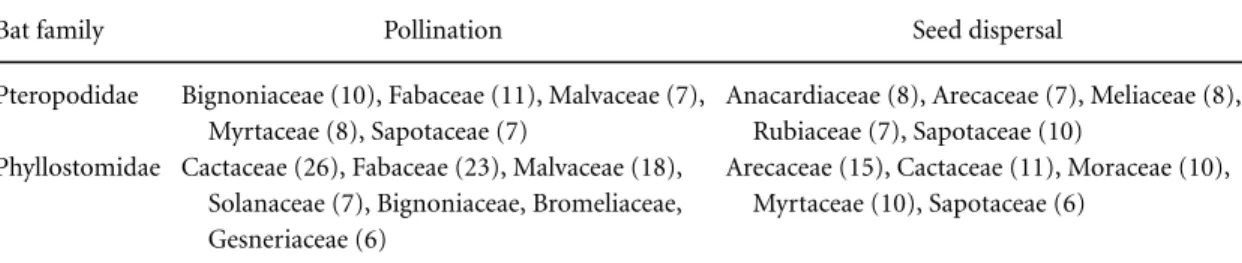
Major plant families (in terms of number of gen-era) containing species either pollinated or dis-persed by the two families of bats are listed in Table 3. Reflecting the independent evolution of bat–plant interactions in Old and New World plant lineages, only a few families are common in the di-ets of both bat families. For flowers, these include Fabaceae, Malvaceae (especially subfamily Bom-bacoideae, formerly known as Bombacaceae), and Bignoniaceae (in which bat flowers occur in differ-ent clades in the Old and New Worlds). For fruits, these include Arecaceae (palms) and Sapotaceae. Although only represented by a few genera in the di-ets of bats, a few additional families are notable for containing many species of bat-pollinated flowers or bat-dispersed fruit. In the New World, these in-clude flowers (Campanulaceae and Marcgraviaceae) and fruit (Araceae, Cecropiaceae, Clusiaceae, Piper-aceae, and Solanaceae). In the Old World, these in-clude fruit (Moraceae). Figs (Moraceae) are very important in the diets of both pteropodid and phyl-lostomid bats worldwide (Fig. 5).
The evolution and ecology of bat–plant interac-tions are discussed in detail in Fleming,149Fleming
Table 3.Examples of the most important angiosperm families (in terms of number of plant genera, in parentheses) whose flowers are pollinated and/or seeds dispersed by pteropodid and phyllostomid batsa
Bat family Pollination Seed dispersal
Pteropodidae Bignoniaceae (10), Fabaceae (11), Malvaceae (7), Myrtaceae (8), Sapotaceae (7)
Anacardiaceae (8), Arecaceae (7), Meliaceae (8), Rubiaceae (7), Sapotaceae (10)
Phyllostomidae Cactaceae (26), Fabaceae (23), Malvaceae (18), Solanaceae (7), Bignoniaceae, Bromeliaceae, Gesneriaceae (6)
Arecaceae (15), Cactaceae (11), Moraceae (10), Myrtaceae (10), Sapotaceae (6)
Figure 5. Gambian epauletted fruit bat (Epomophorus gam-bianus) taking flight after plucking a fig infructescence (photo by Merlin D. Tuttle, Bat Conservation International, www.batcon.org).
and Kress,150 Fleming and Muchhala,146 Fleming
et al.,145Lobovaet al.,147and Muscarella and Flem-ing.151Here, we discuss these interactions in terms of the ecosystem services that provide direct and indirect benefits to humans.
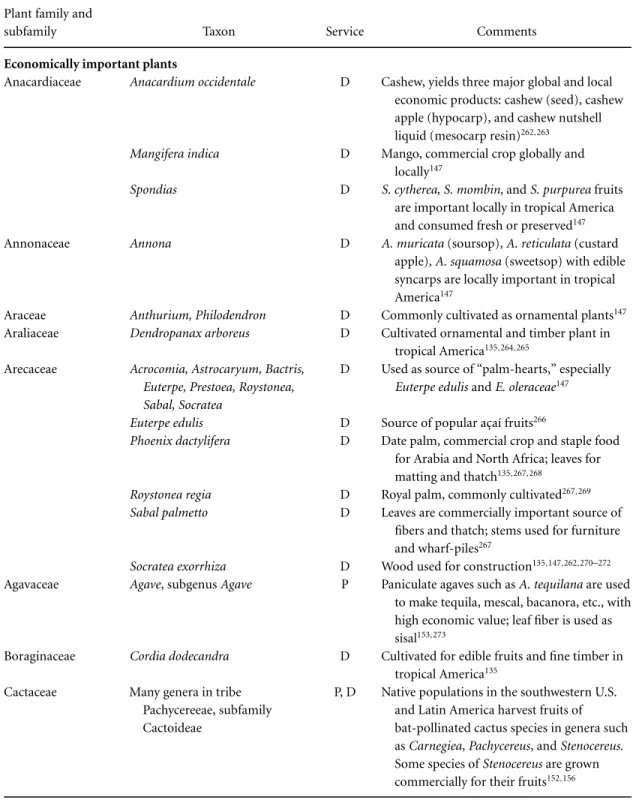
Services providing direct benefits to humans Although bat pollination is relatively uncom-mon compared with bird or insect pollination in angiosperms, it involves an impressive number of economically and/or ecologically important plants (Table 4). In arid habitats in the New World, two families, Agavaceae and Cactaceae, have enormous economic and ecological value. Many species of pan-iculateAgaverely heavily on phyllostomid bats for pollination, and many of these same bats are also major pollinators and seed dispersers of columnar cacti.152Three species ofLeptonycterisbats are espe-cially important in this regard in the southwestern United States, Mexico, and northern South Amer-ica (Fig. 4). The bat-pollinatedA. tequilanais the source of commercial tequila, a multimillion dol-lar industry in Mexico; other species ofAgave are used locally to produce similar alcoholic beverages such as pulque, mescal, and bacanora. Agaves are also important sources of sisal fiber in many trop-ical localities. Although bats are not the exclusive pollinators of most species ofAgave, they are crit-ically important pollinators in tropical latitudes in the New World.153 This is also true of bats polli-nating columnar cacti. For example, bats are mi-nor pollinators of the two mi-northernmost columnar cacti,Carnegiea giganteaandStenocereus thurbei, in the Sonoran Desert, but they are the nearly
exclu-sive pollinators of columnar cacti in south-central Mexico and northern Venezuela.152
Large-scale cash crops produced by plants ei-ther (originally) pollinated or dispersed by bats in-clude nonnative bananas and mangos in the New World and native bananas, breadfruits, durians, mangos, and petai (Parkia speciosa) in the Old World (Table 4). Of these, only durians and petai currently rely on bats (among other animals) for pollination. The same is true for trees such asCeiba pentan-dra, the kapok tree, andOchroma lagopus, the balsa tree. Other bat-fruits that are harvested and sold lo-cally include sapodilla and organ pipe cactus ( Steno-cereus) in the New World and the shea butter tree (Vitellaria(Butyrospermum) parkii) in Africa.154–156 Many other species are listed in Table 4. Placing a dollar value on the economic services of plant-visiting bats is important but is beyond the scope of this paper for at least two reasons: lack of read-ily accessible information about the economic value of many crops, especially ones that are sold locally, and, more importantly, lack of detailed knowledge about the actual contribution of bats to the pollina-tion and/or seed dispersal of many of these plants. In the case of cultivated plants, bats are no longer needed to pollinate their flowers or disperse their seeds. But the ecological services these bats provide for their wild relatives are important for preserving genetic diversity in these plants.
In India, the Mahwa tree (Madhuca indica), also called the honey tree, sugar tree, or Indian butter tree, is pollinated byPteropus giganteus, Rousettus leschenaulti, andCynopterus sphinx.157These polli-nation services highlight one of the highly valued ecosystem services provided by plant-visiting bats both culturally and economically. The timber of this tree is used for making wagon wheels in India. The flowers, also called honey flowers, are used as food and for preparing a distilled spirit (matkom duhli). Sun-dried fruits are directly consumed by humans, and the oil extracted from flowers and seeds, known locally asmahwa,mowrah butter, oryallah, is incor-porated into soaps, candles, cosmetics (e.g., lipstick, lotions), and lubricants, and used medicinally as an emetic, an antirheumatic, and in the treatment of leprosy. Extracts from the fruits are also thought to prevent wrinkles and restore skin flexibility.158,159 Seedcakes made fromM. indica are used as food for cattle and goats160–163and are known to increase their milk production.164
Table 4.Examples of economically and ecologically important plants that are either pollinated (P) or dispersed (D) by batsa
Plant family and
subfamily Taxon Service Comments
Economically important plants
Anacardiaceae Anacardium occidentale D Cashew, yields three major global and local economic products: cashew (seed), cashew apple (hypocarp), and cashew nutshell liquid (mesocarp resin)262,263
Mangifera indica D Mango, commercial crop globally and
locally147
Spondias D S. cytherea, S. mombin,andS. purpureafruits
are important locally in tropical America and consumed fresh or preserved147
Annonaceae Annona D A. muricata(soursop),A. reticulata(custard
apple),A. squamosa(sweetsop) with edible syncarps are locally important in tropical America147
Araceae Anthurium, Philodendron D Commonly cultivated as ornamental plants147
Araliaceae Dendropanax arboreus D Cultivated ornamental and timber plant in tropical America135,264,265
Arecaceae Acrocomia, Astrocaryum, Bactris, Euterpe, Prestoea, Roystonea, Sabal, Socratea
D Used as source of “palm-hearts,” especially
Euterpe edulisandE. oleraceae147
Euterpe edulis D Source of popular ac¸a´ı fruits266
Phoenix dactylifera D Date palm, commercial crop and staple food
for Arabia and North Africa; leaves for matting and thatch135,267,268
Roystonea regia D Royal palm, commonly cultivated267,269
Sabal palmetto D Leaves are commercially important source of
fibers and thatch; stems used for furniture and wharf-piles267
Socratea exorrhiza D Wood used for construction135,147,262,270–272
Agavaceae Agave, subgenusAgave P Paniculate agaves such asA. tequilanaare used to make tequila, mescal, bacanora, etc., with high economic value; leaf fiber is used as sisal153,273
Boraginaceae Cordia dodecandra D Cultivated for edible fruits and fine timber in tropical America135
Cactaceae Many genera in tribe Pachycereeae, subfamily Cactoideae
P, D Native populations in the southwestern U.S. and Latin America harvest fruits of bat-pollinated cactus species in genera such
asCarnegiea,Pachycereus, andStenocereus.
Some species ofStenocereusare grown commercially for their fruits152,156
Table 4.Continued
Plant family and
subfamily Taxon Service Comments
Caricaceae Carica papaya D Papaya, widely cultivated in tropics for fruits
and as a source of papain used in culinary and medical products147
Caryocaraceae Caryocar P, D Many species have seeds that are oil source in
tropical America;C. glabrum(soapwood) inner bark used for washing135,274,275
Cecropiaceae Cecropia peltata D Wood used for pulp, also cultivated as
ornamental in tropical America147
Chrysobalanaceae Chrysobalanus icaco D Grown for edible fruits; seed oil used for candles in West Africa147
Clusiaceae Clusia, Symphonia, Vismia D Resins are locally medicinal in South America147
Combretaceae Terminalia catappa D Tropical almond, source of valuable timber, edible seeds, tannins for dye, bark extract for medicine in Indomalaya147
Cyclanthaceae Carludovica palmata D Panama hat palm, grown for hat manufacture, important export plant for Ecuador, also used for mats and baskets in tropical America135,136,149,276
Ebenaceae Diospyros digyna, D. kaki D Grown for edible fruits (black sapote, Japanese persimmon) in Central America and Asia147
Fabaceae Faboideae
Dipteryx odorata D Fragrant seeds used for scenting tobacco and
snuff147
Andira inermis D Valuable timber, bark used for medicine,
planted for shelter belts in West Indies (cabbage-tree)147
Fabaceae, Mimosoideae
Inga vera D Guaba, widely grown in South America for
edible fruit pulp, timber, shade, medicine, and alcoholic beverage cachiri277,278
Parkia speciosa P Commercially important fruit species in
Southeast Asia154
Lecythidaceae Lecythis pisonis D Paradise nuts, cultivated in South America for edible seeds147,279
Malpighiaceae Malpighia glabra D Barbados cherry, edible fruits high in vitamin C, also ornamental in tropical
America135,262,280
Malvaceae, Bombacoideae
Ceiba P Fibers from fruits ofC. pentandraand other
species ofCeibaare used to make kapok154
Malvaceae Ochroma P Balsa, world’s lightest commercial timber135
Table 4.Continued
Plant family and
subfamily Taxon Service Comments
Malvaceae, Helicteroideae
Durio P D. zibethinus(durian) and several other
species ofDurioare cultivated widely for edible fruits and seeds in Southeast Asia and elsewhere in the tropics135,154
Moraceae Artocarpus D A. altilis(breadfruit) and other species are
cultivated and sold commercially
throughout tropical Asia and Australasia as a source of starch-rich infructescences147
Brosimum alicastrum D Breadnut, seeds are edible and valuable source
of fiber, vitamins, and microelements; leaves used for fodder; latex and wood are also utilized147
Ficus D Numerous species of fig used for rubber, fibers,
paper, timber, medicine, and as ornamentals throughout the world tropics147
Muntingiaceae Muntingia calabura D Firewood crop in tropical America147
Musaceae Musa P, D Bananas, pteropodid bats both pollinate
flowers and disperse seeds of wild bananas. Cultivated bananas have very high economic value147
Myrtaceae Anamomis umbellulifera D Edible fruits in West Indies135,262,280
Psidium guajava D Guava, cultivated for edible fruits, commercial
crop in tropical America147
Syzygium cumini, S. jambos, S. malaccensis
D Rose apple, cultivated for edible fruits in Old World tropics147
Passifloraceae Passiflora D Passionfruit, important edible tropical fruits147
Piperaceae Piper aduncum D Fruits edible in Puerto Rico147
Polygonaceae Coccoloba uvifera D Seaside grape, cultivated for edible fruits in tropical America147
Rhamnaceae Hovenia dulcis D Japanese raisin tree, swollen, fleshy pedicels are sweet and edible; also used in medicine and for timber in Asia281
Rosaceae Eriobotrya japonica D Loquat, native to Asia but widely cultivated throughout world tropics for edible fruits147
Rubiaceae Coffea arabica D Coffee, native to Old World but cultivated for
seeds as source of coffee throughout the world267
Rutaceae Casimiroa edulis D White sapote, cultivated for edible fruits in
Central America135
Salicaceae Flacourtia indica D Fruits edible and medicinal in Old World
tropics135,262,280
Sapindaceae Melicoccus bijugatus D Mamoncillo, edible fruits in tropical America147
Table 4.Continued
Plant family and
subfamily Taxon Service Comments
Sapindus saponaria D Soapberry, fruits used as soap substitutes in
tropical America135,149,280
Sapotaceae Chrysophyllum cainito D Star-apple, cultivated for edible fruits in tropical America147
Manilkara D Species ofManilkara, includingM. zapota
(sapodilla), produce commercially valuable fruits147
Mimusops elengi D Cultivated for fragrant flowers throughout
tropics135,262,280
Pouteria D P. sapota(sapote) is important Carribean fruit;
P. campechianais also a source of edible
fruits in Central America147
Sterculiaceae Guazuma ulmifolia D Light timber for boats, barrels, and fuelwood in tropical America263,267
Ulmaceae Trema micrantha D Used for pre-Hispanic barkcloth in tropical
America; soft timber for matches and chests; also used in shade coffee
plantations265,282,283
Vitaceae Vitus vinifera D Grape vine, source of edible fruits and
alcoholic beverages, native probably to Asia, broadly cultivated throughout the
world135,280,284
Ecologically important plants
Agavaceae Agave P Many species of paniculate agaves are
conspicuous members of arid upland habitats in the Neotropics153,273
Arecaceae Many New and Old World genera D Palms are common elements of many tropical forests, especially in the Neotropics147,148
Cactaceae, Cactoideae
Many columnar cacti in several tribes of this subfamily
P, D Columnar cacti are keystone species in many arid Neotropical habitats152,156
Cecropiaceae Cecropia D Species ofCecropiaare important pioneer trees
throughout the Neotropics151,285
Clusiaceae Vismia D Vismiashrubs are important pioneer species
in the Neotropics151
Malvaceae, Bombacoideae
Adansonia,Bombax,Ceiba,
Pachira,Pseudobombax, etc.
P Trees of this subfamily are often dominant (in terms of basal area) members of tropical forests worldwide135,286,287
Moraceae Ficus D Fig trees are often keystone members of
tropical forests worldwide169
Piperaceae Piper D Pipershrubs are pioneer plants and common
members of Neotropical forest understories288