An analysis of the modus operandi of perpetrators in human trafficking
by
SWASTIKA PARDHOOTHMAN
Submitted in accordance with the requirements for the degree of
MAGISTER TECHNOLOGIAE
in the subject
FORENSIC INVESTIGATION
at the
UNIVERSITY OF SOUTH AFRICA
SUPERVISOR: Dr T Budhram CO- SUPERVISOR: Dr NJC Olivier
COPYRIGHT
All rights reserved jointly by the University of South Africa (UNISA) and Ms. S. Pardhoothman. In terms of the Copyright Act 98 of 1978, no part of this material may be reproduced, be stored in any retrieval system, be transmitted in any form or be published, redistributed or screened by any means (electronic, mechanical, photocopying, recording or otherwise) without prior written permission from UNISA and S. Pardhoothman. However, permission to use in these ways any material in this work that is derived from other sources must be obtained from the original source. For academic and research purposes, original information may be used and referred to on condition that it is properly references and the source acknowledged as such.
© UNISA
ACKNOWLEDGEMENTS
A number of people contributed to the completion of this dissertation. I take this opportunity to convey my sincere thanks and heartfelt gratitude to the following: I thank God, the Almighty, for his grace and for giving me strength during the course of my studies to enable me to complete this research.
My Supervisor, Dr. T Budhram, and co-supervisor, Dr. Nick Olivier for their excellent guidance and expertise throughout my studies.
Marlette van der Merwe, who edited this dissertation, and Melissa Davidson, who formatted this dissertation.
The South African Police Service, who granted me permission to access information and conduct my research within the organisation.
The University of South Africa, for the facilities they have put at my disposal during my research.
The SAPS Commanders, who assisted me in accessing the participants for the interviews.
The participants who were willing to grant me the interviews, for their support and contribution to the success of this research.
And, finally, a very special word of thanks to my two children: my son Nickeel, and my daughter Nikita, who have been my inspiration and sacrificed many hours of our precious family time; and to my husband, Deena, of the HAWKS (DPCI) for his endless support and encouragement. This work is dedicated to you as a token of appreciation of your constant support and motivation. I THANK YOU.
EXECUTIVE SUMMARY
This research attempts to analyse the modus operandi (MO) of perpetrators used in cases of trafficking in persons for sexual purposes, and trafficking in children.
The Trafficking in Persons Bill was passed in South Africa, but not gazetted; therefore, alternate charges are used to prosecute perpetrators.
The purpose, value and elements of MO allow an investigator to link a perpetrator to a specific crime scene.
The research provides an examination of case dockets and the MO of perpetrators in human trafficking – inter alia, looking at such issues as time, location, transport routes used, criminal motive, recruitment styles, and the number of offenders.
The MO of perpetrators identified during docket analysis indicates many similarities, when compared to the international MO of traffickers.
The gathering of MO information forms a critical part of any investigation to link a perpetrator to a crime.
This research therefore presents a comprehensive examination of the MO of perpetrators, and delivers practical recommendations to monitor and combat trafficking.
KEY TERMS
Human trafficking, forensic investigation, crime scene, criminal investigation, docket, modus operandi, perpetrator, Organised Crime Unit, Prevention and Combating of Trafficking in Persons Bill.
DECLARATION
I, SWASTIKA PARDHOOTHMAN, declare that AN ANALYSIS OF THE MODUS OPERANDI OF PERPETRATORS IN HUMAN TRAFFICKING is my own work and that all sources that I have used or quoted have been indicated and acknowledged my means of complete references.
EDITING CERTIFICATE
25 February 2015
I, Marlette van der Merwe, ID 4802060118085, hereby certify that the text and list of references of the master's dissertation, “Analysis of the modus operandi of perpetrators in human trafficking", by Swastika Pardhoothman, have been edited by me, according to the Harvard reference method, UNISA Standardised Referencing Style, as used by the School of Criminal Justice, UNISA.
Marlette van der Merwe BA HDipLib (UCT) Language editor: UNISA School of Computing
TABLE OF CONTENTS COPYRIGHT ... ii ACKNOWLEDGEMENTS ... iii EXECUTIVE SUMMARY ... iv DECLARATION ... v EDITING CERTIFICATE ... vi
TABLE OF CONTENTS ... vii
LIST OF TABLES ... x
LIST OF FIGURES... x
LIST OF ABBREVIATIONS AND ACRONYMS ... xi
CHAPTER 1: GENERAL ORIENTATION ... 1
1.1. INTRODUCTION ... 1
1.2. PROBLEM STATEMENT ... 2
1.3. AIMS OF THE RESEARCH ... 4
1.4. DEMARCATION ... 5
1.5. RESEARCH QUESTIONS... 5
1.6. PURPOSE OF THE RESEARCH ... 6
1.7. KEY THEORETICAL CONCEPTS ... 7
1.7.1. Docket ... 8 1.7.2. Crime scene ... 8 1.7.3. Modus operandi ... 8 1.7.4. Perpetrator ... 8 1.7.5. Human trafficking ... 8 1.7.6. Criminal investigation ... 9 1.8. RESEARCH DESIGN ... 9 1.9. RESEARCH APPROACH ... 10
1.10. TARGET POPULATION AND SAMPLING PROCEDURES ... 10
1.10.1. Sampling ... 11
1.10.2. Selection of case files ... 11
1.11. DATA COLLECTION ... 12
1.11.1. Literature study ... 13
1.11.3. Case docket analysis ... 18
1.12. EXPERIENCE ... 19
1.13. DATA ANALYSIS ... 20
1.13.1. Summary of background information ... 22
1.14. METHODS TAKEN TO ENSURE VALIDITY ... 23
1.15. METHODS TAKEN TO ENSURE RELIABILITY ... 26
1.16. ETHICAL CONSIDERATIONS ... 28
1.17. RESEARCH STRUCTURE ... 30
CHAPTER 2: OBJECTIVES OF THE INVESTIGATION ... 31
2.1. INTRODUCTION ... 31
2.2. CRIMINAL INVESTIGATION ... 31
2.3. FORENSIC INVESTIGATION ... 33
2.4. DIFFERENCE BETWEEN FORENSIC INVESTIGATION AND CRIMINAL INVESTIGATION ... 36
2.5. FORENSIC SCIENCE ... 37
2.6. PROCESS OF CRIMINAL INVESTIGATION ... 38
2.7. OBJECTIVES OF CRIMINAL INVESTIGATION ... 41
2.8. PURPOSE OF INVESTIGATION ... 43
2.9. INTERNATIONAL PROTOCOLS ... 44
2.9.1. The UN Declaration ... 44
2.9.2. The Palermo Protocol ... 45
2.9.3. Declaration in Africa (the African Union-AU) ... 45
2.10. SOUTH AFRICAN EXPERIENCE ... 46
2.11. SUMMARY ... 47
CHAPTER 3: MODUS OPERANDI OF PERPETRATORS IN THE PHENOMENON OF HUMAN TRAFFICKING ... 48
3.1. INTRODUCTION ... 48
3.2. HUMAN TRAFFICKING... 49
3.3. STIPULATED CHARGES FOR THE PHENOMENON OF HUMAN TRAFFICKING ... 49
3.4. PERPETRATORS ... 50
3.5. MODUS OPERANDI ... 51
3.5.1. The purpose of modus operandi ... 54
3.5.2. The value of modus operandi... 56
3.7. MODUS OPERANDI OF CASE DOCKETS ANALYSED ... 60
3.8. FACTORS THAT INFLUENCE MODUS OPERANDI IN HUMAN TRAFFICKING ... 63
3.9. COMPARISON OF THE MODUS OPERANDI OF PERPETRATORS OF THE PHENOMENON OF HUMAN TRAFFICKING ... 65
3.10. SIMILARITIES OF INTERNATIONAL AND NATIONAL CASE DOCKET MODUS OPERANDI TO IDENTIFY PERPETRATORS ... 67
3.11. SUMMARY ... 69
CHAPTER 4: FINDINGS AND RECOMMENDATIONS ... 71
4.1. INTRODUCTION ... 71 4.2. PRIMARY FINDINGS ... 71 4.2.1. Research Question 1 ... 71 4.2.2. Research question 2 ... 71 4.3. SECONDARY FINDINGS ... 72 4.3.1. Research Question 1 ... 72 4.3.1.1. Forensic investigation ... 72 4.3.1.2. Criminal investigation ... 73
4.3.1.3. Difference between forensic investigation and criminal investigation ... 73
4.3.1.4. Forensic science ... 74
4.3.1.5. Process of criminal investigation ... 74
4.3.1.6. Purpose of investigation ... 74
4.3.1.7. Mandate to investigate ... 74
4.3.2. Research Question 2 ... 75
4.3.2.1. Human trafficking ... 75
4.3.2.2. Stipulated charges for the phenomenon of human trafficking ... 76
4.3.2.3. Perpetrators ... 76
4.3.2.4. Modus operandi ... 76
4.3.2.5. Purpose of modus operandi ... 77
4.3.2.6. The value of modus operandi ... 77
4.3.2.7. Elements of modus operandi ... 77
4.3.2.8. Modus operandi of the case dockets analysed ... 77
4.3.2.9. Factors that influence modus operandi in human trafficking ... 77
4.3.2.10. Comparison of the modus operandi of perpetrators of the phenomenon of human trafficking ... 78
4.3.2.11. Similarities of international and case docket modus operandi to identify perpetrators ... 78
4.3.2.12. Modus operandi of perpetrators in human trafficking in KZN ... 79
4.3.2.13. Use of modus operandi to investigate cases of trafficking79 4.3.2.14. Use of modus operandi by participants to investigate cases ... 79
4.4. RECOMMENDATIONS ... 79
4.5. CONCLUSION ... 80
LIST OF REFERENCES ... 81
ANNEXURE A: INTERVIEW SCHEDULE ... 88
ANNEXURE B: PERMISSION TO CONDUCT RESEARCH ... 91
ANNEXURE C: CRIME ADMINISTRATION SYSTEM KEYWORD ENQUIRY ... 94
ANNEXURE D: MODUS OPERANDI OF ILLEGAL RECRUITERS ... 95
ANNEXURE E: NEWSPAPER ARTICLES ... 96
LIST OF TABLES Table 1.1 Elements of human trafficking ...4
Table 3.1 Modus operandi of recruiters... 66
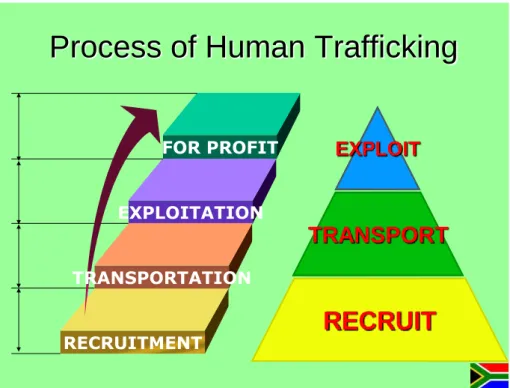
LIST OF FIGURES Figure 3:1 Process of human trafficking .. ... 69
LIST OF ABBREVIATIONS AND ACRONYMS
AU African Union
CAS Crime Administration System
DPCI Directorate of Priority Crime Investigation IGO Intergovernmental Organisations
IOM International Organisation for Migration
KZN KwaZulu-Natal
MO Modus Operandi
NCOP National Council of Provinces NGO Non-Governmental Organisation OCU Organised Crime Unit
SAPS South African Police Service
TIP The Prevention and Combating of Trafficking In Persons Bill UNISA University of South Africa
UNODC United Nations Office on Drugs and Crime
UN United Nations
IRIN Integrated Regional Information Networks
AU COMMIT African Union Commission Iniative Against Trafficking AUC African Union Commission
CHAPTER 1
GENERAL ORIENTATION
1.1. INTRODUCTION
South Africa is a signatory to the 2000 United Nations (UN) Protocol to Prevent, Suppress and Punish Trafficking Victims. In signing this document, also known as the Palermo Protocol, the government committed to adopting legislation to make human trafficking a criminal offence, and began the process of drafting a law in 2003. However, the Prevention and Combating of Trafficking in Persons (TIP) Bill only reached parliament in March 2010, and was passed on 29 July 2013 (Simon, 2013).
The procrastination on the part of government in passing the TIP Bill in 2013 has resulted in the police and prosecutors using alternative laws that deal with sexual offences, employment-related offences, and organised crime and kidnapping, to deal with traffickers, resulting in penalties that are often insufficient. The TIP Bill was passed by the National Assembly on 30 June 2013 (Integrated Regional Information Networks (IRIN), 2013). The TIP Bill was passed by the President, but has not been gazetted, so that the Bill is not operational, and not yet law.
The proposed legislation seeks to effect South Africa’s obligation, as set out in various international agreements. The protocol places particular emphasis on women and children, and it will bring South Africa in line with international standards. The Bill flows from an investigation and report conducted and produced by the South African Law and Reform Commission, on trafficking in persons. The Bill advocates putting in place public awareness campaigns that are designed to prevent and combat human trafficking.
Addressing human trafficking has become a priority for governments and non-governmental organisations (NGO’s), and many aspects of the phenomenon remain poorly understood (Moore, 2013:36). Available information in South Africa about the magnitude of the problem is limited. Human trafficking may be shrouded in secrecy, but it is perpetrated on a regular basis. Trafficking in persons has been practised for centuries; however it is in the last decade of the 20th century that people have
witnessed an increased awareness of the problem, and the social, political and economic ills that it engenders. This has led to an increased focus on efforts to combat trafficking in persons, which is a highly complex phenomenon. Due to the intricacies of trafficking in persons, there are no easy answers (Koen, Mobilyn, Solomons, Molo Songololo, UNODC, 2007:7).
1.2. PROBLEM STATEMENT
A 'problem statement' is a concise description of the issues that need to be addressed by a problem-solving team, and should be presented to them (or created by them) before they try to solve a problem. A good problem statement should answer the following questions: (Anon, 2014).
Who has the problem or who is the client/customer? This should explain who needs the solution, and who will decide when the problem has been solved. In what form can the resolution be? What are the scope and limitations (in
time, money, resources and technologies) that can be used to solve the problem?
The experience of the researcher in interacting with investigators, and assisting with investigations, shows that investigators rarely analyse the modus operandi (MO) of perpetrators in dockets related to trafficking in persons for sexual purposes, and trafficking in children. This results in little effort being put into integrating the cases, as there is no linking of the crime to human trafficking. The nature and extent of human trafficking in persons for sexual purposes and trafficking in children, in Kwa- Zulu Natal (KZN) South Africa is increasing at an alarming rate.
Prior to The Prevention and Combating of Trafficking in Persons (TIP) Bill Act being passed on 29 July 2013, it was difficult for investigators to analyse the MO of perpetrators who committed human trafficking. Perpetrators who had previously been convicted for crimes that made up the Human Trafficking Act – for example, keeping of a brothel and kidnapping, among others, were handed lesser sentences by the courts. On 29 July 2013, President Jacob Zuma signed the Preventing and Combating of the Trafficking in Person’s Bill. However, the Bill currently has not been gazetted, and has not been promulgated into law. Once the Bill is signed, South
addresses the crime of human trafficking (Simon, 2013).
Penalties in the new law for the crime of human trafficking include a maximum penalty of R100 million, or life imprisonment. The Act may assist in addressing the crime of human trafficking and, in particular, the existing MO of perpetrators currently conducting their illegal operations in respect of recruitment, transportation routes and exploitation. The current legal framework in South Africa, and The Criminal Law (Sexual Offences and Related Matters) Amendment Act, 2007(Act 32 of 2007), are practices used in South Africa.
The existing practices and procedures can be found with Non-Governmental Organisations (NGO), legislation, international sources and what is practised currently by investigation units in the SAPS. Currently, offenders of human trafficking are charged under the Criminal Law (Sexual Offences and Related Matters) Amendment Act 32 of 2007, which makes an interim provision relating to trafficking in persons for sexual purposes. Furthermore, The Children’s Act 38 of 2005 also makes an interim provision for trafficking in children. This is pending the promulgation of the Prevention and Combating of Trafficking in Persons Bill, which was recently passed by the National Council of Provinces (NCOP), and is awaiting final signature by the President.
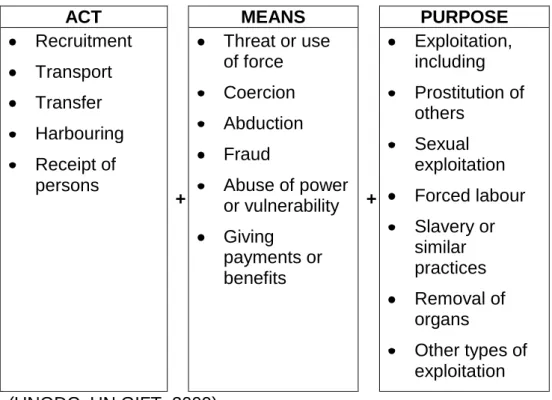
Due to the fact that there are no such cases or law for human trafficking in place in South Africa, the researcher analysed dockets for the MO for trafficking in persons for sexual purposes, and trafficking in children. Although there are no cases on human trafficking, the researcher focused on the Protocol of the United Nations and its elements of human trafficking. The researcher compared the elements of human trafficking, and compared them to other crimes – for example, trafficking in persons for sexual purposes, and trafficking in children. It was found that these two crimes, and the elements specific to human trafficking, were present. According to the Anti-human-trafficking manual for criminal justice practitioners (UNODC, 2009), trafficking in persons has three constituent elements, which are described in the following table:
Table 1.1: Elements of human trafficking ACT + MEANS + PURPOSE = TRAFFICKING Recruitment Transport Transfer Harbouring Receipt of persons Threat or use of force Coercion Abduction Fraud Abuse of power or vulnerability Giving payments or benefits Exploitation, including Prostitution of others Sexual exploitation Forced labour Slavery or similar practices Removal of organs Other types of exploitation (UNODC: UN GIFT, 2009).
The absence of relevant legislation requires the SAPS to investigate and charge perpetrators on alternative charges, which invariably presents challenges in identifying cases specific to human trafficking, and analysing the MO of suspects. 1.3. AIMS OF THE RESEARCH
According to Mouton (1996:103), the aims of research are to establish facts, gather new data, and determine whether there are interesting patterns contained in the data. The aim of research is to discover new facts and their correct interpretations, and to revise accepted conclusions, theories or laws in the light of newly discovered facts, or the practical application of such a conclusion (Leedy, 1993:11).
On the basis of the research topic and problem statement, the aim of this research is to analyse the modus operandi of cases where elements of the phenomenon of human trafficking appear.
1.4. DEMARCATION
Due to the study being of limited scope, it was demarcated specifically to the Durban area, as the researcher works and resides in this area. The SAPS Durban Organised Crime Unit (OCU) investigates serious and organised crime in which the specific elements of human trafficking exist.
According to Koen et al. (2007:7), there are three elements of human trafficking which comprise the act, the means and the purpose. Currently, in South Africa, there are perpetrators who are charged where the elements of human trafficking are present. It will further be demarcated to the United Nations Office on Drugs and Crime (UNODC), which stipulates the elements of human trafficking.
Globally, government action on trafficking is centered on the United Nations Protocol, to prevent, suppress and punish trafficking in persons, and the majority of governments in the entire region have ratified this instrument. This document has been adopted by other countries, including South Africa, and used as a guide in the phenomenon of human trafficking. This has committed governments to criminalising human trafficking, and developing legislation to combat and address this crime. The TIP Bill has not yet been promulgated, and hence the researcher did not include it in this discussion.
Due to the limited scope of this research, it is limited to two types of cases, namely: trafficking in persons for sexual purposes, and trafficking in children.
1.5. RESEARCH QUESTIONS
Research questions were formulated from the problem statement. The research questions provide guidance for the kinds of data that the researcher must collect, and offer suggestions as to how the researcher should analyse and interpret the data collected (Leedy & Ormrod, 2001:60). “The research questions specify exactly what is to be investigated. They are not the broad goals of the research that are directly investigated by the research, but are specific things that are observed, measured and interrogated in order to shed light on the broader topic” (Denscombe, 2002:31).
The research questions that are to be addressed in this dissertation are: What are the objectives of the investigation?
What is the modus operandi of perpetrators suspected of committing the phenomenon of human trafficking?
1.6. PURPOSE OF THE RESEARCH
The researcher’s purpose in analysing the MO of perpetrators who commit human trafficking is to arrive at practical solutions and recommendations that will assist investigators and the SAPS in analysing the MO of perpetrators of the phenomenon of human trafficking.
“The statement of purpose indicates the focus and direction of the research and provides criteria for the evaluation of the outcomes of the research. There should be a reason for doing research or else there would be no point in spending time, money and effort to undertake the investigation” (Denscombe, 2002:25). Based on the research questions and research aims, the researcher identified the following as the purpose of this research:
Evaluation Research
The researcher wanted to critically evaluate the existing practices and procedures used by investigators when analysing the MO of the phenomenon of human trafficking, and to determine their strengths and weaknesses, in order to consider how the practice might be improved (Denscombe, 2002:25). At present, the offenders who are suspected of human trafficking are charged under the Criminal Law (Sexual Offences and Related Matters) Amendment Act 32 of 2007, which makes an interim provision relating to the trafficking in persons for sexual purposes. The Children’s Act 38 of 2005 also makes an interim provision for trafficking in children. These Acts were evaluated in order to determine their strengths and weaknesses in determining modus operandi.
Exploratory Research
The researcher needs to explore what is stated in literature (Denscombe, 2002:27) by national and international authors, as well as experienced experts or investigators in the field of human trafficking. The researcher explored national and international
literature in respect of MO, to establish what new trends had emerged with regard to the analysis of the MO of human trafficking. The researcher had to find answers to account for the lack of research material, and therefore consulted various literature and interviewed experts in the field.
Applied Research
“The main drive behind a piece of research is the desire to solve a practical problem or to improve procedures” (Denscombe, 2002:27). The researcher intends to arrive at suggestions and recommendations for the analysis of MO, which will enhance the performance and skills of investigators, and improve the existing practices as far as the topic is concerned. In this research, the purpose is also to develop good practice (Denscombe, 2002:27). The researcher’s intention is to arrive at practical solutions and recommendations that will assist investigators, and the SAPS, in analysing the MO of perpetrators of human trafficking, in order to identify them.
Empowerment
The purpose of the research is to empower investigators, and the researcher, with new knowledge and insights on the MO of perpetrators of human trafficking. The researcher aims to empower both the investigators and herself to become better investigators, and become more effective in identifying suspects (Denscombe, 2002:27). This will be done by methods in which the researcher will make information available from this study to investigators, which will be valuable to enable the investigators to understand the analysis of MO in terms of human trafficking. The researcher wishes to develop training material for investigators, to enable them to understand this great necessity, and to create an emphasis on the awareness of human trafficking, in order to create intensive operational planning in respect of the MO of perpetrators who commit human trafficking, as well as to provide crime intelligence.
1.7. KEY THEORETICAL CONCEPTS
Mouton (1996:114) is of the opinion that familiarity with the most important theories relating to the research problem, is an essential precondition for an adequate conceptualisation. The important concepts in this study will be defined for the purpose of clarity.
1.7.1. Docket
A docket is an official document in which a record is kept of a reported crime and the investigation conducted into such a crime (Docket Analysis Learner Manual, 2002:2).
1.7.2. Crime scene
A crime scene is a place where direct or indirect evidence of a crime, or allegedly committed crime, can be found. It refers to an area where the crime took place (Fisher, 2004:54; Swanson, Chamelin & Territo, 2003:35).
1.7.3. Modus operandi
Van Heerden (1985:10) describes MO as the habits and techniques of criminals, which have become stereotyped. He views it as a routine mode of conduct in which individualised techniques are employed.
MO comprises of distinct patterns or a manner of working that comes to be associated with a particular criminal. Criminologists have observed that, whatever his speciality – burglary, auto theft or embezzling – the professional criminal is very likely to adhere to his particular way of operating. If, for example, a burglar begins his career by entering houses from the roof, he will, in all probability, continue using this method for as long as he is able to work (Encyclopedia Britannica, 2014).
1.7.4. Perpetrator
The classification of a person as a perpetrator depends on whether his conduct satisfies all the elements of an offence. A perpetrator can therefore be defined as a person who complies with all the requirements of the offence (Joubert, 1999:97).
1.7.5. Human trafficking
Trafficking in persons shall mean the recruitment, transportation, transfer, harbouring, or receipt of persons, by means of a threat, or use of force, or other forms of coercion, of abduction, of fraud, of deception, of the abuse of power or of a position of vulnerability, or of the giving of payments or benefits to achieve the consent of a person having control over another person, for the purpose of exploitation (United Nations Office of Drugs and Crime (UNODC), 2000:12).
1.7.6. Criminal investigation
Criminal investigation can be defined as a systematic, organised search for the truth. It consists of observation and/or enquiries with the purpose of gathering information about an alleged crime or incident (Technikon SA, 1996:3). According to Bennett and Hess (as quoted by Marais & Van Rooyen, 1990:1), criminal investigation is really a search for the truth.
1.8. RESEARCH DESIGN
A research design is an exposition or plan of the way in which the researcher plans to execute the research problem that has been formulated (Mouton, 1996:175). Welman and Kruger (2001:46) state that “a research design is the plan according to which we obtain research participants (objects) and collect information from them”.
The researcher decided to use an empirical design in this research. Empirical research is based on experience and observation (Maxfield & Babbie, 1995:4). For this reason, the researcher decided to use only investigators with investigation experience, and employed the simple random sampling technique. The participants used their own experiences and observations during investigations to research the MO of human trafficking. For this reason, the researcher conducted an extensive literature search in documents, as well as interviews, in accordance with the suggestion made by Denscombe (1998:6) of “getting out of the chair, going out of the office and purposefully seeking the necessary information out there”. This assisted and enlightened the researcher on some practical insights into the information which pertains to this study.
This type of research involves the researcher going into the field and focussing on the personal experiences of the participants in the study (Mouton, 2001:149). In order to address the lack of knowledge illustrated in the problem statement, the researcher needed to produce new knowledge which was based on experience. According to Mouton (2001:150), the design’s limitations are that the results cannot be generalised because they constitute the views of individuals, measurements
cannot be standardised, and the collection and analysis of the data may be time consuming. In order to overcome these limitations, the researcher engaged in one-on-one interviews, using a semi-structured interview schedule, literature, and docket analysis, to investigate the MO of human trafficking.
1.9. RESEARCH APPROACH
Schloss and Smith (1999:86) explain that a qualitative research approach is best suited for trying to better understand complex and interactive phenomena. Qualitative research is multi-method in focus, involving an interpretive, naturalistic approach to its subject matter – for example, the definition and analysis of various modi operandi in human trafficking.
The research approach that was used by the researcher is a qualitative approach, due to the fact that this research is exploratory, and the researcher sought to listen to expert interviewees. This enabled the researcher to build a picture of their ideas and personal experiences (Creswell, 1994:21; Taylor, 1994:208). The main strength of this approach is that it leads to an in-depth insight into the research topic (Mouton, 2001:150), which is important for developing an understanding of the investigative discipline explored in the research. The intention was to obtain practical solutions to the problems, from the participants who were involved in the investigation field. 1.10. TARGET POPULATION AND SAMPLING PROCEDURES
A target population is the aggregation of elements from which the sample is actually selected (Maxfield & Babbie, 1995:186). A population refers to the entire collection of units of analysis on which the research problem has a bearing, while a sample is a group chosen from within the target population to provide the information required (Welman, Kruger & Mitchell, 2012:52-53). A population is the entire group or class from which information is to be gathered (Dantzker & Hunter, 2012:198; Welman et al., 2012:52).
Babbie and Mouton (2001:174) state that a population is that aggregation of elements from which the sample is actually selected. The ideal population for this research was the investigators of the SAPS investigating the phenomenon of human
trafficking cases. However, it was impossible to use the total population of investigators, as it would have been time consuming and also costly, so the researcher decided to use a target population. Investigating officers from the Durban Organised Crime Unit, who investigate human trafficking cases in the Durban metropolitan area, were chosen as the target population. The researcher chose Durban, as she resides in that area. The target population is not representative of the population, as it was not selected but chosen. This sub-population was therefore accessible to the researcher.
1.10.1. Sampling
A sample of investigators was selected using the simple random sampling technique. With simple random sampling, each member of the population has the same chance of being included in the sample (Welman et al., 2012:59). A name list of all the investigators working at the Durban Organised Crime Unit was requested from the Unit.
There are 72 investigators presently attached to the Durban Organised Crime Unit, who investigate cases pertaining to human trafficking in the Durban Central Policing Cluster Area. These investigators are knowledgeable, and have investigation experience in cases in which elements of human trafficking exist. The researcher wrote down the name of each investigator on a piece of paper, each piece being the same size, and placed them in a basket. The basket was shuffled, and a piece of paper was drawn blindly. Where applicable, the remaining pieces of paper were shuffled again, and another piece was drawn blindly. This type of sampling is known as simple random sampling. A total of 25 investigators’ names was drawn. Huysamen (1991:183-185) indicates that a sample of 25 or more is the preferred unit of analysis. The sample therefore consisted of a total of 25 investigators from the Durban Organised Crime Unit.
1.10.2. Selection of case files
The Durban Organised Crime Unit receives cases from four police stations that comprise the Durban Central Policing Cluster Area. These stations include SAPS Durban Central, SAPS Durban North, SAPS Point and SAPS Umbilo. Upon
completion of the investigations, the files are returned to the relevant police stations for filing. With specific cases in which elements of human trafficking are present, the respective police stations are obligated to report them immediately to the Organised Crime Unit, so that an Organised Crime Detective can be assigned to each case. The Durban Organised Crime Unit records all cases received in a Case File Register. Perusal of the Register showed that, for the period 1 January 2008 to 31 December 2011, a total of 30 case files was received, comprising all the cases that had elements of the phenomenon of human trafficking from the various Cluster Stations. These crimes included trafficking in persons for sexual purposes, and cases of trafficking in children where the elements of human trafficking were present. From the elements above, the MO could be determined, in order to link perpetrators. The researcher therefore decided not to employ any sampling in the selection of the case files, but decided to use all 30 cases, for the purpose of case file analysis, which would be collected from the various Cluster Stations.
1.11. DATA COLLECTION
According to Mouton (2001:57), qualitative research involves the following data collection techniques: surveys, experiments, docket analysis, programme evaluation and ethnographic studies. In this study, the researcher used interviews, literature and docket analysis for the research, as these were the best methods to collect the primary data needed in order to address the research questions outlined (Leedy & Ormrod, 2001:70; Creswell, 2009:17).
Primary data is characterised by the fact that it is the result of direct contact between the researcher and the source, and that it is generated by the application of particular methods by the researcher, such as interviews (Blaikie, 2003:18). The researcher used primary data in this research, as this type of data is generated by a researcher who is responsible for the design of the study, and the collection and analysis of the data. The data collected by the researcher was used to answer the research questions in the study.
The researcher made use of triangulation: a method which is a combination of quantitative and qualitative methodology. Mouton and Marais (1990:72, 91),
however, argue that the term 'triangulation' refers mainly to the use of multiple methods of data collection, with a view to increasing the reliability of the observation, and not specifically to the combination of quantitative and qualitative approaches. For the purposes of this research, the researcher decided that docket analysis, literature and interviews would be the most suitable techniques.
1.11.1. Literature study
A literature study was conducted in terms of the collection of data. This included information from journals, the Internet and literature, in the fields of policing, law and criminology. The purpose of a literature study is to establish what has already been done in the researcher’s field of study (Mouton, 2001:88).
'Literature study' refers to the reviewing of existing literature dealing with the chosen topic. It is further argued by Mouton and Marais (1990:77) that there are various documentary sources from which data can be gathered. Such sources could be records, documents, library collections or mass media material. The researcher was guided by the aims of the research, as well as the research questions.
In an attempt to seek literature that was relevant to the topic, information was collected from the Internet, journal articles and libraries using key words from the topic. Literature in the various study fields of policing, criminology and law enforcement were identified by the researcher. According to Mouton (2001:87), it is important to conduct a literature review, in order to establish what has already been done in a specific field of study. The objective of the literature review is to inform the researcher about what is already known on the subject, so that this knowledge can be used as the background for an investigation, which will progress and guide the study through new learning (Denscombe, 2002:86).
After an extensive literature review, the researcher was able to identify a single source similar to the topic being researched: “Modus operandi as a technique in suspect identification in burglary cases”, by Berning (2008), a dissertation which the researcher consulted and used. This research is different from that of Berning, in that although they both focus on MO, the crimes differ. A further difference is that this
research is on human trafficking, and Berning’s research is based on burglary cases. No further articles or books with the same topic were identified by the researcher. The concepts from the research topic were taken and individualised with existing literature from books and the Internet, and no concepts pertaining to the analysis of the MO of human trafficking was found.
This research is relevant, as there are still aspects to this topic that require further an in-depth research knowledge which needs to be explored. The researcher used the literature to reach a better understanding of how the MO of perpetrators in human trafficking is analysed internationally.
The researcher found literature on “modus operandi” and “human trafficking”, but there was no other research found using the data collected from the same population. The topic was therefore divided into the following concepts, in an attempt to expand on the sources. The following concepts were identified by the researcher:
Modus operandi Human trafficking Forensic investigation Perpetrator
Identification
The research questions and aims form a guide in finding the correct data. Extensive research and reading was carried out, to gather information about the above concepts. Very relevant information was gathered. The literature study presented here is made up of material gleaned from library sources, media, newspaper reports and the Internet. To ensure that the most up-to-date and relevant sources were used, the researcher conducted extensive online database searches.
1.11.2. Interviews
Interviews are an effective and accepted data collection method (Mouton 2001:105). Face-to-face interviews were held with the participants (Robson, 2000:88). Welman and Kruger (2001:165) describe a semi-structured interview as a fixed sequence of predetermined questions. The interview can be structured with all interviewees being
asked the same set of questions. The researcher conducted structured interviews using one interview schedule with open-ended questions (Robson, 2000:88). The researcher considered using structured interviews in this study, for the simple reason that greater involvement and interaction is achieved between the researcher and the interviewee, so that quality data is achieved. The questions were formulated by the researcher, and the research questions and aims were considered by the researcher when developing the questions for the interview schedule.
The researcher used the guidelines for conducting a productive interview as prescribed by Leedy and Ormrod (2005:147-149):
Step 1: Identify some questions in advance
The researcher identified questions in advance, based on the research topic. The researcher had to ensure that the conversation was guided in the right direction and was productive. The researcher ensured that the questions related to the research topic and questions. The topic, aims and research questions were the guiding standard to identify questions on MO for human trafficking. The researcher designed an interview schedule (filed as Annexure "A") to record the experience and expertise of the investigators in the field of investigation, and, more specifically, in the MO of perpetrators in human trafficking.
Step 2: Make sure your interviews are representative of the group
There are 72 investigators who are presently attached to the Durban Organised Crime Unit. The researcher wrote down the name of each investigator on a separate piece of paper of the same size, and placed them in a basket. The basket was shuffled and a piece of paper was drawn blindly. Where applicable, the remaining pieces of paper were shuffled again and another piece drawn blindly. This type of sampling is known as simple random sampling. A total of 25 investigators’ names were drawn.
Huysamen (1991:183-185) indicates that a sample of 25 or more is a preferable unit of analysis. The sample therefore consisted of a total of 25 investigators from the Durban Organised Crime Unit. The target population was not representative of the
population, because it was chosen. The findings of the population cannot be generalised. The sample is only representative of the chosen target population. Step 3: Find a suitable location
In theory, an interview can be conducted anywhere. The interviewer selected a quiet boardroom at the respondents’ workplace for the interview to be conducted so that there would be no distractions or interruptions. The researcher found a suitable location that was comfortable, as well as convenient for the participants.
Step 4: Get written permission
The researcher obtained written permission from the SAPS Head Office: Strategic Management, and the Provincial Office, before conducting this research, attached as per Annexure “B”. The interview session was arranged with the permission of the commanders of the unit, so that the participants had no excuse for not participating in the interviews.
The researcher ensured that written permission was obtained in advance, by forwarding consent forms to all the participants, asking them to sign and agree to an interview. The signed consent forms are not attached to the dissertation, due to ethical reasons.
Step 5: Establish and maintain rapport
The researcher maintained the standard of being courteous and respectful at all times in the presence of the participants. The researcher kept the interview informal, as a qualitative study would expect the conversation to be informal, and this aided the researcher in "breaking the ice". To maintain rapport and the general feelings of closeness and trust, the researcher maintained eye contact, and showed an interest by smiling, and encouraged the participants to “please go on” which gave the interviewees encouragement, and allowed them to feel at ease while they spoke. Step 8: Record responses verbatim
Responses given by the participants were recorded with a tape recorder by the researcher, with the permission of the participants. The conversation between the
researcher and the participants was captured in shorthand and then on a laptop, and this was done with all the interviewees. The researcher had a transcript of the tape and a hard copy, on hand, and also had on hand a recorder to record the interviews for transcription purposes, thereby also allowing the researcher to give more attention to the participants. This assisted with the data analysis as well, as the researcher had the actual words of the recorded interview. The researcher at a later stage sat with the interview schedule and feedback from the participants, and transcribed the actual words onto the interview schedule.
Step 9: Keep your reactions to yourself
The researcher did not react emotionally to the participant’s information by showing signs of surprise or confusion. At all times, the researcher maintained a “poker face”, in order to obtain the most accurate information. The researcher did not show signs of surprise, shock or disappointment, which could have prevented the interviewees from sharing their information any further.
Step 10: Remember that you are not necessarily getting the facts
Most of the participants were convincing, and came across as being very confident. The researcher treated all the responses as perceptions, rather than as facts, and compared the various responses of the investigators, taking cognisance of the fact that their responses were not always fact, but given through their experience and knowledge. The researcher therefore conducted data collection through literature in books and on the Internet, as well as from docket analysis.
The first step the researcher took was to compile the interview questions which were drafted in terms of personal experience, research aims and the research questions of the study. The researcher conducted structured, individual interviews with each of the investigators included in the study population, in order to address the analysis of the MO of perpetrators in human trafficking. Every participant who was interviewed has been documented, in respect of their personal investigative experience and understanding.
The interviews contained both open-ended questions, where a more in-depth answer is required by the investigator, and closed-ended questions. The open-ended questions were designed to allow the participants to elaborate on their responses, and thus provide qualitative data, so that the answers were more of a qualitative nature.
According to Leedy and Ormrod (2005:124), a pilot study is “a brief exploratory investigation”. The purpose of a pilot study is to check the correctness of the questions, and gain a better understanding of them:
To detect possible flaws in the measurement procedures To identify unclear or ambiguously formulated items
Pilot studies allow researchers to try out particular procedures, explore new measurement instruments, or utilise new methods of analysis.
Pilot studies also allow researchers to see whether further exploration is necessary, which can be qualitative or quantitative.
A pilot study in respect of the research, was conducted by the researcher. An interview schedule was designed as a measuring instrument to record the experience and expertise of the investigators in the field of investigation – more specifically, in terms of the MO of perpetrators in human trafficking. The researcher identified eight (8) investigators who were not part of the sample, and handed them the interview schedule to read for the purpose of identifying shortfalls. The interview schedule was refined after the pilot study, and some minor changes were incorporated. As part of the pilot study with the investigators, the interview schedule was sent to the supervisor and co- supervisor for their approval (Anon, 2014).
1.11.3. Case docket analysis
Case docket analysis is a research method for observing a specific populace or individual case, with the goal of investigating a focused hypothesis or making a broad observation of behaviour or experience.
Distinctive characteristics of case docket analysis research are that the researcher generally plays an observational role only, and that note taking must be accurately
outlined and methodical (Yin, 1994:14). The type of cases analysed were trafficking in persons for sexual offences, and trafficking in children.
Dockets were studied to determine the following: The number of offenders
Which MO was used in the specific case
The route taken and the method of committing the crime The method of transportation to and from the crime scene The criminal motive
The methods of committing the crime
Pre-surveillance of the crime scene(s) or victim The location of the offence
Recruitment style, the method of transportation of the victims, and the threat or force that was placed on the victims’ lives by the perpetrator
1.12. EXPERIENCE
The researcher has five years of investigation experience. Over the past three years, the researcher has assisted the Durban Organised Crime Unit with investigations in this specific area and various human trafficking sting operations, in which the elements of human trafficking were present. This resulted in the researcher gaining first-hand experience, and a better understanding, of the concept of the MO in human trafficking.
The researcher investigated three cases in which the elements of human trafficking were present. During these investigations, the researcher noted that there was a need for more investigators to be trained and adequately equipped with knowledge on the concept of human trafficking. The experience gained by the researcher in the analysis of MO includes the ability to identify the recruitment style, the method of transportation of the victims, and the threat or force that was placed on their lives by the perpetrators, as well as a better understanding of the emotional status of the victims.
During the interviews, analysis of data, and writing of information from the participants, the researcher kept her own knowledge and experience separate from what was documented on paper from the participants. Everything documented on paper, and reported by the participants, represented their own views, and not those of the researcher.
The researcher, from the outset, understood her position on any biases or assumptions, so as not to influence the participants, especially in terms of rank and experience, as depicted in Creswell (2013:250-252). There was no specific bias, prejudice or assumption relating to the research topic or research questions that could influence the approach, interpretations or findings of the researcher. The topic was approached in an objective manner, working with facts and information and the perspectives of the participants. The researcher did not inform the participants at any time of her SAPS rank or personal experience.
Before the interviews were conducted, the participants were informed that their participation was voluntary and that their recordings and transcripts would be protected by the researcher, in terms of anonymity. During the interviews, the researcher built a trust relationship with the participants, in order to focus on what the participants said (Creswell, 2013:250-252), and this allowed the participants to speak voluntarily and freely.
1.13. DATA ANALYSIS
Data analysis involves breaking up the data into manageable themes, patterns, trends and relationships. The aim of this analysis is to understand the various constituent elements of the data, through an inspection of the relationship between the concepts, constructs or variables, and to see whether there are any patterns or trends that can be identified or isolated, to establish themes in the data (Mouton, 2001:108).
Tesch’s eight-step process for data analysis was used to support this (Tesch, 1990:142-145), as follows:
Get a sense of the whole: The researcher read through the information and made a summary of the different points from the literature and interviews obtained. The researcher took one interview that was the most understandable to her, and used it as a baseline. She then added other information that was relevant to MO.
Pick one document from a prescribed interview, read through it carefully, and identify its meaning: One interview document was identified, and the researcher extracted the important information from it and analysed the meaning of its content. The researcher used the identified interview schedule and extracted the most relevant and meaningful information, in order to analyse the meaning of the information.
Make lists of the topics that emerge, and cluster similar topics together: In addition to this, the researcher listed all the topics that arose from the literature and the interviews, and grouped the topics of the same kind in separate groups. The researcher analysed the data by identifying a specific concept. The researcher also looked for similar concepts in other material. New concepts which emerged enabled the researcher to build new paragraphs. This procedure was also done with other sources.
Code the same information to see whether new categories and codes have emerged: Each group was given a code by the researcher, and, in the event that new information was received, a new group with a code was introduced. As the researcher read through the literature, new concepts came through, and the researcher was able to generate new paragraphs with new ideas.
Find descriptive words, and categorise these by grouping them together: The researcher found new descriptive words and developed new paragraphs with these new descriptive words.
Make a final decision and alphabetise these codes: The researcher made a final decision whereby the different groups of information were arranged in chronological sequence. The researcher gathered the new words and ideas and arranged them in sequence, in order to develop new paragraphs.
Assemble the data material belonging to each category in one place, and perform a preliminary analysis: All data material was assembled and an analysis of the groups was conducted. All existing data was recorded where necessary, and the researcher arranged the data in such a manner that all the similar ideas were placed in the same paragraph. Each new paragraph therefore contained a new idea.
Recode the existing data if necessary: The researcher followed the same steps in examining all the data collected and obtaining a sense of the whole. The researcher was then able to identify the underlying meaning of the gathered data, which led her to identify the topics which emerged from the data. The topics with similar concepts were then put together and given codes. The data was re-examined, and the codes were written in conjunction with the categorised data.
Topics were then sorted into categories by the researcher. Data from each category was tested in the context of the other data for the category, and the preliminary analysis was conducted. Through this process, the researcher was able to create concepts and categories from the data that was collected. One interview document was identified, and the researcher extracted important information from it, to analyse the meaning of its content. The researcher then made a final decision whereby the different groups of information would be arranged in chronological sequence.
1.13.1. Summary of background information
The researcher posed the following questions to the investigators, and their responses to these questions were noted as follows:
“Years of experience?”
The participants interviewed indicated on the interview schedule the number of years of investigation experience they each had. All of the participants interviewed had over 5 years of investigation experience.
“Crime specialisation”
Their experience in investigation included drug trafficking, human trafficking, wildlife-endangered species, specific violent crime, money laundering,
corruption, cash in transit, crimes against the state, terrorism, and precious metals and diamonds.
“Training on human trafficking”
The investigators did receive basic training on human trafficking. Three investigators received further in depth training on human trafficking.
1.14. METHODS TAKEN TO ENSURE VALIDITY
According to Denscombe (2002:100), validity concerns the accuracy of the questions asked, the data collected, and the explanations offered. The target population was not representative of the population, as it was not selected but chosen. This sub-population was therefore accessible to the researcher. The target sub-population was not representative of the total population, thereby allowing the sample to be valid. The research questions were valid, due to the fact that the questions used in the interview schedule were developed from the research questions, which, in turn, were based on the problems of the research.
The questions the researcher asked were valid, and were in line with the research topic, research aim and questions pertaining to the MO of perpetrators in human trafficking. During the interviews, the same questions from the interview schedule were posed to all the participants, which ensured a certain standard of consistency in the qualitative data collection. The validity of the research was addressed in both the population and the measuring instruments used. The three data collection techniques that were used were as follows:
Literature: The researcher used data from various data collections, (interviews, journals and articles from the internet) which was extracted and analysed to ensure validity, in conjunction with the interviews. The research questions and research aim were also taken into consideration to ensure validity.
Case docket analysis: Various case dockets were analysed by the researcher, with the intention of determining the MO used by perpetrators, to ensure validity. During the case docket analysis, the same questions were asked as those that had been asked when information was collected for data analysis,
in order to ensure validity. The crime administrative system (CAS) was approved, monitored and an official system used by the SAPS. In order to ensure validity in the research, the researcher drew case dockets from the different stations, analysed them, and used the CAS system in order to ensure their validity. The dockets drawn were cases pertaining to human trafficking. Human trafficking is not a crime in South Africa. The elements of “an act”, “means” and “purpose” were put together by the researcher, to identify relevant case dockets.
Interviews: The questions were valid, because the questions used in the interview schedule were developed from the research questions which, in turn, were based on the identified problems in the research. The same interview schedule was used for all the participants. The researcher noted that in all the participants’ answers they expressed their personal experience and knowledge in respect of the research topic. A pilot study was done on the schedule, with the purpose of testing the questions, which contributed to their validity.
The analysis of data in this research was based on Tesch’s eight-step process for data analysis. This data analysis process is a tested and approved process for a great deal of research. The Tesch process is a well-tested process used by many researchers for that regard the way in which data to be valid. Data was collected from published articles, journals and books, and associated subject literature. The data and literature sources were those of accredited authors who are regarded as experts in their field.
Creswell (2013:250-252) highlights the following strategies to ensure validity: Prolonged engagement
Triangulation
Peer review or debriefing Negative case analysis
Clarifying the researcher’s bias Member checking
Rich, thick description External audits
The researcher ensured validity by using the points described by Creswell (2013:250-252) as follows:
Triangulation: is a method which is a combination of quantitative and qualitative methodology, whereby multiple methods of data collection are used. For the purposes of this research, the researcher decided that docket analysis, literature and interviews would be the most suitable techniques to ensure that the data collected is valid.
Peer review or debriefing: this provides the researcher with a critical view from the ‘outside’, where a peer debriefer examines the research methodology, interpretations and findings of a study. This validation strategy was also used by discussing the research process, data collection and analysis, and the findings of the study, with independent, experienced colleagues who did not form part of the group of participants. Independent perspectives, ideas and comments were used to validate those of the participants. This was done with the participants interviewed by the researcher.
Negative case analysis: this is data that differs from a researcher’s expectations or the researcher’s working theory. Due to there being no legislation of crime for this study, the researcher had to rely on alternative charges. The researcher reviewed and refined working hypotheses in the light of negative or disconfirming evidence. Including negative evidence or exceptions contributes towards validating the study, by giving it a realistic dimension. Findings from the SAPS docket analysis, interview transcript analysis, interviews with colleagues, and the practical experience of the researcher, were cross-examined and compared for similarities and differences. This was done to determine whether the data yielded any negative or disconfirming data. No major or significant discrepancies, differences or contradictory data, or statements or evidence that specifically warranted further exploration, were found. This fact made a further contribution towards strengthening and confirming the validity of the study.
Clarifying researcher bias: The researcher’s past experiences, biases, prejudices and assumptions were stated at the outset, in order to provide an understanding of the researcher’s position, approach and interpretations. The issue of researcher bias was addressed by explaining the background and experience of the researcher. There was no specific bias or prejudice, or any assumptions relating to the research topic or research questions that could influence the approach, interpretations or findings of the researcher. The topic was approached in an objective manner, working with facts and information and the perspectives of the participants.
Member checking: The researcher sought the participants’ opinions on the credibility of the findings and interpretations of the study. This is regarded as an important validation strategy (Creswell, 2013:252). It involves presenting data, analyses, interpretations and findings to participants, and obtaining feedback in respect of the accuracy and credibility thereof. Validity was ensured by presenting transcripts of interviews, data collected, interpretations, findings and conclusions, for review and comment, to participants.
Rich, thick description: This strategy concerns using such a detailed, abundant, in-depth description of themes, participants’ views and observations, that readers are enabled to transfer the information provided by the researcher to other settings and circumstances, and to determine the degree to which the findings of the study can be transferred and considered as relevant to those settings and circumstances. A rich, thick description supports validity, by strengthening the transferability of the study. Throughout the study, the researcher placed emphasis on collecting and describing data, and recording observations, using rich, thick (dense) descriptive language, abundant in detail, description and meaning, to ensure that exposure to the topic on modus operandi is highlighted.
1.15. METHODS TAKEN TO ENSURE RELIABILITY
According to Mouton and Marais (1990:79) and De Vos (2003:168), the requirement for reliability is the application of a valid measuring instrument to a different set of circumstances that should lead to the same observation. The researcher described
how data was collected (literature and interviews), how it was analysed, how the sampling was done, and how the conclusions were reached (Mouton, 2001:100). Reliability relates to the stability and consistency, over a period of time, of the methods and techniques (instruments/measuring devices) used to collect data. If a study is repeated (replicated), the measuring device (data collection methods and techniques) should provide dependable and consistent results (Dantzker & Hunter, 2012:188).
The structured interview schedule used by the researcher for the interviews conducted with the target population deems the study to be reliable. The interview schedule was compiled with the topic, aim and research questions in mind. The sample is considered to be reliable, by virtue of the fact that the members of the SAPS have the relevant investigations skills, training and experience necessary. The data collection methods used by the researcher included an in-depth study of relevant literature, individual interviews with selected participants, analysis and capturing information from SAPS case dockets, and information drawn from the personal experience of the researcher. The measurement instruments used were a standard structured interview schedule for individual interviews, and a docket analysis template for docket analysis. These instruments themselves were stable and consistent, since they consisted of a fixed set of questions in a fixed sequence. The same instruments were used throughout the research.
The researcher interviewed participants from the SAPS, who were experienced investigators, who had investigated cases of MO, or, more specifically, human trafficking cases.The researcher ensured that the same measuring instrument was used (interview schedule) for all the participants in all the interviews. Information was categorised and documented in such a manner that, should another researcher use these notes, they would be able to replicate the study (Bauer & Gaskell, 2000:363). To ensure reliability, Denscombe (2002:101) recommends the following three necessary actions to the researcher:
Must ask the right questions: The researcher used the interview schedule as a guide to ask the correct questions. The interview schedule was compiled with the topic, aim and research questions in mind.
Must produce precise, detailed data: The researcher used recordings, and the transcripts of the participants' responses were put in place for the researcher’s use.
Must ensure that the information gathered is the truth: The researcher used literature relevant to the topic and the aim of the research. A literature study was conducted in terms of the collection of data. This included information from journals, the Internet, and literature in the fields of policing, law and criminology.
Bell (2004:117) describes reliability as the extent to which a test produces similar results under constant conditions on all occasions. According to Creswell (2014:203), the following are points to ensure reliability:
Check transcripts
The researcher used the above points to ensure reliability, by ensuring that the transcripts would be protected by the researcher, in terms of anonymity. The researcher checked the transcripts by using the recordings of the participants which were put in place for the researcher’s use.
Make sure that there is no drift in definitions, etc.
Another important point that the researcher ensured was not to drift in definition, and this was done by adhering to the interview schedule.
Cross-checking codes
By cross-checking codes, the researcher ensured that the information in the different categories was paragraphed accordingly, and that the information was arranged in chronological sequence.
1.16. ETHICAL CONSIDERATIONS
Ethical considerations were maintained throughout this research. All data collected was reflected in this research without any changes. Objectivity and integrity was maintained in conducting the research. The methods and techniques of analysis