
UNIVERSITY OF THE WESTERN CAPE
An Integrated Sign Language
Recognition System
by
Warren Nel
A thesis submitted in fulfillment for the degree of Master of Science
in the
Faculty of Science
Department of Computer Science
Supervisor: Mehrdad Ghaziasgar Co-supervisor: James Connan
February 2014
Declaration
I, Warren Nel, declare that this thesis titled, ‘An Integrated Sign Language Recognition System’ and the work presented in it are my own. I confirm that:
This work was done wholly or mainly while in candidature for a research degree
at this University.
Where any part of this thesis has previously been submitted for a degree or any
other qualification at this University or any other institution, this has been clearly stated.
Where I have consulted the published work of others, this is always clearly
at-tributed.
Where I have quoted from the work of others, the source is always given. With
the exception of such quotations, this thesis is entirely my own work.
I have acknowledged all main sources of help.
Where the thesis is based on work done by myself jointly with others, I have made
clear exactly what was done by others and what I have contributed myself.
Signed: Date: i
“A good head and good heart are always a formidable combination. But when you add to that a literate tongue or pen, then you have something very special.”
Nelson Mandela
Abstract
Research has shown that five parameters are required to recognize any sign language gesture: hand shape, location, orientation and motion, as well as facial expressions. The South African Sign Language (SASL) research group at the University of the Western Cape has created systems to recognize Sign Language gestures using single parameters. Using a single parameter can cause ambiguities in the recognition of signs that are similarly signed resulting in a restriction of the possible vocabulary size. This research pioneers work at the group towards combining multiple parameters to achieve a larger recognition vocabulary set. The proposed methodology combines hand location and hand shape recognition into one combined recognition system. The system is shown to be able to recognize a very large vocabulary of 50 signs at a high average accuracy of 74.1%. This vocabulary size is much larger than existing SASL recognition systems, and achieves a higher accuracy than these systems in spite of the large vocabulary. It is also shown that the system is highly robust to variations in test subjects such as skin colour, gender and body dimension. Furthermore, the group pioneers research towards continuously recognizing signs from a video stream, whereas existing systems recognized a single sign at a time. To this end, a highly accurate continuous gesture segmentation strategy is proposed and shown to be able to accurately recognize sentences consisting of five isolated SASL gestures.
iii
First and foremost, I would like thank God for blessing me each and everyday. I would like to thank Him for the strength, wisdom, and faith to make it through life’s everyday challenges.
I would like to thank my parents for the opportunity to study. There are so many things that I want to thank them for. They are the reason behind all of my success and I am forever indebted to them. I would like to thank my brother Edi, his wife Sharney, my sister Cheslyn and her husband Gavin, and my close cousins Ozzy and Elroy for all of their support.
I would especially like to thank my supervisor Mr Mehrdad Ghaziasgar for his outstand-ing guidance, inspiration and encouragement – “merci”. Thank you for nurturoutstand-ing me into a hard-working student and for all of your patience and guidance. You were more than just a supervisor to me, you were and still are a true friend. I would also like to thank my co-supervisor Mr James Connan for his guidance and support from afar. I would like to thank Telkom for sponsoring me throughout this degree. This sponsorship made this degree that much more possible.
To my labmates, Mr Imran Achmed, Mr Dane Brown, Mr Ibraheem Frieslaar, Mr Diego Mushfieldt, Mr Kenzo Abrahams, and Mr Roland Foster – thank you for creating the ideal learning environment in our lab. The lab was place where fun met quality research. Imran and Dane thank you very much for your generous advice and assistance. I wish the SASL group at UWC all the prosperity for the future.
I would like to thank the University of the Western Cape for the opportunity to study here. I thank my lecturers for educating me and helping me acquire knowledge in the field of computer science and other fields in life. I would especially like to thank Mr Reg Dodds – his passion for Computer Science was extremely motivational.
I would like to thank all of my train and test subjects for their participation in the testing phase of the project.
I would also like to thank my close friends Lindy, Carla-louise, Gonven, Chad, Adrian, Marco, and Tashwell for their friendship and contributions towards my thesis. I would like to extend a sincere gratitude to Carla for her patience, sense-of-humor, support, and understanding as it was extremely helpful throughout this project.
I am very thankful to all the above for being the solid support system in my life.
Contents
Declaration of Authorship i Abstract iii Acknowledgements iv List of Figures ix List of Tables xi Abbreviations xii 1 Introduction 11.1 Background and Motivation . . . 1
1.2 Research Scope . . . 4 1.3 Research Question . . . 5 1.4 Research Objectives . . . 5 1.5 Premises . . . 5 1.6 Thesis Outline . . . 6 2 Related Work 7 2.1 Articulated Object Tracking . . . 8
2.1.1 Mean-Shift . . . 9
2.1.2 Particle Filters . . . 13
2.1.3 Mean-Shift–Particle Filters Hybrid Methods. . . 15
2.1.4 Optical Flow . . . 15
2.1.5 Summary of Articulated Object Tracking . . . 19
2.2 Articulated Object Recognition . . . 20
2.2.1 Machine Learning Methods . . . 20
2.2.2 Template Matching Methods . . . 23
2.2.3 Summary of Articulated Object Recognition . . . 24
2.3 Sign Language Gesture Recognition . . . 25
2.3.1 Isolated Gesture Recognition Systems . . . 26
2.3.2 Static Gesture Recognition Systems . . . 28
2.3.3 Dynamic Gesture Recognition Systems. . . 31 v
2.3.4 Summary of Gesture Recognition Systems . . . 32
2.4 Conclusion . . . 33
3 Image Processing For Gesture Recognition 35 3.1 Feature Extraction Techniques . . . 35
3.1.1 Face Detection . . . 35
3.1.1.1 Computation of Haar-like Features . . . 36
3.1.1.2 Integral Image Representation . . . 37
3.1.1.3 Using AdaBoost to Generate a Rejection Cascade of Weak Classifiers . . . 39
3.1.1.4 Viola-Jones Face Detection Performance . . . 40
3.1.2 Skin Detection . . . 40
3.1.2.1 RGB Colour Space. . . 41
3.1.2.2 Normalized RGB Colour Space . . . 41
3.1.2.3 HSV Colour Space . . . 42
3.1.2.4 YCbCr Colour Space . . . 42
3.1.2.5 TSL Colour Space . . . 43
3.1.2.6 Selection of an Optimal Colour Space for Skin Detection 44 3.1.2.7 Dynamic Skin Segmentation Using Histogram Back Pro-jection . . . 44
3.1.3 Background Subtraction . . . 46
3.1.3.1 Static Background Subtraction . . . 46
3.1.3.2 Frame Differencing. . . 47
3.1.3.3 Gaussian Mixture Models . . . 48
3.1.3.4 Summary and Discussion on Background Subtraction Tech-niques . . . 50
3.1.4 Hierarchical Chamfer Matching for Hand Detection. . . 50
3.1.4.1 Chamfer Distance Transformation . . . 51
3.1.4.2 Object Detection Using Chamfer Distance Matching . . . 52
3.1.4.3 Hierarchical Chamfer Matching. . . 52
3.1.5 Morphological Operations . . . 53
3.1.5.1 Dilation . . . 54
3.1.5.2 Erosion . . . 54
3.1.5.3 Opening . . . 55
3.1.5.4 Closing . . . 56
3.1.6 Connected Component Analysis . . . 56
3.1.7 Minimum Bounding Box. . . 57
3.2 Support Vector Machines in Image Processing . . . 60
3.2.1 Optimal Separating Hyperplane. . . 61
3.2.2 Linearly Non-Separable Case . . . 63
3.2.3 Non-Linear Support Vector Machine . . . 63
3.2.4 Multi-class Learning . . . 64
3.3 Summary . . . 65
4 Design and Implementation of the Integrated Sign Language Recogni-tion System 66 4.1 System Design Overview . . . 66
4.2 Hand Tracking . . . 68
4.2.1 Dynamic Skin Segmentation Using Face Detection . . . 68
4.2.2 Background Subtraction to Obtain a Moving Skin Image . . . 69
4.2.3 Hand Detection Using Hierarchical Chamfer Distance Matching. . 70
4.2.4 Hand Tracking Using the CamShift Tracking Algorithm . . . 71
4.3 Isolated Gesture Segmentation Using a Motion Thresholding Model . . . 71
4.4 Hand Location Feature Representation and Extraction . . . 72
4.4.1 Position Normalization. . . 73
4.4.2 Superimposed Grid . . . 73
4.5 Hand Shape Feature Representation and Extraction . . . 74
4.5.1 Morphological Operations . . . 74
4.5.2 Connected Component Analysis . . . 75
4.5.3 Feature Normalization by Applying a Minimum Bounding Rectangle 76 4.6 Classification using a Support Vector Machine. . . 76
4.6.1 Feature Vector . . . 76
4.6.2 Training Phase . . . 77
4.6.2.1 Data Set . . . 77
4.6.2.2 Collection of Videos . . . 80
4.6.2.3 Training and Optimization Procedure . . . 80
4.6.3 Testing Phase. . . 81
4.7 Conclusion . . . 81
5 Experimental Setup and Analysis of Results 83 5.1 Experimental Setup . . . 83
5.1.1 Data Set. . . 84
5.1.2 Collection of Videos . . . 85
5.2 Tracking Accuracy . . . 85
5.2.1 Experimental Procedure . . . 85
5.2.2 Results and Analysis . . . 86
5.3 Optimization of the Isolated Gesture Segmentation Model Thresholds . . 87
5.3.1 Experimental Procedure . . . 87
5.3.2 Results and Analysis . . . 88
5.4 Accuracy Testing . . . 90
5.4.1 Experimental Procedure . . . 90
5.4.2 Results and Analysis . . . 90
5.4.2.1 Per-Sign Accuracy . . . 92
5.4.2.2 Per-Sentence Accuracy . . . 93
5.4.2.3 Per-Subject Accuracy . . . 94
5.5 Conclusion . . . 95
6 Conclusion 97 6.1 Directions for Future Work . . . 98
6.1.1 Two-Handed Gesture Recognition . . . 98
6.1.2 The Inclusion of More Parameters . . . 98
6.1.3 Mobile Implementation . . . 98 6.2 Concluding Remarks . . . 98
A Additional Test Results 100 Bibliography 108
List of Figures
2.1 Tracking sequence using Optical Flow. . . 17
2.2 An illustration of the pyramidal Lucas-Kanade optical flow. . . 18
2.3 An illustration of “flocks of features” [65]. . . 19
2.4 An illustration of the extraction and normalization procedure of Sato et al. [97]. . . 22
2.5 An illustration of the Self-Growing Self-Organizing Neural Network Gas technique [23]. . . 23
2.6 An illustration of the hand contour that is plotted on a graph [106]. . . . 24
2.7 The hand image that serves as input to Mapari and Kharat’s system [72]. 28 2.8 An example of an input image to Kulkarni’s system [66]. . . 29
3.1 Four types of haar features used in the Viola-Jones detection framework [122]. . . 37
3.2 Computation of the integral image [122]. . . 38
3.3 Features selected by AdaBoost for face detection [122]. . . 39
3.4 The detection process for rejecting regions in the image [122]. . . 39
3.5 An image of a face. . . 45
3.6 The resulting skin image of the face. . . 46
3.7 An illustration of a static background subtraction technique. . . 47
3.8 The Hierarchical Chamfer Matching algorithm [7]. . . 53
3.9 An illustration of the dilation operator. Dilated image (right) resulting from the original image (left). . . 54
3.10 An illustration of the erosion operator. Eroded image (right) resulting from the original image (left). . . 55
3.11 An illustration of the opening operator. Opened image (right) resulting from the original image (left). . . 55
3.12 An illustration of the closing operator. Closed image (right) resulting from the original image (left). . . 56
3.13 Different connected neighbors [44]. . . 57
3.14 Minimum bounding box computed on a sample image. . . 60
4.1 An overview of the system. . . 67
4.2 Skin tone regions highlighted. . . 69
4.3 Gaussian Mixture Model. . . 69
4.4 Edge-based hand template. . . 70
4.5 Foreground image consisting of possible feature points. . . 70
4.6 Hand tracking using CamShift. . . 71
4.7 The isolated gesture segmentation model. . . 72
ix
4.8 Signer normalized in the frame. . . 73
4.9 Superimposed grid. . . 74
4.10 Opening operator. . . 75
4.11 Closing operator. . . 75
4.12 Connected Component Analysis. . . 76
4.13 Format of feature vector.. . . 77
4.14 Procedure used for SVM training.. . . 78
4.15 Grid search optimization function results. . . 80
4.16 Procedure used in the testing phase. . . 82
5.1 The 50 SASL signs used in experimentation.. . . 84
5.2 Accuracy for each of the 50 SASL signs, sorted in descending order ac-cording to accuracy. . . 91
A.1 Illustration of SASL signs 1 – 20 used in experimentation. . . 102
A.2 Illustration of SASL signs 21 – 40 used in experimentation. . . 103
A.3 Illustration of SASL signs 41 – 50 used in experimentation. . . 104
A.4 Test subjects 1 – 17 used in experimentation. . . 105
A.5 Test subjects 18 – 25 used in experimentation. . . 106
List of Tables
4.1 The 50 SASL signs selected and corresponding labels. . . 79
4.2 Details of the subjects used in training. . . 79
5.1 The 10 sentences of 5 signs each used in experimentation. . . 85
5.2 Data used in tracking accuracy testing.. . . 86
5.3 Results of the tracking accuracy testing. . . 86
5.4 Data used in tracking accuracy testing.. . . 87
5.5 Optimization results for the hold threshold TH. . . 89
5.6 Accuracy per sign. . . 92
5.7 Accuracy per sentence. . . 93
5.8 Number of videos of each sentence per level of correct sign recognition. . . 94
5.9 Accuracy per subject. . . 95
A.1 The 50 SASL signs used in experimentation.. . . 101
A.2 Results of the gesture recognition accuracy experiment. Correct recog-nition is represented by ‘1’ and incorrect recogrecog-nition is represented by ‘0’. . . 107
xi
Abbreviations
2D 2 Dimensional
3D 3 Dimensional
CCA ConnectedComponent Analysis
CPU CentralProcessing Unit
DT Distance Transform
FPS FramesPerSecond
GHz Gigahertz
GMM GaussianMixture Models
HCDM HierarchicalChamferDistanceMatching
HMM HiddenMarkov Models
HSV Hue Saturation Value
LibSVM Library of Support Vector Machines
PF ParticleFilters
RAM Random AccessMemory
SASL South African Sign Language
SL Sign Language
SVM Support Vector Machines
xii
Chapter 1
Introduction
1.1
Background and Motivation
Effective communication is an essential skill required to facilitate effective interactions amongst human beings. Communication is the process by which information is ex-changed between individuals. For effective communication between two parties, both parties should have the ability to understand each other by understanding and acknowl-edging the information conveyed. It is estimated that there are between 300 thousand and 1.5 million Deaf people in South Africa, and 70 million Deaf people worldwide [2,18,73]. The majority of these people use sign languages as their primary and even sole means of communication. A communication barrier exists when a Deaf person and a hearing person attempt to communicate [18].
Contrary to common belief, sign languages are not the signed equivalent of spoken languages. Sign languages are fully fledged languages with grammatical and syntactic structures that are distinct to those of spoken languages. Sign languages were developed within Deaf communities arising from the need to communicate with each other with little or no influence from spoken languages.
It is also misconceived that sign language is a single universal language that the Deaf communicate in globally. Most countries have a distinct sign language of their own. For example, in the United States of America the Deaf communicate in American Sign Lan-guage and in Britain the Deaf communicate in British Sign LanLan-guage. These lanLan-guages are, for the most part, distinct. Examples of other sign languages that are similarly distinct include Chinese Sign Language, Japanese Sign Language, Australian Sign Lan-guage, South African Sign LanLan-guage, among others, each unique to a specific country, and generally distinct from other sign languages. Moreover, it is commonly incorrectly
1
assumed that the Deaf can read and write spoken languages. Statistics indicate that 66% of the South African Deaf are illiterate [63].
The primary language amongst the Deaf in South Africa is South African Sign Language (SASL). The ability for the Deaf to read and write in spoken languages requires special training, which may be expensive and unavailable to most of the South African Deaf. Statistics indicate that only 40% of the South African Deaf attend school and only 12% of the Deaf have education that is higher than grade 8. It has also been found that only 14% of teachers providing specialized training to the Deaf are able to sign [63]. This limits the effectiveness of the education. Holt found that Deaf and hard of hearing students that were taught to read and write in spoken languages achieved a grade rating of 4.5 at age 17, a vast under-achievement as compared to hearing students at the age of 15 that achieved a grade rating of 10 [51]. According to a newsletter [63], South Africa has only graduated only 32 Deaf tertiary students.
It is clear that there are limited educational resources and job opportunities for the South African Deaf as a result of their inability to communicate in spoken languages. 70% of the South African Deaf are unemployed. As a result, many of the Deaf are victims of poverty, with 68% of the Deaf living in informal settlements. The use of skilled interpreters may be considered a solution to breach the communication barrier. However, skilled interpreters are very expensive and scarce and their use and has been limited to official applications rather than everyday common use.
The South African Sign Language (SASL) research group at the University of the West-ern Cape is currently in the process of developing a machine translation system that can automatically translate phrases between SASL and English. The eventual system aims to complement the use of interpreters and provide a cheaper and more accessible everyday solution to the problem of Deaf communication. The SASL group has made significant contributions towards the innovation in technologies to assist in the transla-tion between SASL and English. The current focus of the group is in the field of gesture recognition of SASL.
One of the main aims of the project is to make use of inexpensive commodity hardware such as monocular cameras, making use of computer vision to extract sign language semantic information from 2D video. This is in contrast to the use of expensive hardware placed over the body to track the user’s hands and body. It also aims to avoid solutions that require the user to wear specialized markers over the hands or body, which would undoubtedly simplify the problem, but place constraints on the use of the system. Since South Africa is home to a diverse mix of ethnicities and skin colours, the project also aims to produce recognition systems that are robust to skin colour and body dimensions.
According to Stokoe [111], there are five parameters that uniquely characterize each sign language gesture. These parameters are hand location, shape, motion and orientation, and non-manual gestures in the form of facial expressions. Several systems have been developed by the group each focusing on the recognition of single sign language gesture parameters. To date, the group has produced three facial expression recognition systems [77,105,125], two hand shape recognition systems [68,101], two hand location recogni-tion systems [2, 18], and two hand motion recognition systems [79, 88], each achieving high recognition accuracies.
Some of these recognition strategies were applied to the task of gesture recognition of SASL signs as proofs-of-concept, with only a single parameter used to characterize gestures. While these systems yielded plausible single parameter recognition accuracies, the use of a single parameter meant that only a limited number of SASL gestures could be recognized by these systems, and the signs needed to be distinct to be recognized. Achmed [2] and Brown’s [18] recognition systems had a vocabulary size of 15 signs and used hand location to achieve a gesture recognition accuracy of 88% and 92.95% respectively. Naidoo [79] and Rajah’s [88] recognition systems had the highest SASL vocabulary size of 20 and 23 signs, respectively, and used only hand motion to recognize gestures at an accuracy of 69% and 71% respectively.
All of these gesture recognition strategies take a video containing only a single isolated gesture as input and produce the English phrase corresponding to the SASL gesture as output. None of these systems have a phrase segmentation strategy towards continuous recognition of entire SASL phrases from a continuous video stream.
This research pioneers efforts by the SASL group to use and integrate multiple parame-ters to recognize a larger number of SASL gestures. The current research aims to use two parameters, namely hand shape and hand location, to recognize a larger SASL vocabu-lary. Furthermore, this research pioneers and lays the foundation for a continuous SASL gesture recognition strategy at the group. This will serve as the framework into which other parameter recognition strategies will ultimately be incorporated in future. This will ultimately provide the base on which to recognize entire SASL phrases in future. Research has been conducted into continuous multi-parameter sign language gesture recognition. The majority of such research makes use of specialized hardware worn by the signer – such as Data Gloves, Power Gloves or specially marked colour-coded gloves – or complex camera configurations – such as stereo or Kinect cameras – to retrieve sign language parameters. None of these strategies are able to recognize gestures based on monocular video input in the absence of specialised hardware, robust to abitrary image background configurations and signer skin colour. This is another unique aspect of this research in the field of cotinuous multi-parameter recognition.
With the availability of extensive corpora in other sign languages such as American Sign Language, British Sign Language and Chinese Sign Language, it has been possible to extend continuous gesture recognition research towards the recognition of entire phrases of various length [20,121,123,128]. In most cases, Hidden Markov Models (HMMs) are used to recognize and infer the meaning of phrases. Digital phrase recognition requires knowledge about the unique structure and syntax of a language in the form of a digitial corpus which is currently unavailable in the case of SASL [42,45, 48]. Therefore, the current research is limited to the continuous recognition of gestures in a SASL video in isolation of each other.
The majority of two-parameter sign language gesture recognition research involves the use of the hand shape and hand motion parameters to recognize gestures. Another unique aspect of this research is an attempt at using hand shape and hand location to characterise and recognise SASL gestures.
1.2
Research Scope
The use of hand location to characterize gestures implies that the scope of the research is limited to recognizing gestures that do not involve motions, commonly referred to as static gestures. Examples of SASL signs that do not involve any motion and can be represented by a single image are “Go” performed as a flat hand placed in front of the chest and “Goose” performed by forming an ‘O’ shape with the hand in front of the right shoulder. As such, this research is limited to the recognition of SASL signs that do not involve any motion – static gestures – and can be represented by a single image. The implication of this is that it is not possible to directly compare this work to any systems that use the motion parameter to characterize gestures, such as Naidoo and Rajah’s systems. The data sets used in such systems include SASL signs that do not necessarily include motions, as this is the basis of such systems. Signs that involve motions are commonly referred to as dynamic gestures and include “Hello” performed by placing the hand on the forehead with a flat hand and moving upwards or rightwards and “Stress” performed by forming fists with both hands placed together in the middle of the chest and moving outwards and inwards continuously three or four times. Dynamic gestures can not be represented by a single image.
Therefore, a direct comparison between motion-based systems and the proposed system are not possible. However, a comparison in vocabulary size and overall accuracy may be considered.
Based on this, continuous recognition of static gestures can be achieved by assuming any motions of the hands as transitions between static gestures and poses of the hands as a single static gesture to be recognized.
1.3
Research Question
Considering the challenges posed in the previous section, the following research question is formulated: “Can static SASL gestures be continuously recognized at a high accuracy for a person of any skin tone from a monocular video feed using a combination of two sign language parameters – hand shape and hand location?”.
1.4
Research Objectives
1. Implement a robust hand tracking strategy and a hand shape recognition strategy. 2. Use these features to implement a gesture recognition component that recognizes
a larger number of SASL gestures.
3. Demonstrate that the strategy can recognize a larger vocabulary than the currently existing SASL gesture recognition strategies.
4. Demonstrate that the strategy is robust to skin colour variations.
1.5
Premises
The research is based on the following assumptions:
• It is assumed that the signer will stand in front of an arbitrary background and not require any special equipment such as data gloves or coloured markers. This is a requirement of the SASL project to attempt to provide the most natural feel to the system.
• It is assumed that only a single signer will be in the view of the camera at any time. In the eventual system, the Deaf user of the system can re-locate to a quiet area in which to use the system. The background, however, should not concern the signer. Therefore, this assumption is also justified.
1.6
Thesis Outline
The remainder of the thesis is arranged as follows:
Chapter 2: Related Work: This chapter reviews existing literature in the fields of
articulated object tracking and recognition, and gesture recognition. It explores the various approaches and algorithms used to attain varying accuracies. The strengths and weaknesses of the various approaches are discussed in order to select an appropriate hand tracking and hand shape recognition strategy, as well as justify this research.
Chapter 3: Image Processing For Gesture Recognition: This chapter details the
com-ponents that form part of the proposed gesture recognition system. This discussion forms the basis of understanding for the implementation chapter that follows.
Chapter 4: Design and Implementation of the Integrated Sign Language Recognition
System: This chapter details the proposed gesture recognition system. It details the isolated gesture segmentation strategy used to segment gestures in a continuous image sequence. It also describes the method used to extract hand shape and hand location features from a segmented gesture frame. Subsequently, a description of the gesture classifier used and its optimization is described.
Chapter 5: Experimental Setup and Analysis of Results: This chapter discusses the
experiments carried out to assess the accuracy of components of the proposed gesture recognition system, as well as the accuracy of the continuous gesture recognition strategy as a whole, in order to answer the research question posed in this chapter.
Chapter 6: Conclusion: This chapter concludes the thesis by highlighting the
contri-butions made towards research in the field. It also provides possible directions for future work.
Chapter 2
Related Work
The system proposed in this research has two components: the feature extraction com-ponent and the gesture recognition comcom-ponent. The feature extraction comcom-ponent aims to extract features pertaining to the two sign language parameters set out in the previ-ous chapter, namely, hand shape and hand location. In order to extract these features, the first task that has to be carried out is accurately tracking the hand across the frames of the image sequence. The fact that the hand is an articulated object makes this task challenging and complex. There are various methods that can be used to achieve this goal. Section2.1 details the related work in the field of articulated object tracking and justifies a choice of tracking technique to this end.
Once the hand is accurately tracked, features need to be extracted to infer the location and hand shape. Accurate tracking automatically provides the location of the hand. What remains is to determine the shape of the hand. Once again, the fact that the hand is an articulated object makes the task of shape recognition challenging. Section
2.2details the related work in the field of articulated object recognition and justifies the choice of a technique towards hand shape recognition.
Finally, the extracted features are used to characterize and recognize a set of gestures. Section 2.3details the related work in the field of gesture recognition, with the major-ity of focus on studies that focused on sign language gesture recognition. It presents information pertaining to a variety of aspects of each study where possible, includ-ing the input, the size of the recognized vocabulary, the pre-processinclud-ing procedure, the sign language phrase segmentation strategy where applicable, the choice of classification technique, the training and testing sets and the recognition accuracy. This is used to demonstrate the novel aspect of the proposed system and further motivate the need for this research.
7
The chapter is then concluded.
2.1
Articulated Object Tracking
A common problem that arises in vision-based systems is tracking an object through a sequence of images. It can be a challenging task to segment a desired object from the background, especially when the background is complex. Rigid objects, or those that are slightly articulated may be easier to track considering the object takes on a relatively small number of known shapes. Depending on the object’s orientation and location with respect to the camera, the object may appear differently.
This task becomes even more complex when the desired target object is highly articulated and/or deformable. Articulated objects are deformable and can appear in and take on numerous varied forms. This becomes even more complex when considering that these forms may appear differently as projected in the camera imaging plane. Variations arise from the pose of the object due to its motion, deformation, and articulation such as a changing hand shape, as well as from the potentially complex ambient environment [74]. A good example of such a highly articulated and deformable object is the hand which consists of many articulations and, as such, has numerous degrees of freedom. Taking into consideration all the factors that contribute to the complexity of tracking articulated objects, it can be seen that a robust tracking technique is required to locate the hand before it is possible to extract relevant features from it to recognize the hand shape.
The methods that can be used to track articulated objects can broadly be divided into those are model-based and those that are not, henceforth referred to as “model-free”. Model-based methods are methods that assume specific shapes on the part of the target object and use these shapes to locate and track the object across frames. Model-based methods are unsuitable for the task of hand tracking because the hand is a highly deformable object with several degrees of freedom. It is not possible to assume a constant shape on the part of the hand. One solution is to make use of a comprehensive training set that consists of all possible deformative variations of the hand. This solution is, however, not practical since it is very difficult to construct a converged model with all possible deformations of the hand, taking into account that it hasxdegrees of freedom. In any case, the performance of such a tracking system is expected to be computationally expensive and less than real-time. As a result, these methods are not considered in this research.
Model-free tracking methods have been proven to track hand motions effectively [57,
67, 116]. Model-free tracking methods make use of various cues to track objects. The three most popular tracking methods include Mean-Shift, particle filters and optical flow. These methods may make use of chrominance, luminance, edge and/or motion information to track objects. In principle, they are able to accurately track objects regardless of their shape, even in complex environments. As such, they are suitable to the task of tracking articulated objects. Two factors that can affect the performance of such methods are the chrominance uniformity and luminance uniformity of the object. In the presence of constant lighting, model-free methods can yield highly accurate tracking results. As a result, these methods are considered in this research.
This chapter focuses on model-free articulated object tracking techniques. Although there are many tracking techniques, this chapter focuses on Mean-shift, particle filters, a combination of Mean-shift and particle filters, and optical flow. Sections2.1.1through
2.1.4discuss four popular model-free tracking techniques, namely: Mean-Shift, particle filters, Mean-shift-particle filters hybrid methods, and optical flow. We conclude our analysis in Section2.1.5where we motivate the use of a suitable hand tracking technique.
2.1.1 Mean-Shift
Mean-Shift is a colour-based tracking algorithm. The Mean-Shift algorithm was initially proposed by Fukunaga and Hostetler [47] for use in pattern recognition but was subse-quently applied to other fields like Computer Vision, specifically cluster analysis. Cluster analysis is a procedure which attempts to group a set of objects according to some cri-terion so as to ensure that grouped objects – termed as “clusters” – are more similar to each other in terms of the grouping criterion than the objects in other clusters. Applied to cluster analysis, the Mean-Shift algorithm is computationally inexpensive and has a non-parametric clustering procedure which does not require prior knowledge of the number of clusters or nodes, nor does it constrain the shape of the clusters. Contrary to the k-means clustering approach [24,43,89], there are no embedded assumptions on the shape and distribution, the number of nodes or clusters. The Mean-Shift algorithm works well on static probability distributions but not as well as dynamic probability distributions such as movies [27].
The Mean-Shift algorithm initially requires that the target object be specified, usually by manual selection. A search window of known size, orientation and shape is positioned around the target object. Within an image processing context, a histogram of the region of the image within the search window is computed. This represents the colour
distribution of the target object. Thereafter, the algorithm continuously carries out the following steps on each frame [27]:
1. The probability histogram is back-projected onto the current frame resulting in a probability distributionI. I summarizes the probability with which each pixel in the current frame matches the colour distribution of the target object.
2. The mean of the probability distributionI – better known as the center of mass – is computed. The center of mass represents the region with the highest number of high probability pixels which, in essence, is the highest focus of the target object in the search window.
3. The center of the search window, referred to as the centroid, is repositioned at the center of mass, thus re-positioning it ever closer to the target object.
The centroid of the search window is computed by means of the zeroth moment M00
and first-order momentsM10 and M01within the search window, given by:
M00= X x X y I(x, y) (2.1a) M10= X x X y xI(x, y) (2.1b) M01= X x X y yI(x, y) (2.1c)
where x and y range over the search window and I(x, y) is the value of the probability distributionI of the pixel at (x, y). The centroid (Xc, Yc) of the search window is then
given by: Xc = M10 M00 (2.2a) Yc = M01 M00 (2.2b)
The Mean-Shift algorithm has the disadvantage of assuming a static size and orientation on the part of the target object and search window. This may not be the case for the hand. While the hand moves, it may change in orientation a continuously and quickly, and may also change in size, as viewed by a monocular camera. A closed fist may appear smaller than an open hand.
Bradski extended the Mean-Shift algorithm, incorporating the ability for the search window to dynamically and adaptively change in size and orientation [17]. The new algorithm was named CamShift, which is short for Continuously Adaptive Mean-Shift. The algorithm addressed the static nature of the original Mean-Shift algorithm.
CamShift is robust to temporary occlusions of the target object. In such cases, the search window appears to first absorb the occlusion and then revert to the dominant distribution model when the occlusion passes. However, this is only the case if the colour distribution of the target and occluding objects are different. For example, the algorithm may lose track of the hand when the hand passes over the face region, due to the high skin pixel probability distribution that is present in the face region. In such a case, the search window may bind to the face region, which is a larger skin region.
Like Mean-Shift, CamShift requires that the target object be initially specified. This results in the creation of an initial search window positioned around the object. The algorithm applies Mean-Shift at every time step, but additionally computes the new orientation and size of the search window. The algorithm additionally uses the second-order moments to determine the new orientation and size of the search window at each time step [70]. The first-order moment M11 and second-order moments M20 and M02
are given by:
M20= X x X y x2I(x, y) (2.3a) M02= X x X y y2I(x, y) (2.3b) M11= X x X y xyI(x, y) (2.3c)
The new orientation of the search window is then given by:
θ= arctan( 2( M11 M00−xcyc) (M20 M00−x 2 c)−( M02 M00−y 2 c) ) 2 (2.4)
The length and width of the search window may be determined by first letting:
a= M20 M00 − x2c (2.5a) b= 2(M11 M00− xcyc) (2.5b) c= M02 M00 − yc2. (2.5c)
Then the length l and widthware given by: l= s (a+c) +p (b2+ (a−c)2) 2 (2.6a) w= s (a+c)−p b2+ (a−c2 2 (2.6b)
Bradski showed that the algorithm was able to carry out tracking at a real-time frame rate of 30 frames per second (FPS) on a computer with a Pentium II processor running at 300 MHz with 256 MB RAM. Several researchers [7,9,27,112,127] have used CamShift, coupled with strategic optimizations to make the tracking technique more effective. Two of these are discussed below.
Araki et al. developed a hand tracking algorithm that uses CamShift, coupled with a motion mask to combine colour and movement probability distributions to achieve a “probability reduction”, that is, to de-emphasize areas that may match the target colour distribution, but may not be part of the target object itself [7]. The algorithm can track the hands on multi-coloured backgrounds without the search window binding to noise regions such as the face or skin-coloured background objects. It is visually demonstrated that the tracking algorithm is accurate and more effective than the con-ventional CamShift algorithm. The algorithm was shown to achieve real-time tracking on a Intel Core 2 Duo 2.53 GHz CPU with 4 GB memory and a camera at a resolution of 640×480.
Askaret al. developed a vision-based skin-colour segmentation system which tracks the hands in real-time. The system makes use of a static skin detection method to detect and highlight skin pixels in the original image. Since only skin pixels are considered, three skin blobs comprised of the face and the two hands of the user are obtained. The hands and face are located by a combination of horizontal-vertical projection and neighborhood analysis within resulting image. The position of the face is determined by considering the face to be the largest blob. It is eliminated from the image. The CamShift algorithm is initialized by setting its search window over each of the hand blobs.
This approach was shown to track in real-time at 25 FPS on a 2 Ghz Pentium IV PC working on a video stream at a resolution of 576×720 pixels. It was demonstrated that the algorithm can perform well provided the background does not contain any pixels that resemble the skin. In such a case, more than three skin blobs may be detected resulting in a failure of the algorithm.
2.1.2 Particle Filters
Particle filters (PFs), also known as Sequential Monte Carlo methods, are online pos-terior probability estimation algorithms within a Bayesian recursion framework. They were first introduced in the famous condensation paper of Isard and Blake [56]. They have been shown to be efficient and effective tracking methods in a variety of contexts [14, 85, 93] such as human, vehicle and sports tracking. They have been shown to be especially robust to complex environments.
A posterior probability distribution is represented by a set of samples, each of which has a weight. The samples are also referred to as “particles”, hence the name particle filters. The aim of the procedure is to sequentially and continuously determine and update the weights of all particles in time.
Particle filters may take a variety of forms, each of which makes use of a unique sam-pling method. Examples of particle filters include sequential importance samsam-pling PFs, auxiliary sampling importance re-sampling PFs, sampling importance re-sampling PFs etc. The interested reader is referred to [8,93,109] for an extended reading.
Particle filters are based on three essential models: the observation model which weighs particles according to the associated extracted measurements; the reference model which is a reference representation of the tracked object; and the motion model according to which particles are propagated.
In general, particle filters aim to estimate filtered estimates ofXk given an entire set of
measurementsZt from time t= 1 upto timet=k.
Let{Xi
0:k, wki} Ns
i=1 represent an arbitrary measure used to characterize the posterior
dis-tribution function p(X0:k|Z1:k), where {X0:ik, i = 0, . . . , Ns} is a set of support points
with associated weights {wi
k, i, . . . , Ns} and X0:k = {Xj, j = 0, . . . , k} is the set of all
states up to timek. The weights are normalised such that P
iwik= 1. N samples Xi
k are drawn from the proposal distribution q : Xki ∼ q(Xk|Xki−1, Zk). A
weight wi
k is associated with each particle as per:
wik∝wik−1p(Zk|X i k)p(Xki|Xki−1) q(Xi k|Xki−1)Zk (2.7)
and an approximation of the posterior filtered densityp(Xk|Z1:k) is given by:
p(Xk|Z1:k)≈ Ns X i=1 wkiδ(Xk−Xki) (2.8)
An estimation of an effective sample size ˆNef f can be determined as: ˆ Nef f = 1 PNs i=1(wik)2 (2.9)
Particle filters have been applied, with success, to object tracking. They have been found to be especially robust in complex environments. The main shortcomings of this algorithm are algorithm complexity, and sample impoverishment and degeneracy. The algorithm is complex and may be computationally expensive. Sample impoverishment is a situation in which an increasingly smaller number of samples reflect the true probability distribution. The extreme case is one which only a single particle remains. This results in high estimation error rates. Sample degeneracy refers to a situation in which the majority of samples end up with weights that are very close zero. The extreme case is where all but one of the weights are zero. This can take place quickly in complex environments. In such cases, particle filters become inefficient and inaccurate.
In order to counter the sample degeneracy problem, sequential importance re-sampling (SIR) particle filters were created [49]. The particles in these particle filters are prop-agated over time using a combination of sequential importance sampling and, very im-portantly, re-sampling. Particles are statistically multiplied and/or discarded at each iteration during the re-sampling phase to dynamically re-position particles in high pos-terior probability regions. This can help prevent sample degeneracy.
SIR particle filters were used by Spruytet al. for hand tracking [109]. A combination of motion and skin cues were used as measures used in the particle filters. The skin model used was a static non-adaptive one. Gaussian Mixture Models (GMMs) were used to reduce sources of noise in images. This method ensures that only moving skin regions are tracked by the particle filters.
The suitability of particle filters to the problem of hand tracking is limited by the complexity of the algorithm and the sampling inefficiencies that can occur. These in efficiencies are further explained in the next section which discusses methods that are hybrids of Mean-Shift and particle filters. SIR Particle filters and such hybrid methods share the same drawbacks.
Rincon et al [93]. used particle filters to track objects in complex scenes. A novel particle filter algorithm was proposed that makes use of two sampling methods. The efficiency of the resulting particle filter algorithm is significantly enhanced. Measures from the current scene and a priori probability are used to to track the object. The method extracts pixels from the target object to generate the target object’s colour
distribution. The location of the target object in the next image is predicted using the sample likelihood of all particles and the probability density image.
2.1.3 Mean-Shift–Particle Filters Hybrid Methods
A number of research projects have proposed methods that combine features from both Mean-Shift and particle filters, in a bid to maximize the benefits of both methods and minimize their drawbacks. Examples include the work done by Koichiro et al. [33], Maggio and Cavallaro [71], Cai et al. [19] and Shan et al. [104].
Shan et al. proposed the Mean-Shift embedded particle filter (MSEPF), an algorithm that is a hybrid between Shift and particle filters. The algorithm uses the Mean-Shift algorithm to re-direct particles in a particle filter to nearby high probability areas after they have been propagated. In essence, Mean-Shift acts as a particle guide. It has been shown to perform well even with a small number of particles. This reduces the computational cost of the algorithm. This procedure enhances the estimation accuracy. Other studies have used a similar principle to achieve comparable results.
The advantage of the approach is that it helps prevent sample degeneracy by guiding particles to high probability areas. However, the drawback of the algorithm is the same as its advantage: Mean-Shift begins to guide all particles to a single point which is the highest probability point, causing the other particle filter problem: sample impoverish-ment. For particle filters to function effectively, there must be a number of sufficiently scattered particles. The algorithm begins to behave like Mean-Shift focused at a single particle. This especially becomes a problem when the target object is moving swiftly.
2.1.4 Optical Flow
Optical flow is a tracking method that assigns a motion vector to each pixel in a current image given the previous image as input. Assuming a sufficiently high capture rate of the camera and/or relatively slow motion in the scene, optical flow determines the direction and magnitude of the motion of objects within the scene. Motion of the objects in the scene can be caused by motion on the part of the objects in the scene relative to the camera, the camera relative to the scene, or both. This research assumes a stationary camera.
The method makes use of the intensity of pixels to track them. It is assumed that the intensity of the pixels in the image are static, with only their location varying. This is expressed mathematically as [13]:
I(x, y, t) =I(x+δx, y+δy, t+δt) (2.10)
This can be expressed as:
dI
dt = 0 (2.11)
Differentiating this equation by applying the chain rule yields:
∂I ∂x dx dt + ∂I ∂y dy dt + ∂I ∂t = 0 (2.12) If we let: Vx= dx dt and Vy = dy dt (2.13)
we arrive at a single linear equation in two unknowns,Vx and Vy:
IxVx+IyVy+It= 0 (2.14)
where Ix,Iy and It represent, respectively, the change in intensity with respect to x,y
and t. Vx and Vy here represent, in essence, the velocity of optical flow in the x and y
directions, respectively.
This equation cannot be solved without a further set of equations derived from an additional constraint assumed on the part of the scene. Various methods have been proposed to solve these equations by introducing additional constraints including phase correlation techniques, block-based methods and, most popularly, differential methods. The differential methods make specific assumptions about the flow of motion within the scene and, in turn, take various forms including the Horn-Schunck, Buxton-Buxton, Black-Jepson and, most popularly, the Lucas-Kanade method.
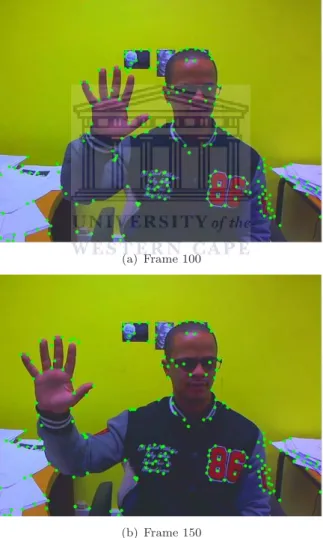
In all these cases, the intensity value of pixels is key to determining the flow of motion and tracking target objects in consecutive frames. Figure 2.1 illustrates a tracking sequence using the technique. The serious drawback of the technique is that it is very sensitive to noise. The assumption that pixels have a constant intensity requires for the lighting of the scene to be static. As such, even small changes in lighting during the frame sequence can severely disrupt tracking. In addition, depending on the assumption
of motion, pixels with the same intensity value as the tracked pixel may be confused with the tracked pixel, resulting in tracking losses.
The most popular optical flow technique, the Lucas-Kanade method, is discussed as a base of understanding. The Lucas-Kanade method assumes small changes in motion in the scene between consecutive frames [13]. This assumption makes it possible to introduce a search window of known size around each pixel in the image, the bounds of which are assumed to be an upper limit to the vector of motion of the pixel within the scene. The size of the window is optimizable according to the specific context of application. Assuming a window size that is too large is equivalent to assuming none at all, while a window size that is too small places a constraint of very small motion within the scene between consecutive frames.
(a) Frame 100
(b) Frame 150
Figure 2.1: Tracking sequence using Optical Flow.
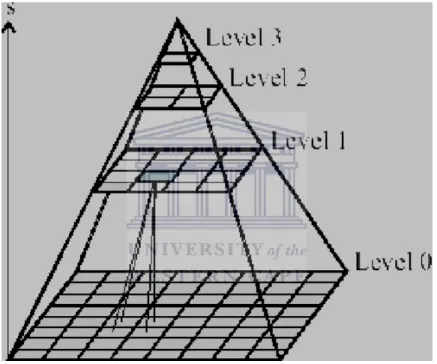
In order to provide the advantages of both a large window size and a small window size, an enhanced Lucas-Kanade optical flow method called the pyramidal Lucas-Kanade optical flow method was proposed. The algorithm constructs a pyramidal cascade, the
base of which is the original image, and each ascending layer, a copy of the original at a resolution that is reduced by a constant factorp. This is illustrated in Figure2.2. In essence, the top of the pyramid is a summarized version of large scale features in the image, with each subsequent layer containing increasingly fine-grained information. The algorithm then applies the Lucas-Kanade optical flow algorithm to the cascade starting at the top working its way down. This makes it possible to get a global estimate of the flow of motion and use this at the next layer as the base point in which to conduct a search. Ultimately, the procedure pin-points the new location of each pixel at the lowest layer – the original image. This procedure makes it possible to assume a local neighborhood of motion but still track large motions as well.
Figure 2.2: An illustration of the pyramidal Lucas-Kanade optical flow.
The algorithm is, however, not effective in tracking highly deformable objects such as the hands [86]. In order to address this problem and make it possible to track objects regardless of rapid and vast deformations, Kolsh and Turk enhanced the algorithm with a strategic assumption that they call “flocks of features” [65]. The main idea employed in this method is that the motion of a highly deformable object is generally similar to that of a flock of birds in flight. The birds in the flock do not wander too far off from the flock but always maintain a minimum distance from each other as well.
The method initially places a set of optical flow points around the hand to be tracked. These points represent the features in the flock. Optical flow is applied at each of the points to track the motion of the object in time with a continuous evaluation of the two aforementioned constraints: each point cannot wander off too far from the the flock; each point cannot roam too close to any other feature point.
If either of these constraints are violated, the point is placed in a position of high skin probability that does not violate either constraint [65]. In general, the position of the hand at any time is taken to be the median distance of all features in the flock. The method was shown to be able to track the hand on a computer with a 3 GHz CPU at an average near-real-time performance of 12.7 FPS on a video stream of resolution 720×480 pixels.
The method has several drawbacks. It is not robust to rapid motions. It assumes a constant and slow motion on the part of the hand. It is also not robust to complex environments. If the hand passes over a region that can be considered a higher skin probability region than the hand such as the face, the algorithm will bind to the latter region. An illustration of the tracking method is provided in Figure 2.3.The figure also illustrates that the method easily loses track when the hand passes over the cupboard – which may be considered a larger high skin probability region than the hand – and when it passes over the user’s neck.
Figure 2.3: An illustration of “flocks of features” [65].
2.1.5 Summary of Articulated Object Tracking
Model-based methods are useful for tracking object with a static shape on an arbitrary background. However, these methods become impractical when the shape of the target object changes severely in time, which is characteristic of articulated objects such as the hands.
In such cases, model-free methods are selected as alternative tracking methods of choice. Such approaches make use of, for example, the colour or intensity of the target object to track it. Four popular tracking methods – Mean-Shift, particle filters and optical flow – were discussed. Methods that combine Mean-Shift and particle filters were also dis-cussed. The strengths and weaknesses of each method were enumerated and illustrated. All things considered, all three methods are generally on par with each other.
However, CamShift, which is an extension of Mean-Shift, can be considered a highly effi-cient and robust method. It is more robust than optical flow and more computationally efficient than particle filters. Combined with an effective pre-processing procedure, it is easily considered as a good trade off between the two tracking approaches. It is selected as the tracking approach for this research.
2.2
Articulated Object Recognition
Articulated object recognition attempts to identify the shape of articulated objects. The two most common methods for articulated shape recognition are techniques that use machine learning and those that use template matching.
Machine learning methods use a trained classifier to determine the shape of the object. The classifier is trained on salient features extracted from a large database of example shape images, along with the shape class to which each image belongs. Given the same features from a query image, the classifier determines the shape class to which the query image belongs. There are a variety of machine learning techniques, each with strengths and weaknesses. Two popular techniques are Support Vector Machines (SVMs) and Neural Networks (NNs). The salient features that can be used to classify shapes are numerous and varied.
Template matching methods match a query image of the articulated object with a database of pre-determined example shape images. A popular method used to carry out the match is determining the distance to the edges of the object, which is also referred to as the segmented silhouettes method [76].
In the case of both methods, a robust pre-processing procedure is required to normalize the extracted object for variations in scale and rotation.
This section is sub-divided into two subsections discussing related research that has made use of each object recognition method in the context of hand shape recognition. Section2.2.1discusses machine learning methods and Section2.2.2deals with template matching methods. The findings from this section are summarized in Section2.2.3.
2.2.1 Machine Learning Methods
Sato et al. [97] used neural networks (NNs) to recognize six distinct hand shapes. A normalization procedure was used to reduce the effects of variations in rotation and scale of hand images. This procedure follows.
After the hand region is located using hand tracking techniques, the translation is applied to the hand image such that the center of mass of the image aligns with the center of the image. A rotation is applied to the resulting image such that the major axis of the image is aligned with either the horizontal or vertical axis. The image is scaled down to a resolution of 12×12 pixels. Down-sampling the image reduces the effects of small amounts of noise and the computation time associated with larger feature sets.
The normalized image resulting from this procedure is taken as a feature vector. It was used to train the NN classifier on six hand shapes. Figure2.4 illustrates the extraction and normalization procedure described. The system was shown to recognize the six hand shapes at an accuracy of 85% at a real-time speed of 20 FPS on a Pentium 2 with a 450 MHz processor.
Another approach that also uses NNs, although in a different manner, is proposed in [23]. A novel technique is proposed that uses the NN to simulate the spreading out of a gas within the extracted hand region, thereby identifying its shape. The technique uses a static skin filter in the YCbCr colour space to identify and segment the hands. No further image normalization procedure is applied.
The technique is called the Self-Growing Self-Organizing Neural Network Gas. The technique operates by initially placing a few neurons – typically one or two – within the hand region. The NN then grows outwards to occupy the entire hand region. This procedure is illustrated in Figure 2.5 which illustrates the initial,intermediate and final configurations of the neural gas on a hand shape image. Finally, a likelihood function classifier is used to determine the hand shape based on the neural gas configuration. The system was trained to recognize 31 hand shapes. The system was tested on 180 hand shape images and was shown to achieve a 90.4% accuracy. However, the system was found to operate at less than 1 FPS, far less than real-time, on a PC with a 3GHz CPU. It is also not robust to varied skin colours or lighting conditions.
Another approach to hand shape recognition is proposed in [68]. This method makes use of SVMs to recognize 10 hand shapes. A robust normalization procedure is proposed and applied. The morphological operations Close, Open, Dilate and Erode, in that or-der, are applied once to the the hand image obtained from the hand tracking procedure. This procedure eliminates small isolated clusters of noise from the image. Connected Component Analysis (CCA) is used to identify the connected contours within the image. The hand is taken to be the largest contour. All other contours are eliminated. A com-putational geometry algorithm [46] is used to compute an oriented minimum bounding box around the contour of the hand. The principal axis of the box is aligned with the vertical axis of the image, thus ensuring that all hand images are upright and rotation
(a) Extracted hand region
(b) Approximation with rectangle
(c) Normalization
Figure 2.4: An illustration of the extraction and normalization procedure of Satoet
al. [97].
(a) (b)
(c)
Figure 2.5: An illustration of the Self-Growing Self-Organizing Neural Network Gas
technique [23].
invariant. The image is scaled down to a resolution of 20×30 pixels. The resulting image is taken as a feature vector.
A SVM was trained to recognize 10 hand shapes. It was shown to achieve an accuracy of 88.5% and operate at a real-time speed of 25 FPS on a MacBook Pro with a 2.5 GHz Intel Core 2 Duo processor and 4 GB memory. It was also shown to be invariant to skin colour and robust to complex backgrounds.
2.2.2 Template Matching Methods
Shimadaet al. created a hand shape recognition system that used the segmented silhou-ettes method to characterize hand shapes [106]. 256 nodes are placed on the contours of the binary silhouette of the hand. The center of mass of the hand region is computed. The distance of the center of mass to each point along the hand contour is plotted on a graph illustrated in Figure 2.6. A unique and distinct distribution is obtained for each hand shape and is used to determine the hand shape.
Figure 2.6: An illustration of the hand contour that is plotted on a graph [106].
It is still necessary to normalize the resulting distribution for variations in rotation and scale. Variations in rotation are controlled by shifting the resulting distribution such that it starts at the highest peak. Variations in scale are controlled by applying a normalization function to all distances. It is expected that generating the distribution in a clockwise or anti-clockwise manner will not affect the performance of the algorithm provided one or the other is done consistently. The exact recognition accuracy of the method is unclear from the literature but it is claimed that the method is robust and accurate.
A similar, yet enhanced, method is proposed in [100]. The method uses an alternative distance computation to the previous approach. As with the previous approach, a pre-determined number of nodes are placed on the hand contour. For each node, the normal to the tangent of the hand contour at that point is computed. A line is drawn from the point within the hand region, in the direction of the normal to the hand contour on the other side of the point. It is this distance that is used to compute the characterizing distribution. The system was shown to be able to recognize 13 hand shapes at a real-time speed of 25 FPS on a video sequence at 640×480 pixels. The exact accuracy of the technique is unclear.
2.2.3 Summary of Articulated Object Recognition
Template matching methods are purely data-driven approaches. This reduces the com-plexity and computational cost of these approaches. It was demonstrated that these approaches generally perform at real-time speeds. However, it is expected that such approaches either require special hardware configurations or specific constraints on the part of hand images to perform at a high accuracy [100,106].
Machine learning methods, on the other hand, provide a good balance between com-putational cost and complexity, and accuracy. In general, they are more robust than template matching methods. By providing a large training set of images in varied con-ditions, it is possible to cater for numerous conditions. Some approaches, such as the neural gas (SGONG) mentioned earlier, can be complex and may not perform at real-time. However, this is case-specific rather than a general rule with machine learning methods. It was mentioned that Li’s [68] and Satoet al.’s [97] methodologies operate at real-time with a very high accuracy.
As such, machine learning methods are selected for use in the hand shape recognition strategy of this research. Specifically, Li’s work is most suitable in terms of complexity, robustness, and computational speed. Li’s methodology will be used to recognize hand shapes, to be applied to gesture recognition.
2.3
Sign Language Gesture Recognition
A variety of research projects have focused on gesture recognition. Of these, some are in the context of generic gesture recognition, as applied, for example, to Human-Computer Interaction, and some in the context of sign language recognition. This section discusses such research, with the greatest focus on those studies that have applied gesture recognition in the context of sign language recognition.
The research can broadly be divided into two groups according to the scope of recognition and the nature of the input expected: those that carry out continuous gesture recognition and those that recognize only a single gesture at a time – single-word gesture recognition systems.
Continuous gesture recognition systems expect a sequence of gestures as input and re-quire a strategy, implicit or explicit, to segment sequences of gestures into single gestures. Such systems then optionally use a grammatical model to infer the meaning of the en-tire gesture sequence. Continuous gesture recognition systems can further be sub-divided into two groups based on the aim of recognition and the gesture sequence segmentation strategy employed: isolated gesture recognition systems and grammar-based gesture recognition systems.
Isolated gesture recognition systems attempt to explicitly segment the input into individ-ual gestures, or isolated gestures, and subsequently recognize each gesture individindivid-ually. Once the isolated gestures have been determined, a language model may be used to infer the meaning of the entire gesture sequence. Grammar-based gesture recognition systems, on the other hand, generally make use of HMMs coupled with a language
model to implicitly and automatically segment a gesture sequence by characterizing the sequence in terms of specific features, with the aim of recognizing the meaning of the entire gesture sequence. Therefore, the entire basis of grammar-based models is a gram-matical model of the underlying sign language with the aim of recognition to infer the meaning of the gesture sequence as a whole. The recognition of isolated gestures is im-plicit. Grammar-based gesture recognition is outside the focus of this research since a grammatical model of SASL is currently unavailable. Only isolated gesture recognition systems are discussed.
Single-word gesture recognition systems assume that the input consists of a single gesture and attempt to infer the meaning of that gesture. Such systems do not have and do not need a gesture sequence segmentation strategy. Such systems can be further sub-divided into two groups, according to the use of either a single image or a sequence of images of the hands from which to extract features: static gesture recognition systems and dynamic gesture recognition systems.
Static gesture recognition systems use only a single image containing the hand or hands to recognize a set of gestures. Common amongst such systems is the use of the shape of the hands, possibly coupled with other features, to characterize gestures. Dynamic gesture recognition systems extract features from an entire image sequence of a ges-ture, usually motion coupled with other features, to characterize and recognize a set of gestures.
The following subsections discuss a number of prominent research studies in these groups. Section 2.3.1discusses isolated gesture recognition systems. Section 2.3.2 details static gesture recognition systems. Finally, Section 2.3.3explains the dynamic gesture recog-nition systems. Section2.3.4summarizes these systems and draws a conclusion towards the system proposed in this research.
2.3.1 Isolated Gesture Recognition Systems
Liang and Ouhyoung [69] developed a large-vocabulary Taiwanese Sign Language (TSL) recognition system using the a motion thresholding model to segment gesture sequences into isolated gestures and Hidden Markov Models to recognize isolated gestures and group isolated gestures into sentences. The system uses a DataGlove worn by the user of the system to seamlessly capture four sign language parameters: hand location, ori-entation, motion and shape.
A motion thresholding model is used to segment gesture sequences into isolated gestures by considering hand motion that is below an empirically determined threshold to be

![Figure 2.5: An illustration of the Self-Growing Self-Organizing Neural Network Gas technique [23].](https://thumb-us.123doks.com/thumbv2/123dok_us/1384329.2685458/36.892.224.671.112.663/figure-illustration-self-growing-organizing-neural-network-technique.webp)
![Figure 2.6: An illustration of the hand contour that is plotted on a graph [106].](https://thumb-us.123doks.com/thumbv2/123dok_us/1384329.2685458/37.892.260.646.132.382/figure-illustration-hand-contour-plotted-graph.webp)
![Figure 2.7: The hand image that serves as input to Mapari and Kharat’s system [72].](https://thumb-us.123doks.com/thumbv2/123dok_us/1384329.2685458/41.892.339.554.485.703/figure-hand-image-serves-input-mapari-kharat-s.webp)
![Figure 2.8: An example of an input image to Kulkarni’s system [66].](https://thumb-us.123doks.com/thumbv2/123dok_us/1384329.2685458/42.892.241.654.125.379/figure-example-input-image-kulkarni-s.webp)
![Figure 3.1: Four types of haar features used in the Viola-Jones detection framework [122].](https://thumb-us.123doks.com/thumbv2/123dok_us/1384329.2685458/50.892.185.733.111.667/figure-types-haar-features-viola-jones-detection-framework.webp)
![Figure 3.4: The detection process for rejecting regions in the image [122].](https://thumb-us.123doks.com/thumbv2/123dok_us/1384329.2685458/52.892.282.601.891.1089/figure-detection-process-rejecting-regions-image.webp)
