Know your Enemy: Compromising Adversaries in Protocol Analysis
DAVID BASIN, ETH ZurichCAS CREMERS, University of Oxford
We present a symbolic framework, based on a modular operational semantics, for formalizing different notions of compromise relevant for the design and analysis of cryptographic protocols. The framework’s rules can be combined to specify different adversary capabilities, capturing different practically-relevant notions of key and state compromise. The resulting adversary models generalize the models currently used in different domains, such as security models for authenticated key exchange. We extend an existing security-protocol analysis tool, Scyther, with our adversary models. This extension systematically supports notions such as weak perfect forward secrecy, key compromise impersonation, and adversaries capable of state-reveal queries. Furthermore, we introduce the concept of a protocol-security hierarchy, which classifies the relative strength of protocols against different adversaries.
In case studies, we use Scyther to analyse protocols and automatically construct protocol-security hi-erarchies in the context of our adversary models. Our analysis confirms known results and uncovers new attacks. Additionally, our hierarchies refine and correct relationships between protocols previously reported in the cryptographic literature.
1. INTRODUCTION
Problem context. Many cryptographic protocols are designed to work in the presence of various forms of corruption. For example, a Diffie-Hellman key agreement protocol, where signatures are used to authenticate the exchanged public keys, provides perfect forward secrecy [G ¨unther 1990; Menezes et al. 1996]: the resulting key remains secret even after all long-term keys are compromised by the adversary. Designing protocols that work even in the presence of different forms of adversary compromise has consid-erable practical relevance. It reflects our multifaceted computing reality with different rings of protection (user space, kernel space, hardware security modules) offering dif-ferent levels of assurance with respect to the computation of cryptographic functions (for example, the quality of the pseudo-random numbers generated) and the storage of keys and intermediate results.
Symbolic and computational approaches have addressed this problem to different degrees. Most symbolic formalisms are based on the Dolev-Yao model. These offer, with few exceptions, a limited view of honesty and conversely corruption: either principals are honest from the start and always keep their secrets to themselves or they are completely malicious and always under adversary control. Under this limited view, it is impossible to distinguish between the security provided by early key-exchange protocols such as the Bilateral Key-Exchange protocol [Clark and Jacob 1997] and state-of-the art protocols such as (H)MQV [Law et al. 2003; Krawczyk 2005a]. It is also impossible to discern any benefit from storing the long-term keys in a tamper-proof module or performing part of a computation in a cryptographic coprocessor. While in theory, some of these aspects could be explicitly encoded, no systematic attempts to
This paper combines and extends results reported in [Basin and Cremers 2010a; 2010b].
Permission to make digital or hard copies of part or all of this work for personal or classroom use is granted without fee provided that copies are not made or distributed for profit or commercial advantage and that copies show this notice on the first page or initial screen of a display along with the full citation. Copyrights for components of this work owned by others than ACM must be honored. Abstracting with credit is per-mitted. To copy otherwise, to republish, to post on servers, to redistribute to lists, or to use any component of this work in other works requires prior specific permission and/or a fee. Permissions may be requested from Publications Dept., ACM, Inc., 2 Penn Plaza, Suite 701, New York, NY 10121-0701 USA, fax+1 (212) 869-0481, or [email protected].
c
YYYY ACM 1094-9224/YYYY/01-ARTA $15.00 DOI:http://dx.doi.org/10.1145/0000000.0000000
do so have been made. Despite this, symbolic methods have the advantage that there are numerous effective tools for symbolic protocol analysis, such as [Blanchet 2001; Cremers 2008a; Schmidt et al. 2013].
In contrast to the above, researchers in the computational setting, such as [Krawczyk 2005a; Bellare and Rogaway 1995; Bellare et al. 2000; Bellare and Rogaway 1993; Katz and Yung 2003; Canetti and Krawczyk 2001; LaMacchia et al. 2007; Shoup 1999; Bres-son and Manulis 2008; Just and Vaudenay 1996; Cremers and Feltz 2013], have de-fined stronger adversary models where principals may be selectively corrupted during protocol execution. For example, their short-term or long-term secrets, or the results of intermediate computations may be revealed (at different times) to the adversary. These models are used to establish stronger properties such as perfect forward secrecy or re-silience to state-reveal attacks. There are, however, drawbacks to these computational models. Namely, they have been defined just for key-agreement protocols, whereas one may expect similar definitions to exist for any security protocol. Moreover, contrary to the security models used in symbolic approaches, there is no automated tool support available for the stronger adversary models.
Our starting point is an operational semantics for security protocols. We parame-terize this semantics by a set of rules that formalize adversarial capabilities. These rules capture three fundamental dimensions of compromise: whose data is compro-mised, which kind of data it is, and when the compromise occurs. For each of these dimensions we define a partitioning based on the work in the computational setting. For example, for thewhose datadimension, we distinguish between theactor(which is the agent that executes the thread), the intended peers, and other agents. As a result, different rule combinations formalize symbolic analogs of different practically-relevant notions of key and state compromise from the computational setting. The operational semantics gives rise, in the standard way, to a notion of correctness with respect to state and trace-based security properties.
Contributions. We present a framework for analyzing security protocols in the pres-ence of adversaries with a wide range of compromise capabilities. We show how analogs of adversary models studied in the computational setting can be modeled in our frame-work. For example, we can model attacks against implementations of cryptographic protocols involving the mixed use of cryptographic co-processors for the secure storage of long-term secrets with the computation of intermediate results in less-secure main memory for efficiency reasons. Such implementations are common and reflect the folk-lore in the PKCS#11 community that if the primary goal is high throughput, one only uses the private-key acceleration capabilities of the hardware and performs all other cryptographic operations (such as symmetric cryptography and hashing) on the host computer [Gutmann ].
Our models bridge another gap between the computational and symbolic approaches by providing symbolic definitions for adversaries and security properties that were pre-viously only available in the computational setting. Moreover, by decomposing security properties into an adversary model and a basic security property, we unify and gener-alize many existing security properties.
We introduce the concept of a protocol-security hierarchy, in which protocols are classified by their relative strength against different adversaries. Protocol-security hi-erarchies can be used to select or design protocols based on implementation require-ments and the worst-case expectations for adversaries in the application domain. This concept can be generalized to classify arbitrary secure systems and is of independent interest.
Our framework directly lends itself to protocol analysis. As an example, we extend Scyther [Cremers 2008a], a symbolic protocol analysis tool. This results in the first
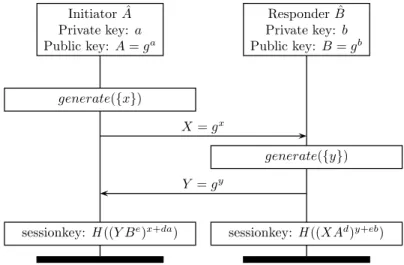
Initiator ˆA Private key: a Public key: A=ga Responder ˆB Private key: b Public key: B=gb generate({x}) X=gx generate({y}) Y =gy sessionkey:H((Y Be)x+da) sessionkey:H((XAd)y+eb)
Fig. 1. Simplified presentation of the HMQV protocol, whered=H¯(X,Bˆ)ande=H¯(Y,Aˆ).
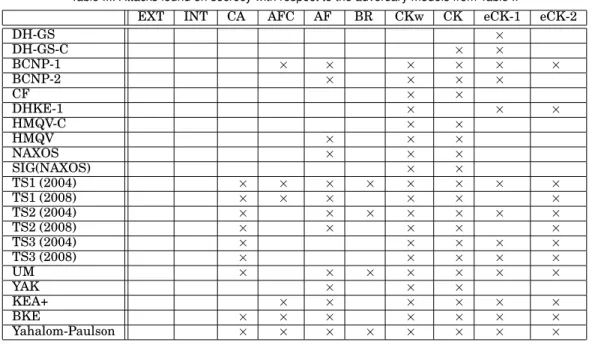
automated tool that systematically supports notions such as weak perfect forward se-crecy, key compromise impersonation, and adversaries that can reveal the local state of agents. We analyze a set of protocols with the tool and rediscover many attacks previ-ously reported in the cryptographic literature, including a so-calledsession-state reveal attackattack on the MQV and HMQV protocols [Kunz-Jacques and Pointcheval 2006], which can occur when HMQV is partly implemented using a secure component such as an HSM. Furthermore, our tool finds previously unreported attacks. Our results in the domain of key exchange protocols provide evidence that our symbolic methodology can effectively support cryptographers in designing security protocols, complementing the (manual and time-consuming) construction of computational proofs.
We also extend Scyther to automatically compute protocol-security hierarchies. In case studies, we use this extension to compute hierarchies that refine and correct re-lationships reported in the cryptographic literature. This further shows that symbolic methods can be effectively used for analyses that were previously possible only using a manual computational analysis.
Organization. We review different adversary capabilities and cryptographic models for authenticated key exchange in Section 2. We present our framework in Section 3. In Section 4, we use it to construct protocol-security hierarchies. In Section 5, we show applications of our framework and report on case studies. We also prove general re-sults relating models and properties, which aid the construction of protocol-security hierarchies. We discuss related work in Section 6 and draw conclusions in Section 7. 2. BACKGROUND ON SECURITY MODELS FOR AUTHENTICATED KEY EXCHANGE
Although the models we develop are not specific to any type of security protocol, they are inspired by the domain of key-exchange protocols. This is because most research on adversary compromise has been performed in the context of authenticated key-exchange (AKE) protocols in the computational setting. We start by recalling the main elements of AKE security models. We cover the models in some detail because they provide the context for the design choices made for our framework. Readers familiar with computational AKE models and modern AKE protocols can skip this section.
The goal of an AKE protocol is to establish a shared symmetric (session) key be-tween agents. For example, consider the simplified presentation of the HMQV
proto-col [Krawczyk 2005b] shown in Figure 1. The protoproto-col assumes as given a generatorg for a groupG, and two hash functions that we identify withH andH¯.
The protocol has two roles, Initiator and Responder, which we assume are named
ˆ
A and Bˆ respectively. Then, A’s long-term private key isˆ a and B’s key isˆ b. Their corresponding long-term public keys areA=gaandB=gb, respectively.
The protocol proceeds as follows. The initiator generates a fresh random valuexand sendsgxto the responder. After receivinggx, the responder generates a fresh random valuey and sendsgy to the initiator. Now they both compute a session key based on the exchanged values and their long-term keys. Due to the algebraic properties of the modular exponentiation, the session keys computed by both parties are identical. An adversary should not be able to compute the session key if he does not have one of the long-term private keys. In fact, even if he obtains long-term private keys, he should not be able to compute the session key unless he also knows eitherxory.
For such AKE protocols, advanced security models have been defined. Examples in-clude [Bellare and Rogaway 1995; Bellare et al. 2000; Bellare and Rogaway 1993], [Bresson and Manulis 2008], [Canetti and Krawczyk 2001; Krawczyk 2005a], [Cre-mers and Feltz 2013], [Katz and Yung 2003], and [LaMacchia et al. 2007]. We take these models as a starting point for our analysis.
2.1. The eCK model
As a concrete example of how security models for key exchange protocols formalize adversarial compromise, we briefly describe the eCK model [LaMacchia et al. 2007].
The eCK model formalizes an adversary that fully controls the network: he can eavesdrop, redirect, or deflect any message, and can insert messages at will. Addi-tionally, the adversary can learn certain values that were intended to be secret. In particular, he can learn:
— Thelong-term private keysof agents, by corrupting the agents.
— Agents’session keys, by learning the session keys of corrupted agents or by perform-ing cryptanalysis.
— Therandomnessgenerated by agents, either because weak or corrupted random num-ber generators are used that leak the data they generate, or because the adversary can perform side channel attacks.
As is common in key exchange models [Bellare and Rogaway 1993], the eCK model describes a game and its winning conditions. A protocol is securewith respect to the model if there exists no adversary (modeled as a probabilistic polynomial-time Turing machine) that has more than negligible advantage over guessing in winning the game. Roughly speaking, the rules of the game allow the adversary to interact with agents that are executing instances of the protocol, and the adversary wins the game if he can distinguish a real session key from a random bit string.
An AKE protocol usually consists of two roles: theInitiator role (performed by the agent that starts the protocol session) and theResponderrole (which is activated when an agent receives the first message). Each agent can perform each role. We call a single role instance, as executed by an agent, athread. Note that in computational models a thread is often referred to as a (local) session. We identify a thread by a thread identifiertid from the set of possible thread identifiersTID.
eCK game.We consider any number of agents with identitiesA, B, C, . . .. Each agent has a long-term public/private key pair associated to its identity. Initially, the adver-sary knows all identities and the long-term public key of each agent, but no long-term private keys. The adversary can perform a given set of actions, historically called queries. For the eCK model, the queries are as follows:
(1) Test(A, B,comm)
If the message comm is the empty message, this query models the adversary scheduling the start of an initiator thread. In particular, the agent A activates a new initiator thread, trying to communicate withB, and computes the first mes-sage to send. The result of the query is that the adversary is given the sent mesmes-sage. This models that the adversary can eavesdrop all sent messages.
If comm is not the empty message, this query models the adversary sending a message comm to the agent A, claiming that the message was sent by B. This message can be accepted by any active thread, updating its state, or it can result in the activation of a new responder thread atAthat receives the message. In both cases, the adversary is given the response message computed byA.
(2) Long-TermKeyReveal(A)
The adversary is given the long-term private key(s) ofA. (3) EphemeralKeyReveal(tid)
tidis the thread identifier of an active thread. The adversary is given theephemeral keysoftid. This terminology stems from Diffie-Hellman style key exchange. In prac-tice, and along the lines of the examples given in the eCK model, this means that all random values previously generated by the thread are given to the adversary. (4) Reveal(tid)
tid is the thread identifier of an active thread that has computed a session keyk. The keykis given to the adversary.
(5) Test(tid)
This query can only be performed once. tid is the thread identifier of an active thread that has computed a session keyk. A coin is flipped and its outcome stored asb ∈ {0,1}. Ifb = 1, the adversary is givenk (as in theRevealquery). Ifb = 0, a random bit string is drawn from the key space and returned to the adversary. (6) Guess(b′)
This query can only be performed if the Test query has been performed earlier. After the Guessquery has been performed, the game ends. The query models the adversary guessing (encoded by the parameterb′∈ {0,1}) whether he received the real session key or a random bit string as a result of theTestquery.
If there were no additional restrictions in the model, the adversary could always guess the correct bit by performingReveal(tid)and thenTest(tid). This would amount to mod-eling that the adversary can learn all session keys at any time, and hence no protocol could ensure that a session key remains secret in this adversary’s presence. Thus, to ensure that at least some protocols are correct with respect to an AKE model, the models restrict the adversary, effectively limiting the queries that he can make. The models aim to specify the fewest possible restrictions but at the same time allow some protocols to be correct.
For the eCK model, we introduce a propertycleanto model when the adversary has met the intended restrictions with respect to a certain thread. We refer to a sequence of queries performed by the adversary as anexperiment.
To model the clean property, we additionally introducematching threads. Informally speaking, the purpose of a key exchange model is to establish a key sharedbetween two threads. Hence, given a threadtid, the notion of matching threads formalizes when a threadtid′ is supposed to compute the same session key as intended by the protocol. Matching threads for two-message protocols in the eCK model. Let tid be a thread. We say itsidentifying tupleis
whererole is the role (Initiator or Responder) performed by the thread,ID is the iden-tity of the agent executing the thread,ID∗is the identity of the intended communica-tion partner, andcomm1, . . . ,commn is the sequence of messages communicated (sent or received) so far. For a threadtidof a two-message protocol with the identifying tuple
(r, A, A′,comm
1,comm2), another threadtid′ is said to be amatching threadif and only if its identifying tuple is(r′, A′, A,comm
1,comm2), wherer6=r′.
Clean property for the eCK game.Let E be an experiment, and lettid be a thread executed byAwith the intended communication partnerB. If a matching thread1for tid exists, we denote this bytid∗. In the context ofE, tid is cleanunless one of the following conditions holds:
(1) EincludesReveal(tid)orReveal(tid∗).
(2) Eincludes bothLong-TermKeyReveal(A)andEphemeralKeyReveal(tid).
(3) A matching thread tid∗ exists and E includes both Long-TermKeyReveal(B) and EphemeralKeyReveal(tid∗).
(4) No matching threadtid∗exists andEincludesLong-TermKeyReveal(B).
Winning condition for the eCK game.The adversary wins the eCK game in an exper-imentEifb′ =band theTestthread isclean.
eCK security.A protocol is secure in the eCK model if matching threads compute the same session key, and no probabilistic polynomial-time adversary has more than negligible advantage (over guessing) in winning the eCK game.
2.2. Observations on AKE models
Security models such as the eCK model are complex, monolithic definitions that are hard to disentangle and for which it is hard to understand the design choices. To fur-ther complicate matters, in general, any two computational models are incomparable due to (often minor) differences not only in the adversary notions, but also in the defi-nition of matching threads, the execution models, and security property specifics. The details of some of these definitions and their relationships have been studied by, e. g., [Choo et al. 2005b; Choo et al. 2005a], [Bresson et al. 2007], [Cremers 2011; 2010], [LaMacchia et al. 2007], and [Menezes and Ustaoglu 2008].
In this article, we would like to model different types of adversaries, irrespective of the execution model and the security property (such as secrecy or authentication). However, separating the execution model, the adversary model, and the security prop-erties in the eCK model is non-trivial because the model is presented in a monolithic way. This observation holds for all AKE security models.
In the next section, we develop an operational semantics with a set of adversary-compromise rules. Our aim is to factor and generalize the adversarial capabilities given by AKE models.
3. COMPROMISING ADVERSARY MODEL
We define an operational semantics that is modular with respect to the adversary’s capabilities. Our framework is compatible with most existing semantics for security protocols, including trace and strand-space semantics. We have kept our execution model minimal to focus on the adversary rules. However, it would be straightforward to incorporate a more elaborate execution model, e. g., with control-flow commands.
3.1. Notational preliminaries
Letf be a function. We writedom(f)andran(f)to denotef’s domain and range. We writef[b ←[ a]to denote f’s update, i. e., the functionf′ where f′(x) = b whenx =a andf′(x) =f(x)otherwise. We writef :X 7→Y to denote a partial function fromX to Y. For any setS,P(S) denotes the power set ofS andS∗ denotes the set of finite sequences of elements fromS. We writehs0, . . . , snito denote the sequence of elements s0tosn, and we omit brackets when no confusion can result. Forsa sequence of length |s|andi <|s|,sidenotes thei-th element ofs. We writesˆs′for the concatenation of the sequencessands′. Abusing set notation, we writee∈siff∃i.s
i=e. When the elements ofsare sets, we writeunion(s)forS
e∈se. We definelast(hi) =∅andlast(sˆhei) =e. Let Sub be a set of substitutions. We write[t0, . . . , tn / x0, . . . , xn] ∈ Sub to denote the simultaneous substitution ofti forxi, for0 ≤i ≤n. We extend the functionsdom and ran to substitutions. We write σ∪σ′ to denote the union of two substitutions, which is defined whendom(σ)∩dom(σ′) =∅, and writeσ(t)for the application of the substitutionσtot. Finally, forR a binary relation,R∗ denotes its reflexive transitive closure.
3.2. Terms and events
As we will see in the next section, protocols are executed by instantiating their roles resulting in threads (also known as role instances, runs, local sessions, or strands). Each thread executes a sequence of events that send or receive messages. We introduce these elements in a bottom-up fashion, starting with terms, which represent messages.
We assume given the infinite setsAgent, Role, Fresh, Var, Func, and TID of agent names, roles, freshly generated terms (nonces, session keys, coin flips, etc.), variables, function names, and thread identifiers. We assume that TID contains two distin-guished thread identifiers,Test andtidA. These identifiers single out a distinguished “point of view” thread (similar to the thread selected by theTestquery in AKE models)
and the adversary thread, respectively.
When role specifications are instantiated in threads, the roles are instantiated with concrete agent names. To bind local terms, such as freshly generated terms or local variables, to a specific thread, we writeT ♯tid. This denotes that the termT is local to the thread identified bytid.
Definition 3.1. Terms
Term::=Agent | Role | Fresh | Var | Fresh♯TID | Var♯TID | (Term,Term) | pk(Term) | sk(Term) | k(Term,Term) | {|Term|}a
Term | {|Term|}sTerm | Func(Term∗)
For each X, Y ∈ Agent, sk(X)denotes the long-term private key, pk(X) denotes the long-term public key, and k(X, Y) denotes the long-term symmetric key shared be-tween X and Y. Moreover, {|t1|}at2 denotes the asymmetric encryption (using a pub-lic key) or the digital signature (using a signing key) of the term t1 with the key t2, and{|t1|}st2 denotes symmetric encryption. The setFuncis used to model other crypto-graphic functions, such as hash functions. Freshly generated terms and variables are assumed to be local to a thread.
Depending on the protocol analyzed, we assume that symmetric or asymmetric long-term keys have been distributed prior to protocol execution. We also assume the exis-tence of an inverse function on terms, wheret−1denotes the inverse key oft. We have thatpk(X)−1=sk(X)andsk(X)−1=pk(X)for allX ∈Agent, andt−1=tfor all other termst.
We define a binary relation⊢, whereM ⊢t denotes that the termtcan be inferred from the set of terms M. Lett0, . . . , tn ∈ Term and let f ∈ Func. We define ⊢as the smallest relation satisfying:
t∈M ⇒M ⊢t M ⊢t1∧M ⊢t2⇔M ⊢(t1, t2) M ⊢ {|t1|}st2∧M ⊢t2⇒M ⊢t1 M ⊢t1∧M ⊢t2⇒M ⊢ {|t1|} s t2 M ⊢ {|t1|}at2∧M ⊢(t2) −1⇒M ⊢t 1 M ⊢t1∧M ⊢t2⇒M ⊢ {|t1|}at2 ^ 0≤i≤n M ⊢ti⇒M ⊢f(t0, . . . , tn) Subterms t′ of a term t, written t′ ⊑ t, are defined as the syntactic subterms of t, e. g., t1 ⊑ {|t1|}ts2 andt2 ⊑ {|t1|}
s
t2. We write FV(t)for the free variables of t, where
FV(t) = t′
t′ ⊑t∧t′∈Var∪ {v♯tid|v∈Var∧tid∈TID} . Definition 3.2. Events
AgentEvent::=create(Role,Agent) | send(Term) | recv(Term)
| generate(P(Fresh)) | state(P(Term)) | sessionkeys(P(Term)) AdversaryEvent::=LKR(Agent) | SKR(TID) | SR(TID) | RNR(TID)
Event ::=AgentEvent | AdversaryEvent
We explain the interpretation of the agent and adversary events shortly. Here we simply note that the first three agent events are standard: starting a thread, sending a message, and receiving a message. The message in the send and receive events does not include explicit sender or recipient fields although, if desired, they can be given as subterms of the message. The last three agent events tag state information, which can possibly be compromised by the adversary. The four adversary events specify which in-formation the adversary compromises. These events can occur any time during protocol execution and correspond to different kinds of adversary queriesfrom computational models. All adversary events are executed in the single adversary threadtidA.
3.3. Protocols and threads
A protocol is a partial function from role names to event sequences, i. e., Protocol : Role 7→AgentEvent∗. We require that no thread identifiers occur as subterms of events in a protocol definition.
Example3.3 (Simple protocol). Let{Init,Resp} ⊆Role,key ∈ Fresh, andx ∈Var. We define the simple protocolSPas follows.
SP(Init) =hgenerate({key}),state({key,{|Resp, key|}a
sk(Init)}),
send(Init,Resp,{| {|Resp, key|}a
sk(Init)|}apk(Resp)),sessionkeys({key})i SP(Resp) =hrecv(Init,Resp,{| {|Resp, x|}a
sk(Init)|}apk(Resp)),
state({x,{|Resp, x|}a
sk(Init)}),sessionkeys({x})i
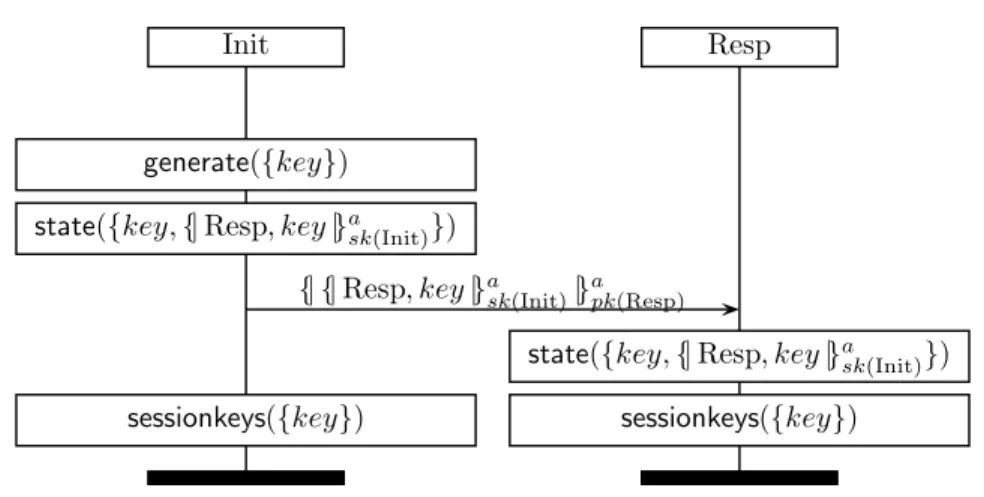
A message sequence chart representation of this protocol is shown in Figure 2.
In this protocol, the initiator generates a key and sends it (together with the respon-der’s name) signed and encrypted, along with the initiator’s and responrespon-der’s names. The recipient expects to receive a message of this form. The additional events mark session keys and state information. The state information depends on the protocol’s implementation and marks which parts of the thread’s state are stored at a lower pro-tection level than the agent’s long-term private keys. The state information inSP
cor-Init Resp
generate({key}) state({key,{|Resp, key|}a
sk(Init)}) {| {|Resp, key|}a
sk(Init)|}apk(Resp)
state({key,{|Resp, key|}a sk(Init)})
sessionkeys({key}) sessionkeys({key})
Fig. 2. Message sequence chart depicting the protocolSPfrom Example 3.3.
responds to, e. g., implementations that use a hardware security module for encryption and signing and perform all other computations in ordinary memory.
Protocols are executed by agents who execute roles (represented by sequences of agent events), thereby instantiating role names with agent names. Agents may execute each role multiple times. Each instance of a role is called a thread. We distinguish between the fresh terms and variables of each thread by assigning them unique names, using the function localize : TID → Sub. Note that we abuse notation and extend the domain of substitutions toVar∪Role∪Fresh.
Definition3.4 (Localize). Lettid∈TID. Then localize(tid) = [
cv∈Fresh∪Var
[cv♯tid / cv].
Usinglocalize, we define a functionthread : (AgentEvent∗×TID× Sub)→AgentEvent∗ that yields the sequence of agent events that may occur in a thread.
Definition3.5 (Thread). Let l be a sequence of events,tid ∈ TID, and let σbe a substitution of role names by agent names and, optionally, variables by terms. Then thread(l, tid, σ) =σ(localize(tid)(l)).
Example 3.6. Let {A, B} ⊆Agent. For a threadt1 ∈TID performing theInitrole from Example 3.3, we havelocalize(t1)(key) =key♯t1and
thread(SP(Init), t1,[A, B /Init,Resp]) =
hgenerate({key♯t1}),state({key♯t1,{|B, key♯t1|}ask(A)}),
send(A, B,{| {|B, key♯t1|}ask(A)|}pka (B)),sessionkeys({key♯t1})i.
Test thread. When verifying security properties, we will focus on a particular thread. In the computational setting, this is the thread where the adversary performs a so-called test query. In the same spirit, we call the thread under consideration thetest thread, with the corresponding thread identifier Test. For the test thread, the sub-stitution of role names by agent names, and all free variables by terms, is given by σTest and the role is given by RTest. For example, if the test thread is performed by Alice in the role of the initiator, trying to talk to Bob, we have thatRTest = Init and σTest= [Alice,Bob/Init,Resp].
3.4. Execution model
We define the setTrace as(TID×Event)∗, representing possible execution histories. The state of our system is a four-tuple(tr,IK, th, σTest)∈Trace× P(Term)×(TID 7→ Event∗)× Sub, whose components are (1) a tracetr, (2) the adversary’s knowledgeIK, (3) a partial function thmapping thread identifiers of initiated threads to sequences of events, and (4) the role to agent and variable assignments of the test thread. To facilitate defining the partner function later, we include the trace as part of the state and fix the test substitution at the start of the system.
Definition3.7 (TestSubP). Given a protocolP, we define the set oftest substitutions TestSubP as the set of ground substitutions σTest such that dom(σTest) = dom(P)∪ {v♯Test |v∈Var}and∀r∈dom(P). σTest(r)∈Agent.
We define the initial adversary knowledgeAK0as
AK0=Agent ∪ {pk(a)|a∈Agent} ∪ {c♯tidA|c∈Fresh}.
The adversary initially knows the names of all agents, their public keys, and a set of adversary-generated constants, which we denote by fresh symbols that are bound to the adversary’s thread identifiertidA. In contrast to most Dolev-Yao models, the initial adversary knowledge does not include any long-term secret keys. The adversary may learn these from long-term key reveal (LKR) events.
ForP a protocol, the set of initial system statesIS(P)is defined as IS(P) = [
σTest∈TestSubP
(hi,AK0,∅, σTest) .
The semantics of a protocolP ∈ Protocol is defined by a transition system that com-bines the execution rules from Figure 3 with a set of adversary rules from Figure 4. We first present the execution rules.
The createP rule starts a new instance (a thread) of a role R of the protocol P. A
fresh thread identifier tid is assigned to the thread, thereby distinguishing it from existing threads, the adversary thread, and the test thread. The rule takes the protocol P as a parameter. The role names of P, which can occur in events associated with the role, are replaced by agent names by the substitution σ. Similarly, thecreateTestP
rule starts the test thread. However, instead of choosing an arbitrary role, it takes an additional parameterRTest, which represents the test role and will be instantiated in the definition of the transition relation in Def. 3.10. Additionally, instead of choosing an arbitraryσ, the test substitutionσTest is used.
The sendrule sends a messagemto the network. In contrast, the receiverule accepts messages from the network that match the pattern pt, where ptis a term that may contain free variables. The resulting substitutionσis applied to the remaining protocol stepsl. Note that, as is standard, we have identified the network with the adversary. Hence messages are sent directly to and received fromIK.
The last three rules support our adversary rules, given shortly. The generate rule marks the fresh terms that have been generated,2 the staterule marks the current
local state, and the sessionkeysrule marks a set of terms as session keys. Auxiliary functions. We define the long-term secret keys of an agentaas
LongTermKeys(a) ={sk(a)} ∪ [ b∈Agent
{k(a, b), k(b, a)}.
2Note that this rule need not ensure that fresh terms are unique. The functionthreadmaps freshly generated termsctoc♯tidin the threadtid, ensuring uniqueness.
R∈dom(P) σ∈Role→Agent tid6∈(dom(th)∪ {tidA,Test}) l=thread(P(R), tid, σ)
(tr,IK, th, σTest)−→(trˆh(tid,create(R, σ(R)))i,IK, th[l←[tid], σTest) [createP]
a=σTest(RTest) Test 6∈dom(th) l=thread(P(RTest),Test, σTest)
(tr,IK, th, σTest)−→(trˆh(Test,create(RTest, a))i,IK, th[l←[Test], σTest)[createTestP]
th(tid) =hsend(m)iˆl
(tr,IK, th, σTest)−→(trˆh(tid,send(m))i,IK∪ {m}, th[l←[tid], σTest)[send]
th(tid) =hrecv(pt)iˆl IK⊢σ(pt) dom(σ) =FV(pt)
(tr,IK, th, σTest)−→(trˆh(tid,recv(σ(pt)))i,IK, th[σ(l)←[tid], σTest)[recv]
th(tid) =hgenerate(M)iˆl
(tr,IK, th, σTest)−→(trˆh(tid,generate(M))i,IK, th[l←[tid], σTest)[generate]
th(tid) =hstate(M)iˆl
(tr,IK, th, σTest)−→(trˆh(tid,state(M))i,IK, th[l←[tid], σTest)[state]
th(tid) =hsessionkeys(M)iˆl
(tr,IK, th, σTest)−→(trˆh(tid,sessionkeys(M))i,IK, th[l←[tid], σTest)[
sessionkeys]
Fig. 3. Execution rules
For traces, we define an operator ↓ that projects traces on events belonging to a par-ticular thread identifier. For alltid, tid′ ∈TID,e∈Event, andtr∈(TID×Event)∗, we definehi ↓tid=hiand
(h(tid′, e)iˆtr)↓tid=
heiˆ(tr↓tid) iftid=tid′, and tr↓tid otherwise.
Similarly, for event sequences, the operator ⇂ selects the contents of events of a particular type. For all e ∈ Event, m ∈ Term, l ∈ Event∗, and evtype ∈ {create,send,recv,generate,state,sessionkeys}, we definehi⇂evtype=hiand
(heiˆl)⇂evtype=
h
miˆ(l⇂evtype) ife=evtype(m), and l⇂evtype otherwise.
During protocol execution, the test thread may intentionally share some of its short-term secrets, such as a session key, with other threads. Hence some adversary rules require distinguishing between the intendedpartner threadsand other threads. There are many notions of partnering in the literature. Here we use partnering based on matching histories for protocols with two roles. A similar notion for protocols with any number of roles is non-injective (message) agreement, as in [Cremers et al. 2006].
Definition3.8 (Matching histories). For sequences of events l and l′, we define
MH(l, l′)≡ l⇂recv=l′⇂send) ∧ (l⇂send=l′⇂recv .
Our partnering definition is parameterized over the protocolP and the test roleRTest. These parameters are later instantiated in the transition-system definition.
Definition3.9 (Partnering). LetRbe the non-test role, i. e.,R ∈ dom(P)andR 6=
RTest. Fortra trace,Partner(tr, σTest) =
tid tid6=Test∧ ∃a.create(R, a)∈tr↓tid
∧ ∃l .MH(σTest(P(RTest)),(tr↓tid)ˆl) .
A threadtidis a partner iff (1)tidis notTest, (2)tidperforms the role different from Test’s role, and (3)tid’s history matches theTest thread (forl =hi) or the thread may
be completed to a matching one (forl6=hi).
Some protocols, such as HMQV, are symmetric in both communication and key com-putation. For such protocols, a slightly modified definition of partnering is required, where requirement (2) is dropped. For details on these subtleties we refer to [Cremers 2011].
3.5. Adversary-compromise rules
We define our adversary-compromise rules in Figure 4. They factor the security defini-tions from the cryptographic protocol literature along three dimensions of adversarial compromise:whichkind of data is compromised,whosedata it is, andwhenthe compro-mise occurs. Not all combinations of capabilities have been used for analyzing protocols. Some combinations are not covered because of impossibility results (e. g. [Krawczyk 2005a]), whereas other combinations have simply been overlooked.
Compromise of long-term keys. The first four rules model the compromise of an agent a’s long-term keys, represented by the long-term key reveal event LKR(a). In tradi-tional Dolev-Yao models, this event occurs implicitly for dishonest agents before the honest agents start their threads.
TheLKRothers rule formalizes the adversary capability used in the symbolic analysis
of security protocols since Lowe’s man-in-the-middle attack on the Needham-Schroeder protocol [Lowe 1996]: the adversary can learn the long-term keys of any agentathat is not an intended partner of the test thread. Hence, if the test thread is executed by Alice, communicating with Bob, the adversary can learn, e. g., Charlie’s long-term key. TheLKRactorrule allows the adversary to learn the long-term key of the agent
execut-ing the test thread, also called theactor. The intuition is that a protocol may still func-tion as long as the long-term keys of the other partners are not revealed. This rule al-lows the adversary to attempt so-called Key Compromise Impersonation attacks [Just and Vaudenay 1996]. The rule’s second premise is required because our model does not allow the compromise of the partner’s key before the end of the test session, but it does allow agents to communicate with themselves: in such cases, revealing the actor’s long-term key would also reveal the partner’s key.
TheLKRafter andLKRaftercorrect rules restrict when the compromise may occur. In
par-ticular, they allow the compromise of long-term keys only after the test thread has finished. This is captured by the premise th(Test) = hi. If a protocol satisfies secrecy properties with respect to an adversary that can useLKRafter, it is said to satisfy Perfect
Forward Secrecy (PFS) [G ¨unther 1990; Menezes et al. 1996].LKRaftercorrecthas the
addi-tional premise that a finished partner thread must exist for the test thread. This con-dition stems from [Krawczyk 2005a] and prevents the adversary from both inserting fake messages during protocol execution and learning the key of the involved agents later. If a protocol satisfies secrecy properties with respect to an adversary that can useLKRaftercorrect, it is said to satisfy weak Perfect Forward Secrecy (wPFS). This
prop-erty is motivated by a class of implicitly authenticated protocols sketched in [Krawczyk 2005a] whose members fail to satisfy PFS, although some satisfy this weaker property.
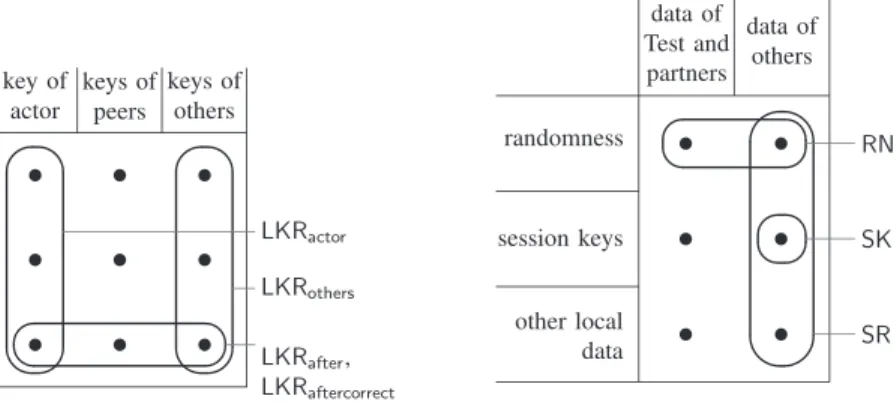
Figure 5 depicts the relationships between our long-term key compromise rules in the relevant dimensions: the rows specify when the compromise occurs and the columns specify whoselong-term keys are compromised. With respect towhena com-promise occurs, we differentiate between before, during, and after the test thread. With
a∈Agent a6∈ {σTest(R) | R∈dom(P)}
(tr,IK, th, σTest)−→(trˆh(tidA,LKR(a))i,IK∪LongTermKeys(a), th, σTest)
[LKRothers]
a=σTest(RTest) a6∈ {σTest(R) | R∈dom(P)\ {RTest}}
(tr,IK, th, σTest)−→(trˆh(tidA,LKR(a))i,IK∪LongTermKeys(a), th, σTest)[
LKRactor]
a∈Agent th(Test) =hi
(tr,IK, th, σTest)−→(trˆh(tidA,LKR(a))i,IK∪LongTermKeys(a), th, σTest)
[LKRafter]
a∈Agent th(Test) =hi tid∈Partner(tr, σTest) th(tid) =hi
(tr,IK, th, σTest)−→(trˆh(tidA,LKR(a))i,IK∪LongTermKeys(a), th, σTest)
[LKRaftercorrect]
tid6=Test tid6∈Partner(tr, σTest)
(tr,IK, th, σTest)−→(trˆh(tidA,SKR(tid))i,IK∪union((tr↓tid)⇂sessionkeys), th, σTest)[
SKR] tid6=Test tid6∈Partner(tr, σTest) th(tid)6=hi
(tr,IK, th, σTest)−→(trˆh(tidA,SR(tid))i,IK∪last((tr↓tid)⇂state), th, σTest) [SR]
(tr,IK, th, σTest)−→(trˆh(tidA,RNR(tid))i,IK∪union((tr↓tid)⇂generate), th, σTest) [RNR]
Fig. 4. Adversary-compromise rules
before Test thread during Test thread after Test thread key of actor keys of peers keys of others t t t t t t t t t ✓ ✒ ✏ ✑ ✓ ✒ ✏ ✑ ✎ ✍ ☞ ✌ LKRactor LKRothers LKRafter, LKRaftercorrect Fig. 5. Relating long-term data reveal rules
randomness session keys other local data data of Test and partners data of others t t t t t t ✎ ✍ ☞ ✌ ✎ ✍ ☞ ✌ ✗ ✖ ✔ ✕ RNR SKR SR
Fig. 6. Relating short-term data reveal rules
respect towhosekeys are compromised, we differentiate between agents not involved in the communication (others), the agent performing the test thread (actor), and the other partner (peer). The ovals specify the effects of each long-term key reveal rule. Compromise of short-term data. The three remaining adversary rules correspond to the compromise of short-term data, that is, data local to a specific thread. In Figure 6, we show the relevant dimensions:whose data, specified by the columns, and which kind of data, specified by the rows. Whereas we assumed a long-term key compromise reveals all long-term keys of an agent, we differentiate here between the different kinds of local data. Because we assume that local data does not exist before or after a session, we can ignore the temporal dimension.
We differentiate between three kinds of local data: randomness, session keys, and other local datasuch as the results of intermediate computations. The notion that the adversary may learn the randomness used in a protocol stems from [LaMacchia et al. 2007]. Considering adversaries that can reveal session keys, for example, by crypt-analysis, is found in many works, such as [Bellare and Rogaway 1993]. An adversary capable of revealing the local state is described in [Canetti and Krawczyk 2001].
In our adversary-compromise models, the session-key reveal event SKR(tid) and state reveal event SR(tid) model that the adversary gains access to the session key or, respectively, the local state of the threadtid. These are marked respectively by the sessionkeysandstateevents.
The contents of the state change over time and are erased when the thread ends. This is reflected in theSRrule by thelaststate marker for the state contents and the third premise requiring that the threadtidhas not ended. The random number reveal event RNR(tid) models that the adversary learns the random numbers generated in the threadtid.
Note that the premise of theSKRandSRrules requires that the compromised thread is not a partner thread. In contrast, the premise of theRNRrule allows for the compro-mise ofallthreads, including the partner threads. This rule is inspired by [LaMacchia et al. 2007], where it is shown that it is possible to construct protocols that are correct in the presence of an adversary capable ofRNR.
For protocols that establish a session key, we assume the session key is shared by all partners and should be secret: revealing it trivially violates this property. Hence the SKRrule disallows the compromise of session keys of the test or partner threads. Similarly, our basic rule set does not contain a rule for the compromise of other local data of the partners. Including such a rule is straightforward. However it is unclear whether any protocol would be correct with respect to such an adversary.
We call each subset of the set of adversary rules from Figure 4 anadversary model. 3.6. Transition relation
Given a protocol and an adversary model, we define the protocol’s behavior as a set of reachable states.
Definition3.10 (Transition relation and reachable states). LetPbe a protocol,Adv an adversary model, andRTesta role. We define atransition relation→P,Adv,RTest from
the execution rules from Figure 3 and the rules in Adv. The variables P, Adv, and RTest in the adversary rules are instantiated by the corresponding parameters of the transition relation. For statessands′,s→
P,Adv,RTest s
′ iff there exists a rule in either
Advor the execution rules with the premisesQ1(s), . . . , Qn(s)and the conclusions→s′ such that all of the premises hold. We define the set ofreachable statesRSas
RS(P,Adv, RTest) =
s
∃s0. s0∈IS(P)∧s0→∗P,Adv,RTest s .
Finally, we define a partial order ≤A on adversary-compromise models based on inclusion of reachable states.
Definition3.11 (Order on adversary-compromise models≤A). For all adversary modelsAdv andAdv′:
Adv≤AAdv′≡ ∀P, R.RS(P,Adv, R)⊆RS(P,Adv′, R).
We writeAdv =AAdv′if and only ifAdv≤AAdv′andAdv′≤AAdv. As is standard, we writeAdv <AAdv′ if and only ifAdv ≤AAdv′ and notAdv =AAdv′.
Table I. Decomposing security properties
Decomposition Security property
Basic property Adversary model
Perfect Forward Secrecy Secrecy {LKRafter}
Weak Perfect Forward Secrecy Secrecy {LKRaftercorrect}
Known-Key Security & Unknown-Key Share Secrecy of session key {SKR} Key Compromise Impersonation Authentication/Secrecy of sess. key {LKRactor} 3.7. Security properties
We now provide two examples of security property definitions. We give a symbolic def-inition of session-key secrecywhich, when combined with different adversary models, gives rise to different notions of secrecy from the literature. We also definealiveness, which is one of the many forms of authentication [Cremers et al. 2006; Lowe 1997]. Other security properties, like secrecy of general terms, symbolic indistinguishability, or other variants of authentication can be defined analogously.
Definition3.12 (Session-key secrecy). Let(tr,IK, th, σTest)be a state. We define the secrecy of the session keys in(tr,IK, th, σTest)as
th(Test) =hi ⇒ ∀k∈union((tr↓Test)⇂sessionkeys).IK 0k .
Definition3.13 (Aliveness for two-party protocols). Let (tr,IK, th, σTest)be a state. We say that(tr,IK, th, σTest)satisfiesalivenessif and only if
th(Test) =hi ⇒ ∃i, i′, j, RTest, R, tid, a. tri= (Test,create(RTest, a))
∧tri′ =last(tr↓Test)∧trj= (tid,create(R, σTest(R)))∧R6=RTest∧j < i′. Intuitively, the above property formalizes that if the test thread ended, the trace con-tains the first and last events of the test thread (tri and tri′) and additionally the intended peer (σTest(R)) started a thread in the other role before the last event of the test thread.
Let Φbe the set of all state properties. For all protocols P, adversary modelsAdv, and state propertiesφ∈Φ, we writesat(P,Adv, φ)iff∀R.∀s. s∈RS(P,Adv, R)⇒φ(s). In the context of a state property φ, we say a protocol is resilient to an adversary capabilityAC if and only ifsat(P,{AC}, φ).
Decomposing security properties. Many definitions of security properties, such as per-fect forward secrecy, contain elements of adversary capabilities. In our framework, such properties are cleanly separated into a basic security property (such as secrecy or authentication) and an adversary model. In Table I, we decompose different security properties from the literature this way.
Our way of modeling security properties provides a uniform view of protocol prop-erties in an execution environment where adversaries have given capabilities. It also allows for direct generalizations of security properties. This leads to new, practically relevant combinations of adversary models and basic security properties. For example, for a hardware security module restricted to protecting long-term keys, relevant prop-erties could be secrecy or agreement, resilient to state-reveal. Other propprop-erties arise by considering the combination of our adversary models with other basic properties like non-repudiation, (plausible) deniability, anonymity, or resistance to denial-of-service attacks.
3.8. Relations between Models and Properties
As previously noted, by classifying different basic adversarial capabilities from the literature, one arrives at a large number of adversary models. Here we provide general results that aid in relating and reasoning with these models.
To begin with, our partial order on adversary models≤A has implications for secu-rity protocol verification. Given a state propertyφlike those from Section 3.6, a proto-col that satisfiesφin a model also satisfiesφin all weaker models. Equivalently, falsifi-cation in a model entails falsififalsifi-cation in all stronger models. Formally, ifAdv ≤AAdv′, then for all protocols P and state properties φ, sat(P,Adv′, φ) ⇒ sat(P,Adv, φ) and, equivalently,¬sat(P,Adv, φ)⇒ ¬sat(P,Adv′, φ).
Since adding adversary rules only results in more transitions and hence more reach-able states, we have:
LEMMA3.14 (ADDING RULES STRENGTHENS THE ADVERSARY). Letrbe an adver-sary rule from Figure 4 andAdv be an adversary model, i. e., a set of adversary rules. ThenAdv ≤AAdv∪ {r}.
Most of our rules are independent in that they provide adversary capabilities not given by other rules. The following lemma formalizes this.
LEMMA3.15 (RULE INDEPENDENCE). Let Adv be an adversary model. Then we have for all adversary rulesrfrom Figure 4
r=LKRaftercorrect∧LKRafter ∈Adv⇔ Adv\ {r}=AAdv∪ {r}.
Proof of (⇒): Letr=LKRaftercorrectandLKRafter∈Adv. Each transition usingLKRaftercorrect
can be simulated usingLKRafter. Hence the sets of reachable states on both sides of the
above equality are equal and thusAdv\ {r}=AAdv∪ {r}.
Proof of (⇐): Let Adv \ {r} =A Adv ∪ {r}. Suppose r 6= LKRaftercorrect. Then there are
transitions enabled by r that are not enabled by the other rules. In particular, even if LKRaftercorrect ∈ Adv, there are protocols with roles that can be completed without
matching sessions, whereby LKRafter enables transitions not enabled by LKRaftercorrect.
Hence we have a contradiction and thereforer=LKRaftercorrect. Now supposeLKRafter 6∈ Adv. Then some transitions enabled byr are not enabled byAdv\ {r}, contradicting Adv\ {r}=AAdv∪ {r}. Hencer=LKRaftercorrectandLKRafter∈Adv.
COROLLARY 3.16. The rules in Figure 4 give rise to25×3 = 96models with distinct
sets of reachable states.
This corollary follows from Lemmas 3.14 and 3.15. In particular, the five rules except forLKRaftercorrectandLKRafterare independent, giving rise to25models. TheLKRafterrule
strictly subsumes the transitions enabled by the LKRaftercorrect rule, and therefore the
union of the two rules does not yield additional transitions. The possible combinations of these two rules therefore yield three distinct sets of enabled transitions.
Interestingly, to evaluate some properties it is only necessary to consider traces up to the end of the test session.
Definition3.17 (Post-test invariant properties). We define the set ofpost-test invari-ant propertiesas all state propertiesφ∈Φthat satisfy
∀P, R,Adv.∀(tr,IK, th, σTest)∈RS(P,Adv, R). th(Test) =hi ⇒
∀s.(tr,IK, th, σTest)→∗P,Adv,RTest s⇒ φ((tr,IK, th, σTest))⇔φ(s)
. Aliveness, as given in Definition 3.13, is post-test invariant: the transitions that occur after the end of the test thread do not influence the property. Other authentication properties such as various forms of agreement [Lowe 1997] or synchronisation [Cre-mers et al. 2006] are also post-test invariant. Secrecy however is not such a property.
THEOREM3.18 (POST-TEST INVARIANT PROPERTIES AND FUTURE CAPABILITIES). Letrbe an adversary rule from Figure 4 andφbe a post-test invariant property. Then
for all protocolsP and adversary modelsAdv,
r∈ {LKRaftercorrect,LKRafter} ∧sat(P,Adv, φ)⇒sat(P,Adv∪ {r}, φ)
Put differently, post-test invariant properties are resilient to future capabilities. This theorem follows as LKRaftercorrect and LKRafter only enable new transitions in
those states where the test thread has ended. By definition, post-test invariant proper-ties are invariant with respect to such transitions. Hence, we need only consider32(out of96) models when analyzing a protocol with respect to post-test invariant properties. Note that some alternate approaches use a fixed adversary model, but use differ-ent assumptions in differdiffer-ent security goals to constrain which adversary actions are considered in that goal. In those approaches, our partial order on adversary models is mirrored by the partial order of logical entailment among the assumptions.
4. PROTOCOL-SECURITY HIERARCHIES
We introduce the notion of aprotocol-security hierarchy. Such a hierarchy orders sets of security protocols with respect to the adversary models in which they satisfy their security properties. Protocol-security hierarchies can be used to select or design proto-cols based on implementation requirements and the worst-case expectations for adver-saries in the application domain.
It follows from Corollary 3.16 that determining for which adversary models a pro-tocol satisfies its state properties involves analyzing the propro-tocol with respect to 96
models. Since this is infeasible to do by hand, we will use automated analysis methods for this task.
Automated methods have the limitation that, for our models, even simple proper-ties such as secrecy are undecidable. Fortunately, there exist semi-decision procedures that are successful in practice in establishing the existence of attacks. Moreover, some of these procedures can also successfully verify some protocols and properties. When analyzing the security properties of protocols with respect to an adversary model, we deal with undecidability by allowing the outcome of the analysis to be undefined, which we denote by⊥. The two other possible outcomes areF (falsified) orV (verified).
Definition4.1 (Recursive approximation ofsat). We say that a function f ∈ Protocol ×A×Φ → {F,⊥, V} recursively approximates sat if and only if f is recur-sive and for all protocols P, adversary models Adv, and state propertiesφ, we have f(P,Adv, φ)6=⊥⇒ f(P,Adv, φ) =V ⇔sat(P,Adv, φ)
.
Given such a functionf, we can define a protocol-security hierarchy.
Definition4.2 (Protocol-security hierarchy). Let Π be a set of protocols, φ a state property, Abe a set of adversary models, and let f recursively approximatesat. The protocol-security hierarchywith respect toΠ,A,φ, andfis a directed graphH = (N,→)
that satisfies the following properties: (1) N is a partition ofΠ, i. e.,S
π∈Nπ= Πand for allπ, π′ ∈N we have thatπ6=∅and π6=π′⇒π∩π′=∅.
(2) The functionf respects the partitionsN in that for allP, P′∈Πwe have
∃π∈N.{P, P′} ⊆π
⇔ ∀Adv ∈A.f(P,Adv, φ) =f(P′,Adv, φ). (3) π→π′ if and only if
∀P∈π.∀P′ ∈π′.∀Adv ∈A. f(P,Adv, φ) =V ⇒f(P′,Adv, φ) =V ∧ f(P′,Adv, φ) =F ⇒f(P,Adv, φ) =F.
{Needham-Schroeder-Lowe} {LKRothers,LKRafter,SKR,SR} {Needham-Schroeder} {LKRafter,SKR}
Fig. 7. A simple protocol-security hierarchy for authentication.
LEMMA 4.3. LetH = (N,→)be a protocol-security hierarchy with respect toΠ,φ,A, andf. Let≤H be defined as follows: for allπ, π′ ∈N,π≤Hπ′iffπ→π′. Then≤H is a partial order.
Proof. First,→is reflexive by properties 2 and 3, and hence≤His also reflexive. Second, since →is transitive by Property 3, so is ≤H. Finally, assumeπ ≤H π′ andπ′ ≤H π. Thenπ→π′andπ′ →π. Hence, by Property 3, for all adversary modelsAdv ∈Aand all protocolsP ∈π, P′ ∈ π′, we havef(P,Adv, φ) = f(P′,Adv, φ). By Property 2, this implies thatπ=π′ and therefore≤
His antisymmetric. Hence≤His a partial order. Effectively, a node in a protocol-security hierarchy represents an equivalence class of protocols whose members satisfy the security property with respect to the same set of adversary models. When visualizing a protocol-security hierarchy, we display two sets for each node: the set of protocolsP and the set of adversary modelsS for which the protocols satisfy the security property. Roughly speaking, each of the protocols in P satisfies the security property with respect to the adversary model m if and only if there exists an adversary model m′ such thatm ≤
A m′ andm′ ∈ S. Note that we omit implied weaker adversary models from the visualisation, that is, ifPsatisfies its properties with respect tomandm′ where{m, m′} ⊆ Aandm≤
Am′, we includem′ but notmin the set of adversary models on the node.
Formally, we annotate each nodeπwith all adversary modelsa∈Afor which ∀a′∈A, P ∈π.(a <Aa′⇒f(P, a′, φ) =F)∧(a′≤Aa⇒f(P, a′, φ)6=F) where we use≤Aand<Afrom Definition 3.11.
Example4.4 (Protocol-security hierarchy). In Figure 7 we show an example of a simple protocol-security hierarchy for two well-known protocols, the Needham-Schroeder protocol and Lowe’s variant, with respect to the synchronisation property.
The Needham-Schroeder protocol [Needham and Schroeder 1978] is resilient to ad-versaries capable ofLKRafter andSKR. By Theorem 3.18, all authentication properties
of any protocol are resilient to LKRafter. The fact that the protocol is resilient toSKR
is not surprising as the protocol does not contain any session keys. Conversely, if the adversary has theLKRothers capability, the Needham-Schroeder protocol is vulnerable
to a man-in-the-middle attack. There are also attacks on the protocol if the adversary has any capability from the set{LKRactor,RNR,SR}. For example, the protocol is
vulner-able toSRbecause the missing identity in the second message allows the adversary to exploit a non-matching session to decrypt this message, in which he usesSRto reveal the nonce of the first message. Therefore, the Needham-Schroeder protocol satisfies synchronisation with respect to exactly four adversary models: ∅, {LKRafter}, {SKR},
and{LKRafter,SKR}. These four models are all weaker than or equal to{LKRafter,SKR}.
Hence we label the node with (1) the singleton set of the Needham-Schroeder protocol, and (2) the (singleton) set of adversary models in which it is correct, where we omit all weaker adversary models.
Lowe’s version of the protocol [Lowe 1996] was designed to prevent the man-in-the-middle attack that exploits LKRothers. Perhaps surprisingly, his fix also prevents the
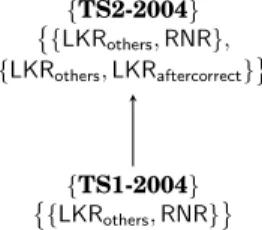
{TS2-2004} {LKRothers,RNR}, {LKRothers,LKRaftercorrect} {TS1-2004} {LKRothers,RNR}
Fig. 8. A simple protocol-security hierarchy for secrecy. The edge is non-strict.
SR attack. In the fixed version of the protocol, sessions that do not match the test session will not accept messages that contain the test-session’s nonce. Thus, the SR rule can no longer be used to reveal these nonces, preventing the attack. Combining these results, we draw a node for the Needham-Schroeder-Lowe protocol that lists the protocol’s resilience to the adversary model {LKRothers,LKRafter,SKR,SR} and any
weaker models.
Because the Needham-Schroeder-Lowe protocol meets the security property with re-spect to all adversary models (and more) than those for which the Needham-Schroeder protocol meets the property, we draw an edge between the nodes.
Automatic generation of protocol-security hierarchies. Because of the large number of possible adversary models, manual construction of protocol-security hierarchies is infeasible for large sets of protocols and is best aided by a model checker.
The Scyther tool [Cremers 2008a] recursively approximates sat and produces an output from{F,⊥, V}.F denotes that Scyther found an attack, thereby falsifying the property, V denotes that Scyther verified the property, and ⊥denotes that either a timeout occurred or Scyther could not verify the property without bounds.
Using our extended version of the Scyther tool, the properties of a protocol can be automatically analyzed with respect to all adversary models. Given a set of protocols, the tool computes a protocol-security hierarchy by combining this data for each of the protocols with the order ≤A on the adversary models. The protocol description files, analysis tools, and graph generation scripts can be downloaded from [Cremers 2014].
Ideally we would like to establish hierarchies based onsat. However, only the recur-sive approximationf is available, which may return⊥, thereby providing only partial information about sat. Consequently, some edges in the hierarchies (involving nodes wheref yields⊥) are also based on this partial information. Roughly speaking, we say an edge isstrictif it also occurs between the protocols when given complete information aboutsat. More formally:
Definition4.5 (strictness of edges in a protocol-security hierarchy). We say an edge π→π′in a protocol-security hierarchy isstrictif the following two properties hold. (1) The protocols inπ′are at least as strong as those inπ.
∀P ∈π, P′∈π′.∀Adv ∈A. f(P,Adv, φ)6=F ⇒f(P′,Adv, φ) =V (2) The protocols inπare not equally strong as those inπ′.
∀P∈π, P′∈π′.∃Adv∈A. f(P,Adv, φ) =F∧f(P′,Adv, φ) =V
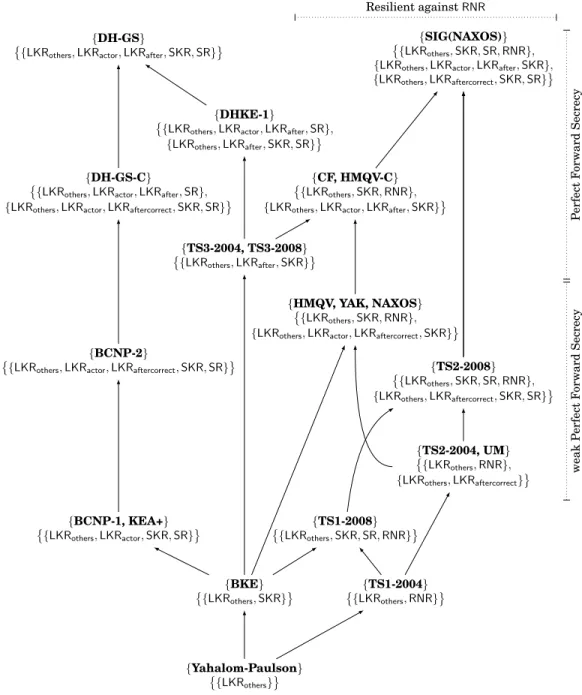
All edges in the authentication hierarchies in Figure 7 and Figure 12 are strict. This reflects Scyther’s success in either verifying or falsifying these protocols. In contrast, for the secrecy hierarchies in Figure 8 and Figure 11, most protocols contain Diffie-Hellman exponentiation, for which Scyther does not provide (unbounded) verification. Therefore, the edges in these figures are only based on attacks. Because they are not strict, they might not occur in the corresponding hierarchy based onsat.
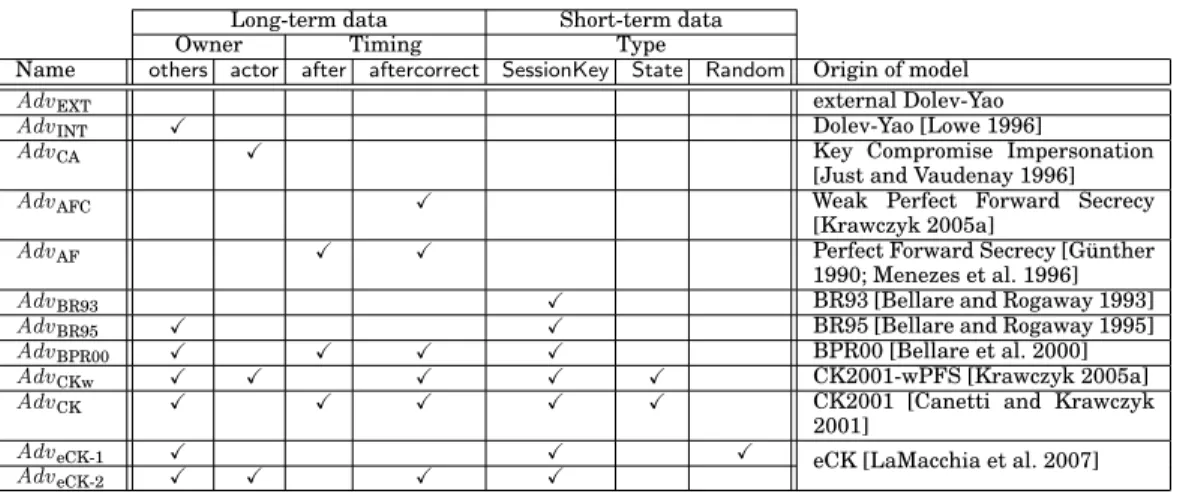
Table II. Mapping adversary-compromise models from the literature
Long-term data Short-term data
Owner Timing Type
Name others actor after aftercorrect SessionKey State Random Origin of model
AdvEXT external Dolev-Yao
AdvINT X Dolev-Yao [Lowe 1996]
AdvCA X Key Compromise Impersonation
[Just and Vaudenay 1996]
AdvAFC X Weak Perfect Forward Secrecy
[Krawczyk 2005a]
AdvAF X X Perfect Forward Secrecy [G ¨unther
1990; Menezes et al. 1996]
AdvBR93 X BR93 [Bellare and Rogaway 1993]
AdvBR95 X X BR95 [Bellare and Rogaway 1995]
AdvBPR00 X X X X BPR00 [Bellare et al. 2000]
AdvCKw X X X X X CK2001-wPFS [Krawczyk 2005a]
AdvCK X X X X X CK2001 [Canetti and Krawczyk
2001]
AdveCK-1 X X X
AdveCK-2 X X X X eCK [LaMacchia et al. 2007] Intuitively, the interpretation of the set of adversary models of a nodeπ, for hierar-chies with non-strict edges, is the following:
(1) No attacks have been found on the protocols for these models and all weaker ones. (2) For each node π′ higher in the hierarchy, there exists an adversary model a in the annotation ofπ′ such that an attack was found on all protocols fromπfor the adversary modela.
In Section 5.4 we perform an extensive case study that includes the automatic gen-eration of larger protocol security hierarchies. We also show how such hierarchies can be used in protocol analysis.
5. APPLICATIONS AND CASE STUDIES
5.1. Modeling adversary notions from the literature
We use our modular semantics to provide a uniform formalization of different adver-sary models, including a number of established adveradver-sary models from the computa-tional setting [Canetti and Krawczyk 2001; Bellare et al. 2000; Bellare and Rogaway 1995; Krawczyk 2005a; LaMacchia et al. 2007]. We focus on the adversary capabilities only, abstracting from subtle differences between the computational models. For exam-ple, the model in [Canetti and Krawczyk 2001] has an execution model that restricts the agents’ choice of thread identifiers, leading to a different notion of partner threads than in other models. Here we define partnering uniformly by matching histories. We refer the reader to [Choo et al. 2005a; Menezes and Ustaoglu 2008; Bresson et al. 2007; Choo et al. 2005b] for further details on the differences between computational models. Table II provides an overview of different adversary models, interpreted as instances of our semantics. We write AdvCK to denote the adversary model extracted from the
CK model [Canetti and Krawczyk 2001] and similarly for other models. A check (X) denotes that the rule labeling the column is included in the adversary model named in the row.
5.2. Tool support
We extended the symbolic security-protocol verification tool Scyther [Cremers 2008a; 2008b] with our adversary rules from Figure 4. We used this tool to automatically analyze a set of protocols, described below. The tool, all protocol models, and test scripts can be downloaded from [Cremers 2014].
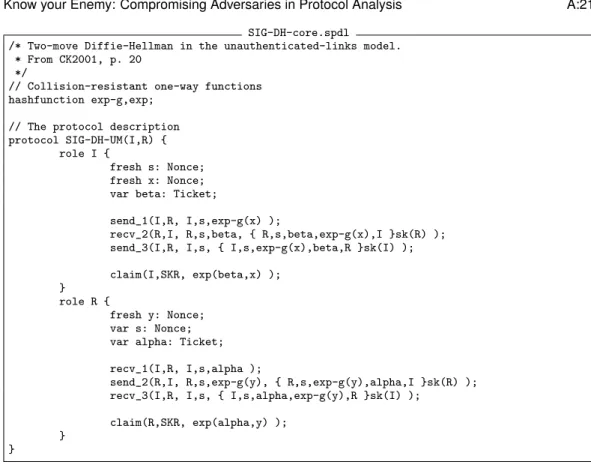
SIG-DH-core.spdl
/* Two-move Diffie-Hellman in the unauthenticated-links model. * From CK2001, p. 20
*/
// Collision-resistant one-way functions hashfunction exp-g,exp;
// The protocol description protocol SIG-DH-UM(I,R) {
role I {
fresh s: Nonce; fresh x: Nonce; var beta: Ticket;
send_1(I,R, I,s,exp-g(x) );
recv_2(R,I, R,s,beta, { R,s,beta,exp-g(x),I }sk(R) ); send_3(I,R, I,s, { I,s,exp-g(x),beta,R }sk(I) ); claim(I,SKR, exp(beta,x) );
} role R {
fresh y: Nonce; var s: Nonce; var alpha: Ticket; recv_1(I,R, I,s,alpha );
send_2(R,I, R,s,exp-g(y), { R,s,exp-g(y),alpha,I }sk(R) ); recv_3(I,R, I,s, { I,s,alpha,exp-g(y),R }sk(I) );
claim(R,SKR, exp(alpha,y) ); }
}
Fig. 9. Input file for the Scyther tool, specifying the two-message signed Diffie-Hellman protocol.
In Figure 9 we show the concrete input file for the Scyther tool that specifies the two-message signed Diffie-Hellman protocol. In the description, theTickettype of the variables alpha and beta corresponds to all possible terms. The abstract functionsexp
and exp-grespectively denote modular exponentiation of two terms, and raising the
generatorgto the power of a term. Additional rules to approximate the Diffie-Hellman equational theory have been omitted from the figure but can be found in the down-loadable model archives. The claim events claim(I,SKR,...) and claim(R,SKR,...) encode the desired security property. Here,SKR denotes that the following term is a session-key, which implies that (a) it can be revealed through the SKR rule, and (b) it should be secret as in Definition 3.12. The adversary model is specified indepen-dently, either through the tool’s GUI or through its command-line/batch mode. Scyther coarsely approximates Diffie-Hellman using additional roles that model a subset of the equations for modular exponentiation, see [Cremers 2014].
5.3. Attack examples
MQV, HMQV, and variants.The MQV protocol family [Krawczyk 2005b; Ustaoglu
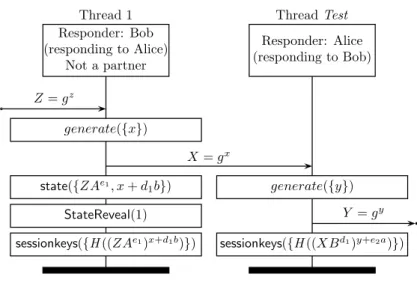
2008; Law et al. 2003] is a class of authenticated key-exchange protocols designed to provide strong security guarantees. The HMQV protocol was proven secure with re-spect to the adversary model in [Krawczyk 2005a]. This model is the analog of our AdvCKw model, where the local state of HMQV is defined as the random values
gen-erated for the Diffie-Hellman key-exchange. Our tool automatically finds that under certain definitions of the session-state, the HMQV protocol is insecure in adversary