Information Systems Managers' Perceptions of the Advantages
and Disadvantages of Telecommuting: A Multivariate Analysis
T. Selwyn Ellis and Robert L. Webster Ouachita Baptist University
[email protected] [email protected]
Abstract
Information Systems (IS) managers from two geographic regions of the United States, the West Coast and the Southeast, were selected as the population to study. The IS managers were asked to respond to a series of twelve advantages and eleven disadvantages associated with telecommuting. Each item's importance was recorded on a seven point Likert scale, where a one indicated very unimportant and a seven indicated very important. Demographic data of respondents were also collected to identify age, organization size, salary level, and whether or not their company had a telecommuting program in place. Prior telecommuting research has not addressed the viewpoint of Information Systems managers, nor have distinctions been made geographically and organizationally between firms that have instituted a telecommuting program and those that have not. This research extends the body of knowledge by concentrating on these heretofore unstudied areas.
Introduction
Telecommuting is an innovative work style that enables employees to work at home or from some other remote site away from the office. The practice of telecommuting has the potential to impact numerous social, economic, and environmental problems associated with conventional commuting. For example, telecommuting parents could care for small children while working at home and physically challenged persons could avoid daily commutes, thereby facilitating their set of needs [14]. On the economic front, telecommuting employees could save on transportation, food, clothing, and child care costs [14]. Employers may also benefit from telecommuting, as telecommuting employees have been found to be more satisfied, punctual, productive, and less stressed in the workforce [1][17]. Additionally, employer office space requirements may be reduced [2]. Environmental benefits that may occur include reduced gasoline consumption and hydrocarbon pollutant discharge [18]. The potential social, economic, and environmental benefits resulting from remote telecommuting may increase as telecommuting distances lengthen.
The term "telecommuting" was introduced in 1973 by Jack Nilles, a California resident. California has been
heavily exposed to the benefits of telecommuting ever since. In 1984, many Los Angeles residents telecommuted because of the increased traffic during the Olympic Games. The State of California established a telecommuting program for state agencies in 1987. Later, legislation was proposed in California to provide tax credits for employers who implemented telecommuting programs. [16] California was the breeding ground for telecommuting programs in the United States.
Although numerous benefits have been attributed to telecommuting, there are also risks and costs associated with telecommuting. Some of the drawbacks cited by telecommuting employees include loneliness, lower salaries or benefits, and being overlooked for promotions and pay raises. Organizational managers have expressed concern over security implications and control problems [15]. As a variety of both advantages and disadvantages have been expressed concerning telecommuting, this research investigates if geographic location and/or type of organization affect the IS manager's perceptions of the advantages and disadvantages of telecommuting.
Telecommuting is becoming a more accepted style of work. The number of telecommuters in the United States was estimated at 8.1 million in September 1995 and will possibly reach 11 million by the year 2000 [7]. A recent survey revealed that two-thirds of Fortune 1000 companies currently have telecommuting programs. The executives surveyed felt that telecommuting was not only advantageous for employees, but also beneficial to employers and organizations.[10] The federal government hopes to have 60,000 employees telecommuting by the end of 1997. [11] While the practice of telecommuting is growing, it is estimated that 40% of today's workforce could be telecommuting and only 10% are actually doing it. [6]
Literature Review
DeSanctis [4], Duxbury, Higgins, and Irving [5], and Yap and Tng [18] conducted studies which examined the attitudes of telecommuters and organizational managers toward telecommuting. None, have looked specifically at the attitudes of IS managers.
DeSanctis studied telecommuting attitudes of managers and programmers in the United States. She found that programmers were more likely to favor telecommuting than managers. When asked an open-ended question about
telecommuting, she found that programmers were more likely to mention advantages, whereas managers would mention disadvantages. However, the two groups did identify many of the same advantages and disadvantages.
Duxbury, Higgins, and Irving studied telecommuting attitudes of 78 managers and 68 employees. They found that employees were more attracted to work-at-home programs than were the managers of this potential group. Their findings were inconclusive concerning the desirability of telecommuting programs, however, were inconclusive.
Yap and Tng examined programmers, systems analysts, and other computer professionals in Singapore. They found that 73% of the respondents favored telecommuting. Those favoring telecommuting cited care for children and families, flexible work schedules, and increased freedom as the major benefits. The concerns listed by the respondents included potential communication barriers, lack of social interaction, and professional isolation.
The Study
Research has found that most corporate executives tend to the financial and managerial matters and delegate computer-related, technological decisions to the IS managers. Also, research has shown that corporate managers are not as comfortable with decisions involving technology and thus delay or even avoid such decision areas. Because of this, IS managers were chosen as the population to study because of the responsibility put upon them for decisions involving technology[3].
IS managers from two distinct geographic regions of the United States, the West Coast and the Southeast, were selected as the research population. The West Coast was chosen since telecommuting was introduced in that area, and California in particular is seen as a cutting edge area for implementing new technologies. The Southeast region was chosen as a comparison group. This area was thought to represent a more conservative business area and therefor a sort of opposite end of the spectrum from the West Coast. The IS managers were asked to respond by mail to a survey (789 mailed) which included questions concerning the advantages and disadvantages of telecommuting. These advantages and disadvantages were derived from the results associated with prior studies of telecommuting attitudes [12] [14] [15] [18]. Each advantage and disadvantage was graded on a seven point Likert scale, where a one indicated the item was considered very unimportant and a seven indicated the item was very important.
Data were collected to identify geographic region, age of respondent, organization size, individual salary, and whether or not the respondent's company had a telecommuting program in place. Of the 159 respondents (20.2% response rate), 51 percent were from the West coast
and 49 percent were from the Southeast. Approximately 28.5 percent of the respondents currently worked in an organization which had a formal telecommuting program.
Research Problem and Hypotheses
The objective of this research was to determine if IS managers from the differing geographical regions and/or organizational environments perceived the importance of the advantages and disadvantages of telecommuting differently.Hypothesis 1: There is no difference among IS managers in the perceived importance of the advantages and disadvantages of telecommuting based on geographic location.
Hypothesis 2: There is no difference among IS managers in the perceived importance of the advantages and disadvantages of telecommuting based on whether or not their company has a formal telecommuting program.
Hypothesis 3: There is no difference among IS managers in the perceived importance of the advantages and disadvantages of telecommuting based on the interaction of region and telecommuting program.
Methodology
The data collected concerning the IS managers' perception of twelve advantages and eleven disadvantages were categorized using a varimax rotated principal component factor analysis. Tables 1 and 2 display the various advantages and disadvantages used in this study and show the factor loadings for each of the items. The loadings indicate a significant relationship between the items in each of the factors since all but one are greater than .50, the critical value for significant loadings [8]. Subsequently, the dependent variables in this study were created by calculating the mean of the individual items which loaded on the particular factors.
The data were then analyzed by using Multivariate Analysis of Variance (MANOVA). MANOVA is concerned with differences between groups, or experimental treatments. MANOVA is termed a multivariate statistical procedure as it is used to assess group differences across multiple dependent metric variables simultaneously [8].
TABLE 1
ADVANTAGES OF TELECOMMUTING
Factors Persona Organizational Facilities Societal
Environmental Benefits .802
Increased Handicapped
Work Force .737
Improved Productivity .809 Improved Employee Retention .802
Office Space Control .805
Facilitated Recruitment .494
Reduced Need for Parking .863 Greater Sense of Control of Job
for Telecommuter .746 More Flexible Schedule for
Telecommuter .628 Improved Communication Skills
of Telecommuter .635 Fewer Interruptions
for Telecommuter .700 Savings on Food, Transportation,
and Clothing .677
TABLE 2
DISADVANTAGES OF TELECOMMUTING
Factors Factors
Personal Organizational Technological Decentralization of Workers .560
Risk and Security of Data .742
Increased Training Costs .552
Hardware, Software, and
Equipment Costs .743
Greater Pressures on Managers
of Telecommuters .801 Lack of Face-to-Face Contact
with Employees .784 Increased Organizational
Planning for Work .663 Self-Motivation Required .637 Loneliness of Telecommuter .716 Training Time for Telecommuter .744 Possible Neglect of Telecommuter
by Management .536
MANOVA is deemed particularly useful when employed in conjunction with experimental designs in which the researcher controls and manipulates one or more independent variables to determine the effect on two or more dependent metric variables [8]. Additionally, MANOVA does away with the problem of a series of individual F-tests (which may lead to increased type 1 errors) by testing the linear combination of all dependent variables simultaneously.
In the study, the seven dependent variables were metric variables based upon means of scaled items. The use of scale based metric variables is a common practice and is demonstrated by Hair, Anderson, and Tatham [8] and Johnson and Wichern [9]. The two independent variables were geographic location and type of organization. An interaction variable was also placed in the model.
The Research Model
The model used to test the given hypotheses is stated as follows:
Yij = U + A + B + A B + E where:i j i j ij
Yij = the vector of responses for each category item from a participant j in group i.
U = overall or grand mean effect.
Ai = effect of level i of factor A (geographic location) on the seven constructs for i=1,2.
Bj = effect of level j of factor B (telecommuting program) on the seven constructs for j=1,2. AB =ik interaction effect of level i of factor A and level
j of factor B.
Eij = random error present in response j in cell i, for j=1,2,...ni.
Practically stated, the model was as follows. Immediately following the model, all variables are defined and the shortened names of the variable are listed for use in the tables that follow.
Y , Y , Y , Y , Y , Y , Y = X , X , X where:1 2 3 4 5 6 7 1 2 3 Y = Personal and Professional Advantages (PERSADV)1 Y = Organizational Advantages (ORGADV)2
Y = Facilities and Infrastructure Advantages (FACADV)3 Y =Societal Advantages (SOCADV)4
Y = Personal and Behavioral Disadvantages (PERSDIS)5 Y = Organizational Development Disadvantages (ORGDIS)6 Y = Technological Disadvantages (TECHDIS)7
X = Location (West Coast or Southeast) (REGION)1 X = Telecommuting Program (Yes or No) (TELECOM)2 X = Interaction Term (REGION and TELECOM)3
Results
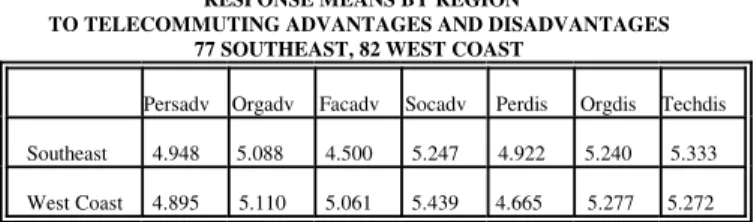
Table 3 displays the mean importance levels reported by region for each of the seven dependent variables. Means were computed from responses based on a one through seven scale.
TABLE 3
RESPONSE MEANS BY REGION
TO TELECOMMUTING ADVANTAGES AND DISADVANTAGES 77 SOUTHEAST, 82 WEST COAST
Persadv Orgadv Facadv Socadv Perdis Orgdis Techdis
Southeast 4.948 5.088 4.500 5.247 4.922 5.240 5.333
West Coast 4.895 5.110 5.061 5.439 4.665 5.277 5.272
Table 4 displays the mean importance levels reported by type of organization (formal telecommuting program or not) for each of the seven dependent variables. Means were computed from responses based on a one through seven scale.
TABLE 4
RESPONSE MEANS BY TELECOMMUTING PROGRAM TO TELECOMMUTING ADVANTAGES AND DISADVANTAGES 48 TELECOMMUTING PROGRAM, 111 NO TELECOMMUTING PROGRAM
Persav Orgadv Facadv Socadv Persdis Orgdis Techdis
Program 4.944 5.155 4.797 5.365 4.863 5.347 5.354
No Program
4.867 4.969 4.771 5.302 4.621 5.057 5.181
Results
Multivariate analysis of variance was the statistical test used to test the research hypotheses. Since one requirement of the MANOVA model is that the dependent variables be correlated, Bartlett's test of sphericity was calculated. This test yielded a value of 237.455 with a significance of 0.000, indicating that the dependent variables were correlated and MANOVA is appropriate for analyzing the data.. Table 5 gives a summary of the MANOVA output for the advantages and disadvantages of telecommuting.
TABLE 5
SUMMARY OF MANOVA OUTPUT
Source of Variation Multivariate F-ratio Significance
REGION 2.200 0.037
TELECOM 0.576 0.774
REGION*TELECOM 1.269 0.270
According to Sharma, if the multivariate test shows that two groups are significantly different, a series univariate test can be done to determine which variables contribute to the overall difference [13]. Since an overall main effect was found for REGION, Hypothesis 1 was rejected. A series of post hoc tests were done to determine which advantages and disadvantages were perceived differently based on geographic location of the IS managers. Table 6 gives a summary of the univariate analysis.
TABLE 6
SUMMARY OF UNIVARIATE ANALYSIS BY REGION Dependent Variable F-ratio Significance
PERSADV 0.053 0.818 ORGADV 0.843 0.772 FACADV 7.841 0.006 SOCADV 0.142 0.707 PERSDIS 3.682 0.057 ORGDIS 0.310 0.579 TECHDIS 0.233 0.630
Summary of Findings
The results of the MANOVA showed that region was a significant variable in the levels of perceived importance of the advantages and disadvantages of telecommuting as reported by the IS managers. The results demonstrated that the vectors of means were statistically different between IS managers from the Southeast and West Coast.
The results of the multivariate analysis also showed that an in-place organizational telecommuting program was not a significant variable. The results indicate that the vectors of means were not statistically different between IS managers in companies with a telecommuting program and those without a telecommuting program.
The results of the MANOVA indicate that the interaction variable was not significant in the model. This lack of interaction is not necessarily desired, but the absence of interaction does keep any significance found in the treatment variables from becoming clouded.
The univariate analysis reveals a significant difference (α=.05) in the way the facilities are perceived as an advantage. The mean for the Southeast was 4.50 and the mean for the West Coast was 5.06. This indicates that the IS managers from the West Coast see "office space control" and "reduced need for parking" as more important benefits than do the IS managers from the Southeast.
The univariate analysis also shows that a significant difference (α=.10) in the way the personal disadvantages are perceived. The mean for the Southeast was 4.92 and the mean for the West Coast was 4.66. This suggests that the IS managers from the Southeast worry that their employees are not ready to deal with the "increased amount of training" and the "loneliness experienced by telecommuters."
Implications
The findings of this research indicate that the cultural and technological differences associated with the two regions extend to technology in the workplace. The West Coast is where telecommuting was originally introduced in the United States. The West Coast is more aware of the environmental concerns, and real estate and other facilities costs are higher on the West Coast than in the Southeast. Organizations considering starting a telecommuting program should be aware that geographical location may be an important variable in successfully implementing such a program.
The findings pose additional research questions for investigation. Specifically, additional research should be conducted to ascertain if telecommuting employees perceive advantages and disadvantages of telecommuting differently than the IS managers. Additionally, research based on how organizational size, gender, and experience levels affect attitudes toward telecommuting are
recommended. Finally, research on telecommuting should be conducted in an international setting to determine, for example, if telecommuting might be viewed differently by locations within one company with several locations around the world.
The findings applicable to the organizational status variable (telecommuting program or no program) may perhaps indicate that an opportunity exists to begin telecommuting programs without large scale objections, at least from IS managers. However, additional research should be conducted to determine if potentially affected employees of non program organizations view the importance of telecommuting advantages and disadvantages differently from employees of organizations with telecommuting programs.
References
[1] Caldwell, Bruce and Jill Gambon, The Virtual Office Gets R e a l , H T T P : / / t e c h w e b . c m p . c o m /techweb/iw/563/63mtoff.htm, January 22, 1996, Accessed April 28, 1996.
[2] Carlson, C. Richard, "An Experiment in Productivity: The Use of Home Terminals," Journal of Information Systems Management, 7(4), Fall 1990, 36-41.
[3] Davenport, Thomas H., Michael Hammer, and Tauno J. Metsisto, "How Executives Shape Their Company's Information Systems," Harvard Business Review, March-April 1989, 130-134.
[4] DeSanctis, G., "Attitudes toward telecommuting: Implications for work-at-home programs," Information and Management, 7, 1984, 133-139.
[5] Duxbury, L. E., C. A. Higgins, and R. H. Irving, "Attitudes of managers and employees to telecommuting," INFOR, 25,3, 1987, 273-285.
[6] Goldman, Eric, Execs Believe Telecommuting Benefits
E m p l o y e r s ,
HTTP://www.att.com/Telecommute_America/re/951023b. html, October 23, 1995, Accessed April 28, 1996.
[7] Goldman, Eric, Telecommute America! Week Kicks O f f i n W a s h i n g t o n , HTTP://www.att.com/press/1095/951023.chc.html, October 23, 1995, Access September 12, 1996. [8] Hair, Joseph F., Ralph E. Anderson, and Ronald L.
Tatham, Multivariate Data Analysis with Readings, Third Edition, Macmillan Publishing Company, New York, 1992.
[9] Johnson, Richard A., and Dean W. Wichern, Applied Multivariate Statistical Analysis, Second Edition, Prentice-Hall, Inc., Englewood Cliffs, New Jersey, 1988.
[10] Miller, Thomas E. 1995 Telecommuting Fact Sheet, HTTP://etrg.findssvp.com/telework/teleindx.html , March 21, 1996, Accessed April 28, 1996. [11] Moore, Mark, "Telecommuting is on the Rise in U.S.
F i r m s , S a y s S u r v e y , " HTTP://www.pcweek.com/archive/43/pcwk0052.ht m, Accessed June 27, 1996.
[12] Roderick, Joan C. and Herbert M. Jelley, "Managerial Perceptions of Telecommuting in Two Large Metropolitan Cities," Southwest Journal of Business and Economics, Volume 8, Spring 1991, 35-41.
[13] Sharma, Subhash, Applied Multivariate Techniques, John Wiley & Sons, Inc. New York, 1996.
[14] Telecommunications in the Age of Information, 1991, United States Government Publication. [15] The California Telecommuting Pilot Project Final
Report, JALA Associates, Inc., June 1990.
[16] Transportation Implications of Telecommuting, Department of Transportation United States of America, April 1993.
[17] Trent, J. T., A. L. Smith, and D. L. Wood, "Telecommuting: Stress and Social Support," Psychological Reports, 74(3), 1994, 1312-1314. [18] Yap, Chee Sing and Helen Tng, "Factors Associated
with Attitudes towards Telecommuting,"Information and Management, Volume 19, 1990, 227-235.