Evaluating Existing Strategies to
Limit Video Game Playing Time
Bryan Davies and Edwin Blake ■ University of Cape TownV
ideo games are becoming a nearly ubiqui-tous form of digital media. Their growth in popularity can be largely attributed to the types of experiences that games provide for their audiences. The quality and variety of positive player experience has improved through advance-ments in graphics technology and better under-standing of player psychology. Indeed, in a survey conducted to explore which features gamers value most, graphics topped the list.1Although realism and techno-logical advancement have long been the primary goal of game graphics research, recent game design discourse includes the notion of polish. Visual polish describes graphic elements that are not necessarily realistic or of high definition but that create significant arousal in gamers. This includes visual feedback that enhances immersion, cre-ates context, and makes players believe in what is happening on screen without needing graphic realism. A polished game is visually more inter-esting, improves the player experience, and keeps gamers playing for longer.2 From this perspective, polish appears to positively affect gamers. Yet, the same graphic elements that make up polish have for many years been implicated as some of the contributing factors in gambling addiction.3 Pol-ish is just one of many game elements, the effects of which are uncertain.
This uncertainty surrounding the effects games have on players has inspired a large body of
re-search and revealed a myriad of complex problems. The most commonly reported problems include putative game addiction, increases in aggres-sive behavior, and other social maladjustments. Many video game-based solutions follow the es-tablished treatment regimes for these problems as they occur in other facets of life, such as clinical intervention. However, although polish may be a contributing factor, it is not the root cause of gaming addiction, and it does provide users with a positive experience. Therefore, other solutions that allow gamers to play, but attempt to limit the amount of time spent playing, have been designed and implemented. In the same way that polish uses arousal to keep players interested, these so-lutions leverage player psychology in order to de-crease player interest.
Our research investigates how two popular solu-tions intended to limit the amount of time players spend in game influence the players’ experiences. We provide a history of the effects of gaming and argue that games are social objects with the power to change the well-being of players in both positive and negative ways. In an experiment that observes gamers as they are subject to the solutions, we show that forcibly removing players from the game environment causes more distress than might be anticipated, and it also negates some of the ben-efits that games have been shown to provide. We show that a fatigue system that encourages shorter periods of play can complement positive effects by allowing players more freedom, while minimizing the negative effects by discouraging marathon ses-sions. However, such an outcome requires a proper understanding of player psychology and how play-ers interact with the mechanics specific to a game.
Public concern surrounding the effects video games have on players has inspired a large body of research, and policy makers have even mandated systems that limit the amount of time players spend in game. This article presents an experiment that evaluates the effectiveness and side effects of such policies on the user experience.
Games in Society
Video games are an immensely popular form of entertainment in many parts of the digitally ori-ented world. One survey showed that games are played by an estimated 97 percent of all American adolescents for at least one hour per day.4 Games have installed themselves in mainstream culture. Commonly compared with other leisure activi-ties, such as television and film, games tend to be considered purely in terms of their entertainment value. However, video games are profoundly in-teractive, an attribute that is unique among their counterparts. Interactivity does more for players than relieve boredom or pass time; games are com-plex objects with the ability to generate sociopsy-chological phenomena, which is to say games have the power to impose significant changes on their users. We refer to these changes as the effects of gaming. The utility, permanence, and consequences of these effects are not well understood and have been the topic of considerable research and debate. Furthermore, public concern is growing, and peo-ple want to know if games are harmful.
Negative Effects
In recent years, games have become a controversial entertainment medium. They have been blamed for various forms of societal degeneration, rang-ing in severity from uncharacteristic tardiness to the tragic loss of human life.5 Popular coverage of these findings in the media tends to be sensa-tional, and it is not surprising that governmental policies surrounding game use have been put in place in an attempt to combat these negative ef-fects (see the “Time-Limiting Policies” section for more details).
Such concerns are not unfounded. A compre-hensive literature review on gaming and serious games literature reports that there is extensive research on abnormal functioning, including poor academic achievement, increases in aggres-sive thoughts and behavior, reduced pro-social behavior, and putative addiction.6 These are em-pirically observed phenomena and certainly de-serve the attention they are receiving. We refer to the problems arising from gaming as problematic video game playing (PVP). However, the negative attention has been driving games research, which generally attempts to prove or disprove that gam-ing is detrimental to human life. Whatever the answer may be, academic discourse is overwhelm-ingly negative. Attempts to understand the effects of gaming have been negatively skewed,7 and the beneficial aspects of gaming that lead to positive life outcomes is receiving far less attention.6
Positive Effects
Games have great power to improve the quality of life in a variety of factors. For example, a meta-analysis of literature did not support the notion that violent games lead to aggressive behavior but found that those who played violent games had better visuospatial skills.8 In a study of socioemo-tional states of older adults (age M = 77), the 60 percent who self-identified as regular or occasional gamers reported greater levels of subjective well-being and social functioning and were less likely to experience negative affect or depression.9 The num-ber of discovered benefits that are associated with gaming is increasing.7 Regular players demonstrate a greater ability to effectively allocate attention to tasks and demonstrate improved visual-spatial abilities. Researchers have highlighted the im-portance of spatial reasoning skills, noting that they can predict achievement in STEM subjects. In addition, games have been used as a form of mood management, and research has shown that gaming is “among the most efficient and effective means by which children and youth generate posi-tive feelings” (p. 71).7
The regular experience of positive emotions alone provides countless benefits to individuals. The effects of gaming on mood have been strongly linked with the widely accepted theory of flow, which correlates activity enjoyment and happi-ness (see the sidebar for more details). Research shows that regular flow experiences are associated with higher than normal levels of subjective well-being. Furthermore, flow is thought to precipitate a range of positive outcomes for youths, including academic achievement and a willingness to com-mit to extramural activities.
Games have a long history of social importance for players and have always been consumed in so-cial settings such as game arcades, where players gather to support or challenge one another. There is social currency earned by playing games and sharing the experience. Inverting the stereotype, youths who do not play games may not be privy to gaming-related conversations and interactions with their peers. Today’s popular MMO (mas-sively multiplayer online) games are designed to be both cooperative and competitive. They are so-cial on a massive scale, as the name implies. In this online space filled with thousands of human players, social currency may not manifest just as shared experiences, but as deep and meaningful relationships between individuals and groups of players. These can be especially beneficial to those who struggle to form such bonds in traditional social spaces.
It is prudent to acknowledge that games, more than any other medium of entertainment, have the power to affect players in both positive and negative ways. Furthermore, it is important to recognize that the effects are so strong because games provide players with engaging and compel-ling experiences that have lasting consequences on the social, cognitive, and emotional aspects of their lives.7 Manipulating a game’s user experience (UX) changes the effect that the game has on the player. However, owing to the overwhelming focus on negative outcomes, the institutions that govern policy may not appreciate the positive outcomes of
these experiences. In fact, the policies described in the next section were built on the assumption that less time spent playing will reduce the incidences of all negative consequences.10 However, restric-tions of this nature minimize the potential for games to generate positives effects. Policy makers may not have considered this or how it changes the UX in all forms, social and otherwise.
Time-Limiting Policies
In response to growing concerns about excessive video game use, a number of Southeast Asian countries have introduced policies that attempt to reduce the amount of time gamers spend in virtual worlds. Hereafter, we use the term “hiatus” to de-scribe the act of not playing for any period of time, while intending to return at some point.
Shutdown laws. South Korea implemented a law in 2011 that prohibits anyone under the age of 16 from playing online games between the hours of midnight and 6 a.m. One year later, it passed a second law that limits how much time gamers could spend playing during any single 24-hour period. Players are forced by the game to take a 10-minute break after two hours of play. They may then continue for an additional hour.11 The first law, while more rigid in terms of when in the day it applies, has the same structure as the second. In both cases, players who are in the middle of a game are forcibly removed from the virtual environment.
Fatigue law. Many of today’s games utilize in-game achievements (or metagames) to encourage game play. For example, players who accomplish certain tasks are awarded with a digital trophy that can be displayed to their friends online or through so-cial media such as Facebook. These rewards carry social currency.
With the same intention as South Korea’s shut-down laws, China introduced a policy to limit time spent in game on a day-to-day basis. However, in-stead of strictly controlling the amount of time gamers are allowed to play every day, China intro-duced a handicap. The policy allows players three hours of normal play, but it cuts in half the rate at which players can acquire these rewards during the fourth and fifth hours and completely removes a player’s ability gain rewards after five hours. For example, if players ordinarily must collect 10 seashells to acquire the “She Sells” achievement, they will need to collect twice as many after three hours. After five hours, the achievement cannot be acquired, no matter how many shells the player collects. Players ostensibly recognized they were
A
ccording to the leading researcher in positive psychology andthe creator of the concept of flow, Mihaly Csikszentmihalyi, the subjective experience of happiness is often incorrectly thought to result from accomplishing a set of culturally defined goals, such as playing your favorite sport, owning a successful business, or having a model family.1 Csikszentmihalyi suggests
that any activity has the potential to produce satisfaction and happiness in any person when he or she finds intrinsic enjoyment in the activity itself and not merely the outcome. He calls this the experience of intrinsic enjoyment optimal experience, or flow. Flow is a state of mind commonly known as “being in the zone.” It is associated with high levels of performance, intense concentra-tion, and positive subjective well-being. When they are in a flow state, people are so engaged with an activity that they have no cognitive resources to spare and do not pay attention to mental and physical discomforts.1 For example, flow states induced by
games have been shown to distract players from uncomfortable treatments such as chemotherapy and burn rehabilitation.2
Flow is often experienced in an activity when a person’s per-ceived skill at the activity meets the challenge that they believe the activity presents. This implies that players will find easy video games to be boring and difficult games to be frustrating. In theory, any game in which players must use their entire skill set in order to successfully overcome the challenges presented will result in flow, and the players will have a positive experience. For more discussion of flow in games, see related work.3
References
1. M. Csikszentmihalyi, Flow: The Psychology of Optimal Performance, Harper & Lee, 1990.
2. M. Griffiths, D.J. Kuss, and A.B. Ortiz de Gortari, “Videogames as Therapy: A Review of the Medical and Psychological Literature,” Handbook of Research on ICTs and Management Systems for Improving Efficiency in Healthcare and Social Care, M. Cruz-Cunha, I. Miranda, and P. Gonçalves, eds., Medical Information Science Reference, 2013, pp. 43–68.
3. J. Chen, “Flow in Games (and Everything Else),” Comm. ACM, vol. 50, no. 4, 2007, pp. 31–34.
becoming less efficient and chose hiatus until the handicap was removed the next day.12
Research Required
The South Korean approach to limiting user game play time employs a one-size-fits-all-games-and-players solution. In doing so, it fails to recognize that gamers must often make social commitments to their peers, including being present in the game’s virtual space until a round of play or an objective is complete. These rounds and objectives do not al-ways fit into the time limits imposed by the shut-down law, and the forced removal can result in players abandoning their teams, effectively wasting their own time and that of their teammates, and significantly affecting the experience of all parties involved. A player who is unable to accomplish a goal can become frustrated and aggressive. The law does not consider the lasting effects of a negative UX. Furthermore, the laws do not acknowledge dif-ferences between players who are at risk of PVP and those who are not. The laws also apply to both single-player and multiplayer games. As a result, the laws have been controversial, with questions being raised about certain social freedoms.
China’s fatigue policy is more subtle, indicating that the policy’s designers recognized that the in-teraction between players and the game system is complex, as well as that the industry has lucrative economic value. They noticed that different games reward players in different ways. Instead of ma-nipulating time directly, they attempt to change the player’s experience over time and not neces-sarily in a negative manner. This policy grants players agency, allowing them to continue until they reach an exit point that best suits the needs of their current sessions, such as at the end of a match or at a point where their departure does not have lasting negative consequences for them-selves or their peers. It allows players a modicum of control over their gaming experience. However, this approach does not guarantee that players will stop playing games once the game restrictions be-gin. The policy is nationwide, so it also does not consider if a player is suffering from PVP. Further-more, single player games are affected by a system designed for multiplayer games.
Both nations assume that the games themselves are the cause of PVP, and their strategy to com-bat prevalence is simple: make players spend less time playing games, and the incidence of negative outcomes will be reduced. It is unclear if these strategies are successful, or if they result in an experience that increases negative outcomes and decreases the opportunity for positive outcomes.
Experiment Factors
The uncertainties in the effectiveness of time-limiting policies inspired our current research, and we sought to answer the following question: How do systems such as the shutdown and fatigue policies affect the average South African gamer’s experience with single-player games? We designed an experiment to explore the efficacy of these poli-cies by looking at the following factors.
Time
The fatigue system’s purpose is to reduce the length of single game sessions as compared with “normal” sessions. We were specifically interested in whether it does this and by how much. We were interested in measuring how long players continue while the fatigue system is active and they are
playing in a less efficient mode as well as how this compares to unregulated gaming. Specifically, we tested the following hypothesis: the fatigue system has an effect on the time players spend in game.
User Experience in Games
In the broadest sense, the UX is the only reason a person plays a game, whether it is for fun, so-cializing, competition, or provoking emotions through a narrative. A positive UX encourages continued use of the game, whereas negative UXs can discourage use. Furthermore, a lack of posi-tive UX can leave a gamer unsatisfied and wanting more, particularly when games are used as mood management and for social interaction. Policies such as those employed in Asia limit the players’ freedoms in a way that also limits their ability to have positive UXs.
The UX of games is a multifactor behavioral con-struct with no widely accepted definition. These factors tend to be highly subjective constructs, including enjoyment, flow, imaginative and sen-sory immersion, affect, and presence. Thus, UX as a construct to be measured is complicated and inherently subjective. Each UX factor is a func-tion of numerous contextual and human factors including, but not limited to, situation, circum-stance, personality type, attitudes, beliefs, and
Our research is primarily
comparative, questioning how
user experience changes as factors
specific to the game change.
prior experiences. Each of these is commonly mea-sured through rigorously validated, self-reported questionnaires. To the best of our knowledge at the onset of this research, there existed no rigor-ously validated measure of general UX as a single construct. Through a review of UX literature, we identified the factors we considered most impor-tant to UX in this context—affect and flow—and operationally defined UX as the experience of these phenomena.
Affect. Affect is a psychological term that is loosely defined as being the subjective experience of emo-tion. No succinct definition of the construct ex-ists, owing to the complexity of the phenomenon it describes,13 and there is considerable debate as to how the construct should be defined. In the context of video games, affect is the subjective emotional experience that is the result of play-ing a game. When measured, affect is considered as two independent factors: positive affect (PA) encompasses positive emotions such as joy and negative affect (NA) covers negative emotions such as fear.
We chose affect because of its common use in other UX literature and its relation to mood man-agement as a positive gaming outcome. A policy that increases NA or decreases PA would be coun-terproductive to the intended effect. Therefore, our goal was to test the following hypotheses: ■ The policies have an effect on PA.
■ The policies have an effect on NA.
Flow. The popularity of video games implies that players have positive experiences while gaming; thus video games have been studied in the context of flow (see the sidebar for more details).
Flow is accepted as being a highly desirable state of mind, one that improves subjective well-being. However, the existence of PVP has researchers pay-ing attention to how particular aspects of the phe-nomenon may coexist with behavior that results in negative outcomes. In the same way that flow distracts from undesirable discomforts such as pain and nausea, it also distracts from necessary discomforts such as hunger, tiredness, and other psychophysiological needs.
We consider flow an important UX factor in this study for two reasons: it is prevalent in other UX research, and the application of the Chinese fatigue system to genres with role-playing game (RPG) elements can be considered flow-state ma-nipulation. By hindering a character’s progression, the challenge presented by the game increases and the intensity of the flow state should change. This in turn may affect factors such as the perception of time passing and the positive outcomes associ-ated with flow. In this case, we test the following hypothesis: the policies have an effect on flow.
Additional Factors
Lastly, we explored player reasons for going on a hiatus. We investigated how soon gamers in-tended to return to the game, and we transcribed any communication between the researcher and participant. We felt it prudent to measure these responses because they would provide insight into player behavior by qualifying the quantitative data gathered for the time and UX factors. In doing so, we hoped to better explain the results obtained and explain phenomena caused by extraneous variables that cannot be controlled for experi-mentally. Specifically, we test this hypothesis: the policies have an effect on a player’s intention to return to the game.
Method
The majority of game and UX research, includ-ing that concerned with PVP, is conducted in a qualitative manner, through the analysis of real-world player data pulled from game servers or with surveys sent out to gamers en masse. These methods are more concerned with how players behave in general rather than what causes specific behaviors. These methods cannot control for the factors that influence UX and are extraneous to a game or system itself. Our research is primar-ily comparative, questioning how UX changes as factors specific to the game change. We there-fore chose to gather data with environmentally controlled experiments to minimize the effects of contextual variables on UX. We designed a re-peated measures experiment to control for these contextual variables and for the effects of per-sonal variables on UX.
Each participant experienced the shutdown and fatigue policy systems and a normal condi-tion, which hereafter we refer to as the shutdown, fatigue, and control conditions, respectively. The control condition contained no experimentally imposed restrictions on how the session would proceed and created baseline data against which
Table 1. Experimental groups experienced the conditions in a different order.
Group Session 1 Session 2 Session 3 1 Shutdown Control Fatigue 2 Fatigue Shutdown Control
the remaining conditions’ data could be compared. Participants attended one session once a week. The sessions occurred at the same time, in the same venue, and on the same machine for three con-secutive weeks. To help control for and identify or-dering effects, we use partial counterbalancing for the order in which conditions were experienced. Participants were placed into one of three groups. Each group experienced the conditions in a differ-ent order (see Table 1). Participants were expected to play for at least an hour, but they were allowed to stop any time after that period and for any rea-son. We included data for only the participants who completed all three sessions. These partici-pants were remunerated for their time, given 120 ZAR (South African Rand).
The experiment was advertised publicly, and 31 volunteers (25 of whom were students) completed the process in its entirety. The sample consisted of five female and 26 male participants, all between the ages of 19 and 39 (with a mean age of 22 and a standard deviation of 3.8). All self-identify as ex-perienced gamers, with an average of 14 hours of play per week across the sample (SD = 19.9, mini-mum = 0, maximini-mum = 100). At the time, three participants had been unable to fit gaming into their schedules, but all players indicated that, in general, they played games at least six hours per week (M = 18.3, SD = 17.37).
The Game
Instead of creating a completely new game, we built a system by extensively modifying an exist-ing game for two reasons. First, modification re-quires significantly fewer resources than original game development. Second, existing titles have a known critical reception and will likely produce UXs of ecological validity. We chose the action RPG Torchlight II. (For more information regard-ing Torchlight II, see torchlight2game.com.)
An RPG is a game in which players create a cus-tomizable character, generally choosing a class of character. Classes define the character’s skill set and abilities, with these factors influencing play style. An archer class of character will generally engage enemies from a distance, for example, whereas a warrior will be more likely to wade di-rectly into the fray. In addition to class selection, players can typically customize their character’s aesthetic appearance as well.
As this character, players must perform activities in order to acquire two things: experience points (Exp) and loot. Exp defines a character’s innate power over obstacles in the game world; this gen-erally translates into their ability to slay enemies
of greater power. When a character’s accumu-lated Exp increases above certain thresholds, the character “levels up.” This event allows players to upgrade their characters in ways that make them more powerful and, correspondingly, more able to perform the activities that generate Exp and loot. Loot refers to in-game items such as wearables (weapons, armor, and jewelry), consumable aids (healing potions, food, and single-use spells), and currency (gold or items traded for gold). Wearables increase a character’s power only when they are worn. Consumables provide temporary enhance-ments to a character’s performance, and currency allows players to purchase new wearables and re-plenish their store of consumables.
We chose Torchlight II in particular for a num-ber of reasons. First, it is a critically successful game. Second, the game is immediately accessible for experienced gamers even if they have never played Torchlight II or the genre itself. Third, the game provides depth for players returning to the game, providing novel experiences. Finally, the game mechanics are similar to many of the games that are associated with PVP, and although our research focused on the single-player experience, the game supports a multiplayer mode, providing a strong platform for future work.
The Torchlight II developers released their pow-erful in-house content creation tool, GUTS, to the public, allowing us to develop extensive modifica-tions and effectively emulate the fatigue condi-tion. We implemented the shutdown condition with a simple batch script that runs for one hour before killing the Torchlight II process. The fatigue condition utilizes GUTS to allow an hour of un-impeded play, after which the rate at which Exp and loot are acquired tends toward zero within a minute from instantiation.
Data-Gathering Tools
At the end of each session, participants were directed to an online questionnaire containing the metrics for UX, and we asked them to reflect on their recent experience. To measure affect, we used the International Positive and Nega-tive Affect Schedule Short Form (I-PANAS-SF).14 Internationally reliable, the metric contains 10 questions requiring Likert-type scale responses. Ten factors of affect are measured with the feel-ings of alertness, inspiration, determination, attentiveness, and activeness covering PA and up-setness, hostility, ashamedness, nervousness, and fear covering NA.
We used the Flow Short Scale (FSS),15 also a Lik-ert-type scale, to measure flow in participants. On
a final Likert-type scale, we also asked participants how soon they wished to continue playing, where 1 indicated “never again” and 6 indicated “immedi-ately” (see Figure 1). Lastly, participants were asked to describe in words why they stopped playing.
Procedure
During their first session, participants were asked to fill out a consent form and provide demographic and gaming experience information. The players created a character for themselves. At this point in all sessions, players were explicitly told about the condition they were about to experience. Sessions were timed by the researcher. When a session came to an end, participants completed the FSS, I-PA-NAS-SF, and additional information forms.
Results
We performed Shapiro-Wilk’s test for normality on the data relevant to each hypothesis. From these results, we chose the most appropriate sta-tistical tests. PA, flow, and time data are normally distributed. We therefore analyzed them using re-peated measures analysis of variance (ANOVA), testing for effects between conditions. The data for NA and for intention to return failed to meet assumptions of normality (p < 0.0005 in all three conditions), rendering mean value testing
inappro-priate. We therefore performed a related samples Friedman’s nonparametric ANOVA by ranks on them to test for differences in rank distribution. Where significant differences were found, we used pairwise comparisons and Wilcoxon signed-rank tests where applicable to confirm and describe dif-ferences between individual conditions.
User Experience
The mean responses for PA were similar across all three conditions, and we found no main effect in this data suggesting that the conditions do not af-fect player’s PA. Similarly for flow, no differences were observed between conditions for any of the measured constructs. This suggests that the game’s ability to foster flow states is not affected by the conditions imposed.
The only UX construct in which an effect was observed was that of NA. Friedman’s test rejects the null hypothesis that the sample distributions are equal (X2(2) = 20.062, p < 0.0005). (See Table 2 for descriptive statistics.) A pairwise comparison of the average ranks shows that the difference is found between the shutdown and control condi-tions (p < 0.0005). A Wilcoxon signed-rank test estimates that the mean difference between condi-tions size is 1.5 points of the scale. Furthermore, the test shows that 21 of the participants reported higher NA in the shutdown condition than the control condition, with eight reporting the same levels and two reporting less.
We performed Wilcoxon’s test on each emotion, between the shutdown and control conditions, to identify if any emotion in particular was respon-sible for this change. The tests found a difference in median values in only one emotion: being upset (p < 0.0005). The shutdown condition appears to make players slightly, but significantly, more upset than the control condition.
Time
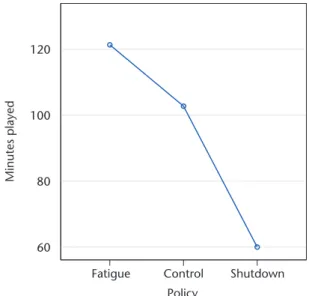
The mean play time (in minutes) for each condi-tion is observably different (see Figure 2 and Table 3), with the fatigue condition producing the lon-gest sessions and shutdown the shortest, at exactly 60 minutes per participant. Table 4 shows that re-peated measures ANOVA found that each condi-tion’s mean length is significantly different from Shutdown Control Fatigue Immediately Sometime today Later this week Sometime in the future Maybe never Policy Intention to return
Figure 1. How soon players intended to return to the game after a session ended. Players exhibited less desire to continue playing after the fatigue session and strong desire after the shutdown session.
Table 2. Descriptive statistics for negative affect.
Treatment Mean Standard deviation Min 25th percentile Median 75th percentile Max
Fatigue 6.84 2.018 5 5 6 8 12
Control 5.87 1.088 5 5 6 6 9
the others (p < 0.0005). Pairwise comparisons of the data shows that fatigue sessions are signifi-cantly longer, with the players spending nearly 20 minutes more than when they played the control condition and an hour more than their shutdown session (see Table 5). No interaction effects were found between the condition and group factors, indicating that the order in which the conditions were presented did not influence the time spent playing in a significant way.
Reasons for a Hiatus
For the open-ended questionnaire, the partici-pants gave three sentence or shorter responses. Therefore, we chose to analyze these responses us-ing thematic analysis. We identified common and recurring themes in the texts and reduced them to three encompassing categories:
■ negative experiences, wherein participants be-came aware of some in-game factor that made playing uncomfortable or undesirable;
■ satisfied hiatus, wherein participants felt sati-ated; and
■ an external (other) priority, wherein partici-pants had some nonpersonal activity to perform so they could no longer continue to play without suffering some negative outcome.
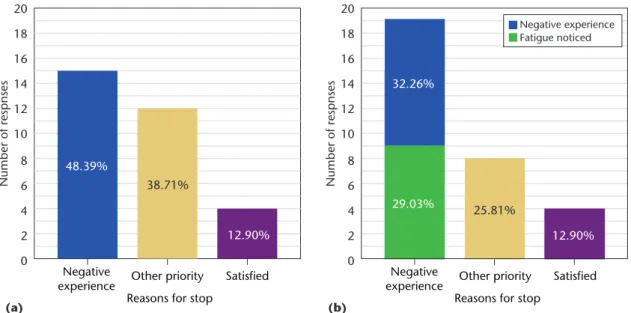
We did not consider the shutdown condition in the latter factor because participants had no con-trol over their reason for a hiatus. Figure 3 shows
a frequency distribution of the results. In both conditions, most players chose to stop for negative reasons, followed by an external priority and the satisfied hiatus option was selected the least often. In the control condition, other priority was selected an additional four times while external priority had four fewer instances. Furthermore, nearly half of the responses in the negative group explicitly cited the fatigue system as a reason for stopping.
Intention to Return to Game
Players were asked how soon they intended to return to the game once the session had ended. Friedman’s test of the data indicated that the distributions of the responses for each condition are not equal (p = 0.004). Pairwise comparisons show that only the shutdown and fatigue conditions’ distributions are significantly different from each other (p = 0.013 with Bonferroni adjustment). Figure 1 shows that 75 percent of the responses after the shutdown condition were either later this week, sometime to-day, or immediately, whereas 75 percent of the re-sponses for the fatigue condition were maybe never, sometime in the future, or later this week.
Discussion
When compared with regular gaming, the shut-down system does not have an effect on the mea-sured positive aspects of UX: flow intensity during game play does not change, nor does the experience of PA after the session. This result is promising
Table 5. Pairwise comparisons showing how the time players spent in game changed depending on the condition.
Pair
Mean
difference Significance
95% confidence interval for time Lower Upper Fatigue and control 18.599 0.02 2.478 34.721 Control and shutdown 42.724 < 0.0005 30.941 54.507 Fatigue and shutdown 61.323 < 0.0005 47.654 74.993
Table 3. Descriptive statistics for the amount of time the participants chose to play.
Treatment Mean Standard deviation
Fatigue 121.323 28.919 Control 103.52 26.334 Policy Shutdown Control Fatigue Minutes played 120 100 80 60
Figure 2. Profile plot for the time factor showing the participants’ mean play times for the fatigue, control, and shutdown conditions. The shutdown condition was strictly limited to 60 minutes, whereas participants in the other conditions were allowed to continue playing beyond the hour.
Table 4. ANOVA statistics for the amount of time the participants chose to play. F-score Degrees of freedom Significance Effect size (ηp2) 95% confidence
interval for (ηp2) Observed
power Lower Upper
when considering these constructs by themselves. A player’s positive experience does not appear to be compromised by the intervention. However, our experiment does not exhaustively measure the positive outcomes for gaming of this type. All that we can conclude from these results is that we did not observe changes in positive UX. Furthermore, we know that the shutdown system has a nega-tive effect on players: many participants are more upset after being suddenly cut off from the game. The 10 participants who were not more upset than their peers may have simply been able to achieve their goals before being cut off, as this participant’s interaction with an experimenter indicates:
Experimenter: “I thought the game was going to cut you off during your fight with General Grell [a boss at the end of a big quest].” Participant 4: [Eyes go wide and takes a breath] “Sjoooooe.” [Shakes head] “Yoh yoh yoh. No, I couldn’t have handled that!” In this case, the participant had finished a ma-jor quest shortly before being cutoff. The idea of possibly not being able to accomplish that goal, despite having already done so, was enough to elicit a response of some concern. Players are far less satisfied after being subjected to the shutdown condition than the fatigue condition, and a signif-icantly larger number indicated that they wished to return to playing sooner than those indicating the same in the fatigue condition.
The shutdown condition does allow greater con-trol over the amount of time that gamers spend playing. However, the goal of the shutdown law is to minimize the negative outcomes of gaming. The evidence suggests that it does not do this. In fact, our participants were negatively affected by it. After they are forced to exit their games, players may seek alternative ways in which to play games in order to satiate their desires. Thus, this policy may do more harm than good.
The fatigue condition does not produce a UX that is any different from normal gaming. That it does not produce a more negative experience is important because players do not lose a game’s potential positive outcomes. However, when sub-jected to this condition, players played for sig-nificantly longer periods of time than when they played normally, for a full hour after the fatigue system kicked in. In other words, they continued to play for an hour after they stopped receiving rewards. This result is counterintuitive on two fronts.
Searching for loot and gaining Exp are core game-play mechanics of the genre. Knowing that Torchlight II exploits this to keep players in a game, we expected its cessation to make players lose in-terest in playing the single-player mode and choose a hiatus sooner. Furthermore, character progres-sion stopped while the challenge of the game world continued to increase, making the game more difficult. This disparity, according to flow theory, should have produced frustration in players, caus-ing them to enjoy the game less and choose a
(a) Reasons for stop (b)
Satisfied Other priority
Negative experience
Reasons for stop
Satisfied Other priority Negative experience Number of respnses 20 18 16 14 12 10 8 6 4 2 0 48.39% 12.90% 38.71% Number of respnses 20 18 16 14 12 10 8 6 4 2 0 48.39% 12.90% 38.71% 29.03% 12.90% 25.81% 32.26% Negative experience Fatigue noticed
Figure 3. Frequency distribution of participants’ reasons for stopping in (a) the control condition and (b) the fatigue condition. “Negative experience” describes players stopping because the game began providing them with negative experiences. “Satisfied” describes players stopping because they felt satisfied. “Other priority” describes stopping for reasons unrelated to the game. The green negative results indicate players who explicitly cited the fatigue condition as part of their reason for stopping.
hiatus sooner. Given how quickly the rewards are stifled, frustration should have set in quickly. Why, then, did our participants keep playing?
We believe the answer lies in what is meant by a challenge in the context of the game. We as-sumed challenge to mean difficulty—how easy it is to be killed by enemies. However, in terms of flow, challenge can mean any goal that players set for themselves. Whereas the Exp and loot reward structure stops being interesting to players, it is offset by the sudden increase in novel challenges. The game becomes more difficult, but not prohibi-tively so. During our experiment, the players spent time testing new strategies that, although less ef-ficient, were novel. The game became differently interesting and renewed the players’ engagement when it required new ways of thinking.
The players also set goals for themselves, other than character progression, inside of each game session and only stopped playing when many of these goals were accomplished. These goals where often based on the game’s narrative, but they were similar to completing a level or specific dungeon. For example, one participant even planned goals for a future session:
Participant 6: “I can’t wait to play again. I want to save that woman’s kids.”
The players chose to exit a game when they felt they had reached a suitable exit point. Being weaker in the Torchlight II environment means that en-emies take longer to defeat. By increasing the chal-lenge, we inadvertently made it more difficult for players to achieve their goals and reach suitable exit points, forcing players to spend longer in game.
Finally, although participants had been explic-itly told about the fatigue system and how it would affect them, only 29 percent cited it as a reason for choosing a hiatus, suggesting that they were not acutely aware of it. We recognize a possible fault in the experiment design that may have led to this finding. First, the implementations in this research are generalizations of real-world appli-cations. In practice, the fatigue systems vary de-pending on how the reward mechanics work in a particular game or system. As the specifics of the system change, we can expect that the sys-tem experience will change as well. Second, the participants experienced this fatigue system once only, and the effects it had on the game’s mechan-ics may have been novel and therefore interesting to them. Playing with the handicap may not have realistically engendered the same sense of loss for them as it would for players who must experience
it every session, in every game they play. It is pos-sible that over a period of weeks, the mean play time would tend toward a lower value.
Going Forward
The existing research clearly demonstrates that, for better or worse, games have a significant influ-ence on those who play them. We must acknowl-edge that gaming for entertainment purposes is a luxury, and ultimate responsibility surrounding consumption lies solely with the consumer. How-ever, the industry must recognize that it has some measure of social responsibility, should be aware of its power over gamers, and should endeavor to do no harm. Current research indicates that harm is being done, even if not on such a grand scale as the news media would have the public believe. We have considered two existing strategies for harm reduc-tion: allowing players the freedom to use video games, but attempting to minimize the harm done.
The shutdown approach is a one-size-fits-all so-lution that treats all games as a single construct. They are not. If properly enforced, the shutdown clearly controls time spent gaming. However, this is the only factor that it addresses toward the goal of player well-being, with research showing that time spent playing does not correlate with well-being. Our experiments indicate that this strategy has a detrimental effect on the average player’s ex-perience and in fact leaves players wanting more. In contrast, the fatigue condition does not ap-pear to have an effect on player’s gaming expe-rience—at least not in the factors we measured. However, it did seem to increase the amount of time players spent gaming. The system could pur-sue a number of strategies to counteract this, such as by simultaneously decreasing difficulty and scaling up character strength; continuing to grant experience and character growth but rescinding all progress made during the fatigue period; and rather than basing the system’s start point on time exclusively, starting the fatigue after a certain amount of time but only when players are close to a suitable exit point. This would be achieved through a better understanding of a game’s exit points and the flow of activity.
The solutions presented here will work only for the single-player action RPG genre. Custom solu-tions would need to be implemented for every dif-ferent genre and may need to be sensitive to the mechanics of specific games within that genre.
Taiwan has recently passed laws that completely ban children under the age of two from using elec-tronic devices. The law also classifies elecelec-tronic devices as being potentially dangerous objects in
the same category as alcohol and cigarettes, and persons under the age of 18 may not use the prod-ucts for an unreasonable amount of time; the sug-gested limit is no more than half an hour at a time. Parents not in compliance with the policy can be fined up to US$1,500.6 The implementation in Taiwan may be different, but the idea is nearly identical to the South Korean laws.
The strict time-limiting policies employed by South Korea and Taiwan are naïve and reaction-ary. Information such as that presented here must be considered when designing policy. Without understanding that games are complex objects and not simply a digital drug, the solution will not address PVP and will only harm the gamers who stand to benefit from the activity. Finally, the strategy of forcing a hiatus will not stop players from interacting with games outside of the virtual environment. Social interaction on game forums, offline learning, planning, and practicing is not far removed from playing the game itself. There is a rich community of gamers, and those engaged with a game can continue to play without actually being actively in a game.
We believe the fatigue system to be viable and effective for single-player RPGs, but it requires a better understanding of how players interact with specific games and genres. The shutdown style of solution appears to fight player psychology, and to this end, it cannot be widely successful. On the other hand, the fatigue system can be imple-mented to work with player psychology and could thereby effectively limit game time while provid-ing the same rich and positive experience that makes gaming such a worthwhile pastime.
References
1. R.T.A. Wood et al., “The Structural Characteristics of Video Games: A Psycho-Structural Analysis,”
CyberPsychology & Behavior, vol. 7, no. 1, 2004, pp. 1–10; doi:10.1089/109493104322820057.
2. F. Kelly, “Don’t Juice It or Lose It,” presentation, Game Design Conf. Europe, 2014; www.gdcvault. com/play/1020861/Don-t-Juice-It-or.
3. D. King et al., “Video Game Structural Characteristics: A New Psychological Taxonomy,” Int’l J. Mental Health and Addiction, vol. 8, no.1, 2010, pp. 90–106. 4. A. Lenhart et al., “Teens, Video Games, and Civics,”
report 202-415-4500, Pew Internet and American Life Project, 2008.
5. S. Parkin, Death by Video Game, Tales of Obsession from the Virtual Frontline, Serpent’s Tail, 2015. 6. M. Connolly et al., “A Systematic Literature Review
of Empirical Evidence on Computer Games and
Serious Games,” Computers & Education, vol. 59, no. 2, 2012, pp. 661–686.
7. I. Granic et al., “The Benefits of Playing Video Games,” Am. Psychologist, vol. 69, no. 1, 2014, pp. 66–78.
8. C.J. Ferguson, “The Good, the Bad and the Ugly: A Meta-analytic Review of Positive and Negative Effects of Violent Video Games,” Psychiatric Quarterly, vol. 78, no. 4, 2007, pp. 309–316.
9. J.C. Allaire et al., “Successful Aging through Digital Games: Socioemotional Differences between Older Adult Gamers and Non-gamers,” Computers in Human Behavior, vol. 29, no. 4, 2013, pp. 1302–1306. 10. G.S. Brunborg, “Is Video Gaming, or Video Game
Addiction, Associated with Depression, Academic Achievement, Heavy Episodic Drinking, or Conduct Problems?” J. Behavioral Addictions, vol. 3, no. 1, 2014, pp. 27–32; http://doi.org/10.1556/JBA.3.2014.002. 11. J. Heo et al., “Addictive Internet Use Among Korean
Adolescents: A National Survey,” PloS One, vol. 9, 2014, article e87819; http://journals.plos.org/ plosone/article?id=10.1371/journal.pone.0087819. 12. S. Yousafzai, Z. Hussain, and M. Griffiths, “Social
Responsibility in Online Videogaming: What Should the Videogame Industry Do?” Addiction Research & Theory, vol. 22, no. 3, 2014, pp. 181–185.
13. V.C. Kelly, “A Primer of Affect Psychology,” The Tompkins Inst., 2009; www.tomkins.org/wp-content/ uploads/2014/07/Primer_of_Affect_Psychology -Kelly.pdf.
14. E.R. Thompson, “Development and Validation of an Internationally Reliable Short-Form of the Positive and Negative Affect Schedule (PANAS),” J. Cross-Cultural Psychology, vol. 38, no. 2, 2007, pp. 227–242. 15. S. Engeser and F. Rheinberg, “Flow, Moderators of
Challenge-Skill-Balance and Performance,” Motivation and Emotion, vol. 32, no. 3, 2008, pp. 158–172.
Bryan Davies is a master’s student in computer science at
the University of Cape Town. His research interests include user experience, human-computer interaction, user-centered design, and cyberpsychology. Davies has a BSc in computer science from the University of Cape Town. Contact him at [email protected].
Edwin Blake is a professor of computer science at the
Uni-versity of Cape Town. His research interests include infor-mation and communications technology for development and user experience as applied to games and virtual envi-ronments. Blake has a PhD in computer science from Queen Mary College, London University. Contact him at edwin @cs.uct.ac.za.
Selected CS articles and columns are also available for free at http://ComputingNow.computer.org.