Jacobs University Bremen
The Variance of Length of Stay and
the Optimal DRG Outlier Payments
Stefan Felder
Priorisierung in der Medizin
FOR 655 Nr. 03 / 2007
FOR 655 Working Paper serves to disseminate the
research results of work in progress prior to
Impressum:
Campus Ring 1
28759 Bremen
Germany
www.jacobs-university.de
ISSN 1866-0290
www.for655.de │www.priorisierung-in-der-medizin.deDie Reihe „Priorisierung in der Medizin“ umfasst Arbeits- und Forschungsberichte
der DFG Forschergruppe FOR655 „
Priorisierung in der Medizin: eine theoretische
und empirische Analyse unter besonderer Berücksichtigung der Gesetzlichen
Krankenversicherung (GKV).
Die Berichte und weitere Informationen zu der Forschergruppe können abgerufen,
werden unter:
http://www.for655.de
oder
http://www.priorisierung-in-der-medizin.de
The series „Priorisierung in der Medizin“ consists of working papers and research
reports of the DFG (Deutsche Forschungsgemeinschaft, i.e., German Research
Foundation) Research Group FOR655 „
Priorisierung in der Medizin: eine
theoretische und empirische Analyse unter besonderer Berücksichtigung der
Gesetzlichen Krankenversicherung (GKV).
(
Prioritizing in Medicine: A Theoretical
and Empirical Analysis in Consideration of the Public Health Insurance System
)
Reports and further information can be found at
The Variance of Length of Stay and the Optimal
DRG Outlier Payments
Stefan Felder*
Otto-von-Guericke University Magdeburg
Prospective payment schemes in health care often include supply-side insurance for cost outliers. In hospital reimbursement, prospective payments for patient discharges, based on their classification into diagnosis related group (DRGs), are complemented by outlier payments for long stay patients. The outlier scheme fixes the length of stay (LOS) threshold, constraining the profit risk of the hospitals. In most DRG systems, this threshold increases with the standard deviation of the LOS distribution. The present paper addresses the adequacy of this DRG outlier threshold rule for risk-averse hospitals with preferences depending on the expected value and the variance of profits. It first shows that the optimal threshold solves the hospital’s tradeoff between higher profit risk and lower premium loading payments. It then demonstrates for normally distributed truncated LOS
that the optimal
outlier threshold generally decreases with an increase in the standard
deviation. The intuition for this result is that a higher variance
increases the profit risk, which in turn leads hospitals to insure a larger
part of the LOS distribution.
JEL Index:
G22, I11
Keywords:
Optimal outlier DRG payments, supply-side insurance in health
care, stop loss insurance
_______________________________
Prof. Dr. Stefan Felder Institute of Social Medicine and Health Economics (ISMHE) Leipziger Str. 44
D-39120 Magdeburg phone: 0391-6724321
The Variance of Lenth of Stay and the Optimal DRG Outlier Payments
1. Introduction
In the mid-eighties, US Medicare introduced the prospective payment system, under which hospital reimbursements for patient discharges are based on their classification into diagnosis related groups (DRGs). Prospective payments replaced the old cost-based reimbursement system, which depended on a patient’s length of stay (LOS). The change from retro- to prospective payments transferred the loss risk from the insurers to the providers and gave the latter an incentive to economize patient treatment costs.
Nevertheless, Medicare retained part of the former system by introducing outlier payments for long stays. Hospitals could charge the costs of treatment based on the actual LOS for patients staying longer than a stated LOS outlier threshold, while pure prospective payments applied to patients discharged within the LOS threshold. The new scheme resembled an insurance contract with a deductible, as the hospital insures only the part of the LOS distribution beyond the threshold.
In the last twenty years, most industrialized countries followed US Medicare and introduced DRGs or similar grouping systems for the reimbursement of inpatient services, complemented by outlier payments to share the risk of treatment costs between hospitals and insurers. Two different methods are applied to define outliers. Some countries calculate the outlier threshold by adding 2 or 3 standard deviations to the mean of LOS (Germany, Spain and the early US-Medicare system). Other countries use a non-parametric outlier method that is based on the inter-quartile range of LOS, which is multiplied by a factor of 1.5 and added to the third quartile (England, Italy and Denmark). France combines the parametric and the non-parametric methods to define the LOS outlier threshold.1
The health economics literature dealt with insurance aspects of DRG outlier payments early on when Medicare introduced its prospective reimbursement system. Ellis and McGuire (1988) applied Arrow’s principle, which states that full insurance after a deductible is the optimal structure of insurance, to hospital reimbursement. They show that outlier payments should be based on the hospital’s average loss per case rather than on individual case-level losses, since the hospital itself can pool the loss risk of individual cases to some extent.
Keeler et al. (1988), combining an optimal deductible with coinsurance on the marginal costs of expensive cases to reduce moral hazard, came to the same conclusion. Outlier payments serve as an insurance scheme for hospitals against excessive losses and they mitigate problems of access and underprovision of care for the patients in need of costly treatment. Keeler et al. also studied the optimal policy for paying more than one DRG when the outlier payments have to be made case by case. Provided that the hospital’s utility is quadratic, they show that the optimal scheme includes deductibles that are the same for all DRGs if there are no coinsurance restrictions and there is a stop equal average loss policy for each DRG per outlier under a constant coinsurance rate. Since, with concave utility, the marginal value of money is higher when losses are greater, the
Stefan Felder
optimal outlier payment policy is to equalize the expected loss of each DRG by adjusting the deductible correspondingly.
This paper’s focus is on the relationship between the LOS standard deviation and the optimal outlier threshold. Section 2 presents the optimal risk sharing between the hospital and the insurer. The existence of a positive threshold arises since we assume loading on the net insurance premium and risk aversion on the part of the hospitals. We derive the optimal outlier threshold for hospitals that exhibit mean-variance preferences over lotteries, and give comparative-static results with respect to the degree of risk aversion, the loading factor and the costs of stay per diem.
Section 3 deals with the adequacy of LOS outlier rules. We parameterize LOS randomness, assuming that LOS is normally distributed and truncated from below at zero. The optimal outlier threshold is shown to increase with the LOS standard deviation provided that the latter increases the hospital’s marginal profit risk. This condition cannot be proven to be fulfilled in general. However, the condition holds for the LOS distributions observed in the German hospital system. Section 4 discusses the results and section 5 concludes that the optimal outlier threshold decreases with an increase in the standard deviation of LOS.
2. Optimal risk sharing between the hospital and the insurer
To begin with, we set the costs per diem of a hospital stay equal to one. The insurer is assumed to pay the hospital depending on a patient’s LOS t according to the following rule:
( ) ( )
if
if
l m F m
t m
t
t m,
<
≥
(1)where m is the outlier threshold (m>0),
( )
( )
m
l m
tf t dt
−∞
=
∫
and f t( )
is the density function of the LOS, withf t dt
( )
1
∞ −∞
=
∫
and f t( )
≥0. With( )
( )
tF t
f t dt
−∞=
∫
as thecumulative density function, F m
( )
is the share of cases and l m F m( ) ( )
is the average LOS in the lower part of the distribution (LOS up to the threshold m). The reimbursement scheme (1) includes an insurance contract covering the LOS beyond the outlier threshold m. Assuming that the insurer loads the insurance premium by the factorλ(0< <
λ
1), with zero-profits, the insurer’s per patient premium amounts to( ) ( ) (
1) ( )
The Variance of Lenth of Stay and the Optimal DRG Outlier Payments
where
( )
( )
m
h m
tf t dt
∞
=
∫
and h m( )
(
1−F m( )
)
is the average LOS in the higher part of the distribution, i.e. in the insured part of the LOS distribution.The hospital’s expected profits per patient equal the difference between the expected reimbursement per patient and the per patient premium (2):
( ) ( ) ( )
( )
( )
.
m
l m
h m
p m
l m
πμ
λ
=
+
−
= −
(3)The variance of profits is zero in the insured part of the LOS distribution. Given (1), the variance of the expected profits per patient, thus, amounts to:
( )
(
( )
)
2( )
(
( )
)
2( )
2m
ml m
t f t dt
mt l m
f t dt
πσ
−∞ −∞=
∫
−
=
∫
−
. (4)Preferences of the hospital are assumed to follow the mean-variance criterion, i.e. hospitals maximize
V
(
μ σ
π,
π2)
.2 As Meyer (1987) and Sinn (1983) independently showed, this specification is a perfect substitute for the more standard expected utility approach when one restricts attention to the linear distribution classes of random variables. This restriction is not crucial in our model as LOS is the only random variable. For simplicity, we assume that the hospital’s utility function takes the form( )
( )
(
2)
( )
2( )
2
r
V
μ
πm ,
σ
πm
=
μ
πm
−
σ
πm
, (5)where
r
is a constant representing the hospital’s degree of absolute risk aversion (r>0).2 Since 2
σ is a monotonic transformation of σ, it is clear that
(
μ σ,)
preferences would lead to the same qualitative results.Stefan Felder
Inserting (3) and (4) into (5), we can rewrite the hospital’s utility as a function of the LOS threshold:
( )
( )
(
( )
)
2( )
2
mr
V m
λ
l m
t l m
f t dt
−∞= −
−
∫
−
. (6)Using the Leibniz rule and noting that ∂h m
( )
∂ = − ∂m l m( )
∂ = −m mf m( )
holds, we derive for a marginal increase in the threshold:( )
( )
(
( )
)
( )
(
( )
)
(
( )
)
( )
( )
( )
(
( )
)
( )
( )
( )
( )
(
( )
)
( )
(
( )
)
2 2 2 2 2 2 2 2 1 . 2 m m m V m r mf m m l m f m t l m mf m f t dt m r mf m f m m l m m tf t dt l m f t dt m l m r mf m l m F m m λ λ λ −∞ −∞ −∞ ⎡ ⎤ ∂ = − ⎢ − + − − ⎥ ∂ ⎣ ⎦ ⎡ ⎛ ⎞⎤ = − ⎢ − − ⎜ − ⎟⎥ ⎢ ⎝ ⎠⎥ ⎣ ⎦ ⎧ ⎡ − ⎤⎫ ⎪ ⎢ ⎥⎪ = ⎨ − − − ⎬ ⎢ ⎥ ⎪ ⎣ ⎦⎪ ⎩ ⎭∫
∫
∫
(7)An increase in the threshold, on the one hand, reduces the premium by f m
( )
λ
m, which, in turn, increases utility. On the other hand, it increases the profit risk by( )
(
( )
)
2( )
(
( )
)
2
1
f m
⎡
⎣
m l m
−
−
ml m
−
F m
⎤
⎦
, which lowers utility. Let( )
(
( )
*)
22
( )
(
1
( )
)
m l m
k m
l m
F m
m
−
−
−
(8)measure the change in the profit risk when the LOS threshold marginally increases, and rewrite (7) as:
( )
( )
( )
2
r
V m
m
f m m
⎛
λ
k m
⎞
∂
∂ =
⎜
−
⎟
⎝
⎠
. (9)This equation illustrates the two key factors governing the tradeoff for an increased threshold: the loading factor l, which determines the benefits, and the additional profit risk k m
( )
, which captures the costs. The optimal thresholdm
* balances the twoopposing effects, giving rise to:
( )
*2
k m
r
λ
=
(10) in the optimum.The Variance of Lenth of Stay and the Optimal DRG Outlier Payments
Assuming that a solution exists, (10) requires that
k m
( )
*>
0
sinceλ
,
r
>
0
. Utility is maximized provided the second-order condition∂
2V m
∂
2<
0
holds. Form m
=
* ,( )
r
2
k m
( )
*λ
=
and thus∂
2V m
∂
2=
f m m
( )
* *(
λ
−
( )
r
2
∂
k m
( )
*∂
m
)
. It follows that∂
k m
( )
*∂ >
m
0
in the utility maximum, given f m ,m, ,r( )
λ
>0.Proposition 1: The optimal threshold i) decreases with an increase in the degree of risk aversion r and ii) increases with an increase in the loading factor
λ.
Proof: i) For infinitesimally small changes in m and r, it holds around the maximum that:
( )
*(
2
)
k m
m dm
λ
r
r dr
⎡
∂
∂
⎤
= − ∂
⎡
⎣
∂
⎤
⎦
⎣
⎦
, or( )
22
0
*dm
r
dr
k m
m
λ
= −
<
∂
∂
, since( )
0
*k m
m
∂
∂ >
. ii) As( )
r d 1d 0 rλ
λ
λ
λ
∂ ⎡ ⎤ = > ⎢ ∂ ⎥ ⎣ ⎦ , it follows that( )
2
0
*dm
r
d
λ
=
∂
k m
∂
m
>
.With higher loading, the optimal LOS threshold increases. In other words, the hospital opts for a lower insurance coverage when the premium becomes more expensive. Furthermore, the threshold decreases when the degree of risk aversion increases. A risk-neutral hospital (r=0), by comparison, would not choose any insurance at all (i.e.
*
m
= ∞
).We have normalized the costs of a stay per diem to one. If the costs per diem are β, the effect of an increase in the threshold on expected utility becomes
( )
(
( ) ( )
2)
EU m f m
β
mλ
rβ
k m∂ ∂ = − (see (8) and (9)). The optimal threshold,
thus, requires:
( )
*2
k m
r
λ
β
=
. (11)Hence, as with the degree of risk aversion, we can state
Proposition 2: The optimal threshold decreases with an increase in the costs per diem
β.
Most DRG outlier threshold rules do not incorporate the costs of treatment. According to proposition 2, the optimal LOS threshold should, ceteris paribus, decrease with the cost of treatment, reflecting the corresponding increase in the hospital’s profit risk.
Stefan Felder
3. LOS standard deviation and the optimal threshold
As mentioned in the introduction, DRG systems use properties of the observed LOS distribution to determine the outlier threshold. A more dispersed LOS distribution leads to a higher outlier threshold in both parametric and non-parametric calculations of the threshold. In the following, we concentrate on parametric distributions and assume a normally distributed LOS according to:
t= +
μ σε
, with E( )
ε
=0, Var( )
ε
=1, (12)where σ is the exogenous standard deviation. The density function of the normal distribution is
( )
(( ) )2 2 2 2 1 2 1 . 2 t f t e e μ σ εσ
π
σ
π
− − − = = (13)Since LOS is non-negative, we consider the normal distribution truncated below at point 0. The density function of the truncated distribution writes:
( )
( )
( )
00, -
0
0
,
1
0
t
f t
f t
,
t
F
∞ ≤ ≤
⎧
⎪
= ⎨
≤ ≤ ∞
⎪ −
⎩
(14) where( )
( )
0 0 F f t dt −∞ =∫
and f t( )
is defined as in (13). Using (12)-(14), we find:( )
( )
(
( )
)
( )(
)
( )
(
)
( ) ( )( )
( )
( )
( )
( )
2 2 2 2 0 0 0 2 2 2 1 2 1 0 1 2 1 0 0 0 . 1 0 m a m a m a m a a l m tf t dt e d F e d e F F m F f m f F σ ε σ σ μ σ ε ε σ σμ σε
ε
π
μ
ε σ
π
μ
σ
− − − − − − − − − = = + − ⎧ ⎫ ⎪ ⎪ = ⎨ − ⎬ − ⎪⎩ ⎪⎭ − − − ⎡ ⎤ ⎡ ⎤ ⎣ ⎦ ⎣ ⎦ = −∫
∫
∫
(15)For the non-truncated distribution, the truncation is at
−∞
. Since( )
( )
0The Variance of Lenth of Stay and the Optimal DRG Outlier Payments
With the truncated distribution, the optimal LOS threshold (see (8) and (10)) changes slightly to:
( )
(
( )
)
( )
(
( )
( )
)
2 * * 0 * * * 0 * 2 2 1 0 m l m k m l m F m F m rλ
− − − + = . (16)Proposition 3: The optimal threshold decreases with an increase in the LOS standard deviation, provided the latter increases the marginal profit risk.
Proof: At the optimal threshold,
( )
( )
* *k m
dm
d
k m
m
σ
σ
∂
∂
= −
∂
∂
holds. Since( )
0
*k m
m
∂
∂ >
, it follows that sign dm sign k m( )
d
σ
σ
∂ ⎡ ⎤ ⎡ ⎤ = − ⎢ ⎥ ⎢ ⎥ ∂ ⎣ ⎦ ⎣ ⎦.From (16), we derive the effect of a change in the standard deviation on the hospital’s additional risk at the LOS threshold:
( )
( ) ( )
(
( )
( )
( )
)
0( )
0 0 0 2 F m F 2 0 l m k l m l m m F m Fσ
σ
σ
σ
⎡⎛∂ ∂ ⎞ ∂ ⎤ ∂ = ⎢⎜ − ⎟ − − − + ⎥ ∂ ⎢⎣⎝ ∂ ∂ ⎠ ∂ ⎥⎦ (17)This equation reveals two effects of an increase in σ on the hospital’s additional risk. First, a higher spread of the distribution changes the mass of LOS in the interval where the hospital bears the risk. Secondly, the increase in σ also changes the average LOS in the uninsured part of the distribution, which will lead to a change in the DRG payment. As we will see below, for the non-truncated distribution the two effects have opposing tendencies, as one would expect, while for the truncated distribution the second effect cannot be signed.
For the three derivatives in (17), we first find from (15):
( )
( )
( )
( )
( )
( )
( )
( ) ( )
( )
2 0 0 0 0 0 2 0 1 0 F m F f m f F f m f l m l m F μ σ σ σ σ σ σ σ σ ∂ ∂ ∂ ∂ ∂ ⎡ − ⎤− − − ⎡ − ⎤+ ⎡ ⎤ ⎢ ∂ ∂ ⎥ ⎣ ⎦ ⎢ ∂ ∂ ⎥ ∂ ∂ ⎣ ⎦ ⎣ ⎦ = ∂ − (18)Moreover, it holds that:
( )
( )
F t
t
f t
μ
σ
σ
∂
= −
−
∂
and (19)( )
( ) (
(
)
)
21
t
f t
f t
μ σ
σ
σ
−
−
∂
=
∂
. (20)Stefan Felder
( )
( )
(
)
( )
(
( )
)
( )
2 2 0 0 0 1 0 f m m m f l m l m Fσ
μ
σ
μ
σ
σ
⎡ ⎤ − + − + + ∂ ⎣ ⎦ = ∂ ⎡⎣ − ⎤⎦ . (21)For the first effect of an increase in the LOS standard deviation, we find from (19):
( )
( )
0
( )
( )
0
F m
F
m
f m
f
μ
μ
σ
σ
σ
σ
∂
−
∂
= −
−
−
∂
∂
. (22)Given
m
>
μ
, this difference is negative, i.e. the mass of the distribution that falls into the uninsured part decreases when the standard deviation of the distribution increases. This, in turn, decreases the hospital’s risk, which would, then, indicate that the LOS threshold should increase.The second effect, however, tends to be in the opposite direction. First, we observe
( )
( )
( )
0
2−l m m F m− +F 0 >0 as 0≤l m m ,F m ,F0
( )
( ) ( )
0 ≤1, givenm
>
μ
. Hence, the sign of the second effect has the opposite sign of∂
E
0m∂
σ
. For the non-truncated distribution, we find ∂l m0( )
∂ <σ
0 from (21). The smaller average LOS in the uninsured part lowers the DRG-payment and increases the profit risk. This can best be seen when one considers the hospital’s maximal loss of treating a patient. It equals the difference between the threshold and the DRG payment: m l m− 0( )
. This maximal possible loss increases when l m0( )
decreases. On the other hand, the maximal possible gain of treating a patient increases when l m0( )
moves toward zero. Altogether, this indicates that the hospital’s profit risk increases. While this is true for the non-truncated distribution, we cannot be sure for the truncated distribution as the second effect cannot be signed here.It is formally not possible to sign the total effect of an increase in the LOS standard deviation on the hospital’s marginal risk even when the distribution is non-truncated. Hence, we have to depend on simulations based on the factual distribution of LOS to evaluate the total effect.
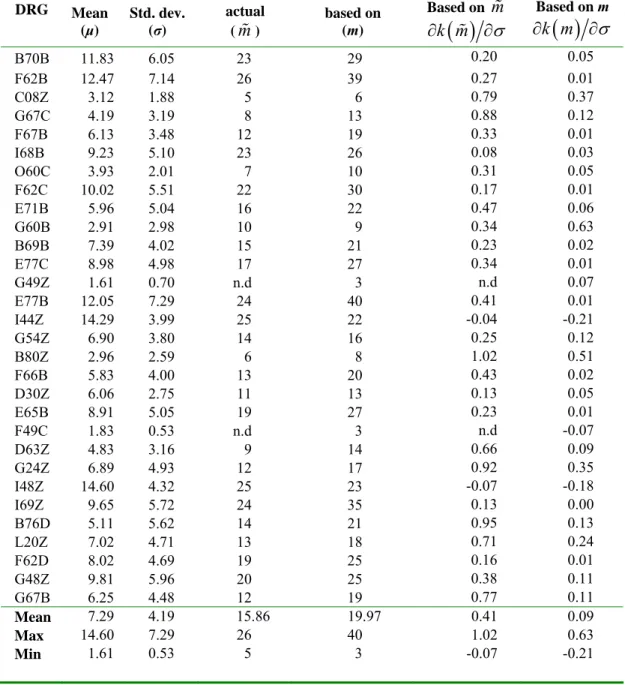
Table 1 presents characteristics of the top 30 German DRGs in 2005, calculated from a sample of roughly 270,000 hospital cases in the state of Saxony-Anhalt. The average LOS is 7.29 days and its average standard deviation 4.1 days. The next column shows the actual threshold for the individual DRGs as published in 2005. On average, the actual threshold is 15.86 days, which is close to two standard deviations above the mean. When we calculate the threshold according to German DRG outlier methodology (m=exp
(
μ
(+2σ
()
, whereμ
(
and σ( are the mean and standard deviation of the log of LOS, respectively), the values in the fifth column are obtained, the average being 20 days.The Variance of Lenth of Stay and the Optimal DRG Outlier Payments
Table 1
:
The top 30 German DRGs (2005)
LOS LOS threshold The change of profit risk DRG Mean (μ) Std. dev. (σ) actual (m
%
) based on (m) Based on m%
( )
k mσ
∂%
∂ Based on m( )
k mσ
∂ ∂ B70B 11.83 6.05 23 29 0.20 0.05 F62B 12.47 7.14 26 39 0.27 0.01 C08Z 3.12 1.88 5 6 0.79 0.37 G67C 4.19 3.19 8 13 0.88 0.12 F67B 6.13 3.48 12 19 0.33 0.01 I68B 9.23 5.10 23 26 0.08 0.03 O60C 3.93 2.01 7 10 0.31 0.05 F62C 10.02 5.51 22 30 0.17 0.01 E71B 5.96 5.04 16 22 0.47 0.06 G60B 2.91 2.98 10 9 0.34 0.63 B69B 7.39 4.02 15 21 0.23 0.02 E77C 8.98 4.98 17 27 0.34 0.01 G49Z 1.61 0.70 n.d 3 n.d 0.07 E77B 12.05 7.29 24 40 0.41 0.01 I44Z 14.29 3.99 25 22 -0.04 -0.21 G54Z 6.90 3.80 14 16 0.25 0.12 B80Z 2.96 2.59 6 8 1.02 0.51 F66B 5.83 4.00 13 20 0.43 0.02 D30Z 6.06 2.75 11 13 0.13 0.05 E65B 8.91 5.05 19 27 0.23 0.01 F49C 1.83 0.53 n.d 3 n.d -0.07 D63Z 4.83 3.16 9 14 0.66 0.09 G24Z 6.89 4.93 12 17 0.92 0.35 I48Z 14.60 4.32 25 23 -0.07 -0.18 I69Z 9.65 5.72 24 35 0.13 0.00 B76D 5.11 5.62 14 21 0.95 0.13 L20Z 7.02 4.71 13 18 0.71 0.24 F62D 8.02 4.69 19 25 0.16 0.01 G48Z 9.81 5.96 20 25 0.38 0.11 G67B 6.25 4.48 12 19 0.77 0.11 Mean 7.29 4.19 15.86 19.97 0.41 0.09 Max 14.60 7.29 26 40 1.02 0.63 Min 1.61 0.53 5 3 -0.07 -0.21Stefan Felder
We can evaluate the DRG threshold rule at the given thresholds and study whether the marginal risk increases with an increase in the standard deviation. The result of this is presented in two final columns of Table 1, presenting the values of ∂ ∂k/
σ
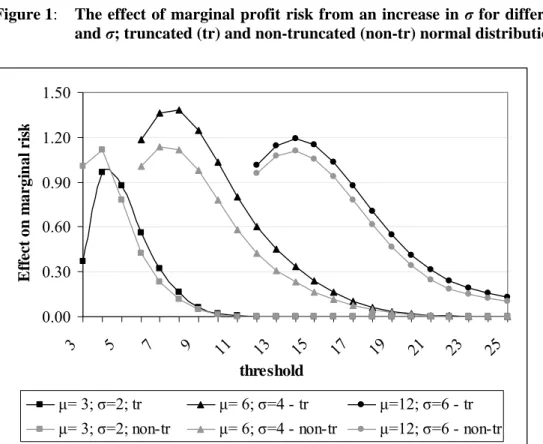
for the current and the calculated German thresholds. Notice that, except for two DRGs, the sign of the derivative is always positive. Thus, in almost all cases, the hospital marginal risk increases, so that a risk-averse hospital would like to extend insurance coverage, i.e. to lower the LOS threshold when the standard deviation increases.Figure 1: The effect of marginal profit risk from an increase in σfor different μ and σ; truncated (tr) and non-truncated (non-tr) normal distribution
0.00 0.30 0.60 0.90 1.20 1.50 3 5 7 9 11 13 15 17 19 21 23 25 threshold E ff ec t on m a rgi n al r is k μ= 3; σ=2; tr μ= 6; σ=4 - tr μ=12; σ=6 - tr
μ= 3; σ=2; non-tr μ= 6; σ=4 - non-tr μ=12; σ=6 - non-tr
As an alternative test of the German outlier payment system, one can calculate the value of the derivative (17) for truncated and non-truncated LOS as a function of the threshold for given distribution parameters. Figure 1 shows these derivatives for three stylized (μ,
σ) pairs.3 For the non-truncated distributions, the derivative is positive, declining to zero for large thresholds. For both the truncated and the non-truncated distributions, the
3 If we interpret the observed mean as the mean of the truncated distribution (
0
E∞
), the mean of the non-truncated (μ) can be derived using (15): 2
( )
(
( )
)
0 0 1 0
E f F
μ= ∞−σ −
The Variance of Lenth of Stay and the Optimal DRG Outlier Payments
derivative is positive over the whole range of thresholds. When the threshold is close to the mean, an increase in the threshold raises the marginal profit risk. The maximum is attained within one to three days, depending on the LOS distribution characteristics. For larger thresholds, the effect, driven by the density function, quickly converges to zero. Again, we find a positive effect on the marginal profit risk, indicating that a larger LOS standard deviation should lead to a smaller outlier threshold, contradicting the outlier threshold rule.
4. Discussion
Since a hospital can influence a patient’s LOS, the assumption of an exogenous LOS is somewhat unrealistic. Let us consider an endogenous LOS. The insurance coverage will then affect the hospital’s choice of a patient’s LOS. Beyond the threshold, reducing the patient’s LOS by Δl m
( )
lowers premium loading payments and increases per patient profit by Δl m( )
λ
, while within the threshold a reduction of the LOS by Δl m( )
translates one to one into higher profits. In other words, insurance coverage dilutes the incentive to reduce the LOS. The optimal policy then needs to address the tradeoff between risk spreading and appropriate incentives (Zeckauser, 1979), which can be solved by combining a threshold with a coinsurance on the marginal costs of stay beyond the threshold. DRG systems reflect this, as outlier days are usually reimbursed with a 40% rebate on the average cost per diem.
An endogenization of the LOS will not necessarily change the comparative statics of the optimal threshold. Consider a simple case where efforts to reduce the patients’ LOS only shift the distribution to the left without changing its shape. In this case, the productivity of efforts is independent of the initial LOS. Abstracting from the discontinuity at the threshold, efforts will have no effect on the LOS variance. Consequently, although the optimal threshold will increase in order to give incentive for cost reduction for a larger range of the LOS distribution, the qualitative relationship between the standard deviation and the optimal threshold will not change. A higher LOS variance will, ceteris paribus, be accompanied by a decrease in the optimal threshold.
The productivity of efforts to reduce the LOS may, however, increase with the initial LOS, so that these efforts will have an effect on the LOS variance. Still, it appears that the following hierarchy of instruments would apply in this case. Moral hazard can be restrained using a non-linear coinsurance rate that increases with the observed LOS to give a stronger incentive to reduce the LOS when it is less expensive to do so. A higher LOS variance will have no effect on the efforts to reduce the LOS. The optimal threshold will reflect these efforts but the comparative statics regarding the variance of LOS will not change its qualitative nature. Proving this conjecture would be difficult, given the discontinuity of the LOS distribution arising when efforts to reduce the LOS are introduced.
Stefan Felder
Ellis and McGuire (1988) criticize the existing outlier payments based on individual cases and propose an insurance scheme based on the average case. Risk pooling within the hospital will reduce the variance of the profit per patient and, thus, decrease insurance demand. This qualification, however, does not affect the optimal threshold rule. A hospital which shoulders a higher risk due to a large case-mix index, ceteris paribus, will demand a lower threshold compared to a hospital with a lower case-mix load.
The new generation of outlier payment systems in the USA is no longer based on the LOS, but on the patients’ costs of stay.4 This reflects the empirical observation that, after controlling for DRG, the costs of stay are only weakly related to the LOS among very long stay cases (see Keeler et al., 1988). Interestingly, the cost outlier schemes do not define the thresholds as a function of the variance. Rather, a cost-to-charge factor determines the threshold. In this case, a mean-preserving increase in the standard deviation will not affect the threshold. This rule is better than the former one, which set the threshold two standard deviations above the mean.
Australian outlier payments do not depend on parametric distribution, being based on the argument that the LOS is not normally distributed.5 The threshold, called the high trim point, is often 2 or 3 times the average length of stay. Like the US Medicare cost outlier, this scheme appears to dominate the original threshold rule, as it does not further aggravate the hospitals’ profit risk by increasing the threshold when the LOS standard deviation increases.
Ma (1994) has analyzed payments systems designed to restore cost and quality incentives. When the provider can refuse expensive patients, a piecewise linear reimbursement rule arises. While prospective reimbursement applies to low cost treatment, cost reimbursement is the optimal rule for expensive patients. This result points to another function of the outlier threshold, viz. the prevention of patient dumping, which can occur when reimbursement is purely prospective.
5. Conclusion
Prospective payment schemes in health care often include supply-side insurance for cost outliers. In the early US Medicare and many current European DRG systems, the outlier scheme fixes a length of stay (LOS) threshold, constraining the profit risk for the provider. This threshold increases with the standard deviation of the LOS distribution. The present paper addresses the adequacy of this outlier threshold rule for risk-averse hospitals with preferences depending on the expected value and the variance of profits.
4 See for instance, Department of Health and Human Services, Center for Medicare and Medicaid Services, 42 CFR Part 412, Federal Register, Vol. 68, No. 43, March 5, 2003, p. 10420-10429.
The Variance of Lenth of Stay and the Optimal DRG Outlier Payments
It first shows that the optimal threshold solves a hospital’s tradeoff between higher profit risk and lower premium loading payments. A comparative static analysis reveals that the optimal outlier threshold decreases with an increase in the hospital’s degree of absolute risk aversion as well as with an increase in the per diem cost of treatment. Higher treatment costs increase the marginal profit risk, implying that a hospital will increase insurance coverage. With a given risk, a more risk-averse hospital will also want to extend coverage, i.e. to lower the LOS outlier threshold.
We then parameterize the LOS distribution, assuming a truncated normally distributed LOS. An increase in the standard deviation has two effects. A larger spread first decreases the share of the distribution that belongs to the uninsured part of the distribution. Hence, this tends to decrease the hospital’s profit risk. On the other hand, a larger spread decreases the average LOS of patients in the uninsured part, which lowers the DRG payment. Hence, with an unchanged threshold the hospital’s risk increases. The sum of the two opposite effects cannot be signed, so one has to depend on simulations to address the adequacy of the outlier threshold rule. The simulation results using German hospitals’ discharge data show that the hospitals’ marginal profit risk is larger for DRGs with a high standard deviation than for DRGs with a low standard deviation of LOS. We conclude that the optimal threshold of a DRG should decrease with an increase in the LOS standard deviation.
*Author note
* I am grateful to Claudia Heinecke for technical assistance. The paper was presented at the annual conference of the health economists’ group within the Verein für Socialpolitik in
München, October 12-13, 2007. I thank the referee, Matthias Staat, and the other participants for helpful comments.
6. References
Ellis, R. P. and Th. G. McGuire (1988), Insurance principles and the design of prospective payment systems, Journal of Health Economics 7, 215-237.
Keeler, E. B., F. M. Carter and S. Trude (1988), Insurance aspects of DRG outlier payments, Journal of Health Economics 7, 193-214.
Ma, C.-T. A. (1994), Health care payment systems: cost and quality incentives, Journal of Economics & Managdement Strategy 3, 93-112.
Meyer, J. (1987), Two-moment decision models and expected utility, American Economic Review 77, 421-430.
Schreyögg, J., T, Stargardt, O. Tiemann, and R. Busse (2006), Methods to determine reimbursement rates for diagnosis related Groups (DRG): A comparison of nine European countries, Health Care Management Sciences 9, 215-223.
Stefan Felder
Sinn, H. W. (1983), Economic decision under uncertainty, Second English edition. Amsterdam et al.: North-Holland Publishing Company.
Zeckhauser, R. (1970), Medical insurance: a case study of the tradeoff between risk spreading and appropriate incentives, Journal of Economic Theory, 2, 10-26.
Working Paper Series FOR 655
1. Hartmut Kliemt: Priority setting in the age of genomics, December 2007 (1) 2. Marlies Ahlert: If not only numbers count – allocation of equal chances,
December 2007 (2)
3. Stefan Felder: The variance of length of stay and the optimal DRG outlier payments, December 2007 (3)
4. Jeannette Winkelhage, Adele Diederich, Simone Heil, Petra Lietz,
Felix Schmitz-Justen, Margrit Schreier: Qualitative Stakeholder-Interviews: Entwicklung eines Interviewleitfadens zur Erfassung von Prioritäten in der medizinischen Versorgung, December 2007 (4)