On the number of lines of theorems
in the formal system MIU
Armando B. Matos
Technical Report Series:
DCC
--Departamento de Ciˆ
encia de Computadores – Faculdade de Ciˆ
encias
&
Laborat´
orio de Inteligˆ
encia Artificial e Ciˆ
encia de Computadores
Universidade do Porto
Tel: +351+2+6001672 – Fax: +351+2+6003654
http://www.ncc.up.pt/fcup/DCC/Pubs/treports.htmlOn the number of lines of theorems
in the formal system MIU
Armando B. Matos
2000
Abstract
The MIU formal system, introduced by Hofstadter in [Hof79], is a relatively simple example of a formal axiomatic system where the length of proofs can be studied in some detail. Denote byl(t) andL(t) respectively the largest and smallest number of lines of a minimum proof of a theorem with tsymbols. We show thatl(t) is Ω(logt) and thatL(t) is Ω(t/logt) andO(t).
1
The MIU formal system
Even for propositional calculus not much is known about the relationship between the length of a theorem and the length of a corresponding shortest proof. Most studies (see for instance [Tse68, SR77, PBI93, Ajt94, Bus87, Urq92, Urq87]) have considered only a particular family of theorems (such as the pigeonhole family of tautologies) and a particular set of inference rules (such as resolution or Frege systems), establishing lower or upper bounds on the length of the shortest proofs. The length of a proof can be defined as either the number of lines it has or its total number of symbols. The MIU formal system, introduced by Hofstadter ([Hof79]), is still simpler than the propositional calculus so that the relationship between the length of a theorem and of its shortest proof can be studied in more detail.
The MIU system system is defined as follows. 1. Alphabet: Σ ={m,i,u} 2. Axiom: mi 3. Inference rules (a) xi→xiu (b) mx→mxx (c) xiiiy→xuy (d) xuuy→xy
Notation. “`x” means thatxis a theorem1of MIU. “y`x” means thatxcan be derived fromy
in 0 or more steps.
Definition 1 The MIU graph GMIU = (V, E) is a directed graph characterized by the following rules.
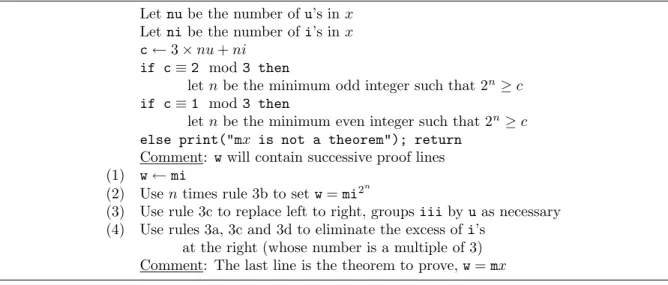
Letnube the number ofu’s in x
Letnibe the number ofi’s in x
c←3×nu+ni
if c≡2 mod3 then
letnbe the minimum odd integer such that 2n
≥c
if c≡1 mod3 then
letnbe the minimum even integer such that 2n
≥c
else print("mx is not a theorem"); return
Comment: wwill contain successive proof lines (1) w←mi
(2) Usentimes rule 3b to setw=mi2n
(3) Use rule 3c to replace left to right, groupsiiibyuas necessary (4) Use rules 3a, 3c and 3d to eliminate the excess ofi’s
at the right (whose number is a multiple of 3) Comment: The last line is the theorem to prove,w=mx
Figure 1: Algorithm which generates the proof in MIU ofmx
– mi∈V.
– Ift1∈V andt2results fromt1by the application of an inference rule, thent2∈V and(t1, t2)∈
E.
Clearly V is the set of theorems of MIU. In Figure 7 we can see a little bit of the MIU graph.
Notice that the MIU graph contains cycles, for instance
mi,mii,miiii,miiiiu,miuu,mi
Asimple proofofxis a simple path from mitox. In this paper we always assume the following
– The size of a theorem is the number ofsymbolsit contains, – The size of a proof is the number oflinesit contains.
2
Standard proofs
2.1
Definition
In [Mat97] it is proved thatyis a theorem of MIU iff
y=mx, x∈ {i,u}?
and|x|i is not a multiple of 3
where |x|i denotes the number of i’s in x. A standard proof of every such mx is also given. For
convenience Figure 2.1 is taken from [Mat97].
2.2
Standard proofs are not shortest
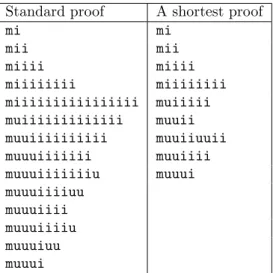
We give an example of a theorem whose shortest proof is not standard. The theorem ismuuuiand both proofs are shown in Figure 2.2. The standard proof has 14 lines while the shortest proof has 9.
Standard proof A shortest proof mi mi mii mii miiii miiii miiiiiiii miiiiiiii miiiiiiiiiiiiiiii muiiiii muiiiiiiiiiiiii muuii muuiiiiiiiiii muuiiuuii muuuiiiiiii muuiiii muuuiiiiiiiu muuui muuuiiiiuu muuuiiii muuuiiiiu muuuiuu muuui
Figure 2: The standard proof of theoremmuuuihas 14 lines but the shortest proof (in lines) has 9.
2.3
Bounds of standard proofs
In this section we establish upper and lower bounds for the number of lines of standard proofs.
Theorem 1 (Upper bound of standard proofs) The number of lines l of a standard proof of a theorem with tsymbols satisfies l <13t.
Proof. We follow the description of standard proofs given in Figure 2.1. Consider the proof of mx
and let t0 =t−1 be the number of symbols in x. We havet0 =n
i+nu where ni and nu denote
respectively the number ofi’s andu’s in x.
Letc= 3nu+ni. We havet0≤c <3t0. The number of steps needed to produceci’s does not exceed2
n=dlogce+ 1 The “+1” takes in account the fact that the parity ofnis given by the algorithm (it depends onc). The number of lines satisfies
l≤ 1 Line “(1)” in Figure 2.1 +n Line “(2)” in Figure 2.1 +nu Line “(3)” in Figure 2.1
+3((2n
−nu)/3) Line “(4)” in Figure 2.1
where “/” in the last term represents integer division. Fromc <3t0we getn <dlog(3t0)e+ 1 so that
2n<2×2dlog(3t0)e ≤4×3t0= 12t0
Thus the number of lines satisfies
l≤n+ 1 + 2n
< n+ 1 + 12t0<12t0+dlog(3t0)e+ 2 Let us now express this result in terms oft=t0+ 1.
l <12(t−12) +dlog(3t)e= 12t+dlog(3t)e −10
But it is easy to see that, for allt≥1, we havet >dlog(3t)e −10 so that we finally getl <13t
Note. It is possible to get a factor less than 13 by using a different definition of standard proof where the excess ofi’s is reduced by groups of 6 (using twice rule 3c and then rule 3d) instead of 3.
Theorem 2 (Exact lower bound of standard proofs) The number of lineslof a standard proof of a theorem witht symbols satisfiesl ≥1 +dlog(t−1)e. This value is reached by every theorem in the infinite family mi2n (withn≥0)
Proof. Notice that no other rule can increase the number of symbols of a line more than rule 3b does. (the application of another rule can result in an equal increase in only a very particular inference
mi`miu). So, the last line of a proof withllines can not have more than 1 + 2n
symbols. If we start with the axiom and applyntimes rule 3b we get theoremmi2n.
3
Bounds for general proofs
We will now study the size of shortest proofs. Notice that there are in general several theorems with the same lengtht. So, we will consider both smallest and longest shortest proofs.
Notation. Lett∈N. Denote respectively byl(t) (L(t)) the smallest (respectively largest) size of
a shortest proof of a theorem havingtsymbols.
Example 1 Consider the theorems with 3 symbols. They are mii, miuandmui, with shortest proofs respectively (the rules applied are indicated as subscripts)
mi`3bmii mi`3amiu
mi`3bmii`3bmiiii`3bmui
Then l(3) = 2 and L(3) = 4. Notice that in general there are proofs (even simple proofs) with an arbitrarily large number of lines.
As a consequence of the results of the previous section we have.
Theorem 3 (Some general bounds) For everyt≥2
1 + log(t−1)≤l(t)≤L(t)<13t
3.1
A lower bound for general proofs
We will now see that, for everyt, there is some theorem with sizet having a shortest proof with at leastk(t/logt) lines wherekis some positive fixed constant. In other words,L(t) is Ω(t/logt). This result (Theorem 4) is based on two observations: (i) there are in general many (about 2t
/3) theorems withtsymbols and (ii) at each step, the number of possible applications of an inference rule is finite and can be appropriately bounded. So, to prove all those theorems, some of the proofs must have a relatively large number of lines. We begin with two lemmas.
Lemma 1 Consider the proof of a theorem having t symbols. If the size of the longest line has T
symbols, the proof must have at leastd(T−t)/2e+ 1 lines.
Proof. Rules 3c and 3d decrease the number of symbols by 2 while rules 3a and 3b increase that number. Then, starting with the T symbol line, we need at least (T −t)/2 proof steps to get the theorem; the corresponding number of lines is the number of steps plus 1.
Lemma 2 The number of symbols T of the longest line of a minimum proof of a theorem with t
Proof. Combining the previous Lemma with Theorem 1 we have (T−t)/2 + 1≤l≤13t
ThenT ≤27t−2<27t.
Notice that, as mentioned before, a factor less than 27 can be obtained if an alternative definition of “standard proof” is used.
Theorem 4 Consider the proofs of all theorems with size t≥3. At least one of them has a number of lines Lsatisfying L≥1 + t−log 3 1 + log(27t)
Proof. The number of theorems with sizetis at least 2b2t−1
/3c. This can be shown by noticing two things. First, every such theorem has the formmxwhere |x|=t−1. And, second, forr= 0, 1 or 2, the number of sequences with lengtht−1 such that each symbol has 2 possibilities,iandu, and the number ofi’s is congruent withr(mod 3), is eitherb2t−1/3cord2t−1/3e(see for instance [GKP94],
exercise 5.75).
Consider now all proofs of theorems with t symbols such that the longest line has no more thanT
symbols. At each step, we can apply rules 3a (1 possibility), 3b (1 possibility), 3c (at most T −3 possibilities; notice thatT ≥t≥3) and 3d (at mostT−2 possibilities). It follows that, at each step, there at no more than 2T−3 applications of an inference rule. The largest numberLof lines in such a proof (recall that the first line is always,mi) must then satisfy (ifT ≥3)
(2T−3)L−1≥2b2t−1/3c
It follows that, asT ≥3 andL≥2, we have (2T)L−1≥2t
/3. Taking the logarithm of both members and using the previous Lemma we get
L≥1 + t−log 3 1 + logT ≥1 +
t−log 3 1 + log(27t)
Theorem 4 shows that
L(t) is Ω(t/log(t))
This means that, no matter what proofs we consider, there are always proofs requiring a number of lines which is “almost linear” in the length of the theorem.
4
Smallest theorems and proofs
The following results were obtained with the help of a Prolog program that builds a database of theorems and corresponding shortest proofs up to a certain number l of lines; we have used l = 9 which corresponds to a database containing 15 885 theorems. Then, given a theorem candidate, the program may be instructed to search for the corresponding shortest proofs whose “path” (if the shortest proof has more thanllines) consists of two parts: a sequence of steps up to a theoremx in the database (with al line shortest proof) and an already computed proof ofx.
1. In Figure 4 we can see what theorems can be proved with no more than 3 lines.
2. Figure 3 shows the number of theorems with shortest proofs not exceeding l lines, for l = 1, 2,. . . , 9. Some of these theorems are small while others are very large; for instance, the shortest proof of the following theorem has only 9 lines.
m
256i’s
z }| {
Number of lines up to Number of theorems 1 1 2 3 3 6 4 11 5 25 6 69 7 282 8 1730 9 15885
Figure 3: Number of theorems with shortest proofs not exceeding 9 lines Theorem Proof Number of lines
mi mi 1
mii mi, mii 2
miu mi, miu 2
miiii mi, mii, miiii 3
miiu mi, mii, miiu 3
miuiu mi, miu, miuiu 3
Figure 4: Theorems with proofs not exceeding 3 lines
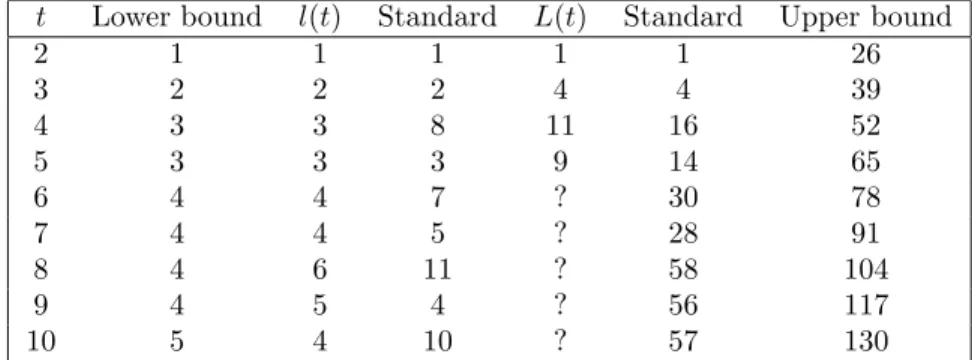
3. Figure 5 shows bounds (see Theorems 1 and 2) and exact values ofl(t) andL(t) for small values oft (see the definitions at the beginning of Section 3).
4. Finally in Figure 6 we compare the lower and upper bounds ofL(t) for a few values oft.
5
Conclusions
We have establish that a shortest proof of a theorem havingtsymbols has at least O(log(t)) and at mostO(t) lines and that the lower bound is exact for a family of theorems. In [Ant97] a different class of proofs is considered from which a bound ofO(max{nu,log(t)}) results. We have also shown
that the largest number of lines of a shortest proof of such a theorem is Ω(t/logt). The proof is based on an counting argument (Information theory) and it is not constructive. It would be interesting to exhibit an explicit family of theorems requiring proofs with this number of lines. It is not even known if this bound is exact; could it be Ω(t)?
It would be also interesting to study shortest proofs if the size of a proof is measured in terms of the
t Lower bound l(t) Standard L(t) Standard Upper bound
2 1 1 1 1 1 26 3 2 2 2 4 4 39 4 3 3 8 11 16 52 5 3 3 3 9 14 65 6 4 4 7 ? 30 78 7 4 4 5 ? 28 91 8 4 6 11 ? 58 104 9 4 5 4 ? 56 117 10 5 4 10 ? 57 130
t Lower bound L(t) Upper bound 3 2 4 39 5 2 9 65 10 2 ? 130 100 9 ? 1300 1000 65 ? 13000
Figure 6: Bounds on the numberL(t) of lines that the proof of a theorem withtsymbols must have. The lower bound is from Theorem 4 and the upper bound is 13t.
number of symbols it contains.
References
[Ajt94] Ajtai. The complexity of the pigeonhole principle. Combinatorica, 14, 1994.
[Ant97] Luis F. Antunes. Short proofs for MIU theorems. Technical report, Laborat´orio de Inteligˆencia Artificial e de Ciˆencia de Computadores, Universidade do Porto, 1997. (To be published).
[Bus87] Buss. Polynomial size proofs of the propositional pigeonhole principle. Journal of Symbolic Logic, 52, 1987.
[GKP94] Ronald L. Graham, Donald E. Knuth, and Oren Patashnik. Concrete Mathematics (second edition). Addison–Wesley, Reading, MA, 1994.
[Hof79] Dougals R. Hofstadter. G¨odel, Escher, Bach, and Eternal Golden Braid. Penguin, 1979. [Mat97] Armando B. Matos. The theorems of the formal system MIU. Technical report, Laborat´orio
de Inteligˆencia Artificial e de Ciˆencia de Computadores, Universidade do Porto, 1997. [PBI93] Pitassi, Beame, and Impagliazzo. Exponential lower bounds for the pigeonhole principle.
Computational Complexity, 3, 1993.
[SR77] S.A. Cook and R.A. Reckhow. The relative complexity of propositional proof systems.
Journal of Symbolic Logic, 44(1):37–50, 1977.
[Tse68] G. S. Tseitin. On the complexity of derivations in propositional calculus. In A. O. Slisenko, editor, Studies in Mathematics and Logic, Part II, pages 115–125. Springer-Verlag, 1992, 1968. (Translated from Russian.
[Urq87] Alasdair Urquhart. Hard examples for resolution. Journal of the ACM, 34(1):209–219, 1987.
[Urq92] Urquhart. Complexity of proofs in classical propositional logic. In Logic from Computer Science: Proceedings of a Workshop held November 13-17, 1989. Springer-Verlag, 1992, 1992.
mi mii miiii z z uuu uuu uu uuu u mui miiiiiiii PPP(( P P P P P P P P P P P P P muiiiii miiiiiiiiiiiiiiii muuii miiiiiiiiiuiiii muuiiuuii miiiiiiiiiuiiiiu muuiiii z z uuu uu uuu uu uu miiiiiiiiiuiuu muuui muuiiiiu miiiiiiiiiui muuiuu miiiiiiuui muui miiiuuui muuuui